We had a longish meeting on Monday Night, and there were a few moments of tension, and as always I recommend you watch the video for details and to get the tone of the room during some of the deliberation, instead of reading through my filter here. After a notable delegation period, our regular Agenda began with a Presentation:
BC Housing Tiny Homes Village
The City has been designated a HEART and HEARTH City by the Province. This program helps deliver programs to support both shelter for people entrenched in homelessness through “Homeless Encampment Action Response Team” funding (which is a compliment to the City’s Crises Response Pilot Project) and “Homeless Encampment Action Response Temporary Housing” which brings us this announcement of transitional housing for residents transitioning from entrenched homelessness or temporary shelter to a more supportive housing environment.
The Tiny Home Village model is one that has been successful in other communities in the province such as Duncan, where residents are given a warm, safe, insulated and secure shelter of their own (not having to share with others) while common spaces provide kitchens, washrooms, laundry, and common social and support spaces. This bridges an important gap for some folks who may want to get out of entrenched homelessness, but don’t have the life skills to move into a more traditional supportive or non-market housing situation. This site will have 30 “tiny homes,” 24/7 staff on site, and access to health services and other supports if residents need them the “wrap around support” model.
This is a program run by and funded by BC Housing, though the City is working with the Province through our Affordable Housing Reserve Fund to provide support for the site lease and for capital support (up to the limit set by our AHRF policy of $500,000). The nature of leasing space for the site also means it is a temporary program, three years with the option to extend for 3 more years. There will be a Letter of Commitment setting out community expectations of the operation, and Operations Management Plan the provider will need to abide by, and a Neighbourhood Inclusion Table to address any neighbourhood challenges. This serves as a transition both for people who need the homes, but also in the housing supply matrix, and gives time for us and the province to fund and build more supportive housing in a more permanent location.
It was not a great provincial budget last week when it comes to housing, but we are fortunate now to have 24/7 shelter and this transitional housing funded by the BC government, while two other supportive housing projects are under construction – we are getting people off of streets and into secure homes in New West, and working well with the province to make it happen.
We then approved the following items On Consent:
Development Cost Charges Reserve Funds Expenditure Bylaw No.8572, 2026
DCCs are funds the City collects from developers to offset the cost of infrastructure related directly to “growth” – the bigger sewers, waterlines, transportation and parks projects required to accommodate the needs of a growing population. Every year we report out on how those funds were applied, this is that report.
Of the 2026 Capital Budget anticipated spend of $104 Million, we anticipate that $10.5 Million, or 10%, will be funded by DCCs.
Vulnerable Buildings Assessment Pathway One – City-Funded Cooling Assessments for Rental Buildings
Part of our response to heat emergencies and our Climate Resilience Plan, the City has identified “vulnerable buildings”, where the residents are as significant risk of harm in the event of a protracted or intense heat emergency. Staff are also leveraging the Federal/Provincial Rental Apartment Retrofit Accelerator (RARA) program to pilot assessments of 10 buildings for retrofit work to make them safer along with the existing program to make them more efficient and reduce their carbon footprint.
This is one of those unique opportunities New Westminster has to leverage our Electrical Utility and Energy Save New West program (funded by the City’s Climate Action Reserve Fund) to see senior government funds invested here in New Westminster to make buildings where lower income people live more efficient, and safer. This is one of those areas where New Westminster delivers beyond other cities in the region.
The following items were Removed from Consent
2025 Filming Activity
This is our annual report on filming activity in the City, and the costs and revenues related to hosting filming in the community. This year the city billed about $1.2 Million to film productions, with our net revenue after expenses being about $450,000. This does not include the revenues that residents and businesses in the city receive for leasing heir homes of buildings for filming, nor does it include the millions of dollars that residents in New Westminster earn working in the film industry. Film is big business in “Hollywood North”, and New Westminster gets its share, with 9 feature films, 33 TV series, and more than a dozen other productions in 2025).
Community Grant Program Update 2025-2026
This is the annual report from our Community Grant program, where staff report out on the grants provided to the sports, arts, and social service organizations that do great work in the city – the organizations that are most in need and most valuable at a time when other levels of government ate engaged in austerity. The one thing we know for sure – every dollar we invest in community organizations through these grants is paid back 3x or 10x in services to the community, through everything from volunteers these organizations empower, to their ability to leverage sponsor ship and matching grants for these programs. This is where “investment in the community” matters most.
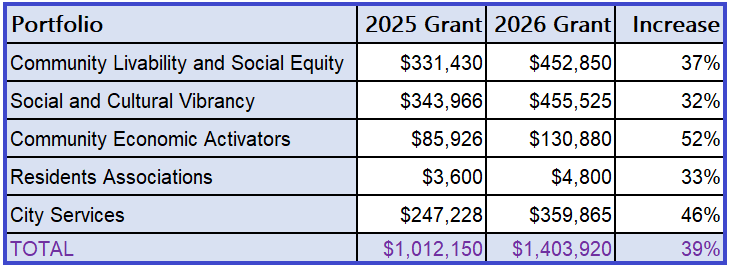
In 2025, the City granted just a bit over $1 Million to 68 community partners, having receive 91 applications. The City also held a one-day “Love New West” event where 2025 partners were invited to set up a booth and share their success, and ideas for next year, with each other and the general public.
In 2026, $1.4 Million was awarded to 71 community partners, from 99 applications:
On top of this, we have allocated $50,000 in community grants specifically for community activation during the World Cup (applications open now!)
We then had several Motions from Council, three of them directly related to the upcoming Lower Mainland LGA conference:
Advancing a Vision Zero Approach to Road Safety
Submitted by Mayor Johnstone
WHEREAS injuries and deaths on BC roads have untold impacts on thousands of BC lives every year, strain local government first responder resources, and result in more than $500 Million in direct health care costs in British Columbia every year; and
WHEREAS the Province’s BC Road Safety Strategy has referenced a Vision Zero approach to road safety starting with the belief that no loss of life on our roads is acceptable and implementing a collaborative Safe System Approach to road safety relying proactive data collection and sharing as the globally recognized path to achieving Vision Zero;
THEREFORE BE IT RESOLVED THAT the City of New Westminster submit a resolution to the Lower Mainland Local Government Association calling on UBCM to request the Province to advance its commitment to Vision Zero and further support local government partners through:
• expansion of the Vision Zero Road Safety Grant program by providing additional funding to introduce a third funding stream with a cap higher than the current $20,000 limit to fund more ambitious local government and First Nation community road safety initiatives; and
• undertaking a comprehensive review of data collected by provincial ministries and agencies in relation to motor vehicle injury and death incidents, and develop strategies for proactive data sharing between those agencies and local governments to inform local road safety improvements.
This resolution for the Lower Mainland LGA conference puts together advocacy work that road safety advocates at Vision Zero Vancouver have been asking for (the increased funding for road safety projects) and the work that the City’s Vision Zero Task Force is working on, and follows on the heels of advocacy last week in Victoria where I was able to meet with Nina Krieger the Minister of Public Safety and staff from the Ministry of Transportation to advance Vision Zero Collaboration.
Triple Net Lease Reform
Submitted by Councillor Henderson
WHEREAS triple net leases shift the responsibility for property taxes, insurance, and maintenance costs from property owners onto commercial tenants, creating financial instability and unpredictability for small and local businesses; and
WHEREAS municipalities rely on vibrant local businesses to support complete communities, economic resilience, and main street vitality, yet lack the legislative authority to regulate commercial leasing practices;
BE IT RESOLVED that the City of New Westminster submit a resolution to the Lower Mainland Local Government Association calling on the Province of BC to review and reform commercial leasing legislation, including the use of triple net leases, to improve transparency, fairness, and protections for commercial tenants, particularly small and locally owned businesses.
This resolution is a result of a lot of work Councillor Henderson has been doing in our community and with business organizations across the province to address the uncertainty and risk asymmetry that Triple Net Leases represent. Small local-serving businesses (like that run by the delegate this evening) just want transparency and predictability, and similar lease protections as residential renters benefit from in this province. The debate here was… strange, as opponents on Council seemed to spend their time arguing against things that are not included in this resolution to the point of fearmongering. They didn’t hear the delegate from earlier in the evening, nor did they, apparently, read the resolution. Fortunately, the majority of Council supported this motion, and I look forward to a great discussion at UBCM.
Enhanced Mental Health Supports Following Infant Loss
Submitted by Councillor Nakagawa
WHEREAS infant loss, including miscarriage, stillbirth, and the death of an infant can result in profound and long-lasting mental health impacts for parents and caregivers; and
WHEREAS access to timely, specialized, and trauma-informed mental health supports following infant loss varies across the province, leaving many families without adequate care during an acute period of grief;
BE IT RESOLVED that the City of New Westminster submit a resolution to the Lower Mainland Local Government Association calling on the Province of BC to ensure ongoing provincial funding for research related to pregnancy loss and bereavement care, to provide standardized education and training for health care providers on how to deliver trauma informed, evidence-based care, and to fund bereavement support programs for families who experience pregnancy loss, infant loss, embryo loss, or failed fertility and IVF treatments.
This resolution speaks for itself, and is here thanks to some powerful advocacy from folks in our community, and I look forward to us taking this to UBCM where it should be an obvious endorsement.
Memorandum of Understanding with Century House Association
Submitted by Councillor Campbell
WHEREAS Century House Association (CHA) has been a valued community partner since 1958 in assuring that Century House provides inclusive, welcoming, and relevant activities and social connection for older adults in New Westminster; and
WHEREAS early in 2020 the City and CHA completed its first Memorandum of Understanding as a basis for sustaining and enhancing this proven relationship between two trusted partners for the delivery of those services; and
WHEREAS there have been changes at the CHA and across the community since the initial MOU was completed prior to the COVID pandemic, including expansion of recreation services in the City, the launching of the City’s Friendly Seniors Strategy and the recent adoption by the CHA of a new Strategic Plan; and
WHEREAS the CHA recently sent a letter to Mayor and Council suggesting the timeliness of a review and potential update of the MOU;
THEREFORE BE IT RESOLVED THAT staff engage with leadership of the Century House Association to explore updating the current Memorandum of Understanding between the City and CHA with the intent to strengthen collaboration in delivering services to an increasing diverse older adult population in the City.
This is not something for Lower Mainland LGA, but a motion asking staff to do some work in producing and updated MOU with the Century House Association, the non-profit group of volunteers who partner with the City in running Century House. The association sent us a letter, and I have had a few conversations with the President and Past President about changes since COVID, since the City opened təməsew̓txʷ (and made adjustments to staffing in recreation centres) and with the pending return to Sunday Opening at Century House. It’s timely, and Council was happy to support it.
We finished up out night with several Bylaws for Adoption:
Zoning Bylaw No. 6680, 2001, Retail Sale of Cannabis (416 East Columbia Street) Amendment Bylaw No. 8520, 2025
This Bylaw that removes cannabis sales as a permitted use from a property in Sapperton where the initial approved proponent was not able to secure a lease was adopted by Council.
Official Community Plan Bylaw No. 7925, 2017, Amendment Bylaw (Provincial Housing Legislation Integration) No. 8522, 2025
This Bylaw that Transit Oriented Development Areas in compliance with the Provinces Bill 47, integrates the City’s Interim Housing Needs Report into the OCP, and makes minor administrative changes to the OCP was adopted by Council.
Zoning Bylaw No. 6680, 2001, Amendment Bylaw (Non-Profit Housing Development, Phase 2) No. 8528, 2025
This Bylaw that allows non-profit affordable housing of up to six storeys in all Transit Oriented Development Areas without rezoning was adopted by Council.
Zoning Bylaw No. 6680, 2001, Amendment Bylaw (Land Use Designation Alignments) No. 8530, 2025
This Bylaw that makes minor administrative changes to our Zoning Bylaw was adopted by Council.
Official Community Plan Bylaw No. 7925, 2017, Amendment Bylaw (Townhouse Accelerator Initiative) No. 8547, 2025
This Bylaw that enables the development of Townhouses on approximately 900 properties across the City and allows non-profit affordable housing projects of up to six storeys to be considered without an OCP update on those same sites was adopted by Council.
Zoning Bylaw No. 6680, 2001, Amendment Bylaw (Townhouse Zoning Update) No. 8524, 2025
This Bylaw that pre-zones approximately 570 properties to speed up the approval of townhouses, and updates regulations for townhouse developments was adopted by Council.
Five-Year Financial Plan (2026-2030) Bylaw No. 8571, 2026
This Bylaw that approves our consolidated Financial Plan for 2026 through 2030 was adopted by Council.