Yesterday was one of those clear, beautiful days that makes you wonder why anyone would live anywhere other than British Columbia,
hyperbolic, boastful advertising slogans notwithstanding.
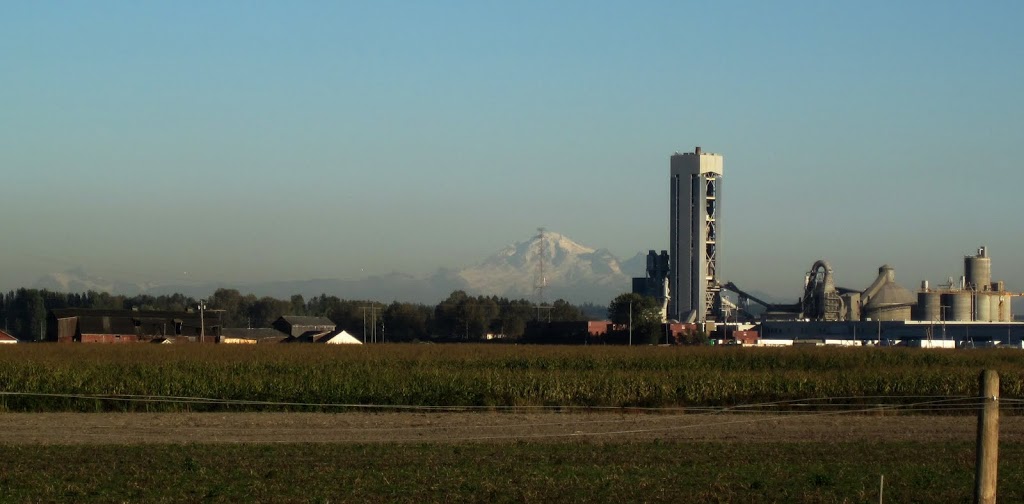
I was riding home from work along Westminster Highway, and Mount Baker was clear and bright on the horizon, providing a dramatic backdrop to the Lafarge cement plant in east Richmond. The volcanologist in me cannot see a volcano without imagining what it is going to look like when the damn thing goes off. In the case of Baker, most of MetroVancouver will have a front row seat to watch the pyroclastic extravaganza. Due to some fortunate geography, we will also avoid most (but not all) the damage caused by the inevitable lahars, ash clouds, and nuée ardente.
The plume coming off an erupting Cascade Volcano will be dramatic, and will dwarf that little
Lafarge Cement Plant. Or will it? This was the question that kept rattling around in my head during the rest of my ride. How many years would that plant have to operate to generate the CO2 of a single eruption of Mount Baker.
The good people at the
Cascades Volcano Observatory in Lesser Vancouver
actually measured the CO2 output of Mount Saint Helens during the 2004-2005 eruptive event, and it was around 650 tonnes per day. According to the paper, the outgassing during the big eruption in 1980 was probably measured in the thousands of tonnes per day, The take-home numbers are about 200,000 tonnes of CO2 released during the big eruption in 1980, a little less than 200,000 tonnes released over the entire 2004-2005 measuring period (a period of significant eruptive and dome-building activity), and somewhat less during quiescent times. This for a volcano of similar type, size and age as Mount Baker.
As for Lafarge, according to Environment Canada , that plant puts out between 800,000 and 900,000 tonnes of CO2 every year. The last year stats are available, 2008, it was 871,000 tonnes.
I don’t mean this as an attack on Lafarge; I recognize that we need concrete in our lives, and Lafarge is an employer in our community… I just make the comparison to shed light on how our human scale is distorted; “Common Sense” is rarely either. Like all risks, we concentrate on the big, dramatic and rare events, but disregard the cumulative impact of every day life in the modern world.
More on the science of volcanoes and AGW here.