Category: NWimby
When is a plan not a plan?
…and when is an announcement not an announcement?
It is pretty clear the BC Liberal brand is in a bit of trouble, and the new packaging is not working out as well as planned. Premier McSparkles’ telegenic smile has not been enough cover for the general lack of direction displayed by a Government that is looking a little past its due date.
I am not a member of any political party, and usually vote based on the value of the local candidate (although, I have to admit, the Federal Conservatives could run the resurrection of Mahatma Ghandi locally, and that wouldn’t be enough to win my vote at this point). I have met both Judy Darcy and Hector Bremner, the presumed local NDP and Liberal candidates in the next Provincial election, and they both seem like good people with their hearts in the right place; I have no reason to believe either wouldn’t serve our community well.
The new Premier was an unknown coming in. In contrast to Kevin “strip it down, pave it over, sell it off” Falcon and Rich “Darth” Coleman (both who give ample reason to vote the other way), there was not enough substance to Clark to make me want to vote for or against her, despite her merging skills. In the end, it appears that apparent lack of substance was masking a much deeper and more profound lack of substance.
Yet like most people in an abusive relationship with an authority figure, I keep waiting and hoping for the BC Liberals to come up with just one Really Big Good Idea (RGBI) that will put them back in this race. And I keep waiting.
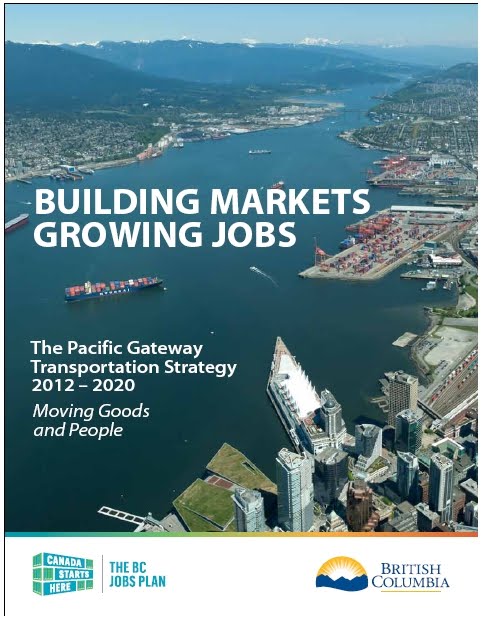
Regular reads here (Hi Mom!) will know that I am way more interested in transportation issues that is, frankly, healthy. So this week when the Premier rolled out her “Pacific Gateway Transportation Strategy” this week, with the by-line “Moving Goods and People”, I thought OK, maybe this is the RGBI. By the announcements, it sounded like they are committing a bunch of money, working with major partners, and are going to deal with the major transportation issues in our Province!
Surely (thinks I) this includes improvements to short-sea shipping, like suggested back in 2005 in a report prepared for Port Metro Vancouver, to finally remove some of the container traffic from our roads and reduce the unsustainable use of trucks to connect major trans-shipment locations. Maybe they will finally include a strategy for high-speed rail, to integrate with the west-coast high speed rail network our Southern Neighbours are planning? Maybe they will finally outline plans for rails to the valley, and upgrades to the Westminster Rail Bridge? Surely, it will include a review of TransLink governance, and a sustainable funding model for TransLink to meet its mandate outlined in Transport 2040. Maybe even (pinch me) an integrated Transportation Demand Management Strategy? A reasoned regional approach to tolls? Where is the Big Plan that shows leadership in Transportation?
Alas, like a Who on Christmas morning, I found nothing under the Christmas Tree that looked anything like Leadership. Even the lump of coal in all our stockings has already be been reduced to atmospheric greenhouse gas.
First off, there is the money committed. Transportation requires infrastructure, infrastructure costs. The plan offers “$25 Billion in total investment… by 2020, beyond the $22 Billion previously committed”. If you go the back pages of the plan document, where the numbers are, you can total up the money committed to $34.7 billion. That sounds like a lot of government investment in getting people and goods moving.
Except that more than $28 Billion (more than 80%) is private money, the lion’s share being a projected $18 Billion to be spent by mystery funders to build mythical LNG plants in Kitimat. The rest? $2.8 Billion in rail line growth by CN and CP, more than $4 Billion in Port Expansion in Vancouver and Prince Rupert, and $1.8Billion in Airport Improvements. All three of these, one should note, are federally-regulated lands and industries, so the Province has less than nothing to do with them. It couldn’t stop them if they tried. After that, private money will be used to build a smattering of privately-funded road works to improve access to mines and oil and gas fields.
OK , so what of the $6.7 Billion that is Government spending? Most of it is wrapped up in the Port Mann 2 and Hwy 1 Widening project ($3.3 Billion) and the South Fraser Perimeter Road project ($1.3 billion). Really, you are re-announcing, yet again, the PMH1 and the SFPR!? Again? This is meant to excite us? Throw in another $1-2 Billion on various ongoing already-announced and well underway highway projects (Kicking Horse Pass, etc.), and we are looking at a grand announcement of…no new investment in transportation.
Then we can look at the various uncosted parts of the announcement/plan. Things like “cap the property tax on designated ports”, and “eliminate jet-fuel tax for intern ational flights”. No indication what these moves are going to cost us, probably because cost accounting on tax cuts is really not this government’s strong suit.
Oh, and that other part of Transportation policy? The less feel-good parts about zooming trucks and vrooming planes? Strangely absent. This strategy is outlined in an 11,000-word document, but there are some words missing. Like “carbon”. In their defense, “climate” appears 7 times in the document. The only problem being that 6 of those times, it is used in the context of “building a climate for investment”. The time it is mentioned in the context of “change” is in the little sidebar about “the environment”, notable as it is also the only time the words “green house gas” and “emissions” are named. Here, they demonstrate their commitment by re-announcing, two years later, the Canada Line (a rapid transit system that was overcapacity the day it was built), and, yes, the Evergreen Line. No mention of a $30Million gap though. The word “Translink” is not raised.
But rest assured, the Environment is important. If you listen really carefully, you can hear the birds chirping over the mid-tempo rock with vrooming-and-zooming soundtrack of the splashy announcement video, right when the word environment appears. You can’t make this shit up:
Just like this big-images, low-content video, this government has once again displayed they are all about show, with no substance at all. Premier McSparkles appears to think re-announcing Kevin Falcon bad ideas and doubling down on the hating teachers is the path to success.
What should be telling is that neither John Cummins nor Adrian Dix are making too much of splash of opposing her ideas or announcements. When a government is sinking this fast and the Premier is busy bailing water onto the boat, you don’t want to risk distracting her from the task at hand
Plaza 88 – The Good, the Bad, and the Industrial.
There is no more prominent symbol of the renaissance on New Westminster than the Plaza 88 Residential / Commercial / Entertainment / Transit complex. This cornerstone project is not only the largest single residential development in New West, it is also a new gateway to the City at our namesake SkyTrain station, and regionally significant in the way it integrates retail space with a transit node.
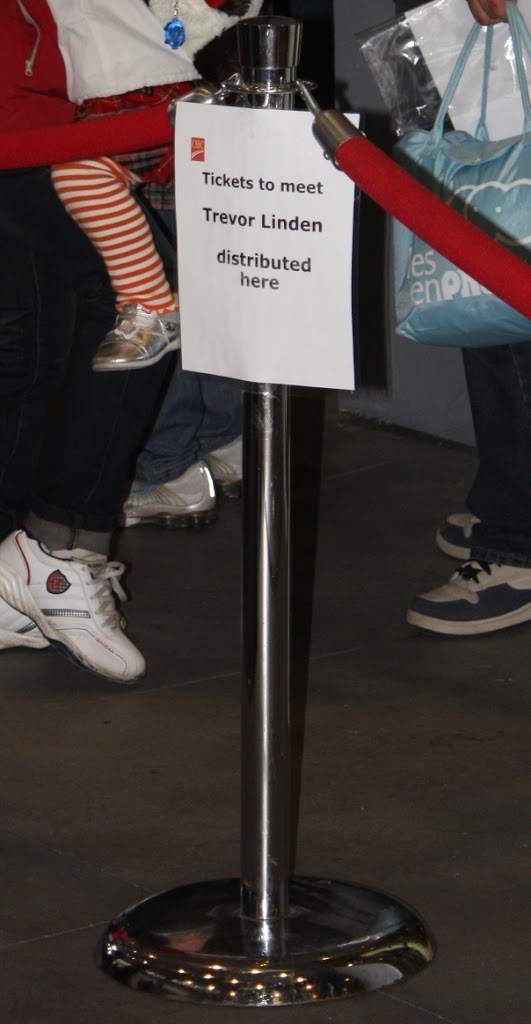
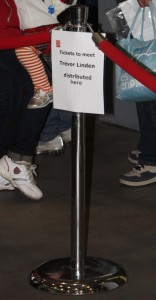
As the residential buildings are completed, the anchor retail tenants are open, and the rest of the space is starting to fill up, I took the opportunity to wander around the Site this weekend, to see how it is filling in. The much-anticipated theatre complex and the retail at the Skytrain level is still a few weeks (months?) off. Clearly, some re-jigging will be necessary with the wedging of FalconGates into the otherwise open plaza, but we have enough of the project completed that I thought it was worth taking a closer look around, and getting a sense of what the project offers as an open space. It helps that the CIBC was holing their little Grand Opening Shindig so I could get a free hotdog and a brush with greatness:
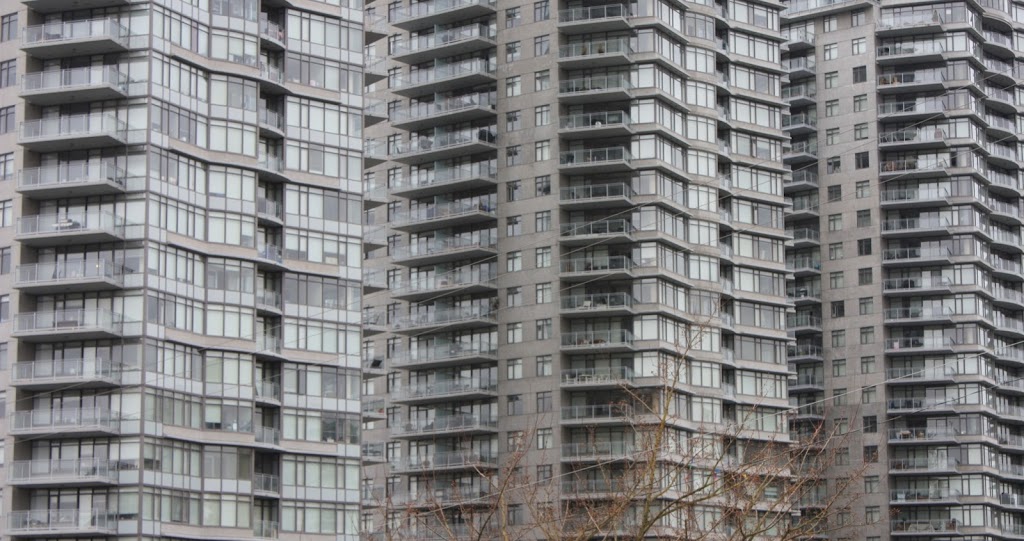
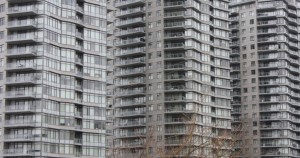
First off, I can’t really declare myself a fan of the residential towers. They are big, out of scale with the surrounding high rises, they are close together, and they are a unique mix of standard-issue-glass-wall-small-balcony-vancouver-condo-tower and bare-concrete-slab-sided-soviet-design-bureau designs that add up to pretty unappealing.
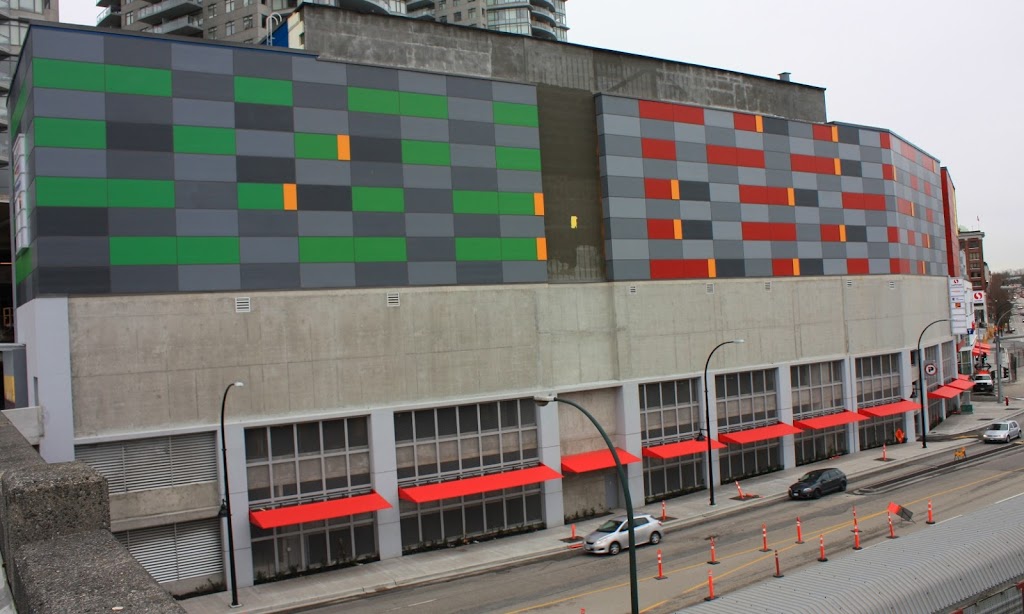
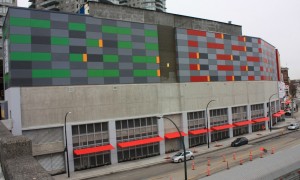
Pretty much the entire building complex, from the outside is unattractive and oversized. The imposing 8-story parkade looms over and shades out Carnarvon Street, although this may eventually be softened by the green wall design and opening of the live-work spaces at ground level. The view from the south is also a rather imposing 8-story concrete wall, with the notable exception of the Art-Deco Façade from the old Sally Ann (which I like), and the brash pattered red and green wall covering (which I am still unsure about). I did manage to decode the message hidden in the pattern on the red/grey part of the wall, but the pattern on the green/grey side is either nonsense, or I am missing something… CSFAO?
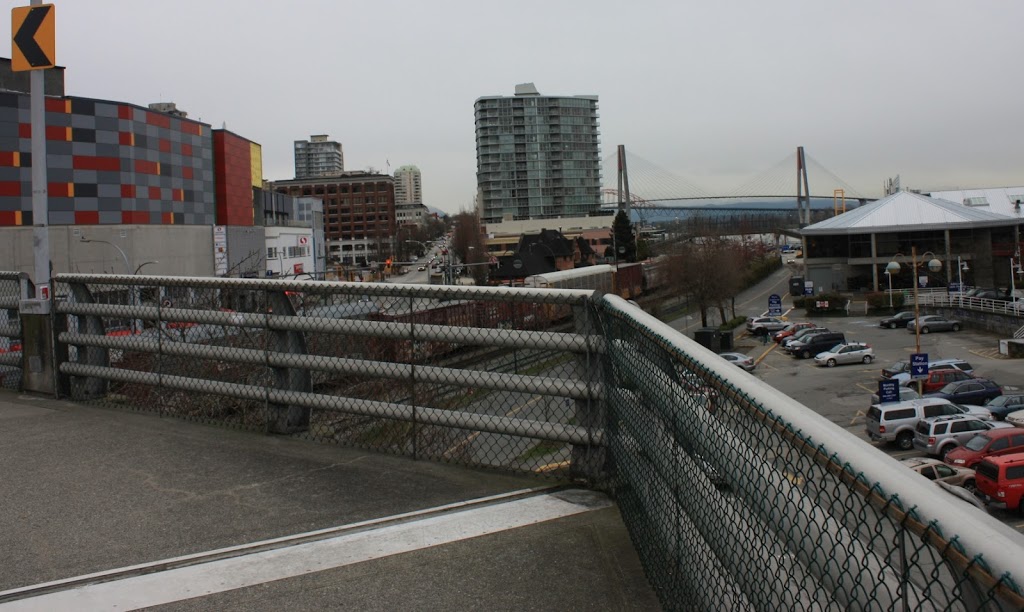
While looking at the wall from the Quayside Drive overpass, I was reminded about yet another “missing link” for pedestrians in New West. From the west exit of Plaza 88, you are only a few hundred metres from the River Market, but the overpass curves west, making it a much longer trip. A staircase on the southeast corner of the overpass would create a much shorter link between Plaza 88 and the River Market, but I digress…
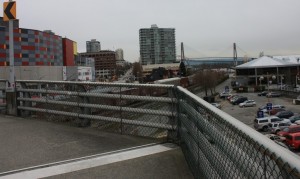
No, wait, I don’t digress. One of my biggest pet peeves with the Plaza 88 project is that it is, on the outside, a pedestrian disaster. The pedestrian mall around a SkyTrain station is a great idea, but anyone trying to get to or from or around the complex is met with horrible pedestrian space. I have already wailed and whined about the east exit, where the primary link between Plaza 88 and the rest of the commercial enterprises on Columbia Street was designed to accommodate trucks and cars, at the cost of being completely unappealing and likely unsafe for pedestrians. The south side has a wide sidewalk, and 100m of concrete wall and parkade cages…, with intermittent awnings of questionable value. The Carnarvon Street environment is crowded, with a bus loop and multiple garage entrances, inadequate cross walks, and will be loaded with busses, as the new bus loop under Plaza88 is already too small for projected bus needs. At every corner, it is clear that pedestrian access and safety was an afterthought in designing the street level of this complex.
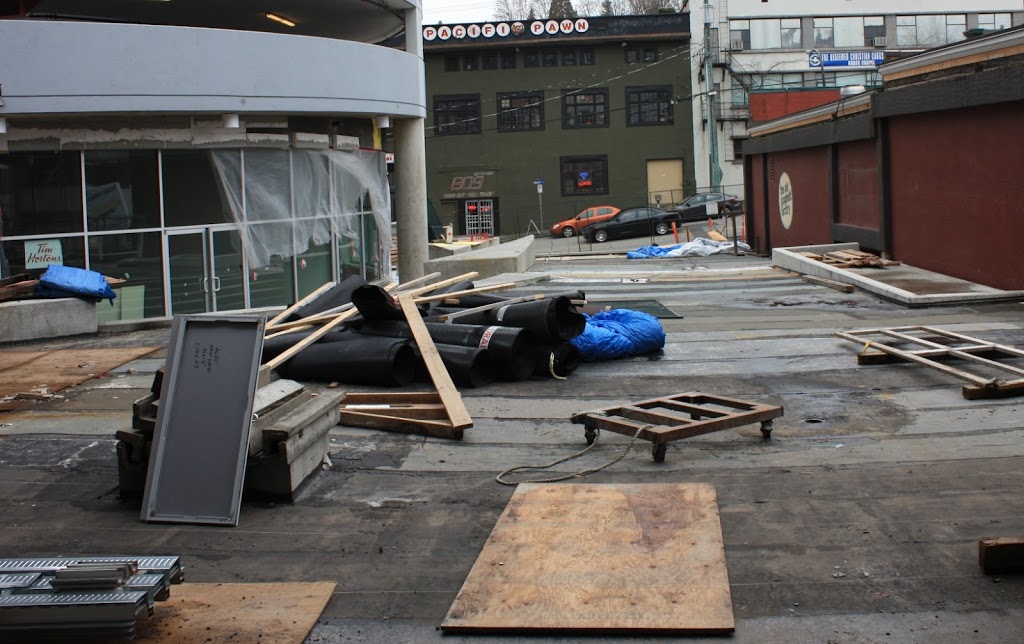
The bright side is the new Tim Hortons plaza exit heading north, although the compelling view of the back of the Spaghetti Factory and the front of a Pawn Shop won’t do much to improve the first impressions of people arriving in New West….
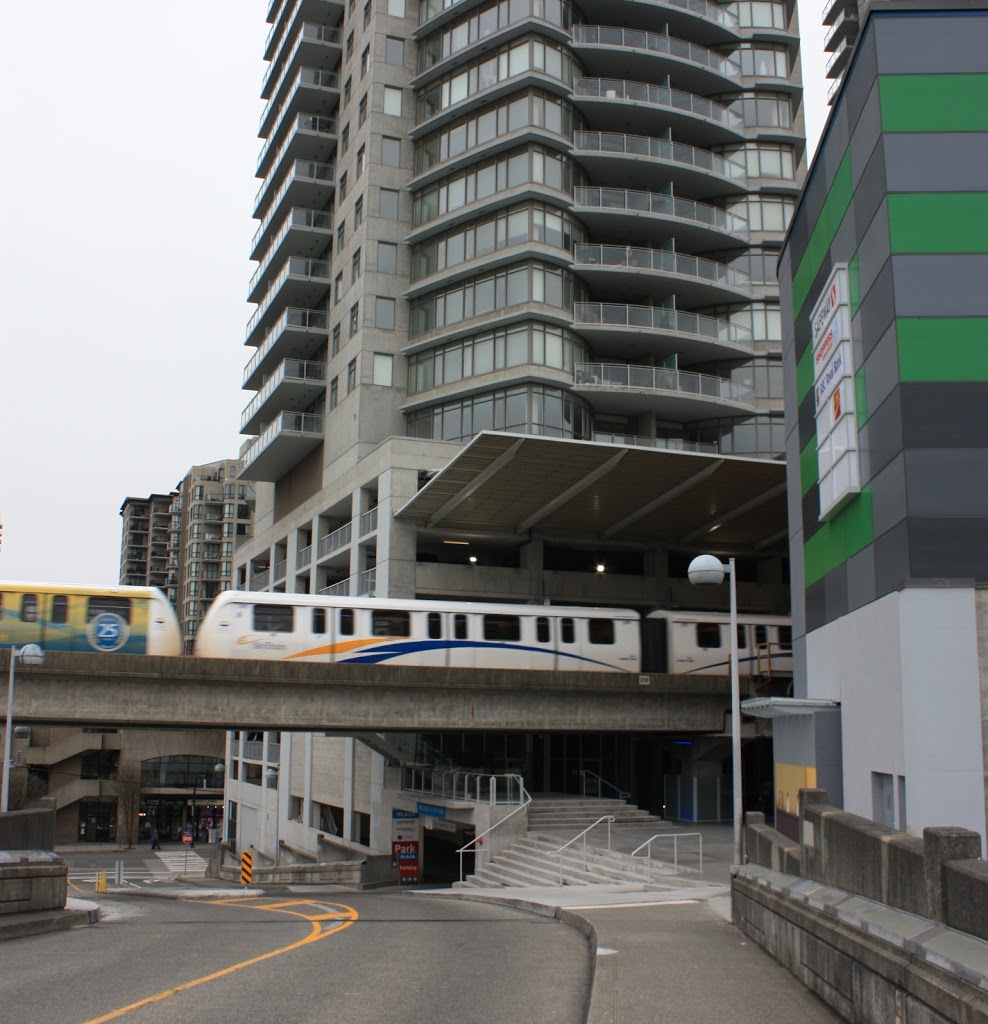
Back to the McInnes overpass, where you get to enter the Pedestrian mall right under the SkyTrain tracks, I have to admit the effect is very City of the Future when you watch the SkyTrain enter the building.
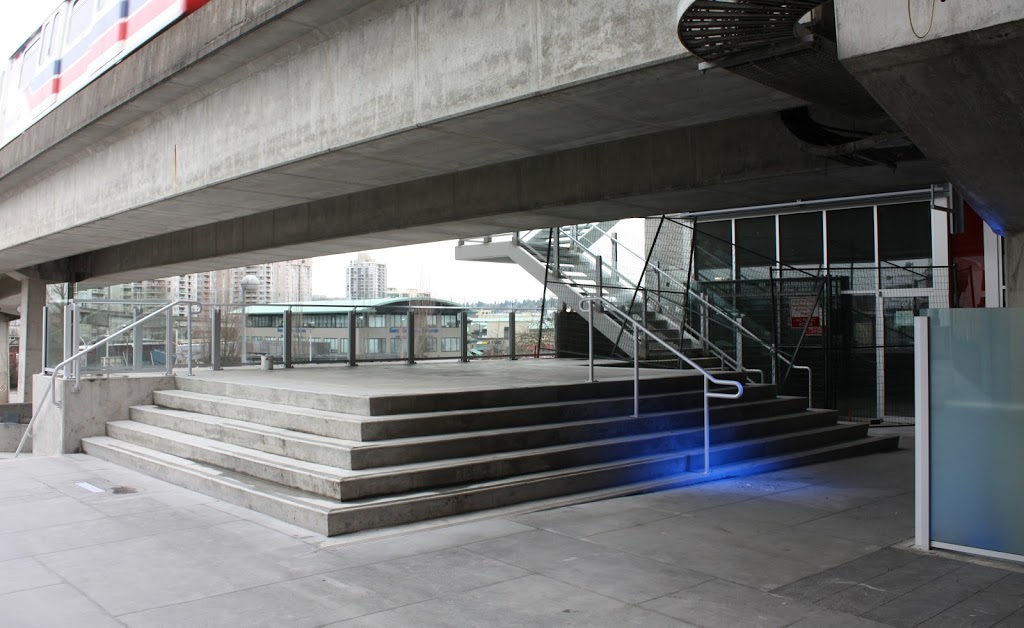
The first thing you notice is what appears to be some sort of stage or platform, right under the tracks. I imagine it is just there for architectural reasons, but I wonder what the intended use is. The roof clearance is less than two metres, so any musician would need to avoid Pete Townshend windmills or loose the skin off their knuckles. Restaurant seating would be interesting, although dinner conversation would be challenging with the roar of trains over head…
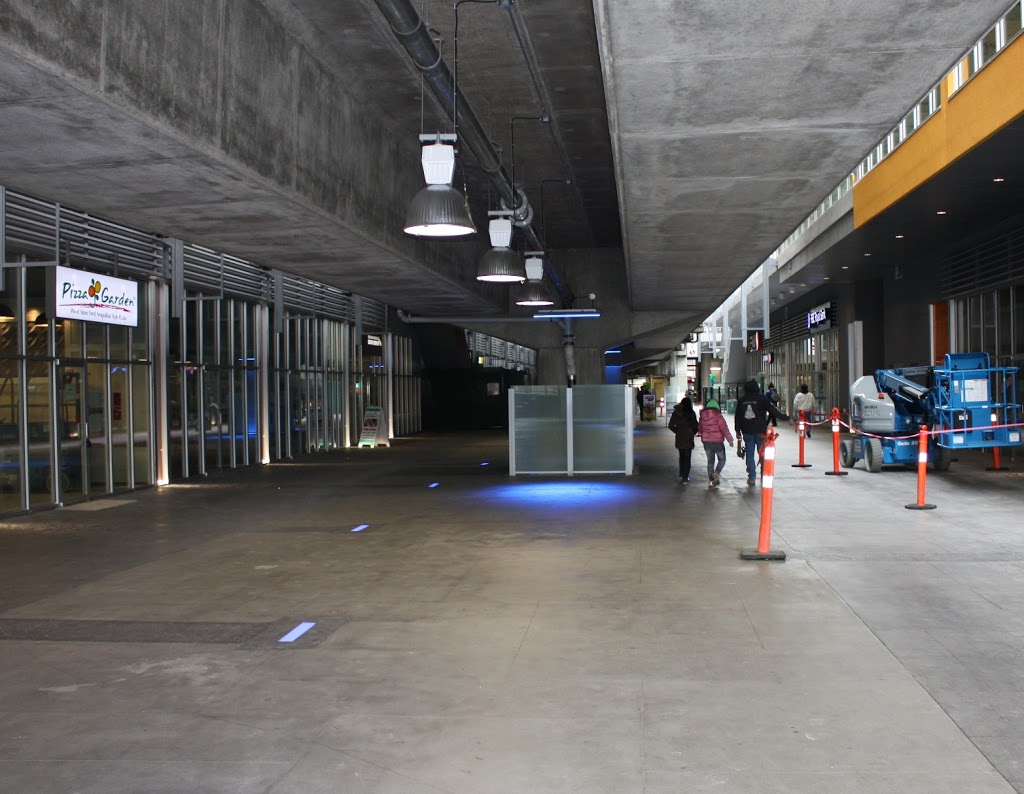
Once you enter the pedestrian mall, the space itself is pretty cool. The smooth concrete, pale tile and blue LED lighting effects have that retro-future industrial look. The roof is low and the bottom of the SkyTrain rails could use a power-washing, though.
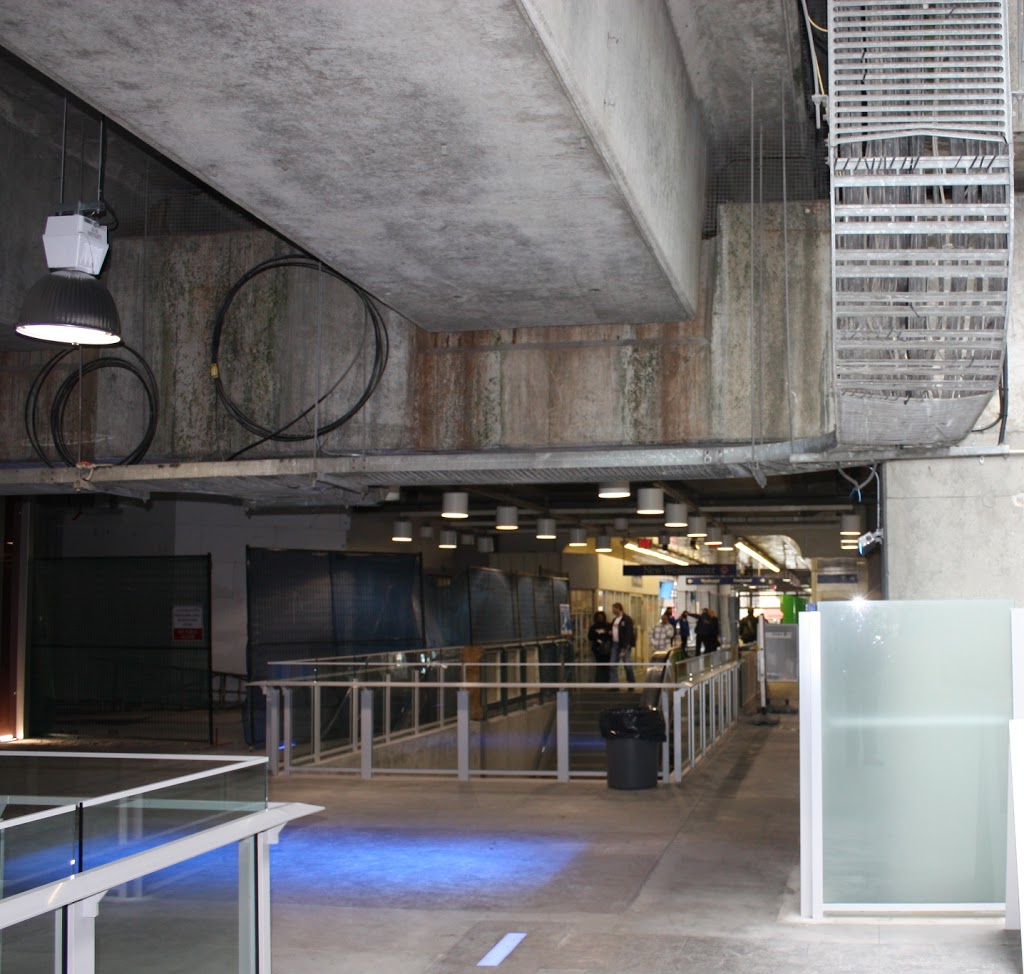
In some spots, it is pretty clear that no-one at SkyTrain ever intended for people to be wandering around just under their rails. Anyone over 6 feet could easily reach into the cable trays hanging off the railbeds. The lack of “electricity can kill you!” signs suggests those are low-voltage or communications cables, but they add to a pretty gritty industrial feel, more so with the pigeon shit factor.
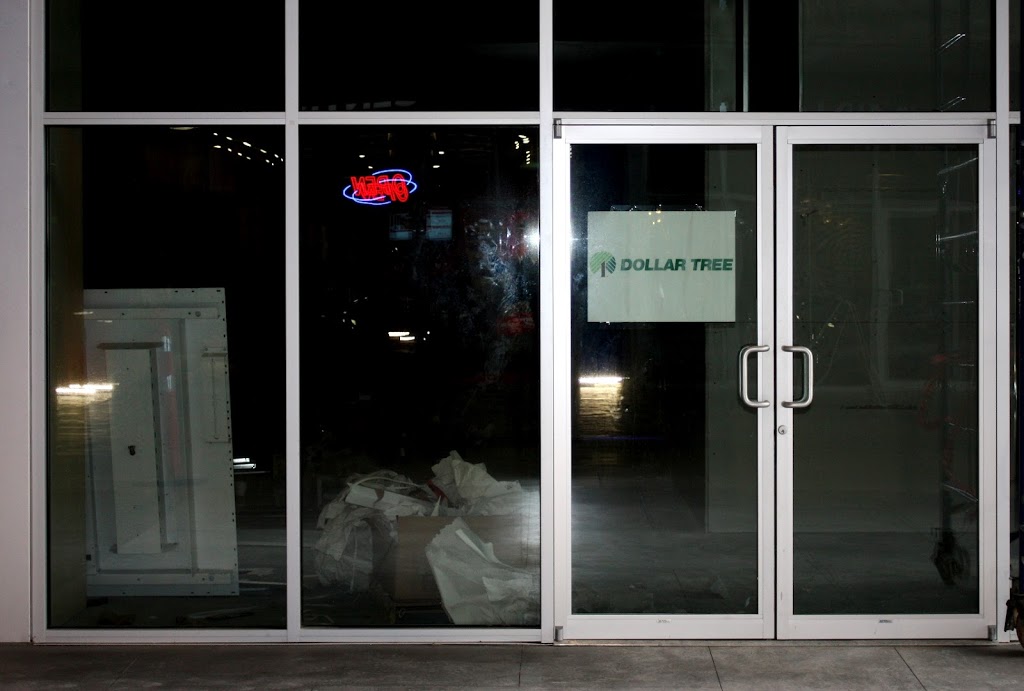
There are businesses slowly filling in. Some look pretty promising:
Others not so much.
It all seems pretty oriented towards service to local residents, as opposed to destination shopping. This is not MetroTown with rails through, it is a service centre at a Transit node. Banks, travel agents, dentists, and small restaurants and cafés: clearly targeting local residents and SkyTrain riders. I’m not sure of that will shift slightly when the upstairs level (with their multi-screen theatre) opens. Time will tell.
So far, the only space to sit in the pedestrian mall is outside the Starbucks attached to the Safeway. Here we see one of the strangest design choices:
I’m not sure what compelled Safeway to defend their little café sitting spot with 6-foot steel pillars and plexiglass. The unfortunate effect is to separate people at the café from the pedestrians, making both spaces less friendly, and making it way less likely I would sit in that glassed-in closet like area and have a coffee, watching the world walk by…
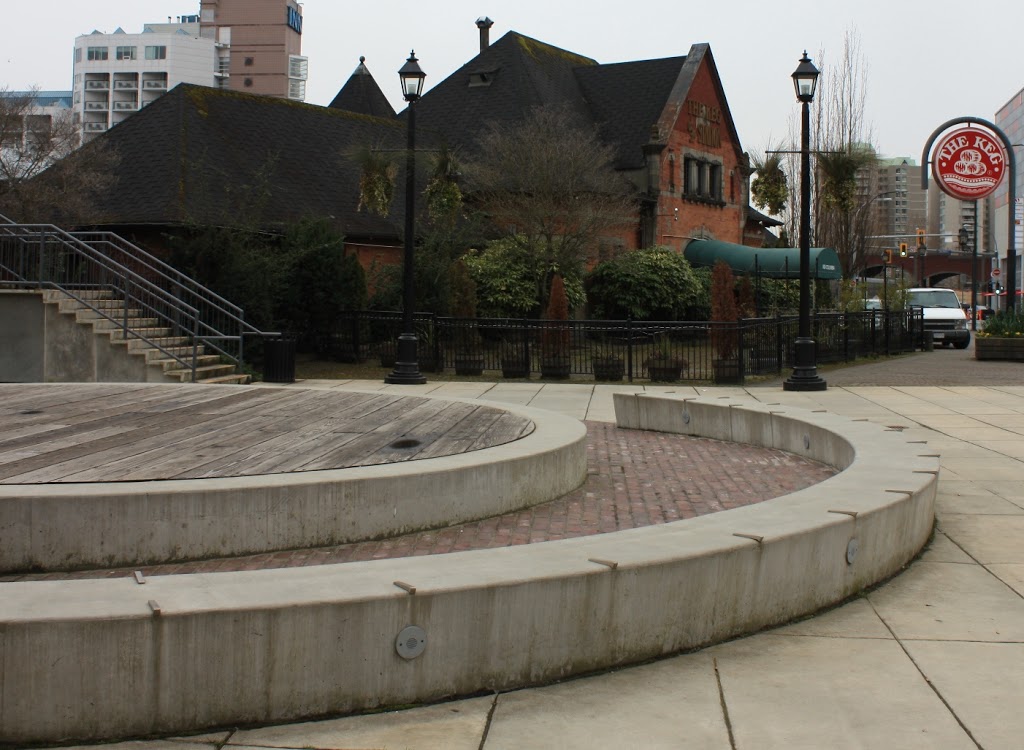
It is vaguely reminiscent of this caged-off area next to another City Square, both unfortunately less friendly becasue of their disconnectedness.
Not that many people will be sitting outside for too long in the lower level at Plaza 88. I hate to admit it, but the SkyTrain is freaking loud. There are places to the west of Safeway where the sound clearly echoes off the apron suspended over the rails, down through the gap between the upper concourse an the rails. I’m not sure of the vertical glass baffles in that gap help, or make the echo situation worse.
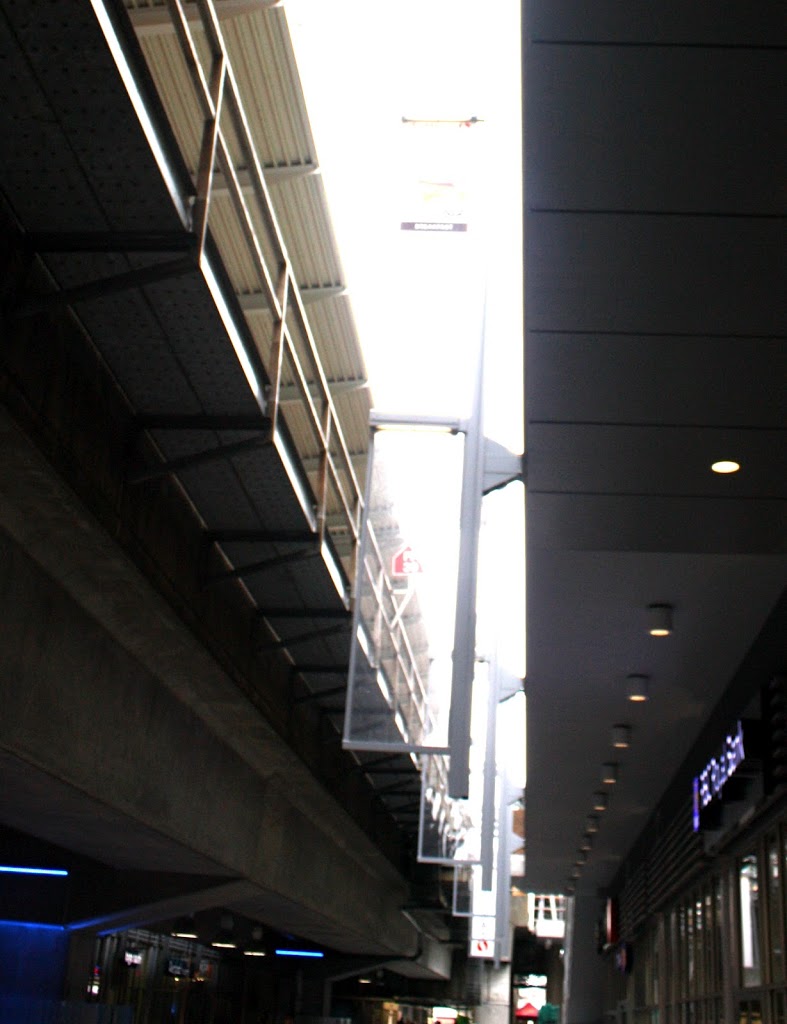
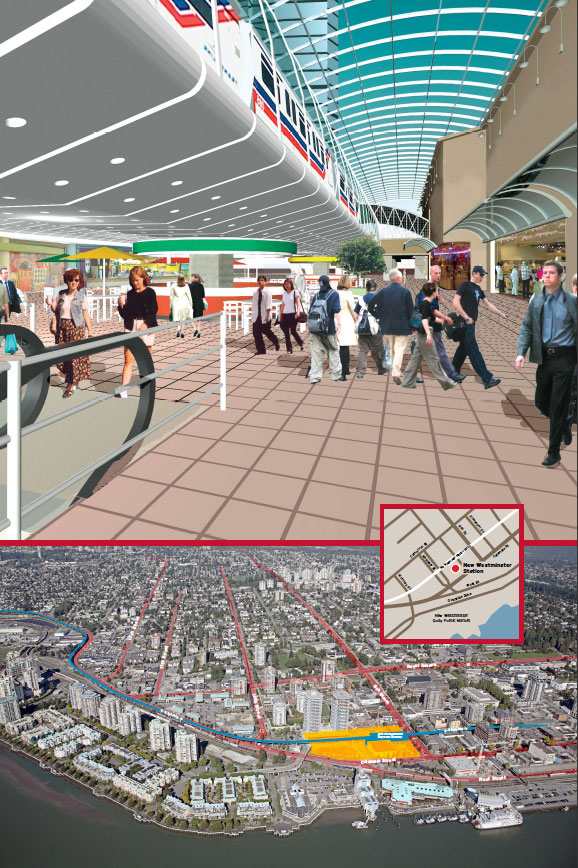
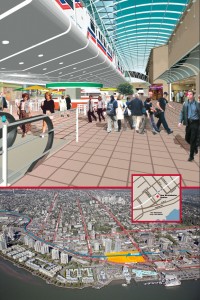
The gap also allows rain to sprinkle down over one enigmatically exposed 5-foot-wide strip adjacent to Safeway, when the rest of the mall is covered. I thought the original design was for it to be all covered. There was also suggestion that the SkyTrain rail bottoms would be more integrated into the design. Like or hate the look, it sure doesn’t look like what we were sold a few years ago:
One more aside. There was a bit of a local Twitterstorm this week around smoking in the Plaza 88 public mall spaces. A few local rabble-rousers (I may have been one of them) asked if the mall was going to be smoke-free, and to the credit of both TransLink and the City, there was some quick response to the Tweets: everyone is, apparently, looking into it. There is a system-wide ban on Smoking in Translink stations, but most of the pedestrian spaces are outside of that. Of course you can’t smoke indoors anywhere, but most of the pedestrian space is really outdoors, in an indoors kind of way. Its not like any outdoor plants would survive on the Safeway Level. You would be hard pressed to find any spot in the plaza that isn’t within 6 Metres of a door, so I guess that Provincial Law could be enforced, but by whom? (TransLink Cops? Mall Security? New West PD? Bylaw Officers?).
As this is a unique project and setting, I guess we can expect little teething problems like this to come along. I know from conversations I have had outside of New Westminster that this project was a difficult one to push along. There was a lot of work by the Mayor, Council, and City staff to make this project happen, between integration with a reluctant TransLink to various design components. At every step, it was pushing the limits of Urban Design in Greater Vancouver.
Am I fan? I don’t know. I hope I will be. Many of the design elements, from the tower facades, to the pedestrian challenges, to the head-scraping pigeon nests are kind of disappointing, but overall, I dig the Blade-Runneresque blue light retro-future look. I also think the risk will pay off if we manage to use the Kyoto block and integrate this project more effectively with the MUCF, Hyack Square, and the River Market. The commercial plaza wrapped around a SkyTrain Station is a brilliant idea, and there are lots of reasons to think it will be a model for development elsewhere along the SkyTrain system.
Now bring on the Theatres
Short take on Minister Lake
For the most part BC Minister of Envrionment Terry Lake seems like a pretty good guy. He is smart, educated, says the right things, seems to have his head screwed on straight. One of the few “Good Guys” in the BC Liberals camp. I wanna believe.
Then I get a series of tweets from him, all talking about the great time he is having at the Vancouver Auto Show, shilling for the New Car Dealers of BC.
Isn’t a sitting Minister of Environment providing hourly tweets promoting the Vancouver Auto Show a little… I dunno… unaware?
How the Denial Machine operates.
You wouldn’t know it by looking at the Federal Budget released yesterday, but Anthropogenic Global Warming (or “Climate Change” as it is currently marketed) is still going on. Actually, there has been a disturbing trend recently of the scientific consensus moving away from “we really need to do something about this, soon” towards “it is looking like soon might be a little too late” as a series of “tipping points” related to polar ice loss, tropical forest desiccation, permafrost methane release, etc. seem to be arriving sooner than even the most alarming IPCC predictions from a few years ago. It appears climate change adaptation measures will soon be structured around small weapons practice and desert survival training.
Really, not much general interest about this issue, though. As some random drunk on CBC pointed out last year, the PR contest is over: reality lost.
This week, there was an excellent example of exactly how this battle has been lost.If you are a purveyor of the neo-Conservative Canadian Blogosphere, you might know that once again this week, AGW has been proven false. In this case because a study proved that the Medieval Warm Period was a global event and therefore Michael Mann was wrong, and therefore the whole house of cards is falling down. I hate to pick on one denier in particular This story is well covered by the erudite opinioneers at the provocatively-named “Small Dead Animals” blog. As is the norm, the link there is to a story at the #1 source for journalistic links for the denial crowd: the UK Daily Mail. That story can be read here, and of course, it does not link to the actual source of the science they are writing about. In fact, the headline of the story, and the headline of the Small Dead Animals post are in direct contrast to the statement in that very article by the scientist who authored the paper:
“Lu says that his research has no direct bearing on the current climate, and points out that his research is restricted to one area in Antarctica, and is not in itself proof that the whole Earth warmed up.”
Actually, the article so misrepresented the results of Lu’s study, and the Daily Mail is so pervasive in the Denial blogosphere, that Lu had to get a press release issued by his University indicating that the Daily Mail was flat wrong, and that his research said nothing like what the Daily Mail said it did. Will the Daily Mail print a retraction? Don’t hold your breath. This is the one paper that did not retract the ClimateGate story, even after every other media outlet did so following the numerous investigations in to the alleged “scandal”.
Instead, like ClimteGate, this will become one more little “fact” to use in the denial machine’s Gish Gallop assault on reason and reality, and the truth about AGW is made a little more difficult for the average non-engaged voter and tax-payer to understand.
It also makes one more noise to rattle around the echo-chamber that is the right-wing blogosphere, so they can use it in the long comment threads that reinforce their strange cognitive dissonance death march. Speaking of “Small Dead Animals”, it doesn’t appear any of the commenters there bothered to follow up to the source of the story, instead they just echo-chambered a bunch of other long-refuted “facts” (with occasional flogging of the ghost of Al Gore) to support their position. Nothing new presented, no new ideas offered, no links to sources of data, and no actual science to back their positions.
Well, I have to admit, to me, there was at least one new idea. This post is something I had not heard before (and a curious look into the mind of these people):
The Middle ages warm period caused enough surplus wealth that they built all the great Cathedrals of Europe, the french put a ban on the import of wine from Scotland, people in Britain were 2 or 3 inches taller in 1250 than they were in 1900. There is a huge civilizational advantage to warm weather.
Hmmm… Where to start. Let’s do this line by line.
The Medieval Warm Period was a northern Europe climate event over a 300-year span from about 950 to 1250. To say “all the great Cathedrals of Europe” were built during this time is, I guess, a matter of opinion around the word “great”, but by excluding all Gothic (Cologne, Notre Dame, Florence, Milan, Reims, Salsbury, Canterbury, Toledo, Burgos, etc.), Renaissance (St. Peters, San Georgio, etc.) and Baroque (St. Pauls) cathedrals from consideration, as they were built well after the MWP, mostly during the “Little Ice Age”, challenges the credibility of the statement.
The writer’s history of the wine trade between France and Scotland is also a little confused. It is pretty clear that through the Medieval, wine was imported to Scotland from France, up to and after the Auld Alliance, which was sealed just after the end of the MWP, and had more to do with pissing off the common enemy (England) than with climate changes. There is simply no evidence of widespread viticulture in Scotland during the MWP, he is making that shit up.
As for British people being taller in 1250 than in 1900, the evidence is the exact opposite ( see page 5 of this publication from some British Archaeologists who studied this exact question). Even if it were true (which it isn’t), it would be hard to argue that warm climates cause height, as 18 of the 20 “tallest countries” are in central or northern Europe, and 18 of the 20 “shortest” are in the tropics.
I’m not even sure what a “civilizational advantage” is. Presumably, he is arguing greater advancement in science, technology, health, and governance correlates with warm weather. Which is apparently why the Incas and Maya ran rampant through Northern Europe plundering resources in the 16th Century, and why the Great Nations of Africa held a conference in 1885 to decide how to break up and distribute the wealth of Europe and Asia amongst themselves.
So he (and yes, it is a “he”, no woman has ever been this self-convincingly stupid about everything) is factually wrong at every point, but what is his great idea? That AGW is good? Because he is commenting on an article that says (wrongly) that AGW is not happening. So is he refuting this? Why are the other commenters, who think this is all an Al Gore-led conspiracy to bring about world government or someother, not challenging him?
This is, unfortunately, the public discourse on AGW. This is what is driving us towards a pretty uncomfortable future when a much more comfortable alternative is available. I am not a defeatist, but I suspect Rex is right on this one: the PR battle is over, science lost, because their side was held back by engaging in reality.
More Fishy Messaging
I’ve been on about the proposed changes in the Fisheries Act, as have several other people of higher intelligence and more importance than me. I cannot emphasize enough that this is a major shift in environmental policy in this country, not just some obscure change in language of some obscure act. It is worth noting that the threatened habitat provisions of the Fisheries Act were added in 1983 by that foreign (Irish?) environmental radical socialist Brian Mulroney.
Not much mention of it in today’s “Penny Smart – Dollar Dumb” budget, but this issue is not going away. The Cons are still messaging what a major inconvenience the Federal Fisheries Act is to all who care to hear, and they are now resorting to printing silly half-truths in local newspapers. I present as evidence a letter written by Conservative MP, former professional voodoo back-cracker, and denier of evolution James Lunny, to the Nanaimo Daily News just a few days ago, the link to which I have provided, but the full text I also offer below:
.
We need reasonable fisheries regulations
Nanaimo
Published: Wednesday, March 28, 2012
Re: ‘Feds should listen to critics’ (Daily News, March 26)There are very few political issues that stir up more rhetoric than fish management or quota allocation. This article does your readers a disservice by inflating reactionary alarms based on speculation.
As one former minister admitted, managing fish, fish habitat and economic development is a balancing act. Many Canadians are unaware of the unreasonable decisions in the name of “habitat protection.”
For example, in Richelieu, overzealous officials blocked a farmer from draining his flooded property. The farmer was fined $1,000 in 1993 for dewatering his fields simply because a couple of fish found their way in with the flood. Believe it or not, he had to buy a fishing permit in the last flood otherwise he would have been subject to a $100,000 fine.
Abbotsford, which maintains flood control ditches, can’t meet its legal obligations to clear waterways due to DFO rules.
We have many such examples on Vancouver Island. When I was first elected I spent months bringing together land owners, provincial authorities and DFO to resolve a recurrent flooding problem at West Glade Creek that had turned a farmer’s field into a fish habitat and threatened to flood neighbouring Island Scallops’ facilities. The problem was resolved by building a groyne to prevent the mouth of the creek from plugging up with gravel.
The B.C. government has long complained about DFO enforcement policies that make it impossible to clear drainage ditches or clogged streams that threaten to flood properties. The federal government is reviewing fish and fish habitat protection policies to ensure they do not go beyond their intended conservation goals and that they reflect Canadians’ priorities.
Let’s not throw reason under the bus because the government is reviewing policy to improve management outcomes; that is the role of responsible government.
James Lunney, MP Nanaimo-Alberni
The silly half-truths are found in the examples provided.
The Richelieu example is drawn from an expose in one of Canada’s greatest bastion of journalistic integrity, the “Weird News” page of the Toronto Sun. Even then, they had to go back to 1993, 19 years ago, for this example of a Farmer being fined for a violation under the Act. Even then (read the story, you can’t make this stuff up), it wasn’t overzealous officials that triggered the fine, but his farming neighbours complaining he was shredding up fish in his pumps and polluting the watercourse with fish offal!
The Abbotsford example is complete, 100% unadulterated bullshit. According the Minister of Fisheries, they are referring to an article in Abbotsford Times from nine years ago. We can assume is that this was an instance of disagreement between the Province and the Federal government over flood control management, long since dealt with.
I can say with confidence that it was dealt with, because Abbotsford, like every other Municipality with man-made ditches draining the Lower Fraser River flood plain (including Chilliwack, Pitt Meadows, Surrey, Langley and Richmond) have developed ways to efficiently manage their drainage systems while staying in compliance with the habitat provisions of the Fisheries Act. I’m not sure what the dispute was in 2003 (the 2003 article is not on the net), but of you look at the Abbotsford City website, you find this guideline used by the City to coordinate their instream works around the appropriate fisheries windows. This is just good environmental practice, with little or no budget implications, and easily managed by professional City Staff. I actually deal with this stuff on a day-by-day basis in my job. Like most Municipalities, the one where I work finds the habitat protection measures of the Fisheries Act are a simple, easy to apply, and effective tool for assuring the health of drainage network and the Fraser River.
The Scallops on West Glade Creek story is a mystery, as there is no mention of it on the internets, nor does Lunney provide any references or details that may allow us to trace the story. It is not mentioned on his website, nor is West Glade Creek easy to find on any map. But again, it sounds like habitat alteration was required to facilitate drainage and to support a local business, and DFO assisted in seeing that the habitat alteration was done in a way that complied with the law. We have no idea what role DFO or the Fisheries Act played in this, but the point is that the habitat alterations were needed, and DFO allowed them to happen. Is this not an example of an envrionmental law working to support both fisheries habitat and businesses?
Finally, there is a very clear process to instream works for drainage and flood control, and if the BC Government has long complained about it, they have been doing so very quietly to us who work in Environment. Actually, the DFO produces a series of Operation Statements, Guidelines and Best Practices, specifically for the unique situation in British Columbia. In fact, the BC Government’s own Riparian Area Regulations extend the exact same protections above the waterline, and are designed to specifically dovetail with the habitat protections under the Fisheries Act. It seems strange that the BC Government would complain about a Federal Law, then extend the exact same protections onto lands not covered by the Federal Law they so loudly disagree with…
So Lunney has no idea what he is talking about. In his defence, he is not there to think, but to parrot the message from the PMO office, as related through the Minister of Fisheries, and sign his name on the bottom. That’s how you get a Senate Seat. This is why the exact same language and underwhelming examples are being trotted out over the signatures of other God-Fearing Harperites, like the Conservative MP for Kelowna has rolled out to demonstrate the importance of this issue to Sportsfishermen. Expect more to come soon.
And, unfortunately, there is probably nothing we can do to stop them.
On 6th Street, Drivers and crosswalks
I noted this story in the News Leader, and as sorry as I may feel for the “rattled molars” of drivers on 6th Street, the story seems to miss the bigger concern on that stretch by the Rivers Reach: the disappearance of the crosswalks.
I live about a block from here, and I’m not afraid to admit that I spend a disproportionate amount of my food budget at the Reach. During Hockey season, The iCandy and I spend enough time at the Rivers Reach that the wait staff know our order coming in. The recent change in hamburger bun suppliers at the Reach was a cause of lengthy conversation in our house. What I am trying to say is that we are regular customers. I also cross 6th on a regular basis, walking to the Curling Rink or Queens Park, or to the Uptown Market (a damn fine small grocery, if I may say so). This area is literally my back yard.
The sewer repairs and resultant asphalt cuts are a hassle, and presented some challenges to local businesses during the works, but with the average speed of drivers cruising down 6th somewhere around 80km/h, it has been kind of nice to have some speed bumps along the way.
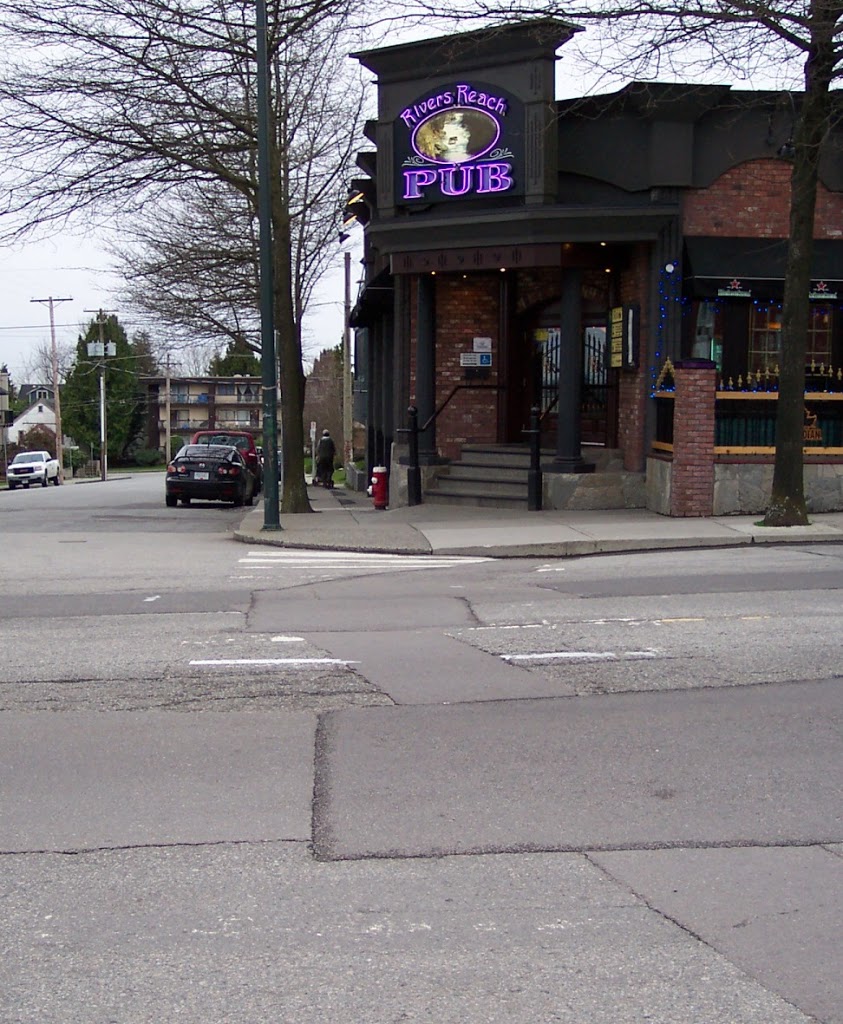
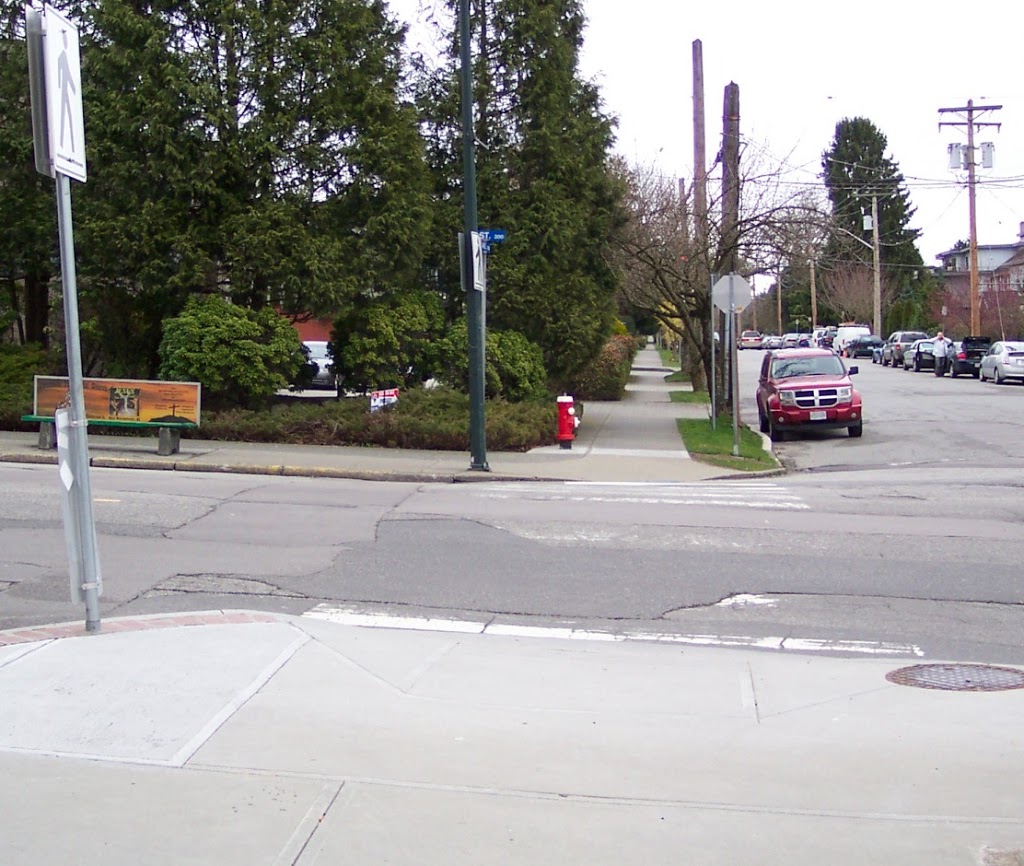
What’s not nice are the crosswalks at Blackford (right in front of the Rivers Reach) and at 3rd Ave being essentially gone for 6 months. With several stages of pavement ripping having taken place, the road markings for the cross walk are essentially eroded away. Crossing 6th between the lights at 4th and the signalized crossing at Queens has become a harrowing experience, with pedestrians not sure of the drivers recognize that there used to be a crosswalk here (or if drivers notice the signs indicating there used to be a crosswalk here), and drivers confused by people stepping onto the road against the flow of traffic, with no crosswalk to be seen.
![]() |
| 6th Street crossing at Blackford. Note great pub for scale. |
![]() |
| The next block down, 3rd Ave. crossing of 6th. The signs belie the lack of road markings. |
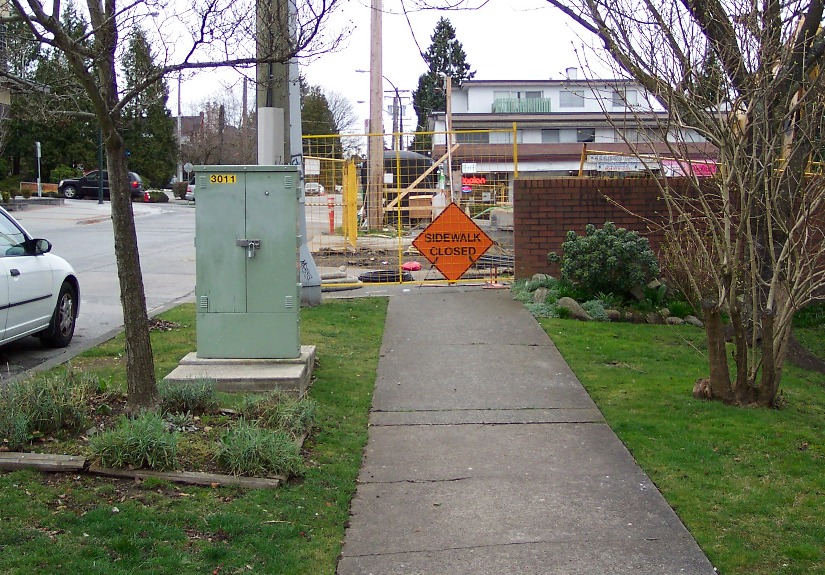
This is exacerbated by the works on 3rd Ave and 6th St., where the much-touted Discount Towers development (I think that was their name) has staged their construction equipment on the sidewalk with nary an accommodation for pedestrians, except a “sidewalk closed” sign. Causing pedestrians approaching form the west to cross 3rd somewhere (as there are actually no north-south crosswalk markings in the area) or to walk in the driving lane.
Which I reprint here for your reading pleasure (emphases thiers):
New Westminster Pedestrian Charter
Walking is the universal mode of transportation; people around the world walk to work, school and other destinations. Nearly every personal trip involves some walking, often to connect with other modes of transportation, such as bicycle, public transit and private car.
A pedestrian is a person that moves from place to place, either by foot or by using an assistive mobility device.
To ensure walking is safe, comfortable and a convenient mode of travel, the City of New Westminster respects the following principles:
Accessibility
Walking is a universally available means of reaching and using goods, services, community amenities and public transit.Equity
Walking is the most affordable mode of transport, and allows everyone of all ages and abilities including children, youth and seniors to travel independently.Healthy
Walking is a proven method of enhancing personal health and well-being.Sustainability
Walking relies on human power and has negligible natural environment impact.Safety
Walking is a safe mode of transportation. The more people out on foot, the more a community has a greater sense of safety.Community
Walking-friendly places are people-friendly places, creating a more livable and cohesive community and contributing to community vitality, both socially and economically.To support and encourage walking, the City of New Westminster will:
- review practices and regulations to ensure that a high priority is placed on pedestrian needs;
- plan, design and develop a pedestrian-friendly environment in public space to meet travel needs of pedestrians;
- improve pedestrian safety by minimizing potential conflicts between pedestrian and other users in the public right-of-way;
- invest in pedestrian facilities and services to encourage people to walk for commuting to work and school, exercise and recreation;
- integrate walking with other modes of transportation.
Actions:
- provide and maintain infrastructure that gives pedestrians safe and convenient passage while walking and crossing streets;
- provide appropriate pedestrian access to public transit services;
- ensure weather protection is in place for pedestrians in commercial areas and other locations where there is significant pedestrian activity; and
- seek funding opportunities with other levels of government and agencies;
- ensure that all sidewalks in the City have appropriate curb cuts, that surface texture is constructed to prevent persons using mobility challenged devices from losing their grip on the devices, to include adequate lighting, and
- access to buses be accommodated at bus stops for devices used by mobility challenged persons.
The City of New Westminster works with individual citizens, community groups and agencies, businesses and other levels of government to achieve a pedestrian-friendly, walkable community.
All I’m asking for is for someone in the City to open a bucket of paint and put temporary lines down until the road is properly restored. It is, quite literally, the very least we can do to live up to the Pedestrian Charter.
NDPLR and Internet Voting
I watched the NDP leadership race with a moderate amount of interest. Although I am a happy supporter of both New Westminster MPs, and I am increasingly of the opinion that Harper donated his heart to Cheney, I am not am member of the NDP, and honestly had not educated myself too much on the leadership contenders.
Up to this weekend, I was most impressed by Brian Topp, although Cullen made a strong case for leadership by naming Beastie Boys’ “Check your Head” as his favourite CD (a bold choice: more challenging than the obvious choice of their magnum opus “Paul’s Boutique”, or even “Hello Nasty”, although that might, admittedly, have been seen as a dig against Mulcair).
To see the Tyee calling Mulcair a “right-wing Liberal” and lamenting his “rigid fiscal conservatism” the same day that James Moore calls him a “Hard-Left Socialist” tells me the NDP have probably done a good job hitting the middle of the road, only time will tell how his leadership skills will hold up.
The more interesting aspect of the race for me was the on-line voting aspect. Remarkably, I agree almost 100% with this City Caucus article on how the on-line experience that the NDP had should serve as a warning to those who think we should all be voting on-line in local, Provincial, or Federal elections in Canada.
When I was finishing up my undergrad, I had a roommate who was doing his Ph.D in computing science. He was a scary-bright guy, but the model of the born-in-1975 computer geek. He is probably a millionaire now, but would have no idea what to do with it if he was. I had a memorable conversation with him one time, talking about school and learning and the Philosophy of Science (Never, and I repeat Never, read Robert Pirsig during the last semester of your Science degree…).
He felt the real problem with a Computing Science education is that they spend a lot of time teaching you to use a computer to solve a problem, without ever asking whether the computer is the right tool to solve the problem you have. This was a profound insight that always came back to me while dealing with transportation engineers who wanted to solve congestion by building more roads, or Politicians trying to solve crime by building more jails.
The question for me, when people talk about on-line voting, is “What problem are you trying to solve?” followed shortly by “Is the Internet the right tool to fix that problem?”
The main problem people seem to identify is “lack of engagement” in the process. Essentially, people have stopped showing up to vote. There is no doubt the proportion of the population that shows up for elections has been on a steady downward slide in the last few decades. Just over 60% of eligible Canadians voted in the last federal election, one where the result was far from foregone on election night. The turnout for the 2009 Provincial election was closer to 50%. To suggest that internet voting will solve this problem presumes that people are not voting because they are too busy in their day to take the two-block journey to their local polling place to make a ballot on election day, or that they are too lazy to get off the sofa and vote.
I suspect people are staying home for other reasons: lack of anyone they deem worth voting for, general disinterest or genuine disgust with the process, the feeling that it won’t make any difference. None of these will be solved by Internet Voting.
For major elections, everyone is guaranteed 4 work free-hours while the polls are open to exercise their franchise. There are also advance polls and absentee ballots. There are myriad options to cast your ballot. if you can’t figure out some way to get your vote counted, chances are you chose not to exercise your franchise. Internet voting will not solve this.
Yes, I am aware that there is a small proportion of the population with mobility issues who do find it difficult to get to a polling place, but this is surely not a significant proportion of the up to 50% of the voting age population that fails to vote. Still, there are numerous ways we can (and do) make it easier for people in this small group to vote – absentee ballots, rides to the polls, etc. Internet Voting is not the best way to mange this.
So what’s the problem with Internet Voting? As the NDP learned, we cannot even imagine. DNS and other hacking attacks are the obvious concern, and would likely result in people who want to vote actually losing their franchise (as apparently happened to some NDP Leadership Race voters. Then there is the “black box” concern about how the votes are counted, and how auditable the process will be. Balancing security of the secret ballot with the need for transparency of the final count (and re-counts) would be difficult challenge for any systems designer. The loss of either of those will reduce the confidence in the system, and likely worsen one cause of general disenchantment with the process.
I don’t think these programming problems are unsolvable, I just question why we want to go through the hassle of solving them with such a kludge solution as the Internet. Paper ballots work. If there is a problem in Canada’s electoral system, it isn’t the paper the ballot is written on.
Oh, and Cullen? he’s so wrong. Paul’s Botique is totally where it’s at
Disclosures part 3
In the third part of my ongoing “ending any hope of ever raising funds from anyone to run for anything” series on the New West Municipal 2011 election, we can now cast our skeptical eye towards the election of City Councillors. There were 16 candidates for 6 positions, and it appears the one trend that favours election more than any other is incumbency. Even the new guy elected was a bit of an incumbent. However, if any single race makes the case that Labour Council support is fundamental to securing a seat, this is it.
![]() |
| click to make bigger… |
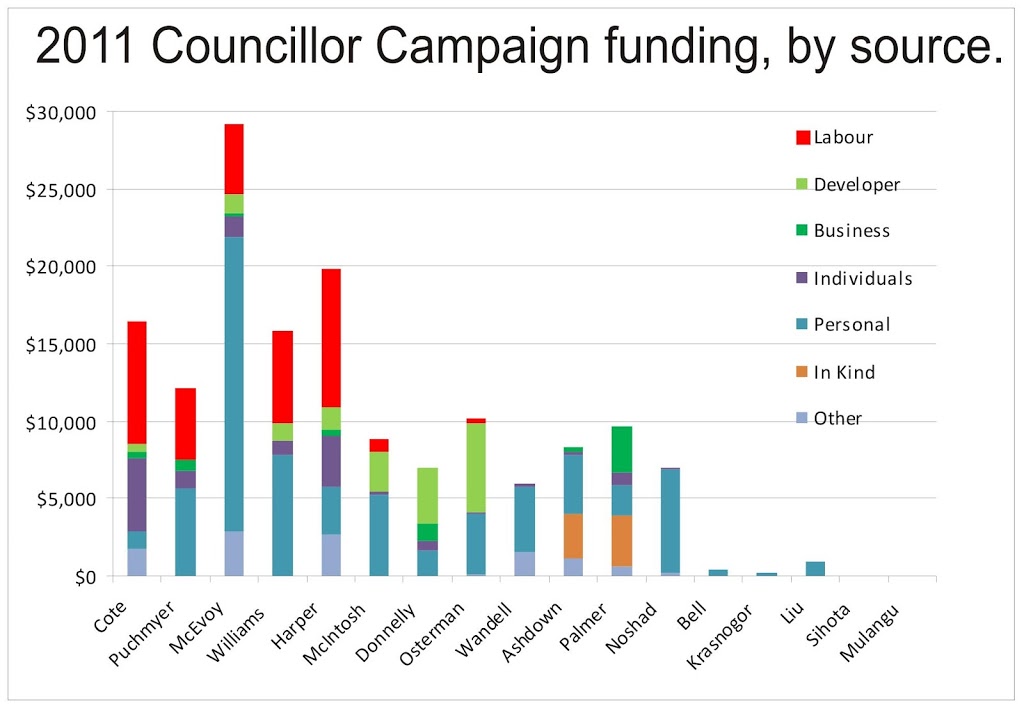
Here, once again, are the candidates’ disclosed financing sources by category, reading from left to right by the number of votes received. It is notable that all 6 elected candidates received financial backing from one or more labour unions, and only one of the non-elected 10 did. Also, the top 5 candidates are those that received the most financial support from labour.
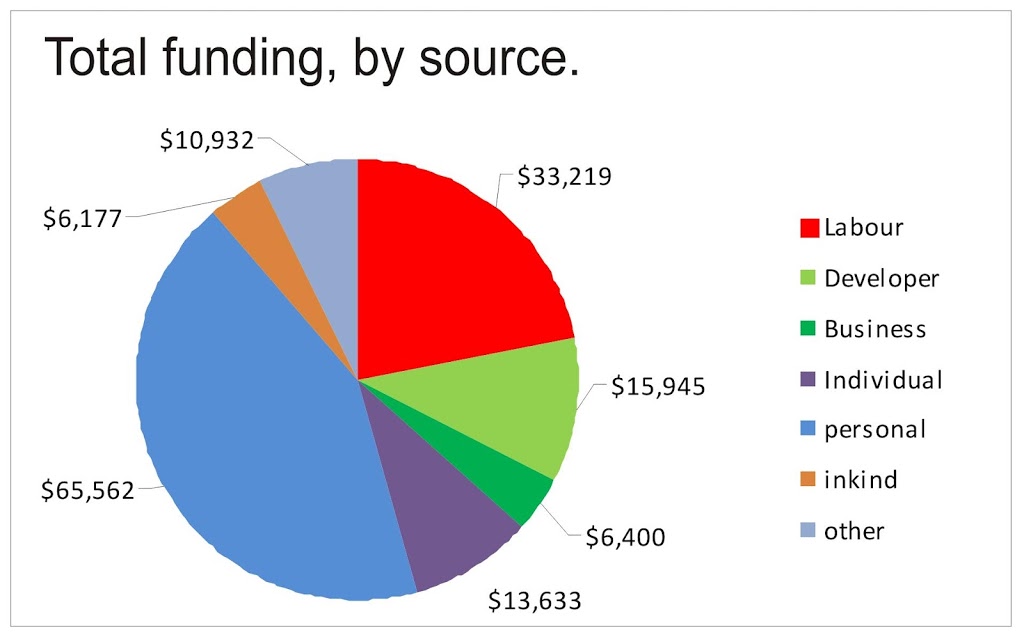
In contrast the other “controversial” contribution source, the Development community, provided significant support to two losing candidates, and less substantial support to all but one elected candidate. But as we can see, in total, the amount donated by the Development community is less than half of that from organized labour, and both of those pale in comparison with the amount spent by the Candidates themselves:
A couple of other anomalies we can note: Ashdown and Palmer were no doubt more open about “In Kind” support provided to their campaign than the others. The rules about what represents true “in kind” contribution are rather fuzzy, especially when a volunteer relies on a “professional skill”. If a teenage volunteer sets you up a webpage as a volunteer, it is probably not declarable, but if a Professional Web designer does so as a volunteer, that should probably be declared, but there is a lot of room for grey zone between those extremes.
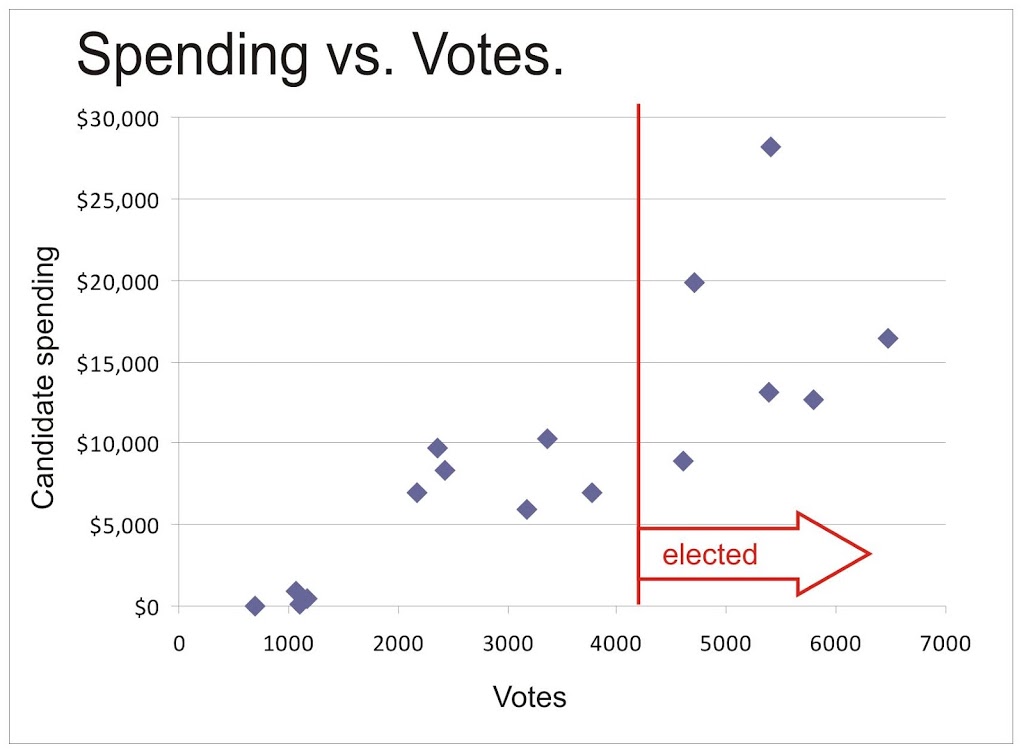
On a completely unrelated note, what the hell is up with Jaimie McEvoy? $28,000? How does one candidate spend more than three times the average, and about 40% more than the second place spender? Notably, the big anomaly is the amount of his personal money that went into the campaign, so I suppose if he wants to re-invest so much of his Council Stipend on campaigning, then all the power to him, but yikes! He more than doubled the amount spent per vote for any winning candidate, and was well ahead of a couple of per-vote big spenders on the losing side. Maybe he overestimated the challenge that Chuck Puchmayr posed (ultimately, his well-founded support came at the expense of Long-serving councillor Bob Osterman).
Jonathan Cote receives a lot of support from the Labour Council, but he is more notable for the amount of fundraising he received from private donors (disclosure: this includes me). I think this simply comes down to Jonathan’s curb appeal. He is young, bright, and isn’t afraid to speak out on issues important to the community. While working, serving the community, and raising a young family, he is taking courses at SFU towards a certificate in Urban Planning – actually learning about the intricacies of running a City instead of assuming he knows it all. It is hard to walk away unimpressed when talking to Jonathan on a variety of subjects, from breed-specific dog bylaws to infilling ditches in Queensborough, with his knowledge (or at least acknowledgement) of both sides of the issue. The fact he receives such strong support for the community, and the most votes from the community, is enough to prove to a cynic like me that local democracy can actually work.
So I am far from worried about where the money is coming from. I actually think the support that the top 5 candidates get from labour comes more from the DLC’s acknowledged support than the money. Out door-knocking with one candidate this year, I was surprised to hear how many people in Sapperton asked the candidate right out front: “Are you supported by the Labour Council?” Like it or not, New Westminster is a Labour Town, and Labour manages to get the vote out enough that it counts in Municipal elections. Much like support from the business and developer community, the disclosure is more important than the actual money.
This brings me to the issue I actually worry more about: the horrible state of disclosure. Simply put, many of the disclosure forms are either incomplete or factually wrong.
Quick Quiz: how much did Jaimie McEvoy actual raise? Here is the link to his disclosure form. According to Schedule A, he received $6001 from businesses and labour, and $20,276 from Individuals, and no anonymous donations. By my math, that is $26,277, which is not the same as the $25,765 he put on the top of page 4. Add $2,898 (donations under $99) to the $26,277, and you get $29,174. Somewhere, someone forgot to carry a 1, and the disclosure is off by $1000. If $28,176 was spent, where is that $1000 now?
Wayne Wright’s declaration is a mathematical mess. There are very few columns that add up. The number $61301 is apparently the sum of all the numbers in his Schedule A disclosures, including the $10876 from his own campaign fund, but NOT the twe $50 donations that he nonetheless included in the Schedule A2 forms and included in the subtotals, but I suspect those are the same two $50 donations that appear on line B of Schedule A1.
Hanlon’s Razor cuts pretty sharp here.
Chuck Puckmayr’s contributions magically go from $12,095 on Schedule A2 to $12,695 on Schedule A1, with no indication where the extra $600 came from. Bill Harper also gets his math wrong, as his list of Class 1 contributors adds up to $6425, not $6,350, and he offers total contributions (including those under $100) as both $19,814 (Schedule A2) and $20,264 (Schedule A1), although adding it all up, the number seems to total $19,888. Oh, and he had 9 contributions of under $100 each, but they somehow add up to $2651.
It’s not just Councillors. Apparently, the problem with School board is not too many teachers, but too few Math teachers. According to Michael Ewen’s Schedules A1 and A2, $6082+$4080 = $10,862. In Jim Goring math, $3008 = $2938.
Some may see this as nit-picking, but the idea behind disclosure is to create transparency. Bad math can be just that, a simple mistake, but it creates the perception that something fishy is going on, and this is all about perception. I don’t think this is corruption (see Hanlons Razor again), nor do I think failing to carry a 1 on a financial disclosure form is a particularly clever way to get away with something untoward, I think it is just sloppy, and doesnt instill confidence. Sloppy should not be acceptable at this level. It seems petty to worry about a $3000 School board campaign, but now that the Mayoral race is approaching 6 digits, and there are councillors willing to drop nearly $30K for a campaign, things need to be clearly, visibly above board.
Simple solution: that $500 fine for not filing your form before the deadline? The ineligibility repercussions for not completing a form? These should be extended to include forms where the math simply doesn’t work out, because a false declaration, even by mistake, is no declaration at all.
Muni Election Disclosures – Part 2
The School Board Trustee election is sometimes the most “local” of all local elections. The 2011 edition in New West comes on the heels of some pretty ugly politicking around the previous board. A vocal DPAC has accused the Board of everything short of fraud, and seems to see Conflict of Interest luring behind every corner (a battle that seems to be ongoing).
I don’t have any kids, and don’t plan to, so my interest in the School Board is completely from the taxpayer side. I pay school taxes every year, and don’t really begrudge it: a well-educated populace benefits society, so paying my part for the education of other people’s kids doesn’t really offend me too much, much like I don’t mind my taxes going to a hospital that I have never needed the services of…
However, after attending a Board Meeting last year to talk on what I thought was a well-intentioned student-led project, I watched the silly partisan bickering taking place, and walked out embarrassed for the entire adult population of the School system (The students in attendance were the models of reason and decorum: stunning in contrast). So I went into this election with a bit of a “pox on both their houses” mentality, and decided to support a couple of new candidates who seemed to have their heads screwed on right. They both finished well atop the popular vote, but I suspect it had less to do with my support than the support of the District Labour Council. I’m just not sure the financial support from Labour is really that meaningful.
![]() |
| Click to make bigger |
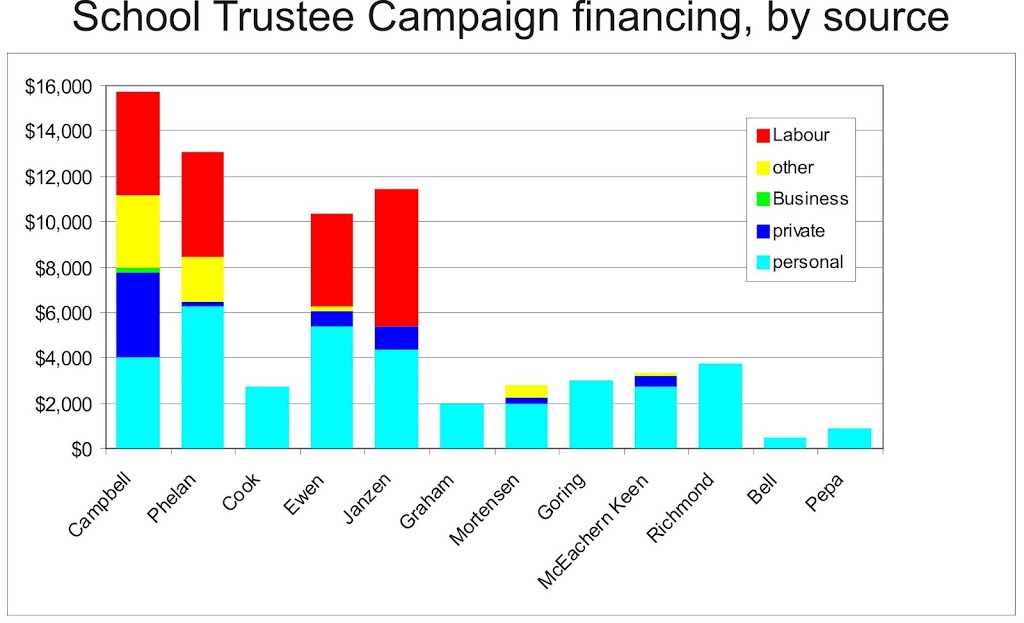
Look at the money raised by the candidates (order from left to right by the number of votes, Mortenson crossed the elected threshold, Goring did not):
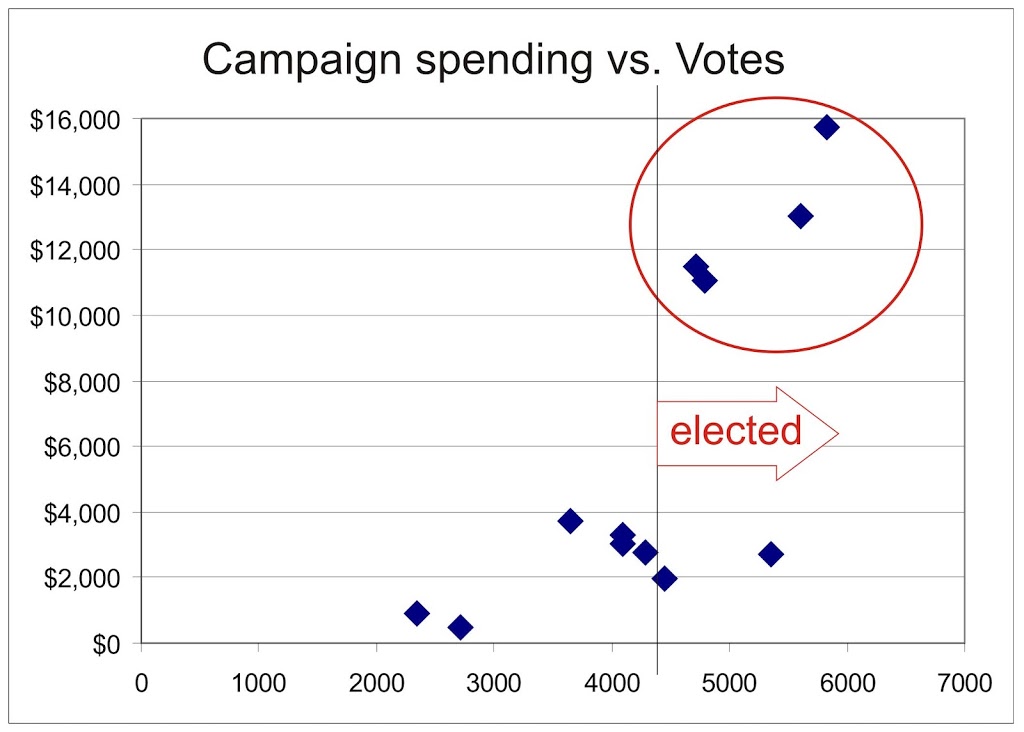
Of course, the outstanding numbers here are the money provided by “Labour” to four of the candidates, all elected. At and average of $4,800 per candidate, this clearly puts those four candidate way above the rest of the field in spending. Actually, without the money from Labour, they would have still been the top four spenders in the election by a healthy margin. So the utility of having all that extra cash is suspect. Especially if you plot the number of votes vs. the amount of spending:
Note those 4 circled outliers: that is the strange result of the labour funding.
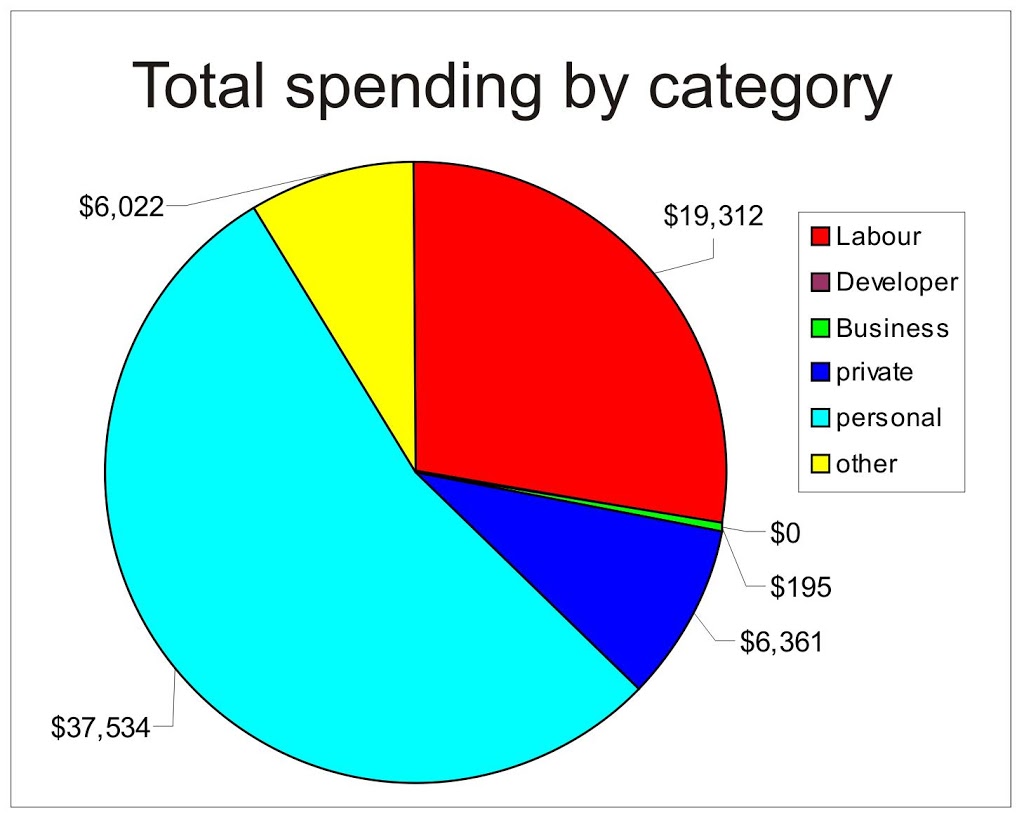
There are other trends to take note of. Jonina Campbell was the most effective fundraiser (even discounting the Labour money) by far. I suspect that had much to do with her rather refreshing approach and her very effective public speaking during the campaign. The amount of personal money that most candidates sunk into the election was also significant. Spending by the candidates themselves totalled almost $40,000 and almost twice as much as Organized Labour spent on the School Board campaign in New Westminster.
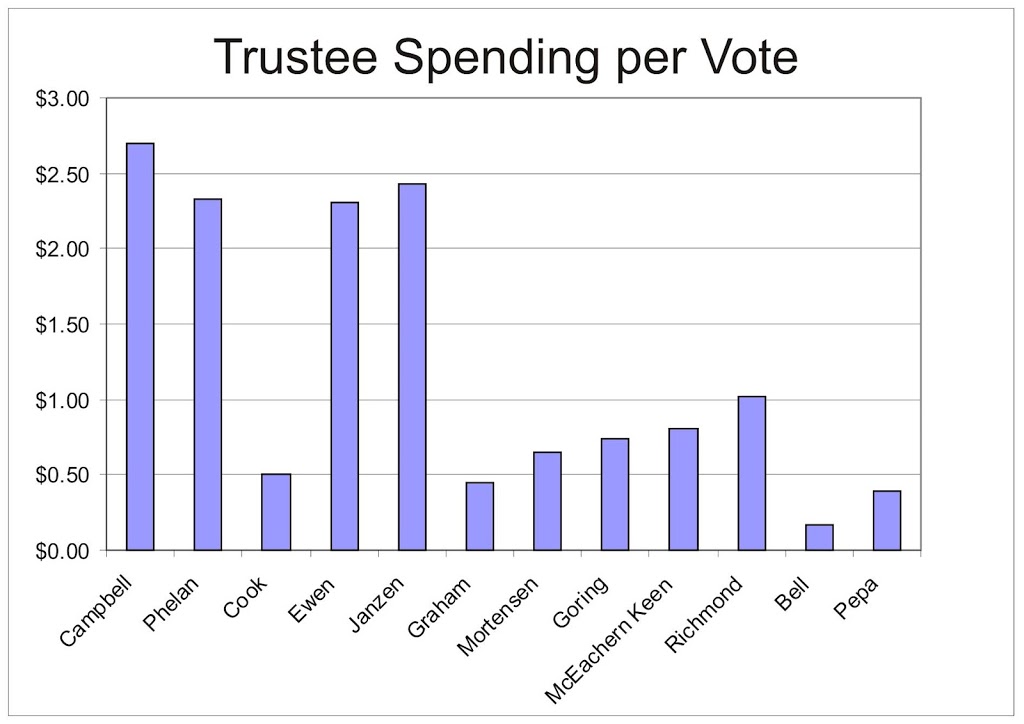
Finally, a bi-modal distribution shows up again when you plot the amount of money spent by candidates per vote.
The Labour Council-backed candidates all spent a little more than $2 per vote, where the non-affiliated candidates all spent less than $1. More remarkable is that, outside of the vetted 4, there is little correlation between spending and the vote received. In the non-labour affiliated subgroup, the value of the candidate seems more important than the money spent.