Windows, part three.

Our window replacement project now complete, it is all over but the Blogging

Really, our choices were vinyl or wood. Aluminum had no real advantage, fiberglass was out of our price range, as were wood-clad or other complicated hybrid window styles.

So we did what most semi-informed consumers do, we delved into the marketplace.

Full disclosure here, Tig and I are bad consumers. By that, I mean we just don’t do the shopping thing well. To say we have high sales resistance is to downplay the problem. It is more that we rarely find anything worth buying. A trip to the Mall is something we avoid at all costs, as it fills us with what Hunter called “Fear and Loathing”. I simply do not enter the retail environment in the month of December. When one of us decides we need to buy something, say, a shirt for work, we steel our resolve and enter the fray, and rarely come out satisfied with our purchases, and more often walk out having bought nothing, realizing that we are not the target market for anything. The modern consumer experience is not designed for us, and we are not designed for it. So why force the issue?

So when Sssssalesmen start coming to our house with quarter-cuts of windows as samples and lots of glossy brochures, to do a few measurements and drop us an estimate with an abstract 5 digit number on it… this is usually a bad experience for all involved. I am not going to name any of the non-successful bidders, they live in their own window-sales Hell, may the Flying Spaghetti Monster have noodly mercy on their souls. Suffice to say, we saw them all, or a wide enough sampling so as to be statistically significant.

We asked a lot of questions, and some were better at answering them than others. The higher-priced people made compelling cases for rigidity of the vinyl, for higher numbers of void spaces in the window frames, for colour options, for muntin designs to match the heritage of our house.

The problem with vinyl becomes pretty clear: if you want a strong structure with lots of void space for thermal efficiency, there needs to be a big, thick window frame. Making that big, thick window frame fit into the pre-existing hole in the house, without getting into expensive and difficult mucking about with stucco and plaster and drywall, you start to lose significant window space. In a 1940 house with relatively small window space to start with, this becomes significant.

Also, vinyl, for all it’s flexibility in design, is kind of ugly. You can have pretty much any colour you want, but white is about the only colour offered (economies of scale limit the ability of these companies to extrude numerous colours locally). The size of some of our double-hung windows limited the ability of their relatively weak frames to support the structure; so many sssssales people pushed us to alternate styles that were less appealing. The design elements (muntin grilles, opening hardware, etc.) were generally cheap-looking and added on, and took more away from the look than they added.

Then there were uncertainties about the install. We had guys promise to do the total install of 19 windows in one day, “no problems”. That is a pretty bold promise to make in a 70 year old house after 2 minutes of looking at a window. It did not instill confidence that they would be taking utmost care or managing unforeseen issues with my best interests in mind. One test of this was to show the ssssssales person that crappy downstairs install I pointed out earlier. The range of reaction we got were telling. Some were aghast that anyone would slap a window in like that, while others basically said, yeah, it doesn’t look too bad, must have been a funny sized opening… you should maybe add a little silicone… . Needless to say, that quick-filtered many proposals (and, perhaps not paradoxically, those were generally the lowest bidders).

Another irritant was never really having an impression of how the windows in their glossy brochure would look in our house. Invariably, the ssssales guy would show up with a ¼ of a window so we could see the void spaces that made them so efficient, but rarely with a complete window. Some offered local references, and this lead to us wandering the streets of Queens Park and West end looking at (not through) innocent people’s windows. We also tried to go to any showrooms or warehouses so we could put our fingers on the actual product, see what it actually looks like. This caused some of the ssssales people discomfort, and some companies really didn’t have a showroom or display product (other than the ¼-cut window with all those wonderful void spaces!) to show. Is it just me, or is asking someone to spend 5 figures on a product they really haven’t seen a normal thing in sales?

After a couple of months, and more than a dozen sales folks, it seemed we were back to Square 1. Exploring the options for wood windows lead us to a couple of fairly large and well-regarded companies, and initial meetings looked good. We got to go to an actual showroom to look at actual windows, install options looked good. Unfortunately, being a relatively small project to some of these companies, it seemed options were limited. Not totally limited, but very cost limited. As these windows were manufactured in far-off places familiar only from Coen Brothers Movies, every little deviation from a “standard” size of install added up quickly. Wood manufacturing does not have the flexibility at the factory level that vinyl does.

Then we found a local company that seemed to get it. They made wood windows specifically for the heritage-home market, and their ssssales guy was also the owner, so he was interested in making us happy instead of his commission. He was also very straight-forward about what was and wasn’t possible in our house, he was realistic about what we could (and should) do. He was incredibly patient taking the time to answer our questions, but didn’t call us every day to try to close the sale. He was also asking a little more than we wanted to spend. But pretty soon in, Tig and I know we found our guy, we just needed to figure out how to get the windows.
Transportation news!

It seems that not all is silent on the transportation front.

Since the furor over the United Boulevard Extension erupted in December, causing Translink to delay plans and ask for their funding deadline to be extended until March, it has been pretty quiet around here. Here we are, halfway to the new deadline, and the public discussion of this issue has all but disappeared. Tenth to the Fraser has expended some energy trying to keep the discussion going in a productive way, with Chris Bryan’s well-considered column, and Matt Laird’s two-part analysis of the real issues with the grey-dotted-line-on-a-map referred to as the North Fraser Perimeter Road. But from Mayor, Council and TransLink? Silence.

That ended this week. We find out that discussions have been going on between TransLink and the City, and apparently, the City is not totally thrilled with where they are going.

This week in New Westminster Council, there were surprise discussions of these negotiations. Surprise, as they did not appear any of the Agendas produced for Monday’s Council meetings, so anyone actually interested in the subject would not know to show up (is this what Voice is complaining about?). Also surprise, as it seems most of the actual discussion took place in closed session, so we don’t have a full understanding of the process, but I will hit that issue later.

Anyone who is interested can download the video of the council meetings courtesy of local rabble-rousers and tech guru Matt Laird. The UBE topic comes up (unannounced, but apparently known to all present) around 1:30:00 on the recording.

Some of the context of the discussions is in the earlier Public Delegations from Dave Nicholson Mary Wilson, and (?) from Brow of the Hill talking about pedestrian safety in the City. As an aside, it is great around 0:35 minutes where Mary talked eloquently about how reactive responses to single pedestrian danger points is missing the point of making the entire transportation system friendlier and safer for pedestrians, to which Councillor Osterman comes back with a recollection of a single incident of pedestrian safety that they took care of…ugh… completely missing the very point Mary made so clearly. Even this was wiped from my consciousness 5 minutes later when Councillor MacIntosh blames pedestrians for wearing too much black… essentially blaming the victim for the crime of not being able to keep your 3000lb steel toy from running into them. I try not to be too critical of our elected officials, but that is a dimwitted comment to make.

Oh, and Councillor Harper referring to a popular search engine as “the Google” is funny.

Then it was on to the surprise UBE discussion. Right off the bat, I need to say that I recognize that negotiations involving potential real estate transactions, financial negotiations with other agencies, and some other fiscally-sensitive issues must be carried out in camera, and this is why the Local Government Act gives the City the power to hold in camera meetings. However, transparency in government is necessary, especially in election years. So here we have aspects of in camera sessions being brought to the public.

Long and short of it: Council, to their credit, said all the right things. They reiterate that their motion in December on the UBE stated that they would not endorse any UBE plans unless they include plans for the entire NFPR, from United Boulevard to New Westminster’s western borders. Apparently Translink brought some proposals to the City in a January 19th letter, and Council was not satisfied. According to Councillor Cote, it was really nothing new, and didn’t address the issues the City raised in December. Councillor McEvoy was even more vociferous, chiding TransLink for attempting to rush the City and for not performing appropriate public consultation back in the fall. I also like his clear message that New Westminster is only 7 square kilometres, all of it built out, and we do not have the free space to accommodate road expansion (This will do doubt be a major argument come Master Transportation Plan time).

Good news is that TransLink is supposed to be back for next weeks Council Meeting (the 14th), so if the UBE interests you, it wouldn’t hurt to show up. Oh, it’s budget night to, so fun all around.

Then there was this news that TransLink is considering not replacing the Patullo, but instead may just refurbish it. This “news release” was strange, in that there was no mention on the TransLink webpage, no obvious press release, just an article by Jeff Nagel for Black Press, and a story on CKNW (a cynic would say directed at Liberal supporters South of the Fraser two weeks before the Premier Falcon Coronation… uh… I mean Liberal Leadership Vote). Regardless, if this announcement marks a change in policy about the Patullo (either from the Province or from TransLink) then the earlier assertion by TransLink that the Front Street / NFPR works would be done as part of the Patullo project means that these changes are back to the drawing board.

This is actually good news for New Westminster. To potential of replacing the Patullo with a larger bridge with more lanes will be another UBE-type debate: increasing the capacity for cars to get into our City without concomitant infrastructure to deal with the traffic once it is in the City, resulting in more traffic, more congestion on our streets, more “rat running”, less pedestrian safety, and a less liveable city. The only difference is that this debate will include Diane Watts, which makes it louder.

Of course, traffic is already anticipated to increase significantly on the Patullo when the tolls for the Port Mann kick in, which has raised suggestions that the existing Patullo should be tolled as well to manage this issue, but that is another issue for another time

The Master Transportation Plan, Background

The City of New Westminster is currently working on a Master Transportation Plan. The process to update the City’s 10-year-old transportation planning document was initiated n 2010, and will hopefully be completed in 2011 (the plan has been delayed somewhat by “staffing changes” in City Hall). As I suggested at my year-end looking back/looking forward interview with the News Leader, the MTP should be the #1 environmental issue in New Westminster this year, as nothing will have more influence on the liveability of our City in the decades to come than this plan and its successful implementation. With the UBE Experience behind us (for now) and the NFPR breathing down our necks, the City needs to get it’s transportation priorities down, or decisions will be made without us.

So what is a Master Transportation Plan? It is the high-level guidance document that outlines what the goals, priorities, and needs of the City are in relation to its transportation infrastructure. Usually, it is a high-level document, which creates broad guidelines, as opposed to providing details, it is more likely to state that all sidewalks should be accessible to people with disabilities, instead of detailing the dimensions and slope of the perfect curb cut. It sets guidelines that the engineers and planners can use to do their work. Think about the MTP as the Constitution: it doesn’t create laws, but all laws must be compared to it to see if they comply.

Once the MTP is created and accepted, then every transportation project in the City can be assessed compared to that document. If the project meets the goals and priorities of the Plan, it is easy to approve. If it doesn’t, then the project has to be adapted. In theory, this assures that the complex integrated system that is the “transportation infrastructure” all works together, instead of being a slapped-together patchwork. The end result should be lower building and maintenance costs due to efficiencies, reduced overlap or competition between projects, and ultimately, a less expensive, better organized transportation network.

So perhaps you can see why it is so important to the City that the MTP is right, and how important it is to the liveability of the City.

The big issues are outlined on the City’s website on Transportation Planning: pedestrian safety, cycling infrastructure, transit access and service, the volume of regional traffic through the City, air quality, and noise. Further, the City states that the MTP “will focus on principles of sustainability, social liveability, environmental stewardship and economic prosperity”.

This is a promising start, as it seems to put the emphasis on sustainable transportation choices, increased safety for all road (and sidewalk) users, and increased liveability.

There are two other documents that are already available from the City that will provide guidance for the MTP. They are the (now slightly dated) “Official Community Plan”, and the “Livable City Strategy“. Both of these documents make many of the same points: sustainable transportation alternatives (walking, transit, bicycles) need to be encouraged, and building more roads to accommodate more traffic will only result in more noise, more pollution, and more congestion.

Over the next couple of months, I hope to Blog quite a bit on the MTP process. The NWEP Transportation Group is also watching to see how it develops. It is the documents above that are going to provide a framework for the discussions. If you are interested in the topic, you might want to read them. And you should be interested, both because it is important for the City, and because the City will be looking for public input into the plan, through consultations. We don’t know what those consultations will look like, but it would be great to be informed when the call comes.

There are also many examples of Transportation Plans available on line, most Cities have them. Here are links to a couple of interesting ones:
Vancouver (showing how “Gregor’s Bike Routes” were planned in 1997).
City of North Vancouver (A city with similar demographics and challenges as New Westminster)
Coquitlam (as cautionary example).
Burnaby (our closest neighbour)

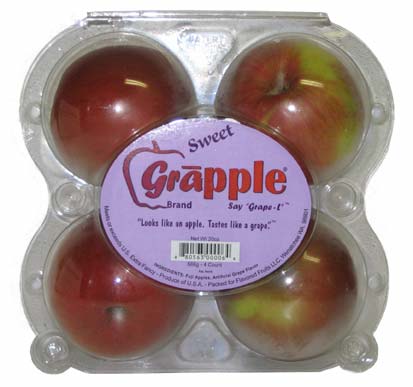
The end of civilization will be Grāpe® flavoured.

The Clean Bin movie was great. Well attended, and a well-shot and entertaining movie with surprisingly high production value and humour. The filmmakers were friendly and engaging, and had a nice Q&A session after. It was a good evening.

A few people wondered how the film topic (reducing trash) meshed with the food security ideals of a local Farmers Market. In the film the link became obvious. Through trying to reduce excess and non-recyclable packaging, the filmmakers ended up buying more food at the local Farmers Market, while being exacerbated by trying to purchase food at the local SupraMarket without packaging. They also found themselves eating better and saving money, as whole foods replaced processed food in their diet.

Which brought me to think about a book I read a few years ago, ”The End of Food” by Thomas Pawlick. The book begins with his description of the modern tomato, closer to a tennis ball than it is to the tomato that previous generations loved. Due to selective breeding for characteristics like shelf life, durability for shipping, predictable ripening time, and size, the consumer tomato has undergone evolutionary change. Unfortunately, flavour and nutrition are not two things that are selectively bred towards. Therefore, tomatoes are puffed-up, bland, tough, nasty brutes compared to the Tomatoes of our parent’s youth. Worse, according to the USDA’s own reports, the modern tomato contains significantly less vitamin A, vitamin C, calcium, potassium and protein than they did 50 years ago. They do, however have 65% more fat, and more than twice as much sodium as they did in the 1960s.

There is no doubt that factory food production and delivery has made more kinds of food available to more people. Unfortunately, the actual food is commonly less healthful than it once was.

That said, I am not a big believer in the “organic food” movement. The term “organic” is so fuzzy as to be meaningless, and too often people shut off their critical thinking and assume “organic” means it is good for you or more ethical, in the same way we have (still do?) with “whole grain” or “Fat Free”. If there is any diet idea I can agree with, it is Michael Pollen’s “Eat food, not too much, mostly plants”. As such, I spend most of my time in the grocery store around the outside walls, where the veggies, meat, and other food is, and away from those inner aisles where the food-inventions in boxes-in-foil and foil-in-boxes are shelved. As long as we have produce, we won’t starve.

Until I saw the Grapple® at my local Cave-in Foods. There, in the fruit section, between BC and Washington state apples of various variety, is a plastic-packaged 4-pack of apples. Intrigued by the wasteful packaging choice, I was horrified to read what the product really was.

An artificially flavoured apple…

Apples are, hands down, my favourite food. I eat one every day if I have access. Hate apple juice, like apple pie, can give or take dried apples, but absolutely love a fresh, crisp apple. Granny Smith (when crisp), Macintosh (when you can get them from the fruitstand in Keremeos) or Fuji are my favourites. It never occurred to me that impregnating an apple with artificial grape flavour would be an improvement.

Don’t get me wrong: I like grapes. Grapes are great in all their forms, except the form of an apple, a banana, a grapefruit.. any other form of fruit.

Artificial Grape Flavour is great for getting children to take cough medicine, but an asinine way to get a kid to eat an apple. It is like mixing single malt scotch with Grape Tang, I don’t care if you like it better that way, it is wrong to the core.

What does this say about our society? That we add artificial flavour to fruit in the produce section? Or that people are actually shelling out $5 for a plastic-clamshell 4-pack of apples with artificial flavour when they can get 6 apples and a pound of grapes for $5?

I wept for mankind.

On Farmers Markets and Clean Bins

The Royal City Farmers Market is one of the Jewels in the crown of the revitalized Royal City, and it is just the kind of grass-roots community building organization that the NWEP exists to support. The RCFM has grown and prospered to such a scale that it hardly resembles the nascent organization that appeared only a couple of years ago. Current RCFM President Andrew Murray and a core team of volunteers and staff have made the Market a weekly ritual for Queens Park, Downtown and Brow residents, while attracting customers and hangers-on from Sapperton the West End, and other parts of the City.

The introduction of monthly indoor Winter Markets last year was rewarded with great crowds, as the combination of preserves, prepared foods, crafts made up for the lack of variety of farm-fresh local veggies and fruit we are used to in the summer.

Last year’s Fundraiser at the Heritage Grill was most memorable for the apologies the staff and volunteers were handing out for the overwhelming response. The place was so crowded, that it took longer than usual to get drinks or the meals prepared. But no-one was complaining as the music and the company were great, as was the charity auction.

This year, the RCFM folks have decided to spice up their Societies-Act -mandated Annual General Meeting with a screening of the film “The Clean Bin Project”. I haven’t seen the film, but am aware of the filmmakers and their project to go without producing waste for one year, as the Glenbrook North Zero Waste Challenge folks were all over the story.

Apparently the movie is inspirational and refreshing in that the do-gooders in the central role don’t take themselves to seriously, or even try to suggest this is a viable option for most people. It is just intended to be an eye-opener to a subject that we all take for granted:

The Clean Bin Project – Trailer from Grant Baldwin Videography on Vimeo.

So, go to the RCFM AGM, and see what a dedicated group of community activists can create.

See the Clean Bin Movie screening, and see what a couple of dedicated local activists can achieve.

Support the next RCFM Winter Market, on February 12th.

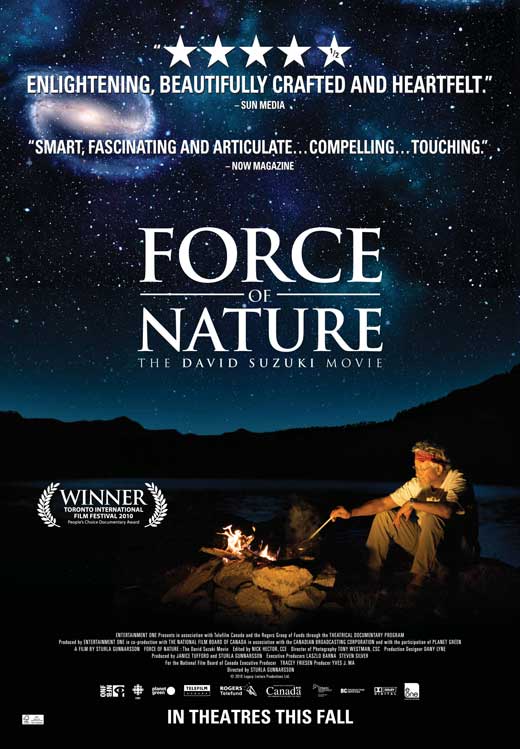
Force of Nature Review

I am not a movie reviewer (I think Machete might be the best movie I saw in 2010, but I was real tired at the time), but here goes.

The movie was, much like its subject, interesting as much for its flaws as its message.

The film combined footage from Suzuki’s “Legacy Lecture” tour stop in Vancouver with biographical vignettes, which blended archival photos and film with footage of Suzuki visiting those places most important in his 75-year life.

And it is interesting to see the things that influenced his development into the Icon we all recognize. He begins with the bombing of Pearl Harbour when he was 5, which he describes as the pivotal moment in his life, as it set the course of his 1942 internment, his 1946 relocation across the Rockies, and his growing up as an outsider in a small Ontario town, and the complex relationship with his home that he in part inherited from his father. He discusses his introduction to research science, benefiting from the “Sputnik Moment” recently referenced in Obama’s State of the Union address (and hilariously bungled in Sarah Palin’s rebuttal), and he eventual disillusionment with research while immersed in the counter-culture of late 1960 Vancouver. We see his introduction to broadcasting, and his discovery of the huge range his voice could have, and how he leveraged this into activism, most notably in the preservation of pristine watersheds in the Haida Gwaii.

It is an interesting journey, and he has had a remarkable life. But there is no attempt here to sugar coat his history, or his person. His dedication to research and inability to give his wife and children the attention they needed cost him a marriage. The film also didn’t shy away from showing the now silly-looking pot-philosophy trip he was groovin’ in the 60s. To a scientist, his arguments around the responsibility of research scientists in a world where all science shares ideas and one could not control how one’s research is used are intellectually weak. It also seems to be an argument that belies his current ideas about how we need, as a species, to learn. But few of us would like to be judged by the ideas we formulated in our 20s while under the influence of premium Mexican sensimilla.

Which brings me to one of the problems I have always had with Suzuki as a spokesperson for science. He too often gets his science mixed up with his spirituality. He does this here again with his blending of the real science of the Big Bang (which he irritatingly calls an “explosion”, when it is nothing of the sort) and the formation of matter with “love” as an attractive force on par with gravity. Philosophers can use science, and scientists can have philosophies, but muddying them up like that in the guise of science education does a disservice to both, and unfairly lumps too much pseudo-science in with true insight.

The same complaints cannot be used when he talks about sustainability, though. His message is not in the least bit muddied there. We are using resources faster then they can be replaced, and we are the last generation that will (for example) have a Bluefin Tuna Auction. Humans do not exist outside of, or apart from, the environment, we are immersed in it so intimately that the exhaust from our cars goes into our lungs and mixes with our cells. We become the exhaust from our cars, the neurotoxins in our pesticides, the plastic in our seas.

The filmmakers made some interesting choices. They didn’t interview anyone about Suzuki, other than Suzuki (with the sole exception of a 10-second sound bite from his current wife). Some of the people around him are completely absent, including his “best friend” (who is briefly mentioned but not seen), or his political allies and detractors. This sometimes gives it the vibe of a vanity project, and does little to dispel the common idea that Suzuki suffers from in inflated self-image, They also insisted on using a strange fast-zoom-in technique, presumably to create emphasis that may have been lacking from Suzuki’s relatively unexpressive visage during an important part of a discussion, or maybe it was to try to make him look like Batman. Regardless, it was distracting at first, irritating the 20th time.

Overall, the movie was effective. Suzuki is an interesting character, whose flaws as a person or as a scientist do not take away from the essential truth of his message: the planet has limited carrying capacity, and the way we measure value in our economy is not the way we measure value in our lives. It is this disconnect on the definition of “value” that is resulting in the destruction of the very biosphere that sustains us.

Movie Night

Love him or hate him, you cannot deny his impact. There has been no one more strident and resolute about environmental issues in Canada in the last 25 years than David Suzuki. To truly understand the impact he has made, just surf over to the Right Side of the Internet, and see how much rage and vitriol is directed towards him by the Climate Change Denier crowd, by the CBC haters, and by pretty much anyone who thinks Corporations matter more than Cooperation.

Tonight at 7:30pm at the Massey Theatre, there will be a showing of an award-winning biographical documentary about Suzuki, his life and times, and the experiences that made him such a Force of Nature.

Even if you disagree with him, it is worthwhile going to see the film. Partly because, as Sun Tzu says, you must know your enemy. However, it is also a chance to support the New Westminster Arts Council, as this is part of their monthly “Last Monday at the movies” series.

See you there!

The MUCF open house

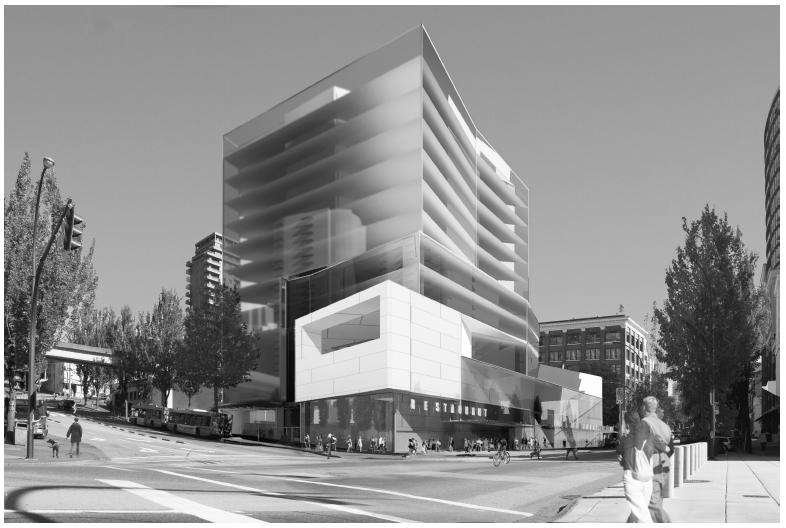
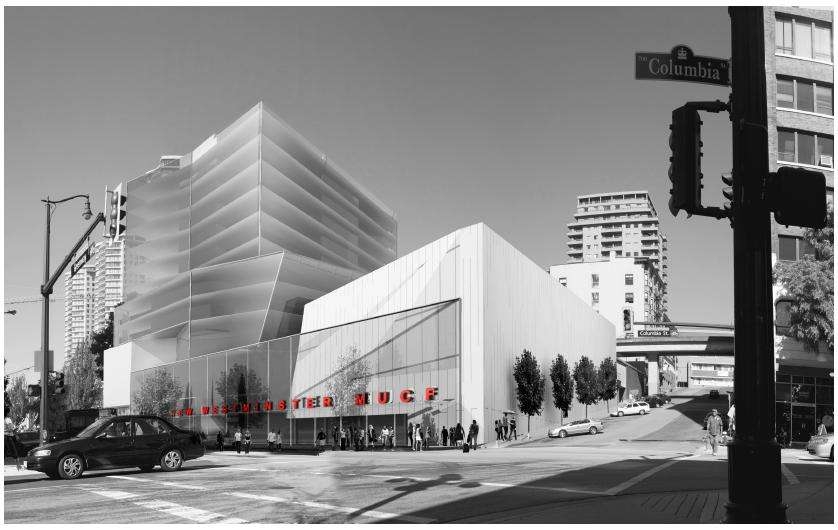
Thursday, the City held a public open house to garner feedback on the new Multi-Use Civic Facility, planned for the 700 block of Columbia Ave.

It was remarkably well attended, and there were lots of staff about to answer questions, but I liked that they were there to ask questions as well. I was approached more than a half dozen times with staff members asking what I think, or if I had input: you get the sense they really wanted to hear from us (note to TransLink: hire New Westminster Planning to facilitate your next open house, I’m sure their rates are reasonable). It was also a great idea to hold the open house at the Westminster Club, on the 7th floor overlooking the site where the MUCF will be built.

The project is somewhere beyond the visioning stage, but the design is clearly not quite done. The model was balsa wood, and was good for getting a sense of the mass and layout of the building, but not an idea of the real appearance. There were several design-type drawings, but no complete picture of what the building will look like (more on this below). However, I walked out of there impressed with the concept, and excited about what it means to downtown New Westminster.

There is much to like. With the completion of the commercial part of the Plaza 88 development, there are going to be big changes in this neighbourhood. Movie theatres and restaurants right on the Skytrain station are a potential game-changer. This will be the most accessible movie theatre for the Lougheed Mall, and SFU crowds, and will even be easier to get to than Guildford for a lot of people in the new Surrey Centre. The food, drink, and entertainment options on the street immediately adjacent that development are going to have a huge impact on the success of the Columbia Street renewal, drawing in pedestrians and shoppers. This building will be the keystone.

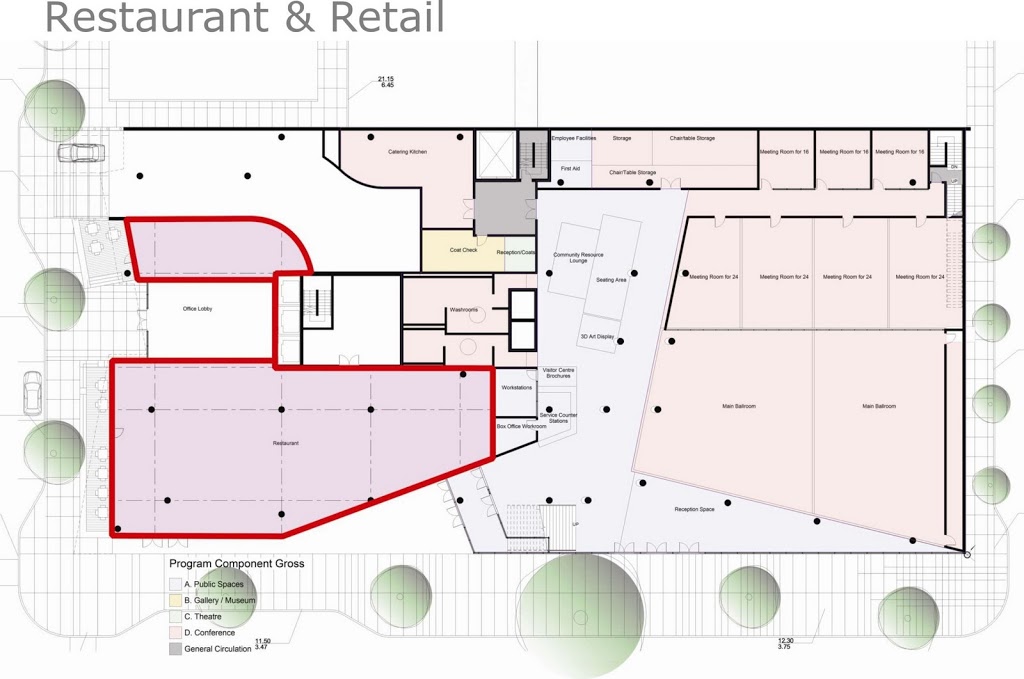
The restaurant space on the corner of 8th and Columbia is a smart move. No names of potential tenants are being mentioned (for obvious reasons), but a popular mid-scale local chain (think Earls, Cactus Club, etc.) would be an obvious fit. It is clear they want the restaurant to have street appeal: open window space and a large patio to bring the restaurant out onto the street. My only complaint is the plans have the deck on the 8th street side, where we really need it on Columbia if we want to connect to the rest of the businesses in the area, from Waves to the Heritage and all the way up to Brooklyn. Restaurants are about the only business (other than wedding shops apparently) that benefits from having more competition in he neighbourhood. The deck/patio will also lead to more engagement of Hyack Square, and we will have to wait to see what happens with the third corner at Columbia and 8th. I can’t help but feel the Sally Ann is going to increasingly be out of place on this new “entertainment core”.

Click to zoom in

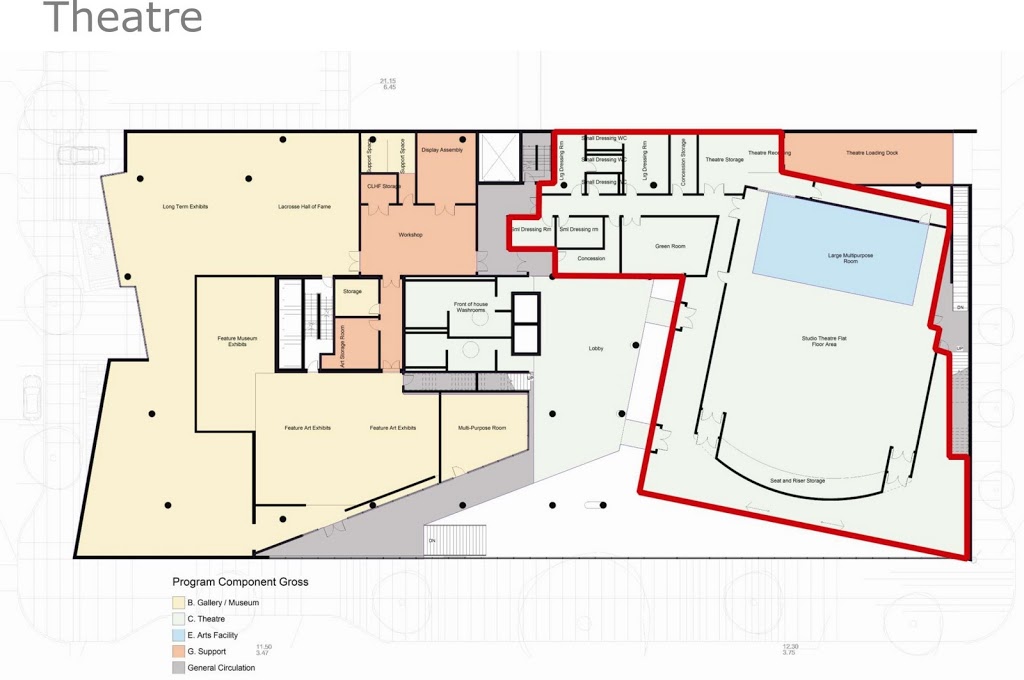
The planned theatre space in the MUCF also looks great, a mid-sized and very convertible space. Small concert and performance space is lacking in the City, as our existing theatres downtown seem to be limited to single-use only (tickle and giggle, respectively). At 1/3 of the seating capacity, this will not threaten the (New! Improved! Eventually!) Massey Theatre, but the potential for smaller arts productions, for local music, and for screening space for indy films and docs is pretty exciting.

Bringing the City Archives, the City Museum, the Police Museum and the Canadian Lacrosse Hall of Fame together under one roof will also bee a boon. With the Fraser River Discovery Centre just across the tracks, we will have a one-stop-shopping “museum core”, with a gift shop and food options attached. Finally, when friends and relatives are visiting for a day, we can give them a spot to go to entertain themselves for several hours, without having to send them to Vancouver.

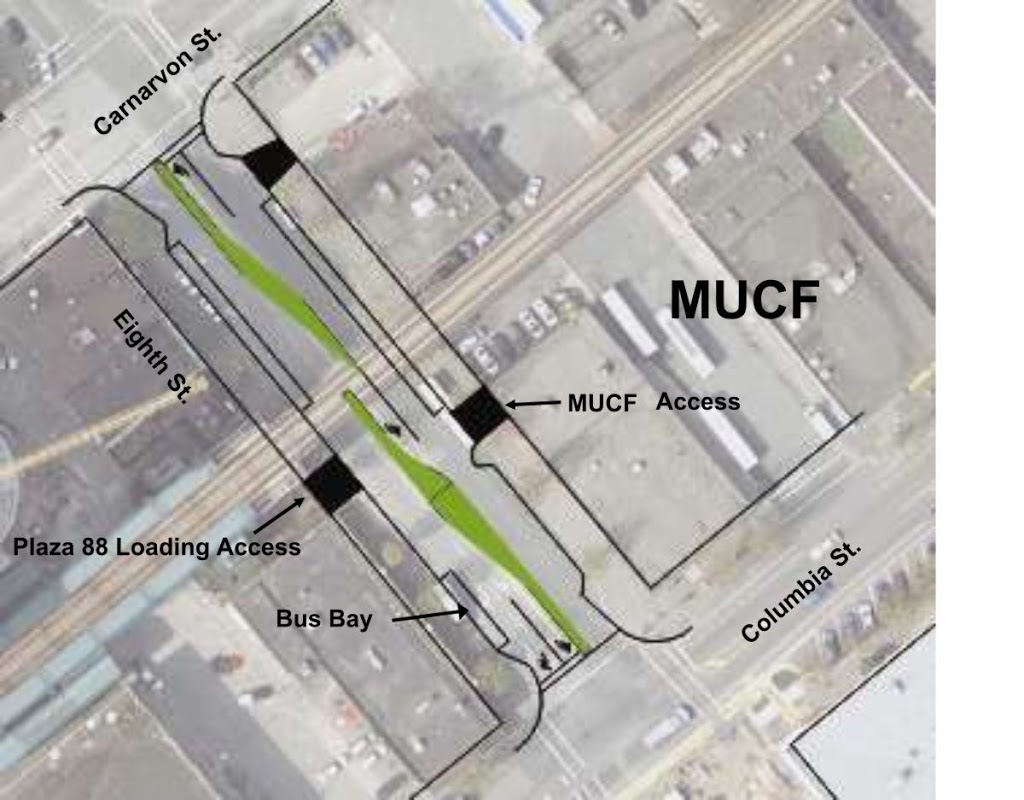
The transportation planning around the facility has not been finalized, but I can already see a few concerns. The re-vamping of 8th Street between Carnarvon and Columbia will have to be approached with caution. Presumably, there will be no bus stops on 8th once the loop at Plaza 88 is completed, but the previous crossing issue at 8th at the SkyTrain exit will remain. People will still want to cross mid-block from the station to the new MUCF. It is too bad an elevated walkway from the Skytrain to the east side of 8th is not included in the plans.

Worse, when one leaves the Skytrain Station and the Plaza 88 commercial/entertainment centre, you will be greeted with a view of the garage ramp on 8th. Why stick a garage entrance right in the middle of your façade? We want this area to be as pedestrian-friendly as possible, and a garage entrance crossing the sidewalk does not do this. This area needs a re-think, and I suspect the answer will be to stick the cars (and garage entrance) around back on Begbie.

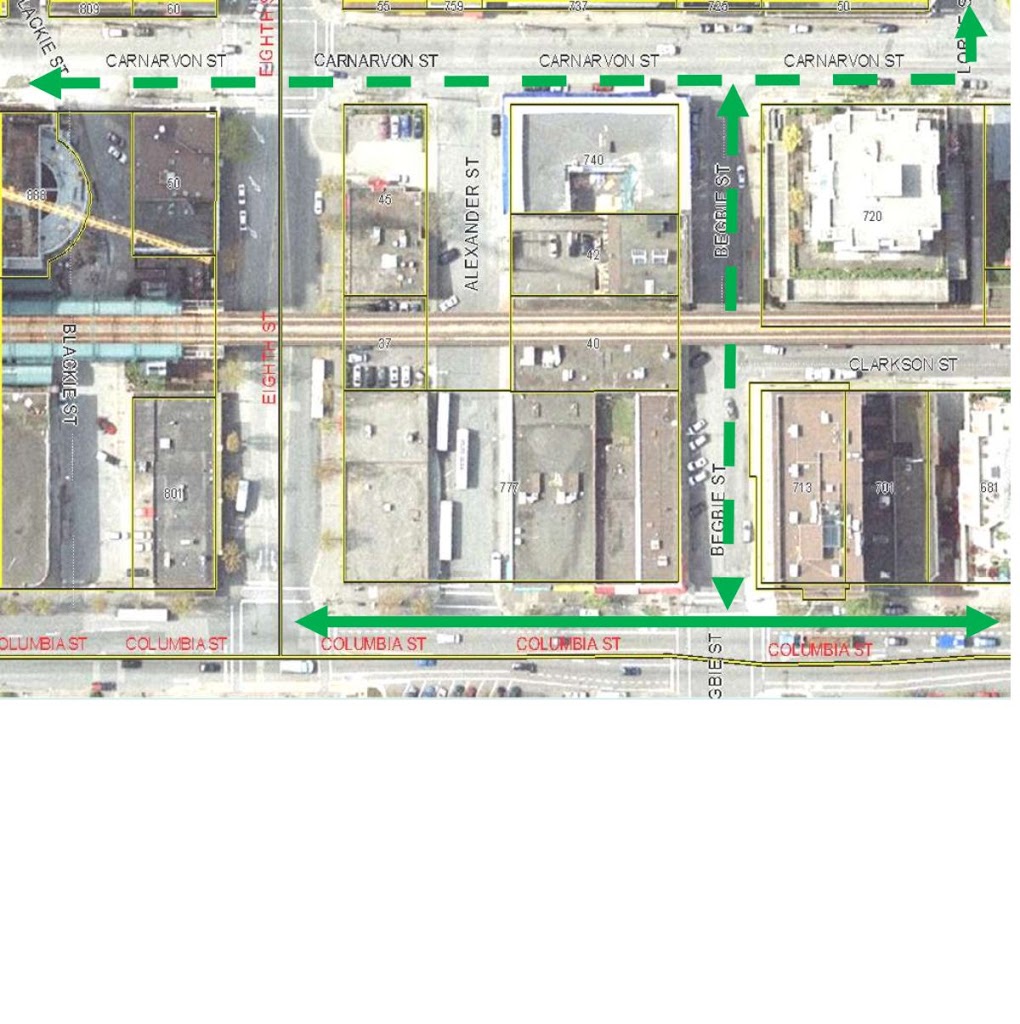
The plans show the use of Begbie as the Greenway connector between Columbia and Carnarvon, which is a sub-optimal solution. The slope on 8th between Carnarvon and Columbia is less then 8%, which is a much more bike-friendly grade than the slope on Begbie (higher than 10%). The Central Valley Greenway should connect to Hyack Square and the New Westminster Skytrain directly, along Columbia to 8th. For these reasons, 8th should remain the connection between Columbia and Carnarvon for bikes, with cars accessing the underground parking along the much-less-trafficked Begbie side.

The idea of closing Alexander Street and using it only for loading is great, but let’s be sensitive to what it means to the people in the low-costs housing around there, who will now be shadowed by a new tower, will be facing a loading dock for their front yard, and will have reduced access to Columbia Street. Some creative urban design might be needed here to head off a potential crime problem.

Again, this is early design phase, so these potential issues can be addressed simply, but they have to start thinking about them soon before too much detailed design is completed.

Which brings me back to design. The preliminary drawings are definitely “place making”. They have that big “I’m Here” look to them. However, much of the chatter around the room was about “where is the heritage?” Simply put, this building needs to fit the surroundings. I love the Chicago-school Westminster Building and Trapp Block. I am not a big fan of the “modern-glass-tower humping a heritage façade” technique used at the InterUrban, but recognized that the requirements of the modern Condo market (balconies, floor-to-ceiling windows, etc) made this the best we could hope for. I will be interested to see how the Art-Deco Façade at Plaza 88 is preserved, and how it fits those hideous-looking pseudo-Soviet towers. Mostly, I love Art Deco (cognizant that it can go really bad really quickly), and would love to see that part of New Westminster’s heritage be accentuated, but that is very much a personal matter of taste.

Since there is going to be an office tower on top of this building, there is a lot more flexibility in design than there would be for a condo complex. As this is going to be the keystone building for the continued revitalisation of Columbia Street, it is imperative that the visual impact of this building represent New Westminster, both its iconic heritage, and where we want the City to be. It should be an interesting challenge for a talented Architect. The pictures I have seen so far, and the comments I heard around the room, suggest they are not there yet.

Oh, and I seriously hope “MUCF” is a working title, and we will find a better name for the building, but that is a minor detail, which we can debate in 2014.

Killer Bikes Lanes

Related to bike routes, and completely separate to yesterday’s post…

Being a loud-mouth and a “crackpot environmentalist”, I often get called out on various issues in social setting where people already know my position. I guess I am a fun guy to get a rise out of. Last night at the Curling Rink one of my buddies remarked to me:

“I think your bike lane on Dunsmuir got somebody killed today”.

He then regaled me with the story of a cyclist, an ambulance, and a scene that looked like a commercial vehicle turned right across the bike lane and struck a cyclist. I have no idea if any of the info he gave me was accurate, but I have no reason to doubt him. I can only comment on the allegation he made: a cyclist on the Dunsmuir Bike Lane was killed by right-turning truck.

First off, it isn’t “my” bike lane, and before you say it, it isn’t even Gregor Robertson’s bike lane. The dedicated bike lane on Dunsmuir (and the one on Hornby) are part of Vancouver’s Transportation Plan, which was written in 1997, under NPA Mayor Phillip Owen, and fully supported by COPE Mayor Larry Campbell, NPA Mayor Sam Sullivan, and Vision Vancouver Mayor Gregor Robertson. Four mayors, four administrations. They are a piece of a puzzle that has been assembling for 15 years.

Second, a bike lane can’t kill anyone. The story he told me was a commercial vehicle turning right where it shouldn’t have hitting a cyclist. It was the bike lane’s fault because cars used to be able to turn right there, and cyclists in the bike lane are hard to see for truck drivers turning right.

I cannot say this clear enough: in this alleged scenario, the truck driver killed the cyclist. He broke the law by turning right when the motor vehicle code said he could not. This is no different than someone going 100km/h through a school zone and plowing down a kid on a crosswalk. It doesn’t matter that the school zone was on what used to be an open road, or that the kid should have been looking for speeding cars prior to crossing the cross walk. No rational person would wave it off by saying “well, you know those kids are always crossing streets, usually not at crosswalks, the kid had it coming”.

And no-one would say to me “I think cross walk in that School Zone got some kid killed today”.

It is a manifestation of the post from yesterday: blaming the victim (or the victim’s advocates) instead of recognizing the real problem

Bikes in Richmond

This article pisses me off, as someone who cummutes regularly, by bike, to Richmond.

First, it has the regurgitated-press-release style of lazy journalism, but I can let that pass. It is the overall message that is sent that causes me tremors. That message, on the front page, is that cycling in Richmond is unsafe, and that it is the cyclists fault.

Let’s start off with the Stats:

“Between 2005 and 2009, there were 291 crashes involving cyclists in Richmond…including two fatalities.”

So a hair under 300 cyclist-related crashes in 5 years reported to ICBC. We can presume that if ICBC was involved, there were not people falling off bikes or hitting trees, these were impacts between bicycles and automobiles. But where is the context? Is 300 bad?

According to ICBC stats, there are, on average, 900 auto accidents per year in Richmond, resulting in an average of 10 deaths, which extrapolates to 4500 accidents and 50 deaths over 5 years.

“Mode share” for cycling in Richmond is around 3%.. That means for every 100 trips taken, about four were by bicycle. The mode share for cars was about 65% (with the rest being walking and transit), so to compare apples with apples, we need to lose the 32% others and say 3 in 68 trips (4.4%) were by bike, and 65 in 68 (95.5%) were by car. Then we can do the same with the accident statistics, and see how much more dangerous cycling is that driving:

                  As mode share      Accidents        Deaths
Drivers          95.6%                      94%             96%
Cyclists           4.4%                      6%                4%

Considering that drivers are surrounded by 3000lbs of steel and plastic, with seatbelts and airbags, and cyclists usually wear some combination of lycra and styrofoam, I think the numbers don’t really make cyclists a public health hazard.

Another way to look at the above numbers:
                                      total      cyclists were killed      people in cars were killed
Accidents with cyclists   6%                 0.6%                                    0*
Accidents w/o  cyclists  94%                0%                                     1.1%

So you are more likely to die if you are in a car crash, than if you are in a bicycle crash. If you are in a car, you have a miniscule chance of being hit by a bike relative to being hit by another car, and as far as I can read in the stats, not a single driver or passenger was killed in a collision with a cyclist (I cannot confirm this, hence the *). So if you are hit by anything in an accident, you are better off if you are hit by a bike than a car, and you are actually better off being on a bike when you are hit than being in car.

But the biggest stat here is that 6% of crashes involved bikes, but 100%, involve a car. I will come back to this.

First, let’s look at the “most dangerous intersections” outlined in the article: the Bike map for Richmond might be useful.

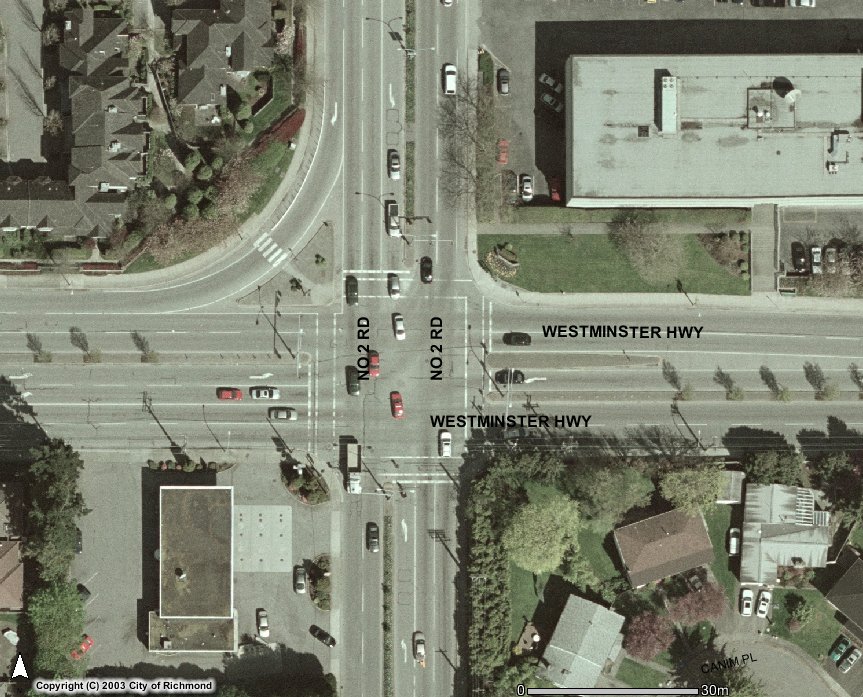
#1: No 2 Road and Westminster Highway (9 crashes).

Here is a location where a designated bike route along a major arterial (the No 2 Road Bridge and Russ Baker Way) abruptly comes to a stop at the crossing of two major arterial routes. Full 1.5m bike lanes evaporate into nothing except two 6-lane arterial roads with no shoulders that lead to residential areas. The southbound bike lane squeezes out into a right-turn only lane, with no shoulder to the right…not even a curb cut to give you the illegal but safer sidewalk bailout… I’m surprised there aren’t rotating knives.

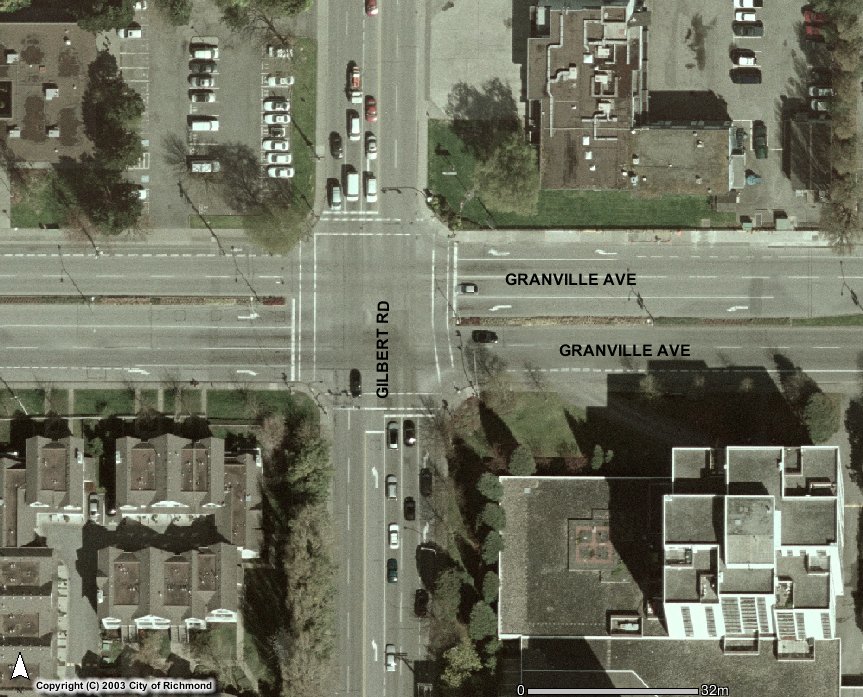
#2: Gilbert and Granville (8 crashes).

Here we have Granville, which is a dedicated bike route with full bike lanes on both sides, crossing Gilbert, which to the north is a dedicated bike route in name only (it has kind of wide shoulders, but no pavement lines or markings), and no shoulders at all to the south. Of course, the “bike lanes” on Granville both become “right turn” lanes at the intersection, confusing both cyclists and drivers, and the shoulder on Gilbert is wide enough that it acts as a defacto right-turn lane, even though it is not marked as such. The fact the corner is on one of the City’s destination public facilities (Minoru complex houses playing fields, pools, arenas, libraries, etc.) and Granville is the major east-west bike routh through town, it is no surprise this disaster of an intersection is up in the stats.

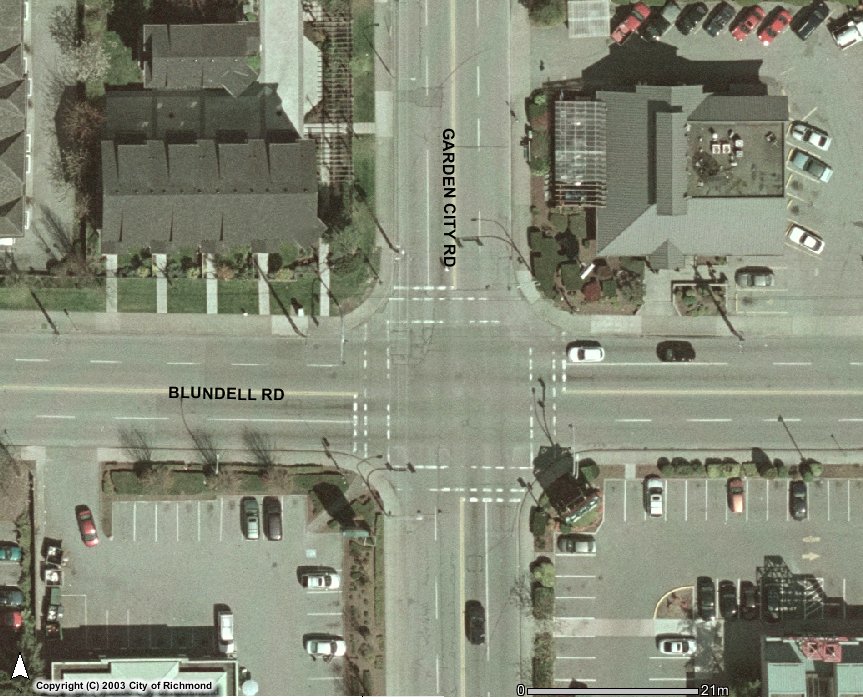
#3 (tie): Blundell and Garden City Roads.

This surprises me a bit, only because it is one of the few I don’t frequent. Garden City is a dedicated bike lane in name only (slightly wider shoulders, no pavement markings) and Blundell is an east-west racetrack with no shoulders. Also, the corner visibility is a little sketchy due to retail signage, and there is a lot of relatively dense residential area around, but there is little here to make this intersection worse than 90% of the others in the City.

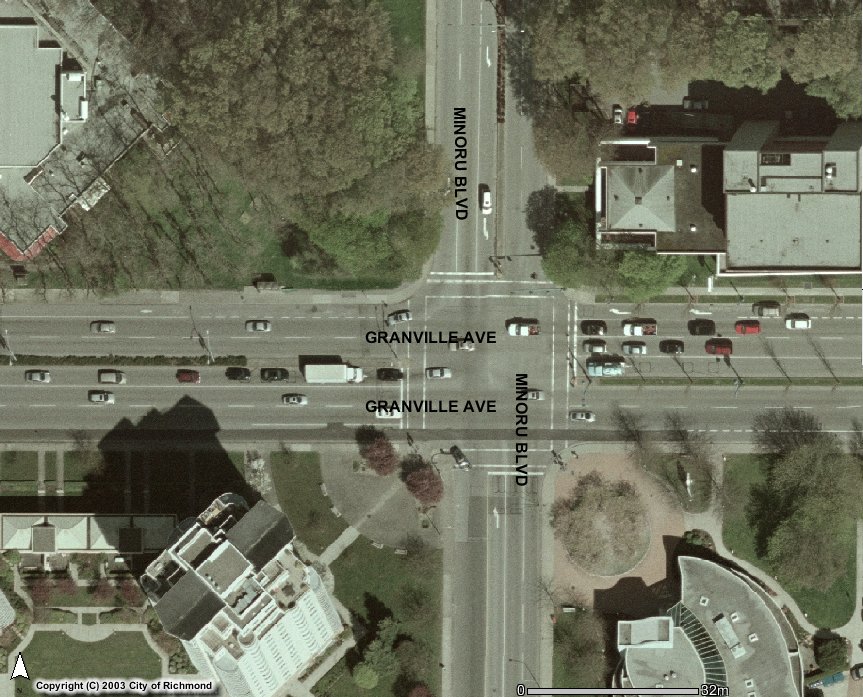
#3 (tie): Granville Avenue and Minoru Boulevard;

Take everything I said about Granville and Gilbert, adjust by the fact Minoru is not a dedicated bike route, and you have Granville and Minoru. Proximity to the Minoru complex brings the bikes along the main east-west bike route, the bike lanes become right-turn only lanes, Minoru is narrow with basically no shoulder. Bada-bing Ba da boom.

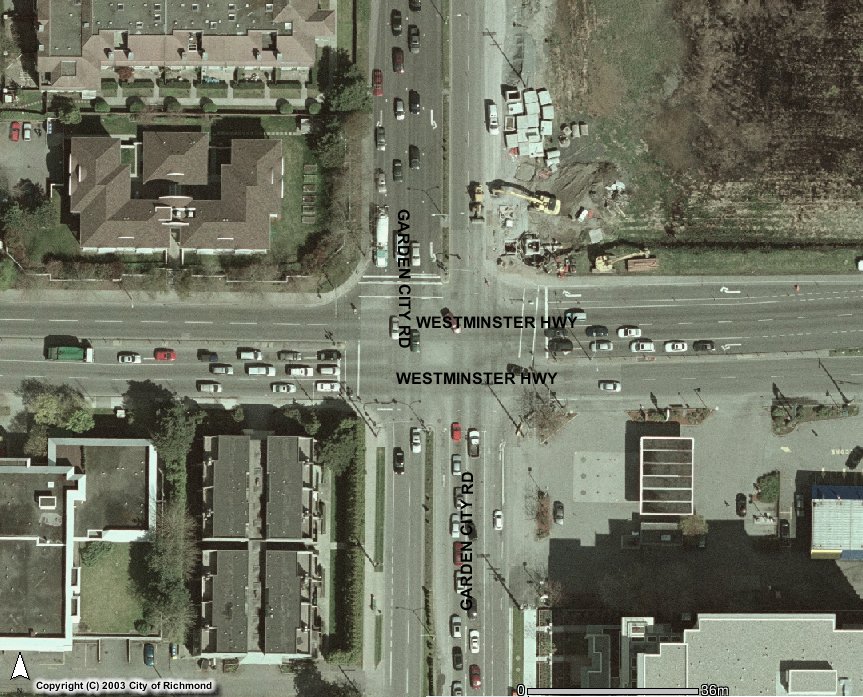
#3 (tie): Garden City Road and Westminster Highway.

Garden City north and south have great, well-marked bike routes (although they have been seemingly under constant construction for the last two years, making me wonder if the stats are biased by that), and represent the best north-south route through central Richmond (much better than the disaster that is No 3 Road). Of course, the nice southbound bike lane becomes a right-turn only lane, while the north-bound one sort of hops across the extended right-turn only lane, leaving the right-turning cyclist in a nasty spot with especially poor visibility around the Gas Station on the southeast corner. Westminster Highway also has excellent wide bike lanes to the east…but absolutely nothing the west. There isn’t even a shoulder wide enough to ride on safely for an experienced cyclist. Car speeds are high here (they seem to take “highway” as a suggested speed).

I humbly suggest there are many ways to alleviate the risk to cyclists here and city-wide. A few engineering improvements on these roads, better education of cyclists and drivers, perhaps signage improvements., but what does the article suggest after rhetorically asking “…what’s a cyclist to do to avoid being victimized?”

They advise that cyclist dress brightly so drivers can see them, look both ways before crossing streets, and wear helmets. Or to translate: if you girls don’t want to get harassed so much, maybe you shoudn’t wear them short skirts!

Every single one of these accidents involved a car. Every one of those cars had a driver. Yes, some proportion of the accidents was no doubt caused by a lack of cyclist caution, or even by cyclists violating the Motor Vehicle Code (which, I remind you, was written for motor vehicles, and does not reflect the reality of cyclists in our modern cities). However, some of the accidents were most assuredly caused by drivers not paying attention, or violating the motor vehicle code. If I want to wear camouflage on a bike, that is my right, and if a driver hits me while I am wearing that camouflage and within my rights on the road, the “I didn’t see him, he should wear something brighter” is not a freaking excuse. We don’t make you paint a car neon orange, do we?

The sad reality is that most cyclists do dress brightly, most do ride with caution and plan ahead, most do wear helmets, all because they are acutely aware that they can get hit by a car, and that would be a bad thing. This article does nothing to alert the majority of readers (who are drivers, not cyclists) that perhaps they should also exercise caution In their 3000lb vehicles so they don’t accidentally kill or injure a cyclist. Instead, it suggests bikes are dangerous (not true) and that all accidents involving bikes are caused by cyclists (not true).

That would involve thinking beyond the ICBC press release though.