A tale of two developments

Two development projects came to light this week in the local papers, and at council chambers.

Both are planned to occupy under-utilized pieces of land adjacent to major transportation corridors, and both are going to convert unused space into economic drivers by providing jobs. However, these two projects are completely different. By comparison and contrast, they teach us about sustainable land use planning, and how it relates to sustainable transportation planning. They serve to challenge us about the type of City we want to build.

First, the good news. Bentall Kennedy (yes, those Bentalls; no, not those Kennedys), the owners of the biggest freaking warehouse in the world adjacent to the Braid Skytrain Station, are hoping to develop the lot that includes the warehouse visible from space and the surrounding empty lots.

The report to Council outlines a first phase office complex development, followed by further offices, commercial and/or residential space. They are in the early part of the planning process, and want to get out into the community to do some consultation before they roll out their final plans (hear that TransLink?), but from the media reports, it sounds like two office buildings are already moving through the process, and more to come.

Why am I excited about office buildings? Because empty lots beside a SkyTrain Station are an embarrassing lack of planning, and a big warehouse (where stuff is taken off of one truck only to be put onto another) right next to SkyTrain Station is doubly so. Building a transit-oriented development at this future transit hub (if, as Gordie the Liar once speculated, we ever get transit onto the Shiny New Bridge). Presumably, the value of that land has increased due to the presence of SkyTrain, and this property will not only provide jobs and potential living space to accommodate growth, it will provide much-needed business revenue for the City’s coffers. Much like the MUCF, a location next to a transit hub is actually a feature when attracting 21st century businesses. New Westminster, with 5 SkyTrain Stations, is only beginning to cash in on this benefit.

Note how they are going to consult with the City and the residents before they build? Absent other info, I would suggest building working and living space next to a transit station is a good idea that we should support.

Now the bad news. The big, empty space over which you can enjoy views of Poplar Island from the east sidewalk of the Queensborough Bridge (arguably a better view than Walmart over wrecked cars – the offering from the west sidewalk) is finally going to be put to use: for taking things off of then putting them back onto trucks.

No doubt strategically located adjacent to the potential North Fraser Perimeter Road, the people of Queensborough, already burdened by excessive trucks and traffic, are going to get to enjoy dozens more trucks on their surface streets. Not trucks picking up goods from New Westminster manufacturers, or delivering goods to New Westminster businesses, but just brought here, unloaded, reloaded and shipped off elsewhere. Since it is Port Metro Vancouver land, we don’t even get the Property Tax Benefits of having a commercial distribution hub. More traffic, more road wear, minimal tax benefit. Bad idea.

Notice how the Port didn’t ask to do this, but sent a letter to the Queensborough community telling them they will be doing it? They are the Freakin Port of Freakin Metro Freakin Vancouver: they don’t need no stinkin’ consultations.

If we were consulted, what would we say? Unloading, storing and loading trucks is, perhaps, not the best use for our valuable waterfront industrial property. Although the Port originally promised short-sea shipping at this location, that seems pretty unlikely now. If you look at Port lands along the Fraser, less and less of it is involved in putting things on or off ships, and more of it is becoming a tax-free and lucrative place to build truck-only warehouse complexes. The job creation is minimal, the tax benefits are limited, and the environmental, economic and social costs of increased truck traffic in our neighborhoods is significant. The former Interfor lands, if not a place where manufacturing can take place, could at least be a location where short-sea shipping can reduce the need for the North Fraser Perimeter Road, for the United Boulevard Extension, for lines of trucks backed up on Stewardson every morning…

What do these two projects say about Urban Planning? To quote the ghost of Shoeless Joe: “if you build it, they will come”. Metro Vancouver is growing, but the type of growth we will see in New Westminster depends on the growth we are building to accommodate. Do we want relatively dense office and commercial development next to residential spaces, connected to the rest of the Lower Mainland by an integrated transit and greenway system (i.e. Braid Station, the MUCF, the Brewery District, Plaza 88)? Or do we want our roads full of trucks, connecting inefficient goods-shuffling (but not manufacturing) businesses spread out along our waterfront and through our neighborhoods?

If we build truck routes we will get trucks. If instead we build a modern, integrated system to move people and goods, we will more efficiently move people and goods, and become an attractive place for transit-oriented development.

…and on an almost completely unrelated note, the UBE is coming back to the table on Saturday.
Counting your Trips to the Curb

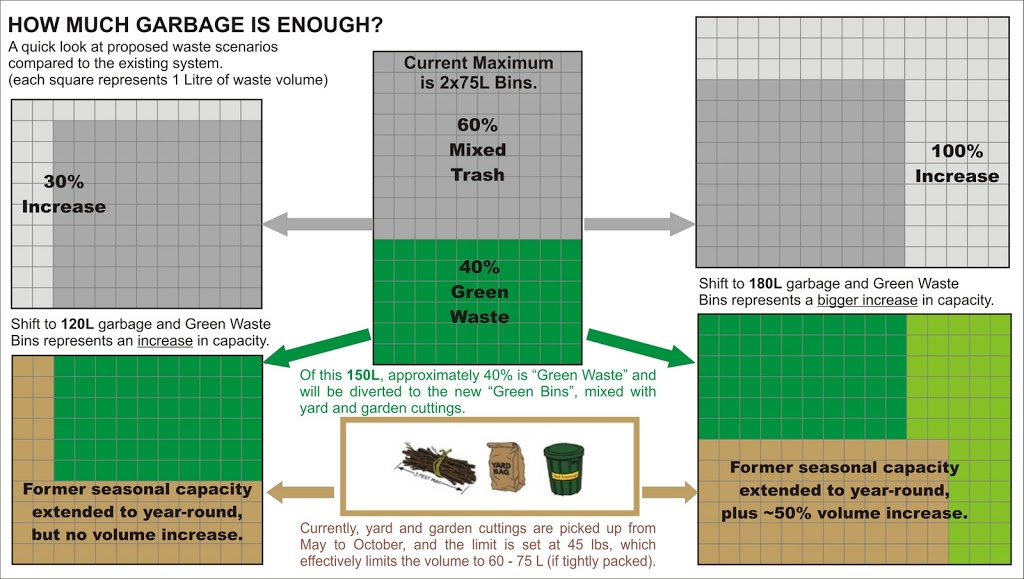
For those who remember the NWEP’s campaign around the roll-out of the automated trash bins, we put a lot of effort into convincing the City that 120L bins were large enough for most, if not all, households. We used the City’s own data and data from MetroVancouver’s own solid waste folks.

We even threw together some graphics.

In the end the City decided wisely to use 120L and the standard bin, and to offer 240L bins for an increased cost for those who insisted on clogging up landfills to the maximum possible extent. I was chagrined to find out that they ran out of 120L bins, and I (of all people) was one of the few houses that got a 240L bin, but the City swapped it out for me a month later (a month in which I didn’t use the bin once, just to make a point).
Kristian at the City must have got a laugh out of me, with my loud mouth, being one of the people with the 204L black bin, as he (I suspect) chose to swap out my green bin for a 120L model recently, without even telling me. Not a complaint, as I have hardly used that bin, with my green cone and compost both going gang-busters. In fact, I have no idea when the swap happened, I just noticed one day they were the same size.

However, another member of the NWEP Trash Talkers group was complaining recently about only using her 120L bin once every two months or so. With the organics out of it, it doesn’t stink, and she just doesn’t produce enough waste to fill it, and sees no point taking it out until it is full. Her only concern is that the garbage truck comes by her house 52 times per year, when it only really has to come by 6 or 7 times. She wondered how many other people found they were putting out the bins less than once a week. And from the kernel or thinking came the NWEP Trash Tracking program.

Using the lessons of the successful Glenbrook North and Sapperton Zero Waste Challenges, this idea is to estimate how much trash people actually put out: is there enough interest in fortnight or less frequent pick up if it means money savings? Is there use for 75L or smaller bins with concomitant savings in your trash bill?
To find out, first we need to collect some data, which we can then take to the City and use to plan further waste-reduction strategies. This is where you come in.

The NWEP have put together a simple garbage-tracking form.

It is designed to be posted next to the garbage calendar you receive from the City. To fill it out, you simply make a check mark every time you take one or both of your trash bins to the curb. You can mark if the bin was “full”, about half full, almost empty, or if you didn’t take it out that week. The same for the Green Organic Waste bin. Although the form starts this week, we will only use the data from April through on for stats crunching, the March start gives us a chance to get the word out and the bugs worked out. You can download it from the NWEP website and print it, or you can fill it our digitally, or if you don’t have a printer, contact us and we will get a form in your mailbox ASAP.

At the end of the survey, you can scan, e-mail, or drop your tracking sheet off (or we can come by and pick it up from you). We will collect this data, post it on our website (the names and addresses of all participants will remain anonymous) and hopefully present it to New Westminster Council and Staff in the Fall.
More info and contact info if you need more answers at the NWEP website .
p.s. I did some serious weeding last weekend, so my 120L green bin will be going out 1/2 full. Looks like my black bin is only about 1/3 full right now, so I will not be taking it out this week at all.

Long post on post shortages…

Blogging continues to be light. Things are happening, usually so fast that I just don’t have time to write as much as I would like. Blogging right now is a little light because of my other time commitments. Things I am working on that are taking more time than anticipated. Just what am I doing?

At work, I am involved in the CEAA process for a large project. I cannot comment on the actual project for obvious reasons, but it is interesting to see how these processes work. Being in a meeting with 40+ people, with the conversation varying from extremely technical science-based analysis of potential environmental impacts to listening to First Nations representatives talk about their concerns, which are often completely invisible to those of us not raised in that culture. Then there is the fun of trying to eak out the politics of the room and understand where people are coming from. That part is just a fun aside, though, as my role is very technical. My main task is to wade through several thousand pages of technical documents just to be educated enough to be able to provide summary info to the public and to senior management. Challenging, yes, but quite rewarding, as I am learning both technical material and about legislative processes. Love my job.

We are ticking down to the end of the Live Smart energy audit time, so we are doing a few last-minute upgrades at home, now that the windows are done. I will finish up the story of the windows (and why, in the end, we are not going to get any credit for them on our energy audit!), and will write about the wonders of furnaces and air-source heat pumps. For now, we are scrambling to get things done. Do first, write later.

It is also a busy time for the NWEP. We are trying to get our volunteer garbage-tracking project rolling out, we are finally updating the webpage, the transportation group is all over the MUCF issue and the UBE is looking to rear it’s ugly head again. There are potential changes to GreenDrinks coming along. A lot of this is not visible yet, but expect to hear more from the NWEP in the next few months.

The Curling Club board is also taking a bit of time these days. We are in the middle of a bunch of energy-efficiency changes. Long and short of it, a curling rink uses a lot of energy. Making ice involves taking a lot of heat out of a lot of water, which, thanks to a pesky thing called Thermodynamics, takes a lot of energy. The Royal City Club was built in the 60’s (they just celebrated their 45th anniversary), and although there have been many upgrades over the years, energy efficiency is not always priority #1. But with utility costs being a major expense in the club, and increased awareness, this is changing. I will blog more on this, but short version is that in the last year the club has dramatically cut its utility cost by installing a water recycler for the ice plant, replacing lighting fixtures and furnaces for the non-ice area, and are currently applying for grants to replace on-ice heaters and dehumidifiers. Being a member-owned and -operated club with no direct municipal funding, the budgets are shoestring and grants to help fund these efficiency programs are helpful. Grant application writing, however, is no fun.

Civic Committees are back up as well. I served on the Bicycle and Pedestrian Advisory Committee last year, and have signed up for a second year. It will be an exciting year to be part of this group, as this is the year of the Master Transportation Plan, and we have a new Senior Transportation Engineer coming to the City, so changes are afoot! I also signed up for the Emergency Advisory Committee this year. I actually have some training in Emergency Operations Centre systems, and I figured this group would allow me to keep that training refreshed, while helping the City plan for the “ifs” that are really only “whens”. Having taken part in Exercise Gold last year, and being a work coordinator of the BC Shakeout this year, I seem to be getting more and more involved in Emergency Management. Don’t panic.

So, a long winging post explaining why I don’t have as much time these days to write my regular long winging posts. Typical.

Clark and the Zipper

So we have a new Premier.

I am pretty non-partisan. I think more on issues than I do on party affiliation. I had quite a few discussions around the Liberal Leadership Race with friends over the last few weeks, and as it became more and more a two-horse race, the question to me always came down to: is the Devil you know better or worse than the devil you don’t?

Kevin Falcon is a free-market ideologue who loved to build highways like that was some sort of transportation policy. I disagree with Falcon on almost every single policy issue, but at least I know where he is coming from. As Hunter Thompson once said of Nixon: “As long as Nixon was politically alive… we could always be sure of finding the enemy on the Low Road. There was no need to look anywhere else for the evil bastard.”

But Christy Clark is a different animal. It isn’t the lack of caucus support of the lack of a seat in the house that make he similar to Vander Zalm, it is the poorly defined populist agenda that makes her essentially a random-number generator on policy. She is the devil few of us really know.

He campaign never resulted in a clear picture where she saw the province going. The only strong policy positions she put out she almost immediately backed away from at the first hint if discord. Even her major pledge, to “support Families” is so pragmatically unspecific as to be irrelevant. Does supporting families mean encouraging responsible family planning through sex education in schools and support for Planned Parenthood, or does it mean letting parents decide when and how their kids learn about sex, and the prevention of all abortions? To know what “supporting Families” means, you have to look through your own filter. That is what makes it such good campaign rhetoric, but completely meaningless. It is like “supporting Healthcare” or, dare I say, “Sustainability”.

It suits, though. She has a record of pissing off teachers, which (by some definitions), is supporting families. She ostensibly left politics (coincidentally as the BC Rail scandal was scooping up those closest to her) to “be with her family”, then less than 6 months later decided to run for Mayor of a City in which she didn’t live. She just doesn’t seem to be consistent on anything.

I can’t help but think she is a lightweight . Her resume doesn’t mention if she has ever had a job that required her to balance a budget, or even run a payroll. There are mentions of three universities, but no evidence she got a degree from any of them. Take it from someone who served two contentious years on the Simon Fraser Student Society: the only thing you learn there is how to make a meeting go as slowly as possible while avoiding actually saying anything, or how you should never cross David Bowie Fans . Other than being the 5th or 6th most popular radio host in Vancouver, and the afore-mentioned pissing off teachers, what experience does she have in an executive position?

If she is trying to shake the Vander Zalm / Sarah Palin comparisons (looks good, not too smart, populist), it was probably not too wise to have her first post-convention press appearance, the day after being declared Premier Elect, while doing the “Hockey Mom” thing at her Kid’s game.

Rafe Mair (once again) summed up the Liberal Convention speeches this morning on CBC Radio: Abbot looked like a doctor delivering some bad news, DeJong like a lawyer for the defence, arguing a case he knew was already lost, Falcon like a guy selling a really good used car, and Clark like the lady from the Welcome Wagon. Zing.

Anyway, all of this is a lead-up to a co-worker’s story I heard today. He is an extremely reliable source. He drives in every day from North Vancouver, and has to manage the “zipper” at the north end of the Lions Gate. In the morning, that means the two lanes from West Van merge in to the right lane, and the two lanes from North Van merge into the centre lane. Never the twain do meet. But this morning, a silver Jetta did the unthinkable: coming up the left of the two lanes from West Van, it got to the merge zone, and instead of merging right…it stuck on it’s left signal and forced itself, illogically, into the centre lane! My co-worker was considering giving the driver the bird (as Zipper decorum would require), but couldn’t see through the back window as the Jetta’s back seat was full or cello-wrapped humungous flower arrangements. Once the Jetta got caught behind a bus on Georgia, my friend pulled up beside to throw a now-belated stink-eye, only to see Christy Clark! Once he regained his composure, he was going to wave at the next stoplight, but she was busy applying her eye makeup. Whether she was driving with a trunk full of gifts from well-wishers, or dropping gifts to those who supported her is unknown… but she has to think about delegating the running-around-with-flowers tasks if she is going to run the province.

However, perhaps we should take this as an omen. Given the option of safely staying in the right position, Clark chose to veer left, taking a risk to bully her way to the middle. She even ran a higher risk of a head-on collision over there in the middle, but she boldly blasted on, and never looked back. Or maybe I am reading too much into it.

Bottled Water, and the Gentleman™ from Nestle™

The Board of Education meeting Tuesday was strange, fascinating, frustrating, and educational. None of those in a good way.

This story gives the headline, but instead of actually discussing the issue, or talking about what happened at the board, it ends up being an advertisement for Nestle water. Rather lazy reporting, I’m afraid.

It is telling that Nestle™ , one of the largest multi-national food conglomerates in the world (2010 revenues: $113 Billion CDN) flew a director in from Toronto to take on two local Grade 11 students. With his 24 years of corporate and marketing communications experience, I’m thinking he doesn’t fly Coach. Near as I can tell, Nestle is in direct competition with PepsiCo, the makers of Aquafina, which is the exclusive brand of water offered at NWSS, so one has to wonder what Nestle’s horse was in this race…

After the Students from the NWSS Environmental Club gave a presentation to Board, reiterating their earlier request that the board take a principled environmental stand here, there were several addresses from the audience on the issue, and some discussion amongst the board members. To protect the innocent, I will not paraphrase any audience members except myself and the Gentleman™ form Nestle™.

Having endured the earlier hour of partisan bickering and procedural minute of the first part of the Board meeting, I decided not to bore the audience with meaningless environmental statistics. The environmental argument against bottle water is pretty cut and dried: bottled water represents a ridiculous victory of clever marketing over common sense, economics, environmental science, and sustainability. Large Multi-Nationals like Nestle take tap water, run it through a filter and maybe add some salt (the benefits of either dubious), stick it in a foul-tasting disposable plastic bottle, chill it (to reduce the plastic flavour), and sell it for 2000x to 3000x the value they pay for the water. The more remarkable part is that we fall for it. But that is where the clever marketing comes in.

We all know who clever marketers like the Gentleman™ from Nestle™ covets the most: teenagers. There is a reason they invest so much time and energy into getting at the captive audiences in high schools. This is where life-long habits are formed the most. Like toothpaste brands, cigarettes and religions: if they get you by 18, they probably have you for life. A high school full of bottled water drinkers will “normalize” paying that 3000x mark-up for a completely unnecessary product. Since all bottled water (labels aside) are exactly the same product, it doesn’t matter if students get hooked on Aquafina, Dasani, or Nestle water: if you get hoodwinked onto buying one, you will be a customer of them all. Enter the Gentleman™ form Nestle™, with no products on NWSS, fighting to keep his competitors products on the shelf there. That’s the FreeMarket® 2.0.

The real story here should be the group of students who identified an environmental, social and moral issue. They educated themselves about the issue, they talked to their peers, they got a petition signed, they presented a report to the Board. This is how Representative Democracy should work. I hope they were not too discouraged by what happened next.

The Gentleman™ from Nestle™ read a prepared statement, using baffling statistics (apparently not as concerned about keeping peoples interest) such as “almost 75% of water bottles in Canada are recycled” (with the other 25% being, presumably, of no concern to anyone, and completely oblivious to the issue of downcycling that the students had already covered in their presentation), made it clear Nestle supported people drinking tap water at home (!?!), made vague suggestions that tap water was less safe, or even an imminent threat to immune deficient people (demonstrably not true) and claimed that all water extraction and bulk sale in Canada is tightly regulated (simply utterly false: there is no regulation on groundwater extraction in British Columbia). But the main point he wanted to make: this was about freedom of choice.

Of course, our students make lots of choices. They may choose to work hard at school and get better grades, they may choose to play video games all night. They may choose to join an environmental club. They choose their friends, and their clothes, and their extra-curricular activities. They may even choose to smoke, or do drugs. Of course, not all choices are equal, and one of the roles if the Education system is help them sift through these choices they are offered. The school system can help make some choices, or they can confuse the issue by allowing the aggressive marketing of the wrong choice to the captive audience of students on school. There is a reason we don’t have cigarette machines in schools, to have them would be to tacitly encourage that choice.

Once the Trustees started the discussion, it was clear the divide was already well drawn. Most seemed to like the recommendation on the table: that bottled water be phased out, along with sugared and caffeinated drinks, and this would not take place until the capitol plans (e.g. three new schools) are completed.

Seeing that this is a rather silly and arbitrary timeline (“we are able to do two things at once”), Trustee Watt attempted to amended the plan to remove the phrase linking the phased plan to the capitol projects. Atkinson, Graham and Cook paradoxically voted against this amendment, without providing good reasons for it, and the two other members abstained (thanks for coming out students, welcome to democracy). Trustee Ewen brought another amendment that water bottle filler fountains be brought to all schools: this received more support, but was accepted only after being watered down (pun?) by Goring asking for “costing” first. In the end, bottled water is leaving the schools, but not for at least another 6 years. Ugh.

The conversation around this was even more telling than the vote or the decision. Trustee Cook mis-quoted a newspaper article and used that as a suggestion that NWSS’s schools water was laced with lead. This sounded especially rich 5 minutes later when Trustee Goring asked (and not rhetorically) where the students ever got the idea that the water wasn’t safe. He suggested that more education about the water was needed (but presumably not from Cook). Of course, Cook thought the water bottle machines were fine, and that instead of getting rid of them, we should educate the students about making the right choice: he even used the successful advertising and social marketing campaigns against smoking as an example. As ridiculous as it sounds, Cook just made a compelling case for bringing cigarette machines back into high schools. The entire conversation was Hellerian .

If the purpose of the Board of Education is to educate, then they have succeeded: I learned a lot going to my first Board meeting. However, I fear I learned more about the Peter Principle than I did about Roberts Rules. As another audience member commented to me after: “If only these meetings were televised, none of these people would ever get re-elected”. On display were not only variations on Roberts Rules, but of basic decorum and respect one would learn in a Grade 2 class. People talked out of order to make cheap shots, people on the left side of the table shared whispered secrets while a person on the other side we talking, and vice versa. I watched one Trustee abstain from a vote on an amendment (causing it to fail), only 5 minutes later to argue a point that the amendment would have supported, leading one to assume he abstained not because he didn’t support the motion, but because of who moved it, or more accurately, which side of the table it came from. There didn’t seem to be any other logical reason for it. One 25-year trustee appeared to be comatose for most of the meeting. Neither people acting as chair (one was challenged successfully at one point) effectively managed the debate, evidenced best by the first half hour where everyone was arguing over some procedural issue relating to the minutes or previous meetings, with there being no motion on the floor to even discuss. After a half hour of unorganized bickering, it ended with no resolution. I felt sorry for the students who were present and had to see that.

MUCF Public Hearing

tonight was School board, victory and loss on the Bottled Water issue, more on that later. For today, all I have is video and comments from Monday night’s Council discussion around the transportation issues at the proposed MUCF. Video courtesy Matt Laird (So my Mom can see I still need a hair cut, my wife can complain about all my “um”ing, and my Anonymous Stalker can pick me out of a crowd)

Yep, I’m a goof, but the answers received from staff were slightly unsatisfying. I didn’t think that this was the forum to engage in a protracted debate, but I did have a great discussion after with a VP from Uptown Property Group. Things I learned:

Moving the garage entrance to Begbie is challenged by the slope of the lot. The building lot is several metres higher in the northeast corner than it is in the southwest corner, placing the ramp over on the east side would make for a steeper ramp and not allow as much parking capacity. To hear City Staff talk about it, moving the garage cannot be done.

First off, in my consulting days, I was taught by a senior engineer to never say “it cannot be done”. It can always be done, it is a matter of priorities and costs. Having the parking entrance on the east side of the building is, in my opinion a HUGE priority, so let us see the economic argument about whether it can be done. Some of the slope issue could be addressed (and I thank Matt Laird for pointing this out) by creating the ramp parallel to the building where the angled parking on the east side of Begbie currently sits, or working the ramps into the Alexander Street end of the site. The Gentleman from Uptown pointed out that the tiny retail space on the northwest corner is a compromise due to the desire to have parking on the west side of the building, moving the entrance to the east will also improve this property, increasing the value of the building. I stand by the idea that having a garage entrance on the west side of the building is both unsightly and unsafe, and challenge the engineers and architects to come up with a better solution.

Second, with all due respect to Mr. Lowrie (who I think does a great job for the City), the response that Begbie has always been the designated bike route connecting the CVG and Carnarvon sort of avoids the issue: the original decision was wrong. Time plus wrong does not make right. This is part of ongoing discussions at the VACC, at the City’s Bicycle and Pedestrian Advisory Committee, and amongst the NWEP transportation group: the bike plan for the City consists of green lines on a map that are evenly spaced to create “coverage”, but do not reflect the reality of riding a bike. Begbie is not an appropriate bike route when 8th ave is a couple of dozen metres further west and is way more accommodating to more cyclists. The City’s Bike Plan includes Tenth Street as a major north-south route through town. The 200m of Tenth between Royal and Queens is over 13% grade! It is crossed by major traffic route at Royal (where cyclists coming down tenth will be overheating their cantilevers to avoid drifting into traffic) and a completely blind corner at the top of a steep hill at Queens. and a 13% grade. As my French friend would say: Hors Categorie! To suggest that is the correct spot for a bike route is ludicrous, it might be the most difficult and dangerous north-south route in the City for bikes. Although Begbie is not as bad as this, it is likely to see much more traffic due to the location at the CVG, near the SkyTrain, and around the new MUCF. Move the bike route to 8th, so it can actually be a bike route and not just a convenient green line on a map.

Finally, and I have to call attention to this, it is suggested in the design and was confirmed by the architect from Uptown, that the mid-block crosswalk at 8th in front of the SkyTrain station will be removed. The NWEP fought to have that crosswalk installed, and make no mistake we will fight to have it maintained. That crosswalk is an important part of the pedestrian infrastructure in New Westminster, it is heavily used, it serves to protect the lives of New Westminster pedestrians at the front of our busiest Sky Train station, and it will only become more important with the MUCF and the completion of the Plaza 88 development. It was installed to save lives, it should continue to do so.

Before that crosswalk was installed, people walking out of the Skytrain wanting to cross 8th were asked to walk up or down the street a half block, in the rain, to the corner of Columbia or Carnarvon. The mid-block crossing not only provided a more direct crossing, it offered the rain shelter of the Skytrain line. Naturally, people jaywalked, creating a safety hazard for cars and busses before the crosswalk was installed. The City wanted to install a fence down the middle of the road to solve the jaywalking problem, not recognizing that the problem was one of bad design. The NWEP fought the City, forcing them to recognize that Pedestrians had as much right to the street (especially at a Skytrain entrance!) as cars. Reluctantly, the City installed the crosswalk as a temporary measure. It is still there, it is still safe, and it is still used.

With the introduction of a left turn lane to access the MUCF, I guess the fence idea is pooched. With new retail and restaurant activities on the east side of 8th, the pedestrian traffic will only increase. Does the City think the people coming out of the Skytrain will now walk to the corner of Columbia (in the rain), wait for a light (in the rain) then cross, to get ot he MUCF from the Skytrain, or from Plaza 88? Of course they will stay under the cover of the Skytrain, and they will Jaywalk, right in front of cars pulling into or out of the MUCF. Conflict will ensue. Someone may get killed.

Again, the root of this problem is the parking entrance on the west side of the MUCF. How many compromises are we making for this one design fault? Let’s do it right.

Short Post: Short Video

I was going to write another quick post about why I am going to the MUCF Public Hearing tonight. But Matt Laird once again put it all to video, with heritage piano rag to boot!

I don’t think these are significant changes in the scope of a $35 Million building, but need to be made early in the planning process.

Light Blogging

Sorry, fans (and by “Fans”, I mean Mom), but I’m not blogging much right now. Real life is in the way. Besides work (which is crazy enough), I have some things on tap this week:

Monday is the MUCF meeting at City Hall.
Tuesday is New West School board
Wednesday is the February NWEP Meeting
Thursday is Curling Night
Friday, all day, is the EMA of BC Workshop I am helping organize.

I’ll sleep when I’m dead

More Transportation News…

A few interesting stories have arrived in the media this week involving TransLink, transportation planning, and tolls.

The tone of this story was surprising, especially when juxtaposed against the opinion piece that the editor of that same paper produced last month. The ”danger” facing the NFPR is that it is a bad idea that does not fit in our community. Indeed, unless TransLink comes back with something substantial to mitigate the traffic impacts on all of New Westminster, from Brunette to Queensborough, then this plan may indeed have to go away. I do not think that is something to fear, however, it is the new reality of transportation planning. Clearly, the UBE as proposed in December did not fit the bill; we need a better solution.

The days when you could plow freeways through neighborhoods ended in Vancouver in the 70’s; perhaps it will end for the rest of the North-of-Fraser area in the 10’s. The South-of-Fraser communities will have to come to their own epiphany about this, and there are groups trying to usher that day along, but I am afraid as long as Diane Watts and Kevin Falcon are in charge, they will be mired in asphalt.

The Mayor is back to talking about tunnels and tolls, which are all well and good, but this raises as many questions as it answers. Is a graded, 2-km long 4-lane vehicle tunnel the best way to spend $1 Billion? Will a tunnel serve the primary purpose of a goods movement corridor if it will not be permitted to transport dangerous goods? What will either end of the tunnel look like? How does this tunnel free up traffic at Queensborough Bridge (as Councillor Osterman was quick to point out last meeting as a significant part of New Westminster’s Traffic woes)? How long until the traffic expands to make the tunnel a congested, polluted mess?

I know Mayor Wright has a visionary streak in him, but I am afraid he is missing the point here. The most visionary approach to this problem is not to engineer some white elephant solution that has proven time and time again in places across the globe to not solve the problem of congestion. The visionary approach is to say “no”, to say that the livability of our City is too important to add more traffic to the mix.

Then I saw this article towards the “filler” pages of the Leader, which features The Minister of Transportation and the Mayor of Surrey trying to out-Conservative each other.

I’m all for sober second thoughts, but Mayor Watts is off the mark here. She wants a new bridge to support her continued unsustainable development based on last century’s “car in every garage” model, but she doesn’t want the poor beleaguered Surrey citizenry who choose an auto-based lifestyle to have to pay for the infrastructure to support it.

Her argument that Surrey bridges shouldn’t be tolled because Vancouver bridges are not tolled (which she christens a “fair tolling” policy) is simply ridiculous. It ignores the fact that she is pushing automobile-dependent development that will require bridges, while the City of Vancouver is reducing the need for bridges by building working alternatives, and by building more compact, complete communities. As we learned last year in Jerry Dobrovolny’s talk at the NWEP AGM, this resulted in significant decreases in cars entering and leaving the City, at the same time they enjoyed significant growth of both population and jobs.

Anyone care to contrast this with the Panorama Ridge area of Surrey? If that is how Diane wants to build her City, she can pay for her own @%&@$&* bridge.
Finally, there was this story about the perils of trying to predict traffic. I have never driven across the Golden Ears Bridge, but I have ridden a bicycle across it a few times. To me, it is a monstrosity connecting two automobile-oriented communities, and again wonder if some of that $800 Million (or $1.04 Billion, or $928.5 Million, depending on whom you ask) could have been used to build more sustainable transportation alternatives for two communities that desperately need them (Langley and Maple Ridge).

Seems the problem here is that TransLink wrote ambitious predictions about traffic load to get the PPP happening, only to be on the hook when their own predictions failed. Naturally cars are avoiding the tolls by driving around the long way. The comments in the CBC story demonstrate how people act irrationally when it comes to tolls. A commenter says it is “only 25 minutes” to drive around. and the gas cost is “not nearly that much”.

Google Maps tells us the trip from the 200th Street in Langley to downtown Maple Ridge is 16km by the Bridge, 42km by the Port Mann, for a difference of 26km. I suppose you could make that trip in 25 minutes, if it is 2am. Mid-day, you are looking at an hour at least. The average car sold in Canada gets between 7L/100km and 12L/100km, so fuel costs to avoid the bridge (at $1.10 a Litre) is between $2.00 and $3.00. The toll on the bridge? Between $2.80 and $3.90. I guess for some people, avoiding an hour in traffic is not worth a loonie. Problem is, these people are all going to drive through New Westminster over the Patullo once the Port Mann is tolled… today’s bad planners are tomorrow’s New Wesmtinster traffic crisis. 

The headline “taxpayers off the hook” is a severe case of spin. Although one might not catch this from how the news articles on this were written, TransLink is going to have to pay that $63.8 Million dollars to a private corporation, which goes curiously unnamed in the articles. It is almost like TransLink and Consortium that run the Bridge don’t want to mention the recipient of the sweetheart deal. I leave that for you to Google yourself. So Translink will “find the money” to pay for this shortfall, but make no mistake that it is all taxpayers’ money. It may come from other capital projects or from reserves, but that just means $63.8 Million less to pay for new buses, new SkyTrain cars, to fill the “Funding Gap” for Evergreen, or for building Wayne Wright’s dream tunnel down Royal Avenue.

Council to Translink: not so fast. -Now With Video!

Thanks to Matt Laird, you can all enjoy the video of Mondays’ UBE discussion at council. Now I’m making it easy to show how much I paraphrased. Note the twitchy, swarthy guy in the background behind Laird… he looks like a trouble-maker…

Once again, local rabble-rouser Matt Laird took his 5 minutes of allotted council time to keep the issue of the United Boulevard Extension out in front of council.

For those not paying attention, a motion came out of the Working Session on Monday, the essentially told Translink to come back with something better.

Long and short of it, Translink has again managed to put off the “deadline” for securing Federal funds for this project (proving once again that the “deadline” is more like a “justrestingline”), and will work with the City to see if they can find a solution to the Front Street part of the NFPR in time to make the UBE more tenable.

Contrary to some reports, this does not mean that the City has agreed to the UBE, only to keep their minds open and see what TransLink has to offer. This is (in my never humble opinion) the right tack to take. Lets not close our eyes to all offers, let’s see what they can come up with, then decide if the proposed solution improves out City.

The public opinion on this project is such that all 6 council members felt they had to comment on Laird’s delegation and the motion that went forward. For those who missed it, the entire session should be up by some time mid-week at Matt’s website: luther.ca/newwestcouncil. Here are my comments on their comments (of course, there comments are paraphrased from my notes at the meeting, please let me know if I mis-quote any of them!).

4:21, Councillor McEvoy: Is curious to see how Translink plans to improve traffic flow but not increase traffic volume.

This is a significant question, and perhaps cuts to the very heart of the matter. As anyone involved in transportation planning can tell you, traffic usually expands to fill the void. If we double traffic capacity on the NFPR, we can only expect traffic to double, resulting in an equal amount of congestion concomitant with increased noise, pollution, maintenance costs, etc. etc.

6:10, Councillor MacIntosh: Reminded us that the industrial area in Sapperton needs help, they are suffering from congestion and need to be able to move goods to survive. She also reminded us that the Federal Money being offered is intended to increase efficiency and safety of train operations (supported in this case by replacing a level crossing with an overpass). Finally, she made it clear the Translink will be evaluating various options, perhaps including a 2-lane bridge to replace the Bailey, or re-routing Braid industrial Area traffic through Coquitlam, where new road infrastructure is being built already.

These comments brought to my mind (as echoed by Laird), that the problem is commuter cars using our industrial roads as a shortcut, clogging them up so goods-carrying vehicles can not get through. Essentially, this is the same problem as “Rat Running” in the residential parts of Sapperton. It is not clear how this problem for our important industrial citizens will be solved by knocking down some of their businesses to make room for a road that will only serve to funnel more commuter traffic through the industrial area. This is suspiciously close to fighting fire with matches.

If the Feds and Railways have the goal of improving upon the level crossing, and the City’s goal is to make Braid Industrial Area more accessible, then these goals may not coincide with TransLink’s goal to build more roads and Coquitlam’s goal to improve traffic flow to the big box hell (and soon car-oriented development hell) that is United Boulevard.

10:39, Councillor Harper: Started by reminding us that this is a complex problem, and that there will not only not be a single answer, there is also not a single goal. He rhetorically asks if we have “address” truck traffic, then non-rhetorically answers in the affirmative. Harper seems to be the one most in favour of the existing offer from Translink, as he lists the issues relating to the existing situation on Brunette and Columbia, but he fails to close the loop on how any of these problems will be solved by the UBE (although he alludes to “mitigation”) or how building a 4-lane freeway amounts to “reclaiming out waterfront”. He finishes by questioning how long before we have another “opportunity” to get $65 million in Federal money to build our way out of this problem.

After my erlier comments about conflicting goals, I think all of Council should, at least, have a single goal: to make New Westminster a more livable, more prosperous, and more sustainable community. I look back at the Mayor’s annual address, and I see one goal laid out again and again: Make the City more livable. If there are any other goals here, let’s get them out on the table.

I’m not sure how one “addresses” truck traffic. The way I see it, we have three options: have more, have the same amount, or have less. The things that make any single truck safer, less polluting, or quieter are outside the City’s jurisdiction. All we really can control is the number or trucks, and we control that by building the infrastructure to accommodate them. You can argue that we need to build more capacity to accommodate more trucks, but don’t then complain about increased noise and pollution. You can argue that we need to reduce truck traffic, but if you do this, you had better be ready to work with our industrial and commercial citizens to make sure you don’t drive (ha ha) them our of business or to another jurisdiction. The third option is to not build more capacity. This will, of course, require you to do both: :mitigate the already significant pollution and noise issues, and work with our business partners to make the existing infrastructure more efficient for them. In many ways, this is the most difficult option, but might represent the best option for a City like New Westminster.

Finally, the $65 million is a red herring argument. That is not Federal Stimulus money, it is money earmarked for Asia-Pacific Gateway improvement. If New Westminster along with it’s partners at the railway, Translink, and the Province find a way to free up train travel and increase level crossing safety, the money will be there. This is separate from the entire idea that we must do something because “someone else” will pay for a portion of it. That is not really visionary, especially when that “someone else” is actually us, the taxpayer. If it serves the community and other levels of Government are willing to contribute (Pier Park anyone?), then great. But if it doesn’t serve us, we should be responsible enough to say no thank you.

17:25,Councillor Osterman: Recognizes the traffic problem as a problem, citing traffic by the Columbia Square and 20th Street as good examples: “the system needs work”. He agrees that we need the long-term plan in place before we spend money unwisely. He is also of the opinion that New Westminster (and potentially all of Greater Vancouver) is on the “cusp”, but I didn’t really get the idea of what cusp he was speaking of…after all, cusps can be the top of a wave, or they can be the edge of a cliff…

It is interesting that the traffic problems Osterman outlines (primarily, his own hassles commuting in a single occupant vehicle to the airport and back, and trying to get to Council on time) are likely to be made worse by the UBE, and worse yet if the full 4-lane NFPR is built on Front Street. These projects will just move the traffic choke point to his neighborhood.

I think (and hope) he meant the cusp where a larger investment directed at public and alternative transportation will be required to make our Cities livable over into the next Century. This is the time when we start to seriously move away from building transportation infrastructure based on the individual automobile and start building it based on the realities of Peak Oil, Climate change, and what type of City we want to live in 10, 20, 50 years from now. Osterman cited European examples, and I concur that northern Europe is full of amazing cities with enviable transportation systems: Amsterdam, Copenhagen, Oslo, even London.

Imagine…

21:50, Councillor Cote: Surprised me by mentioning that he did not support the motion, as he feels strongly that the Patullo Bridge question must be answered at the same time as the NFPR question, the two solutions must happen hand-in-hand, and with the Patullo decision delayed until the fall, that cannot happen.

I can see both sides of this coin. Yes, ideally, the entire system should be dealt with holistically (and, uh, is sort of required to under CEAA, but I digress). However, the Patullo decision might just be out of TransLink’s hands, as Premier Falcon is going to want to cut the ribbon on that one at the most opportune time. So if Translink can run the numbers with each of the three most likely Patullo upgrade outcomes (refurbishing the existing bridge; replacing with a 4-lane bridge; replacing with expanded capacity) then the City may have something that can be fairly evaluated. Now, Cote surely knows more than I about the plans, as he sat through the TransLink presentation, and I am hearing about it third hand, so I am not going to be critical of him for his principled stand.

24:50, Councillor Williams: Had little to say, but going 6th, most of it had already been said, but she reminded us once again that the City willing to agree to anything unless the entire NFPR routing is dealt with concurrently.

Overall, Council’s position on this remains clear. Although there is a spectrum of views from the Councillors, they all reflect different approaches to the same point: The UBE is part of the NFPR, and we, as a City, will not accept the piecemeal management of this major regional route through the City.

It will be interesting to see what comes back in June. With the City Engineers working on the project with TransLink, they are unlikely to come back without something they can recommend to Council. If Matt Laird’s suggestion that the physical limits at several locations along the proposed NFPR routes will preclude the 4-lane truck highway some dream about, then we might be in for quite a fight in June.

Just in time for an election campaign.