Back to the Blob… ugh

There is an ongoing dialogue about the Pier Park going on in the comments section of the News Leader. I have hit this topic several times, have blogged about this topic before, and have actually met Chris Bell to discuss his concerns. But since I opened my fat gob once again to comment online on some comments I see as scare-mongering in Mr. Bell’s letter to the leader, I am now stuck here, blogging on what I see as a non-topic again, just to correct some facts on what I said, and in what Mr. Bell read into it.

The standard caveat: this project is close enough to my professional area that I should probably start by making some sort of declaration of my lack of knowledge. I cannot give a “Professional Opinion” on this topic, mostly because I am not privy to all the information. Everything I know about this project is from the public reports released through City Council and the media. So although I have significant training and experience managing contaminated sites across BC, and a pretty solid understanding of the Contaminated Sites Regulation and the Environmental Management Act, what follows is a personal opinion worth exactly what you paid for it: nothing.

I will go through Mr. Bell’s last comment to me, topic by topic.

“Patrick, you argue that the city showed due diligence before they purchased the pier land.”

The term “due diligence” does not mean you do everything humanly possible to find all available information about a piece of land. The “Due” part means that you do everything that should be reasonably expected to be done, that the effort and resources used coincide with what would typically be done in the industry.

When taking milk out of the fridge, good “due diligence” before handing it to your child to drink would be to check the expiry date, or maybe sniff the open bottle to see if it is rank, and to inspect for signs of curdle as you pour it in the glass. Running a mass spectroscopy analysis or doing an LD50 test on rabbits would probably provide ever further reassurance that the milk was not rotten or tainted with botulism, and is safe to drink, but that would be costly and time consuming, and would exceed “due diligence”.

In a real estate purchase, what is too costly or too time consuming? There is no upper limit to the amount of time and money you could spend investigating a site. You can drill holes and install monitoring wells across every meter of the ground, and still miss a 90cm-across block of uranium. A good rule of thumb for costing out these exercises is that every single monitoring well you install, including drilling costs, sampling, analytical costs for soil and groundwater samples, and all the accessory costs of doing the investigation, costs $5,000. Sometimes you can drill 10 for $30,000, sometimes only 5 cost you $50,000. But $5,000 per hole is a good order-of magnitude back-of-the-envelope guess for investigation costs. So what constitutes “due diligence” at $5,000 a hole?

In reality, we don’t in the industry machine-gun a site with $5000 holes, as potentially profitable as that would be for consultants. Instead, we look at the site history and make some educated guesses about the likelihood of contamination in certain areas, and dedicate our resources to those areas. Prior to the purchase in 2009, the City’s consultant took existing reports on the site (back to 2005), and used those as a basis for further investigation. This launched what is called a Supplementary Phase 2 investigation. They probably could have relied on those existing reports, but instead, they did a little extra diligence and went back to the previously identified “hot spots” and installed more monitoring wells. This, in my personal opinion, represents a level of due diligence consummate with the purchase of former industrial land that would become a park. I might have saved some money and dug some test pits instead of so much drilling, and relied on the existing wells more, but I’m a cheap bastard. I work for government.

Again, in my personal opinion as a taxpayer in New Westminster, this report demonstrates due diligence was performed on the environmental risk prior to the purchase. The City knew, as best as they could with reasonable efforts, what was there, and could make an informed decision about the purchase. You can disagree about the decision they made, that is your right as a voter, but you cannot say they did not exercise due diligence.

“The City has stated that the land purchase cost was reduced by the expected costs of remediation ”about 1.5 million dollars” and yet they ignored their own experts observations that vapour and off-site investigation of the lands to the north of the park must occur before the investigations could be considered complete.”

Let’s look at what the Supplemental Phase 2 report said. They confirmed the soil metals contamination previously identified on site, and that there was no groundwater metals problem. They identified some PAHs that exceeded standards in groundwater. PAH is a catch-all term for a group of petroleum hydrocarbon substances that contain benzene rings (hence the “aromatic” in Polycyclic Aromatic Hydrocarbons). These are generally trace constituents or break-down products of oils or fuels, and are common in gas station-type contaminated sites. They are all LNAPLs, so they tend to float on top of (or concentrate towards the top of if dissolved) water. Again, no surprises here, they know they were there from the earlier reports, they were just confirming their concentrations and how things may have changed since the previous reporting time. These substances are also regulated as vapours, but assuming their remediation plan was scooping them up and trucking them away, there was no need to worry too much about the vapour concentrations: if you remove the PAHs, the vapours also go away.

Finally, they confirmed the presence of some DNAPL compounds: the dreaded “Toxic Blob” of Chris Bell’s nightmares. They found them because they knew they were there from the earlier reports. The news here looks good, though. The sampling indicated they were much lower concentration that the previous (2005) sampling, and in fact, they did not exceed the allowable standards. The concentrations were so low, that they did not constitute “contamination”.

The report did indeed say that new (in 2009) Ministry standards would mean that vapours would need to be investigated. However it was not noted as a flaw or a gap in the report, as Mr. Bell suggests, but as a heads-up. The consultant is saying “you had better plan to manage these vapours when you are planning to manage your soil and groundwater”. Removing the PAHs physically would constitute managing the vapours as I mentioned a couple of paragraphs ago. As far as the DNAPL solvents, the concentrations are so low in this report, that it is extremely unlikely that vapours will exceed any standards, But they still have to sample them by the regulations. Take a few samples, find acceptable concentrations, apply for a CofC, Bob’s your uncle. I suspect the main reason they threw that warning was that vapour sampling was new at the time, and is both expensive and was technically challenging in 2009 when the new standards had just been adopted (and there was little technical guidance from Ministry), so they had better budget time and money for collecting the samples. There is no suggestion from this report that active remediation or risk management on those DNAPLs would be required. The data just didn’t suggest that.

No-where does that report state that offsite investigation would be required or recommended. Here Mr. Bell is completely wrong. To do intrusive investigations like drilling and digging holes on a site you don’t own, but are considering buying, is a difficult enough legal process to go through (who owns the data? What are the rights and responsibilities of the parties in relation to the data? Who has liability for accidents or property damage? Who has responsibility for the monitoring wells if you decide not to buy?) But to try to secure access to a third-party piece of adjacent land, in which you have no commercial interest, only to prove they might be damaging a piece of land you do not own? That is a ridiculous request, unlikely to be agreed to by the best of neighbours (as they can only lose by allowing it), and I am afraid the Railways are not always the best of neighbours. Any attempt to collect data without their permission would constitute criminal trespass.

“It is the cost of these investigations that added another two to three million dollars to the remediation costs. ”

I don’t know where Mr. Bell’s numbers are coming from, so I cannot comment on them. The “investigations” certainly did not cost millions of dollars, but probably several hundred thousand. Apparently (based on Jim Lowrie’s recent comments) the overall remediation budget has gone over $2 million, and I imagine (but cannot confirm, as I do not have the information) that the engineering, hydrogeology and installation of the bentonite/concrete barrier wall is the majority of that cost. Considering that they had a $1.5 Million reduction on the purchase price because of the environmental concerns, it sounds like they are $500,000 down overall (within contingency according to Lowrie).

But let’s be clear, the DNAPL presence was known, it was investigated, and in 2005 and 2009 the best evidence was that the DNAPL was at a concentration that did not constitute “contamination”, and at the time, the idea that they would need to install a barrier wall was simply not on the table. Something changed in the nature of the contamination between 2009 and 2010, and along with this the standards and requirements for remediation changed. It is safe to say that those changes could not reasonably have been anticipated in 2009 when the due diligence was performed.

“How did ignoring the requirements for off-site and vapour testing show due diligence?”

Already discussed. There were no requirements ignored.

“ The environmental cleanup is over budget… by millions. The City advertised, “…a worst case scenario, all in cost of 1.5 million dollars on environmental cleanup” Millions not spent on cleanup could have been used to build more park infrastructure. “

No, the environmental cleanup is within the contingency budget. Remember, that $1.5 Million is the cost reduction that the City got on the purchase based on the known contamination. If the City did not have to spend that money on clean-up, they would have had to pay that much extra for the land purchase. Because the City did due diligence, it got that reduction in the purchase cost which covered most of the cost for remediation.

It’s your declaration Patrick that, “To make the more strident claim that the City is risking the health and well being of its Citizens and is somehow in cahoots with the Province to expose children and joggers to dangerous chemicals is absurd scare mongering.”
I’ll leave the attack on my character alone…”

And I stand by the statement that claims that the City is risking people’s health in their management of the chlorinated solvents are not only false, they represent fear-mongering. This is not a character attack, it is my assessment of the facts on the ground.

“… and stick to the known threats from the chlorinated solvents along the city owned land along the northern border of the park site. City reports to the Ministry Of Environment state the railway corridor soils are High Risk for chlorinated solvents.”

Here is where Mr. Bell is simply confusing his terms. There is an area of the park designated “High Risk”. That term is very strictly defined by the Ministry of Environment, and there are strict protocols about how it is used and what it means. The money quote from that protocol is this: “If mobile NAPL is present at a site, the site is considered a high risk site.”

The presence of mobile DNAPL at the pier park is what makes the site “High Risk”. Because it is “High Risk”, the City is under more strict reporting guidelines with the Ministry, and the Ministry will ultimately have final sign-off on the cleanup. This is the highest level of Provincial oversight one could hope for.

“People walk/run this corridor as a pathway across New Westminster thus exposing themselves to the toxic soils. “

This is simply untrue. “High Risk” in this case does not mean is that there is any immediate danger to anyone or to anything. It does not mean that the soils are emitting toxic fumes into the air, it does not mean that people are being harmed by the DNAPL.

In risk assessment, the term “pathway” refers to any route through which a contaminant can get to a receptor, be that a person or the environment. Hydrocarbon vapours coming off of soil and being breathed by joggers is a “pathway”. Arsenic in soil getting on your fingers then onto your lunch is a “pathway”. PCBs leaching through the ground and into grass, then being eaten by a cow is a “pathway”. For there to be any threat to a person, there has to be an “open pathway” from the contamination to the person. In the case of the Pier Park, there is no evidence that there is an open pathway. DNAPL dissolved in water 40 feet below the ground simply cannot get into the system of a jogger on the tracks. There is no pathway.

The “risk” here is not a threat to human health, it is the uncertainty related to mobility of the contaminants. Therefore there is now a positive onus on the City to stop that migration and keep track of the contamination, so that they and the Ministry will know if there is ever an “open pathway”, and an actual threat posed by this stuff.

DNAPL 40 feet down will never be a threat to humans, unless they sink a drinking water well at the park (an unlikely scenario). If allowed to migrate, it is possible the contamination will migrate to the bottom of the river (well away from the shore) and impact marine invertebrates, potentially causing a “dead zone” in the river, but unlikely to be harmful to even salmon, as these DNAPLs will be pretty diluted by the river and are not bio-accumulators. I’m not saying this would happen, I’m just trying to imagine a scenario where these things can cause harm to anything.

“The City is stating it has no plans to remediate the toxic railway corridor nor will it put up signs warning the public away from the High Risk contaminated lands. Are these non-actions not risking the health and well being of New Westminster citizens?”

Correct, these non-actions are not risking the health and well-being of New Westminster residents. See above.

The City not only has no responsibility to clean up the Railway lands, I suspect they would not legally be able to. It isn’t their land. Unless it could be demonstrated that the contamination migrated from City land to the railway land, then the Ministry might compel the City to clean up the Railway land, but it would be extremely unusual for the Ministry to do this when there is no human health risk. More likely, the railway would clean up its own land and take the City to court to make them pay for it. Which is exactly what I think the City should do to the railways.

“How you came to the conclusion that I think lowly of the Ministry Of Environment is truly puzzling to me. I praise the Lord for the MOE’S involvement and look forward to their scrutiny of the City’s cleanup efforts if, and when, the City ever sends the required documents to Victoria for review. Why did you state that I have a pitiful view of the MOE when the complete opposite is true?”

Chris, I suspect you misinterpreted my comments, or I gave you a false impression though bad wordsmithing. You stated clearly that you have more faith in MoE than you do the City, and I previously stated that you should therefore feel better about the High Risk determination, as that will result in a higher level of scrutiny from the Ministry.

“I agree with you, Patrick, that the current Mayor and council have invested a lot of political capital on this Pier Park and the Realpolitik negotiations (between the need for complete environmental investigation/remediation and opening the park before the November elections) must be brutal. “

Again, I am not privy to the negotiations going on, but they are going to have to hustle their asses to get a CofC from the Province before November. They may be able to get a release letter that limits how they use the Park and sets strict conditions on the management of soils on the park prior to getting a CofC, the Ministry is starting to get pretty proactive with those. That would essentially allow them to open and use the park without a CofC. But again, I don’t know much about their strategy with managing the site, and the High Risk designation may make that a non-starter.

“The City’s environmental management of the Westminster Pier Park Brownfield has been neither consistent, nor transparent, nor responsible. “

I have seen literally hundreds of these types of projects. In my experience, the City has been consistent and responsible, and have frankly been much more transparent about the process than any corporate client I ever had, and at least as transparent as any government client I ever had. Frankly, I was a little shocked about how much info on this site I could get with few hours on Google. Try that with a Port Metro Vancouver or Kinder Morgan contaminated site…. I do not share Mr. Bell’s criticism here.

“Thankfully, it will be up to the highly skilled Ministry of Environment to decide when the environmental investigations/cleanup are complete although I pray that political deadlines do not trump an in-depth remediation process.”

I’m not a praying type, but I have faith in the professionals doing the work.
Guys for whom I cannot vote (yet)

This just in: now there are 4.

 
Just watched the BC NDP leadership debate on the Environment and Sustainability, and I have made my decision about who I want to lead the NDP, and to lead the Province after Christy calls the snap election in June.

I have not seen them talk in the other debates, but they are all available here. I can’t sit through that much NDP bafflegab, so I decided to bet all my chips on the one subject where I have a lot of knowledge, Environmental Sustainability is right up my alley.

Not that I have a vote on the leader of the NDP, I’m not a member of the party. But I will have a vote in the election, and if John Horgan is leading the NDP, they will likely get my vote. This is my summary of how the candidates fared in this debate, and as unbiased as I was going in, I was pretty biased by the end.

First off, as far as battles of white guys in dark grey suits goes, they had the white guys and the dark suits, but it wasn’t much of a battle. This is a party that just eviscerated itself over the departure of the least leader, but it seems to all be peace and love here, no sign that any one of these guys disagrees with any other of these guys on any point whatsoever (although I don’t think any of them take Dana Larsen seriously). I would have liked to have heard “I respectfully disagree with my opponent on this point” just once, to make this seem like a battle of ideas, but that never happened.

Part of that was the nature of the format, but I guess being a third-place party in a two-party province begets a need for open unity. My only complaint overall with the format was having to hear Andrea Reimer’s voice scrape across the blackboard of my eardrums. Painful.

Mike Farnsworth is, apparently, the front runner. He has Jenny Kwan on his side, so what else could he want? Farnsworth hits all the right notes, and shows more nuance than you would expect from a n NDP front-runner, by alternately praising a good decision by WAC Bennett to build BC Hydro, and recognizing that the NDP missed the boat on the Carbon Tax. He also gets bonus points for mentioning the Evergreen Line and a Provincial approach to the control of cosmetic pesticide use (two issues that municipalities would like the Province to take more leadership on). however, in the end, he is a little too NDP, and will not sell well to the fence-sitters, as he may be a little too Mike Harcourt 2.0. If I am not voting NDP party line, I have no compelling reason to vote for him.

Dana Larsen is well-meaning, mentions one of my favourite ideas (fare-free transit), and makes a specific point to irritate AM radio fans and National Post readers by suggesting BC needs “Progressive, Visionary, Socialist” governance (the new right hates those three words the most). I give the former leader of the Marijuana Party kudos for waiting a full 40 minutes before the first mention of hemp as the solution to all of society’s problems. He also makes an interesting comparison between the Carbon Tax and Gambling which i will have to spend more time thinking about. Still, the lack of depth in his approach is reflected by the rather flaccid applause he receives from the audience. Is there any such thing as “former Pot activist”? I guess until we leagalize the stuff, we won’t know.

Nicolas Simons is quite likely the best possible choice, but – as he admits himself – he could never be elected. Although he has experience dealing with some of the most difficult parts of the civil service – children in need and First Nations consultation – he come across as a smarter Mr. Bean. The fact he is not a serious candidate for the leadership should be seen as a condemnation of 21st Century democracy, not of him. When I hear him talk about taking a science-based approach to policy; when he admits there are few “easy answers” and instead we need to understand the deep implications of our decisions; when he suggests the public have to have confidence that Government is working in good faith for the betterment of society; I nod my head in agreement, but at the same time recognize these are completely unreasonable requests in the politics of 2011. Kevin Falcon would cover this guy with a dressing of equal parts vinegar and bad ideas, and eat him for lunch. I hope whoever is leader recognizes that Simons should be up towards the top of the government making the hard choices that need to be made by government, I have that much faith in his ability to make intelligent policy, but don’t put him down in the trenches trying to defend them. He is above being leader.

But Adrian Dix isn’t. I almost couldn’t get past Adrian’s shiny, fat, orange tie. He makes some solid points, and at least one is close to my heart – making the environment the centre of the NDP platform will hit the Clark Liberals where they are embarrassingly weak. The problem is that the NDP doesn’t have the environmental cred to do the job, and they have (up to now at least) not had a green set of policies. As long as they are beholden to Big Labour’s perception that environmentalism is counter to Workers Rights, the NDP will not be able to fight from that position (one of the reasons I have never yet voted for an NDP candidate). Adrian made good points about the Environmental Assessment process (going through one right now at work, I am suddenly very aware of the strengths and weaknesses of the current EA system). But in the end Adrian is worse than Mike Harcourt 2.0, he is Glen Clarke 2.0.

Which brings us to John Horgan. At the first blush, John is an aw-shucks nice guy, and this is a serious value for people sitting on the fence of what might be a three-way battle for the next government of the Province. His main opposition will be the queen of aw-shucks nice, and you need to get on the same field as her to win that battle. He is a party insider from way back, but one who took at rather principled stand when the party started to eat itself last year. He seems to take a common-sense, and science-based approach to many issues, and is very well versed in the energy sector, where BC is going to need to make some tough choices in the next decade. He shares my concern that the public service at the Ministry of Environment, and organizations like the Geological Survey have been gutted, leaving little ability for enforcement of environmental laws, and little science to support policy decisions.

At a real gut-level, though, there were two things that won me over. First, he said that as leader, he would not allow any NDP candidate show up at a constituent’s door with a pamphlet featuring a photo of Christie Clark. In other words, let’s bring fresh, new, better ideas instead of wasting our time arguing against the ideas of the other team. Second, as an MLA, he holds an informal Town Hall on the #61 bus from the Legislature to his home in Sooke. He uses this opportunity, on public transit, to find out what is really happening in his community. He started doing it informally, but now the constituents expect it.

From that, I get the impression that John Horgan “gets it”. We elect people to represent us, and take our ideas and desires to the halls of government, and we elect people to find solutions, though a well trained and well supported public service, for the problems we encounter. He also had the funniest joke of the night: “We’re the NDP. Bill Good calls us up every three years to ask us why we suck so much”.

So anyone out there who is a member of the NDP (especially Dawn Black, my local MLA), vote for John Horgan, and you have my vote next election.

Just to be as fair and non-partisan as possible, I have also included a video that summarizes the complete BC Liberal discussion on the environment from their leadership race.

on being visionary, one Clear, Open Stream at a time…

I just had the Sustainable Communities equivalent of a Stones fan meeting Mick. I had a chance to meet and hear a talk by one of the major rock stars of sustainable Urban Development.

Dr. Kee Yeon Hwang is the President of the Korea Transport Institute, which is a somewhat unusual organization in the Canadian context: a policy research think tank, populated by academic experts in the field, that works directly for the Prime Minister. Dr. Hwang was visiting Vancouver as a Visiting Fellow in Urban Sustainable Development at the SFU Urban Studies Program. While here, he gave two public lectures, one on the Cheonggyecheon Project, and one on Seoul’s bus transit system. The sharp end of my curling season meant I could not attend the evening lectures, but Councillor Cote managed to arrange a visit to New Westminster for Dr. Hwang, which included a walking tour of the City’s waterfront, and a presentation by Dr. Hwang to members of City Council and City staff in Transportation and Planning. Councillor Cote invited members of the City’s Bicycle and Pedestrian Advisory Committee, which is how I got into this great talk. The topic, Cheonggyecheon, is relevant and timely in New Westminster, with all the recent talk of North Fraser Perimeter Roads and United Boulevard Extensions, and the City entering a Master Transportation Plan process.

“Cheong Gye Cheon” can be roughly translated into “clear, open, stream”, which as a name was remarkably ironic, but is now iconic. The short version of the story is that the City of Seoul took 6 congested kilometres of stacked 12-lane freeway and solved the congestion by simply removing the road and replacing it with an urban stream and greenway/linear park, sparking a urban renewal in Seoul that is still going on today. But there is a longer version of the story, and I will try to condense Dr. Hwang’s talk here (based on my notes, so any factual errors are very likely mine!).

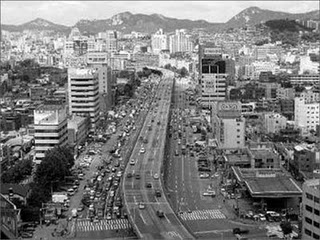
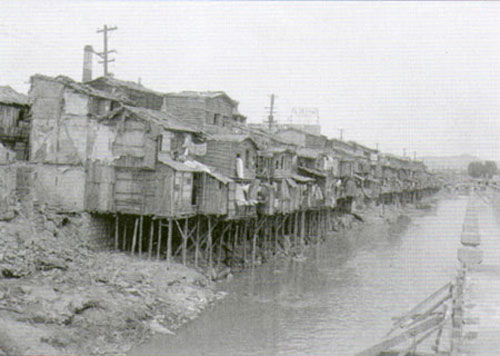
The history of Cheonggyecheon is of a small, ephemeral stream near the centre of Seoul. In the early 20th century, there were less than a million people in Seoul, and this stream was a water source, a place to wash clothes, and an open sewer, much like streams in developing urban centres the world. Things did not improve with the economic collapse around the Korean War. Post-war the stream was mostly home to squatter houses and squatter factories. Between sewage, waste, and dyes from the unofficial textiles industries, the stream was very polluted, and often ran multiple colours. When Dr. Hwang was a child, this was considered the “bad part of town”, with poverty and all the crime that comes with it.

Cheonggyecheon in the post-war period.

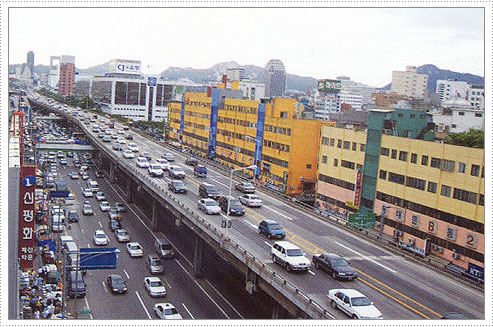
With the rapid development and industrialization of Korea in the 1970’s, there was little resistance to burying a small, heavily polluted, ephemeral stream in the bad part of town, and capping it with 8 lanes or surface traffic and 4-6 lanes of elevated traffic. Seoul was the heart of Korea, and building major freeways was a point of national pride: this is the progress Korea needed to become a leading world economy.

Cheonggyecheon expressway in all its glory.

???

Fast forward to 2002. Seoul is a modern “world class” city of more than 10 million people. The elevated Cheonggyecheon expressway is congested, the original watercourse has been buried in underground vaults and culverts, and the space between is nothing short of disaster. No sunlight, polluted by vehicles, traffic congested, not accessible to pedestrians as all open spaces are taken up by travelling vehicles, commercial vehicle parking, and unlicensed retail operations (street hawkers). The buildings were aging, and there was no impetus to improve them in this undesirable setting, so the businesses were declining. This was just one of the epicentres of overall urban decay in Seoul. Although they had built the trappings of a modern city, with advanced infrastructure and large dense population, the residents and officials in Seoul were realizing their quality of life – the liveability of their City – was lagging behind cities that were considered “World Leaders”.

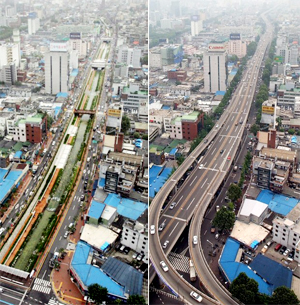
This begat a paradigm shift. A new Mayor was elected in 2002, and the new broom swept clean. His new paradigm including shifting from development to conservation; from building spaces for automobiles to building spaces for people; from infrastructure efficiency to infrastructure equality. This is similar to what we now call “sustainability” in urban design. The Mayor immediately announced the plan to tear out the Cheonggyecheon freeway and return it to a 5.8km-long linear park. The project was master planned in less than 6 months, and completed in a remarkable 3 years. There obvious political motivation for the fast timing, in that Mayors in Korea face the polls every 4 years. The project cost almost $300 Million (US), but the planners calculated that this amount was about the same as they would save in 10 years of maintenance of the existing highway and buried waterway system that was reaching the end of it’s design life.

Before and after airphotos – where would you rather live?

Although there was an extensive (if rushed) consultation process, including the Transportation Institute, all levels of government, and citizen representatives, this did not prevent significant backlash and protest. The protests will sound familiar to anyone who has listened to the Hornby Street Bikeway project or who might suggest New Westminster might be better off without the waterfront parkade: local businesses worried about losing traffic and customers, concerns about where everyone will park, neighbouring areas concerned that the congested traffic till get worse on adjacent streets. The illegal street vendors were particularly militant in their protests, but the project went ahead.

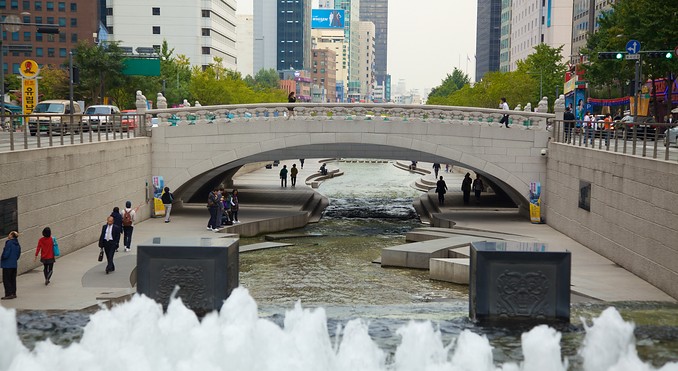
The road was cut up and removed (with 95% of the material recycled). The stream was exposed and re-contoured. Since most of the stream’s flow was ephemeral and partly because of other water management projects in the City, the stream was going to be dry 8 months of the year. A diversion project from the adjacent river and groundwater sources were combined to provide up to 120,000 M3 of water a day through the stream to maintain a constant minimum of 40cm of water. Storm runoff and combined-flow sewer water was separated and treated before entering the stream. Aside from the base flow, the stream was designed to accommodate the 50-year flood in a lower tier, and the 200-year flood in its upper tier. There were also 22 bridges built to cross the 5.8-km route, although many of there ware actually restorations of original bridges that were partially deconstructed and buried in asphalt in the 70’s.

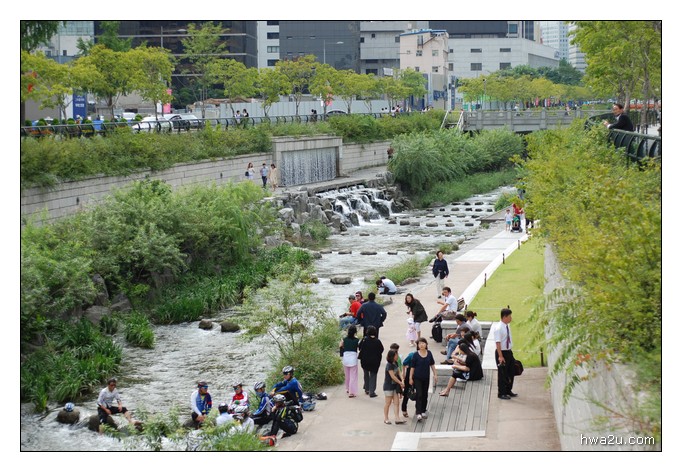
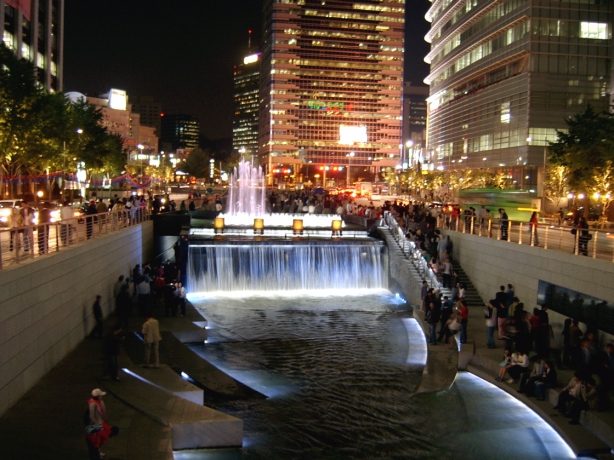
The end result is 5.8-km people space. Areas are very green and organic, other parts of very hard-surface with lots of facilities to accommodate public gathering, arts, or walking. People are encouraged to interact with the water. Where the symbol of “Korean Progress” used to be a 16-lane freeway full of cars, the new symbol is of urban children playing in a refurbished stream surrounded by green. Paradigm shift indeed.

What of the externalities, and what of the protests? The complaints about increased traffic elsewhere disappeared, just as the traffic did. Ridership on the adjacent subways increased, some people changed their travel times, some changed route, but mostly, people just stopped travelling so much through the area. Adjacent traffic congestion increased less than 1.5%, but overall there was a concurrent 2.5% decrease in Central Business District traffic. Property values adjacent to the stream increased 30%, and businesses prospered as they were suddenly adjacent to a site where there were more than 50 Million visits during the first year. The air temperature in this part of the Central Business District dropped several degrees during Seoul’s hot, humid summers, as the water flow acted as natural air conditioner and created a conduit for cool breezes. All this in a public place for festivals, for lunch, for art, for living space…

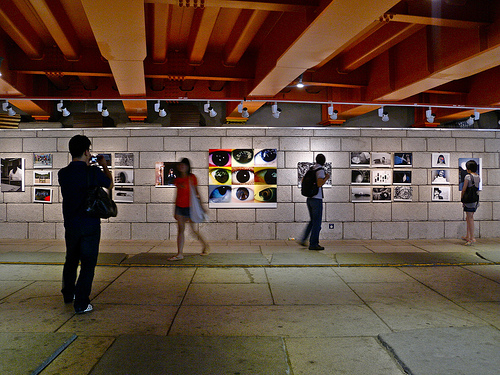
One of several “under bridge Art Galleries”

However, this progress does not forget the past. At several locations along Cheonggyecheon, there are reminders of the past. Those forgetting history are doomed to repeat it.

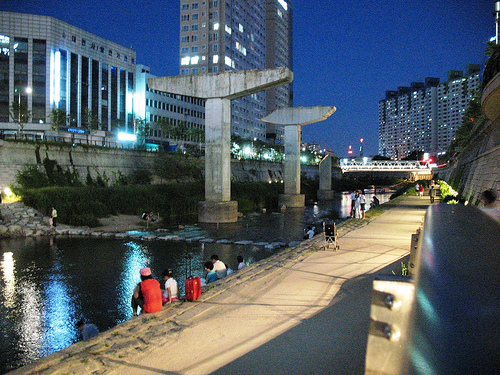
Several columns preserved, to remind people what they lost.

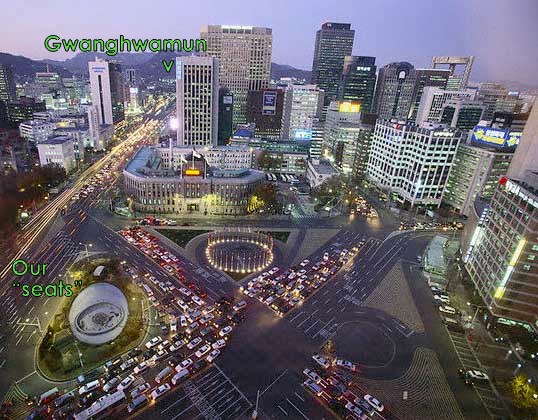
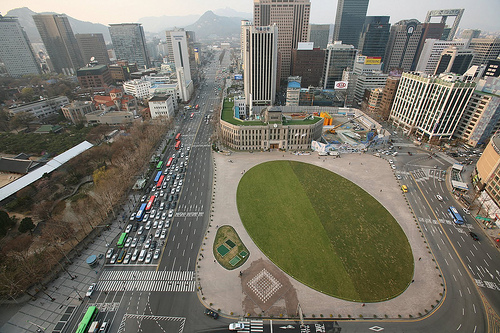
How does this translate to the rest of the City? Once the success of this project was apparent, every part of the City wanted one. Other viaducts have been removed under a “sky-opening” initiative. Other significant public areas in the City have seen the removal of traffic lanes to make room for green space: effectively building for people instead of cars.
?

Seoul City Hall before…

?

…and after.

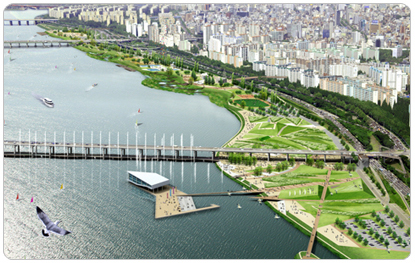
There has been a renaissance across the Central Business District, with more people moving into the area (12,000 new residential units in the CBD being planned right now), greenways popping up in exchange for density across the city, and all of the sudden, people in Seoul are finding they can walk places. With the new mayor talking up plans to refurbish their industrial river front:

Oh, and the visionary Mayor who proposed and fast-tracked this project? He is now the President of the Country.

So… the question is, are we ready in Canada, in BC, in New Westminster, for this kind of shift?


Are we ready to re-evaluate our public space and our public spending? The province is currently spending billions of dollars building more freeways, with little protest. There is huge pressure to push more lanes of “important regional traffic” through New Westminster and along our water front, and people seem indifferent, or think it will solve some problem in a magical way that has never worked anywhere else in the world.

When will our paradigm shift happen? When will we catch up to Korea? Or are we visionary enough now to not bury our waterfront under cars?

Election Day 1

As you can read here, I am not a member of any political party, and my votes in the past have gone to candidates from all over the political spectrum. I am political, but pretty non-partisan. Good ideas can come from anyone, just as bad ideas can.

But I am not without biases. I really don’t like Harper’s Conservatives, for several reasons. A good recent example arrived in my electronic mailbox on Thursday.

I am on an Environment Canada mail list for both work and personal interest reasons, mostly because I like to know what my “open and accountable” government is up to. So when this notice arrived in my mailbox (and mailboxes across Canada) at 12:25 PDT on Thursday, I was naturally excited. Apparently the Government was finally going to do something about the damning report they themselves commissioned, then tried to bury, only releasing it a couple of days before Christmas, when everyone is paying attention. I was looking forward to calling in for the announcement, until I realized the actual announcement was in less than 20 minutes, and I would have to “pre-register” by calling the handy number they provided. So they are giving a press conference to no-one, at 3:45 EDT, the day before the Government Falls. Why do I think this is not going to be good news? Open and accountable government? those bastards. Ends up they came up with a “plan” to start monitoring the Tar Sands impacts on the Assiniboine River. No actual timing is mentioned, no actual funding is suggested. Really, there is no evidence they plan to actually do anything, but they have a plan. To start monitoring. Some time. Later. Maybe.

Apparently, I am supposed to vote Liberal, but tomorrow I will be out pounding signs into lawns for a friend representing another party. Not that it matters in this riding, as someone representing yet a third party is the foregone winner. Dilworth’s pre-recorded voice already called me today, and she gave me the canned Party Line. The message offered to hear my questions of I pressed 1, which I dutifully did. They hung up on me. but a pre-recorded message that lies about allowing you to interact: that is pretty much the Conservative Party Line, isn’t it?

So I can sit back and enjoy the election with a slight detachment. 24 hours in to the election, and Ignatieff has already made a strategic blunder.

This coalition thing is a smokescreen, it is just more of the Politics of Fear that Steve learned from his Southern Friends. As long as they are trying to paint a coalition as the Worst Possible Thing That Could Happen™, none of the real issues are going to come to the forefront.

So to deny that a coalition is up for consideration serves three purposes: It reinforces the false notion that it is the Worst Possible Thing That Could Happen™; it limits his options if the polls don’t start improving soon; and it lets Harper control the conversation.

The only appropriate response to this type of bullshit is to turn it around on him. Say something like:

“I am campaigning for a Liberal Majority Government, because I think that would be the best result for all Canadians. That said, Mr. Harper is going to have to explain to Canada why a stable coalition of willing Parliamentarians, working together to represent the interests of the majority of Canadians is somehow “less stable” than yet another fragile minority government, unwilling to work with anyone or hear any diversity of voices, desperate enough to hold on to the reigns of power that they would rather prorogue Parliament that listen to the will of the people.”

Boom.

Pier Park Redeux

We got a little more info the last two weeks on the ongoing non-story of Pier Park contamination, and each little bit of info we get fills a few more gaps. I have to throw out the standard caveat here: although I have spent most of the last decade working on contaminated sites investigation and management in one capacity or another, I do not have the technical knowledge about this site to offer any “professional” opinions on it. Everything I know about this site is from the Council Reports and stories in the local media. So the following is a personal opinion based on incomplete knowledge, so treat it for what it is worth (approximately equal to what you paid for it).

So far we have had the February 14 update report to Council, and in March Chris Bell gave a delegation to Council raising his concerns about the ongoing remediation at the park, and we have seen an update on the Park and an interview with the project manager in the local papers.

First the update. It seems the (presumably shallow) soils have been remediated, and there is ongoing progress on the scrap metal “mounds”. The groundwater contamination plume (I will avoid the pejorative “toxic blob”) has been delineated (which means they have drilled holes all around it, sampled all of those wells, and found them clean), so they can now definitively say where the contamination is and where it is not. It is all within a 350 m^2 area, and they are between 40 and 50 feet below the surface. The highest concentrations are on the adjacent property, and if the groundwater flows towards the river (a safe assumption at that depth), then we can say the chlorinated solvents came from the adjacent property and migrated on to the Park Site through groundwater flow.

It is pretty clear the presence of these “DNAPL” chlorinated solvents was a surprise. It is extremely unlikely that this plume would have been discovered in any “Stage 1” or “Stage 2” Preliminary Site Investigation of the site, the type of investigation one would do prior to purchasing or developing such a site. From what I can interpret from the available reports, they bumped into this stuff while trying to do some depth-delineation of known contamination on the site. Such is the nature of the Contaminated Sites Regulations, though, that they have found it, they need to deal with it in order to get a certificate from the Ministry of Environment for the site.

These are liquid hydrocarbon solvents (likely carbon tetrachloride or tetrachloroethylene or the sort) that are heavier than water, so they sink to the bottom of the groundwater column in which they are dumped (much like the vinegar in your salad dressing drops down below the olive oil). This stuff is toxic to the environment, and potentially harmful to people, yes. Most chlorinated solvents are an irritant in low concentrations, harmful to organs like the brain to the liver in higher concentrations, and potentially carcinogenic with long-term exposure, kind of like the stuff you put in your gas tank every day or the polycyclic aromatic hydrocarbon smog you are exposed to walking through cosmetics section of the Bay. Toxic, but not the worst thing known to man. You can walk into Canadian tire and purchase Tetrochloroethylene for cleaning your brakes, and prior to the Montreal Protocol, you could buy Carbon Tetrachloride for everything from killing ants to running your refrigerator (but we called it Freon when using it for the latter). Mostly, they are common drycleaning chemicals.

Honestly, I cannot comment on the budget part of the update, as I am not up to speed on the budget history of this site. It is possible that this DNAPL plume is going to expand the budget of the park, but Jim Lowrie assures us it is within the “contingency” budget. Before we start yelling boondoggle, remember two things: this DNAPL was almost certainly unexpected and unpredictable, and that is what contingency budgets are for: contingent on the unexpected happening. Second, this extra cost is potentially 100% recoverable from whoever owns the property that is the source of the contamination. At this point, the concerned taxpayer would say “well, then make them clean it up!” Unfortunately, there is no way under the Contaminated Sites Regulations that the City or anyone else can force the owner of the source property to clean up the City’s property. What the City can do is clean it up, and then send the bill to the owner of the source property. They have to do it through the civil courts, but if managing this DNAPL really costs the City $1 million as some have suggested, and we can prove it came from off-site, then it should be pretty simple to recover those costs. But first, the City actually has to spend the money before it can ask for compensation. You may not like that, but it is Provincial law.

Now onto Mr. Bell’s concerns. I have met with Mr. Bell and discussed this issue with him. I respect him for his concern for the community, his persistence, and for speaking out about an issue that is relevant to all of us in the City. Just by asking questions publicly and making sure this issue stays in front of mind (if not on the front page of the Record), he is providing more impetus to the City and their consultants to make sure their “i”s are dotted and the “t”s are crossed, and to make sure the public is kept updated on what is happening down there (remember, all of these reports will be public information eventually, so the City has nothing to lose by sharing them with us). That said, just because Chris is constantly asking questions doesn’t mean the answers are not adequate.

You can hear his delegation to council here (he starts about 1:03 in and the conversation goes on for about 15 minutes).

First, it seemed a bit flippant by Mr. Lowrie, but Madame Railjogger is almost certainly much more endangered by trains and car/truck exhaust jogging along Front Street than from vapours from the DNAPL plume. My guess based on how they are managing this plume (barrier wall), is that the surface vapours will be “risk assessed”, and the City is confident the Ministry will agree there is no unacceptable risk. With all hydrocarbons, there are separate standards for vapours rising up through the soils, based on the potential health effects of people breathing those vapours. In this case, the amount of vapour produced at depth will be small, but not negligible. However, those vapours will have to rise up through a significant saturated water column, maybe 35 feet thick, then through another 15 feet of unsaturated soils before reaching the surface, all along the way being both degraded and diluted. By the time these vapours hit the surface where Madame Railjogger is working out, they are likely to be diluted to non-detectable levels. However, even if this was not the case, the park will not be getting a certificate from the Ministry of Environment until that potential pathway is assessed. If there are vapours getting to the surface, then they will be required to put a barrier in place, but in this case, that looks pretty unlikely.

Second, my turn to be flippant: Just because Mr. Bell and the Mayor don’t understand hydrogeology, it doesn’t mean no-one else does. These contaminants are heavier than water; when dropped in a column of water, they sink. I’m not sure what Mr. Bell is calling “hardpan”, but New Westminster is underlain by permeable and semi-permeable materials for tens of metres, or more. DNAPL, when dropped in the groundwater, will go down until it hits a layer of sediment that is not permeable, then it will stay there (vertically), while spreading out on the impermeable surface, and even flow downhill along that surface if there is a slope or a groundwater flow to push it along. The Spring floods (freshet) will never cause the contaminants to rise to the surface, like they would if this was LNAPL (that is, hydrocarbons lighter than water). Placing a u-shaped barrier (described by Mr. Bell as a “fish weir”) may work perfectly fine to stop the flow of the contaminants downhill (i.e. towards the River), as long as the DNAPL cannot flow under the wall, build up to sufficient thickness to flow over the wall, or have a reason to change flow direction and go around the wall. Bentonite / concrete walls l are extremely effective, and have been used for dozens of years, in thousands of applications; the technology is well understood, effective, and reliable. Assuming there is good hydrogeology behind it, it should be the best solution here. The only pathway to people or the environment is to go sideways into the river bottom, then leak out into the river. The barrier wall will stop this from happening. The plume won’t go anywhere, it will be kept stable in place where it can do no harm. Eventually (over many, many decades I suspect) it will dissolve away, biodegrade, and otherwise break down, but no active measures will be taken to physically remove the stuff.

Third: with the contamination ‘contained’, is it a threat to the park, my puppy, my kids? Simple answer is no. This stuff is stable and is a long way down. Your child will not be able to touch this stuff, drink water contaminated with it, or breathe vapours coming off of it. With a barrier wall, this stuff will not migrate to river sediment and get into the food chain of the Pacific Salmon. There is no reasonable way that this stuff is going to get to your kid’s system. Since there will be residual contamination on the site, there will need to be a Human Health Risk Assessment demonstrating that this residual material poses no health risks prior to the City getting a certificate for the park from the Province. With the Risk managed, there is no reason people cannot live, work and play on top of a contained DNAPL plume with no risk to their health.

And that is a significant point; the Province is overseeing this work. The City and their Contractor don’t need to reassure me to move forward, nor do they have to convince Mr. Bell that everything is on the up-and-up. They need to convince the Ministry of Environment. Mr. Bell mentions in his delegation that he trusts the MoE to provide oversight, and that is what he is getting. The MoE will not issue a certificate for the Park unless they are convinced from the science on the ground that there is no risk to human health or the environment. I don’t know what else to ask for from the environmental side.

So, in summary, I remain unconcerned about the contamination issue in the Pier Park. If Mr. Bell wants to continue to make an issue of this, he might be better served chasing down the cost overrun issue, or the process for public consultation around the spending. I’m not an accountant, I don’t know much about that side of the thing, so I am best to avoid that (go to moneynewwest.blogspot.com, maybe they can help). Also, as a taxpayers, I hope the people making decisions for the City are motivated to try to recover as much of the contamination mitigation costs from the railway or whomever caused the DNAPL plume in the first place. Keep in mind 100% of this money should be recoverable from the “persons responsible” for the contamination, or the landowner from whom we received this contamination, if the City chooses to pursue those costs. I think it is important that our tax dollars not be used to clean up someone else’s spill incident, if that someone else is still around to pay for the cleanup. That is where I am looking for fiscal responsibility on this one.

Water fight!

I’m getting a little tired and punchy over The story that just won’t die. What started as an effort to reduce the environmental impact of bottled water in our schools has turned into one of the silliest political debates in the city since… hmmm… I can’t think of sillier one.

I should declare my bias here, since conflict of interest is such a big part of this. I have already publicly declared my opinion that bottled water is one of the most egregious examples of the victory of cleaver marketing over common sense, good economics, and sustainability. Not on par with smoking in the personal-health-risk department, but probably more damaging on a global heath risk, and no less stupid. So my bias is that I agree with the students on this one, not the Board of Education.

I don’t know Lori Watt, I had never met her before the infamous school board meeting where the latest motion on bottled water was discussed. Frankly, I was not impressed with her unprofessional manner at the meeting, but it is not like being unprofessional stood out in that completely dysfunctional organization, where most if not all of the members have lost touch with what they are there to do. Speaking as an adult, I was embarrassed to have the students in the audience watch their elected representatives act like that. So for the two “slates” on the board, I say a pox on all your houses.

However, the claims of “conflict of interest” in this case seem a bizarre stretch, legal opinion notwithstanding. During the last election for Board of Education, Lori Watt worked as a staffer for CUPE, and was a member of COPE, and CUPE contributed to her campaign (as they did to Trustee Ewen and Trustee Janzen). These are not secrets, nor do they preclude her for running for the Board. People voted for her in spite of (or in some cases, I am sure, because of) these associations. Labour Unions are political organizations, just as multinational corporations are. They have political interests, and put their support behind those that reflect them. Watt is a member of a labour union (like about 30% of Canada’s working population), and quite possibly shares some of the same political ideas as the Union does. It is possible she even goes to Union Meetings and takes part in the democratic process of setting those policies. Of course, she can’t vote one CUPE policies, only COPE ones.

Note also that New Westminster is a “union-friendly” City. There are numerous union offices in town, the population mix is decidedly working class, and it is a longstanding labour-NDP stronghold since before the days when Tommy Douglas represented New Westminster in Ottawa. It is entirely possible that Lori Watt’s labour connection helped her get elected: that people voted for her because of her union affiliation. These people are her constituency: like it or not, that is representative democracy.

So a member of the Board of Education, elected as a union member, put forward a motion for a policy change, seconded by Trustee Graham (who did not receive CUPE funding) and supported by all members of the board, that happened to reflect the expressed interests of her constituency. That is the conflict of interest? Conflict of interest is now putting forward a motion reflecting the interests of her constituency that was immediately supported by the rest of the board? Huh? Is there any suspicion that she personally gained financially from this? Did she short-sell her PepsiCo stocks prior to this motion coming forward? If she didn’t bring the motion forward, would she be fired from her union job? Where was her gain here? Excuse the French, but this is so much ado about sweet fuck all.

But what of the legal opinion, you ask? Given sufficient money, I could have a legal opinion drafted up that says the sky is not blue and the ocean is not wet. When one of the world’s largest bottled-water selling multinational corporations (Nestle) pays for a legal opinion from the same law firm that represents another one of the world’s largest bottled-water-selling multinational corporations (PepsiCo), and that opinion comes back in favour of the position of the bottled-water-selling multinational corporations, are we to be surprised? We should be no less surprised that the Board’s own legal opinion said there was not conflict. Legal opinions are like children: there is no limit to how many you can have, even if you can’t afford them, and everyone thinks their own is the best.

Since we are on the topic of conflict of interest: we know O’Connor received some financial assistance from Nestle for his supposedly one-man grassroots campaign against Watt. We know there were other, so far unnamed, financial contributors, willing to spend money to support one failed Board of Education candidate, as the “public face” of the fight. Receiving secret funding to wage a personal campaign? No possibility of conflict there. If O’Connor was really concerned about openness and accountability, he would declare just how many people contributed to his “grassroots” campaign, and how he got the address of PepsiCo’s favourite law firm. Still, I have yet to hear Patrick O’Connor mention anything about the interests of students (remember them?) in this entire debate. It is pretty ugly on the face of it.

I am afraid the local “Voice for openness and accountability” is on the wrong side of this fight. They threw another shot across the bow last week in the form of a letter from the President to the News Leader, praising the Board for making a “balanced and thoughtful” decision on this matter. It is clear Neil was not in the room witnessing those discussions, as there was clearly little thought put into the fall-back position this board came to.

However, there are two things I think get lost in the language, but not the spirit, of Neil’s letter, and I hope to clarify them: the health concerns of NWSS water, and “freedom of choice”, two arguments used by Voice Board of Education Members, and reinforced by the Gentleman™ from Nestle™ at that board meeting.

During the meeting, there were three people expressing the opinion that the water at NWSS was not safe: Trustee Cook, whose nuanced argument included reference to a video he apparently saw on YouTube and a headline from the Vancouver Sun that he took out of context to create the perception that school water was laden with killer lead; The Gentleman™ from Nestle™ who made vague references to “immune-deficient people”; and some guy named “Paul” from the DPAC, who I didn’t know, but I seem to recall him saying something about commies and our precious bodily fluids:

But the funniest moment was shortly after this when Trustee Goring suggested (without a hint of irony) we need to educate the youth better, because he didn’t know where these rumours were coming from amongst the students that the water was unsafe…when there were numerous youth in the room arguing for a ban on bottled water, and it was only a few misinformed (or misinforming?) adults making these ridiculous claims…

For the record, the public health officer did not say the tap water at the school was unsafe. She suggested that a ban on bottled water should be applied concurrently with a ban on all single-serving drinks, including juices and sodas. Note, she was not arguing to maintain “freedom of choice”, but to remove all choices, leaving the school with only tap water, as this would be the healthiest alternative.

Which brings us to freedom of choice. This was big part of the Gentleman™ from Nestle™ argument, and something Trustee Cook was all over: give the students choice, and educate them to make the right choice. The false choice thing aside (with no facilities to easily fill refillable bottles, and big, glowing, pop machines everywhere you look in the school, just what is the message students are being given?) why would we give the students a choice that is the opposite of the recommendation of the public health officer? I am sure the public health officer would not suggest we install cigarette machines, then let the students “choose” not to smoke. Part of an education system is empowering the students to make the right choice by providing respite from the constant media bombardment to do the wrong thing. How do we effectively teach them to make the rational choice when we turn around and take money from a global multinational to advertise the irrational choice in the teaching environment?

On an almost completely unrelated note, you might have noticed this story about how Pepsi has slipped to #3 in the “Cola Wars”. Frankly, I don’t care what brand of malted battery acid you drink, but one number popped out to me: the United States annually consumes 1.6 billion cases of Coke. A “case” is an industry measure, equal to 24 x 8-oz containers, or 192 oz. That means the USof freaking A consumes 9.1 Billion Litres of Coke a year. To put this number in perspective, if you were to fill a 10-foot-deep swimming pool with this volume of Coke, the pool would need to be as wide as a CFL Football Field, and more than 100 km long! And that is just Coke Classic, we haven’t even thought about the Dr. Pepper effect. Freedom of choice indeed.

So, if the Board of Education was really concerned about the student’s health, they would immediately adopt the public health officer’ recommendation (see the recommendation here, on page 20) and begin the phasing out of vending machines in the schools. It is clear that the public health officer thinks tap water, supplied by Metro Vancouver and regulated by Vancouver Coastal Health is the helathiest, safest alternative. If Patrick O’Connor is really interested in cultivating his position as “maverick community activist” and not a bought-and-paid hack for Multinational Corporations, then he should stop taking their shadowy money, and if Voice is really interested in open and accountable governance, they should probably be backing away from this issue and Mr. O’Connor completely.

Oh, and everybody: apologise to the damn students for being such idiots.

Earthquakes, there and here. – now with extra nuclear reality check

As a geoscientist and someone who works in Richmond, I am hyperaware of the situation in Japan. I was at the curling rink at midnight last Thursday when the news came on the TV. The initial pictures of tsunami waves of debris flowing over farmlands and the shock of seeing entire oil refineries going up in flames was ultimately too harrowing to watch. I had to turn it off and go to bed. The horror on the ground was too real. Roland Emmerlich be damned.

I am in no way an “earthquake expert”, my geology training is more sedimentology and tectonics, with some ichnology thrown in and a bunch of hydrogeology experience. However, during my schooling, I was lucky enough to learn about natural hazards from a couple of the people you have seen and heard on TV and the radio in the last few days (such as John Clague at SFU, who is the go-to academic on this stuff in Vancouver, and was a very busy guy last weekend). I also had seismic course work both theoretical at SFU, and more applied at the University of Hawaii-Hilo, so I would consider myself a well informed non-expert with quite a but of related background. For what that is worth.

An event like the one in Japan will not hit Vancouver in the same way it hit Sendai. The earthquake at Sendai was a very large megathrust , one of the largest quakes ever recorded (currently the USGS has it rated at magnitude 9.0), which occurred at the very shallow depth of 10km, only 100km from the shoreline. On every single scale, that is pretty much the worst case scenario.

We do get “megathrust” quakes off the west coast of BC, and some may even hit this magnitude, but Vancouver (and even Victoria) is not like Sendai. First off, the major thrust fault plate boundary off of Vancouver Island is more than 300km from Vancouver, and more than 200km from Victoria, with the bulk of the Olympic Peninsula and Vancouver Island in the way. Also, there are up to two kilometres of soft Quaternary sediments draped over the subduction zone here, which may soften the blow a bit.

That said, a megathrust will be a bad day here in Vancouver (think magnitude 6.5 quake-type shaking, but lasting for several minutes: up to 15!), but the tsunami risk to Vancouver is relatively small (with a caveat below). The west coast of Vancouver Island will not get off so easy: Tofino, Bamfield, Port Alberni: these places stand a pretty good chance of being wiped out completely. The only real good news for them is that these events are very uncommon, probably about once every 500 to 700 years, so odds are it will not happen in our lifetimes.

Probably a much higher direct risk to Greater Vancouver is presented by much smaller “crustal” earthquakes that may occur very close to the City. These quakes are usually shallow, and if close enough, can cause major damage, although tsunamis are unlikely (with that caveat below). There are unlikely to be much higher than magnitude 7 or 7.2, but the proximity is the issue. These can happen anywhere between Hope and Sooke. This is the difference between Kobe, where most of the destruction was caused by shaking and fire, and Sendai, where most of the damage was by tsunami. Locally, this type of quake is much more likely, and probably has a recurrence interval of less than 100 years in our geographic region.

Oh, can we stop saying “Richter Scale”? No-one has used the Richter Scale for about 20 years. It is the Moment Magnitude Scale now, the difference is small, but quite signficant scientifically.

The tsunami caveat I have to include is that there could be a serious secondary tsunami, caused by a major landslide on the pacific coast (say, Sea-to-Sky area?) displacing a bunch of sea water, or even worse, a major collapse of the unconsolidated sediments off the west end of the Fraser Delta, which could hit the Gulf Islands with a serious tsunami, only to have to reflected back and hit Vancouver proper. Again, this is unlikely, but would be a bad day for everyone involved.

Which brings us to Richmond. I cannot comment for the City, nothing I say here is on behalf of the City. My job in the City is related to water quality and pollution prevention, I am not in the Engineering department, so I am not really in touch with those who do the earthquake planning. The only things I know about earthquake impacts in Richmond is from reading the City’s website on the issue, and a little bit of earthquake info I gained from my own personal research. None of this is official folks, it is just my personal, relatively uninformed position.

However, buildings and dikes are built to the 1:475 standard, which means the intensity expected once every 475 years, so essentially the worst of the “local crustal” quakes anticipated. Some critical infrastructure is built to higher standards yet. Legends of the entire Lulu Island “liquefying” are rather exaggerated. There will be local liquefaction of soils, probably resulting in some road and building damage and maybe some utility failures, but not the widespread destruction some would have you believe. Modern buildings are built with Liquefaction in mind, including piles, rafted foundations, stone columns… engineers, for all I hassle them, do good work.

The dykes, for the most part, should also be fine. Minor slumping in some of the older parts of the dykes is possible, but the internal drainage system of the Island (ditches, sewers, and pumps) can deal with that. Remember, most of Richmond I actually above sea level, unless there is a major freshet on the Fraser and an exceptionally high tide at the exact same time as the earthquake, widespread flooding is extremely unlikely even in the event of a major quake.

If anyone is really concerned about an acknowledged weak link in the Earthquake protection system, maybe ask the Provincial Governement where they are in those School upgrades.

Ask any Emergency Management expert in the province and they will tell you the #1 thing you can do to protect yourself from the inevitable earthquake is to be prepared. Have a 72-hour survival kit , because you shouldn’t anticipate getting any help in the first few days after an event. Another emergency kit (water, food, blanket) for your car, and one for your workplace will give you that extra protection, as you don’t know where you will be when it happens. Finally, plan ahead with your family and loved ones to agree to a place to reunite after the event, as you may not have phones to get in touch. The more eventualities you plan for, the more secure you and your family will be when (not if) the earthquake happens.

One interesting science side of this event was the pattern of earthquakes leading up to the big thrust that caused this disaster. In the days leading up to March 11th, there were several dozen “pre-shocks” of significant size in the area of the main earthquake, even up to magnitude 6.0. The Japanese lead the world in earthquake research (all due respect to the USGS), and this pre-quake pattern will be studied to death. There is hope we will learn more about the pre-cursors for this type of quake. A day’s warning, even 6 hours warning, would mean everything to the people of Tofino or Port Alberni. Compared to the hour or so warning Sendai had between the shaking and the tsunami, it could save thousands of life.

Not that Canada is slacking on this reaserch. The Neptune Project includes a plan to wire the entire Juan de Fuca plate, from the Pacific plate to the subduction zone, with sensitive seismometers to understand the changing stress regime of the plate. This is pretty cool, cutting edge stuff, no less remarkable or technically challenging that putting a probe in orbit around Mercury. It won’t get as much press, or course, unless it actually predicts the Megathrust and saves lives.

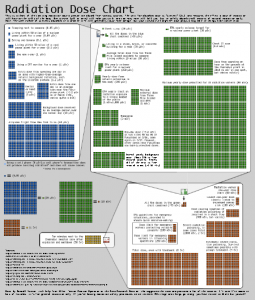
Update: as for the nuclear plant issue, the good sciency types at XKCD.com have made this cool chart up to give you an idea what the actual radiation risk is. Chort form: way less relevant than the tens oft housands killed in the tsunami, or the hundresd of thousands now homeless in Japan. Click to make readable.

On Caps

I heard Gordon Hobbis on CBC Radio’s “The Morning Edition” on Wednesday the 16th (you can stream it here, he was on about 1:40 in) talking about the United Boulevard Extension, and it got me thinking about Gord’s business: Caps Bicycles.

First off, Gordon did a great job on the radio. He hit the right points, and really addressed the concerns the neighbourhood and the entire City have about the UBE. This despite the efforts of Rick Cluff, who not only sees the world through a windshield, but is one of the all-time worst radio interviewers (you can hear him reading the questions off the sheet, as opposed to engaging in a conversation), OK for sports reporting in Ontario, and he sure likes talking about food, but his lack of intellectual depth or nuance is fairly exposed when the conversation turns the least bit political. Locally, see Stephen Quinn for the opposite: he actually asks smart questions, uses the interviewee’s responses as a launching point for follow-ups, even if this means putting them in an uncomfortable spot, or pointing out their own contradictions…but I digress.

I actually grew up in a bike shop. When I was 7 or 8, my parents bought a small-town sports store specializing in team sports, shoes, bikes and cross-country skis. My Mom became a local legend for her skate-sharpening skills, with figures skating clubs across the Kootenays sending her bags of skates on the Greyhound, which she would stay up late sharpening so they could be shipped back out on the next bus. My Dad put 20+ hours a week in as well, on top of his regular 40-hour job as an engineer. I learned a lot from growing up around that, mostly about the rewards of working hard, about how boredom could only result from laziness, and about being part of a community instead of just living in it.

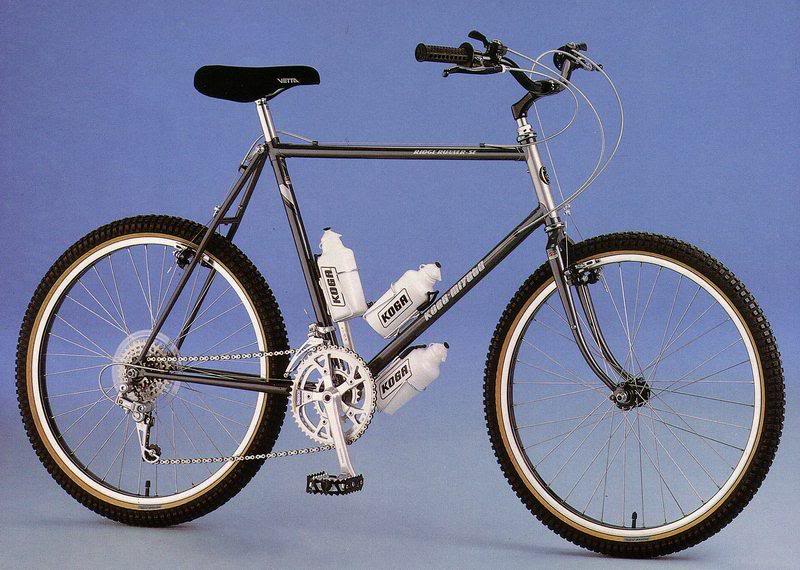
But mostly, I learned to love bicycles. I remember changing my first flat tire when I was 8 or 9. I remember disassembling all of my first bikes to their bare parts, only to see how they go back together, and I remember a 1982 copy of Bicycling Magazine that talked about “The Klunkers of Marin County”: my first introduction to what we came to know as mountain bikes. With my parents running the store, I had access to bikes. I had my first real mountain bike (a pretty marginal Raleigh) by 1984, and my second (a sweet lugged and brazed triple-butted chromoly number from Miyata) by 1985. By the time I bought mountain bike #3, my parents had sold the business, and so I went out to the open market.
?

Bike #2 – Ridge Runner SE (it was actually a 1985-1/2 model)

By 1987, the mountain bike boom had exploded. Within about 5 years, bike shops went for selling 90% “ten speeds” to selling 90% mountain bikes, and they were selling more bikes than ever before. The twin drivers of new technology advanced around mountain bikes and the emergence of Shimano SIS, along with North American cyclists like Greg Lemond, Andy “Hamstrings” and Steve Bauer finding success in Europe, cycling was momentarily cool.

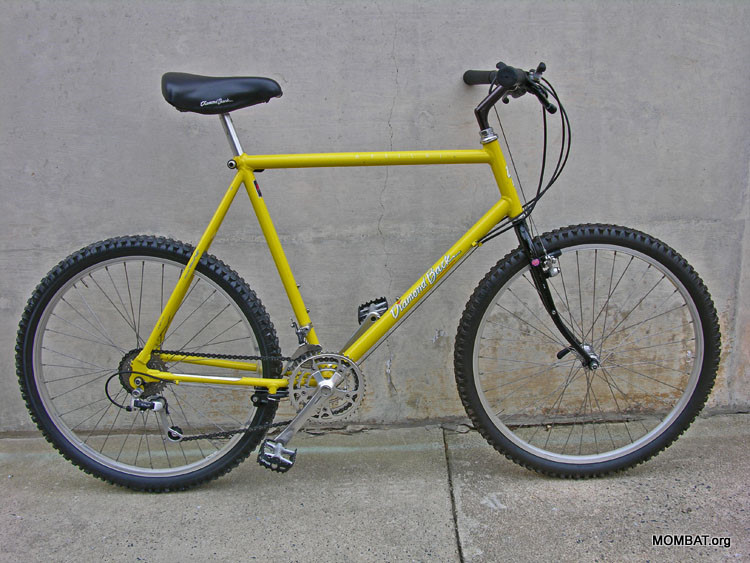
The biggest bike dealer in BC was easily Caps. Even in the Kootenays, we knew of Caps, it was a big chain and always had the lowest price. So it passed that when I graduated from High school I bought my third mountain bike from Caps. It was a 1987 Diamond Back Arrival. TIG-welded 7000-series aluminum frame (rare at the time), Deore XT components, seat-stay mounted U-brake, biopace, Araya RM-20s; this puppy was state of the art for a factory-built bike. I seem to remember is selling for $1050. And I rode the hell out of that bike for at least 4 years. Eventually it saw ubiquitous upgrades like a Syncros Stem, a Hite-Rite, and Specialized Ground Control tires. It was the bike I brought down with me in 1988 when I first moved the New West. It was the bike I put slick tires on to work as a bicycle courier in downtown Vancouver. It was the bike I raced over Vedder Mountain in those “classic” races. It was the bike that opened up Burnaby Mountain trials to me, and was the bike I had when I helped build Nicole’s trail, one of the most venerable trails on that hill. I loved that bike.

My First bike from Caps… State of the 1987 art.

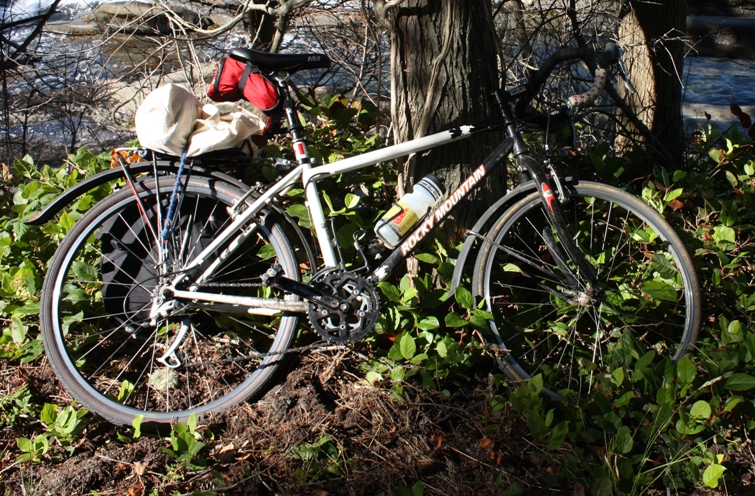
Then I started paying my way through school working in other bikes shops, in the Kootenays, in Vancouver and North Van. As the Diamond Back got old, I bought a Scott Pro Racing (Tange prestige, XT, Scott self-energizing brakes, and my first set of Rock Shox RS-1s), a Giant Cadex CFM-2 (aluminum lugged carbon fibre, Suntour, Rock Shox Mag21s), then another Cadex CFM-2 (same frame, AMP parallelogram front fork(!) and the last set of thumbies I would ever own (alas)). This was replaced by my first Rocky Mountain Blizzard (Marzocchi XC-600 forks, XT, gripshift, and Magura hydraulic cantilever brakes), then another Blizzard (Bombers, XT, RaceFace, V-brakes) that I still use for commuting, and now my SantaCruz Blur named Morton. That is my mountain bike history, in a nutshell. Road bikes are another matter, as are commuters.

Liz 2 – my 2nd Blizzard, now an uber-commuter and light tourer.

Now it has been 10 years since my last bike shop job (Blizzard #1 was the last bike I didn’t have to pay retail for), and I generally hate going in bike shops. Actually, I love going in bike shops, I hate going in with the intent to buy, as more often than not I know more than the sales guy I am working with about the product I want to buy, I am a terribly picky customer and have little patience for the marketing hype (don’t get me started on “riser” handlebars) and the entire sales/snob side of the cycling industry just irritates me. That said, The iCandy has purchased both of her last two bikes from Caps: a Devinci road bike for training and Grand Fondos, and another Devinci hybrid for commuting. She has a hard time finding bikes that fit her well, and both Devinci and the staff at Caps have done a good job for her. I can go in and talk to Gord or Marie or anyone else there and 90% of the time, get what I need (and the other 10% of the time, the thing I need doesn’t exist anymore…my list of bikes above makes me look like an early adopter, but I am now pretty far to the retro-grouch end of the spectrum).

It is also great to support someone who lives and breathes his community. Gord is the driving force behind Sapperton Days, an event embraced by the entire community. He serves on community committees (including previously on the Pedestrian and Bicycle Advisory Committee, where I got to know him better), and he is always up for discussion about the local events of the day. I think (from my young memories), that is how my parents were: selling baseball equipment but also coaching and providing uniforms for community teams (sponsoring 8-year olds… funny when you think about it), renting XC skis, but also providing a sales location (free of charge) for the local cross-country ski club to sell their passes. They didn’t sell golf equipment (why compete with the Pro at the local club, who is a specialist in the field and a good guy?) but they served on the board of the community golf course… build the community and your customers will reward you.

So kudos to Gord, for running a community-based business, and building the community. And shame on anyone in New Westminster who buys a bike a Walmart.

News update…

So much going on, so little time to write about it.

First off, Christie Clark announces her Cabinet. To her credit, I think it is a good mix of old and new, evidenced in how Moe Sihota was stuck on CBC concurrently complaining about the lack of some new members’ experience and the fact there was no evidence of change! No problem: that kind of cognitive dissonance is nothing new for Moe. There is no local angle here (New West is a long way from any Liberals of note, figuratively, if not literally), but there is an environment angle. The new Minister of Environment is some guy no-one outside of Kamloops has ever heard of. That said, he is genuinely educated (a Veterinarian), has executive experience (Mayor of Kamloops), and seems a generally nice guy (including doing a lot of overseas development work for a non-religious organization), so I am hopeful.

However, Clark’s biggest concern should not be her cabinet selection, or Moe Sihota, it should be the three high-profile, right-of-centre-right BC MPs who have just announced they are leaving federal politics . In Stockwell Day, John Cummings, and Chuck Strahl, the BC Conservatives suddenly have an electable core, and they they won’t have to dip into the Randy White pool o’ crazy for a leader. The landscape of BC politics is about the change: you read it here first.

Now getting more local, The UBE open house on Saturday was apparently well attended and well organized. I was out of town for a curling bonspiel, and could not go, but from the reports I have heard, any topics I would have covered were covered very well by others. I am actually at a committee meeting at the same time as the Wednesday consultation, so I will not be able to attend, but I recommend all with any interest do so!

The “water bottle in the school” issue will not be going away any time soon. With the President of Voice writing an opinion piece supporting the School board (while getting some of the facts wrong), on the same day we find out that the pro-water bottle “legal opinion” was actually financed by the Gentleman™ from Nestle™. I think Voice’s best tactic now is to back slowly away from this issue. Secretive corporate financing of Mr. O’Connor’s “grassroots” anti-labour rhetoric is not really the kind of thing people commonly associate with the “accountable, transparent, democratic” ideas Voice usually represents. O’Connor is not, to the best of my knowledge, a Voice member, nor does he speak for them, but this is probably something they don’t want to be too close to when it crashes and burns.

Finally, rumour has it that the City is looking at fortnight trash delivery. Good news.

Pinch me, I’m famous – Updated!

I Finally made it.

After 6 months of blogging, 70 posts and with 5000 hits on this blog, four years with the NWEP, and 2 years as President, a half dozen delegations to council, many more letters to various editors, working on City committees, working on various political campaigns, attending countless public meetings and generally ranting and raving about politics and the environment for too many years to keep track of…I finally broke through.

Nobel Prize? Koufax Award? Book deal? Kudos from P.Z. Myers? No, better than all of these:

Paul Forseth knows I exist.

Paul Forseth 2005
I’m either standing in your shadow, or blocking your light…

We all know Paul as former MP, Conservative roustabout, and purveyor of the least local of all local blogs. His dot-com presence is more a conduit for missives from the Prime Minister’s Office than a blog, displayed in the way most posts are written by actual members of the Conservative Government, and read word-for-word like press releases in local papers nationwide.

I call it the most “non-local” local blog, as the words “New Westminster” have not appeared in a single post on the site over the last two years. Not once.

His latest post is a source of great hilarity, though. He purportedly asks people to send him their feelings about having an election, which he will dutifully post for you. Apparently, he is unaware that the whole “mail it to me and I will post it” thing isn’t needed in a Blog, as there is a “comment” thing down there at the bottom. He even has moderation turned on, which means he can filter out all those uncomfortable mentions of in-and-out scandals, Bev Oda’s inability to remember “not”s, illegal campaigning in Ministers offices, recent speaker censures, jet plane budget misestimates, or…well, you get the point.

It also went up with a dozen “opinions” that presumably already arrived, with semi-anonymous people falling into two camps: 1) No election now, Harper is doing a great job! and 2) Call an election now! Harper will sweep to majority! Of course, they all arrived with the original post asking for comments, and he hasn’t updated since, so they do smack of…I dunno, not being 100% genuine? Astroturf much?

Then I notice that one of the posts from Camp 2 is from none other than “P. Johnstone”.

O.K., so I have been a Johnstone all my life. And surprisingly, there are not that many of us. Something about the Campbells sweeping into the borderlands 400 years ago and marrying all our women. “Johnson”s out the ying-yang, “Johnston”s a dime a dozen, but “Johnstone”? Not too common. Telus White Pages list no Johnstones in New Westminster at all, and only 8 in all of Burnaby. I guess it is possible that there is another P. Johnstone in New West without a listed phone number like me, who happened upon Paul Forseth’s blog on the day he posted a request for comments, who rushed to comment. Hey, some coincidence, but stranger things happen.

Or, Maybe Paul saw my dig at his blog on another much, much more local blog and took notice. That means he knows I exist, and has been paying attention enough that this slightly uncommon but totally random name appeared in his “pseudo-comments”. I leave it up to Occam to decide.

Too bad he didn’t take my gentle jibes for what they were: advice to use his burgeoning web presence to try to connect with the people in New Westminster. That is the power of social media, it isn’t just an advertising platform, it is an opportunity to engage in conversation. For example, one local MP has been vocal about the transportation issues affecting New Westminster (those projects receiving federal funds, so therefore relevant to the federal file). Where is Paul on the UBE? Where is Paul on anything?

Maybe he need to think about taking a workshop on how Social Media is supposed to work…

Update: March 14:
In what I am sure is a complete coincidence, Paul’s website now has a post talking about a local event, and all the older missives from the PMO posts have gone down the memory hole. It’s a fundraiser, but at least it’s local!

Good to have another active voice added to the local blogosphere… I don’t know if anyone else has noticed, but we need a little more active input from the Right side of the political spectrum around here.