UBE – endless consultations

It has taken me forever to get this post written, at least partially because of the Blogger hiccups of the last couple of days. More, though, I am not even sure how to approach this topic again. The TransLink consultation process on the United Boulevard Extension is wearing me down. Like many others, I am finding it frustrating.

TransLink is holding these consultations for good reasons. They want the best possible plan to take to New Westminster City Council, to maximise their chances of getting this thing approved and built. However, during all of this polishing of concepts, engagement of the local residents, planning, visioning, and conversing, they continue to miss the main point. The more that talk about alternate orientations, noise abatement walls and pedestrian overpasses, the more they avoid the real issues that got them into this mess. It wasn’t the colour of the noise abatement wall that caused New Westminster City Council to send them back to the drawing board in late 2010, it was the lack of a justification for the project in light of the negative impacts on the City, and the lack of a comprehensive plan to manage traffic west of the project.

This frustration was exemplified during the April 30th Workshop when the facilitator asked that everyone “put aside the UBE vs. no UBE debate”, and then flatly declared that it would be difficult to “get full agreement from everybody on anything”. I don’t think I was the only one in the room who thought this discussion isn’t about getting full agreement from everyone, it is about deciding if this plan to spend $170 Million of taxpayers money is going to fix anything, or is going to just make things worse for Sapperton and the rest of New Westminster.

Forever the sport, I will play TransLink’s game, I’ll try to keep the discussion here on the UBE concepts as they were presented at the Workshop.

Most of the background info provided in the presentation was familiar to people who attended previous meetings. Notably, the results of earlier consultations are filtered through TransLink’s lens. An example of this is on Slide 8 of the presentation:
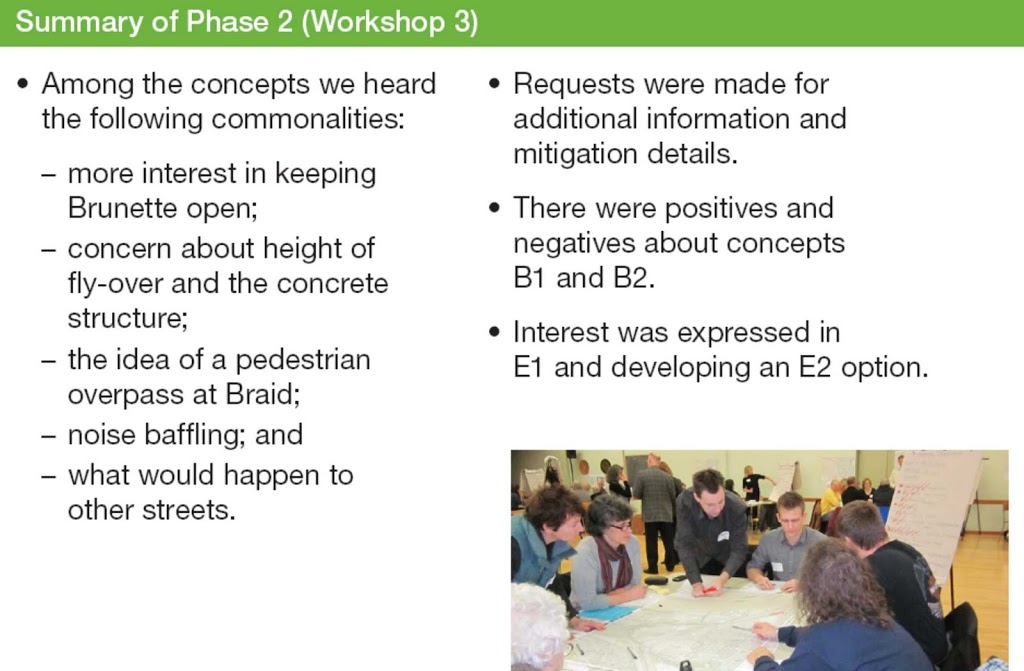
When they say that the community noted “positives and negatives about Concepts B1 and B2” or “Interest was expressed in E1 and developing an E2 Option”, they are being selective in their interpretations. From the conversation I had coming out of the last meeting, most people wanted to see better justification for tossing Concept C aside, and none thought B1 was any better (and was potentially worse) than the old “T junction” that was rejected in December. The E option was preferred by everyone I talked to (except those who still thought the best option was to build nothing).

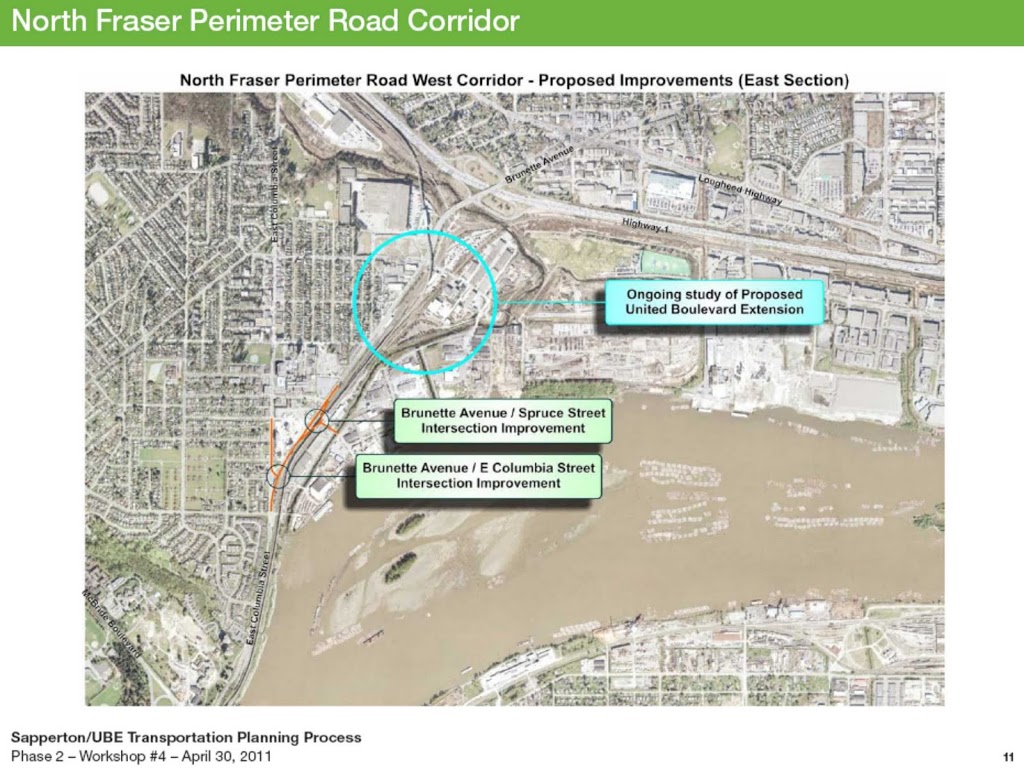
I have already posted on the Christmas Gift List of the proposed “improvements” to Front Street, so I will avoid repeating myself.
Click to zoom in

The plans further east, including plans to improve the Spruce Street intersection, are a new twist, however. This has not come up before in these discussions, and provides an interesting contrast to removing the rail crossing at Braid – they want to increase truck traffic at a level crossing a kilometre west of where they are spending $170 Million to eliminate a level crossing for truck safety? That said, the proposed improvements for Columbia at Braid would result in significant improvements to the traffic flow, discourage trucks from going along East Columbia, and potentially improve the Central Valley Greenway. The City should look at this option for that intersection ven after the UBE has finally been killed.

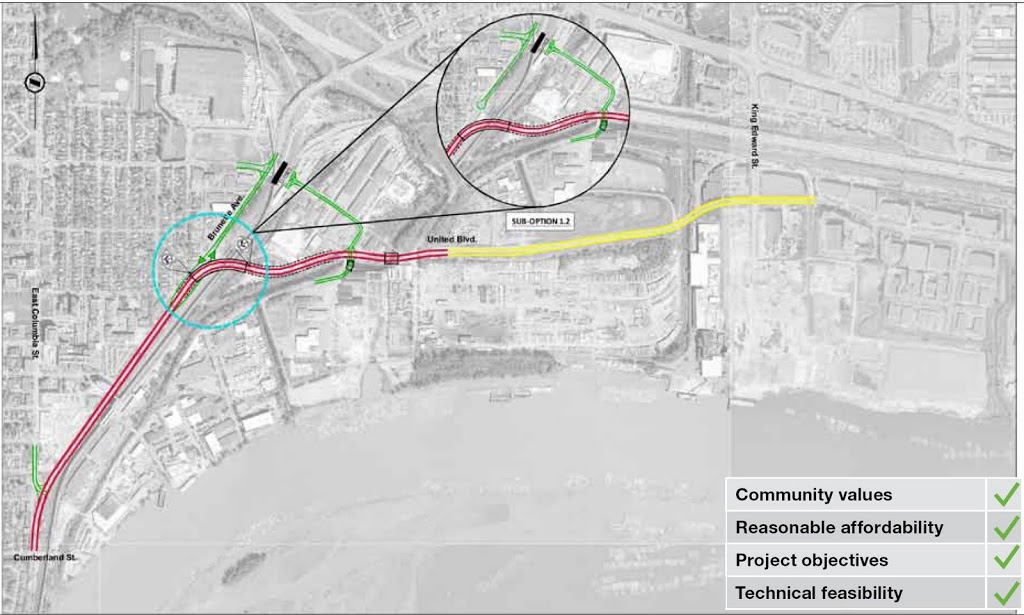
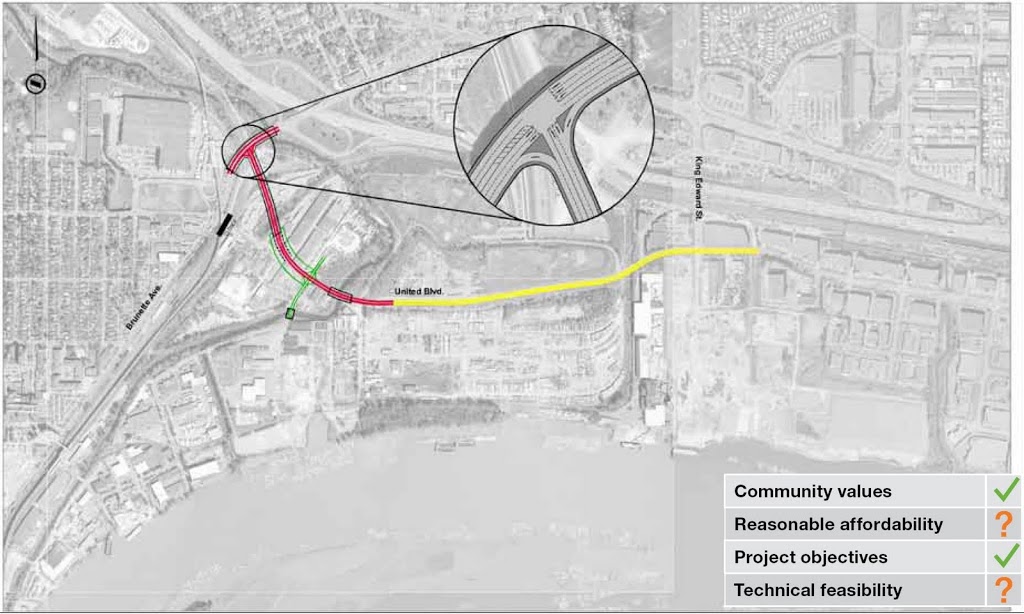
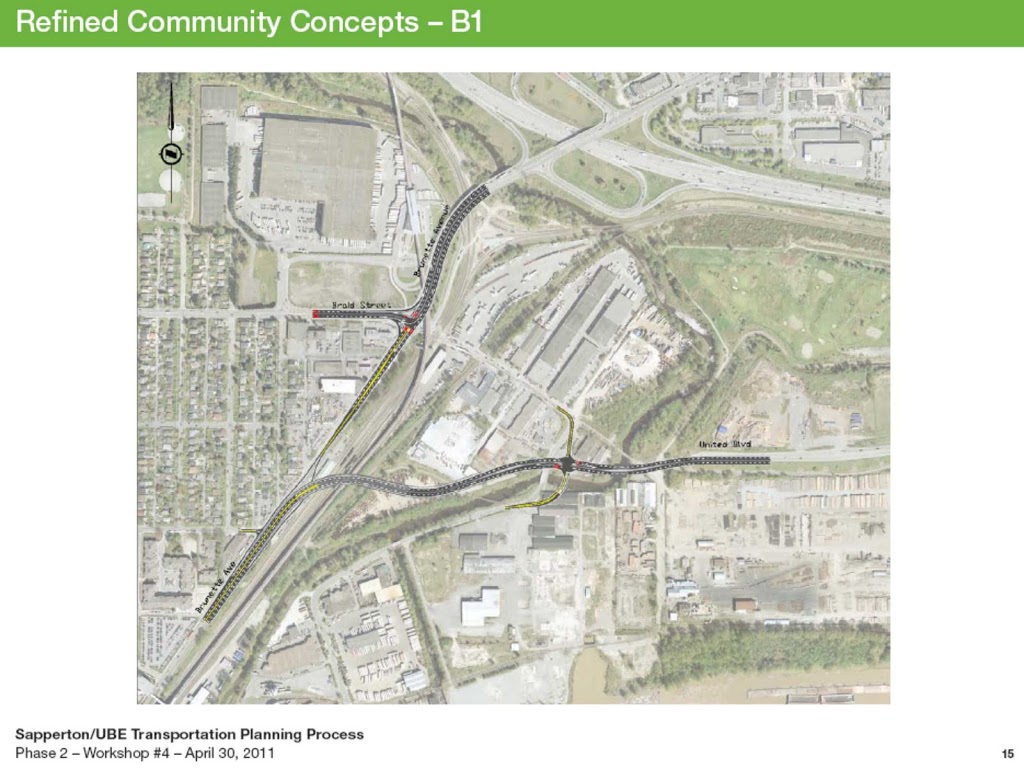
Refined Concept B1:
Note I didn’t call it a “community concept” like TransLink does. I’m not going to sugar-coat this: these concepts are coming from TransLink, not from the Community. If I go to Key West Ford and Jaimie tries to sell me a black F-150, but I pick one out with white paint and alloy rims, it doesn’t make me the guy who designed and built the truck. I’m just the guy who bought it. It is still a Ford.
click to zoom in

This is the plan that TransLink wants to build (there, I said it). The problems should be obvious to anyone following this story. The size and scale of the overpass will impact much of Sapperton. Only a few properties will be directly damaged, but the large overpass will be in dozens of backyards. This is really just a warmed-over version of the earlier rejected concepts.

The new twist that makes this even worse for Sapperton is the re-design of Brunette, where two lanes from the freeway shrink to one just north of the overpass. This will of course result in a merge zone backup. And what happens every morning when that backup gets as far as Braid? The traffic will natural bail out and go up Braid and wind its way through New Westminster neighbourhoods, the “rat running” that Sapperton was hoping to see come to an end. The back-up of vehicles coming east along Brunette and headed for the Freeway will be just as bad as they need to drop to a single lane. So much for free-flowing traffic on Brunette.

TransLink’s response to this was that the drivers will instead go over the overpass and take United Boulevard. This seems fanciful, considering anyone headed for the freeway or points east is not going to want to drive 5 km along a 4-lane commercial street with stop lights, past furniture stores, the casino, and the new Fraser Mills residential neighbourhood with it’s 10,000 commuters in order to get onto the 10 lane freeway that is less than a kilometre away…Or am I missing something?

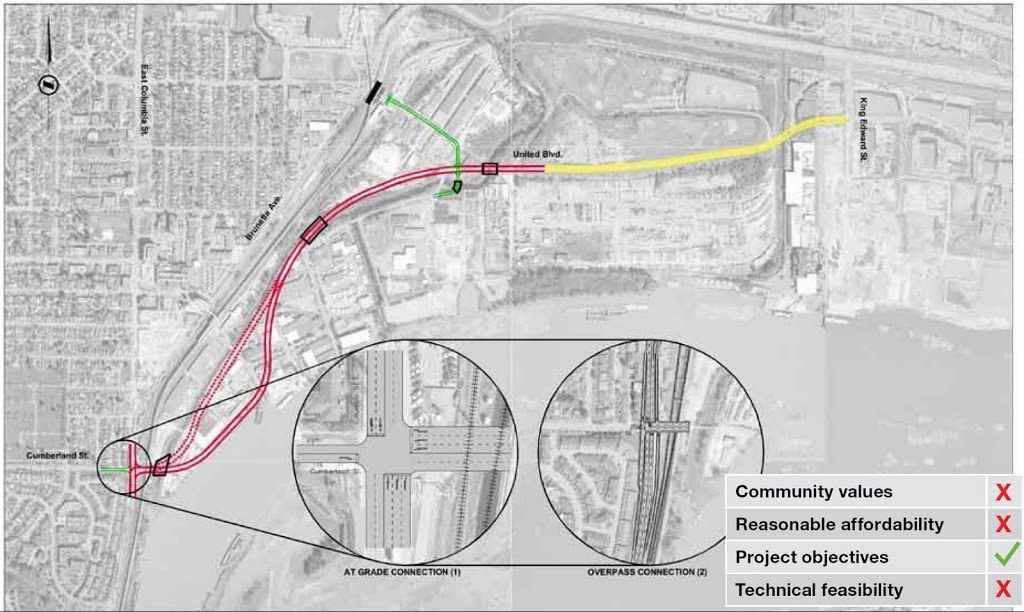
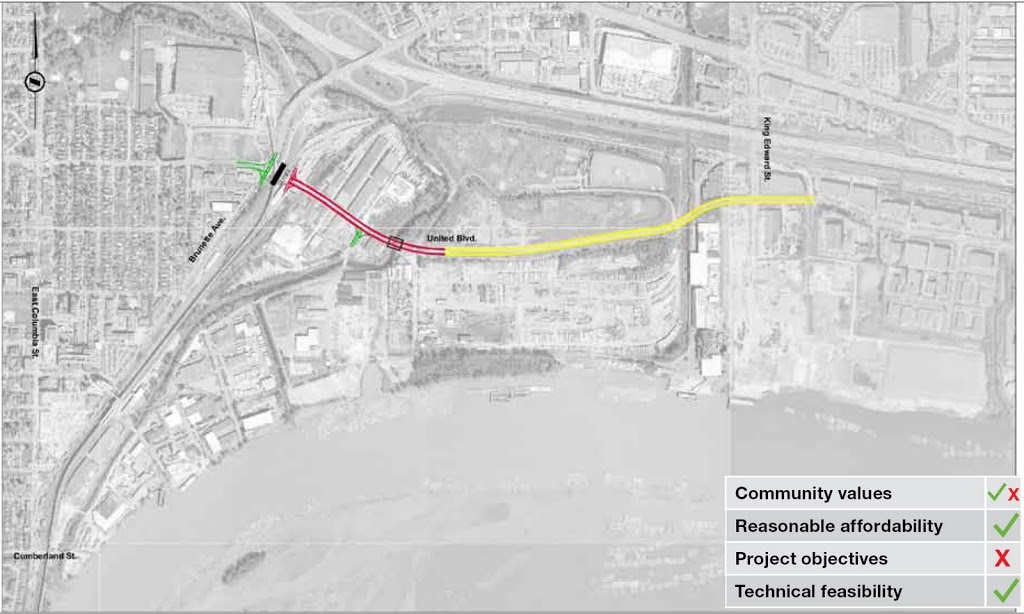
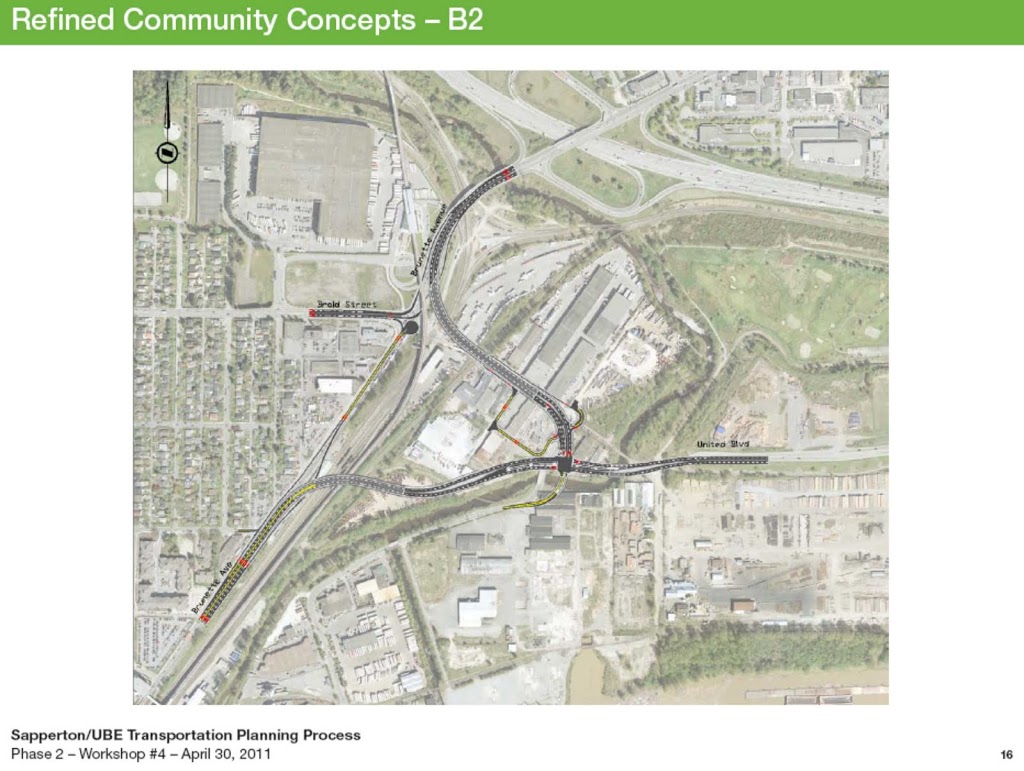
Refined Concept B2:
click to zoom in. Do I have to keep saying this?

This project takes most of the negatives of B1, with the exception that it doesn’t cause as much back-up on Brunette. As a trade-off, it impacts more New Westminster industrial land, builds a set of intersections with significant navigation challenges to cyclists (It took 10 minutes for me to show the TransLink representative that the routes for bikes here just didn’t work out). Worse, it completely cuts Braid Station off from the rest of the community and points east. This design also looks like it will cost TransLink 2 or 3 times as much as the original design, with that much more elevated overpass construction, much of it over working rail yard. This may represent a cost equal to the Evergreen Funding Gap.

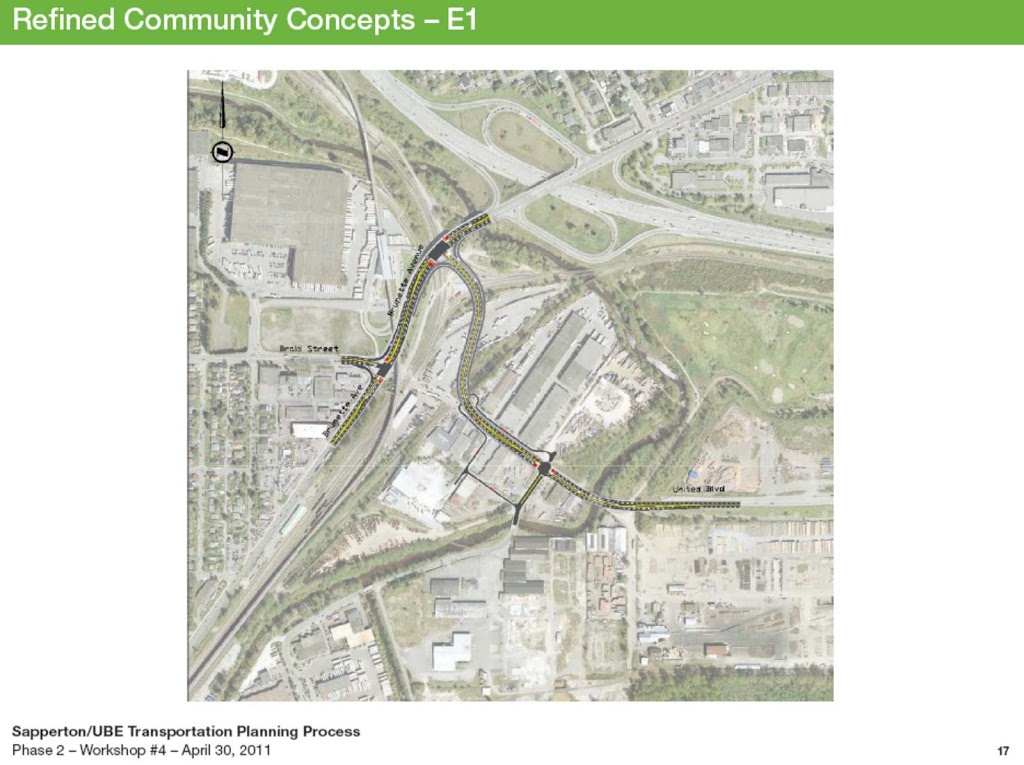
Refined Concept E1:
Guess what happens when you click

This concept definitely has more community support than the “B” concepts, mostly because it has much lower impact on the residential and commercial properties in Sapperton (but possibly a bigger impact on the Industrial properties is it meant to be servicing). TransLink has suggested the location of a new light-controlled intersection between the Freeway and Braid presents congestion challenges that may not be surmountable, and it is hard to argue against that point. Perhaps there is a creative solution to be found in creating an interchange where the intersection is currently shown on Brunette, but it got me wondering if it might just be easier to make it only two lanes instead of four. If the purpose is to bypass the level crossing at Braid, isn’t two lanes enough to still “free up traffic”?

Community Concept E2:
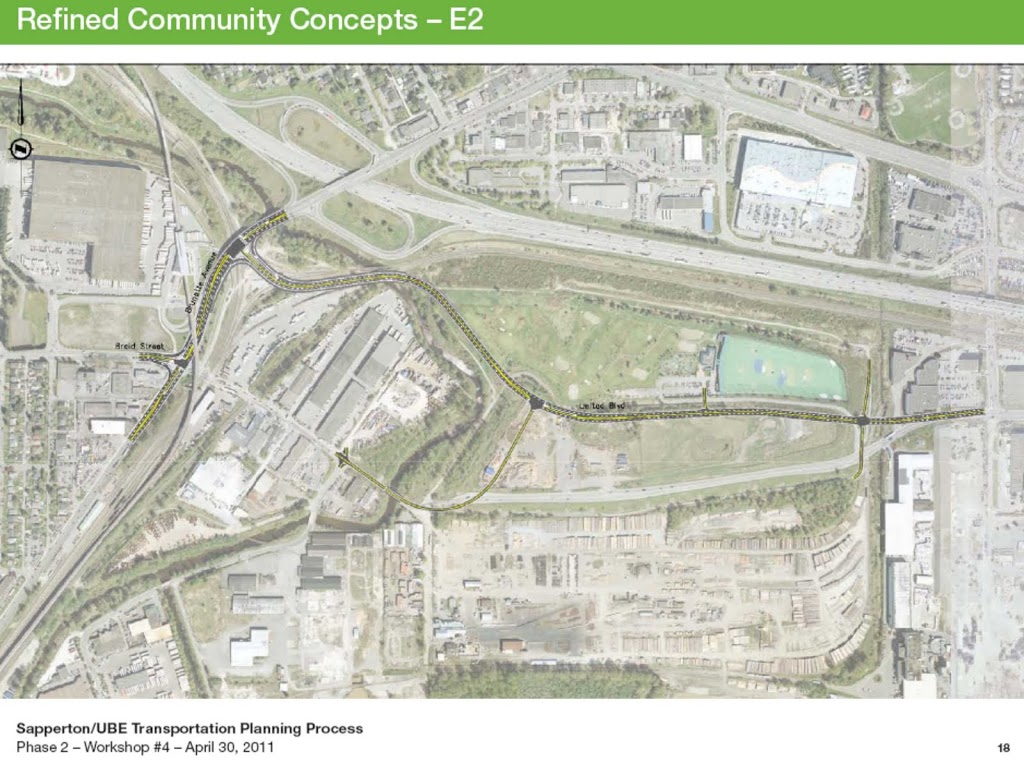
Don;t click this one, or it will zoom in.

This one did actually come from the community. There are a few problems with how it was worked up by TransLink (mostly, there is no need for the new intersection at the west end of the golf course – just direct traffic to the Braid Industrial area along the “old” United Boulevard and the Bailey Bridge, and direct the through-traffic along this new road). The big advantage is that the land being removed from the property tax rolls here is in Coquitlam, where they want this road, not in New West, where we don’t. TransLink suggested there were engineering challenges building a road on the old landfill (to which my answer was –yeah. So? Wasn’t Highway 1 being build on old landfills? And sections of the SFPR? And IKEA?). But the major point to make with this concept is that it looks better than E1 because it is closer to the Freeway. In fact, moving it to the north side of the Golf Course makes it look better yet. This road looks better the closer you push it to the Freeway, which again raises the question of why not just put the Trucks on the Freeway, and keep them off of local roads?

Refined Concept E3:
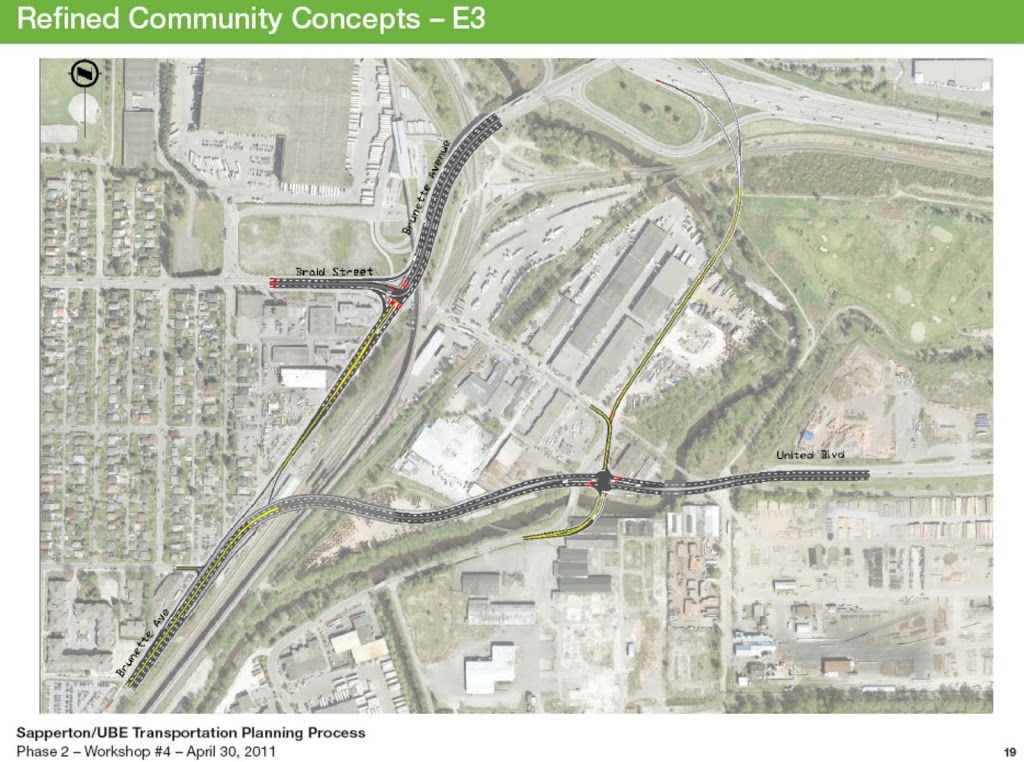
is this caption redundant?

Uniquely combines all the negatives of the other plans with increased cost, and no apparent gain. Dead in the water.

One concept that did not come up for discussion was presented by Voony on his Blog:
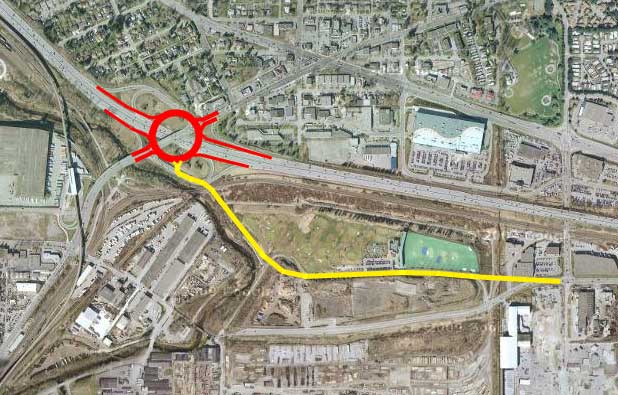
This offers all the advantaged of the “E”s, and actually frees up movement around the Braid interchange without increasing road capacity.

And it is not that unusual, and multi-lane roundabouts are now the MOT’s preferred method to deal with these type of geometrically-challenged intersections, or those that need smoother flow without increased road capacity… sound familiar?  Voony even offered and example from France:
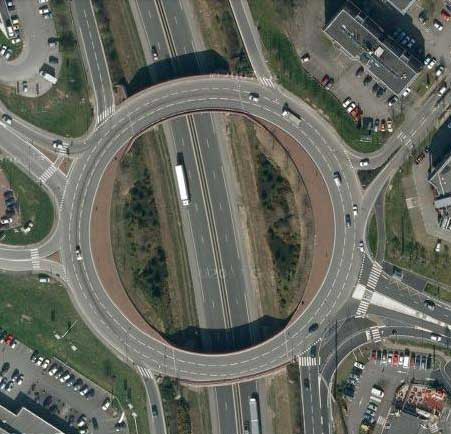
An example closer to home that eerily similar to the Brunette interchange issues can be found in Chilliwack.

Well, those are my opinions the “refined” options, but much of the Workshop was on the topic of mitigation details, and fancy garlands they plan to hang on the sides of the overpasses to make them pretty. My frustration is turning into a headache, so I will save that for another post…

Short post on a positive development

I think this is good news for the City. Yeah, it is just a warehouse, but it is a huge warehouse: at almost 12 acres, it will have a 20% bigger footprint than BC Place. The few dozen jobs it provides are less important than the security of knowing that New Westminster’s largest industrial employer is investing further in the community. It is also good to have brownfields put back into the industrial tax base.

Go ahead, call me a faux environmentalist for saying good things about a stinkin’ paper mill, but Kruger is an example of value-added manufacturing for our domestic renewable resources, and have taken many steps to reduce the environmental impact of their products. Kruger is one of the leading producers of paper products from post-consumer fibres (that stuff you put out in the blue box). Here in New Westminster, they recently invested in a biomass gasification system to vaporize then burn scrap wood and paper and reduce their need for fossil fuels. Making paper can, ultimately, become a sustainable industry, and these small steps are heading that way down that very long road (maybe if we can all stop demanding that the paper we use to wipe our privates is whiter than the drifting snow? Ah, never mind)

As a caveat, any time you talk about a half-million square foot warehouse, you need to talk about how things are going in and out of the warehouse. This may represent a significant amount of truck traffic coming to the area of Queensborough that is already suffering from a freeway pushed through the middle of it and all the congestions, noise and emissions that come with it. The good news is that the Queensborough Landing site has two advantages: an adjacent rail spur, and an adjacent river. The river especially opens up and exciting opportunity: this could be a model situation for short sea shipping. The Kruger plant is 5km from this new warehouse by road (and that includes in increasingly-congested Queensborough Bridge), but it is less than 2km by the North Arm of the Fraser River. Kruger can reduce it’s greenhouse gasses and fuel costs significantly by using small barges to move goods between the two sites along a lightly-used piece of tidewater. This seems like a no-brainer, but I say this without knowing what regulatory nightmares Port Metro Vancouver might put in their way. It seems PMV is more interested in moving trucks around these days than dealing with actual floating things. Kruger has demonstrated an interest in being environmentally innovative in the past, let’s hope they follow through here.

Call it greenwashing if you want, but compared to some industry’s approach to the environment, it is good to see new Westminster’s largest manufacturer taking measurable steps in the right direction.

I’m not just saying that because they sponsor curling. But it helps.

On a Four-Lane Front Street (UPDATE!)

I haven’t blogged on the topic of the fourth TransLink Workshop on the UBE yet, mostly because I waiting for TransLink to put the materials from the latest workshop on line (which they have just done!). so I will get on that next and discuss at length the latest coat of polish applied to that particular pair of old shoes.

In the meantime, I want to address the bigger issue, the one that seems to be the source of much of the push-back on the UBE: the idea that the UBE may worsen our traffic problems City-wide, not make them better. For the first time during these workshops, TransLink brought some materials to address this concern. As part of their pre-workshop presentation, Delcan presented a single PowerPoint slide that showed how they plan to address the NFPR in New Westminster. It was short on detail (there was not timing or budget mentioned) and there were no graphics except an image of the current proposed NFPR route with word-clouds pointing to several proposed improvements, paraphrased here:

1) Widening Front Street to 4 lanes;
2) Re-aligning the intersection at Columbia and Brunette so that Brunette is a continuous road and Columbia joins it at a “T”;
3) Doing a similar realignment at Front so that the Front Street-Columbia-east connection is a thoroughfare, and Columbia Street-west joins at a “T”;
4) Again making the Front Street-to-Stewardson a straight shot with Columbia meeting it at a “T” west of Hyack Square;
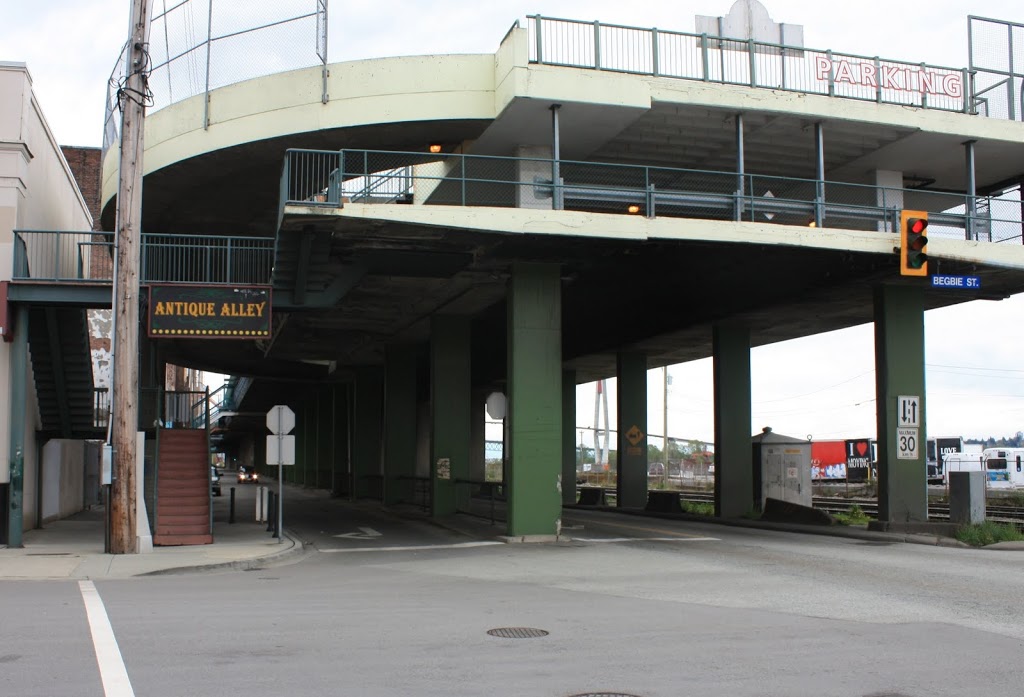
5) Tearing down the Parkade; and
6) Re-aligning several intersections on Stewardson, including Royal Ave.

Click to zoom in, TransLink’s Christmas Wish List.

At this point, this list is akin to my thumbing through the toy section of the Sears Christmas Catalogue when I was 7 years old and checking off the toys I wanted (Lego: check! Matchbox cars; Check! Smash-up-Derby? Check! Hungry Hungry Hippos? Why not!; Millennium Falcon? Double Check!). There was about an equal amount of planning and budgeting for how I was going to get those Christmas presents as there is here.

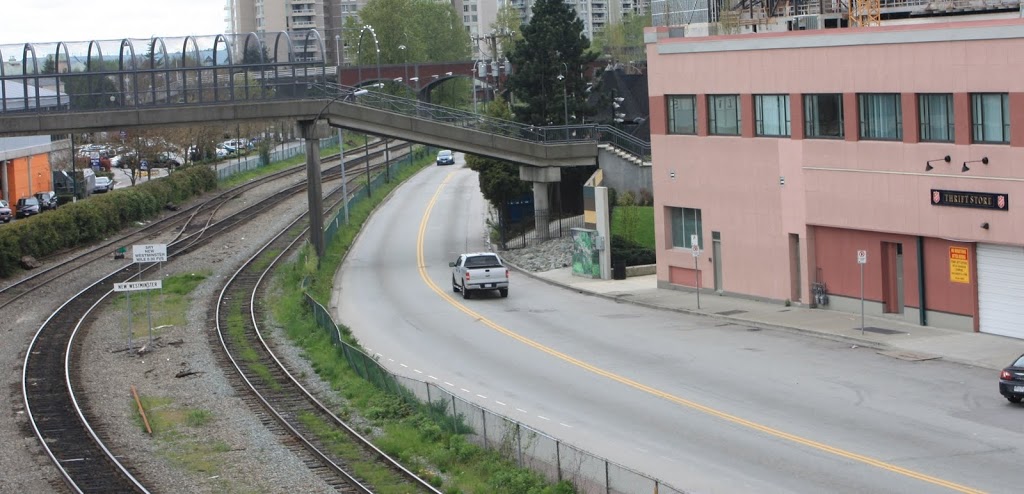
Making Front Street four lanes is going to take significantly more than a sweep of the hand or drawing a grey dotted line on a map. As much as I agree that White Elephant Parking Inc. should go, it is hardly the only limiting factor here. As Matt Laird keeps asking: are you going to move the Keg building and the Sally Ann, or the rails? Where the rail grades separate to the east; which of the two is going to have to go? What of the rail and Skytrain underpasses? Currently there isn’t room for a sidewalk on Front, and you want to install two more driving lanes?

Then there are the intersections. East Columbia at Front has no room for a T-intersection, as the tight “Y” there now is sandwiched between rails and (I kid you not) a “Heritage Wall” whose ultimate immovability has been used by the City to argue against pedestrian- and cyclist-safety improvements at Columbia and McBride. At the other end, what will Hyack Square look like attached to a new T-intersection onto the truck route?

And I don’t know if anyone else noticed, but since the recent traffic calming around Stewardson between 3rd Ave and 5th Ave, the traffic back-up getting onto the Queensborough has noticeably expanded, as has the back-up on 6th Ave to get to the bridge, and the congestion coming off the bridge down the hill along Stewardson. With a less-fettered through-shot to Freeway offered by a doubling of Front Street, does anyone imagine that Stewardson is going to see less traffic? When (or more importantly, where) is this game of Whack-a-Mole going to stop?

Through this very few people are asking the City if they even want an inevitably-congested 4-lane limited access road cutting the City off from it’s waterfront forever. For too many people, it is taken as inevitable that this will happen, and we need to manage the “mitigation” as best we can.

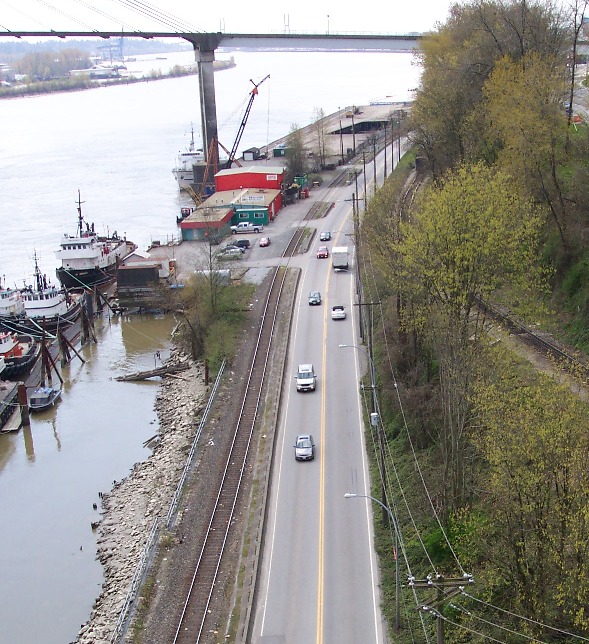
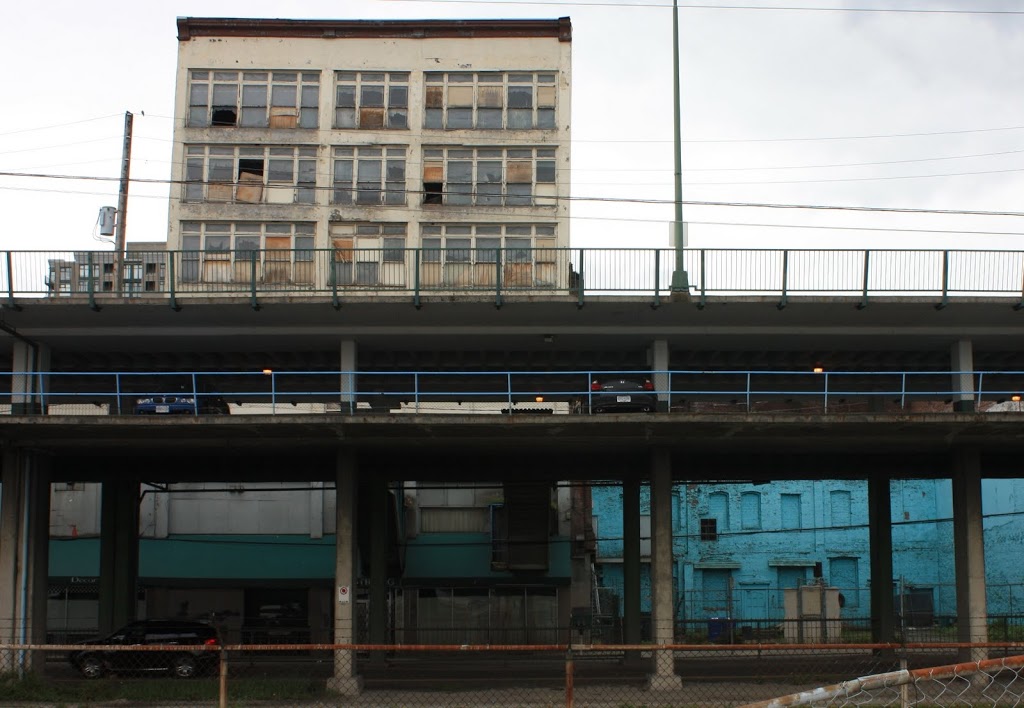
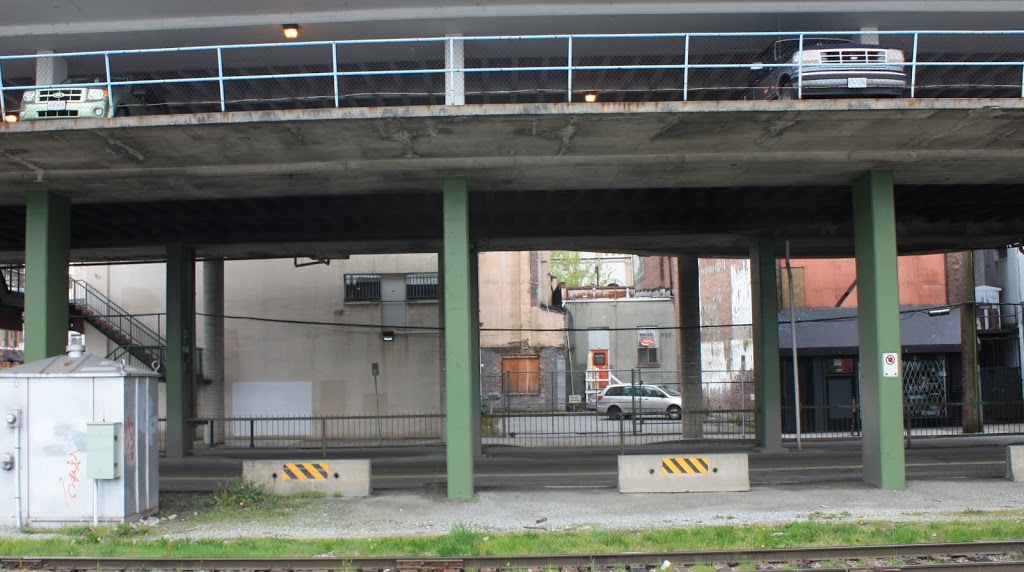
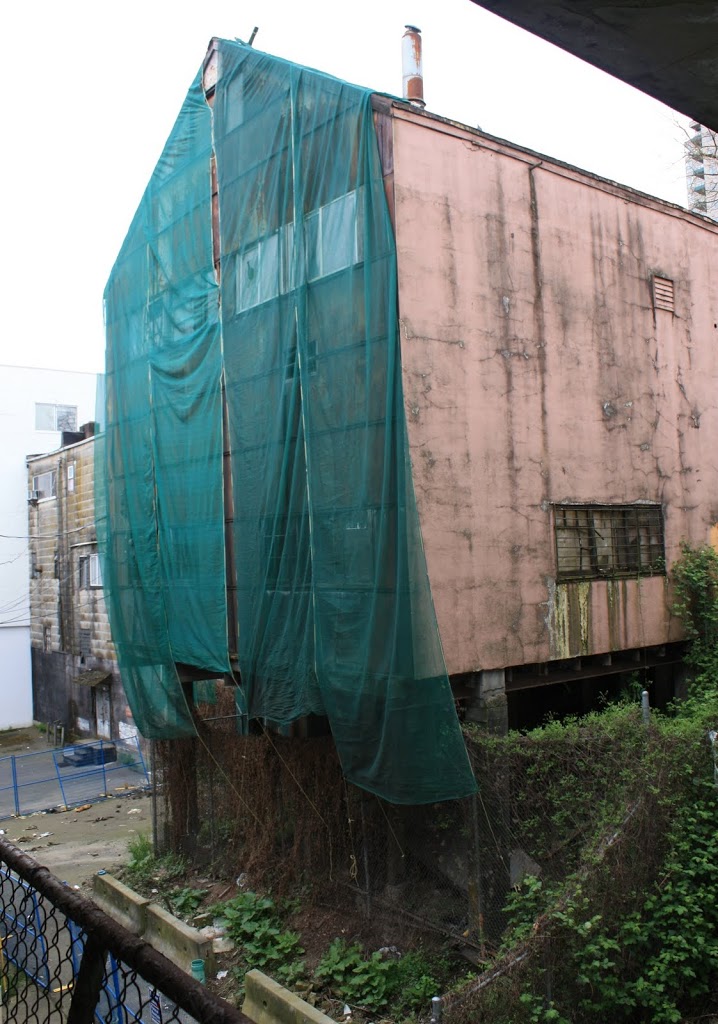
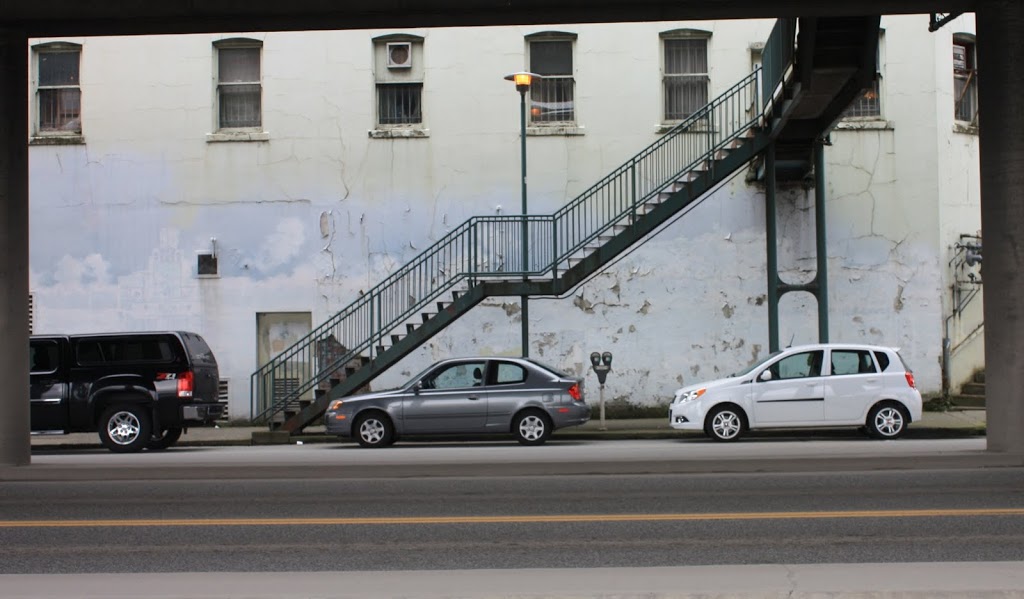
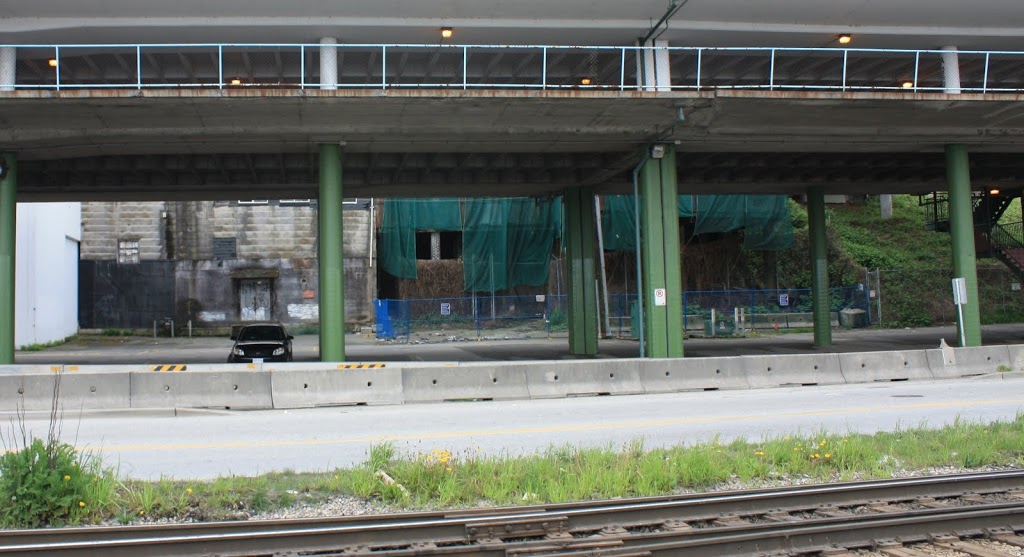
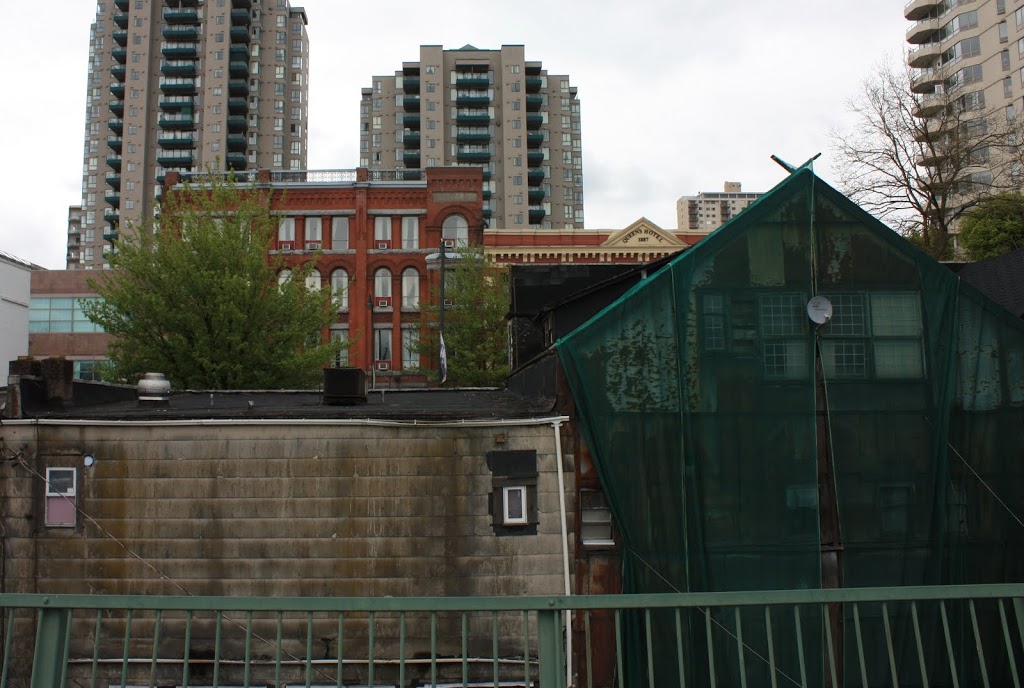
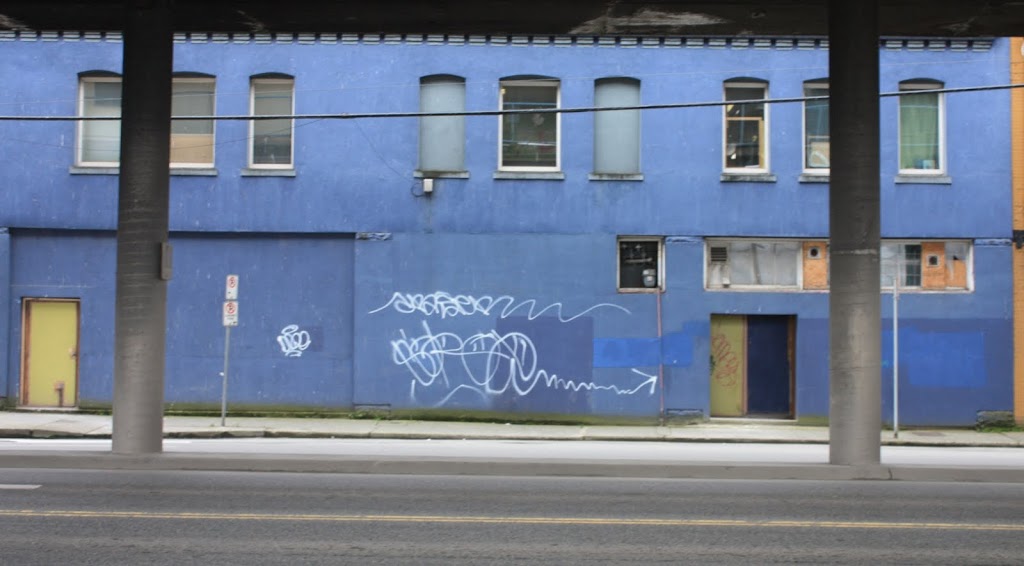
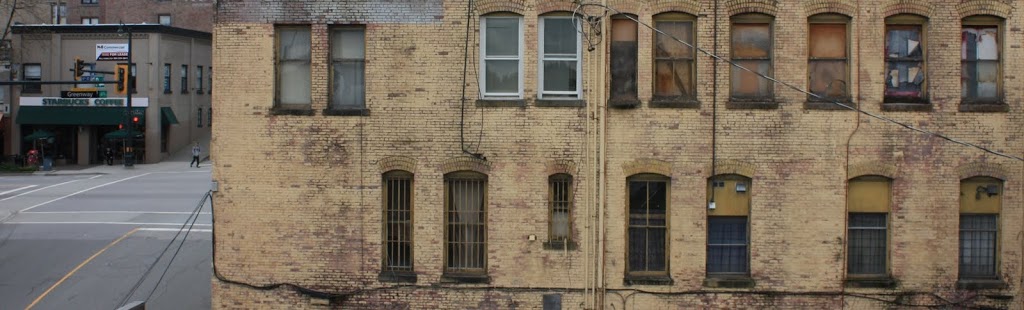
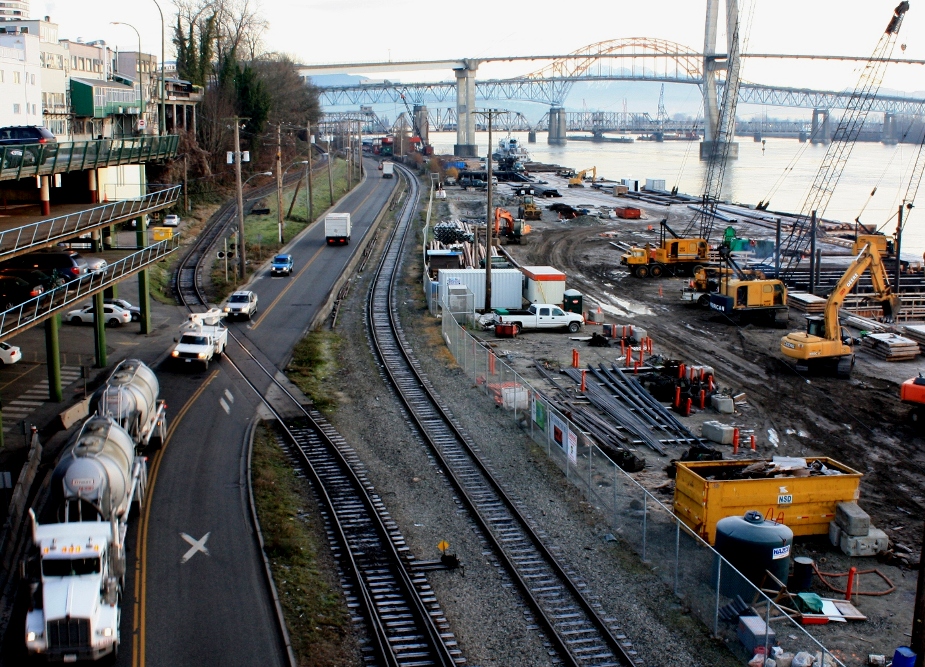
Please people, take a trip to Downtown Seattle before you make that call. If you lack travel funds, but have some imagination, just go down to the Front Street Parkade and look at the ass end of the businesses on Columbia: wood that hasn’t seen paint in 50 years, bricks swollen with too many layers of peeling paint, tarps keeping the leaks out, broken or boarded up windows, rusty chain-link and barbed wire, graffiti, garbage, shopping carts, blackberries and ivy…

This is our City’s waterfront. Despite the efforts of the Antique Alley merchants, it is a dark and dismal place. In many areas, the general dilapidation is embarrassing, and will only become more so as the Pier Park draws people down to the river: this is what they will see when they look back. This will be the face of New Westminster to those visitors.

Now tug at the braids of your imagination a bit and think about what could be.

It could be full of vibrant businesses and comfortable homes, just as Columbia Street is. It could be opened up to let the sunlight in and the exhaust out. It could be made pedestrian friendly, it could be safe and attractive. The empty parking bays could be courtyard restaurants, or pocket green parks. The Antique Alley businesses could see walk-by customers again. The entire downtown could be improved with new high-value commercial real estate providing jobs and tax revenue.

We don’t need to completely remove Front Street or the rails to do this, there is plenty of room for two lanes of Front, three rail lines, and a wide sidewalk with trees, planters, and even curb-side parking and café seating. White Rock’s boardwalk doesn’t suffer greatly from the existence of rails, it actually adds some charm to the location, and here rails can serve as homage to the City’s proud history as a working waterfront.

Put a 4-lane express route through there, you can kiss this bright future of Front Street goodbye. That would be a shame.

With transit-and pedestrian-oriented development along Columbia, including the MUCF, the Inter Urban, Plaza 88, and with the road diet on Columbia and resultant accessibility of the businesses, there is a resurgence of the Heart of our City. You can’t argue with the business development, with the people on the street, with the positive vibe down there, a sharp contrast to 20 years ago. I can’t shake the feeling that we are approaching a tipping point, though, and the opportunity exists now to build on that momentum, and grow the Heart of the City down to the water, to link it to Quayside and the resurgent River Market, to continue building the Heart of the City up 6th to the new high rise developments (and beyond?), and west to connect to Columbia Square (and beyond with the re-purposing of lower 12th?). Or we can let New Westminster remain a place of unrealized promise, much like it was for the second half of the 20th Century.

The UBE is the beginning of the NFPR process, and I have said before and will say again: no single project is going to have as big an impact on the future of our City than the NFPR. So let TransLink figure out if it is technically or economically feasible to complete (many of us clearly have doubts), but in the meantime, this City has to start discussing whether it is socially feasible.

Election Results

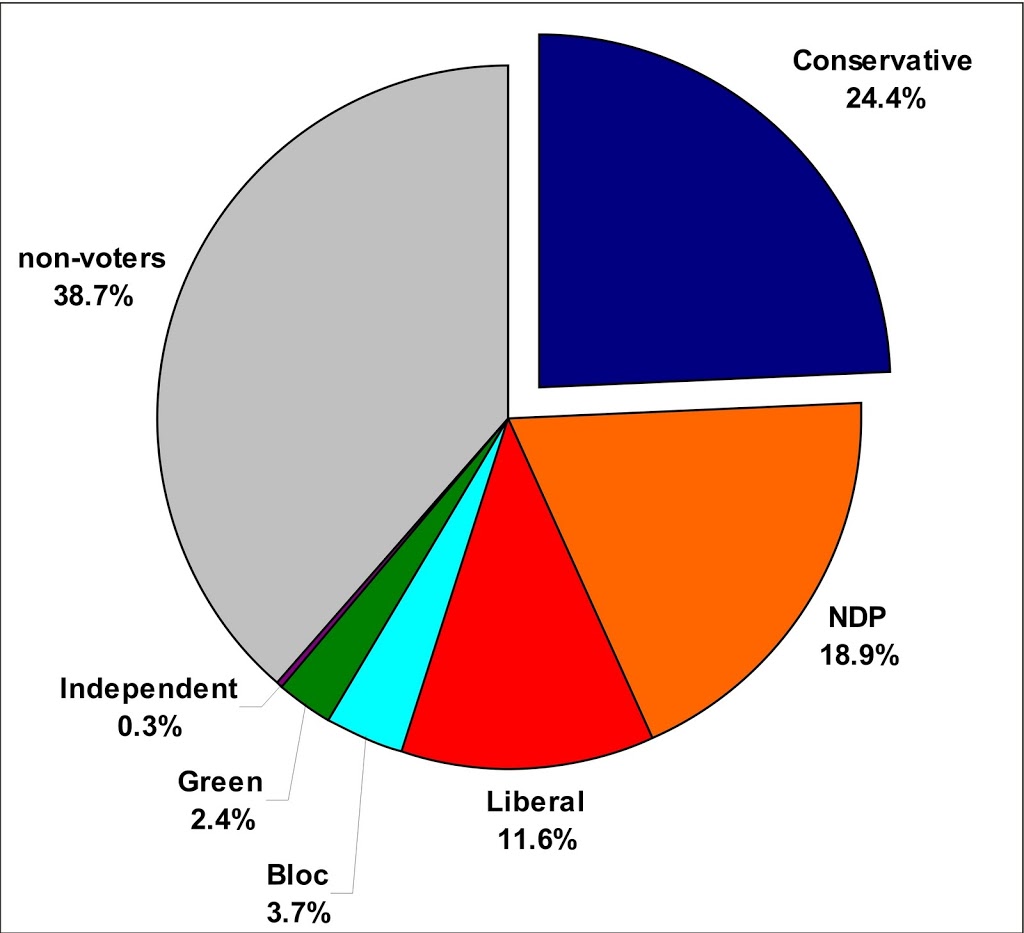
The real election results:

The Majority Mandate enjoyed by our new Government

??

Locally, I am happy Fin won, as he is a great representative, for reasons I pointed out earlier. I also would like to thank Diana Dilworth, Ken Beck Lee, and Rebecca Helps for running positive campaigns. I think Diana especially proved herself capable and worthy as a Candidate, and deserves the reward of more votes vs. the previous by-election when she was famous mostly for not being accessible. This campaign, she was aware of the issues, meeting the public personally and at events, and was very personable when I met her. It was only the Shadow of Darth Harper holding her back in my estimation.

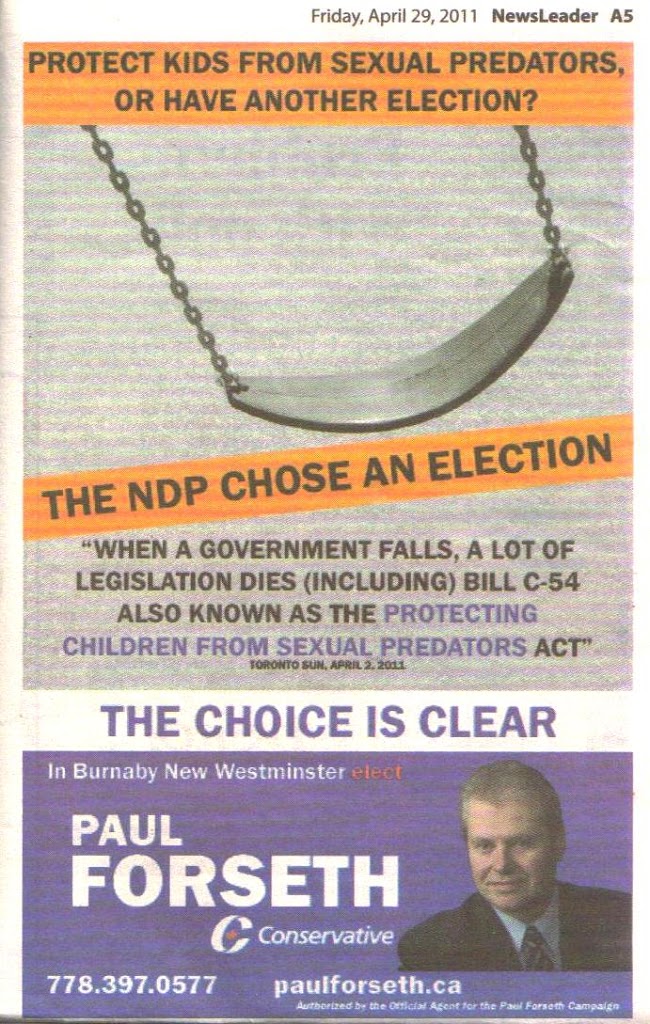
Her campaign also contrasted with Paul Forseth, who relied heavily on the politics of fear: this ad in the local paper is an example of the shitty politics that no-one should be rewarded for:

Classless, baseless, and insulting to the reader. I met Paul this election, and had a chance to chat with him, we agreed to disagree on some issues, but he kept bringing up the “Free Enterprise vs. Socialists” false dichotomy, as if there is no grey area between completely free unfettered markets and regulated social systems… so 19th Century as to be quaint. So although I was not able to vote for Peter Julian, I was happy to see him win.

Federally, it is obvious we are entering a new phase in Canada’s history. Part of me is hoping that Harper will follow the lead of Joe Clarke and Brian Mulroney: campaign right and govern middle. Maybe that is his “hidden agenda”. Otherwise, there will be interesting days ahead, with Jack driven apoplectic in the house, and a new era of very divisive politics in Canada.

One thing seems clear: the shift of Canada from one of the most highly respected nations on earth to a global pariah will continue. This is not “hidden agenda” stuff: this is what the Harper Conservatives wear on their sleeve. We will become more militaristic in lieu of seeking diplomacy. Our days as honest broker in the middle are gone. We will continue to be one of the planet’s worst polluters. We will continue to value security at the cost of liberty, and through this, we will become less secure by making ourselves more of a target for terrorism. Sewing a maple leaf on your backpack may no longer be a “get out of trouble free card” for people like me who enjoy travelling to countries without all-inclusive resorts.

Where the shift of support from the Liberals to the NDP will take us is uncertain. Some are saying the NDP surge in Quebec may create the legend of Jack Layton as the saviour of Canada, but let’s not start counting chickens. If Harper comes out of the gate too aggressivly with social conservatism, we will see a surge in PQ support in the upcoming Provincial Election, with little federal interest to prevent it (make no mistake, these are Manning Conservatives in this majority – a majority with no mandate in Quebec is a Reform Party of Canada dream).. and we may see a referendum in this parliament.

I think that the loss of Gerard Kennedy is a much bigger blow to the Liberals than the loss of Ignatieff. Without Kennedy, the Grits will need to re-grow around someone else. Most are looking at a youth wing surrounding Justin Trudeau. The number of old big-C conservatives who hated P.E.Trudeau for being so urbane is dwindling with demographics, and as the legend replaces actual memory, Justin will be there to scoop it up. I think any centre + left coalition talk will depend on how the NDP are polling in 2014. They have no reason to entertain the Liberals until they need votes. Or unless they need the Trudeau name to replace and ailing Jack. I hope Jack realizes that Bob Rae is the reason he didn’t win seats in Ontario, and the reason we have a Harper Majority.

Nina Grewal is an excellent example of why representative democracy sometimes just doesn’t work.

I was skeptical of Elizabeth May’s all-for-one strategy, but knowing several people on the islands, it seems obvious now. The end of per-vote subsidies may be a problem for her, but with it seemingly inevitable now, the strategy of getting a seat instead of crossing the country to grub out every possible $5 vote probably makes sense. From what I experienced this year as a former member, The Green fundraising machine is has been substantially developed since the deficit situation they got into last election. If Harper brings back big-money corporate political donations (and why wouldn’t he?), then all the other parties are in trouble money-wise. (that said, election rules really don’t matter to the Tories, as they are happy to break them with complete immunity, so I guess that doesn’t matter).

The Greens best strategy going forward is to keep her in the news, and expand the all-for-one campaign next election to an all-for-5, by identifying 3 or 4 more ridings and putting superstar candidates in them. I think of some of those Quebec ridings where the BQ support so collapsed that absentee NDP kids were elected: the Greens should be able to hone in and pick up those protest votes when the college bartenders prove to be incapable of administering a constituency office.

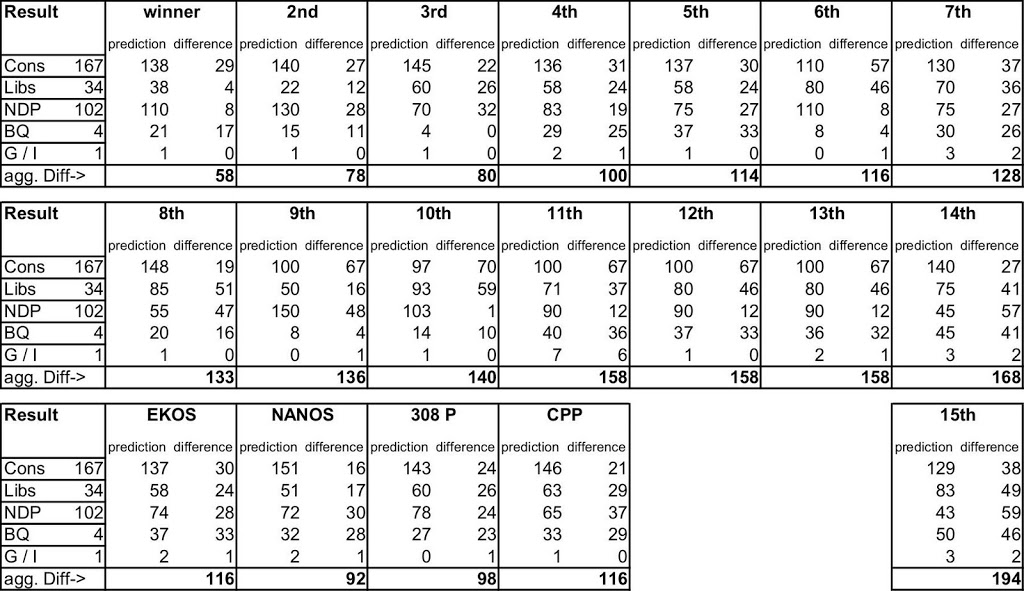
So election night I was at the NWEP / Tenth to the Fraser poll party, and ran an informal poll pool. The results were interesting, proving the lottery nature of this election.

In the end, the NWEP’s answer to Nostradamus, Andrew Murray, came closest to predicting the unpredictable, and won the pool. Although he predicted a minority government, his guess of 138 Conservative seats, 110 NDP, 38 Liberal, 21 Bloc, and 1 Green/Independent was closer to the final results that anyone else, with an aggregate total seat difference of 58, well ahead of the 2nd place finisher, who had a 78 seat difference. Clearly, the difference was Andrew’s prescient evaluation of the Liberal collapse and the NDP rise.

At first look, it appears the Vote Party participants (there were only 15 who filled out ballots before the 7:00 deadline) were woefully unable to predict the results, and even in what seemed to be a typical New West NDP-friendly crowd (the announcement of the Conservative majority really took the buzz off the party), the group underestimated the the NDP rise (average guess 88 seats) and Liberal collapse (average guess: 67 seats). Although one person correctly predicted only 4 seats for the Bloc, the average guess was 26 seats. The most common miss was a significant underestimate of the Conservative wins (average guess 123 seats), as no-one predicted a majority.

To be fair to the participants, most were given about 5 minutes to fill out a “ballot” with very little guidance. The professionals and pundits also significantly missed the mark here. Just for fun, I showed the EKOS and Nanos polling firm predictions from the day before the election, and the predictions of two “interactive” polling ideas: the 308 Project and the Canadian Prediction Project. With aggregate differences between 92 and 116, none of them would have won our contest, and they had 4 weeks to perfect their picks. As I said going in, this election was like a lottery. Next time, the pollsters should save us all time and money, and just call Andrew.

So much for the Secret Ballot

I’m throwing my lot in with Tenth to the Fraser here, and am supporting Fin Donnelly this election.

To many people who know me only from this Blog, that is probably not a surprise. I come across as a soft leftie big-government tax-and-spend environmental whack job (or so I am told). However, it is a surprise to most people who know me, including myself.

I have never voted NDP in my life, and I have voted in every federal election since 1988 (When I voted for the PCs, who with the benefit of hindsight, were the most progressive Government on the environment in my lifetime). With elections in 1993, 1997, 2000, 2004, 2006, and 2008, along with one Federal by-election (that I can recall voting in) and 4 Provincial Elections (I didn’t vote in 2001 as I was living in the States), that is 11 chances, and I have never taken the Orange pill.
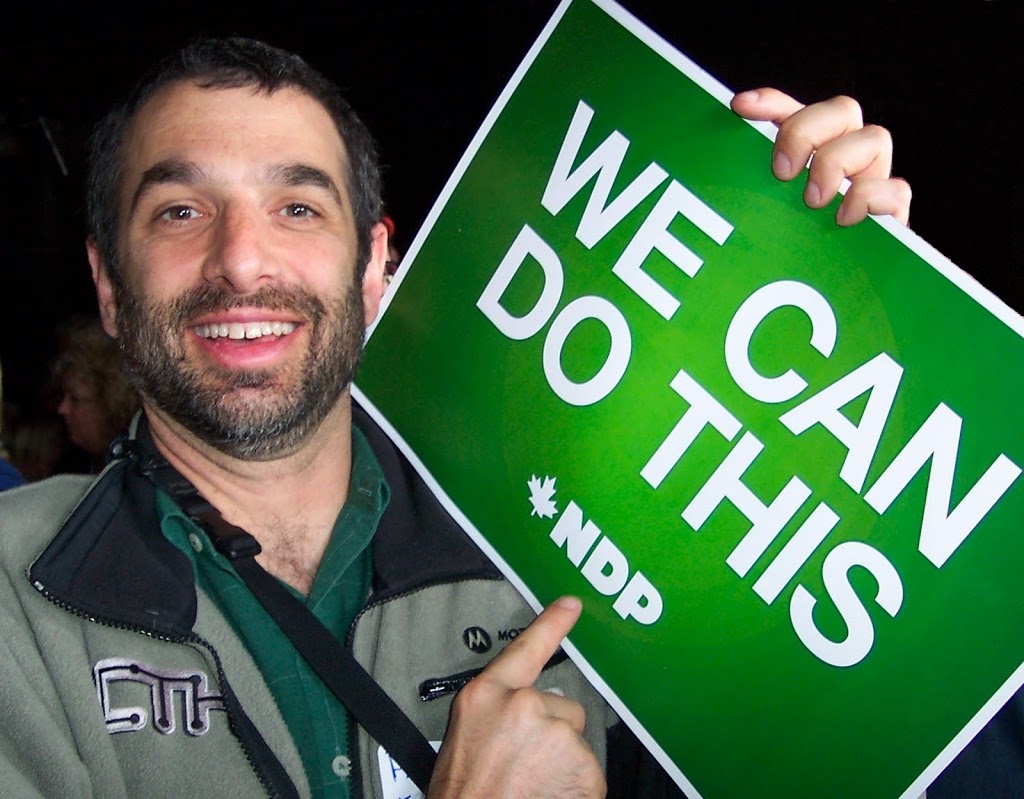
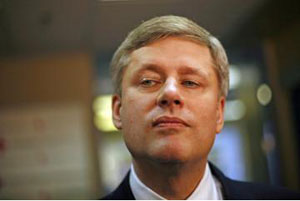
Part of the reason for this is that I was raised in a Big C Conservative household. My Dad, especially, was never too comfortable with the “Progressive” tag in the PC name, and proudly lined up to vote for Robert Stanfield against Trudeau three times. The ironic part of this is that every time I suggest perhaps Stephen Harper is not the best thing ever to happen to Canada, my Father’s reflex false dichotomy argument is to accuse me of “loving Jack”. So telling my Dad, in his 70th year, that I voted for Jack is going to hurt. This picture will no doubt disappoint:
Sorry Dad. I guess the Canucks playoff beard doesn’t help, eh? 
Another reason is that the last Party of which I was a member was the Green Party of Canada. I joined after meeting Marshall Smith, who ran for New Westminster-Coquitlam, and have helped Rebecca Helps in the subsequent by-election. My membership is now lapsed (which hasn’t stopped the relentless flow of spam), although I still think the Greens may have the best platform on balance. There is a lot more there that I agree with than things I don’t (although there is still much of the latter). This election, however, the Greens have decided to put all of their effort into one and a half ridings, and have essentially abandoned the idea of being a national party. I also have concerns that the “Green” brand has taken that party as far as it is going to go, and they have to do some serious soul-searching about how they plan to break past the 7% ceiling they have hit. Locally, Rebecca was a great candidate during the by-election, and has her heart in the right place, but has herself moved on to Victoria to work for the Provincial Greens, and has had a pretty lacklustre campaign locally.
That said, the biggest challenge the New Westminster-Coquitlam Greens have is Fin Donnelly. The NDP have a hit-and-miss record on the environment, partly (in my uninformed opinion) because of their traditional labour support (so Union Jobs will always come before environmental stewardship), and partly because their response to Climate Change (the “Cap and Trade” method) is simply wrong. Nonetheless, Fin rises above the balance of the party on the Environment file. His unrelenting advocacy for the protection of the Fraser River and wild Pacific Salmon is approaching legend status. He is as “green” as any NDP candidate gets.
In his short 16-months as MP, he has demonstrated an exceptional work ethic. For a new MP in a third-place party, his record is substantial: he has brought 6 private members bills forward, two on environmental issues, and has worked across parties to advance these initiatives. He has held town hall meetings here at home to connect his constituents to Ottawa. He is the only local senior-government politician who is impolite enough to mention that Evergreen has not really been built yet.
I can personally vouch for his constituent support. A couple of friends and I were working on a difficult local environment issue, and were able to arrange a meeting with Fin to discuss the issue. He took the time to listen to our concerns, gave us some insight into the politics of the issue, and provided some really useful suggestions. He also took the time to provide useful insight into the UBE issue that has a Federal component (as that is where some of the money comes from). He has worked in Ottawa, and he has worked in the community. That is what I want from an MP.

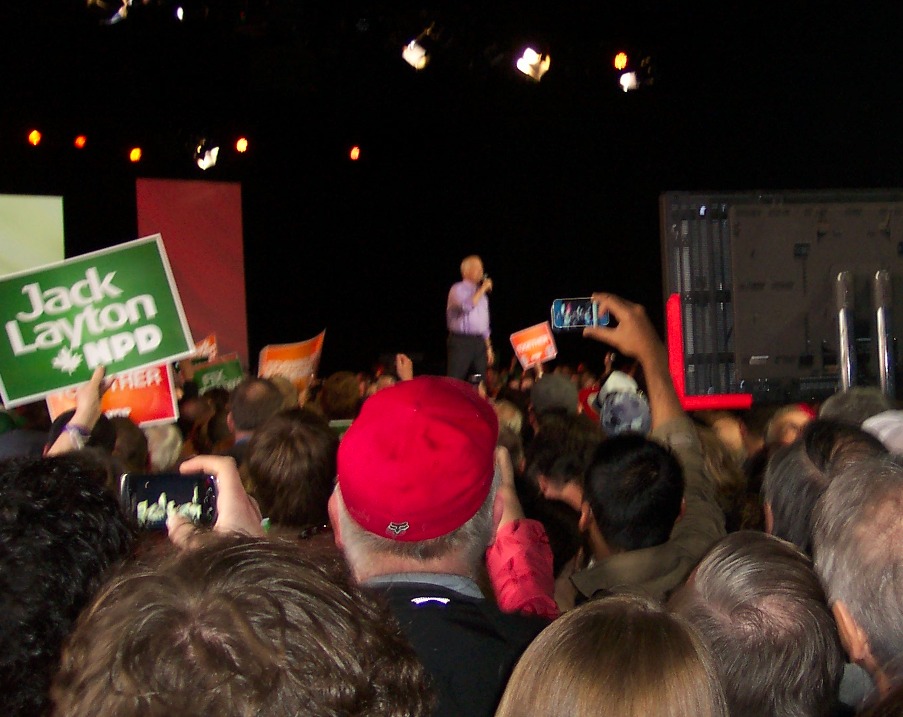
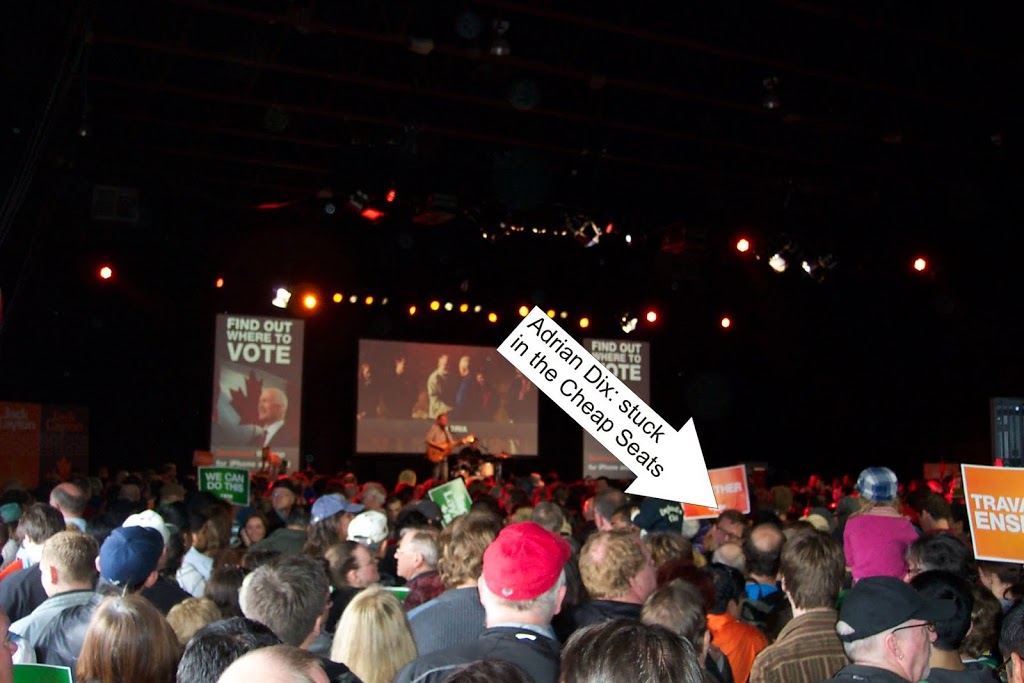
So today I decided to attend the Jack Layton rally in Burnaby. Notably, I am not and NDP member, nor have I ever supported the NDP, but I had not problem joining the crowd at this rally (hear that Stephen?). And it was as pumped up a crowd as I have seen since I saw the Tragically Hip play at the House of Blues in Vegas. Following the tried-and-true campaign tactic of ordering a room about 10% too small for the crowd you anticipate, the NDP missed the goal here, as there were more people outside rallying than there were inside. It was so packed inside that even Adrian Dix couldn’t get a front-row seat. Jack was on message, and full of energy, and made sure to point out, in English and in French, that the Quebec breakthrough makes this an election like no other.

Jack was so full of energy, I would have needed a faster camaera to catch him…
The Rally was so crowded, even those who should have had some pull
seemed to have a hard time getting close to the stage.
So I guess I am on the Orange Wave. The polls, if they are to be trusted, are suggesting that the NDP may beat the Liberals. I’m not sure the popular vote surge is going to result in enough seats to make Jack Prime Minister in our first-past-the-post system, but predictions are not worth much this year. Monday Night’s Vote Party will be fun, and it will be a nail biter.

What a dick.

I try to stay non-partisan. I have voted for many different parties in the past, and now that I have zeroed in on “the environment” as the main issue I vote around, I am pretty confident that any party can take a leadership role on that topic (although none of them choose to talk about it this election). Generally, I vote for the best local candidate, and that is how I am going to vote this year. I feel pretty good about my vote this year, having had the chance to chat with all 4 of my local “main party” candidates last week. So this vote is a character vote, not a party vote.

That said, I have nothing against my local Conservative candidate. She works hard in her community and has some “envrionmental cred”, but I am going to be voting against her party for one simple reason: Stephen Harper is a dick.

I try to run a family program here, but the word “dick” just describes Harper so perfectly, I can’t think of a less profane way to encapsulate his personality. His history is defined by a long serious of serious dick moves, and he pretty much owns 100% of the dick moves this election campaign.

His latest dick move was standing up yesterday and talking up his unqualified support for profiteering from third world deaths.

Background: The sale of asbestos is illegal in Canada, as it is in most of Europe, Japan, and the rest of the industrialized world. In the US it is not strictly illegal due to strong industry throttling of the EPA, but it is effectively impossible to use, as the costs related to safety and clean-up have priced asbestos out of the market compared to safer alternatives. This is because asbestos causes cancer and other deadly diseases. Of course, in developing countries, they don’t have the governance levels required to institute strict controls on asbestos use. Therefore, in much of the world, Canadian asbestos is used in the same way now as it was in North America 50 years ago, with the same resultant cancer deaths.

Selling a known cancer-causing agent to countries that cannot effectively regulate their use is not illegal, it is just deeply, deeply unethical. Especially as Canada itself will not allow its use because of the unacceptable human health impact. Yet Canada is in the exclusive company of Russia, China, Kazakhstan, Zimbabwe and Columbia as the last countries that mine and sell asbestos.

Why? Well, he is interested in protecting jobs! However, the few remaining asbestos mines in Canada are all in Quebec, and employ less than 1000 people. To put that in perspective, that is about 5% of the total mining employment in Quebec, and way less than 1% of the mining employment in Canada. Ten times as many people work for the City of Vancouver than work in all the asbestos mines in Canada combined. These few mines operate only due to government subsidies, and create markets in the poorer parts of the world through a government-funded marketing and PR firm. Standing up for this losing industry that kills more people annually than it employs is a big-time dick move.

Another campaign example of a dick move is to continue to assert that his pet jet planes are going to cost $75 million each. This despite the guys selling the planes saying that is not true; industry experts from Washington saying it is not true; his own Department of Defence saying it is not true; his own Parlimentary Budget Office saying it is not true. What do any of these guys know? Steve is sticking to his story. What a dick.

There was even a loca ldick move last week. Apparently, The right honrourable dick was going to meet the press and give a few words here in New Westminster. The press and supporters were told to expect him some time around noon on Easter Sunday, at Royal Square. A few people I know well showed up, hoping to spy the PM. However, only invited guests and press were loaded on to a bus, with a driver who apparently didn’t know (or couldn’t say) where he was going. At noon, they drove over to the Burnaby Alliance Church, and arrived just in time to see (and film, for the afternoon broadcast) the dick walk out of a church and into his motorcade. No press conference, no interaction with the public. Compare this to Ignatieff’s visit to West Vancouver last week, a public stop at a small business, an open-to-the-public town hall, addressing questions from people off the street. Or compare it to the time last year that Jack came into the Brooklyn on Columbia and shook every hand in the room, with Fin Donnelly the only “security” around. These are not dick moves.

Firing his “Integrity Commissioner” and paying her to shut her up? Firing the Nuclear Safety Regulator for not agreeing to approve the unsafe operation of a nuclear reactor? Giving a speech to his American pals describing Canada as a “Northern European Welfare State in the worst sense of the term”? All dick moves.

How about throwing Helena Guergis under the bus? Keeping mum for more than a year about shadowy “allegations” that made her too hot to keep around caucus, and eventually lead to her being turfed. Then when she is running in a tight election race as a Independent, Harper releases a bunch of salacious allegations, painting her as a drug addicted whore, then saying in effect “well, we have no proof, but boy, look at them allegations!”. This is eerily similar to the “ancient and honourable story” Hunter S. Thompson told about how Lyndon Johnson first got elected to Congress in 1948:

“…Lyndon was running about 10 points behind, with only nine days to go… He was sunk in despair. He was desperate. And it was just before noon on a Monday, they say, when he called his equally depressed campaign manager and instructed him to call a press conference at two or two-thirty (just after lunch on a slow news day) and accuse his high-riding opponent (the [wealthy and politically favoured] pig farmer) of having routine carnal knowledge of his barnyard sows, despite the pleas of his wife and children… His campaign manager was shocked. ‘We can’t say that, Lyndon,’ he said. ‘It’s not true.’ ‘Of course it’s not,’ Johnson barked at him, ‘but let’s make the bastard deny it.’

That is the type and scale of dick Stephen Harper is.

Pier Park ad nauseum.

Chris Bell’s ongoing criticism of the Pier Park has suffered a bit of a backlash in the local media, which has in turn resulted in Mr. Bell striking back with allegations of a personal vendetta. The drama…

Mr. Bell’s analysis of ad hominem was interesting, if slightly flawed. However, he may have a point. Little in Mrs. Jepser’s letter addressed the specific claims made by Mr. Bell. These are claims I am painfully familiar with, and have addressed specifically in the past. Mr. Bell has even offered to retort to my criticism of his specific claims, but so far, he has failed to do so.

So I will avoid ad hominem, and address Mr. Bell’s specific claims, as he presented them in his recent letter, and since he raised the spectre of Logical Fallacy, I will return the favour:

“I have claimed that the railroad lands north of the Westminster Pier Park are themselves a brownfield site…”

This is a factual error. For a piece of land to be a “brownfield”, it must be abandoned, or have lost its useful value due to actual or perceived contamination. The rail lines are far from abandoned, but are being used to move trains. They are an active contaminated site. To the best of my knowledge, there are no plans for them to be abandoned any time in the near future. (Logical Fallacy: incorrect use of terminology)

“…heavily contaminated…”

This phrase is kind of subjective, and judgmental in this setting. There is inferred contamination in the groundwater (and potentially the soil) under the tracks, but by what measure is contamination “heavy”? (Logical Fallacy: use of Weasel Words)

“…with hazardous levels of tetrachloroethylene, trichloroethylene and cichloroethylene,”(sic)

This assertion is not supported by the facts. There is some concentration of these three solvents (common in drycleaning solutions and things like brake cleaners or carburettor treatments you can buy at Canadian Tire) in the groundwater at the park. No-where in the reports is it suggested that these solvents are present in concentrations regulated under the Hazardous Waste Regulations. Therefore the use of “hazardous” in the strict sense of the Environmental Management Act is wrong, and (as we will see next) incorrect in the informal sense (Logical Fallacy: incorrect use of terminology).

“…and therefore must be avoided”.

This is a complete non-sequitor. I have explained this to Mr. Bell several times, but he continuously fails to acknowledge the fact. The identified contamination under the rails area is in groundwater 40 feet below the surface. It does not now, nor will conceivably ever, pose a health risk to people standing on the tracks. No matter how hard or how often he bangs this drum, it ain’t the truth (Logical Fallacy: Non-Sequitor).

“I have questioned why the City of New Westminster, having known about the toxic railway right-of-way (which it owns) for many months, has not posted signs alerting citizens to the toxic soils.”

And I suspect the answer he received was: there is no risk to people using the tracks from the soils, and the railway already has signs saying “Private Property: keep off”. Not because of the risk from soils, but because of the risk caused by onrushing trains!

“This claim is not in dispute…”

Yes it is, and I have disputed it with Mr. Bell repeatedly. (Logical Fallacy: this is a form of Begging the Question)

“as the City of New Westminster sent a report to the Ministry of Environment eight months ago outlining how the railway land soils are high risk for contamination.”

And, as has been explained to Mr. Bell several times, the “High Risk” designation under the Contaminated Sites Regulations has no relation whatsoever to actual hazard caused to people walking on the tracks or using the park (Logical Fallacy: incorrect use of terminology).

“ That same report outlines how the railway lands are more contaminated than the park soils were”

There is an interesting use of the phrase “more contaminated”. The Park soils had metals contamination in the surface soils (now removed), and small patches of near-surface light hydrocarbon contamination (now removed or treated), and low concentrations of the chlorinated solvents in groundwater at one location at great depth. The concentrations of the solvents at depth are likely higher under the tracks, but there is no indication the metals of light hydrocarbon contamination is present on the tracks.

“(that’s saying something considering how toxic the soils of the park were)”

No it isn’t. It isn’t saying anything, since the bulk of contamination in the Park lands was addressed and was in no way related to the contamination under the tracks. (Logical Fallacy: the Association Fallacy).

Another interesting Logical Fallacy has come up recently in the media discussion about the Pier Park. First the main argument was that there was something underhanded about how the park was purchased (secret deals, etc.), and those were well refuted. This was followed by the suggestion that there was a lack of environmental due diligence in the purchase (also refuted). Then the argument was that the contamination on the site was going to be a danger to park users (yes, refuted), which shifted slightly to an argument that the tracks adjacent to the Park were dangerous to trespassers (now, hopefully, completely refuted). Now the argument is arouynd a preceived inadequacy in the number of piles being used to stabilise the pier, as if the structural engineers, geotechnical engineers, and the City are conspiring together the endanger park users…

This technique is known as the “Gish Gallop”.

Meeting Candidates

Notice, this is one of those few posts I will do where I am essentially writing as President of the New Westminster Environmental Partners. I have not passed this by the membership, so the opinions expressed below are not necessarily those of the NWEP, but the event I am talking about is clearly an NWEP-led initiative. So: Facts theirs, opinions mine. Capice?

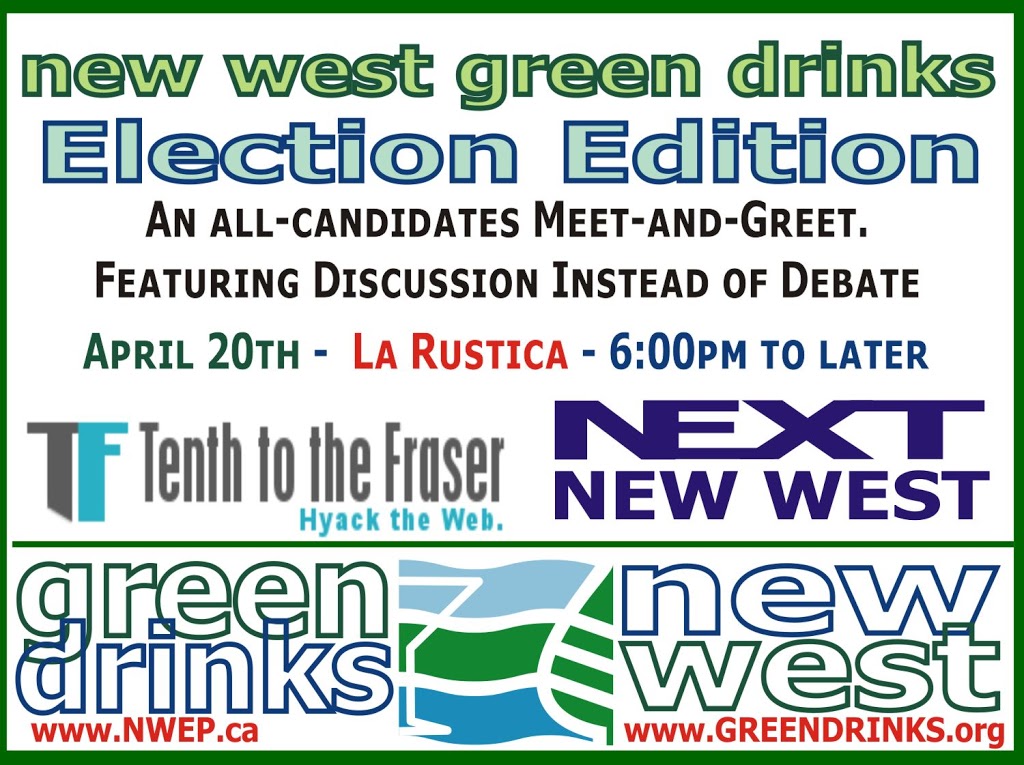
Last week, the New Westminster Environmental Partners did what they do best: partnered with other groups to bring people together and get them talking about solutions to problems. The only thing different this week was the people who got together: Members of Parliament and people seeking to become members of Parliament.

Partnering with NEXT New West (a group so secretive, they have meetings in public places every month, and commonly post video of them on YouTube), and Tenth to the Fraser (you know who they are…), we held a unique all-candidates event.

Now, the NWEP do not, as a general rule, shout and protest. More commonly, we try to educate ourselves about sustainability topics, seek to inform the public about issues, and engage the decision makers to try to find common interest towards positive outcomes. Most of the time, we find conversation much more productive if neither side is shouting. There may be a time and an issue that calls for protest, but in a community like New Westminster you can usually bend the ear of the people you need to reach without the need to yell.

With this in mind, we wanted to hold an event for the Federal Election, as we have organized traditional debate-style “all candidates meetings” in previous elections. But just another debate-style meeting, where candidates read the party script to an audience of already-decided people, with microphones and media all waiting for the gotcha-moment, that doesn’t seem like engaging conversation anymore. Maybe all we need to do is bring the local candidates into a room and let them have normal conversations with each other and their constituents.

It just so happens NWEP had a format in our back pocket: Green Drinks. Once a month for the last few years, NWEP types and others interested in environment and sustainability issues have gathered on the first Wednesday of the month to socialize and network for a few hours. No themes, no speeches, just a chance to get together and share ideas. We didn’t invent the idea: Green Drinks have happened for years around the world.

Of course “Green Drinks” is a pretty loaded idea, and although the environmental focus is an attractive idea to some parties, it may not appeal to a few others (remaining non-partisan, I’ll let you fill those categories yourself). So we asked NEXT – a group comprised of young business leaders and entrepreneurs in New Westminster, if they wanted to meet the candidates and they agreed it was a good idea. We hoped this would broaden the appeal somewhat. The good folks at Tenth to the Fraser also piped in to offer logistical and advertising support, and we now had everything…except a date or a location.

The original Green Drinks time and place did not work out for a variety of reasons, mostly conflicting schedules, and not enough lead time to get any Candidates. Long story short, Robert Tang from LaRustica stepped up and offered to host us in the Roma Room. We had little certainty to offer him: we didn’t know how many people would show up, nor did we know how much people would buy… so it must have been a challenge for him to organize staffing… but he was accommodating and in the end it worked out.

Of course, timing was also important: we had to compete with the all-candidates meetings being scheduled in other locations in both ridings (notably, none in New Westminster), with the Easter Long Weekend, with the short election cycle, and with Canucks Playoff games. Once a likely date was found, we sent invitations to all 8 candidates in the “main” parties for the two New West ridings, and were frankly shocked when 7 of the 8 agreed to show up.

To keep this from being just another debate, we decided to give each candidate a few minutes on a soap box to introduce themselves. Briana from Tenth to the Fraser took video of each speech (and mercifully avoided showing my ham-fisted announcements), so you can see they were short and the crowd was (for the most part) receptive. But outside of the 15 minutes or so of “soap box time” the rest of the evening was lively, with lots of conversation. The crowd was smaller than I expected, but we mostly filled the room, and there was unprecedented access to the candidates for those who did show up.

It was great to see such a mixed crowd: along with the usual NWEP rabble rousers, there was a popular former coffee-shop owner, to a local trucker well known for being politically outspoken, several young local proprietors, a young local realtor, a City councillor, and a well-known Quayside president, along with several people I met for the first time. Since there was little time wasted on speeches, I got to bend Diana Dilworth’s ear about the Fraser Basin Council, talk to Ken Beck Lee about his work on scrutinizing international GHG auditors, and chat with Paul Forseth about a common friend (a former Reform MP from my home town) and the adventure of flying into Castlegar airport. It was great to be able to chat with these “candidates” as people. Of course, I also discussed my vision of environmental responsibility with a couple of candidates, asked some questions about their vision, and made sure they knew what topics I thought were important this election.

I think it was a good event. The candidates seemed happy, and the crowd there had great access to the candidates. I think this is a model the NWEP will return to in future elections, now that we know it actually works. If nothing else, I now know who I am going to vote for, and feel good about the person I am giving my vote to.

In contrast, I attended the “traditional” all-candidates meeting put on the Burquitlam Community Association at Banting Middle School the following evening. This was very well attended, there were several hundred people, and there were 5 candidates there from the New Westminster-Coquitlam riding. And quite honestly, it was painful. In an echo-laden gym, the candidates sat behind a table with their policy books in front of them, and answered vapid or loaded questions as close to the party line as possible, with the same group of family and supporters cheering or jeering on cue. 

There were a few interesting moments (some NDP supporter asked Diana Dilworth about abortion, Fin Donnelly asked who we were going to attack with our F-35 Attack planes), but for the most part, the responses were dull, and varied little from the rhetoric of campaign-speak. When a question about voter apathy came up about an hour in, we had to leave for fear of narcolepsy.

With all required modesty, I think the NWEP/NEXT/TttF did it better.

Spring time is Garden Time

The Gardening season is pretty late this year. Although some early plants (lettuce, radishes, carrots) have been in the ground for almost a month, nothing is showing at the surface yet. The only green I have in my garden is last fall’s onions and garlic, and a heck of a lot of chickweed (where does that stuff come from?). But this last weekend was warm and sunny, so much untended garden was now tended to.

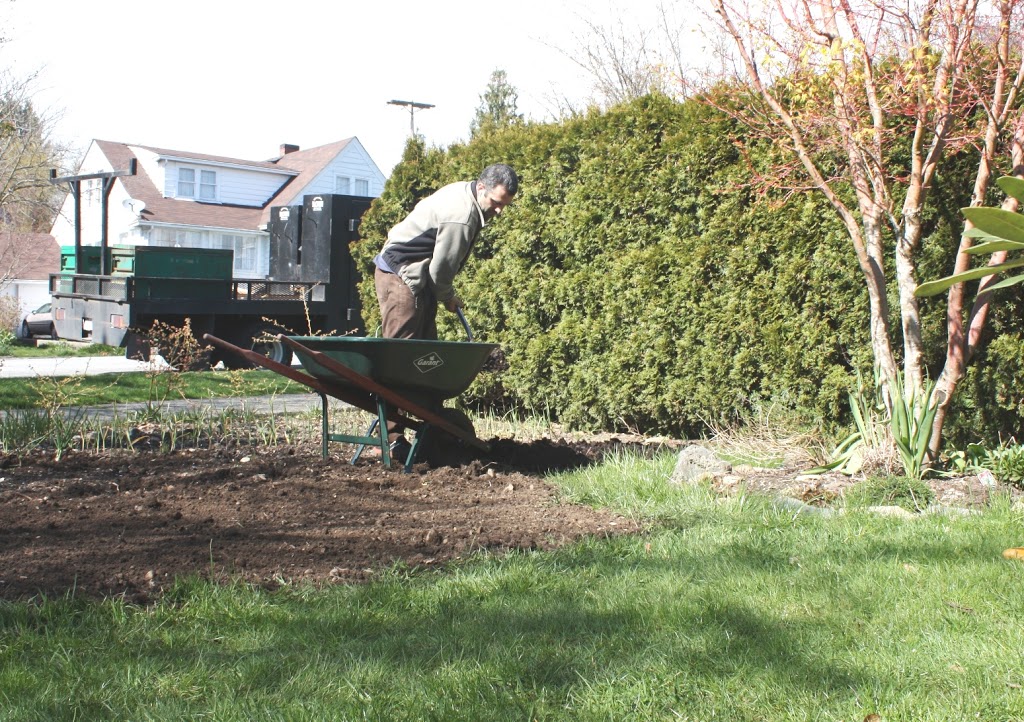
We had a lot of well-digested compost, so I spent much of Sunday hauling it out, spreading it, then cutting and raking it in. Fun stuff, but working with well-worn compost is much more pleasant than working with manure, and there is some satisfaction in using the free fertilizer that might have otherwise gone to the curb, not to mention giving the few remaining worms their freedom.
?

? This year we are starting our Cukes, Tomatoes, Zucchini and Peppers inside, instead of buying young plants. Many of the tomatoes are last year’s seeds. We also collected carrot seeds last year, along with fennel and coriander, although we have actually eaten most of the last two…

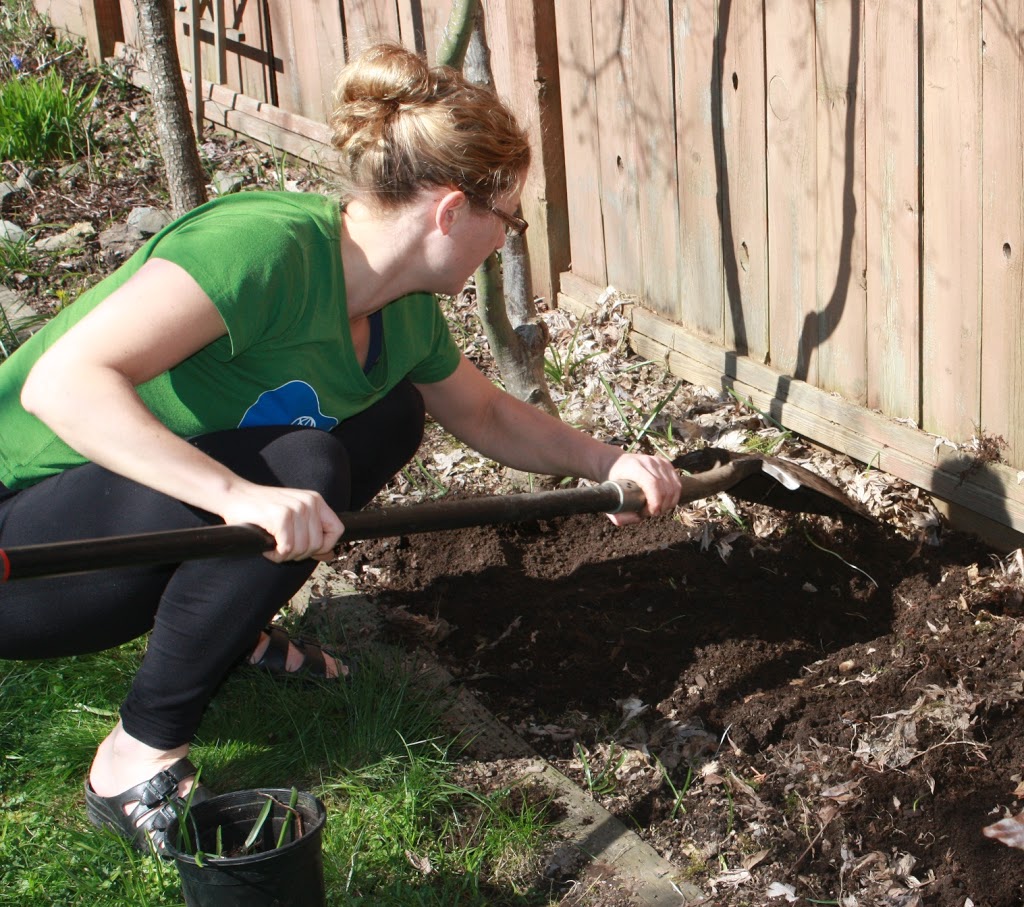
The spring is also weeding time, as we slowly wage war against the creeping buttercup and blue bells. There are places in our back yard where you turn over the soil and hit a layer about 8” down of solid bulbs. I’m sure the flowers were beautiful at one point, but now they are just voracious, crowd everything else out, and create this non-permeable layer that hurts the yard’s drainage, leading to moss in what is generally really sandy, well-drained storage. Here is The iCandy using an oversized tool for an oversized job.

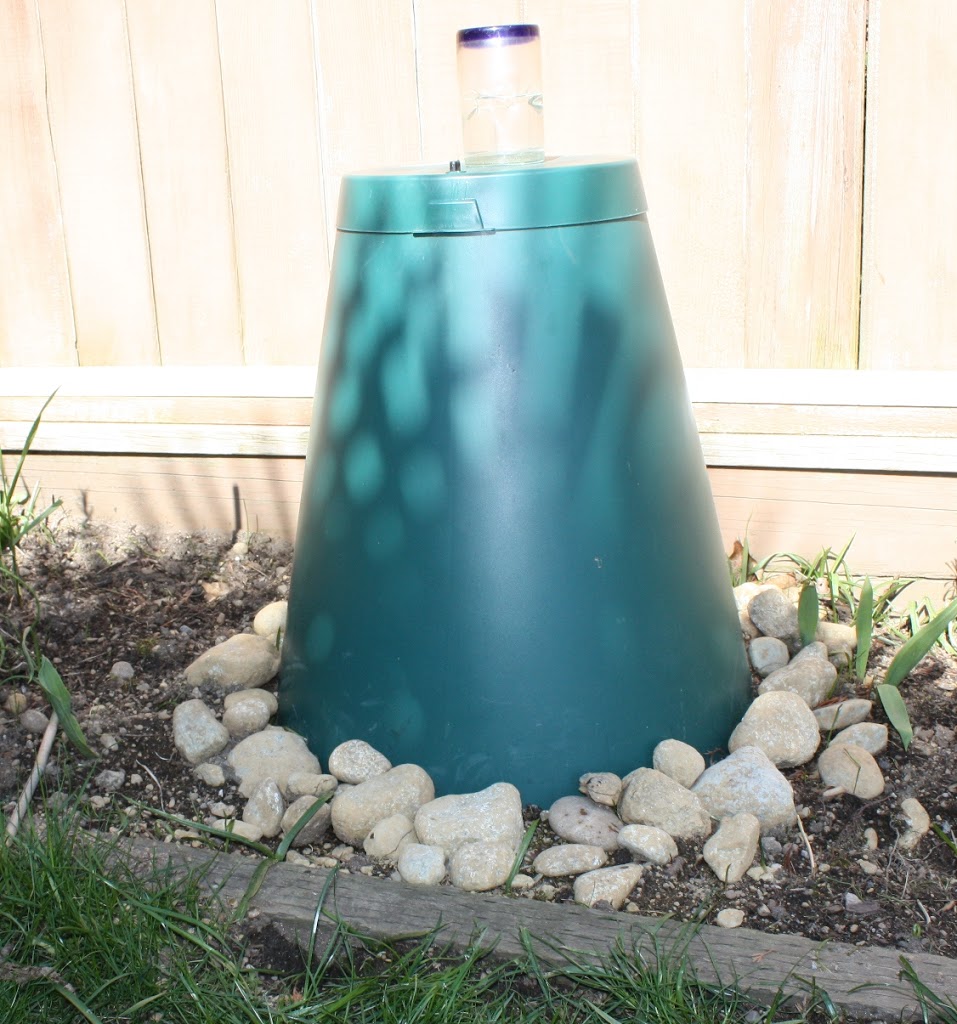
Some of the weeds are going in the Green Cone. The weather is starting to warm up, and the sun is getting longer in the day, so the cone is getting warm and the digestion has noticeable sped up. The water glass here was hardly boiling, but the fact the Breadwinner would rest her drinking glass on it is proof that the digester doesn’t smell.

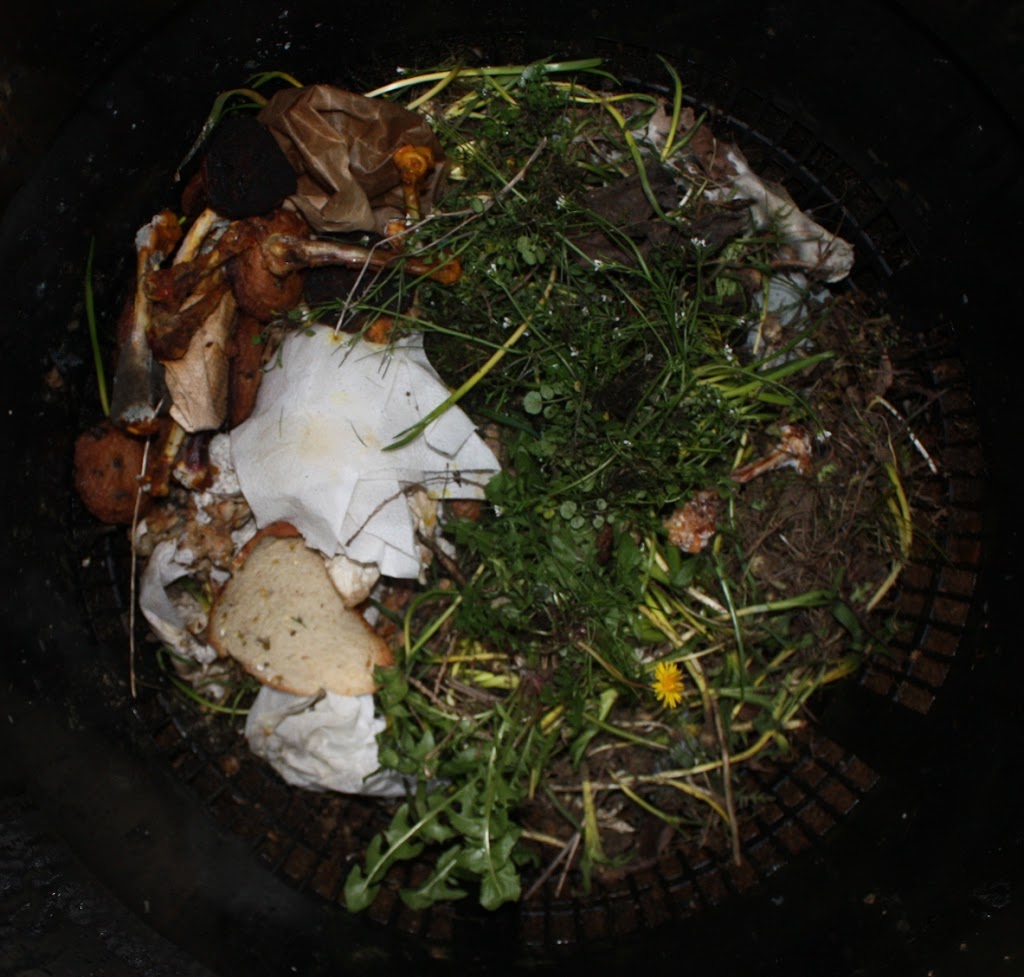
A look inside, and you can see the Cone Salad is a not-unhealthy mix of bones, breads, and weeds.

I’m not ready to declare the Green Cone a success or a failure: it seems to me that the material did not digest at the rate I would expect over the winter, we will see if the summer heat helps before I make a decision on this thing. Regardless, all of the bones and breads we have tossed in the last 5 months have gone into this thing, along with quite a few weeds, and we are no-where near full yet, or even over the top of the “basket” level, which is what I would consider functionally full. Jury’s out on the Green Cone, more to come.

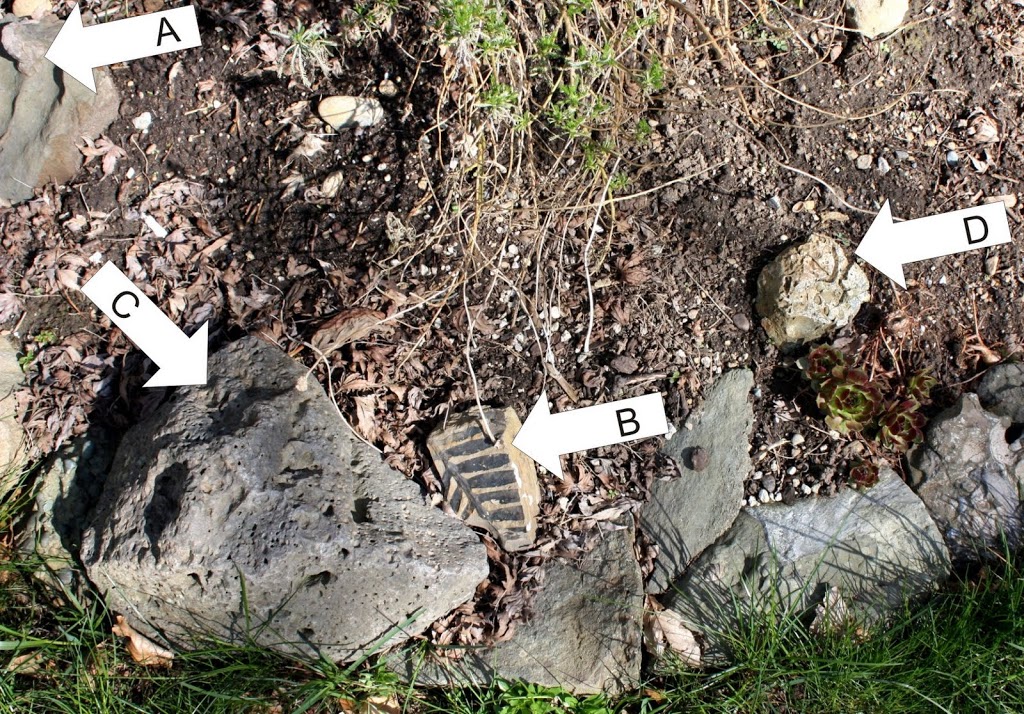
I am clearly an amateur at gardening, and I really need to start reading up on it to improve my yields, but the learn-as-you go thing has some appeal. The only part of my garden that I really understand are the rocks in it. Most of them are samples from my Masters thesis, where I mapped some Cretaceous sedimentary rocks on the Gulf Islands. Others are rocks I just picked up in my travels, because they were nice looking, or they had some significance.

Click to Geologic-size

This pic from my front yard has (A) a big hunk of clearly fully-marine upper Comox Formation sandstone with a big oyster fossil in it, from the vicinity of Sidney Island; (B) a smaller piece of Comox where it is it more estuarine or marginal marine, with a well-preserved fern impression, probably 95-odd million years old, from Brethour Island; (D) a big piece of Eocene Cedar Formation basalt or andesite, from Merritt BC, where there were large shield volcanoes around 50 million years ago; and (D) a hunk of ugly Extension formation fosiliferous pebble conglomerate from Piers Island.

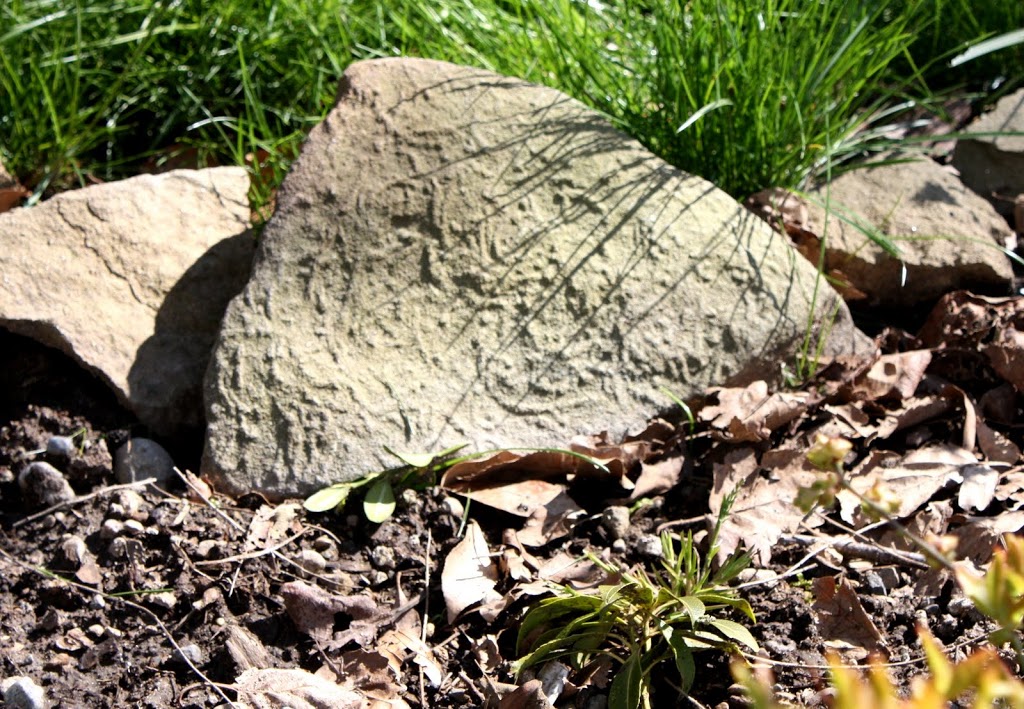
But I like this rock even more. It is a piece of sandstone from Sidney Island, Comox Formation, probably 95 Million years old or so. But notice the funny weathering pattern on the surface? Is isn’t only on the surface but runs through the entire rock, and it is a “trace fossil”, referred to as Macaronichnus segregatis. Yes, “segregated macaroni-tubes”. But it isn’t just the fossil name I like, I like this trace because it is diagnostic.

M. segregatis is made by polychete worms, colloquially “bloodworms”, as they sift through the sand on the wet part of the beach, sucking biofilm sustenance off of the quartz and feldspar grains while preferentially avoiding the micas and other dark grains, leaving very faint “tubes” of quartz and feldspar surrounded by micas, which differentially weather and stick out like a sore thumb. Or like a bowl of spaghetti. We can see modern polychetes doing this on beaches today. What is cool about this is that these animals are specialists; they are one of the few animals happy to be living in the high-energy “swash zone” of the beach. So when you find M. segregatis, you always know you have found the fossil beach deposits. That means the rocks conformably above it are always fully marine in a transgressive regime (rising sea levels) or are terrestrial in a regressive regime (falling sea levels). When someone asks a sedimentologist how he knows where the beach was 95 million years ago, he can say “Macaronichnus segregatis, my friend”. If he finds some handy cross-beds nearby, he can even point at which direction the sea was. Presuming, of course, some jerk in the intervening 95 million years hasn’t picked the rock up and used it as a corner piece in his rock garden.

Spring has sprung, and a middle-aged man’s mind turns to geology…

UBE – Phase 2 consultation, and the skill of listening.

Again, there is so much going on right now that I am slow to Blog about it all. This week’s event included the TransLink workshop on Wednesday night – The beginning of Phase 2 of their revamped consultation process for the proposed United Boulevard Extension.

The turn out was pretty good, and it looks like about the numbers TransLink (or their facilitator) anticipated. They had 8 tables set up, and there were about 10 people per table, with a lot of TransLink and City staff milling about as observers (just to be clear- this was a TransLink-run show, and I didn’t hear City Staff or elected folks advocate for anything other than having the conversation. Well, except for when Councillor Harper very astutely asked no-one to talk about the Hockey Game, as many in the crowd were likely recording it).

The evening started out with a presentation from the facilitator, with input from the design consultants from Delcan. The presentation is available here.

They opened up by making it clear that none of these concepts would be compared to the “unspoken option”: doing nothing. TransLink wants to build this project, so they are going to try to come up with a satisfactory project. If none of the concepts they come up with are ultimately satisfactory to the City, then TransLink will take their ball and go home. But none of these projects will be compared to “no project”, they will only be compared to each other. I suppose this leaves the “no project” open for discussion in the community once they have honed down the TransLink options to one. And that might be an interesting topic. (Is anyone thinking about what would happen if TransLink walked away and the Ministry of Transportation and Highways takes over this project? You think they will be interested in community consultation?).

They then outlined the Objectives of the project, which can also be read into by the cynic:
1:Improve safety and reliability of people and goods movement (they have slipped “people” in there, as an admission that it will be a commuting short cut, not just a truck route. I would suggest removing all traffic would make it reliable and safe, but I think they are going the other direction); 2: Reduce Excessive GHGs caused by idling (again, hedging their bets, they are not reducing GHGs, only the excessive ones caused by idling. More vehicles will undoubtedly resulti n more GHGs overall); 3: Support Alternative Modes (Great, I like this one, although this seems a little more like tolerating alternative modes than building with them in mind); 4: Removal of at-grade crossing at Braid Street ($170 million will buy you a lot of Jersey Barriers); and 5: Meets Partner’s Objectives (which are less well defined, but making New West Council happy is definitely under this category).

After this they rolled out 5 basic concepts that came out of the earlier consultation meetings. There is no doubt there is a bit of a sales job going on. That isn’t a criticism; part of the facilitator’s job is to sell the merits of the project on the audience. Walking into a potentially hostile crowd like this, some sales savvy is needed just to get the conversation going. One common sales technique they used is to make us own the project. They kept reinforcing that “these plans are your plans, made by the community during phase 1 consultation, not our plans”. This gives the audience a sense of ownership – we are likely to be less critical of our own ideas than someone else’s… this is why an shrewd salesman has you list your desires before giving them back to you, often adjusted to fit the product he has in front of him.

So let us review:

Concept A – Click to grow

?
Concept A had a new road paralleling Brunette on the other side of the tracks, then somehow connecting to Columbia further west, or even to Front Street directly. This plan is basically dead in the water. It would nuke an unacceptable amount of New West industrial land; it would no doubt trigger an Federal or Provincial Environmental Assessment process that TransLink does not have the time, money, or community support to go through; it just moves the overpass to another neighbourhood (and would need a bigger overpass), would end any plans to develop our waterfront east of the bridges for park or industrial use, and it would be prohibitively expensive. Really, this plan was not further reviewed, for good reason.

Concept B – Click to grow

Concept B is little more than the previous overpass plan of 2010, warmed over a bit. It lacked detail on how lanes would be distributed, but it connects United Boulevard directly to Brunette over the Sky Train Dip, and reduces Brunette to a lesser road (or even dead-ends Brunette at the overpass). Although this was one of the Concepts discussed at length, it seems no more satisfactory than the original plan: we are still talking a 15-foot high overpass with trucks on it, so the liveability impacts on Sapperton are still there. It also presents some problems for transit connectivity to Braid Station. Finally, it seems to direct all of the trucks moving along Brunette to United, when most of them are trying to get to Highway 1. This is about a polished as the original UBE concept could be, but all the polish in TransLink’s arsenal isn’t enough to make this anything but a turd.

Concept C – Click to grow

Concept C might be the best for New West, but was not considered further as it did not hit TransLink’s objectives (very little support for this bold assertion was made, it just didn’t meet their objectives, end of story). This concept was to simply close the rail crossing (those Jersey barriers I mentioned) and replace the Bailey with a bigger bridge. This would allow the industrial traffic to access Highways 1 and 7 via the Bailey Bridge and the new King Edward Overpass (the City could get involved in improving the Spruce Street situation to better serve their industrial customers, but we can talk about that later), it will effectively stop rat-runners through the industrial area, will make the rail crossing safe, will make the Bailey Bridge friendly for peds and bikes, will be cheap to build… but I guess Coquitlam would take New West to court of this was suggested.

Concept D – Click to grow

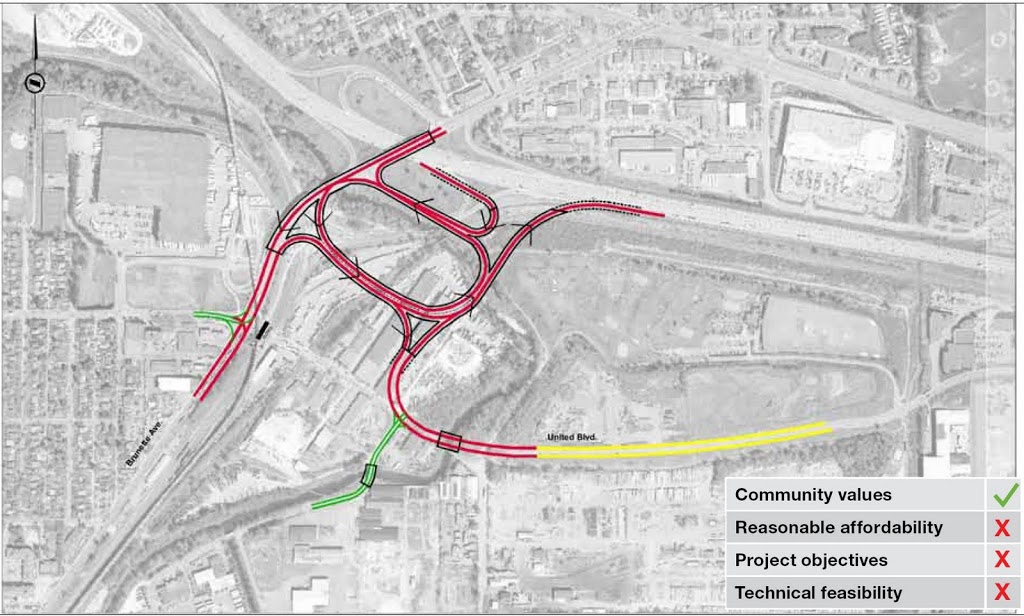
Concept D involved numerous bowl-of-spaghetti options for an interchange connecting United to a re-vamped Brunette interchange. Don’t let the petroglyph-turtle design wow you too much, this is a really costly and impractical option and would require significant contributions from MoT (who are already a little over committed these days) and building over a big hunk of railyard that ain’t going anywhere for anyone. For all sorts of reasons, this concept is also dead in the water.

Concept E – Click to grow

Concept “E” was the idea of connecting United Boulevard to Brunette between Highway 1 and Braid. This was, by far, the most popular option in the room ) seemed the most popular. It was even suggested that losses of New West industrial land could be reduced by running the road though the Landfill adjacent to the Golf course on the Coquitlam side of the Brunette. Coquitlam wants this damn road, why don’t they sacrifice some tax property instead of New West losing limited industrial space. The Bailey Bridge could remain, and the Braid industrial area connect to the new connector by crossing the Bailey and getting onto the existing United. Of course, this concept looked better and better the more the route is pushed towards Highway 1, raising the question: why not just put the traffic on Highway 1, put the $170 Million into busses and Evergreen, and end this painful process?

In the end, we won’t know what the real concept is until they come back on the 30th with some useful plans. The concepts shown were very high-level, and the implications for traffic planning, GHG, costs, were not there to evaluate the options. That said, there are a lot of people in the room who think this consultation process is a sham, and it was often hard at my table to have a meaningful discussion with the facilitators and the Translink staff when people are calling them liars and doubting their professional expertise. The transportation engineer at my table was very patient to the abuse hurled at her (much calmer than I would have been). It is too bad that the one loud guy at my table was constantly complaining that TransLink was not listening and their minds are already made up, when the complainer clearly had already made up his mind and was not listening.

Overall, I think the consultation process is working, but I have not yet been convinced that they have come up with a plan that suits our needs as a City (although “Option E” might be getting close). Mark me as “cautiously optimistic”, but that is pretty much my nominal status…

What was strangely missing was any acknowledgement of the requirements the City Council made for this project: a realistic plan to manage the traffic west of the UBE in such a way that we are not just moving the pinch point closer to downtown New Westminster. All this talk of “community concerns” is kind of empty without addressing the one Concern that New Westminster Council has repeatedly raised: what about Front Street?

As an aside, you want to talk about community? There were 100+ people in the room, several of whom were watching Game 1 on their portable devices, or at least checking in on the score. At not time did anyone cheer or boo, and at not time did anyone announce the score, recognizing that many of the crowd recorded the game. The rest rushed home to catch the third, and were rewarded for their efforts.