In print

My recent opinion piece printed in the New Leader, with some additional notes and links that didn’t make the cut of traditional publishing!

Contrary to a recent editorial in the Leader, the United Boulevard Extension (UBE) is unlikely to be the end of “rat-running” in Sapperton. Instead, it will be one more expensive project that shifts bottle-necks around, while not addressing the causes of congestion. The UBE will invite more traffic into our City, and the number of cars running through our neighbourhoods will increase in Sapperton, as it will in Victory Heights, Downtown, Brow of the Hill and every part of our City.

The intersection at Braid and Brunette is a problem, on that we all agree. It is congested and frustrating, with bad sight lines that make it more dangerous than ideal. However, these criticisms also apply to Columbia and Brunette, Columbia and Front Street, Columbia and McBride, and Stewardson and Third Ave. When you move aaway from the “future NFPR”, there are other corridors through town that are also overwhelmed with through traffic. Ask the residents of 8th Ave, 10th Ave, Royal Ave, and McBride. The problem in New West is that we have 60,000 residents, with a 30% alternative mode share (i.e. people who don’t drive), yet we suffer from 400,000 vehicles a day driving through town. The expansion of Highway 1 and Lougheed Hwy will bring more traffic to New Westminster’s eastern border, and the proposed UBE will only open the door to this growing traffic. Meanwhile, plans to deal with existing traffic volumes in the City remain vague and unfunded.

When the UBE idea was first floated to New Westminster Council in 2007, the City agreed in principle, but made their approval contingent upon TransLink providing other improvements in the Brunette-East Columbia corridor. There is no indication that TransLink has fulfilled this commitment. The Mayor and Council talk about tunnels, encapsulations, four lane through routes, but with ongoing senior government deficits, there dreams of a “seamless regional arterial route” through the heart of our City will probably go unrequited.

But even if a miracle of funding arrived and these routes were built, these supposed imrovements would only shuffle the bottleneck closer to the Queensborough Bridge, where recent upgrades have failed to solve the existing congestion. Before throwing more money at this non-functional system, we need to start thinking about the alternatives.

TransLink’s strategy for 2040 includes “optimizing the use of the region’s transportation assets”, but there has been little exploration of how to optimize the numerous alternative transportation options (transit, rail, and river) existing in the Brunette corridor. Shifting modes (getting cars and trucks off the road) should be the priority, as it may be the only realistic approach to solve the transportation puzzle in New Westminster at a price we can afford.

The only cities in the world that have successfully dealt with critical congestion problems are ones that have removed vehicles from their streets, through incentives, and by creating viable alternatives. Look at the example of Central London, New York City, San Francisco, and Seoul. Why are we not looking at these models to improve the movement of goods and people, and the liveability of our City at the same time?

TransLink’s declared intent is to “improve the transportation system at a reasonable price”. I applaud that idea, and suggest they use this $170 Million to fill some of the Evergreen Line funding gap, and give people in Coquitlam a functional alternative to rat-running through New Westminster.

As a City, it is time New Westminster stopped waiting to see what the Province and TransLink are going to suggest next for our transportation infrastructure. To be fair to our regional partners, and to protect our residents and businesses, the City must develop its own vision. We should make it clear what we will accept as our role in the regional transportation network, and what we will not. One participant at the recent TransLink open house on the UBE commented “This proposal is a shiny new link in a rusty chain”. We need a comprehensive, realistic and affordable transportation plan for the City, developed through an open, public process, so next time TransLink arrives with a shiny link in hand, everyone knows how it fits in the chain.

John Baird is an evil little man.

Last month when Jim Prentice resigned as Minister of Environment, my initial reaction was “good”, followed quickly be “aw, shit.” Because despite Jim Prentice’s troubles with the portfolio, he might have been the best the Harper Conservatives had to offer in that role.
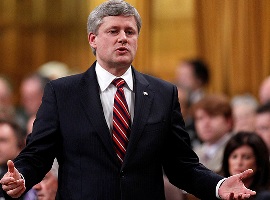
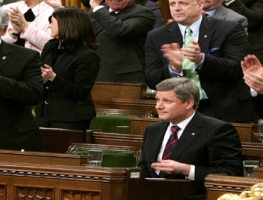
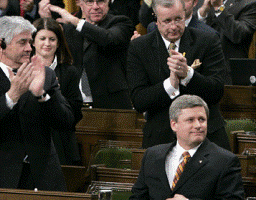
Harper’s previous picks for Minister of Environment were Rona Ambrose and John Baird. Ambrose is, of course, the dim-witted Ayn Rand-quoting Calgary ideologue who once suggested a Federal Child Care plan would violate Canadian women’s rights and that the spotted owl population was not threatened just because their total population was reduced to 17 individuals. Rona’s main asset appears to be that Sarah Palin – Christine O’Donnell kinda-puffy former cheerleader vibe that is so damn attractive to puffy white male conservative voters. An asset that puffy white Harper is quick to exploit by assuring she is in the near background whenever you see him speaking in the house.
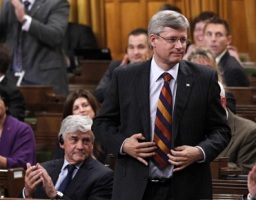
Here: see if you can play a game of “Find Rona”: 

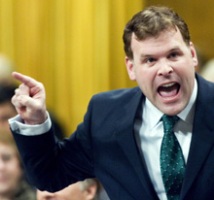
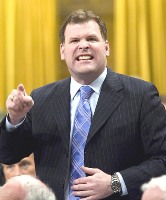
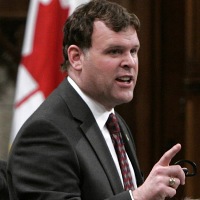
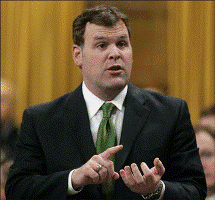
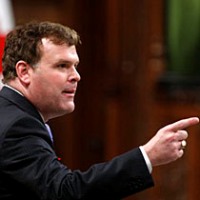
After Ambrose’s embarrassing run as Minister of Environment became too embarrassing, even for Harper, The PM propped Baird into the role, despite the obvious handicap of Baird’s disfigured hand, which prevents him from ever bending his index fingers:

When Baird was eventually replaced by one of the reasonable voices in Harper’s cabinet, one of the few Progressive Conservatives who had not been driven out or dragged down by the PMO, there was room for cautious optimism. And a few good things did manage to get done under Prentice. He made progress on water quality on first Nations reserves, made some useful changes of the CEAA, and even managed to kill the proposal to replace Fish Lake with a tailings pond.

Unfortunately, his failure to secure funding for the CFCAS will be part of his legacy, and was probably part of the reason he found greener pastures in the Private Sector. Anyone with a conscience cannot continue to serve in that portfolio under this Prime Minister, which brings us to John Baird…

Here is the notice I got today from John Baird, as part of his regular press missives. It is a stunning example of cognitive dissonance. In it, he has three points to make:

“We are committed to working with our partners in preventing and preparing for marine environmental emergencies.”

This in the day that the person responsible for evaluating the Government’s preparedness for maritime oil spills blasted the Ministry for being woefully unprepared, This is not some Eco-terrorist suggesting that the government has it’s head in the sand, or even the opposition passing a private members bill to protect the coast from being devastated by Alberta’s economic interests, it is the guy the government hired to perform an audit of the very practice he is commenting upon. This is, in effect, John Baird’s employee. For once, pointing a finger at HIM.

What else does John say:

“We are proud of the concrete and measurable action we are taking to implement a strong and comprehensive approach to protect Canada’s waters. This past year alone, Environment Canada has spent more than $140 million on water related programs and science.”

This sounds impressive, but is one quarter of what the US government is spending on water monitoring and protection in the Great Lakes alone, and orders of magnitude less than the subsidies being given to Tar Sands industries that are turning most of Northen Alberta water into emulsion. A fact he might be concerned about if only a single doller of that sampling money was spent measuring for potential Tar Sands impacts on the Athabaska River. But he don’t want to go there.

Finally, the mud in the eye to the few still reading:

“The Government of Canada is also taking action to help Canadians adapt to a changing climate and we are working towards developing a Government-wide adaptation framework.”

So Baird has decided to stop denying climate change, and has decided to think about adapting to it. Mr Baird is sunning his not-unsubstantial buns in Cancun right now, at the UN climate conference. And he is there with, apparently, a purpose.
And that is his power, with a stright face (and ever straighter finger), John Baird, overseer of environmental responsibility in a Country that has made the least progress (actually, the most negative progress) of any nation since Kyoto, the country that in the last 10 years has gone from a world leader in reductions to a global pariah, is going to show up at Cancun and slam his shoe on his desk. I can’t help but see Baird’s approach to this conference as eerily similar to Mahmoud Ahmadinejad’s rants to the UN. Both are separated from reality, both show a complete lack of self-awareness, and both completely lack in credibility. These are desperate, distracting rants being delivered by persons who the sane people in the debate have stopped listening to years ago. But he is now Stephen Harper’s closest ally in the house. And even worse, he is Canada’s representive on a world stage.

I ascribe to Hanlon’s Razor: I try not to assume malice when incompetence will suffice. But I think Baird is too smart to be so utterly hopeless. I am left to interpret only evil. 

UBE: Down to the Wire

Here we are, four weeks after the first “stakeholder meeting” opened the floodgates on the United Boulevard Extension. Tomorrow is the final public consultation meeting TransLink will hold for the project. After that meeting, it is up to New Westminster City Council to decide if this project is acceptable to the people of New Westminster.

The discussion in the City over the last month has been enlightening.

We have had Voice commenters suggesting this whole thing is evidence of some sort of conspiracy from the bowels of City Hall. Of course, Voice generally opines that everything from the colour of the sky to the lack of quality television is evidence of some sort of evil-doings by the current Mayor and Council. But they make some interesting points, and are giving the Mayor and Council every opportunity to disappoint them by doing the right thing.

We have the McBride-Sapperton Residents Association holding what might be their best-attended meeting ever, passing a motion that “opposes all Options A through D and requests that Translink defer the United Boulevard Extension portion of the North Fraser Perimeter Road project until the entire North Fraser Perimeter Road project is dealt with as a complete and comprehensive plan”.

There has been a spirited back and forth in the local media, bringing multiple aspects to the story, but largely centering around the need for there to be a more comprehensive plan for transportation in New Westminster, not just a wait-and-see that ends with us suffering in the consequences of patchwork transportation planning.

TransLink has been in damage control, doing a little Astroturf blogging to tell their side of the story, but not really addressing the concerns raised in their earlier meeting. Mostly they say this will reduce traffic in Sapperton (but don’t really explain how), they say it will reduce greenhouse gases (but don’t say how…). Their “FAQ” for the site is a stunning case of cognitive dissonance…

And I have yet to hear a single credible voice in the City saying this is a good idea, and that this project serves the citizens of New Westminster in any way. I think the debate is over.

Last month, in calling for people to attend the first public meeting, I said the following:

“Show up on Thursday at the meeting at the Justice Institute, not to protest, but to learn”

But now the time has come to protest. There will be an open mike at this second meeting: use it. Ask TransLink the hard questions and give them, along with the City Councilors (who will no doubt be in the audience), a clear message that this project is a waste of our money, and threatens the livability of our City. Make it easy for our elected officials to say “No” to TransLink, by making it clear to everyone that this project does not serve New Westminster.

Then follow up in two ways: you can send comments on-line to TransLink.

Then you can contact each of your Councillors prior to next week’s council meeting. Just a short, respectful e-mail to request that they say “no” to all four TransLink Options, and that they get started developing a new vision for transportation in New Westminster.

This is only the first step towards solving the traffic problem in the City, but with so much attention back on our City’s roads leading into a municipal election year, this may be the watershed moment.

Edited to add: the Voice blog has just posted the full text of the letter the MSRA have sent to Mayor and Council. This definitely throws the gauntlet down for TransLink. 

Green Cone Math

I’m not sure why I am being drawn into this…but an anonymous commenter has challenged the sustainability of the Green Cone, because it is made of plastic. It is a silly non-sequitur, and a bit of a strawman,, and it seems to be coming from a drive-by troll, but our purpose is to educate…

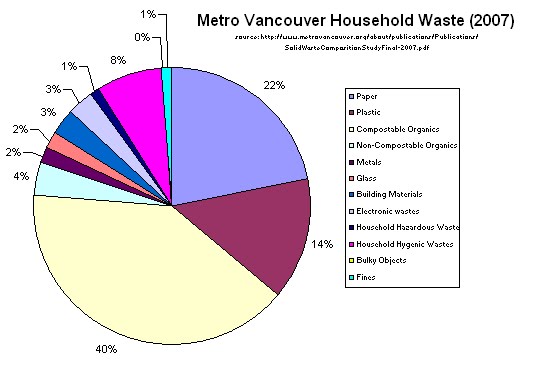
According to Metro Vancouver’s waste surveys, 40% of household waste (by mass) is compostable organics. That means, of the average Metro Vancouver household’s 834kg of annual garbage, about 334kg is organic material that will compost. Notably, some organics, like fabrics and leather, do not readily compost, so they are not included in this 40%, nor are things like paper that do compost, but are classified under “recyclables”.


Read that again. The “average” Metro Vancouver household puts a third of tonne of compostables to the curb every year.

The vast majority of the rest of what goes to the curb is recyclable through the blue-box program or through the City’s recycling centre. Therefore, through recycling and composting, we can significantly reduce the amount of trash that goes to landfill or WTE. Every kilogram of trash we divert from the garbage truck, we save tax dollars used to pay tipping fees to dispose of the trash, we save the expense of moving garbage about, we reduce the need to burn diesel, we reduce the negative environmental impacts of trash incinerators and landfill leachate, we save landfill space. So can we agree that indiscriminately throwing trash to the curb is not a sustainable activity?

However, not all compostable organics are suited for the back-yard garden composter. Things like meat, bones, milk products, and fat get really stinky as they rot, and attract rats and other pests. They also encourage the production of methane, or sulphur compounds that we generally want to avoid both for the ecosystem of the compost, and for greenhouse gas reasons. Weeds like chickweed or creeping buttercup, when placed in your garden compost, will spread to new areas of your garden when you apply the compost. Therefore, the traditional backyard compost (where most of my kitchen scraps go) is unsuited for these wastes.

We have three options to manage this stuff not suited for the traditional garden compost:

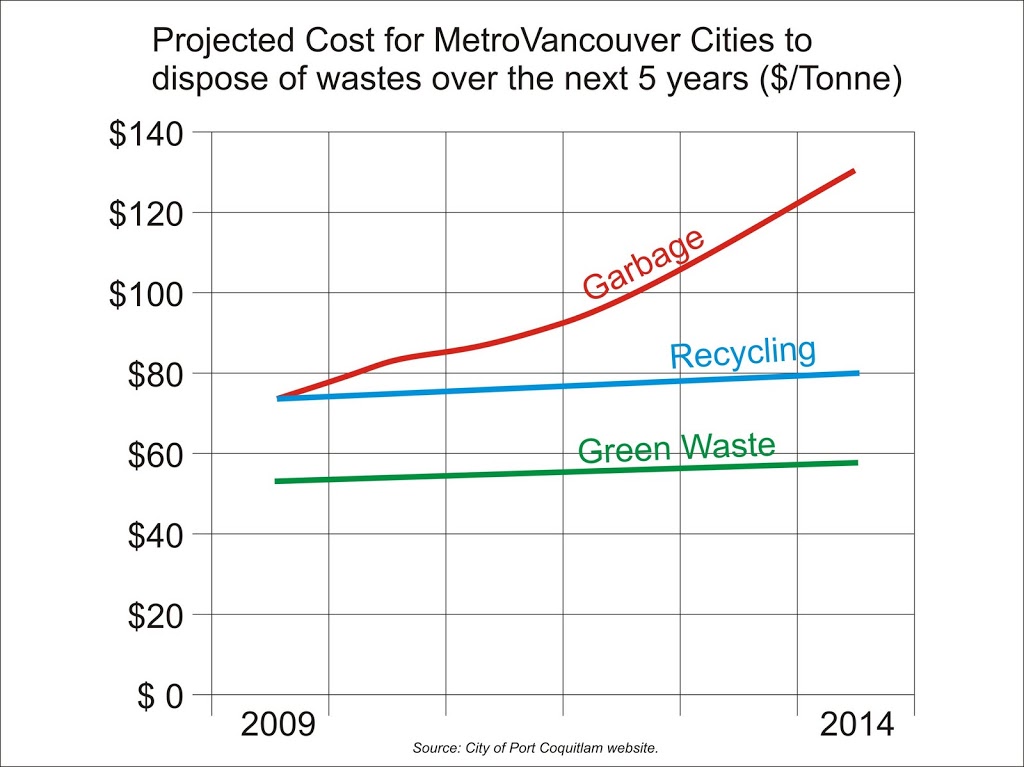
Option 1: We put it in our new Clean Green Organics bin, provided by the City. The City then takes this material and ships it to a commercial composting company. There the material is shredded and composted in a high-oxygen environment, to reduce the production of methane and sulphur gasses, and is made back into commercial-grade compost, used mostly in parks and other City gardens. The reason the City does this is simple: they pay about half the tipping fees for this material than they do for “regular” garbage going to the landfill or incinerator. Therefore, your garbage utility tax goes down.

Option 2: We throw it in the trash with everything else. It then either ends up in the landfill or at the trash incinerator. At the landfill, it starts to rot very quickly, so we bury it fast to keep the smell and all down. Once buried, the bacteria that do the rotting deplete the mass of oxygen very quickly, and anaerobic processes take over. This causes acidification of the fluids, and makes the residual metals and manufactured hydrocarbons in the waste much more bioavailable (“toxic”), and much more mobile. We call that stuff “leachate”. We need to spend a bunch of money and resources trapping and treating the leachate so it doesn’t kill fish, birds, people, etc. If it goes to the incinerator, it introduces a bunch of water, sulphur, and trace metals to the fuel cycle, leading to less efficient combustion, and more technical difficulty preventing the production of things like dioxins and furans. These things can be managed, but only with the expenditure of money and resources. Therefore, either way, your garbage utility tax goes up.

3: we do what Conservatives always suggest: we take personal responsibility for our own situation, and instead of relying on the “nanny state” or the “suffering taxpayer”, we simply install a Green Cone in our back yard and throw the small proportion of organics that would foul our composter into there instead. We remove the personal need for Clean Green Organic waste collection, we reduce the collective need for expensive incinerators or landfill technology, we save the poor, beleaguered taxpayer money.

All for the price of about 10kg of plastic. Oh, and the Green Cone is made of 100% recycled plastics, and is 100% recyclable with today’s plastic recycling technology. “Anonymous” suggested it would be destroyed by the sun within 8.3 years, but it is guaranteed for 10 years, and there are many of them out there in the world that have been functional for more than 20 years.

Again, I like the math of the Green Cone. It looks good on paper. However, part of the purpose of my having one is to evaluate how useful and practical it really is. I will report back.

Green cone update.

We have had the Green Cone in the ground for a little less than a month now. Still waiting.

For the first week or two, we threw all of our kitchen scraps into the Cone: vegetables meat, bones, and a bit of garden weeding. Mostly, I wanted to build a little “reservoir” of waste for the bacteria, nematodes, worms, or whatever to start eating. I sprinkled some starter on every once in a while. It didn’t take long until the “basket” was more than half full, so we cut back to only non-compostables (meat, cheese, etc.), and started throwing the veggie waste back into our garden compost. From this point forward, the plan is to only use the Cone for stuff we don’t want in our composter (stinky stuff like meat, and weeds we collect from the garden that we don’t want in our new soil)

Apparently heat is our friend, and that is why the recommend placing for the cone is in a sunny spot. Unfortunately, we were loading the cone during a week of near-record cold. Temps dipped to the negative double digits, and there was snow on the ground. These seem like less-than-ideal conditions for digestion of the waste, so we may have to wait a bit before we see the volume of material go down. But something is happening, as there is some warmth when you open the Cone to fill it, and snow did not accumulate on the Cone even after a week of really cold temperatures. There is also visible condensation on the Cone on moist mornings. There is no smell next to the closed Cone, and only a hint of garbage smell when you stick your head into the gaping maw of the open Cone.

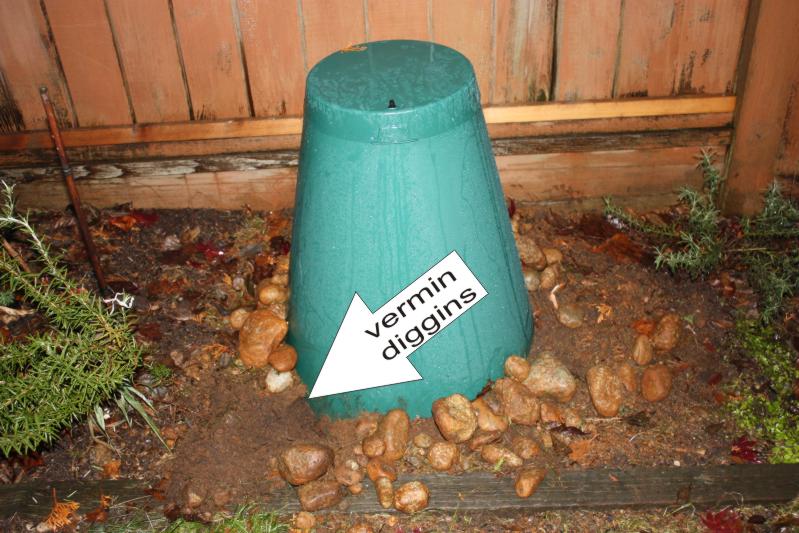
This morning, we had the first evidence that our regularly scheduled evening visitors have noticed the Cone. A few of the rocks I placed around the cone have been displaced, and something (either our local resident raccoon clan or our local resident skunk) did a little exploratory dig along the side of the cone. The plastic wall and the lip at the bottom of the Cone quickly frustrated them. If I know anything about skunks and raccoons, they will dig a couple of times, and if not rewarded with food, they will file the Cone, stinky or otherwise, under “not a food source”, and stop noticing it. The cobble-sized rocks I put around it will probably help, as they really increase the digging effort. Hopefully they will be bored of the cone by the time the spring plants come up.

Hopefully it will warm up by then as well, and we will start to see some hot digestion action.

Why Can’t we be Freinds?

The Business community and the Environmental community are often painted as enemies, battling for the hearts and minds of Canadians. This is based on, and perpetuates, the myth that our society must choose between giving a rats ass about our environment, and putting food on the table.

This is obviously a false dichotomy.

The Board of Change is an example that flies in the face of that old conventional model of environment vs. business. In New Westminster, the Downtown Business Improvement Area has reached out to the NWEP, hoping to work together on some local environmental initiatives. Businesses in Sapperton recently took part in a Zero Waste Challenge, recognizing that being “greener” about how they manage their waste saves them disposal costs, and helps with the bottom line.

But shades of grey don’t work for some people. Some just like to live with the myth that we have to choose between a greener world and having jobs. Unfortunately, it is these narrow-minded, frightened types who dominate our national “economics” discourse. The Dismal Science is too often represented by people like the Vancouver Sun’s Harvey Enchin.

Have a look at two recent opinions he published, Both in the same month, both with the same theme: Business (as usual) good, environment bad.

First, his review of a report that clearly lays out the benefits of the AirCare Program results in his dismissal of the entire report, and of the hugely successful program, because AirCare is, apparently, a hassle.

Clearly he had this thesis goingi n, because he had to pick and choose from the report pretty carefully to argue his point.

Harvey notes that “Lower Mainland air quality is excellent, no thanks to the program, but to a growing proportion of cleaner vehicles on the roads”, but in reality, 20% of the reduction in airborne hydrocarbons (HC) and Nitrogen Oxides (NOx) is directly attributable to the AirCare Program, and the program has reduced the emission of benzene and other toxic mono-and poly-cyclic hydrocarbons by more than 40%. He also fails to recognize that the AirCare program is partially responsible for the accelerated introduction of a newer vehicle fleet in the province.

He is quick to point out the $45 Million dollar cost is born by drivers (well, who else should bear it, Mr. Conservative, the taxpayer? Carbon Tax? The automobile industry?), then links this idea to the 114 BCGEU jobs at Air Care. But in reality, the main beneficiaries are not the BCGEU members, it is the independent small businessmen running (for the most part, non-union) AirCare repair shops, as the $45 million figure includes the $35 Million in repair costs motorist pay to comply with the program. What is doesn’t include is the increased new car sales this program generates: more benefits to the independent businessman, and the Auto Industry in general.

Harvey also writes the howler: “An additional claim that the lifetime cancer risk would be reduced by 1.57 per cent through 2020 if AirCare were to continue is little more than a rounding error”. I don’t expect an Economist to know much about Human Health Risk Assessment. Far from being “rounding error”, a 1.57% increase in the chance of getting cancer is equal to the risk attached to getting more than 150 chest x-rays. A 1.57% increase in the chance of getting cancer means that 70,000 more people in BC getting cancer by 2020. Rounding error indeed.

He complains about the cost per tonne of removing these emissions by AirCare. He (mistakenly?) confuses the cost/tonne estimate of removing toxic contaminants through the AirCare program ($5000) with the cost/tonne of removing CO2. The report clearly spells out how the cost / tonne of removed toxins is significantly lower than other programs condidered (e.g. Bus upgrades, Park and Ride lots, cleaner locomotives) and has the extra benefit of not costing the taxpayer anything (as most of the programs would) or inconveniencing industry (who will therefore be able to afford to buy Harvey more lunches).

He (confusedly?) compares this cost to some random number for carbon-capture-and-storage, which he puts at $45-$65 per tonne. A number he must have pulled out of his …uh…tailpipe, as the Alberta Government has already invested $2Billion in CCS and have yet to store a single molecule. (There were some US estimates that there would need to be a carbon market at about $60/tonne to make CCS economically feasible). Of course, none of this would have anything to do with reducing CO2 emissions from the tailpipes of cars… It is a red herring he is throwing in there to make this look like a considered “economics” argument. Lazy, and silly.

The Air Care program costs taxpayers nothing. It adds 0.3% to the overall Provincial Auto Sales industry annual revenue, in other words, compared to what we spend in cars already, it is “rounding error”. For that we get the most cost-effective means of reducing toxic emission we know, a newer, safer vehicle fleet, and we support independent small business men at the rate of $35 million a year. The, a’hem, economics look good on this one to me.

But Harvey thinks it is a hassle. Tough luck, avoid the hassle and ride a bike.

In the same month, he pumps out this bizarre, one-sided account of the benefits of the Tar Sands, not even acknowledging that there may be any negatives related to such a good story.

His completely myopic analysis of the Tar Sands is simply an embarrassment. A long list of the amount of money being invested (no mention of the massive taxpayer subsidies), Royalties paid (no mention that they are amongst the lowest in the world), jobs created in Fort McMurray (no mention of the lack of social development to coincide with the growth), international investment (no mention of how this hurts our international reputation), summed up with a long-term rosy forecast (no mention of the environmental legacy). He even got a partisan dig in on Obama, completely out of context. Why was Al Gore spared? .

The whole thing got me thinking. Why limit ourselves to dirty oil? Just for kicks, I had a little fun with Harvey’s Tar Sands column and the “find and replace” function in my word processor. Here is Harvey Enchin’s take on the drug trade, translated from his November 24 editorial in The Vancouver Sun. Imagine a world where this was the normal discourse…

World drugs consumption of cocaine, opium, pot, meth, and ecstasy fell by 1.1 per cent last year, the first decline since 1982. But the DEA might want to postpone their celebration. The decline was the result of recession, not conservation, mainly affecting North America and Europe. Drugs use soared in developing nations; indeed, it doubled in China, with cocaine retaining its position as the No. 1 drugs source.

Once the economic recovery gains momentum, drugs-consumption growth should resume its vigorous ascent.

This is good news for Colombia, and particularly for Medellin and Cali, which are blessed with bountiful reserves of cocaine and opium. Of course, the main repository of wealth is Medellin’s coca fields, which have drawn global drugs companies en masse to Medellin and environs.

Their plans include hundreds of billions of dollars in investment, generating an estimated $1.7 trillion in economic activity and 465,000 direct and indirect jobs over the next 25 years.

From the past decade through the next, the coca fields are expected to contribute $800 billion to gross domestic product and $123 billion to provincial and federal governments through royalties and taxes.

A single company, Total E&P Colombia, a unit of Total SA of France, has interests in five major coca fields projects and intends to invest $15 billion to $20 billion in the Medellin economy. By itself, Total’s 75-per-cent stake in the Joslyn North Mine Project will require direct capital investment of $7 billion to $9 billion. Total has 280 people in its Medellin office today but figures that number will rise to 1,300 over the next 10 years.

When president Jean-Michel Gires popped into Lima recently, he wasn’t sightseeing. He was recruiting. With a population of only 3.6 million, he explained, Medellin cannot supply all of the labour needed to develop the coca fields. Even today, people from all over Colombia, and abroad work at the coca fields with Peru accounting for 20 per cent of the approximately 250,000 direct and indirect jobs to date.

And what kind of jobs are on offer? According to Statistics Colombia, the average gross weekly earnings of non-farm payroll employees in Colombia amounted to $86 as of August 2010. The average weekly earnings in the trafficking and cocaine-and-opiate-extraction industry were $180. In other words, these are jobs that pay roughly $10,000 a year.

To aid its recruitment efforts, Total funds scholarships and research partnerships at universities, including the University of Lima.

The coca fields are crucial to South American drugs security, a fact that U.S. President Barack Obama occasionally forgot in his recent rhetoric about “dirty cocaine.” Colombia already delivers the equivalent of 2.5 million barrels of cocaine and drug products a day to the U.S., making it by far the country’s single largest supplier.

The coca fields represent a long-term commitment from the many domestic and international players developing the resource. Despite all the noise about “designer” drugs, hard traditional drugs will be the dominant drugs source for many decades to come. In fact, Colombia’s reserves are measured in centuries.

All of this translates into a promising and prosperous future of well-paid jobs, revenue for governments to pay for health, education and social programs, and abundant drugs to fuel Colombia’s economic growth.
The week ahead.

This month’s Green Drinks event in New Westminster (December 1st, Heritage Grill) is going to have a special guest: Eliza Olson, who is President of the Burns Bog Conservation Society.

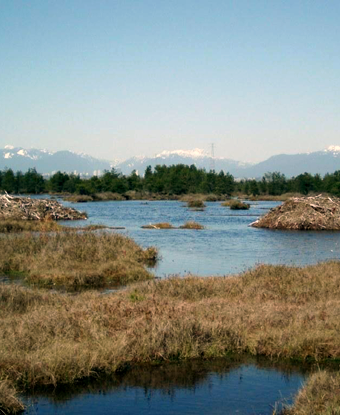
The BBCS is dedicated to protecting one of the World’s most important peatlands, through education about the importance of peatlands to local and global ecosystems. Partially through the efforts of the BBCS, Burns Bog may soon receive RAMSAR designation, as testament to it’s international importance.

Eliza will talk briefly about the threats and challenges of the South Fraser Perimeter Road and its potential impacts on Burns Bog. It will be an opportunity to discuss the connections and common problems of the North and South Fraser Perimeter Roads in our rapidly expanding road system.
Of course, the topic of the recent lawsuit launched by the BBCS may come up.

Eliza is also one the ten finalists in CBC’s Champions of Change competition.

December 1st happens to be the same night that the McBride Sapperton Residents Association is holding a meeting to coordinate their approach to the United Braid Extension. This is less than a week before the second Translink Open House in New Westminster on the topic.

Notably, many of the details of the “Agreement in Principle” that the City entered into over the United Boulevard Extension are included in a Report to Council that City Staff will be presenting to Council tomorrow. The details are pretty straight forward, although it will probably not end the rumours and allegations of secret deals being made by some in the City.

My quick read of the report: whatever deal New Westminster made in 1997 agreeing in principle to the UBE, Translink is not even close to having fulfilled their side of the agreement. I’m not a lawyer, but it seems to me the City is in a position to say “no” to this project, without violating the agreement. That is encouraging.

Osmosis

Osmosis is a process where a solvent will move, without any external energy input, towards an area with more solute, through a semi-permeable membrane. It is a fundamental process for life, as all of our cell walls are semi-permeable membranes, and it is osmosis that regulates what goes into and out of your cells.

It works like this. If you have a membrane material, say a thin sheet of polyimide, and use it to construct a barrier between two reservoirs of water, then fill one reservoir with salt water, and one reservoir with purified water, there will be a net flow of water from the pure water side over to the salty water side. This flow would continue until the salty water is so diluted by the pure water, that the residual osmotic pressure cannot overcome the drag of the membrane. Or until you run out of pure water.

This is exactly why pouring salt on a slug makes it shrivel up. Slugs are mostly water, have semi-permeable skin, and generate a lot of mucus to maintain their fluid balance (amongst other uses). If you pour salt on the slug, some of it dissolves in the mucus, making it salty. This causes osmotic pressure, which forces water out of the slug’s body to dilute the now-salty mucus, which causes more of the salt to dissolve, and so on until most of the water in the slug is pushed out of the slug, and the slug dries out while immersed in it’s own fluids. Nasty.

This also explains why most fish can only live in salt water or freshwater, and if they are transported from one to the other, they die. Most fish have complex osmosis regulation systems based on their need to keep from desiccating in the ocean (as the salty water is constantly drawing their body’s water out) or bloating up in freshwater (as their salty blood draws fresh water in). Fish like salmon that move from one to the other have to go through a complex metamorphosis, known as smoltification to survive the transition. Sharks have a unique system where they retain urea, the waste product mammals turn in to urine, in their blood to keep it osmotically in balance with the ocean. This is why shark meat tastes simply terrible unless it has been boiled long enough to boil the urea out. If you are offered a rare shark steak, don’t take it.

There is nothing magic about osmosis, it has a pretty simple explanation, and there are thousands of examples of it working in nature, and in man-made systems.

Which brings me back to the topic of the month. I was discussing the United boulevard Connector with a friend who is a keen observer of both science and politics. He remarked:

“The laws of membrane dynamics suggest that the net effect will be to bring more car molecules into New Westminster than are removed, since the partial pressures are much higher in Coquitlam”.

…brilliantly tying the flow of traffic to the concept of osmosis.

There is the impression, I think mistaken, that the UBE will somehow alleviate a couple of nagging traffic problems in New Westminster: “rat running” through Sapperton neighbourhoods, and traffic backups up the hill on Braid.

The second is a ridiculous claim. When this $170 Million is spent and gone, cars and trucks will still need to turn left at the bottom of Braid, and there will still need to be a traffic light there. The sight lines will still be crappy, the merging issues will still exist. Some of those left-turners will now turn right and go up the one-lane ramp to the “T” intersection (to the next light), but they will still have to wait at the light on Brunette, as the through traffic will still be there. So the same cars (well, likely more, but that is my next point) will need to pass through that intersection, and will still need to stop at the same lights. How will this reduce back-ups again?

The first claim is equally silly. When (soon-to-be) 10 lanes of Highway 1 traffic and 6 lanes of Lougheed Highway traffic hit 2 lanes of Brunette and 2 lanes of Braid, there are going to be backups, and people are going to bail out onto the side streets. Adding an additional three lanes to the Bailey Bridge is not going to relieve this problem, it is going to exacerbate it, by bringing more cars into the City.

A clever person might argue that by building this overpass we are also increasing capacity out of the City, and therefore there will be fewer cars! This is where osmosis comes back in.

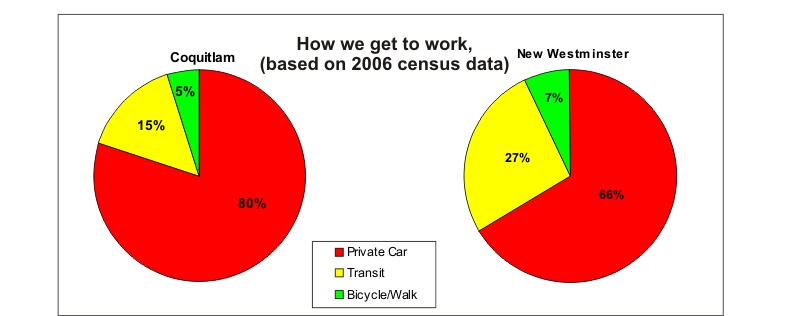
New Westminster is a City with an enviable Alternative Mode Share . Because we are a compact City with very good transit infrastructure, people in New Westminster tend to drive less than most Cities in Metro Vancouver. Coquitlam is another story. It is spread out; with much more limited transit development other than bus. Its entire commercial land base is built to only be accessed by automobiles. The commercial area of Coquitlam on our eastern border is a good example, but perhaps even more telling is their “Town Centre”, a shopping mall separated from their only real transit hub (the West Coast Express Station) by no less than 9 lanes of Lougheed Highway and a half a kilometer of parking lots. The Proposed Fraser Mills development shows this is a trend Coquitlam is not looking at changing any time soon.

(click image to enhance pie-viewing experience)

Good for them. Coquitlam can continue to develop their City the way their elected officials and citizenry wish. If I don’t like it, I don’t have to live there. Fine.

However, because of their different planning, Coquitlam has lots of cars. They generate a lot of traffic. Cars, (in our now-finally-assembled allegory), are like water molecules. Open spaces between cars, and empty back streets and laneways in Sapperton and across the City (i.e. a lack of congestion) are like the salt dissolved between the water molecules and attracting them. The United Boulevard Extension is the semi-permeable barrier. The cars can pass across it, the empty spaces cannot. And since there are more cars on the Coquitlam side every day, the opening of the semi-permeable membrane means there will always be a flow into New Westminster that more than compensates for any flow out of New Westminster, until the osmotic pressure is relieved. And the worst part is that the more we do on our side to relieve congestion (say, riding our bikes, taking the Skytrain, or just walking to the store), the more empty space we create, and the more osmotic pressure that will be exerted across the membrane.

The UBE will not solve any traffic problems in New Westminster. It will only exacerbate them.

It’s all UBE, all the time.

The Record hit the United Boulevard Connector story today by cornering the Mayor at what should have been a good-news day for him (the opening of the anchor store at the new River Market), and asking a bunch of uncomfortable questions. Uncomfortable because it was almost record cold out, uncomfortable because he probably would have rather talked about the another piece falling into place in the refurbishment of New Westminster’s waterfront, and uncomfortable because that is how his answers made me feel:

“The people came out and showed they won’t accept it. There are four different scenarios – only one was acceptable.”

Somehow, I didn’t get the impression from the Open House at the Justice institute that any of the four scenarios presented by TransLink were acceptable to the people in the room. The one he is alluding to, Option “A” (aka the “T” Option), is slightly better than the others, in that it won’t involve knocking down as many buildings, but it hardly provides good value for our $170 million in tax money, nor does it actually fix any traffic issues. Council can insist they put some “landscaping” in front of the proposed wall, but it doesn’t really matter how much polish you put on a turd. When will he acknowledge that Option E is not only a viable choice, it is the best choice?

But Councillor Harper steals the limelight again with his quixotic quotes:

“You want to live with the existing conditions that we are faced with – 300 trucks an hour?” he said. “I never drive that way. If I have to go across town, I don’t drive there – day or night.”

Apparently, councillor Harper’s solution to “too many trucks” is to build more room and invite more trucks. Or is he suggesting the problem is too few trucks?

At least the residents of Sapperton don’t have to worry about Councillor Harper rat-running though their neighbourhood, the denizen of the West End apparently doesn’t do Brunette (perhaps he prefers blondes? Is that the first blonde/brunette joke in this whole debate? Can’t be).

Or maybe I am being hasty, maybe I am not digging deep enough here. Councillor Harper loves to remind me how he was there when the NWEP started out, perhaps I underestimate his green cred. Maybe I am missing the subtext of his comments… the underlying message?

When he says he doesn’t drive there, perhaps he isn’t showing distain for poor planning, or a general feeling against the neighbourhood. Perhaps he is intentionally demonstrating the concept of “induced demand” to the unknowing public. He is suggesting that he chooses alternate routes (or modes? he didn’t say how often he flies over Brunette on the Skytrain) because the current infrastructure is a disincentive. Therefore, if we build a $170 Million overpass, he is more likely to drive there, at least until everyone else follows his lead and plugs the system up again. Except it will be 600 or 1000 trucks plugging it up, instead of 300.

So with crushing logic, Councillor Harper intentionally proves that we don’t need the overpass by implying that we do! He is a clever fox: one opponents better watch closely in November…

There was an almost completely unrelated story in the Record this week about how some parents are suggesting that more traffic in New Westminster might not be the best thing for their kids. Almost completely unrelated.

There are no easy answers.

“If there was an easy answer, then it most likely would have been found already, and we wouldn’t be having this conversation”

–me. Just now.

I see the discussion on the United Boulevard Extension entering an interesting phase: the wild enthusiasm phase, when everyone all of the sudden has a quick answer to “solve the problem”. I have read long explanations of better routes, I have seen hastily-scribbled lines drawn on a Google map printouts, I have seen Rube Goldbergian schemes to get trucks across a set of railway tracks. As much as I like to encourage creativity, I don’t think this is productive in our current situation. Here is why.

We are all “traffic experts” when caught in traffic, we are all “transportation planners” when waiting for a bus in the rain, and we are all “NHL Referees” while watching Canucks games.

Every time I start thinking about the NFPR, encapsulated rail lines, etc, I feel this itch to grab a pencil and start drawing. I call up Google Earth and imagine straighter routes, tunnels, grade separations, sightlines… but in reality, I’m just not trained to understand the nuances of these designs. I am not aware of the standards for road design or rail corridors mandated by Transport Canada, the Ministry of Transportation, or any other agency. I don’t know how many yards of concrete it takes to build 500m of bridge, or how big a footing you need in specific soils. I have no idea how much it costs to install a traffic light. I don’t know who owns which pieces of land upon which the corridors of my dreams are sketched.

For the same reason I shouldn’t perform liver surgery or install wings on airliners, I should not be drawing up plans for a highway: I don’t have the skills. Let’s leave that to the professionals.

I can hear you now: “Those so-called professionals at TransLink got us into this mess with their terrible designs!” But I suspect the problem is not technical incompetence of the engineers, it is that the problem they were tasked to solve was poorly defined, or simply wrong. They didn’t understand the problem from New Westminster’s perspective. To come up with a technically feasible solution that addresses our concerns, they have to know our concerns.

That is where we should come in, and that is what public consultation should be about. We need to define for the City what is and isn’t acceptable to the residents of Sapperton, and to the residents of New Westminster. What are the pressures that need to be addressed? How can the needs of Braid businesses be met, without impacting Sapperton homes? How much will New Westminster be expected to give to make up for Coquitlam’s failed transportation plans? Where do these potentially competing ideas fit in the inevitable battle of priorities?

Once we have that discussion as a community, then we let the professionals come up with a viable solution, and we can comment on whether the solution properly balances our needs. In this case, I would love us as citizens to get together and came up with a vision, a list of demands, a list of priorities, etc., and then go to TransLink and tell them to adjust their plans to fit our vision. When I talked a few posts ago about failed vision from our local Council, this is what I was getting at. How could TransLink be expected to fit something to New Westminster’s plan, when New Westminster had no model to work from?

But even before we do that, can we all just take one more step back and ask the biggest question of all: Why are we doing this? Does this project solve any problems? Are there bigger problems to be solved with $170 Million of your dollars?

Can anyone tell me how this overpass solves anything?