Transportation news!

It seems that not all is silent on the transportation front.

Since the furor over the United Boulevard Extension erupted in December, causing Translink to delay plans and ask for their funding deadline to be extended until March, it has been pretty quiet around here. Here we are, halfway to the new deadline, and the public discussion of this issue has all but disappeared. Tenth to the Fraser has expended some energy trying to keep the discussion going in a productive way, with Chris Bryan’s well-considered column, and Matt Laird’s two-part analysis of the real issues with the grey-dotted-line-on-a-map referred to as the North Fraser Perimeter Road. But from Mayor, Council and TransLink? Silence.

That ended this week. We find out that discussions have been going on between TransLink and the City, and apparently, the City is not totally thrilled with where they are going.

This week in New Westminster Council, there were surprise discussions of these negotiations. Surprise, as they did not appear any of the Agendas produced for Monday’s Council meetings, so anyone actually interested in the subject would not know to show up (is this what Voice is complaining about?). Also surprise, as it seems most of the actual discussion took place in closed session, so we don’t have a full understanding of the process, but I will hit that issue later.

Anyone who is interested can download the video of the council meetings courtesy of local rabble-rousers and tech guru Matt Laird. The UBE topic comes up (unannounced, but apparently known to all present) around 1:30:00 on the recording.

Some of the context of the discussions is in the earlier Public Delegations from Dave Nicholson Mary Wilson, and (?) from Brow of the Hill talking about pedestrian safety in the City. As an aside, it is great around 0:35 minutes where Mary talked eloquently about how reactive responses to single pedestrian danger points is missing the point of making the entire transportation system friendlier and safer for pedestrians, to which Councillor Osterman comes back with a recollection of a single incident of pedestrian safety that they took care of…ugh… completely missing the very point Mary made so clearly. Even this was wiped from my consciousness 5 minutes later when Councillor MacIntosh blames pedestrians for wearing too much black… essentially blaming the victim for the crime of not being able to keep your 3000lb steel toy from running into them. I try not to be too critical of our elected officials, but that is a dimwitted comment to make.

Oh, and Councillor Harper referring to a popular search engine as “the Google” is funny.

Then it was on to the surprise UBE discussion. Right off the bat, I need to say that I recognize that negotiations involving potential real estate transactions, financial negotiations with other agencies, and some other fiscally-sensitive issues must be carried out in camera, and this is why the Local Government Act gives the City the power to hold in camera meetings. However, transparency in government is necessary, especially in election years. So here we have aspects of in camera sessions being brought to the public.

Long and short of it: Council, to their credit, said all the right things. They reiterate that their motion in December on the UBE stated that they would not endorse any UBE plans unless they include plans for the entire NFPR, from United Boulevard to New Westminster’s western borders. Apparently Translink brought some proposals to the City in a January 19th letter, and Council was not satisfied. According to Councillor Cote, it was really nothing new, and didn’t address the issues the City raised in December. Councillor McEvoy was even more vociferous, chiding TransLink for attempting to rush the City and for not performing appropriate public consultation back in the fall. I also like his clear message that New Westminster is only 7 square kilometres, all of it built out, and we do not have the free space to accommodate road expansion (This will do doubt be a major argument come Master Transportation Plan time).

Good news is that TransLink is supposed to be back for next weeks Council Meeting (the 14th), so if the UBE interests you, it wouldn’t hurt to show up. Oh, it’s budget night to, so fun all around.

Then there was this news that TransLink is considering not replacing the Patullo, but instead may just refurbish it. This “news release” was strange, in that there was no mention on the TransLink webpage, no obvious press release, just an article by Jeff Nagel for Black Press, and a story on CKNW (a cynic would say directed at Liberal supporters South of the Fraser two weeks before the Premier Falcon Coronation… uh… I mean Liberal Leadership Vote). Regardless, if this announcement marks a change in policy about the Patullo (either from the Province or from TransLink) then the earlier assertion by TransLink that the Front Street / NFPR works would be done as part of the Patullo project means that these changes are back to the drawing board.

This is actually good news for New Westminster. To potential of replacing the Patullo with a larger bridge with more lanes will be another UBE-type debate: increasing the capacity for cars to get into our City without concomitant infrastructure to deal with the traffic once it is in the City, resulting in more traffic, more congestion on our streets, more “rat running”, less pedestrian safety, and a less liveable city. The only difference is that this debate will include Diane Watts, which makes it louder.

Of course, traffic is already anticipated to increase significantly on the Patullo when the tolls for the Port Mann kick in, which has raised suggestions that the existing Patullo should be tolled as well to manage this issue, but that is another issue for another time
The Master Transportation Plan, Background

The City of New Westminster is currently working on a Master Transportation Plan. The process to update the City’s 10-year-old transportation planning document was initiated n 2010, and will hopefully be completed in 2011 (the plan has been delayed somewhat by “staffing changes” in City Hall). As I suggested at my year-end looking back/looking forward interview with the News Leader, the MTP should be the #1 environmental issue in New Westminster this year, as nothing will have more influence on the liveability of our City in the decades to come than this plan and its successful implementation. With the UBE Experience behind us (for now) and the NFPR breathing down our necks, the City needs to get it’s transportation priorities down, or decisions will be made without us.

So what is a Master Transportation Plan? It is the high-level guidance document that outlines what the goals, priorities, and needs of the City are in relation to its transportation infrastructure. Usually, it is a high-level document, which creates broad guidelines, as opposed to providing details, it is more likely to state that all sidewalks should be accessible to people with disabilities, instead of detailing the dimensions and slope of the perfect curb cut. It sets guidelines that the engineers and planners can use to do their work. Think about the MTP as the Constitution: it doesn’t create laws, but all laws must be compared to it to see if they comply.

Once the MTP is created and accepted, then every transportation project in the City can be assessed compared to that document. If the project meets the goals and priorities of the Plan, it is easy to approve. If it doesn’t, then the project has to be adapted. In theory, this assures that the complex integrated system that is the “transportation infrastructure” all works together, instead of being a slapped-together patchwork. The end result should be lower building and maintenance costs due to efficiencies, reduced overlap or competition between projects, and ultimately, a less expensive, better organized transportation network.

So perhaps you can see why it is so important to the City that the MTP is right, and how important it is to the liveability of the City.

The big issues are outlined on the City’s website on Transportation Planning: pedestrian safety, cycling infrastructure, transit access and service, the volume of regional traffic through the City, air quality, and noise. Further, the City states that the MTP “will focus on principles of sustainability, social liveability, environmental stewardship and economic prosperity”.

This is a promising start, as it seems to put the emphasis on sustainable transportation choices, increased safety for all road (and sidewalk) users, and increased liveability.

There are two other documents that are already available from the City that will provide guidance for the MTP. They are the (now slightly dated) “Official Community Plan”, and the “Livable City Strategy“. Both of these documents make many of the same points: sustainable transportation alternatives (walking, transit, bicycles) need to be encouraged, and building more roads to accommodate more traffic will only result in more noise, more pollution, and more congestion.

Over the next couple of months, I hope to Blog quite a bit on the MTP process. The NWEP Transportation Group is also watching to see how it develops. It is the documents above that are going to provide a framework for the discussions. If you are interested in the topic, you might want to read them. And you should be interested, both because it is important for the City, and because the City will be looking for public input into the plan, through consultations. We don’t know what those consultations will look like, but it would be great to be informed when the call comes.

There are also many examples of Transportation Plans available on line, most Cities have them. Here are links to a couple of interesting ones:
Vancouver (showing how “Gregor’s Bike Routes” were planned in 1997).
City of North Vancouver (A city with similar demographics and challenges as New Westminster)
Coquitlam (as cautionary example).
Burnaby (our closest neighbour)

The MUCF open house

Thursday, the City held a public open house to garner feedback on the new Multi-Use Civic Facility, planned for the 700 block of Columbia Ave.

It was remarkably well attended, and there were lots of staff about to answer questions, but I liked that they were there to ask questions as well. I was approached more than a half dozen times with staff members asking what I think, or if I had input: you get the sense they really wanted to hear from us (note to TransLink: hire New Westminster Planning to facilitate your next open house, I’m sure their rates are reasonable). It was also a great idea to hold the open house at the Westminster Club, on the 7th floor overlooking the site where the MUCF will be built.

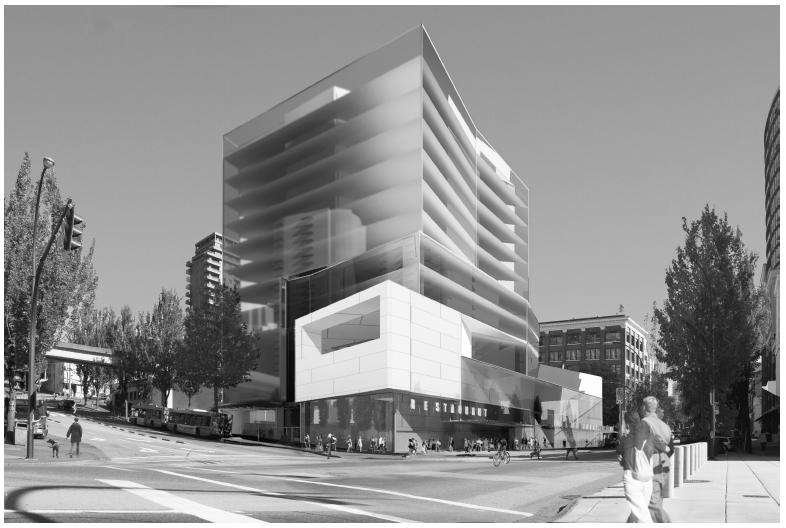
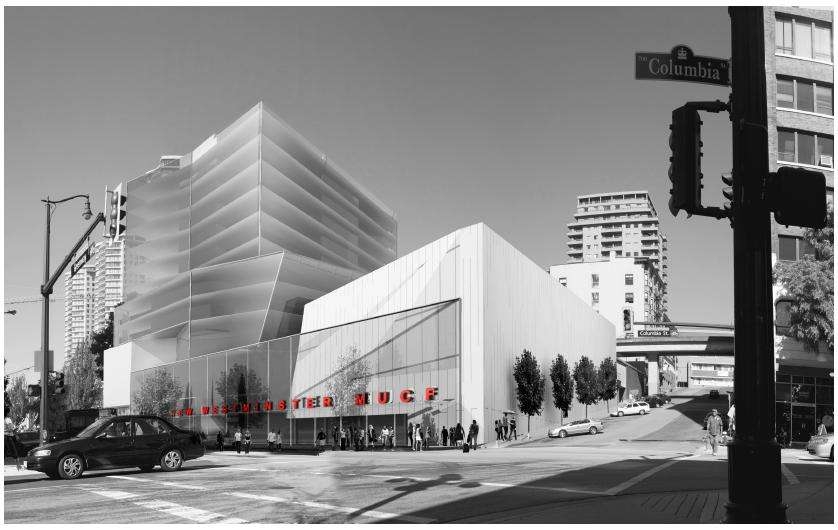
The project is somewhere beyond the visioning stage, but the design is clearly not quite done. The model was balsa wood, and was good for getting a sense of the mass and layout of the building, but not an idea of the real appearance. There were several design-type drawings, but no complete picture of what the building will look like (more on this below). However, I walked out of there impressed with the concept, and excited about what it means to downtown New Westminster.

There is much to like. With the completion of the commercial part of the Plaza 88 development, there are going to be big changes in this neighbourhood. Movie theatres and restaurants right on the Skytrain station are a potential game-changer. This will be the most accessible movie theatre for the Lougheed Mall, and SFU crowds, and will even be easier to get to than Guildford for a lot of people in the new Surrey Centre. The food, drink, and entertainment options on the street immediately adjacent that development are going to have a huge impact on the success of the Columbia Street renewal, drawing in pedestrians and shoppers. This building will be the keystone.

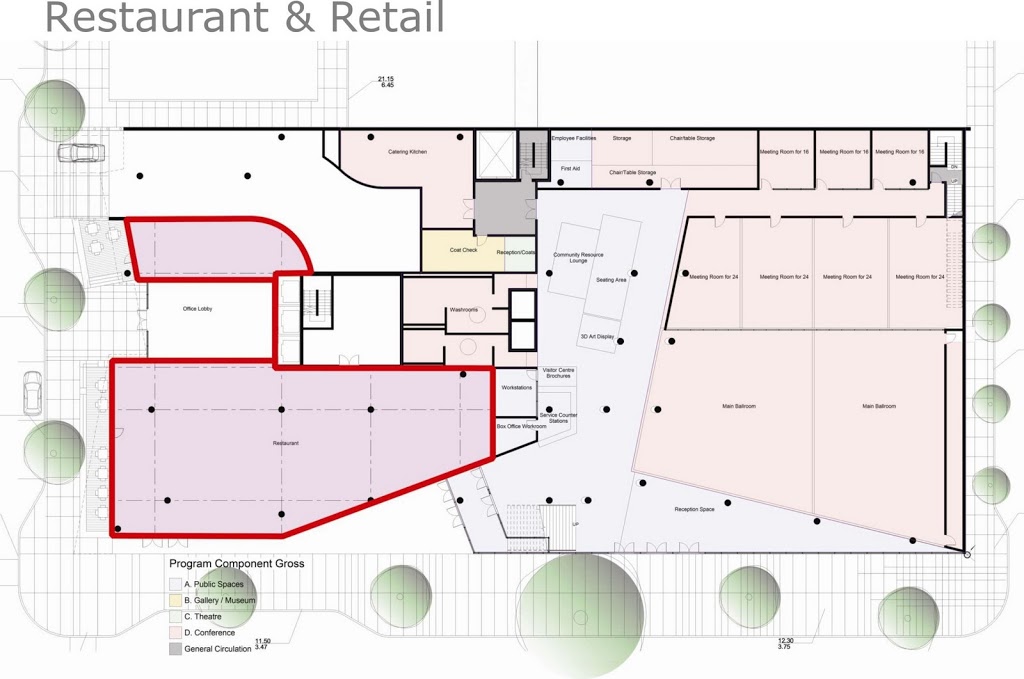
The restaurant space on the corner of 8th and Columbia is a smart move. No names of potential tenants are being mentioned (for obvious reasons), but a popular mid-scale local chain (think Earls, Cactus Club, etc.) would be an obvious fit. It is clear they want the restaurant to have street appeal: open window space and a large patio to bring the restaurant out onto the street. My only complaint is the plans have the deck on the 8th street side, where we really need it on Columbia if we want to connect to the rest of the businesses in the area, from Waves to the Heritage and all the way up to Brooklyn. Restaurants are about the only business (other than wedding shops apparently) that benefits from having more competition in he neighbourhood. The deck/patio will also lead to more engagement of Hyack Square, and we will have to wait to see what happens with the third corner at Columbia and 8th. I can’t help but feel the Sally Ann is going to increasingly be out of place on this new “entertainment core”.

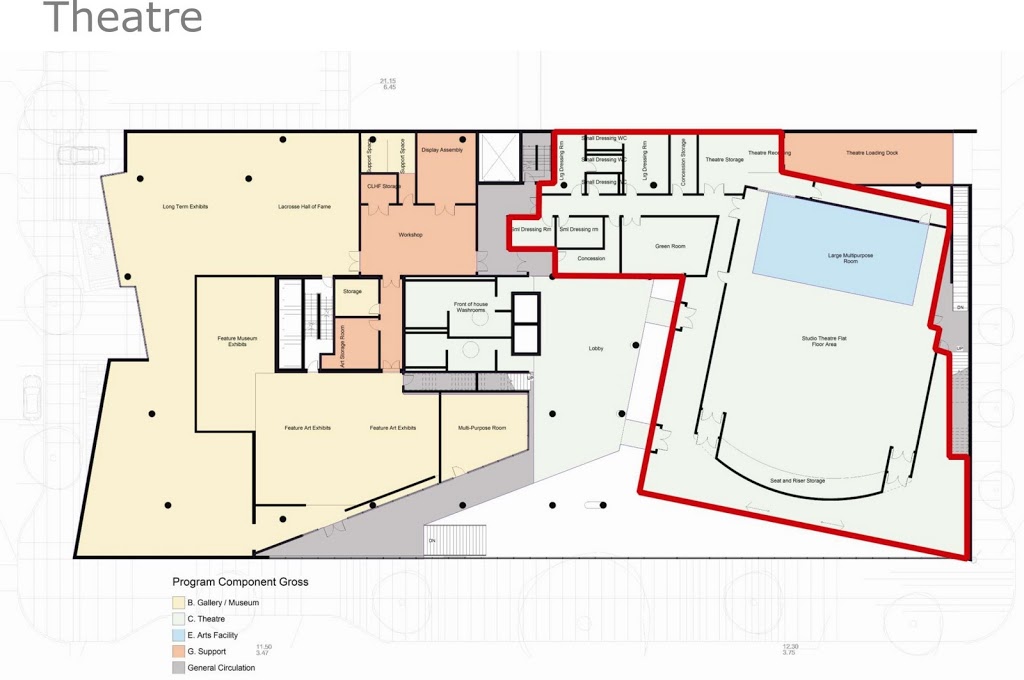
Click to zoom in

The planned theatre space in the MUCF also looks great, a mid-sized and very convertible space. Small concert and performance space is lacking in the City, as our existing theatres downtown seem to be limited to single-use only (tickle and giggle, respectively). At 1/3 of the seating capacity, this will not threaten the (New! Improved! Eventually!) Massey Theatre, but the potential for smaller arts productions, for local music, and for screening space for indy films and docs is pretty exciting.

Bringing the City Archives, the City Museum, the Police Museum and the Canadian Lacrosse Hall of Fame together under one roof will also bee a boon. With the Fraser River Discovery Centre just across the tracks, we will have a one-stop-shopping “museum core”, with a gift shop and food options attached. Finally, when friends and relatives are visiting for a day, we can give them a spot to go to entertain themselves for several hours, without having to send them to Vancouver.

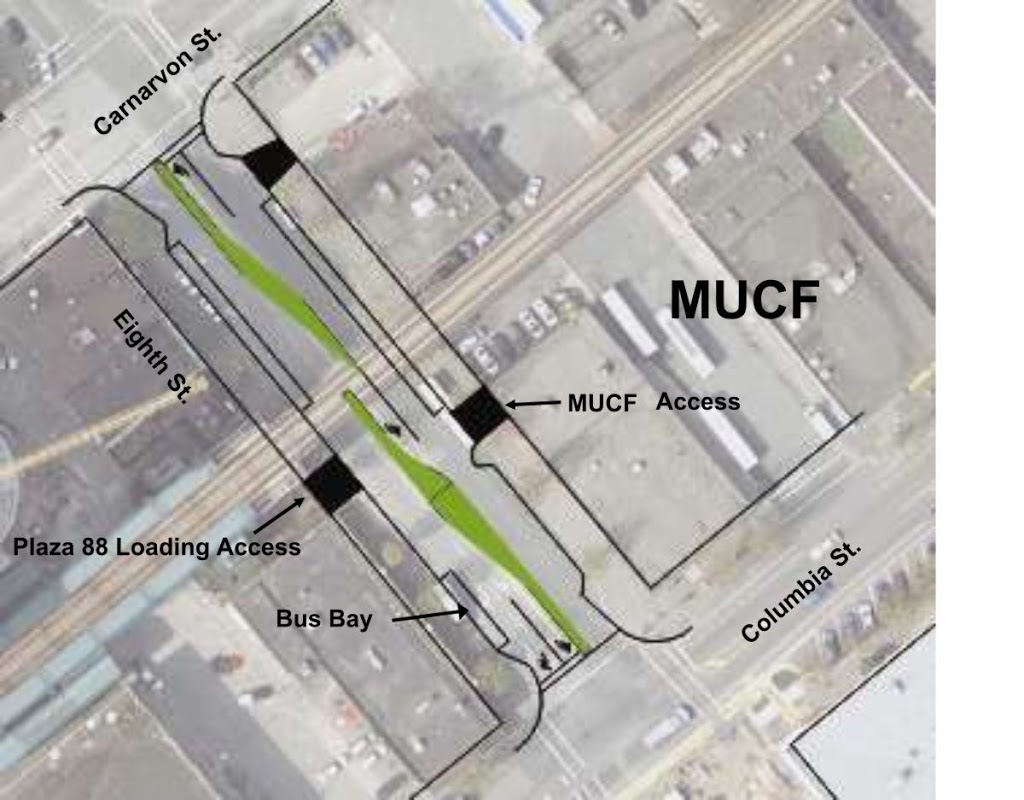
The transportation planning around the facility has not been finalized, but I can already see a few concerns. The re-vamping of 8th Street between Carnarvon and Columbia will have to be approached with caution. Presumably, there will be no bus stops on 8th once the loop at Plaza 88 is completed, but the previous crossing issue at 8th at the SkyTrain exit will remain. People will still want to cross mid-block from the station to the new MUCF. It is too bad an elevated walkway from the Skytrain to the east side of 8th is not included in the plans.

Worse, when one leaves the Skytrain Station and the Plaza 88 commercial/entertainment centre, you will be greeted with a view of the garage ramp on 8th. Why stick a garage entrance right in the middle of your façade? We want this area to be as pedestrian-friendly as possible, and a garage entrance crossing the sidewalk does not do this. This area needs a re-think, and I suspect the answer will be to stick the cars (and garage entrance) around back on Begbie.

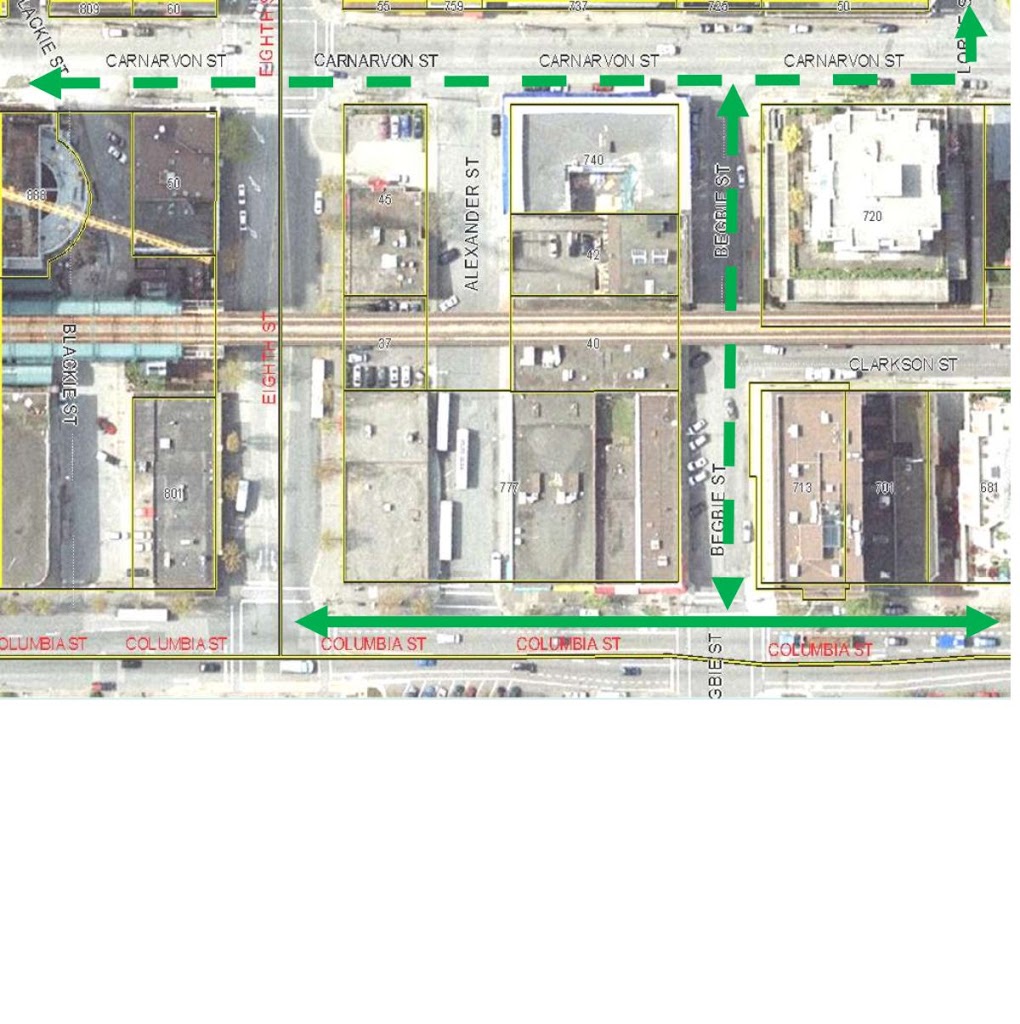
The plans show the use of Begbie as the Greenway connector between Columbia and Carnarvon, which is a sub-optimal solution. The slope on 8th between Carnarvon and Columbia is less then 8%, which is a much more bike-friendly grade than the slope on Begbie (higher than 10%). The Central Valley Greenway should connect to Hyack Square and the New Westminster Skytrain directly, along Columbia to 8th. For these reasons, 8th should remain the connection between Columbia and Carnarvon for bikes, with cars accessing the underground parking along the much-less-trafficked Begbie side.

The idea of closing Alexander Street and using it only for loading is great, but let’s be sensitive to what it means to the people in the low-costs housing around there, who will now be shadowed by a new tower, will be facing a loading dock for their front yard, and will have reduced access to Columbia Street. Some creative urban design might be needed here to head off a potential crime problem.

Again, this is early design phase, so these potential issues can be addressed simply, but they have to start thinking about them soon before too much detailed design is completed.

Which brings me back to design. The preliminary drawings are definitely “place making”. They have that big “I’m Here” look to them. However, much of the chatter around the room was about “where is the heritage?” Simply put, this building needs to fit the surroundings. I love the Chicago-school Westminster Building and Trapp Block. I am not a big fan of the “modern-glass-tower humping a heritage façade” technique used at the InterUrban, but recognized that the requirements of the modern Condo market (balconies, floor-to-ceiling windows, etc) made this the best we could hope for. I will be interested to see how the Art-Deco Façade at Plaza 88 is preserved, and how it fits those hideous-looking pseudo-Soviet towers. Mostly, I love Art Deco (cognizant that it can go really bad really quickly), and would love to see that part of New Westminster’s heritage be accentuated, but that is very much a personal matter of taste.

Since there is going to be an office tower on top of this building, there is a lot more flexibility in design than there would be for a condo complex. As this is going to be the keystone building for the continued revitalisation of Columbia Street, it is imperative that the visual impact of this building represent New Westminster, both its iconic heritage, and where we want the City to be. It should be an interesting challenge for a talented Architect. The pictures I have seen so far, and the comments I heard around the room, suggest they are not there yet.

Oh, and I seriously hope “MUCF” is a working title, and we will find a better name for the building, but that is a minor detail, which we can debate in 2014.

Killer Bikes Lanes

Related to bike routes, and completely separate to yesterday’s post…

Being a loud-mouth and a “crackpot environmentalist”, I often get called out on various issues in social setting where people already know my position. I guess I am a fun guy to get a rise out of. Last night at the Curling Rink one of my buddies remarked to me:

“I think your bike lane on Dunsmuir got somebody killed today”.

He then regaled me with the story of a cyclist, an ambulance, and a scene that looked like a commercial vehicle turned right across the bike lane and struck a cyclist. I have no idea if any of the info he gave me was accurate, but I have no reason to doubt him. I can only comment on the allegation he made: a cyclist on the Dunsmuir Bike Lane was killed by right-turning truck.

First off, it isn’t “my” bike lane, and before you say it, it isn’t even Gregor Robertson’s bike lane. The dedicated bike lane on Dunsmuir (and the one on Hornby) are part of Vancouver’s Transportation Plan, which was written in 1997, under NPA Mayor Phillip Owen, and fully supported by COPE Mayor Larry Campbell, NPA Mayor Sam Sullivan, and Vision Vancouver Mayor Gregor Robertson. Four mayors, four administrations. They are a piece of a puzzle that has been assembling for 15 years.

Second, a bike lane can’t kill anyone. The story he told me was a commercial vehicle turning right where it shouldn’t have hitting a cyclist. It was the bike lane’s fault because cars used to be able to turn right there, and cyclists in the bike lane are hard to see for truck drivers turning right.

I cannot say this clear enough: in this alleged scenario, the truck driver killed the cyclist. He broke the law by turning right when the motor vehicle code said he could not. This is no different than someone going 100km/h through a school zone and plowing down a kid on a crosswalk. It doesn’t matter that the school zone was on what used to be an open road, or that the kid should have been looking for speeding cars prior to crossing the cross walk. No rational person would wave it off by saying “well, you know those kids are always crossing streets, usually not at crosswalks, the kid had it coming”.

And no-one would say to me “I think cross walk in that School Zone got some kid killed today”.

It is a manifestation of the post from yesterday: blaming the victim (or the victim’s advocates) instead of recognizing the real problem

TttF, and the Transport debate

I really dig Tenth to the Fraser. Jen, Briana, Will and Jocelyn the gang over there do an incredible job in keeping the conversation going in New Westminster, whether they are talking politics, business, environment, or community events. The great part is that they avoid being one-dimensional like some lesser local blogs, and instead have a diversity of topics, and a diversity of speakers. I am excited about their new series covering aspects of the upcoming Civic Election. They fill a big gap in New Westminster public discourse, and they should be read every day by everyone who lives in the Royal City (does that make me an “elitist”?).

I’m mostly gushing right now in order to call attention to Matt Laird’s recent two-part series on the UBE and the future of the North Fraser Perimeter Road. Matt, ever the muck-raker and pot-stirrer, raises some of the uncomfortable questions about the dream of a “seamless 4-lane truck route” through New Westminster. The problems with this dream can be broken down onto 5 points:

1) There is no room on Front Street for 4 lanes of truck traffic, without moving rails (the railway won’t agree to reduce shunting noise or modify level crossings, they won’t agree to pedestrian overpasses to the new Park, you think they are going to agree to give up real estate!?!), or chopping off the front of a couple of buildings (InterUrban, the new Sally Ann, and the Keg/Train Station for starters). The Parkade would also have to go, but I think few will shed a tear for it (although the Downtown businesses will expect the City to replace the lost 700 parking spots)

2) The idea of “stacking” the four lanes is monumentally expensive, complex from an engineering standpoint, and may create issues around the transportation of dangerous goods (which makes it’s utility as a “truck route” limited). Working the stacked road around the rail overpasses at the east end of Front Street would be a challenge, as would designing some sort of interchange at the west end that would bring trucks safely back to grade, work as an intersection for Columbia Street traffic, and not be a blight to the Plaza 88 development, all in a very small footprint.

3) It only serves to move more trucks to Stewardson Way, where they will line up with the cars to get through the Queensborough Bridge spaghetti-bowl. Anyone who drives that intersection west regularly knows the right lane is commonly backed up to 4th, the left lane is full of cars looking for advantageous gaps in the right lane to squeeze in (gaps usually found between big trucks that cannot be as aggressive as cars at blocking queue-jumpers). For the New Westminster residents in Queensborough, their only access to the rest of the City is already backed up with traffic 12 hours of the day with all of the vehicles heading east… and to this mess we want to add more trucks?.

4) Take everything I said about Queensborough, and insert “Columbia and Brunette”.

5) It won’t solve a congestion problem. After the last Translink open house, there was some informal discussion around the NFPR, and I asked one of our City Councilors (I won’t name him here, but his last name rhymes with “Foster Can”) how long it would take for a 4-lane truck route to become just as congested as the current two-lane road, 5 years? Ten? And he admitted, “less than that!” So we want to spend 10 years and more than billion dollars designing and building a road we know will be just as congested as it is now in less than 10 years? That is madness.

It is going to be up to us to make the case to TransLink that this is a colossal waste of money. Your money and my money. When it comes down to it, New West as a municipality may be limited in their ability to stop a regional project if there is strong political pressure to build it (See Delta’s position on the South Fraser Perimeter Road as an example). Up to this point, New West Council has done a good job protecting New Westminster from the unnecessary intrusion of the UBE, but the future of the NFPR will need to be a campaign directed at TransLink and the Province.

The first step in that campaign would be for a strong voice from City Hall to counter the frankly ridiculous comments of the Mayor of Coquitlam.

Jonathan Cote at the NWEP Transportation Forum

Comments on the NWEP’s forum on the future of Sustainable Transportation, held at Douglas College on November 9th, 2010. – the much-belated Part 4. There has been so much going on in Transportation locally, and the UBE issue pushed itself to the front page so effectively, that I almost forgot to finish up the series on the NWEP forum held in November. That would be a shame, because the final speaker was New Westminster City Councillor Jonathan Cote, and we were lucky to have a sitting council member share some ideas about how he sees the future of transportation in New Westminster, and throughout the region.

First off, it was refreshing to have a politician sit in front of a crowd and put ideas out there, especially ideas about sustainable transportation and the things that Cities (including ours) do wrong. But Cote always struck me as one of those rare types in politics who actually thinks about these issues, who cares about communities (especially his own), and who knows who Jane Jacobs was, and what she meant. He is also young enough that he still has a thirst for learning. He was generous with his time, and with his ideas. I tried to catch the essence of what he said below, but I am working from two-month-old notes now, so any gross errors or inexactitudes below are more likely mine than his!

His talk began by putting “sustainable transportation” into context. There are lots of feel-good reasons to build sustainable transportation infrastructure and to increase sustainable mode share (safer more livable cities, lower development costs, healthier populations), but the harsh realities of Anthropogenic Climate Change and Peak Oil mean the heady decades of our parents may soon be over, and we may be forced by economics to make better choices.

Cote then discussed the “Chicken and Egg conundrum” around urban planning and transportation planning, although I think the analogy fails on two fronts: clearly the egg came first (after all, the genetic changes that result in diversity happen during the reproduction phase and very early development, not by gradual change within an individual of a species, but hey, this is about transportation, not evolutionary biology); and second, it isn’t really a conundrum as the there is a simple answer: both must happen in concert. We built automobile-serviced suburbs because people had automobiles, people had automobiles because they lived in (or wanted to live in) those suburbs. The two are so entwined that the entire model must be redrawn together. His points about street design and density (then, now and future) were well made however, and were (in my opinion) similar to the Patrick Condon mode of thinking. Read his stuff, there is much there to think about, and even things to disagree with.

There were two solid “factoids” I took out of Cote’s talk, and they stuck with me so well I have repeated them and used them in discussions about sustainable cities in various contexts.

The first is the “5 – 7 – 10” rule, and once I looked this up, I realized it was a Patrick Condon concept.

5 minutes is approximately how far the average person will walk to get to a place, or a transit stop. Any more than 5 minutes, and walking is no longer the likely choice the person will make. The Dutch Rail bicycle program takes advantage of this by setting loose thousands of bicycles into the unsuspecting public. If people will ride a bike 5 minutes to get to the train station, that triples the distance people can travel in 5 minutes, increasing passenger share, and ultimately paying off for Dutch Rail. This basically speaks the transit density we must build to make transit the truly viable option: everyone must be 5 minutes from a stop.

7 minutes is the maximum time between buses or trains that makes the system reliable and efficient without the need for schedules. If the maximum wait is 7 minutes, people will tend to just go to the stop and catch the next bus. If it is 10 minutes, and you need to make a connection to a bus with 15-minute frequency, all of the sudden you need to consult a schedule and plan your trip. I thought about this recently trying to take the Canada Line from Brighouse Station to the Airport at 7:00 on a Friday, when the train frequency was 12 minutes to each of the “Richmond spurs”. Which meant a 10-minute wait at Brighouse, a 5 minute ride to Bridgeport, a 12-minute wait at Bridgeport then a 8 minute ride to the airport: It took me more than a half hour to get from Richmond to the Airport… frustrating.

Finally, 10 units per acre is the density required to support transit service at the frequency required to be efficient: density is the key. But in reality, 10 units an acre is not that dense. An acre is 43,560 square feet, so 10 city lots at 50 feet by 90 feet will suffice. It isn’t Queens Park Mansions for all, but a 1500 square-foot footprint will fit nicely on a lot that size, and with good design, a comfortable 2500-square foot home can be built. At the other end of the scale, a single 20-story high-rise can be built on less than an acre and have 120 units in it. The density can be built, and for New Westminster it is already here.

The second point that stuck in my craw was an old CATO Institute economic study Cote showed that purported it would be cheaper for the governments of the United States to buy a new car for every citizen that it was costing to provide public transportation. Wethinks the old-school Reaganites at the Cato meant this to demonstrate the public transit is a waste of money and people should just find their own damn way to work. Cote turned it around and described it is a condemnation of the state of Urban Planning in the United States. If the most efficient way of moving people around is the least efficient form of transportation ever invented, then clearly something is wrong with your cities.

So what is wrong with our Cities? Where is my 7-minute service? The answer came back to the “Funding Gap”. How do we raise money for public transportation? We have federal and provincial governments claiming poverty (while subsidising the auto industry, and building 10-lane freeways, respectively). We have municipal governments absorbing more and more infrastructure and other costs that used to belong to higher levels, while extremely limited by the Local Government Act in how they can raise funds. The only source Munis have is property taxes, and there are numerous reasons why that is not the appropriate way to fund regional transit systems. Road taxes, gas taxes, vehicle levies, and these types of creative funding measures would require the Provincial government to institute them, and that isn’t something any government thinking about re-election is willing to do.

Translink has a dream of an integrated, effective, region-wide transit system. Many critics of it say it isn’t enough, that the infrastructure planned for 2040 will be inadequate for 2025. The harsh reality is that even that “too little too late” plan will never see the light of day unless the Province frees up the Municipalities and Metro Vancouver to find the creative measures it needs to properly fund the system the region needs.

UBE Open House – The Sequel

The second public meeting on the United Brain Extension at the Justice Institute was very well attended, standing-room only in the JI Auditorium. TransLink opened by apologizing for the “donnybrook” that was the previous meeting, and I think they made up for it here. Sany Zein from TransLink did a very good job laying out the plan, and opening the floor to questions. There was a significant amount of new info presented, including traffic counts and compelling photos of existing traffic problems around Brain and Brunette.

First off, they made it clear that Options B, C, and D were off the table, and lacking support from City Council, they would not be further considered. So the rest of the discussion was about Option A. Although it disturbed me that Option A was constantly referred to as not causing the destruction of and houses, but it was clear from the drawings that houses and businesses would still meet the wrecking ball with this Option… just fewer than with other options. It was well pointed out in the presentation (and repeated later by several audience members) that Option A would cause much greater disturbance to the Sapperton neighbourhood, with trucks traveling up ramps and stopping at traffic signals 9 metres above the ground.

The problem was, everyone in the room agreed traffic was a problem in New West. 400,000 cars a day in a City with 60,000 residents is a problem. However, TransLink failed to convince the room that this little overpass was going to solve this problem; most actually though it would make the situation worse.

TransLink was somehow arguing that this would increase traffic flow through the restricting one-lane Bailey bridge, as the one-lane-with-signal design only facilitated 300 vehicles and hour each way, but that this project would not result in more traffic in New Westminster. When pressed on this contradiction, Mr. Zein mentioned something about the difference between vehicles per hour and total number of vehicles. This made even less sense (would rush hour volumes be reduced, but last longer at night, or would rush hour be shorter with more cars? which is better?) It didn’t make sense.

TransLink did throw two new treats into the pile. First, they committed to fix the intersection at Columbia and Brunette but doubling the right-turn lanes onto Brunette from the east. Of course, this wouldn’t happen until 2018 (4 years after the UBE is done), the funding is not secured, and it was not mentioned that this would mean the removal of another half dozen tax paying New Westminster businesses. Second, TransLink will “support” the City’s removal of Columbia between Brunette and Braid, and the Braid-8th Ave corridor from the regional truck route network. Again, when pressed, Mr. Zein admitted that TransLink’s support was only a formality if the City requested the removal, and this approval was in no way contingent on the approval of the UBE. It was raised by an audience member that 8th needed to be a truck route, as it was the only route to the Pattullo Bridge from the east when the loop-ramp off Columbia is closed in the evening rush. So the new treats didn’t sweeten the plot much.

Any other improvements on Front Street will have to wait until a decision is made on the Pattullo Bridge. So 2020 would be ambitious. Meanwhile, the traffic will build up.

After the presentation, there was a spirited Q&A session. Many people were there to comment, many were asking questions. But in the end, not a single person stood up and said “this is a good idea”.

There was a variety of issues raised, familiar to anyone who reads this blog. The impact of the new Freeway and the SFPR on the need for Trucks routes through New Westminster. The long list of bottlenecks to which this project will feed traffic to, all the way to the Queensborough Bridge. There was even a commenter from Queensborough who was clearly irritated that this backed-up truck route was her only link to the rest of the City, and this plan would only invite more trucks. Several people pointed out the bad transportation planning on Coquitlam’s part, and questioned why New Westminster should suffer for it. The Fraser Mills development was raised, and one of the largest applauses of the night went to a fellow who calmly suggested the most economic solution might be to remove the Bailey bridge completely. A few people pointed out that this would not be a truck-only route (even the image TransLink provided to show that this was a “truck route” showed more than 50% of the current traffic as private cars), and asked very sharp questions about what alternatives to move goods did Translink explore (short answer: none. TransLink builds roads, any other “good movement” modes such as short-haul barges and trains are not their jurisdiction). Talk of the existing “funding gap” was as expected: TransLink has no idea how it will be filled, but Mr. Zein made it very clear this would not be a P3.

For an hour and a half, the citizens of New Westminster stood up and listed concerns about the plans. Not one single person agreed this was the solution.

If the Mayor and Councilors, as was suggested after the first meeting, were waiting to hear details from TransLink and feedback from the citizens of New West, they got it. And the message is clear.

Some seem to be hedging their bets a bit, which is why we still need to send them a strong message and drie it home: this project is non-starter. It does nothing for New Westminster, while threatening the livability of not just Sapperton, but all of New Westminster’s neighbourhoods, from Victory Heights to Queensborough.

Please take the 5 minutes to contact your Mayor and Council. E-mail them, phone them, or send them mail, but do it quick. Also try to show up at Monday’s council meeting. As I have said several time before: be brief, be respectful, be rational, just tell them how you feel about this project and ask them to vote against it. Then thank them for listening.

UBE: Down to the Wire

Here we are, four weeks after the first “stakeholder meeting” opened the floodgates on the United Boulevard Extension. Tomorrow is the final public consultation meeting TransLink will hold for the project. After that meeting, it is up to New Westminster City Council to decide if this project is acceptable to the people of New Westminster.

The discussion in the City over the last month has been enlightening.

We have had Voice commenters suggesting this whole thing is evidence of some sort of conspiracy from the bowels of City Hall. Of course, Voice generally opines that everything from the colour of the sky to the lack of quality television is evidence of some sort of evil-doings by the current Mayor and Council. But they make some interesting points, and are giving the Mayor and Council every opportunity to disappoint them by doing the right thing.

We have the McBride-Sapperton Residents Association holding what might be their best-attended meeting ever, passing a motion that “opposes all Options A through D and requests that Translink defer the United Boulevard Extension portion of the North Fraser Perimeter Road project until the entire North Fraser Perimeter Road project is dealt with as a complete and comprehensive plan”.

There has been a spirited back and forth in the local media, bringing multiple aspects to the story, but largely centering around the need for there to be a more comprehensive plan for transportation in New Westminster, not just a wait-and-see that ends with us suffering in the consequences of patchwork transportation planning.

TransLink has been in damage control, doing a little Astroturf blogging to tell their side of the story, but not really addressing the concerns raised in their earlier meeting. Mostly they say this will reduce traffic in Sapperton (but don’t really explain how), they say it will reduce greenhouse gases (but don’t say how…). Their “FAQ” for the site is a stunning case of cognitive dissonance…

And I have yet to hear a single credible voice in the City saying this is a good idea, and that this project serves the citizens of New Westminster in any way. I think the debate is over.

Last month, in calling for people to attend the first public meeting, I said the following:

“Show up on Thursday at the meeting at the Justice Institute, not to protest, but to learn”

But now the time has come to protest. There will be an open mike at this second meeting: use it. Ask TransLink the hard questions and give them, along with the City Councilors (who will no doubt be in the audience), a clear message that this project is a waste of our money, and threatens the livability of our City. Make it easy for our elected officials to say “No” to TransLink, by making it clear to everyone that this project does not serve New Westminster.

Then follow up in two ways: you can send comments on-line to TransLink.

Then you can contact each of your Councillors prior to next week’s council meeting. Just a short, respectful e-mail to request that they say “no” to all four TransLink Options, and that they get started developing a new vision for transportation in New Westminster.

This is only the first step towards solving the traffic problem in the City, but with so much attention back on our City’s roads leading into a municipal election year, this may be the watershed moment.

Edited to add: the Voice blog has just posted the full text of the letter the MSRA have sent to Mayor and Council. This definitely throws the gauntlet down for TransLink. 

Osmosis

Osmosis is a process where a solvent will move, without any external energy input, towards an area with more solute, through a semi-permeable membrane. It is a fundamental process for life, as all of our cell walls are semi-permeable membranes, and it is osmosis that regulates what goes into and out of your cells.

It works like this. If you have a membrane material, say a thin sheet of polyimide, and use it to construct a barrier between two reservoirs of water, then fill one reservoir with salt water, and one reservoir with purified water, there will be a net flow of water from the pure water side over to the salty water side. This flow would continue until the salty water is so diluted by the pure water, that the residual osmotic pressure cannot overcome the drag of the membrane. Or until you run out of pure water.

This is exactly why pouring salt on a slug makes it shrivel up. Slugs are mostly water, have semi-permeable skin, and generate a lot of mucus to maintain their fluid balance (amongst other uses). If you pour salt on the slug, some of it dissolves in the mucus, making it salty. This causes osmotic pressure, which forces water out of the slug’s body to dilute the now-salty mucus, which causes more of the salt to dissolve, and so on until most of the water in the slug is pushed out of the slug, and the slug dries out while immersed in it’s own fluids. Nasty.

This also explains why most fish can only live in salt water or freshwater, and if they are transported from one to the other, they die. Most fish have complex osmosis regulation systems based on their need to keep from desiccating in the ocean (as the salty water is constantly drawing their body’s water out) or bloating up in freshwater (as their salty blood draws fresh water in). Fish like salmon that move from one to the other have to go through a complex metamorphosis, known as smoltification to survive the transition. Sharks have a unique system where they retain urea, the waste product mammals turn in to urine, in their blood to keep it osmotically in balance with the ocean. This is why shark meat tastes simply terrible unless it has been boiled long enough to boil the urea out. If you are offered a rare shark steak, don’t take it.

There is nothing magic about osmosis, it has a pretty simple explanation, and there are thousands of examples of it working in nature, and in man-made systems.

Which brings me back to the topic of the month. I was discussing the United boulevard Connector with a friend who is a keen observer of both science and politics. He remarked:

“The laws of membrane dynamics suggest that the net effect will be to bring more car molecules into New Westminster than are removed, since the partial pressures are much higher in Coquitlam”.

…brilliantly tying the flow of traffic to the concept of osmosis.

There is the impression, I think mistaken, that the UBE will somehow alleviate a couple of nagging traffic problems in New Westminster: “rat running” through Sapperton neighbourhoods, and traffic backups up the hill on Braid.

The second is a ridiculous claim. When this $170 Million is spent and gone, cars and trucks will still need to turn left at the bottom of Braid, and there will still need to be a traffic light there. The sight lines will still be crappy, the merging issues will still exist. Some of those left-turners will now turn right and go up the one-lane ramp to the “T” intersection (to the next light), but they will still have to wait at the light on Brunette, as the through traffic will still be there. So the same cars (well, likely more, but that is my next point) will need to pass through that intersection, and will still need to stop at the same lights. How will this reduce back-ups again?

The first claim is equally silly. When (soon-to-be) 10 lanes of Highway 1 traffic and 6 lanes of Lougheed Highway traffic hit 2 lanes of Brunette and 2 lanes of Braid, there are going to be backups, and people are going to bail out onto the side streets. Adding an additional three lanes to the Bailey Bridge is not going to relieve this problem, it is going to exacerbate it, by bringing more cars into the City.

A clever person might argue that by building this overpass we are also increasing capacity out of the City, and therefore there will be fewer cars! This is where osmosis comes back in.

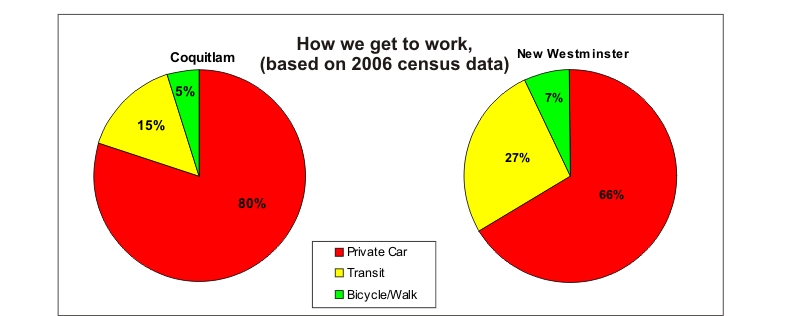
New Westminster is a City with an enviable Alternative Mode Share . Because we are a compact City with very good transit infrastructure, people in New Westminster tend to drive less than most Cities in Metro Vancouver. Coquitlam is another story. It is spread out; with much more limited transit development other than bus. Its entire commercial land base is built to only be accessed by automobiles. The commercial area of Coquitlam on our eastern border is a good example, but perhaps even more telling is their “Town Centre”, a shopping mall separated from their only real transit hub (the West Coast Express Station) by no less than 9 lanes of Lougheed Highway and a half a kilometer of parking lots. The Proposed Fraser Mills development shows this is a trend Coquitlam is not looking at changing any time soon.

(click image to enhance pie-viewing experience)

Good for them. Coquitlam can continue to develop their City the way their elected officials and citizenry wish. If I don’t like it, I don’t have to live there. Fine.

However, because of their different planning, Coquitlam has lots of cars. They generate a lot of traffic. Cars, (in our now-finally-assembled allegory), are like water molecules. Open spaces between cars, and empty back streets and laneways in Sapperton and across the City (i.e. a lack of congestion) are like the salt dissolved between the water molecules and attracting them. The United Boulevard Extension is the semi-permeable barrier. The cars can pass across it, the empty spaces cannot. And since there are more cars on the Coquitlam side every day, the opening of the semi-permeable membrane means there will always be a flow into New Westminster that more than compensates for any flow out of New Westminster, until the osmotic pressure is relieved. And the worst part is that the more we do on our side to relieve congestion (say, riding our bikes, taking the Skytrain, or just walking to the store), the more empty space we create, and the more osmotic pressure that will be exerted across the membrane.

The UBE will not solve any traffic problems in New Westminster. It will only exacerbate them.

It’s all UBE, all the time.

The Record hit the United Boulevard Connector story today by cornering the Mayor at what should have been a good-news day for him (the opening of the anchor store at the new River Market), and asking a bunch of uncomfortable questions. Uncomfortable because it was almost record cold out, uncomfortable because he probably would have rather talked about the another piece falling into place in the refurbishment of New Westminster’s waterfront, and uncomfortable because that is how his answers made me feel:

“The people came out and showed they won’t accept it. There are four different scenarios – only one was acceptable.”

Somehow, I didn’t get the impression from the Open House at the Justice institute that any of the four scenarios presented by TransLink were acceptable to the people in the room. The one he is alluding to, Option “A” (aka the “T” Option), is slightly better than the others, in that it won’t involve knocking down as many buildings, but it hardly provides good value for our $170 million in tax money, nor does it actually fix any traffic issues. Council can insist they put some “landscaping” in front of the proposed wall, but it doesn’t really matter how much polish you put on a turd. When will he acknowledge that Option E is not only a viable choice, it is the best choice?

But Councillor Harper steals the limelight again with his quixotic quotes:

“You want to live with the existing conditions that we are faced with – 300 trucks an hour?” he said. “I never drive that way. If I have to go across town, I don’t drive there – day or night.”

Apparently, councillor Harper’s solution to “too many trucks” is to build more room and invite more trucks. Or is he suggesting the problem is too few trucks?

At least the residents of Sapperton don’t have to worry about Councillor Harper rat-running though their neighbourhood, the denizen of the West End apparently doesn’t do Brunette (perhaps he prefers blondes? Is that the first blonde/brunette joke in this whole debate? Can’t be).

Or maybe I am being hasty, maybe I am not digging deep enough here. Councillor Harper loves to remind me how he was there when the NWEP started out, perhaps I underestimate his green cred. Maybe I am missing the subtext of his comments… the underlying message?

When he says he doesn’t drive there, perhaps he isn’t showing distain for poor planning, or a general feeling against the neighbourhood. Perhaps he is intentionally demonstrating the concept of “induced demand” to the unknowing public. He is suggesting that he chooses alternate routes (or modes? he didn’t say how often he flies over Brunette on the Skytrain) because the current infrastructure is a disincentive. Therefore, if we build a $170 Million overpass, he is more likely to drive there, at least until everyone else follows his lead and plugs the system up again. Except it will be 600 or 1000 trucks plugging it up, instead of 300.

So with crushing logic, Councillor Harper intentionally proves that we don’t need the overpass by implying that we do! He is a clever fox: one opponents better watch closely in November…

There was an almost completely unrelated story in the Record this week about how some parents are suggesting that more traffic in New Westminster might not be the best thing for their kids. Almost completely unrelated.