COUNCIL – DEC 12, 2022 (PT2)

The December 12th meeting had an unprecedented 7 motions presented and motivated by a single member of Council. This was surprising not only because it is the number of motions a proactive Council Member may typically present in a typical year, but also because Council has not yet finished onboarding (indeed there were onboarding meetings and tours continuing this week), and the Council has not yet had time to do the regular Strategic Planning to set priorities for the year or the term.

But here we are.

There was a lot of politicking going on during these motions, and though I think most members of Council were genuinely trying to find consensus positions that could be supported, this was challenged by rhetorical questions and some confrontational approaches that did not make consensus easy to find. We have some work to do to determine how we will be working together in the best interest of the City. As it is hard for me to talk about this politicking without engaging in it a bit myself, I do need to emphasize that this blog, as always, is my viewpoint and opinions, and not official position of the City or Council.

1:Halting the Phase-out of the Royal City Moniker

BE IT RESOLVED THAT the City of New Westminster halt the phasing out of the ‘Royal City’ moniker in our branding; and
BE IT FURTHER RESOLVED THAT no future change to the branding shall be undertaken without due notice and proper consultation with our residents, businesses and Indigenous people.

This resolution asked staff to do two things. The first was asking them to “halt” something that was not an actual activity they were undertaking. The use of the moniker in any real way was effectively phased out more than a decade ago, and no-one knows when the last time it was part of the City’s official branding at all, but it was at least before 2009. The second was to ask for a public consultation before undertaking re-branding, which is exactly the instruction given to staff 6 months ago.

So the first half asks staff to stop doing something they aren’t doing, and the second half asks staff to do something they re already doing, so it passing or failing changes nothing. Since there is no functional difference between supporting and defeating the motion, it is moot. I ruled the motion out of order.

Frankly, this motion could have used a bit of conversation with staff to talk about what is actually happening, and to avoid confusion over terms like “moniker”, and what constitutes branding. It seems that creating confusion about this was a political tactic during the election, suggesting something vaguely nefarious is going on is always populist. But I think thing will become clearer when staff come back with the promised engagement strategy around branding, but I m not sure that is going to happen very soon given the number of priorities the City is dealing with right now.

2:Elimination of Train Whistle Noise and Supporting Increased Liveability

THEREFORE BE IT RESOLVED THAT Council re-establish the Railway Community Advisory Panel and that staff report back to Council on the updated terms of reference by no later than
BE IT FURTHER RESOLVED that the City of New Westminster establishes a target of eliminating all unnecessary train whistles which are negatively impacting the quality of life for thousands of Sapperton and Queensborough residents by no later than 2026; and
BE IT FURTHER RESOLVED that City Council draft a letter to the Federal Minister of Transportation advising that we wish to accelerate negotiations with the Federal Government to get their support and assistance with whistle cessation in our neighbourhoods; and
BE IT FURTHER RESOLVED that staff be required to provide quarterly updates to City Council and the public regarding progress made to eliminate unnecessary train whistles; and
BE IT FURTHER RESOLVED that staff ensure the website containing critical information regarding whistle cessation is updated with the latest information; and
BE IT FURTHER RESOLVED that staff report back on the capital costs related to the infrastructure upgrade to the Sapperton and Queensborough train crossings and if we are eligible to apply for provincial or federal infrastructure funding to lower the tax burden on city ratepayers.

This is a motion that would have also benefitted from waiting until after onboarding so the member could discuss with staff the rather complex background behind train whistle cessation. This blog doesn’t have space to go down every hallway here, but suffice to say there is no such thing as an “unnecessary train whistle” – they are required by law every time they sound. The Federal Minister of Transportation has no role in “negotiating” Whistle Cessation (unless the member is hoping we will lobby to change the Rail Safety Act, which I’m not sure would be the best use of staff time), nor is there “negotiation” over the standards being applied. Half of our crossings are not even regulated by Transport Canada, but by Technical Safety BC. The application of arbitrary deadlines is also challenging as we (the City and senior governments) have no control over the timelines the four railways operate by when reviewing and approving plans. And the final question about Grants is really a simple question to staff (yes there are federal grants available for rail crossing safety, we have already received and spent many of them).

I think everyone on Council agreed train whistle cessation is a goal, not all agreed these steps were the best way to get there. Through some discussion, this motion was split up with Council ageing to postpone the striking of a committee (and determining the nature of that committee) until after Strategic Planning; approving the request for more frequent updates from staff and online of the progress of whistle cessation; and referring the other sections back to staff for a report with background.

3:Reducing Crime and Increasing Public Safety in New Westminster

THEREFORE BE IT RESOLVED THAT a new Crime Reduction and Public Safety Advisory Committee be created and that staff report back to Council on the terms of reference for the Task Force by no later than January 31, 2023.

At the very beginning of the term, I made a commitment to the council that we would not significantly change the task force and committee structure until we had onboarding and Strategic Planning, so that all of council could be informed enough and given an opportunity to take part in the priority setting. So we postponed consideration of this motion until after that work is done very early in the new year.

This does not mean public safety isn’t a priority. Indeed, we spent the first hour of this meeting talking about the Downtown Livability Strategy where safety for all businesses and residents (including the most vulnerable) was a central theme, and coordination with stakeholders was key. The Motion strangely had several “whereas” clauses referencing police budgets, and there is already a City committee comprised mostly of members of the public who are empowered by the Province to address Police budget and resources – it is called the Police Board. It exists at arms-length from City Council by provincial Law, and it was never made clear in the deliberations where it is intended for this committee to overlap with the intersection between Council work and Police Board work. Council will have an opportunity to speak to police board budgeting the upcoming budget discussions, but this seems like a motion that once again could have benefitted from more background work before it got here, and the postponing it is a good idea.

4:Creation of a New Finance and City Services Standing Committee

THEREFORE BE IT RESOLVED THAT Council recommend to the Mayor he establish a new Finance and City Services Standing Committee and that staff report back to Council on the terms of reference by no later than January 31, 2023.

Earlier in the meeting, we had a staff report on council efficiencies, and the idea of a finance-related Committee of the Whole was raised. A Standing Committee is strictly defined in Section 141 of the Charter, and is a sub-majority of Council given standing of majority, but on finance questions, we have had a practice of involving all of Council. Indeed, most municipalities that have “finance committees” make them Committees of the Whole. There was also discussion of where asset Management and Finance overlap right now, as recent motions to dip into our reserves (already not in the healthy place our finance staff would prefer) to give one-time fee reductions demonstrate the need to think fiscally when making those kind of commitments.

Council agreed to explore this idea more following Strategic Planning in the new year.

5:Creation of a New Amateur Sport and Recreation Advisory Committee

THEREFORE BE IT RESOLVED THAT a new Amateur Sport and Recreation Advisory Committee be created and that staff report back to Council on the terms of reference by no later than January 31, 2023.

Once again, this committee idea was not opposed so much as suggested it needs to come back after Strategic Planning and priority setting – taking a collaborative approach. So like the other ones that pre-empt those discussions, we postponed consideration of this motion until after that work is done early in the new year.

6:Advocacy to the BC Government to Increase Housing and Wrap-Around Supports for People Living with Mental Illness

BE IT RESOLVED THAT Council request the Mayor write to Premier David Eby and request that funding be set aside and prioritized in the 2023 Provincial Budget to begin the planning, development and construction of large-scale, community-based, modern mental health residential care facilities in the Metro Vancouver area; and
BE IT FURTHER RESOLVED THAT staff create a motion with a similar intent that can be sent to the LMLGA and UBCM for consideration.

This motion was somewhat contentious and brought out some passions in Council. The idea that people suffering from mental health challenges and addiction need more support from all levels of government is not controversial. A motion that invokes Riverview and frames those supports (by poorly chosen words if not by intent) as being large-scale, residential and not connected to the community is not one I want to take to senior government or UBCM.

New Westminster has its own terrible history of institutionalization with Woodlands, one we have tried as a community to reconcile through memorialization. When talking about mental health support, it behooves us to be cognizant of this history, and to choose our advocacy path very carefully. Earlier this meeting, we talked about the various areas we can advocate to help people in our community feeling the impacts of the mental health and opioid crises. There is no lack of opportunity to advocate for community-based, compassionate, and progressive supports. This is what the peer community, the people with lived experience, are calling for, and we should amplify their voices. Council voted to not endorse this resolution.

7:Supporting Better Governance, Decision-Making and Public Engagement at City Hall

THEREFORE BE IT RESOLVED THAT the City Clerk make the agenda and supporting documents available to members of Council no less than five business days prior to the meeting;
BE IT FURTHER RESOLVED THAT Council direct staff to bring forward changes to the Procedure Bylaw No. 6910, 2004 to reflect the new council package distribution timelines

A big part of Council work is being prepared for meetings. We get hundreds of pages of material to read before each meeting, some of it very technical, some digging deep into complex policy. The more time we have to read and absorb this info, the better prepared we will be for Monday meetings. On the counter to that, the closer to Monday the council reports are ready, the more time staff have to hone them and assure they are up to date.

Last term we got most Council Packages (in digital form) on the Thursday before the meeting, giving us 3-4 days to read them. That started to slip to Friday as COVID put pressure on staff and the decisions we made were increasingly reactive to very dynamic situation. The request in this motion is to assure packages are available 5 business days before the meeting, meaning (as I interpret it) Thursday or Friday the second week before council. So if we have a meeting on two consecutive Mondays, we will have two active packages at a time.

We have excellent staff preparing these agendas, and good processes to make sure Council has the information it needs to make informed decisions. We also need to balance the need to for lots of lead time with the desire to be nimble and proactive in addressing emergent issues, a long and rigid timeline for agenda completion works against our desire to be nimble. It adds a rigid bureaucracy where flexibility allows us to get more done, faster
Council was split on whether this provided enough flexibility for staff, but in the end voted to support this resolution.

So by my count, of the 7 motions we had 1 passed as written, 1 spilt and partially passed, 1 outright defeated, 1 that was moot, and 3 that were postponed. All were heartily debated, and you can watch the video if you want more insight into any of the discussions. Or you could spend some quality time with the ones you love doing the things you love over the holiday break.

Council – Dec 12, 2022 (pt1)

We had a bit of a marathon Council meeting on Monday. A lot of things added to the agenda, a bunch of new Council members (myself included) learning the ropes and working our way through procedures and processes. There was also a fair amount of grandstanding and political theatre, which is a new vibe, but I’ll try my best in this post to stick to the decisions made, and not the distractions.

The meeting started with Reports and Presentations from staff:

Downtown Livability
This was a comprehensive reporting out and two reports to update Council and the public on all the work going on Downtown right now. A lot of this arose from a mid-Pandemic motion asking for some more proactive approaches to downtown streetfront activation, but is also related to recent delegations to council regarding interface challenges with the emergency shelter. Staff have taken a package of short-term, medium-term and long-term tactics and strategies (those are two different things) and called it a “Downtown Livability Strategy”. These reports outline a few of the measures and plans, to get both the new Council and the public caught up.

The first report was about capital investments, and goes back to the removal of the parkade and building of the “Mews” on Front Street, which has become a great public space. There were plans to expand this activation to the east all the way to the 4th street overpass, and some preliminary work was done to test out some concepts. The more permanent work got delayed by COVID as Council and staff chose to prioritize the support of businesses and the community through the pandemic. However, there is money in the 2023 capital budget to do that work (though it may need to be updated as the current cost estimate is from 2018, and inflation is a thing).

Then there was a more operational report. Staff from Community Planning, Economic Development, Engineering, Fire Services, Integrated Services (“Bylaws”), Parks and Recreation, Finance, and Police Service have all been a part of its development and ongoing implementation.

There are five main areas of action: Improved general cleanliness and enhanced access to 24/7 public toilets; Enhanced homeless outreach and added emergency shelter capacity; Opioid epidemic and illicit drug response; Business support and engagement; and mental health response and support. Each is outlined in the report and detailed in the presentation, so I won’t belabour that here.

There is also an accounting for how much we have spent, how much we anticipate spending, how much support we have received from senior government, and how much more we are going to ask. The big cost items will be Public Bathrooms, both the capital cost of long-term solutions, and the ongoing operational cost to assure they are clean, safe, operational, and comfortable for all users.
There are costs, but this detailed report is an excellent rebuke to some who would suggest nothing is being done. Challenges are daunting, the responses are not simple but require inter-departmental and interagency coordination, and they cost money. Success looks like people being safer downtown, people having access to social services they need to get through their day, people have a dignified place to go to the bathroom and to sleep at night.

As this is ongoing work, this was in part an update report, but it was also notice there would be requests coming from staff in the new year for new monies as part of our budget deliberations to support some of the medium- and longer-term goals. There is also a commitment to seek senior government support for much of the work.

Feedback from Businesses about Sixth Street Bike Lanes
Coming from last meeting’s delegations, we asked staff to engage with the business community about the construction site Uptown (“construction site” because the bike lanes are not built yet and any impacts they are feeling now will be related to construction, not bike lanes). As staff had a very limited time to connect with businesses and prepare this report, the summary is necessarily incomplete. The bulk of the comments were about snow removal and lack of bikes using the new lanes (though, of course, the lanes are not opened yet but are a construction site), though there are concerns about parking availability and some other concerns they would like addressed.

The report also goes through the two years of multi-phase engagement with the 1,000+ residents, businesses, and stakeholders during two years of active engagement and co-design of this project. And the many years stakeholders (Including the City’s Active Transportation and Youth Advisory Committees) were asking the City to provide safe cycling infrastructure to the new High School – a conversation that started long before the new school was even built.

Staff did identify some potential mitigation strategies to address some concerns raised during the engagement, which council endorsed.


We then moved the following items Moved on Consent:

Amendments to the Community Heritage Commission Bylaw No. 6423, 1997
These are basically housekeeping updates of the Bylaw that empowers the CHC. Since we were opening it up to appoint two Council members it was timely to make these updates to align with other City policies and changed provincial regulatory language.

Staffing Challenges Update
Like many organizations, we are short staffed. About 10% down in simple vacancies, another 5% with people on leave (medical, parental, etc.). This makes it hard to operate. This report is mostly for information, to get the new council up to date on the conversation had with the last council. Staff will bring another report back in the near future with some new strategies to address workload and staff culture in a time of being under-resourced.


We then had the following items Removed from Consent for discussion:

Budget 2023: Engineering and Electrical Utility Amendment Bylaw
We reviewed and debated Utility Rates last meeting, and approved the increases, asking Staff to prepare the necessary Bylaws. These are those Bylaws. There was once again a motion to divert money from reserves for a one-time rate reduction, but Council did not vote to support this. There will be much more discussion of the importance of reserves and their relationship to asset management best practices in upcoming budget discussions.

Child Care and Community Uses on School Sites
This report outlines a lot of the background behind the closing of community spaces (childcare and Family Place) in downtown schools as they struggle to meet their capacity needs for elementary students in the downtown. This has resulted in an exchange of formal letters, and several meetings at the staff and Council-to-School-Board level to talk about the current situation, but more about how we can work together to address the critical space shortage and longer term to better plan for school space needs.

Efficiencies – Processes and Council Meetings
This report has a collection of ideas from staff on how to make the Council Meeting process more efficient. This is one of those reviews that typically happens at the beginning of a new term. There are a few things here, and we voted on them separately, so I’ll try to be concise.

Committee of the Whole is a model used by many Local Governments, and was the standard way of doing business in New West when I was first elected in 2014. I didn’t like the way we did them then, because I saw it as being very duplicative: there was an afternoon meeting where decision were made, and an evening meeting where they were (sometimes performatively) made again. I envision them working differently now, by treating them as topic-specific Standing Committees, with all members of Council included. For example, I can see a place for a Finance and Asset Management Standing Committee, and another to address actions directly related to the 7 Bold Steps. I also think this model could replace the function of LUPC, bringing all of council into those earlier conversations on planning and development, so the Standing Committee on Development as proposed here can serve that function.

As I see a Standing Committee of the whole offsetting some of the existing Task Forces, I want to keep my commitment to Council that we not make significant changes to the tasks forces or committee structure until after Strategic Planning, so I suggested we postpone striking these Standing Committees until after that time.

There are suggested changes here to the Preliminary Application Review process (an early-review for some developments), and a new policy for Voluntary Amenity Contributions that council supported and staff will develop for our future approval.

We also approved the idea of moving “For Information” reports off of the regular agenda, and instead making the available on the city website and providing a link to them on the agenda. If there isn’t a decision for Council to make, we don’t’ need to spend a bunch of valuable Council time reviewing the reports. They are available for us (and the public) to read, and if a Councillor has questions or concerns rising from them, they can request that report be brought to the subsequent council meeting for discussion.

There were some proposed changes in delegation powers related to the noise Bylaw that we sent back to staff to give us a more fulsome report before we make any changes.


We then read several bylaws, including the following Bylaws for Adoption:

Revenue Anticipation Borrowing Amendment Bylaw No. 8370, 2022
This Bylaw that gives staff the authority to draw temporarily form our line of credit in case of low cash flow was adopted by Council.


After all of that, the night was only half done as we had a bunch of Motions from Council, but I think I’ll skip those for a follow-up post, and get right to the bottom of the agenda where we had two pieces of New Business:

Construction Noise Bylaw Exemption Request: Front Street from Tenth Street to McBride Boulevard – Metro Vancouver Sewer Inspection
Metro Vancouver needs to do inspection and maintenance of the major sewer line under Front Street. It has to happen at night (so the sewer flows are low enough that they can “shut down” the line for a period of time), and when it isn’t pouring rain (for the same reason – yes, a lot of rainwater gets in to the sewer. So we are granting them a Construction Noise Bylaw Exemption to do this work.

Electric Utility Billing Credit
The BC Ministry of Energy and Mines is giving BC Hydro Customers a one-time credit ($100 for most residential customers), and as New West Electrical is a BC Hydro customer, we also get a Credit. Council agreed to pass that credit on to customers the same as BC Hydro. If you had a NWE account in October, you should see the credit on your first bill in the new year.


That was the bulk of the work done in the meeting. I’ll write about the rest of the evening in a follow up. Lucky I have some vacation time coming up.

Council – Nov 28, 2022

Have I mentioned I’m busy? It’s not necessarily something to be proud of. Being busy is often the opposite of being productive, and usually can’t be sustained, but there is a lot of stuff (good and bad) going on that is taking away from my time to sit down and write these. So a little late but here is my report on what we did on Monday with a fairly light Council agenda:

We started by moving the following items On Consent:

2023 Revenue Anticipation Borrowing Amendment Bylaw
The City spends money all year round, but about half of our income comes in a very short period when people pay their property taxes. This means the “cash on hand” the City has to pay day-to-day bills is cyclical, reaching a nexus at tax time. We also want to limit the amount of “cash on hand” we have, as we would rather be providing services with that money (or earning investment income in reserves). So we have a line-of-credit with a bank just in a case we have a sudden need for cash at the time when our cash on hand is low. We don’t use it much, but it is better to have it there than to default on a bill because of a short-term crunch. This borrowing authority relies on the City passing a Bylaw every year to approve it. This is that Bylaw. We approved giving it 3 readings.

Appointment of Chair to the Accessibility Advisory Committee
In part related to changes in Provincial regulation, the City is reconstituting an Accessibility Advisory Committee. We approved the Term of Reference in the last meeting before the Election, we are now appointing Councillor McEvoy to serve as the Chair. Councillor McEvoy has been increasingly open about his mostly-hidden disabilities, and his lived experience will serve the community well here.

Construction Noise Bylaw Exemption Request: Front Street from Tenth Street to McBride Boulevard – Metro Vancouver Sewer Inspection
MetroVancouver is going to do late-night sewer inspections along Front Street. This happens at night because the traffic disruption is reduced, and because the flow in sewers is reduced late at night, allowing the temporary and necessary shutdown of the sewer pump station for the work to be done. We are granting a nighttime construction noise variance for five nights.

Proposed 2023 Schedule of Council Meetings
The proposed schedule for Council meetings in 2023 would include about two meetings a month except July August and December that each have only one meeting, totaling 21 meetings. This is consistent with the meeting schedules for the last few years, while recognizing there is an ability to add an emergency meeting if need be. Set your calendars!


The following items were then Removed from Consent for discussion:

Community Grant Program: 2022 Highlights and 2023 Program Adjustments
The City has a generous grant program for organizations providing a variety of community-building services. In 2022 about $1 Million was given out through 105 grants to 93 organizations. These are a variety of social service, childcare, sports, environmental, arts and festival organizations that make our City a richer place to live.

This report called attention to many of the successes that came from grants in the last year, and looked at some adjustments to the grant process to make it work smoother. In essence, one of the three intake periods was not working very well due to a variety of challenges, including weirdness of trying to organize grant application and approval during the summer months. Staff is recommending we reduce the intakes to two: the “regular” fall one and the in-cycle late spring one. Council approved unanimously.

Q3 2022 Capital and Operating Performance Report
This report outlines quarterly changes to our annual Capital Budget, 5-Year Capital Plan, and overall 20222 Operating Budget, based on progress on various capital projects in the City. There are a few details in the Capital part here (the pool might be delayed a bit, the Queensborough Substation may come in under budget, the AMI meter upgrade in the Electrical Utility may go over budget, etc.) but pending further reports, there is only a small adjustment ($771K, or 0.4% of the annual budget) that will be offset within the existing 5-year plan.

The operational budget update is a good-news-bad-news thing. There are reports from each department and overall we are looking at surplus numbers (revenue exceeding spending more than anticipated) but a lot of that is a result of us being short staffed and unable to deliver on a lot of programs and projects because of that shortage. Council voted unanimously to make the required adjustments.


We had a couple of pieces of New Business which were both brought forward from a previous closed meeting:

Recruitment 2023: Appointment to the New Westminster Library Board
We have a Library Board as constituted by the Provincial Library Act. As per the recommendation, we appointed the current Chair to another 2-year term.

Release of Motion regarding School Capacity and Child Care options
We received a letter from the School Board a couple of weeks ago, and also received a delegation speaking to concerns around the movement of childcare spaces from Downtown Schools where the capacity is needed for teaching spaces. We are responding to the correspondence with some shared concerns, and setting the stage for working together to address childcare capacity concerns downtown.


We had presentations, delegations, and a few readings of Bylaws, but the list above are the decisions made by Council in the meeting on Monday. We had a few referrals to staff coming out of delegations, but I will report on these when they get back to Council with staff reports.

Council – Nov 7, 2022

We had a Council meeting last week! It was the inaugural meeting, which is mostly ceremonial, but I’m going to use this as an excuse to start playing with the blogging format stuff, in light of the weird part I wrote about in an earlier post about how I am now the de facto spokesperson for the City Council and the Police Board, so my blogged writings, as often as I may say “These are not official communications from the City,” run the risk of being read as more official than they are meant to be.

I could write caveats all day, but here’s a summary of the business that got done on November 7th.

Oaths of Office:
We read oaths are required by law. Mayor, Councilors, Police Board Chair, and Parcel Tax Roll Review Panel. That makes us official.

2022 General Local Election – Report of Election Results
The Chief Election Officer reported on the official election results, and we received the report.

Acting Mayor Appointments
New Westminster doesn’t have a Deputy Mayor position, but we do appoint an Acting Mayor in the event the mayor is on vacation or otherwise not available for official duties. We have a practice in New West of rotating all 6 Councilors through for two-month stints as Acting Mayor. I suggested spots be filled based on where council finished in the polls, lacking any other way of differentiating when folks serve, and alphabetical order being so unexciting. Council voted unanimously to approve.

Council Member Appointments to Internal and External Committees, Task Forces, Boards and Councils
We have about two dozen Advisory Committees, Task Forces, and Commissions/Boards internal and external for Council to serve. It is pretty typical for a new Council (and we have a new Mayor and 4 new Councilors) to re-jig these. However, I have suggested to Council that we not make immediate changes to the committees that exist until the new members have had a chance to get caught up on what is happening in the City, and we have a chance to sit down as a Council of 7 and do some strategic planning around our priorities for the next year and four years. Every Task Force and Committee takes a lot of time on the part of staff, Council and the public (if it is a public committee). I suggest we need to be strategic about how we get the most value out of that time before we make big changes here.

So Council unanimously agreed to keep the same structure for the short term, and appoint the Mayor and Councilors to serve as either Chairs or Council Reps on the various committees until we get a chance to meet as a Council and do that longer-term planning. If you are curious, the long list of appointments is here.

Metro Vancouver Board Appointments
We also need to appoint a person and an alternate to represent this Council at the Metro Vancouver regional board. New Westminster gets one board seat, but more seats may open up on committees at Metro depending on how the Board Chair and new Board structure committees for the term. We probably won’t know more about that until early in the New Year. Council voted to appoint me as Metro Vancouver rep, and Councilor Nakagawa as alternate.

Then I read my inaugural speech, and we all smiled for photos. Now the work begins.

Inauguration

Yep, I’m busy. So to keep something happening on this page, and in the spirit of recycling and placemarking, Here are the notes I used for the inauguration speech I delivered on Monday. Share and Enjoy.

Thank you.

I am honoured to be here, and humbled to receive the support from the community for this role.

I want to start my remarks by expressing deep gratitude to Mayor Jonathan Cote. I am so grateful for the work he did on Council and 8 years in this chair to move New Westminster forward. His work and vision have left a strong foundation for this Council to build upon – leadership on housing, on climate, on public engagement. Even through this last term with a global pandemic and so much economic uncertainty, we weathered the storm and are a stronger City now than we were 8 years ago.

And personally, having worked with Jonathan for 8 years, I also appreciate his mentorship and his friendship. His knowledge of the job, and his keen eye of my own strengths and weaknesses made our conversations over the last few weeks invaluable. I appreciate his sage and candid advice during the transition, and appreciate the time he took with the new Council Members to inspire their confidence in the work to come.

I also want to thank Chuck Puchmayr, Mary Trentadue, and Chinu Das for your service to this community. I have watched as all three of you put your hearts and souls into this work, each leaving indelible marks on the City. Especially through the challenging last 4 years, I am proud or our reputation as one of the most functional councils in the Lower Mainland, and the work you did to make that happen. We found consensus on most issues, and were respectful in our disagreements. It wasn’t easy, but most Mondays I walked home from the council meeting feeling we did good work for the community, and I thank you for that. I thank you for the sacrifice of your time and energy, the time away from your families, your other plans put on hold, in service to the community.

To the four new members of this Council, Ruby, Tasha, Paul, and Daniel, and to our returning champions Jaimie and Nadine, congratulations on earning the support of the voters, and thank you for stepping up to do this work. I look forward to each of you bringing your unique and diverse perspectives to this Council. My commitment to you is to do my best to empower each of you to do your best work here. This is a council of seven members, and I ask you to remember the community is best served when all of council engages in robust discussion of matters on our agenda, seeks consensus where it can be found, and does not let disagreement prevent us from taking firm and decisive action on the issues important to this community.

We have all spent the last 6 months (or more) knocking on doors and speaking with the community, we have heard the issues that are top of mind: housing, climate, transportation, safety for all in the face of overlapping crises in our region. We also heard that the community wants a proactive and forward-looking Council, not one that shrinks away from these challenges.

I also want us to be mindful of the voices we didn’t hear during the campaign, to recognize that political engagement is often the privilege of the few. It is incumbent upon us to continue to reach out and engage the entire community, especially those who face structural barriers to representation.

I also ask that all of council engage meaningfully in the journey towards reconciliation that we are undertaking as a local government. Be mindful that we are only the latest representatives of a system of erasure, built on the theft of land and of history. As we do the work commanded of us by legislation, we must also do the parallel work of exposing the truth and of building meaningful relationships with the people indigenous to these lands. That work is both collective and individual, and it is at times difficult, but it is your responsibility now, and as important as anything you will do in the next four years.

I also want to make special note of the work the City is doing to address climate change. You will be in these seats at least until 2026, taking us half way to 2030, a year for which bold targets for emission reduction have been set by this City, by the Province and the Nation. Everything else we do in the City – from housing and transportation to recreation and public safety – will be impacted by climate disruption, and will need to adapt to meet these targets. This is the term of council that will decide if our City meets our legislated goals, there can be no delay.

Perhaps an unintentional symbol of this responsibility, City parks staff have planted seven new trees on the front lawn of City Hall to mark the inauguration of the new Council. Let them remind us of our responsibility and the work ahead.

In the next few months, we will engage in a strategic planning process to set out our collective goals for the term, and in this job the consultation with the community never stops. I look around the council table, and I see our community represented by the many different life paths and experiences that brought you here. I know you are ready to do this work, and will make New Westminster proud.

But we cannot do this alone. We need to work as a team, we need to support and empower our staff to find creative and innovative solutions to the unprecedented challenges facing the community and the region. And we need to empower the broader community to be partners in these solutions. New Westminster is a city of incredible teams doing great work – non-profits and social profits supporting community, neighbourhood organizations, Arts and Sports organizations, Business organizations formal and informal. As a City we can harness that energy and talent to do amazing things.

So I close with an invitation to everyone in this room and everyone watching at home, to get involved. Connect with your Residents Association or your local Business Improvement organization, volunteer with the Arts Council or New West Little League. Come to a community engagement session, and bring a friend or two. This is your City, and your community, and you can shape it, but first you have to show up. By taking active part in your community, you in turn empower this Council to achieve the community’s goals.

Working together to support the community we love is a New Westminster tradition I hope we will all embrace.

Poll-by-Poll 2022

The full election results are available on the City website, and as I have done in the last couple of goes-around, I like to look at the poll-by-poll results and infer a few things. Of course, others have taken this on and provided their own analysis, but I love to stick to a trend once I start, which in part explains the existence of this blog. Note: after boldly asserting I am NOT a political scientist, everything I write here has to be taken with a grain of salt.

This overlaps with the point that anyone in New West could vote in any polling station. One might assume that people vote in the station closest to their homes (as I did, voting early at City Hall), but there is nothing stopping someone from voting across town, so the geography of voting location is only a feeble proxy for the political leanings of that neighbourhood, which is the thesis of this entire post. Caveat Lector. But it is always fun to conject, so let’s have some fun. (Thanks Canspice for the image:

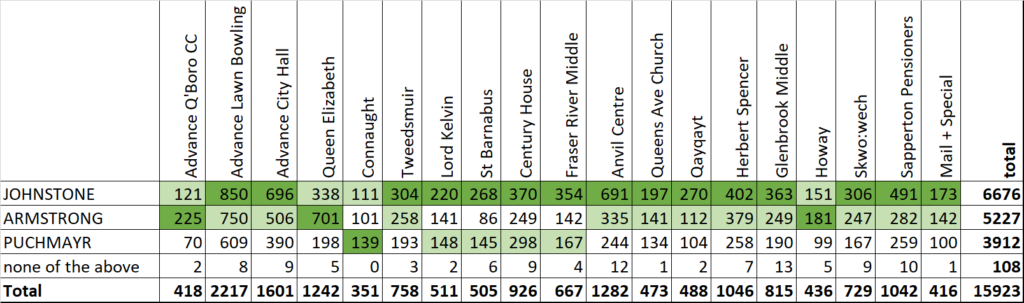
Starting with the Mayor’s Race, I marked the first place finisher in a poll with dark green, the second place finisher in lighter green. I also bunched the “Special Polls” and “Mail in” together as a single poll, for simplicity:

I finished first in most polls, and second in all the others, with my strongest polls being Downtown and the Brow, where I pulled greater than 50%. Armstrong won handily (~55%) in the two Queensborough polls, which represent about 10% of the overall votes. He also won the closer race in the Howay (Massey Victory Heights) poll. Puchmayr won Connaught Heights, which also happened to be the smallest poll, and the polls around his home in Moody Park generally had Puchmayr ahead of Armstrong in second place. As others have observed, there is a marked difference between multi-family and single-family neighbourhoods.

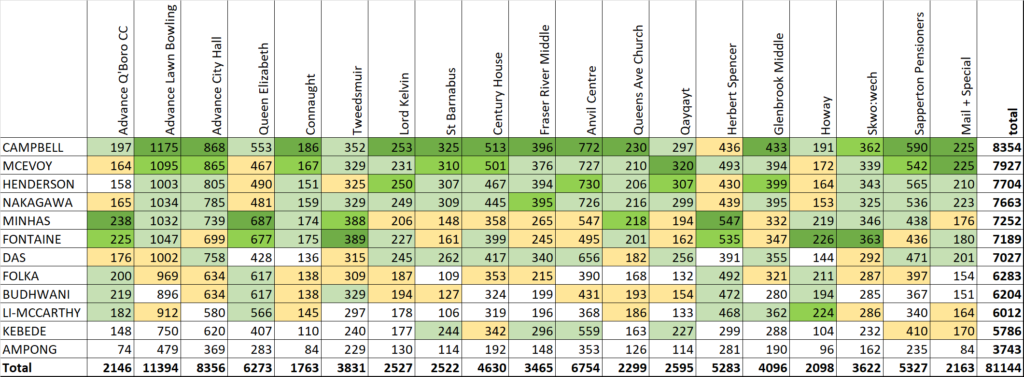
The Council race provides a bit more insight into how the vote was distributed. Here I shaded the first place finished in darker green, the second place finished in an apple green, and the other top 6 finishers in pale green. I used pale yellow for the three people just below the line, and no shading for the bottom three.

Much like Nadine Nakagawa last election, rookie candidate Ruby Campbell finished first overall by a good gap, and won the most polls. She finished first in 12 of the 19 polls, and second in one more. She “showed” (finished in the top 6) in all polls except (perhaps surprisingly) Herbert Spencer. Daniel Fontaine and Paul Minhas each led three polls, and Jaimie McEvoy was tied with Campbell for the favourite in the special polls, and was overall winner at QayQayt.

As most candidates were running with a party, there were clear trends related to those parties, and reflected somewhat the Mayor’s race. Community First had better results overall in most neighbourhoods, with the notable exceptions of Queensborough (the effect of Ken Armstrong being a Q’boro resident?) and Massey Victory Heights. The Progressives had a surprisingly strong showing at Herbert Spencer, which presumably draws most voters from Glenbrook North (where 3 of their down-ballot candidates reside) and Queens Park, but the same strength didn’t show at Queens Ave Church or Glenbrook Middle which would also presumably draw from Queens Park and Glenbrook. The two successful NWP candidates also had strong showings in Tweedsmuir (the West End) and Skwo:wech (Upper Sapperton), showing their appeal was broader overall this election than last, though again linked to single family neighbourhoods. The fact Queensborough didn’t show up for the one council candidate from Q’boro, when Downtown and the Brow did, will no doubt be the source of much deeper discussion.

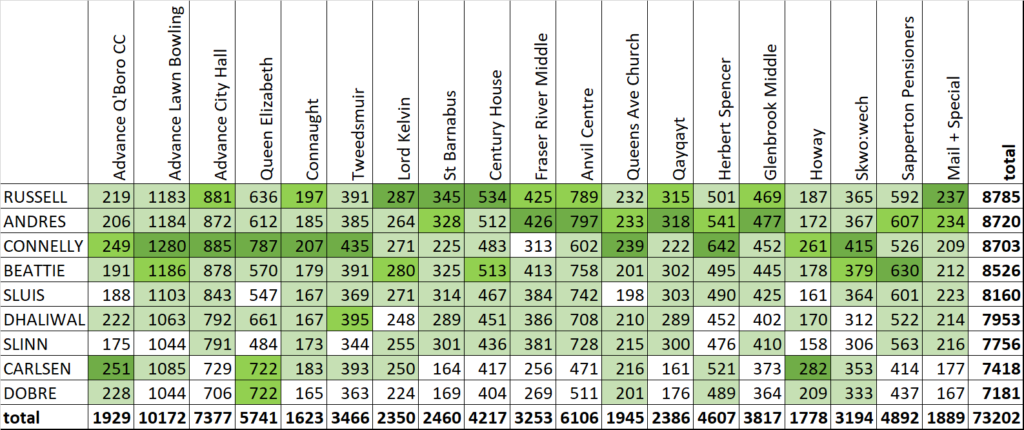
And here are the School Board results with dark green for overall winner, apple green for second place, pale green for the rest of the top 7 finishers:

The results were close between the top three finishers, with third place finisher Connelly actually winning more polls (8) outright than Russell or Andres (4 each), who nonetheless had broader appeal across the City. Again, the NWP candidates followed Mayor and Council in having their strongest results in Queensborough and Massey Victory Heights, and Carlsen not able to leverage two first place and a second place finish into enough overall votes to get across the line. Aside from this single anomaly, it is perhaps surprising that party lines were not clearer. You could convince yourself that Connelly’s popularity pulled votes for Carlsen and Dobre in many polls, but it is far from consistent across the table.

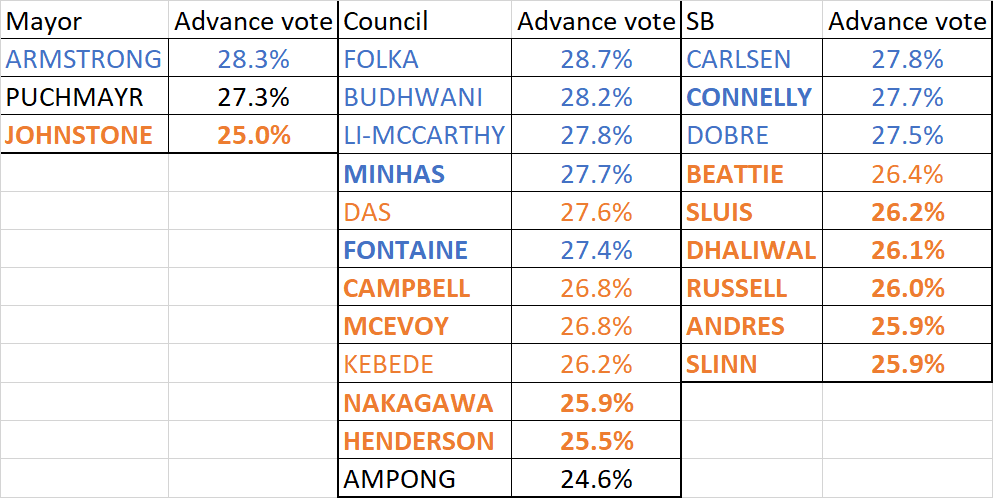
Here is an interesting trend. Last election, about 21% of vote was cast at an advance poll. That went up to 27% this election. What’s interesting is in how the advance vote was distributed. Last election Team Cote got a bit more support at the advance than election day polls in comparison to the New West Progressives. This election, NWP candidates got an average of 28% of their vote in the advance polls, CFNW candidates only around 26% on average, with the Mayoral candidates having the biggest spread. See these tables with colour-coding for party affiliation and winners bolded:

Now, 2% isn’t a huge gap, but it is such a consistent trend between parties that it can’t be a coincidence. The prominence of an advance poll in Queensborough (and relative NWP popularity there) is not enough of a vote gap to account for this, so we need to presume something shifted in overall popularity between the first advance polls and the final election day. Community First got more popular as the election went on. The said, if we only counted advance pollsthe results in the end would be pretty much the same. The only difference would have been Carlsen being elected instead of Slinn for the final School Board spot.

Finally, there were 15,923 ballots counted, but 108 of them (0.68%) did not select a Mayor Candidate. If we project that same number of ballots to the Council race, there were 95,538 potential Council votes (6 per ballot), and 81,144 votes marked, or 85%. With School Board and 7 votes per ballot, there were 73,202 out of a possible 111,461 (66%) votes cast.

Ask Pat: Now What?

SMac asked—

Congratulations! Will you still write a regular blog with your new duties?

Following up on the Election, this has been a common question. I talked a bit about this last post, and mentioned some of the considerations. Maybe I can expand a bit on that here.

As much as I’d like to say nothing has changed, the reality is that the Mayor is a de facto spokesperson for Council, for the City, and for the Police Board. This means that people will often conflate any statement made by the Mayor with the official position of those entities. As a Councillor, I am free to say “Council voted for X, and I was a dissenting vote because of these reasons”. As Mayor, one of my duties is to carry out and support the decisions of the Council (or the Police Board), so it is much more difficult for me to talk about how and why I disagree with them.

The City has communications staff, and as a Corporation it is challenging to have parallel communications streams. Messages get muddled, and confidence is eroded, both of the public and the staff. I have always tried to make clear I am writing this blog from my personal point of view without an editor (hence, the sometimes-questionable grammar), so running it through City Comms staff before I publish would be a major shift. First off, like all staff in the City they don’t work for the Mayor, they work for the CAO. Secondly, they already have enough work to do without having to worry about managing the Mayor’s Sunday morning blog ramblings.

I have been running this blog on the cheap, with some support from friends for hosting and technical services. The design is now 8 years old, and though it still functions great from my end, 8 years is forever in the Internets. Indeed, blogging itself as a medium has gone a bit by the wayside, as have 1,000+ word essays, so I have to question whether this is even an effective way to communicate in 2022 and beyond.

That said, the process of sitting down to write these blogs has been a major part of how I do the work. When reading Council Reports, I do so with the intent of understanding them enough to relate them here. And though I am slow at it, I like the accessibility of eventually answering Ask Pats. When other local issues like New West’s relative taxation level or police service levels are raised, this blog drives me to dig for data so I can better understand and better communicate. At the highest level, if I cannot explain a decision I made at Council through this medium, then maybe I don’t understand the decision enough to be confident about it. To get really meta about this: my writing this very blog post is itself part of my process for deciding whether and how I will continue to write this blog.

So, yes. I hope to keep writing here, and am setting a goal of putting up a post a week as a minimum. But it will be a bit different, and the scale of that difference is something that I will have to iterate as we go along. So stay tuned, we’ll see where it goes. Meanwhile, I’m looking into this TikTok thing…


I have also been asked about what I have planned for the next few weeks. I hasten to note we still have a Mayor, and he serves until November 7th. But there is some work going on to prepare for the months ahead. Here is a bit of a summary of the last week of my life and two weeks ahead.

I have met with Jonathan and with the CAO of the City, and more meetings are planned. I have sat down with the Police Chief to get updated on Police Board matters and with the Acting Fire Chief. I have also been connecting with Mayors from around the region, and am setting up meetings to discuss regional issues we will need to collaborate on both at Metro Vancouver and TransLink.

One immediate task is to get organized around inauguration and get Council ready for it. That means some on-boarding for the four new candidates, and getting them up to speed on the various files in the city. They also need to learn about the legal obligations of the job, our Code of Conduct, about Section 90 of the Community Charter and FOIPPA.

Though that is the work of our Clerk and CAO, I have also reached out to all of the new Council to start talking about strategic planning and larger goals each of them have for the term, about committee appointments, and those kinds of details. As I have repeated ad nauseam for the last 6 months, a Mayor can’t do any of this alone.

We are fortunate in New Westminster, because we are building on a legacy of strong leadership on the previous Council and School Board. We have led the region in protecting our most affordable housing, and in getting new affordable and rental housing built. We weathered the challenges of the Pandemic and were named among the most economically resilient communities in BC, and we are taking strong action on the climate. But we have lots of work to do. We are still a region facing a housing crisis, we are still losing people to a poisoned drug supply, and we are still facing climate disruption. We are part way through an aggressive capital plan to build new recreation facilities, new schools, new mobility routes. I ran a campaign talking about being proactive, not shrinking away from innovative approaches to these challenges, and I’m looking forward to sitting down with the new Council and getting to work.

I’m almost embarrassed to admit this, but I also took a mini-vacation this weekend. 3 days on a Gulf Island where I effectively slept 12 hours a day. My batteries needed a serious recharge, from the business of the campaign and the emotional stress of the campaign. Each day I woke up amazed at my ability to sleep, and each day a little more energized for the work ahead.

Council, October 21, 2022.

Believe it or not, we had a Council Meeting on Friday. The shortest council meeting ever, with only one item on the Agenda. But  I’ve reported here on every other council meeting over 8 years, so it would be a shame to miss this one and break the streak.

Permissive Property Tax Exemption Bylaw No. 8366, 2022
The City provides permissive property tax exemptions to some properties that are used for community service of charitable purposes. Every year we need to update the Bylaw that empowers this. Our council schedule got messed up by the stat holiday to mark the death of the Queen, and this one outstanding piece of business needed to be addressed on a legislated timeline. So we met to Adopt this Bylaw. And voted unanimously to adopt it.

The new Council is sworn in on November 7th. See you there!

The Campaign

What a wild ride that was.

In early January, I started to ask people if they thought I should run for Mayor, and started noodling about what a run would look like. It took a few months for me to convince myself that there was a viable path, that it would take a strong team, I would need a lot of help putting that team together, but the team was there to be brought together. That work took another 3 months, with conversations and facilitated sessions and the help of many people with experience in organizational development and politics. Bylaws, an AGM, candidate search and nomination process, it was a whirlwind. Then we started knocking on doors and connecting with the broader community, developing platforms, and setting ourselves up for Labour Day, when the real rush begins…

All though the campaign, I found I kept saying the same thing to the candidates: Keep it positive, and do your work. In the good times and the bad times, when we were excited and when we were lagging, when facing conflict or negativity, we just told each other to stay on the positive, and then found some work to do.

There are so many people to thank, and those will be more personal notes than this. I thought for my first post-election blog, I wanted to write a bit about the experience. I’ll follow up with more of a “what’s next” post later. For now, here are my 8 things I learned this campaign:

People are good: I admit to being a bit nervous about door knocking back in June. For a lot of people the last two years have been shitty: locked down and stuck at homes for long periods, shifts in their work and social lives, a lot of anxiety driven by economic uncertainty, concerns about health and family, loss of loved ones, doom scrolling bad news locally and around the world, and clear signs of climate disruption warning us things are not going to get better. I was afraid people were not in a mental space to talk to a hopeful election candidate who shows up at their house.

For the most part, I was wrong. Door knocking was an encouraging experience. People were happy to talk, were looking for reasons to be positive and optimistic. Yes, they had concerns and gripes, but they also had ideas about what we can do better and wanted to hear from candidates that we had ideas for a brighter future. So many people in New West responded to crises and anxiety with hope and optimism about things getting better. Door knocking was uplifting, and I hope the candidates don’t lose that feeling over the next 4 years.

Algorithms are Bad: I shouldn’t have to tell anyone that Facebook is not the real world, but I have never seen a contrast as strong as this election. If the election result was determined by Facebook comments, I had no chance this election, nor did any incumbent in the election. After all, I was called everything from an idiot to a sociopath to a “vampire slug” by people I know in the community. Some of my (alas, inevitably) non-male colleagues faced much worse. And the algorithms assure any time I spend in social media world emphasize and amplified those few voices. The contrast between the vitriol on Facebook and the conversations I had every day with real people in this community was remarkable. I’ll write more about this in the “looking forward” post, but I cannot imagine what value Facebook provides to people interested in engaging with the community. It is a broken interface.

Politics are Parochial: In our doorknocking this time, it was a good reminder of how local many concerns are. Sure climate and COVID and big issues impacting the world right now are getting all the news space, and people want to see us taking serious action on Big Issues. However, when you ask folks about issues on the spot, they can usually physically point at the thing on top of their mind as they stand on their doorstep. A sidewalk in need of repair, the loss of trees, a too-stringent tree bylaw, parking (always parking), a fire hydrant in need of painting, the schedule for glass recycling. The little details of daily life are things that people think about when they think City Hall.

Housing Matters: One big difference this election over previous ones (in my imperfect memory) is that the housing crisis was top of mind for everyone this year, even those comfortably housed in single family neighbourhoods. Previously, you heard a lot about housing security and housing affordability in multi-family and rental buildings, but now the impacts of the ongoing crisis are being felt by everyone – because their kids cannot afford to live in the neighbourhood where they grew up, because rental availability is so low, because it is harder to find employees, because homelessness is more visible than ever. There were other issues this election, but the marked difference in the housing discussion really stood out to me.

Teams: I’m really proud of the team I ran with, and so grateful of the work we did. No-one has ever knocked on as many doors as Community First did during this campaign. Some members faced unique challenges and the other members stood up to support them. The incumbents pulled for the new candidates, and the volunteers and campaign staff were always there to enable the candidates to concentrate on connecting with voters. And when something went sideways – as will inevitably happen when you have 13 stressed candidates and dozens of passionate volunteers interacting with thousands of engaged residents on a tight deadline – we were able to pull together and regroup and get back to the positive, and back to doing the work.

Who knows what works? I am a physical scientist, and a member of Generation X. Both of those characteristics lend me towards wanting to understand how things work. How does [this one thing] get me closer to [the goal]. In a campaign surrounded by political activists, experienced campaigners, and enthusiastic volunteers, you hear a lot of differing opinions about what actually works in pulling the vote: the air game vs the ground game; the lawn sign war; Full Page Ads; viral TikToks (whatever the hell those are). Few people will agree on what is most important and what isn’t, and most of the traditional knowledge is wrapped in confirmation bias, survivorship bias, and anecdata. A local government election with limited media and 13 candidates on a team is also a very different animal that a traditional two- or three-party campaign we are used to with senior government.

I guess there is a thing called “Political Science”, but I have not studied it beyond reading Hunter Thompson books from the 1970s, as I tend to be reading about policy ideas and policy failures, assuming good ideas with predictable outcomes are all people want. But good policy is really hard to meme, and often the electorate is busy, otherwise engaged, or indifferent. So, to our incredible campaign staff, I apologize for every time I took part in the “Lawn signs don’t matter” vs “We are losing the Lawn Sign War!” debate in the office. Thanks for indulging us, letting us vent, then getting us back on track.

Elections are hard: Running for office is an emotional rollercoaster. If you care about the work, about the community, and about the ideals you bring into this, then there is some point in a campaign where it is going to hurt. Maybe low blood sugar and a couple of bad interactions at a door line up and your imposter syndrome hits you and you question why the hell you are doing this. Maybe you get stuck in the spiral of reading your opponent’s messaging (“did they just say that!?”) and Facebook comments (“do people actually believe that!?”) and you have to swallow the irritation because your team keeps telling you to keep it positive. Maybe you know you need to go hit doors or attend an event, when all you want to do this evening is sit down for dinner with your daughter and talk about her first day at school. Having a great team of supporters to pull you through those low points makes it easier, and sometimes we lament the burden taken on by our families and friends in supporting us as candidates. In the end, the positives of working together to build something positive wins out, even if we sometimes need to be reminded of this. A year from now we are going to remember the funny stories from doorknocking, not those low points, but at the moment, they are hard. A campaign office with sugary snacks help.

Losing sucks: I’m heartbroken that my colleagues Chinu and Bereket were not able to get over the top. Maybe I can speculate about the “why” part when I dig into the poll-by-poll results, but for now I am just disappointed and feel badly that our team didn’t do more to help them. Chinu has been an incredible source of calm wisdom and incisive fire at Council, and I have felt honoured to sit with her and learn from her. I was feeling really confident about Bereket from the day I met him about a year ago, he is smart, principled, and was so charming at the doors, while also pulling in an amazing team of volunteers. He was persistently positive, lifting the team every chance he had, and reminding us about Queensborough if we ever let it slip. I know they will both continue to be passionate advocates for their community, it is in their hearts to do this work.


The last week has been a different kind of whirlwind. I am working with my elected colleagues and City Staff to get organized around inauguration (November 7th in Council Chambers, mark your calendar), and getting all of council prepped to do the work. I have chatted with and am planning more meetings with Jonathan, and have also set up some meetings with Mayors from around the region to connect again with those I already know and introduce myself to those I have I haven’t worked with yet. And the invites for events of all types are starting to stream in.

I will hope to find time this weekend to write a bit of a “what’s next” follow up to this, but first things first, to answer the big question here:

Yes, I intend to keep blogging, but it is going to be different. I don’t even know how it will be different yet, because I need to find a new context for this writing. For good or for bad, anything written by the “person wearing the chain” becomes conflated with the “Official position of the City”, and I am aware of my need to separate those two. My council colleagues and staff of the city need to know I am not going to make their work harder through this part of my new-found bully pulpit. There is also the time commitment required to do this that I will need to understand and manage.

But writing this blog has become part of my “process” for understanding and keeping track of what is happening in council business. Somewhere in my University days I learned if I can’t write clearly about it, I clearly don’t understand it. So writing the notes that become this blog are part of how I read and absorb my council package and the reports attached. for now I suggest the presentation may change, the tone may change, but I do intend to keep connecting directly like this as long as it is viable to do so.

So thank you to my regular readers (Hi Mom!), and let’s see where this goes!

Council – Oct 3, 2022

TOO MUCH HAPPENING! AAAAHHHH!!!

Ok, I’m over that. Here’s the report.

We had the last Council Meeting of the Term on Monday. It was a real roller coaster, because we covered some significant topics, putting a point on the road for some large topics in the hope the next Council will carry them forward – there are lots of “passing the baton” metaphors below. It was also the final council meeting for Mayor Cote and Councillor Trentadue, and at least one other member of Council. So there were emotions in the room. But for the purposes of this report I’m going to stick to the Agenda.

We started with a couple of Temporary Use Permits :

Temporary Use Permit No. TUP00028 for 97 Braid Street
The Construction of RCH has brought a lot of workers to Sapperton, and there has been a temporary parking lot installed by the Braid SkyTrain station with shuttles that run workers back and forth to the construction site. This is not a regular use of that property, so we issued a Temporary Use Permit to allow it. They are asking for a renewal, as construction is ongoing.

There was a call for public comment, sign on the site, and received no comments from the public. The operation has been largely without trouble and does actively relieve some of the parking stress Sapperton already y feels during the construction, so Council voted to support the TUP.

Temporary Use Permit No. TUP00029 for 311 Louellen Street
The owner of a large house on the Brow of the Hill Neighbourhood wants to provide a Group Living facility for people living in recovery from addiction (including alcohol, drugs, and gambling). This land use is consistent with the Official Community Plan for the neighbourhood, but would require a rezoning or a Temporary Use Permit for up to 3 years. Here were two separate public calls for comment on this, and a public Open House (with 33 neighbours attending), and we received more than 100 pieces of correspondence, mostly in favour of providing these types services in New Westminster, with some comments concerned about the specific location, operational details and effect on adjacent property values.

New Westminster has a good history with supporting these types of transitional housing operations, and they have without fail turned out to be good neighbours that do not cause conflict issues in residential neighbourhoods. That said, the regulation and oversight of an operation like this not as consistent as some in the community may like, although this is evolving. Staff have provided a list of conditions to help address some of the community anxiety around this change.

I voted in favour of this TUP with the conditions attached. I have personal experience with being a neighbours with a similar facility by a different operator that works on a very similar model, and recognize that many of the anxieties felt about these sites are just not born out in practice. They do not constitute a threat to vulnerable people in the community, nor do they correlate with nuisance behaviours or crime. Quite the opposite, in fact.

The TUP and conditions attached should provide some incentive to the operator to assure their commitment to being a good neighbours is met, and on balance having facilities in our community that help people get past the health impacts and stigma of addiction is an important step in building a strong community for all.


We then had two Reports to Council:

Peer Assisted Care Team (PACT) Pilot Project Update
The PACT model is an exciting and innovative way to deal with mental health crises in our community, being piloted here in BC in New West, Victoria, and North Van, but based on proven models from other jurisdictions around North America. It is in partnership with the Canadian Mental Health Association, and Purpose Society. This came out of our earlier submissions to the Special Committee on Reforming the Police Act, and has taken a real drive be several members of Council and partnerships with the Provincial Government and other agencies to see the light of day. We are still working on the effort to properly integrate the PACT model with 911, which will lead to more consistent dispatch and better data gathering.

This does have the potential to be transformational in people’s lives, and an example of what a community can do when all members meet together with a common understanding of a problem, apply evidence-based policy and compassion, and are willing to find flexibility and innovation in finding solutions.

Council Update on Research into Actions taken by the City of New Westminster involving Indigenous Peoples from 1860-1999
Friday was National Truth and Reconciliation Day, and it was profound to see Pier Park as full as I have ever seen it, more than a thousand people, most in orange t-shirts, to witness and learn about residential schools and reconciliation. It is timely that the City provide an update on the work we have done towards Truth and Reconciliation, so we can hand over the baton to the next Council in the hopes they will continue to carry it on this long journey.

The first part of Truth and Reconciliation is Truth. It is about exposing and talking about the record of what occurred, and when it comes to the colonization and subjugation of Indigenous Peoples, a lot happened in New Westminster. As part of our work, the City went about combing the archives and records of the city to outline exactly what happened. Recognizing our records only tell the story from the colonizers’ point of view, and therefore our written record in incomplete, it is nonetheless important that we expose this history to the light, and find a respectful way to share this learning with the people who were impacted, and their descendants, in accordance with the TRC Calls to Action and the Articles of UNDRIP.

The City has begun engagement with many nations to whom these histories are relevant, and will be working through shared learnings with those nations, now that this report is available. For now, a summary report is available for the general public to review, with the more detailed and technical report being used as the foundation for deeper consultations.

At this point, we are receiving the report, and updates on progress the City has made in our Reconciliation Strategy. Much of it (training and learnings for staff, relationship building with Nations around the region, this research work) has been “behind the scenes” for good reasons, but it is outlined on the city website now to let those interested see where we are at. We also received in update on the next steps ahead in Reconciliation for the city. May the baton be passed on to the next Council, and may they run with it.


We then moved the following items On Consent:

Formal Recognition of National Aboriginal Veterans’ Day
The RSIE Task Force is recommending Council formally recognize National Aboriginal Veterans’ Day on November 8th. And we will do so.

Heritage Revitalization Agreement: 441 Fader Street – Preliminary Report to Council
The owner of this unique 1930s house in lower Sapperton want to build an infill house on the property with a secondary suite and preserve the existing house with Heritage Protection. The zoning allows three units on the property (a house with a suite and a laneway house), but this arrangement, where the existing “main” house is smaller and the infill house has the suite, and the proposal to stratify the property so it operates more like a duplex instead of subdividing or making them all single ownership is unusual. This is a preliminary application, and will go to public consultation and Public Hearing before Council makes any decisions, so let us know if you have opinions!

Uptown Business Association and Downtown New Westminster BIA – 2023 Business Promotion Scheme Budget Approvals
The City’s two BIAs operate by the City collecting a special tax on the member businesses, then turning that money over to the BIAs to do the work their board determines best serves their members. As their budgets (~$150K/year for Uptown, ~$300K/year for Downtown) mostly go through our budget, and their work plans mesh with work the City is doing, we have an opportunity to review and comment on their budgets.

This is more of a report for information than it is a request for approval, as the BIAs operate fairly autonomously.

Vancouver Fraser Port Authority Carter Street Foreshore Lease Agreement Renewal
There is a part of the Queensborough waterfront by Carter Street where the City pays the Port about $600 a year to lease. This is to assure public access as a watery extension to the foreshore park where the City has park benches, trails, interpretive signage and such. We are renewing the lease we have carried since 1997 for another 10-year term.


The following items were Removed from Consent for discussion:

All Ages and Abilities Active Transportation Network Plan
A year ago, I brought a motion to Council asking that we establish a core mobility lane network and that we integrate the building of that network into the City’s 5 year Capital Plan. After a year of work, engineering, design, and public consultation, this is the draft network, and the price tag.

I wrote a lot about this last year, and I don’t want to repeat it all here, but I think this work is necessary, is “core work” for a 21st century urban city, and is timely. It will represent an increase in our 5-year Capital plan, but an increase of less than 10%, and with significant senior government support available through the National Active Transportation Strategy and the CleanBC Active Transportation Fund. It is still a significant amount of money, and will also require increased staff resources to roll out on the timeline suggested, but if we want to meet the goals set out in our 7 Bold Steps, if we want to achieve the safe roads and public spaces and prepare ourselves for the transportation revolution coming with new mobility devices, if we want to be a modern forward-looking city, this is work we need to commit to now. This will be transformational.

There is a lot in here about how we got from idea to a network map, and I will maybe write more about that in a follow-up post, I but I think this plan is good. To reach AAA (“All Ages and Abilities”), staff created a CCC framework (“Comfortable, Complete and Connected”) to make sure a bike route is near every home, connects to key destinations, and is not only safe for all users, but comfortable for all users. And connected means we are finally going to invest in getting rid of the persistent gaps in our mobility lane network that created comfort and safety barriers for so many users.

Community Energy and Emissions Plan 2050 – Adoption
Another big file I am glad to see advanced before the end of the term. The City has two Plans for reducing GHG emissions- the “Corporate” plan that covers everything the City itself does from running garbage trucks to heating City Hall, and the “Community” Plan, which is all the GHG emissions residents and businesses create by driving their vehicles or heating their buildings or generating waste. Our corporate plan was reported on last meeting (we are ahead of schedule getting to 2030), and this report is asking for adoption of a new Community Plan – one to set a new target to “near zero” emissions by 2050.

This is a big strategic plan with clear actions that are already starting, and creates a strong roadmap for the next 7 years. This means faster Step Code implementation to get new buildings more efficient faster; it means retrofit assist to get older buildings off fossil fuels and adapted to our new climate; it means a faster roll out of EV-support infrastructure and transportation infrastructure that reduces the reliance on cars. And it means adopting Just Transition and Climate Equity lenses in how we prioritize and fund this work.

With adoption of the CEEP, we have clearly set out the path ahead. Again, the baton is being passed to the next Council, and I hope we have a Council ready to run with it.

Development Permit Application: Brewery District Transit Plaza – For Information
The Brewery District is looking at how it will design the last pieces of the puzzle. There is one more building (which is proposed to be mixed use with lots of commercial space) to be built, and a completion of the groundworks around the entrance to the SkyTrain station. This report outlines the preliminary designs for the latter. This is a report for information, and a development permit to approve the design will be managed through staff without further Council input.

It looks pretty good. The route from SkyTrain to RCH and Sapperton will be universally accessible, where it is now a bit challenging with existing slopes and ramp designs, and an elevator on the RCH property that has not be functional for several years. I still chagrin that the RCH design does not address the SkyTrain station better, but Wesgroup is making up for it in this plaza design. They are still taking public input, so if you have opinions, let them know here.

Lighting Up City Hall in Celebration of Diwali
The RSIE Task Force is recommending we light up and decorate City Hall to mark Diwali, so we are going to do that. This is a change from our usual practice of mostly only decorating City Hall for Christian holidays (Christmas, Easter).


And finally, we adopted the following Bylaws:

Anvil Theatre Fees and Charges Amendment Bylaw No. 8367, 2022; Climate Action Planning and Development Fees and Rates Amendment Bylaw No. 8358, 2022; Cultural Services Fees and Charges Amendment Bylaw No. 8359, 2022; Electrical Utility Charges Amendment Bylaw No. 8368, 2022; and Engineering User Fees and Rates Amendment Bylaw No. 8360, 2022
As discussed over the last two meetings, these Bylaws that set our fees, fines, and user rates for various services in the City for the year ahead were all adopted unanimously by Council.


Whew! There were a few speeches made, and you can watch the video, but I am sure I will have more to say about this term and my colleagues on Council after October 15th. For now, I gotta go GOTV. Remember to vote!