Utilities 2018 (Part 2)

In my previous utilities post, I talked about revenues and expenses in our utilities, and readers of our financial spreadsheets would see that we make more money in revenues than we spend operating the utility – we make a “profit” every year. So what happens to that money? And if we make a profit already, why are rates going up?

I feel I have to caveat a bunch of this stuff, probably should have in the last post as well – I’m not a finance professional, or even a decent bookkeeper. I need to simplify what are sometimes pretty complex finance rules and practices to understand them myself, never mind try to explain them. So everything here needs to be read in that context – I may get some of this a little wrong in a way that causes a Chartered Accountant to chuckle, but hey, at least it is them laughing at me for a change instead of the other way around. This is also why I am tempted to put scare quotes around a bunch of terms like “profits”, because I realize I am using the terms colloquially, not strictly. So maybe assume any word below that is not used in a way that strictly fits the definition as having scare quotes.

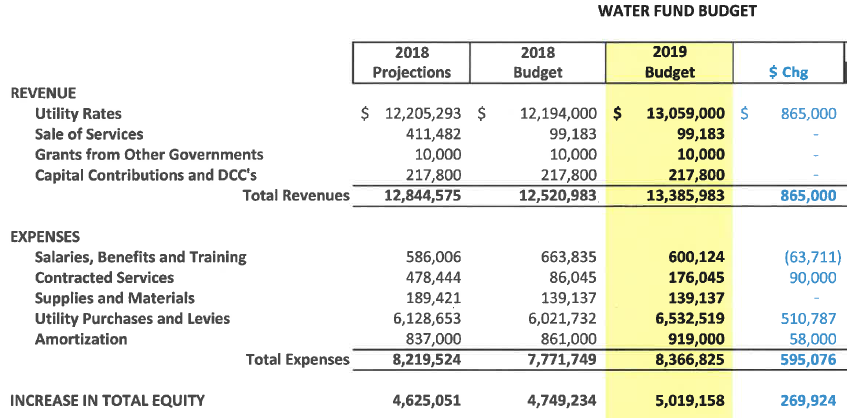
The short answer to that question is that all of the profit from utilities is re-invested into the utilities through their respective capital budget. Looking at the 2019 Water budget that looks like this:

One would be tempted to interpret this as:
Our Revenues are projected to be:  $13.4 Million
Our Expenses are projected to be:  $  8.4 Million
So the “profit” is                                  $  5.0 Million.

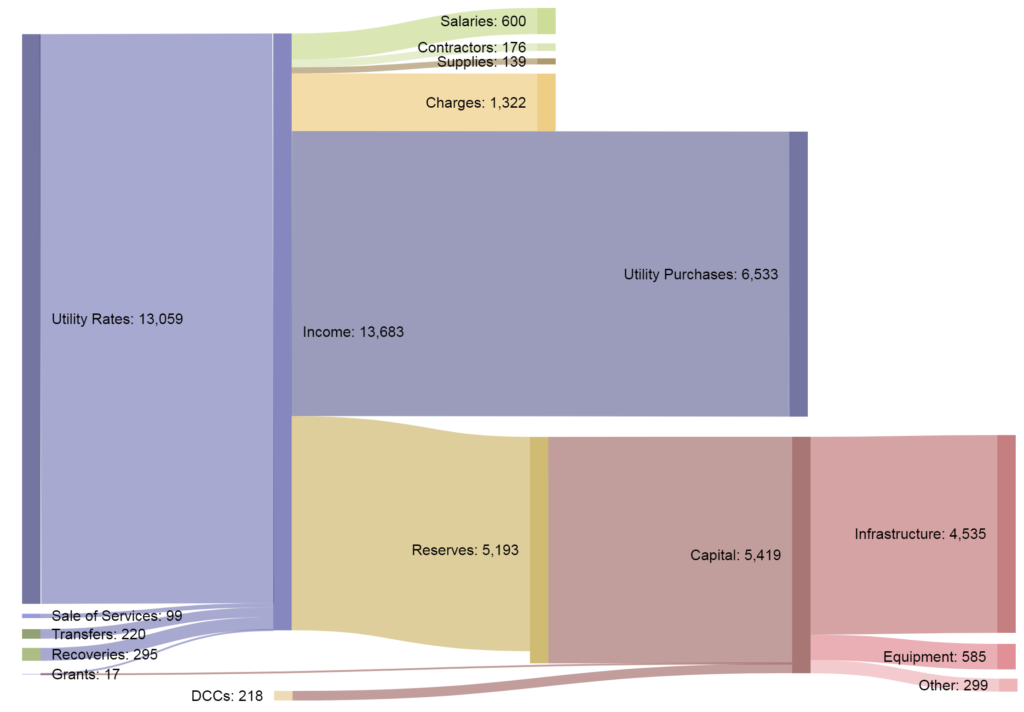
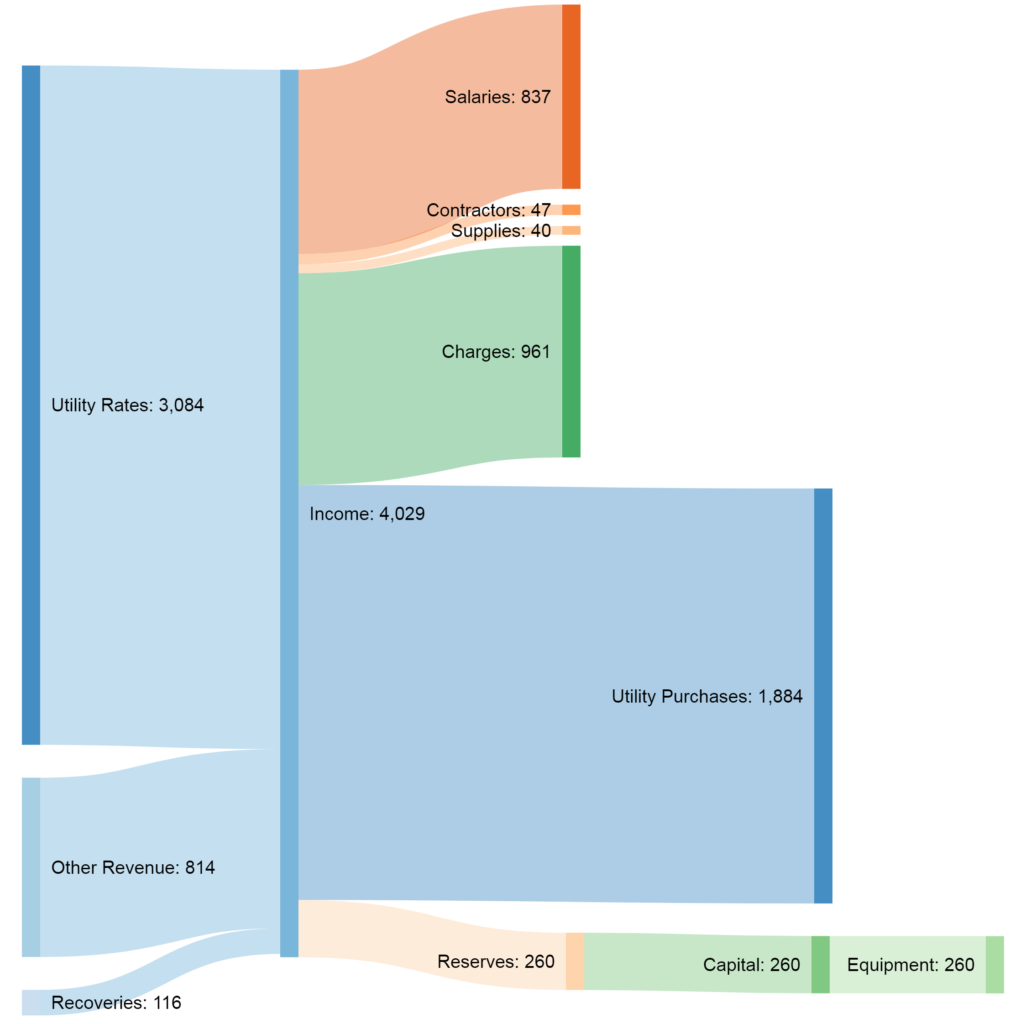
However, this is a simplification of our actual 2019 budget, because it only considers our operating budget, not the way we support our reserves and capital costs. This is why the numbers you see here will be a little different than the ones in my previous post – I am going to try to meld together our operational and capital budgets in a way that makes sense. A better way to look at these spreadsheets for people not that into spreadsheets is a flow diagram:

On the left are all of our “inputs”, and the right are out “outputs”, and all of the vertical bars are to scale (numbers are thousands of dollars). You can see most of the income of the utility is in Rates (about $13M of $14M). Of that money, about $6.5M goes to Metro Vancouver to pay for water, about $2M goes to salaries and other operational costs, and about $5.4M ultimately contributes to Capital costs. Most of that Capital spending is on paying for infrastructure repairs and replacements (actual pipes in the ground, valves, pumps, and such), though some goes to equipment (trucks, wrenches, computers) used to keep the infrastructure operating.

Keen eyes will note that the Reserves bar has a gap at the bottom left – we are budgeting to take about $280K more out of reserves in 2019 than we put in. Not shown on this diagram is the ~$4.3 Million we have stored in our reserves at the end of 2018, and how that will be reduced to ~$4.0 Million by the end of 2019. I will talk more about that later.

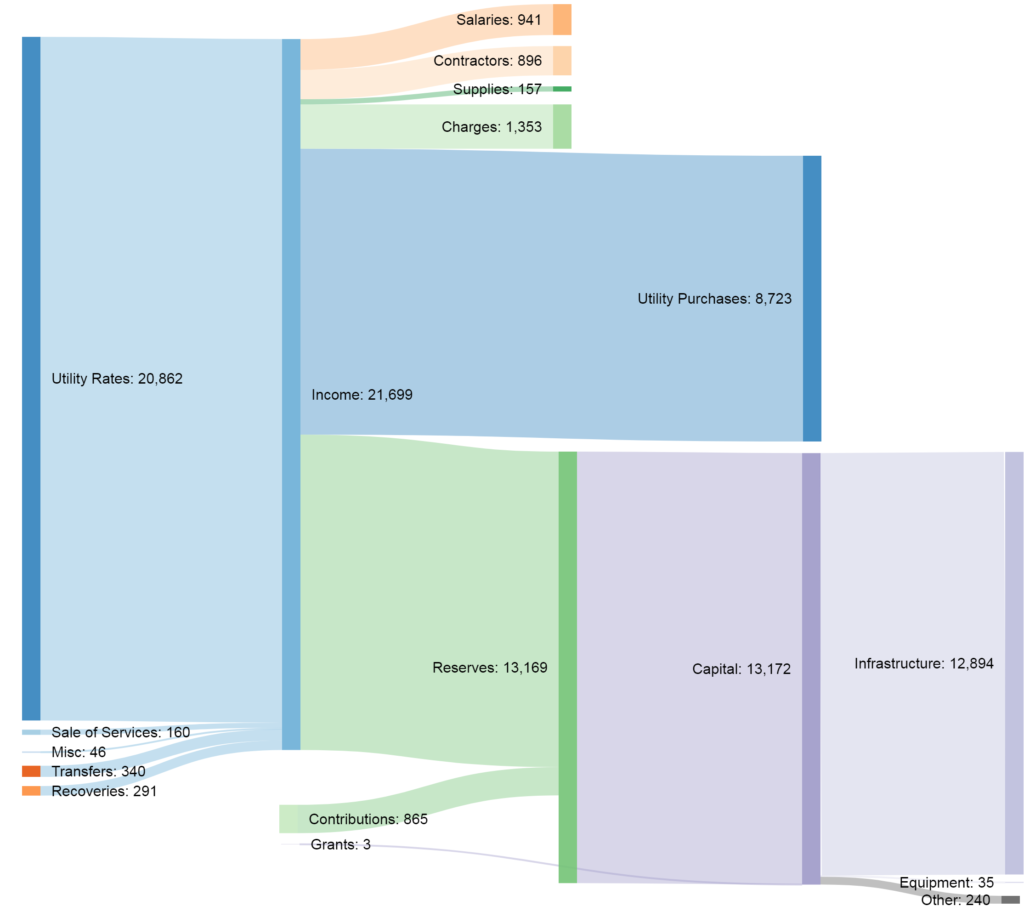
I created a similar flow diagram for the 2019 Sewers budget:Immediately, you will notice we are spending much more money (proportionally) on infrastructure here than in the water utility. This is largely due to the ongoing sewer separation work that New Westminster has to deal with. You can see it is almost all spent on actual infrastructure ($13 Million!). You will note also that the gap between what we are putting into reserves and taking out is large – about $2.7 Million in 2019. We are also expected to receive another $865K in grants to help pay close that gap. Again, more on this later.
The Solid Waste budget looks a little different:Two things stand out here: the capital budget is much smaller (it is all equipment), and both salaries and Charges is much bigger. This has to do with the nature of the work, collecting garbage requires people, and I suspect the largest “charges” expense is fuel to keep the garbage trucks rolling.
So that is where we are in 2019, but what will change as we increase rates every year?

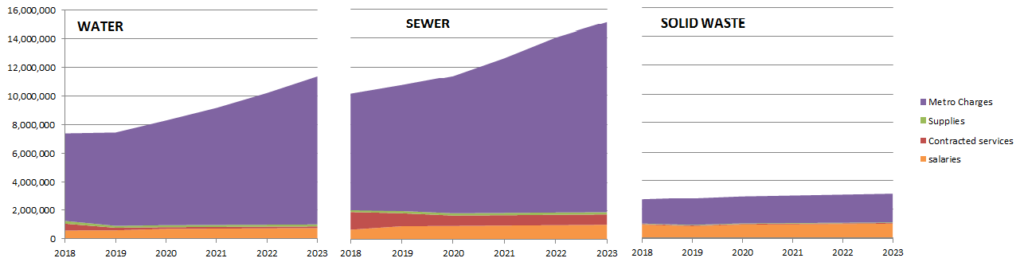
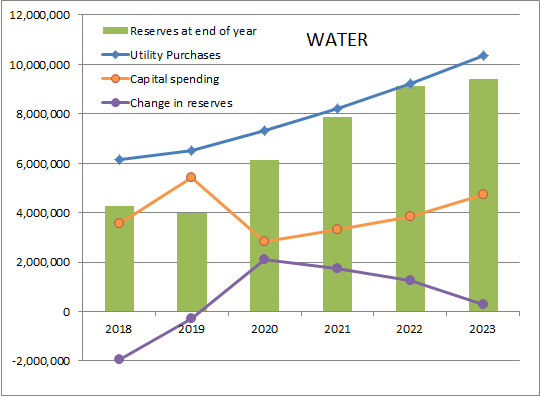
This graph shows how the main Water Utility cost drivers are going to change over the 5-year plan. The rates we pay to Metro for water going up steadily, capital spending increasing at a lower rate, and the trend for our reserves is moving from a small annual loss (remember the gap in the flow chart above) to an increase, then trending back to even. You can see by the green bars that our reserves are currently just over $4 Million, with the goal of them settling in at just under $10 million.
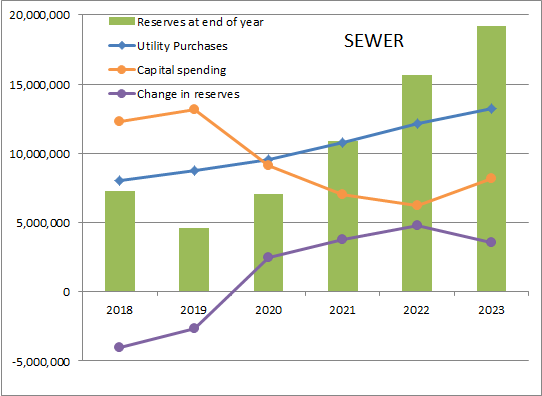
The same graph for the Sewer Utility shows Metro rates steadily increasing, capital spending going down, and our reserve contributions again going from negative to a more sustainable level.
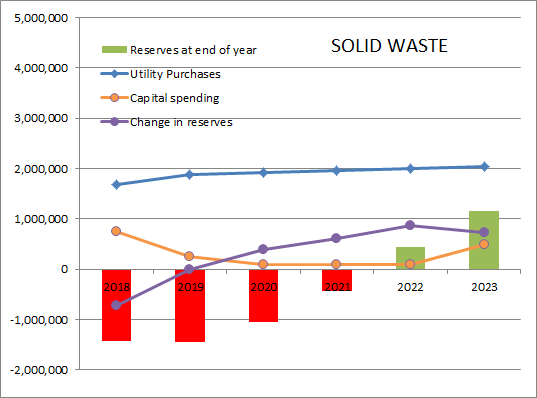
Finally, our Solid Waste accounts show Metro rates only increasing moderately, and our capital spending going down for a few years while the trend for reserves will hopefully go from a deficit position to a small positive reserve.
In summary, the current plan will get our utility reserves back into a place where they can support the long-term financial sustainability of the utilities, and constrain our local capital spending a bit to buffer this. The part we have less control over is the Metro Rates, and this topic is something that is making waves across the region. I’ll write more about this in a future blog post.

Council Top Three!

This is regular pre-council list of what I think are going to be the most important three items on our Council agenda on Monday* in no particular order, so you can decide if you want to tune in. Honestly, I don’t see any specific item this week raising a rancorous debate – maybe there will be some good delegations? Anyway, here are my guesses.

#1: Five-Year Financial Plan (2018-2022) Amendment Bylaw No. 8062, 2018
This is the first sure sign that the Canada Games Pool project is moving ahead – and that it is going to cost the City a lot of money. The timing here is that the application window for the federal / provincial grant we would like to help pay for this project is closing in January, and we need to have proof that we can finance this project before that happens. So we need to include the updated finance plan in our 5-year Financial Plan, then go to the public for authorization for long-term borrowing. This amendment is the first step in this process.

#2: Code of Conduct for City Council
This should finally put an end to all of the swearing and back-stabbing at Council! Just kidding. This is more staff recognizing that we have not operated with a modern Code of Conduct for some time. This is something many Cities have adopted, partly because of increased expectations around respectful workplaces, and partly from observing examples from other cities (cough, Nanaimo, cough) where the municipal operations were hampered by poor conduct on the part of a few disruptive Council members.

#3: Recreational Cannabis: Nuisance Monitoring Program
With the legalization of cannabis, the City has recognized that our biggest hassle is likely to be nuisance complaints related to smoking in public places. There are both provincial and municipal laws that apply here, and enforcement of smoking has never been easy. Staff have a plan to track complaints and enforcement efforts in a systematic way to help us figure out methods to address it.

*normal footnote: The funny thing about Council: it is almost impossible to predict what three items will rise to the top and get the most debate/ public feedback / media coverage. These are only my guesses, and I am only one of seven. For a full prediction of the entire Council agenda, go to the agenda!

Utilities 2018 (Part 1)

I read this headline, and my best reply is: Yep, I share your frustration.

I hear the concern expressed by residents in New Westminster when they see utility costs are going up at rates much greater than inflation. However, I am challenged in trying to find an alternative approach that balances operational costs while planning for long-term sustainability of the utilities. Its not from a lack of concern or empathy for the impact of rate increases, it is more about responsible management of the budget in a way that doesn’t threaten the financial sustainability of the utilities.

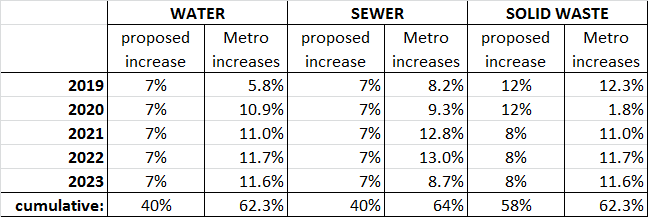
A 7% annual increase (adding up to a 40% increase over 5 years) sounds like a lot, and is clearly well above CPI, which is predicted to be between 2% and 2.5% for the next few years. However, the cost to operate our utilities is also increasing much faster than CPI. The best I can do here is unpack some of the details.

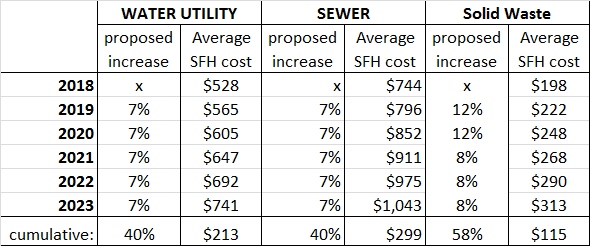
Let’s put aside the electrical utility for a bit, because Council sent those proposed changes back to staff for some more work, and we will be having (I suspect) a deeper conversation about those rates in a future meeting. That leaves the three utilities every City deals with: Water, Sewer, and Solid Waste. Here are the changes as proposed:

All the numbers I use in this post are from the utilities report we received last Council meeting. You can read it all here, starting on page 19.

Note the “Average Single Family Household” cost is an average, and your experience will likely be different. Many people in multi-family have their own commercial solid waste services, so pay nothing to the City for that. The sewer and water rates are flat rates to Single Family detached houses, but metered charges to multi-family dwellings. This is an estimate of the impact to the average household, not your exact bill.

Still, next year this average household will likely pay on the order of $100 more for utilities, and by 2023 pay $600 more a year than they pay now – that is $50 extra a month.

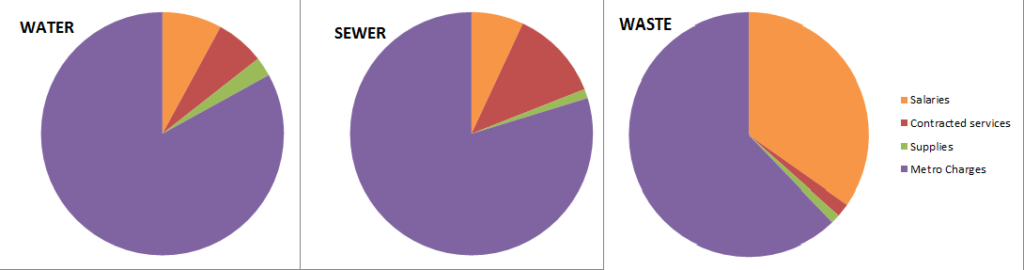
To get a sense of why the rates are going up, here is where the City spends that utility money:

In all three utilities, the majority of the cost is what I slightly misleadingly labelled “Metro Charges” – the money we pay to other agencies to supply the water or to take away and responsibly manage our waste streams. Metro Vancouver provides clean, treated, and pressurized water and charges us per cubic metre delivered. Similarly, Metro Vancouver takes our waste water and sends it to the treatment plant at Annacis Island, where it is treated to be safe for disposal into the Fraser River, again charging us per cubic metre. Solid waste is slightly more complicated because organics, recyclables, and “garbage” go to three different streams, and some of those are costing us more than others.

The other costs are related to how we deliver those utilities. Salaries are pretty clear – that is what we pay people to do everything from performing repairs to pipes to processing your bills. Contractors also do similar tasks, but are usually related to projects like replacing a length of watermain under a street or designing a new billing system. You may note that Solid Waste has proportionally much more salary cost because we need people to drive around in trucks and empty your bins – Solid Waste is inherently more of a “service” delivered by people than one relying on capital sitting in the ground in the form of pipes. Supplies are the paperclips, toner fluid, and rubber gloves that staff need to do the jobs above. Note this category is limited to things that are consumed, as opposed to things like trucks and new pipes that are capitalized and included with our Amortization, but let’s not dig too deeply into the capital budget right now (I’ll talk about it more later) .

It is telling that 83% (water), 80% (sewer) and 62% (solid waste) of our expenses for these utilities are external, and for the two big ones, are going up much faster than the rate increases we are anticipating for the next 5 years:

If we extend the pie charts above over the 5 years of the financial plan, we can see that not only are those external costs the largest portion of our costs, they are increasing at a much greater rate than the other expenses:

So utility rates are going up, because the main cost driver for the utilities are going up. What we can do about it?

Inevitably, someone is going to raise the issue of salary costs – it is unavoidable when talking about government. CUPE contracts that provide decent wages and work conditions, along with decent CPI-level wage increases won through collective bargaining, seems to elicit anger in some members of the public. However, public service wages are not a significant cost driver here, because they make up less than 10% of the cost for delivering utility service in the City. If we were somehow able to cut all salaries in half (those orange areas in the chart above), your utility costs would go down less than 6%. Such a drastic move would not even offset a single year of utility increases, and we would be back to regular increases in year two, with a much less effective utility due to the lengthy labour dispute and loss of staff.

Some will note that our “revenue” for utilities is much higher than our “expenses” for Utilities, and this is where we get to the other part of the equation: the capital budget. This is the money we need to re-invest into the utilities every year to keep them functioning, and to build towards sustainability. In the larger scheme, it is capital investment that explains why those Metro Vancouver rates are going up so much.

But that will have to wait until the next blog post…

Council – Nov. 19, 2018

Our first real meeting of the new term was full of interesting Agenda items, but we managed to get through them fairly quickly, even before the Public Delegations began.

The following items were Moved on Consent without discussion:

Queensborough Electrical Substation Loan Authorization Bylaw and Temporary Borrowing Bylaw
It is time for the Electrical Utility to build a new substation in Queensborough to deal with increased loads on that side of the river. The Electrical Utility is self-funding, so the capital cost of the substation (approximately $30 Million dollars) will be paid by electrical customers through their regular electrical bill, which requires that we borrow the money and amortize the cost of the construction over 20 years. The City cannot borrow money beyond the 5 years of our financial plan without specific authorization from the province and the public. So we are starting that process.

There are actually two Bylaws here. One will allow us to temporarily borrow up to $30 million dollars (“temporary” being within the 5-year financial plan) to provide the electrical utility access to the cash they need to hire contractors to do the work and pay them at the time they need to hire and pay contractors. The second is to do a long-term (and hopefully lower-rate) infrastructure loan through the Municipal Finance Authority so we can amortize up to $30 Million debt over 20 years. In short, we pay the contractor with the first loan, then pay off the first loan with the long-term loan, because it will cost less in the long run.

Revenue Anticipation Borrowing Amendment Bylaw No. 8038, 2018
Let’s for a few moments do the dangerous thing of comparing municipal finance to your household finances. The City has a chequing account to pay for day-to-day operations. From salaries to asphalt to photocopy fluid, it all gets paid from this chequing account. Much of the money going into that account arrives in a short period of time around Tax time, but much of it trickles in over the year through fees, senior government grants, etc. We are required (by law) to balance our budget at the end of the year, but it is possible that at some point through the year we may be in a negative cash position because we need to write more cheques in, say, April, than the money we take in that month. In this case, we may need to borrow money for a month or two until those tax cheques start arriving. As a City, we cannot borrow money without a Bylaw authorizing us to do so. So every year, we pass this “revenue Anticipation Borrowing Bylaw” which gives our finance staff the authority to borrow in the short term so we don’t go overdraft.

618 Carnarvon Street: Development Variance Permit No. DVP00656 to Vary Sign Bylaw Requirements – Consideration of Notice of Opportunity to be Heard
There is a development property in Downtown that installed signs that, by the most generous interpretation of the Sign Bylaw, do not comply. When staff informed the developer of this, they applied for a variance.

There is a bit of nuance here, because the printed copy of the sign is within the size allowed by the Bylaw , but the very large white space of the sign is not. In theory, the developer could have painted the wall white (which is exempt from the sign Bylaw) and put a regulation-size sign up and the result would be indistinguishable from the current situation. Alas, after the fact, a variance is the best way to deal with this, and there will be an Opportunity to be Heard at the December 10, 2018 meeting. C’mon out and tell us what you think.

Engineering User Fees and Rates Amendment Bylaw No. 8058, 2018
There was a typo in the Bylaw we gave Third Reading last month, so we are going to rescind that Third Reading, and do another one with the edited Bylaw.

1209 – 1217 Eighth Avenue: Rezoning and Development Permit Applications for 22 Unit Infill Townhouse Project – For Information
This is a preliminary information report to let Council know that this project is going through reviews and public consultation. The project is the first larger Infill Townhouse project that Council has seen since the changes in the OCP, so there will be some curiosity about how the project develops. As the project will eventually work its way to a Public Hearing, I will hold my comments until that time.


The following items were Removed from Consent for discussion:

2019 – 2023 Draft Financial Plan – Utilities
Right back at it in the first meeting of the new Council, and we need to keep the process for the new budget rolling.

Utilities are self-supporting in the City. Water, sewer, and solid waste are paid for through utility fees, including a significant amount of money put aside in their capital reserves in order to fund ongoing and anticipated capital upgrades to the aging infrastructure. The Electrical Utility is slightly different, because it makes a profit and pays a dividend to the shareholder (the City) every year.

Water and sewer increases are pretty much what we have been anticipating. The cost of capital improvements and maintenance locally (the higher-than-inflation increased cost of replacing old pipes in this super-heated construction market) and regionally (we are building many new and improved sewer treatment plants and water supply infrastructure, as both federal standards and public environmental expectations are higher than ever before) means these rates will continue to grow slightly faster than CPI for the foreseeable future.

No doubt 7% increase a year looks like an unsustainable path for many homeowners – this culminates to a 40% increase over 5 years, but the regional water rates are anticipated to go up 62% in the same time, and sewer rates by 64%. So our local rate increases are actually lower than the regional trends.

Solid waste increases have been very modest over the last few years, even below CPI, but those good times appear to be coming to an end. There are some significant problems in the regional solid waste system, including issues with managing the organics stream (with a major Richmond facility shutting its doors in 2019) to ongoing issues with provincially-regulated EPR programs dealing with plastics and printed paper. The amount was pay per household in relatively modest for the level of solid waste service we receive, but with increases averaging 10 percent over the next 5 years, we may want to have another conversation about waste reduction and diversion education, and perhaps enforcement, to reduce tipping costs.

Now on to the tough one. I am not currently willing to support increasing our electrical fees above what is charged by BC Hydro to customers across the borders in Burnaby and Coquitlam. The electrical utility provides a dividend to taxpayers in this City, which is one of (not the only) benefits of having an electrical utility. However, it is much harder to argue that we should continue to offset property taxes by expecting electrical customers to pay *more* than the market rate for electricity. I think that represents a change in practice (if not policy) that requires more discussion around Council.

In the end, we moved to approve in principle the other utility rate increases (staff will now draft the appropriate Bylaws, so we can still debate some of the details), but I asked that the Electrical Utility bring back more options for Council in regards to electrical rates, including an analysis of what it looks like if we peg our rates to BC Hydro rate increases.

2018 General Local Election – Report of Election Results
This is the required-by-regulation report of final numbers for the election. The only new news here is that the turnout of registered voters was 29%, In the end, the turnout of registered voters was 29% turnout is slightly below the previous election but not anomalous. This report will be followed up in a later report with a more comprehensive review of how the election went and we can have a discussion then about voter engagement, poll issues, or budget needs for the next election.

420 Boyne Street (Animal Shelter): Consideration of Development Permit for Issuance
The City still plans to build a new Animal Care Facility and tow yard in Queensborough, and just like everyone else, we need to apply for a development permit to do so. Having Adopted the required Zoning Amendment back in October, and the building complying with that zoning, this shouldn’t be too complicated. The RA has no objections and the Design Panel supports the project with some minor adjustment of the cladding. I had a few questions about the pedestrian realm and roads around the new building, but as far as the DP itself, it’s ready to go!

41 Duncan Street (Child Care): Development Permit and Development Variance Permit – Consideration of Notice of Opportunity to be Heard
The development approved recently for 41 Duncan Street included a building that is intended to be a childcare facility. A DP and DVP are required to put that landuse there. Again, this stage reviews some of the form and character of the building and clarifies the amenities, parking facilities, and such things that will support the final building. This has been through the RA and design panel, and will go to a public Opportunity to be Heard on December 10, 2018. C’mon out and let us know what you think.

Front Street Sewer Upgrade (Metro Vancouver): Request for Extension of Construction Noise Bylaw Exemption
The sewer project that keeps on going is delayed a bit longer. Some of the work they need to do has to happen at night because that is when sewer flows are lower, so they are asking for a noise variance until the end of the year. I moved that we not give them an exemption from December 24th to December 31st. It’s Christmas, people are at home more and trying to enjoy time with their families. In the end Council moved to grant the variance until December 23, and if they need more time they can come back to us after January 1st.

Integration of the Regional Disaster Debris Management Guideline with the City of New Westminster Emergency Response Plan
This was a really interesting report for me (but perhaps not for everyone?) In the event of a major disaster, management of debris can be a huge logistical issue, and it is difficult to plan this kind of thing after the event when you have piles of debris everywhere. A little regional coordination and pre-planning will help a lot in the event of a seismic event, building collapse, tornado, or other derbis-inducing event. My concerns were mostly around liability and how our responsibilities under the Environmental Management Act are relinquished in the event of emergency action.

I might have geeked out a bit (sorry, staff), but am glad to see that this work is being done, and the region is being proactive planning for the certainty of a major incident.

Amendment to the Parks and Recreation Fees and Charges Bylaw
We are doing our annual review of fees. There were some election discussions at looking at making some changes to some Parks and Rec programs to make them more affordable, so Council asked staff to come back with a few adjustments of these proposed rate increases, especially around how the toonie program is supported.

There is also some good news in here about staff looking at a system where liability insurance can be provided at a very low cost to “unaffiliated” community group that may want to use Community rooms in our Rec centres and such. This is actually a significant barrier to some small users groups who lack meeting space, and I hope we can make something work here for them


We then had a couple of items Added to the Agenda:

Appointment of Chairs to 2019 Advisory Bodies of Council and Organizations
With a new Council Term comes new responsibilities. I am going to continue to chair the Access Ability Advisory Committee and ACTBiPed, am going to Chair the Intelligent City Advisory Committee, and join the Electrical Utility Commission. I will also continue on the Canada Games Pool Replacement Task Force and Transportation Task Force, and an joining the Riverfront and Public Realm Task Force. Outside of the City I am serving as the Chair of the Community Energy Association, and as second vice President of the Lower Mainland Local Government Association. So that should keep me busy.

Re-Appointment to the New Westminster Municipal Police board
Our Police force is regulated under the Police Act by a Police Board, the members of which are appointed by Order in Council by the Attorney General of BC, but City Council must nominate the appointee and send that recommendation to the AG. We are recommending the re-appointment of a current member.

Appointments to the New Westminster Library Board
Similar to the Police, the Library is regulated by a Provincial Act, but we are able to appoint the members to the Library board without asking the province for permission. We are appointing Councillor Trentadue and a community member to the board for two-year terms.

*I have decided this term to skip talking about all of the Bylaws we give various readings during these reports, its really not that exciting, gets long sometimes, and you can read the details in the Agenda. I will only report on the Bylaws when we adopt them, so you know when they become the Law of the Land and your compliance is expected.

We then Adopted some Bylaws:

Tree Protection and Regulation Bylaw Amendment Bylaw No. 8052, 2018; and
Development Services Fees and Rates Bylaw Amendment Bylaw No. 8053, 2018
These Bylaws that formalize the updates to the Tree Protection Bylaw that were given Third Reading back on October 1st were adopted by Council.

Development Services Fees and Rates Amendment Bylaw No. 8061, 2018;
Cultural Services Fees and Charges Amendment Bylaw No. 8060, 2018;
and
Fees Amendment Bylaw No. 8059, 2018
These Bylaws that formalize the updates to our planning and engineering fees to keep up with inflation and changes in operational costs that were given Third Reading back on October 1st were adopted by Council.

Housing Agreement (813-823 Carnarvon) Amendment Bylaw No. 8056, 2018
This bylaws that secures affordable housing will be offered for the life of the recently-approved building in Downtown was adopted by Council.

And other than a few announcements and Public Delegations (that you will need to watch the video to learn about), we were done for the evening!

Council Top 3!

This is episode 7 (?) of my hopefully-regular pre-council list of what I think are going to be the most important three items on our Council agenda on Monday* in no particular order, so you can decide if you want to tune in.

#1: Queensborough Electrical Substation Loan Authorization Bylaws
We need to build a new substation in Queensborough. It has been in the long-term capital plan for the Electrical Utility for quite some time as load demand has been going up, and the fire on the Q’Bobo bridge last year that caused a protracted power outage in the neighbourhood demonstrated a surprising lack of resiliency in our grid over there. Substations are expensive, and we will need to borrow to pay for it (well, the Electrical Utility will need to borrow to pay for it, but we own the electrical utility), which will require a Bylaw and public approval.

#2: 2019 – 2023 Draft Financial Plan – Utilities
The budget process moves on, and it is time for us to talk about utility rates changes so the appropriate rate bylaws can be drafted. No surprise utility rates are going up, but once again the rates are increasing more than inflation for a variety of reasons. The water, sewer, and solid waste utilities operate somewhat separately from the City’s general revenue, and their increases are directly tied to the increasing cost of the service and the need to plan and finance infrastructure improvements. The Electrical Utility is a special case that makes us different than other cities, but it is still impacted by the increasing cost of wholesale electricity from BC Hydro. Expect a robust discussion here about efforts to keep utility rates in check.

#3: Testing out the new ones!
This is the first real Council Meeting for a couple of new Councillors, Chinu Das and Nadine Nakagawa. They have both been inaugurated and through a bit of orientation training, but nothing like budget deliberations to really turn the heat on them. Fortunately, they both have a tonne of experience working on boards and are pretty will versed on how Council works. I’m not expecting any strangeness, though there are still sometimes unexpected procedural hi-jinks even for us experienced types!

*footnote: The funny thing about Council: it is almost impossible to predict what three items will rise to the top and get the most debate/ public feedback / media coverage. These are only my guesses, and I am only one of seven.  For a full prediction of the entire Council agenda, go to the agenda!

Ask Pat: Setbacks

“Jean-Luc” asks

I live in a new condo building that abuts right onto an older building. I’m not sure how the developer got away with building right to the property line. Needless to say, the owners of the other building were not happy with us, and really, it’s not what we envisioned either. What is the minimum distance requirement between two multi-family dwellings…if any?

It depends. And unfortunately, the better answer is buried in a complex and arcane document called the Zoning Bylaw. The Bylaw was originally adopted back in 2001, but has been significantly modified such that the latest version consolidated to include all changes up to July, 2018 are cobbled together into not a single pdf, but a website that links to a relatively well-organized list of several pdfs that you can access here:

https://www.newwestcity.ca/zoning-bylaw

In there you will find a 9-page list of amendments, in case you care to see the evolution of the Bylaw over 17 years. You will also find an introductory document that lays out the format of the Bylaw, including 22 pages of definitions and the names of the 75 “districts” into which the City is divided, each with their own specific rules. Telling, but not surprising if you have ever been to a Public Hearing about a rezoning, this launches off with then 22 pages of parking requirements, before a bunch of seemingly-random but no-doubt-logical-at-the-time rules about things like garbage and recycling storage facilities and satellite dishes… alas.

There is also a little bit in this section about setbacks – the required distance behind a property line where buildings can be constructed, but here it is a strange list of specific spots that were probably put in place for location-specific requirements like utility offsets or traffic sightlines. If you want to know how close you can build to your property line or how close your neighbour can build to it, you probably need to get into the specifics of the zoning district that applies.

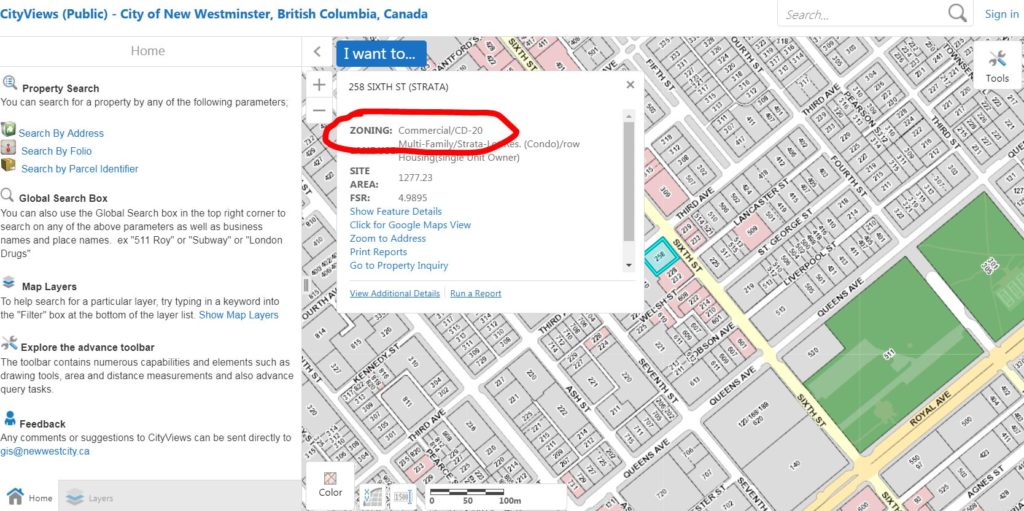
To do that, you go to the Zoning Map (sorry, you probably need Silverlight to do that, because it is 2018), and see what zoning district applies to the spot of land you care about. Just open the map, zoom/scroll to your location and click the property, a table with zoning on it should pop up (I circled in red):

Then you need to go to the comprehensive list (7 documents, 400+ pages) of zoning districts to see what the specific rules are. All this to say, there is no single rule, but a set of rules and local exemptions apply, so everything I say here is general and the only relation it has to your specific case is that it almost certainly doesn’t apply to your specific case. Zoning is complicated.

In generality, for single family homes the “side setback” is 10% of the lot width or 5 feet, whichever is less, but never less than 4 feet, although it may be possible for some non-wall to “project” into this setback in special cases. That not clear, but about the clearest case you can have.

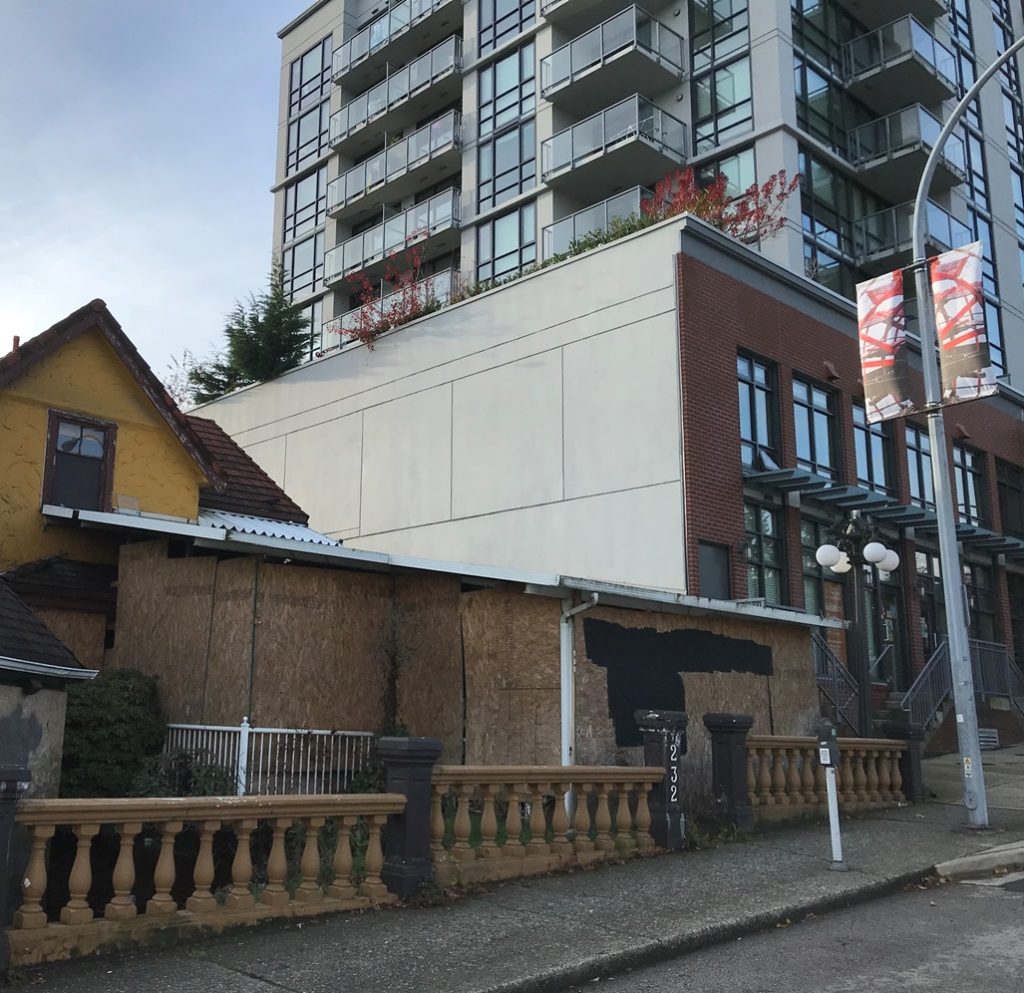
Condo buildings vary in their zoning type, depending on what type of building they are (townhouse or small apartment building or tower?). Some fit snugly in a Townhouse or Commercial District designation, others are “Comprehensive Development Districts”, which are stand-alone zoning rules developed to support a specific development at a specific site – and therefore have an address attached to them. The nearest one to where I am sitting now is the one I clicked on in the map above, which is CD-20: Comprehensive Development District (246 Sixth Street). This was put together in 2008 to permit a 16 storey residential tower with commercial “live-work units” at grade, now called 258 Sixth Street, just to complicate matters. It has no set-back requirement at grade, but setbacks above 9.14 metres (i.e. starting on the fourth floor) of 2.5m at the streetscape sides (to reduce the “mass” of the building as it appears from the street), 14.2m at the rear and 7.1m on the neighboring-building side (both to reduce the proximity to current and potential future residential buildings).

When you look at the building you can see that the lower part of the side was build, as most commercial buildings are, to butt up against a future adjacent building, while the upper parts are built to provide a bit of space between future residential areas:

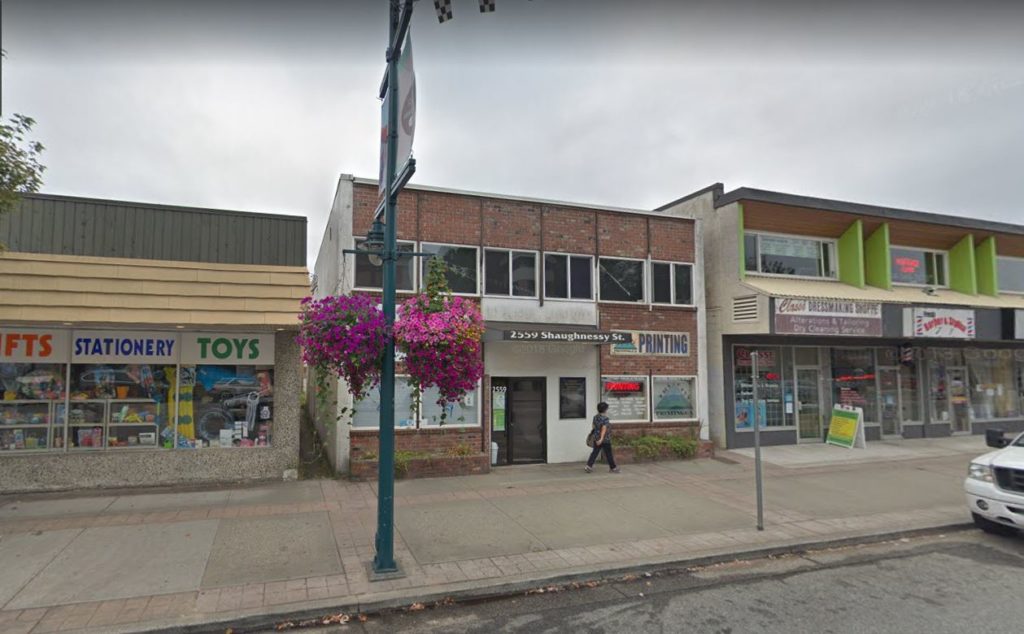
The reality is that the fixed rules are more commonly treated as strong “guidelines” based on best practices. For example, the general practice for towers is to have more than 30m between the “towery” parts of towers, and in commercial areas the best practice is to have no space between buildings at grade in order to create a cohesive, attractive, and safe commercial frontage, where gaps don’t make any planning sense (like this spot I recognized recently in downtown Port Coquitlam but failed to take a photo of, so thanks Google Street View):

Every Comprehensive Development District has its own character, as does each neighbourhood. Its shape and form of any planned building is impacted by the buildings that are adjacent to it and by the future vision of the neighbourhood based on longer-term planning guidelines like the Official Community Plan. However, all of these guidelines can be overruled by bringing a Development Plan and appropriate Zoning Amendment to Council and convincing Council there is a good reason to vary from the guidelines. Sometimes this means placing a tower towards one side of the pedestal in order to reduce the viewscape conflict with an adjacent building, sometimes it means the increasing the size of a setback in order to provide some community benefit like improved pedestrian realm or emergency vehicle access. These are the complicated maths that often require months or years of negotiation between our planning staff, the landowner, stakeholders and the community.

Perhaps that is the part of the entire development-approving process that most of the public don’t understand when they see a project come to Council for a Public Hearing. They see Council approving or denying a specific building, but in actuality it is a large and complicated stack of compromises (by than landowner and the City) and potential benefits built up over those negotiations that Council eventually is asked to approve or not approve.

So your building may have allowed zero setback as part of its zoning, or a zero setback may have been something the City wanted as part of the development to create a more amiable streetscape in the long term, or a zero setback may have been something the developer of your building wanted to maximize the amount of square footage they could sell. Likely at least two of these are true, or else it would not have been built like that.

Council – Nov. 5, 2018

We had a bit of a Council meeting on November 5th. The first meeting of a new term is limited to a few procedural matters that get us up and running as a Council, but there were decisions made so I may as well report on them.

Oaths of Office
First we had Oaths of Office required by regulation, which all of our Council managed to get through relatively unscathed. Even the newbies. And I pronounced pecuniary correctly after 4 years of daily practice.

Metro Vancouver Board Appointments
We officially appointed Mayor Cote to the Metro Vancouver Board, as is the general practice. Municipalities like New Westminster get a single seat at the Board, and it is typically the Mayor who serves that position.

We also name and Alternate to cover for the Mayor if they are not available. In New Westminster, the practice has been to allow the Alternate serve on one of the regional committees with an available spot for New Westminster. (e.g. for the last 2 years, I have been serving as Alternate and have been on the Metro Vancouver Utilities committee). We voted to appoint Councillor Trentadue to serve as Alternate.

Task Force Creation
The Mayor is setting up a new Task Force to give local economic development a little more focus than it previously had. This model – a Task Force with a clear mandate and financial support to do the work needed to bring new ideas to council, supported by staff and outside experts – worked well for Public Engagement last term (although our implementation is a little slower than I might like on that), and on ongoing issues related to Affordable Housing and Transportation.

Acting Mayor Appointments
Sometimes the Mayor is out of town or even (gasp!) on vacation. We always have to have a Mayor designated for some legal reasons around signing important stuff, emergency chain of command, etc. In New Westminster, we share this responsibility with each Council member “acting” two months a year in the event that His Worship is not around. As was the case in the previous term, my months are March and August.

Committees and Task Force appointments
The Mayor gets to assign us to committees and Task Forces as well. This does not include the myriad of Council advisory committees (those are yet to come), but more the legislative committees and Mayors task forces. I will be continuing to serve on the Transportation Task Force and Canada Games Pool Replacement Task Force, and will be serving in a full role on the Riverfront and Public Realm Task Force (after serving as an alternate for part of the last term). My time on the Land use and Planning committee has also come to an end –as we have tried to rotate that around Council members.

Zoning Amendment (1050 Boyd Street and 1005 Ewen Avenue) Bylaw No. 8033, 2018.
Finally, we adopted this Bylaw given Third Reading back in July, because it took until now to get Ministry of Transportation sign-off as required.


First real Council meeting will be on November 19th, and I am expecting a stuffed-full agenda!

How I’m voting on how we vote

Finishing up my own electoral stuff, it is time to move on to the referendum. It seems just yesterday that I was stumping for a Yes vote on a referendum plebiscite from my City Council bully pulpit – how did that one work out?

Nonetheless, I was asked about the Electoral System Referendum a few times during the election and I told people I didn’t want to get distracted while involved in my own campaign, but I would write something about it when the ballots come out. A ballot package is currently sitting on my counter, so here we go.

I am voting for proportional representation (PR) over first past the post (FPTP). The reasons for this are plentiful, and I have done a significant amount of research on this over the last few years, including during the aborted Trudeau campaign to change the federal electoral system. To keep this from expanding into a book-length blog, I am going to simplify a bit on a few key points.

The primary pro-FPTP argument that PR will bring extremists into power is a heaping pile of logical fallacy. In recent FPTP elections we have seen Doug Ford given 100% of the power to invoke the notwithstanding clause to punish his former City Council political enemies with only 40% of the vote. He says he was elected to cut taxes and slash public services when 60% of Ontario Voters voted for the exact opposite. Shortly after, the CAQ were given 100% of the power in Quebec to invoke the notwithstanding clause to pursue their anti-immigration and anti-free-expression campaign after garnering 38% of the vote. These are extremist views for Canada. A PR system may allow these voices into legislatures, but there is significantly less chance they would earn enough votes to achieve the power needed to shift policy towards those views.

Despite FPTP-supporter arguments, you will always have a locally-accountable MLA under any of the PR systems. Every system has you voting for a direct MLA representative as you do now, the difference is that all systems will give you at least one more second MLA who is also representing you. It is also likely this second MLA will be from a different party than your first MLA. Remember how during the Teacher’s Strike, all of those BC Liberal MLAs locked their office doors and refused to meet their constituents? Too often in an artificial FPTP majority, the job of that MLA is to represent the party’s interest to the community, not vice versa. When a government policy impacts your life negatively, it is important that you have someone in your community who can assure that your concern is carried to the legislature. PR provides this much better than FPTP.

Jurisdictions that use PR are more successful by almost any measure of good governance. There is a significant body of evidence from around the world about the results of different systems. Among OCED democracies, those that use some form of PR have consistently higher Human Development Index scores, have less income inequality, have stronger environmental regulation and are leading the world on addressing greenhouse gas reduction. The quality of life for their residents is higher and their electoral participation levels are higher. It is almost as if these two things go hand-in hand. This is why the PR argument is so much about “making your vote count” – it results in governments adopting policies that appeal to a broader range of voters. Who could possibly be against that?

These arguments aside, I was caused to step back and look at this situation in a different way a few months ago when I was chatting with MLA Bowinn Ma on a SkyTrain trip. Memory being what it is and she being much more nuanced and eloquent than I, we can call this a paraphrase. She pointed out that every argument for FPTP was about who would take power after the election, while every argument for PR was about how we can make more votes count. This is a simple but profound difference in vision for what we are trying to achieve through democracy. I believe the latter is a better, more hopeful vision, which is probably why I find their arguments more compelling. I hope this referendum will give us an opportunity to reach for that better vision.

The second question asks which of the three proposed PR systems I would prefer. Here is where it gets tougher. I am going to list in order of my preference, but recognize that no one system is perfect (but none are as imperfect as the current FPTP system).

Mixed Member Proportional – This is the most tried-and-true proportional representation system. In BC, it would mean our ridings would grow a little in size, and every riding would have an MLA elected by FPTP like they are today. However, ridings would be clumped together into small regions of several ridings that would have regional MLAs. You would be able to vote on that regional representatives, but the persons serving that role would not be elected by straight FPTP, but allocated to make party representation across the province match that of the overall vote. The ballot can be simple, the change in our ridings is minor, and PR is achieved. This wins in the balancing simple and easy to understand while also giving you an opportunity to vote for a great local candidate who may not be with the party of the Premier you want to see elected.

Dual Member Proportional– This is a system modified for Canada, where most ridings are merged into two ridings, with on MLA elected on the current FPTP system, and a second appointed based on electoral results in order to balance party representation across the province. This seems to be intended to simplify the ballot (you only vote once), but otherwise has no advantages I can find over MMP. You lose the ability to vote for Party A but an outstanding local candidate for Party B like you get from MMP – in other words, this forces you to choose a great local rep OR a party affiliation, but not necessarily both.

Rural-Urban Proportional– This hybrid system mixes Single Transferable Vote for the “urban” parts of BC, expanding ridings to 4-7 MLAs and a ranked ballot to allow you to vote for as many or as few as you might like, and a Mixed Member Proportional system (top) for rural ridings. I can see where this idea appears – it provides sophisticated urban political nerds like me an appealing ranked ballot, but also assures the rural ridings of the province won’t feel like they are losing their disproportional representation in Victoria. I dislike it for both of those reasons, and it being the most complicated system, I don’t think it will really be embraced by the voting public.

So put me down for Yes and MMP. I honestly would be happier with any of the three options than I am with FPTP, so the second question is really rather…uh… secondary. But please fill it out, because it is fun to fill our ranked ballots, and because I want to do everything I can to support the government having the political will to make this change.

#NWELXN18 – a wrap

I have gone through the numbers of the recent election in a couple of posts, (here, here, and here) but I did so recognizing that I was perpetuating a trope that plagues democracy in North America (and perhaps the world?) – looking at politics like it is just another a sport. Line scores and a zero-sum-game of winners and losers are the easiest and laziest way to report on elections. It leaves little room for the more important discussions we should be having during an election: the debate of ideas and values and visions for the future.

I need to say that this has been a difficult blog post to write. There are a couple of 1,500-word drafts that have been deleted, because they all fell into the mode of being an us-vs-them analysis, and were more critical than helpful. I spent most of the last three months biting my (digital) tongue and not reacting to the messages of those who would have rather they be elected than me, because I wanted to avoid being drawn into a useless spat everyone would regret. It would serve no purpose (other than a little personal catharsis) to go there now.

**That said, I feel the need to stick one of my regular caveats here where I say all of this is my opinion, not the opinion of my council or election colleagues, City Council, the City, or any rational person or organization. If you disagree with me, let me know!**

This slipped once during the campaign when I made a reference to Daniel Fontaine, in reaction to a pretty ham-fisted attempt on his part to demean me on his blog, using what I think was an appropriate amount of dismissive humour, but then following to point out how disingenuous the hit piece was:

Trust me, the hardest part for me this election was not reacting to opponents on-line. There were many drafted-then-deleted tweets. Maybe I’m growing up.

But what was this election about? Other cities had clear narratives (Surrey wanted someone to deal with crime, Burnaby was about the need for housing, Port Moody about slowing the pace of development), but what was the New Westminster election theme?

After the fact and looking at the numbers, it is easiest for me to take the message that voters are generally happy with the way the City is being run, and were not as interested in change as in some of our surrounding communities. This reflected what I heard on the doorstep during three months of doorknocking, and what I heard in a thousand small conversations I had during the election. Things are not perfect, there are definitely things we could do better, but for the most part, things are headed in the right direction, and few are interested in a big shift in direction.

In the end, our main opponents must have heard that as well, and were challenged with messaging “things are mostly OK” along with the “time for a change” idea. In the end, they fell back on the familiar and tired narrative that New Westminster is run by organized labour in a poorly-defined but somehow nefarious way. This is the same narrative that James Crosty used to no success in New West for several elections, and the old Voice New West relied upon. Like running against bike lanes in Vancouver, this campaign message is exciting to a group of people in the City and gets amplified every election by the local media, but has never been one to motivate voters to come out and create a change. New Westminster happily votes for Labour-affiliated and NDP-affiliated candidates enough to elect them, and have done so in increasing numbers in every election for the last decade or two. This is why orange signs were a cynically good idea.

To the credit of my colleagues and voters, the winning candidates never stopped talking about the important issues to New Westminster – housing, transportation, inclusion and accessibility in schools, and livability of our community. They also worked hard to knock on doors and meet people. When I look at the new names at the top of the polls – Nakagawa, Ansari, Beattie, Dhaliwal – these are the candidates I saw out there every day earning votes with shoeleather and ideas. On election-period effort alone they earned every vote they got.

There was one big difference between this election and the previous one – the remarkable shrinking of the media space. Last election there were four (4!) local newspapers a week in New Westminster, now there is one. At the risk of poking those who buy ink by the barrel, there was not a tonne of coverage in the last few weeks of the election in the lone paper standing.

Since Labour Day (when the public starts properly paying attention to the campaign), there were a few news stories that announced the new candidates as they trickled out, a couple of pieces covering NWP messaging around how unfair the entire election process was, and not a lot else. The two substantial pieces were an October 4th quote-mining review of two All-Candidates Meetings (which strangely emphasized May Day as the biggest issue), and a really excellent 2-page spread on October 11th on diversity. However, through the entire election period there were no printed candidate profiles, not a single article discussing housing policy, infrastructure needs, transportation challenges, or any of the other top issues that might have informed voters about contrasts between what different candidates were offering. The final edition before the election (October 18th) had a single opinion piece admonishing people to vote, but no other coverage of the election or issues at hand. I don’t remember being asked a single election-related question by a single reporter between Labour Day and the close of the polls.

I recognize there are limited resources and limited column inches in one edition a week, and there was more material available on-line, but even that discussion was dominated by discussing the process of the election, with paltry discussion of policy issues. The emphasis on click-baity open-question headlines on Twitter and Facebook probably just worsened partisan bickering between supporters instead of actually inform on any issue. Indeed, here is where I missed the old Tomkinson-era Tenth to the Fraser that provided a really strong and well-curated online discussion. I suspect print is still more important to a significant number of voters than on-line content, and I can’t help but feel that the Burnaby Now side of the local Black Press Glacier Media office got a lot more attention, and their election got more column inches. Perhaps their election was more exciting.

So what now? The things I tried to talk about during the election are still my priorities after the election. We need to continue to improve how the City communicates and engages the public, and I want to have a serious talk with the provincial government on reforming the Public Hearing process. We are already leading the region in affordable housing policy, but have no intention of taking our foot off the gas, and will work to get new funding and new policy levers provided by the province (such as Rental Zoning) working for us locally. On transportation, I want to push a conversation forward about changing the culture in our roads. I want us to prioritize making vulnerable road users feel safe at all times. It is time for us to grow up and talk honestly about the goals of our transportation plan, which is not the destructive (and ultimately self-defeating) goal of “getting traffic moving”. 

Of course, I am just one of 7 on Council, and finding consensus on strategic plans for the next 4 years will be the main conversation for the next couple of months. Stay tuned!

#NWelxn18 – poll-by-poll

The final election results are out, with poll-by-poll results. This gives us an opportunity to infer a bunch of things about the election. Note that this is more like reading tea leaves than defensible analysis, because anyone in the City can vote anywhere during a local election. We don’t know if the typical Queens Park Voter cast their vote at the Armoury, Glenbrook Middle School, or in an advance poll at the Lawn Bowling Club or City Hall. It is somewhat safer to assume mostly Queensborough voters voted in Queensborough, and the Pensioners’ Hall probably captured most of lower Sapperton, but where did Downtowners vote? There is a lot of fuzziness here, but here is a poll map:

Messy data doesn’t prevent me (or some other local blogger) from trying to glean insight from it.

This table shows the poll-by-poll vote for City Council. I marked the winner of each poll in dark green, the second place in medium green, and the rest of the top 6 in light green. Orange is for the 4 people who finished just below the threshold:

No surprise here that overall winner Nadine Nakagawa won the most polls with 13 – she not only won the popular vote, she won the Electoral College! She was also the only candidate to “place” (finish in the top 6) in all 20 polls. She dominated. Mary Trentadue and Daniel Fontaine each won two polls, with myself, Jaimie McEvoy and Chuck Puchmayr each winning a single poll. I had far and away the most second place polls, and all of those elected “placed” in between 18 and 20 of the 20 polls.

Team Cote candidates dominated almost every poll, except in Queensborough, and (arguably) Howay – the poll used mostly by Massey Victory Heights residents – where the New West Progressives (NWP) had a solid showing.

People paying attention to the campaign will have noticed that the NWP put a lot of effort into Queensborough, stoking some discontent around a few long-standing neighbourhood grievances, and benefiting from support of a small but vocal group of Temporary Modular Housing opponents. Team Cote members also did a lot of work in Queensborough (I personally knocked on hundreds of doors there), though we can look back now and say that the ~200 vote gap between the best NWP candidate and worst Team Cote candidate in that neighbourhood was hardly a factor in the overall election result.

For the fun of it, I looked at what percentage of their total vote each candidate received in the advance and special polls:

Interesting that Team Cote candidates received between 21% and 22% of our votes in the advance polls, NWPs around 20%, and others under 20%. I’m not sure if this relates to the relative get-out-the-advance-vote efforts, but it seems a consistent trend.

School Board data looks a lot like Council results, though perhaps a little more diffuse:

Overall winner Anita Ansari won 11 poll of the 20 polls, with Dee Beattie winning three and returning champions Mark Gifford and Mary Lalji each winning two. Queensborough resident Gurveen Dhaliwal won both polls in that neighbourhood. Beattie was second in most of the polls she didn’t win. NWP candidate Danielle Connelly didn’t win any polls outright, but did finish 2nd in three of them. Ansari was the only candidate to place in the top 7 in all polls, although Beattie only missed one (the Q’boro advance poll) as did Connelly (the Special Poll for hospitalized voters). Also note that the Team Cote candidates finished in alphabetical order – likely a coincidence, but fun to speculate about.

Mirroring the Council result, the NWP candidates did better in Queensborough than any other polling station, but also clearly had good success at the FW Howey poll in Massey Victory Heights, along with Mary Lalji. The standout among the others was Alejandro Diaz, whose success seemed to track along with Team Cote success better than the NWP, suggesting he was the most popular “6th vote” for those who voted the Team Cote ticket, where Lalji had stronger results where Team Cote did less well. Again, the Advance vote percentage closely mirrors that of Council:

I’m not going to say to much about the Mayor’s race, because it was a blowout by pretty much any measure. Cote finished with less than 70% of the vote only in two polls (Queensborough and Howey), and won more than 80% in his own neighbourhood. Nikki Binns was clearly the second most popular candidate:

Outside of the statistical analysis, I am struggling to write a piece about “what it all means”. As someone who did well in the election, I don’t want to be seen as punching down in my analysis of why others didn’t do well. I have had a lot of conversations with different people since the election, and have heard a lot of opinions about the result. I am tempted read into New Westminster bucking the general regional trend of this being a “change election”, as seen in Port Moody, Vancouver, and Burnaby as a testament to the good work this Council has done, but getting out of my bubble a bit on this will be a challenge.

Bonus chart: Since I mention the quirk of the alphabet order of the top 5 in the School Board election, I thought I would do a quick scatter chart of election results and order the names appear on the ballot. Blue is Council and red is School Board (with best fit lines and R² provided by Excel):

The Council result is close enough to random to be considered so, but you could convince me there is something going on here with the School Board ballot…