Myths and Lies

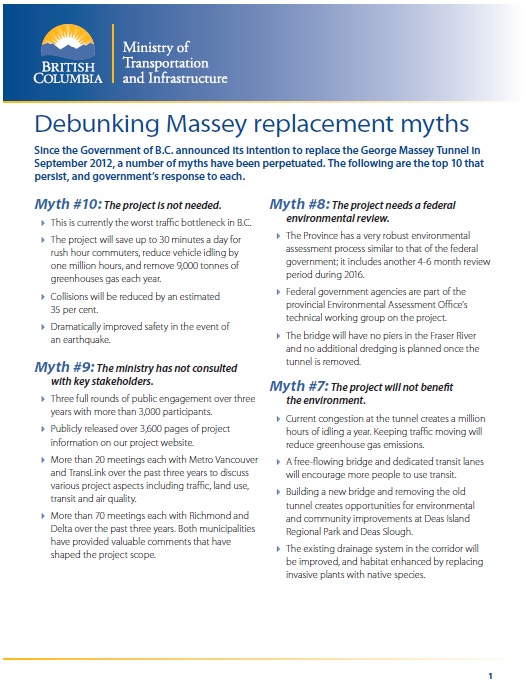
There is a lot going on right now in the transportation file in the Lower Mainland, both good and bad news, and I can hardly keep up, never mind blog about it. So while the local radio stations stoked anger a couple of weeks ago about another TransLink “outrage”, I had something completely different to get angry about: this “Fact Scheet” produced by the provincial government in regards to the Massey Tunnel replacement project:factsheet
After venting into a Word document, I put it aside and relaxed. Writing is good therapy, and I figured I would edit it up and make use of it later. Anger abated, back of mind, life goes on. Then last week I was triggered to pull it back out by this post by Transportation Economist Stephen Rees (someone you should be reading – his knowledge and insight are unique and powerful), and his writing:

I must admit that when I read it I became almost incoherent with rage.

Amen, Brother.

Why “rage” about a seemingly innocuous two-page fact sheet produced to hard sell a key government project to the business community? Because almost every proclaimed myth-busting point presented on this definitive piece of Government paper is a lie. A stinking pile of bullshit that anyone who has spent any time learning about transportation policy in the western world over the last three decades can smell from a mile away. And it is printed on Government letterhead. I’m angry that either people in the Ministry of Transportation don’t know it is all bullshit, or they do know and are still willing to publish it. I’m not sure which is worse.

That last paragraph may seem inappropriate to some of my readers (Sorry, Mom!), but please let me assure you, I use the term bullshit in the strictly technical sense of the word. And someone needs to start calling this government out on their lies.

The “myths” hit the news two weeks ago when the Minister presented his case for a 10-lane bridge to the relatively receptive audience of the Richmond Chamber of Commerce. At the event, he was suggested to have “busted” some myths about the project, being spread by what he called “rumour-mongers, conspiracy theorists and those with apparently ill-informed opinions”.

Let us look at the Myths seemingly busted:
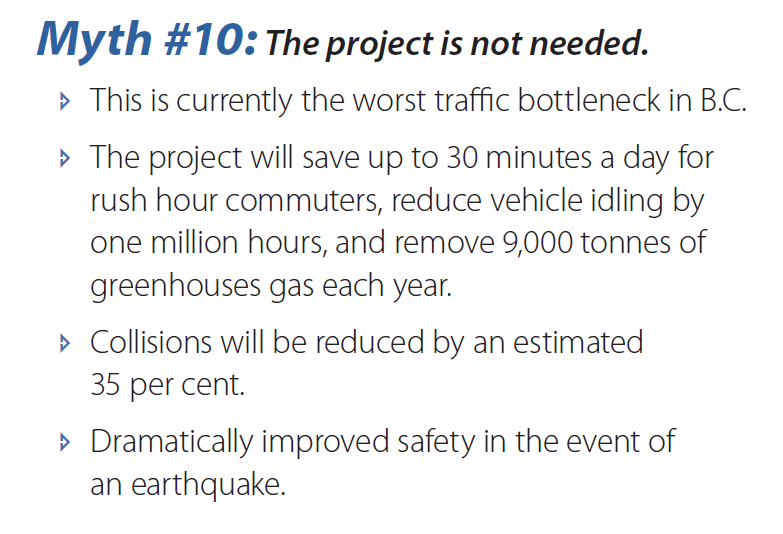
myth10

If we define “The project” as a 10-lane high level bridge, then clearly it is not the only solution to the problems presented here. Traffic congestion in the tunnel has been demonstrated to be getting better, not worse, over the last decade, and the Ministry’s own data shows that 87% of vehicles in the tunnel are cars (almost all single-occupant) while more than a quarter of the *people* going through the tunnel are in the 1% of vehicles that comprise the inadequate transit service through the tube. Providing better options for only 15% of the people who use the tunnel would virtually end congestion, leaving a bunch of money left over to finish the work to make the tunnel earthquake safe again. Saying “we need to do something” is not the same as saying “we need to do this thing”. This project is not needed. Myth not busted.
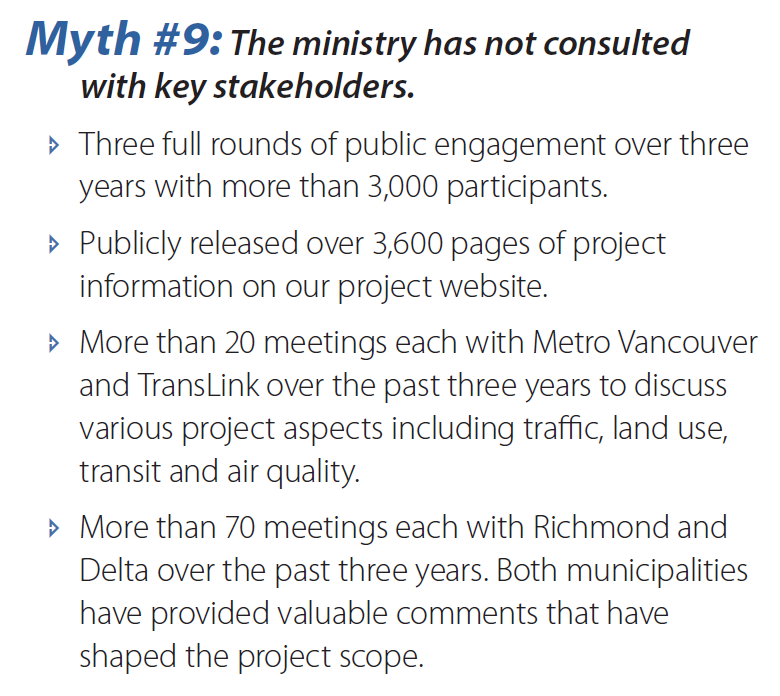
myth9There is no doubt the Ministry has talked to many people, but to say they have “consulted” is quite the stretch. The City where the majority of the project has taken place is claiming they have not been listened to, and are not in favour of the project, the regional government is opposed, as are all of the local governments (save one). No defensible business case has been presented answering for the project. The parts of the “3,600 pages of Project Information” that referred to costing and SWAT analysis were redacted.

One way to tell that “consultation” has not occurred: No aspect of the plan has demonstrably been changed to address the concerns of people consulted since this 10-lane bridge solution was first presented to the public. They started with a 10-lane high level bridge solution, and ended at it. Myth not busted.myth8
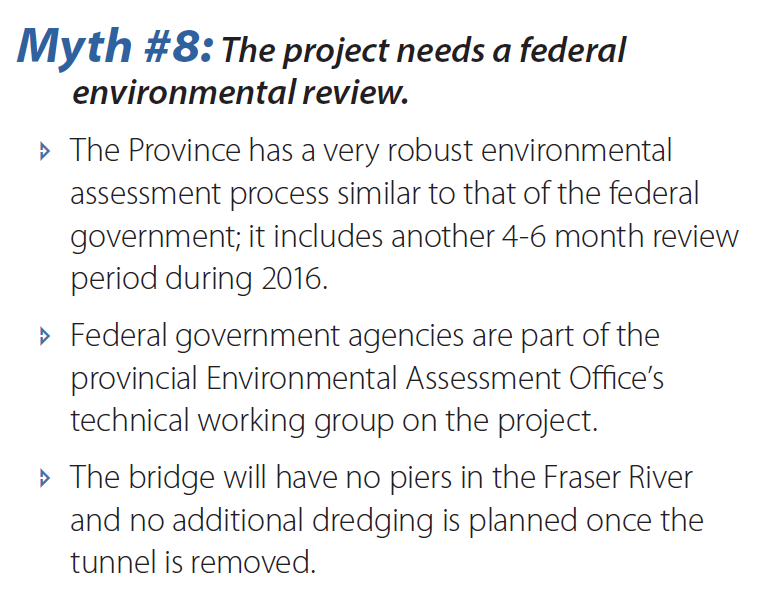
They are right, no Federal Review is required by current legislation (assuming that other accessory projects like removing the old tunnel and re-routing of the BC Hydro line that uses the tunnel are separate projects). This is because the gutting of the Canadian Environmental Assessment Act by the Harper Conservatives in 2012 significantly cut back on Federal Review guidelines. Myth busted, but probably not something to be proud of.
myth7

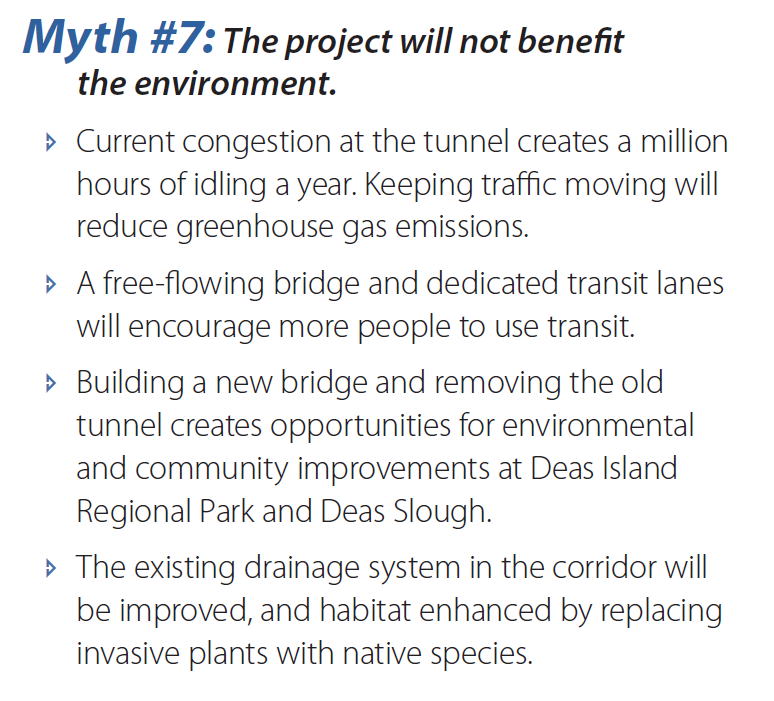
What a steaming pile this is. “keeping traffic moving to reduce GHG emissions” is a perfect example of bullshit: it’s not wrong, it’s just stupid. Ways to reduce GHG impacts of transportation have been studied to death, and yes, idling reduction (depending on conditions) can reduce gas consumption per kilometre, but it does not reduce GHG emissions anywhere near as much as dozens of other available techniques, including modifying trip-making choices, increasing vehicle occupancy rates, shifting (freight and passengers) to more efficient modes, compact community planning, etc. etc. – policies that are directly undermined by this very project! Claiming that “free flowing traffic” induces transit use boggles the mind. The other “improvements” and “enhancements” listed here could easily be funded at a fraction of the cost of building a $3.5Billion bridge, without the boondoggle hanging over it. Why is planting a tree contingent on laying asphalt, what does one have to do with the other? Myth not busted.
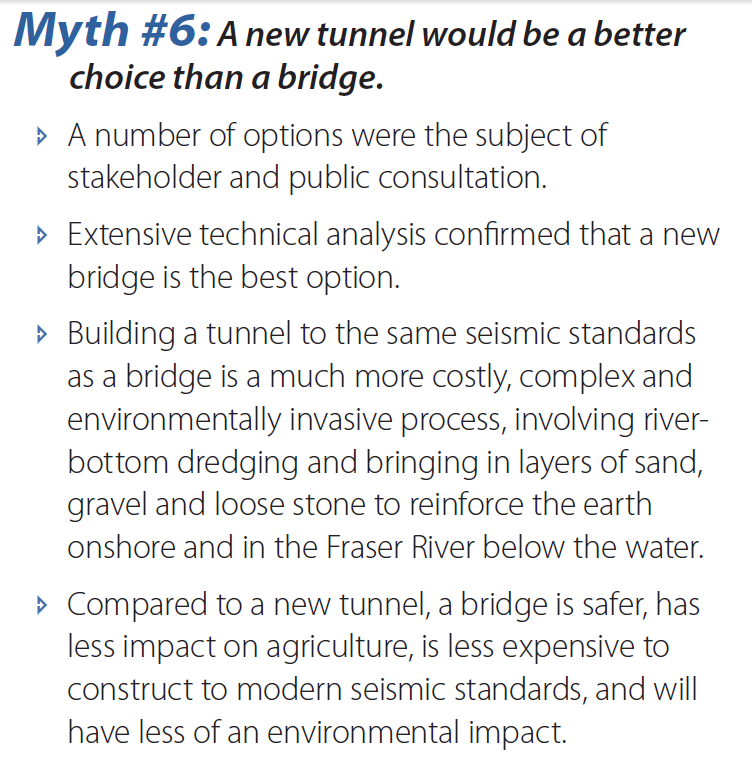
myth6This may very well be true. But you know what is cheaper than building a new tunnel and cheaper than a new bridge? Making the infrastructure you already have work better. One of the more galling parts of this entire project is that no-one seems to be looking at the opportunity cost of a $3.5Billion infrastructure investment – what real improvements could we build to the regional transportation system with that kind of money. Perhaps start here.  Myth busted, not that it is relevant to the argument.myth5
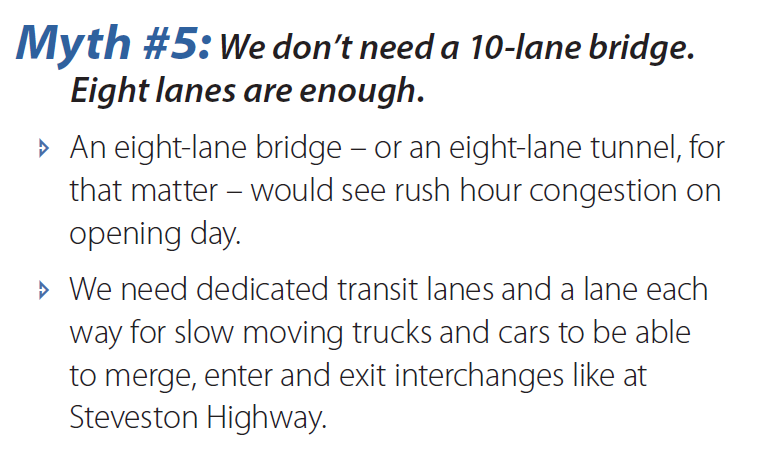
Seriously. The Ministry is arguing that the route that now has 4 lanes will be congested on opening day if it has 8 lanes, but will allow free-flow until 2040 if it has 10 lanes. Chew on that for a bit. Just let the magical thinking sink in. Then remember, these are the guys who projected traffic demand for the Port Mann. Myth not busted.myth4
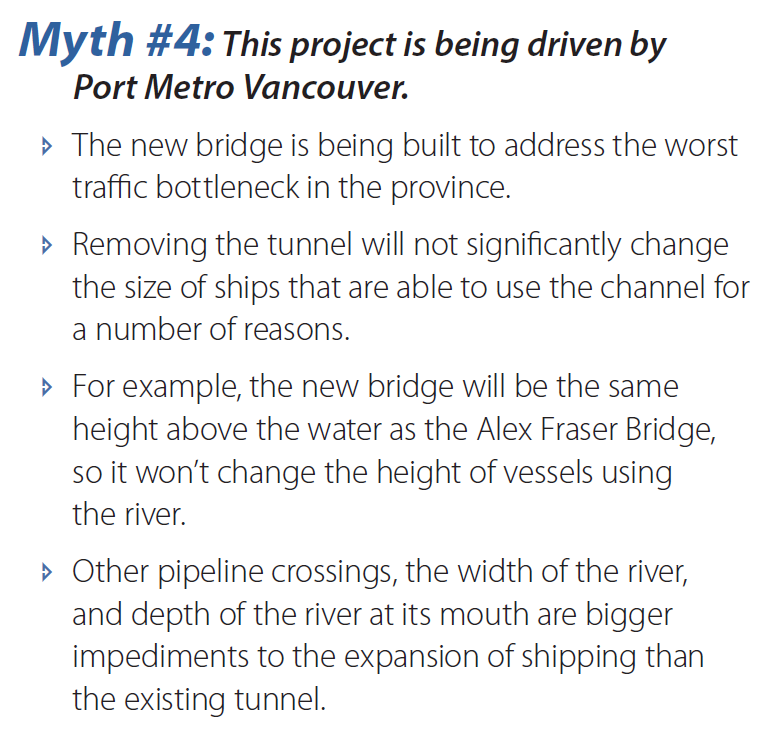
There is a lot of creative work here to not directly address the assertion that is being made. The bottleneck is irrelevant to this point (as we know there are too many other more affordable ways to address a bottleneck that is 85% single occupancy cars). The height of the Alex Fraser is irrelevant as well, as that is not currently a limit to crossing the tunnel. The word “dredging” is not raised at all in this retort, nor the evidence that deeper dredging in the river is a long-established goal of the various port authorities and port operators on the south arm, or that the tunnel is currently the largest impediment to a deeper channel. Myth not busted; Myth deftly avoided.myth3
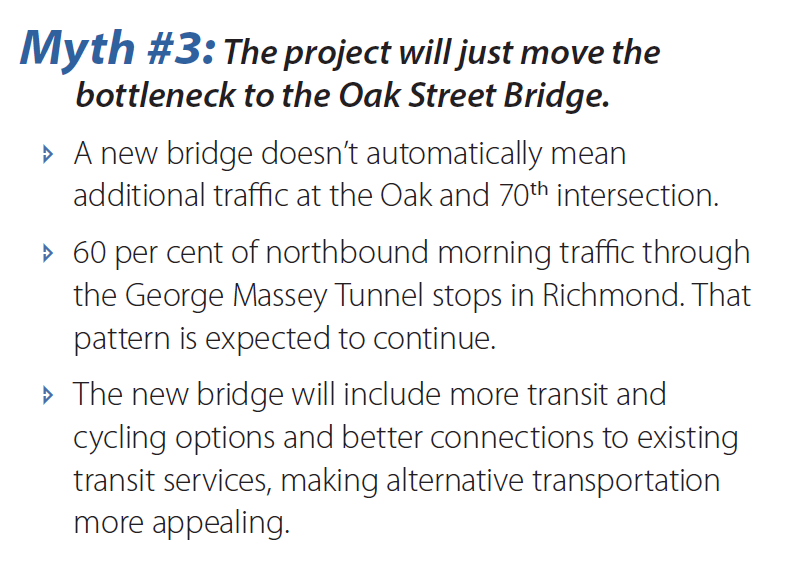
This is the “myth busting” that caused Stephen Rees the most rage, because it is completely separated from reality, the reality that he has spent a distinguished career studying on two continents. There are no transportation planners, transportation economists, transportation engineers, or rational human beings who believe that more than doubling the capacity at the tunnel will not increase traffic congestion at the Oak Street Bridge. Their denial of this basic reality is simply a lie. To get the count of “60% stops in Richmond”, they had to count all of the traffic leaving the 99 to go on the East-West Connector and the Knight Street Bridge as being “Richmond” traffic. And yes, those routes will also become more congested, calling for more future “improvements”, because of the induced demand this project will bring (more on that under Myth #1). Myth not busted.
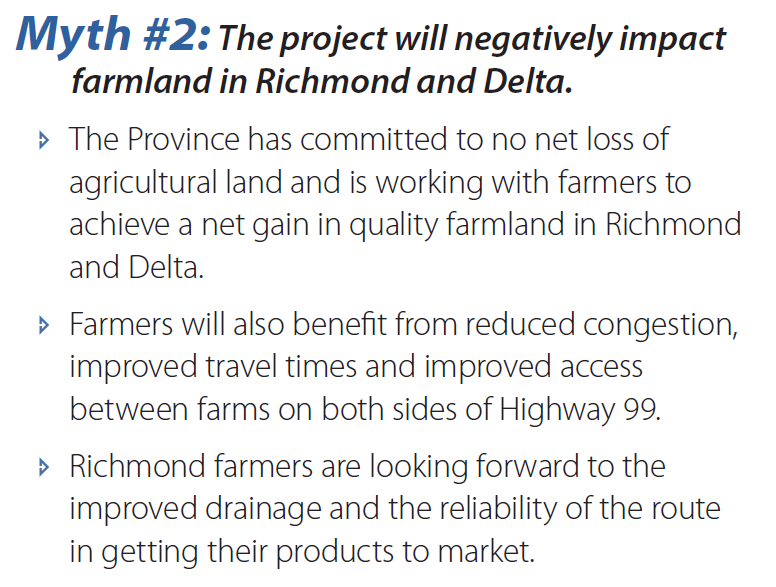
myth2Did you know that Highways are allowed in the ALR? Much of the South Fraser Perimeter Road is actually in the ALR, no exclusion necessary, just compensation paid to the property owner who has his acreage bisected or cut off. So the Ministry can put the entirety of this project on ALR land and claim “no net loss” of ALR land- although admittedly it is hard to farm asphalt.

I cannot find any evidence (outside of Ministry pieces like this) that farmers on either side of the river support this project, nor does their business case or other consultation material explain how putting hundreds of acres of farmland under asphalt could result in “net gain”. I have read stories of farmers expressing concern about various aspects of the project. I have also heard farmers speaking about the increased pressure on farmland, the inability to afford to farm on farmland with price speculation pushing up farm land prices because of projects such as this which encourage auto-oriented sprawl in valley communities. I have also read about the Port buying up farmland in Richmond to build cross-docking facilities that will be linked to this project with shiny new roads. Myth not busted.

And to top it all off:
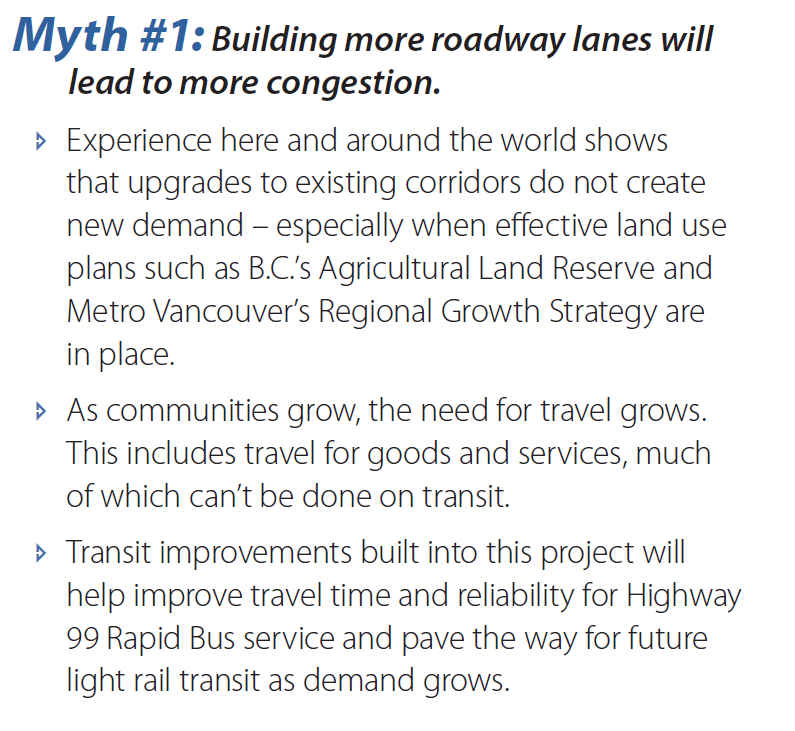
myth1

This is pure, unadulterated bullshit. If the Ministry of Transportation can show us an example (from their alleged “experience here and around the world”) from a growing industrialized economy where adding highway capacity has not resulted in increased highway use, they should bottle it and sell it to Los Angeles, or Dallas, or Houston, or Atlanta, or freaking Hanoi. This magic solution to congestion will pay off better than LNG. That increased capacity equals increased congestion is such a well-established concept in transportation planning that it is actually called The Fundamental Law of Road Congestion by the people who study this stuff as an academic discipline. To deny this is to deny gravity, or evolution, or the atomic model. Myth not busted, but supported by a Fundamental Law.

On this blog, I’m trying to be solutions-based. I often write things that sound critical as a search for solutions, as a way to force myself to look deeper at issues, do some research, understand the counter-arguments against my point, so I can do a better job when I have to make a decision. The Q2Q bridge is an example where I am less and less certain about how to move the project the more I learn about it. Although I am still hopeful we can find a good solution, I am increasing cognizant through stages of planning and public consultation of just how complicated a project it is, and that no matter what we do, someone isn’t going to like it. And I’m trying, really hard, to stay realistic and evidence-based on this project. When I point out numerous flaws to one specific approach, it isn’t just to be a boo-bird or support “the forces of NO”, it is to challenge assumptions and try to understand *if* the idea will work, which is often easiest to do by figuring out why it won’t. That is, I suppose, a result of my training in science, where we work to find reasons to reject null hypotheses. Or maybe I’m just a detail-mining jerk.

Then I get confronted with a project like the Massey Tunnel Replacement. This is a project with no reasoned justification, no supported business case, no alignment with any other regional plan or transportation initiative. It is a megaproject that stands in opposition to regional growth plans, regional transportation plans, and provincial and federal GHG reduction plans, and will undermine them all. It’s a bad idea at a bad time, badly presented for bad reasons. It is a bad idea so bad even most of the arguments against it are bad, but are still better than the arguments for it. And this is why I get angry even writing about it.

That is what your money is building, folks, a 10-lane $3.5Billion concrete edifice to bad ideas, now being bolstered by bald-faced lies by people you are paying to tell them to you. If you are not angry about this, you need to start paying attention.
Community – Ides of April edition

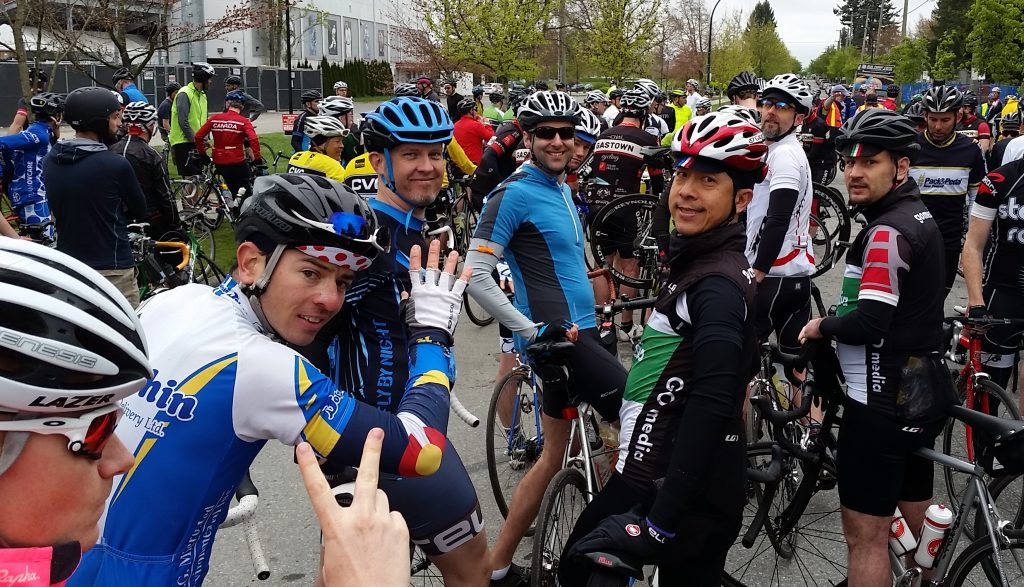
I’ve been busy. Not the least with riding in (and recovering from) my first long bike ride of the year. The Pacific Populaire is 100km, 700+ riders, and on a beautiful spring day like we had last Sunday, pretty much the best 4 hours a person can spend. We had a great turnout from the @FRFuggitivi which bodes well for the cycling season ahead!

The Fraser River Fuggitivi, and a few hundred friends.

Since my March 27th post, here are a few other things that have kept me busy.

We had another meeting with the Youth Advisory Committee, where representatives from the City’s Bylaws department and Fraser Health talked about smoking. Not the usual “why you kids shouldn’t smoke!” stuff (the youth of today are smarter than we were at that age about addictions and peer pressure), but to have questions about smoking enforcement answered for them. Mostly, they want more and better enforcement of anti-smoking rules, want to know why people can smoke in parks or at SkyTrain stations, things like that. It was another one of those generation-divide type conversations, and I’m not blowing smoke when I continue to say that these meetings are really educational and inspirational for me.

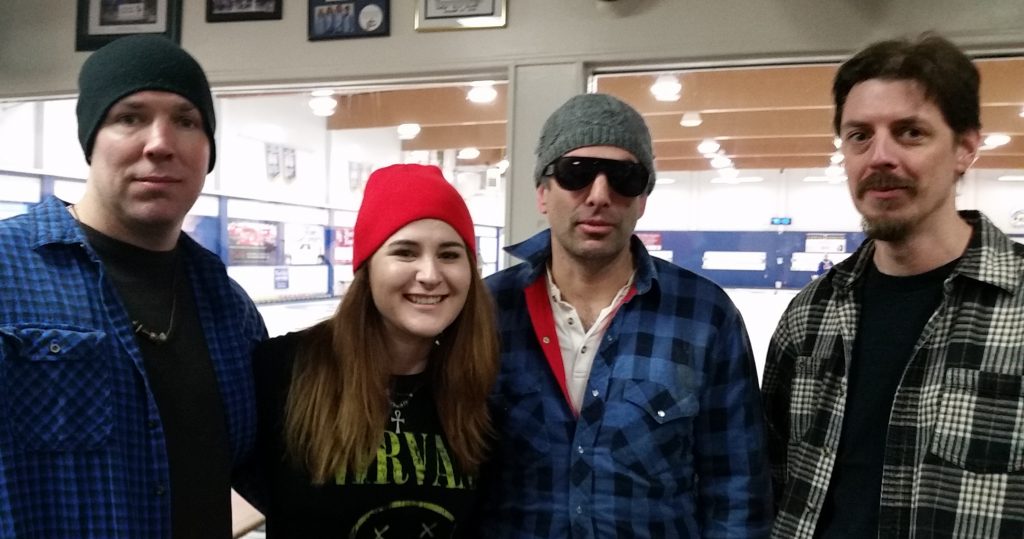
The Royal City Curling Club had its annual DonSpiel- the last event of the curling season, and a good time for all. I was not on a team this year (too many things scheduled that weekend) but was able to pinch hit for one game. The theme this year was Team Jerseys, so the team for which I was asked to spare with chose to go with a grunge theme and call themselves “Curl Jam”. We won, we had fun, and we got a great pic for the back of our next Cd!

Curl Jam. We hurry hard for no-one.

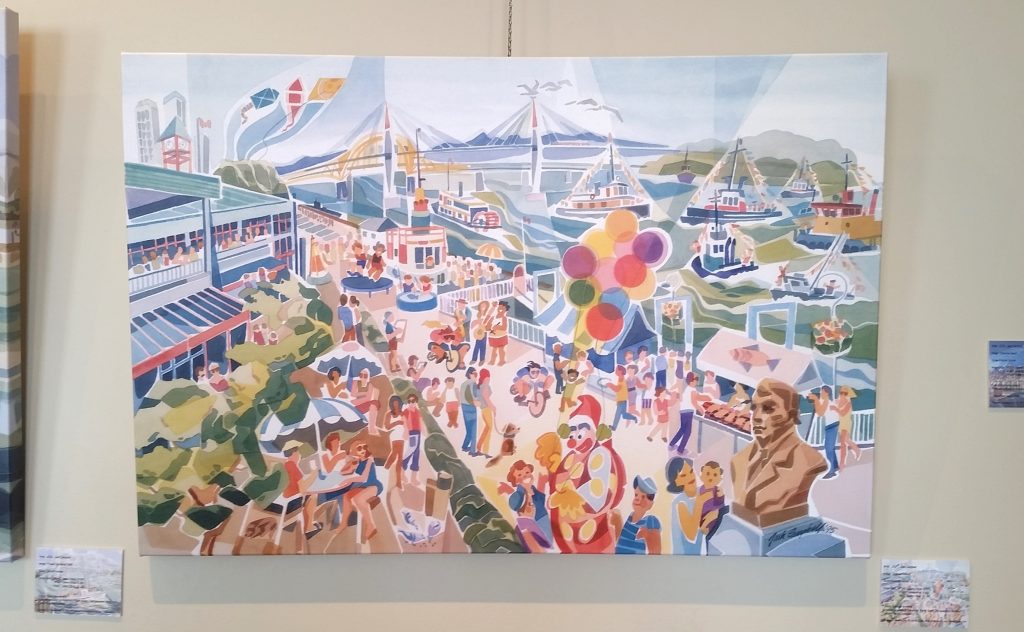
The same weekend, I attended the opening of a showing of Jack Campbell paintings at the Plaskett Gallery at Massey Theatre. I wrote a blog a couple of years ago when Jack died remembering my sometimes neighbour, and I am really happy that the Massey Theatre Society decided to show his works this month. It is on until April 28, and worth a visit, if only to get a sense of what New Westminster’s waterfront looked like though an artist’s eyes in the decades past.

I recognize that place!

I attended an event at Douglas College where a group of marketing students presented their semester projects, as a part of a partnership between the College, Envision Financial, and local not-for-profits. The student teams are matched with an external NFP that needs to solve a marketing, development or promotional problem. The students get real hands-on experience, the NFP gets the benefit of solid advice from people trained in marketing and promotions, and good things result. This year’s teams talked about their work with the Chrons and Colitis Canada, the Royal City Curling Club (them again!), and the Eagle Ridge Hospital Auxiliary Thrift Shop. This is a great program, and an example of how Douglas College is really stepping out to make a bigger impact on the greater community. Kudos to everyone involved.

Speaking of Kudos, the New Westminster Police Department had a banquet to thank their volunteers last week at the Anvil. You may not have realized it, but the NWPD have more than 100 volunteers, who contributed more than 15,000 hours in volunteer service in 2015, in outreach, crime prevention, victim services, and other functions. We are a small town, and are lucky to have our own police force that understands and can concentrate on building our local community, but their work would be no-where near as effective or affordable without the efforts of people like Bruno Bersani and Alana Dochtermann, who each volunteered over 280 hours in 2015!

While at the Anvil Centre, I dropped by the opening of a new show at the New Media Gallery. The collection is called Germinal, with three pieces around themes of animal/human hybrids, and freak evolution, and genetic migration and… subjects that might make people a little wierded out. There is a large video collage, a mesmerizing projected work where genetic algorithms are used to create and modify words, and a very cool interactive video work where you can get your animal face on. Well worth a visit!

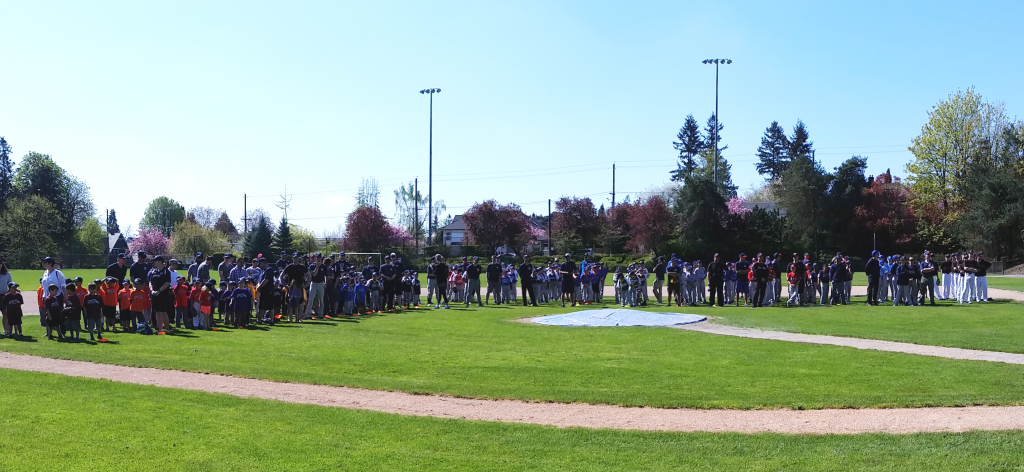
This past weekend also saw the 65th annual Opening Day of the New Westminster Little League season, where Councillor Trentadue took the role of Acting Mayor and threw her patented off-speed sinker across the plate, a pitch that would have surely induced a swing and a miss. The woman has skills. It was a beautiful day at Queens Park stadium! baseball

There was also a Fundraiser for the Royal City Farmers Market held a 100 Braid Studios. I was able to try my hand at painting with wine, see some of the works of the resident artists at 100 Braid, and help raise a little money for the best little Farmers Market in the region (we are less than a month from the Tipperary Park opening for 2016!)

We used the same wine, MsNWimby used talent..

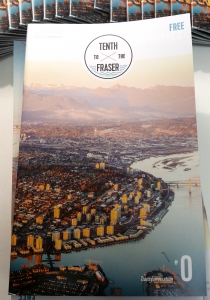
Finally, the start of April also brought an entire new and exciting venture to New Westminster. You all know Jen Arbo and Tenth to the Fraser, the website, but you may not know she has been working with a team to expand the 10th media empire. A print magazine with the same title was just launched with an “Issue #0”. It is a slick new format, really well produced, with a plan to give local writers, artists, photographers, and other artists a medium to add to the conversation that is already occurring at TenthtotheFraser.ca.  I am totally not unbiased here, I have a great interest in seeing this idea fly, because there is a need for a breadth of voices in this community, and because I think the printed word still has a market. The key to me is to respect and challenge the audience by producing high-quality content, and I think “Issue #0” is a sign of good things to come.

Sure to be a collectors item.

If nothing else, the Launch Party at 6th Street Pop-up was a great event where much, much fun was had (see top of post).

ASK PAT: road pricing

Wes asks—

I’ve heard a lot recently about road pricing, as a means to fund transit and road infrastructure. What does this actually look like ? Ts it transponders and sensors all over the Metro area? Is it simply a declaration at time of insurance renewal of Vehicle KM last year and current Vehicle KM ?

I think the short answer to this question is we don’t really know yet, but we can make a pretty qualified guess.

In my earlier posts, I talked about how the “$1-toll-for-all-bridges” idea could be refined into a more practical regional road pricing model. This model would expand the Port Mann / Golden Ears transponder and licence plate scanning model to maybe a dozen locations at logical “pinch points”. That is a quick and dirty way to make it work, and uses proven technology and bureaucracy that already exists. I don’t think anyone thinks this is the long-term solution, but it is a move we can get going very quickly and get the public used to the unpopular idea that roads aren’t free, if we have the political will to make it happen.

The long-term plan is something that is discussed in the Mayor’s Plan, but was blithely ignored by the media and Bateman during the Plebiscite. The plan was very clear that the sales tax was a 10-year cash infusion for capital improvement to build the required alternatives prior to the implementation of a proper road pricing model. The plan was for increased user revenue and road pricing to increasingly fill the revenue gap to allow for continued development of the system:

“LONGER TERM: Staged introduction of mobility pricing on the road network Over the longer term, the Mayors’ Council is committed to implementing time-and-distance based mobility pricing on the road network as an efficient, fair and sustainable method of helping to pay for the transportation system.

“Mobility pricing on the road network would help generate funding to implement the remainder of this Vision and shift taxation away from the fuel sales tax—which is a declining revenue source due to increased vehicle efficiency and leakage to areas outside of the region. By generating $250 million per year from a fair, region-wide approach to mobility pricing on the road network, we will be able to fund the remainder of this Vision and at the same time reduce the price paid at the pump by about $0.06 per litre.” – pg. 36, Regional Transportation Investments: a Vision for Metro Vancouver

Systems to make this work are limited to a few existing (and a few speculated) models. The model common in the US, Europe, and Australia of charging distance tolls on limited access freeways (“Turnpikes”) based on how many exits you have passed, is probably not a practical system for BC. We have few true limited-access roads: Highway 1, and 91 and 99 south of the Fraser. Even the new South Fraser Perimeter Road is doesn’t really fit the limited access model for much of its distance. With interconnected surface roads providing alternatives and a demonstrated proclivity for local drivers to value their money more than their time, this approach is doomed to a CLEM7 failure from the start.

There are two other ways to imagine road pricing, both potentially administered by ICBC.

The simplest is a charge-per-use model where every year you report your mileage to ICBC when you update your insurance, and pay a per-kilometer charge. This is potentially the least intrusive model, but the model most likely to see tax avoidance. With modern cars, it is a bit of a complicated process to just “crack open the odometer and roll it back by hand”, a la Ferris Bueller, and there is generally electronic data storage onboard that may have be useful. Of course, this would be easier if we still had an AirCare infrastructure to put to use, but it might be in inferred “unfairness” of the model that makes it least palatable. Expect questions like “If I take a road trip to San Francisco, why should I pay BC roadtax on that?” or EV owners whinging that they should get exempted, as they often conflate their reduced GHG output with other urban design issues related to the single occupant vehicle. This also does not allow differentiation of rates based on where and at what time the mileage is run up, significantly reducing the Transportation Demand Management (TDM) utility. Should you pay as much for a Sunday drive to the park as you do for crossing the Pettullo at rush hour?

The model that would likely work best is, unfortunately, the one that is going to create the most political pushback for mostly nonsensical (and therefore hard to refute) reasons. This is the placement of GPS-type transducers in all vehicles insured in BC, and piggyback on the existing cellular networks to track all vehicle movement. This is a significant data-crunching challenge, as there are something like 2 Million vehicles registered in the Lower Mainland, but the benefits are huge. True distance and time-of-day charging can be done to get the best TDM benefits. It would be arguably the most “fair” process to balance the needs of all users, although there would be a Smart-meter type push back.

There would also be significant devil-in-the-details around how the pricing scheme was developed. In todays’ provincial and regional political climate, it would be hard to wrest that decision making from the politicians, and parochial battles would no doubt ensue. There could be interesting side benefits (it would essentially end car theft, as stolen vehicles could be easily and quickly be tracked) but these would no doubt be offset by the brain melt it would cause for civil libertarians (why does Big Brother need to know where my car goes!?). Ultimately, this is probably politically impossible in our current regime. Perhaps this situation will change as the next generation raised on smart technology are the descision-makers, and we are ready to re-think transportation as a technology challenge.

This speaks somewhat to Helsinki’s one-card model for all transportation modes. They are building a scheme where you pay for a “transportation card”, and you can use that to pay for all transportation choices: road tolls, train tickets, bus passes, bike share, taxis, Car-2-Go type car share, everything. Prices can be made flexible for time/congestion/availability issues to manage the entire system more efficiently, and you can walk out the door of a building and decide what mode (or combination of modes) is best to get you to your next destination with seamless transitions. But we are nowhere near there yet in North America.

In the end, the tolling of bridges (and possible other “gateways” such as North Road, 264th Street, Horseshoe Bay, the US Border, etc.) through an expanded transponder/licence plate scanner is the best we can practically hope for in the decade ahead. It has been working in Singapore for years, and has seen success in London and other European cities. It is a little kludgey, and definitely sub-optimal,  but as I have said before, we can’t let the perfect be the enemy of the good, and we need to start moving this conversation forward as a region.

Council – April 4, 2016

Whattya think folks? Mayor Mary did a pretty good pinch-hit for His Worship, no?

It was fun handing out awards to kids for colouring contests, but before that Council moved the following items on Consent:

Resolution on the Massey Theatre
The City has been waiting, just as the community has, for an announcement that the Province is ready to step up and fund the replacement of NWSS. In the meantime, we have been working with the Province and the School Board to make the process and the path forward clearer.

It should be no surprise that the City has committed $10Million to the eventual refurbishment or replacement of the Massey Theatre, this has been part of our Strategic Goals for the term, and has been a line item in our Capital budget for some time. This Agreement in Principle, however, clarifies the roles of the School Board, the Province, and the City in the event that the School project moves ahead in the near future, and that keeping the Massey Theatre open and running is not part of the Province’s budget for the new school. This was never a cause of delay on the project, but by getting an agreement framework in place, we can assure the fate of the Massey is not a delay in the works to replace the school once the project starts rolling.

And we need a new school. If you agree, maybe you can do something about it if you have a bit of time on Sunday.

Brewery District Building 5 Housing Agreement – Principles
The current plan for the next residential building in the Brewery District development is to have secured market rental for a portion of the building. This agreement (the details of which Council approved in principle) secures those units as rental for the long-term.

Policy for Driving the Parade Float, Truck and Trailer
The City actually owns the parade float chassis, and the truck and trailer combination used to haul the float around. Through Partnership Grants, the City provides funds to the Hyack Festival Association to revamp and decorate the float every two years, and we provide the use of the truck and trailer as an in-kind grant to Hyack and any other local organization who would like to use it for their festival.

Up to no, we have not had an established policy about who can drive the City truck/trailer combination and float, as it has always been one of a very few Hyack volunteers. However, now that at least one other organization is using the float, it was thought appropriate to codify license, use, and practice policies to make sure we are doing our due diligence as far as use of the City asset and compliance with the City’ insurance requirements. In that sense, this isn’t a new policy, so much as a putting into a policy what has been the traditional practice.

Financial Plan 2016-2020
The 5-year Financial Plan must be passed as a Bylaw, and Council moved to approve three readings of the Bylaw, now that the public process has wrapped up.

2015 Filming Update
The City both has a new Filming Coordinator, and had a record year in filming revenue. The City collects permit fees and charges for Engineering Services, Police Services, and whatever the Film companies may need to operate on City lands. We collected more than $500,000 in revenue for 2015, not including money made by private landowners or the spin-off revenue of the industry (New Westminster residents were paid more than $8Million in wages working in the local film industry).

Official Name for the City of New Westminster’s Youth Facility
The Youth Centre at Moody Park has been remarkably successful since it opened in 2010. As a member of the Youth Advisory Committee, I see the use of the site, and hear the youth of the City talking about how much they appreciate the facility. However, it has never had an “official” name.

A focus group of youth were brought together to develop and decide upon an official name for the facility and decided on Boaty McBoatface.

Just Kidding! Our youth are more rational than the British Internet, and chose the relatively obvious “New West Youth Centre”. Sometimes the simplest names are the best, and this was chosen through a process that put the youth who are the user group in the front of the process, so I am happy to support it.

Council Remuneration 2016
Yes, we get paid. A decade ago, it was decided that the issue of Council pay should be put over to our HR department, and an empirical process developed by an external consultant used to determine how our pay should be compared to our cohort in other regional Cities. Our pay is compared to other municipalities similar n size (so, not Surrey, Vancouver or Richmond), and normalized relative to two measures of the “size” (and inferred Council responsibility) of each municipality: population and total budget. The only change to this process we made is that the analysis (and subsequent adjustment) is done every 4 years to match the new election cycle, instead of the previous every 3 years.

There will be a public process where people can come out and tell us much they appreciate the hard work we do. C’mon out on May 2 and let us know what you think. Should be fun.

805 Boyd Street: Rezoning
This commercial property in Queensborough Landing needs a rezoing in order to open one of those drive-up oil and lube places. This is something we don’t have a lot of in the City, and in the middle of the only real car-oriented retail area in the City is pretty much the most innocuous place to locate a business of this type. Council agreed to give the rezoning First and Second reading.

322 Sixth Avenue: DVP Application – Consideration of Issuance
This heritage home in Queens Park is located with relatively large setbacks on a corner lot, and the owner wished to install a new garage that will match the setback of their neighbor’s existing garage, which is nonetheless 1.5 feet closer to the lane that is permitted by the zoning allows. This requires a Development Variance Permit.

Council agreed to consider issuance, and there will be an Opportunity to be Heard at Council on April 25. C’mon out and tell us what you think.

Proposed Development Pre-Application Process
One of the things we are trying to do this term of Council is improve some of the internal processes for approving developments. Cities approach their regulatory requirements in different ways, and I hear that New West is one of the more onerous – we over-emphasize public engagement and internal committee approvals relative to most Cities. The more changes that need to be made in a plan to get past these hurdles, and the later in the process those changes are made, the more expensive and complicated those changes get.

This proposed change in our process will not remove those steps, but it will hopefully make it easier for proponents to bring plans to the City earlier in the process for review, at a lower initial costs, and to allow the proponent to make changes or adjustments earlier when it is cheapest to do so.

Council moved to give the two required Bylaw changes preliminary readings.

We also received a few pieces of Council Correspondence:

Ministry of Community, Sport and Culture and Minister Responsible for TransLink Letter Dated March 8, 2016 Regarding Uber and  similar ride-sharing Services
I really can’t comment on this much more than I already have.

The Corporation of Delta Letter Dated March 14, 2016 Regarding George Massey Tunnel Replacement Project
I really can’t comment on this much more than I already have .

Port Metro Vancouver Letter Dated March 16, 2016 Regarding Rental  Fees for Marina Owners on the Fraser River
Ugh. When will we get a review of the Port’s mandate?

88 Residents at Laguna Landing Regarding Q2Q Bridge: Petition to Change the Location and Concept
There is lots of upcoming public engagement on this project, but I really can’t say much more than I already have.

After the Heritage Poster contest, we had a report on a Public Art process for a Pump Station Replacement Project, then had an Opportunity to be Heard:

Development Variance Permit No. 00573 (Amendment #1) for 320
Salter Street

This was an Opportunity to be Heard for a Development Variance Permit for a market rental housing development in Queensborough. The Variance is required to vary the parking requirements, and that variance requires this opportunity to be heard. No one chose to exercise their right to speak, and no-one sent in any letters of opposition. Council moved to consider the development Permit for issuance.

We then had two Reports for Action:

Tax Exemption for Emergency Response Kits
Council move to support a recommendation from the Emergency Advisory Committee that we ask the LMLGA, UBCM and FCM to call on senior governments to remove PST/GST/HST from designated Emergency Preparedness Kits, to encourage people to buy them.

Day of Mourning Event April 28th, 2016 at Pier Park
The City will be hosting this important memorial event on April 28 at Pier Park.

We then did our usual Bylaws reading procedure:

Zoning Amendment (805 Boyd Street) Bylaw No. 7827, 2016
This Zoning Amendment discussed above was given two readings.

Development Services Fees Amendment Bylaw No. 7826, 2016
Development Approval Procedures Amendment Bylaw No. 7825, 2016

These Bylaws to support the changed development approval process discussed above were given three readings.

Financial Plan (2016-2020) Bylaw No. 7821, 2016
The Budget Bylaw was given three readings.

And that, aside from our usual delegations, was a night’s work.

Ask Pat: “it(‘)s?” -UPDATED!

tom asks—

Is there a good reason why you often and erroneously put an apostrophe in the possessive form of “it?” (See e.g., “Photo radar has it’s use,” “This book (along with it’s Canadian version” and others too numerous to mention).
“It’s” is a contraction of “it is” and nothing else. Possessive pronouns don’t take apostrophes: we write “my,” “your,” “his,” “her,” “its,” “our,” “their,” “whose,” and so on. I’m only bringing this up because you’re a fine writer, which makes these occasional punctuation lapses even more jarring. It’s like seeing you smile with a piece of lettuce in your teeth.
Anyway, thanks for letting me sound off. I’m glad we have you on the city council, and I’ll keep on enjoying your articles — with or without the apostrophes.

Simple answer: Much like my penchant for ending sentences with prepositions, starting them with conjunctions, and generally letting them run on past any kind of social norm, I need an editor. I am pretty proud of my punctuation overall, but have a frenetic writing style, terrible typing skills, do most of my writing in me free time distressingly close to midnight, and hardly have the time to edit my own stuff, so bad practices slip through. Or maybe I just put them there to see if you are paying attention. Really, I just need an editor.

Thanks for reading.

Update:

…and to the three (3!) people who have already written me offering editing services for as little as a penny a word: No. You see, this little blogging hobby of mine returns me exactly zero dollars, and I am in no position to pay someone to facilitate my hobby. Oh, god, no! SEO and “Monetize your Blog” people, please don’t write me now, not interested, not doing it, can’t even imagine why I would.

You might want to look at this page (oh, boy, it really needs an update!) about why I am doing this. I started blogging for the fun of it, and because I had a lot to say about things in the City and about the state of the world. I now do it for somewhat different communications goals – I want people to understand a bit more about what City Council does and how I, as a newbie Councillor, am learning to understand the job. I also want to make it easier for people (especially those who disagree with me) to understand how I approach issues in the City, as I generally find the “traditional media” doesn’t have the time or inclination to dig past the he-said/she-said aspect of most stories. If things go well, it will probably turn into an X-year running journal of idealism slowly eroded by cynicism as my soul is systematically hollowed out by the sheer impossibility of representative governance. Or everything will be good. Who knows? Should be fun to see.

However, it will always be amateur-hour here at GreenNewWest NWimby PatrickJohnstone.ca because that is what people (and by “people”, I mean “me”) come here for, and because the world is full of really interesting professional writer types that you should be reading if you want quality professional writing skills with editors. Just today, a great new source of professionally-curated, well-written, excellently edited, and beautifully presented on-line and print media has entered the Hyper-local New Westminster scene. I’m really looking forward to where Tenth to the Fraser is going to take us!

Utilities 2016

As we are deep in to budget times at the City, I wrote a couple of previous posts comparing the amount of tax collected by New Westminster, and the rate of tax increases in New Westminster relative to the other Cities in the Lower Mainland.

If you are a homeowner in New West, you also paid your annual utility bill recently, and you may have noticed the rates for utilities are going up faster than your taxes. So it is worthwhile comparing between municipalities, as the way they manage their utilities has an impact on the taxes you pay, and the cost of living in your community.

First off, I removed the very rural municipalities from this analysis, mostly because the comparison of apples to apples is difficult. Anmore, for example, has no municipal sewer service, so every resident has their own septic field. Water services on Bowen Island are limited to parts of the community, and the level of service provided to Lions Bay and Belcarra is very different than in major communities.

Even within the “bigger” communities, there is variety. The Township of Langley provides about half of its water through its own groundwater wells, White Rock has its own groundwater supply for 100% of its needs, where pretty much everyone else who charges for water gets it from he GVRD. Large numbers of Langley residents and smaller numbers of Richmond, Pitt Meadows or Maple Ridge residents still use septic fields. Trash collection services vary widely across the region.

I have done my best to compare the cities based on the numbers they made available on their websites (as of March 1, 2016 – yes I wrote this pose a few weeks ago and just haven’t had a chance to put the graphics together). All the numbers shown are the published 2015 rates, except for two Cities that have already published their 2016 rates and purged their 2015 rates from their respective web sites, which I label in the diagrams below. So the numbers you see don’t reflect the numbers on your bill this year because I am comparing 2015 values, because that is the data available.

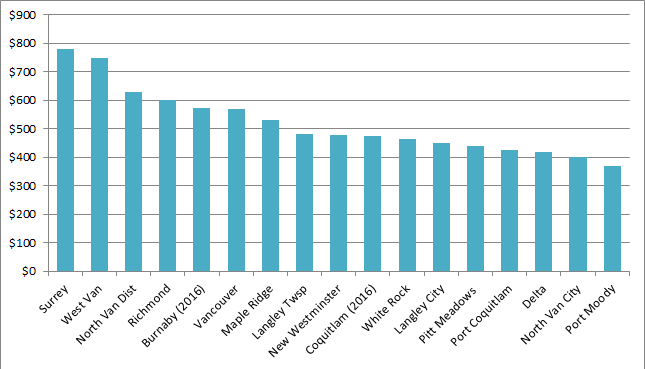
To start with Water Services, it is important to note that some municipalities meter their water, some charge a flat fee. If there is a flat fee available, I listed that. If only a metered rate is available, I calculated the amount they would pay if the household consumes the Lower Mainland average of 350 cubic metres of water per year.

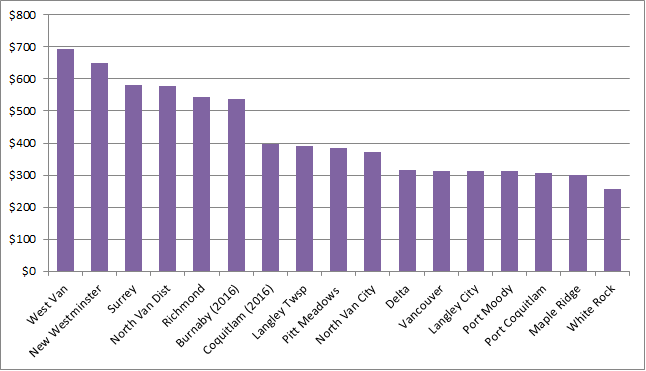
water
Average household water bill per municipality. Flat Rate for Single Family Home or metered rate for 350 cubic metres.

As you can see, New Westminster is about the middle of the pack, and slightly less than the regional average of $519. Surrey is especially high as their flat rate is somewhat punitive to encourage voluntary metering, whereas West Van is fully metered and charges pretty high rates (all of those single family homes on large lots, high slopes, and hard rock result in significant infrastructure cost for their utility).

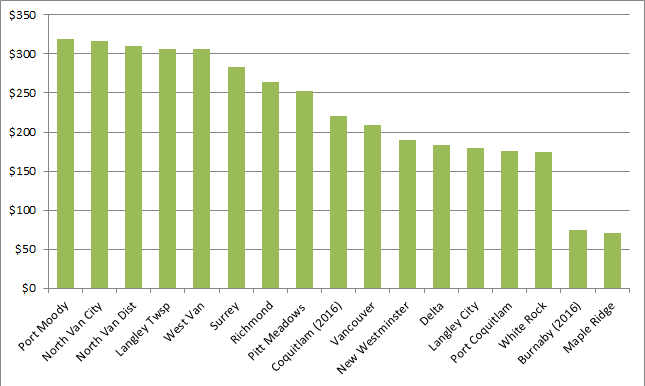
The sewer utility comparison tells another story. New Westminster is the second most expensive city in Greater Vancouver for sewer rates:

sewer
Sewer rates for Single Family Detached homes, including drainage rates if run as a separate utility. For metered municipalities, 350 cubic metres consumption was presumed.

This can be partially blamed on the age of our infrastructure (we need to put more into reserves sooner to plan replacement/upgrade) and a large amount on us still having a large proportion of our sewers not source-separated. We send a lot of storm water to the treatment plant, and that is really, really expensive way to deal with it. The alternate is to accelerate our source separation program, which also happens to be very, very, expensive. There is a whole blog post to be written on this point alone, so I’ll leave it be for now.

Finally, garbage and recycling programs vary probably the most between municipalities. As some Cities have bi-weekly trash collection, and vary greatly in the volume of different waste types they collect, I tried my best to compare to the “baseline” in New Westminster, which is 120L trash and green bins, unlimited recycling bins.

waste
Municipal solid waste / organics / recycling rates per household, assuming 120L bins where options exist.

As you can see, New West is slightly below the middle of the pack for solid waste services. This reflects two competing trends. Our city is compact, which should reduce the cost for trash collection, but we have one of the largest percentages of residents not living in the Single Family Detached, where trash is collected commercially and not by the City, which hurts our economy of scale somewhat.

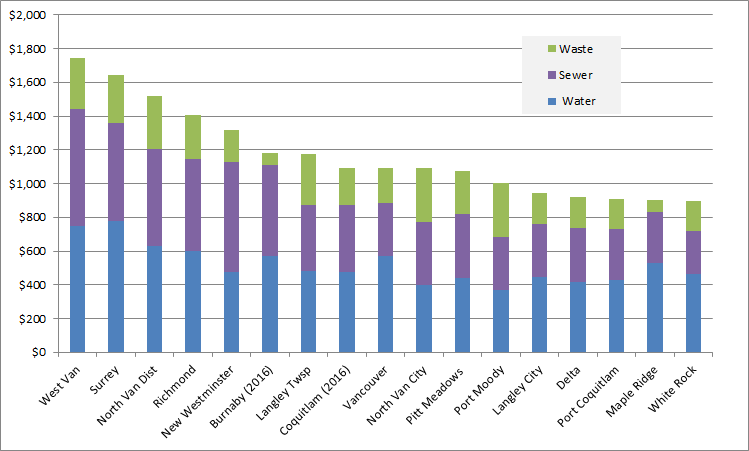
Put these all together, and here is where all Municipalities compare on utility rates:

allute

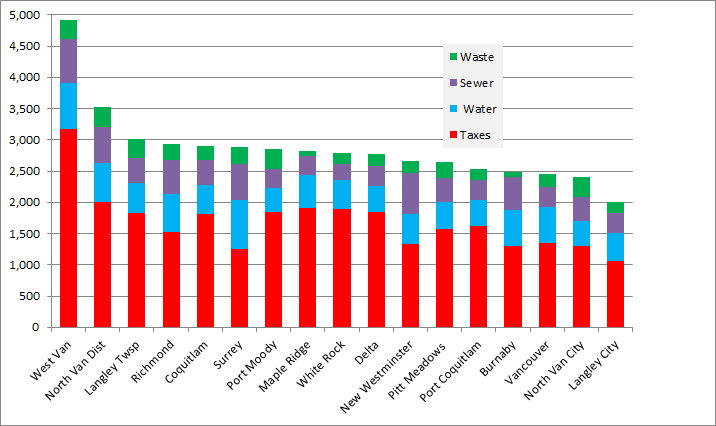
We are the 5th most expensive Municipality out of 17, firmly in the top third, almost completely driven by our higher sewer rates. As there is a complex interplay between tax rates and utility rates, it is interesting to add our average residential tax per household number from this old post to the amount we pay in utilities, to show a closer approximation of real costs between Cities:

combo

Not surprisingly, West Vancouver with the highest taxes and the highest utility rates, is standing tall compared to all others. It is more interesting to see Surrey with its very low taxes jump up to the middle of the pack because of higher utility rates (driven in this analysis, by the punitive “non-metered” water rates, a Surrey resident can probably save $250 a year by getting a meter, which would put it down around Pitt Meadows overall). New Westminster, as expected, is somewhere down on the low side of average, 11th of 17 municipalities.

So what does this all mean? Not much, especially as this is a bit of a jumble of data – a combination of sources with great citations, but combined in a way that would get me laughed out of accounting school. Overall, though, it does suggest that New Westminster is not running its City anomalously less or more efficiently than any other city in the region. New Westminster does not have the costs or services of West Vancouver, but spends more than Langley City. Outside the few anomalies at the ends of the charts, it is probably not surprising that similar cost drivers overwhelm wildly varying political philosophies, and most Cities in the region have found a way to balance the needs and desires of their residents within very similar funding envelopes.

Community – the rest of March.

My plan to provide regular Smilin’-Politician-in-the-Community blog posts keeps getting derailed. But let’s see if I can catch up since my last report about two weeks ago, because I have been smiling quite a bit.

We had a meeting of the Mayor’s Public Engagement Taskforce, which has been doing some pretty cool work as of late in figuring out how the City can do a better job engaging with the public (expect to see some reporting coming out this spring). I also had an ACTBiPed meeting, and have been doing some work with the Mayor’s Canada Games Pool Taskforce.

I attended the UNIBUG Forum. The User Network for Insect Biology in the Urban Garden (UNIBUG) is a citizen science initiative at Douglas College that lets people doing urban gardening contribute to research into beneficial insects, while providing a learning network to help them garden better. If you have a garden box, a backyard gardens, or even planter gardens in New West, you should check out UNIBUG and see if understanding your bugs is right for you!

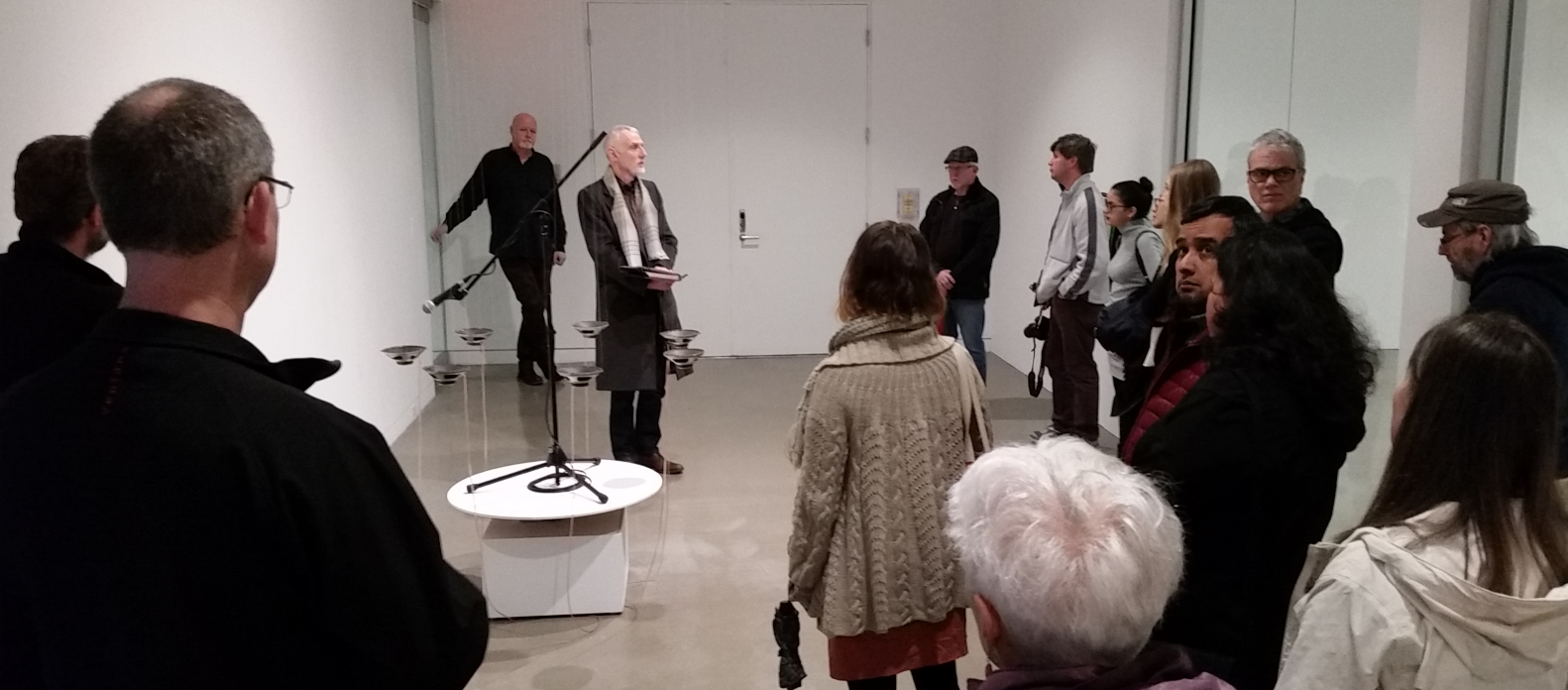
I attended two artist talks at the New Media Gallery, both relating to the recently-closed exhibit OTIC. Jesper Norda spoke about his piece The Centre of Silence, and showed us some of his remarkable earlier works. Then on the closing day of OTIC, composer John Oliver walked a group of us through the exhibition, bringing his interpretations of the works, drawing from his vast experience in composition, avant-garde music and psychoacoustics.

ud2

It was interesting to me, as someone who thinks pretty squarely about topics of science (when they talk about the mass of the air in the room, I can’t help but do a Fermi Estimate: “22 Litres per mol, 30grams per mol, so ~700 grams per cubic metre… etc.”) to be given a completely different viewpoint that connects the actual science to how we interpret sound. It was educational and brought a whole bunch more out of the exhibition I already really enjoyed.

I also wanted to note, after leaving the Norda talk on a Thursday night (I had to rush off to curling), I was riding my bike up Columbia Street and was amazed by the entertainment opportunities. There was an Open Mic going on at Old Crow Coffee, live music at el Santo, live music (and a new menu!) at the Heritage Grill, and a general buzz of activity downtown. I can’t help but feel we are turning a corner here…

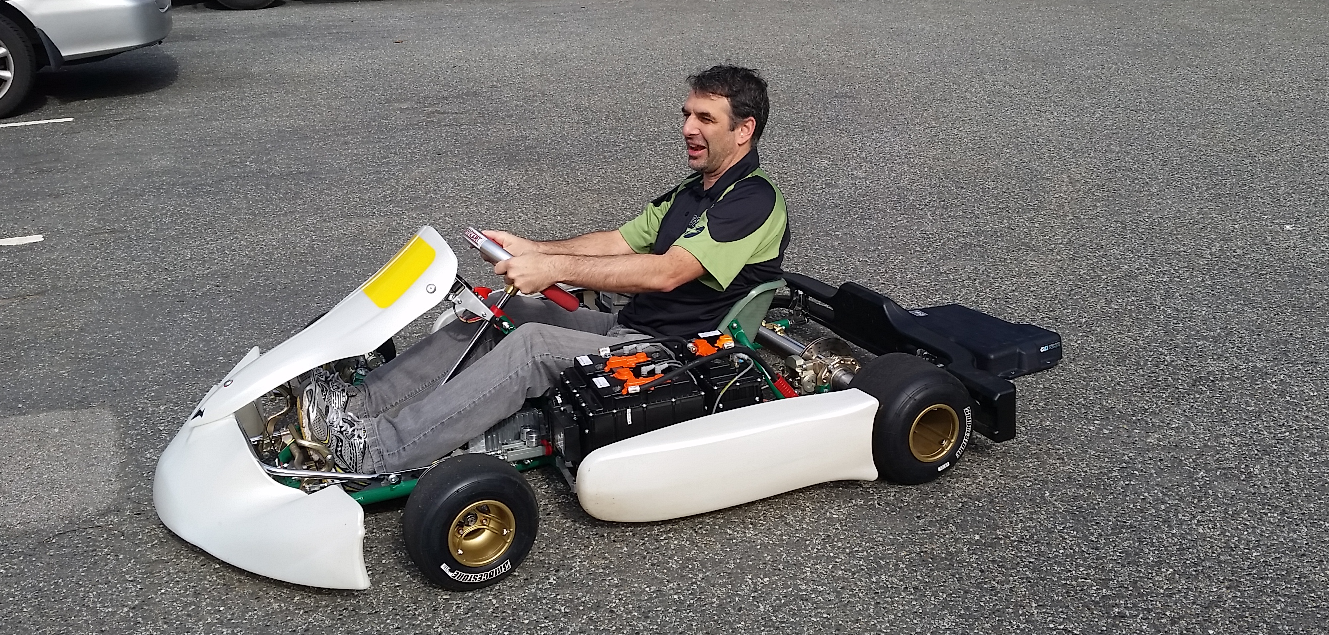
Talking about turning corners, the group that tried to put together an electric racing cart series a couple of years ago are back on the scene, and it appears that a series is happening this summer. A few of us were given an opportunity to check the carts out in the City Hall parking lot, with a pro driver going fast around an impromptu circuit, and several of us going quite a bit slower:ud3

The carts are your typical high-performance racing carts, except that they are 100% electric powered, which makes them scary quiet, and scary fast. apparently we have a race coming this July in Downtown New Westminster. Hold on to your hats.

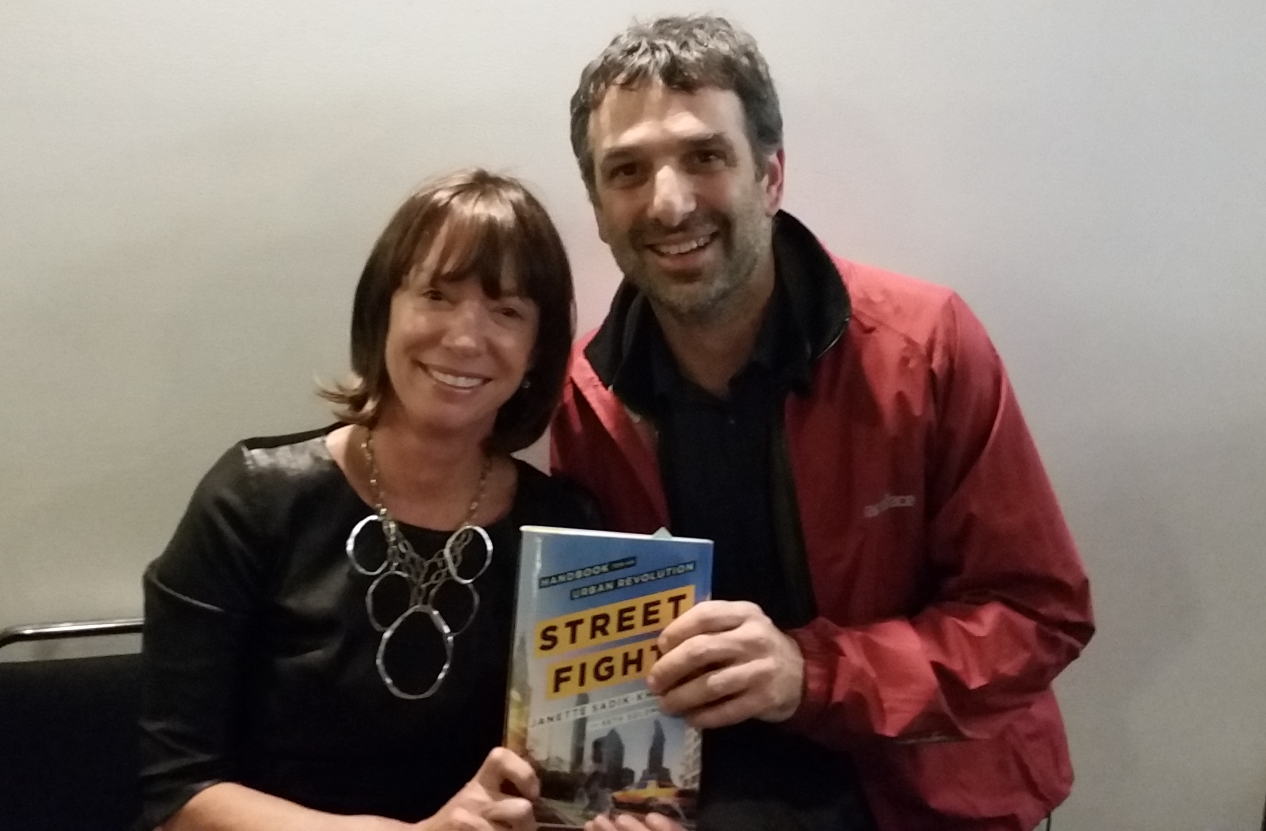
What kind of a Metro Area do we live in that a former transportation commissioner of New York can sell out a talk in a 700+ seat theatre and be given rock star status while here? There was a serious urban planning and sustainable transportation geek-out at the Vancouver Playhouse when Janette Sadik-Khan arrived on the Vancouver stop of her book tour. And I, of course, was the total fan-boy:ud1Her book “Streetfight: Handbook for an Urban Revolution” tells how she re-drew the streetscape of New York City following a motto that “The public realm is the public’s realm”. From strategically reclaiming poorly utilized parking spaces to closing a stretch of Broadway to make Times Square a human space again, he book is a manual of how to take out streets back from those who want to use them only as roads.

It is also full of condensed insight, beautifully concise explanations clearly honed by years of having the same arguments discussions about the same controversial simple ideas to make public space more useful and pedestrian spaces safer. Her page-and-a-half about curb extensions should be required reading for anyone who argues that removing them from Royal Ave will help anything.

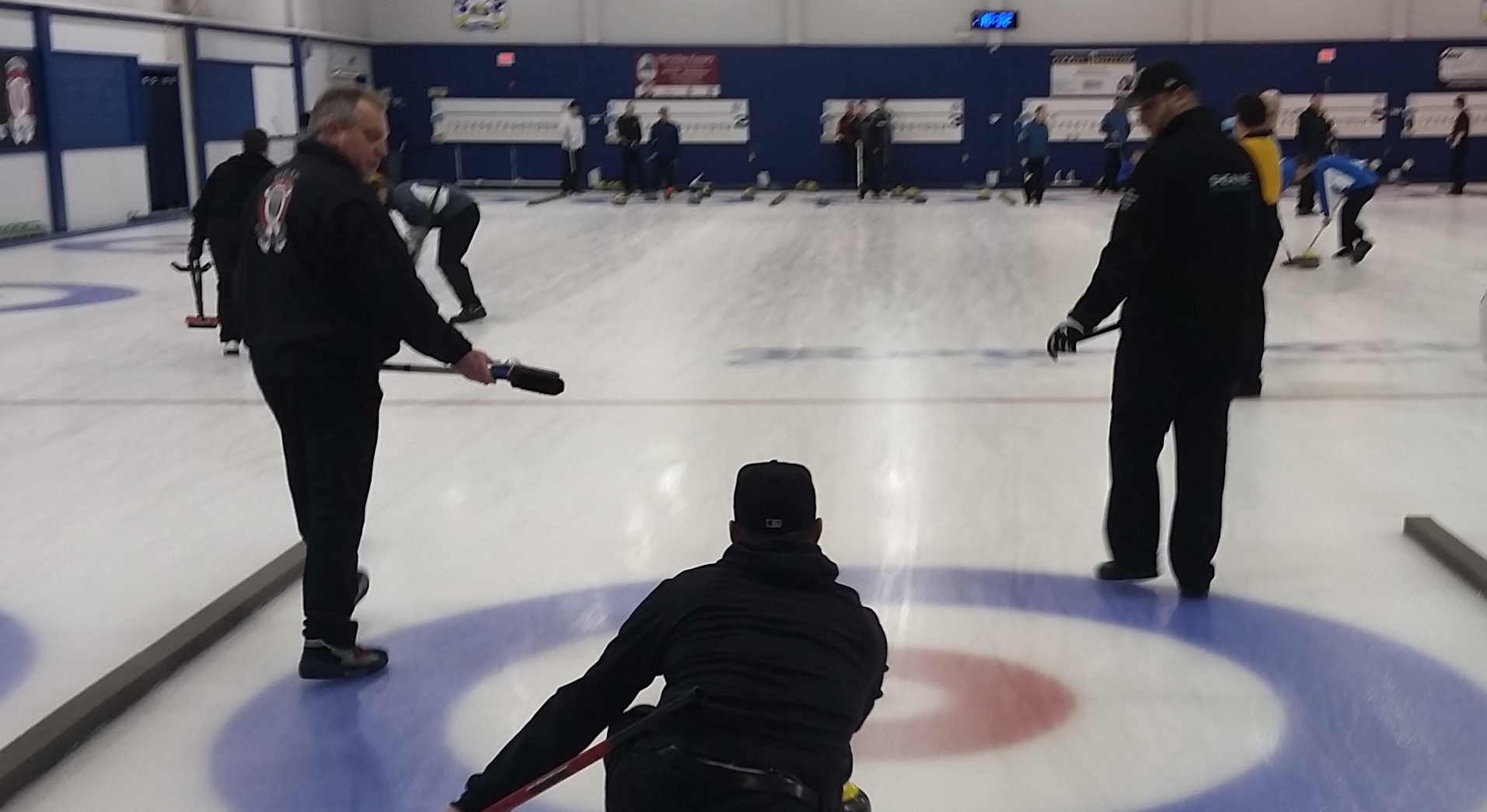
So that, a trip over to Saturna to make life difficult for some scotch broom, and the wrap-up of the curling season (Team DeGobbi finished in the semi-finals! Congrats to Team Pierce for winning the Royal City Curling Club’s 50th Club Championships!), have been keeping me busy and smiling.ud4.

Ask Pat: Safety Dictator

Nicole asks—

Since your wonderful idea of a 30 km/h urban speed limit has drawn some ire, what other controversial things might you do to make our roads safer if you were made Dictator of BC for, say, a year? (I am guessing that photo radar is very high on the list, if not number one.)

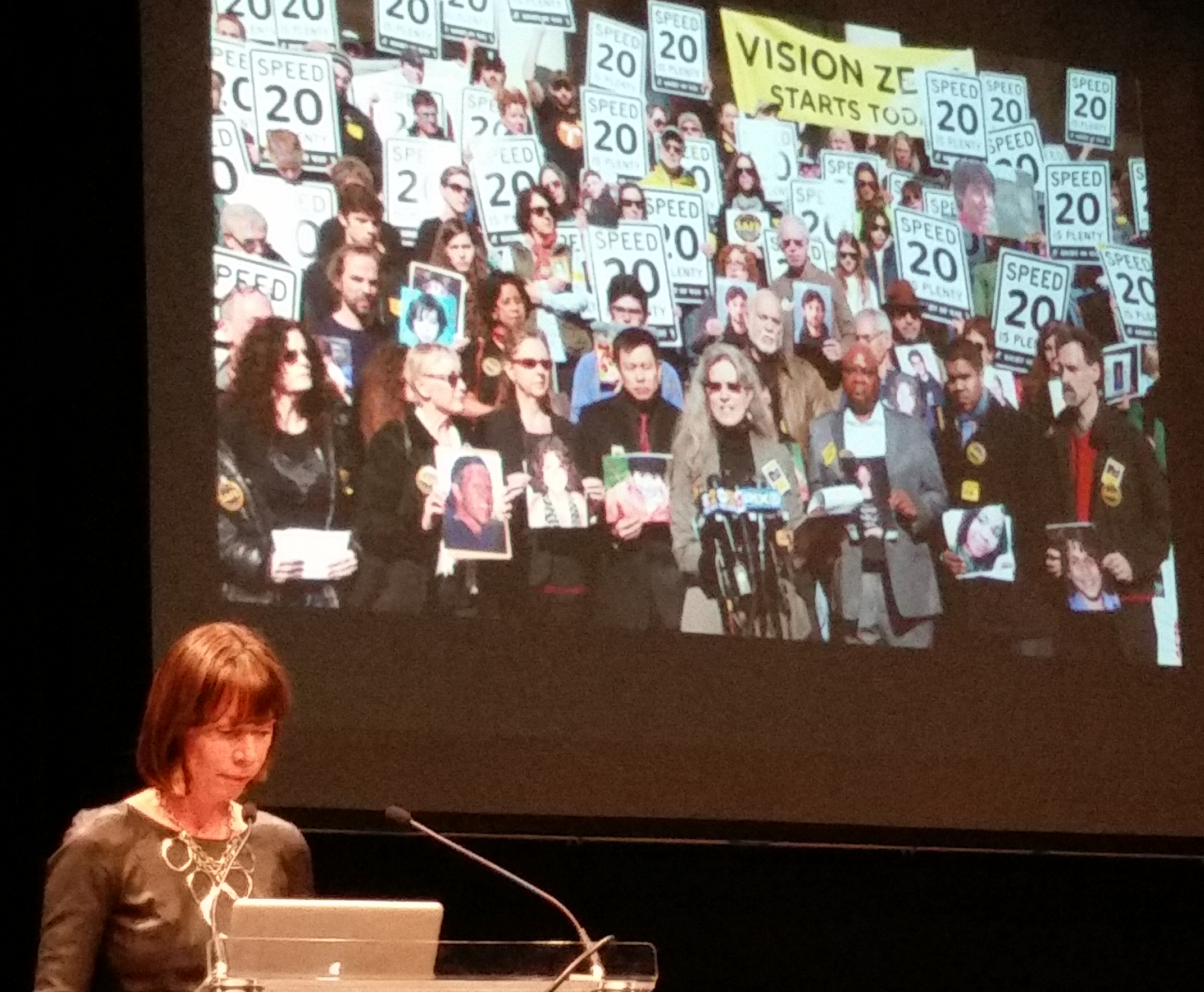
Ire!? If an idea doesn’t draw ire from some sector, it is probably not worth even discussing. You may have heard some ire, I heard a lot of people saying its about time. Just this week, there were articles in Price Tags (Vancouver’s best Urbanism portal), there have been great results out of Toronto on their speed reduction program, and Seattle has joined the fray. I even took this photo at the Janette Sadik-Khan talk in Vancouver on Tuesday night:JSK20

Ire be damned, I want our streets to be safer. As JSK herself says: “When you challenge the status quo, it pushes back. Hard.”

I like the tone of your question, however. What would I do if I was Dictator for a year and was able to do whatever I wanted to make roads safer? Not sure I could get it all done in a year, but Dictators have armies to do their bidding, right?

Photo radar has it’s use. The Pattullo Bridge is a perfect example of a 50km/h road where everyone goes 80km/h and the resultant accidents are incredibly dangerous for other bridge users. It also reduces the inferred safety of the bridge, and is used as a primary reason for replacement. With careful application and an emphasis on safety (as opposed to punitive punishment in places where poor road design encourages speeding), photo radar has a role.

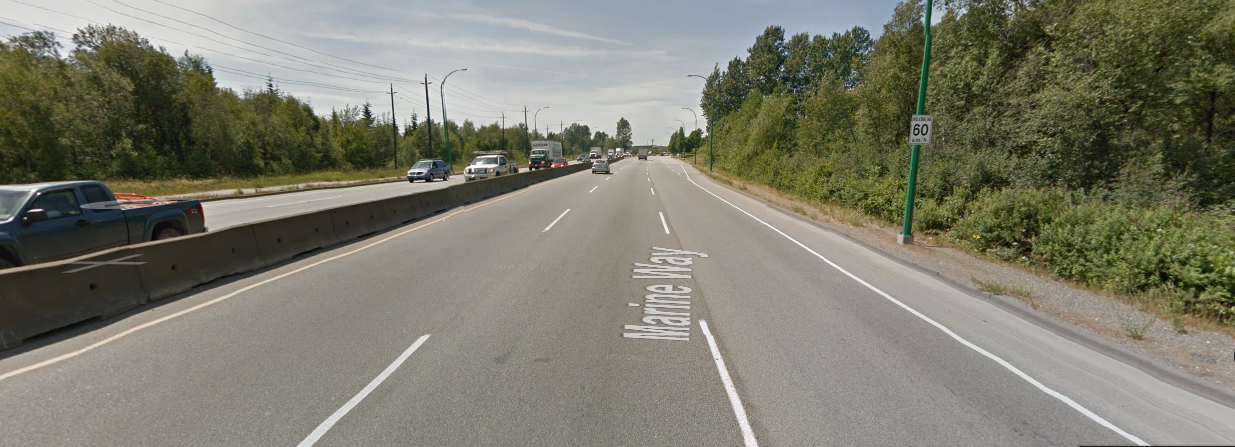
Look at this stupid road. Nothing here tells you to go 60km/h, except the sign. Of course everyone goes 80
Look at this stupid road. Nothing here, not the >3.5m lanes, not the generous shoulder and fixed divider, not the wide-open sight lines, nothing tells you to go 60km/h, except the sign. Of course everyone goes 80 or faster. A silly and punitive place to put Photo Radar, but dollars to donuts, the first place it would be installed.

I also think intersection cameras have a role. There are some in New West, and ICBC and the Integrated Road Safety Unit have a program to support them. However, they seem to concentrate on the red-light runners, likely because it is the easiest thing to enforce with a camera. I’m just as concerned about illegal turns, failing to yield to pedestrians, and entering intersections you have no possible way of exiting in order to “beat a light cycle”. With all the talk of distracted pedestrians and dark clothing, it is a pretty important point that the majority of pedestrian fatalities are caused by the driver failing to yield right of way in an intersection.

To make roads safer for cyclists, I would start by implementing (almost all) the recommendations that the Ontario Coroner released a couple of years ago after investigating cycling deaths in the province. I wrote a long piece on this once, but in summary: build safe infrastructure for cyclists, improve education for school students and all drivers, pass a 3-foot rule, and so on. We already have a pretty good idea what works, this isn’t radical or anything surprising. All that is lacking is the politcial will to make it happen.

The next big step would be nothing less than a complete re-writing of the design standards for urban streets. This is major part of Janette Sadik-Khan’s thesis for road safety. The existing standards for road design, paint markings, signs, and other treatments are from a different era, and were developed with the desire to make driving through our cities as efficient as possible, with only a nod to driver safety. That the “efficient movement” of cars makes the environment for all other road users less safe does not seem to be addressed.

JSK points out the American road design bible (“Manual on Uniform Traffic Control Devices”) has more than 800 pages of diagrams and plans describing the standards, 800 pages in which not a single pedestrian is shown. This book (along with it’s Canadian version) needs to be thrown away.

The good news is that there is already a lot of work being done on a better book to replace it. The National Association of City Transportation Officials has a go-to book called “The Urban Street Design Guide” That needs to become the standard, not the alternative. We can no longer use a 1950s guide book to adapt our 1920s streets for 2015 users. Time to challenge the status quo.

This probably exceeds the authority of the Dictator, but I would also change the laws to make cars safer. This engineering work is being done primarily in Europe, and some of it is becoming mainstream, but we can and should make more changes sooner. This includes a suite of things: better crush zones in front bumpers; softer hood materials with larger energy-absorbing gaps between sheetmetal and hardpoints; use of active cushioning (airbags); injury-reducing body shape geometry; larger windows with smaller pillars to improve driver visibility; active and passive collision avoidance systems.

While we are at it, we can add regular vehicle inspection to assure these systems work, and have not been messed with. There is no place in the urban environment for the suite of modifications that make automobiles unsafe for the people sharing the environment: trucks lifted to ridiculous heights, bull and grill guards, black tinted windows and lights, etc. I know that this is a radical idea in a society where many people consider their car an extension of their personality, and anything that impacts the design of their car would be seen as squelching freedom of expression.

Talking about Freedom of Expression, I am a keen follower of the move to change the language of traffic crashes. Read your local newspaper about a pedestrian being killed by a driver, and the headline is usually some form of “Pedestrian killed by car”. The events are always referred to immediately as “accidents”, which makes them sound inevitable, something that just happens, and presumes there is no fault (and, by inference, nothing we can do about it).

We can change how we value public space and our expectation of pedestrian safety by simply changing our language. “Pedestrian hit by driver of car” makes it clear there are two people in the transaction, not a person and an inanimate object. “Collision” and “incident” are both better terms than “accident” until the police and ICBC have an opportunity to determine the cause of the collision (inattentive driving? texting while walking? bad street design? non-functional brakes?). I think words mean something, and the words we use frame the discussion we will have, and we need to have a better discussion, because people are getting killed and we should have no tolerance for it.

Boy, I really sounded like a Dictator there, eh?

Toll comment

I received this comment to my previous post about $1 tolls:

Another big problem, amongst others in this plan, is that it does not fairly distribute the burden on all Lower Mainland residents. I notice that nobody seems to think that the Burrard, Granville, Cambie, No. 2 Road, Dinsmore or either of the Moray Channel Bridges should be tolled. Therefore, if your objective is downtown Vancouver, all residents of Vancouver, Burnaby, Port Moody, New Westminster and Coquitlam are exempt from tolls. Ditto for any Richmond resident working at YVR. And yet, their cars place as much stress on the infrastructure and contribute to congestion/GHG emissions as a car coming from across the Fraser or Burrard Inlet.

There is a lot packed inside this succinct comment, and it deserves a fuller response that I can fit in a comment. If we decide to toll all/most bridges, which bridges do we toll?

The Mayor of Delta provided an analysis of tolling all crossings of the Fraser River and Burrard Inlet within the general TransLink area. I pointed out a problem with including the Laing bridge, as it is Federal, and YVR isn’t going to want someone else collecting tolls on their infrastructure that they built for their customers to use.

There are also (as noted in the comment) three more crossings of the middle arm of the Fraser (the No 2 Road, Dinsmore and Moray bridges) that all belong to the City of Richmond. There are also three bridges crossing False Creek (the Burrard, Granville and Cambie) that belong to the City of Vancouver. Should we expect those two cities to turn the infrastructure that they paid to build and still pay to maintain, over to regional tolling?

Should we expect their respective Mayors to take any different an opinion about this than the Mayors of the North Shore do when it is suggested their residents and businesses start paying tolls without a concomitant return in infrastructure investment for their residents and businesses?

Perhaps we are asking this question the wrong way. Instead of asking where we can toll, we should be asking what we want to achieve with a regional tolling strategy.

Although many appeal to “fairness”, that discussion usually devolves to getting someone else to pay more and the commenter to pay less. There is little fair in transportation funding. Pedestrians and cyclists subsidize drivers, transit users pay to cross rivers, drivers don’t. We all pay for TransLink whether we use buses ourselves or not. People in Vancouver are paying to build transit infrastructure in Prince George, but Prince George residents are not expected to pay for TransLink infrastructure, BC Ferries that run on tidewater are expensive, those that run on fresh water are free. It isn’t fair. Let’s put fair aside.

One thing we may try to do is manage the infrastructure we have more efficiently. The toll on the Port Mann has caused a decline in the use of that brand new and woefully underutilized crossing, and an offsetting increase in use of the aged, decrepit and congested Pattullo. When (if?) the Massey and the Pattullo are replaced with tolled crossings, the Alex Fraser is going to be a gong show. The idea of balancing tolls across the region is one way to address this issue.

Of course, flat tolls on all bridges is a pretty inelegant and inefficient way to do this. Dynamic tolling where off-peak crossing costs are lower than peak times, and even (gasp!) temporary reductions on some alternates when an incident or construction is causing one crossing to be jammed, are possibilities that could make our existing infrastructure carry loads better, and make road use more predictable. Of course, this is effectively the same thing as increasing capacity, and induced demand will result in the same net congestion within a few years anyway. Which brings us to the third (and best) reason to toll crossings.

Transportation Demand Management (TDM) is the only thing (emphasis needed here: *The. Only.Thing.*) that has ever been effective at reducing traffic congestion in urban areas. When we talk of “road pricing” or “congestion pricing”, we really mean using the forces of the market to adjust traveller’s behaviour. Airlines do it (it costs more to fly on Friday and at Christmas), Ski Hills do it (it costs more to take a lift on a Saturday in December than a Tuesday in March), Ships, Trains, Busses, Car Rental companies, hotels – they all do it. Charge more at peak times and less in slow times to encourage some percentage of riders to take the off-peak trip and save your need to build more capacity.

Except when we talk about an integrated regional transportation system, we can also incentivise different uses altogether. And herein lies some of the answer of which bridges we should toll.

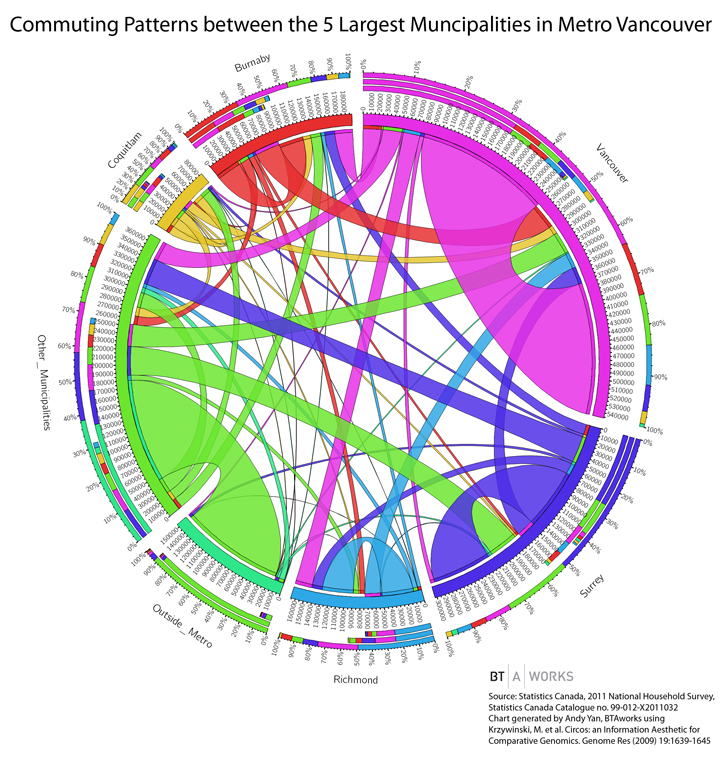
If your objective is downtown” is a compelling part of the comment. Translink constantly reminds us, the living in the burbs – working downtown model does not apply to Greater Vancouver (reason #437 why the PMH! Project was a silly approach). Look at this compelling diagram from BTAworks  that shows where commuters travel. Most people from Surrey don’t commute to Vancouver, nor do most people in most communities.

JtW2011
Source: http://www.btaworks.com/wp-content/uploads/2014/07/JtW2011.jpg

However, there is no doubt the region has “zones” for the most part defined by water bodies, and just like we use those zones to determine transit use, we can use them to determine tolling policy.

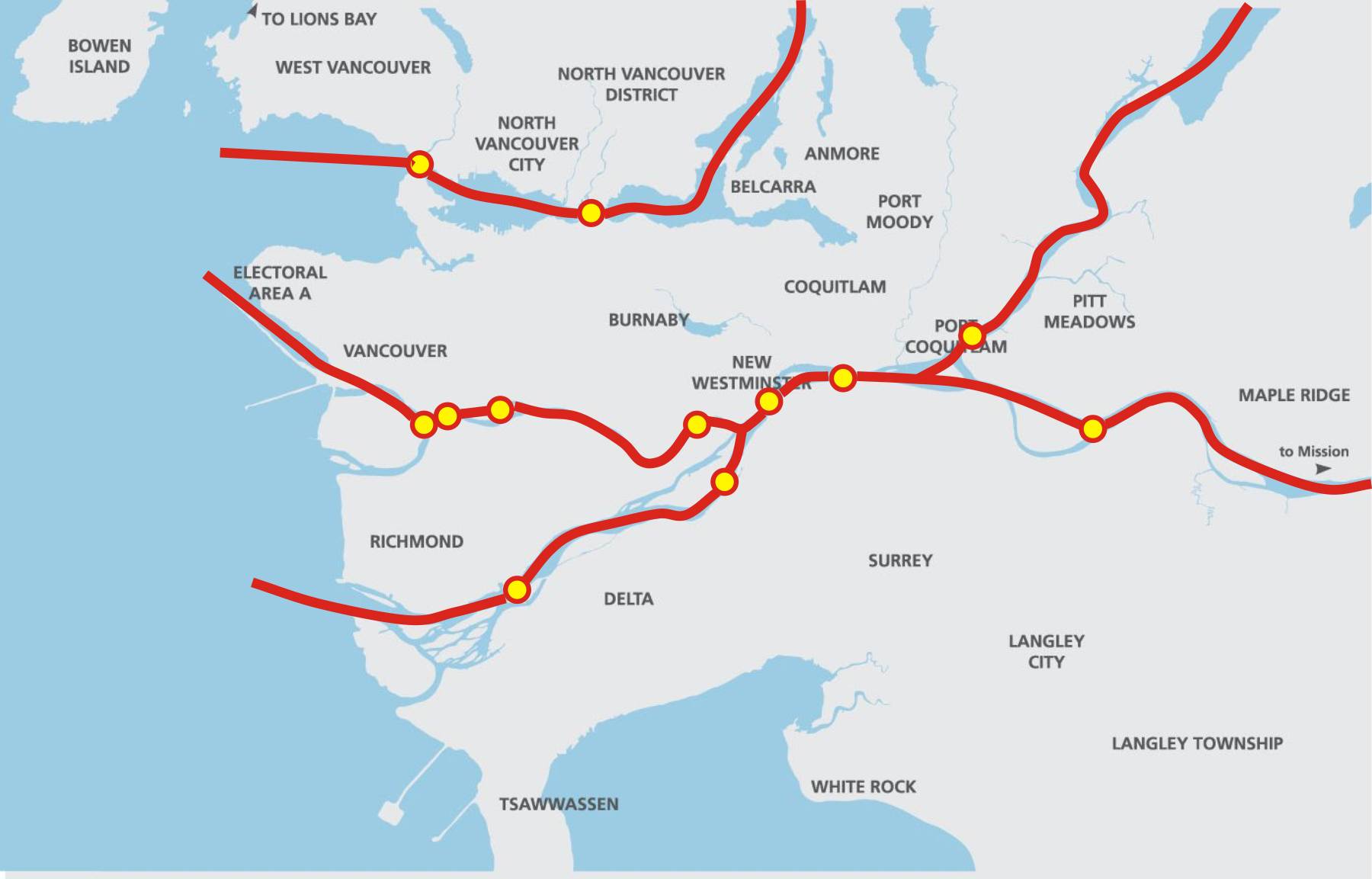
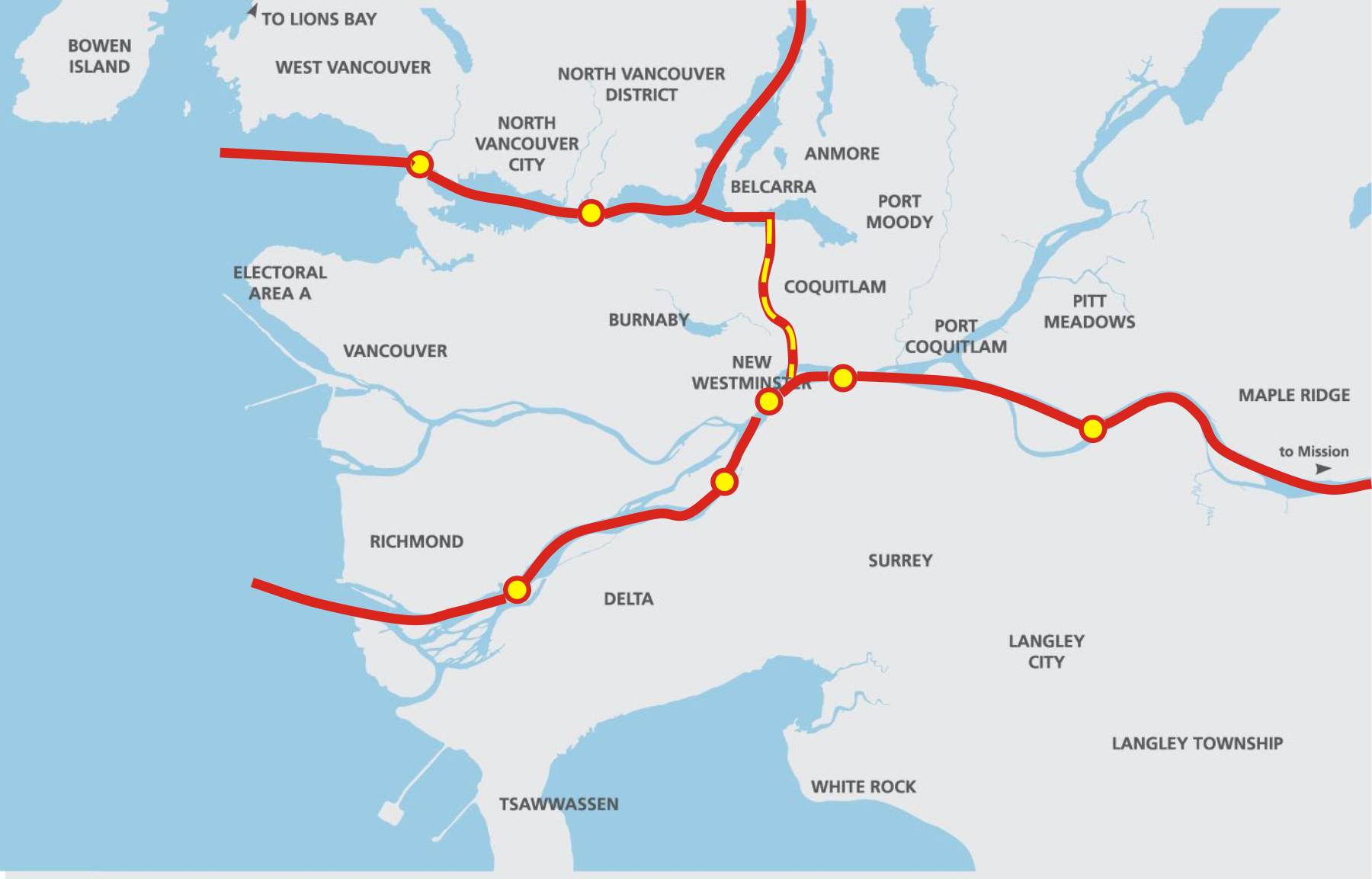
The model suggested by the Mayor of Delta would divide the lower mainland into the following zones: the Mainland, South of the Fraser, Lulu Island, the North Shore and the North Valley.
map1

Although I admire the simplicity, this does seem to create significant inconsistencies, and as the commentor noted, if I want to drive the 45km from Anmore to UBC, I pay no toll, while I would pay two tolls to go the 12km from New West to my favourite Indian Restaurant in North Delta (and this is, like most things, all about me).

This also creates as bit of a strange zone-in-the-middle out of Lulu island, which I suspect would be of concern to the City of Richmond. Or not. Their residents may hate the idea that every time they wish to go somewhere more than 3m above sea level (and bring their car along) they need to pay a toll. Alternately, they may like the idea that toll-in and toll-out will reduce through traffic and make their City streets work better for the residents that live there. I frankly don’t understand the politics of Richmond enough to predict where that discussion would go, but I would wager less tolls would be favoured.

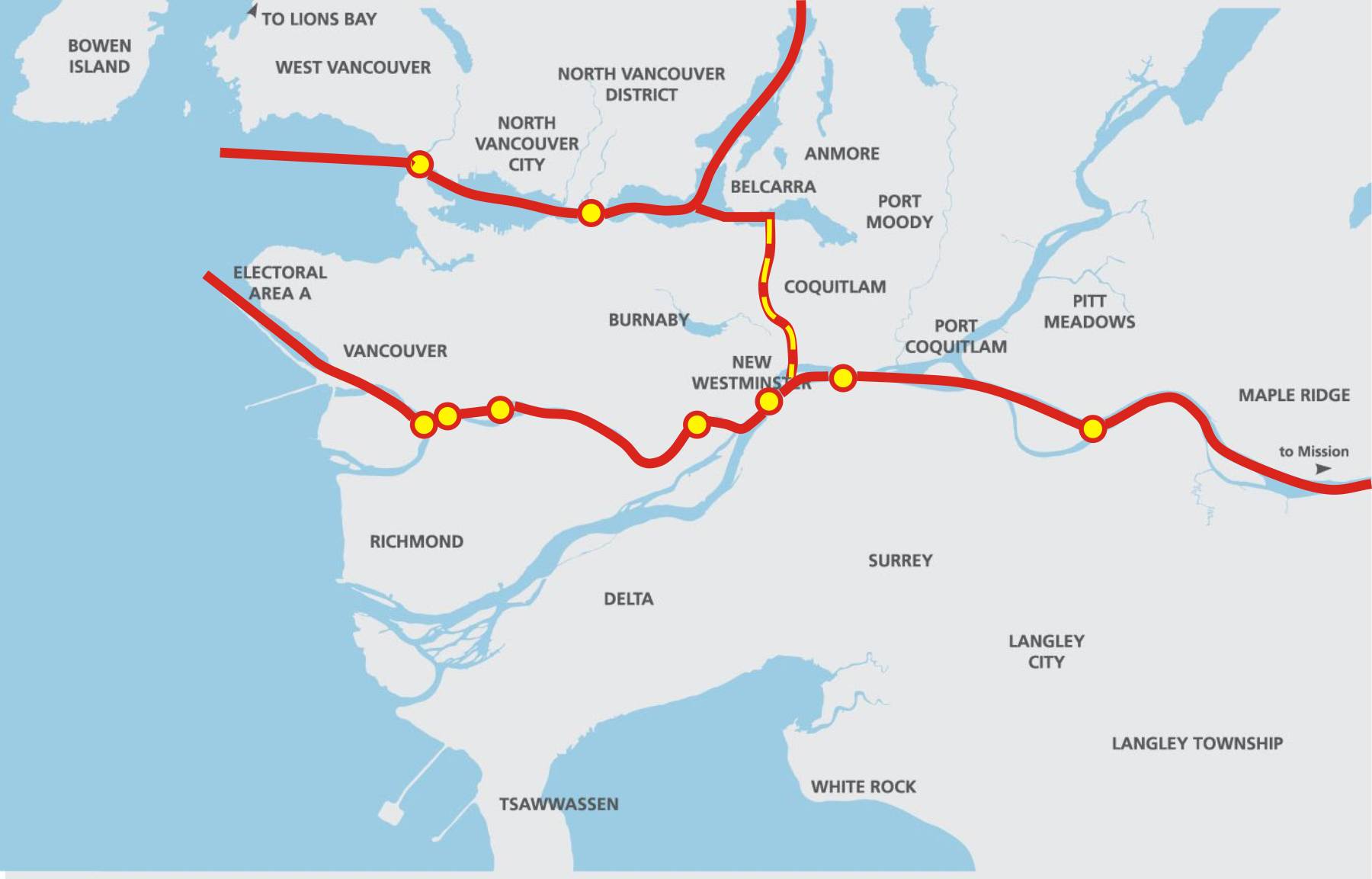
A perhaps more logical model I once saw suggested was to consider the Burrard Peninsula as the “central zone”, and create three other zones: South of the Fraser, the Northeast, and the North Shore:map2

This creates the slightly complicated (but not insurmountable) challenge of tolling crossings of North Road (or some imaginary line that runs roughly parallel to it). This arguably distributes the burden better. The problem is what to do with Lulu Island. Does it belong North or South of the Fraser?

The answer in that probably lies in one of the fundamental assumptions of using road pricing as a TDM measure: You need to provide alternatives. Simply tolling a crossing where people have no choice but to drive will do little to disincentivize people from adding to the traffic, but will do much to anger people who used to get a crossing for “free”. Looking at Lulu Island, the transit options to the south through the tunnel and Alex Fraser are not great. However, the Knight, Oak, and Laird currently parallel one of the nicest, shiniest, newest transit lines to ever grace the Lower Mainland. The pedestrian and bike alternatives are also there. So from a TDM perspective, it makes sense to toll the four north arm crossings, not the two main arm crossings.

map3

I agree, true distance-based road pricing is a better solution, but we are a decade or more from that being implemented, and we need to deal with a funding situation that is killing the regional transportation vision right now. Meanwhile we are bringing a bunch of new asphalt infrastructure into the equation within the next decade. I see a more regional tolling introduction as a good stop-gap measure, and we can no longer allow the perfect to be the enemy of the good. We need to get moving.

And yeah, $1 still isn’t enough.

Ask Pat: Tipperary U-turns

Chad asks—

I’m a Brow of the Hill resident who walks home from the Skytrain at Columbia St up 4th St every day. I’m wondering about the deal with Royal Ave and 4th St. Every day I see dozens of cars getting around the no right turn restriction on to Royal Ave by driving into the Tipperary Park parking lot and doing a u-turn. (Where I frequently feel I’m at risk of being run over). I’m especially concerned about this as the days get warmer and longer and more people will be making use of that great park, while those using New West as their highway between home and work zip around in the parking lot to try to bypass part of the Royal Ave traffic parade. I can see that there is a no u-turn sign in the parking lot but no one’s paying attention to it – makes me wonder why they even bother obeying the no right turn sign…anyway, would love to see this area made safer for pedestrians and park goers alike, and would greatly appreciate your thoughts on this!

It has taken me more than a month to answer this question, mostly because I don’t have an answer.

It isn’t only the “no right turn from 4th to Royal” folks who do this. It is also the “no left turn from 3rd to Royal” who turn right instead, go the block and pull a u-turn. Mix these with the people who drive through the City Hall parking lot and access 4th from there instead of waiting a light cycle on 6th

It is a mess. We have (according to some counts, although the source of this oft-cited number is somewhat obscured by urban legend) 400,000 vehicles a day passing through New Westminster, and for an hour or two a day, the legal accesses to the Pattullo Bridge are constricted, and those through-commuters do whatever they can to take a few minutes off their commutes. Except pay a toll on the Port Mann, of course.

It has been measured, this increase in 20,000 vehicles a day crossing the Pattullo (about 30%) since the tolls were applied at the Port Mann. There is a coincident 20,000-vehicle drop in daily crossings of the Port Mann. This is a huge part of the reason why this City has been working so hard to assure that any replacement for the Pattullo Bridge will result in a tolled crossing – to level that playing field. We are also lobbying to assure the bridge is not higher-capacity, as induced demand will assuredly result in congestion on the feeder routes increasing as capacity does. Finally, we worked to encourage people to vote YES for the funding of the Mayor’s Plan to bring better transit service South of the Fraser so those 10,000 extra people had viable alternatives to sitting in traffic in New Westminster and getting frustrated enough to pull a u-turn in a parking lot to shave a few minutes off their trip.

We can target enforcement in places like you mention, and the NWPD does have a traffic division who do this. Their priorities are not necessarily to catch “rat runners”, but to target the most dangerous road users at the most dangerous intersections. With a few thousand intersections in the City and a million road signs, they can’t be everywhere enforcing everything (and enforcement costs money!), but they are doing what they can against the tide.

So no easy answers, and yes I share your concern, but I don’t know the solution. I’d love to hear if you have any ideas to make the situation safer.