Council – October 3, 2016

Back from the week in Victoria for UBCM, we were back at our regular Council meetings. Our agenda was not too lengthy, but there were some interesting Public Delegations you will need to watch the video to enjoy.

Council moved the following items on Consent:

Investment Report to August 31st, 2016
The City has money in the bank, almost $150 Million. This arises from several well-regulated situations, and more details are available in our Financial Statements. We collect DCCs from development to pay for the increased cost of servicing those developments with things like water, sewer, and roads, however, we don’t spend that money until actually works need replacing, so they sit in various reserve funds earmarked for specific projects. Those add up to just under $20 Million right now. We also have a bunch of other reserve funds, set up to pay for projected capital costs like the Canada Games Pool, or the public art program, some for specific future utility needs that you have been paying for through your utility bill, which combined together total over $100Million.

This report simply updates Council on how our investments are doing. We made about $1.6 Million in interest in the first half of the year, but are expecting to earn a little less than budgeted by the end of the year.

Amendment to the Parks and Recreation Fees and Charges Bylaw
This is the annual adjustment of our Parks and Recreation fees, for everything from swim lessons to renting Queens Park Arena. Increases this year range from 0% to 5%, with almost all increases below 2.8%. Appendix C of the report is worthwhile noting, as that is where we compare our rates to those in our neighboring cities. New West ice rentals are the lowest cost in the region; our gym and pool fees are on or below average across the region. Getting and keeping fit in New West is (relative) bargain!

1209 Hamilton Street: Proposed Rezoning to Allow 20 Child Care Spaces – Zoning Amendment Bylaw No. 7832, 2016 for First and Second Readings
Daycare spaces are a rare commodity in the Royal City. The current economics of running a daycare and the restrictive rules for their operation (important to preserve quality of spaces and protect the well-being of children) mean setting up facilities is sometimes an arduous process. The City, through its Child Care Strategy, is trying to facilitate the opening of more childcare spaces to fill this recognized need through a variety of policy and supports.

This application is for a daycare in a current duplex house, immediately adjacent to commercial areas, close to family neighbourhoods and transportation options. Current policy would allow 20 childcare spaces in a duplex such as this, and the applicant is requesting expansion to 20 spaces, 12 of which will be for toddlers (an identified need in the community).

This proposal will go to a Public Hearing on October 24th. C’mon out and tell us what you think!

1004 Salter Street: Development Variance Permit 00602 for 18 Lot Subdivision with Park Dedication – Consideration of Issuance
This development project in Queensborough requires a variance because of the shape of the lots. All of the lots are larger than the minimum required by the Zoning Bylaw, but they are deeper than typical, meaning that their frontages are less than 10% of their perimeter (following me here?). The proposed lots are 141 feet deep by 31 feet wide, where the 10% formula would require 34 foot frontages. They are not asking for bigger houses than permitted or reduced spacing between buildings, only frontages reduced by 3 feet. Doing it this way would allow better laneway and park dedication to make for a better designed family neighbourhood.

There is some public consultation and committee review to be done yet, but council expressed general support for this model being moved forward to those steps.

Recommendation from Advisory Committee for Transit, Bicycles and Pedestrians (ActBiPed): Public Seating Strategy to Encourage Walking & Neighbourhood Livability
This recommendation came from the ACTBiPed, who advise council on active transportation issues (transit, bicycles, and pedestrians). Perhaps counter-intuitively, ACTBiPed is advocating for more public seating. Just as parking is an important part of planning for car use, and bike racks are required to encourage bike use, adequate and attractive public seating is vital for pedestrians and transit users. In a City like New West, with hills that present challenges to a portion of the community, adequate places where they can be made comfortable to stop and rest for a few minutes can be the difference between taking a walk, or taking the car. It also creates opportunity for eyes on the street, for social interaction, and for making people more connected to their neighborhood, just ask Jane Jacobs.

ACTBiPed asked that the City create a strategy to support adequate and comfortable public seating, and have recommended several policies and measures to support that strategy. Council moved this recommendation.

Recommendation from Access Ability Advisory Committee: Proposal to change the Terms of Reference of the Committee
This recommendation came from the committee charged with advising council on issues of accessibility with the goal of assuring the public realm is accessible to all people in our community, regardless of physical or other barriers. The recommendation is to change the terms of reference a bit to encourage participation from youth in the city, and organizations in the City that no not necessarily have accessibility as part of their mandate, but are interested in taking steps to improve accessibility in their organization, or in the broader community. Council approved this recommendation.


The following items were Removed from Consent for discussion:

718 Twelfth Street: Temporary Use Permit for Islamic Society
This organization has been trying to find a home in New Westminster for some time, and is requesting a temporary use permit for the Heritage Hall on 12th Street. There are some significant land-use concerns with permanently converting street-front commercial space to church religious assembly use. However, this is a temporary use to support a burgeoning organization that serves an underrepresented part of our community, so this temporary request is worthy of consideration. There will be some public consultation and an Opportunity to be Heard. Watch this space.


We also addressed some correspondence:

Uptown Business Association of New Westminster letter dated
September 21, 2016 regarding Belmont Street Parklet

The merchants of and commercial property owners of Uptown have written the City to express support for the temporary Uptown Parklet that has invaded part of Belmont Street for the last few months. I think our Parks and Planning staff did a really god job turning a very small amount of money into a really friendly place that people seem to enjoy. There have been a few complaints, and a lot of kudos. Some early concerns about potential behavior issues on the site turned out to be a pretty minor issue, although some residents have been concerned about noise at night (seemingly more related to the nearby bar than the parklet). However, during the day it is apparent that citizens have started to occupy the space and make it their own.

As a trial, our second Parklet (remember, we installed one in Sapperton last year) can be called a success, and it is time to have a discussion about how the future of Belmont Street may be reshaped, and about where else in the City Parklets may work.

Letter received via email dated September 22, 2016 from Michelle Cunningham regarding Electrical Vehicle Incentive and Zoning Bylaws
The topic of this letter was referred to Staff. There are many opportunities to incentivize the installation of electrical charging stations for vehicles, and it is better to be in front of this trend than behind it. New West has some natural advantages: our own Electrical Utility, our central location, and our large number of people living in multi-family dwellings. At the Municipal Climate Leadership Council meetings at UBCM, I heard a lot about the programs that organizations like the Community Energy Association of BC are doing to promote initiatives like this, and senior government help that is available.


We then addressed some Bylaws:

New Westminster Civic Infrastructure Temporary Borrowing Bylaw No. 7843, 2016
This Bylaw that provides the City some borrowing authority for various civic infrastructure projects, which passed the Alternate Approval Process (ugh) a few months ago, was adopted, and is now the law of the land.

Zoning Amendment Bylaw (1209 Hamilton Street) No. 7832, 2016
This Bylaw addressing the daycare space off of 12th Street (discussed above) was given two readings.

Parks and Recreation Fees Amendment Bylaw No. 7865, 2016
This Bylaw formalizing the new Parks and Rec fees (discussed above) was given three readings.


There were then a series of interesting Public Delegations, worth your time and energy to watch. It will be interesting to see what arises out of a few of those discussions….
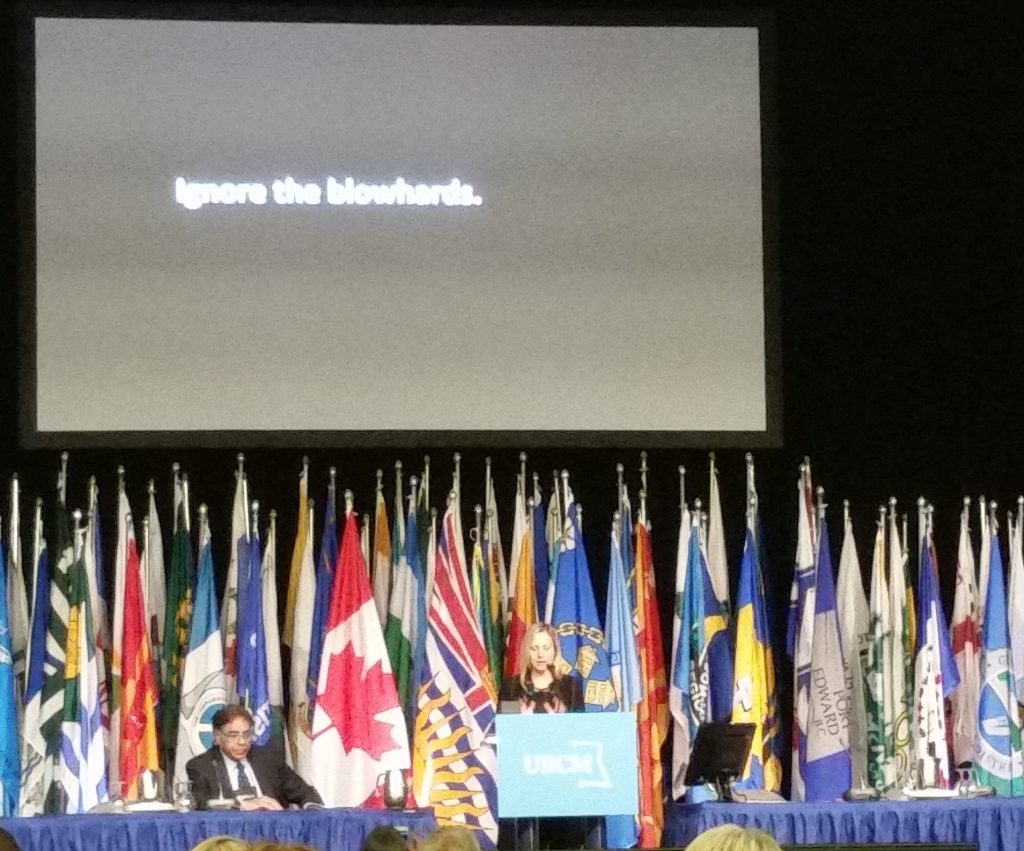
UBCM 2016 – Part 2

It’s been three days of UBCM 2016, and I hardly have time to write my thoughts. Somehow, Langley City Councillor Nathan Pachal has pumped out several really great blog posts about the talks he has been to. I see him at every event, and have shared food and drink with him, (we are conspiring together on something…), so I have no idea where he finds the time, but it is worth while reading if you want to get a different view of some of the talks. Actually Nathan’s Blog is good reading any day, he is a smart guy.

So back to me, and that weird existential angst I was expressing around climate change last post. It has not abated, as I have attended talks on other subjects, and have had some scheduled face time with a few Ministers and Members of the Opposition, but I was also given the gift of inspiration.

After climate change, the biggest issue facing BC right now is housing, at every level.

During the Large Cities Forum, we had presentations on the remarkably progressive approach that Maple Ridge took when trying to address a long-standing tent city issue. There was much discussion of the social aspect of this type of homelessness, and the importance of giving people franchise over their space, and building trusting relationships between the residents of the tent City and the people trying to keep the tent City safe, and hopefully move people to a more tenable living situation. They had people who had been living outside for a decade or longer, and some who were simply terrified of the idea of going into a building.

There was a transition from this discussion to talking about the health aspect of homelessness, and those difficult to house. Although there are many ways for a person to become homeless, the most common are one (or a combination) of three: Youth aging out of foster care, people leaving the criminal justice system, and people coming out of hospitals after longer stays. I all three cases, they have been disconnected from their support systems, have nowhere to go, and end up on the street. They generally have barriers to receiving even the most basic services. They often can’t get basic healthcare at a clinic because of a variety of barriers inherent in the system.

There are good people working on this issue, and many good ideas about how to prevent the worst tragedies. St. Paul’s is working on a transition program, where people leaving Emergency Room care, if they don’t have a home to go to, can go to a temporary shelter on the hospital grounds. They are more likely to heal, they are less likely to return to emergency any time soon, they are more likely to get access to detox or mental health services they need, they are less likely to die on the street.

But, again, it is frustrating. With all the good work being done by local governments, by Health Authorities, and by various provincial agencies, it isn’t enough. We are constantly reminded that BC has the greatest economy in Canada, and we are the Greatest Place on Earth, but too many of these people (and let us not forget that point – these are people, citizens of our province as deserving of dignity and safety as you or I) are simply being left to rot. A crisis we are nibbling around the edges of, but certainly not treating as a crisis.

There was also discussion about the other end of the housing spectrum – run-away housing prices. Short version is economists expect prices to continue to rise medium-term (even allowing for possible “short term corrections” of 10-30%). Single family houses in across the lower mainland will double in price in the next decade or so, if the trends are to be believed. The wind went out of the room when that was suggested.

We were then refreshed by a very entertaining talk by Tom Davidoff about how we are doing it all wrong. Housing prices are going up 30% a year, while housing supply is going up 2%. This has resulted in the ridiculous situation where 95% of the households in Canada simply do not have the income to buy a home in Vancouver, or as he put it, the City has banned 95% of Canada from living in it. His solution? Build denser neighbourhoods, especially row homes and townhouses (not so surprising), and facilitate that by massively increasing property taxes (!), and giving the province the power to override local parochial densification concerns (!!). Naturally, the message that Mayors need to raise taxes and give up control over zoning was not what local governments wanted to hear, but it was entertainingly delivered.

I also went to a workshop on contaminated sites stuff and invasive species that will probably not interest the readers of this blog in the least, but was really interesting to me.

I had a good chat with representatives from AirBnB before Vancouver announced today that they are going to take on regulating AirBnB. I was already aware of the approach taken by Nelson (and some of its strengths and weaknesses of that approach), and am ready for us in New West to have the conversation about short-term rentals. There are more than 300 listings on AirBnB in New Westminster, far more than the number of hotel rooms in the City. The trick is how to develop a regulatory environment where responsible homeowners who respect their community and neighbourhood can operate legally, while preventing unscrupulous, unsafe, or otherwise problematic operators. How do we address the larger concerns in the community? Much to do here.

Finally (for this post), we were treated to an excellent and inspiring Keynote by Dr. Samantha Nutt, who is one of those heroes that make you wonder how they can even exist in this world or cynicism and short-term thought. She is the founder of War Child, and organization that provides various types of aid to children impacted by war in the worst parts of the world. She provided the inspiration, and some great wisdom.

20160928_095409

I can’t get into the length of her talk, it was full of absolutely heart-rending stories of war and suffering, and yet somehow full of hope and laughter about why we do what we do. She joked about being shot at, threatened, illegally detained, made sick with rashes she could not identify and afflicted with plagues that have her doubled over in the worst bathrooms in earth, and yet her husbands’ job is even worse – he is a politician. This is a bit of a ridiculous pander to a room full of politicians, but her point was that there are many people doing things around the world, big and small, trying to make positive change, and all of them, all of us, question whether we are making progress, whether the fight is worth it. And there are people trying to stop progress, who we have to outwit, outlast, and out think.

This was actually a message I needed to hear, because too much of UBCM has been about small steps to address big problems, recognizing that we are not making enough progress, and there are serious structural barriers – sometimes actual people – who are in the way of this progress. Why do we continue to work against these forces?

“Leadership is a test of endurance, and at least we aren’t just spectators”

There was another message in her talk. We, here in Canada, sitting on our fat asses at a conference, are complicit in these wars on Somalia, in Darfur, in Eastern Congo. By selling them the arms they need, by buying conflict metals that fund those weapons sales but keep our smart phones (and this Blog) running. You can hear her give a different talk with similar messages here. I honestly cannot believe I am lucky enough to share the planet with a woman like this.

So go out, do what you do, make positive change.

Council – Sept 12, 2016

This week was our annual City Council on the Road trip to Queensborough. This is just like a regular Council Meeting, except we hold it at the Queensborough Community Centre, and more people show up!

Our agenda was not too long this week, so we started with a couple of announcements regarding the LEED Gold certification of the Queensborough Community Centre, and a progress report on the Ewen Street upgrading project (two years down, one to go!) and a few smaller pedestrian safety projects we are fast-tracking in Queensborough.

We passed the following items on Consent

2017 Development Services, Planning Division User Fees and Rates Review
One of the Principles of local government in BC is that some things are paid out of taxes, and some things are paid on a cost-recovery basis (this is a “principle” that is often hard to be too strict about, because of the hugely complicated overlap between the two groups, and the cost and hassle of keeping the division strict would overwhelm the cost recovery, but we try the best we can). Fees for things like processing development permits are intended to put the City’s costs for working a development through the review and consultation process as much as possible on the developer, not on the taxpayer.

Another principle is that we do not want to have our permits completely out of line with other Cities in the region, but because we “compete” with other cities for business, commercial, and residential taxpayers, and because being anomalously high or low relative to other Cities is a sign we are probably doing something wrong.

The changes proposed will bring us back in line with the median across the region. I am happy to support this change, as it assures we are regionally in the right ballpark on our fees, but that doesn’t mean the entire region isn’t over or undercharging, or that being in the middle of the pack removes our responsibility to find efficiencies in our operations. And we want to be regional leaders, don’t we?

So to support these principles, it would be great if staff did a bit of a desktop exercise to estimate the actual cost to the City for processing these applications – how much time does it take staff to review the average application, how many staff are required, and what are the costs – are we recovering half the cost? 90%? Or are we making money? I suspect there is a huge range, as applications vary in their complication and in the sophistication of the applicant, but estimating a range would be a useful exercise for council, especially as we are re-evaluating where we fit in the regional context.

1016 – 1022 Fourth Avenue: Development Variance Permit for Five Lot Subdivision with Duplexes on Each Lot – Consideration of Issuance
This Permit is essentially a housekeeping exercise on some of the language of the existing development permit, previously passed by Council. A few issues were discovered during further planning by the site developer that required clarification of language, and a relatively small adjustment of setbacks was made to accommodate the mature tree that is extant on the property, in concordance with our new Tree Protection Bylaw.

1209 – 1211 Fourth Avenue: Development Permit for Eight Unit Townhouse Development – Consideration of Issuance
This application has been winding its way through the process. The owner does not appear to be in much of a rush as the Public Engagement and Panel Review work was completed back in 2012. It is an interesting site on a pretty steep hill, but a good example of “missing middle” townhouse development we need so much on the mainland of New West.

Sewer Pump Station Rehabilitation – 2016 – Budget Re-Allocation
One of the fun parts about developing on flat land like in Queensborough is that you need to lift your sewage. You install your pipes with a bit of a slope to keep ‘em flowing, but eventually you get too deep and need a pump station to lift the sewage to a new, higher pipe to get more slope. Sewage lift stations are expensive, and need quite a bit of maintenance to keep your pipes clean because you wouldn’t believe what people flush. A couple of the lift stations in Queensborough apparently need major servicing sooner, rather than later, so we are moving some budget money forward.

This is a re-allocation of budget not an increase, as we would have spent this in 2017 or 2018 anyway as part of the regular maintenance schedule, we are just expediting the process a bit due to need, and to get some economies of scale, we are doing 5 stations as part of a single tender.

100 Braid Street (Urban Academy School): DP – Preliminary Report
Up to now, we have seen the site re-zoned. At this step, we are seeing detailed design of the school building, which is the first phase of development for the site.

This project will go to Design Panel, Sapperton RA and to a public open house, so please show up and tell us what you think.

Intelligent City Advisory Committee Amended Terms of Reference
The next phase of the ICI is starting to unfold, now that fibre and BridgeNet are approved, and installations are occurring. It is time to talk about the other interesting possibilities related to becoming an “Intelligent City”. We have had some interesting discussions recently about using more intelligent traffic control technologies… but we’ll save that for future discussions…


The following items were removed form consent

Sign Bylaw Update: Consideration of Public Consultation
The City is looking at its existing Sign Bylaw, and a few updates are intended to make the process easier and more consistent for businesses (we want to rely less on variances to the Bylaw). This is a pretty full re-write, but relies on the existing bylaw and its various edits and revisions to set the framework.

There are some mundane requirements, like having an engineer certify that the sign won’t fall and hurt somebody with the first puff of wind, or making sure lights meet electrical code. However, there is also the more complicated desire to assure businesses can install appropriate or needed signage, while limiting the visual intrusion of signage and maintaining an attractive streetscape for users.

This latter requirement is, of course, a challenging goal, and will rely on a lot of input from the business community, the Design Panel, and everyone else who lives, works, and shops in New Westminster. So we are sending this draft Bylaw out for some public and business input.

I asked that we also consult with the Access Ability Advisory Committee. I think they would want to provide comment on the types of signs that impair mobility on our streets and sidewalks, but also on making signs more effective for the visually impaired, and how signage impacts navigability for people suffering with dementia, as per our Dementia-Friendly community action plan, which may also include input form the City’s Senior Social Planner.

I have a few more comments in regards to some of the new restrictions, but I am happy to have this go to consultation as is, and hear what the business community and other stakeholders have to say, and reserve my right to comment when it comes back to Council!

701 Sixth Street: Glenbrooke Daycare Society Request for Financial Support
This Daycare is looking to expand, and the spaces are woefully needed in New Westminster. They are asking the City for some financial help as they have significant start-up costs if they wish to expand.. We have a Reserve Fund for these types of requests. However, our current reserve fund is mostly earmarked for addressing the situation in Queensborough, where daycare and pre-school needs are beyond crisis levels.

In the end, we need a little more info from this applicant before we can decide if it is the best use of some of our reserve fund, or if there is another source the City can dip into to support these very-much-needed spaces.

Metro Vancouver Regional Affordable Housing Strategy
I attended forum at Douglas College last Thursday hosted by Judy Darcy, our MLA, where representatives from the DSU and from Senior Services Society spoke about the challenges of our current housing crisis, and David Eby (the Opposition Critic on housing) and our own Mayor spoke of strategies to address it.

I think there were two messages I took away from that forum. First, as emphasized by Mayor Cote, is that the current housing crisis in BC is occurring at every level of the socioeconomic spectrum. There are tent cities popping up not just in Vancouver and Victoria, but in Abbotsford, in Prince George, in Maple Ridge. We have shelters filling up with the working poor – people with full time jobs who just can’t find a place they can afford. Waitlists for supportive housing through Housing BC are years long, and one of the cornerstones of affordable family living – the Co-Op housing system – is falling apart as their capital grants are stripped by senior governments. Rental rates are shooting up as the vacancy rates are below 1%, and even those fortunate enough to afford downpayments and mortgages in this overheated market are finding they cannot afford places large enough to accommodate families, as the $1Million line sweeps eastward across the region towards the most distant suburbs.

The second message was form David Eby, who emphasized that although the problem is multi-faceted and complex, the solution is really simple: we need a provincial government who believes housing is part of their mandate.

The regional government has a role in developing affordable housing strategies, and this document outlines a strategic plan for what Metro and the member Municipalities can do to alleviate the problem. I look at the 24 goals in this strategy, and more than half of them would be more achievable with the Provincial Government working with the cities of the region to make them more livable It’s an election year, maybe something good will happen.

Meantime, I am proud of the work New Westminster has done already. Again, much of this was brought in before my time on Council, but we are seeing the positive results now. When you look at this strategy and see that New West is already working on 23 of the 24 recommendations, there is no doubt we are a regional leader in almost every aspect of housing, punching well above our weight as the 10th largest Municipality in the region. But our powers are limited, as is our budget. Working with our regional partners on a regional affordable housing strategy is important to the current residents of New West, and to the future residents of New West, and I am happy to endorse this strategy.


We then adopted the following Bylaws

Sewerage and Drainage Regulation Amendment Bylaw No. 7863, 2016
Bylaw Notice Enforcement Amendment Bylaw No. 7860, 2016

As discussed on August 29, these bylaws better regulating discharges to our storm drainage system for construction sites was adopted. It’s now the law of the land, and I would appreciate it if you adjusted your behavior accordingly.

HRA (508 Agnes Street) Amendment Bylaw No. 7866, 2016
As also discussed on August 29, this HRA extension was granted through adoption of this bylaw.


And then I rode my bike home across the Queensborough Bridge, as the last rays of the sunset tinged the horizon orange (see banner photo above)… feeling like not just the end of a long day, but that the summer is ending soon. Grab a little more of September before it is gone, folks!

ASK PAT: Electrical utility

Chelsea asks—

Why does New Westminster have its own electrical utility? What benefits does it deliver to residents and businesses? Seeing as every time Hydro raises its rates to pay for new infrastructure or repairs we have to raise ours too.

Reason I ask is that as a single homeowner living in an apartment, I pay a flat rate that is higher than BC Hydro’s step 1 rates, and I never use enough electricity to move me into step 2 if we were on BC Hydro. So basically…families and people who use a lot of power over a two-month billing period are getting a discount compared to BCH, and I’m paying more.

We also don’t get the benefits of online access to our electricity consumption or basic things like e-bills. It’s nice that I could still pay my bill in person at City Hall if I chose…but I think I’d take being able to see my usage online, just like my cellphone bill or my cable/Internet.

I could have sworn I already wrote this blog post and drawn the graph below, but I can’t find anything in my archives, so I guess I just dreamed about it, or half-wrote it then moved on. So thanks for the reminder!

First off, we have our own electrical utility because we have always had our own electrical utility. It started in 1891, which makes it 70 years older than BC Hydro, and even 7 years older than Hydro’s grandfather, BC Electric Railway Company. Though most local municipal power systems across BC were amalgamated into BC Hydro (or West Kootenay Power, now FortisBC, or other entities), a few still remain independent.

The most obvious benefit is that the City makes money selling electricity. We purchase it at wholesale rates from BC Hydro, and we sell it at retail rates similar to what BC Hydro charges users in adjacent communities (more on this below). The difference between the two is about $8 Million a year. Some of that goes to pay for the operation of the utility (maintaining all those poles and wires, and the staff to do so) and contingency funds to pay for asset replacement as the system ages, but a significant portion of it goes into the City’s coffers, where it effectively offsets property taxes.

There are a few other benefits as well. We generally have more reliable power service and faster response during storm events, because we have dedicated crews and contractors who concentrate on dealing with New West issues while BC Hydro is sometimes stretched a little thin during large storm events. We also, by owning so much of our own utility assets, can leverage that for things like installing a fibre network (happening now) and district energy utilities (coming soon, I hope).

Historically, our Electrical Utility has emphasized reliable service and economy, and has (how can I put this politely…) lagged behind a bit on customer service innovation like on-line billing. They don’t have much of a web presence, and mostly operate out of a non-descript building adjacent to our works yard. Even finding out how our rates work can be a bit of a challenge with the City’s website, as most customers would not think to search for Schedule A of the Electrical Utility Bylaw to get answers. Really, in 2016, they shouldn’t have to. This is a place where a little Community Engagement effort would go a long way.

Now onto the rates issue. The City’s policy has been to maintain retail rates similar to BC Hydro retail rates, and overall when all of our different residential, commercial, industrial, and other rates are combined together, you find this is the case. However, the actual structure of how we charge is slightly different, and ultimately, some people pay a little more than they would on BC Hydro, some pay a little less.

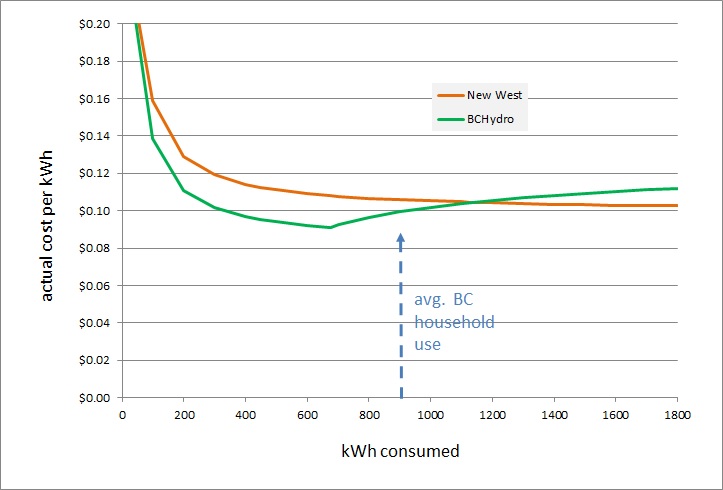
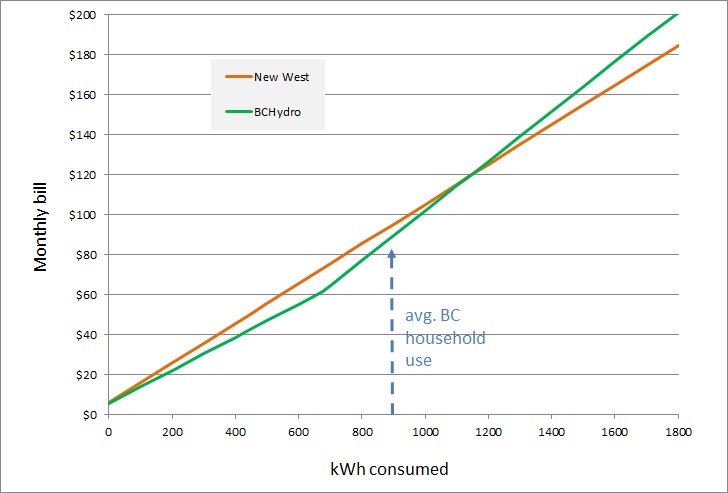
As you have discovered, our base rate for residential users (the amount you pay to have an account, regardless of electrical use) works out to be a few cents higher per 2-month billing period (New West charges $11.92 per 2-month period, BC Hydro charges $0.1835 per day). We then charge a flat $0.0993/ kWh of use, where BC Hydro charges $0.0829 for the first 1350kWh per billing period (2 months) and $0.1243 for any above 1350kWh. So, although collectively, we pay about the same rate, residential users (like you and I ) who use less electricity probably pay more per unit relative to BC Hydro rates, that people who use a lot. To graph it out, it looks like this:

graph1

According to BC Hydro, the average BC household uses about 900kWh of electricity every month. If this average holds true for New West, then the average household is paying about $5.80 per month more than they would in a BC Hydro service area, or almost $70 more per year. Strangely, if you are an efficient apartment dweller and use half that amount of electricity, your monthly New West premium is even higher – at $93 per year.

If you use about 1130kWh per month, then your rates are the same as BC Hydro, and the more you use, the more your savings go up. At twice the average, 1800kWh/month, you would get about a $200 per year discount off BC Hydro rates by living in New West.

As our rate structure is flat, you are not subsidizing larger users – we all pay the same for each unit of electricity in New West. However, comparison to BC Hydro’s stepped rate structure gives the impression that we are encouraging consumption, but not doing enough to actively discourage it. If you add the base and metered values together, here is the true cost of what you pay for every kWh of electricity, based on your usage:

graph2

For context, my (admittedly back-of-the envelope) estimate is that the average New West household saves about $160 a year in Property Taxes (or, depending on your viewpoint, receives $160 worth of extra services from the City they don’t need to pay for through taxes) because we have an electrical utility and the profit it earns for the City. That might make you feel better, except that property taxes index with the value of your home, so again, the big-house-owner probably gets more benefit than the apartment dweller.

In summary, I don’t think this is good. I support the concept of City using the Electrical Utility to provide a financial benefit to the residents that own the utility, and offset their taxes. I support using “similar to BC Hydro” as the benchmark for our retail rates. However, I think the impression of benefitting larger users that is created by our flat rate structure sends the wrong message. I remember asking some questions about this back when I was still pretty new to the job, and I seem to remember getting a report that more of less confirmed what the graph above shows.

I’m not on the Electrical Commission, and I’m not sure when the next rate review will occur, but I’ll see what I can do.

Council, August 29, 2016

The first post-summer meeting occurred on August 29th, which is really only about 2/3 of the way through summer, but the levers and tubes in the Mayor’s Office that control the weather have been dialed back towards continued cooling and precipitation, and the days have shortened enough that it was dark outside before the end of the meeting.

As it was the last meeting of the month we had a Public Hearing at the start, with only one item on the agenda:

Zoning Amendment (Housekeeping) Bylaw No. 7862, 2016 (415 and 444 East Columbia Street)
When a couple of commercial properties in Sapperton were zoned, the specific use “pharmacy” was not included in the zoning language, although that same use is allowed in pretty much every other commercial space in the neighbourhood. It so happens one of the vacant spaces is a perfect fit for a successful pharmacy in Sapperton hoping to expand. The best way to manage this problem is to fix the zoning language for the two properties that were missed all those years ago.

We had two people present written submissions, one in favour (the proponent) and one opposed (who felt there were already too many pharmacies in the City). We had one person appear at the Public Hearing, requesting clarity about the change, without expressing an opinion for or against.

Council moved to give the zoning amendment a third reading.


We then moved into our Regular Meeting agenda, where we started with the Bylaw just discussed in Public Hearing:

Zoning Amendment (Housekeeping) Bylaw No. 7862, 2016
The above-mentioned Zoning Amendment Bylaw was given Third Reading.


The following Items were moved on Consent:

Hyack Square Dedication Brick Revised Layout and Budget
As part of the Wait For Me Daddy celebrations a couple of years ago, the City set up a Dedication Brick program, where you could purchase a brick with an inscription and have it added to the paving around the statue for perpetuity.

Sales of the bricks didn’t necessarily meet expectations, although we still expect something like 200 dedicated bricks to be installed. The numbers have led to a bit of a re-design of the paving plan.

Arts Strategy Update
The City’s existing Arts Strategy dates back to 2008 – it is time for a refresh. The City has grown a lot since 2008, as has the Arts scene. The Anvil Centre being the largest example of this change, along with the upcoming renovation of the Massy Theatre, but there is so much more. The hugely successful annual Cultural Crawl, the opening of interesting arts scenes from the Heritage Grill to Old Crow Coffee and 100 Braid Studios, the re-alignment of the City’s festival season, secure funding for our Public Art program…

There is a need to refresh the strategy to leverage the best we have for continued growth of the City’s arts and culture, and make the most of the support the City provides. A plan will be put together in the next year to inform the 2017-2022 planning window. Keep your eyes open for opportunities to take part!

508 Agnes Street: HRA Amendment Bylaw No. 7817, 2016
This Heritage Revitalization Agreement is a few years old, and the Owner has not been able to complete all of the work included in the agreement – heritage renovations often have their own timeline. The delays are well defended and reasonable, but the Agreement has an expiry date, and so Council needs to agree to extend the HRA to allow the owners to complete their work.

97 Braid Street: Temporary Use Permit for Off-Site Parking for Hospital Staff and Construction Workers during Phase 1 RCH Redevelopment
During the upcoming major works at RCH, the regular parking patterns will be disturbed, both for regular hospital employees who are losing part of their lot, and for construction workers. Fraser Health has swung a deal with the owners of 97 Braid to set up temporary parking in the big empty lot at Brain and Brunette in front of the Sky Train Station.

The City had concerns that charging Hospital staff and construction workers $40 a month to park in an outdoor gravel lot more than kilometre away then rely on a shuttle, is going to exacerbate the situation where RCH employees and contractors park in residential neighbourhoods around the hospitals. In light of this, Fraser Health will work with our Bylaws staff to step up parking enforcement in Sapperton residential neighbourhoods.

88 Tenth Street (Boston Pizza): DVP00610 to vary Sign Bylaw
Boston Pizza want to change some of their signage to make their business more visible from Stewardson Way, which requires a variance of the sign bylaw. The signage is not too obtrusive, and fits with the design of the building, so I have no reason to oppose the idea, except maybe that I have never forgiven, and will never forgive, the dirty stinking Bruins. F#*&$% Marchand and his fat, stupid face.

Proposed Sewerage and Drainage Regulation Amendment Bylaw No.
7863, 2016 and Associated Bylaw Enforcement Amendment Bylaw No.
7860, 2016

Our Sewerage and Drainage Bylaw is being updated to better regulate the discharge of water from construction sites. When they dig a hole and put a foundation for a building, construction crews need to get rid of the rainwater and (sometimes) groundwater they encounter.

This Bylaw change will allow us to better control the quality of those water discharges that go to our storm drainage system to reduce sediment that had negative impacts on our storm drainage infrastructure (pipes, valves, pumps) and contaminants like concrete fines which can impact water pH and damage aquatic habitat when the water is eventually discharged to the river.

2015 Annual Water Quality Monitoring Report
We have a regulatory requirement to test the water quality in the City to assure it meets provincial drinking water standards for things like dissolved metals, bacteria and chlorine levels. And we are required to report this out. The reports show the water is safe to drink. No need to buy the bottled stuff.

Appointment of External Auditor
The City, like most organizations handling public money, need to hire and pay for an external auditor to make sure our books meet all applicable accounting standards. We re-hire every 5 years, and the time is now.

1102, 1110, 1116 and 1122 Salter Street, OCP Amendment, Rezoning, Public Consultation
This mixed housing development in Queensborough will include small detached houses, duplexes, strata townhouses, and freehold row homes, and will result in the dedication of some land for a park.

This project has to go through several levels of review, including public consultation, and will eventually got to Public Hearing, so I will hold my comments until then.

1023 Third Avenue: HRA and Heritage Designation – Preliminary Report
Another Preliminary report, with committee and public consultation work to come, but this project looks interesting. The Heritage Home on the lot has been increasingly in bad repair over the last couple of years, so I am happy to see a serious effort being put into preserving it and yet finding room for more innovative and sensitive infill in the Brow neighbourhood.


Consent Agenda passed, our regular agenda items were then discussed, starting with an Opportunity to Be Heard:

709 and 705 Cumberland Street: Development Variance Permit
These properties were created as a subdivision of a single lot as part of a Heritage Restoration Agreement for the Historic house on the lot. Unfortunately, during renovation of the heritage home, the conditions of the HRA were not able to be kept, and the heritage home was lost. Therefore, the City is taking away the subdivision that was granted. This requires a Development Variance to change the original development plan. No-one showed up to exercise their right to be heard.


Amongst the Presentations to Council was a reporting out by TransLink on the recent Public Consultations for the Pattullo Bridge replacement project. There will be an entire blog topic here, coming soon, so check back in if you really want to hear my pontificating.


Piling Noise
I don’t know if you noticed they are driving piles for two construction projects downtown. The City has construction noise bylaws that limit what times loud noises can be made, but we ae realizing that pile driving noise is different that the running of generators and powersaws. It has been loud downtown and on the Quayside.

Now, we recognize that many of the people most disturbed by this work live in building that are, themselves, built on piles. However, “we’ve always done it this way” is a terrible reason to accept any standard, so the Mayor has asked Staff to explore what other jurisdictions do in regards to regulating pile driving, if we can adjust timing or methods, and to ask if there are other technology solutions that are less disruptive (such as using vibration installation, drilling, or even noise suppression at the driving site).

It may not mean immediate relief, but there are still building lots downtown and on the waterfront, and pile driving is not ending with these projects, I am glad we are looking forward to reduce the impacts (pun!) of future development.

OCP – Draft Land Use Designation Map & Community Consultation
Yes, the OCP is back for more Consultation. I will have more to say in future blog posts about this, but we now have a Draft land use map, based on the consultation that came out of all of those earlier maps you may have seen if you took part.

To make sense of the new map, you need to read the new Land Use Designations. You also need to recognize that these changes have no effect on the current land use, and that zoning requirements about what kind of development will fit on what kind of lot are yet to come.

However, it is worth your time to look at the map, and to take part in the upcoming public consultation meetings coming up in late September and October to get your two cents in on the future of the City. All the info you want or need is here.

Fraser River Middle School – School Bus
According to the Ministry of Education, a Grade 8 student can get themselves to school 4.8km away. That means that, according to the Ministry’s funding mechanism, no student in New Westminster lives too far from the new Fraser River Middle School to walk there.

Some parents of the Connaught Heights and West End areas disagree, and have taken matters into their own hands. They plan to contract a bus service, and run it as a neighbourhood co-op. This after being frustrated by the Ministry’s refusal to fund a bus, and TransLink’s refusal to adjust their service to accommodate school routes (which must sound familiar to Queensborough parents of NWSS students!). They have approached some funding partners to reduce the burden on the parents, and to help get the proof-of-concept running.

The City doesn’t run school busses, full stop. It is not in our mandate, and no other City in the Lower Mainland does it (I don’t even know of any in BC that do). The Ministry of Education’s shift away from funding school busses over the last decade have been shameful, but the City stepping in creates all kinds of problems, from cost to liability, to basic fairness. Of the $5.48 per mil you paid in Property Taxes this year, $1.67 per mil goes directly to the Ministry of Education – we already collect taxes for them.

That’s not to say the City doesn’t have a role in school transportation from our $3.42 per mil. We need to provide safe sidewalks, crosswalks, and roads. We need our police to enforce school zones and encourage safe driving around schools. We have created Safe Routes maps, and continue to make infrastructure improvements. We also help promote safe cycling courses in the schools, and work with the local School District implement transportation plans for every school.

However, this initiative is not the City getting into the school bus business. It is providing some seed funding to a community- lead initiative, financed by parents to benefit a neighbourhood and (hopefully) reduce the number of cars running around our residential nieghbourhoods twice a day. A few months ago, the City agreed to provide a bit of seed funding to assist the Downtown-Uptown Connector shuttle bus (“DUC”), to help determine if this community-led initiative is viable and serves a populace. That is clearly within our mandate, and I am happy to support it.

New Westminster Civic Infrastructure Loan Authorization Bylaw No. 7842, 2016 – Results of the Alternative Approval Process
To the surprise of no-one, the AAP failed to receive the required number of submissions from the public to force a referendum on this loan initiative, with about 0.2% response rate (which falls short of the 10% required). The City is now authorized to borrow up to $28.3Million from the Municipal Finance Authority to fund several infrastructure initiatives.

Consideration of Heritage Alteration Permit Applications during the Heritage Control Period in the Queen’s Park Neighbourhood
This Item and two Demolition Permit applications were tabled by Council for consideration in a future meeting – meaning we will have more discussion about this in two weeks at our next meeting. For now the most I can say is that the types of concerns raised by delegates at Council in regards to the policy developed around the Heritage Control Period are a pretty good summary of the reasons why we tabled these discussions until staff can provide Council with more information to support decision making on these issues.


We then did the usual Bylaws shuffle:

Sewerage and Drainage Regulation Amendment Bylaw No. 7863, 2016
Bylaw Notice Enforcement Amendment Bylaw No. 7860, 2016

As mentioned above, these Bylaws regulating discharges of water from construction sites was given three readings.

HRA (508 Agnes Street) Amendment Bylaw No. 7866, 2016
As mentioned above, this extension for the HRA to give the owners more time to complete their renovation work was given three readings.

Queensborough Special Study Area – OCP Bylaw No. 7822, 2016
Zoning Amendment Bylaw No. 7823, 2016

As last discussed in the Public Hearing on May 30, 2016, these changes to the land use in parts of Queensborough were adopted by Council.

Civic Infrastructure Loan Authorization No. 7842, 2016
As mentioned above, this authorization for the Infrastructure Loan was adopted by Council.

And that, but for some correspondence basically referred to Staff, was the end of summer exciting return to regular Council programming. See you in two weeks.

Council – August 8, 2016

We had a short “Special” council meeting this week. This is a meeting that isn’t on the regular schedule, but we had a few time-sensitive items that came up, and a meeting was convened.

It happens that earlier in the day, a quorum of Council attended the Rainbow Flag Raising at City Hall and Proclamation of Pride Week in New Westminster (New West Pride President Mike Tiney, acting Mayor Lorrie Williams, and the Godfather of New West Pride Vance McFadyen seen above at the ceremony). Then in the afternoon, we had the following less glamorous tasks:

Housekeeping Amendment to Zoning Bylaw to Allow Drug Stores (Pharmacies) in C-CD-3 and C-2L Districts
Almost all commercial-zoned properties in the city permit pharmacies. There are a couple of established commercial properties in Sapperton near RCH that do not, because of historic inconsistencies in how the area was developed. It so happens an existing and successful pharmacy in the area wants to move to a larger property which is one of those few not zoned to permit it.

A logical approach is to do a “housekeeping” amendment, updating the language of the two zones in Sapperton that do not permit pharmacies. That is, effectively, a rezoning, requiring a Public Hearing. Council approved this moving to the Public Hearing stage.

709 and 705 Cumberland Street: Proposed Consolidation and Development Variance Permit Application for Consolidated Parcel
This property near Canada Games Pool had an unprotected heritage house on it, and the owner decided to protect the house with a Heritage Revitalization Agreement in exchange for subdivision, which would allow more density and the building of a second house. Unfortunately, the conditions for protecting the heritage values of the original house were breached, meaning the terms of the HRA were not met. Therefore, the City has come to an agreement with the owner to reconsolidate the lots, effectively taking away the benefits the owner received through the HRA.

The new agreement will not need a Public Hearing, but there is an Opportunity to be Heard on the issue scheduled for the next Council Meeting on August 29. C’mon out and tell us what you think.

Arising form the first agenda item above, we had one Bylaw to address:

Zoning Amendment (Housekeeping) Bylaw No. 7862, 2016
As discussed above, this Bylaw to allow pharmacies in two commercial zoning designations in Sapperton was given first and second reading. There will be a Public Hearing on August 29, 2016. C’mon out and tell us what you think.

And with that, our special early august meeting was adjourned. Enjoy Pride everyone!

What do you do?

I’ve been at the City Councillor thing for a year and a half now, long enough that I have to stop referring to myself as “the new guy”. At some point, I have to stop blaming / giving credit to the previous Council for everything going wrong / right in the City. I suspect (hope?) the steep part of the learning curve is now behind me, and I start directing more of my learning towards the problems I want to see solved, the opportunities ahead. It is also long enough that I should be able to answer the simple question “What do you do?”

I have tried, over the last 18 months, to report out on this blog some of the mechanics of City Council, as it was my goal when running to open up the process a bit, and try to do a better job explaining the sometimes-incomprehensible decisions Council (and the City) make. Recognizing many in the City will disagree with any given decision made by Council, I wanted to at least provide enough information so that they know what they are disagreeing with, and not rely on the few very vocal boo-birds in town who assume a decision is bad only because this Council makes it.

However, this post isn’t about that, it is more about the actual day-to-day duties of a person you pay $40,000 a year (plus Vehicle Allowance!) to represent you, whether you voted for them or not. So here is my summary of the job.

*This is a good time for one of my disclaimers about how everything I write here is my opinion and my viewpoint, and doesn’t necessarily reflect the ideas or opinions of any other members of Council, who are, believe it or not, individual people with their own ideas and biases. Like the rest of this Blog, this is not the “official position” of the City or any entity other than myself.*

Council Meetings:
Council meeting days happen about every two weeks on average. In the spring and fall we meet more often, and we more time off in the summer and around Christmas. The schedule is flexible around work load and stat holiday schedules, but we have about 26-30 meetings a year.

Council meeting days are comprised of a Closed Meeting and an Open Meeting, only the latter of which you see on TV. About 10 times a year (the last meeting of most months), the Open Meeting is coupled with a Public Hearing. We also, at times, have Committee/Taskforce meetings (more on that below) and Council Workshops on these Mondays.

A long Council Monday can be 12 or more hours, with breaks for lunch and dinner. The portion you see on TV is only the Open Meeting and Public Hearing part. On any given meeting day I am at City hall at 9:00am, and typically wander home sometime between 9:00 and midnight.

Council Prep:
We cannot show up at Council Meetings unprepared to discuss the business of the day. Our schedule on Monday is typically pretty stuffed, and we cannot hope to learn enough about the issues on which we will be discussing during that time. On the Friday before the meeting we are delivered (electronically in my case) our “Council Package”. This contains the staff-prepared reports and background info we need to put discussions in context. The Package varies in length, but is typically about 1,000 pages when Closed and Open agenda items are combined.

My practice is to get take a glance at the Package for maybe an hour after I get home from work on Friday or first thing Saturday morning. This allows me to get an idea of what is on the agenda, to determine if it is a 700-page or a 2,000-page week, and to do a first pass over the topics being discussed. From that I can plan out my weekend to assure I have enough time put aside to review at the detail needed, and do any other research I might want to do in order to understand the issue. That is usually when I decide if I have time to do a bike ride on Sunday or attend a Saturday function.

Typically (and this varies quite a bit), I spend about 8 hours on Sunday reviewing the package and taking my notes. My notes form the backbone of the Blog I will eventually write about the week’s Council meeting, but more importantly they create a framework around which I organize my thoughts on the agenda items. This is an old trick from studying during my University years, but I find that if I write a summary of a topic I am trying to learn, it forces me to learn enough to summarize the important points, and to understand what questions I need to have answered yet. Often, you don’t know what you don’t know until you try to write it down.

I print those notes out, so you can see me at Council using my computer screen (where the agenda and reports that make up the Package are) and written notes, along with the extra papers that we receive on Council Day, typically supporting reports that weren’t available Friday, presentation materials, or other relevant documents. My desk is a mess.

Committees and Taskforces:
Like the rest of my colleagues, I serve on several Committees and Taskforces for Council. These each meet anywhere from once a month to once every second month. Most meetings are in the later afternoon, mid-week, after I get off my regular job, and meetings typically last about two hours. With my being on three taskforces and four committees, this adds up to an average of about one meeting a week during the busy months, but not many in the summer (except occasional exceptional meetings, like the Transportation Taskforce last week, and the ACTBiPed next week).

In these meetings, Council members, staff, and stakeholders work through issues, ideas, programs, or proposals, and (hopefully) provide guidance to Council to make better decisions. Prep for these meetings varies greatly, but rarely takes more than an hour. Follow-up on some of the issues that arise at these meetings, and some of the extraordinary meetings, tours or other activities involved with the work these committees are doing takes quite a bit more time.

Community Events: There are various types of community events, some you have to attend, like the Civic Dinner where we thank committee volunteers, some you attend to show support to organizations or people doing good work in the City, some you attend just because they are fun.

This is a challenge for any Councillor’s schedule. We get a lot of invitations, and cannot hope to attend everything. I try to be careful about stretching myself too thin, and end up missing a lot of events I really want to get to. I try to respond to every invitation and send a decline if I cannot make it, but scheduling is an ongoing challenge, as is managing my work and Council calendars while still finding some time to remind @MsNWimby that I exist. The job does not come with a social coordinator, and every calendar app I can find for my phone is worse than every other one. I’m still working on this part…

Constituent Services:
This is a big, but pretty loosely defined group of activities, and each Councillor can make their own decision about how they manage this, and how much time it takes. This is another part of the job that “expands to fill the space available to it”.

Sometimes, a person complains to you about potholes on their street, or the noise from their neighbor’s wind chimes. Sometimes they call you to ask for help with a business license issue, or to complain about a development in their neighbourhood. Sometimes people complain about unfair enforcement of a Bylaw, while others complain about lack of Bylaw enforcement. Some people just want to be heard and the problem acknowledged, some want you to fix things for them.

I try to take an approach to this based on a few principles. I am not there to help people get out of Bylaw requirements, to get their stuff pushed to the front of a line, or to help them get around a process that exists. I am really conscious that procedures and policy exist in government, and that we have professional staff working on directives from Council as translated through their management – they should not have to deal with an individual Councillor coming and telling them how to do their jobs. That said, if a resident or business owner feels that the process is unfair, or that they have received treatment form the City that is not in keeping with City policy or good customer service, I am happy to talk with management at the City and (this is important) get both sides of the story and figure out what went wrong.

It is a delicate balance. Sometimes my job is to help explain to a resident or business owner why things are so bureaucratic and irritating, and why the Bylaw is written or enforced the way it is. Sometimes staff do mess up, or processes are developed that don’t really work when put into practice, and someone needs to facilitate a better outcome for everyone. I don’t see my job as advocating for either party in a conflict like this, but as a mediator trying to figure out an outcome that works best for the City and the Residents. And occasionally the approach required is to work with the Mayor and Council at the executive level to fix a process or a system that is not working for the residents and businesses in the City. Deciding which of the three is the right course when hearing from a complainant is a tough job, and something I am still learning about and developing my skills at.

Communications:
I receive dozens of e-mails a day and a few phone calls a week from residents or businesses in town. I try to respond to all of them. I fail.

When I first got elected, I dreamed I would answer them all promptly and personally, but reality has set in. Some (like the every-couple-of-day missives from the hateful racists at Immigration Watch) go directly to delete. Some I am just cc’d to, and am not the best person to answer, so I usually wait to see if a more appropriate person responds before chiming in. Some raise interesting and complex questions that I need to put a bit of thinking too before I respond. Some scroll off the first page, and I get back to them a week or two later and feel bad about not having responded right away. Some, I just don’t seem to have the time to keep track of.

So if you wrote me an e-mail, and I was slow to respond, please don’t take it personally, and don’t feel bad sending me a reminder e-mail. I will get back to you eventually. Unless your comments are full of hateful racism or other abusive language, in which case I’m likely to just ignore you and hope you go away. In that case, I guess, you can take it personally.

This other stuff:
Writing this Blog is, to me, a really important part of how I do this job. It takes a lot of time, and is almost always done after 10:00 on weekday nights. Summarizing a Council Report can take a couple of hours, depending on how many items on the week’s agenda require extended explanation. I find free time to write pieces like this wherever I can (in this case, I am sitting at one of the little desks on the Queen of Alberni crossing the Strait of Georgia while @MsNWimby enjoys the blue sky on the sun deck).

Tracking the local and regional media (including the social media) is also an important part of the job whose hours simply cannot be counted. Keeping track of the goings in the City, of the trends in the region, of Provincial and Federal politics as it relates to our City, is vital if we hope to make good decisions for the City. This includes a fair amount of general interest research, following great local sources like Price Tags, or global sources like StrongTowns along with reading great urban and economics leaders from Janette Sadik-Khan to Umair Haque.

Nothing in New West is new, we don’t have completely unique challenges, but the same challenges as other Cities and regions have had. Learning what from their successes and failures is the best way to train myself to make better decisions.

I have been at this for 18 months, and parts of it are getting easier. I am now better able to judge the amount of my Saturday and Sunday I need to spend reading my Package, more of the “background” in my Package is familiar to me, requiring less review. I have a better idea who in City Hall to call and get a question answered. The trade-off is the expanded time I spend doing that last part – the constant learning to empower myself to make better decisions and dream bigger about the future of the City.

Now if I can only get ahead of my e-mails and get my scheduling figured out…

BridgeNet

I haven’t talked too much about BridgeNet here, the City of New Westminster’s fibre optic utility initiative. It is one of those things in the City that I am less involved in, as I am not on the Economic Development or Intelligent City committees, though it is an idea of which I am supportive.

There was a recent discussion in a community Facebook thread that breezed past traffic, talked about the current long-term lending plan, and various taxes and spending issues, but some good questions were raised about why and how the City is investing in fiber optic infrastructure. So instead of lengthening that already lengthy thread, I thought I would answer the questions here (and link back, of course). The questions are thus:

I am curious however why NW has ‘invested’ $9M of taxpayers money in a fibre optic network to compete with Canada’s four private sector service providers Bell, Telus, Rogers and Shaw?

The simple answer is that access to higher speed internet connections is something residents and businesses want, and is part of both the City’s Intelligent City initiative, and a part of our Economic Development Plan. There is a new generation of business, a new type of worker, where an internet connection is as important to their success as access to truck routes are to some more traditional industries. These types of value-added high-paying jobs are an important part of developing a City where people can work, live, shop and play in the same community. And the Big 4 Telcos are not bringing 1Gb service to New West any time soon.

Some are under the mistaken impression that the City is starting a Telecommunications company (“Telco”) to compete with the Big 4, but that isn’t the plan. If I can stretch the analogy of this being the trucking industry of the next century, it might cast a little light on what we are actually doing.

In most of Canada, consumers hoping to connect to the internet have to choose from one of the Big 4 Telcos. This is because those companies have had the financial wherewithal to build a full network, mostly off the infrastructure backbone of the telephone companies that spanned the country in the first half of the last century. In the data-as-cargo analogy, these companies are like the large railways. There are few of them, because they had to pay to install the infrastructure that they use (with significant legislative and material support from supportive governments, interested in “opening up the markets”) and as a result, they have a pretty solid grip on the competition within the market. They are, effectively, an oligopoly.

This doesn’t mean they completely lack competition. Trucking companies also move goods, and what they lack in might and capacity, they make up for in a built-in efficiency: they don’t need to build the roads or bridges they operate on. That infrastructure is built as a commons, and everyone can use them. Local, regional, and provincial governments build roads using your taxes, but they don’t run trucking companies. They can, however, choose where they build roads, and how they provide access – something they really can’t do with railways.

So it is with a dark fibre utility. The City is, essentially, building the roads (“fibre”) so that any trucking company (“ISP”) can come in and compete with the railways (“Big 4 Telcos”). There are many small ISPs who can and are willing to offer boutique and discount services in New West, but cannot build the trunk infrastructure needed to get into the business. Meanwhile, the Big 4 are concentrating their infrastructure upgrades in the biggest markets like downtown Vancouver and working to outcompete each other where the money is easy.

Far from competing with the Big 4, the City is building a fibre network that will open up competition, such that more companies can challenge the limited offerings provided by the Oligopoly, promising businesses and residents along the network much faster internet service, and more affordable and flexible service plans. We are not offering those services, but we are charging tolls to the companies that will offer them through the fibres we install. Those tolls will (for the first decade or so) pay for the cost of the infrastructure, and after that it will provide a revenue source that a future Council can use to offset taxes, much as the Electrical Utility currently does.

I guess New West has decided that running it’s own Crown Corps is a great way to ‘increase revenue’, a phrase I’ve heard repeated on several occasions at City Hall.

Yes, providing services that people want is a good way to increase revenue in the City, and it provides an opportunity to offset your taxes. Especially when a City leverages opportunities that come with operating roads and utilities, and can use its solid financial position and favorable Municipal Finance Authority rates, the City can provide things that people want for less money. Sort of the thing people who ask Cities to “operate more like a business” would suggest we do.

Governments are not for-profit businesses. I can write an entire blog post about how Governments and businesses are fundamentally different, but that would be a long digression at this point. Suffice to say, providing a utility service that improves the competitiveness of our business community, is attractive to residents and people who work at home, and doing it in a way that will first pay for its own infrastructure, then return value to future taxpayers, seems like a pretty good governance decision.

This $9M in this optional financing program also intrigues me seeing as, based on walking around town, this network at least appears to be mostly installed. How did we pay for it in the first place?

The network is not mostly installed. A couple of trunk lines are in the ground to allow communication between City facilities so our internal corporate network can run better. Those were paid for by taxpayers, like the rest of the City’s computer network system.

Perhaps what you are looking at (?) is the conduit we have installed – the plastic tubes that fibre can be fed through. The City was forward-thinking enough to install conduit while road and utility works have happened over recent years. Conduit is cheap, and it is easy to drop it in the trench while you are doing other works before the asphalt goes down. The Ministry of Transportation does similar things when they build major road projects, like the SFPR. Stick the conduit in, because you never know how you are going to use it in the future. in fact, BridgeNet will use MoT conduit for part of it’s system, a service BridgeNet will pay MoT for.

What we have not yet done (but are working on right now) is put fibre into those conduits, nor have we built the infrastructure at the junctions and end of the lines that would allow that fibre to light up. That stuff costs money, and we are investing in it now. We will also be investing in last-metre connections as customers sign up to access the services that the Internet Service Providers (ISPs) will be providing. That stuff costs money, and rather that use property tax money or dipping into reserves, it makes sense to borrow the money at the low rates the Municipal Finance Authority makes available to us, and to pay back those loans with the income earned from the operation of the Fibre Utility. Utility customers – the users of the infrastructure – will be paying this infrastructure loan back, not taxpayers.

BridgeNet is a pretty exciting initiative, and one that is about the future of the City. There was a great open house last month where industry leaders came to the Anvil Centre to talk about the potential that high-speed internet provides to Cities, to businesses, to institutions like Douglas College and our Schools, and to residents. We had four ISPs there, demonstrating the types of services they want to deliver, be it discount home 1Gb service or specific boutique offerings for office centres. There were hundreds of residents and businesses there, excited to look at the map, and all asking the same question: When will this service be coming to my street? The answer can be found at the BridgeNet Website, and the map you can find here.

Ask Pat: 8th Street

Pedestrian asks—

What is the future of 8th Street? Reading through the Master Transportation Plan I believe that I’ve spotted some inconsistencies. For example, on page 90 8th St is noted as a Great Street and that with a consistent 30 metre right of way it could become four lanes from Downtown to the Burnaby border. There is also discussion of potential bus priority access. However I don’t see any other reference in the MTP to 8th Street being a Great Street. Further, 8th St is classified as a Local Collector. According to page 136 Local Collectors should only be two lanes.

Can you provide more information that would correct these inconsistencies? What does bus priority access mean anyhow?

For what it is worth my personal perspective is that the current width of 8th St creates an artificial barrier in the Brow of the Hill neighbourhood. Further, the absence of a boulevard on the East side of the street and no street trees make for a lacklustre pedestrian environment. I’d hate for the street to be widened, making the problem even worse. With Fraser River Middle School opening up this fall, and developments at 4th Ave wrapping up around the same time, now is the perfect time to clarify direction.

In the short term: not much. There is no capital plan or budget right now allocated to changing the streetscape of 8th Street. There will be a few crossing improvements (Dublin, 7th Ave) and some local improvements as development occurs (like in front of Fraser River Middle School), and these will be informed by the long term vision provided by the Master Transportation Plan.

There is a typo on the MTP that may be causing some confusion. The reference to 8th Street being a “Great Street” on page 90 is wrong, as the Great Streets map on Page 108 and the entirety of Section 4.4 make no reference to it. This makes sense, as aside from a few short stretches, there is little retail on 8th Street, and there is little chance of it becoming a primarily commercial corridor like 6th Street or the other identified “Great Streets”.

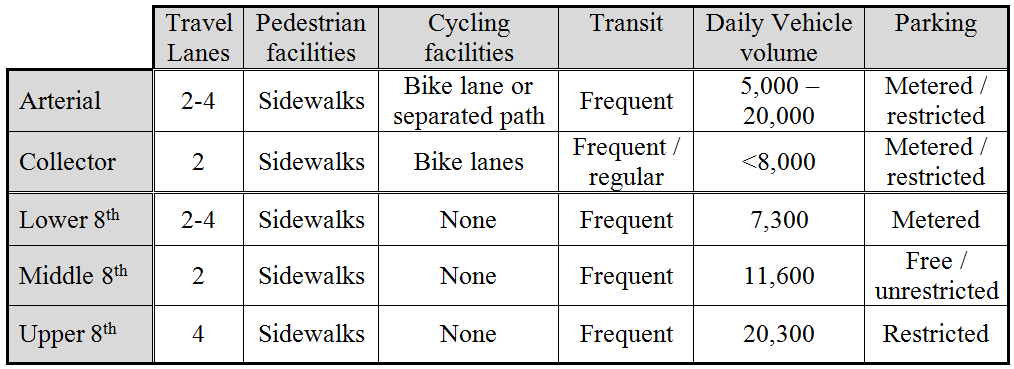
As you point out, 8th St. has some other characteristics that don’t necessarily match the designated use. In the MTP it is designated as a City Collector road, but it has many of the characteristics of an Arterial, although the street varies in use along its length. The disconnect between how the road is designated, how it is designed, and how it works, is shown on the following table (all info from the MTP):8thtable

So outside of the MTP, recognizing there are no immediate capital plans changing the road, and to your point of it not being a very friendly road (dare I say “pre-Stroad”?) right now, what can we envision for the future of 8th St.?

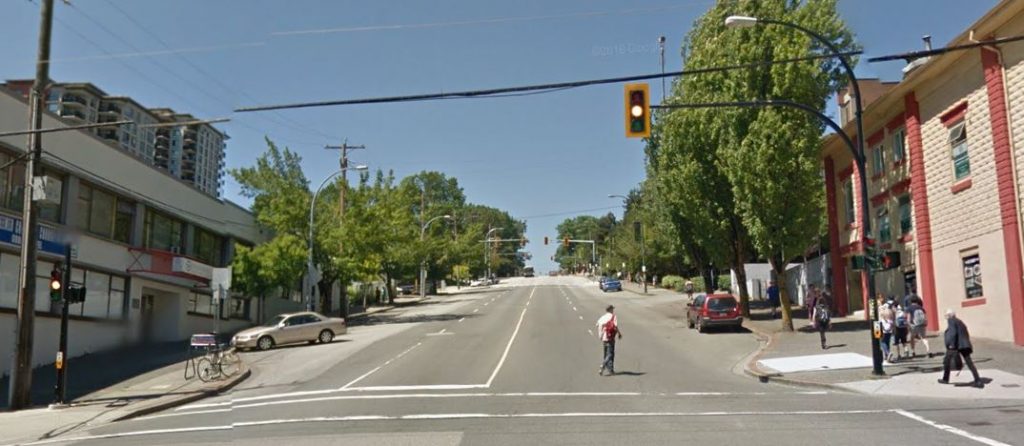
lower8th
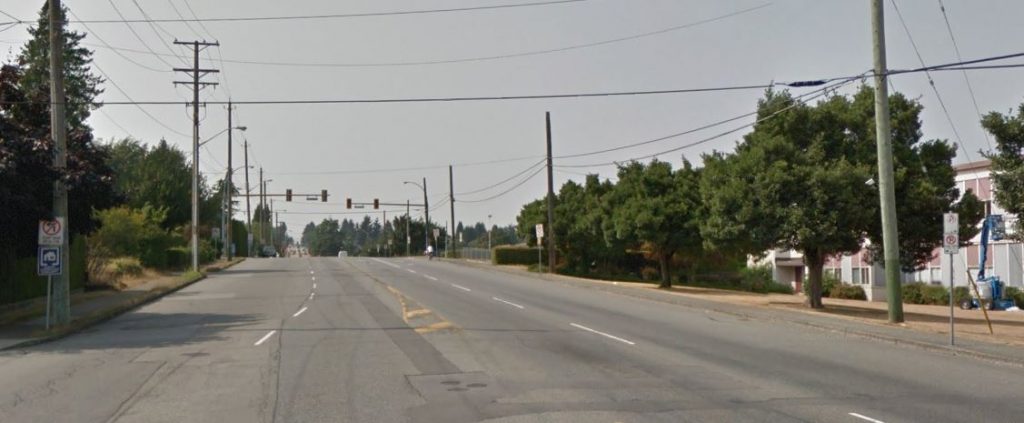
Google Street View, no permission sought.

The portion below Royal is exceptionally wide (more than 20m curb-to-curb in some spots), and is predominantly a pedestrian space, despite various attempts to corral and displace pedestrians to “get traffic moving”. This is the only part of 8th that has traffic volumes within the “City Collector” ideal – less than 8,000 vehicles per day. Everything about this tells me we should be reducing the driving width of this street, and improve the pedestrian realm. The massive daily flow of students between the New Westminster Station and Douglas College shouldn’t be crowded on a narrow sidewalk while waiting for pedestrian lights to change. The City should not have built the Anvil Centre (or allowed Plaza88 to be built) in such a way that parking garage entrances and loading bays disgorge into what should be a pedestrian-first place, but that ship has now sailed. This doesn’t mean we can’t think about re-allocating underused road space and shifting priorities to active users.

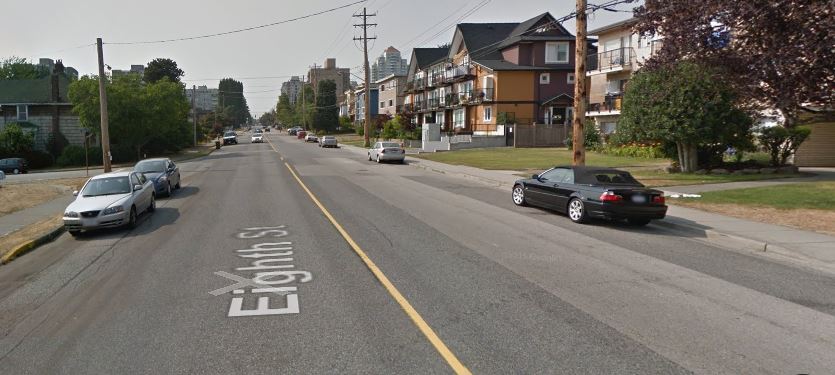
mid8th
more Google Street View, not sure how legal this is.

The portion between Royal and 6th Ave is essentially residential, although traffic counts here are higher. It operates as a true “collector” in the sense that the adjacent local roads dump traffic onto 8th as the route to the regional road system (be that Royal Ave, Canada Way, or wherever). The 15-m curb-to-curb width is still pretty wide for a two-lane road, and parking is both free and plentiful. A few curb extensions at important intersections (3rd Ave, 5th Ave) help improve pedestrian safety, but the open road feel definitely encourages travel speed greater than the regulated 50km/h, which combined with expansive asphalt and a general lack of trees, adds to the “barrier” feel you mention. There are some planned improvements around the new Middle School, but I doubt there would be any desire or political will to expand this road to 4 travelling lanes. The traffic doesn’t warrant it, and the impact on the livability of the community would be profound.

upper8th
but hey, Google just took these photos without asking permission…

The portion between 6th and 10th is harder to peg. The lanes are a bit chaotic, parking intermittent, and at more than 20,000 vehicles per day, the traffic is pushing the upper limits of what an Arterial should be handling. This is one of the main connections from the Brow and Uptown to the regional road network (Canada Way), so I guess it isn’t surprising that the end of all the collectors is a logjam. At the same time, it has a High School, one of our most frequented parks, some high-density residential areas, and our largest commercial centre. It is crossed by two Greenways and is frequented by a large number of seniors. It is a mess, and likely the most Stroad-like road we have in New West, but solutions here are difficult to find. There will be re-writing of the interface with NWSS when the new school is built, but I don’t see much other relief any time soon, mostly due to vehicle load.

Finally, Bus Priority Lanes are just that: lanes where B-line type buses can have priority over traffic uses, although not specifically bus-only lanes, as they may share space with right-turning cars or general traffic in some locations. They come in several flavours, but are not common in urban areas of the Lower Mainland. Highway 99 has them approaching the tunnel, and East Hastings through Burnaby has a version of this. They might be considered in the future for 8th if traffic loads increase to the point where congestion seriously impacts bus operations, but I do not think we would consider installing more asphalt to make them happen.

ASK PAT: Car allowance

Mark asks—

Hi Pat

A question regarding the recent council compensation recommendations, specifically the car allowance. Given the city and council’s vocal support for increased transit spending, reducing traffic in the city and it’s occasional touting of how great the city is in terms of transportation mode share, why would council (well, you at least since we’re on ask Pat) support a flat payment for automotive use?

Given their advocacy on the matter, council members should be leading by example on this. The city has excellent skytrain and decent bus service, and is well connected regionally. Why not give councilors transit passes to cover their travel?

Of course not all commitments can be met by transit, and yes councilors should be free to expense appropriate mileage (or taxis, rentals, car shares, etc) related to their duties. But simply giving councilors money for their automotive expenses runs counter to what the city and council is pushing for.

Appreciate your thoughts and the time to reply, and thanks for keeping up the blog.

Yep, I agree with you. The “car allowance” is a stupid idea for a City of 15 square kilometres, with the densest transit coverage and highest alternative mode share of any community outside of downtown Vancouver, and a Master Transportation Plan that takes priority away from the private automobile as the primary form of transportation. We have a Mayor who walks to work, one Councillor who never drives and a couple others (including me) who make it a point not to use a car to get around within town. A “car allowance” makes no sense.

Of course, it isn’t a “car allowance”, or even the HR-preferred vernacular “vehicle allowance”. It is a “transportation allowance”, as we can use it on any mode we like. We can top up a Compass Card, hire a taxi, gas up our car, get a Modo membership, or buy replacement tires for my bike.

Of course, it isn’t even a “transportation allowance”. It is $100 we get to spend on whatever we want. We are not required to provide receipts or justification, so this is little more than a taxable top-up of our salary. As a Councillor, I will get $1,200 more per year above the “base salary”, and whether that adequately compensates me for the transportation cost related to my job is kind of secondary (which makes it different than our other expense allowances, because they are actually backed up by policy guidance and we need to provide receipts and get them passed by HR, just like any expenses you might accrue in your regular job).

This issue arises from the once-every-term review of Council remuneration, which is always a sticky point. I don’t want to get into a long discussion about how much elected officials should get paid here, because that is pretty philosophical topic with wide differences of opinion, and wasn’t your question. However, it is apropos to discuss what a good governance model is to determine how much elected officials get paid. The decision we made this spring was, in my look at it, more about approving the process than the numbers.

When it comes to local government in BC, it is up to the Mayor/Councillors to determine their own pay. This is a direct conflict-of-interest that is not only permitted under the provincial law regulating local governments, but required by it! In that context, good governance requires that Mayor and Council don’t make a capricious decision and write their own cheques, but that they permit the professional staff in their HR and Finance departments to determine an appropriate process to determine appropriate compensation. The best we (and by “we”, I mean citizens and elected types) can hope for is that the process is transparent and defensible. Where both transparency and defensibility break down is when one or more elected official tries to supersede or run around that process, be it for personal or political reasons.

The process we have in New West is that every 4 years, HR staff compare the wages and benefits of elected officials in New West to those in comparable cities – a collection of other Lower Mainland municipalities, excepting the biggest (Vancouver, Surrey, Richmond) and the smallest (Bowen Island, Anmore, Belcarra) and do regression analysis on several statistics (population, budget, size of Council), with the guidance being to keep our Council firmly in the middle. Between those every-4-year adjustments, annual increases are indexed to CPI. You may suggest a better system, but HR has explained their rationale through reports, find it defensible and transparent. The process made sense to me, in that I could understand the rationale, could follow the numbers and do the math, and it made sense, so I supported it.

As for the “vehicle allowance”? I don’t like it, think it is a bad idea for all the reasons you state. However, respecting the process that provides good governance makes it hard to pick and choose the results of that process. HR and our external consultants determined what constitutes fair compensation based on a policy guideline that was, essentially: do what other similar Cities do. Apparently “car/travel/transportation allowance” is now part of that. We could have rolled it into the regular wage and compared across the municipalities and come up with a wage number that is $1,200 higher per year, but HR determined that making it a taxable expense makes more sense from an HR perspective.

I’m not sure raising a stink and pulling apart that process is the appropriate way to manage my discomfort about the symbolism of a “Car Allowance” in 2016 in New Westminster. How do I do it without calling into question the process – one that I have essentially been at arms-length from to reduce the conflict of interest created by the legislative structure – and not opening the door for a very political discussion with everyone making whatever adjustment suits their specific desires, political position, or special idea? I would argue of all the decisions we make as a Council, this is one where our personal politics need to be ignored, and the decision made (effectively) by staff.

So I don’t really have an answer to the “Car Allowance” question (at least not one I could come up with and propose in a reasonable timeline), but it is clear my personal political opinion is that it is a bad idea. This is something I am thinking about as I think our entire organization at City Hall needs to do a better job walking the walk when it comes to Transportation Demand Management. We are asking residents and businesses in the City to adapt to a more sustainable transportation system, but are slow to adopt progressive change as a corporate entity. Obviously, that argument is easier to make if us elected officials take a position of leadership. I’ve put this issue on my To Do list, and hope to have a better answer for you prior to the next time we go through this exercise.