The Fare Gate Fiasco.

The Faregate Fiasco is beginning.

The introduction of faregates at SkyTrain Station is another example of the broken governance of TransLink. At a time when the Regional Transportation Authority is financially challenged enough that they cannot finance 20-year-old expansion plans, when they are going to have to come, cup-in-hand to the taxpayers to try to fill their operating budget for the next 10 years, they are being forced to implement a system they don’t want, don’t need, and cannot afford, so that the Premier and pals can cut a ribbon and be seen to be “doing something” about a problem that doesn’t exist.

Let’s start by looking at some of the rhetoric around the issue.

First off, the current system does not operate on an “honour system”. It is a “Proof of Payment” system: you are required by law to carry proof of payment within fare paid zones (like on all SkyTrains). If you don’t have a proof of payment, you are kicked off the train and out of the station, and you get a ticket from Transit Cops. “Honour” has nothing to do with it.

Anyone who rides the SkyTrain regularly (as I do) will tell you that they do regular screening, and they do actually pull people off trains and issue tickets. When they come on a train and do a ticket check, 99% of the people on the train actually have tickets. I am a gambler by nature, I love to think about and play odds. I have done the math on buying a SkyTrain ticket many times, and there is significant incentive to buy a fare in the current system.

Yep, that above is an example of anecdotal evidence, and is not something to base policy upon. Except by TransLink’s own math, Fare Evasion is not an issue. A few years ago, it was estimated to represent $3 Million a year. Those numbers have been suspiciously creeping up (to justify fare gates?) to $7 Million a year this year. (or maybe the numbers are decreasing?). It is interesting that this “evasion creep” has been happening at the same time that the TransLink Cops have grown into a fully armed force of more than 200 cops, ready to taser people for not paying their fare, with a budget that has grown to $28 Million a year .. where is the value for our money there? Still, that means it went from about 0.85% of fare revenue to about 1.75%. (I can’t help but think that if they raised fares 2% to offset this and passed on the gates, few would complain).

So TransLink is spending $170 Million of your money to save (an inflated?) $7 million of “Fare evasion” that their $28 Million a year armed police force cannot stop. Oh, and the Gates will cost $9milloon a year to operate, maintain, and staff (yes, there must be a person at every gate). The math stinks.

Especially since the gates won’t end fare evasion. People who don’t ride transit imagine everyone they see walking into a Skytrain station and not stopping at the ticket machines is evading the fare (they aren’t, most riders have transfers or passes). But fare evasion comes in many other flavours: people who get on the back of a way-overcrowded B-line bus without a pass, people who use other people’s passes, people who get on a bus with a 1-zone pass and ride two zones, people who use concession fares when they shouldn’t, people selling U-passes on Craig’s List. The faregates are not going to stop any of these people. Only the existing “Proof of Payment” system can, as that requires the person to present a valid fare to a Transit Cop. This is why some argue the faregates will increase fare evasion system-wide, as there is less human verification of passes: the gate can’t tell I am a 40-year-old using a seniors pass.

There is another issue: the stations themselves. There are several stations where the Gates will not really fit, or will create serious pedestrian congestion including Metrotown, one of the busiest stations in the system. In Stations like the revamped pedestrian-friendly mixed-transit-retail New Westminster Station, the Gates will introduce an obstruction to pedestrian flow that will undermine the public space aspect of our transportation hubs. This will not increase anyone’s “feeling of security”.

And that is what this is about, creating a “perception of safety”. It is the same thinking that has Canada building more prisons as crime rates continue to plummet. I don’t blame TransLink, they made it very clear a couple of years ago that they do not want to install these gates, for all the reason I listed above. Then they were overruled by Kevin Falcon after the former Minister of Transportation took a trip to London and had a epiphany… and the rest is a long story of bad governance based on unsupported perceptions that contradict the actual data. It is a strange epiphany, considering London, with faregates, has both a higher fare evasion rate and more crime in their terminals (pickpockets being the most recent issue).

The result of Kevin Falcon pulling transportation policy out of his ass and forcing it on a local government body is a whole bunch of your tax money being burned, now and into the foreseeable future, for no reason other than to give him a ribbon to cut.

Another Trip on the NeverGreen Line – UPDATED

Since I have been gone, I have particularly enjoyed the Evergreen Story Arc.
It all started with this story. It reads like good news: The “funding gap” finally filled, the Mayors and the Minister of Transportation finally coming to an agreement, time to start breaking out the shovels and ceremonially turn some sod (yet again). Rumour has it Richard Stewart even dusted off his gold-plated shovel for the announcement. News too good to be true? Of course.

This was, unfortunately, a result of credulous reporting of a news release completely lacking in context, and complete failure of the reporter to ask any questions about the “facts” being presented (or if they were asked, the answers were edited out of the final report). Even from my semi-secluded state, it occurred to me that this agreement was going to require the Province to pass an increased gas tax as requested by the Mayors, presumably some time between the HST referendum and the much-anticipated Provincial Election, or approximately coincident with a Municipal election. What are the chances of Premier McSparkle™ and the Mayors going for that? And was a $0.02/L gas tax going to be enough?

Then the full TransLink news release came out, and a few more details were available. Apparently,“the Mayors’ Council on Regional Transportation and the provincial government have agreed on a way to provide $70 million in additional annual revenue”, subject to some public consultation. This included the $.02/L gas tax in 2012, and…umm… something else, maybe property taxes, maybe something else… by 2013. So, really, they kind of agreed on part of a plan to fill “the gap”, and as for the rest, well, we are right back where we started. But still, at least they all agree, right?

Well, apparently not . Within days, the mayors are either starting to line up and say they don’t support this plan, or are reluctant to comment on whether they voted for it or not. So again, this plan can only go forward with “public consultation” during an election year, and they won’t even publicly acknowledge if they voted for or against it? Not promising. 

At least we know where Grampa John Cummins stands. He wants Evergreen to be built, but doesn’t want to pay for it with taxes, because taxes are evil. Sounds like Harper’s plan to buy attack jets… if we pretend it doesn’t cost money… maybe it won’t? Thanks for coming out, John.

So TransLink and the Mayors, and the “opposition” are all unsatisfied, maybe the good news to be gleaned out of that very-fast-to-tarnish golden news release was that the new Minister of Transportation is finally getting this problem fixed, and the Province is committing to building the train promised to Premier McSparkle’s™ old neighbourhood (back before it was her old neighbourhood and she was busy dropping out of SFU). Except that the Premier has made it crystal clear that she is not going to vote in a new tax between the HST vote and the next election. No way. Whatsoever. Or maybe she will.
That’s leadership you can believe in.

If I was Richard Stewart I would be starting to get concerned. That shovel has been bouncing around his trunk for a while…

UPDATE: This story keeps on giving. Mayor Watts is uncharacteristically sounding like the voice of sanity here, while Grampa Cummins proves he still doesn’t get it. After reading Watt’s’ comments, it appears Gramps has decided that the increase in operating funds TransLink needs can be found by taking it out of the operating funds of TransLink. You can’t argue with that logic.

I haven’t heard anyone put the 2 cent gas tax in perspective. For the average driver in Canada (see Stats Can numbers), it works out to about $28 a year. That $28 is about two-thirds of what the average Canadian spends per week on gas (at $1.33/L). Or, alternately, it is slightly less than the cost of a book of 10 2-zone bus passes: a week’s worth of commuting for most transit users.

Community -updated!

I had such a fun weekend. One that reminded me how much I love my community.

I just want to add the note that back in December, I did an interview with the News Leader, and made my predictions for the 2011 Stanley Cup Playoffs. OK, I said Canucks-Habs, but Boston are an original six team that needed 7 games to knock Montreal out, so I’ll call that predition 75% accurate.

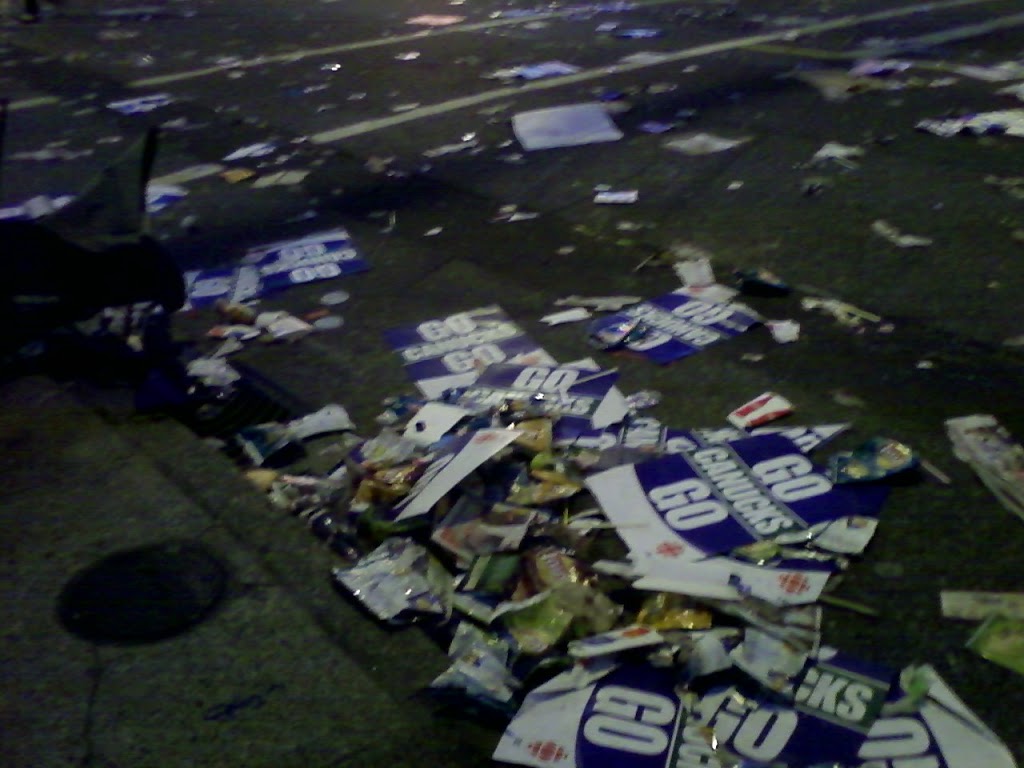
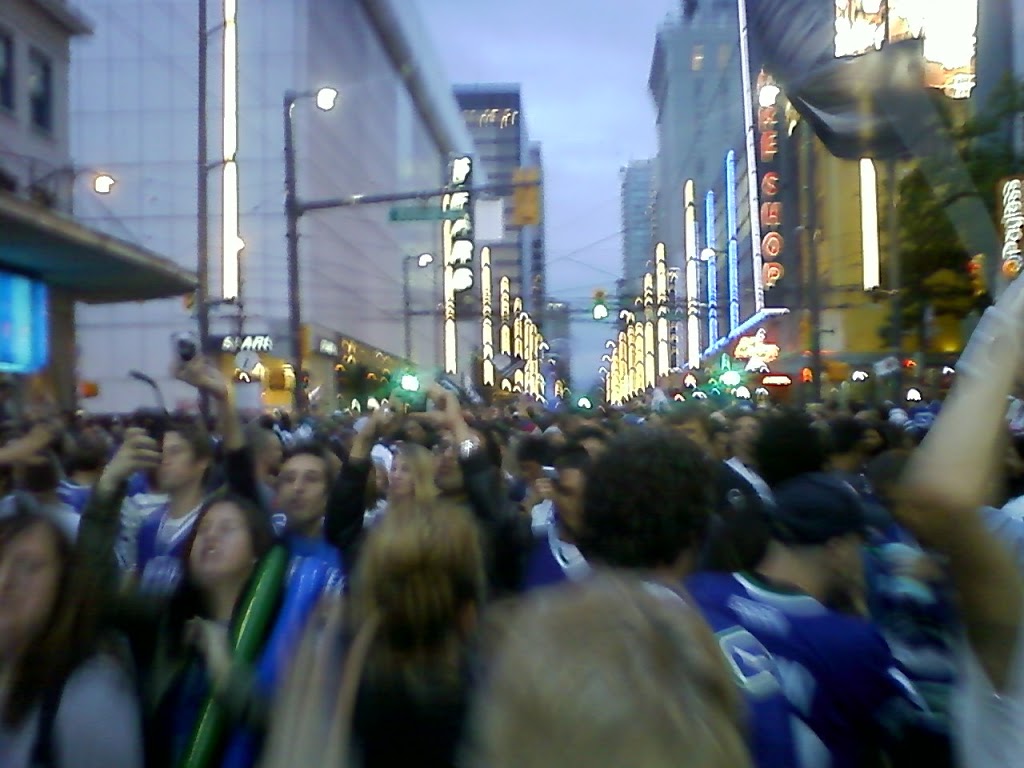
Friday evening was spent in Downtown Vancouver with some great friends, performing an unusual ritual for a life-long Canuck fan: drinking beer and watching hockey in the month of June. The sounds of the crowds downtown when the goal was scored, and when the final buzzer sounded, were amazing. I was lucky enough to be downtown during the Olympic Gold Metal Game as well, and the feeling was much the same. To be in amongst a crowd of tens of thousands, everyone throwing high-fives as they walk the street, the feeling was electric. Lots of cops in the crowd, but much like the olympics, they were present to make us feel secure, not to “keep order”, and they shared as many high-fives as anyone else. It was a great time.

It wasn’t the camera – it was actually this blurry out.
It is silly to try to explain it. Generally and really large crowd of like-minded individuals is inherently a dangerous thing, but the feeling was so positive. Why? Because, as XKCD so eloquently put it, a weighted random number generator just produced a new batch of numbers. Why care if the Professional Sports Franchise in my hometown is superior to the Professional Sports Franchise in another town? Is the only benefit to all the time and energy we put into ultimately meaningless entertainment just about feeling good, collectively, once in a while? Is this a better way to spend out time an energy than curing cancer or writing piano concertos?  Is this community building?
It occurred to me on the SkyTrain home; it might have been the beer.

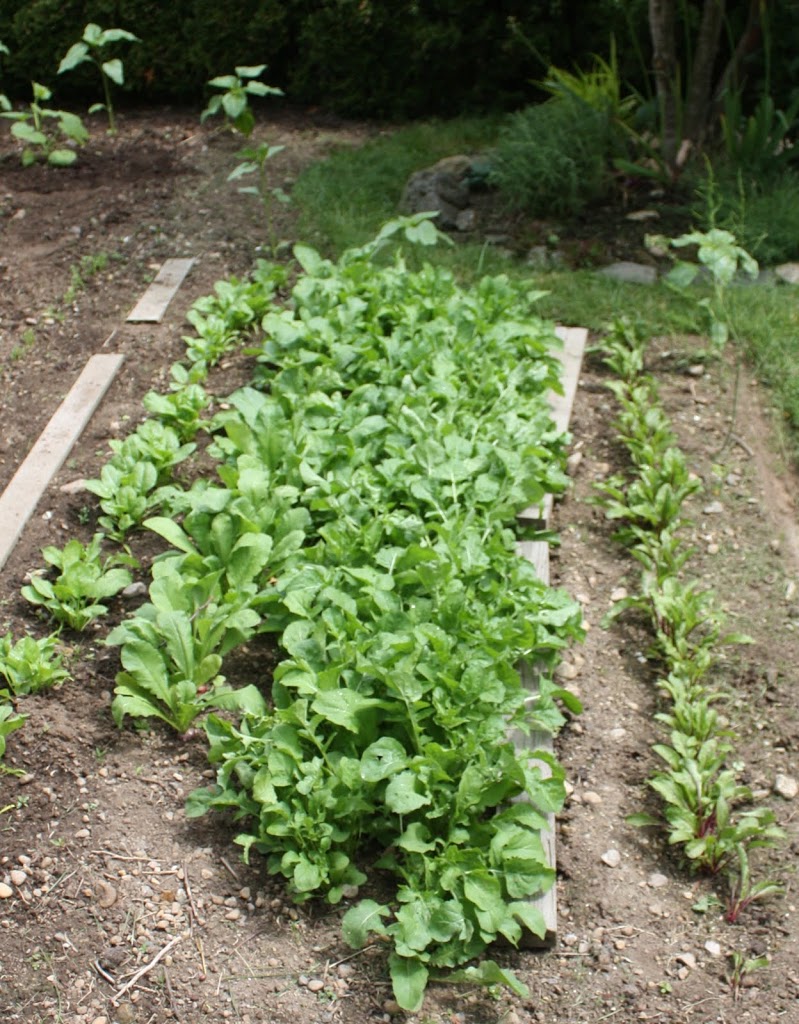
Saturday was mostly a garden day. Putting out a lot of the plants that I started indoors: the peppers, the tomatoes and the cucumbers, along with a few squash plants I was gifted from a friend. The radishes, lettuce and spinach are already out of the ground and into my salads, but with the cool spring we had, everything is starting late, and I have to fight the slugs, aphids and cutworms for every leaf. More bloggin on this to come, an ongoing summer project.

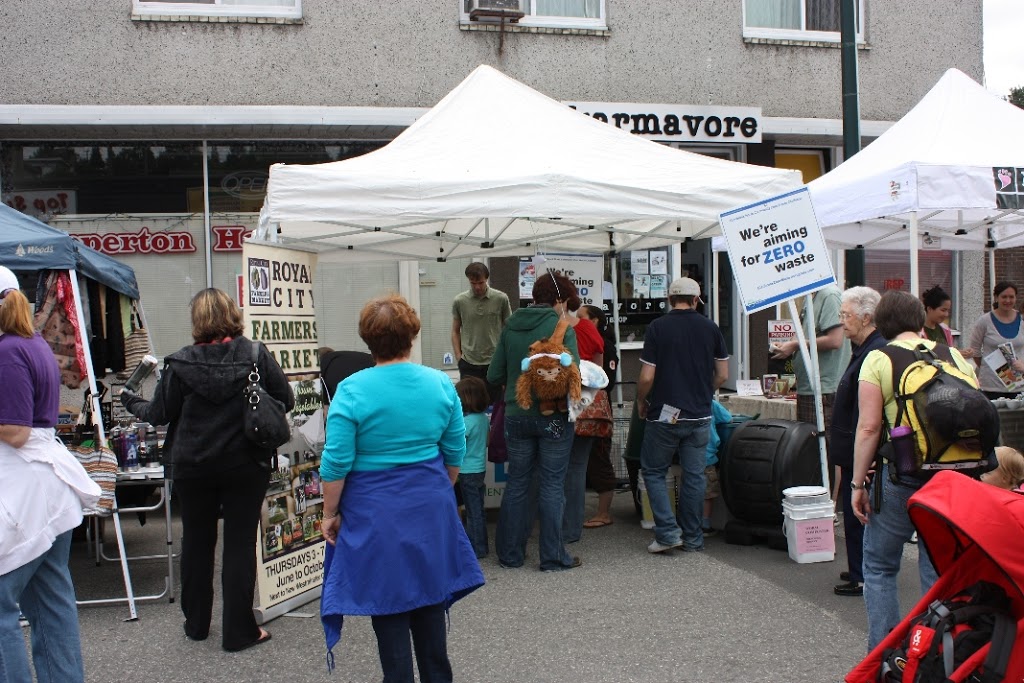
Finally, Sunday was spent at Sapperton Day, and it went off great. The event itself was incredibly well attended, the bands were great, the food was great (mmm…pulled Pork sandwich from the Crave/Ranch), and it was great to connect with many people I only see during summer events.

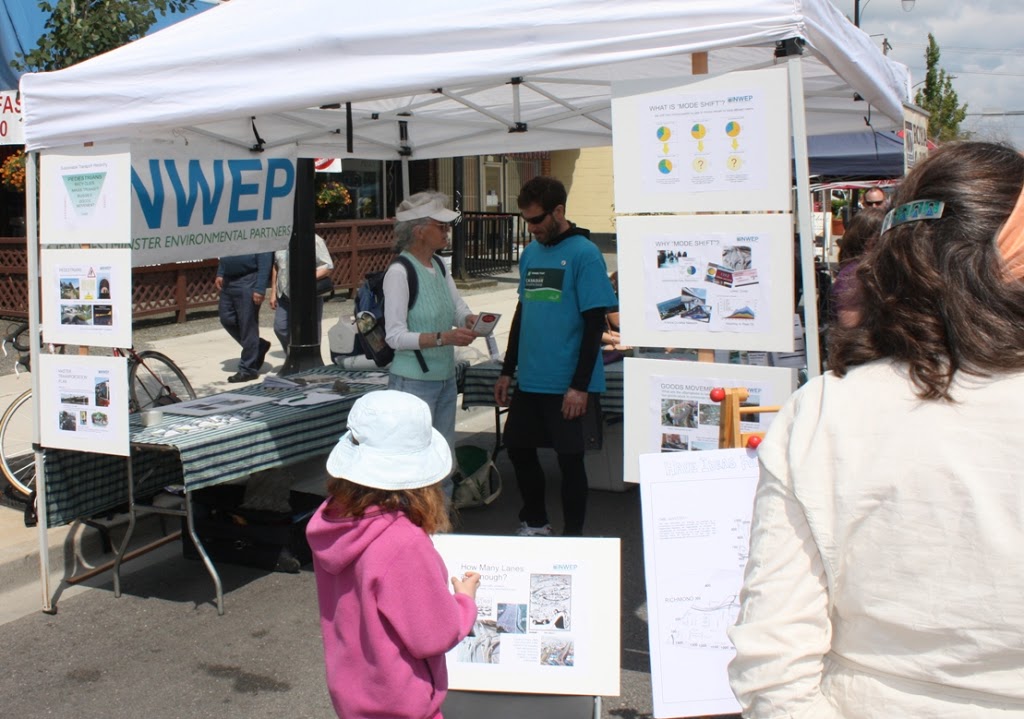
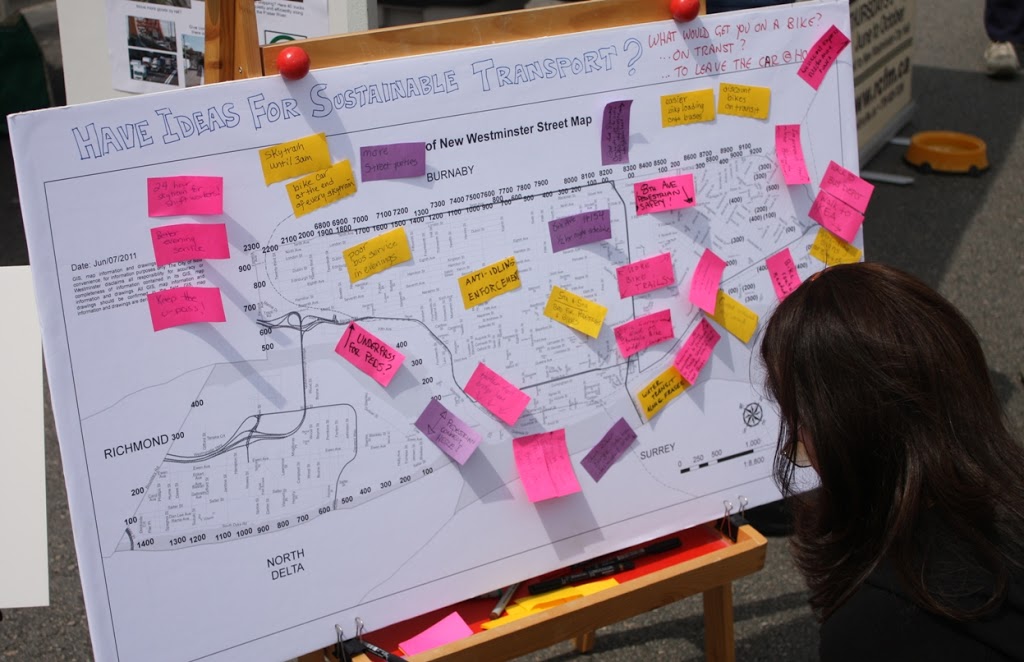
The NWEP booth was well attended, and there was lots of great discussion about the future of transportation in New West, post-UBE. We had a “blank map” to allow people to attach post-it notes with ideas about transportation in the City – What works, what doesn’t, pet peeves and points to ponder. Hopefully ,we can use this blank slate to collect ideas at all the summer events we are attending this year. It was great at facilitating conversation, and lots of great ideas were placed on the board. Notably, not all were NWEP member ideas, or even ideas the NWEP would endorse! The point was to start people thinking about transportation, as the City is getting into its Master Transportation Plan process. We hope that by starting the conversation, people will be informed and curious when the public consultations start.

But mostly Sapperton days is about getting together in the community to meet neighbours, catch up with friends, make new friends, get a little sunburned and have fun. Again, it is all about people coming together to community build.

…and have a little fun along the way.

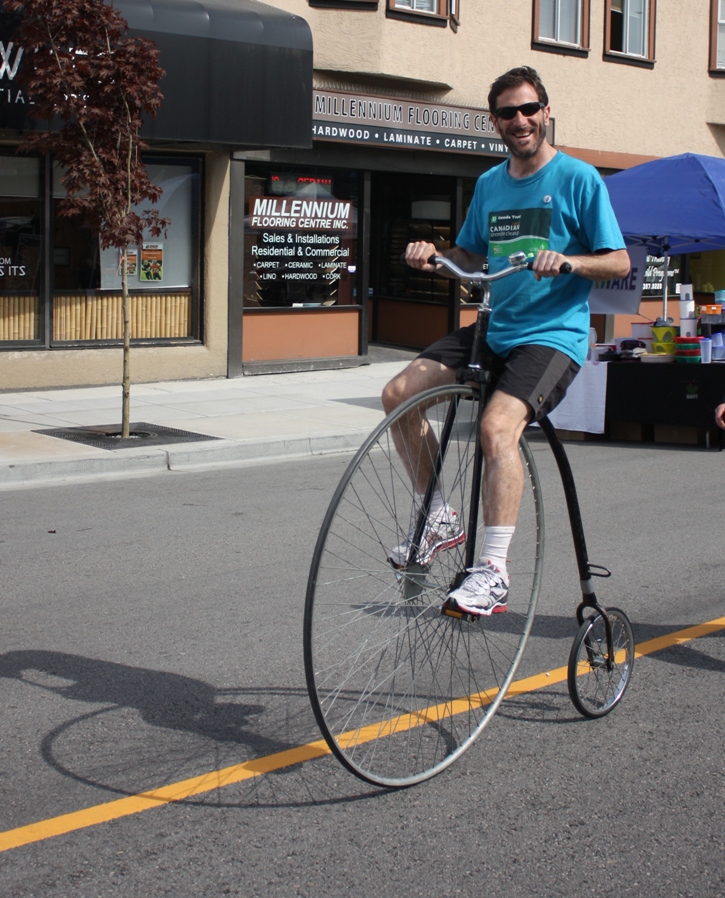
NWEP’s cycling wildman and Ryan Kesler look-alike Pete taking a few turns on his new bike?

Sapperton Day this Sunday

The Summer Festival season is upon us. We don’t have “Car Free Days” per se in New Westminster, but there are a few days when we close roads and let people gather on the streets. It is always a great way to meet your neighbours, re-connect with people you haven’t seen in a while, and remind yourself how we are a small community within a large City.

I guess the season started last month with the Hyack festival, and I had a great time sitting in the beer garden at Queens Park listening to Jim Byrnes play the blues while the Octopus and the Tilt-a-Whirl made faces green a few metres away.


However, for the NWEP, festival season starts with Sapperton Days , as we are setting up our booth and doing some outreach to the community.

Last year, our outreach concentrated on solid waste issues, as the City was rolling out it’s clean green program, we had two neighbourhood Zero Waste Challenges in the City, and Metro was consulting on an Integrated Solid Waste Resource Management Plan (still sitting on the Minister of Environment’s desk, by the way).

This year, we are talking transportation. The reasons should be obvious to anyone who has been reading this blog (hi mom!). With the UBE dead, with the future of the NFPR in doubt, with questions about the future of the Pattullo Bridge, and with the City starting its Master Transportation Plan process, now is the time to talk about transportation issues in the City.

So the NWEP will be there sharing our perspective. Our Transportation Group has established a set of ideas and principles that the group can support, based on our vision for the City and our research and consultation with regional transportation experts.

However, these community events aren’t about us preaching to an audience, they are about exchanging ideas. The main point of our booth is to listen to what the community thinks, and where the community is going on this issue. We hope that our ideas will be the starting point of conversations and will raise the topic so that more people get engaged in the public consultation around the Master Transportation Plan.

As such, we will be asking lots of questions about what you want to see in the City’s Master Transportation Plan. These are the “big ideas”: do we want to build more roads to move more traffic? Do we want to make the streets safer for bicycles and pedestrians? Can we take better advantage of our Transit opportunities? Can kids safely walk to school in New West? Can people with disabilities safely cross a street?

We will also be going smaller-scale. We hope to have a map where you can attach your ideas, where you can point out the “good, bad, and ugly” of New Wesmtinster’s transportation system. That intersection that just doesn’t seem safe, the area under-serviced by transit, the traffic light that doesn’t make sense or the crosswalk no-one seems to stop at.

So I hope to see you there Sunday. Make sure you show up in time for the Pennyfarthing Races, it is a highlight of Sapperton Day for me.

Just for fun, and to start a discussion, here is a collection of Myths about transportation I prepared for our booth (these are my opinions, and not neccessarily the NWEP position on these points). These are common conversation points that come up when we start talking about sustainable transportation to an audience that sees the world through a windshield. Don’t agree? Come down on Sunday and give me a hard time. I’m the guy with the 4th Round playoff beard.

Myth: The best way to fix traffic problems is to build more or better roads.
Evidence clearly indicates the opposite is true. No-where in the world has road building acted as anything more than a temporary solution to traffic congestion. Many large cities around the world (New York, London, San Francisco, Seoul, etc. etc.) have solved intractable traffic problems by reducing road space and investing in more rational alternatives. Others (Los Angeles, Seattle, Shanghai, Tokyo) have continued to build and expand roads, only to find them soon swollen with cars.

Myth: “Sustainable Transportation” means we will all be forced to ride around on bikes! You can’t move products to stores on bikes!
Sustainable transportation needs to include multiple choices for transportation of people and goods, and the most carbon-and space-efficient should be made the most cost-efficient. By moving people towards mass transit or “active transportation” like walking or cycling, and long- and medium-haul freight movement towards rails and ships, we make better use of existing roads to move goods to the stores more efficiently!

Myth: The traffic is going to come whether we build for it or not!
Traffic expands to fill space available. This is incontrovertible, and has been demonstrated around the world. “Rush Hour” traffic is caused by landuse planning built around the automobile. We need to start building to encourage more efficient transportation. The only demonstrably effective way to reduce the noise, pollution, and loss of liveability related to traffic is to reduce the space that traffic can take up. If you build it, they will come.

Myth: Trucks caught in traffic are limiting our economic growth!
No-one has clearly demonstrated how our economic growth is slowed by traffic. Clearly, the movement of bulk and container goods by truck is still competitive compared to the alternatives (such as rails or short-sea shipping) or companies would not rely so heavily on them. However, the trucking industry (much like the private automobile) is heavily subsidized by all levels of government, while rails and ship operators are mostly on their own for all their infrastructure costs. Economic growth comes from a level playing field and robust competition between competitors, not by favouring the least carbon-and energy-efficient mode of transportation by externalizing many of the infrastructure costs to the taxpayer.

Myth: Roads are cheap, building alternative transportation is expensive!
This should be an easy one in a Province where we are spending $3 billion in road bridge and highway expansion, and cannot find $400 Million to “fill the gap” on the Evergreen line. But when you add up the amount of your taxes the government spends on roads, on traffic lights, on traffic cops, and factor in the “externalized” costs related to healthcare, oil company subsidies, air pollution and greenhouse gas emissions, environmental degradation resulting from road runoff into our rivers and loss of developable land to parking lots and road lanes, the amount you pay for insurance, car repair, and gas seems miniscule. Once transit systems are built, once urban development encourages active transportation, their maintenance and operation costs become very small fractions of the costs of roads. One reason transit so great in most European cities is that they didn’t waste their money on roads!

Myth: Cyclists don’t pay taxes for the roads they use, drivers do!
No tax exists in BC that specifically charges drivers for road use. Gas taxes and carbon taxes go into general revenue to pay for roads, hospitals, fighter jets, Stephen Harper’s Stanley Cup roadtrips, and gazebos in Tony Clement’s riding, not specifically towards road building (although a portion of the TransLink gas levy does go to road building). Your roads are built mostly by the municipality and the province, using a combination of property taxes, income taxes, and sales taxes. People who ride bicycles pay the same taxes as people who drive cars, yet use 5% of the road space. Pedestrians and transit users also pay all these taxes, and use less than 5% of the road space that drivers do. People using alternative transportation are in fact subsidizing the private automobile user, and most would strongly support a road tax that fairly charged drivers for their road use

The Mayor of Coquitlam wants to create a Zombie

The Mayor of Coquitlam is not taking the death of the UBE lightly. I suppose we should have expected as much. Except that his complete lack of participation in the last 6 months of public consultation, and the complete lack of interest his community has show for the project sort of got me thinking maybe Coquitlam would accept the obvious, as New Westminster did. The obvious being that 10 lanes of Freeway and 6 lanes of Lougheed Highway would prove adequate for goods movement, and that trucks really don’t need another four lanes of curvy, driveway-dotted United Boulevard.

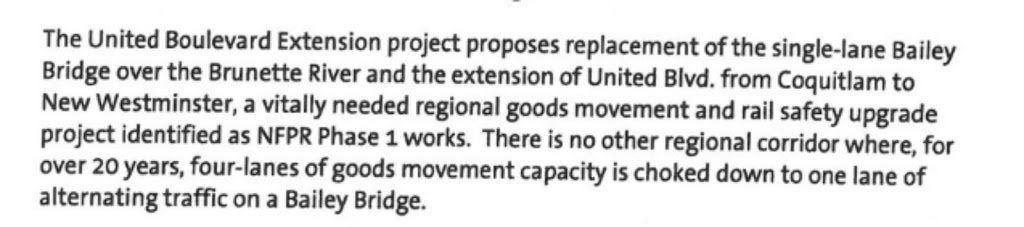
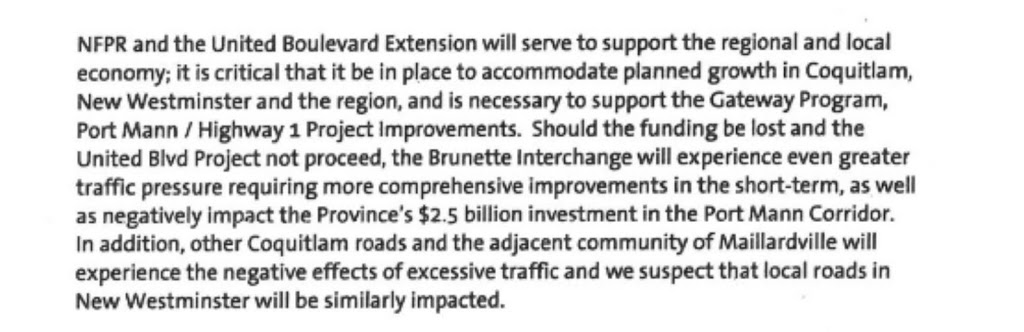
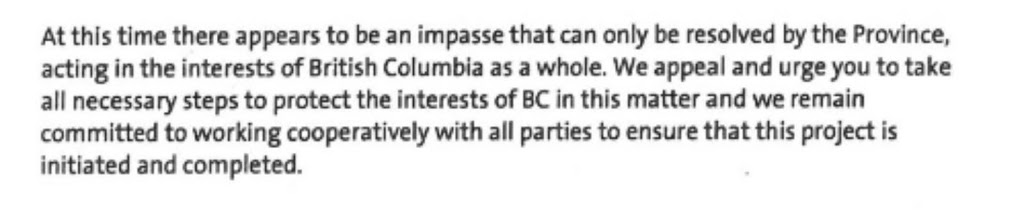
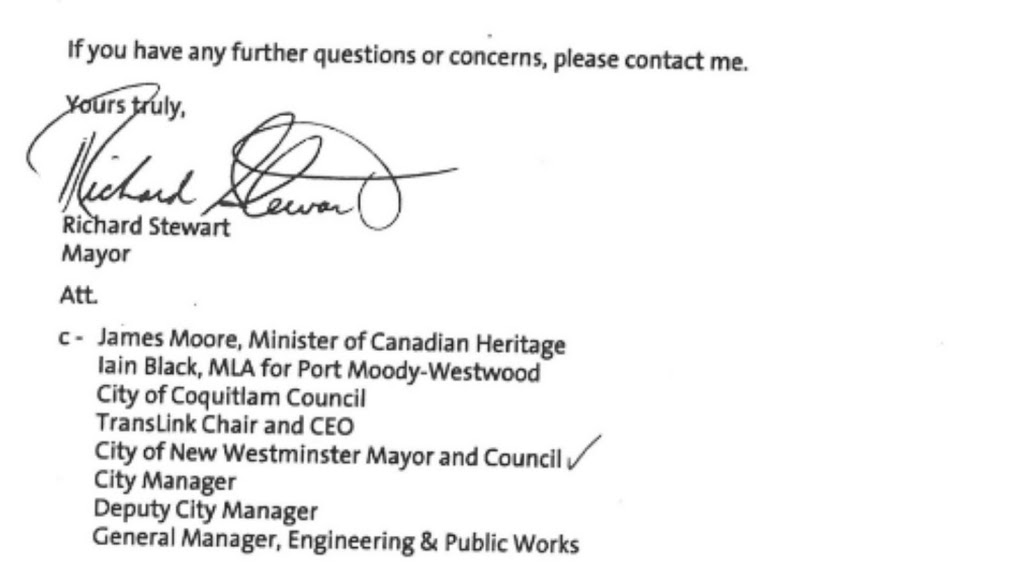
Alas, those were but dreams. Mayor Stewart has instead decided to cry to the teacher … uh, I mean the Province and the Feds, in the form of a letter to the Ministry of Transport and the Federal Minister of Canadian Heritage. It is apparent from the letter that he could have learned a lot from attending some of the consultation meetings.

I would love to deconstruct this letter. It’s my blog, I guess I will.

No-one has ever demonstrated that United Blvd. is” vitally needed” for good movement, especially after the freeway is expanded and the SFPR is built. Just who are these truckers trying to get from New West to points East via a narrow, 4-lane commercial road, through lights and past the Casino, the furniture stores, the Toys R Us, just to get to the freeway or the Lougheed? Why are they so irrational as to not just go directly to the freeway or Lougheed?

Also, the consultations with TransLink found a solution that adequately addressed the rail safety issues at the level crossing at Braid: it was “Option C”, and TransLink decided it did not serve it’s needs. If Mayor Stewart is concerned about rail safety at a level crossing that has not seen an accident since…?, then will he embrace TransLink’s “option C” that was preferred by New Westminster residents during the 6 months of consultations he did not attend?

He keeps going on about “goods movement capacity” going from 4 lanes to one. United Boulevard is not 4 lanes, it is two lanes. Expansion to 4 lanes is possible (although not if we want to maintain cycling lanes, as the road is not wide enough for 4+cycling lanes, but I digress). But most of the traffic on this road is cars and commuters, not goods movement. He knows it, we know it, TransLink knows it. Blair Lekstrom probably doesn’t know it.

Also, where does this 4 lanes of “goods movement capacity” go when it gets another 500m west? To a one-lane light-controlled left turn onto Front Street. So much for increased capacity.

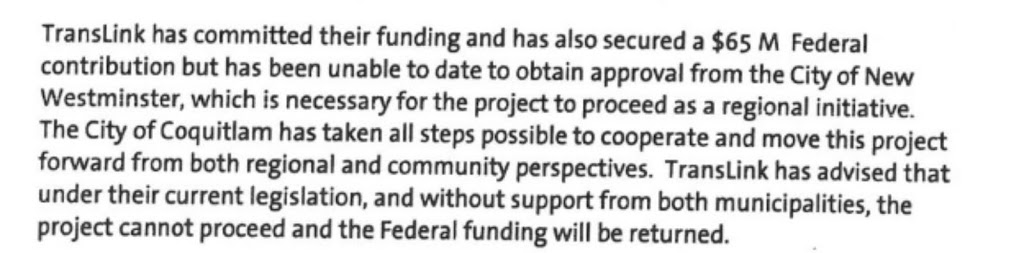
TransLink has NOT committed funding, in fact Mayor Stewart himself is on the Mayor’s Council that did not fully fund the supplemental budget that would have included the UBE: He doesn’t know where the money is coming from. Even with this supplemental funding (that Mayor Stewart voted against), there was a $30-50 Million “funding gap” on the UBE, remarkably similar to the “Funding Gap” on the Evergreen.

Also, by (intentionally?) conflating the UBE and the NFPR, hew can conveniently avoid the issue that the entire TransLink portion of the NFPR is completely unfunded, another several-hundred-million-dollar “funding Gap”. Mayor Stewart wants a freeway overpass in New Westminster, but he doesn’t want to pay for it. Compared to the rest of the NFPR, this $65Million in federal money is a drop in the bucket.

Who is “we”? the Mayor signed it himself. Is he using the “Royal We”? Regardless, I would like His Worship to explain exactly how the Bailey Bridge is “holding our regional economy back”. Really, he is asking the Feds to commit $65 Million, for TransLink and (?) to spend another $100 Million, for Sapperton residents to live with a freeway overpass in their front yard, and for all of New Westminster to accommodate increased traffic congestion and the negative impacts to our entire City… isn’t it a fair question to ask exactly how avoiding these impacts is “holding our regional economy back”? Let’s see a business case.

Oh, here we go, the UBE supports Coquitlam’s “planned growth”. Now we are getting to brass tacks, Coquitlam’s “planned growth” is contingent on the degradation of New Westminster’s liveability? Sorry, We are the City that is accommodating regional growth by building a dense, transit-oriented City. We are the City with region-leading alternative transportation mode share. Coquitlam is the City that refuses to sign the Regional Growth Strategy, the City that refused to allow a Millennium Line station in Maillardville, because transit accessibility was such and offensive idea. So we have to accept the automobile and exhaust effluent of your unsustainable, car-oriented residential development at Fraser Mills? Now, after refusing a Skytrain Station, after you start building the King Edward Overpass, after you fill lower Maillardville with auto-oriented development, 10 lanes of freeway and 6 lanes of Lougheed Highway connected by a spaghetti-bowl of concrete: now you suggest traffic might be a problem? And you are crazy enough to suggest 3 more lanes of bridge in New Westminster are going to be some sort of magic solution to this traffic quagmire you have developed!? With all due respect, are you insane?

It seems that Mayor Stewart has a different definition of “community livability” than I do. Based on what I saw and heard at 6 months of community consultation, I suspect that the majority opinion is closer to mine than his.

There we go with the “Royal We” again. Presumably, he is talking for Council, but Council is addressed as a copy to the letter. Along with making the province aware of the negative impacts on regional economic development, could he also let us know? He has hinted towards it, but he still doesn’t actually provide any data to support this assertion.

I’m also not sure here what he is asking the Province to do. “Act quickly and decisively” to overturn the results of 6 months of public consultations? Why does the Mayor feel so contemptuous towards the public?

It is great that Coquitlam has a “preferred solution”, yet will be flexible on how their poor planning negatively impacts New Westminster, even being OK with a few trees being planted for mitigation. Damn magnanimous of him. What a team player.

With all the usual sarcasm and snarkiness aside, here I honestly disagree with Mayor Stewart. This is not an impasse that can only be solved by the Province plowing a freewhere through where a community doesn’t want it. This is a disagreement between neighbours, and there is a lot of room for discussion yet. The UBE as proposed by TransLink is dead, and as a zombie it is starting to stink. If Mayor Stewart really wants to move goods and people, really wants to improve rail safety, and really wants to work with New Westminster finding a common solution, then maybe he should engage us like TransLink did. Maybe he can actually hear the concerns that New Westminster had, and find out if some of the solutions that came out of the TransLink consultations (that didn’t work for TransLink) can work for both Cities.

We all want rail safety, we all want goods to move efficiently, we all want livable communities. We just disagree how to get there. The Mayor thinks more roads in New Westminster will solve his problem, the people in New Westminster don’t think building lanes has ever solved congestion problems.

If you can find an example from anywhere in the world where building road capacity has done anything other than increase traffic demand and lead to further congestion, please bring that to the meeting.

Since you asked, I have a few questions:

James Moore is the Minister of Canadian Heritage. What does he think of the destruction of the waterfront of BC’s first Capital City to accommodate a 4-lane express route for trucks, against the expressed desires of the Mayor, Council, and Citizens of BC’s most Historic City?

Is that the same Iain Black who suggested during a 2009 All-Candidates Meeting that the Evergreen was a “done deal”, and people should stop worrying because it was being built?

OK, those questions were both sarcastic and a little snarky. They were not, however, as cynical as your Worship’s letter.

Signs of the Queensborough

The cycling and pedestrian access to the Queensborough Bridge is a local success story in sustainable transportation.

The “improvements” to automobile traffic flow on the north foot of the bridge a few years ago (funded by the Federal Border Infrastructure Program as part of the Gateway Program and the, yeah, you guessed it, the North Fraser Perimeter Road) were pretty much a disaster as far as traffic-flows go. The commuter backups on 20th Street, 6th Ave, and Stewardson are no better than they were before the project started, almost a perfect demonstration of how you cannot build your way out of congestion. However, the improvements to the “active transportation” routes are great. I can attest to this, as it is my regular bike commuting route to Richmond.

However, several cycling advocates have pointed out as good as the physical improvements are for safety, the route marking is terrible. For everyday commuters, this doesn’t matter. For people visiting the City or trying to find their way through or to our City along this great new infrastructure will inevitably get lost if they follow the signs.

Like all pictures below, you can click to enlarge.

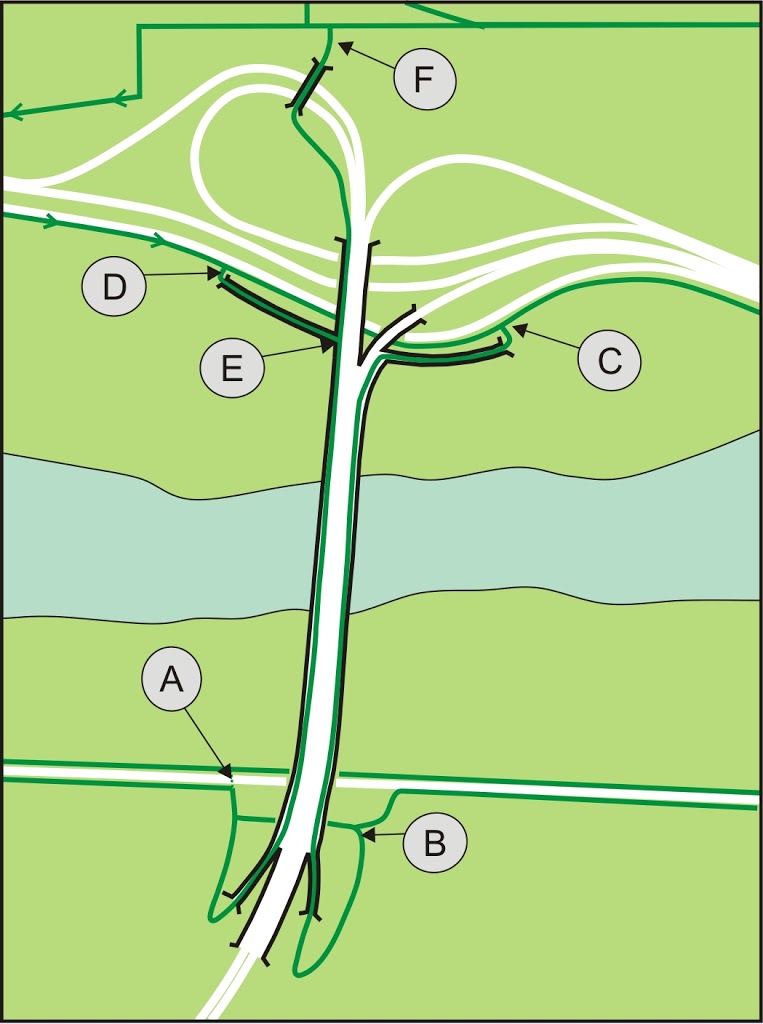
Here is my fancy CorelDraw drawing of the Bridge, green lines are bike/pedestrian routes, white are roads, and the black lines are supposed to evoke “bridginess”. As you can see, the bridge can be approached from any direction by cyclists, and the sidewalks are adequate to allow cyclists to go either way (with a little caution, more on this later). Only the two routes on the west on either side of Marine Way are “one way”. I marked the 6 most important route-marking spots with letters, summarized here.

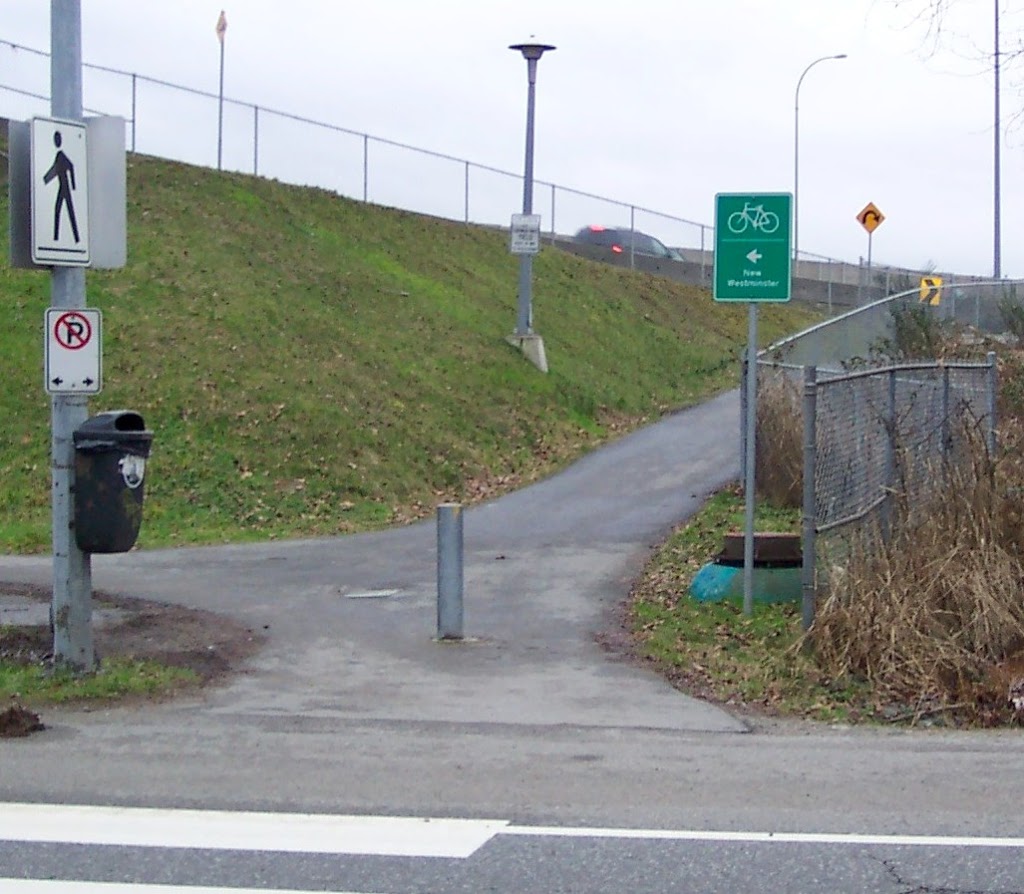
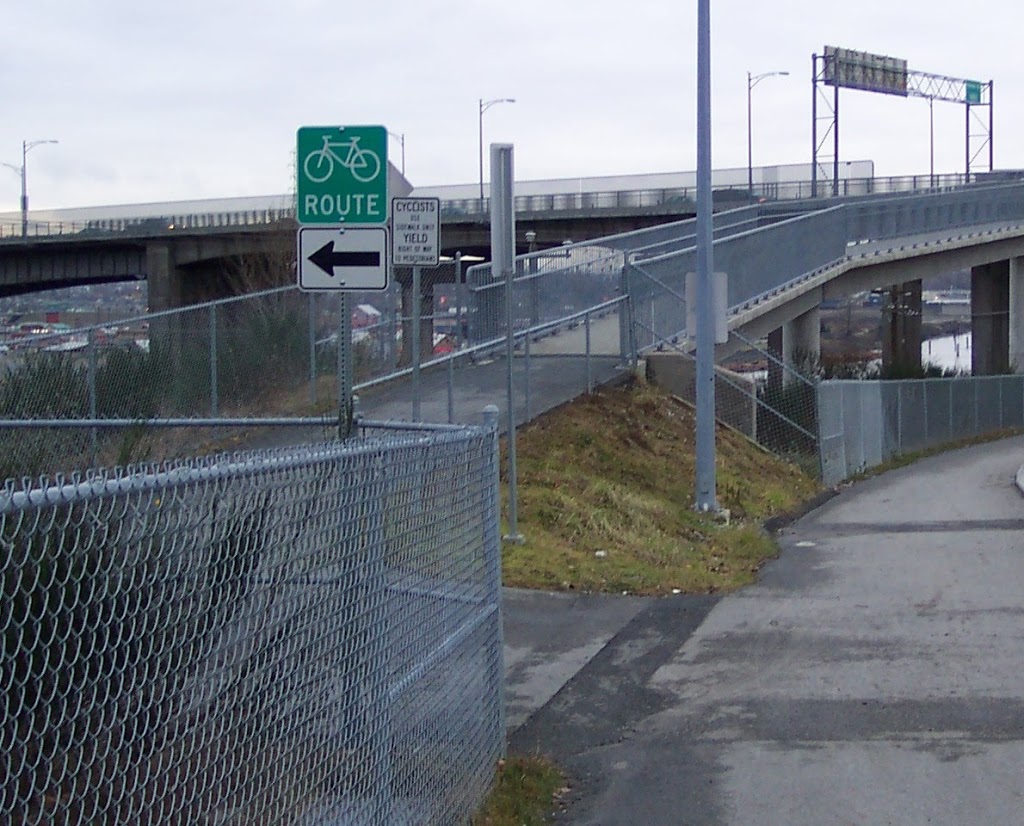
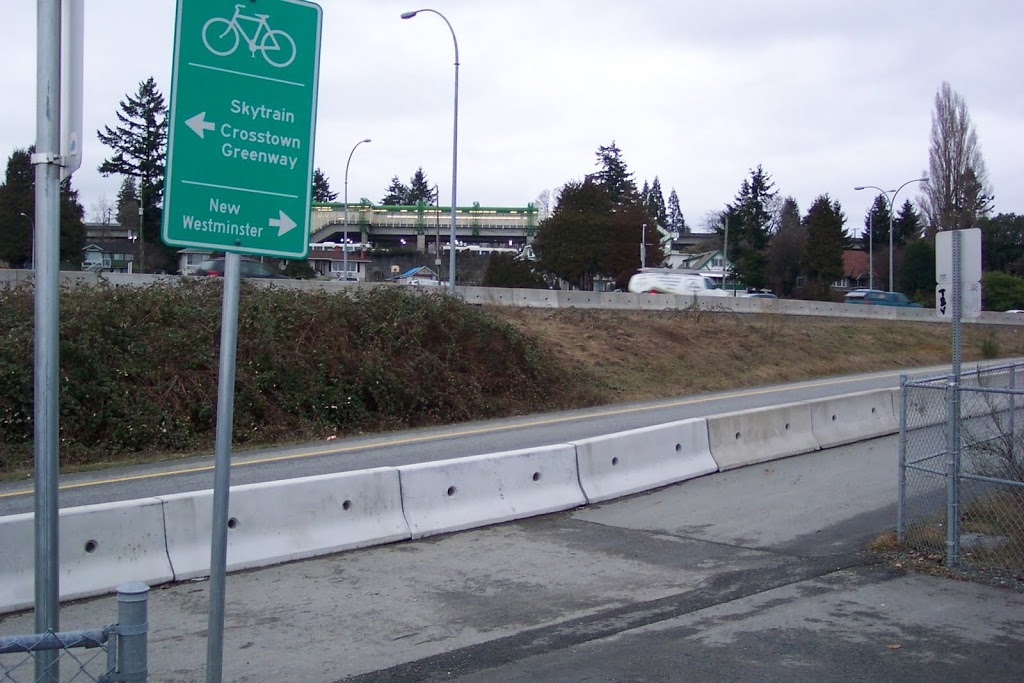
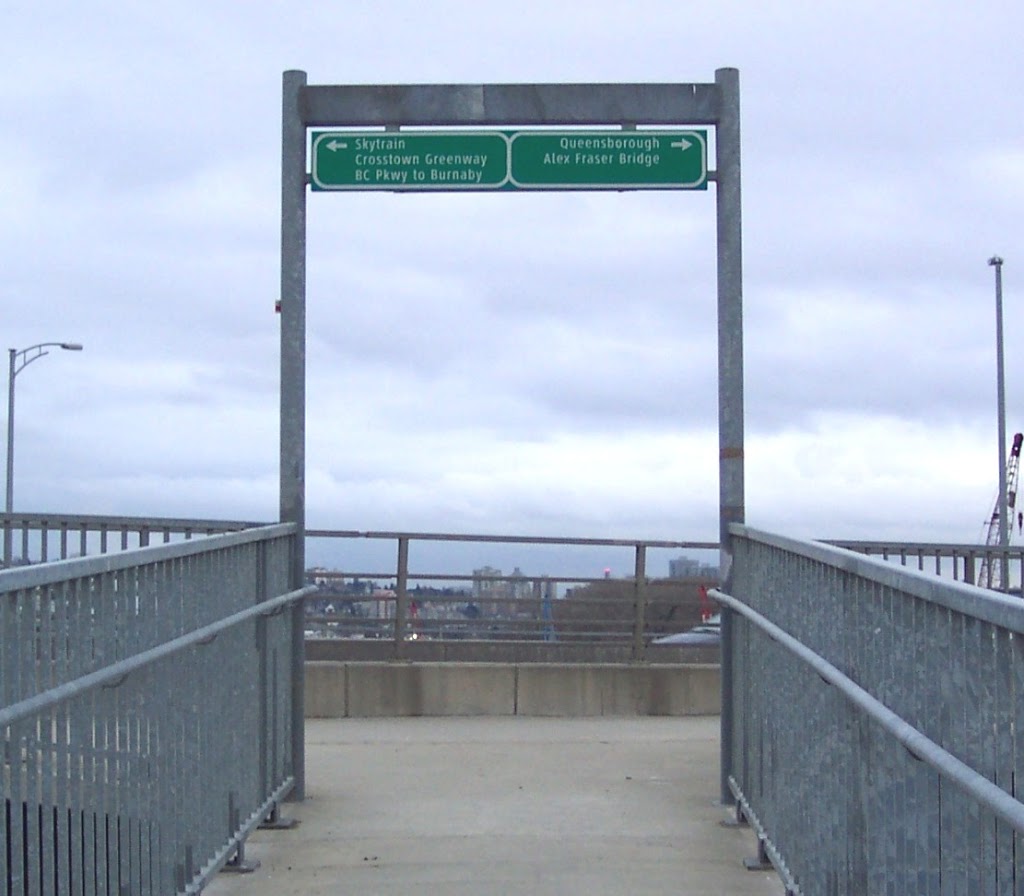
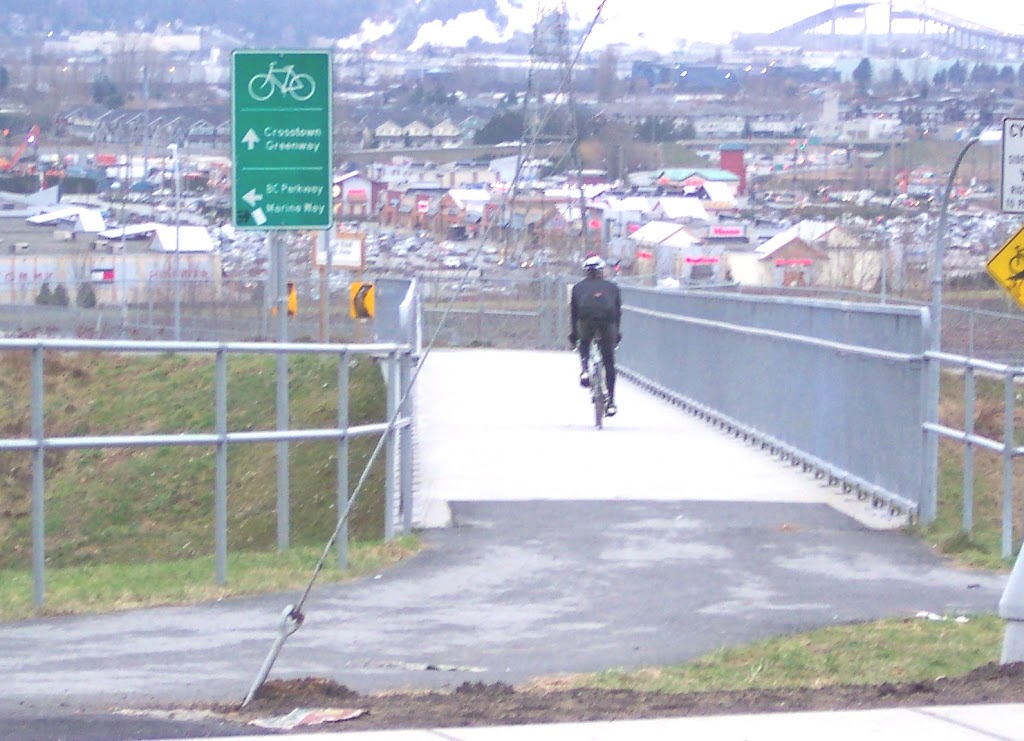
A: When approaching the bridge on the Queensborough side along Boyd Street, you have the option of taking the West sidewalk or the East one. The way the new ramps on the north side are constructed, this is not a decision to take lightly. Here is the sign you will see if you arrive from the West (say, from Richmond):

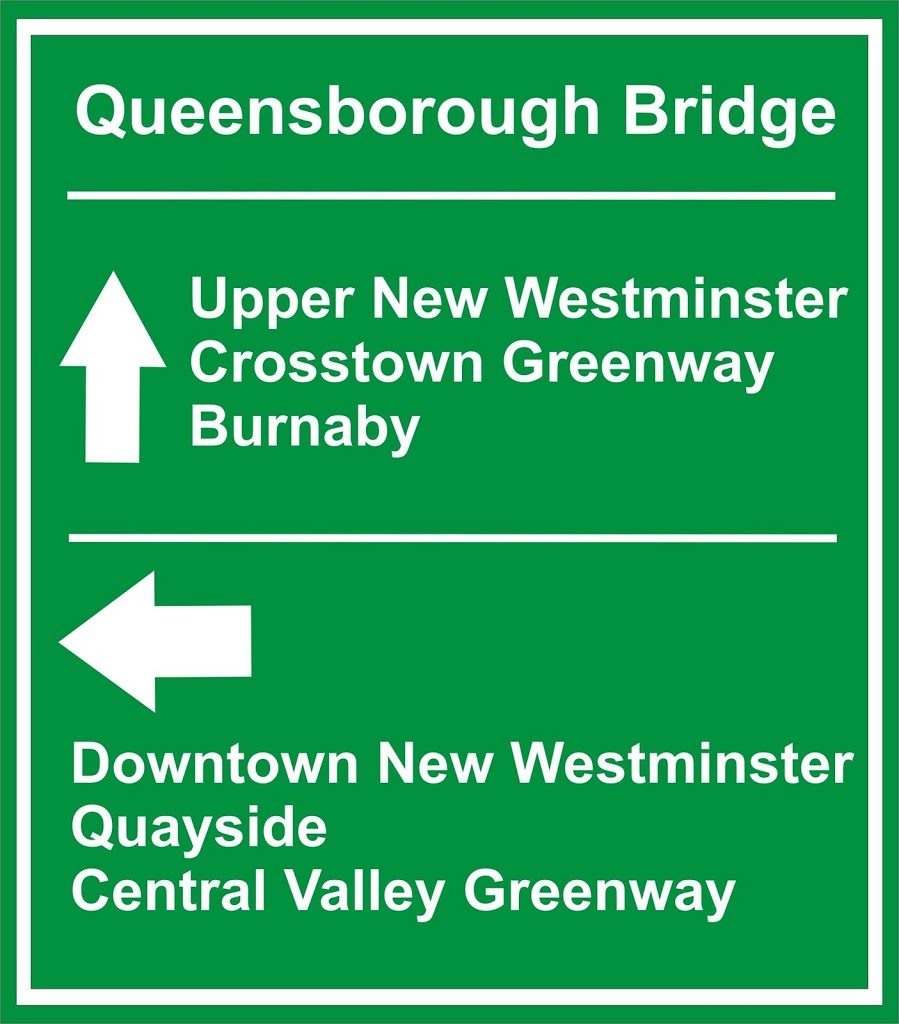
I’m not even sure what information this is meant to invoke. Take the left path to get to New West? Or go ahead to the next left to get to New West? Well, both routes will take you to New West, but then why have a sign at all?

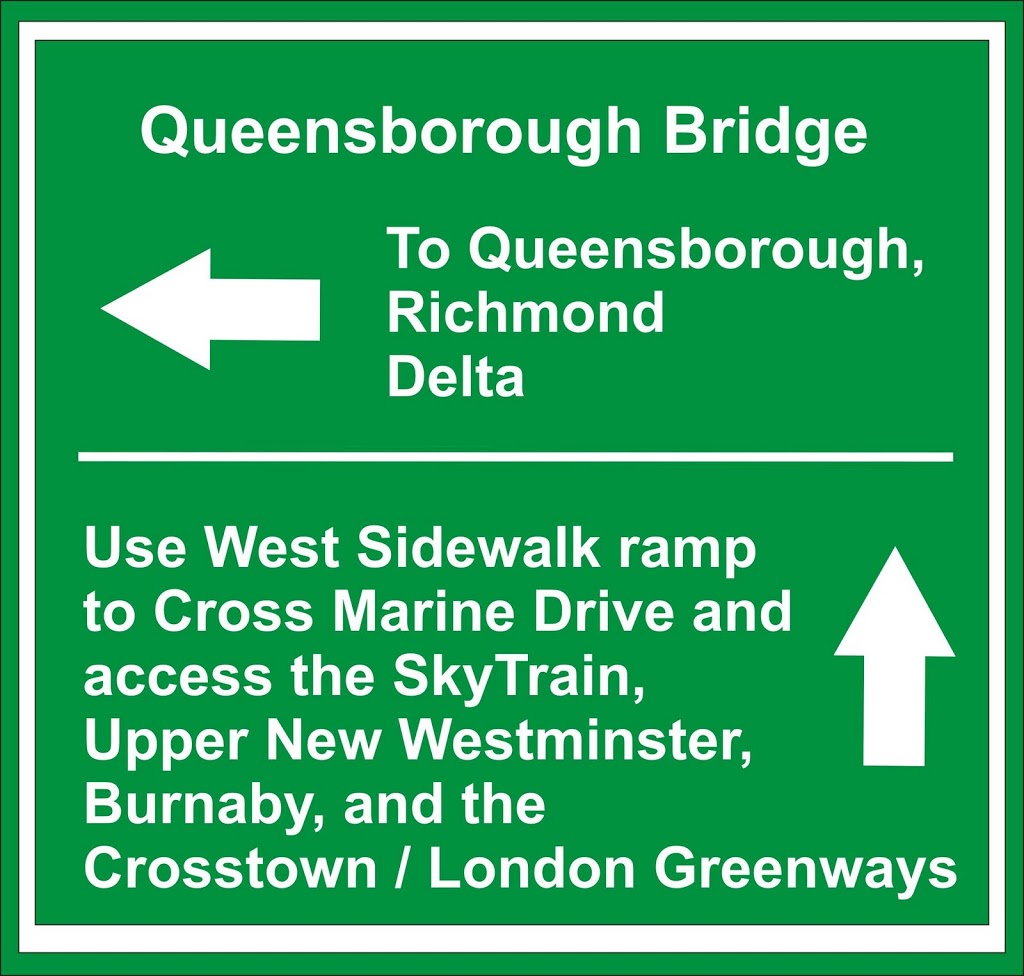
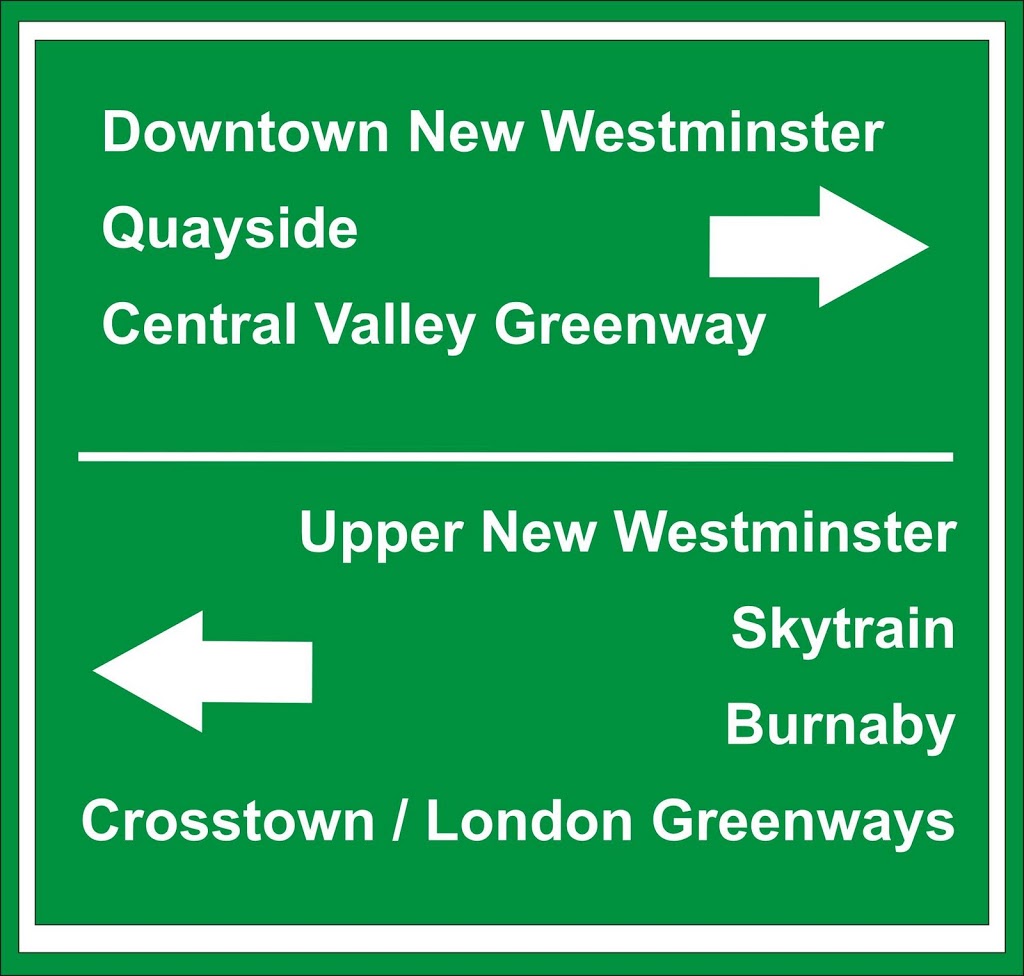
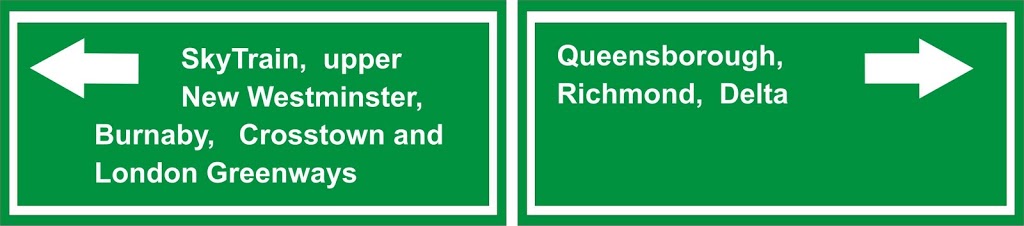
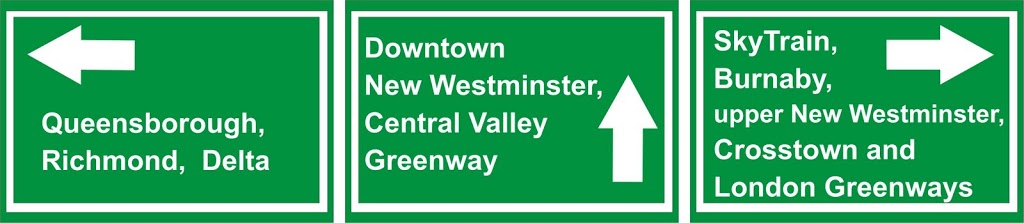
This is what the sign should look like:

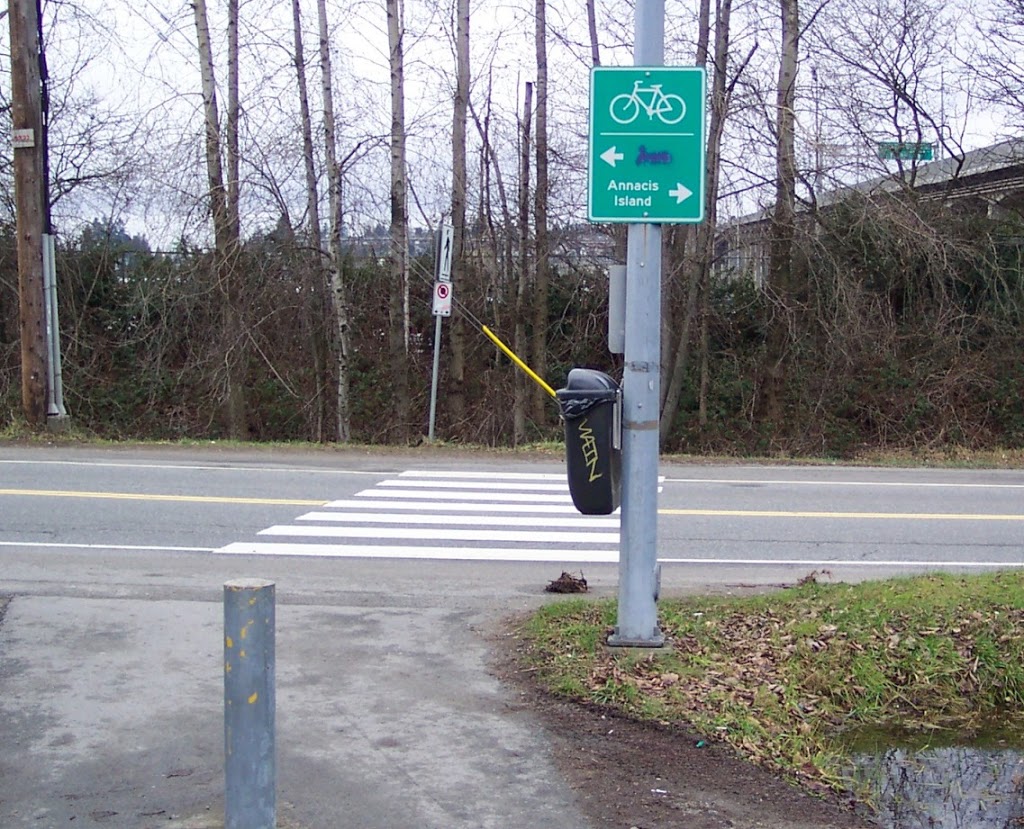
Coming off of the bridge, you approach Boyd and have this information:

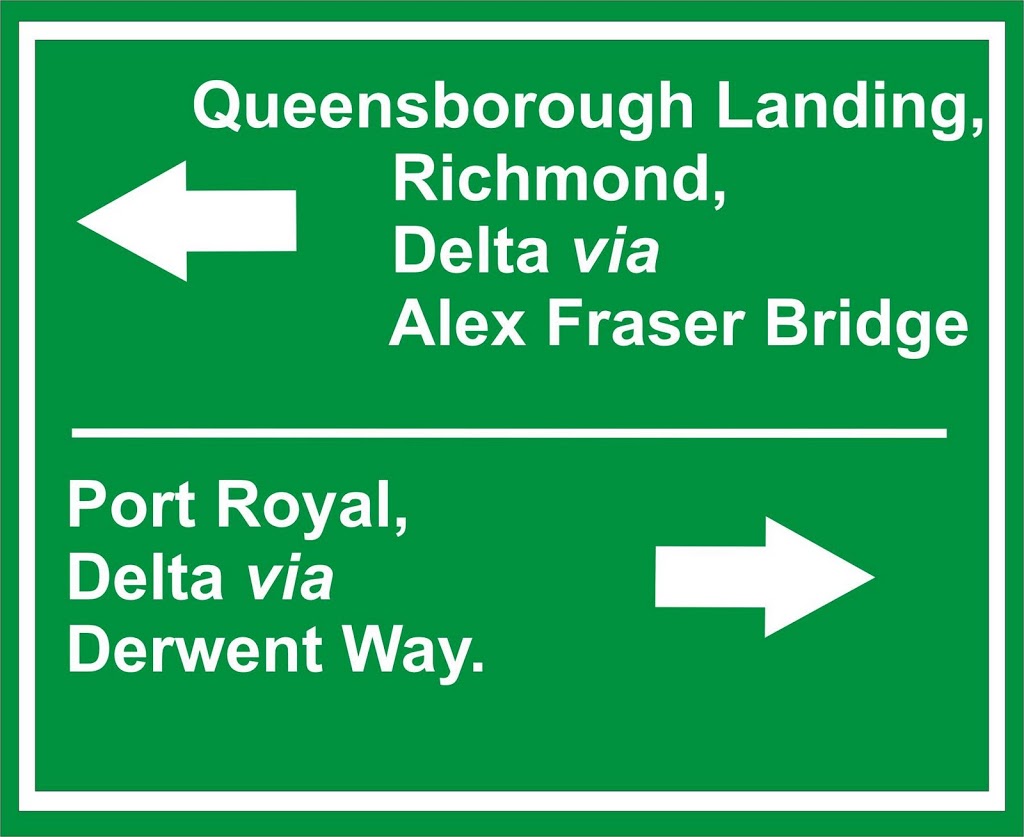
Now, this wouldn’t be so bad if the painted-over word was “Richmond”. That would provide a bit of directions suggestion. But it actually said “Delta”. I don’t know if anyone noticed, but Annacis Island is actually in Delta. This sign is Hellerian in its obtuseness, but not nearly as clever. Here is what is should say:

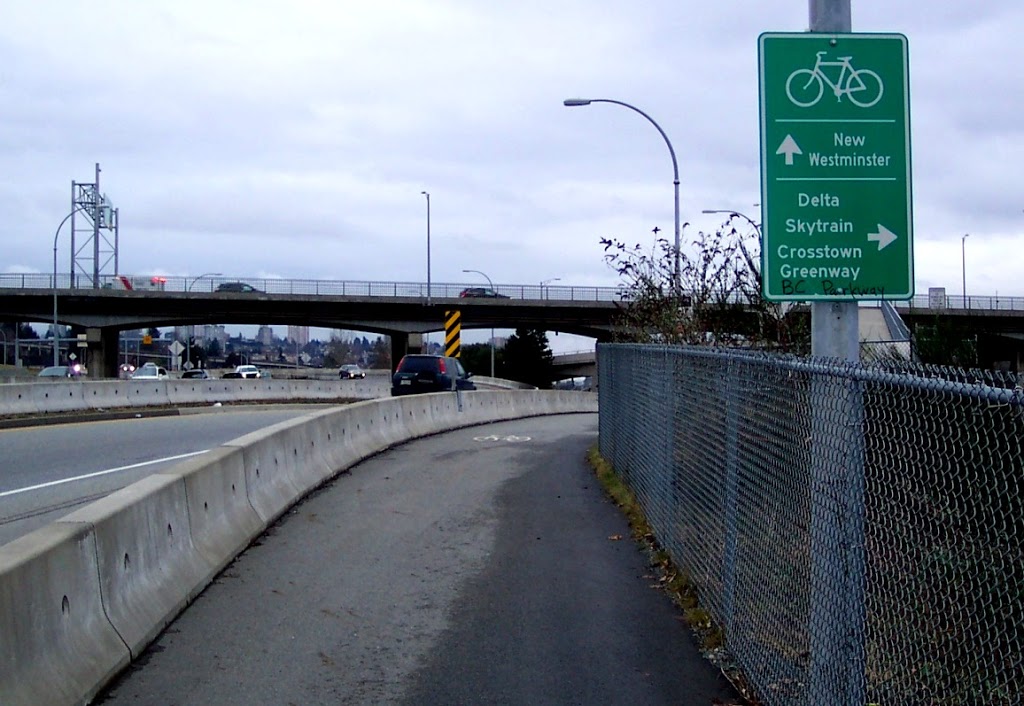
B: If you choose the lower option at A and head to the ramp to the East sidewalk, or if you approach the Bridge from the East (perhaps arriving from the Annacis Bridge on Derwent Way, or from Port Royal) here is what you currently see:

Not particularly useful, even before the local artistic intervention. It doesn’t even acknowledge the existence of the west sidewalk. Perhaps the sign should be moved down to the decision-making intersection, and another version of the previously-suggested sign installed:

And of course, a similar sign here as suggested on the other offramp to let people know destinations to the west or east once they arrive in Queensborough.

C: This is an interesting spot. When arriving on the designated bike route from New West, here is the instruction you get:

Bike route to where? Anyone riding up Stewardson on the old 7-11 bike route under the Skytrain has not been able to cross Stewardson for more than a kilometre. At this point, they probably have no idea how to get back on that route. Entering the bridge will take them to Queensborough. So here is my somewhat wordy suggestion:

Similarly, people coming off the east sidewalk of the bridge and hitting Stewardson might not be sure where they are at… and this sign is actually not bad, if incomplete:

May I humbly suggest, just so we are all crystal clear:

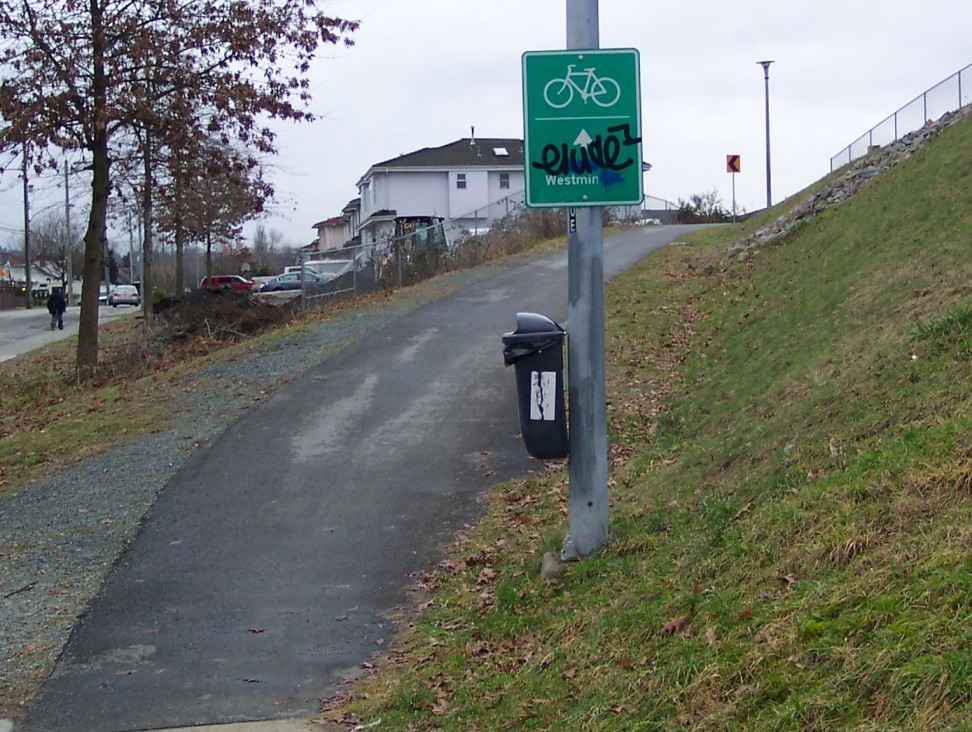
D: Approaching from the West, here is the sign you are presented with:

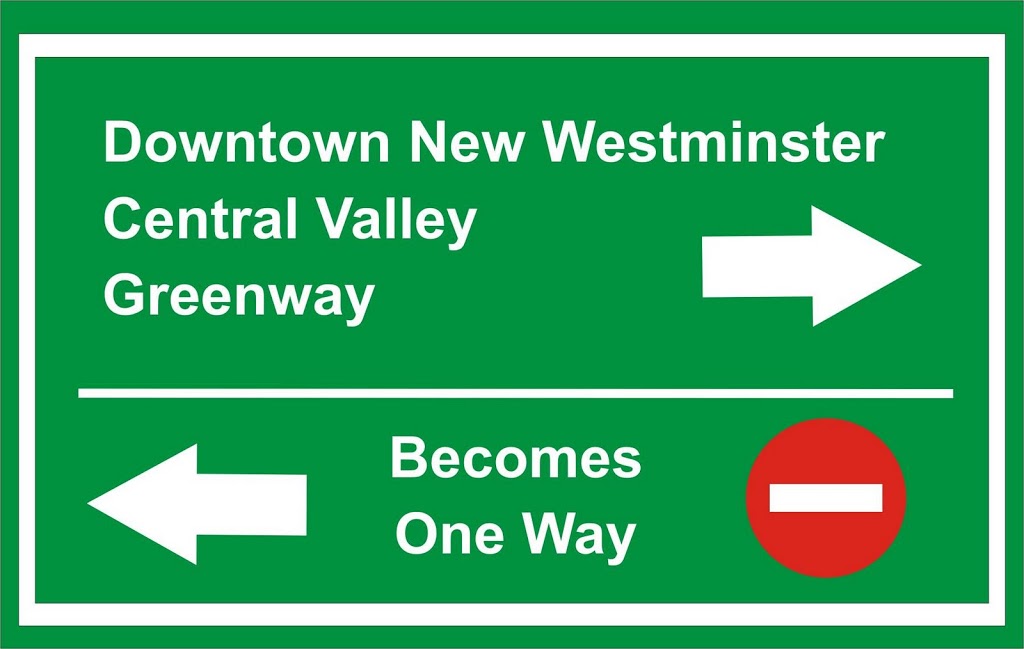
This is curious, as at this point all roads lead to New Westminster, either the West Side, Downtown, or Queensborough. At least here, the graffiti actually increases the amount of useful information on the sign. Approaching from the East, there is no way-marking at all, including no suggestion that the route west soon will become one-way, and you will be going the wrong way on Marine Drive if you go there.

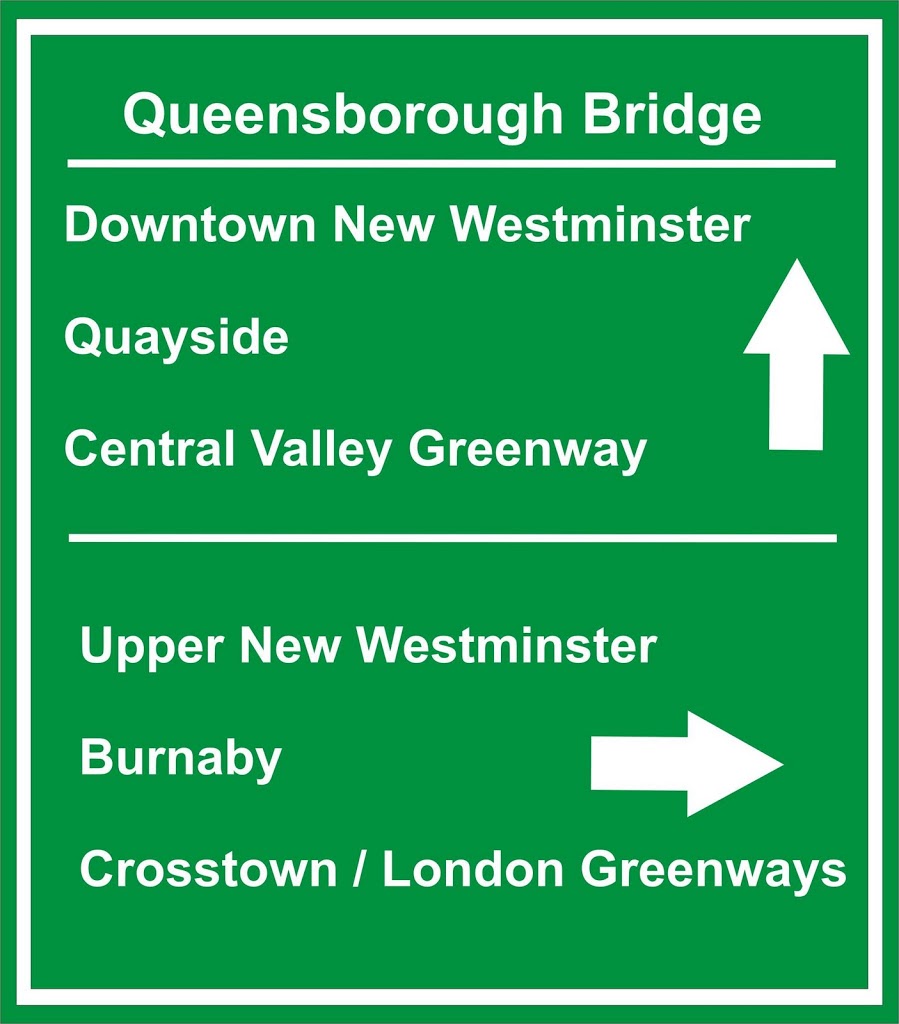
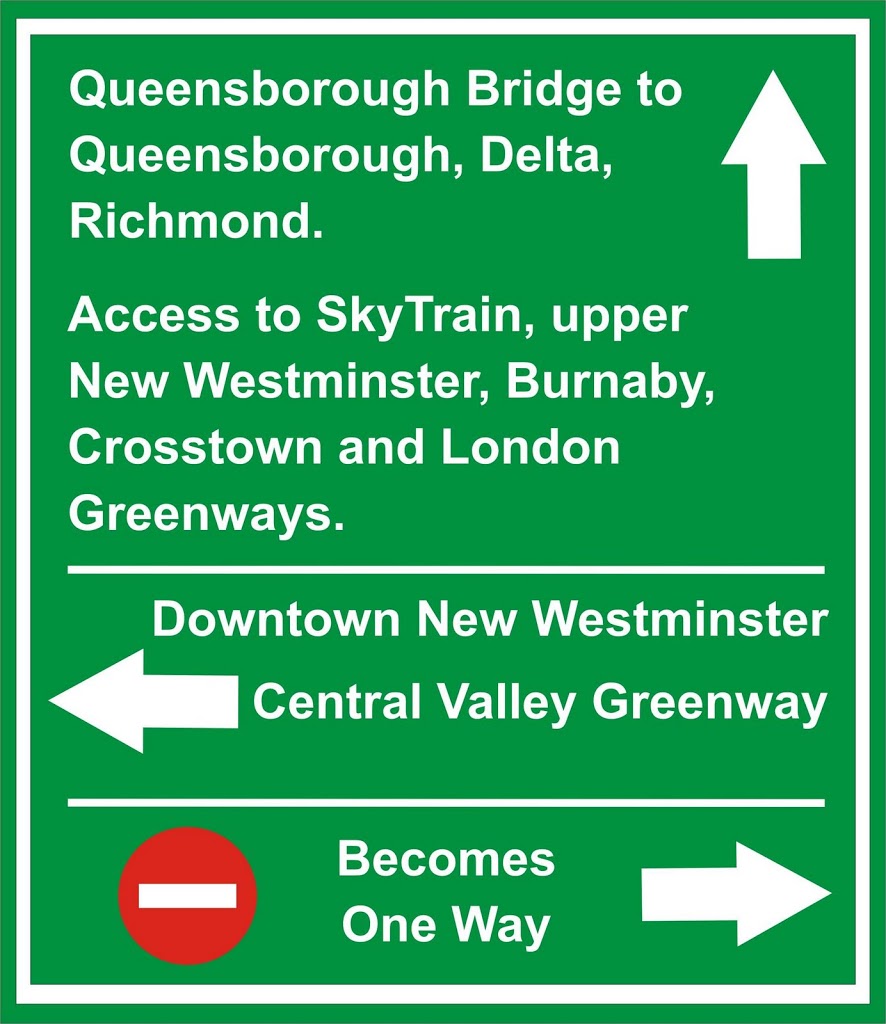
Here, I would suggest a single sign, facing north right where the ramp leaves the sidewalk, so people looking south at the ramp (where they need to make a decision) see this:

People coming down off the ramp really only have one direction to go, so this sign can be pretty simple, but anything is better than the lack of signs they have now:

E: This is a spot where the signs are pretty good, they are pretty complete and correct for those heading up the ramp. If we were going to scrimp, this is where I would keep things like they are.

However, if the sign-printing machines are up and running and we already opened a few cans of green paint, this could be replaced with:
 The signage facing downhill on the ramp is not as good:

So it could use some modifications:

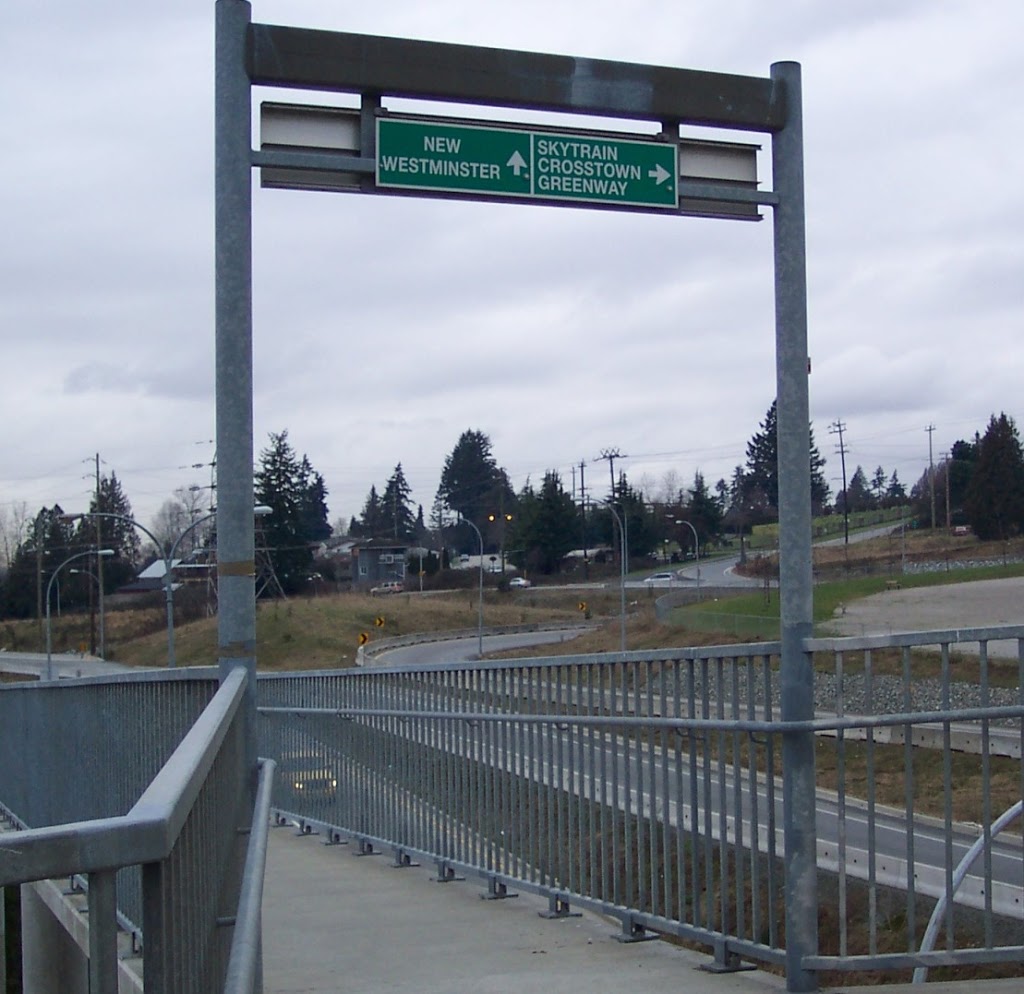
F: Finally, this sign is exactly wrong:

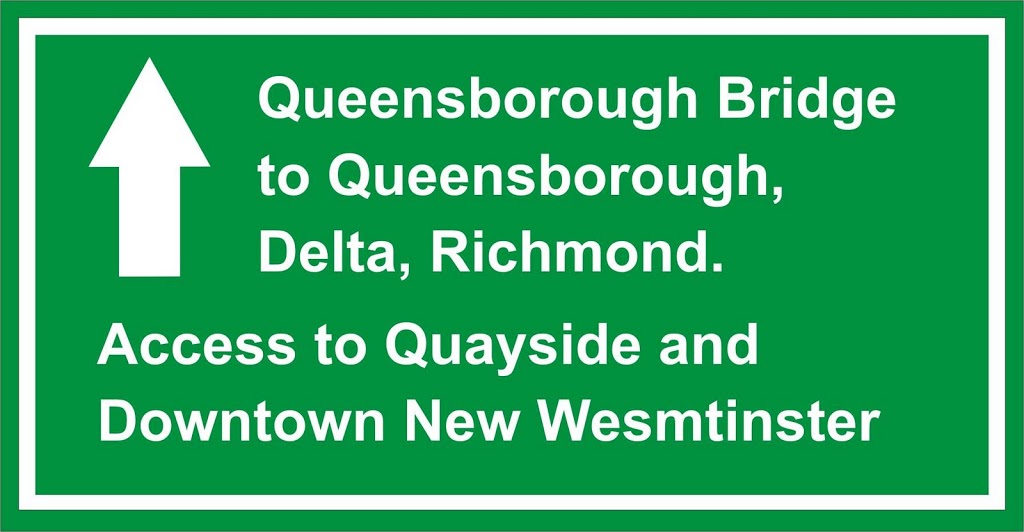
Actually, it looks like it has been rotated 180 degrees, so the instructions are confused. Therefore it is providing no useful instruction either way, and it is the only wayfinding sign at the north foot of the Queensborough Bridge. A couple of million dollars of infrastructure in front of you, and the sign is on backwards. Trust me, car drivers would not accept this. Why should pedestrians and cyclists?

 For those approaching this onramp, the sign should say:

For those coming off the Bridge, there are numerous opportunities. As a minimum, there should be a sign saying this:

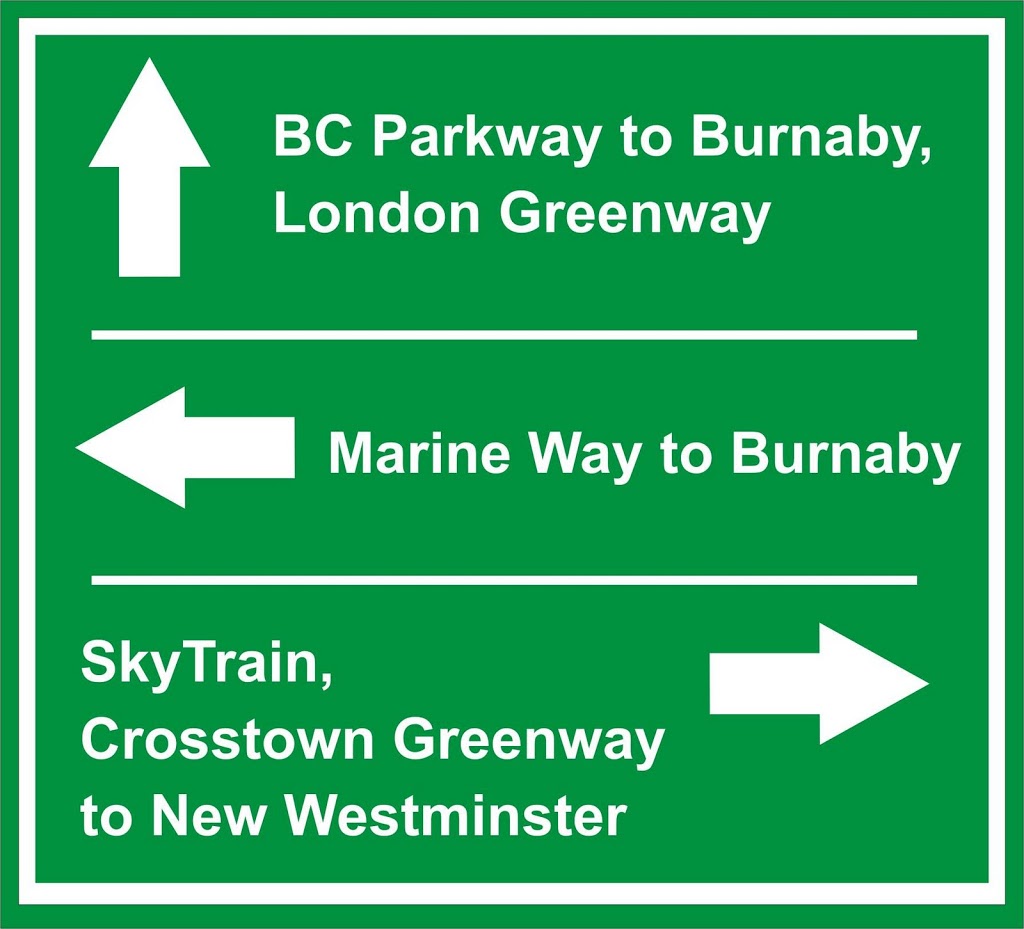
However, this area is a major regional pedestrian and cyclist hub, and deserves better than a small green sign on the offramp. This is where the BC Parkway under the SkyTrain and the London and Crosstown Greenways all connect within a kilometre radius. Ideally, there would be a poster-style map located across the road from the bridge offramp, one that showed the quickest route to the major Greenways, and showed where each of those Greenways lead. I think there are better design minds than mine who could put such a poster together. Notably, it was raised during the City’s Pedestrian and Bicycle Advisory Committee summer ride last year that this area a funny bit of infrastructure jurisdiction. The Queensborough Bridge is Ministry of Transportation, the area under the SkyTrain including the BC Parkway is TransLink, and the Greenways are City of New Westminster. Someone would need to get all the parties together and see who would pay for this improvement, and who would install it.

All my suggestions above are just that: suggestions. If you have better ideas or suggestions, Please let me know! If you have stories of wayfinding around the Queensborough, I would like to hear those as well.

Oh, and back to that safety thing on the two-way sidewalks that are not quite wide enough for two-way traffic. Can I recommend we all practice standard trail etiquette?

  1. Cyclists should yield to pedestrians: That means when approaching them face-to-face, slow right down to walking pace, and come to a stop, holding the rail while they walk by. If approaching them from behind, give them some friendly rings of your bike bell as approaching (NOT right behind them to shock them), and slow to pedestrian speed, and only pass when they give you the right of way.
  2. Pedestrians: Try to be aware of people on bikes approaching from behind, and skooch over a bit to let them by without snagging your purse, your dog, or your hair. If a cyclist comes up from behind and says “on your left”, that is code for you to move right a little and give them room.
  3. Uphill traffic has right of way: When bikes are approaching head-on, the downhill cyclist should slow down and give way to the uphill rider. It is much easier to get back up to speed for the downhill rider than it is for the uphill rider, and the uphill rider is much more likely to be travelling at a speed that is safe for crossing.
  4. Everyone: Try to be aware of your surroundings. And don’t forget to stop at the top, spit off and count how long it takes to hit the water. Gravity is cool.

What next?

Now that the UBE has been killed, and TransLink has decided that the NFPR is no longer a priority, the natural question is “What next”?

First off, we now have the luxury of a bit of time. Part of the original concern with the UBE was that there was a pressing deadline: shovels had to go into dirt real soon or Federal matching funds were going to disappear. That meant we didn’t have time to come up with comprehensive solutions for the Brunette-Columbia-Front-Stewardson corridor (the BCFS as I am going to start calling it for brevity). Although there I still a pressing need to address many of the traffic, access, and safety issues along the BCFS, we at least can now approach them with adequate planning and discussion. Stories of a 2015 Pattullo replacement now seem a little premature, with TransLink suggesting 2020 as a more likely time frame, yet a slide at the TransLink presentation on Thursday that suggested 2017-2018… let’s agree to call TransLink “non-committal” on the Pattullo timing, but at least we know we are likely a couple of years from the consultation process. That would indicate we have a couple of years to plan for that.

I would like to have a community conversation about the Brunette Creek industrial area, and how we can provide adequate access to the important businesses there without burdening those same businesses with commuter through-flow (the inevitable result of the UBE proposals). I think keeping the Bailey Bridge as one-lane alternating is a good control on through-flow. I also think that closing the level crossing at Braid would provide safety benefits and simplify the traffic situation at Braid and Brunette. (Note I don’t think it will reduce congestion, because I am strong believer that induced demand is the major control on traffic congestion; the smoother we make the flow, the more cars that will enter the flow, until the congestion reaches a point of equilibrium). This leaves us with only one other way out of Brunette Creek: Spruce Street.

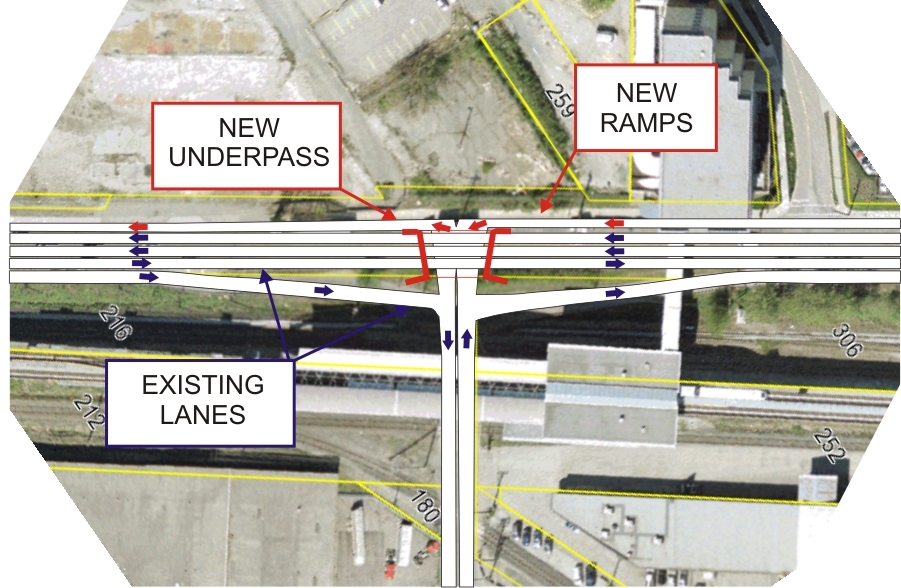
Currently, one can enter Spruce Street from northbound Brunette, and can exit northbound on Brunette from Spruce Street. To connect Spruce Street to southbound Brunette, I would suggest an underpass beneath Brunette, with entrance/exit ramps on the west side of Brunette that essentially mirror the ones on the east side. A single light-controlled intersection at the underpass. This moves trucks down where the noise will have reduced impacts on the surrounding neighbourhoods, and makes the biggest ingress-egress point from the industrial lands nearer the center of the industrial lands, but a long way from the Bailey bridge, to reduce the attraction of commuters to the industrial area. Clearly, this approach will need to take into account the current development plans at the Brewery district, but there is nothing in the ground there yet. By using this to close the Brain level crossing, the Federal Gateway Money should still be available, as this meets the same rail safety improvements as the UBE (which, notably, also included maintaining the Spruce Street level crossing).

Click to enlarge – and please excuse ham-fisted CorelDraw use

I don’t want to spend too much time on the details, because that is what these things are: details. Before we start fleshing out details, we need to make the big decisions: How will our City address its traffic problems? How will our City adapt to regional and internal growth as projected by MetroVancouver’s Regional Growth Strategy? How will we accommodate a new Pattullo Bridge? How will we address the pressure our City will see from the Highway 1 expansion? How will we support TransLink’s goals for mode shift as outlined in their Transport 2040 plan? How will we adapt our transportation infrastructure to deal with Climate Change, with Peak Oil, with an aging population? How will we protect the livability our City’s neighbourhoods, from Sapperton and Downtown to the West End and Queensborough?

The proper way to address these questions is through the City’s Master Transportation Plan. Fortunately, that planning process is starting right now. So the opportunity is in front of us.

I am hoping to take a lot of the blogging energy I have been putting into the UBE, and direct it towards addressing those questions. I don’t pretend to have the answers, and don’t expect to find them on this Blog. I think the answers have to come from the community, and it a pretty big order to fill. I only hope to open a dialogue and help find our way towards the answers. Make no mistake: this is important, even more important than the UBE. The Master Transportation Plan will shape our City for the coming decades.

Climb on board, folks, it should be a fun ride.

Thank You TransLink, Thank You Sapperton

20 hours later, I’m still unsure how to view the announcement that the UBE and the NFPR through New Westminster are dead.

My first reaction was to thank the volunteers who spent countless hours working through the consultation process. This is the note I sent the UBE Google Group last night:

“Congratulations, everyone. It is refreshing to see a community come together, and to see those elected and/or hired to represent us listen to the community.

But let’s not forget, the end of the NFPR is only the beginning of the conversation. We still have traffic issues to deal with, we still have Braid and Brunette, we still have Front Street cutting us off from our waterfront, we still have an under-serviced industrial area. The City is just now starting on a Master Transportation Plan process that will set the City’s priorities for the next decade and on. I encourage everyone who got involved in the UBE consultations to stay involved in the MTP process.

And finally, let’s acknowledge TransLink for taking an honest approach to community consultation. They spent a lot of money and staff time to make this thing work, and in the end when they could not get the support of the community, they were honest about it, and chose not to challenge the will of the people. They deserve kudos for both taking the time to make the case, and for taking the time to listen to ours.”

So this post is about that last point (there will be lots of opportunity to discuss the earlier points later).

I want to thank TransLink for engaging in this process, and for actually listening to the community instead of dictating to the community. There were a lot of people who were quick to say this consultation was all a sham. An Anonymous commenter on this Blog as recently as yesterday suggested as much. The indefatigable troll “Rick” on Tenth to the Fraser has been counted amongst those suggesting the UBE was a done deal, and frankly, a lot of people at the consultations felt the same way during the process. I was not one of them.

I have been a pretty harsh critic of TransLink recently (including a letter in this week’s News Leader following up on their recent budget announcement), but they did the right thing here, and deserve kudos. I made the point last night to personally thank Vincent Gonsalves and Sany Zein for taking the time to listen to the community and for honestly recognizing that their vision and our community’s vision were not compatable.

I heard Ken Hardie on CBC radio this morning. His message was at times slightly off-putting. It will be heard by many as one small neighborhood (Sapperton), blocking “traffic progress” for the whole region. In reality, it was the entire of New Westminster that took part in the consultation, and the reasons the community was against it were not as simple as Mr. Hardie framed them. It wasn’t only about impacts on Sapperton, it was about taking a holistic approach to the traffic issues in New Westminster, it was about prioritizing highway expansion over more sustainable alternatives, it was about trying to do what no other jurisdiction has ever done: solve traffic congestion by building roads. Those are the messages that resonated in New Westminster, and those are the reasons the community did not get on board. It was the impacts on the neighborhood that brought the people out, but it was the lack of viable solutions that killed the project.

Unfortunately, Rick Cluff (who continues to view the world through a windshield) tried to paint this as a big defeat and failure for TransLink, and I do not think that is fair. I see this as vindication of TransLink’s approach to public consultation, and it goes a long way towards building trust in TransLink as an organization that is genuinely interested in the needs of Metro Vancouver.

More importantly, this is not a NIMBY issue. New Westminster wants TransLink to build Evergreen so that our under-serviced neighbouring communities can enjoy the Transit access that New Westminster already enjoys.New Westminster wants TranLink to build rail alternatives for the South-of-Fraser and the Valley, so that the need for more roads is reduced. New Westminster wants Translink and the Federal Government to spend our tax dollars on practical, useful infrastructure that will move goods and people, and support more sustainable community development. If that infrastructure spending is not in New West, that is fine with us, becasue the entire region benefits, and we are good neighbours.

There is temptation to say “WE WON!” and by extension to suggest TransLink lost. However, that is superficial. The victory here is for the process, and TransLink owns that victory as much as New Westminster does. The only people who lost were the people sitting on the sidelines, not taking part in the engagement process, and who will now, no doubt, start complaining about the decision that was made (see the comments on the CBC news item to see the Monday-morning quarterbacking already). The fact Coquitlam was essentially absent from all these discussions (they had 24 people show up at their UBE open house event, and most were from New Westminster) will hurt them if they try to claim injustice now.

One More Open House

I have said about all I can about the UBE prior to tomorrow’s final Open House/Workshop, so I will keep this brief. Before you attend (and you are attending, right?), I hope you will read these three things:

Monica Hardjowasito’s impassioned letter to the News Leader. I have not met Monica personally, but she obviously has been paying close attention to the process , and has come to some very reasoned conclusions.

Reena Meijer Drees’ comments on her new blog. As the “Postergirl” for consultations on this project, Reena shares her characteristically frank opinions on the project and the process.

Most importantly, review the minutes from the December 13 Council Meeting where Council made it very clear that they wanted to see a holistic solution, that includes an assessment of the long term issues with traffic capacity in this City. That is what you should have in your head when evaluating the project TransLink offers up on Thursday, as that is the first bar this revised project has to get over.

Enhancement, mitigation; tomay-toe, tomah-toe.

Now that the “Community Concepts” have been developed, TransLink is emphasizing the “Community Enhancements”. Which sound much better than “mitigation”. The latter is about trying to reduce the inevitable negative impacts (and is, of sorts, an admission that there will be negative impacts that require mitigation), the former sounds like the cherry on top of an ice cream sundae. Too bad I’m lactose intolerant.

click to make big

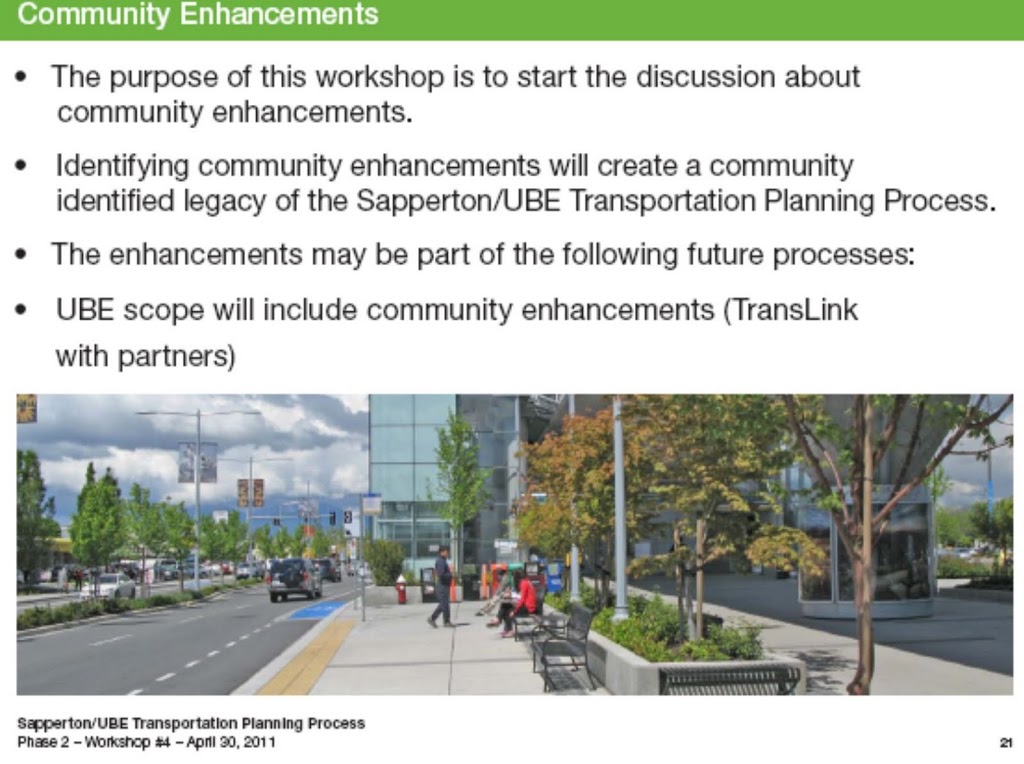
It didn’t build my confidence when the slide they showed to demonstrate model enhancement is an image of a Canada Line station and No. 3 Road in Richmond. As someone who rides a bike through Richmond on a regular basis, I’m not afraid to say the No 3 Road bike route shown in the image is a disaster. It is partly a raised and painted separated bike route, except for all the commercial driveways crossing it that are almost all blind due to the location of the support towers for the overhead SkyTrain line. Once or twice a block, the painted route becomes a bus stop (see the image). Then right at the station, the bike route becomes the favoured pedestrian route around the station itself. So the Canada Line Bike Route is a recipe conflict between bikes and cars, bikes and busses, bikes and pedestrians. A waste of money that doesn’t serve the community it is built for. Let’s hope we don’t end up with the same thing here.

So let’s look at some of the baubles we are being offered.

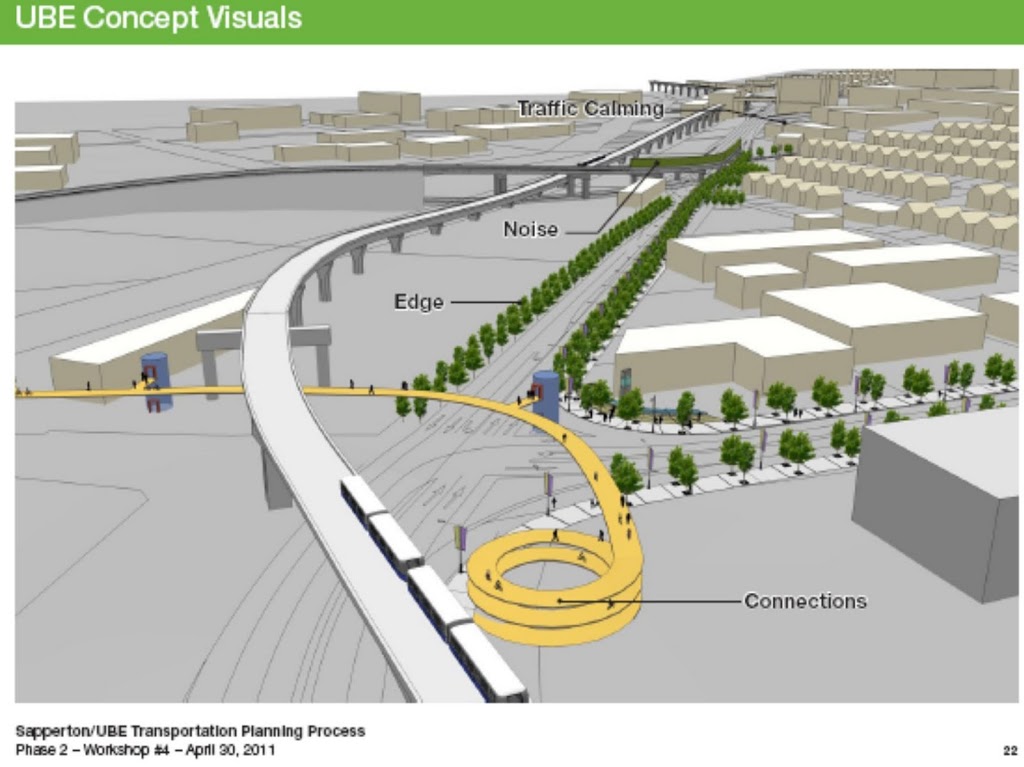
This leaf-spring overpass plan seemed to be a major part of the discussions. With the level rail crossing at Braid closed, an alternative plan for getting people not in cars across the tracks is required. The challenge is making a structure suitable for pedestrians, cyclists, and people with mobility issues. Stairs are reliable, elevators are accessible. Long ramps wrapped into loops are both, but make for a large structure and turn crossing the street into a 2-kilometre journey.

To me, this is the ultimate expression of a “bauble”. We are trying to have a discussion about the implications of doubling the traffic entering New Westminster from the East, and TransLink engages us in a long discussion about what flavour of pedestrian overpass we want. No wonder the crowd was getting restless. This kind of design element can be discusses long after there has been a decision to build or not to build. At best, it is a waste of engineering time, at worst, it is a distraction from the real story.

I do note that all of the “enhancement” images showed “Concept B1”. This led more credence to the theory that TransLink has already decided which option they will be taking forward.

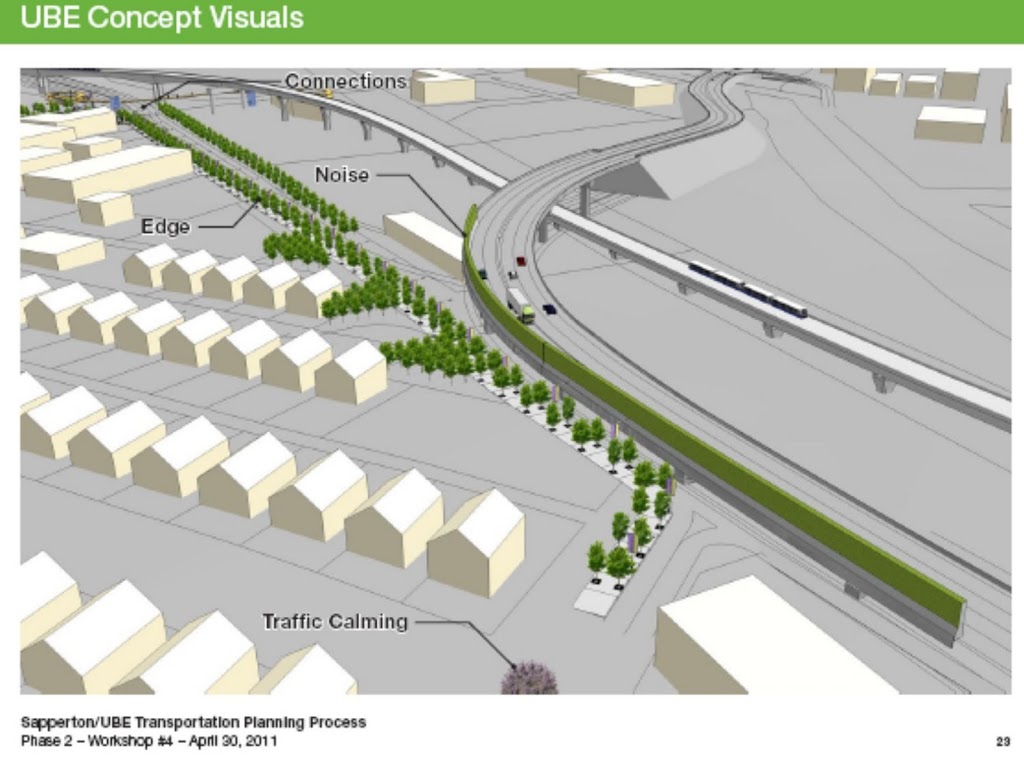
There was also much discussion of “edge” concepts. No surprises here, everyone thought trees and planters were better than… um… no trees or planters (again, why are we talking about this now?). Absent from the drawings were the 75 kV power lines that run along the west side of Brunette, and the communications lines that run along the east side: those trees are either going to be very short (10 feet is the safe approach limit from BC Hydro), or the lines will need to be moved (not a minor task).

Anyway, good to know that replacing roadways with green space, or at least separating people from roads with green space, is about the only thing that received unanimous support…Maybe we can all agree on something.

Now let’s talk about the wall. One of the early concerns from the Sapperton Neighbourhood (other than the knocking down of their houses) was the impact on the neighbourhood of an elevated truck highway in front of their homes. To manage this concern, TransLink is offering a noise wall, even suggesting that it can be a “green wall”, with vertical plantings to make it more attractive.

I have nothing against a Green Wall per se, but the high angle view shown above doesn’t give a very good impression of how high the wall would have to be to provide adequate noise abatement to not just the properties on Rosseau, but those up on Wilson, or Garrett. (Here is a bit of a primer on vehicle noise from some specialists in the field). Much of the noise of these trucks is produces at the exhaust, 2 or 3 metres above the road, and Sapperton slopes up from t his road, creating line-of-sight challenges the further up the hill you go. I’m not saying an effective wall cannot be built, but the visual effect of the wall, on top of the height required for the overpass to clear the rails and the SkyTrain at the Dip, is starting to add up to a pretty big wall.

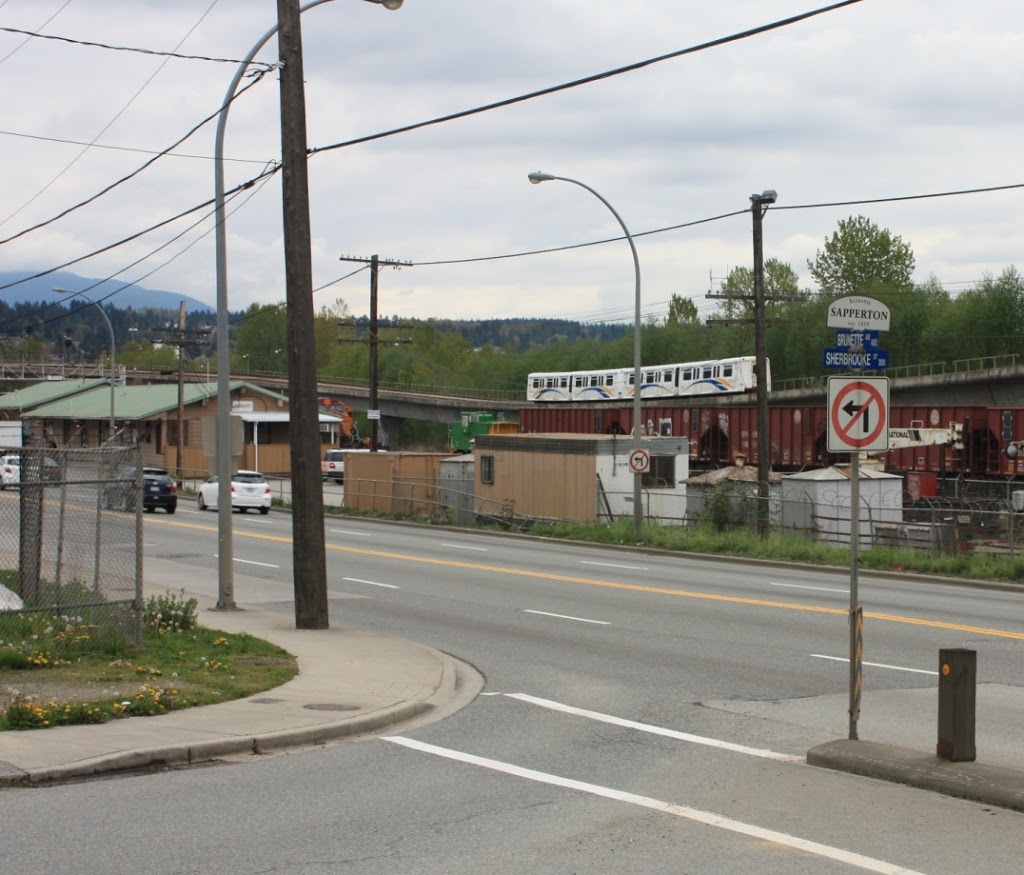
Just for perspective, here is a photo of the Skytrain swooping through the “Dip”. The white Sky Train Mark I train is about 2.5 m high from the top of the wheels to the roof. So picture another 2.5 m or so for the overpass structure, then another 3m or so for a Green wall.

Personally, I’m hoping we can take a closer look at Option “E”, and the long-dismissed Option “C”. I guess we will know on Thursday.