Council – March 30, 2026

(This post is being re-posted in July from a draft version as the original post was lost through some website glitch. Please excuse any formatting errors, lost links or other weirdness, its here for the sake of completeness, and I just don’t have time to reformat everything) 

It has been a hectic week, with lots of exciting things going on, some big and public, some more about ongoing conversations that are just starting to see public news release, or aren’t ready for new release yet. It’s been busy!

Last week’s Council meetings was not without its drama (I could write an entire report just on the delegations!), and there will be some more fallout of that, but we also got a lot of great work done from a relatively concise agenda, and that’s what this report is about. It started with a Presentation from Staff:

People, Parks and Play: New Westminster Parks and Recreation Comprehensive Plan Update
This term of Council, following on the heels of the opening of təməsew̓txʷ, there has been a lot of work in the background and through several phases of public consultation on a new master plan for parks and recreation in the City. This is the culmination of that work, and sets the path for the next 10 years in recreation and parks investment in the City. It’s an exciting time of looking forward.

As our last Parks Plan from 2008 demonstrates, there has been a lot of change in 18 years, and the recreation needs of the community have evolved. It’s not simply a matter of “we need more of everything”, we have had to shift and adapt to long-term trends in recreation and parks use, driven by shifts in our demographics, to assure what we can offer in our limited 15 square kilometres best meets the needs of our residents.

Much like our Council Strategic Plan, this master plan is structured around clear goals (six defined goals in this case) and the three foundational lenses of Reconciliation, Equity and Inclusion, and Climate Action are used as lenses to define how we achieve those goals. Not surprisingly for a City that has grown in population by about 50% since 2008, out park-space-per-capita has gone down, though most residents still live within a 10 minute walk of an active park, only about half live within a 5-minute walk, and acquisition of new park land, especially in denser areas like the Brow of the Hill where most residents don’t have back yard, is a priority.

But to me the exciting part of this report and Council’s resolution to move forward rapidly on high priority projects is the commitment to the next phase of recreation infrastructure investment following təməsew̓txʷ.
New sports courts Simcoe Park, Grimston and Moody Park, and a new multi-purpose covered outdoor sport court, replacing our aging collection of outdoor lacrosse boxes; major upgrades at Westburnco; commitment to a third sheet of ice to compliment Queens Park Arena and Moody Arena; and commitment a new (2,800 square meters?) multi-purpose community center in the downtown.

The next 5 years are going to be a period of rapid parks and recreation growth in the City, and this plan is the roadmap we need to see that growth succeed.


The following items were then approved On Consent:

2026 Parcel Tax Roll Review Panel for Local Area Services
Parcel Taxes are the method through which the City collects money from some landowners to pay for a specific service, based on lots size or frontage as opposed to assessed value. In New Westminster that is limited to funding the BIAs Uptown and Downtown though a tax that applies only to members. As a matter of legal practice, we must review the Parcel Tax Roll every year, and province a venue for owners in the parcel tax area to appeal if they think it shouldn’t apply to them. This report is just outlining that process, and giving public notice that we will formally review the poll in an upcoming Council meeting.
FCM Resolution Amendment – Modernizing Federal Small Business Policy to Support Local Economic Stability and Succession
The way the FCM (our national advocacy body as local governments) managed resolutions is bit different than the Lower Mainland Local Government Association (our local body) and the Unions of BC Municipalities (our Provincial body). After reviewing the resolution we submitted, they are making some recommendations for modification of the resolution that doesn’t change the meaning or nature, just the process of its consideration at FCM. We approve.

Response to Council Motion: Municipal Practices for Allocation of Filming Revenue
There was some discussion in council recently about the “excess revenue” the City collects for filming in the City. Most of the revenue we collect is cost recovery (covering the costs of police attendance, traffic management, engineering support, etc.) but we do make a little but of extra revenue every year that goes into general revenues. This idea was whether some of this could be earmarked for new initiatives, likely through a reserve fund. Staff have looked around the region and found that the way we manage excess revenue is pretty typical region-wide, but will take the idea of earmarking some of the revenues to the ACEDAC.

Westminster Pier Park Westward Expansion- Additional Fee Request from PFS Studio
We effectively sole-sourced this phase of design work for the Pier Park western expansion, because there was a design team we were working with that knew the complexity of the site (building a park on top of a parkade structure!) and had been partnering with us through this work The total in fees now exceeds what were are able to sole-source without Council authorization, so here is staff seeking that authorization. This is not a budget change – the project is on budget, and will be completed this spring!


The following items were Removed from consentfor discussion.

Budget 2027 Public Opinion Survey Methodology
Every couple of years, we pay for a formal scientific poll of the community as part of our budget consultation process. This is different that the workshops, opportunities to be heard, Facebook (oh, god) comments, and other processes we do, as it is actually a scientifically defensible survey of public opinion on the budget, taxes, and level of service in the community. The last poll in 2025 showed people are generally satisfied with the value they get for their tax dollar in New Westminster and are not in favour of cutting services to keep tax increases down. We will repeat this process in 2026 to survey the community and hopefully use that feedback to frame our discussion about the 2027 budget. Public polling like this, to get reliable results, costs money, but as part of a broader strategy of hearing from the community, it is worth while doing these check-ins every couple of years.

Business Regulations and Licensing (Rental Units) Bylaw Cooling Amendments and Next Steps
I don’t have to remind regular readers about the 2021 heat dome, and the devastating impact it had on our community. I wrote about it here, and after 33 coroner-confirmed direct deaths (and other related to the event), I am still committed to the City doing everything within our power to prevent a repeat. We have already taken many actions, from expanding our heat emergency response efforts, reevaluating how we operate and advertise cooling centres, and working with residential property operators on “one cool room” and other strategies to assure that older and less efficient buildings in the City don’t become death traps during the next major heat event.

We have done a lot of work, and have implemented several “carrots” to support residential property managers to make homes safer. We have struggled with the “sticks” part of that same policy goal. We have already passed a bylaw regulating that landlords cannot arbitrarily ban air conditioners from rental apartments, we are now moving forward with what we think is a pragmatic and defensible position that landlord are required to maintain safe indoor temperatures in at least one living space in a rental unit. We already have laws that require heating to a safe temperature be provided, we are adding to this that beyond a safe minimum temperature, there must be a safe maximum temperature.

Alongside this, and as part of our ongoing Vulnerable Buildings Assessment project, a pilot project is simultaneously being developed to support building owners and tenants to identify, access and implement indoor cooling solutions on a case-by-case basis.

This report brings the first three reading of the Bylaws, and we have some work and consultation to do prior to adoption, then we will have some communications work to do following adoption, but I think this is another example of New Westminster going above and beyond to protect the most vulnerable people in our community, and I’m proud that staff were able to find a bold and pragmatic approach that might just save lives.

Official Community Plan Amendment and Rezoning Application: 807-823 Sangster Place and 39 E Eighth Avenue – Application Update
This is a challenging project that has been under development for several years, and has run up against the deadline of June 30 that the City has for implementing our Bill 46-mandated funding structure for DCCs and ACCs. In short, after that date we are no longer able to negotiate Community Amenity Contributions, and instead must charge Development Cost Charges and Amenity Cost Charges to get funding for amenities from developers. This project was developed without the updated DCC and ACC costs included, and the developer was given the option to proceed under the new rules or under the old rules, on the condition that in the latter case all work required be completed in time for Council to provide approval before June 30th. The developer chose that second path. That has resulted in the unusual situation where staff are bringing the project to Council while not recommending approval.

To the biggest point here, the applicant has missed the deadline to provide the information necessary to prepare the Bylaws. As this project is not just a rezoning, but necessitates an amendment of the Official Community Plan, legislations requires significant external agency consultation and public consultation leading to an Public Hearing based on the prepared Bylaws, and now the timelines to get all of that done by June 30th are too tight.

That is a process problem, and what led to Council making the decision to vote against advancing this application, but there are some other problems with the development that can be summed up as it representing an OCP amendment without public amenity contribution sufficient to warrant OCP update. The applicant can re-apply at a future date, but the project will now be subject to the new DCC and ACC regulations.

Planning for the 2026 General Local Elections
Hey! There is an election coming in October! And the City has to run the election for both Council and the School Board, so this report outlines the election plan from the our Corporate Officer. There will be some changed arising out of the post-election summary provided to Council back in, and the only recommendation coming out of that that council did not agree with was moving the date for installing lawn signs forward to the start of the nomination period. Instead lawn signs will be permitted at the start of the 28-day campaign period to align with provincial practice.


And that was Council for March. I cannot believe it is April already. Happy Easter everyone.
Trip Dairy 2023

I could have sworn I already wrote this post, but looking through the archives, I apparently never did! It is the long-awaited follow up to this post, where I reported on the results of the 2017 TransLink Trip Diary and what is says about how New Westies get around.

The Trip Diary (2023 results here) is the most comprehensive survey of regional transportation use in the TransLink area. Unlike the census data that only asks folks their most common way of getting to work (or school), the Trip Diary counts all trips over a week, and asks that people report on all modes used, not just their most common mode, and also collects more data about trip distance, municipal-level data, and more.

That last post I did in 2019 (there were actually two, here and here), reported that between the 2011 and 2017 Trip Diaries, New Westminster had grown 8.9% in population, the number of trips taken by New West residents during the survey went up a little more than this, but the number of car trips actually went down. All new trips generated were by transit, walking or cycle. In the second post, I dug a bit deeper to show that the change in the number of car trips does not correlate with population change. Turns out there are many factors driving traffic and traffic congestion other than the simplistic rubric that population=traffic.

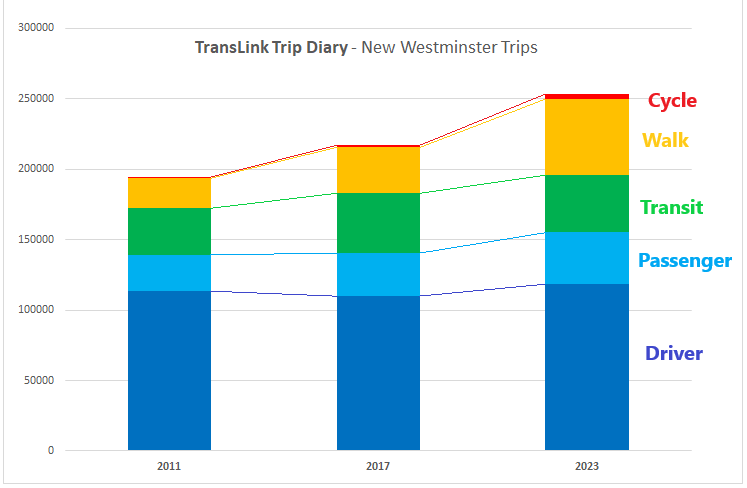
The data form the 2023 Trip Diary has been out for a while now, so I can update those tables to see how things have progressed, and there is both good and bad news for sustainable transportation. Here’s the chart:

Though population continues to increase in New Westminster (30% between 2011 and 2023), and the number of trips over the same period increased by about the same amount, the headline is that the number of trips as a driver has only gone up 4%, and the driver mode is now less than 50% of all trips. We can now confidently say most New Westies don’t drive for most of their trips. But there is a lot of detail hidden in this chart.

The number driver trips did increase slightly from 2017 to 2023, which offset the decrease over the previous 6 years, while passenger trips have gone up steadily. This may have something to do with the rise of ride share services (which would translate to more cars on the road and worsening traffic), but may also represent an increase in carpooling (which would not result in more cars on the road).

The number of trips by Transit has gone up 19% over the same 12 years, even as it has gone down slightly over the second half of that period. No doubt the impact of COVID is showing up here, and though post-COVID ridership recovery was well on it way in 2023, it wasn’t until 2025 that ridership across most of the region returned to pre-COVID levels. Unchanged from 2017 is the headline fact that New Westminster has the highest Transit ridership of any City in the Lower Mainland (see below).

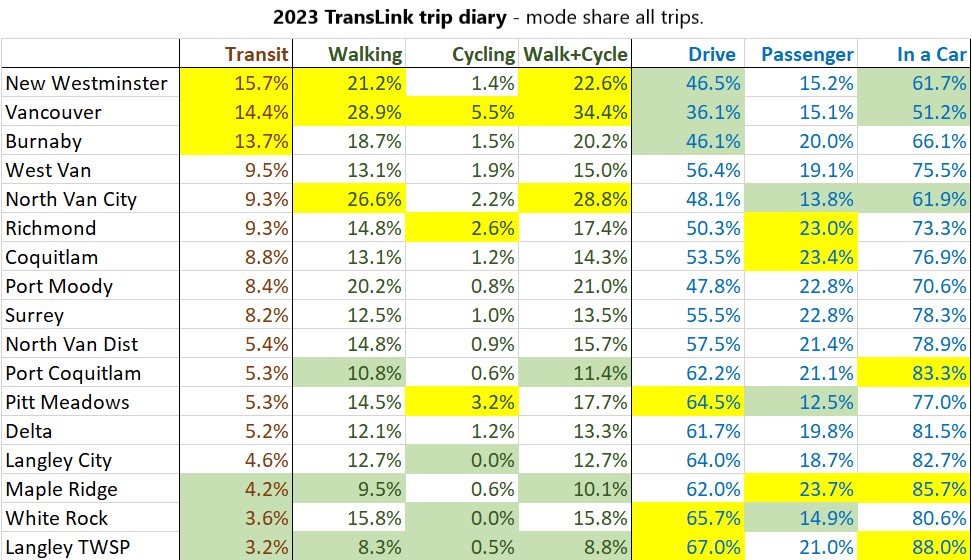
Where we see the biggest shifts are in Active Transportation – walking trips up 153% over the 12 years and cycling trips up 338%. Overall active modes doubled over the 12 years and were clearly the biggest growth area. New West has always been a walkable city, and is slowly becoming a cycling one (and yes, E-bikes are a big part of this, because hills). Here are the major modes compared across the region:

Yellow highlights three highest numbers in the region, green highlights the three lowest numbers.

New Westminster, when compared to the region, has the highest transit ridership, is third highest (after only Vancouver and North Van City) in walking, is seventh out of 17 for cycling, has the third lowest (after Vancouver and Burnaby) number of drivers and the second lowest (after Vanouver) number of people in cars. As one would expect from a compact, dense, livable community with exceptional transit service.

Council – March 9, 2026

This week’s Council meeting was relatively short one, with a shortish Agenda that started with a less-common-these-days Public Hearing:

Heritage Revitalization Agreement (1121 Eighth Avenue) Bylaw No.8550, 2026
Heritage Designation (1121 Eighth Avenue) Bylaw No. 8551, 2026
The owner of this property in the Moody Park neighbourhood want to build a new house and a duplex on this lot while also granting permanent protection to the heritage home on the lot. A Heritage Revitalization Agreement is the tool to do this, it works similarly to a rezoning, with the heritage preservation as the “community benefit”. Unlike most residential rezoning in the City where public hearings are forbidden by Provincial regulation, an HRA requires a public hearing, despite the compliance with the Official Community Plan.

The 1909 house on the site would be permanently preserved and restored, a new 1,500sqft detached house would be build beside it, and a new 3,600sqft duplex would be built on the back of the lot, facing the alley. This mean 4 homes where three are currently permitted (though the City is working on a response ot the new provincial housing regulations that would permit up to six units on this property). This property will have an FSR of just under 1.0, and the new housing regulation would permit up to 1.0. The model here is to stratify the four units.

We received no correspondence and no-one spoke to the Public Hearing. Council voted unanimously on third reading of the Bylaws.


We then approved the following items On Consent:

Appointment of Acting Financial Officer
Our CFO has taken another job, and this is one job that Council has to officially appoint as it is a “statutory position”, meaning they have legislative responsibilities under the community charter, so we are appointing the Senior Manager of Financial Services as the interim while HR does the work of getting a CFO hired.

Housing Agreement Bylaw and Development Variance Permit to Vary Residential Parking Requirements: 430 Ninth Street – Bylaw for Three Readings
This 29-unit rental building in the Moody Park neighbourhood is going through a significant renovation of the envelope, windows, accessibility and including mechanical cooling (!), and they want to also include the addition of a couple of suites, to raise the number to 31, and remove a couple of parking stall that mean they will have 3 fewer than required by zoning, therefore requiring a Development Variance Permit. In exchange they will sign a housing agreement guaranteeing rental tenure for 60 years or the life of the building (whichever is longer).


Then we addressed these items that were Removed from Consent for discussion:

Official Community Plan Amendment and Rezoning Application: 807-823 Sangster Place and 39 E Eighth Avenue – Application Update
This application is a bit of an unusual one, and led to a bit of discussion at Council, as it is not common for Staff to bring a project to Council while also recommending against its approval. However, there are various overlapping issues here that required some time for Council to unpack. The proponent however communicated with Council and requested that we defer decision making until next meeting so they could get some stuff sorted out, and Council voted to defer.

Our City, Our Homes: Implementation of Transit Oriented Development Area Extensions and Regional Planning
The City recently adopted its response to the Transit Oriented Development regulation of the Province from Bill 47, but for technical reasons related to other decisions the City has to make about townhouses and infill density, we did not include the “edge cases” of the circles drawn by the provincial mandate of 800m from a SkyTrain Station. The circle-on-a-map process means there are many blocks where part of the block is under TOD (permitting up to 8 storeys) and parts are not. Through some public consultation, staff have identified 104 properties that are “on the edge” that they recommend be included in the TOD areas, to “square the circle” so it fits into the context of existing neighbourhoods.

There are also some changes here to the statement about how our OCP aligns with the Regional Growth Strategy and adoption of some climate action into the OCP. This is first and second reading, and these changes to the OCP will go to a Public Hearing, so I won’t comment too much more until that process occurs.

The New Westminster Age-Friendly Strategy
I recently attended an event at Century House where Alison from the Senior Services Society and Dan Levitt the provincial Seniors Advocate spoke about the challenges facing many older adults in our community, from housing precarity to the lack of senior government supports to make aging in place an option for more people. This is an increasing concern as the “baby boom” generation journeys though older age, and as austerity governments resist investing in the supports this growing community needs.

The City got a grant in 2024 to update our Age Friendly community policy, and here it is. There are 59 recommended actions in here, and one of the first ones is to appoint a community working group – a task force of Older Adults from the community to oversee and prioritize the implementation – which I see as a key to making this work. And though I appreciate the 28 people who helped put this together, I think the implementation working group could be smaller and centre the older adults in the community.


We then had a single Motion from Council:

Queensborough School Bus Program
Submitted by Councillor Minhas

WHEREAS over 230 Queensborough based students and their families rely on the Queensborough bus service to enable students to attend New Westminster Secondary School in a safe, secure and timely manner, without which journeys take three times as long and students are often passed over by overcrowded buses causing them to arrive late or not at all; and
WHEREAS a pilot service launched in January 2024 at cost to parents is slated to end on June 30, 2026 despite a campaign promise made on October 8, 2024 that if the NDP government were re-elected, this service would be made ‘permanent and free’; and
WHEREAS New Westminster is the second most dense city in Canada, with only one high school, and the acceptance of this density should have already unlocked new funding from senior orders of government;
THEREFORE BE IT RESOLVED THAT the Mayor be requested to write to our three government and opposition MLAs asking they advocate to secure the necessary provincial funding to ensure the Queensborough school bus program becomes ‘free and permanent’ as previously promised; and
BE IT FURTHER RESOLVED the Mayor write to the Minister of Education and Child Care requesting that additional funding be granted to School District 40 for the Queensborough school bus service to continue and be made permanent (beyond June 30,2026) and without cost to local families until such time as a new high school is built in the Queensborough community.

Advocacy for this service has been consistent and relentless since the previous dedicated transit service was cut in 2013, and thought the School District was able to secure support for the pilot project, in my mind, you run a pilot to determine if a project works and has community support. It is clear after two years that the students and families of Queensborough support this program, and it’s time for the province to step up and make the bus service sustainable. I have a meeting booked in early April with Minister Beare, and along with discussion of future school sites and advocacy for seamless childcare support in the community, the bus issue is on the agenda.


And we closed with a single Bylaw For Adoption

Development Cost Charge Reserve Funds Expenditure Bylaw No. 8572, 2026
This Bylaw that authorizes applying $10.5 Million from our DCC reserves to our 2026 Capital Plan was adopted by Council.

And believe it or not, we were out of there by 7:00, just like the old days.

IWD 2026

Today is International Women’s Day, and it always feel weird to be “Mayorsplaining” the experience of women and girls to the majority of the City who are not cis guys. Especially as I am surrounded by so many smart, strong, and bold women who are leading in New Westminster. So I’ll take this opportunity to highlight a few of the books that have guided my learning about cities and hope some of the dudes who follow me do their own learning and work to support more equitable and just cities as a path to a more equitable and just world.

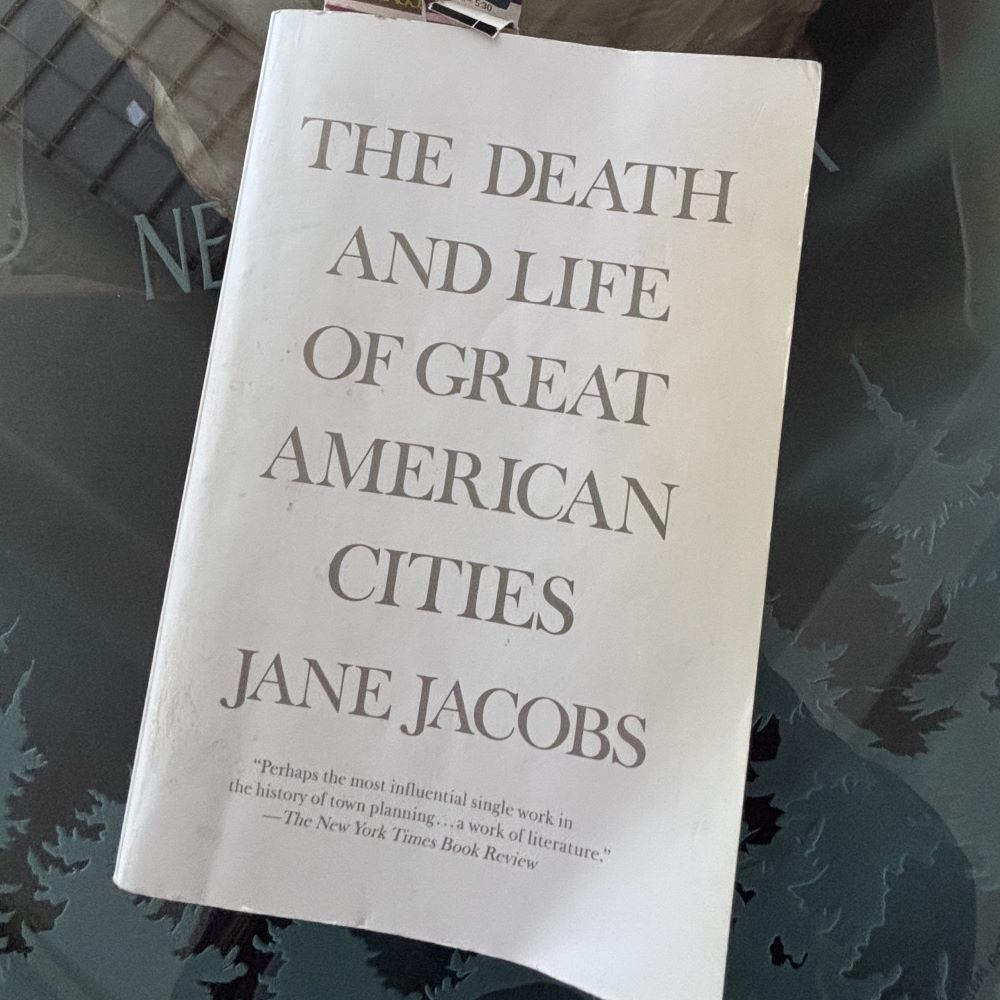
The obvious first book is Jane Jacobs’ “The Death and Life of Great American Cities”. Still relevant 65 years after it was written, the book was written as a critique (attack) on orthodox city planning and became an important part of the paradigm shift that changed the planning profession.  My own copy has suffered greatly from dog-earing and marginal noting, as I return to the many insights in here round the role of sidewalks as social places, the value of framing the experience of children in a public space, and the difference between a City designed for cars an one designed for people. https://tinyurl.com/5ezdpkx2

When Janette Sadik-Khan wrote “Streetfight”, she had just left her role as Transportation Commissioner of New York City, where she led bold (and ultimately highly successful) initiatives to give the streets back to the people of New York, a City where most people don’t include driving as part of their everyday lives, but most public space was still given to cars. She was instrumental in making New York a cycling city, in the redesign of Times Square and other public spaces to emphasize gathering and community in the most famous city in the world. And one quote in this book is burned in my head: “When you push the status quo, it pushes back. Hard.” https://tinyurl.com/bdaj7e8d

One thing these two books reference, sometimes obliquely, is that cities are traditionally designed to serve an outmoded ideal – the single male breadwinner of the nuclear family. This is simply not how most people live today, and we need to change how our cities work if we want to address the needs of today. This is more explicitly set out in Leslie Kern’s “Feminist City”. This book opens up new ways to see a city and a community (at least new to folks like me), and asks a lot of questions, even if I think it falls short of providing answers to those questions (I’m hoping for a sequel!) https://tinyurl.com/szt42f3y

Have a meaningful International Women’s Day, and pass the knowledge!