The Return of Green Drinks

Sorry I haven’t rapped at ya recently, but I have been busy. Work is crazy, a few volunteer things are coming to a head right now, spent a few days trapped outside of New Westminster, attended a massively fun Pecha Kucha event, and am generally enjoying the hell out of life.

I do want to make a quick point, though: GreenDrinks is coming back to New Westminster!

For those out of the loop, GreenDrinks is an international local event. The idea is that people interested in Environmental and Sustainability issues get together once a month or so, and have a casual social and networking event. There isn’t an agenda, there isn’t a formal meeting, or any real formal structure: the idea is to just bring people together and see what arises!

Although lacking that formal structure, this isn’t completely anarchy. GreenDrinks is part of a great international tradition. There are GreenDrinks events everywhere from Argentina to Vietnam, from Perth to Vancouver. All are related in name, spirit, and “The Code”.

It is sometimes amazing what arises. Many of the things the NWEP have done in the past have grown from tossed-around ideas at GreenDrinks, and new friendships and partnerships have grown from these events. For a variety of reasons, monthly GreenDrinks stopped in New West a little more than a year ago, but a crew of people have stepped up to get the event operating again, and the first draft (so to speak) is next week!

There is no charge, no stress, all we ask is that you are willing to get into a conversation, meet someone new, bring your ideas and opinions, and bring a sense of humour. We’ll put name tags on you to make introductions easy, and we will have a conversation starter around the break any ice that might develop. People will start arriving around 6:30, and it will continue until the last person leaves (but hey, it’s a school night – so don’t wait until midnight, you might miss the best stuff!)

New West has the perfect location: the Back Room at The Heritage Grill allows semi-privacy, a great menu, drinks for those who would like them, while being open and inviting to people who don’t want to drink (or are not yet 19 – it is a Restaurant, not a Pub!). Oh, and cool tunes out front later in the night.

So if you need an excuse to be social, are interested in environment and sustainability issues, or think you might have an idea that people should hear about, come by GreenDrinks. Who knows what will develop?

What about the Utilities?

I started posting about municipal taxes a few weeks ago. An astute #newwest hashtagger on Twitter, apparently finding me inadequately critical of local tax rates, suggested that once utilities were included, I would find New Westminsterites pay way more than nearly anyone.

“@NWimby Do a comparison with fees for sewer, water and garbage added to property tax and you’ll get a different answer.”

To which I suggested:

“@redacted go for it! Love to see you do that!”

To which the commenter retorted:

“@NWimby It has already been done. NW is 2nd highest behind Maple Ridge but NW is 6squ. Miles and Maple Ridge is 103squ. Mile”

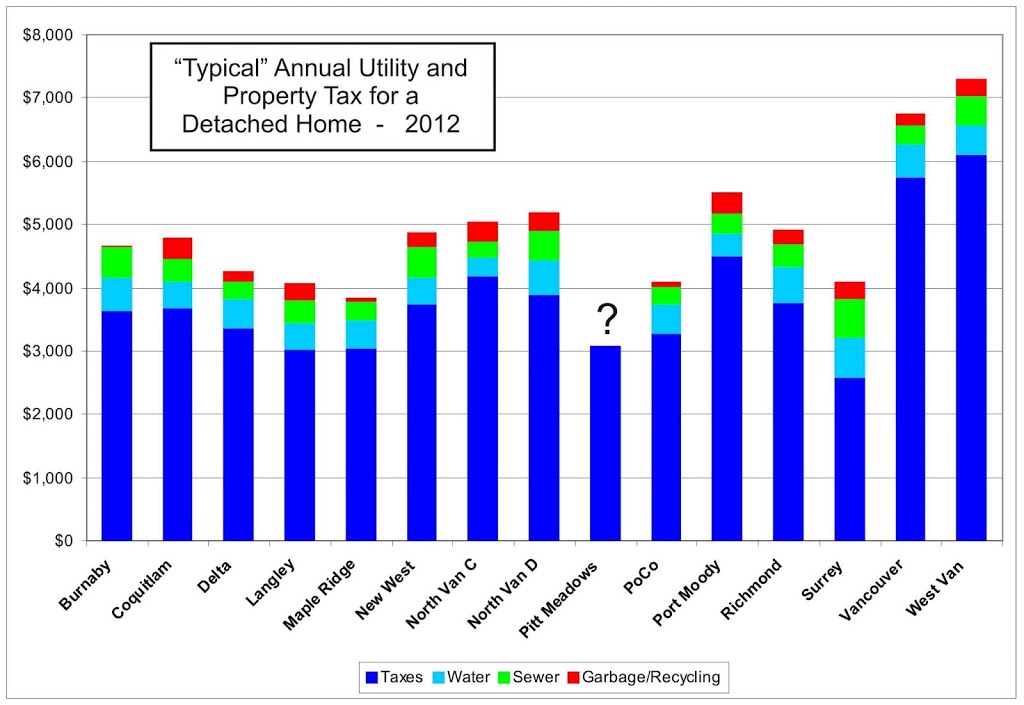
Since no actual data was proffered, I decided to do the analysis myself. Luckily, I had a few hours in an airport with WiFi to do the digging through City websites. The results were interesting, for me at least. For the rest of you, come back next week, I’ll rant about skateboards or bridges or something.

Much like Mil rates, it is sometimes tough to compare between municipalities, as different jurisdictions handle their utility accounts differently. I did my best to compare apple to apples.

Water utility rates are difficult to compare because some cities have water meters for residential users, some don’t, and for some meters are optional. Even the metered cities usually have a flat service charge with a metered rate on top. So to compare the typical annual water bill, I assumed that the house used the average amount of water for metered Canadian households, which is 25 cubic metres per month.

Sewer rates are also sometimes tied to metered water use, and in that case I made the same assumption about typical water use volume. Some cities have extra “drainage” levies or charges to deal with storm water costs, some include it in their sewer bill. I have added all sewer and storm drainage charges, metered or not, into the singe sewerage charge.

Garbage and recycling was the hardest to compare, as every city offers different services. Some have organics collection, some blue box, some co-mingled recycling. Some charge a lot less for “small” containers and really ding the big container users, others have less difference. So for the purposes of comparison, I assumed everyone used a 120L trash, green waste (if available) and blue bin.

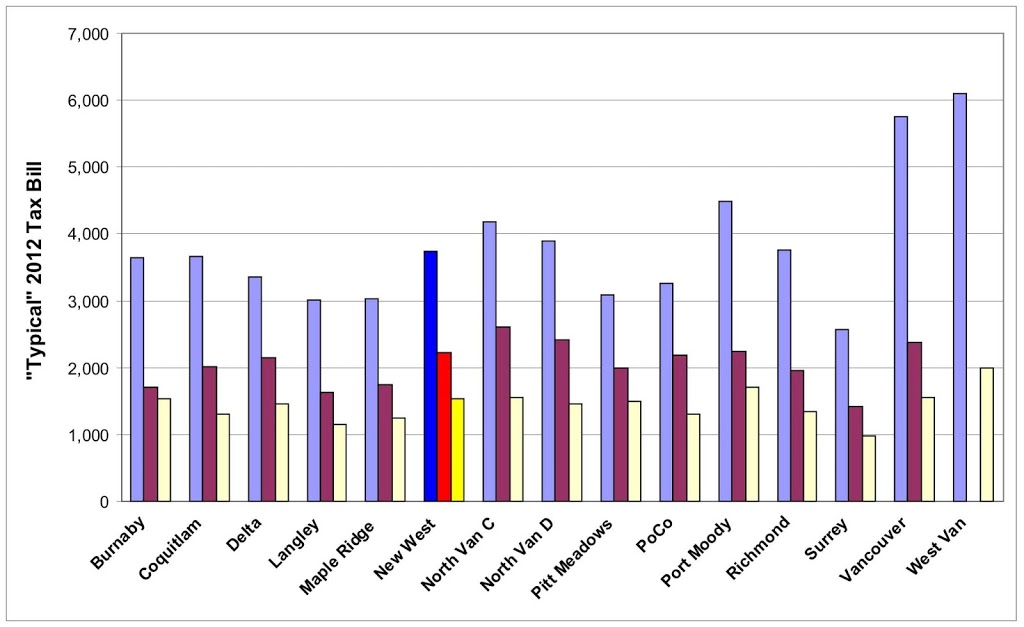
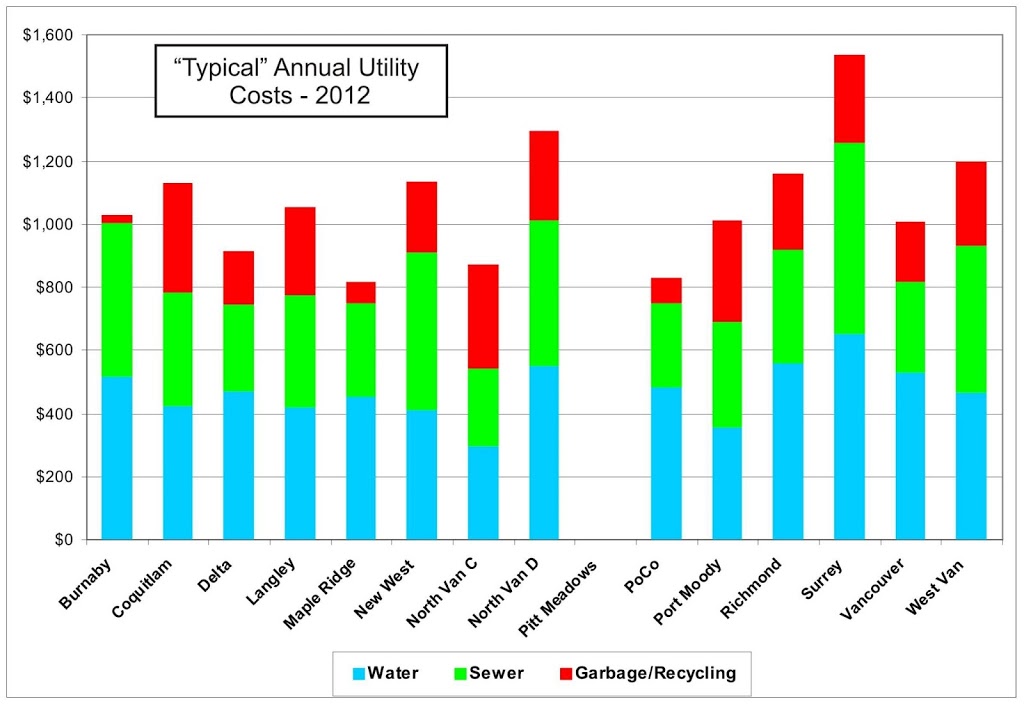
I did the best I could collecting all of this data together (and if you find a flaw, please let me know!) I found nothing on-line for Pitt Meadows, and didn’t care to dig too much further. I am suspicious of Burnaby numbers, but that doesn’t affect my analysis too much. This table shows the “typical” household utility bill, per year, for each municipality:

Click to enlarge

Again, we see New Westminster is somewhere in the middle, 6th of the 14 municipalities for which I could find data. Our water rates are lower than most, our sewer rates higher than most, and our trash/recycling about typical.

So what happens when we add this to the annual tax bill for the typical detached home? This is what happens:

click to enlarge

New Westminster ends up right in the middle, 7th of 14 municipalities with utility data available.Maple Ridge isn’t the only Municipality more expensive than New West, as suggested by my Twitter friend – it is actually a relative bargain (except, of course, you are stuck in Maple Ridge).

What is a Mil worth?

There were some recent letters in the Record, lamenting New Westminster’s out-of-scale property taxes. Some feel we have the highest property taxes in the region, one fellow last year even opined the second highest in Canada!

As I previously posted, there are many ways to measure taxes, and Mil Rates only tell part of the story. It gets even more complicated when you add utilities to the mix. Municipalities have different ways of paying for your water, sewer, and trash collection, and this impacts what your property tax bill looks like in June.

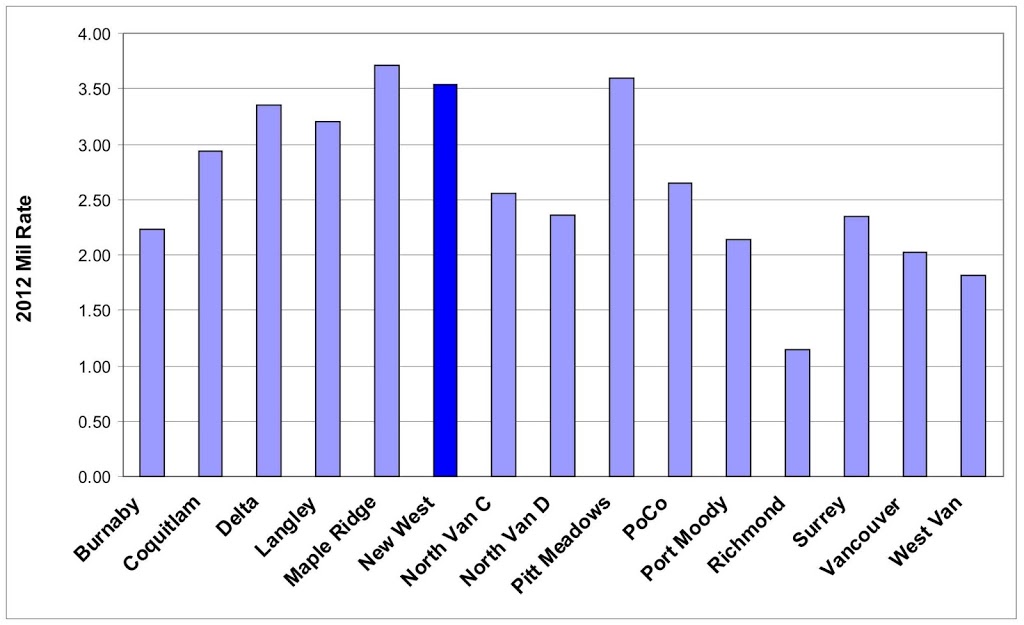
As part of my continued interest in calling a spade a shovel, I did a little on-line digging around, and here are the 2012 Mil Rates for the 15 Lower Mainland municipalities that publish this stuff on-line (or at least those who publish it in an easy enough way that I didn’t spend my weekend digging through Bylaw pages).

Richmond can claim the lowest Mil Rate at 1.15, with West Vancouver second at 1.81 and Vancouver a close third at 2.02. New Westminster is third highest at 3.54, with only Pitt Meadows (3.60) and Maple Ridge (3.71) higher.

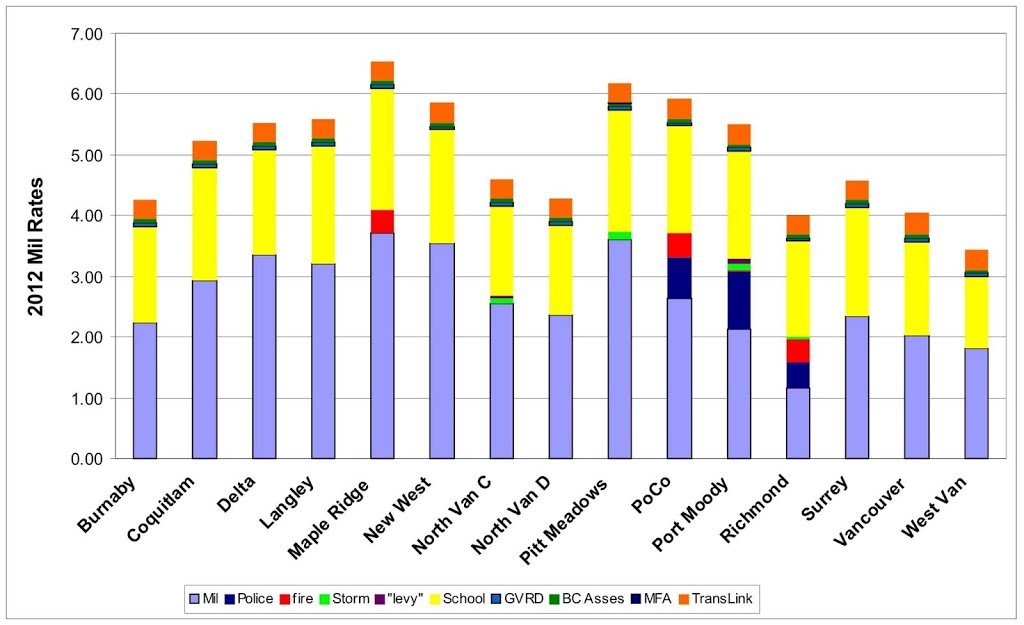
However, many cities list their fire, police, storm sewerage, or other services and “levies” separately from their Mil Rate. These are not utilities (which are defined in the Local Government Act), but part of the regular City service. Also, there are senior government taxes applied to property taxes: School taxes (set by the Province), along with GVRD, TransLink, BC Assessment Office, Municipal Finance Authority. Add these all up, and you get a truer Mil Rate comparison:

You can click to make larger- tax free!

Now we see West Vancouver pull into its rightful place as the lowest Mil Rate Municipality, with Richmond and Vancouver neck-to-neck for second. New Westminster moves up to 12th, now that PoCo’s “levy” load is added on. The Gap to Places like Port Moody and Langley also tighten somewhat. Still, 12th of 15, with a Mill Rate 70% higher than the lowest in the region, is nothing to brag about, right?

Remember, that these Mil Rates are applied against the assessed value of your house. Since houses in New Westminster cost less than in Vancouver, and more than in Pitt Meadows, the amount of tax you pay doesn’t index all that well to Mil rates.You can use the BC Assessment Office data to figure out the “average” house price in each Municipality, but that does not really tell you what the “typical” house price. Medians and means are both overly influenced by outliers, and when looking at house prices from Maple Ridge to West Vancouver, there are a lot of outliers.

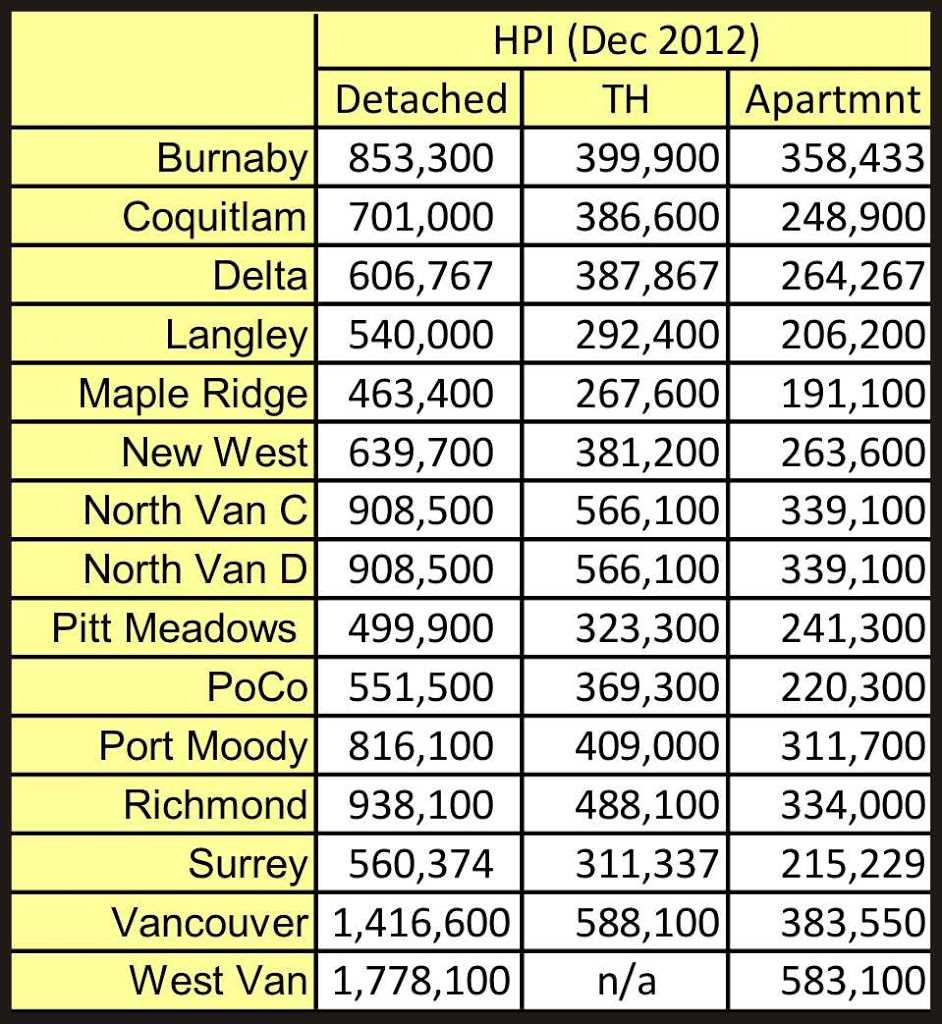
Luckily, the good people at the Greater Vancouver and Fraser Valley Real Estate Boards have a better database of high, low, median, and ( this is most important) typical house value. And they break it up by detached, townhouse/rowhouse, and apartment. You can look at their methodology and explanation of why “typical” is better than median or mean here.

Here is the list of the values of the typical house, townhouse and apartment for the 15 municipalities:

Not surprisingly, New Westminster is in the middle-lower part of the list as far as property values go; generally higher than places south and east, lower than places west. Blame the prevailing winds.

The fun part is combining this table with the Mil Rates Table. I know Mil Rates are based on Assessed Value, not the selling prices that are used in the Real Estate Board stats, but can we agree that the assessment process is equally unrepresentative across the region, and that for the purposes of comparison, the data pile is fair, if not the individual data? Again, the result is accurate, if not very precise.

So here are tables of “typical” Property Tax Bills for the 15 municipalities, based on domicile type, not including seniors discounts, Grants, or the three big utilities (water, sewer, and trash – those will be another post, there is already too much math going on here).

New Westminster is, as might be expected, somewhere in the middle of the pack for most housing types. Not the highest-tax municipality in the region, not the lowest. Somewhere between the 5th and 7th highest, out of 15 municipalities.

This doesn’t comment on the comment that everyone across the region is paying too much tax, but it kind of takes the wind out of the specific examples many cite when saying City X pays way more than City Y. So next time someone suggests their “taxes doubled” since moving from Vancouver to New West, congratulate them on their new home, since they would have had to upgrade from a way-below typical $600,000 house in Vancouver to a somewhat-above-typical $850,000 place in New West (or proportionally similar increase). Which seems like a nice upgrade to me.

Jurisdictions

At a party this weekend, I was chatting up a striking lady (no worry, Ms.NWimby was right beside me), and I mentioned my interest in local transportation issues. She then started to complain about trains. This is not unusual in mixed company in New Westminster: she was sick and tired of the long whistles, the loud whistles, the middle of the night whistles. Why didn’t New Westminster do something about it?

At this point, I usually repart that there is an issue with jurisdictions: in Canada we have Local Government, who are below the Provincial Government, who are under the Federal Government, who are superseded by the Jedi Council. The Jedis answer to the Railways.

But this post isn’t about the railways, it’s about jurisdictions.

There has been a bit of chatter recently around homeless shelters, and the point that New Westminster has them, Burnaby doesn’t. Chris Bryan at the NewsLeaders (Burnaby and New Westminster) has called Burnaby out on the issue several times.

However, Burnaby’s Mayor Corrigan is resolute: homelessness is not the municipality’s jurisdiction, it is up to Senior Governments to provide these services. If the Province and Feds don’t deal with the issue, that is no business of his, and certainly not something he wants impacting his Property Tax rates! New Westminster’s Mayor Wright is just as resolute: it is the Senior Government’s responsibility, but if they drop the ball, the City cannot just sit and watch people die on the streets. So for both of them it is a matter of principle.

For me, it is pretty easy to see who is on the higher moral ground, and where the leadership is.

I gave New Westminster Council the gears a little more than a month ago over the Shark Fin Soup Ban. It was, in some ways, a similar issue (and no, I am not comparing homeless people to fish). The subject is well outside of Municipal jurisdiction, and contains a moral question that might compel action, real or symbolic, regardless of that jurisdictional nuance. However, unlike the Shark Fin Soup issue, the action taken by New Westminster on homelessness is not a symbolic one, but directly helps people living right here in our community, and comes with a real cost to New Westminster taxpayers. It might even be unpopular with some of the more, um, “frugal” taxpayers in the City. There is a potential political cost to making that decision, and it therefore requires some leadership.

There is a recent parallel issue where Mayors Corrigan and Wright apparently agreed: the supplemental funding of TransLink. Here they both agreed that no more municipal money was going to be used to maintain and grow the regional transportation system, and that new funding had to come from some Senior Government master plan. This despite the fact that they represent two of the Cities that benefit the most from TransLink operations and will be impacted the most bythrough-traffic increases that will undoubtedly results as TransLink is choked off from being able to provide better service to peripheral areas. So here the choice to not do what the senior governments should (in your opinion) be doing saves money for local taxpayers money, but costs your citizens and the region in livability. Tough choice.

I don’t want to live in a community where people freeze to death on the street for need of a safe place to sleep, and I am not the least bit concerned that some small portion of my property taxes go to providing basic emergency shelter needs. I wish we had a Provincial strategy to deal with homelessness and our social services were funded adequately by both senior levels of government so we don’t have homeless. I would even offer that my portion of the F-35 money would be better spent on this. But all the wishes I make are not going to help if no government shows leadership and steps in to deal with the problems. I could be talking homelessness or TransLink right now.

What I can’t countenance is Mayor Corrigan sitting on his hands and refusing to invest even a small portion of City land or any local resources to help homeless people in his City, and hiding behind jurisdictional issues. He may feel like he is on high moral ground on this issue, but I don’t see any leadership coming from up there.

Sufferfest

I signed up for a Sufferfest this year. A moment of weakness, a compelling (but probably very bad) idea, a challenge issued, and a handshake agreement. I’m committed.

A friend Andrew and some cycling buddies of his have an annual ritual. They meet up in some Interior BC city on the May Long Weekend, and spend three days riding bicycles long distances over high mountain passes. I saw pictures of last year’s cold and rainy event: it was a Sufferfest.

This year’s plan is no less suffer-worthy, but includes some roads I have never ridden, hence my being compelled to contemplate perhaps taking part. Then the shocking realization came in.

Day 1: (185km) Vernon to Merritt via Kelowna, 97C and the Pennask Summit.
Day 2: (165km) Merritt to Sorrento, via Kamloops, Highway 5 and the Surrey Lake Summit.
Day 3: (140km) Sorrento to Vernon, via Sicamous.

This will be done on bicycles, as fast as possible. Rain or shine, perhaps snow. Suffering encouraged.

The reason I bring this up is that it is creating a lot of discussion among my drinking buddies usual life advisers around techniques to reduce the level of suffering, and much of this discussion is getting very metaphysical. To wit:

Andrew’s advice is to “train”. Aside from the issue of whether I should take any more advice from the guy who got me into this in the first place, the idea of “training” is sort of antithetical to the way I ride bikes. Even in the old days when I used to race bikes, I didn’t train so much as I just went for a lot of long bike rides and more than a few fast bike rides. Intervals? Speed work? Spinning? Not so much. I love to ride, and training was just an excuse to ride more, why reduce the fun of the riding by introducing “training” to the mix? This is perhaps why I generally failed to win races.

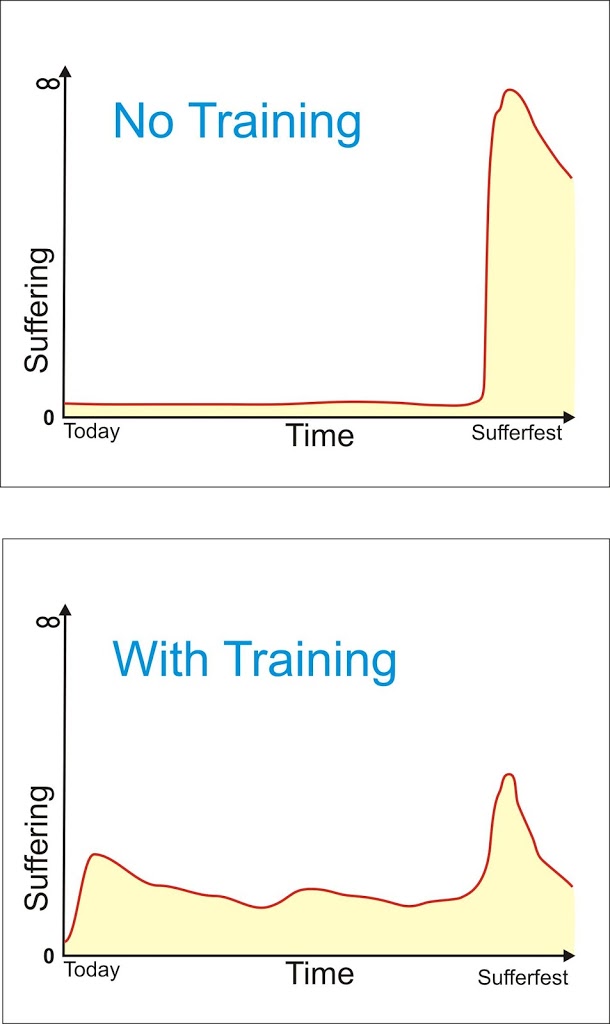
I got to thinking, at the meta level, if to train is to suffer, then one has to decide if more suffering is the best approach to reducing suffering. You see, the Sufferfest is going to invoke suffering no matter what I do between then and now. The scale (both depth and breadth) of the suffering will be reduced by filling the intervening time with training, which is programmed lesser suffering to reduce the eventual event suffering.

But how much pre-suffering is necessary to meaningfully reduce the event suffering? Or more important, how does one reduce the net suffering. If one was to graph the suffering over time, you would get something like this:

Since the front part of the curve (training-induced suffering) effects the back part of the curve (Sufferfest suffering), I need some way to reduce the total suffering, which in this case is represented by the shaded area under the curve. I need to find the smallest possible value for that area. That way, I can assure I don’t waste early suffering that will not impact late suffering: I need to find the suffer-minima. I knew I should have paid more attention in college, because this is going to take some intregal calculus.

Then it occurred to me that this may not help me, because the person who has to worry about that is Future Pat. The suffering of Future Pat really shouldn’t be the concern of me, Present Pat. I am already dealing with all the bad decisions made by Past Pat, who not only got me into the terrible shape I am right now by blithely ignoring his bikes for a couple of months, then making some sort of deal with Andrew that has me in my current situation. Past Pat is a real jerk that way, never thinking of others.

This is the same Past Pat, I remind you, who constantly failed to study adequately for calculus exams, dooming Future Pat to marks not befitting the stress induced. I’m afraid he has left me with little choice. Already carrying the load of Past Pat, I’m in no position to be taking yet another Pat under my wing, Future Pat is on his own.

Future Pat is going to suffer the May Long Weekend, the poor bastard. Glad I’m not him.

On Assessments and Mil Rates

Regular readers (Hi Mom!) know I like to define my terms. Almost to a fault. That is how a 300-word missive on the latest outrage can expand into a 1500-word explanation of some nuanced difference in language.

Here we go again.

With the BC Assessment Office returning this year’s assessment reports, and everyone able to look up their own house (and that of their neighbour) using the on-line tool, the Cities will now be able to set their “Mil rates” (or less correctly but more commonly, “Mill Rates”) and the Cities can all brag or their citizens can lament about being the highest or lowest taxes municipalities. Ironically, West Vancouver can claim both titles, and here is where defining our terms is so important.

Property taxes are calculated using a slightly complicated formula, based on three factors: the value of your property, the value of the other properties in your tax area (that is, across your municipality), and the Mil Rate established by the Municipal government. There are some other complicating factors, such as the multipliers used for non-residential properties (Commercial and Industrial properties pay 3-10x as much as residential properties for the same assessed value), and the Homeowners Grant which reduces the effective tax rate for lower-value properties, but really, it all circles around the Mil Rate.

How the Mil Rate is calculated is rather simple. The Municipality figures out in its annual budget how much money it needs from property taxes to operate over the upcoming year, we’ll call that “Taxation Income”. It is then told by the BC Assessment Authority what the “Total Assessed Value” is of all taxable properties in the City. The first number is divided by the second, multiplied by 1000 (hence the “Mil”) and the result is the Mil rate.

So if we imagine a City where there are 100 houses all worth $100,000, their Total Assessed Value is $10,000,000. If the City needs $30,000 to operate, the Mil rate will be 3. We can easily calculate from this that every homeowner will pay $300 in property tax ($30,000 / 100), or $3 per every $1000 of house value.

Now imagine a City where there are 100 houses, but 9 of them are worth $500,000, one of them is worth $100,000, and the remaining 90 are worth $60,000 each. Same number of houses, and the same cost to run the City, so the Mil rate will stay at 3. The Lucky Duckies in the mansions will pay $1500, the guy in the $100,000 house pays the same $300, but the median homeowner will pay $180. Mil rate is the same, the average tax is the same, but the median tax is lower.

Back to the first City. If the Council decided it needs to raise property taxes by 5% to maintain services demanded by its residents, they now need $31,500 in tax revenue. If no-one’s house value increases, the mill rate is 3.15, and they all pay $315. If their properties all go up in value by the same 5%, then they all have $105,000 properties, the Mil rate stays at 3, and they all pay $315.

Just for the fun of it, imagine a City that is similar to the first one, but due to a freak of geography, every house has a spectacular view of the sun setting over the ocean and cold beer springs from the back yard fountains. Because of this, all of the properties have values of $200,000. However, the sea-air and beer runoff erodes the roads, and the City needs $36,000 per year to operate. The mill rate would need to be 1.8, and each homeowner would pay $360. So does that City have higher or lower taxes than the first City?

These examples are ridiculously simple, of course, but they demonstrate the point, when comparing taxes between cities you need to compare apples to apples and oranges to oranges.

The Mil Rate for residential property in New Westminster in 2012 was 3.5441. This compares to other municipalities across the Lower Mainland from 1.81 (West Vancouver) to 4.73 (Abbotsford ). Vancouver was 2.02. Across-the-board comparisons show New Westminster’s Mil Rate is higher than most, but certainly not the highest in the Lower Mainland.

But how do our actual taxes compare?

The average assessed value for residential property in West Vancouver is just under $2 Million. The average assessed value for property in New Westminster is about $550,000, so for the average homeowner, West Van taxes are $3,620; in New Westminster the same calculation is $1,949. Not even close.

Another way to estimate is to compare BC Assessment numbers with 2011 Canada Census data (different ways of counting and different estimates mean different numbers, but the trend/scale is the same):

New West:
Total value: $13 Billion,
Mil Rate: 3.5441
Tax Collected: ~$46 Million (not counting commercial/industrial).
Households: 30,585
Population: 65,976
Tax per Household: ~$1,500
Tax per Person: ~$700.

West Vancouver:
Total value: $30 Billion,
Mil Rate: 1.81
Tax Collected: ~$54 Million (not counting commercial/industrial).
Households: 17,070
Population: 42,694
Tax per Household: ~$3,160
Tax per Person: ~$1,250.

No matter how you cut it, West Vancouver people pay more in property taxes, despite their lowest-in-the-region Mil Rate.

For the City of Vancouver, their ~$1Million average assessed value and 2.02 Mill rate puts them somewhere between New West and West Van.

A friend recently asked me why they pay more for taxes on a $650,000 house in New West than their friends pay for their $900,000 house in East Van. This is a good question, and probably the real cause for the common (incorrect) complaint that New Westminster taxes are higher than anywhere else. The simple solution turns out to be a little complex. Again, let’s use the West Vancouver comparison. From Canada Census data, here is the distribution of housing types:

New West:
Single/ Semi detached (18.6%)
Townhouse (4.1%)
Highrise Apartment (30.5%)
Lowrise apartment (46.6%)

West Vancouver:
Single/Semi detached (61.0%)
Townhouse (2.1%)
Highrise Apartment (20.2%)
Lowrise apartment (16.8%)

Note the highlighted lines: almost half of New Westminster households are in apartments of less than 5 stories: the majority of them in those three-story walk-ups that pepper the Downtown and Brow of the Hill Neighbourhoods. Less than 20% of households are in single detached homes. Compare that to West Vancouver, where the vast majority are single detached.

Yet the things Cities pay for: roads, sidewalks, police, fire, parks, recreation, infrastructure, etc. are needed by all, whether they live in a two-bedroom apartment on the 2nd floor or a 5,000 square foot house on an acre lot. Those costs index to population, not property value. So in New West, we have more people in lower-value housing, and consequently paying less tax.

So my friend has a $650,000 house in Glenbrook North that may be similar to her friend’s $900,000 house on Renfrew Street, but the relative value of her house ($100,000 higher than the community average) is much higher than her friend’s ($100,000 below the community average), and therefore she carries more of the tax burden for the community.

It might not seem fair, but I cannot imagine the alternative. We could cut Property Taxes in New Westminster to the same Mil Rate as Vancouver, but that would reduce our City budget by more than a third, resulting in a catastrophic reduction in services and infrastructure, which would reduce our property values more, widening the Property Value gap between us and Vancouver, and further choking City Hall of money. That seems a vicious cycle to enter.

Another way to look at the problem, of course, is to recognize that you pay $650,000 for a house in Glenbrook North that would cost you $900,000 off of Renfrew. That $250,000 savings is about 200x the annual increase in taxes you pay in New Westminster, not to mention the savings in borrowing costs for the much less onerous mortgage required.

So do we pay too much property Tax in New Westminster? We don’t pay the most in the Lower Mainland (by any measure) or the least (by any measure). And you can always move to West Vancouver and enjoy paying both the lowest and highest property taxes in the region.

The second debate that happens this time of year is the “fairness” of the assessment process. When Real Estate sales are dropping off and everyone is confidently predicting the long-predicted bursting of the housing bubble- how is it possible that the Assessment Office calculated a modest rise in real estate value for New West?

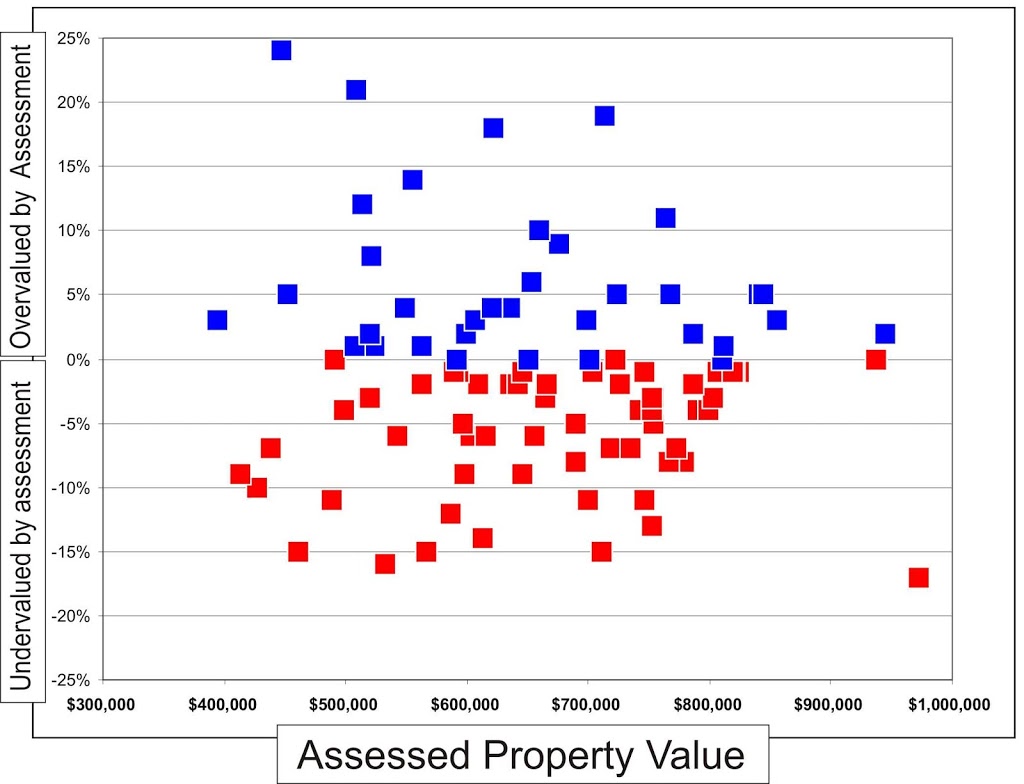
For the fun of it, I entered my address into the BC Assessment search engine, and asked for all local “sales” in the previous year. It returned the 100 nearest properties (all detached homes) that sold in 2012, ranging from $383,000 to $2,500,000 in sale price. I don’t know how “local” they were, but they were all in New Westminster. Then I compared their sale price to the assessed value. The results were interesting.

NOTE: First off, I tossed one property out of the dataset, as it was both the most expensive sale ($2,550,000) and it sold for a shocking 56% premium over its assessed value ($1,631,700). This was a large property in Ewan Ave in Queensborough, with its single home no doubt about to be torn down and replaced with row-houses or an apartment building. It was so anomalous, I needed to remove it to fit the graph below.

For the remaining 99 properties, I plotted the assessed value on the x axis, and the percentage difference between the sale price and the assessed value on the y axis, and the result is informative, if not interesting, in that there is basically no pattern:

If the assessment authority was systematically underestimating property value, the cluster would be predominantly below the 0% line; if it was overestimating, the cluster would be above the 0% line. In reality, the centre of that cluster is just below the line- the Assessment Authority undervalues all property near my house (relative to the resale market) by about 1.4%. (I’m assuming this has to do with my playing Tom Waits loudly all hours of the day and night). Overall, there are 62 properties undervalued, 36 overvalued, and one exactly valued. However, the majority of properties are assessed within 4% of their market value.

Note, there is not much “slope” to the cluster, the authority does not unfairly value expensive properties relative to inexpensive values in any significant way. The average assessed value of every property below the line is $685,000, and the average assessed value of those above the line is $665,000. So although it is not visible in the data, there is a slight(1.5%) shift of assessed value from expensive homes to less-expensive ones.

All that said:  if I was to characterize the cluster, I would call it high accuracy, low precision. There are more than 20% of properties that are off (plus or minus side) by more than 10%. That means a large number of people are paying $200 a year more – or less – than they “should”. However, you should rest assured that you are more likely (ever so slightly) to be paying less in taxes than your share according to the BC Assessment Office.

Bike Ride

I went for a bike ride the other day.

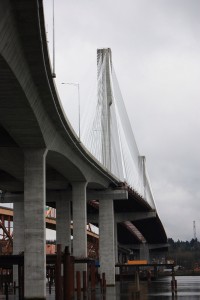
I go for bike rides lots of days, but what made this unique was I decided (against all experience and reason) to go for a bike ride in Coquitlam. Mostly, I wanted to check out progress of cycling connections around the new Port Mann Bridge.

Remember, bicycle and pedestrian access is a “a key goal of the PMH1 Project”, and the plan is to have a bike and pedestrian path crossing at Port Mann for the first time since… well, since anyone remembers. And with all the breathless excitement of the opening of the new bridge (tempered somewhat by the bridge’s sudden violent temper), the introduction of tolls, and New West suffering under the weight of the toll-free alternative, I thought I would pop over to Coquitlam and see what the new bike path looks like.

Except, of course, the new bike path isn’t done yet. And there is no mention anywhere on the PMH1, Gateway, or Ministry of Transportation websites suggesting when or if it will be done. I sent an e-mail to the Gateway people and got this in reply:

A key goal of the PMH1 Project is to improve cycling connections throughout Metro Vancouver, and when the project is complete, cyclists and pedestrians will be able to cross the Port Mann Bridge for the first time.
When the bridge opens in its final design, it will have 10 lanes and one multi-use path on the east side of the new bridge. The multi-use path will have a barrier-separated, three metre-wide cycling and pedestrian path. A portion of the existing bridge must be dismantled to complete the final two lanes on the south approach. Given this, the multi-use path will be complete when the final two lanes are opened. We are in the process of finalizing a schedule, but we anticipate this will occur by the end of 2013.

So cyclists and pedestrians will have to wait another year or so before they get to use the bridge, but it is still a “Key Goal”.

Until then, I can speculate about how useful the bike path will be, considering its connections on the Coquitlam side, and I can lament the abhorrent situation created by the construction of the bridge in the first place. Hence, my little bike ride.

Riding through New Westminster on the Central Valley Greenway is a relatively painless experience. The CVG is not perfect, but it is a pretty good second-generation bike route. Even with a few strange connections on the New West side, it is easy to follow, and at no time is it really unsafe. Trying to connect to Coquitlam, that is when you enter the danger zone.

Dropping down behind Hume Park on the bike path to the Braid Station, the Coquitlam-bound have two options: The Baily Bridge to United Boulevard, or the Brunette Overpass to Lougheed. The second isn’t really an option: it is a confusing jumble of lane-changing highway traffic with no shoulder and an uneven and intermittent sidewalks, leading you to nowhere but more killer intersections. Meanwhile drivers are jockyeying for the hole-shot of the on-ramp merging just before exit or the gap in traffic on Brunette to make the suicide turn off the off-ramp (both definitively not looking for cyclists). I’m an aggressively hyper-aware and experienced bicycle commuter (I worked as a bicycle courier in downtown Vancouver in the late 1980s!), I can move a bike through urban traffic like few people. The Brunette overpass area is too scary for me.

So that leaves us the Bailey Bridge to United Boulevard option. The bridge is ok, wait your turn in the line of traffic and occupy the entire lane so the irate guy behind you cannot pass. United past the Golf Course is currently pretty good, because it was built as a 4-lane but currently has two lanes, so lots of room. It was noted by cycling advocates during the UBE discussions that it is certainly not wide enough for four lanes and a reasonable bike path. TransLink’s inability to commit to widening United to make it a safe bike route was one reason regional cycling advocates lined up against the UBE, even with a bike path on the UBE being a “key goal”.

things get much worse once you get past the new King Edward Overpass (with its luxurious pedestrian and bicycle lanes). United Boulevard is narrow and curvy, just barely wide enough for its four driving lanes. No sidewalks, and certainly no shoulder. Add to this numerous poorly-marked driveway entrances and exits to the commercial and industrial sites and a completely disregarded speed limit, and this is one of the least safe roads for cycling in the region. Yet, there are no alternatives. There are no connecting roads at all to the south. Lougheed is a high-speed high-volume freeway with double-lane turnoffs. Brunette Ave through Maillairdville is only better than United in that there are enough traffic lights to slow traffic a bit. The simple message is that Coquitlam doesn’t want people riding bicycles.

The City of Coquitlam does produce a Bicycle Route map, you can see it here. It is pretty much what you expect, disconnected lines with a few routes, featuring more gaps than actual connections. So once the new bike route accross the Port Mann is built, where is it going to go? Who the hell would ever use it?

According to Gateway plans, it will connect to Lougheed Highway on the north side. This should, at long last, provide the people of Surrey the safe cycling access to Mackin Park they have so long awaited. Or perhaps, they can ride to the King Edward Overpass, and watch 10 lanes of cars vroom by below. Fun for the whole family.

What Coquitlam does have is those kind of bike paths preferred by people who don’t really ride bikes for their utility, but as an alternative to playing tennis or bocce. The short multi-use bike path through the park, where one can drive to and park easily, take the Canadian Tire bikes off the rack, spin around for a half an hour. A great example is the path connecting Maquabeak Park under the old Port Mann to Colony Farm Park (as you can see on the Coquitlam Cycling map). It is not really suited for cycling, is guaranteed to produce user conflict, and doesn’t really go anywhere.

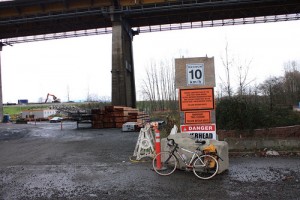
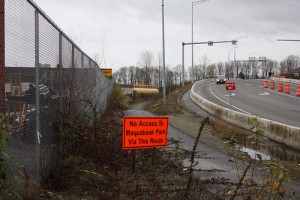
Even this sub-optimal trail has been wrecked by two years of Port Mann construction. With construction staging on top of the old trail, there are signs indicating some sort of detour:

But no actual map or diagram or even arrow to tell you where these detours are. I looked on the City of Coquitlam website, the Gateway one, the MOT and transLink sites after I got home, and I’ll be damned if I can find a map of the purported detour anywhere. so I cannot even blame my complete lack of preparedness for this adventure.

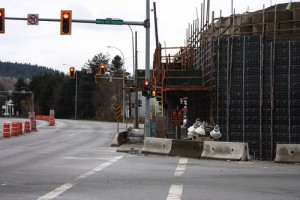
So it was back on United, still bereft of sidewalks or shoulders, but now enhanced by highway on-ramp and off -ramp traffic. Until I was greeted by this:

And this:

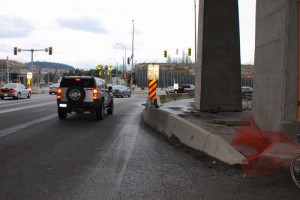
I had apparently found the detour. It went right by this spot:

At first, I assumed he sign in the middle was not meant to be ironic. then I thought about it some more, and realized that it was only through the lens of irony or pure David Lynch surrealism that any of the signs made any sense whatsoever.

So what’s the point? When it comes to bicycle access, Coquitlam is a disaster. Combine their incompetence/disinterest with the Ministry of Transportation/Gateway™ aggressive dislike for non-automobile users, and the result is a horror show of pissed away taxpayer money.

The $5 Billion Gateway™ program will, they triumphantly declare, provide “an estimated $50 million in pedestrian and cycling improvements.” Which is, apparently, “the largest single investment in cycling infrastructure in the region”. I would love to be excited about this “investment” in sustainable transportation that represents 1% of the budget, except for two things: It is a sham, and the results will be useless.

The MoT/Gateway™ plan for that $50 million can be read in this report (at least that is the most recent information we have). Aside from including a bike path on the new Port Mann Bridge that won’t connect to anything useful, (at maybe a marginal cost of a couple of million dollars?) it isn’t about building bicycle or pedestrian infrastructure at all. It is about “accommodating” bicycles and pedestrians on the expanded overpasses they have to build to span their shiny new megahighway. Essentially, replacing the current sidewalks and leaving enough shoulder room to paint a white line.

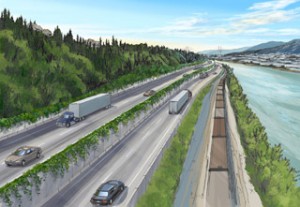
It actually gets worse on the South Fraser Perimeter Road, where the “cycling infrastructure” investment is going to be painted bike symbols on the hard shoulder of a limited-access 80km/h 4-lane truck route. Look at these pictures from the official SFPR website:

See that space between the semi truck going >80km/h and the concrete wall? That’s “bicycle infrastructure” in which they are investing your tax dollars. Looks like a fun place to take the kids for a spin, eh? Why not just call it what it is (pull-off space so stalled vehicles don’t slow the rush of progress traffic), and quit with this shell game accommodation-as-infrastructure bullshit.

If MoT / Gateway™ was really interested in improving cycling infrastructure, they would hand that $50 Million to TransLink or the municipalities to invest in real, useable bicycle infrastructure where it is needed and where it will be used.

In the meantime, I suggest everyone avoid taking bike rides to Coquitlam.

Annus horribilis

It is the time of year when the media take their annual look back at the year in review. As I am enjoying a short vacation (notably in a place a healthy distance south of New Westminster), I am less immersed in every day life and find myself looking back as well, but I’m afraid looking back doesn’t fill me with joy. Instead, I find myself thinking of 2012 as annus horribilis for the issue I am most concerned about: environmental sustainability.

Nationally, that began with Bill C-38. The least open and accountable government in Canadian History (and that is saying something coming out of the Chretien years) created a 425 page “Budget Bill” that featured a dozen pages on budget issues wrapped in a lengthy, complicated, and harmful disassembly of decades of environmental law.

How bad was it?

They ripped the bottom out of the Fisheries Act: the single strongest piece of environmental protection law the country had. This is (was) the law around which all other laws protecting the quality of Canada’s water were structured. The CCME Water Quality Guidelines, the Provincial Fish Protection Act, the Provincial Environmental Management Act, Municipal Riparian Areas Regulations, (and more) are all structured around the basic protections of water quality and habitat protection afforded by the Fisheries Act. The Harper Government(tm) ripped this fundamental law apart so suddenly and inexplicably that even the Government’s own scientists have yet to understand what the loss of habitat protection means. They left the professionals tasked with applying the laws completely in the dark about what the changes mean, while concurrently firing all of the Government staff who might provide the guidance. They did this just before the report from the Cohen Commission was released, knowing full well it was going to suggest that the Fisheries Act needed to strengthen, not weaken, fish protection.

That was bad enough, but they did the same thing (again completely without consulting the public, their own scientists, or the practicing professionals working with the regulations) with the Canadian Environmental Assessment Act (reducing by 90% the number of major projects requiring any environmental planning at all). They scuppered the law that made it illegal for them to break an international agreement (The Kyoto Protocol); they opened up the coincidently ice-free arctic to oil and gas drilling while giving the National Energy Board the only power of oversight over this monumental policy change and not actually asking any of the locals; they also gave the National Energy Board the power to deem which species qualify for protection under the Species at Risk Act; disbanded the National Roundtable on Environment and the Economy (because god forbid we have a rational discussion between environmental professionals and industry about developing business responsibly); specifically exempted pipelines from the Navigable Waters Protections Act; along with several other goodies.

All this under the guise of a “Budget”, and all without any public discussion. One might argue the Act went to committee and there was discussion in Parliament before it was passed, and that constitutes “discussion”. However, not a single amendment was made to the original bill as written – 425 pages modifying a dozen other pieces of legislation that fundamentally changed how the environment is protected across the nation, and it was apparently perfect on the first draft, at least according to the Harper Government(tm).

Then, after all the negative press (even the National Post, the Conservative house paper, called the Omnibus Bill “Illegitimate” and spoke of “fundamental issues of Parliamentary government”), after the outcry from the opposition, former Parliamentarians from both sides of the aisle, and the public, the Harper Government(tm) doubled down with Bill C-45, which further reduced protection of lakes and rivers in Canada, causing the government to shirk it’s constitutionally-mandated responsibility (in other words, Provinces cannot even legallly step in an provide the protection the Feds have stripped).

Aside from Omnibus nuke-the-environment bills, the Federal government has also made some dubious decisions regarding our nation’s ability to protectant exploit its non-renewable resources. They continue to float the idea of signing a free trade agreement with China which doesn’t specifically permit Chinese-owned companies to operate in Canada without following Canadian environmental laws, but it may allow them to sue the Canadian Taxpayers for lost profit caused by following those laws. The race to the bottom has never been so clear.

I’m not as concerned as some about the Nexen takeover by CNOOC, but when you combine that takeover with the increasing interest in Canadian hydrocarbons from state-owned oil companies from Japan to Korea to Malaysia, one has to wonder if Canada is the only nation that is specifically exempt from owning Canadian Oil and Gas. Yes, I am going there: It is time for National Energy Program 2. If all of our customer countries are doing it on our own soil, it is getting tough to argue it will make us uncompetitive…

However, the Harper Government(tm) doesn’t want to openly discuss these important issues any more than they want to discuss changes in the Fisheries Act.

“In spite of all the very important deals and the billions of dollars of contracts we signed this week, more people in Canada will notice the pandas than anything else.” Stephen Harper to Bo Xilai during a trip to China.

The 2012 story was not much better locally in New Westminster.

The opening of the replacement Port Mann Bridge produced the centre-piece for the $5 Billion subsidy to unsustainable urban planning that is the Gateway Program. Assuring that car-oriented development, traffic quagmires, air pollution, and erosion of livability will continue South of the Fraser of another generation. The minor damage done to a couple of dozen cars by falling ice is an irrelevant distraction compared to the long-term damage that bridge will do to our City.

Especially when put into the context of the ongoing standoff over TransLink funding, where our idiotic-looking Provincial Government is battling the moronic-acting Mayors’ Council over 0.6% of that amount of money to keep our Regional Transit System operating at it’s current level of service. The idea of growing the Transit System to meet the needs of the growing community, and the growing number of people actually using the already inadequate system, is apparently off the table for now. Instead of addressing this issue, the Mayors of our biggest communities bitch and grumble over which rapid transit line should be built next, while ignoring the fact that the one promised to the Northeast Sector almost 20 years ago has still not been built! We can build three freeways at the same time in BC, but ask the same people to build two transit lines at the same time, and that is apparently beyond our engineering capacity.

Meanwhile, the Left Coast of Canada is quickly becoming the new Persian Gulf, as the only industry our Governments deem worthy of investment is the putting of hydrocarbons (be they coal, bitumen, or methane) onto boats to ply the stormy seas of volatile international energy markets. Considering what our planned contributions to Greenhouse Gas Emissions are from these projects alone, I hope they’re building those ports well up the hill from today’s tidewater.

Cazart.

Despite all of this, there was some good news. Despite the Harper Government(tm) attempts to derail all environmental oversight, the push-back over the Enbridge Northern Gateway and Kinder Morgan Pipelines are aligning disparate citizens’ groups toward a common cause: assuring their is environmental oversight and public discussion of major projects, even if the Government doesn’t want it. As a result, the ongoing coordinated media blitz between the Oil and Gas Industry, the Provincial and Federal Governments, is being seen for what it is: a cheap sales job paid for by taxpayers to sell them an idea that might be a bad one for them (even if it is a good one for the oil companies eking the last bit of profit out of their 20th Century business models).

These projects, and the failure of the Federal Government in its constitutional responsibilities, are leading to what may turn out to be the most important national political action by First Nations since Elijah Harper held a feather up to Meech Lake. The epicentre may be Attawapiskat, but the real battle will be in Ottawa and Kitimat, and it refreshes me to know that the one group in Canada that has so consistently been marginalized by official proclamation will be Idle No More.

Locally, things are also looking up. TransLink’s rush to expand the Pattullo Bridge has slowed down as they seek more consultation from New Westminster and Surrey, and they re-assess their budget and the alleged need for more bridge capacity connecting King George to McBride. Meanwhile, New Westminster’s Master Transportation Plan consultations showed the people in New Westminster want the City to set aggressive goals towards reducing traffic load on our City, and with EnVision2032, City Hall is taking steps to integrate Sustainability into all future City planning and activities.

however, if There was one dominant “Good News” story for the Environment in this annus horribilis, it was the emergence of Elizabeth May, Parliamentarian. Every day she was in the House (and she was there every day it sat), she demonstrated what a Member in a parliamentary representative democracy should be. She proved that a lone member from a fringe party can represent, and that perhaps it is time for us to stop relying on the “established” parties to represent us, when they really only represent their party, when instead we should be choosing the individual who will fight the good fight in the House.

You should read the speech excerpted in that link above. It is a compelling plea for democracy and the traditions of parliament that once made Canada a model for the world, a place where rule of law, honest discussion and diplomacy was the way to solve problems. Where people didn’t need to fight for our freedoms, but negotiated them like civilized people. People often forget our nation confederated over a table, we didn’t fight a bloody revolution. We did all of our fighting for freedoms in other countries, like France and the Netherlands and Korea and Cyprus and Bosnia, hoping that others would enjoy the freedoms we won through peaceful negotiation. Here at home, compromise and understanding were not evils to be avoided, but were the way we got things done. And I’m proud of the country that approach built…

…but I may be getting ahead of myself a bit here. We lost some things in 2012, I’m not sure if we will know their impact for years to come, but Canada is still here, and BC is still here, and New Westminster is still here, and they are still the best places to live (in my sometimes-humble opinion).

So for the environment, 2012 was annus horribilis. As a proud Canadian, that only renews my energy and drive to do better in 2013.

Happy New Year.

Smoke on the Plaza

You know what’s gross? Smoking.

This will shock many of my readers (but not one: hi Mom!) who think “NWimby” and “Clean Living” are synonymous, but I was once a smoker, Off and on for most of my teenage years and early 20s. I started in High School, the same as my siblings and my parents. Strangely, I would quit during the summer to bike race, start again in the winter. I did this pretty much until I met a girl who meant more to me than the MacDonald Lassie; a few years after high school.

I was lucky, in that I just don’t have addictive tendencies. It was just as easy for me to quit cold turkey as it was to pick up a pack of smokes and start again. Once I got old enough and smart enough to think about it, smoking was a bad idea- socially, economically, health-wise. I just stopped, and it was easy for me to do. I was lucky.

So, like many former smokers, I am a bit of a militant anti-smoker. The stuff isn’t good for you, and it really stinks up any environment where it is introduced. Funny how I used to sit in a car and smoke, now I am offended if the guy in front of me in traffic smokes and I have to smell that distant scent from the little bit that works its way to my car’s vents. I’m like a bloodhound for the stuff.

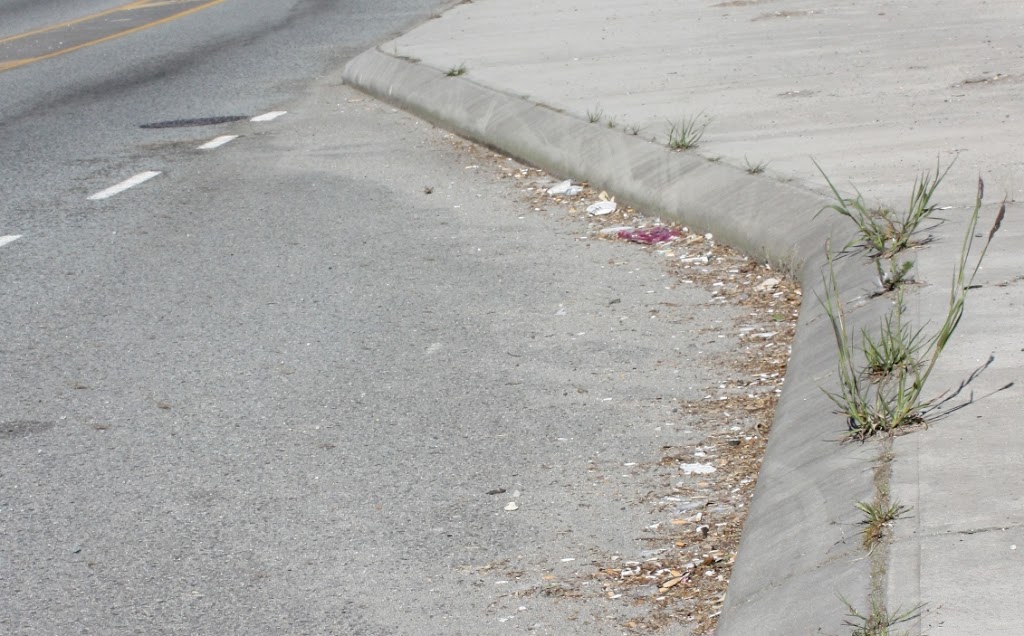
Then there’s the trash. We are, in British Columbia, in 2012, pretty much a post-litter society. Someone opening up a candy wrapper and tossing it on the ground is a rare enough event that it would turn heads and elicit comment from adjacent people. We don’t throw our used fast food containers out the window of our car. But it is still normal to see someone take that last, satisfying puff of a cancer stick, and flick it to the ground on the sidewalk, or toss it from the car window, like it is someone else’s problem to clean up.

The Shoreline Cleanups count cigarette butts as the single most common piece of litter, by far. There were no less than three fires last summer along Stewardson Way related to discarded butts, and all you need to do is look in any storm drain or along any poorly maintained roadside, and you will see that 90% of the gunk accumulating along the curb is cigarette filters.Gross.

Stricken from restaurants and bars, from pubic buildings and most homes, smokers are stuck on the street, smoking outside doorways (but not within 3 m!). I can only think of two bars in New West that still have a place where you can sit (outside), have a beer and a smoke. And I sit inside whenever I am at either of them. But you can’t escape the smell. There has been much Twitter space complaining about the smokers in the underground bus mall at Plaza88 The Shops at New Westminster Station (I have seen the bus loop referred to as the most expensive and dankest smoking lounge in the City).

And then there is the gauntlet of smokers you need to run to get into the London Drugs in Uptown New West.

There was a recent letter to the editor of the Record suggesting BC is the only province that still allows the sale of cigarettes in Pharmacies, and this should change. The thinking is that Pharmacies are “health care businesses”, and the sales of cigarettes are a violation of whatever the Pharmacy version of the Hippocratic Oath is.

Even the Premier was asked about this by The Tyee in a recent interview. And I have to give Premier McSparklestm credit: she makes a good point regarding the role of Pharmacies as some special type of retailer in the world of the London Drugs Electronics section and Walmart prescription counters.

That said, I would argue the exact opposite of the letter writer. I am starting to think Pharmacies are the only place that should sell cigarettes. The entire purpose of the Pharmacist is to distribute potentially-harmful drugs in a regulated way to prevent their misapplication, misuse or abuse. I offer the opinion that cigarettes are little more than harmful drug delivery systems. Nicotine is a powerful, addictive neurotoxin. For the vast majority, smoking is not a habit, it is a chemical addiction, little different than alcoholism or heroin. Perhaps we can start treating it like an addiction.

The BCLiberals, again to their credit, have made a few positive steps in this direction: the Province supports smoking cessation programs as part of its health plan, which is a pretty progressive position to take. This seems a rational approach to health-care policy, which I suspect has a strong business case behind it (lung cancer and emphysema are really expensive to manage, and cost the health care system a lot of money).

The next logical step may be to start selling cigarettes over the counter like other lethal drugs. No prescription needed, but only sold to adults, up to a carton at a time, and every package includes smoking cessation information and important information about use and contra-indications, just like any dangerous and addictive drug. It is part of moving smoking further from the mainstream, and more like the fringe activity it really has become.

In the meantime, back to London Drugs in Uptown; the one you cannot currently get into without second-hand smoking a Dunhill or two. I was at an open house a couple of weeks ago put on the Uptown Property Group. They were showing plans to re-invent that plaza space at 555 Sixth Street. Apparently, the owners of the complex recognize the loitering smoker problem there, the impact on their customers, and have not been able to fix it.

They have put up No Smoking signs (ignored), have their own security guys go out there regularly (similarly ignored). As this a problem impacting is both private and public property, they have found no relief from Bylaw Officers or the Police (unfortunately, Provincial smoking laws are enforced by the Health Department- when’s the last time you met a Health Department cop?) It seems an unmanageable situation.

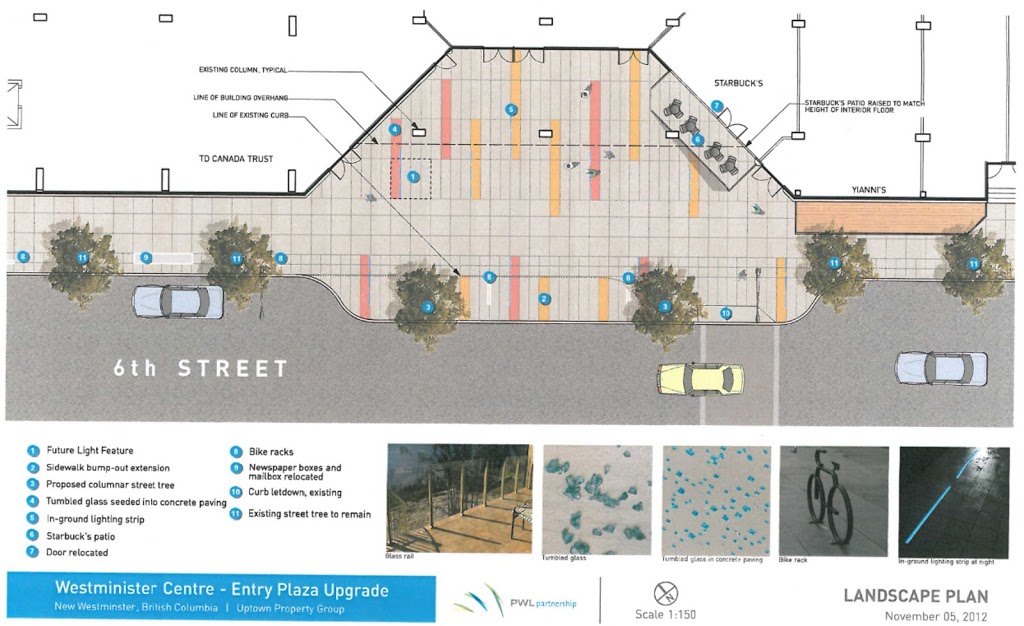
So UPG decided to apply some CPTED principles, and do a re-design of the plaza. Looking over the drawings included with the Report to Council (the same drawings were shown at the Open House), the plan is to remove the planters and seating under cover in front of the entrance of London Drugs, and retain seating only on the patio in front of Starbucks – and that only accessible from within the Starbucks (making the non-smoking rule much more likely to be respected). Besides opening up the court yard, they wanted to expand the surface out towards the street and add some feature lighting, a couple of trees, and tile designs in order to make it a nice open space.

The Plan from the Council Report (click to zoom)

I thought of comparisons to Plaza88 The Shops at New Westminster Station. The proposed patio is like the new north entrance to Plaza88 TS@NWS between the Tim Horton’s and the Old Spaghetti Factory. I can only hope the newly-fenced-in Starbucks seating will not look like the Plaza88 TS@NWS Safeway Starbucks, which is currently the best-defended deck space in the City. Plans for the opened-up space include introduction of public art, with the bonus that it would provide another stage space for Uptown Live and the Hyack Parade. It would be a half-covered, open, well-lit, modern and inviting space for humans, without being the unofficial smoking zone it is now.

I was surprised to hear Council discussing this at Committee in the Whole last week, and watching the video of the exchange, the surprise began to turn to dismay when it was clear how negative the reaction was from Council (why weren’t UPG there to defend their reasoning?). You can see the video here, by choosing the December 10 Committee of the Whole meeting. The conversation on this topic starts at 1:00:50.

I want to make a couple of points based on that discussion:

• Parking spots? We are worried about 3 parking spots? Look at the picture on Page 2 of the report to Council I linked to above – does that look like a spot where the loss of three (3) parking spots is going to hurt business? There are a thousand parking spots insdie and out within a block. Not ot mention it is, after all, the most prominent business looking to remove them;

• The topic of the length of the bus stop across the street is not relevant to the discussion. Whether this project happens or not has no effect on the bus stops across the street;

• Opening up and modernizing a public plaza is not an assault on the poor. People “having a cup of coffee smoking a cigarette, whatever they are doing” is NOT  “entirely appropriate” when they are sitting in front a no smoking sign two metres from the entrance to a business. It is illegal, and does not make the space more livable;

• Assuming that the City’s “progressive laws” will fix the problems at the site ignores that those same laws have not yet solved the issues at the site, nor are they solving the problem at the Plaza88 bus loop or other places where smokers are impacting people. If panhandling is an issue here, if smokers ignore the signs, the business requests to butt out, then how does that square with the need for our “aging population” to feel safe?

• This is not public space being turned over to a private owner, and it clearly is NOT a “private benefit” by any reasonable definition. We are talking about converting space dedicated to public parking into space dedicated to public walking and standing… how does that make it a private benefit? Is every parking space, bicycle rack, bus stop in front of a business a private benefit?

• There is no “pedestrian safety” concern at the crosswalk at the location. If cars are sometimes forced to wait for people to cross the street, sometimes for tens of seconds, that is not a “safety issue”. To me, it is effective use of pedestrian space, and one of the safest crosswalks in the City. The only safety issue is the parking spot across the street that is clearly a violation of section 400.13 of the City’s Street Traffic Bylaw 6027 (go ahead, look it up!)

As usual, I offer my usual caveat that I am working from public info and a short conversation with UPG coming out of the Open House, and maybe there is stuff going on here behind the scenes of which I am not aware, but I take what people say at face value. I was initially hoping that UPG would come to Council and provide a little more guidance towards their thinking here, and how these changes will address a real problem, while adding a public asset. However, talk around the knitting circle suggests the plans have been withdrawn due to resistance from Council. It seems to be there is a lost opportunity here. UPG may do some similar improvements on their own property (the City may bit be able to stop them), but any plans to make the 500 Block of 6th Street a more open, public, friendly and open space, without the need for non-smokers to hold their breath through it.

Alas, before they take the smokes out of the Pharmacy, they can find a way to get the Pharmacy out from behind a wall of smoke, and that’s really all I want.

The Language of Curling

Just for the fun of it, I am totally going to geek out on curling, because we had a great game at the Royal City club on Tuesday, and I can. None of this is going to make any sense to my friends that don’t curl, but part of what I love about the game is the language – because everything below makes perfect sense to anyone who has spent any time in a curling rink. The Roarin’ Game has its own Language.

1st end: We lost the flip, as per usual, but Byron put his first rock 6’ short on the line, and buried his second on the top of the 4, and we were set up. Then we let the end get away from us after they made a nice corner freeze on the counter and we failed to stick the freeze on the other side. They peeled to open it up, And it turned into a peel game. However, his last overturned to the nose and stuck around, forcing the point.

2nd end: He put his first draw top 12, and the hit game commenced. It was real Ryan vs. Lukowich time, trading rolls, making most. Ice was pretty straight for the outside-in game with hit weight, but turned an easy 3 feet off the line with anything around control weight: all predictable. He rolled his last shot out, and we decided to draw and take one instead of the strategic blank (it was an even end, and I needed to practice my draw after playing in Seattle all weekend).

3rd end: We put up a corner guard, then they put one up on centre, so we went behind the corner. They drew in the middle and we followed, but their down-weight hit and flop worked. With things building up behind the guard but in front of the T, we needed to switch up and open things. Our semi-peel perfectly caught one of the counters. After a few traded hits, we ended up sitting two and he was forced to take one facing two of ours.

4th end: With the hammer, we decided to plug it up a bit to see if we could get some action, and I think he had the same idea. When one of his guards came up heavy and almost froze his counter in the top of the 4, he was all of the sudden sitting 1st and 2nd in the 4, us sitting 3rd at the back of the 4, and him 4th at the back of the 12 (we had flob way over in the wings). Ward threw a great across-the face peel on the two counters- he needed to get across the face with pretty big weight to keep the drag from jamming on our 3rd rock, and he dragged it perfectly to pick out their third rock and preserve the shooter- a beauty triple, and all of the sudden we are sitting 3 with skips rocks to come. He hits and rolls, I hit and roll, his hit and roll ends up not frozen to our counter at the back of the 12, but overlapping enough that I need a delicate angle to pick him and stick for three. Even the jam miss still scores two. What doesn’t score three or two is me coming out inside and light, curling across the face, and jamming him into our back rock. We take one. Half way done, we are all tied up.

5th end: Rolls were definitely going our way here. They decided to push the matter and score this end, but we were making our draws. At some point he needed to clear off some front rocks to give himself a route in. By the time I threw my last, we had one just biting the top of the 4 half covered, and a couple of other counters in front of the T. The 4 foot was covered on the in turn side, all I had to do was jam up the port on the outturn side and he was going to have a hard time cutting us to 1. Being a greedy guy, I figured: put it in the 8 foot for a second counter, and he would have a hard time keeping us to 2. Of course, I was about a foot long in my guard, so the nose hit cut us to 1, and he made it. Still, it was a steal, which at this point is the first skin of the game.

6th end: Our first rock slid into the house, and they hit it, so off we go to the hit game again. We traded misses at one point, and we traded picks at one point (oh, oh- pebble is starting to go away) but it was a basic split-house draw and chase where I was never able to get the roll I needed to close the gap. They had an opportunity to hit and stick for two, but overturned on (previously) straight piece of ice, and couldn’t save the shooter. Another single, and tied again.

7th end: this is where the wheels fell off of our bus. Like the 5th where we were getting the draws and rolls, here in the 5th they got the rolls and skinny come-arounds, we got the racks and the wrecks. At one point we were looking at 4 of their rocks in the house, and none of ours. We managed to keep the guards off and had a control-weight nose hit on the counter to score single and get out of the end. Thank you Mr. Hammer.

8th end: We are one up without coming home, they of course are one down with. We need to steal, they need multiples, so the guards go up early. Ice is getting straighter as the pebble goes away, so the come-arounds aren’t burying. We managed to get Ward’s last rock biting the top corner of the button and ¾ buried, and their attempt to extract it with hack or backline just hung too long, actually pushing us over a foot- dead buried covering the pin. We had a counter at the side, so they need to remove it and stick around. They had two fairly long angle run-backs, I had to throw two guards. My guard of the outturn draw (which was probably just there) picked or overturned, and didn’t do much to make his life any more difficult. He threw the inturn run-back and missed wide, but taking off the guard, giving himself a route in to the button. My attempt to guard that port failed to turn enough to close the port, and he drew through it perfect, just pushing us off the button without a roll. Tied up.

Tie break is a turkey shoot: one rock each, closest to the button. Having just thrown the button draw, he did it again, stopping full 4. Having just missed two guards, I threw too deep, back 8, and we shook hands. We had three chances to take control of the game: my last shots in the 4th, 5th, and 8th. Those seem to overshadow his missed deuce in 6th or my game-saving hit and stick in 7th.

Thankless life of the skip.