Active Transportation

I know I haven’t blogged about this week’s Council meeting yet, I haven’t had time to edit and get the post up. It’s coming, I swear. In the meantime, I want to get this out, because it has been in my outbox for a little while and it has suddenly become time sensitive.

The Provincial Government is asking the public about active transportation. I have been known to criticize the Ministry of Transportation in the past about their approach to “cycling infrastructure”, but I am going to hope that this is the start of a new approach. You have until Monday to answer their questions!

If you are too busy to write your own thing, you can go to HUB and fill in their form letter, but as an elected person, I like to receive input that brings something new – a 1000-person petition is not as powerful as 100 personal letters that each bring different nuance. So I encourage you to take a few minutes and fill in the answers yourself. If you want some inspiration, here are my answers I will submit this weekend:

Question 1: What does active transportation mean to you and how does it fit into your life?
Active transportation means healthier, safer, happier communities where youth are safe to ride a bike to school and the elderly are comfortable walking to the grocery store. It is about replacing fossil fuel dependence with transportation independence. When we build the infrastructure to support active transportation, we give more people the freedom of choice in how they move around their community, reduce their reliance on volatile international oil markets, keep more of their money in the local economy, build resiliency in our communities and connections between neighbors.

Question 2: What are some of the challenges in your every day life that prevent you from moving towards using active transportation modes? What are some of your concerns about active transportation?
As an active transportation user, and a local government decision maker, the biggest challenge I face is addressing the “gaps” in our systems that make active transportation less safe and less comfortable. I am lucky to live in a compact, dense community where most services are a short walk or bike ride away, but so many of my neighbours still feel it is unsafe to make the journey unless surrounded by two tonnes of steel, which in turn reduces the perceived safety for other community members.

Too much of our active transportation infrastructure is developed as baubles attached to the side of new automobile infrastructure. Sidewalks, crosswalks, overpasses, cycling lanes, and transit supports are evaluated in how they support or hinder adequate “Levels of Service” for automobiles, while the high LOS goals (fast, uninterrupted vehicle travel) acts to make active transportation space less safe and less comfortable. An overpass over a busy road is seen as a pedestrian amenity, when it actually serves to provide more space for automobiles to have unrestricted travel. The trade-off is usually a longer more difficult journey for a pedestrian and introduction of a new barrier for people with mobility challenges. We need to see active transportation alternatives as a solution to community livability, not as a hindrance to the flow of traffic.

Even the language of “transportation” vs. “active transportation” reinforces the idea that using your feet and your own body to move around is somehow lesser than – a secondary consideration to – using an automobile. I have to explain to people that I use transit to get to work, I use a bike to run errands, I walk to City Hall, like that is some sort of radical action instead of a rational and normal way for a person to live in on a modern urban city. Let’s switch that default, for the good of our communities, the good of our budgets, and the good of our planet.

Question 3: What is the most important action that government could take to promote active transportation? What is unique in your community or region that needs to be considered?
Of course, funding. Local governments are straining to provide services as our infrastructure ages. We receive 8% of the tax revenue in Canada, yet own more than 50% of the infrastructure. This inequity is sharpest when it comes to transportation infrastructure. Billions flow for highways and bridges that direct automobiles into our communities (with, admittedly, the requisite active transportation baubles attached), but the local improvements to help us move around within our communities are tied to expectations about “Level of Service” for those automobiles. The cycle is vicious.

My community has one of the highest active transportation mode shares in the province. New Westminster is a transit city, it is an easy city to walk in and the revolution in electric assist bicycles means that residents no longer need to be athletes to manage our hills. We have some of the lowest car ownership rates in Canada. This is not an accident, the City has a dense urban fabric that puts most services near where people live, we are concentrating our growth around these transit hubs and working to make our pedestrian spaces safer and fully accessible. Yet we are choked by through-traffic that makes all of our active transportation spaces less safe and comfortable. This load means we need to spend millions of dollars every year in maintaining our asphalt to provide the level of service through-traffic expects, while struggling to find the thousands of dollars to build better cycling, pedestrian, and transit-supporting infrastructure.

We need help making our transportation system work better for our community, but as long as that transportation funding is tied to our ability to get cars moving, to provide high automobile “levels of service”, we are putting out fires with gasoline.

ASK PAT: Staff and audits

Bruce asks—

Hi Patrick. Do you have a comparison of staffing levels by municipality as a percent of population / households / tax base in the lower mainland. If so, where does NW fare?

Has consideration ever been given to staff reductions?

Are you in favor of auditor general audits of all municipalities and efficiency comparisons?

This is an interesting collection of questions, and they seem to be leading somewhere, but I’ll take them all at face value and answer best I can.

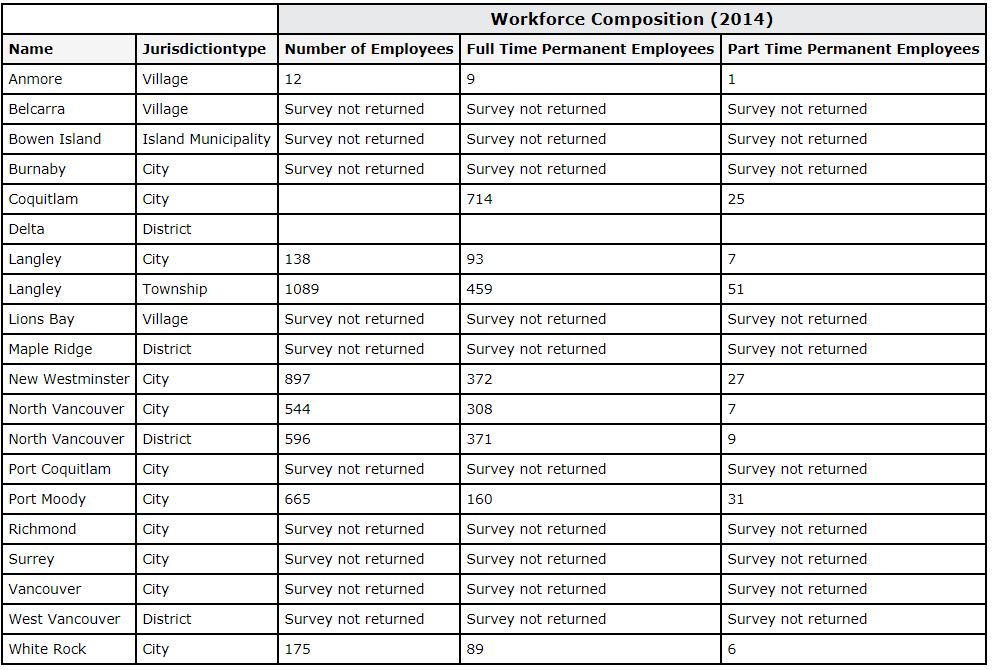
Short answer to your first question is no. I have tried a few times to do a comparison across Lower Mainland communities on staffing levels, but the data is hard to come by, and it is especially hard to compare apples to apples on the topic of municipal staffing. Even if we put aside confounding factors (the type of police service a City runs, different services provided like New Westminster’s electrical utility or White Rock having their own water supply, and situations like the North Vancouver’s sharing of a Recreation Commission), there is no definitive source of data to determine what any City’s “FTE” (“full time equivalent”) staff counts is, other than our own. This is just not one of those things publicly accounted for in any standardized way. Even CivicInfo, your usual one-stop shop for municipal stats, had poor response rates last time they tried to survey local governments on their staffing levels. (note –New Westminster is one of the few Lower Mainland communities that responded):

I may ask what you would expect staffing numbers to tell you that isn’t already accounted for in budgetary comparisons between Cities? New Westminster spends less per capita on municipal operations than the average across the region, and our wages are (slightly) below average compared to our cohort communities, so it would be hard to imagine that we have comparatively higher staffing levels. The bulk of our operational costs are staff wages and benefits, because the bulk of our operations are customer service. Police, fire, recreation, parks maintenance, planning, etc., these things are all functions provided by people. If we allege (as some do) than a City with lower staff levels is more “efficient” or more prudent with taxpayer’s dollars, then we have to account for the work being done my contractors working for the City. As a general rule, smaller municipalities have to rely on more contractors than larger cities, and may or may not pay more for the services those contractors provide than they would if that work could be brought “in house”.

Should you hire a new Engineer at $90,000 per year, or contract that work out at $120 /hour? Back-of-the-envelope would suggest you do the latter if you have less than ~1,000 hours of work for that engineer in any given year, but the back of the envelope is always devoid of confounding factors. Obviously, larger municipalities have a bit of an advantage here, because more specialized work can be brought in house easier as there is higher demand for it. There also some significant political considerations around contracting out work, that will lead us down another path that ends with me ranting about neo-liberalism, and no-one wants to read that.

To answer your second question, there has never in my time been a concerted effort to cut staff. Part of that is related to the fact we are a growing City facing increased service needs, but part of it is because the question belies the way decision making in a municipal government works. Every year we go through a budgeting processes that that is centered on service delivery. We make decisions around what services we want to provide, where we can provide service more efficiently, and where we are falling short of community expectations. We are almost always under tremendous pressure from the community to increase delivery of programs, and we have to rationalize that within the budget available to us – and our willingness to increase taxes.

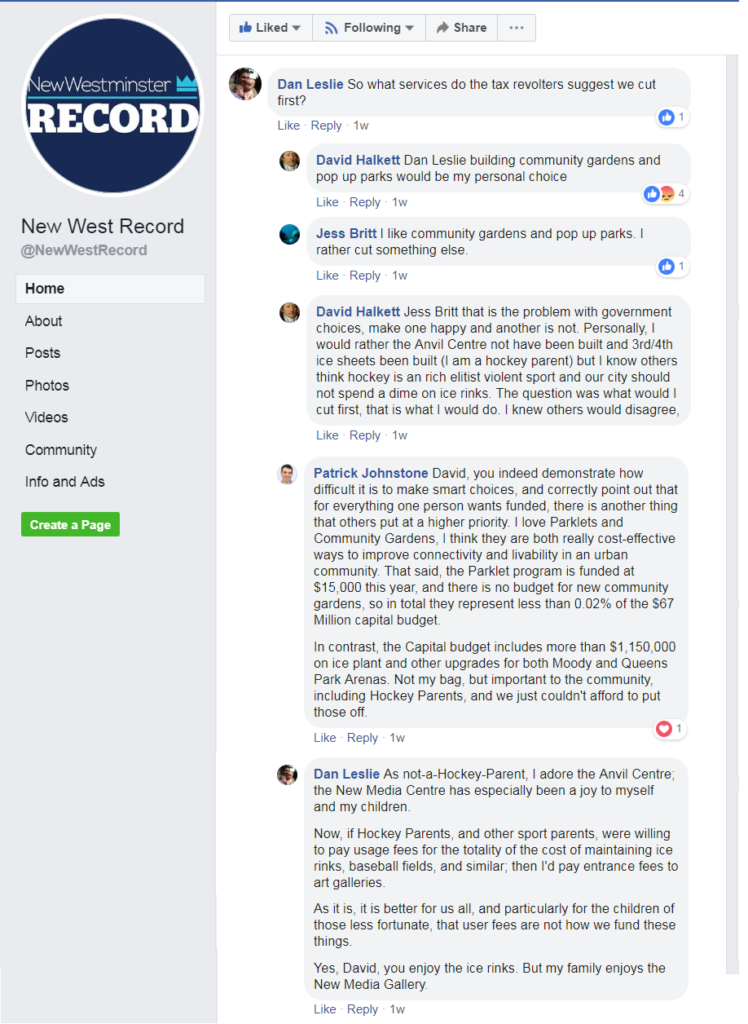
Of course we hear from people telling us tax increases are burdensome, but those people rarely tell us what services to cut. If they do offer suggestions, they usually are minor in comparison to the City’s budget, and others almost immediately come to defend that program. A recent Facebook example:

Finally, I am generally in favour of the process that the Auditor General for Local Government goes through, which I think puts me at odds with the majority of local government elected officials. But I’ll throw some significant qualifiers in there, because that is always what the AGLG does ;-).

One problem I have is how the audits are treated in the media and public. The City of New Westminster was selected for an audit a few years ago to review the management of our police budget and the relationship between Council and the Police Board. The result of the Audit was very positive, with a few minor improvements suggested, but overall a high level of confidence expressed about how New West does this work. Of course, it was good news, so there was virtually no media about it – no “news” to be found in a government doing a good job. Compare this to the shit-storm that a small municipality like Sechelt faces when an audit discovers some problems in how they do procurement. The negative audit is newsworthy, the positive audit is not, which results in an overall erosion in trust of local government, instead of building trust in the oversight of Local Government, which to be should be the goal of the AGLG.

Also, the AGLG audit process is (IMHO) stacked against smaller governments. At the first level, it expects small cities with small staff to have resources and business acumen that is often not available to them. The audit process itself is time and resource consuming, and the AGLG does not provide financial support to local governments for the staff time and resources – again much more unfairly burdening smaller governments than larger ones who are more likely to be able to absorb these costs.

So I general approve of the idea, but would like to see some shifts in how the process is put into practice.

ASK PAT: Parking Bylaws

Susan asks—

According to New West’s by-law for the parking of vehicles 4.9.1 – any New West resident can park their vehicle(s) on any residential street (except areas requiring permits, or metered parking) for as long as they wish as long as their vehicle has valid insurance.
In Burnaby & Vancouver, the by-law is more specific and requires that any vehicle cannot park for more than 3 hours in front of a residence unless the residence is the actual property of the parker.
If another New West resident decides to leave their vehicle parked in front of another residence and does not move it for week/months, there is nothing Parking Enforcement can do.
What is the process in requesting a change to this bylaw?

You basically have it right. Our Street and Traffic Bylaw makes it illegal to park a car for more than 72 hours where there are no other parking restrictions, unless you are a resident of the City. As long as your vehicle is not derelict, is insured, and is not a commercial vehicle heavier than 5,500kg, the road is yours to store your vehicle for free as long as you can find a spot.

I have vague memories of the last time we upgraded the Streets and Traffic Bylaw, and at the time staff recommended that the 72-hour restriction be applied to everyone. Checking my notes, it was in the March 23, 2015 Committee of the Whole meeting where some members of Council argued that this was unfair, and that residents should be able to park for free for as long as they want. I disagreed at the time, and continue to disagree.

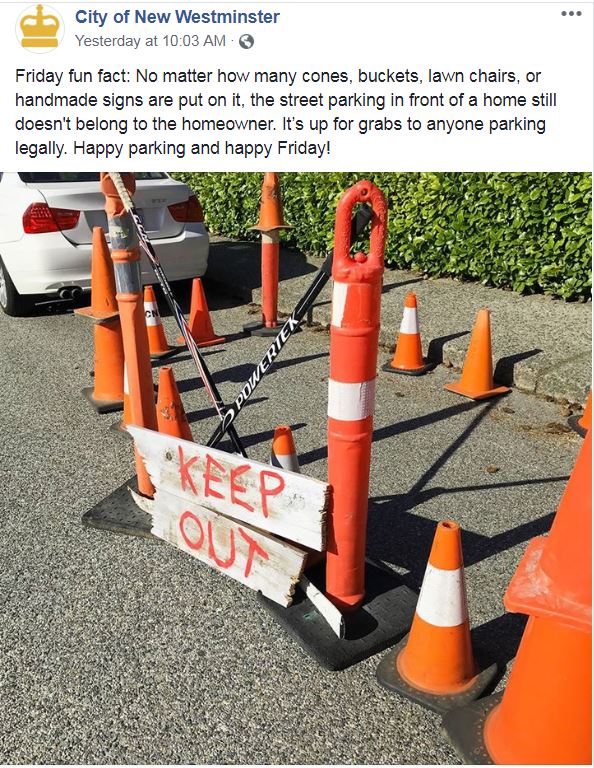
That said, I doubly disagree with the Burnaby approach, where the public land in front of your house somehow belongs to the resident of the house that happens to be in front of it. That land does not belong to you, it belongs to the public. Putting up barriers, cones, milk crates, or buckets to protect it as a personal parking space like this is similarly against the law.

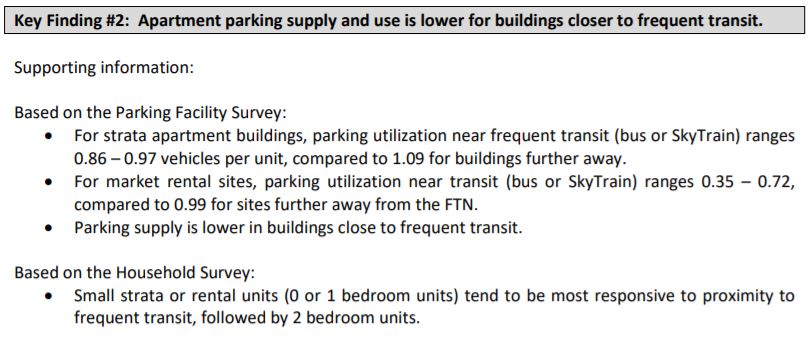
Here is an unpopular opinion: there is no shortage of parking in New Westminster. There are local shortages of the free or very low-cost public parking that people prefer, but every house in New Westminster has a garage or parking pad (regardless of whether they are actually used for car storage) and every new multi-family building is built with more parking than the residents use. And outside of a few special events and around churches on Sunday Morning, there is generally no lack of street parking. When it comes to resident parking and nw buildings, we are simply building too much.

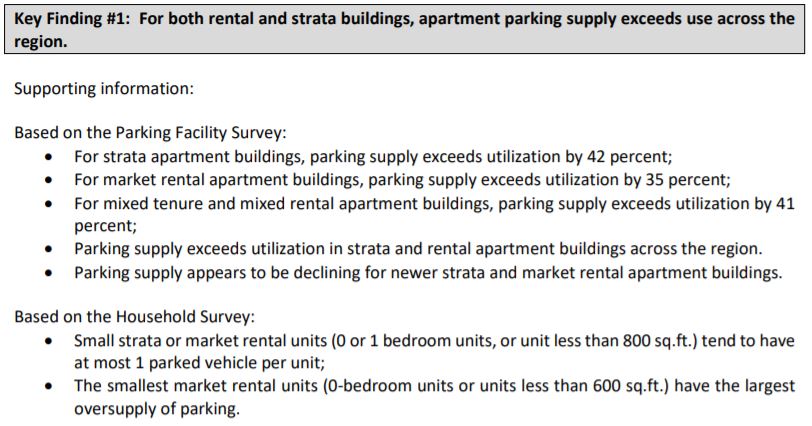
There was even a recent Metro Vancouver study on parking availability whose highlight point was that across the region “Apartment parking supply remains excessive relative to observed utilization”. Here are the first two key findings:

As mentioned in an opinion in The Record a few weeks ago, there is a real cost to this. Underground parking is expensive to build ($50,000+ per spot) and an alleged lack of parking is a common reason residents oppose new housing in their neighbourhoods, making housing more expensive for all. But I now I realize I’m drifting pretty far from the nature of your question…

The process to change the Bylaw would be to ask Council to do it. Ask Pats, as fun as they are, do not represent official correspondence with Mayor and Council, so you could write a letter to Council (here are the links about how you do that). Try to keep it relatively short and respectful, and explain the rationale for why you think the Bylaw should change. Any member of Council could take the concern to Council and ask staff to follow up, though there is no guarantee. Alternately, you can come to Council yourself and make your case as a Public Delegation at most Council Meetings, and again, Council may or may not act, but it can’t hurt to ask.

Ask Pat: Private School taxes

Duke asked—

The two large private schools on opposite ends of the city are nearing completion. My question is will the City be receiving any property taxes from these schools? It’s my understanding the BC Libs exempted them from certain taxes.

Short version: no, they likely won’t pay property tax. But as always, there is a longer answer. And this needs a bit of a “this is how I understand things, and I think I am correct here, but am willing to hear any corrections if people have them and I will fix the record” warning.

There are two types of exemptions from paying property taxes: statutory and permissive. As you may have figured from the name, the first is set in provincial regulation, Section 220 of the Community Charter outlines uses that may be exempt from property tax: Provincial property, places of worship, cemeteries, fruit trees(!), private schools and other things. The general interpretation of this act is that the statutory exemption only applies to the building or ground used for the prescribed purpose, not necessarily the entire property.  So a church that has a large parking lot and/or adjacent housing on the same property may not get statutory exemption for those auxiliary lands, but just for the place of worship.

The permissive exemption is also what it sounds like: something cities are permitted to grant, but are not required to grant. There are limits to how we can hand these out, and they are listed in Section 224 of the Community Charter. This permission is generally limited to government-owned lands not caught up in Section 220, parts of lands exempted under S.220 that are not strictly exempted by S.220 (like the parking lot around a church), or lands used by a charity or public service that are used for a community service or charitable work, including sports clubs. The City may grant partial or complete exemptions on these lands, but it is generally limited by Section 25 of the Charter which prohibits the City from providing direct assistance to a business. Whew.

In practice, the City does a review of permissive exemptions (and reviews applications for new permissive exemptions) in September or October, and updates its Bylaw in time that those exemptions can be factored into our financial planning for the next year. The last time we reviewed them in New West was on September 17, 2018, and you can see in that report the list of to whom the City provides exemptions. Both John Knox and Urban Academy are listed as exempt under S.224.

Now back to the other part of your question, Back in 2015, the BC Liberal Government was led by a Premier who proudly boasted that her child attended the most exclusive private school in Vancouver (one that had a large swath of “Permissive Exemption” real estate) while also taking public school teachers to the Supreme Court to defend an illegal contract that kept her from having to staff public schools enough to meet reasonable classroom size standards. That government signed in to law Bill 29, which extended a Statutory Exemption to all of these ancillary lands around private schools are part of the school operation. Student housing, parking lots, skating arenas, the woods out back where the kids smoke pot; as long as they belong to the school, they are now exempt by statute.

Frankly, this change probably does not apply to either the new John Knox school on 12th street or the new Urban Academy school at Braid and Rousseau, because both are modern “urban school” designs, with very little footprint outside of the building site. The parking is underground and the play area on the roof, so there aren’t open fields of “accessory lands”. The shift from Permissive to Statutory exemption is probably irrelevant in this case, though I am not clear why the City gives them an S.224 exemption when a S.220 exemption probably applies.

That said, both schools are being built on lands that had significant commercial value, and paid commercial property taxes before the schools took over the sites. If we ballpark the two properties at (land value only) $3 Million each, then at 2018 taxation rates for commercial properties, the property tax they would pay to the City would be a little over $30,000 each per year if there was a non-exempt commercial property on that spot. Plus about $12,000 each in School Tax. Take from that what you will.

Council – March 11, 2019

Our Council meeting on March 11 had its share of pageantry and drama, and much of it was after the annual May Queen draw. Alas, I don’t have time to blog at length about what got me hot under the collar during the Opportunity for Public Comment, as meta as it may have been, and you will have to watch the video to get the full experience. Still we had a packed agenda that started with an Opportunity for Public Comment:

Draft 2019 – 2023 Financial Plan
As discussed in workshop and blogged about at length, we have a proposed 2019 budget and 5-year financial plan. As always, between the public workshop where we discussed at length and made decisions about the discretionary parts of the financial plan, we accept correspondence and have a public opportunity to comment. The e-mail correspondence we received on the Financial plan was about 38 pages (almost all of it comprising questions from a single person that staff patiently responded to as best they could). We also had about a half dozen members of the public come to speak, assuring that the voice of the middle aged white man was well represented. I agree strongly with some of the input we received – two delegates mentioned that cities and (in turn) property tax payers are being unfairly burdened for the cost of local infrastructure when there are more progressive taxation types such as income tax available to senior governments, though little of that trickles back to local governments. I also strongly disagree with a person who receives 30-plus pages of responses from staff then is given a public forum to ask questions of Council complaining that this is a secretive and closed process.

Anyway, the Financial Plan will need to come to us in the form of the Bylaw, which will occur in April. I will blog more about the final financial plan at that time.


The following items were Moved on Consent:

Urban Indigenous Engagement around the development of the New Westminster Aquatic and Community Centre
This is a short report on the efforts staff are taking to engage the local indigenous population in planning for the new Aquatic and Community Centre (the project name of the replacement for the Canada Games Pool and Centennial Community Centre). It will be interesting to work through this framework and find what works and what doesn’t as we are going into a broader-reaching Truth and Reconciliation process in the City.

Recruitment 2019: Committee Appointments (SAC, NTAC, RJC, and ACTBiPed)
These are regular adjustments to various council advisory committees. People move, people (alas) pass away, and people shift their volunteer priorities, but advisory committees go on. We have named new representatives to these committees.

310 Salter Street (Port Royal Phase 6B): Development Permit and Development Variance Permit for Mid Rise Multi Unit Residential Development – Consideration of Notice of Opportunity to be Heard
One of the final pieces of the Port Royal development is an 87 unit 4- to 6-story residential complex on Salter Street. The proposed complex of three buildings meets the FSR and is smaller than the allowable maximum lot coverage, but requires variances for height and setbacks. There will be an Opportunity to be Heard on this on April 8th. C’mon out and tell us what you think.

Connaught Heights Park Playground Redevelopment – Preferred Option
The playground adjacent to Connaught Heights School needs to be refurbished. There was a pretty extensive child-centred community consultation, and a final plan is now proposed, for a mixed use playground to appeal to all ages nestled within the existing mature trees on site. The construction will take place while school is out for the summer, to reduce the impact on the students.

Vimy Heritage Oak Trees Proposal
There is an organization that preserves and propagates oak trees grown from acorns collected from Vimy Ridge shortly after the WW1 battle for the ridge ended. Working with the New West Heritage Preservation Society, there are two saplings to be planted on the front lawn of City hall to frame the Cenotaph and formal commemoration space.

2019 Environmental Grant Recipient – Project Scope Change
The plan to put together a documentary film on the history of the preservation of the Brunette River have been shelved for some creative and logistical reason. The City provided a bit of grant money for that project, but the organizers would now like to use those funds to create more educational multi-media materials on the same theme. I support this, as it is a story that needs to be told, and I think the mixed media proposal will reach a broader audience than the film.


We then had a couple of pieces of New Business:

Queen’s Park Sportsplex – Conceptual Design
After much too long of a wait, we have moved the Arenex replacement to final design. This has been a challenging project for several reasons, including details about insurance. The building that will start construction this spring in Queens Park will not have the old-timey charm of the Arenex, but will be a much more functional building for the primary user groups. The majority of the cost (about 80%) of the replacement will be covered by the insurance claim for the Arenex, though we will need to top it up a bit, mostly from a grant fund we have been holding in reserve for sports facilities in the City.

Climate Action in the City of New Westminster
This was a motion on notice form Councillors Nakagawa and McEvoy, which was well supported by a large delegation of community leaders from the Force of Nature Alliance. It is worth reading in its entirety:

WHEREAS The earth is currently on track to warm by more than 3 degrees Celsius; and

WHEREAS An October 8, 2018 report from the Intergovernmental Panel on Climate Change (IPCC) finds that it is necessary to limit global warming to 1.5 degrees Celsius, rather than 2 degrees as previously understood, and that doing so “would require rapid, far- reaching and unprecedented changes in all aspects of
society,” and that we have until 2030 to undertake these changes; and

WHEREAS The IPCC report puts the benchmark for greenhouse gas reduction targets for corporate and community-wide emissions at 45% by 2030, 65% by 2040, and 100% by 2050;

WHEREAS The British Columbia government declared a provincial state of emergency in 2018 over record-setting wildfires; and

WHEREAS The Legislature of British Columbia and the House of Commons of Canada have acknowledged the growing crisis of climate breakdown by holding emergency debates following the release of the IPCC report; and

WHEREAS Local governments worldwide are taking action to avoid the worst impacts of climate change and calling on senior levels of government for an urgent, emergency response; and

WHEREAS The costs to New Westminster for dealing with the impacts of climate change – including sea level rise – are significant; and

WHEREAS The most vulnerable members of our community are the most impacted by the effects of climate change; and

WHEREAS The City of New Westminster has been taking action on sustainability through the Environmental Strategy and Action Plan, Community Energy and Emissions Plan, and Envision 2032;

THEREFORE BE IT RESOLVED

THAT Council recognize that climate change constitutes an emergency for the City of New Westminster; and

THAT Council direct staff to report back on how the following action items can be implemented:

1. Update existing City plans with new targets as per the IPCC report;
2. Increase ambition and/or accelerate timelines for existing actions under the Environmental Strategy and Action Plan and the Community Energy and Emissions Plan;
3. Consider new actions to help the City achieve its targets;
4. Consider new actions that would help reduce GHG emissions beyond the scope of the City’s current climate targets;
5. Track and report on community emissions;
6. Engage the community in discussion on how to drastically reduce GHG emissions with particular focus on those most vulnerable to climate impacts and most in need of support in transitioning to renewable energy;
7. More broadly communicate with the community about City emissions and targets;
8. Implement a carbon budget; and

THAT Council direct staff to include climate action for consideration within the City’s strategic plan that is currently being developed.

I don’t have much to add to that, except that I struggled with considering if we should do this before or after we had completed our Council Strategic Planning work to set out goals for the term. It was Councillor Nakagawa who convinced me that the Climate emergency needs to frame our Council goals, because vice-versa is how we have always operated as a City, as a province, and as a country, tacking on climate as just one more thing we need to deal with. This is the existential struggle of our age, perhaps the first truly global existential struggle. We need to act, and act with purpose.


The following items were Removed from Consent for discussion:

Cannabis: New Retail Store Application Evaluation
As we discussed at some length last summer, the City has put together some guidance and community standards for cannabis retail operations that wish to open in #NewWest. After receiving 22 completed applications for these businesses, staff used a ranking system to prioritize 5 applications to be reviewed together as an initial tranche, one in each of Downtown, Uptown, Sapperton, 12th Street and Queensborough. These 5 will still need to go through a Zoning Amendment Bylaw, which should happen in April (no, not on the 20th), and if everything goes well with the City, the Liquor and Cannabis Regulation Branch, and the applicants, we should have our first stores opened by the summer.

There were many delegates who came to speak to this process, all of them representing businesses that did not make the scoring cut, or were ranked lower than their competitors. However, I hold the opinion that the process was clear and fairly adjudicated. This was not going to be an easy process, and the gold rush mentality about this new industry makes these conversations difficult. Although I think the process was more fair and accountable than the alternate “lottery” process for choosing first wave applicants, it was inevitable that some would not be chosen – even really good applicants. Everyone, successful and otherwise, put serious money and time into the application process, and as with cutting-edge entrepreneurs, really put their heart in it as well. The quality of the applications showed this.

The 5 applicants who got through this first screening will still need to go through Zoning and business license approvals, so there is some work to do yet, and there will be a Public Hearing, so I am going to hold my comments about individual applicants until then.

Interesting to note that there are still some issues to work out with the Province on regulation of these businesses. The LCRB wants these stores to have opaque windows, but for both community design and safety reasons, opaque windows are no longer favoured in retail zones. This is something we need to work out with the LCRB.

Naming of Two New Streets in Queensborough
We have two new streets being created in Q’Boro, so they need names. The Community Heritage Commission and Queensborough Residents Association were consulted, and the names Kamachi and Ota rose to the top of the selections, honouring the memory of two prominent families in the earlier history of the ‘Boro.

330 East Columbia Street (Royal Columbia Hospital Project): Update on Rezoning to Allow for the Renovation, Redevelopment and Modernization of Hospital Facilities
RCH needs to do a rezoning for the next phases of development on the site, which will require some staff and committee review of things like setbacks, height, density and massing, transportation requirements, and design elements. It will go through some committee review and public consultation in April. Phase 2 of the RCH Project is the big one –with a new Acute Acre tower that will be the largest building on site. Folks in Sapperton especially should spend a bit of time getting to know this project and its potential impact on their neighbourhood.

The movement of Ambulance access to the Sherbrook Street side of the building is sure to be something Lower Sapperton residents are going to have opinions on, but the maintenance of a pedestrian and cycling connection through the campus from the Sapperton SkyTrain Station to lower Sapperton is a positive idea.

I also took a moment to reiterate that East Columbia cannot be the primary road access for staff and visitors of this major acute care hospital. The community’s dreams of East Columbia as a great street supporting a vibrant commercial district mean we need to reduce this traffic load on that road, not increase it. The only alternative is for the regional traffic accessing the hospital (and adjacent commercial development at the Brewery district) to have direct access from Brunette Avenue, which would require a light-controlled intersection at Kearey, Allen, or Sherbrook. This will be a tough sell to regional traffic mongers like the Trucking Association and the Gateway Council, but regional traffic on regional roads is the primary plan for not just New Westminster and Sapperton, but for the entire Greater Vancouver region. This is a fight worth having, and we need to get Fraser Health on side with it.

Proposal for Public Realm Improvements in Brow of the Hill at 1010 Fifth Avenue
Another small parklet in the Brow of the Hill Neighbourhood, where the City has some of the greatest density and least access to public green space. Little hubs like this can really make an apartment-centric neighbourhood a home. I’m happy to support them, and happy that Councillor Nakagawa (a champion for the Brow before it was cool!) called for a more “green” design.

Quayside Tugger Pilot House: Removal and Replacement Project
With mixed feelings, I am sorry to report Tugger has to go. She served us well for 30+ years, but rusting structural elements are taking their toll. The underlying decking needs significant structural intervention, and that simply cannot happen without deconstruction and removal of the ol’ tetanus tug.

The good news is that a new play structure is planned and will be installed in his spring, thanks to support from the local Rotary Club in memory of long-time member Dr. Irwin Stewart (who provided $50,000 for the project), and Bosa (who are doing the deck repairs).

The design is a bit controversial, just as most every other playspace is when seen as a rendering and as a replacement for what we are used to. But I like the nod to the old tug, and the creative use of the main evidence that the Fraser is still a working river – a heaping barge – as the foundation for an all-ages tumble space.

Downtown Dog Off-Leash Area – Partial Relocation
The downtown off-leash area has been in place since 2009, but the land it is on does not belong to the City, and with a new building on part of the lot and a new memorial park planned for the site, we need to move the urban dog park.

We went through some public consultation, and dog parks are always exciting and challenging public consultations for a variety of reasons. However, the best current option is to put a dog run at Simcoe Park.

I am challenged by the idea that we won’t have a dog park below Royal Avenue. I am asking staff to continue to look for opportunities downtown, recognizing we don’t have much City-owned land in the downtown, but a lot of people in apartments have dogs, and need this service. I have a few ideas that I hope staff will explore, but I’m not going to share them now because I honestly don’t know the practicality of feasibility of either site, and I don’t an to set expectations. There is work to do here…


Finally, we adopted the following Bylaws

Engineering User Fees and Rates Amendment Bylaw 8097, 2019
Cemetery Bylaw Amendment Bylaw No. 8102, 2019
Development Services Fees and Rates Amendment Bylaw 8098, 2019
These Bylaws that represent our annual adjustment of various fees and charges in the City – almost every bit of revenue that we collect that isn’t taxation, were adopted by Council. Be sure to put “2019” on your cheques.

Controlled Substance Property Bylaw Amendment Bylaw No. 8081, 2019
Noise Bylaw Amendment Bylaw No. 8082, 2019
Construction Noise Bylaw Amendment Bylaw No. 8083, 2019
These Bylaw amendments are housekeeping measures to update the language of older Bylaws to match new bylaws and senior government legislation. It was adopted by Council, so check your language.

Electrical Utility Amendment Bylaw No. 8096, 2019
This Bylaw updates our electrical utility rates for 2019, and it was Adopted by Council on a split vote (Councillor Johnstone opposed).
(draft) Budget 2019

I guess we knew this was going to be a tight budget year for New Westminster, as it is for most Cities in the lower mainland. The shift in MSP / employer health tax has impacted many municipalities hard, which I will talk more about below. Combine that with our aggressive capital plan, regular inflationary increases in costs, and constant demand for new services, and the tax increase is higher than some would have liked this year. That said, I actually would vote to make it a little bit higher, and indicated so to Council. Here is my rationale.

The current proposal is for a 5.28% increase in property taxes. That is about a $117/year increase for the “average” household. For perspective, the “average” household in New West is a $1.2M house that went up in value over the last year by 9%, or about $100,000. Condos went up a little more than houses overall, so the tax increase for condo owners will be proportionally higher than for detached house owners. The City has no control over that, it is just how the market works.

For the purpose of explanation, it is helpful to break that 5.28% into component parts. The numbers below are my back-of-the envelope estimates drawn from the kinda complex budget documents (you can see a staff report here), and of course the budget has not been passed yet, so the numbers may change. All that to say nothing below represents official numbers or communications, but this is close enough to an accurate breakdown to foster conversation:

1.8% is directly attributable to the shift in the MSP and employer health tax. This could be viewed as downloading: increased local government costs that will be funding something that should be paid from provincial and federal coffers. However, I generally reserve that for when we shift the burden for a service to local governments, not just the cost – an oft-mentioned (by me!) example is underfunding the provincially-funded ambulance service so that our locally-funded Fire and Rescue staff need to cover the load. regardless of what you call it ,the effect is the same. We and other cities have challenged the province to not apply this to local governments, and we lost that fight. So here we are, and need to budget for it.

If you want to take a more positive look at (spin of?) this tax increase, remember that it is a result of phasing out of the MSP system. That means the $40 or so that this 1.8% costs the “average” household is easily offset by the $1,500 the “average” New West household saves in reduced MSP fees. If that is no help, then at least recognize this is a one-time event, and that there will actually be a slight reduction in City costs next year as the final MSP phase-out occurs. That means we will be starting the 2020 budget year ahead of the game by about $300,000.

4.23% is direct growth and inflationary pressure – increased wage and supply costs related to just doing what we do every day. This goes up both because of because of inflation, and because the population City is growing at a rate of about 1.6% per year, so we need to do about 1.6% more stuff. Add to this inflation a little above the 2.0% projected CPI increase (don’t get me on a rant about how the CPI “basket of goods” does not fairly reflect the inflation of running a municipal government) and the projected 2.5 % wage growth across the region. Much of this increase is locked up in contracts with our staff, which have annual increases built into them. Of course budget time usually results in some on-line trolling of City workers. For the record, I no not think our staff is underworked or overpaid. Wages in New West are a little below the regional average for municipal governments for people in comparative roles, and our ratio of exempt staff to union staff is about 13%, which is slightly below the average of comparable sized municipalities (a fact that is directly counter to the rhetoric used by some during the recent election).

-2.46% That’s right, this is a negative. The growth part of above means that there are more properties / people to pay taxes and more services bought from the City. The taxes from new construction and increased other revenues allow us to actually reduce the overall tax rate by about 2.5%.

1.2% is related to new spending. This is all new staff positions and operational and capital costs related to things we do now that we didn’t do in the past. This is “discretionary spending”, the money we get to haggle over at this point in the budget cycle. And haggle we did.

The reality for us on Council is that people rarely ask us to do less. Every week, people come to Council asking the City to do something more, be it paint more crosswalks or plant more trees or give more to a local group to help run a festival or provide homelessness outreach. Nine times out of ten, we want to do it, and often I see the strained look in staff’s eyes as they are the first to recognize that we don’t have the capacity in our budgets or room in staff work plans to do this, and they are going to have to come back to Council with hat in hand, asking for the resources to fund what Council has already said we want them to do, or to ask us which of the existing programs or services we should cut. It is only the week of budget that everyone asks us to spend less, but aside from “finding efficiencies”, I never hear specific programs that people want us to cut.

The “nice to haves” in the budget reporting this year added up to more than $2 Million, and would have put us well over a 7% tax increase. This means we did not fund some of the things I would have loved see happen this year in the City.

To give you an idea of what kind of new spending we did approve, here are a few line items from the report:
• $122,000 (equal to 0.15% tax increase) to hire two new staff to ramp up the tree maintenance and planting program as we move forward with Urban Forest Management Program;
• $80,000 (0.10%) to bring in some expertise to guide us through our Truth and Reconciliation process;
• $225,000 (0.28%) to run the QtoQ ferry service year-round;
• $54,000 (0.07%)for a part-time Facilities Project Manager to help us make budget and timing on a couple of our bigger capital projects;
• $100,000 (0.13%) for a full time program coordinator to carry the Intelligent City program forward for one more year;
• $65,000 (0.08%) for a Special Events program coordinator to help for community partners to run events like Fridays on Front.

0.5% The final piece of the budget increase this year is the Capital Levy. We introduced this special line item last year as a buffer for our increasingly extensive capital plan. The big item is, of course, the replacement of the Canada Games Pool and the Centennial Community Centre, which will blow a $100 Million hole in our budget. This is a big enough story, and this is already a long enough blog, that I am going to hold off commenting more on the Capital Plan until a follow-up blog. Short version: I think we should be putting more into this Capital Levy and keep it at 1% this year, but the majority of Council did not agree.

What we have now is a proposed budget framework, subject to some last-minute number crunching and adjustments by finance staff. There will be a budget bylaw (and new 5-year financial plan) prepared, which will come to Council for deliberation, though the real debate happened in workshop last week (see the video here). Of course, we always invite public comment and delegations to come speak to the budget and let us know how much they appreciate the hard work staff and Council do to manage the City’s finances responsibly. Alternate opinions are also welcomed.

Council – Feb 25, 2019

The things we discussed in open workshop on February 25th will end up being more interesting than what we did in Council, but those will have to wait for subsequent posts. Partly because those things will come to regular council and I need to stick ti current business here, and we had a full agenda, starting with a Public Hearing:

Zoning Amendment Bylaw No. 8067, 2019 Phase One of Infill Housing Program
As part of the implementation of the Official Community Plan, we have created zoning language around design of infill housing – laneway houses and carriage houses. After review of several applications that have been coming in coming in since the program was started, staff are recommending a few changes of that language to allow more flexibility in design while still addressing the design, massing, and parking concerns that may be presented by these designs. We are also making a few housekeeping changes (i.e. making our access requirement consistent at 6.0m when it was made inconsistent by a rounding error). These changes require a change in the zoning bylaw, which we are required to test in a Public Hearing.

No-one wrote us to opine on the subject, and no-one showed up to speak to the Public Hearing, so Council moved to give the Bylaw third reading and adoption.


We then went on to a couple of Opportunities to be Heard:

Development Variance Permit DVP00660 for 1050 Boyd Street
The new Toyota dealership located next to Boyd and Howes wants to put fascia signs on more than one face of their building, and have a taller freestanding sign than strictly meet the limits of our sign bylaw. The highway-offramp location is not typical of New West, and that is why their design really doesn’t fit neatly in our Sign Bylaw, and why they are looking for a variance. No-one wrote to council to opine on the variance, and no-one came to speak against it. Council voted to approve the variance.

Commercial Vehicle Amendment (Taxi) Bylaw No. 8091, 2019
This Bylaw increases the number of permitted taxi licenses in New West, consummate with the number permitted by the Passenger Transportation Board. Not enough, and not enough accessible taxis, in my opinion, but this will marginally improve service and reliability of taxi service in the City. No-one wrote to us or came to speak to the Bylaw, and Council moved to approve it.


The following items were moved on consent:

New Revenue Sources
It’s budget time, and we are reviewing many aspects of how we collect and spend money. Part of that is reviewing our non-taxation revenue sources: fees we charge for every service from building inspections to swim passes. Many are adjusted annually to match CPI, while others are given a more detailed review that tries to balance the sometimes-conflicting goals of cost recovery and being a price that reflects the regional market for similar services.

This report covers a variety of engineering fees, including parking in the downtown parkades going up in price for the first time in several years. We are also doing a bit of a revamp of development fees as that department is seeing increased work load with more complexity in the types of applications they see, and there is a general feeling that more of the cost of that work should fall on the applicants in the development community than the general taxpayer.

Revised 2019 City Partnership Grant Recommendations
The City’s Partnership Grant process is getting more and more difficult to administer, as we are reaching towards a half million dollars in annual granting and the dozens of applications are all for things we want to see happen in the City. The battle to manage within our budget inevitably means saying no to many worthy organizations and potentially great programs. The good news? We are giving a combined $493,000 to 22 organizations supporting the arts and varied social services in our community. These are all true social profits for our community, and I hope you will support them with your time or money (whichever you have more of), and help them keep our community connected.

Recruitment 2019: Economic Development Advisory Committee (EDAC) Appointments
The EDAC needs community members, so we appointed them! Thanks to the volunteers who give their time and energy to help us help the local economy.

Recruitment 2019: Youth Advisory Committee (YAC) Appointments
The Youth Advisory Committee needs a few more appointees for the year – so here they are getting appointed!

Recruitment 2019: Community Heritage Commission Representative on the Heritage Grant Program Committee
We have a volunteer committee that evaluates heritage grant applications, and one spot is reserved for a representative from the Community Heritage Committee, and here they are, appointed by Council upon recommendation from that Commission.

Light Industrial Zoning Districts (M-1): Text Amendment to Permit Electrical Utilities – First and Second Reading
The City expropriated a piece of light industrial land in Queensborough upon which it intends to build an electrical substation. The zoning does not currently permit that use, so we need a zoning text amendment to fix that.

Housekeeping Amendments to Three City Bylaws (Controlled Substance Property Bylaw No. 6679, 2001; Noise Bylaw No. 6250, 1999; and Construction Noise Bylaw No. 6063, 1992): Bylaws For Three Readings
Here we go with some omnibus changes to Bylaws under the category of “housekeeping”. We are not changing how the Bylaws work, you won’t notice any changes, this just updates the language and makes sure the language is consistent with language found in more recent Bylaws and with shifts in other regulations.

Royal Columbia Hospital Project: Request for Construction Noise Bylaw Exemption
Work at Royal Columbian is going to require digging up East Columbia Street to install electrical conduits, water pipes, and the such. Staff figure the best way to avoid traffic chaos of closing the street during the day is to allow some night work noise exemptions so the work can happen outside of business hours. They are asking for a noise Bylaw exemption for a few days in March and a few days in April, which Council approved.

Hey Neighbour Collective
This is an interesting program that has some solid academic backing and has proven to work in Vancouver where it was piloted. The idea is to improve social connectedness and public engagement in multi-family buildings. Anyone who has read “The Happy City” knows that creating social connections and engaged neighbourhoods in multi-family buildings is sometimes challenging, but is very much doable with the right kind of intervention. Council voted to approve this program on the recommendation of the Community and Social Issues Committee.


These items were Removed from Consent for discussion:

Sanctuary City Designation: Process and Proposed Next Steps
Back in January, Councillor Das put forward a motion requesting the City work towards Sanctuary City status. This report outlines the path the City will take to implement that recommendation including work with external agencies and the Multiculturalism Advisory committee. Council added that the NWPD be brought closer into the process, as their participation in this program will be vital to its success.

In short, a Sanctuary City is one where all residents are provided access to services regardless of their immigration status – or lack of immigration status. There are people in our community who may be reluctant to seek a variety of services, be it calling the police to report a crime, seeking health care, or even applying for a permit, because they may carry fear that exposing themselves to officialdom may impact their immigration status, or even cause them to be jailed or deported. This may seem absurd to many Canadians, but a portion of our immigrant community comes from places where governance and corruption exist in a very different space, and they may have good reason to mistrust people in positions of authority. We want to assure all residents have equitable access to municipal services, and that no-one should live with fear separating them from vital services.

Light Industrial Mixed Use Zoning Districts (M-5): Text Amendment to Permit Public Utilities – First and Second Reading
Metro Vancouver is boring a new water main under the Fraser River, and it will terminate and connect to a pumping station on a lot they expropriated on the Lower 12th Street area. The lot is zoned light industrial, but this specific type of utility operation is not named in the applicable use for M-5 zoning. So a text amendment or re-zoning is required, and staff figured the text amendment was minor enough that it was the easier way to go.

My only question was about the property tax implications. A lot like this pays taxes if it has an industrial or commercial operation on it, I want to know if Metro pays taxes to the city at that rate, or what the impact is if they get a different rate. Staff surprisingly did not have the answer on hand, so hopefully will clarify this before third reading.

660 Quayside Drive (Bosa Development): Request for Construction Noise Bylaw Exemption
The Bosa project on the waterfront is continuing to adjust how they manage the most challenging part of the project – driving a secant pile wall adjacent to fisheries habitat with uncertain ground conditions within a rapidly-closing fisheries protection window. I have a bit of experience in this type of work, and can attest it was much easier to manage (with better protection of habitat) before the federal government disassembled FREMP. Alas, there appears to be no interest in the new government for cleaning up that environmental review mess either… wait – I went off on a tangent there

We continue to get complaints about impact driving, but not on the vibratory driving of the secant piles. This request to do non-impact-driving works outside of regulated construction hours in order to reduce the amount time spent impact driving is a reasonable request, and I think a net good for the community. I hasten to remind people – they could, under the existing bylaw, be doing 100% impact driving, 8 hours a day 6 days a week, but have spent a considerable amount of time and effort to reduce that impact in response to community concerns, and to reach out to the community to manage conflicts. To characterize this as “pushing us around” is, in the technical term, bullshit.

Proposed Speed Hump Policy
The use of speed humps to reduce speed in our residential neighbourhoods is something we receive occasional calls for. They are often seen as a bit of a panacea for other traffic-related concerns, when in reality, they are only one tool that needs to be fit into context of other interventions (traffic diversion, road narrowing, speed enforcement, education).

That said, the City receives almost constant requests for new speed humps where residents feel they have a spot speeding problem, so the Neighbourhood Traffic Advisory Committee and staff took on the task of developing a policy about when these requests would be reviewed, the process used when a request is received to determine if the intervention makes engineering sense, and then to prioritize installations of new humps within the available budget, based on that data.

Council bounced this back to staff, only because the public consultation part of it seems to emphasize homeowners, actually to the exclusion of renters. Almost half of residents of New West are renters, and we have been trying to better engage them – they care just as much about safe streets and traffic management as homeowners, so this need to be jigged a little to assure they are given a voice.

1968 New Westminster Salmonbellies Lacrosse – BC Sports Hall of Fame Induction Recognition
The 1968 Salmonbellies were one of the greatest lacrosse teams ever assembled, apparently. They are already in the Lacrosse Hall of Fame, but are about to be indicted into the BC Sport Hall of Fame, and the City is going to honour them at a reception at the Anvil Centre.

2019/2020 Electrical Utility Rates
The Electrical Commission is recommending a 2.8% increase in electrical rates. I do not support the recommendation, and would have preferred a 1.8% increase. This was discussed at some greater length in the afternoon workshop, where I went off on a pretty lengthy rant. I will write another blog post to follow up on this to explain my rationale, as it gets pretty philosophical, but short version is I was not supported by the majority of Council on opposing this.

Festival Grant Committee: Request for additional funding for Sapperton Day Street Festival
I recognize the value of Sapperton Day, and have enjoyed it for the many years it has been running. However, having just gone through the Festival and Partnership granting process where we gave out more than our ~$600,000 in budgeted grant money, Council was not in the mood to re-open the process and add another $25,000. To the best of my knowledge, Sapperton Days did not apply for this funding back in December when every other festival organization did, which led the Grant Committee (of which I was a member) to understand that they were satisfied with the $11,100 grant in cash and city services they were already granted for 2019 as part of the 3-year agreement with the City. I am hoping staff can connect with them around how to make things work within their existing budget, or they can work on alternative funding models, but to throw $25,000 more at them at this stage would be unfair to every granted festival in the City, not to mention the ones we found we just didn’t have the budget to grant in 2019.


We then did our readings of bylaws, and many went through first, second, and third, but there are the Bylaws for Adoption:

Building Bylaw Amendment Bylaw No. 8084, 2019
This was the Bylaw we rescinded and fixed after second reading, and adjusts some of the fees and fines under the building bylaw. Council approved it, and it is now the Law of the Land.

Development Services Fees and Rates Amendment Bylaw No. 8094, 2019
This Bylaw adjusts some of the fees we charge for various development process, permit application and the such. Council approved it, and it is now the Law of the Land.


We then addressed a bit of New Business, as is becoming the trend:

Motion: Neighbourhood Learning Centres
Councillor Das brought forward this motion to ask staff to work with the School District to provide an update on “Neighbourhoods of Learning Pilot Project”, and to update us on plans for an integration centre as part of the new high School neighbourhood learning space plans.

Motion: Creation of Office of the Renters Advocate
Councillor Puchmayr brought forward this motion after Councillor Nakagawa raised the need for an independent provincial Renters Advocate at a recent community forum. The idea is that the advocate could work on the same models as the Advocate for Youth or Seniors Advocate to hold the government accountable for how their various programs and initiatives are impacts in housing affordability and the availability of rental housing in the province. For increasing numbers of our working population, renting isn’t a wacky phase of life, but their only foreseeable access to housing. New West will bring this motion to the Lower Mainland LGA and the UBCM, hoping to get more communities to call upon the province to make this a reality.

Ask Pat: Omnibus edition!

I had a few Ask Pat questions in the queue, and it being Family Day Long Weekend and all, I figured I would answer them all in one fell swoop. Have a question about the City, Council, Politics, music or fashion? Hit the red button up there to the right and send it to me, and more likely than not will answer it, hopefully before you forgot you even asked it!

RK asked—

I was in Winnipeg this last Christmas for a few days, and when I visited the public market at The Forks, I saw they had craft beer/wine stall set up in the main food court area, where people could buy a drink (served in glassware) and then enjoy it at any of the tables in the market, not just a roped-off area. Are you aware if there are legal restrictions on such a business opening in the River Market? It seems like a great and space-efficient way to not only add more life to a market but also complement the existing food-service businesses. And perhaps it was just the time of day that I was there, but I didn’t notice any roaming gangs of drunkards smashing up the place or terrorizing young children.

I’m not one to speak for the River Market. They are a private business with a business model that works for them. They have been pretty successful at activating the Market Hall, and I have enjoyed many, many events there over the last few years. It is also one of our community’s great “Third Spaces” where you never know who you will meet or the conversation you are going to have when you get there.

I also may not be completely up to date on the changes to BC liquor laws as they pertain to public spaces, but I think the Market would probably be able to license the common spaces as you suggest. However, this would very likely limit their flexibility in how they operate the space, and strange things like security measures and temporary license suspensions to accommodate special events would probably be more hassle than it is worth. The owners and operators of the Market are pretty entrepreneurial and creative, so the best evidence I have that the inherent hassles make it not worth doing is the fact they are currently not doing it.

That said, have you been to Fridays on Front? There was even a Christmas Edition under the Parkade this year. There were shifts in provincial liquor laws that allowed this to happen, and it took a bit of vision to put New West at the leading edge of activating those changes. I think the Downtown BIA (with some support from the City) has done a great job demonstrating that public market spaces can have an open license for adult beverages available without chaos ensuing. I’m old enough to remember the craziness that used to come with public drinking in BC in decades past, and the cost of managing that craziness made some great events go away (I’m looking at you Seafest Vancouver Seafest, Pentiction Peachfest, White Rock Sandcastle festival). I think the attitude around beer and wine have changed as our society has matured, though the transition away from puritan prohibition-era liquor controls is a slow one.

And as of the leading edge of current regulation, there are no special event licenses envisioned for cannabis, but I’ll hold that conversation off for a future post.


JJ asks—

are you the person that sides with justin trudeau of political correctness? Jaywalking the word to be remove? Stop the left wing removement!

[Sic] Dude, if you think Justin Trudeau represents some sort of left wing of Canadian politics, we are not conversing from the same frame of reference. My disappointment in his election in 2015 was very much tempered by the knowledge that Harper was headed for a long-overdue trip to the political wilderness, but I was also disappointed that Mulcair decided to tack towards the centre and got “out lefted” by Trudeau on the campaign trail (though that was not the only NDP campaign mistake last election). Clearly people were ready to move left politically, and voted for progressive ideas like legalization of cannabis (done), electoral reform (shamefully abandoned), and feminism (the jury is out on this one). Predictably, Trudeau swung right after the election and abandoned many of the most left-progressive ideas upon which he campaigned, from climate action to reconciliation, and his record is almost indistinguishable from Harper’s Conservatives on these files. Gord Downie would be disappointed. I am becoming less and less of a Trudeau fan as time goes on, and look forward to calling him out on his failures in October, but I will not make the mistake of looking for him to my left.


FB asked—

If i find someone isn’t sorting garbage and i take a picture as proof is it violating his personal information or privacy?

I’m not a lawyer, and know better than to give legal advice. If you have a problem with how someone is managing their waste stream , and suspect that they are contaminating the recycleables or compostables, there is good reason for you to take action, because this type of contamination costs the City money, or your Strata potentially lots of money, depending on how your waste is managed. I might suggest that friendly attempts at education might get you further than surreptitious incrimination. They may just not know better, as the rules for waste sorting are sometimes complicated and constantly shifting.

If this is going into the City’s waste stream, you can contact our Engineering Operations folks at 604-526-4691 or engops@newwestcity.ca. If you are in a Strata or a rental, please let your building manager know and ask them to take action. It is their job, and they will save money in the long run if they have a well-organized waste stream that assures as much waste as possible is diverted from the landfill.


Jenni asks—

How do I find out information about previous renovations done to my home before I purchased it? The previous owner simply said that all of the work was done before they purchased the home. Is there an archive of building or renovation permits that I can search?

Hey, I actually know the answer to this one! The City has an online tool where you can search for all kind of details about the property you own, or snoop on your neighbor if that is more your thing, because permits are public information, and the City has a pretty open approach to sharing data that belongs to the public.

If you go to the City’s website, and look for “Property Inquiry” under the Online Tools section, you get a slightly-ugly but super-functional interface that allows you to get an online report that tells you all sorts of info about your property. For the fun of it, I searched for my house and found a bounty of info about my lot size, the amount of tax I pay, and even that the Business License for my consulting hussle is up to date (redacted a bit to make it one step harder for stalkers to find out where I live):

You can also get a list of all the permits for the property:
Here I can see three permit numbers: the original building permit was from 1940, my rear sundeck was built in 1987 with a valid permit, and I can see the permit I took out for my bathroom renovation project I did two years ago.

Of course, there are no permits there for the renovation of my basement that probably happened in the 1980s, or of the attic conversion that happened around the same time, or of the transition my house clearly went from knob-and-tube electrical to modern insulated wiring. It is possible that permits were not required, or the owner at the time didn’t get a permit, or the City has lost the records. This just to say that the City knows what the City knows, and you should not assume the data you get from these searches is a definitive record of the work done in your house.

Ask Pat: Protecting Trees

Someone asked—

I’m curious about the tree protection bylaw that was introduced a few years back. The amount of protection barriers around the city is quite high and frankly questionable. The city of New Westminster neither supplies the materials to build these barriers, nor do they facilitate the recycling of either wood or barrier fencing. In fact, the orange barrier fencing is not recyclable at any Metro Vancouver transfer stations. How have we come to having to contribute substantial, single use construction waste, both plastic and wood, to landfills in order to protect trees that in many cases are not in harms way. I challenge someone to accurately estimate the amount of waste we are creating. We are cutting down trees, so we can build a barrier around another tree and then throwing the wood away . It’s all a bit of a head scratcher imo.

Yep, that is a good point.

First off, let’s go over how we got here. New West adopted an Urban Forest Management Strategy back in 2016. At the time, the City’s tree canopy was measured to be about 18% of landcover and trending downwards. The City set a goal to increase this cover to the North American average of 27% over 20 years. To do that, we need to do two things: Stop cutting down so many trees (during a time when we are densifying our neighbourhoods!) and plant more trees. The Tree Protection Bylaw is primarily about the former, but if well administered will also help with the latter.

When the City introduced the Tree Protection Bylaw, we did so building on the existing Bylaws that exist around the region. Why re-invent the wheel when other nearby communities have already taken a test drive? This allowed us to get out of the gate quicker, but also resulted in a few parts of the Bylaw that didn’t really work so well in our local context, so we have been making some changes to the Bylaw as we go along, and have made some adjustments in how it is implemented. This happened in a context where (frankly) not all of Council was on board agreeing that a Bylaw was needed, or felt that the protection provisions were too strict. I don’t agree with that position, because I think trees are fundamentally important to the livability of our community – the more the better – and the cost of protecting them is easily offset by the cost benefit to the community.

One of the aspects common to most tree protection bylaws is tree protection fences at construction sites. The idea is that a fixed temporary fence line to protect the branches and critical root zones of protected trees when construction happens around them. This is to stop the occasional (usual accidental) bumping over of a tree by an excavator, or the excavation of tree roots required for the tree to remain healthy. Sometimes they are located away from any visible excavation work, however this is likely because they are located in a location identified as a likely laydown area for building supplies or fill or drive alleys for construction vehicles – loading critical root zones can be almost as damaging as excavating them.

These fences – staked-in lumber with polypropylene safety fencing – is pretty typical of these bylaws. It uses materials typical to construction sites (i.e. doesn’t introduce something builders aren’t used to) and are relatively durable and cheap to put together. They do, admittedly, look a little overkill in some applications, but they are definitely on the cheap & easy solution side of things.

However, you do point out rightly that they seem pretty wasteful. Most scrap lumber at construction sites is kept out of the standard waste stream, it is commonly “recycled” into wood products used to fire turbines and generate steam or electricity. The polypropylene, however, seems destined to the landfill. I’m not sure it is a substantial proportion of construction waste for a typical project, but there is no reason for us to add more.

I have had a preliminary discussion with city staff about this to understand the need a little more, but will follow up to see if there has been any effort to explore alternatives. I suspect temporary modular fencing might be much more expensive (so we will get backlash from builders already irritated by the need for tree protection), or if the City can suggest alternative materials, or even provide at a cost-recovery rate recyclable materials that meet the needs of the Bylaw, the industry, and homeowners. Thanks for the idea.

Bylaw 8085

For the second week in a row, we had a Council meeting where many people came to speak to a bylaw that is meant to reduce the incidence of renoviction in the City. Ironically, this week’s bylaw has much more far-reaching implications than the very limited rezoning discussion of the previous meeting, but we had nary a landlord or members of the development community come to speak against this move. We did, however, have a large number of people come to speak about the real human impacts of renoviction in our community, and remind us why these kinds of aggressive actions are needed.

As a bit of nuance, this was not a Public Hearing as constituted by the Local Government Act, like we had last week. This was an Opportunity to be Heard. We effectively operate these like a Public Hearings in New West, but they don’t have the same regulatory baggage. In short, it is a non-regulatory opportunity for the public to either send us a letter or come and speak to Council on a point of public interest.

Business Regulations and Licensing (Rental Units) Amendment Bylaw No. 8085, 2019
As I said about last week’s Bylaw to protect 18 properties in the City with Rental Tenure Zoning, we are going to need many more tools to address housing affordability in the City. This step is another bold measure that will give the City more ability to protect people who are precariously housed. This and last week’s bylaw are part of a larger Rental Housing Revitalization Initiative that will provide both metaphorical carrots and sticks within our legal authority to protect safe, secure, and affordable housing in the City and hopefully mitigate the current rental crunch and its impact on lower-income residents.

The step being adopted here is to use a tool that is not typically considered when dealing with land use tenure: our business licensing powers. Cities typically look at demo- or reno-viction through a planning context, which invokes zoning or building bylaws. However, it happens that all businesses operating rental buildings in the city require a business license to do so, and we have great flexibility in how we administer our business regulations, as long as they are fair to all businesses. Our staff have found a creative way to apply these regulatory powers to create new protections against renoviction.

Nothing on this Bylaw prevents renovation of older rental stock buildings. Instead, the Bylaw requires that the building owner provide the City a demonstration of the efforts they have taken to accommodate the residency needs of tenants prior to the City providing them a permit to perform a major renovation that requires tenant displacement. This may include providing them alternative accommodation, providing them priority to rent the same unit after renovation, or other methods to assure the resident is not made homeless. This also gives the City the ability to determine if a renovation even requires tenant removal or not.

The City can apply fines and/or a business license surcharge if these conditions are not met, and those charges may be built upon each other. We can even pull a business licence if the violations are egregious enough. Of course, exceptions are considered for life safety improvements, immediate repairs necessitated by an emergency or natural disaster, or other reasonable causes.

Much like the previous Bylaw, this change will not stand alone, and indeed the few criticisms I have heard of the Bylaw are based on thinking that it does. We cannot stop renovating our older building stock, or the most affordable housing in the City will eventually become the least livable. This is why these Bylaws exist within the framework of a wider Rental Housing Revitalization Initiative. The entire program includes an updated Rental Replacement Policy to create clear guidelines for the development community about how and when we would address the replacement of any rental stock lost through development, and an incentive program through fee and tax reductions to encourage and make more affordable the renovation of older buildings.

This is a comprehensive program that will help assure there continues to be market rental in New Westminster that is safe and livable, but stays at the affordable end of the market rental scale. This, in turn, is enhanced by the admittedly less-affordable new rental stock that is coming on line in the City which will help on the supply side and hopefully put downward pressure on market rent costs. Of course, this also relies on all three levels of government working together to bring more non-market housing on line, because “the market” will never supply the type of affordable housing needed by those 500+ families currently on the waiting list for supportive housing in New Westminster.

The work goes on. Housing affordability is a pernicious problem and we are indeed in a crisis situation in the Lower Mainland. I am proud to sit on a Council where we support taking bold action, and thank our staff – planning, business license, and legal – who have worked to find creative ways for the City to address the problem. Mostly, though, I want to thank the residents of New Westminster who live in rental buildings (44% of our residents!), some of them in somewhat precarious financial situations, for uniting and bravely bringing your voices to Council so that we have the political support to do the right thing, and so that the rest of your community can understand why the need for bold, progressive housing action exists.