Trucks in the City

Douglas College has been running an interesting talk series this year under the banner of “Urban Challenges Forum”. The final episode of this semester occurred on Wednesday night, and deserved a better turnout than it received, considering the amount of social media bits and watercooler shatter we have in New Westminster around the topic: the livability impacts of truck routes and goods movement in our community.

Fortunately, they recorded video of the event, and will (hopefully?) be posting it on line. It is worth the time to see how the four panelists speak about trucks from different viewpoints: an urban systems geographer, a representative of the trucking industry, a representative of the Port Authority, and the CAO of New Westminster, a City that is (arguably) impacted most by the negative externalities of “goods movement” in the region.

I want to give a quick summary of my take-away points before raising the question I never got to raise at the event, partly because of the time constraints, partly because no-on needs to hear from a Politician when actual thinking people are speaking, and partially because I wasn’t sure how to phrase my question in the form of a question*.

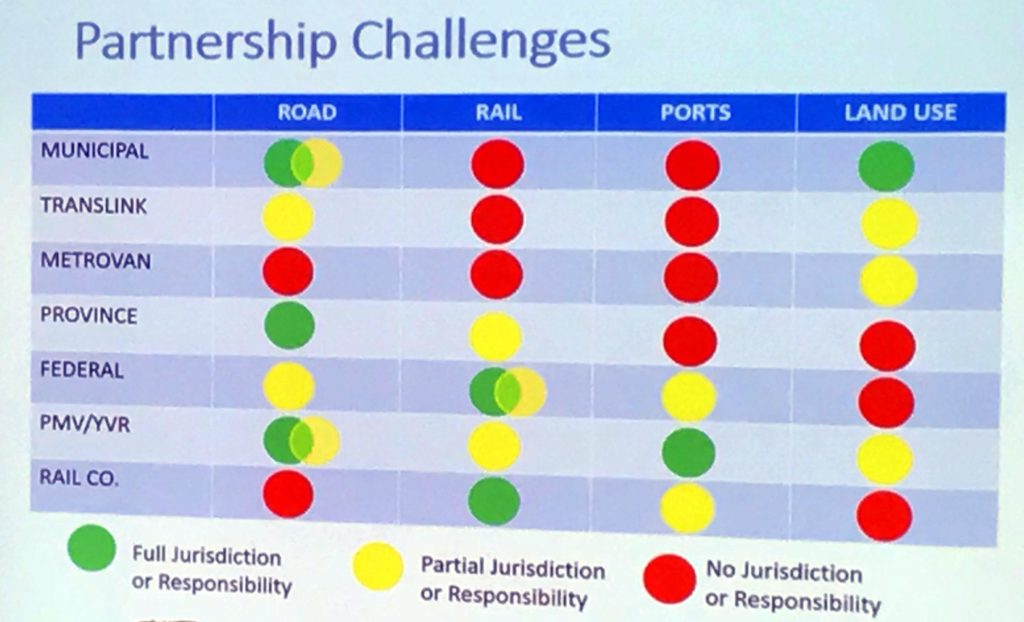
Peter Hall (the geographer) reminded us that transportation, by its very nature, makes us selfish, and makes us act in shamefully selfish ways (speeding, tailgating, yelling at others). This is at least partly because it isn’t an ends, but a means, and its hassles are preventing us from meeting these ends. Add to this our general ignorance about freight, and we get a selfish ignorance about goods movement – we all want the benefits, none of us understand why we need to tolerate the costs. Trucking also has many benefits and externalities, and they are not evenly distributed. Altogether, this makes it a vicious political problem, not made easier by jurisdictional overlap.

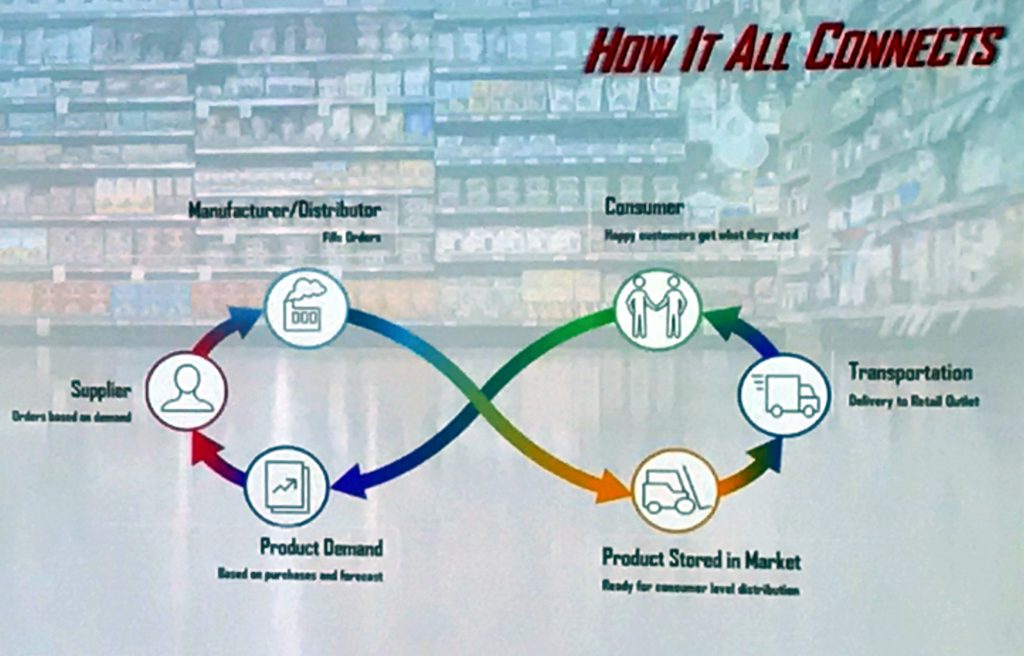
Matthew May from BST Transport and Peter Xotta from the Port of Vancouver gave similar messages about their respective industries: they need to keep the goods moving in the National Interest. You ask for tomatoes in the store, you need to deal with trucks. You want a vibrant economy, you need trucks and ports. You live in a Gateway, and we will accommodate your community as best we can (even want to make you happy!), but the mandate is to drive the economy.

Lisa Spitale gave a concise summary of some of the interface issues New Westminster has dealt with over the last few decades. With rail and roads encircling the community and a Regional Growth Strategy mandate to be a dense Urban Centre supported by (and supporting) transit, we are a hot spot for the externalities of goods movement, by rail and truck.

If I had a point to make at this event (again, I could not put this in the form of a question), it is that we have *chosen* to accept the level of negative externalities that come with a large number of diesel trucks in our neighbourhoods.

To frame this point, we need to put aside the local-goods-delivery for a moment and talk about the larger getting-stuff-from-Port-to-hinterland-through-logistics-hubs part of this equation. This is what separates us as a “Gateway” city from most other regions, and is the foundation of both the Port’s arguments on this issue and the emphasis of the Gateway Council model that has commonly dominated our regional transportation conversation. But what kind of Gateway have we built?

Here in New Westminster, we host one end of a 114-year-old single-track swing bridge that is the only rail link crossing the Fraser River west of Mission. The City of New Westminster has something like 14km of river shoreline under Port of Vancouver jurisdiction, with about a third of that backed by industrial land, much of it under the Port’s direct control. Much of this land is used for logistics, cross-shipping, container storage, and other aspects of that all-important gateway-to-the-hinterland business. Yet over all of that space there are (2) conveyors moving aggregates and chips on/off barges, and one (1) pier occasionally used to move breakbulk lumber. These are the only location in New Westminster’s extensive port lands where anything is taken on or off of a boat.

The only contribution our Port lands make to the Gateway is providing space to move and store trucks, and facilitate the movement of goods in and out of trucks. Unfortunately, New Westminster is not alone in this.

How we move goods through the region is a choice we make, not a foregone conclusion. For these hinterland goods in containers, we have chosen to use trucks to move a large portion of them intra-regionally. A cynic would suggest that is because building waterfront infrastructure to make better use of short sea shipping and barges is expensive. Upgrading rail infrastructure so a single swing bridge isn’t the only vital link across a river that has seen 30 lanes of highway built across since that single track was installed, is expensive. Relying on roads and bridges is comparatively cheap from the view of the person who has to pay for the initial capital, because taxpayers will often pony up for “congestion reduction” investment, and the other costs (noise, pollution, public safety) are completely externalized, at least partially in the form of decreased livability of our communities.

I’ve made this rant before.

Since 1808 when Simon Fraser first tasted salt in the Sto:lo, there have been strains resulting from the needs of the Gateway to the Hinterland and the needs of the people living on the river’s shores. We can, however, find a better balance between these forces. It must include acknowledging that externalized costs of fueling the Gateway need to be accounted. Trucks are part of a functioning modern society, but their true role cannot be understood as long as we subsidize them over other options.

*I was once at a forum-type event where the request for “question from the floor” was prefaced by this proviso: Your first sentence must be in the form of a question; there should not be a second sentence. I thought that was brilliant.

That New Premier Smell

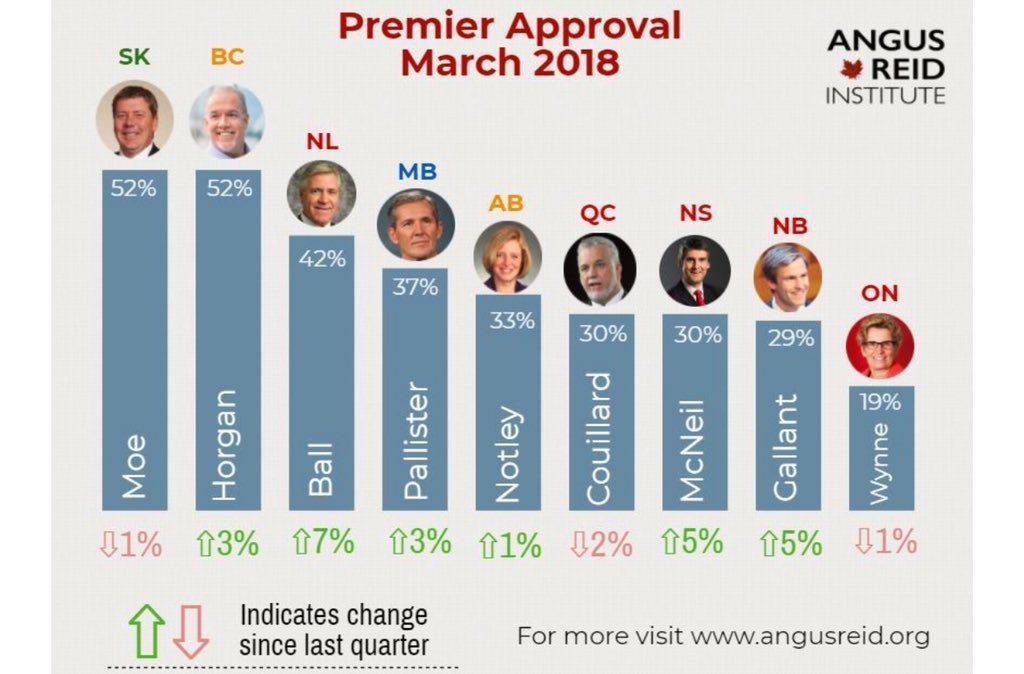
You may have seen this graphic across the #CDNPoli Social Media this week:

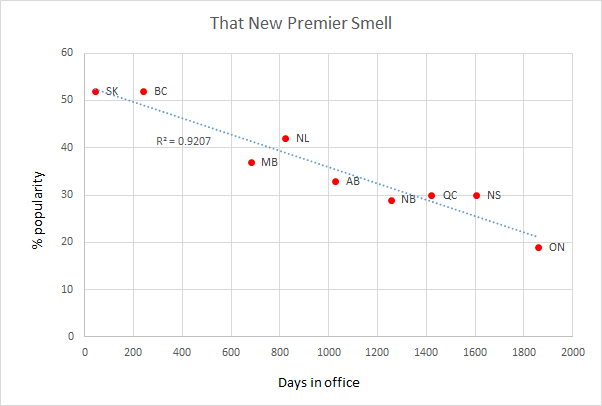
It reinforces whatever political biases you bring into it: Horgan is doing OK; Wynne is a wreck; PEI doesn’t matter. But I took something else out of it, and had to draw my own graph to demonstrate it:

Politics is a hell of a business.

For the rest of us who slept through Statistics 101, an R of .92 is a pretty high correlation, so I can definitively say popularity as a Premier in Canada correlates negatively with time in office. Any Premier above that trend line is doing better than average, any premier below the line is doing worse than average. Arguably, Pallister is doing worse than McNeil on average, but you know which I would rather be going into re-election.

Because in politics, it doesn’t seem to matter if you are above or below the line here. The only lesson to be learned from this graph is that the best you can hope for in Provincial Politics in Canada is to get things done before that New Premier Smell wears off. As years in office accumulate, any successes or victories are quickly weighed down by a legacy of being to blame for everything that may have gone wrong. Inevitably some of that is your fault (no one is perfect) and some is beyond your control, but in politics at the highest level, it simply doesn’t matter.

The only good way out of politics is to recognize when the door has been opened for you, and get out. Problem is, that kind of self-recognition is the first thing to be eroded by electoral success and access to power. Entering politics in the first place requires hubris, time in politics increases hubris, getting out requires absence of hubris. You can see the problem here.

I’m not sure how this plays out at the Municipal level, but I am just going to leave this post here, and hopefully someone will point it out to me when I am considering my 6th term for Council.

ASK PAT: Road Closures.

JF asked—

Pat, what are the City of New Westminster’s policies regarding road closures that impact cycling routes? Is there a requirement for the company requesting the road closure to identify and provision safe detours for people walking and bicycling through construction zones.

This past fall and winter has seen a large number of road closures in the Sapperton area for combined sewer separation and RCH related projects, and another sewer separation project on 7th Avenue near Moody Park. The Crosstown Greenway passes through both of these areas.

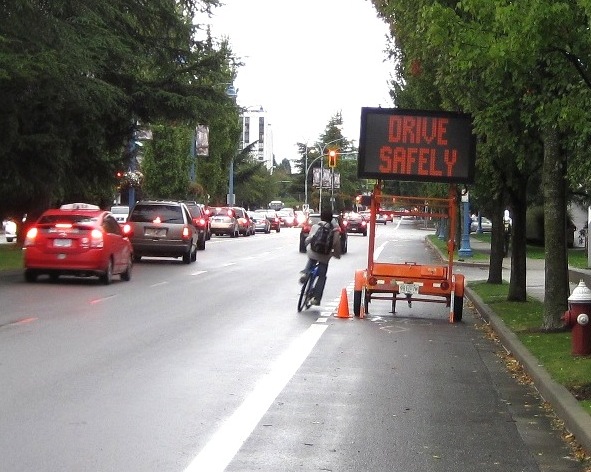
Many, many times over the past few months I have encountered road closures on the Crosstown greenway or connecting streets that I utilize. Most of these closures have little in the way of advanced warning and any detours in place don’t have cycling or walking in mind – ie being detoured down an alley onto Braid Street – FUN!

I’m a daily bicycle commuter passing through New West to/from my place of work in Burnaby and easily fall into the capable/confident category of rider. I don’t have any problem being detoured onto Braid or 8th Avenue and cycling alongside traffic moving at 50+km/h, but for a new or less confident rider I could easily picture them saying “forget it. I’m taking the car.” Not exactly the goal for any Active Transportation minded community.

To answer your first question, the City’s policy is that road closures caused by road/utility works are required to be well signed, and that safe alternate routes for all users including cyclists and pedestrians are to be maintained at all times. What you have discovered is that the policy sometimes fall short in practice. This is something I have spent much time ranting about in the past. It is a perennial problem, one that is (hopefully) getting better, but is (admittedly) a work in progress.

There is a *lot* of roadwork going on right now in New West. As you surmised, much of it is related to a sewer separation program accelerated somewhat by winning a federal grant to help pay for some of it. The situation in lower Sapperton has been especially intrusive, as that is where the sewer separation work is most intense along with utility works related to the expansion of the Hospital.

Almost all of this work is done by contractors (a city the size of New West doesn’t really have staff to do works at this scale anymore), and requirements to maintain rights of way and accommodate all types of road users are written right into the tender documents. They hire road flagging crews, do traffic plans, our engineers sign off on those plans, and our engineers sometimes drop by the site to see how things are going. However, these jobs are complicated and worksites are dynamic, so maintaining 100% access is difficult, and traffic plans necessarily shift as the project requires. This is often when the best laid plans get set aside for a bit, and people are inconvenienced. Sometimes, of course, they simply don’t care. Either way, the City needs to be let know.

Often, it results in a call to the Engineering Department or a SeeClickFix entry, an e-mail to a Councillor, or my better half bending my ear over dinner (if it impacted her riding route to work, like it did on 13th Ave last month). This usually means one of our engineering staff goes out there, sees what the situation is, and the contractor (if they haven’t already) are told to make it right.

This is, unfortunately, the reality of this type of work. I simply don’t know how to make it better.

I say that as someone who rides bikes around this city all the time, but I also say it as someone who at one point in his life got paid to stand with a hardhat next to an excavator or drill rig with flagging crews protecting me from traffic and vice versa. Any time you are interacting with heavy equipment, public streets and underground utilities, there are unpredictable conditions you encounter, and you need to make adjustments to plans on the fly, and the impact on traffic is but one (important) aspect of your contingency plans.

I was actually compelled early in the year to drop by the upper Sapperton project when I received two separate compliments from cyclists I know about how well the flagging personnel managed two different conflict situations with a bike route. This seriously never happens – I never get people pointing out when something goes good – so I had to check it out and let the Director of Engineering know. That said, I have also gone through lower Sapperton in the last couple of weeks, and have found through-signage lacking at times.

This is all to say I think we are doing better that we used to on this, as we have updated our policies. Our Engineering Department requires that cycling access or alternate routes must be part of the traffic plan, and that safe pedestrian access routes must be considered prior to starting work. At the same time, it still happens that I run into road works with no warning, and little indication of how I am supposed to route around them.

My best advice, when this happens, is to contact our engineering operations desk (604-526-4691  or engops@newwestcity.ca) and tell them about your experiences. We don’t have engineers on site every moment of the project, and if they don’t know there is a problem, they cannot address it. You can contact me as well, but I’m just going to contact Engineering Operations anyway, so you can cut out the middle man.

If you are into filling out web forms (you got here, didn’t you?) you can also use the SeeClickFix App to report these issues, with the bonus of being able to track how staff respond to them.

Making a complaint to Engineering may help in the short term, but it also helps longer-term. There are a limited number of contractors who do this type of work in the region, and a contractor that receives complaints about their inability to manage our traffic and access requirements is one we are less likely to hire for future contracts. Their ability to address traffic access is part of the quality assessment staff need to do at the end of every contract. That is, ultimately, the only way we will get better compliance.

I just want to say one more thing. This situation is frustrating at the time, but please try to be kind to the persons holding the Stop/Slow paddles at the worksite. Their job is surprisingly difficult and stressful. They often work in terrible conditions (noise, dust, weather, silly hours), and have to deal with irate drivers, angry neighbours and demanding construction managers, while carrying the responsibility of keeping the public and the workers on the site safe – often by putting themselves in dangerous situations. They know you are frustrated, they have little control over the hazards they are protecting you from, they honestly want to get you on your way as quickly and safely as they can.

Council – March 12, 2018

Our Pre-Spring Break meeting had a lot of public participation and delegations, and also came after an afternoon Workshop where we discussed implementation of the Heritage Conservation Area in Queens Park (worth watching the Video if this topic is interesting to you).

Our evening Agenda began with a startling ritual, and the following items being Moved on Consent:

2018 Delegation to Lijiang, China
The City will once again be sending Councillor Williams to Lijiang as part of our Sister City and Student Visitation policies, and will fund this from our International Relations fund. I have my own ideas about where the City could benefit better from an International Relations program than this, but my thoughts are still somewhat half-formed, and I guess I will write more about that after giving them a little more work.

Recommendations from the International Relations Task Force
This is part of what I think we can do better with our international Relations process, and can be a major part of our reconciliation efforts in the City. Recognizing the nationhood of the First Nations in this province is a huge step towards rectifying our common past, and Councillor Puchmayr’s efforts as a representative of the City to build a positive relationship with the Tsilhqot’in is groundbreaking.

I love the idea of holding an event here in the City, in the model of a gathering. I think the spirit of reconciliation would have us first asking representatives of local first nations to permit us to hold this event on Coast Salish lands, and of course to invite them. At the ArtLatch held at the Massey Theatre earlier this year there was an interesting revision of a great meeting that occurred in New Westminster between then-Governor Seymour and the assembled Chiefs of the region and colony. The young artists used transcripts of the meeting to demonstrate how people talking past each other, empowered by patriarchal and colonialist attitudes, stood in the way of communication. The colonial interest in getting business done failed to acknowledge the need to first establish a relationship or even seek a common set of understandings. Too often today, we fall to this same trap.

As a community (and as a Council representing the community) we need to get back to building these relationships and understanding one another. A gathering may give us the opportunity to begin on this new path towards understanding, if we are brave enough to put our egos and preconceived notions aside, and share our stories.

Recruitment 2018: ACTBiPed Appointment
There was a bit of an adjustment of the membership of ACTBiPed coming out of the recruitment for the 2018 committee selection process and scheduling.

Updated Automated Voting Machines Authorization Amendment Bylaw No.7994, 2018
We needed to update our Bylaw that permits the use of those automated ballot-counting machines to align with new provincial regulations and language. Another change was identified since we gave this Bylaw third reading, so we need to rescind that third reading and re-do it with the amended Bylaw. Hey, folks, there’s an election in October!

Queen’s Park Heritage Conservation Area: Official Community Plan Amendments to Remove Protection – Streamlined Application Review Process
With the new HCA in Queens Park, we need a formal process to move houses between categories, to either extend further protection to an identified heritage asset not caught in the first-draft classification, or to reduce the protection of a house that is old, but so heavily modified or degraded that it no longer carries any heritage value. One of the principles established while setting up the HCA was that this should be a transparent process that isn’t too onerous.

The regular OCP Amendment process may be described as onerous. It requires multiple committee reviews, Council approvals, and stages of public consultation. A diligent applicant may navigate this process in 6 months, and will not know the result until after a potentially-confrontational Public Hearing right at the end of it all. The proposed “Streamlined” process would still include committee and Council input, and a Public Hearing, but may be completed within about a 6 week window, by relying on the application meeting a set of requirements and conditions established through the HRA consultation process. This is not about skipping review or ignoring our due diligence, it is about creating a process that makes the necessary bureaucracy operate more efficiently.

2018 Spring Freshet and Snow Pack Level
The spring freshet report is getting slightly worse, with some larger-than average snow packs in the Fraser River Basin. There have also been big snow accumulations late in the season in the Kootenays (mostly those go to the Columbia, not the Fraser). We keep an eye on this to inform our flood preparedness. Nothing to panic about yet, but there is a slightly enhanced interest, as flood risk so much depends on the rate of melt as it does on the accumulation. It is a la Nina year, which would usually suggest a slower rate of melt.

The good news is that local snow packs are high, which bodes well for our summer water supply, but similarly much of this depends of the speed of the melt and how much we need to spill out of our reservoirs in the spring.

Connaught Heights Traffic Calming Plan
We are doing some work to make the pedestrian realm safer and more pleasant in Connaught Heights. This includes improved sidewalks and lighting on key routes, mostly connecting to the 22nd Street Skytrain station (through partnership with TransLink). There will also be some enhancements to the traffic calming measures in the neighbourhoods, coming after extensive consultation with residents and the RA. I’m also glad to see there will be some improvements of the paint treatment on 20th to (hopefully) reduce the blocking of the intersections at 8th and 7th by queuing traffic.

Application for Grant Funding to the Community Emergency Preparedness Fund
We need to update/upgrade another pump station in Queensborough – another one of those pretty-much-invisible but rather expensive capital projects the City is working on. Because this is a primary flood control measure, it is applicable to a provincial grant program to help finance emergency preparedness infrastructure. Let’s hope it gets granted!

2018/2019 Electrical Utility Rates
The City’s Electrical Utility has a long-standing practice of adjusting electricity rates to mimic BC Hydro rates. We buy from BC Hydro at wholesale rates, sell at retail, and with the difference we pay for the infrastructure and capital costs of the utility, and still return a dividend to the City that offsets a few million dollars in taxes.

A few months ago as we were doing budget planning, the Electrical Department provided a forecast of rates going up 3% to match the BC Hydro increase. Then the provincial government applied to the BCUC to freeze rates for a year, which frankly threw our capital planning into a bit of a twizzle. When the BCUC denied the rate freeze (recognizing BC Hydro’s own capital planning needs) it put things back on track for us, for the meantime anyway. So your electricity rates will be going up 3% next year, like everyone else in the province.


The following items were Removed from Consent for discussion:

Ethical investment options through the MFA
This idea has already been reported on, but this update includes the response from the Municipal Finance Authority to calls from several municipalities (New West is not alone here) to consider fossil fuel divestment. No need for me to rant again (you can read this if you want to dig into it), but I am glad we are making a little progress in pushing for Ethical Investing options, and am happy to bring this topic again to the UBCM.

It is interesting to contrast this action with recent calls for “ethically responsible” businesses like MEC to stop carrying goods produced by companies who make money selling assault rifles. There are many ways to frame the ethical investing argument, but only one way to frame the alternative view: that it is the job – nay the Professional Responsibility – of our investment brokers to return the highest value possible to fundholders, and anything that constrains their decision making (be it ethical concerns on the part of fundholder or new regulations) may possibly impinge upon their ability to Act Professionally. This, in summary, is how Capitalism flaunts the line between allowing and encouraging unethical practices, from poisoning rivers to selling dangerous weapons to dangerous people.

The City will continue to call on the MFA to explore more ethical investing options, and will also work with our partner municipalities (Victoria is already on board, along with a few others) to get enough capital commitment together to make this happen.

Housing and Social Services Coordinator: Request to Seek Funding for Proposed Pilot Project
This is another one of those gut-check times. I think this City does more than most, perhaps more than any other of our size, on the housing affordability file. Through stellar work by our staff, we have supported a variety of programs to address homelessness and housing affordability. Some may (and do) argue this is something we should leave to senior government, and I wish they provided all of the resources to do the work that needs to be done, but they have not in the past, and I don’t think we can just ignore the gaps that exist in our community.

It is a time that rental vacancy is below 1%, prices are skyrocketing, and when regional pressures are being felt locally. When people face renoviction in this market, are priced out of housing, are transitioning out of healthcare or fleeing unsafe domestic situations – who are they going to call? Federal government cuts to homelessness outreach have taken more than a quarter million dollars out of local outreach funding. This is another gap we can hardly afford to ignore, and our Social Planning folks working for the City have been overtasked trying to cover this.

This initiative would fund at least a part-time position to continue this important outreach work. We have the potential to share a person with another adjacent community with limited resources, in order to save money and provide better connections to a wider range of supports. We also hope that the province will step up and help fund the position. I completely support the need for this position, and hope through partnership we can manage the cost.

Amendment to Water Shortage Response Bylaw No. 6948, 2004 – Revisions to the Water Shortage Response Plan
The regional policies on water shortage are being subtly adjusted to reflect better consumption research and public feedback. There will be a few changes on what is and is not permitted under Stage 1 – Stage 3 water shortages. These rules are developed at the Metro Vancouver level (our water utility is a regional function), but there is a partnership between Metro and the member Municipalities to educate and enforce.


We then went through a Bylaws reading ritual:

Water Shortage Response Amendment Bylaw No.7988, 2018 (Revisions to the Water Shortage Response Plan)
This Bylaw that aligns our Municipal water shortage response plan with the updated regional plan, as discussed above, was given Three Readings.

Electrical Utility Amendment Bylaw No.7998, 2018
This Bylaw that updates our electrical rates to match BC Hydro rate increases, as discussed above, was given Three Readings.

Automated Voting Machines Authorization Amendment Bylaw No. 7994, 2018
This Bylaw that regulates the automated ballot-reading machines we use in the Municipal Election needed some modification to better match the new provincial regulations. We rescinded the Third Reading from last meeting, and did a Third Reading of the amended Bylaw today.


We then had a few pieces of New Business:

Community Health Centres
After another compelling presentation by advocates, and what was frankly a remarkably long conversation around an item that all of council easily supported, Council voted to endorse the Community Health Centre model, and ask the Provincial Government to do something about it (via the UBCM).

Updating the Motor Vehicle Act
Following up on a recommendation from ACTBiPed as endorsed by Council at a previous meeting, we moved to take our support for the Road Safety Law Reform Group recommendations to the LMLGA, and ask the provincial government to update the Motor Vehicle Act to protect vulnerable road users.

Mercer Stadium Skatepark Relocation
Council asked Staff to bring a report as soon as possible on the community consultation for the proposed replacement Skate Park. With the highschool project getting ready to break ground, I am afraid we are going to have an extended period without a skate facility in the community if we delay construction past this summer season. We need to decide whether the location we have is the one we are going with, or if we need to retool, but we cannot delay that decision any longer.


And that brought the meeting to a wrap. Hope everyone has a good Spring Break, and we’ll see you back at Council on April 9!

PAL by another name.

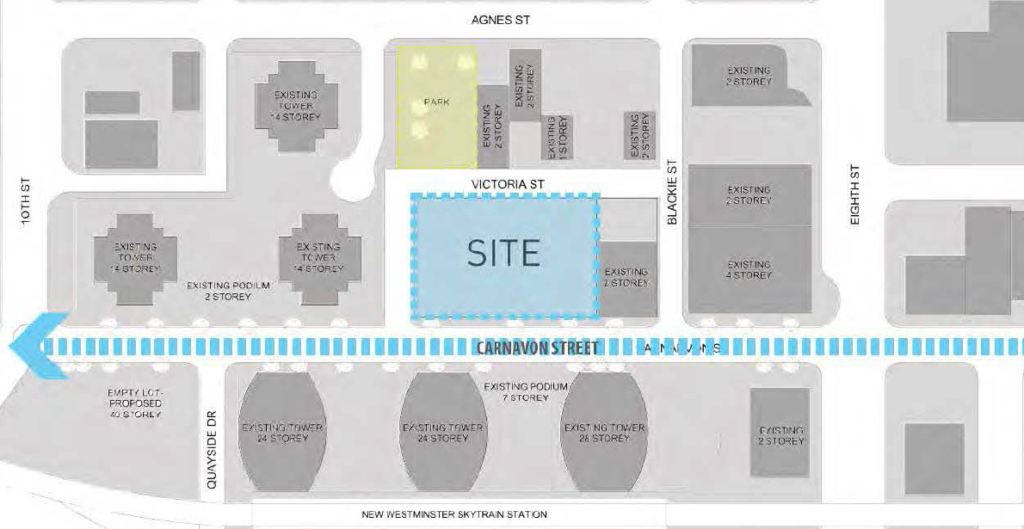
Monday’s Council meeting included a Public Hearing on a notable project on Carnarvon Street. Although it didn’t get much media (social or otherwise) before the Public Hearing, it seems to be getting some now, and there was enough going on at the Public Hearing that I think it is worth some discussion here.

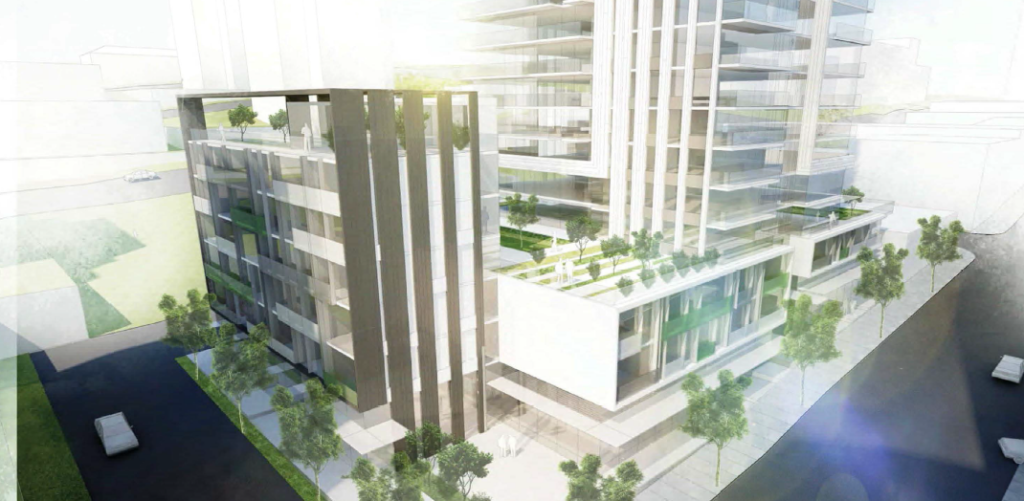
The proposal will bring a new 32-story tower to the downtown tower district with 204 market strata units. The residential building meets the City’s Family Friendly Housing policy by exceeding the minimum number of 2- and 3-bedroom units. The tower will have a 3-story pedestal which will house commercial storefront space and some amenity space, and a little bit of above-ground parking around the back (more on that later). The tower will share the pedestal with a second 8-story tower that will have 66 non-market rental units run by the Performing Arts Lodges Society (“PALS”), a charity that helps provide affordable housing for veterans of the performing arts industries.

Council received two pieces of correspondence in regards to this project, both expressing support. We had 6 people present at the Public Hearing, one expressing concerns that the affordable housing component was not broad-reaching enough, and one local business concerned about the name of the development (see below), and the rest speaking in support (including the proponent, and the president of the New West Arts Council), mostly emphasizing support for the affordable housing component.

The project meets the goals of the Downtown Community Plan, was approved by the Advisory Planning Commission and Design Panel, and appears to be well supported by the community. The project puts density adjacent to frequent transit service and within walking distance of most services. The location also means we can bring new density and affordable housing on line without displacing other low-cost housing.

As one delegate at the Public Hearing mentioned, this is clearly not the entire answer for affordable housing. Far from it. Our regional housing affordability crisis exists at every level: professionals not able to afford family-sized homes; working poor facing demo-viction and rising rents; people with barriers to traditional housing lacking adequate supports, it’s a mess. No single project can fix all of these. What this project does, though, is address one identified gap, and engage a not-for-Profit in helping with that. This project is similar in that sense to the two small affordable housing projects the City is supporting on City lands, each identifying a specific group in need of housing and a service agency taking on the charge to help operate that housing.

The PALS project helps people who have worked on building the cultural quality of our community, and recognizes that people working in the performing arts rarely have pension plans or stable retirement income. By providing space in our community for dozens of experienced actors, writers, dancers, singers, production designers, directors, choreographers (etc., etc.), we promise to enrich our community’s culture. They will be the story tellers, the teachers, the artists that support a vibrant cultural future in New West. I don’t think we can measure the positive impact that could have in our community.

I have expressed concern in the past about Carnarvon Street and its urban expression. I think the Plaza88 development does not address the street well, and is out of scale with the pedestrian space we want to have downtown. I am more enthused by the urban design of this project, as it is well articulated, includes an open public plaza area, and appears to provide lots of eyes on the street, as opposed to a large wall of parked cars behind screens.

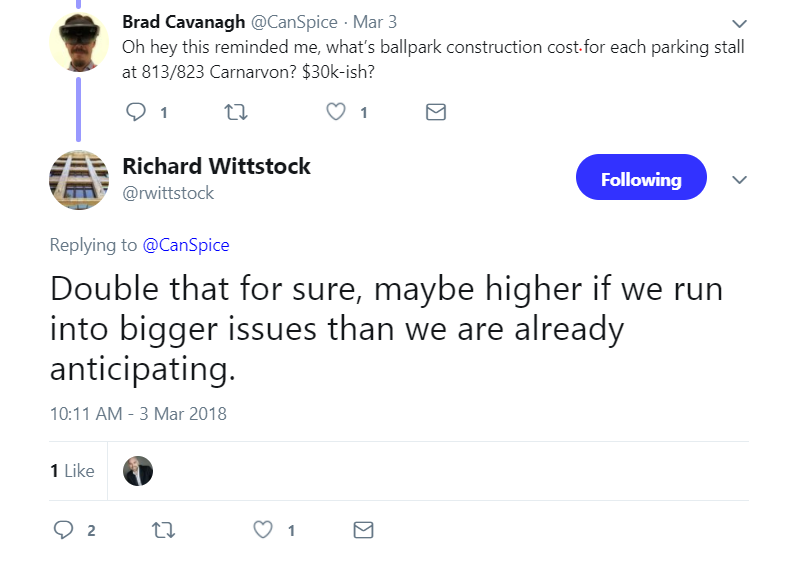
At initial readings and again at Third Reading, some concern was raised by some of Council about the parking situation. Between resident and visitors parking, this project will have 275 parking spaces, most of them underground. That is more than one parking spot per unit in a building that is across the street from a SkyTrain Station and walking distance to all amenities. The cost of building these parking spots (which could be more than $60,000 a spot!) must shift the cost of the units in the building – both affordable and not. We need to question why we are spending so much finding warm dry spots for cars when we are struggling to afford warm dry spots for people.

The project was designed to meet the City’s parking minimums, and shifting the goalposts for the developer at this stage in the process would be pretty onerous, and potentially threaten the project. However, this has raised the conversation at Council that our downtown parking standards need an update if we hope to make housing more affordable and meet the goals of our Master Transportation Plan. This conversation will be ongoing, and I’d love to bend your ears for a few hours about it.

Finally, the marketing department of the developer has some work to do, as they had found a great name for the development that was, unfortunately, almost indistinguishable from the name of a young but established business on the same side of the street about a block away. The business owner came to delegate to Council and expressed support for the project (the Arts community supports their own!) but was worried about potential impact on her business. The City has no regulatory role on the naming of developments, and having a legal fight over Trademarks and registered business names will only enrich lawyers and take time. Both parties have had an initial and positive conversation, and felt confident that a compromise could be found, so Council asked that they find a mutually acceptable solution prior to the project coming back to Council for Adoption.

Overall, this project is a net positive. In my opinion there are significant benefits to the community: affordable housing that adds to the City’s cultural diversity, improved public spaces, DCCs, density bonus and VAC money that contributes to community amenities, family-friendly housing diversity, density near SkyTrain, and a refreshed area of downtown bringing supporting customers to our business district.

I just hope those lens flares don’t keep the neighbours up at night.

Council – March 5, 2018

The first meeting in March (I cannot believe it is March already!) started with a special Public Hearing:

Zoning Amendment (813 – 823 Carnarvon Street) Bylaw No. 7974, 2018
This proposal will bring a new 32-story tower to the downtown tower district with 206 market strata units. The building will share a 3-story pedestal with a second, 8-story tower that will have 66 non-market rental units run by the Performing Arts Lodges, a not-for-profit that helps provide affordable housing for veterans of the performing arts industries. I will write a follow-up post on this development, but short version is Council voted to give the project Third Reading.


We then proceeded to our Regular Meeting agenda, starting with a Staff Presentation:

2017 Achievements and Accomplishments
This presentation by senior staff is an annual review of the work done and projects completed. Things are crazy busy in the City right now, partly driven by the (region-wide) pace of growth, partly by Council’s increasingly ambitious plans for moving the City forward in a lot of different directions. I will do a follow-up blog post to talk a little more about this, but short version is staff are running full gas, and I appreciate their work.


The following items were Moved on Consent:

Amendment to the 2018 Schedule of Regular Council Meetings
This minor change in our calendar will permit a workshop on cannabis regulations on June 18th. Please adjust your social calendar appropriately.

215 Mowat Street: Development Permit Application for Façade Upgrades to an Existing Multi-Unit Residential Building
This older Strata apartment building is in need of some significant envelope repairs, and the owners have decided to do some upgrades to the building appearance and landscaping at the same time. The total estimated costs of the repairs is high enough to trigger the need for them to apply for a Development Permit.

The Brow of the Hill RA supported this project, as did the Design Panel, and the neighbours have been notified and have not raised any objections. Council moved to issue the Development Permit.

312 Fifth Street: Heritage Revitalization Agreement and Heritage Designation – Bylaws for First and Second Readings
This Heritage Revitalization Agreement for a house in Queens Park will provide Heritage Designation and significant restoration of a heritage home in exchange for some allowances around a laneway house on the back of the property. Council gave the HRA two readings, and the project will be going to a Public Hearing on April 30, 2018. C’mon out and let us know what you think!


The following items were Removed from Consent for discussion:

Intelligent New West collaboration with UBC Master of Engineering Leadership (MEL) Smart City Research Update
This is an opportunity the City has, through the work of our Intelligent City team, to collaborate with UBC and benefit from cutting-edge research on data management and urban systems. They will be looking at innovative ways to make our City work better for our residents and businesses. We have had success with previous collaborations, and want to move ahead with studying three new areas:

• Fast charging infrastructure for Electric Vehicles – assuring the revolution in EVs doesn’t pass the City by, and identifying potential to leverage our Electrical Utility to provide region-leading EV service;
• Modernizing our electrical metering service to allow better data management of our grid;
• Broader public Wi-Fi connectivity – expanding the advantage of BridgeNet to make internet connectivity more available, and more equitable.

Council moved to support this initiative with funding from the Intelligent City budget.

Updated Corporate Energy and Emissions Reduction Strategy – Proposed Vision, Goals and Evaluation Criteria
As previously reported, we are meeting our GHG reduction goals in every sector except our fleet, which was thrown a curveball last year with the protracted snow/ice event and concomitant increase in vehicle mileage for our road maintenance vehicles. Council is not daunted, however, and we plan to set some aggressive targets for the next phase of our CEERS. I will address the fleet issue in the item below where we talked about our shift to alternative fuels.

318 Fifth Street: Heritage Revitalization Agreement – Window replacement
This HRA project in Queens Park will provide Designation of a heritage home, along with some restoration right away and some longer-term restoration/upkeep commitments in exchange for some accommodations for a laneway house at the back of the property. The project has not yet gone to First and Second reading, however, because it is a little hung up on the timeline for replacement of the existing vinyl windows.

There are multiple opinions here about the windows. The Heritage Consultant working on the house has suggested that replacing the functional and high-efficiency vinyl windows (which are not, naturally, heritage-appropriate materials) at the end of their functional life, citing the cost and impact of breaking the envelope of the building and doing intrusive work when it isn’t immediately necessary. Some heritage conservation advocates (including the Community Heritage Commission) wanted to see the windows replaced sooner, or even immediately. Prior to drafting the Heritage Revitalization Agreement between the homeowner and the City (which will go to Public Hearing), Staff asked for some clarity from Council on how far we should push the window issue.

I was concerned we were missing the forest for the trees here, and think the long-term heritage preservation of such a well-cared-for home for the decades ahead is more important than the short-term heritage “win” of replacing the windows right away, as the consummate costs may put the entire project in jeopardy. I am happy with the commitment to replacement of the windows with appropriate wood-frame versions, on a timeframe appropriate for the long term viability of the house – be that end of life or sooner – and securing that commitment with a covenant or in the language of the HRA.

There were several options provided to council, reflecting the varying opinions of the Community Heritage Commission (replace within 10 years), Advisory Planning Commission (replace windows at the end of their service life with heritage-appropriate units), and the proponents (replace street-fronting windows within 10 years, the rest at the end of their service life). After some discussion, Council chose to support the proponent’s proposal, with the addition of a cosmetic treatment of the current windows to address the non-heritage-appropriate colour; a compromise that may slightly disappoint everyone. But I guess we will find out at the Public Hearing.

Queen’s Park Heritage Conservation Area: Implementation Work Program Update and Proposed Direction
Staff continues to work on the incentive programs planned for the Queens Park Heritage Conservation Area, along with development and consultation on some of the other implementation measures promised as part of the HCA.

Several of these proposals were easily supported by Council, but the one part around the process through which homeowners with protected properties could apply to have a preliminary evaluation done of their property to determine if they lack heritage value to the point where they could be moved to Limited Protection status lead to some discussion and clarification. In the end I supported all of the staff recommendations (and all were passed by Council).

This is an ongoing project, and a healthy discussion on Council is important, even when especially when we disagree on some points of language and policy. There is a bunch of work to do yet here, and there are upcoming public meetings on these initiatives, so stay tuned!

1084 Tanaka Court: Development Approvals Process Timeline Update for the Rezoning and Development Permit Applications to Permit a Banquet Hall
The proposal to build a large Banquet Hall on an undeveloped piece of land adjacent to Queensborough Landing is going through an extra level of review, as the proponents have determined the best way to meet their parking requirements is to build a parkade, which is resulting in a redesign of the building shape and form.

Update on the City’s Use of Alternative Fuels and Electric Vehicles
A little while ago, we asked staff to provide us an update on our efforts to shift our fleet to lower-emission and zero-emission vehicles. This is related to the discussion around fleet being the one part of our Corporate Energy and Emissions Reduction Strategy (above) that isn’t hitting targets. Of course, the issue is more complex than just saying “we need to stop buying gas/diesel vehicles”. We have a legacy fleet and the technology available for small consumer cars (like the Nissan Leaf the City has in its pool) is not expanding to other vehicle types as quickly as we may like. Just try to buy an electric (or even plug-in hybrid), pick-up truck. They don’t exist.

That said, technology is shifting fast. Vancouver is testing an electric garbage truck that can do a 10-hour shift on a 2-hour charge, but that is definitely not a mainstream technology, and we cannot yet evaluate the lifetime costs. We also have everything from backhoes to field lawnmowers and firetrucks that are not likely to see total electrification soon. Our Police are doing a good job with propane-hybrid vehicles and new anti-idling practices, and our fire services are now using separate diesel generators to run on-board systems so the drive engine can be shut off during extended deployments. As stop-gap measures, these are great, but not the end of the discussion.

Its not a matter of if we are going to move to a complete low- or zero-emission vehicle fleet, but when. Even if the pressures of carbon pricing (going up!) were more important than the fact it is 20 degrees above normal today in parts of the Arctic, the emergent health impacts of diesel pollution in our communities is enough to make the case for a shift to a cleaner, greener fleet and fleet practices that reduce engine idling and fuel use.

Council emphasized that New Westminster has its own electrical utility (vertical integration!), is a compact City with high population density within a small area, and has a Council that has demonstrated its interest in finding innovative approaches to problems and expresses an environmental ethos – if New West can’t lead the region (or even the country) on this file, I don’t know what City could. Council called on staff to continue to be innovative and see where they can push some limits here to make our fleet cleaner.

European Chafer Management Program Update
The City provides subsidies to people who wish to apply nematodes to their lawns to battle the Chafer beetle and the animals that tear up yards to feast on them. I have some concerns about us continuing to invest in a losing battle here. This is a subsidy to single family homeowners to maintain green lawns, when there are alternatives available, including better turf care practices or alternative lawn covers. The Chafer is not going away, and I wonder about the value of doing this for perpetuity.

Regardless, I am aware that this is a bigger policy discussion, and am happy in the short term to continue the program until we can come up with a better understanding of a long term strategy.


We then moved on to our regular reading of Bylaws:

312 Fifth Street: Heritage Revitalization Agreement Bylaw No. 7979, 2018 and 312 Fifth Street: Heritage Designation Bylaw No. 7980, 2018
These Bylaws that support the heritage restoration and designation of a house in Queens Park in exchange for allowances around a laneway house, as mentioned above, were given two readings. They will go to Public Hearing on April 30. C’mon out and let us know what you think.

Five-Year Financial Plan (2018-2022) Bylaw No. 7992, 2018
This Bylaw that formalized our 5-year financial plan which was given Third Reading on February 19, was formally adopted. It is now the Law of the Land.

Zoning Amendment Bylaw No. 7915, 2017 (for 229 Eleventh Street)
This Bylaw to permit a residential building in the Brow of the Hill which was given Third Reading on January 29th was formally adopted. Please adjust your behaviour accordingly.

Zoning Amendment (Housekeeping) Bylaw No. 7924, 2018
This Bylaw that makes a bunch of language changes to correct our Zoning Bylaw where it is incorrect, unclear, or didn’t rhyme was formally adopted. Please update all of your bylaw dictionaries and related hyperlinks.

And that was another night of Council work done!

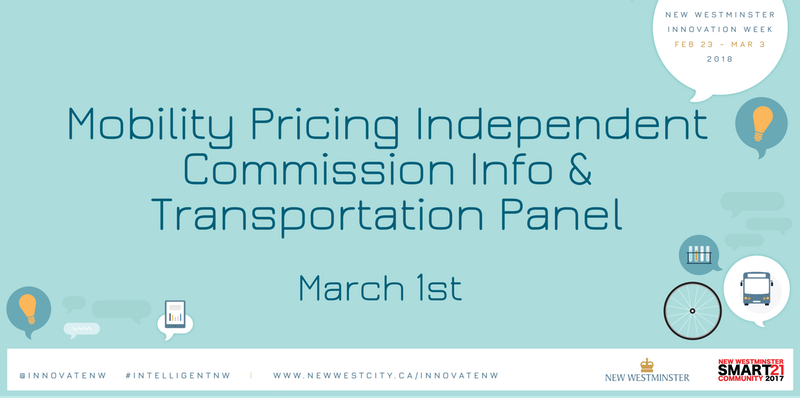
Innovation! Transportation!

Next week is Innovation Week in New West. It actually starts with an Opening Reception at City Hall this Friday night which should be off-the-hook (with free music and video presentations and a special Steel & Oak release!) If you are in the #NewWest #Twitterati, you probably know this already, but some of you may wonder: “What is Innovation Week? And what can it do for Me?”

Let. Me. Tell. You.

As part of New West’s Intelligent City initiatives, Innovation week is a showcase of how technology, innovation, and sharing information can make our City work better, can make us a stronger community, can make businesses more prosperous and residents happier. It is about strategically leveraging innovative ideas like the City’s award-winning Open Data portal with hardware like the BridgeNet fibre network to build a better and more equitable future.

Now I read that last paragraph, and it is all true, but it doesn’t really tell you what Innovation Week is, does it? Let me try again.

Innovation Week is a series of panel discussions, hands-on workshops, networking sessions, tours and activities all open to the public, and inclusive of all ages, experiences, and interests. There will be classes to teach kids about coding, a Hack-a-Thon for teams of coders to develop new tech, forum discussions about new ideas, chances for Tech start-ups and businesses of all sizes to connect with Private and Public funding sources to bring ideas to reality. All wrapped up in fun enough with arts and music to keep your mind fresh. Through the week, you will be given reasons to dream, and information and resources to make that dream work.

I will probably write again about more events (if I get time, or else I will live tweet from there!), but I want to call attention to two events in particular, as they are interesting (I think) to the entire region:

Metro Conversations is a talk series I have been helping to organize with council colleagues from other municipalities. Out Fifth Conversation will be on Tuesday the 27th in the evening on the topic of The Promise of Innovations in Transportation. But instead of just dreaming of autonomous vehicles and hyperloops and Tunnels, we are going to ask whether the technological promises addresses what we actually want from our Cities – safe streets, livable neighbourhoods, sustainable communities, social connections and equity. This will be a fast-paced hour-long conversation, free to attend, but you might want to register as we don’t have the biggest room.

As a bit of a primer: watch this video form 1958, and ask yourself, is this the community we want? And how does this differ from Elon Musk’s vision of tunnels and hyperloops “connecting” our community.

The second event I with broad regional appeal for people like me who care about Sustainable Transportation and how it interacts with City Planning will be the Transportation Forums on March 1st. I’d suggest you book the time off work and enjoy the entire day, but you really don’t want to miss the evening event, as Mobility Pricing is sure to be the hottest political topic in the Lower Mainland through the fall elections and into 2019.

The evening forum will feature the Chair of the Mobility Pricing Independent Commission, one of the most respected and outspoken Urban Planners in Canada, and an Economist who can unpack the idea of what “fairness” is when it comes to paying for our regional transportation infrastructure. The Mayor of New Westminster will moderate the discussion, and it is free to attend.

If you are like me, you may be interested but apprehensive about Mobility Pricing. I have engaged in TransLink’s “Its Time” consultations, and understand how Mobility Pricing works in Singpore and London and Helsinki, but am cognizant of the challenge we have in Vancouver setting up a system that fits our region, and can be politically supported by the broad interests of the region. I’m hoping this forum will answer some of the questions I have, and allow me to better engage with the proponents and critics of road pricing.

There is a tonne of other great stuff happening between February 23 and March 3. Please come out and support these events, and thanks the many sponsors who help lead these conversations in New West. That link again.

Council, Feb 19, 2017

Apparently it was a cold, sunny day on February 19th, but Council Chambers were kept warm with a mid-day Workshop on the City’s Economic Development Plan (which you can see here and read here).

Our evening began with Public Hearings on the following Zoning changes:

Zoning Amendment (Housekeeping) Bylaw No. 7924, 2018
This Bylaw makes a bunch of “housekeeping” changes to our Zoning Bylaw. These are changes like replacing the word “church” with the words “place of worship” to modernize the language, and “Update references to Local Government Act Section 921 to Local Government Act Section 493” to catch up to changes that happened in other legislation, and to standardize units of measure. This should be pretty uncontroversial stuff as we are not changing any practices here, just updating language to clarify existing policy. Not surprisingly, we had no correspondence on the Bylaw, and no-one came to speak to Council on the issue.

Council moved to Refer this Bylaw to the Council Meeting immediately following, where Council gave the Bylaw Third Reading.

Zoning Amendment (1319 Third Avenue) Bylaw No. 7981, 2018
Steel & Oak wants to expand their seating area from 30 seats to 50, and this requires a Zoning Amendment, as we don’t currently have a zone in our Industrial Areas that allows public assembly of more than 30 customers. S&O have been great business leaders in the City, helping at a variety of community events, and becoming unofficial spokespeople for their home community. Their operation has not caused any concern with the neighbours, Bylaws or the police. Alas, our long legacy of Bylaws often means it takes way too long for zoning changes like this to work through our processes, and this should not have taken more than a year, but I’m glad we finally got to this point so S&O can hire more staff and continue to build our local economy.

We received no correspondence on this application, and only the Proponent came to speak to the amendment. Council moved to refer this Bylaw to the Council Meeting immediately following, where Council gave the Bylaw Third Reading and Adoption, and also passed a follow-up resolution to support S&O’s application to the Provincial Government for the concomitant license change.

Zoning Amendment Bylaw (Retail Sale of Cannabis) No. 7966, 2018
We discussed this during our recent workshop on Cannabis regulation, The City is making a temporary change to the Zoning Bylaw to clarify the current regulatory environment, in preparation nfor the new regulations we hope to have in place for when the Federal Government legalizes the recreational cannabis industry. Even since I wrote that piece a couple of weeks ago, there has been some change both provincially and federally in regards to senior government framework and timing. Staff is working on putting together a public consultation process, and hope to bring a comprehensive set of regulations to Council this summer.

We had a couple of people come to speak to this issue, mostly involved either directly or peripherally in the industry, and mostly curious about what our permanent bylaw regime is going to look like. Council moved to refer this Bylaw to the council meeting immediately following, where Council gave the Bylaw Third Reading and Adoption.


Following the Public Hearing, we moved to our Regular Agenda and Opportunities to be Heard on various variance permits:

Development Variance Permit DVP00636 for 319 Ash Street
A Resident in Brow of the Hill wants to formalize a secondary suite, but doesn’t want to knock down a tree to build another off-street parking space. That requires a variance. One piece of correspondence appeared on table in opposition (in the interest of full disclosure – letter from a former employer of mine!), and the only the proponent appeared to speak in favour. IMO, the Brow needs as many trees as it can get. Council moved to approve the variance.

Development Variance Permit DVP00640 for 232 Eleventh Street
This property in the Brow has been difficult to develop because it is on a steep slope and the only street frontage is on the top edge of the property. It has been vacant for some time as a result. The request is for the City to allow off-street parking in the front yard (though the house will really “front” facing down the hill, the primary road access is technically the “front”), which requires a variance.

No-one in the neighbourhood seemed to object, and staff think this is a reasonable solution. Council moved to support the variance.

Development Variance Permit DVP00641 for 354 Johnston Street and Development Variance Permit DVP00619 for 353 Johnston Street
AI put these together, as they are two adjacent properties with the same issue. The extra-deep 147-foot lots on Johnston Street (no relation!), when subdivided to a pretty typical modern width (33 feet), don’t comply with one of our Zoning laws that say the long side of a lot can’t be more than 4x the width. So they need a Variance. These lots are common in Queensborough, and not particularly controversial.

We had no-one correspond with us on this, and had one person come to speak in opposition, worried that there is not enough on-street parking on a street where every house is built with 4 off-street parking spaces. Council voted to approve the variance.

Temporary Use Permit TUP00015 for 457 East Columbia Street
A resident wants to open an old-fashioned quarters-in-the-slot-blast-pixelated-aliens Arcade in Sapperton. We have pretty restrictive Bylaws for arcades created in the 90’s for a bunch of reasons that probably made sense at the time (after all, this was pre-Grunge and the Seattle scene!) so they need a Variance. We received quite a bit of correspondence on this, almost all in favour. If I had known Arcade folks liked writing to City Hall so much, I’d have charged them a quarter each… the RA supported the idea, and no protests from local businesses.

Council had several questions around the business plan and the potential for alcohol sales. If I could paraphrase all of Council comments: what can we do to make your business model more robust; sorry it took so long to get this organized; and hopefully Staff can bring a more permanent solution to Council sooner rather than later, but we don’t want to delay this Temporary Use permit to get you up and running as soon as possible. Good luck!


We then had a slightly more detailed than expected report from our Electrical Utility on the response and follow-up to the Queensborough Bridge Electrical Fire last October.

If you live in Q’Boro, you no doubt remember not having electricity for 28 hours. The fire was caused by a failure of one of the circuits in a conduit attached to the bridge, which impacted adjacent conduits. This report outlines costs related to the initial repair ($65,000), the follow-up repair to make the system stable again ($150,000), and an estimate for a better longer-term repair ($350,000). This also emphasized the need to build a Substation in Q’boro, which has always been a plan but may be accelerated due to this.


The following items were Moved on Consent:

Financial Plan, 2018-2022
This is the Bylaw that formalizes our five-year financial plan, which includes a 2.95% tax increase and a 1% capital levy. I will blog more on this when I get a chance, but for now Council moved to give the Bylaw three readings.

Recruitment 2018: NTAC Appointment
The Q’boro RA representative to the Neighbourhood Traffic Advisory Committee is appointed.

Recruitment 2018: EDAC Appointment
An adjustment to the representation on the EDAC, due to the inability of one member to serve, and based on an application received during the most recent Committee Application process.

Official Community Plan Implementation Work Program: Update on Scope of Work to Address Emerging Issues
We have some staffing issues in our Planning Department. Part of it has to do with retirements and attrition, some with a very aggressive set of Council initiatives that have eaten up a bunch of planning staff time – Implementing OCP measures and the HCA, proactive approaches to Affordable Housing, ongoing development and new policy areas like the Cannabis regulations and Short Term Rentals. Staff are giving Council (and the public) a bit of notice here that their capacity for new tasks is getting strained.

I am concerned that we will get caught flat-footed on Short Term Rentals policy, but recognize our bandwidth limits here, and cannot think of any of the prioritized policy areas that I would “bump down” to put STR policy on the fast track. Another approach here is to expand our capacity, but this will be an ongoing discussion on Council as we are near the end of our 2018 Budget process and may need to defer this discussion for the next budget period.

100 Braid Street (Urban Academy): Request for Construction Noise Bylaw Exemption
Construction sometimes sticks you between a rock and a hard place. Sunday morning construction is a hassle for neighbours, but sometimes needs to happen. In this case, the builders need to close two lanes of Braid street, which would have bad impacts on neighbourhood and regional traffic if done mid-week, and the Saturday would be better, but there is a Wedding being held next door! A wedding! So Council granted a variance to allow one day of Sunday construction so the school project can put up their roof trusses.

200 to 700 Blocks Columbia Street Sewer Interceptors: Request for Construction Noise Bylaw Exemption
Construction sometimes needs to happen at bad times because it works better then. Major sewer works especially work better at night when sewer loads are smaller, for obvious reasons. Treatment of the major sewer works under Columbia Street with a Magnesium Hydroxide every once in a while prolongs the lifespan of the works by counteracting the chemical erosion caused by the hydrogen sulfide that emits from your… uh… waste. Council moved to give this variance so the milk of magnesia can be delivered to the guts of the City.

Possible Modular Housing Projects
The topic of Temporary Modular Housing has been pretty hot in Vancouver, where the homelessness crisis is most acute, and there has been some push-back from residents there around plans to give their neighbours safe roofs over their heads. Here in New West, our staff have recognized that there is demand here for these facilities, but we are challenged by a general lack of City-owned land upon which to place them.

Perhaps ironically, two potential candidate locations the City owns are not available because the City has provided them to not-for-profits to build permanent non-market housing, a project that has been going on for more than a year. Staff have evaluated many pieces of land in the City over which we have some control (City and Provincially-owned), and have identified two priority locations, one in Queensborough, and one on the Mainland.

We are moving forward with geotechnical analysis (the temporary buildings need to have solid footing) and working with the province to determine how to best bring these sites on-line, or even if the province is interested in bringing their program to the sites we have available. I think Council is interested in seeing these developed as part of our comprehensive approach to housing affordability, and I hope we can fast –track any approval the City need to provide to pave the way for getting people into safer homes. Its cold out there people.

Applications for Grant Funding to the FCM – Municipal Asset Management Program and UBCM Local Government Program Service 2018 Asset Management Planning Program
Creating a more comprehensive Asset Management program is one of the Strategic Priorities set for this Council term. The very short version of this is to look at everything the City owns that has a lifespan (road lines, telephone poles, HVAC systems, sewer pipes, that arcade-style basketball hoop thing at the Canada Games Pool, etc.) and provide a systematic process to evaluate their lifespan, maintenance and replacement cost, and put those costs into a financial framework to better assist long-term financial planning. Luckily, the FCM is giving out grants to support this kind of work, and we are going to apply for one of those grants. Cross your fingers!

514 Carnarvon Street (Holy Trinity): Affordable Housing Update
The parish of the historic Holy Trinity Cathedral are hoping to develop their lot in order to raise funds for restoration of their building, expansion of the community space on their campus, and to provide both non-market and market secured rental and strata residential units in the same building. Although this project has already seen a couple of years of reshaping, it is still pretty early in the process for the project. There will be public consultation and a public hearing if this project proceeds. Stay tuned.


The following items were Removed from Consent for discussion:

Servicing of Water Lots Within Port of Vancouver Jurisdiction
This is an information report brought to catch Council up on some issues raised more than year ago by some residents of float homes in Queensborough. For the most part, they are living on water lots under Port of Vancouver jurisdiction. For reasons going back through decades of zoning decisions, there are other people living in legally non-conforming residences on the “flood” side of the dyke, in lots that are at least partially Port jurisdiction, and can only be serviced through the Dyke (which comes with another set of complications). The Port’s land use plan for their water lots are more industrial than the current use reflects, or even what the City’s long term use plans may be. Short version: the Port doesn’t like float homes expanding into their industrial land base, and the City is reluctant to provide services to them, especially if the Port doesn’t approve.

Modernization of the British Columbia Motor Vehicle Act
The ACTBiPed was provided a presentation from the Road Safety Law Reform Group pf BC, a collection of road safety advocates, cycling groups, lawyers and Public Health researchers, outlining the need for a serious reform of the Motor Vehicle Act of BC.

The very fact it is called the “Motor Vehicle Act”, but is the primary provincial regulation covering the use of the provinces’ public transportation realm is telling – we need to start thinking about the safety of all users of public space, and distribute the rights and responsibilities more equitably. The Act was drafted in 1957, and hasn’t changed much since.

The proposals of the RSLRG, are mostly changes to protect vulnerable road users, and are based on research done in other provinces (most notably Quebec and Ontario). They start with redrafting the Act as a “Road Safety Act”, and separating different road users (motorists, cyclists, pedestrians) based upon their real risk and the different ways they operate in public spaces.

This includes changes to make cycling more safe (i.e. a three-foot passing law, clarifying when a cyclist may pass on the right and lane occupancy priorities), and for make in pedestrian spaces safer (including rules to reduce cyclist-pedestrian conflicts). There are also several well-understood and researched safety changes, including making 30km/h the default speed limit on local roads without a centre line, allowing “red arrow” lights to restrict right turns, etc.

ACTBiPed asked Council to endorse the recommendations made by the RSLRG, and to sponsor a resolution at the upcoming UBCM meeting in support of modernizing the MVA. Council approved.

Electric Vehicle Charging Stations in New Developments
This is obviously an emergent technology, and one that most local governments want to support to reduce the air pollution and GHG impacts in our community. Some communities are aggressively updating their zoning and development Bylaws to encourage or force the installation of works required to facilitate plug-ins in new residential and commercial buildings. Council asked staff to review and bring back options for us to approve new requirements and make it easier for our residents to switch to electric.


We then read and adopted a couple of Bylaws:

Draft 2018 – 2022 Financial Plan Bylaw 7992, 2018
Council gave the Bylaw that codifies our 2018-2022 Budget three readings.

Heritage Revitalization Agreement (235 Durham Street) Amendment
Bylaw No. 7975, 2018

Council adopted this Bylaw that gave a homeowner working on a heritage Restoration a little more time to get his requirements fulfilled.


Finally, we had a piece of New Business:

Motion on Notice, Single-use Plastic Bags and straws
Councillor Williams brought forward this Notice of Motion a couple of weeks ago. I support the intent, but the actual motion included a “due date” I was concerned about. I think we need to work with Metro Vancouver’s Zero Waste Program, and this is something we can roll into the Environmental Policy update staff is working on as part of our Strategic Plans this Council Terms. Finally, I note we are not alone in doing this, as Port Moody and Victoria are on the bandwagon here, and I suspect we may be seeing Provincial action soon.

And that was all except for the singing. Yes, we sang.
Ask Pat: Stormont redux?

CH of Burnaby asks—

Have you changed your views on the Stormont Connector now that there is an opportunity to revamp the access to the new Pattullo Bridge? You were against the connector a few years ago. Do you still want all that traffic meandering through your residential areas? 

To your first question: No. And your second question sets up a false premise.

The Stormont Connector is a really expensive solution to a poorly defined problem, as I wrote about at length six (!) years ago. Nothing has substantially changed since I wrote that, except that the plans for Pattullo replacement have shifted from a 6-lane bridge to a 4-lane bridge, and the Port Mann now provides 10 toll-free lanes shifting even more regional traffic to that bridge. If anything, we have less reason to spend billions of dollars building a freeway through the middle of our city, and asking Burnaby to do the same.

Do I want rush hour traffic meandering through New West neighbourhoods? Not really, but I also don’t want a freeway running through the centre of the City, and there is no reason to believe that adding the latter will take away the former.  It simply doesn’t work like that.

So TransLink and the Ministry of Transportation are going to replace the Pattullo with a similar-capacity bridge, and there will be some minor increases in vehicle through-put, mostly related to better designed intersections at each end of the bridge. I think the opportunities New West has through this process are to improve the east-west connections through our City. We can make it safer and easier for Victoria Hill residents to walk and cycle to Downtown or to QayQayt. We can safely connect the Central Valley Greenway across McBride (finally) with enhanced connections to the proposed Agnes Street Greenway. We can vastly improve the public realm around Albert Crescent Park. There are many potential wins here for the City of New West, I just don’t see how a Stormont connector is one of them.

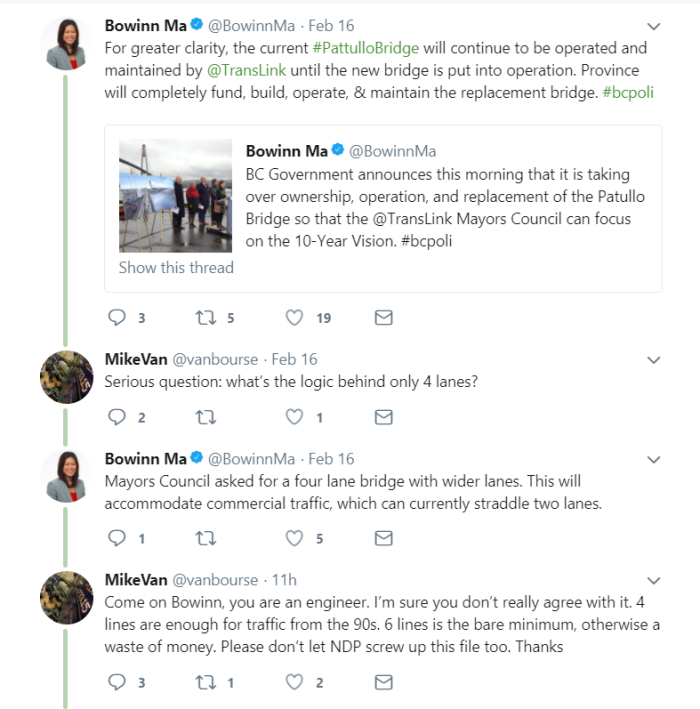
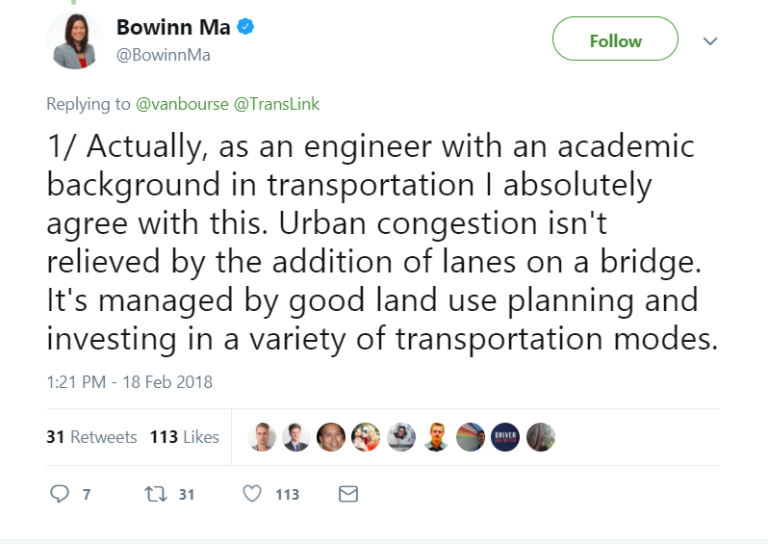
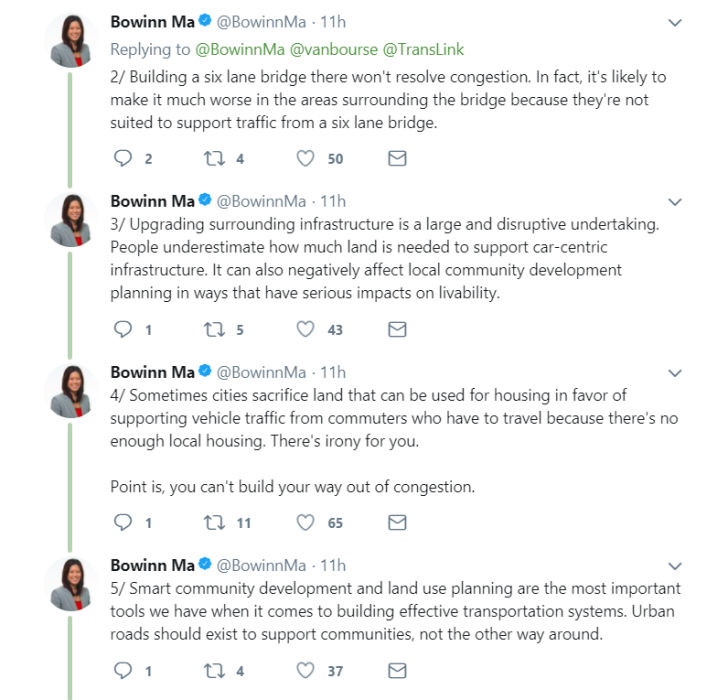
This topic also gives me a chance to give props to North Vancouver MLA Bowinn Ma, whom I was able to chat with at the Pattullo press event on Friday, and who continues to impress with her straightforward smarts and ability to engage on technical topics. It is refreshing to have an MLA speak so clearly and knowledgeably about urban transportation issues as Ma did on twitter last night:

Yep, She gets it.

Council – Feb 5, 2018

It was a report-full and public-conversation-full Council Meeting this week, with a lot on the agenda, so put on a kettle of tea. We started with an open invite for the public to comment on:

Draft 2018 – 2022 Financial Plan
This is our annual budget consultation. As required by the Community Charter, our budget must be balanced over a 5-year cycle, and there are some prescriptive reporting requirements. We also provide more information in order to make the somewhat enigmatic budget figures more understandable.

I will blog more about this in the coming weeks, but the short version of the draft plan is that general revenues are projected to go up by about $5.8 Million. Of this, about $1.6 Million (28%) is from new taxes related directly to growth and $1.3 Million (22%) is related to new fees collected mostly from supporting growth (permit and engineering fees, for the most part). Add to this a proposed 2.95% tax increase that bring in an extra $2.2 Million (38%), and a new 1% Capital Levy to support our ambitious capital renewal plan which will bring in about $750K (13%) to be directed to our Capital Reserves.

Utility rates are, not surprisingly, going up mostly due to local and regional Capital investment, from water tunnels under the river to new sewer treatment plants. We are still not sure what BC Hydro will be doing with electrical rates in 2018, as the utility predicted a 3% increase and the Premier suggested he would freeze that for a year. We will need to talk about the long-term policy implications for the City of BC Hydro creating unsustainable deferment accounts – we need to maintain our capital (including some new substation needs) and need some certainty in rates to plan for that.

We had a few people present to the plan, some sharing our concern about the infrastructure gap and the need for Senior Governments to help local governments, others with more technical questions about the numbers. We also received some written correspondence on the budget. Council moved to receive the report, and staff will now work towards creating supporting Bylaws to make the Financial Plan official.


The following items were Moved on Consent

Updates to the City’s Election Bylaws
Why has no-one told me there is going to be an election this year? As God is my witness, the fountain of information coming out of the Provincial Government has been unrelenting, with new and constantly-updating financing and declaration rules. However, these Bylaw changes are simply about making sure our local election rules comply with the Provincial regulations. There will be little change here, except the dates of the early ballots will be adjusted to avoid the polls falling on the Thanksgiving weekend when many people travel.

235 Durham Street: Heritage Revitalization Agreement Amendment Bylaw No. 7975, 2018
This HRA project has been delayed by the owner for a few reasons relating to family issues. The owner does plan to proceed, but needs some more time. As these Agreements have deadlines, Council had to agree to extend the deadlines through a Bylaw.

835 Eighth Street (New Westminster Secondary School): Proposed Redevelopment of the New Westminster Secondary School
The new High School project is rolling along, but unlike the RCH project (see below) it doesn’t need any zoning approval or anything from the City. However the City does have some interest in the transportation connections, relationship to Massey Theatre, the Moody Park Arena and Mercer Stadium. So it is good to get an update on the plans as they move along.

Mostly, seeing as we have no regulatory role, I think the City’s main desire here is to stay out of the way and let the new School get built. The one issue we needed to deal with is a triangle of land that belongs to the City but the School District wants to use for crane installation and construction staging. So we are making that happen.

406 – 412 East Columbia Street: Principles for a Housing Agreement
A developer is working on a plan to build a mixed-sue building on a vacant lot in Sapperton. It will combine street retail, office space, and purpose-built secured rental housing. To secure the potential residential units as rental for the life of the building, a legal agreement will be prepared between the City and the developer. This report outlines the principles of the agreement, and now that council endorsed the principles, staff will draft a formal agreement as part of the development review process.

Bylaw Closing a Portion of Highway – 1084 Tanaka Court
A portion of land adjacent to Tanaka Court (the road one uses to get to the Lowes parking lot in Queensborough) belongs to the City, and though it is designated as part of the road, it is only really useful as part of a redevelopment of the adjacent piece of vacant land. In order for the City to sell it, we first have to “close the road”, so it is a titled lot, or can be amalgamated on to the adjacent lot. That takes a Road Closure Bylaw.

Assuming the Ministry of Transportation approves, this Bylaw will go to a public Opportunity to be Heard. Watch your local CityPage for the announcement!

Recreation Management Software Replacement Project
Parks and Recreation are ready to pull the switch on their major registration and facility management software upgrade. This is the software used for all recreation and cultural programs and facilities rentals. Naturally, this is a big shift, but staff have been working on this for a year the new provider of the software has a solid reputation with a lot of experience at this stuff. Fortunately, they are a Burnaby-based company, and there are 22 other municipalities that use the system, so we are not all on our own here.

That said, its new software, so expect a few hiccups and a bit of time on a learning curve, but hopefully registration will soon be smooth and easy like never before!


We then had a few Reports for Action

Status of 2015-2018 Strategic Initiatives – Update
This is our new practice of receiving regular reports on the progress of many of our Strategic Initiatives for the term. This time around, we heard progress reports on these three initiatives:
Library upgrades: The Library is our second most-visited facility (after the Canada Games Pool), and hasn’t seen major renovations in a few decades. The older side of the building is from the 50’s and needs some pretty significant work done on the building envelope and stricter, aside from the need to upgrade the facility to suit modern needs. Libraries are very different places in 2018 than they were in 1958, and we have not kept up with that change. So there will be (unfortunately but necessarily) disruptive work going on in the building for the next year and a half. The ongoing plan is to only deactivate portions at a time to keep as much continuity in service as possible, so please be friendly to the staff as they make the best of a bad situation. The end result will be worth it!
Economic Development: The City has taken a more proactive role in Economic Development in the last few years, and are very fortunate to have great partnerships with our Chamber of Commerce, our two “official” BIAs and three Business Area Associations. The major thrust here is through the Intelligent City initiative to promote and retain more tech-savvy businesses while continuing to support our retail and commercial areas as the population grows. This is a never-ending job, but a solid strategy and team is vital.
Environment Strategy: It is time the City did a comprehensive review of its various environmental programs and initiatives, and provide a strong framework plan to assure we are being strategic with our priorities. There was some great initial public consultation for this program in the fall, with some new ideas, some suggestions and criticisms of the City’s current programs, and visions of a more sustainable City. We expect to see a policy document some time in late spring bringing these together.

813 – 823 Carnarvon Street: Rezoning to Allow a 204 Unit Market Residential and 66 Unit Non-Market Residential Development – Bylaw for First and Second Readings,
This is a proposed development in the Downtown Tower District that combines a Market condo tower (a little shorter than the adjacent Plaza88 tower) with a smaller tower of non-market rental suites. The organization running the non-market Tower is called PAL, and they hope to run a facility similar to one they have on Coal Harbour where seniors who have worked in the arts can live in a means-tested affordable housing building attached to the market tower.

The project will be going to public consultation and eventually to Public Hearing, so I don’t want to say too much about it until the public has a chance to chew on it. However another topic came up through the discussion of the project, and that resulted in a follow-up motion from Council.

I did, however, raise a concern about the amount of parking going into a building that is immediately adjacent to a SkyTrain Station – 275 parking spots for a 270-unit building (including guest parking and some parking to support the commercial in the podium). I think we are at a time where we can start significantly reducing the parking numbers for developments like this. Underground parking is a significant cost for developers: depending on site and ground conditions, $30,000 – $50,000 per spot. Underground, they make construction much more expensive and disruptive to the community as large excavations and de-watering projects must be tolerated; above ground, they create out-of-scale buildings with terrible streetscape.

The City has a program where developers can build less than our regulated “parking minimum”, but they must pay cash in-lieu to the City based on some formula. This program dates back to 2011, and may need a revisit, as times change and we have a new Master Transportation Plan and housing affordability issues that this should directly address. During Q&A, this developer expressed concern about the cost of building four levels of parking, and was confident they could market the condos without parking spaces – it is the City and our policies that are forcing so much parking to be built across the street from a SkyTrain.

So, we are going to review these policies (though I suspect it is too late for this specific project).

813 – 823 Carnarvon Street (Affordable Housing): Principles for Housing Agreement
This report outlines the shape of a Housing agreement that would assure the second building in this development would remain non-market affordable housing for the life of the building. If the project were to be approved, these are the conditions the City would expect the developer and not-for-profit operator to stick to.

Aside from some subtlety of language around storage space allocation and a bit of a follow-up gripe about requiring parking in a supportive housing development, Council moved to support the principles in the report.


After a report from our Police Department, some awards given to a couple of outstanding officers, and some proclamations and public delegations (I blogged a bit about a few of them here, and will talk about another on in a subsequent post), we moved onto the items Removed from Consent for discussion.

Community Mural Policy
Staff and the Arts Commission worked on a policy where the City could support community-driven mural projects on City and private buildings. It looked pretty good, but Councillor Trentadue did raise an interesting issue around how the City seems to be creating a situation where people wishing to beautify their own private building may run into a bureaucracy wall when, really, outside the Sign Bylaw, we should only be interested in mural on our own property. Council moved to send it back to Committee for a little more work prior to passage.

616 – 640 Sixth Street (Market Rental): Principles for a Housing Agreement
Similar to above, this is another proposed development that has not had Council Approval, but Staff is working to put together a Housing Agreement to secure the conditions of the Purpose Built Rental part of the development. Again, aside from a few minor language changes, Council supported the principles.

330 East Columbia Street (Royal Columbian Hospital): Rezoning to Allow Renovation, Modernization and Redevelopment of Hospital Facilities
The City has some permitting to manage as the Royal Columbian Hospital redevelopment occurs over the next decade. This report gives us some idea what is coming down the pike. It also includes a report to be used by Fraser Health and their consultants to drive the public realm designs of the buildings.

From a City perspective, I am mostly concerned about how this building integrates with our traffic and pedestrian systems. If staff and visitors of the Hospital are all going to arrive and leave by cars on East Columbia Street, none of our goals for making east Columbia a vibrant Great Street are going to be realized. It will be a disaster.

Good news is that Fraser Health and City are committed to making alternatives work, including moving the main automobile ingress and egress down to Brunette Avenue, and whatever changes need to happen to Keary Street and/or Sherbrook to support this needs to be understood early. We also need to assure the pedestrian, cycling ,and bus infrastructure on East Columbia is well integrated and makes those attractive options.

Fortunately, the initial concepts look positive, and Fraser Health is talking Transportation Demand Management to help with their own parking issues, which is a huge step towards making a new, expanded hospital support East Columbia and the livability of the entire community. Exciting times ahead.


We then, as always, did our Local Government Act Prescribed Bylaws dance:

Zoning Amendment (813 – 823 Carnarvon Street) Bylaw No. 7974, 2018
As described above, this proposal to build a two-tower mixed use residential building on Carnarvon Street, including a supportive housing component, was given two readings. There will be a special Public Hearing on March 5th. C’mon out and tell us what you think!

Council Procedure Bylaw Amendment Bylaw No. 7986, 2018
Local Government Elections Procedures Bylaw No. 7985, 2018
Automated Voting Machines Authorization Amendment Bylaw No. 7994, 2018
These three Bylaws to adjust our Council schedule, make some necessary changes to our Elections Bylaw to meet the new Provincial laws, and to authorize the voting machines for the 2018 Local Government Elections were given three readings.

Heritage Revitalization Agreement (235 Durham Street) Amendment Bylaw No. 7975, 2018
As described above, this Bylaw to facilitate a request for a time extension for a homeowner to do their heritage restoration work was given three readings.

Tanaka Court Road Closure Bylaw No. 7991, 2018
As described above, this Bylaw to close an unused portion of the Tanaka Court right-of-way was given three readings. There will be an Opportunity to be Heard scheduled once the Ministry of Transportation and Infrastructure is given us the green light.

Corporate Record Management Bylaw No. 7987, 2018
As discussed last meeting, this update to our procedures for record retention, destruction, and transmission to our permanent archive was Adopted. It is now the Law of the Land. It should be fun seeing what comes out of the deep file search of some of our very old Bylaws and they are transferred to digital.

Zoning Amendment Bylaw No. 7953, 2018: Passive Design Incentives for Single Detached Zones
As discussed last meeting, this Zoning Bylaw amendment that will provide modest incentives for the building of more energy efficient homes in the community was Adopted. It is now the Law of the Land. Adjust your thermostats appropriately.


We then had some New business</> coming out of last week’s notices of motion:

Motion on Notice, Umbrella Cooperative
This is a not-for-profit operating a community health clinic in New Westminster specifically developed to support people with language or cultural barriers to public services. They could use a little help and the City is formally asking the Province ot help them out, and to provide for more of this type of service to our new residents.

Motion on Notice, First Nations Representatives on Committees
The City is working on a diversity mandate for Council Advisory Committees, and I think it is important that First Nations representatives (be they from local or regional First Nations, or people who live in our community and have lived the Indigenous experience, regardless of their tradition territory) is an important part of that. We will make sure there is a mechanism in place for next Committee Recruiting season to make this happen.

Happy Family day everyone. Pop by the Anvil Centre, as there will be many things happening!