Ask Pat: Jamieson & the C3

Someone asked—

I live at Jamieson Crt and currently catch the C3 at the bottom of my complex. It also drops me off there on my return. I am worried this stop will be eliminated. Is this there any indication that this might happen? This is a very convenient spot for folks to board the bus. I hope this spot will remain as is.

I talked about this in a previous post, and it seems the C3 as we know it is going away. If you used the C3 as a direct route up to Canada Games Pool, then you will potentially need to take the C9 to Columbia Station, then switch to a “J” to get you Uptown. If you used it to get to Columbia Street downtown, your route just became more direct.

TransLink floated the idea of completely removing the Jamieson Court stop, and I asked them at Council on November 2nd to please reconsider this, for reasons I outlined in the post I link to above. The stop on Jamieson is useful for a few destinations popular with seniors, and the crossing at Jamieson and Richmond is not great for pedestrians, especially those with mobility issues. We do not yet know if that request (made by others as well, I hope, through the public engagement that ended in November) had any effect. I have not heard any further, but the TransLink system maps on this page “Effective from January 4, 2016 to April 10, 2016” show Jamieson still an active stop for the C3 and C9, and the C3 on existing route, so the changes are probably not going to occur until later in the spring.

If you and your neighbours have concerns about the Jamieson stop being lost, especially as they relate to safety of seniors trying to get to Richmond street, please make sure everyone lets TransLink know. You can contact them at this link. I would categorize this as a “suggestion”, and make sure to ask for a response.

Ask Pat: Trees!

Two Ask Pats in one! Both of these questions came in about the same time a while ago, and one I have already personally answered at a public event, but they are a common theme, so here goes:

Someone asks—

does Queensborough landing area require tree cutting permit to remove tree on edge of city and private properties?

Depends. If it is on their land, they can cut it down. The City does not have a tree protection bylaw for private property, something I have complained about in the past. We do have a Bylaw that makes it illegal to cut or damage trees on City property without the City’s permission. We can fine you for that, and make you replace the tree.

Wes asks—

Hi Pat, why in light of the City’s recognition of the importance of an Urban Forest Strategy did Management and Council strip out budget for the city arborist to plant any new Boulevard trees this year? Seems totally counterintuitive.

Because we probably weren’t aware, and because it made sense at the time.

The annual budgeting process is large and complicated, and Council needs to rely on senior staff to make decisions about their annual needs, based on a set of priorities set out by the Council.

It would be unusual, and not very useful, for any individual Councillor to go through every single budget line and decide “a little more” or “a little less”. If every Councillor did this, it would be chaos. The budget documents we need to review come in three-ring binders, the massive 3-inch ring types, and are printed double-sided. Every change to one line results in sometimes obscure changes to other items, with compounding effects over multi-year budgeting cycles. Relying on senior staff from multiple departments to distill this info is required.

That said, as a Council we asked Parks, Culture, and Recreation staff to reduce some of their spending last year from what they requested, in part of the effort to get the annual property tax increase reduced from a draft 2.42% in February to the to 1.96% we approved in April (and yeah, there may be some politics to that idea of “keeping it under 2%”).

I do remember having discussions about the reductions in some spending on Parks Maintenance staff (which I voted against) as I remember joking that if we paved all of the green space, it would then be Engineering’s problem to pay for it, and Parks would be off the hook. I also remember at the time staff being asked to dig deeper for some operational savings related to this. We did, at the time, discuss Council’s expressed desire to improve the amount and quality of our green spaces in the City, and how this wasn’t being reflected in the budget. However, I doubt it was ever expressed to us that no trees would be planted in 2015.

The good news is that this does not mean that no trees would be planted in 2015. Parks staff recognized that they had a bit of a backlog of unplanted trees. These are generally trees the City receives as part of the contributions of various developers (if a developer is required to put trees in front of their property on City land, they just pay the City to do that instead of doing it themselves) and other sources. We also (I am told by staff) had a bit of catching up to do in regards to tree maintenance across the City, so this freed up some staff time to do more pruning and other tree maintenance activities.

The City plants something north of 200 trees per year on average, but the early work being done to help develop an Urban Forest Management Strategy tells us this is not enough to maintain a healthy urban forest. Expect to hear more in the New Year, but the City is going to need to ramp up its plantings, and do more to encourage the protection of trees on private property, if we want to change the trend of an urban forest continuing to erode.

Council – Dec 7, 2015

Another week, another very late Council report. Sorry, but Theresa McManus sits through our sometimes interminable meetings, and I like when she gets the scoops! No, actually, in reality I have been busy with events, some political, some Christmassy, all much fun (except for the public meeting from which I was given the bum’s rush, but that is another story for another time!)

The final Council Meeting of 2015 began with Council passing the following items on Consent without discussion:

Preamble: many topics this week are around the various Community Grants the City awards to various groups in New Westminster for various purposes. All of these grant funds exist within a Terms of Reference, and a pre-determined budget. Each grant fund has its own committee that recommends to Council how the budget should be allocated, based on how their application meets the term of reference provided to the Committee by Council.

That said, ultimately, the decision on funding resides with Council. I really appreciate the work these committees do, and any changes that Council make to the recommended grant allocations represents either a failure of Council to set a Terms that properly reflect their desires, or an introduction of new information by Council that the Committee did not have access to (i.e. that the entire Grants budget was not awarded).

2016 Child Care Grant Committee Recommendations
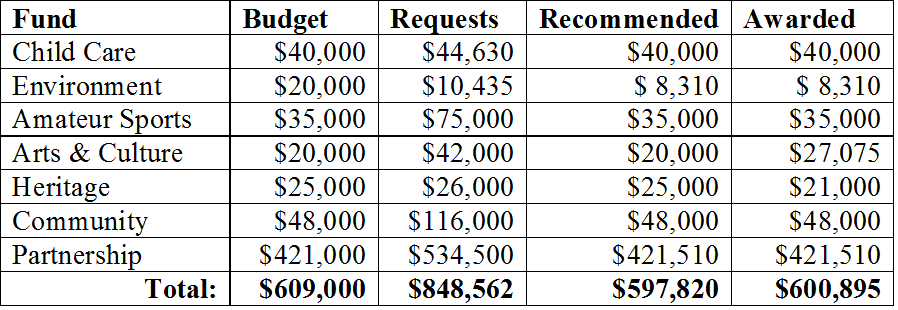
This Grant has a $40,000 annual budget, and just under $40,000 was granted (of $44,630 requested) to support the needs of 295 children. Of course, that is not a good measure, because the grants are not for operations, but for capital projects that enhance childcare spaces and create an ongoing legacy, potentially helping thousands of kids in non-for-profit daycare across the City.

2016 Environmental Grant Program Recommendations
Only $8,310 was granted this year from $10,435 in requests, and out of a budget of $20,000. Let this be a message to burgeoning environmental groups or those with an idea to improve the City’s sustainability – there is more grant money available next year!

Information Access Principles and Guidelines
Move recommendation

Recruitment 2016: Appointment of Chairs to 2016 Advisory Bodies
This is the assignment of Committees for the members of Council. Not much has changed from last year. I chair two committees (ACTBIPed, Access Ability Advisory), Co-chair one (Environment Advisory), serve as Council representative on one (Youth Advisory), and am a member of three Task Forces (Public Engagement, Transportation, and Canada Games Pool Replacement).

Community Heritage Commission Amendment Bylaw No. 7808, 2015
The Heritage Commission is a Council advisory committee. This recommendation is to adjust the terms of reference such that the two-year terms are staggered between two groups of appointees, to create some continuity. An easy thing to agree to.

Arts Commission Amendment Bylaw No. 7809, 2015
This is the same change as with the Heritage Commission, staggering two-year terms to create more continuity.

Information Access Principles and Guidelines
After some public consultation ,we are moving forward with developing policy improvements to how the city manages our Freedom of Information files. The City is moving increasingly towards easier access and more openness of our data, which is a good thing.

Tenant Relocation Policy
This report came out of a request I made a few months ago for Staff to update Council on how well we are protecting the affordability and accessibility of rental housing in New Westminster. We have a Secured Market Rental Housing Policy which is helping us get more rental housing built as we battle against regional shortages. We also have an Affordable Housing Strategy that works to develop supported affordable housing options. However, we have a vacancy rate of about 1.3% in market rental housing, and as new rental buildings replace some of our aging rental stock, the rents increase significantly, with average rent for a building built after 2000 almost double that for a building built before 1980.

The challenges here are plenty. Rental stock must periodically be replaced, as aging buildings do not provide the safety, the energy efficiency, or the durability of newer buildings, and become more expensive to maintain at the same time as their value to renters becomes reduced. Still, there are instances where people live in the same rental unit for a decade or longer and truly establish homes in rental buildings. Forced removal, by renovation, by development, by demolition, is incredibly disruptive to their lives. Seniors are the most vulnerable, although young families with limited incomes suffer from stress as well.

I would like an evaluation of whether the policy can provide higher levels of protection to longer-term tenants, and what the implications are if we include this in a policy… will we disincentivize longer-term rentals, or are protections in the existing Residential Tenancy Act enough to prevent that kind of blow-back in policy?

I also want to have a little better understanding about how the tenant relocation and eviction process would dovetail with a typical Rezoning or HRA, where the review process and Public Hearings and bylaw implementation can take 6 months or a year. Does that get included in notice, and how to we sensitively facilitate the communications between landlord and renter over what can be a year-long process?

I see this policy as supporting an updated tenant relocation strategy, similar to those adopted in Vancouver and North Vancouver, but recognizing some of the unique characteristics of New Westminster, where we have a large stock of aging rental buildings, and where much of other rental stock is found in non-purpose rental and less formal arrangements like secondary suites. This is fundamental to the livability and affordability of our City, and am happy staff is continuing this work and bringing back a developed policy to Council early in the New Year.

Zoning Amendment Bylaw No. 7781, 2015 to Zoning Bylaw 6680, 2001
to Permit Commercial Storage Lockers in the C-4C Zoning District

There are a set of storage lockers in Plaza 88 near the loading bay on 8th Street, which have turned out to be not useful for the commercial or residential users of the building complex. The owner of the building would like to convert them to commercial storage units, which requires an amendment to the Zoning Bylaw to permit that type of commercial operation.

Animal Shelter and Tow Yard Facility – Task Force Recommendations
The City is building a new Animal Shelter, and is integrating it with a move of our tow yard to create a single civic facility in Queensborough under the Queensborough Bridge. This is part of our long-term strategic plan, and will be paid for by some strategic land sales as part of our long-term capital plan. The task force has been working on this for quite some time, I’m glad to see the City moving forward on their recommendations.

The meeting then proceeded with an Opportunity to Be Heard:

DVP No. 601 for 109 Third Ave
This Development Variance Permit is required to allow a resident to pave a thin strip of their land so that there is smooth asphalt between their three-car garage and the adjacent alley (which is, like many alleys in New Westminster, a named street, in this case, Emory Street). The zoning only allows paved driveways to be certain widths, and this is technically a “driveway” that exceeds that width, although it is only a foot or so long.

We received one piece of correspondence supporting the DVP, and no-one came to speak against it. Council moved to support the DVP.

We then had a presentation from folks at Fraser Health to talk about the first stages of construction work at RCH, which includes the moving of the Helipad. Following this lengthy discussion, we wanted to delay the conversation about Grants until after the Public Delegations, we launched into other parts of the agenda including:

Recruitment 2016: Library Board Appointments
This is an approval of the recommended new members of the Library Board. Welcome, new volunteers.

DNA funding
This is a follow up to a recent federal decision to download the funding for DNA analysis to local police forces, and the unwillingness of the Provincial Government to step up and fill the gap. Police costs come right out of your property taxes folks, and this will add to that burden.

Commercial Storage Lockers Zoning Amendment Bylaw No. 7781, 2015
As discussed above, this Bylaw received two readings.

Community Heritage Commission Amendment Bylaw No. 7808, 2015
As discussed above, this Bylaw received three readings.

Arts and Commission Amendment Bylaw No. 7809, 2015
As discussed above, this Bylaw received three readings.

Inter-Municipal Business License Agreement Bylaw No. 7794, 2015 and
Inter-Municipal Business License Agreement Bylaw No. 7795, 2015

As discussed November 30, these Bylaws were Adopted. It is now the Law of the Land, please adjust your behavior appropriately.

Demolition Waste and Recyclable Materials Management Bylaw No. 7660, 2014
As discussed November 30, these Bylaws were Adopted. It is now the Law of the Land, please adjust your behavior appropriately.

After a short recess and some Public Delegations, we continued covering items removed from the consent agenda, which again launched us into talking about Grants.

2016 Amateur Sport Fund Committee Grant Recommendations
This grant is totally covered by two endowment funds, one from the Canada Games (1973!) and one from the Casino. More than $75,000 was requested, and the full allotment of $35,000 was awarded. This works out to about $10 per athlete for 3,500 amateur athletes over 10 different sports.

2016 Arts & Culture Grant Recommendations
I needed to remove myself from some of this discussion because @MsNWimby is the treasurer of the Arts Council, and filled out a lot of grant forms for them. Regardless, there was $42,000 requested from a fund of $20,000. After some compelling delegations Council decided to expand the granting envelope here and add $4,500 for the Royal City Musical Theatre request, and $2,575 for the New Westminster Symphony request.

2016 Heritage Grant Program Committee Recommendations
This grant allocation is $25,000, and we had $26,000 in requests. Uniquely, one organization was granted $4,000 more than they requested, which rubbed a couple of Councillors the wrong way (including me). So instead of granting them the $14,000 recommended, we dialed that back to $10,000. In total, we ended up granting $21,000.

2016 Community Grant Recommendations
There as a budget of $48,000, all awarded, from requests totaling almost $116,000. The recommendation was followed.

2016 City Partnership Grants
Again, there were some Arts Council requests here, which means I had to remove myself from that part of the discussion. This is the big one – $421,510 was awarded from a budget of $421,000, and there was $534,500 in requests. Some are multi-year agreements.

So after all is said and done, we came in a little under budget on Grants, but still awarded more than $600,000.
table

At that point, the meeting was all over but the singing. We Wish you a Merry Christmas, indeed.
Council – Nov. 30, 2015

The council meeting on November 30 was a little different in format, and it appears we are still working out some bugs of the post-Committee of the Whole era for New West Council. Part of the reason for the change of formats was to provide more time for open workshop-type discussions where we can dig into larger issues though a public discussion, the other was to try to push more of our day-to-day business discussion into the evening meeting, instead of doing it as a Committee of the Whole.

This week’s agenda had such an Open Workshop that ended up looking very much like a committee of the Whole meeting, including items passed on consent – not really the purpose of a workshop. We also had a remarkably light agenda including the Public Hearing and Workshop materials, so I may as well report on what talked about at all three meetings.

Workshop:

The New Media Gallery First Year
I’m not afraid to admit I am a big fan of the New Media Gallery, although I was at times wondering how it was doing as far as crowd-draw and regional impacts. Looking at the report, it is clear the answer is very good. Compared to any other regional publically-run Art Gallery (with the exception of the Vancouver Art Gallery), the NMG is pulling big numbers, and operating on a lean budget. The fact we are pulling in internationally-famous artists when the gallery is so new and limited in budget is a real testament to the knowledge and talent of Sarah and Gordon, our exceptional directors.

You should take the time to go to the NMG, it is free to enjoy for everyone, and open to all ages. The current show “the Scary”, and despite its title, looks pretty appropriate for all ages to me. I find a great way to enjoy the NMG pieces are to go in without a guide, and just sit and try to figure out what is going on. Some pieces seem very straight-forward, others completely baffling. After spending some time setting your own notions, you can have the host provide you a walk-around tour, which will usually change what you thought was straight-forward, and open up some of the things that didn’t make sense to you at first pass. It is a fun way to spend an hour opening up your mind. I’m really happy it is so successful. The fact it often challenges what I interpret as “Art” leads to the next topic we discussed in Workshop…

Public Art Workshop
This report brought us into a discussion about how the City’s Public Art program operates, and more specifically, what the role of the Public Art Advisory Committee, our professional Cultural Services Staff, a Public art Selection jury, and Council play in determining how our public art budget is set up.

In earlier discussions, I think I have made my position pretty clear on this (and I am digging deep into personal opinion here, speaking only for myself, and willing to hear counter-arguments). I think Council should approve themes, ideas, concepts, and budgets, but we should not be the final say on which pieces of Public Art are selected. I was not elected for my art criticism skills, and art, by its very nature, should challenge what we think we understand about aesthetics, about communication, and about community. To have 7 politicians look at something created by a professional and curated by a jury of professionals who were presumably provided clear conceptual guidance, and have those Council members “I don’t like it” is to undermine the professionalism of those persons so charged, and to have Council say “…therefore we won’t have it” opens the doors to all kinds of censorship and other issues. Sometime good governance is being able to step back and let people do their jobs.

I want our Public Art to be interesting, challenging, and iconic. To get there, it sometimes has to push the community out of its comfort zone. If given a choice between two pieces, one that Council unanimously endorsed, and one that Council turned down 4 votes to three, I can tell you which of the two would generate more interesting conversations and push the discussion of artistic expression into the daily conversation. It would be a shame if this or a future council, were to recommend against something for fear of facing some negative public reaction. Ironically, the best way for us politicians to avoid being in that situation is to rely on our professional staff and the jury of art professionals, with the guidance of our Public Art Advisory Committee, to determine what best fits the needs of the piece, the location, or the concept.

I have to admit, the WOW piece looks a lot better in context than it does is photos (or it did as concept drawings), and although I could not envision it, I supported the process that got the City to approving it over the last year or two, and I appreciate the positive and negative feedback I have received since it was installed. It makes a statement, it challenges our idea of aesthetics, and it created a new visual icon on our waterfront. It works.

Temporary Use Permit for Extreme Weather Response
There is an Emergency Shelter set up in Downtown New Westminster which is activated when the weather gets such that it seriously threatens the lives of people who are living outdoors (extreme cold, snow, protracted heavy rain), The permit for this site must be renewed every three years, and Council moved to renew the license.

Councillor Puchmayr further raised the issue that the hours of the shelter do not coincide with other social services in town, and asking about the potential to expand shelter hours so that in the worst of conditions, people at risk don’t have to spend a few hours every morning with no-where to go, exposing them to potentially hazardous conditions. Of course, funding and programs are stretched, but we need to find these opportunities to improve what services we provide.

There were also a couple of items that we, paradoxically, passed by Consent as part of the Workshop:

Anvil Centre Capital Budget Update
This is an administrative shuffling of budget amounts. There were several things at the Anvil fit-out that cost more than expected (AV system installations, LEED certification, etc.) and to pay for them, several other things (Installation of corridor, dishwasher upgrades, storage space modifications, etc.) were put off until future capital budget savings or a new allocation of capital funds.

Youth Advisory Committee Amendment to TOR
We agreed to adjust the Terms of Reference for the Youth Advisory Committee to include one more person, a returning member of last year’s YAC who made great contributions in the community and would make a great mentor for the new YAC members.

The evening’s meeting began with an Opportunity to be Heard on the topic of ne Inter-Municipal Business License Agreement. I mentioned this in a earlier report, where were are working with adjacent Cities to align our business licensing for building trades and contractors, such that it is easier for these businesses to work across municipal boundaries, but each City’s business license costs are still covered.

No one corresponded with the City on this issue, and no-one came to council to delegate on the topic, so we referred the two enabling Bylaws to Council for Third Reading.

The Public Hearing began at 6:00 sharp, with a single project up for discussion:

This is a townhouse development in Queensborough at the Corner of Boyd and Stanley Streets. This is essentially the western end of the higher-density part of the Queensborough west of Boyd Street, and is in compliance with the larger Queensborough Community Plan. It will have 80 townhouses, all 2- and 3-bedroom, averaging over 1,200 square feet each, with some green space in the block, special design considerations (double drywall, higher-buffering windows) to reduce the impact of nose from the light industrial area to the North (which, in the case of the way the Port manages its “industrial land”, means a truck warehouse, which will not generate a lot of noise other than truck traffic), and an established buffer between the buildings and the adjacent Riparian Management Area protected watercourse.

The Community Plan supports it, the Design Panel supports it, the Advisory Planning Commission supports it, the Queensborough Neighborhood Association supports it, the Port opposes it, and no-one else wrote or came to Council to speak about it, so I have no reason to oppose this project.

The Regular Meeting began right after the Public Hearing, and began with the Zoning Amendment Bylaw coming out of that Public Hearing:

Zoning Amendment Bylaw No. 7796, 2015
As mentioned above, this is a townhouse development in Queensborough at the Corner of Boyd and Stanley Streets, and Council passed Third Reading of the Bylaw.

This was followed up by several other Bylaws:

Inter-Municipal Business Licence Agreement Bylaw No. 7794, 2015
Inter-Municipal Business Licence Bylaw Amendment Bylaw No. 7795,
2015.

After referral at today’s Opportunity to be Heard, these Bylaws were given Third Reading.

Delegation Bylaw No. 7176, 2015
As discussed on November 16, This Bylaw was adopted. It is now the Law of the Land, please warn your neighbours and friends.

Development Cost Charge Expenditure Bylaw No. 7797, 2015
As discussed on November 16, this Bylaw was adopted. It is now the Law of the Land, please warn your neighbours and friends.

Engineering User Fees and Rates Amendment Bylaw No. 7798, 2015
As discussed on November 2, this Bylaw was adopted. It is now the Law of the Land, please warn your neighbours and friends.

Which bring to the end a very short meeting of New Westminster council.

Inconvenient Thesis

I’ve mentioned the Gish Gallop before, in how it is used by the disingenuous to cast doubt on the scientific certainty that the observed recent increase in warming of the planet is caused by the introduction of fossil carbon to the atmosphere by human activity. I even opined that the Gish Gallop is the mark of someone who knows they are being disingenuous, because its use knowingly belies intelligent discussion of the topic or useful exchange of ideas.

I have also written several retorts and taken pot-shots at Tom Fletcher, because he is, in my opinion, the most ignorant, belligerent, lazy, and cynical columnist claiming the mantle of journalism in British Columbia today (and there is an ongoing battle for that low ground) while being unexplainably ubiquitous in small town media across BC. Misinformed and regressive opinions are one thing, but when combined with terrible rhetorical skills and piss-poor writing, it is pretty unforgivable that Fletcher still draws pay from the ever-shrinking dead tree media. I have not agreed with a P.J. O’Rourke opinion since I was an 18-year old, hemped up on hormones and car magazines and the smart-ass-conservative-white-dude-certainty they reinforce, but at least O’Rourke can turn a phrase and make me laugh while I disagree with him. Fletcher just makes me weep for a societal system that gives him a forum.

One thing they teach you in high school English class (and sorry to get all academic elitist here) is that an essay needs to have a thesis – in the OED sense of “a statement that is put forward as a premise to be maintained or proved”. In other words, before you sit down to write something, you need to understand what you are trying to say. For example, the thesis of this blog post started out as my strongly felt personal opinion that:

“Tom Fletcher is a hack journalist whose opinions are ignorant to the point of insulting his readership, whose writing skills are subpar, and whose continued employment as a columnist by Black Press represents an injustice to the many skilled and determined journalists currently suffering underemployment from the collapse of traditional media model, while also supporting the theory that this collapse is a result of wounds self-inflicted by the very media platforms that are suffering most from the collapse”.

Although, in the interest of brevity, I might have to reduce the scope of this thesis to the first 5 words.

The piece of evidence that led me to write an opinion essay on this thesis is Fletcher’s most recent Black Press missive, entitled “Inconvenient truths of climate change”. I challenge you to put a single-sentence thesis on this column that is supported by the column. Is Fletcher arguing that polar bears are fine, and therefore the climate is not changing? Is he arguing that the COP21 talks are doomed to failure, or that, because of the “religious zeal” of climate change profiteers, they should be doomed to failure? Is he arguing that BC was wrong to put in a carbon tax and reduce emissions while growing the economy, or that BC were previously leaders who are now failing because the economy is growing despite the existence of a carbon tax? Or is he arguing that Barack Obama’s failure to meet some of the aspirations he expressed at his inauguration should be a lesson to Justin Trudeau to just give up?

The column comes across as a Gish Gallop of disconnected factoids bereft of context, leading one to suspect that introducing context to any of the factoids would prove most of them to be less representative of the truth than a typical YouTube video comments stream. By introducing a little context, or at least a coherent narrative, perhaps Fletcher could get the column past the entire “old man sitting on a porch shaking his fist at passing clouds” aesthetic. Although, one could suppose that was the position he was actually aiming for. I can’t imagine his motivations, only marvel at the results.

Large parts of the old media are dying, at least in part because of instant accessibility to a huge variety of new voices and more interesting approaches to content delivery that are simply out-competing the dead tree press for time, for eyeballs, and for advertizing money. Smart companies are adapting to this change and not just taking the same stale product on-line, but are re-investing in quality of content, giving people a reason to look at what they are producing. Other companies are just pushing their old, tired concepts onto digital platforms, hoping that enough flashing lights along the edges will make their tired content seem new, and the pop-up ads will be attractive to the people who pay the bills. In the quest to appear “interactive” they have created unreadable comment forums attached to articles, that soon degrade into nonsensical collections of disconnected uninformed factoids bereft of content or self-recognition, interspersed with cynical drive-by insult-by-implication.

In other words: a typical Tom Fletcher column. They should be treated with the same deference.

Ask Pat: Dontenwill Hall

Someone asked—

Hey Pat, I was driving down Agnes Street the other day and was checking out the progress on the restoration of the old Dontenwill Hall (336 Agnes) and remember reading in your April 3 post that you support the proposed HRA for this redevelopment, which provided some concessions to the developer as a means to ensure that survival of this ” the historically important building”. The thing that struck me as odd while I drove by was the recent installation of Vinyl windows and addition of a huge A/C unit on the front roof. Being under an HRA, shouldn’t the exterior materials used be in keeping with those available at the time of construction and should not there be reasonable attempts to place mechanical systems so that they do not affect the street appearance of the building?

This is one of those topics of which I don’t know much, so I need to do more research, and rely on the opinions and suggestions of our staff and the external experts who do know more.

The conditions of the HRA are outlined in the agreement,  which you can read as part of the agenda of the March 3o Public Hearing. The only thing in that agreement that directly references the approach to restoration is this clause:

Upon execution of this Agreement, the Owner shall promptly commence the preservation, rehabilitation, and restoration of the Heritage Building (the “Work”) in accordance with the “Dontenwill Hall – Heritage Conservation Plan” prepared by Pattison Architecture and dated August, 2014, a copy of which is attached as Appendix 2 (the “Conservation Plan”).

Which makes the appended Conservation Plan the document with the details to how the City and proponent have agreed to do the restoration. In there, it appears there were some 1990s vinyl windows that were allowed to stay as they were in good condition and structurally sound, however the agreement states that if those windows ever need replacing, they will need to be with period-appropriate wood framed units. I suspect cleaning them up and fixing up around them might make them look like new units, but I have been assured they are the existing ones.

The air handling system isn’t really covered in the HRA, as there is no reference to it in the Restoration Plan. Apparently, it came later in the planning. This is part I had to check into, and apparently there is a plan to do some screening of the units, but there is a bit of devil in details here. As the HVAC upgrades are not strictly related to the exterior renovation (which is what the HRA secures), and there are building permits and code requirements in regards to air handling that definitely did not exist in 1940, there needs to be a bit of  wiggle room in the final design if we want the building to be functional. Long and short, the HVAC unit does not violate the terms of the HRA, but the “spirit” of the HRA would support screening them to make them blend in better.

Note, the hall is still a “work in progress”, so we should wait to see how it all turns out.

Bugs in my compass

I had a slightly different commute schedule last Wednesday, in that I had a morning meeting in one of New Westminster’s western suburbs, and had one of those multi-leg trips to work. Instead of riding my bike or joining my carpool partners, I took the SkyTrain on all three legs.

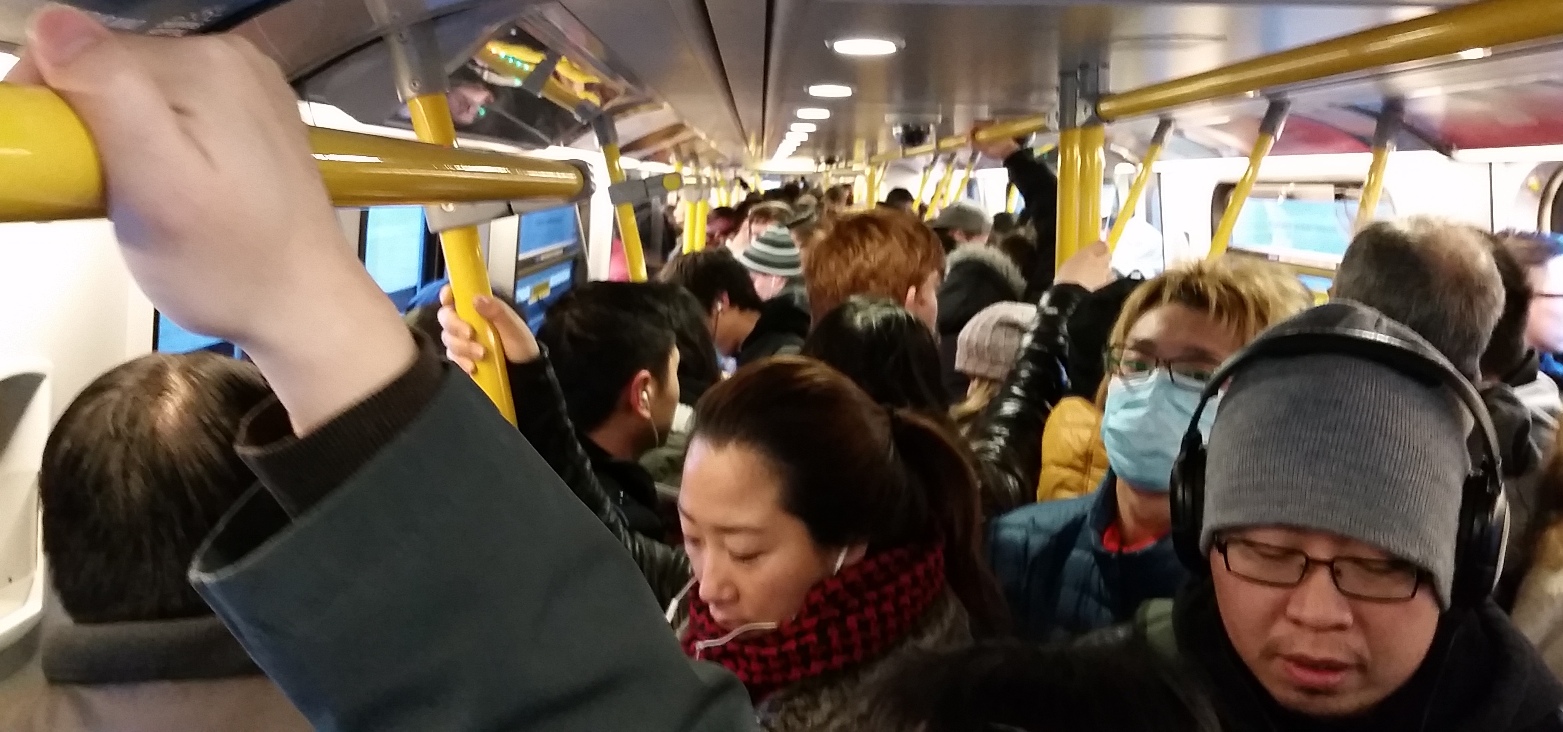
My transit commuting is irregular enough that FareSavers have been the most logical and economical way to pay. Since the FareSavers have become about as rare as white rhinos, I have been buying tickets at the kiosk, pretty much because that is the pattern I have fallen into. On the first leg of my Wednesday journey, I reflexively bought a 2-zone ticket and although I noticed a few weeks ago that the new tickets are essentially disposable Compass cards, it took me one of those overstuffed train moments of self-realization to ask: why the hell haven’t I bought a Compass Card?

My thinking place
My thinking place

So on the second leg of my journey, after my meeting in that distant western suburb (I like what they’ve done with the place, not sure why anyone would want to live there), I popped for the $6 deposit and a nice float of $60. The number seemed to me prudent: large enough that it will keep me for a little while as I try out these new-fangled ideas, but not so large that I will hate the world when I inevitably lose it. Tap In at Waterfront; all good.

My first problem was at Brighouse. Like many of my cohort, I was riding with earphones, listening to a Skeptic’s Guide to the Universe podcast, and as I left the station and performed my first Tap Out, I was uncertain if I heard a beep. Actually, I heard multiple beeps, as people were tapping in and out all around me, but did MY kiosk beep? I think so, and with people behind me rushing out of the station to the busses, I didn’t want to break momentum to make sure. Even if I did, would Tapping Out twice somehow mess the system up, and count as re-entry? When did I become so old that new technology confuses me? Was it before or after I completely lost touch with popular music? Is Beyonce still a thing?

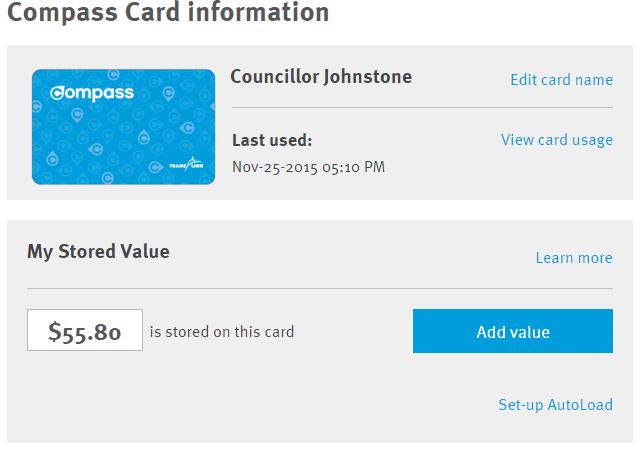
Fortunately, I can go on-line to see the status of my Compass Card. To do this, you need to set up an account, and aside from the frustratingly archaic, patriarchal and gender-normative mandatory “Mr/Mrs/Ms” data field (really, TransLink? It’s 2015), the interface was easy enough for gramps like me to navigate. I was able to confirm that, sure enough, the Tap Out didn’t take. My card balance showed $55.80, meaning I was charged the FareSaver Rate of $4.20 for a three-zone ride, instead of the $3.15 FareSaver Rate for a 2-zone ride. To fix my Tap Out mistake, I needed to call the 1-800 phone number, which launched me on yet another metaphysical debate about whether that hassle was worth $1.05 of my time.

I go through life like this, folks. It is harrowing.

Being interested in taking the ride to see where it goes, I did nothing. After work I once again hopped on transit, this time Tapping In at Brighouse Station at 5:10pm (90% sure it beeped for me), Tapping Out at waterfront at about 5:45 (70% sure, as the exit from Canada Line at Waterfront is a serious traffic pinch point that I am still certain will be the failure of the entire FalconGate Fiasco), Tapping In again across the lobby at Waterfront (100% sure, as the FalconGate was operating), and Tapping Out again at Columbia Station at about 6:15 (lets put this one at 95%). I made it to my 6:30 meeting at City Hall just in time. Thanks TransLink!

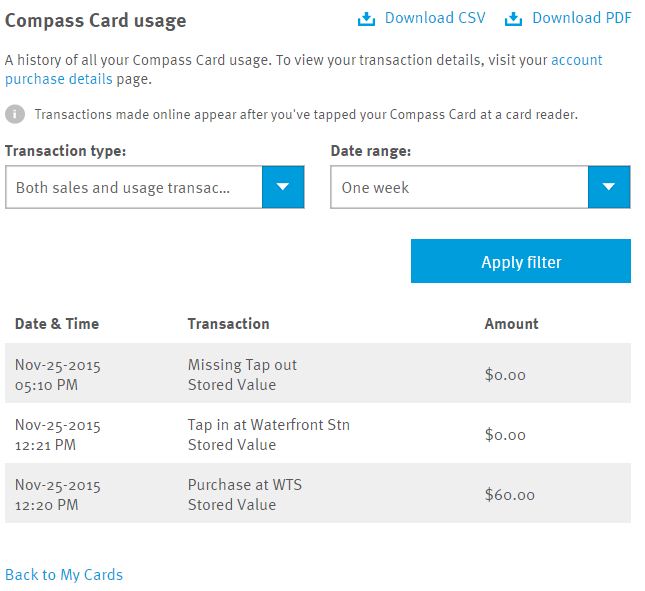
Curious to see how all of this activity showed up on my card, I logged on (after resetting my password, because who remembers those things?) and this is what I get:

Capture

Clearly, Compass is confused, or I really need to work on my tapping skills. My 5:10 Tap In was apparently registered, as it appears to have made the system aware I didn’t tap out, but none of the subsequent taps was registered. Fred Astaire I am not. As far as tracking my movements, we have a 2 for 6 on Taps. I suppose the two Waterfront taps cancel each other out, I’m surprised it didn’t catch me leaving Columbia Station. The good news is:

Capture2

The confusion of my movements has resulted in TransLink charging me for one three-zone trip, and not for the two 2-zone trips I made, so I guess I am $2.10 up on the deal.

I hasten to note this problem is very likely to go away once the FalconGates are fully operational, as it will be pretty much impossible for you to miss a tap-out. The current bugs in the system should probably be expected, and at least there is a method for you to receive a refund in the case you get overcharged.

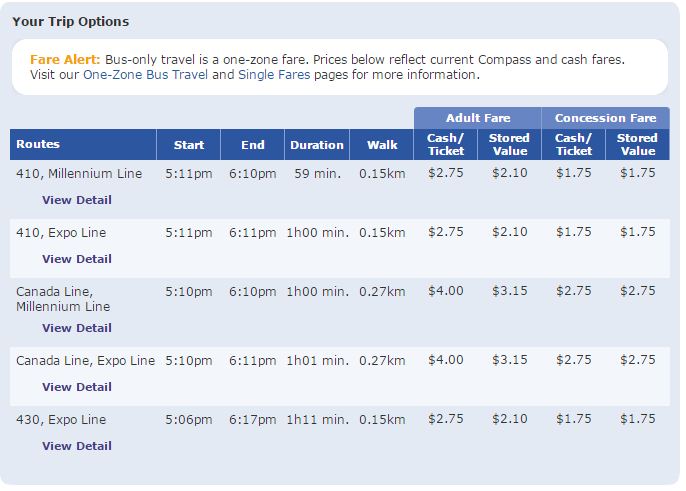
As an interesting aside, I have two travel options on transit getting from my work to New West. I can take the Canada Line to Waterfront, then SkyTrain to New West, or I can hop on the 410 bus to 22nd Street station then one stop on SkyTrain. Both take almost exactly the same time, one hour station-to-station. I have always chosen the SkyTrain because it is more comfortable than the 410 bus and (traditionally) more reliable as it doesn’t get stuck in the east-west-connector single-occupant-vehicle Stockholm-syndrome traffic-radio-reality-program plebiscite-free fustercluck that our regional transportation system is becoming.

However, now that we are in the Compass world there is another difference:

Capture3

The ride on the bus will cost me $2.10 with my loaded Compass Card, the Train ride $3.15. If I was a daily commuter, that would be a difference of more than $500 a year. This makes me wonder if people will actually engage in this type of “toll avoidance”, trading convenience and comfort for a few dollars a day.

Ask Pat: Whistle cessation?

Sleepless asks—

What is the deal with the downtown train whistle cessation program?

In early 2014, it was announced that an agreement had been reached with the railroad companies and that trains would stop whistling downtown as soon as the crossings are upgraded.

In mid-2014, councilor Puchmayr mentioned at a Downtown Residents Association meeting that the only thing holding back whistle cessation downtown was backordered equipment for the Fourth and Begbie St crossings, and that the upgrade work was expected to be completed “within a few weeks”.

A year later, in your May 25, 2015 Council Meeting report on this site, you mentioned that the target for whistle cessation downtown was now September 2015.

I just saw an update on newwestcity.ca, dated August 2015, which gives a new date of “end of 2015” for downtown whistle cessation.

So, what is the hold-up? Why is a simple crossing upgrade taking so long? Why does the target date keep getting pushed back? Is there any hope of the whistles ever stopping?

Of all those sources, I would trust the most recent one. The problems across the many crossings in the City are complex, and there are some crossings (Spruce Street and Braid, especially) where the issues may be unsolvable in the short term, but that is not true for Begbie and Fourth.

The best update I can give you is this one from the summer that you mentioned, but I am not on the Rail Committee, so there may have been developments since then.

The City really hoped to have the Begbie crossing done this fall, but there were some delays on ordering the required hardware, and now it looks more like spring. I know this isn’t what we planned, but the important pieces are in place – the Railway companies have agreed to a hardware plan that will permit cessation, the City has budgeted the money to do the work (and, in one case, Southern Rail has contributed some money to making a solution work), so it is going to happen, it is only a matter of time now.

I cannot emphasize enough how getting those first pieces in place was a significant effort by the City (again, this is one of those things I can take no credit for, as it mostly happened before I joined council), after a decade of unfortunate confrontation between the railways and a few well-meaning community groups, we now have a collaborative relationship that will see dividends as far as whistle cessation, and is already showing dividends in how emergency planning takes place on the Quayside.

So much like the 4th Street Elevator and the upgrades to council chambers, I am disappointed by the delays, but believe the work needs to be done, and am happy Council has supported and funded the projects. I apologize that we have not hit our intended timelines, and am starting to question how we, as a City, set our timelines.

Ask Pat: Carriage/Laneway homes

Bill asks—

Carriage/Laneway homes … what is the current status of talks about this topic? I am in the midst of planning a demo/rebuild of a home here in New West for ~ April 2016. I’m wondering if future planning for a Carriage home (my parents or in-laws suite, or delinquent kids in their 30s) is a good idea. Thanks!

Although it sort of depends on where your house is and the details of the site, I suspect you are not currently permitted to put a Carriage House in. However, it just so happens the City is having discussions on this very topic as part of the ongoing “Our City 2041” Official Community Plan Update consultations.

There have been a series of public and stakeholder meetings on this topic since the big day-long workshop at the Anvil Centre that was held on November 7th that was attended by more than 200 people. There is one more Open House on the tour (this coming Saturday, November 28, 9am-noon, at Connaught Heights School) where you can look over the types of new housing and infill density being considered in the City in the coming decade, and provide your feedback on what parts of the City different forms may fit better.

There will also be (I’m told) a pretty solid on-line engagement tool being rolled out in a couple of weeks, so that you can provide similar feedback from the comfort of your couch (or wherever you typically sit while engaging in public consultation).

So if you are interested in carriage homes, laneway housing, cluster homes, quadriplexes, or other types of housing we don’t currently have an abundance of in New Westminster, you might want to check out this link for your opportunities to tell the City what you want to see.

Ask Pat: Parking Meters and PayByPhone.

Edjo asks—

New Area/Block Parking Meters and PayByPhone.

Is there any plan to enable to the new area/block parking meters to be work with PayByPhone as is the case in Vancouver (for years) and the River Market parking lot?

Yes.

The new meters were purchased with the capability to support this. Currently the budget for the system is being allocated towards installations and getting the meters across the City changed over to the new system. There will be a cost to implementing the pay-by-phone option, which will probably have to come through Council, so I don’t have a time frame for you, but that is definitely the plan.