New West needs Renewal (the substation agreement, anyway)

This is one of the stranger things I have read in the City Page .

It seems that New Westminster’s main substation (which is owned by BC Hydro) needs some upgrades. This makes sense, the City has seen a lot of growth in the last 10 years, it seems reasonable that a few upgrades would be needed. It also happens the agreement between the City’s unique electrical utility and our beleaguered provincial Power Authority over the maintenance and operation of the substation also needs some upgrades, so they are going to do both concurrently. No problems there.

Most of the rest doesn’t make sense to me, however.

Granted, I am a little thick.

First off, the whole reason for this notice is that the agreement is longer than a typical 5-year agreement, and that creates some interesting problems in the Community Charter (the Provincial regulation outlining the roles and responsibilities of local government).* Essentially, these types of agreements that involve financial commitments are easy if they last 5 years or less. Longer than 5 years and the City needs to be approved by the electorate. Essentially, an elected Council has more authority to make 5-year commitments than longer ones. This makes sense when you think about it, it stops one particular Council from dooming a City to a life of servitude to a bad agreement. The practical result is that Cities make a lot of 5-year agreements, and renew them every 5 years. So why is Hydro requesting an 8-year one here?

And who exactly is paying for this $23.5 million upgrade? Here is the quote:

“The cost of the upgrades will be fully funded by BC Hydro. The Agreement commits the City to reimburse BC Hydro for all costs relating to operating, maintaining and upgrading the substation and provides the option for the City to pay out the full amount of the remaining balance of the substation upgrade costs at any time during the term of the agreement.”

I read that as saying BC Hydro is paying the cash up front, but we can expect a bill. That seems fair, we are the ones who need it. The 30,000 residences and businesses that hook up to New Westminster Power should pay the $800 each to cover the cost. Except our Electrical Utility has a $33 Million accumulated surplus, so I guess we could pay it off right away. Or maybe we can’t, as maybe that surplus includes assets? Jeezz… I need an accountant here. (Talking to accountants, I have learned enough to know that I know too little to make actual intelligent discussion about accounting – Me talking accounting is like Kirk Cameron talking evolutionary biology…hopelessly out of my element)

But it is this part of the proposed agreement that first raised my eyebrows:

“The Agreement also includes a “revenue guarantee” provision in accordance with BC Hydro’s Tariff Supplemental No. 6. The “revenue guarantee”…(clip) …is only paid out if incremental revenue projections accruing to BC Hydro over the next 12 years are not realized.”

So if I read that right, BC Hydro has decided the amount of electricity New Westminster will buy over the next decade or more, and if New Westminster does not buy that much, they still get paid for that much? As the environmental whacko I am, this makes me wonder what this means for the City’s energy management goals? If the City were to decide, a few years down the road, to take a proactive approach to energy conservation, and start seriously reducing it’s use of electricity, and incentivise efficiency of co-generation amongst the users of the Electrical Utility, will that effectively work against our financial interest? Is this a built-in incentive against conservation? 

What does that mean for the new energy manager we are about to hire?

I have a second concern about the whole “Democracy-Accountability” side of this issue. Since they need to get approval from the electorate to enter this agreement, they have decided to allow people to voluntarily vote against it, by showing up at City Hall and filling out a form. And if 4,900 people fill out that form within the next month or so, they will take it to referendum. Is it just me, or is that a little bass-ackwards?

For perspective, 4,900 people is more than the number of votes required last election to get elected to City Council (of our present 6 councilors, only Jonathan Cote received more than 4,900 votes), and the City seriously expects 4,900 people to show up and fill out a form to force a referendum over a vague agreement with BC Hydro based on a vague ad in the local paper?

Especially when an actual election is coming up in November, doesn’t it make sense to just add this to the Civic Election as a referendum question? That way the issue can actually be discussed, and the people in the City who have decided this deal is a good one for the City can actually stand up and explain to us why it is a good deal. They would be able to educate the electorate about the need, and we can vote. Isn’t that how democracy should work? Does anyone doubt that the HST would still be here if the Liberals had taken the truthful approach and sold it on it’s benefits before en election instead of lying about it after?

Some may suggest I am tilting at windmills here, and I may be. However, the Community Charter has good reasons for creating these limitations on local government power, and sets clear criteria for when the electorate must be consulted. I just think those types of rules should be respected in the spirit of, not just the letter of, the law.

*As we go into the municipal election season, I think this will be the question I ask any Candidate for Council or Mayor who knocks on my door: “Can you explain to me the difference between the Community Charter and the Local Government Act?” Since they constitute the regulatory framework under which a City is administered, and the Candidate is looking for a job administering a City, I think the question is quite fair.


The power of Critical Thinking skills – Wasting a Phone Scammer’s time.

So guy phones me up, mystery number, asks if I have a Windows computer. I say yes. He says they are phoning all Windows users to do a security check. You know where this is going…

I interrupt his script to suggest that is a daunting task, with there being something like 2 billion Windows computers. I express genuine interest in the logistics, asking him about his staff levels, work hours and management team.

Trying to stay on track, he quickly says they have 10,000 staff working around the clock.

I act impressed, but suggest that this seems hardly enough, as each of the 10,000 people would need to make 250 calls a day each to get to all the Windows computer users within a three-year timeframe. That is only if they are lucky enough to get everyone the first try: what about the people they miss the first time, and need to call back? Or need to call back more than once? That must at least double the number of calls needed.

Starting to feel trapped, he said something about them working very hard…

I assured him I beleive he did, but what do they do about the database problem? How to keep track of calls made by 10,000 staff, and to keep track of the people who may buy a windows computer during the three years it takes to get through all the users.

He started to get itchy now. And went back to his first question: did I have a Windows computer?

Then it occurred to me that he was asking IF I had a windows computer, which leads me to believe they are making up the database as they go along. Aye Carumba! What are they thinking!?! They need to call everyone on Earth, hoping to catch the 2 billion with Windows computers!

He suggested these things were management’s problem, not his. Pretty creative response, if you ask me. But I was more undaunted than he.

I then asked if the 10,000 included management, because that just makes the numbers worse. I started to compliment him on the astounding task he and his massive team have undertaken. Then started asking how they manage the language problem, as the majority of Windows computer owners likely don’t speak English. Were there, I suggested, some sort of regional language teams, and how many languages do the 10,000 staff speak?

I had him going on this line for about 5 minutes before he hung up.

Never got my security check…

Carbon Credits revisited

This looks like good news.

I already went on about the ham-fisted way our Provincial government has forced Cities to become “Carbon neutral”, mostly by using property taxes to purchase carbon offsets and line the pockets of profitable multi-nationals.

But it’s not just eco-terrorist left wing lunatics like me saying this system is messed up. Those socialists in the Vancouver Business Press are also asking questions. In the August 23-30 edition of Business in Vancouver (issue 1139), there is a great piece called “Smoke and Mirrors” about how this system is corrupt at its core. It is well worth the read, only to hear the Surrey School Board, Marc Jaccard (the SFU scientist who shared the IPCC’s Nobel Prize for characterizing Climate change risk), John Cummins, and the BC School Trustees all agreeing with left-wing eco-terrorists like me.

Alas, if that is the system we have, how can we make it work for us? Here is where Jane Sterk of the BC Green party hits the nail right on the head. She suggests TransLink can fill its ongoing “funding gap” by selling carbon credits to the Pacific Carbon Trust. This is brilliant.

As Sterk suggests in the press release, every one of the 210 Million + transit riders per year , every person riding a bus, riding a SkyTrain, riding the West Coast Express, or riding the Sea Bus is producing less CO2e per km than a person in a car. TransLink provides the service that allows that carbon reduction. TransLink already has stats around transit use, all they need to do is get an energy economist to provide the number of Tonnes of carbon reduction per annum, and TransLink can negotiate a fat check from the PCT. Instead of our municipal and school tax dollars going to Encana, or Lafarge, they go back to us in the form of improved transportation service.

But let’s not stop there What about AirCare? According to
a recent study
, one of the side benefits of the AirCare inspection program is a reduction in GHG emissions, as much as 1.1% of the total emissions of the Lower Mainland. This works out to enough offsets to run the entire AirCare program, saving drivers money. Or the money can go right back into TransLink general revenue.

Of course, the better alternative would just be to fund transit appropriately, without having to resort to ridiculous paper-shuffling exercises like the Pacific Carbon Trust. If we took the Province’s carbon tax and specifically earmarked it for carbon-reduction initiatives (like the Evergreen Line), then we wouldn’t need to go the long way around.

The Reported Death of AGW

I don’t know if you have heard. It is all over the internets. Climate change is dead. Over. Kaput. Finito. History.

Some may suggest, in contrast to the Twain quote, that reports of the death of Anthropogenic Global Warming may be greatly exaggerated, but it seems pretty official this time, as it is being reported by no greater authority than Rex Murphy.

This is really no surprise. Since Rex returned to serious drinking a few years ago, he has been leading the charge of climate change deniers in the mainstream Canadian Media. We all expect knee-biters like Ezra Levant to be in the denier camp, but when Rex the Verbose declares climate change a hoax, there must be something to it.

However, if one reads his piece beyond the headline and first paragraph, and delves into the content (admittedly not the strength of the National Post on-line audience) you notice he doesn’t make a single point about AGW or about the science of the climate, doesn’t mention the ever-expanding pile of scientific data measuring the direct and indirect impacts of human-caused warming of the planet. Instead, the article is yet another silly attack on Al Gore, who according to the Right End of the Internets, has recently come publicly “unhinged” and become a raving lunatic.

All because of this recording.

Maybe I am unhinged, because when I hear this recording, it sounds completely rational to me. He sounds significantly more hinged than pretty much any other politician in the United States on this issue; Democrat, Republican, or otherwise.

Yes, he uses the word bullshit repeatedly, but he uses it completely in context. When someone says volcanoes put out more CO2 than humans, that is bullshit. Demonstrated bullshit that was proven to be false decades ago, as any intelligent person can prove to themselves with a little math in few minutes. When deniers say it is sunspots causing the recently observed changes, that is demonstrably, clearly, and unambiguously bullshit. Same with saying CO2 is not a greenhouse gas, or that climate it isn’t warming, or whatever old debunked bullshit they are recycling this week. Al Gore is not a scientist, is not a climate expert, but he is an accomplished politician, and politicians do recognize one thing better than most: Bullshit. This guy worked with Bill Clinton and lost an election to Carl Rove, I would say he is a world expert on the topic of political bullshit.

What I hear here is not a person “unhinged”, I hear a guy speaking truthfully, and somewhat exasperated that seemingly intelligent people like Rex Murphy fail to acknowledge the emperor’s nudity.

Much like Al, I just don’t see where Rex is on this issue. I am a firm believer in Hanlon’s Razor, but the other side of that razor says if you cannot find the incompetence, your only resort is to assume malice. I don’t think Rex is incompetent. But I also don’t believe that he can write a 900-word piece declaring the death of AGW without once mentioning that the planet isn’t warming or that the scientists were wrong. Instead, he writes a lot of vague phrases about how the public relations battle has been lost. Or, alternately, Rex and the people on his side of this issue have won the PR battle. They successfully piled on the bullshit so high that they won a PR battle over the truth.

And this is why Al and I are using words like Bullshit in otherwise polite company. What else can we do, when reality has lost a public relations battle?

Who really wins when reality loses a popularity contest?

I can’t help but feel Many years from now we will look back at this moment and wonder what the hell we were thinking. Only 35 years after the world agreed to end of all atmospheric nuclear testing, only 25 years after the Montreal Protocol saved the ozone layer, how can a small number of PR hacks funded by a few of the largest corporations on earth, publicly deny reality, and get the majority of people to agree?

This may be all fine and dandy for Rex. The worst impacts of climate change, the negative feedback of the stupid decisions we make now, will only be felt after Rex’s cirrhotic liver has failed and his pickled corpse is stinking up the churchyard on Carbonear.

But wasn’t journalism supposed to be about facts?

Six more reasons for a tree bylaw

I noticed this on the way home today:
436 7th Street. Six mature pine trees gone.
Perhaps they needed to go. The stumps sure look healthy, but I;m not an arborist. Maybe they were diseased or had been topped to death. Maybe they will be replaced with young trees better suited to whatever the property manager is looking for. Let’s hope so, because trees have a value in a mature community like ours, and I would hate to think they just knocked them down because they didn’t like sweeping up pine needles, or because they were a perceived “security issue”. As we wait for a tree bylaw to get organized, we will lose more of these.

Jack

A leader inspires people to follow.

A leader sees a destination and charts a course, and isn’t afraid to change course when a shorter or superior path the destination is found.

A leader is clear about what he stands for, and makes an eloquent case for his position.

A leader brings out the best in the people around him, not by forging them in the Leader’s image, but by allowing every individual’s strengths to rise, and providing them the tools they need to contribute their best, to make the team stronger.

A leader attracts opposition, faces it head-on, and becomes stronger through it.

A leader does not move forward by holding others back.

A leader, by force of personality, causes us to question what we are doing as individuals towards the causes we believe in.

Love him or loathe him (few seemed indifferent!), today Canada lost a Leader in every sense of the word. But as he set a course, he inspired us to act, it is now up to us to carry forward. Leaders leave us stronger with their legacy, and in that sense, we rarely know their power until they are gone.

In the days, weeks and years ahead, let’s remember his final message to Canadians:

“Love is better than anger. Hope is better than fear. Optimism is better than despair. So let us be loving, hopeful and optimistic. And we’ll change the world.”

Metering Time

Call me a conservative, I think this is a good idea.

Water is a subject that raises passions in Canada, partly because we have so much of it, partly because we do such a poor job protecting it. Much like with electricity, good planning decades ago got us used to a plentiful supply of cheap water, and now to suggest we can’t have all we want, or that we might have to pay more for it? Well, that is the kind of thing that loses people elections.

But I’m not running for anything, so I’ll say it: we need to start paying for our water.

It is true that Metro Vancouver has a large supply of very well protected water in our reservoirs, and on most years, have enough to serve the current population very well. Even with the large anticipated growth in the Lower Mainland over the next 50 years, our existing reservoirs (barring significant climate change or natural disaster) should serve us volume-wise. However, volume is not the only concern.

Every drop of water in your house has to be filtered, has to be treated, and has to be delivered to your house through a finite infrastructure of pipes, pumps and valves. The managing of this water is energy-intensive, and expensive. It’s not the water you pay for, it is the treatment and delivery system.

Our water is of spectacular quality, partially because of the quality of the source and the investment in watershed protection the region has made, and partly because of the systems to filter, treat, inspect, test, and manage the water. Metro Vancouver does this one thing very, very well (which probably means the Province will come in an muck it up, or try to privatize it, but I digress….)

What do we do with this valuable resource, after we spend all that time and energy making sure every drop meets high drinking water standards? During the summer months, we put about half of it on our lawns to keep the grass from going dormant. We use about a third of the remainder to flush out toilets. On Sunday I watched a neighbour with a garden hose spending the best part of an hour washing leaves off the back alley behind my house.  We do things like wash cars on the streets or our driveways, which has the double benefit of wasting hundreds of litres of water, and washing soap, oil grease, and other stuff into the adjacent storm drain where it impacts the fish in the River.

Part of the reason we waste this resource is that we don’t value it as a resource. Metro Vancouver charges every City for their water use by the cubic metre. Some Cities charge their customers per cubic meter, some charge a flat rate, some do some combination of both. It is only fair of all Cities start charging the users per cubic metre.

The City of Surrey has had a “voluntary” water metering system for several years. Far from a “cash grab”, the metering system provides incentives to those who choose to conserve water, and has been popular enough that 27,000 households have signed up. They pay $0.75 per cubic meter for water, and $0.63 per cubic metre for sewer, or about a thousandth the cost of bottled water. As the average Canadian household uses about 400 cubic metres a year, so their bill in Surrey would be about $500/year (Note the Average Surreyite still uses more than the Canadian Average) . In New Westminster, the “flat rate” for water and sewer is $851/year, so we would probably have to charge a little more than Surrey, unless the metering lead to conservation. Of course, it has led to conservation elsewhere, so there is every reason to believe it will here.

How would metered water at similar rates as Surrey impact your lifestyle? Using a typical 400L of water to wash your car would cost you about 50 cents. Watering your New Westminster 250 square foot front yard with a typical weekly 2” of sprinkling would cost you about $1.50. Flushing your 13L toilet 5 times a day would cost you about $30 over the year. Switch it out for a low-flow and you can cut that to less than half. I have no idea what it would cost for you to wash the leaves off my back alley with your garden hose, but it would cost you, which is better than it costing me.

Multi-family dwellings in New Westminster are already metered. Where is our voluntary metering program?

Translink to BC Hydro: welcome to my hell.

BC Hydro can be listed amongst the organizations that have been completely mucked up by the current BC Government. One of the last great Crown Corporations in BC, Hydro has managed to make money, create jobs, and provide a growing province with some of the lowest electricity costs in North America since it was first created by that raving socialist W.A.C Bennett in 1961. It is a stellar example of taking a public resource (our rivers) and turning them into a direct benefit for the people who own them.

However, all of the sudden, BC Hydro is in trouble. They are applying to the BCTC to increase rates in order to keep themselves, uh, above water. If you read Vancouver’s Newspapers, or listen to Vancouver radio, the culprit is pretty clear: It employs too many people. (although, bizarrely, the Sun also suggests that Hydro doesn’t burn enough natural gas).

Don’t worry, Darth Coleman has leapt in and said he can save the people of BC from unreasonably paying the same as the rest of North America for electricity, by cutting staff. But this is a complete distraction from the real reasons BC Hydro is in the situation it is. To find the truth, all one would have to do is read the actual report.

The executive summary is enough to realize this report should be a concern. BC Hydro is accused, in reference to building a safe, efficient, and reliable power grid, of “[having a] corporate culture [where] ‘being the best’ and the resulting desire to have the gold standard is not necessarily for lowest cost or greatest value for money.” – so they tried to be too good for their own good. Why should BC customers pay to have a safe, reliable power grid, when a less safe, less reliable one is available for less? They are also accused of being too “risk adverse”. God forbid a public utility should be risk adverse…

What of too many employees? From the report: “BC Hydro’s operating costs have been increasing over the past years largely due to the volume of work required for maintaining aging infrastructure and changes in legal, regulatory and environmental legislation/ practices resulting in significant and uncontrolled increases in the number of employees and spending.” So, maintenance demands and regulatory requirements have forced BC Hydro to increase staff. This is not discretionary hiring, but required hiring to fulfill their mandate in a tougher regulatory world.

This sentence is a beautiful piece of corporate-speak:
“BC Hydro rates are competitive with comparable jurisdictions, however, there may be a perception that general commercial customers are subsidizing residential customers.”
In other words, rates competitive, we have some of the lowest power rates in North America, but aside from these facts there is a perception that businesses pay too much compared to residents. Of course, the residents of BC own BC Hydro, it is perfectly reasonable that we set the rates to benefit us. It is hardly like our Hydro Rates are slowing business growth in BC. But there is a perception, so expect that corporate rates will go down, residential rates will go up.

It goes on, but it is too painful to read.

So what is really causing BC Hydro’s current financial crisis?

We can start by looking at how small pieces of BC Hydro are being sold off for short-term profit, with no regard for how it impacts the operation of the company.

Or maybe providing infrastructure to support a completely unsustainable boom in gas production in the Peace is costing BC Hydro Money, with no long-term payout for these short-term infrastructure needs. BC Hydro is effectively a taxpayer-funded subsidy to this unsustainable resource development by private international oil and gas industries.

Or we can look at the Independent Power Producers. That raving socialist Rafe Mair has bee non about the so-called “run of the river” power projects for years, mostly to deaf ears. This report almost reads like a Rafe Mair opinion piece of 5 years ago. IPP power costs BC Hydro way too much money. BC Hydro gets 16% of its power from IPPs, and pays almost 50% of it’s royalties to these parasites. We – you and I as the taxpayer owners of BC Hydro, and as BC Hydro rate payers, pay private companies 3x as much for the electricity that we could instead be producing ourselves. Power that we must purchase at times when we have a glut, and can’t get when rates are higher. Power BC Hydro did not want to buy, but was forced to by the Campbell/Clark government. Power we are now forced to buy for the next 60 years.

Similar to TransLink, the governance of BC Hydro used to be at arms-length from the government, overseen by an independent body. The BC Liberals have changed that, and have taken a 45-year-old profitable public service turning it into a short-term cash cow, ready for privatization. And you lose.

At least in New West, we have our own, fully accountable, locally run and super-efficient power utiility. Right?

Right?

“…the beginning of the long dash, following X minutes of silence…”

If you grew up listening to CBC (or, if you prefer, being indoctrinated in state socialism) like I did, you are familiar with these words: “The National Research Council Official Time Signal. The beginning of the long dash…”. The National Time signal is actually the longest-running program in Canadian radio, having been broadcast at 10:00am Pacific (1:00pm Eastern), 7 days a week, 365 days a year for 71 years. And the plot never changes.

But if you grew up listening to out national far-left socialist propaganda service broadcaster, you know the plot has changed. A few years ago the NRC shifted from “ten seconds of silence” to five seconds. This makes complete sense for three reasons:

1) Clearly, the National Research Council is a perfect example of “sciencey” fat that the Harper Government™ has been trying to trim from the Federal budget. Every year, we throw millions of dollars at the NRC, and all they do is tell us what time it is. In 2011, people can look at their iPhones if they need to know what time it is. By cutting the NRC signal in half, we can cut the budget of the agency in half, to benefit all hard-working Canadians. Put money back in Canadians’ Pockets, yadda yadda yadda…

2) If we are going to have a government-funded broadcaster, I’ll be damned if my tax dollars are going to fund the broadcasting of silence. By reducing the silence by 50%, we are cutting in half the time those government employees are all getting paid to stand around doing nothing.

3) Kids today have short attention spans, and are not as smart as we are. When I was a kid, I would listen to the beeping, then challenge myself to keep rhythm and guess precisely when the “the beginning of the long dash” was going to arrive. (my interest in doing this reduced significantly when my parents bought a Home Pong). But these kids today, no way they can wait 10 seconds for that kind of payback, no way they can do the math, or maintain the concentration to count to 10 with perfect precision at 10:00 in the morning. These kids have been made soft by decades of liberal influence and immersion into pinko labour-oriented public schools. They had to reduce it to 5 seconds just to give the squirts a chance.

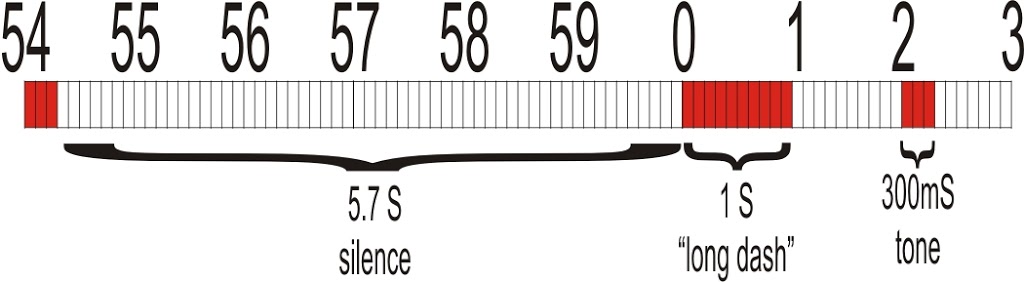
But more recently, I noticed the program changed again. Twice in a few years, after almost 70 years of complete consitencey. This time, however, it is one of those head-slapping obvious things, once you think about, you cannot believe you never thought of it before, or that it took the NRC decades to make the change. The “5 seconds of silence” is now referred to as “6 seconds of silence”, because it is much closer to 6 seconds than 5. Following the same reasoning, the old silence was about 11 seconds, not 10. See if you follow:

Each short tone is 300 milliseconds long, or 3/10 of a second. So the silence between tones is 700 mS:

During the 5 seconds of silence, there are 5 “missed” tones, followed by the one-second long tone at the top of the hour. Therefore the “silence” is 5 seconds, plus 700mS, or 5.7 seconds.

Round that to a whole number, and 6 is definitely closer than 5. I can’t believe it took them 70 years to make the change. Probably a communist plot.

UNIBUG – Learning & Science around bugs.

The Environmental Science field is full of biologists, so I have worked with a lot of biologists in my day. In my current job, I am the “token geologist”, surrounded by Bio-types. This results in a lot of ribbing back and forth. After listening to a long discussion on some arcane invasive plant species or some subtlety of insect biology, I will finally respond with: “what is its preservation potential in the rock record?” (trust me, to geologists, that is hilarious if well timed). They often exclude me from a conversation by saying “you won’t be interested, it is alive…” Good fun.

Kidding aside, having done a lot of field work with enough biologists, I am amazed by what they know. I can look at rock outcrop and tell them more-or-less believable stories about the history of the rocks, and what they say about the tectonic history of the region. They can look at the surroundings, and tell me things about the plants, the animals, and the ecological interactions that I am completely blind to.

After a couple of years of geology field work in the interior, I could identify two types of trees: pine (they are red or brown) and alder (they are sprouting up all over the decommissioned logging roads I need to access to get to the rocks). I could also tell the difference between mosquitoes, blackflies, noseeums, and deer fly based on the geography of the bites on my skin, but that was about the limit of my field biology. All bugging of my co-workers aside, I lament that I don’t know more.

So I am trying to learn some more biology. Because I work with an invasive plant control guy, I cam now good at recognizing giant hogweed, Japanese knotweed, purple loosestrife, English ivy, Scotch broom and other invasive plants that cause so much stress to our local ecosystems. I am now expanding into learning a bit more about insects, good and bad, in my garden.

Partly to help with this, I joined a local program this year to identify beneficial insects in urban gardens. The program is called UNIBUG: a rather ungainly acronym for “User Network for Insect Biology In Urban Gardens”. This is a program run by the Institute of Urban Ecology at Douglas College, and is administered by Dr. Veronica Wahl.

The idea is really simple: give urban gardeners a bit of background material and the tools they need to collect useful data on beneficial insects. The gardeners dedicate a bit of garden space, and collect a lot more data than the researcher would working alone, setting up and maintaining their own test plots across the City (many hands make light work). It also allows a small army of “citizen scientists” to learn a bit more about beneficial insects, about their gardens, and about how science is done. For some of us, just getting the chance to bend the ear of a PhD ecologist in our gardens is worth a fortune.

The basic program this year involves evaluating if two different plants (yarrow and white alyssum), which are colloquially known to attract beneficial insects, actually do attract statistically significant numbers of insects. To do this, each gardener places a “pitfall trap” (for crawling insects) and a “sticky trap” for flying insects in each of two locations of their garden. The attracting plant is located adjacent to one set of traps, and there is no attracting plant within 5m of the “control” trap. In theory, there will be more bugs trapped near the attracting plant… or, as my grade 10 science teacher would say “The null hypothesis is that the traps would collect the same number of bugs, within the range of statistical significance”.

A pitfall trap with Yarrow planted around it.

My “control” pitfall and sticky traps.

For the pit-fall traps, we are instructed to only count the beetles, and to compare the beetles we see to an identification guide we are provided. Our main target are ground beetles of the Carabidae family. These guys eat many common garden pests like caterpillars, aphids, and slugs. Identifying the genus of the beetles we catch is the fun part of the exercise. The sticky traps have to be counted by experts working with microscopes back at the lab, so we just collect and catalogue those.

One of the beetles I trapped and counted in week 1. He was subsequently released.

There are UNIBUG volunteers across the Lower Mainland (keeping Dr. Ronnie running around keeping things running smoothly!), and here in New West, we have volunteers with yard gardens (like me) and several volunteers at each of the City’s three Community Gardens. With us all entering data on-line every week, and collecting stickytrap each week, I see a lot of lab time crunching data in Dr. Ronnie’s future. We get the fun part, she has to do the grunt work. The glory of a career in science!