Cities and Carbon credits.

We all agree that anthropogenic climate change is happening, and that Canada is one of the worlds worst offenders per capita (If not, perhaps you should review a bit of this and come back later). The question is what are we going to do about it?

Carbon Offsets are one of those ideas that might sort of work, much like a carbon tax, but their success and usefulness depends on very careful legislation. The problem is, in our hyper-policial world where logic and science rarely come into play during he drafting of legislation, they can seriously go wrong. I present to you as evidence, the Pacific Carbon Trust.

Some of you may know about the Climate Action Charter. This makes all local governments who “voluntarily sign” the charter, to be “carbon neutral” by 2012. Of course, it isn’t really voluntary, as these communities are offered a 100% rebate of the carbon taxes they pay if they fulfill this commitment. There is some strange calculus between reducing the carbon they use to the point where the savings in the taxes offset the extra carbon offsets you need to buy to get back to “carbon neutral”, but I leave that for the accountants.

The end result or this coercion is that Cities do often-good sometimes-questionable actions to reduce their carbon use. Retrofitting City buildings to be more energy efficient, introducing anti-idle policies and investing in a more efficient fleet of vehicles to line up around the token guy with the shovel, creating District Energy Utilities where the City’s ice rink takes all the waste heat it creates making ice and uses it to heat the water in adjacent swimming pool. You can also throw in building compact, transportation-efficient cities. These are all reasonable measures that should save taxpayers money in the long run and reduce the need to oxidize hydrocarbons. These are good things.

(Notably, one of any City’s largest green house gas producing activities is the generation and disposal of solid waste, and that is exempt from the Charter. I could go on…)

Recognizing that Cities can’t just stop burning fuel tomorrow, there is en expectation that Cities will use carbon offsets. This idea being that organizations that make money producing carbon dioxide can be provided economic incentives to not produce so much carbon dioxide, and sell that non-production of carbon dioxide to someone who cannot help but produce carbon dioxide. So for every tonne of carbon dioxide that a City produces, it will pay $25 to someone else to not produce a tonne of carbon dioxide. Alternately, they could just pay the $25 in carbon tax to the Provincial coffers.

I have had discussions with Municipal Energy Managers and GHG-reduction experts who are convinced this is a good idea for all kinds of traditional economics reasons. It is, they argue, the same as carbon tax, in that is puts a “cost” upon the production of pollution that can be used to directly reduce pollution. There are also some significant GHG Experts who think it is a terrible idea.

However, much like our completely misguided and ineffective carbon tax (another topic), the way the offset market is managed in BC is both unproductive and ethically compromised. You see, our local governments must purchase their carbon offsets from an entity known as the Pacific Carbon Trust. This is a Provincial Crown Corporation that operates under the direction of Kevin Falcon. Guilt by association is never a good idea, but considering Falcon’s greatest accomplishment up to this point is the ramming through of the largest climate crime of the last decade in this province, well, we know GHG reduction is not really a priority of his.

That said, we can measure the Pacific Carbon Trust for what it does, without worrying about the Falcon taint. After all, it is a public reporting company, and every person who pays property or school taxes in the Province is going to be buying carbon credits from the PCT, so let’s see where it is a going.

The PCT’s two largest offset purchases so far are from TimberWest (about $7.5 Million) and EnCana ($2 Million).

Timberwest is getting paid off by choosing not to log less than 8% of their 300,000 Ha of forest on Vancouver Island. The fact this area has not been logged up to here is pretty compelling evidence that it was not economical to log, either due to access issues, riparian protection laws, or political sensitivity. Reading the project summary is a twisted journey into justification. You see, they are anticipating a future “acceleration” in logging, after the current pine-beetle-harvest-glut of lumber passes, and they are committing to not accelerating in the future quite so much: a hypothetical agreement to reduce by 8% their future hypothetical logging based on hypothetical future market conditions. For this, our Cities and Schools have shipped them $7,500,000, so far.

I say “so far” because according to the report, TimberWest figures it will be offsetting up to half a million tonnes of carbon a year for perpetuity. That means taxpayers will be throwing up to $12,000,000 a year to Timberwest not to log trees they admit are not economical to log due to the glut of lumber on the market, presumably until the market forces them to “accelerate”, at which time they will probably find it more profitable to cut the trees that perpetuate the offset myth.

Now TimberWest is an interesting organization. It is mostly the investment wing of a bunch of public service and private pension funds (which means, ironically, that I am probably benefiting directly from this scheme, having a public service pension, but as a minor fouth-tier “shareholder”, have no say whateoever in its operations). However other “we promise not to log (this week)” deals with the PCT have been signed across the province.

The EnCana deal is even uglier. EnCana is one of Canada’s largest oil and gas companies, and is one of the largest natural gas companies in North America. They produce about $6 Billion in revenue per year, and are currently building the largest office tower in Western Canada. The BC government gave then $2 Million for a program where they capture residual gas from their drilling operations and use it instead of just flaring it off. The end result? That gas ends up in a pipeline, and is sold by EnCana.

In a rational world, the Province would pass a simple piece of legislation that says gas drillers cannot flare gas at their drill sites, but instead need to capture it. That gas is a provincial resource, we can pass any law we want about how it is managed, including insisting that if you are going to pull it out of the ground, you are going to sell it, not let it flare. Clearly, the technology to do this exists. Instead, we are paying a large profitable multi-national company to put gas in a pipe and sell it on the open market. We are paying them with your property taxes. And let us not forget, this gas is not being sequestered, every bit of that gas is still going to get burned and go into the atmosphere, it is just going to be sold to generate profit before being burned instead of being immediately flared.

So, what is my point? I am one of those people who think that the largest, most profitable companies in Canada do not need handouts from our municipal taxpayers and school boards. Therefore, I think the City/School board should take every measure to reduce their GHG emissions. Then they should fairly account their residual carbon, and pay the carbon tax to the provincial government. I would rather my tax dollars go to fund government services than line the pockets of profitable companies like EnCana. I guess that makes me a raving socialist.


Bugs in the Garden – UPDATE

This has been a tough year for the garden. A cool wet spring had a lot of our seeds dying in the ground. The weather also brought us slugs, snails, and aphids. The first crop of lettuce expired, as did the first attempt at carrots. The beets and radishes got eaten by slugs. Radishes wormed-through. I am a terrible gardener.
??

By the Middle of June, not much was happening. Besdies the Garlic and the two “vounteer” potatoes, everything seen was transplants sprouted inside.

??Besides the weather, a constant issue in my garden is the combined aphid-ant battle. I learned last year that some species of ants actually farm aphids. The aphids apparently take more sugar-filled sap out of some plants than they can digest, so they…uh… pass a very sugar-rich waste that the ants harvest. Ants “milk” the aphids like we do cows. This is so successful that the ants have actually learned to farm the aphids. They move small aphids from one part of a plant to another to spread around the feeding space, they even defend the aphids from predators. My attempts to dissuade the ants from my plants, using tanglefoot on my blueberries, and diatomaceous earth on my sunflowers, were to no avail. Using a spray-bottle or water to knock the aphids off was pretty effective, until the ants replaced the lost flock with more young aphids. I just don’t have the time to do it every day. I’m a terrible gardener.

Ants and aphids working together to kill my bluberry plant. (click to zoom).

The problem with using anything more powerful (even insecticidal soap) is that it tends to knock down the natural enemies that control aphids and ants and other pests. The natural enemy of the aphid is the lady bug. So every time I see a lady bug in the garden, I know it is on my side. My experiences with ladybugs this year have included the whole life cycle.

Back in June I found a bunch of ladybug eggs on one of my sunflower plants:

Not long after, I found a bunch of freshly-hatched ladybug larvae on a leaf on my pepper plants:

Problem is, my pepper plants are amongst my tomatoes on the hot back deck, and the only two plants not being nuked by aphids. So I took matters into my own hands. I clipped the leaf off the pepper plant and attached it with a twist-tie to an aphid-infested blueberry plant in my front yard. I hoped the larvae would find a quick bounty, and stick around the garden patch where they were most needed.

That is where I learned about the ants and their defensive skills. 10 minutes after moving the leaf, there were a half dozen ants on the leaf, attacking the freshly hatched larvae. Oops. I moved the leaf to safer spot, and hopefully some of them survived! When they get big enough to defend themselves, the larvae are pretty cool looking:

And I can announce now that the weather has turned, there is a good population of ladybugs in my garden, and the aphids are almost gone completely. I still see a lot of ants around, and the sunflowers seem to have some aphids, but they are big enough to defend themselves, and they seem to be just populous enough to keep the ladybugs fed.

Oh, and now that the weather has turned, the garden is booming. Too late to get too much off the tomatoes this year I expect, but the beets, carrots, cukes and zuchs, the garlic, the blueberries, the potatoes and the onions seems to be going gangbusters, and the herb garden is loving the summer. We may even get a pumpkin to survive. Unfortunately, lettuce has been hit-and-miss this year, after a really successful last season. I really don’t know what I am doing. It sure is fun learning.

It looks like about two weeks until Fig Season, the greatest week of the year.

I am also taking part in a community science project being sponsored by Douglas College’s Institute of Urban Ecology, but I’ll talk about that later. If you are on Facebook, you can check it out now.

First update: That picture at the top shows what the garden was like inJune, with the late start, here is what it looks like now:

Second Update: I did a little research into Lady bugs, and I am supposing that little bug I photographed above is actually not a native ladybug, it is likely Harmonia axyridis, or a Japanese multi-colour ladybug. OK, because they eat a lot of aphids. but bad because are apparently displacing native species that might be better adapted to our climate. An interesting peice of background on native vs. introduced ladybugs. good reading!.

Green Party and EMF 2.0

After yesterday’s winge, I have to give props to Elizabeth May for addressing the EMF issue head-on. I disagree with her position (as do a lot of other Green supporters, based on the responses to her post), but she isn’t ducking and hiding. Instead, she is providing the rationale for her position, and providing a set of independent data that supports her position, allowing those interested to make their own, more informed judgements. This is what an accountable politician should do. Contrast this with the Conservative approach when they are challenged to provide background or scientific analysis of any of their policies!

People are right to point out the flaw in the Federal Green Party approach to this issue. According to Elizabeth May: “There is no scientific consensus on EMF and health.” That should sound eerily familiar, as this is the central argument used by Climate Change Deniers: there is no scientific consensus. To support this, she provides links to a couple of recent studies, yet completely disregards the thousands of studies on the biological effects of electricity, magnetic fields, and non-ionizing electromagnetic radiation that have been done over the last 100 years. This is the equivalent of arguing that Anthropogenic Global Warming is not happening because a paper came out in Nature suggesting Mars has experienced some warming over the last decade (yes, this is an actual argument you can find in the climate change denier crowd). There is scientific consensus on these topics, and just like the consensus that our planet is an oblate spheroid and circles the sun, there will never be unanimous agreement. Few are those who can win an argument against a dedicated flat-earther.

May often talks about the “precautionary principle”, and brings it up in this debate. The problem is that the principle can not rationally be applied until we pass a threshold of plausibility. Sleeping with your lights on to avoid the monsters under your bed is not precautionary (who can prove there aren’t invisible monsters!?!), it is silly. Similarly, there is no plausible link between WiFi and the list of ills Magda Havas applies to them. We know this, because the technology behind cell phones, WiFi, Smart Meters, etc. is nothing new. Sure, the actual device is new, but they are not generating any magic waves that humans have not generated for more than 100 years. Nokia didn’t invent microwave communication, they just put it in a colourful compact package. They also happen to be the same waves that the sun sends our way every day. The scientific body of evidence exists, and the day-to-day experience with actual EMF-generating equipment throughout our lives has demonstrated that they do not cause cancer, MS, Alzheimer’s, ADD, planters warts, or whatever Magda Havas is claiming they cause this week. We also have no plausible mechanism offered through which non-ionizing radiation can cause any of these ills, and none offered by the people claiming a link. This is very far from any plausibility threshold.

That said, let’s not lose track of the BC Green Party issue. Jane Sterk is not suggesting limiting cell phone transmitter power, or buffering cell towers from residential areas, or banning cell phones from kids, she is talking about putting what is essentially a cell phone on the wall of your house that will transmit data for less than a minute a day. Your exposure to EMF from this device will be equivalent to sitting in the same SkyTrain car as a cell phone user for one minute, or sitting at a stop light when the guy in the car next to you is texting his friend. And on this basis, the Green Party is opposing what is essentially an energy conservation measure, is distracting from other, possibly valid, concerns about the Smart Meter program, and is giving a grifter like Magda Havas a platform.

Although I have not heard an official announcement, a friend connected to the BC party has suggested that the Party leadership has recognized this might have been a mis-step, and they are discussing changes in their protocols to verify the professional credentials and the quality of the research and publications of the experts they use to help guide their policy. This is a good sign. We all make mistakes, but the true measure is how we learn from them, and how we adapt in light of them.

oh, and XKCD, once again, has it right:

The Green Party and EMF

I have been an on-again, off-again Green Party supporter for years. At times “on” enough that I was active in my local federal EDA, and have supported local Green candidates. Anyone who reads this blog will know I am prone to seeking the “green” solution to problems, which to me means the solution closest to Aristotle’s “Golden Mean”:  between the three legs of sustainability: economic, social, and environmental concerns.  Look it up, if that means nothing to you.

I am also convinced that the only way to find that Golden Mean is through rational discussion of scientifically valid data. Any decision made based on bad data is likely to be a bad decision. This is why I have railed on about the Conservative Party’s war on science: they don’t want information that does not support their ideology, and therefore, they make a lot of bad decisions.

Of course, all political parties are prone to bad decisions, and most have an underlying ideology that prevents them from creating policy based solely on accurate analysis of good information. That’s the party system, and that is the reality of Canadian politics. However, I have found on most issues, the Green Party has policy based closest to the rational advice that would be give by scientific experts in the field. Some would argue they alone have that luxury, as they will never actually have to worry about finding enough votes to actually get elected, but they used to say that about the NDP.

This week, however, the Green Party jumped the shark in my mind. Both federal leader Elizabeth May and Provincial leader Jane Sterk this week came out against electricity. They have aligned themselves with one of Canada’s most notorious pseudo-scientists, Magda Havas, by regurgitating the long-debunked link between electromagnetic waves and cancer and other ailments. This is so far from the scientific truth of the matter, that they may as well have come out against leprechauns.

Provincially, we saw Jane Stark standing beside Magda Havas and calling for an end to the Smart Meter program because of “health and environmental concerns”. Here is the Green Party throwing a science-based approach out the window and aligning themselves with the scare-mongering denizens of wingnuttia. Havas has linked EMF to everything from cancer to MS to diabetes over the years, all the time helping her friend sell “electronic filters” that remove “dirty electricity”. Havas’ claims about smart meters are so far from a science-based approach that I simply cannot square it with rational policy at any level. Havas is a snake-oil sales person, a shameless self-promoter, and, wost of all, a terrible scientist.

Now, before writing this post, I sent an e-mail to Jane Sterk’s website. I was actually shocked that she e-mailed me back personally within a couple of hours. In her response, she raised some interesting discussion points about the accountability around the contract to deliver the meters, about the business case for the potential savings, about BC Hydro not having a real plan to take advantage of the meters. These are excellent points, but not what my complaint was about. For the record, I am decidedly agnostic about Smart Meters. Seems like it is a useful technology to encourage electricity conservation through flexible billing, and it seems they could help with leakage control, but whether the business case can be made, I’m not sure. But none of this addresses the central complaint  that he opposition argument is based on the irrational ravings of a pseudo-scientific whack-a-loon.  This is not a foundation upon which to base policy.

Worse, the rational discussion we should be having about the business case for Smart Meters and the need for household electricity conservation will be drowned out by the silly sideshow of Smart Meters allegedly causing cancer, diabetes, Alzheimer’s, and MS (all claims made by Havas). Enter “Green Party Smart Meters” into Google, and scan though the first 100 hits. You can see that there has been no pick-up on the potentially valid economic or energy policy concerns you mention above. Instead, rational debate is lost in a fog of pseudo-science, playing directly into Magda Havas’ hands (and potentially building a great market for EMF filters specifically designed for Smart Meters… patent pending, suckers!).

Ms. Stark also suggested in her e-mail to me that Hydro should provide the option for hard-wired meters for those concerned about EMF, which, of course, does nothing to support her arguments that the business case is not right, and again reinforces the idea that Smart Meters will kill you.

I should also note that Ms. Stark’s e-mail to me was followed by a ubiquitous tag, so common as to be not be noticeable, but relevant to this discussion:

“Sent from my iPhone”

Presumably, that iPhone was plugged into a wall and not emitting microwaves…

East Point Geology

As I have noted before, in one of the earlier lives I was a geologist. Like most people who are once geologists, I am always thinking like a geologist, in that I can never walk by a rock without looking sideways at it, and making up stories in my head as to its origin.
A summer long weekend on the Gulf Islands (the Canada Day Lamb Roast on Saturna Island is a family tradition, going on long enough now that I have an assigned volunteer role) gets me looking at rocks again, and rocks I know well and love.
I actually did my Master’s Thesis looking at rocks of the Nanaimo Group on the Gulf Islands, so I have a particular affinity to Upper Cretaceous sedimentary rocks, and always see the sandstones, conglomerates and mudstones of the Gulf Islands as “my rocks”.
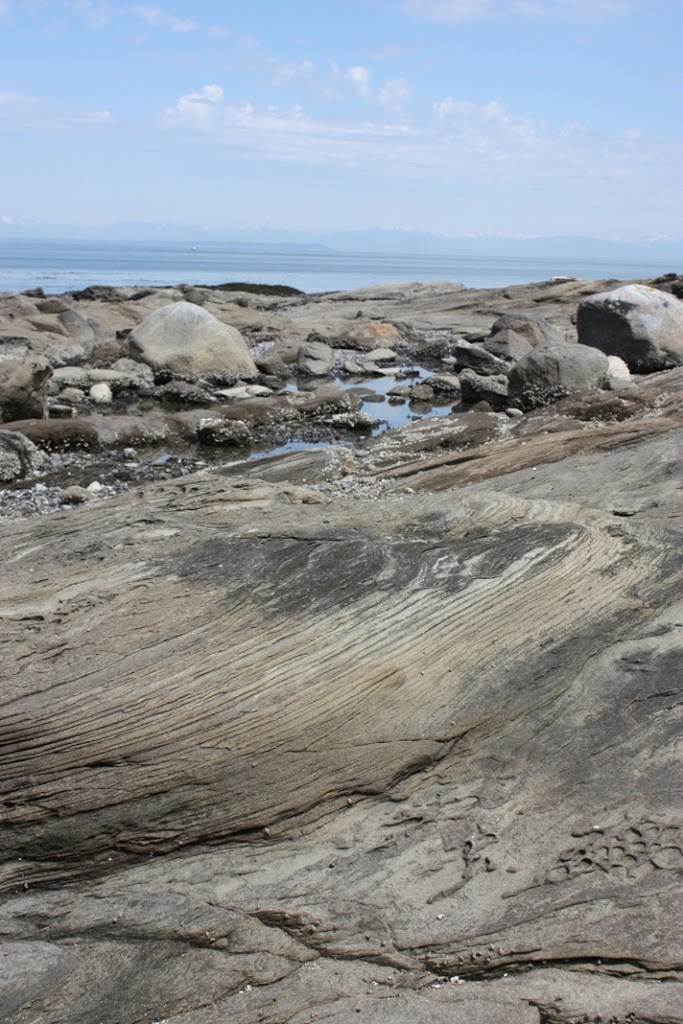
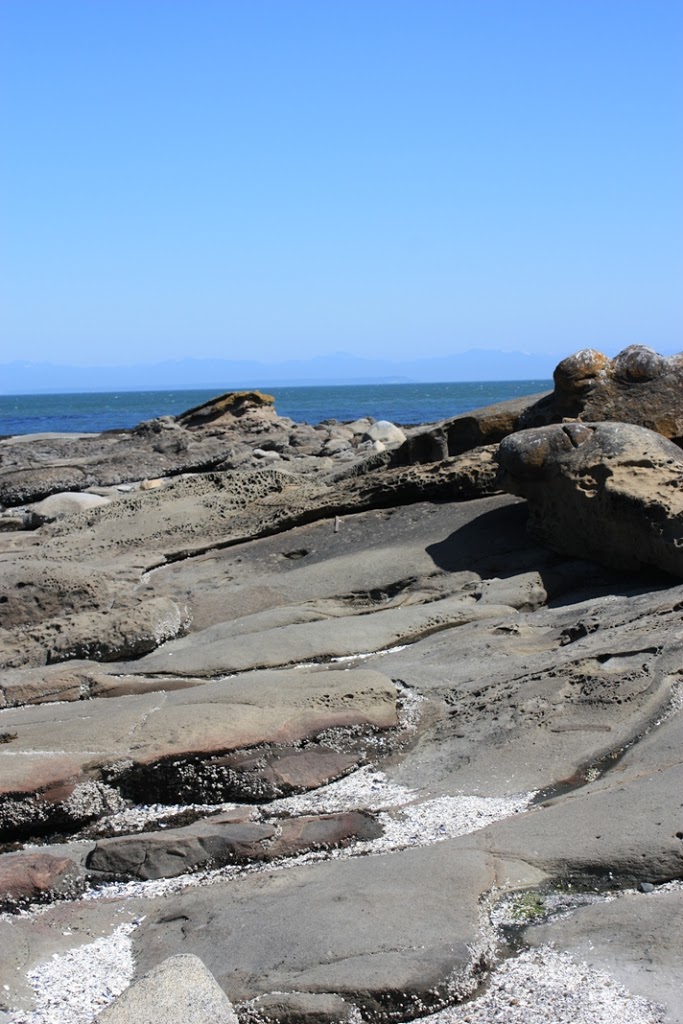
On Saturna, I spend most of my time out on East Point, where the exposures of the Geoffrey Formation are dominant. This is a very late Cretaceous set of rocks, probably 75 million years old. For context, 75 Million years ago there were dinosaurs walking about, all the mammals in the world were shrew-sized or smaller, and the dominant form of sea life was various hard-shelled cephalopods we call ammonites. The Coast mountains were actively building up, as were the Rockies, and the coast was much more like the west coast of Chile is now, with the mountains the size and scale of the Andes, and a deep subduction trench off the coast. Vancouver Island was, for all intents and purposes, not there.

There is some debate about where these Nanaimo Group rocks were, geography-wise, when they were deposited. There is no doubt they were deposited into an ocean, facing west, near a coast open enough that they were subjected to large hurricane-force storms on a regular basis. Most of the geology and the palaeontology suggest they formed in the temperate Proto-Pacific (just a little south of where they are now), but there is a pretty interesting body of geophysical data suggesting they were much further south in the tropics, around present-day Baja Mexico, when they were formed. The “Baja-BC Hypothesis”. I for one side with the geologists over the geophysicists, purely on a weight-of-evidence argument, but that is neither here nor there.

The Geoffrey Formation rocks of Saturna were deposited as part of a submarine fan complex. They were deposited in the ocean, deep enough that surface waves, even during the biggest storms, did not effect the sediments on the ocean floor. They were influenced, however, by large submarine “turbidity flows”, or large landslide-like events that occur occasionally in the ocean. Walking along the shores of Saturna, the evidence of these events is written large on the rocks.

In the ocean, sediments are deposited fairly slowly. As the currents away from the shore are pretty gentle, it is only fine materials like silt and clay that get out there to be deposited. The sand and coarser material is washed around on the beaches and near the shore, and is constantly re-worked by wind and wave and bugs in the soils, but there just isn’t enough wave energy to move them our very far out into the ocean. The exceptions are big storms, which can ramp up enough of the wave energy to move much of the sand and gravel built up on the beaches further out to sea, or big flood events along deltas, when there is a big migration of river sand out to the delta front. For the most part, however, the coarser sediments get to the shore (or just offshore) and basically stay there, building up over time into big, unstable, shelves of loose material.

To quote Thom Yorke: gravity always wins. When these shelves build up large enough, they eventually begin to fail along submarine canyons. When large amounts of water-saturated sand and silt, with a little gravel mixed in, begin to move under water and flow down these submarine canyons, they do so in the form of “turbidity currents”. These high-speed flows of are a lot like the “mudslide” that just buried Highway 1, but because they are underwater and are water-saturated, they behave very differently. The turbidity of their flow keeps them suspended on a laminar base, and they can therefore move very far along a shallow slope with little energy loss. Most remarkable is what happens when friction rises to a critical point and overwhelms the forces keeping the flow moving: the sediments almost instantly “freeze” in place. This makes them very distinctive from river sands or beach sands or even dunes in a desert, where the constant working by currents result in complex structures like cross beds and dunes and ripples.

Fancy as this may sound, I’m not making this shit up. We know these things happen because we can go to places like the modern Indus Fan or even the Mendocino Trench and see these things operating today. Geology is great that way: uniformitarianism rules all.

Even more fun with the submarine fans is that the material they transport can include the fine gravel or coarse sand moved out to the shelf by floods or storms, along with the layers of fine mud deposited in the calm deep ocean, and fossils from boththe shallow water and from the deep water, and even pieces of terrestrial plants like logs and leaves, flushed into the shallow ocean, all mixed together in a chaotic matrix. At East Point on Saturna Island, we can see the deposits of all this.

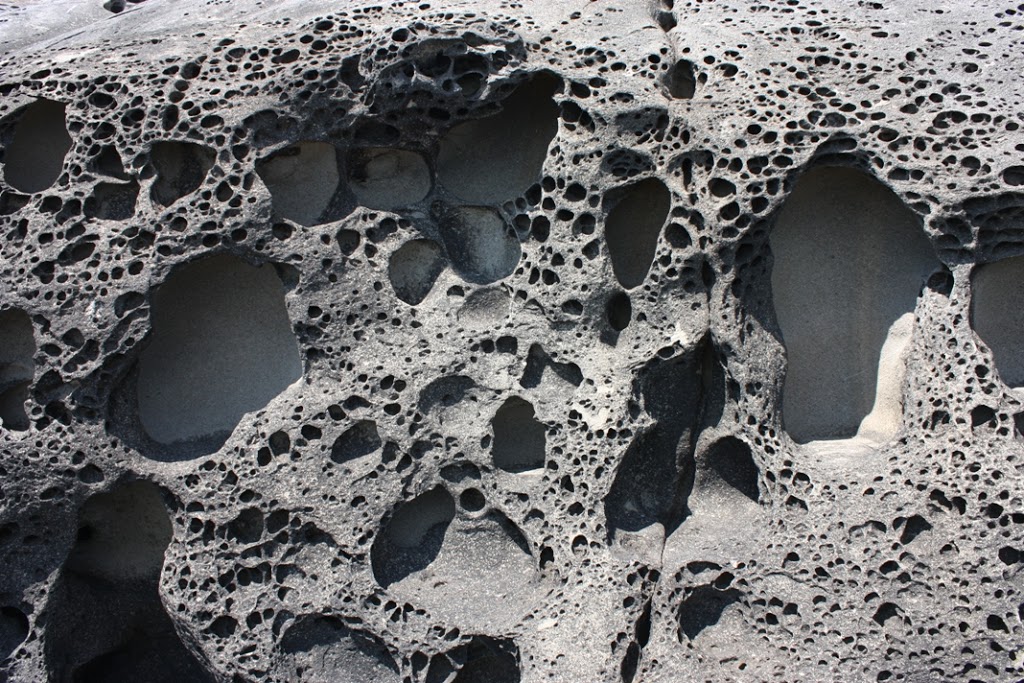
Mostly, the Geoffrey Formation sandstones at East Point are thick and massive, with only minor interbeds of pebble to cobble conglomerate, and only widely dispersed silty mudstone layers. The sandstone represents the bulk of the material stored along the shoreline (not too dissimilar to the sand built up off the coast of Vancouver Island now, to hundreds of metres of depth), and the bulk of the material that filled those submarine channels when there were turbidity flows, and they are the material that sometimes “froze in place”. These massive sandstone beds (“massive” in geology does not mean it is really big, it means that the entire bed is homogenous, without cross beds or ripple marks or bedding planes) are the beds that tend to erode in a pattern known as “taphoni” or honeycomb weathering, one of the most distinctive features of the sandstone of the Gulf Islands.

“taphony” weathering

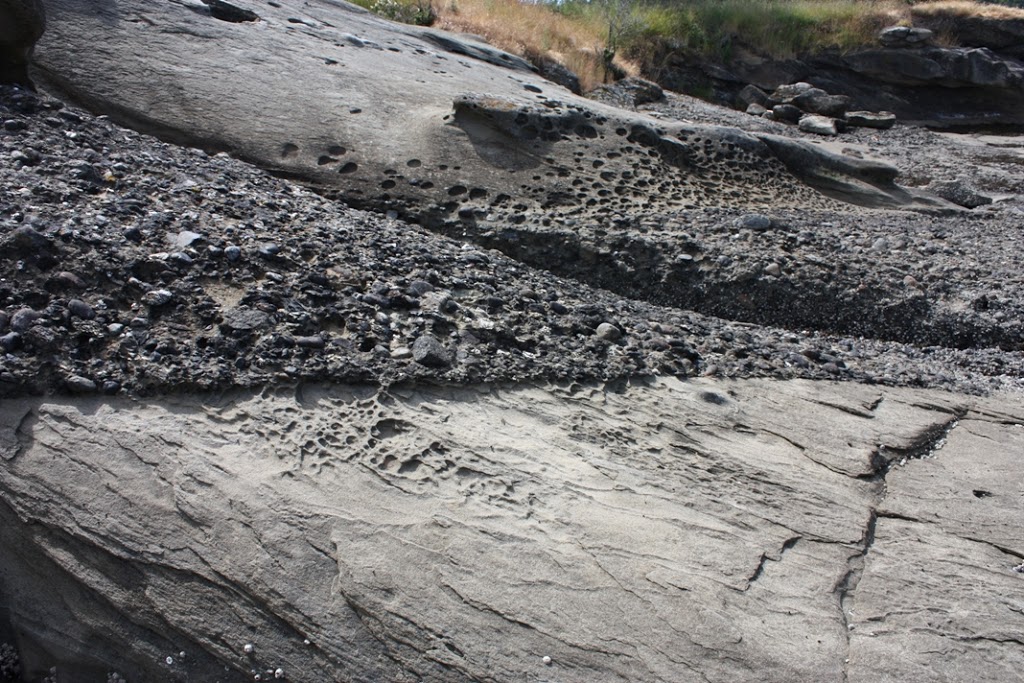
There are also a few conglomerate beds mixed in with these sandstones, where material from closer to shore was swept out though one of these long canyons. This material is more dense than sandstone, so it concentrates along the bottom of the flow, where it erodes into the underlying sand material and creates a sharp contact on the bottom of the bed. Sometimes other material is mixed in with the gravel, especially shell material, now fossilized.

Gravel bed, note “sharp” contact at bottom where gravel eroded into soft sand, and more gradual shift to sand on top.
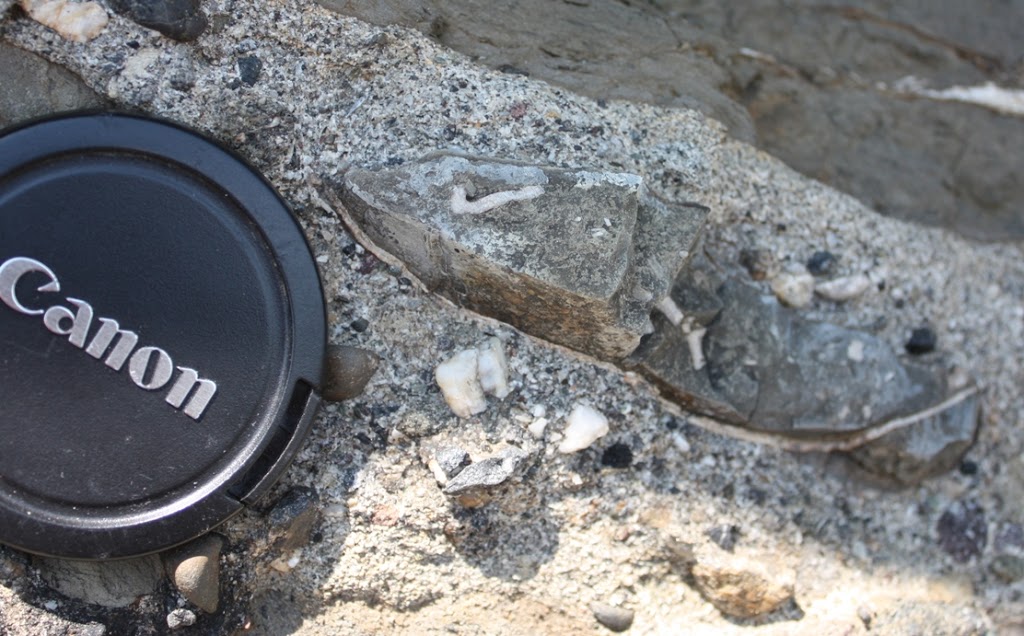
That big oval to the right of the lens cap is actually a section through a bivalve shell, which got broken up as it moved along with the graveland sand, but preserved finer mud material from where it was living within it’s hollow. I’m not a paleontologist, but that there is a ~70 Million year old clam of some sort.

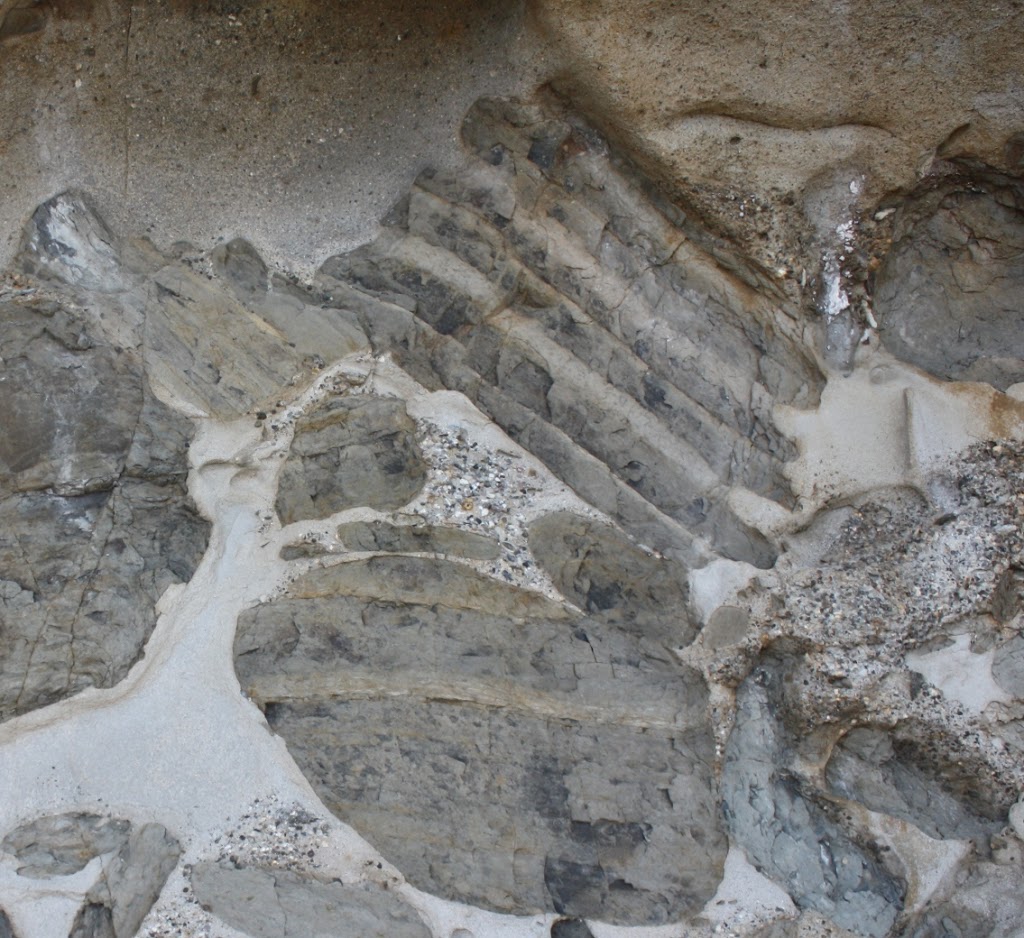
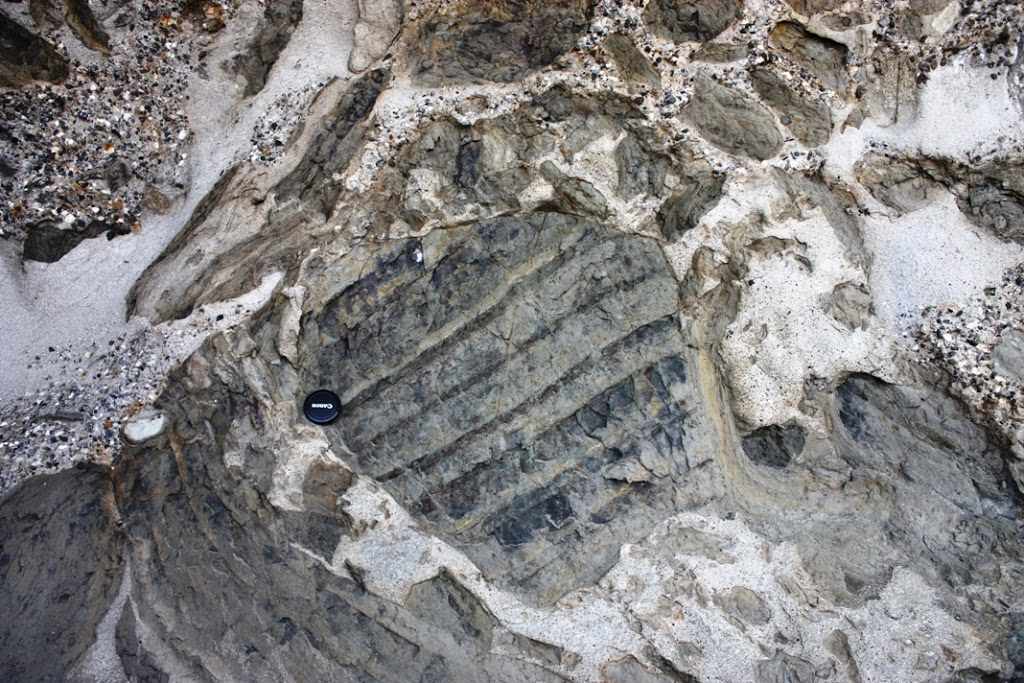
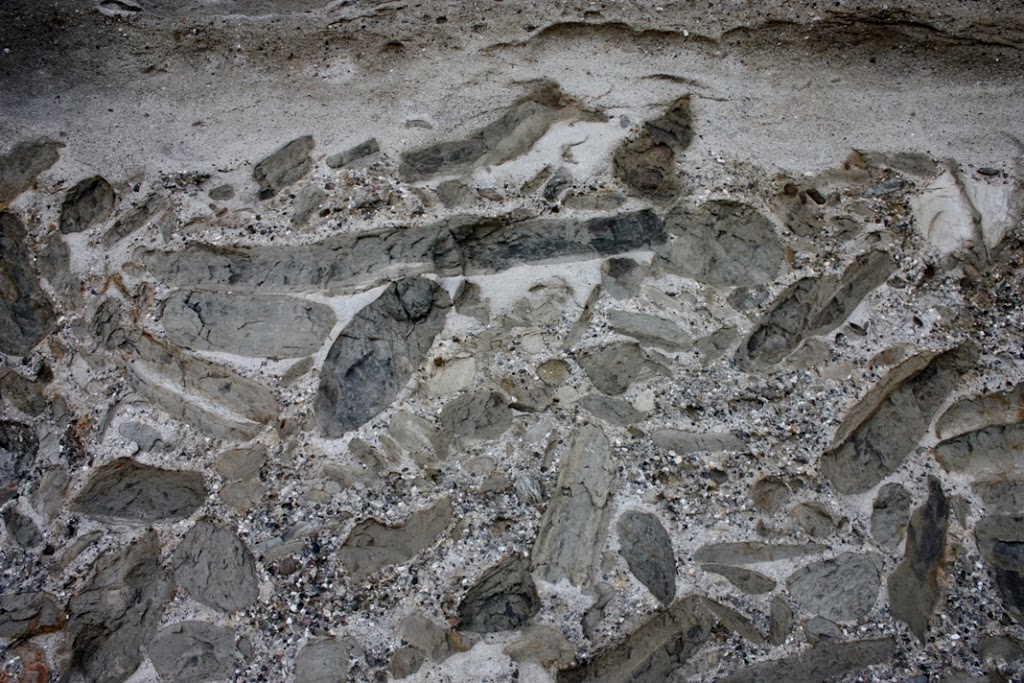
But on the south edge of East point, down by the water is a really special bed. Collected along the bottom of a bed are polygonal hunks of mudstone. These chunks often have bedding structures within them, showing the mud was laid down gently over time, with only the faintest traces of currents in thin silty interbeds. Often, there are trace fossils, showing that some type or animal eked out some meagre existence within those mud beds.

Note the bedding is only within the chunk of mud, which is oriented chaotically compared to the sandstone beds, and compared to the bedding in other chunks of mud. Also, the edges of the mud chunk are broken up, or even bent. These big mud balls are colloquially called “rip-up clasts”. They are literally hunks of soft sediment deposited on calm water then ripped up by the turbidity current and swept along in the flow. We know they were pretty firm and compacted, because they didn’t completely break up in the flow but remained cohesive and moved along like a wet pile of cardboard. We know they were soft sediment and not “rock” because they were easily folded, bent and had their edges eroded by the flow. They are mud, so they are denser than the saturated sand, and collect towards the bottom of the flows, and are mixed in with gravels and fossil fragments. When the flow stopped, they were “frozen in place”, without the ability to fall into a layers. The result is some pretty amazing patterns:

So there I was, on a Gulf Island long weekend, looking at a rock sideways and making up stories of their origin. Drives the iCandy crazy.

Ubiquitous Gulf-Island-sunset-from-the-pub shot.

Good news?

Lest I am seen as always writing negative stuff here, bitching and complaining about the state of our environment, I thought I would point out some local positives today. (back to complaints tomorrow…)

It is great to read that City Hall (both the elected folk and the Staff) are publicly saying what much of the public has been saying since the UBE situation first cropped up last year. The end of the UBE and the indefinite future of the NFPR could have very positive consequences for New Westminster. Instead of our waterfront being defined as a through-fare for trucks moving containers from “Port Facilities” to places like Port Coquitlam and Port Kells and Port Mann, it can be a place where businesses grow, where people walk, where taxes are paid, and where the Downtown meets the waterfront. (Notably, this can all be done without spending a billion dollars putting vehicles in the fancy tunnels that would only result in increased traffic chaos at each end). Think the Quays of Old Port Montreal or the Peoria Waterfront, (which both have rails near the waterfront) or Spokane, or any of a dozen other examples of cities that have reconnected with their River Waterfront.

Then this rather fanciful story comes out. It looks very preliminary, but there may some real niche markets for this service. Driving from PoCo by the old Gillnetter Pub to the Canada Line in Richmond is only 35 km by road, but takes the best part of an hour during rush hour. The same trip by Transit takes a bus, Skytrain and Canada Line, and more than an hour and a half (and a three-zone fare). The same trip by high-speed catamaran, about 25km of River, could take less than an hour.

But yes, it is preliminary. I wonder what the economic reality is, with it apparently costing $1000/hr to run one of these boats, and an estimated (by me) seating capacity of 100 people, you need to charge $10 for a one-way trip to break even, and sell out every trip. I also wonder about how fast the actual ferries could go. There are off-the-shelf cats that can do 25 knots (~40 km/h) in good conditions, but the Fraser is both narrow in places and laden with logs and other debris. Popping a 3-foot diameter log at 40 km/h is going to be a bad day for the engineer in charge.

As a mass transit system, this might be wanting. As a niche market to connect poorly-connected hubs, there is potential. But I wonder what those hubs are…

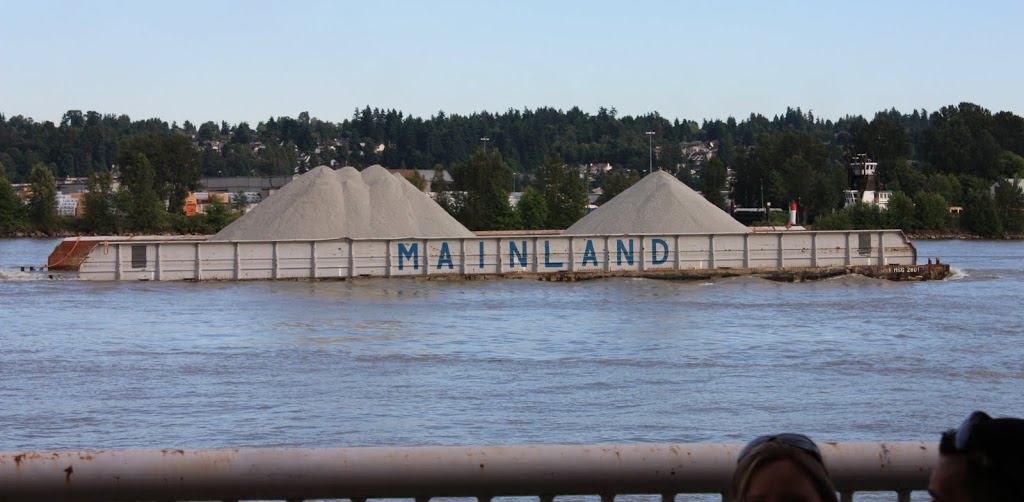
But funny how we don’t think about the transportation markets that already operate on the River. I was sitting at the beer garden during Fraser Fest, listening to The NWSS band play some kicking R&B (I do love a 4-piece horn section), and I noticed this guy leaving the Southminster Dock in Surrey. They run barges of trailers to Vancouver Island a few times a day. Each barge carries 40 or so trailers. No doubt a more economic approach than having 40 trucks and drivers sitting in a BC ferry line-up.

I also a saw a barge load of rock rip-rap, enough to fill 100 trucks.

And a barge full of sorted gravel, enough to fill another 100 trucks.

3 tug boats doing the work of 240 trucks. This is the future of our waterfront, folks.

Finally, researching this topic, I ran into a new (to me) blog in New Westminster. I don’t know who this guy is, but it looks like he has been at it for a while, and he recently quoted Phil Plait, so he must be a gentleman and a scholar. Go over there and give him a read and a comment. We can forgive him for being from Toronto; you can’t choose where you are born, you can only choose where you live!

The Fare Gate Fiasco.

The Faregate Fiasco is beginning.

The introduction of faregates at SkyTrain Station is another example of the broken governance of TransLink. At a time when the Regional Transportation Authority is financially challenged enough that they cannot finance 20-year-old expansion plans, when they are going to have to come, cup-in-hand to the taxpayers to try to fill their operating budget for the next 10 years, they are being forced to implement a system they don’t want, don’t need, and cannot afford, so that the Premier and pals can cut a ribbon and be seen to be “doing something” about a problem that doesn’t exist.

Let’s start by looking at some of the rhetoric around the issue.

First off, the current system does not operate on an “honour system”. It is a “Proof of Payment” system: you are required by law to carry proof of payment within fare paid zones (like on all SkyTrains). If you don’t have a proof of payment, you are kicked off the train and out of the station, and you get a ticket from Transit Cops. “Honour” has nothing to do with it.

Anyone who rides the SkyTrain regularly (as I do) will tell you that they do regular screening, and they do actually pull people off trains and issue tickets. When they come on a train and do a ticket check, 99% of the people on the train actually have tickets. I am a gambler by nature, I love to think about and play odds. I have done the math on buying a SkyTrain ticket many times, and there is significant incentive to buy a fare in the current system.

Yep, that above is an example of anecdotal evidence, and is not something to base policy upon. Except by TransLink’s own math, Fare Evasion is not an issue. A few years ago, it was estimated to represent $3 Million a year. Those numbers have been suspiciously creeping up (to justify fare gates?) to $7 Million a year this year. (or maybe the numbers are decreasing?). It is interesting that this “evasion creep” has been happening at the same time that the TransLink Cops have grown into a fully armed force of more than 200 cops, ready to taser people for not paying their fare, with a budget that has grown to $28 Million a year .. where is the value for our money there? Still, that means it went from about 0.85% of fare revenue to about 1.75%. (I can’t help but think that if they raised fares 2% to offset this and passed on the gates, few would complain).

So TransLink is spending $170 Million of your money to save (an inflated?) $7 million of “Fare evasion” that their $28 Million a year armed police force cannot stop. Oh, and the Gates will cost $9milloon a year to operate, maintain, and staff (yes, there must be a person at every gate). The math stinks.

Especially since the gates won’t end fare evasion. People who don’t ride transit imagine everyone they see walking into a Skytrain station and not stopping at the ticket machines is evading the fare (they aren’t, most riders have transfers or passes). But fare evasion comes in many other flavours: people who get on the back of a way-overcrowded B-line bus without a pass, people who use other people’s passes, people who get on a bus with a 1-zone pass and ride two zones, people who use concession fares when they shouldn’t, people selling U-passes on Craig’s List. The faregates are not going to stop any of these people. Only the existing “Proof of Payment” system can, as that requires the person to present a valid fare to a Transit Cop. This is why some argue the faregates will increase fare evasion system-wide, as there is less human verification of passes: the gate can’t tell I am a 40-year-old using a seniors pass.

There is another issue: the stations themselves. There are several stations where the Gates will not really fit, or will create serious pedestrian congestion including Metrotown, one of the busiest stations in the system. In Stations like the revamped pedestrian-friendly mixed-transit-retail New Westminster Station, the Gates will introduce an obstruction to pedestrian flow that will undermine the public space aspect of our transportation hubs. This will not increase anyone’s “feeling of security”.

And that is what this is about, creating a “perception of safety”. It is the same thinking that has Canada building more prisons as crime rates continue to plummet. I don’t blame TransLink, they made it very clear a couple of years ago that they do not want to install these gates, for all the reason I listed above. Then they were overruled by Kevin Falcon after the former Minister of Transportation took a trip to London and had a epiphany… and the rest is a long story of bad governance based on unsupported perceptions that contradict the actual data. It is a strange epiphany, considering London, with faregates, has both a higher fare evasion rate and more crime in their terminals (pickpockets being the most recent issue).

The result of Kevin Falcon pulling transportation policy out of his ass and forcing it on a local government body is a whole bunch of your tax money being burned, now and into the foreseeable future, for no reason other than to give him a ribbon to cut.

Another Trip on the NeverGreen Line – UPDATED

Since I have been gone, I have particularly enjoyed the Evergreen Story Arc.
It all started with this story. It reads like good news: The “funding gap” finally filled, the Mayors and the Minister of Transportation finally coming to an agreement, time to start breaking out the shovels and ceremonially turn some sod (yet again). Rumour has it Richard Stewart even dusted off his gold-plated shovel for the announcement. News too good to be true? Of course.

This was, unfortunately, a result of credulous reporting of a news release completely lacking in context, and complete failure of the reporter to ask any questions about the “facts” being presented (or if they were asked, the answers were edited out of the final report). Even from my semi-secluded state, it occurred to me that this agreement was going to require the Province to pass an increased gas tax as requested by the Mayors, presumably some time between the HST referendum and the much-anticipated Provincial Election, or approximately coincident with a Municipal election. What are the chances of Premier McSparkle™ and the Mayors going for that? And was a $0.02/L gas tax going to be enough?

Then the full TransLink news release came out, and a few more details were available. Apparently,“the Mayors’ Council on Regional Transportation and the provincial government have agreed on a way to provide $70 million in additional annual revenue”, subject to some public consultation. This included the $.02/L gas tax in 2012, and…umm… something else, maybe property taxes, maybe something else… by 2013. So, really, they kind of agreed on part of a plan to fill “the gap”, and as for the rest, well, we are right back where we started. But still, at least they all agree, right?

Well, apparently not . Within days, the mayors are either starting to line up and say they don’t support this plan, or are reluctant to comment on whether they voted for it or not. So again, this plan can only go forward with “public consultation” during an election year, and they won’t even publicly acknowledge if they voted for or against it? Not promising. 

At least we know where Grampa John Cummins stands. He wants Evergreen to be built, but doesn’t want to pay for it with taxes, because taxes are evil. Sounds like Harper’s plan to buy attack jets… if we pretend it doesn’t cost money… maybe it won’t? Thanks for coming out, John.

So TransLink and the Mayors, and the “opposition” are all unsatisfied, maybe the good news to be gleaned out of that very-fast-to-tarnish golden news release was that the new Minister of Transportation is finally getting this problem fixed, and the Province is committing to building the train promised to Premier McSparkle’s™ old neighbourhood (back before it was her old neighbourhood and she was busy dropping out of SFU). Except that the Premier has made it crystal clear that she is not going to vote in a new tax between the HST vote and the next election. No way. Whatsoever. Or maybe she will.
That’s leadership you can believe in.

If I was Richard Stewart I would be starting to get concerned. That shovel has been bouncing around his trunk for a while…

UPDATE: This story keeps on giving. Mayor Watts is uncharacteristically sounding like the voice of sanity here, while Grampa Cummins proves he still doesn’t get it. After reading Watt’s’ comments, it appears Gramps has decided that the increase in operating funds TransLink needs can be found by taking it out of the operating funds of TransLink. You can’t argue with that logic.

I haven’t heard anyone put the 2 cent gas tax in perspective. For the average driver in Canada (see Stats Can numbers), it works out to about $28 a year. That $28 is about two-thirds of what the average Canadian spends per week on gas (at $1.33/L). Or, alternately, it is slightly less than the cost of a book of 10 2-zone bus passes: a week’s worth of commuting for most transit users.

In which our Hero Questions his mind

I had a dream last night that I had a panic attack.
This is interesting for several reasons. First, I rarely if ever remember my dreams. Second, I have never had an actual panic attack when I was awake. Third, I have been, if not half-heartedly, at most two-thirds heartedly studying for my Professional Practice Exam, the first real sit-down-in-a-classroom and fill-out-bubbles-with-a-No-2-pencil closed-book-exam I have had to write in something like 10 years.

Funny part is that it wasn’t the PPE I was panicking about in the dream: it was my 2011-2012 Hockey Pool Draft.

In my dream, it was Poole Draft Day, and apparently, I had drawn first in the draft. I was completely unable to make my first pick. Will the Sedins pull it off again? Which one to pick? Is Crosby back? Why can’t I remember the pre-season? Where did Stamkos end up after free agency? Did he get moved? How the hell to you spell Ovechkin!?! (it seems it was vitally important in my dream pool that the player’s name be spelled correctly). Everyone is staring at me, waiting for mee to fill out the form… in a panic reflex, I write in “Oveckin”. No problem. Plausible deniability. But then the 20 other guys all fill in their picks instantly and I immediately have to decide again. How did they do that so fast, and now they are all waiting for me again. Oh, the curse of the unprepared. Where is my draft sheet? Why can’t I see what they picked? I was completely paralysed in indecision…until I woke up.

Funny, I didn’t feel the least bit stressed about my exam. Maybe I should be?

If nothing else, I have resolved to be fully prepared for this year’s Draft. I’ll have my pick sheet prepared before the pre-season games start. Last year’s stats will be reviewed, all the player moves analysed for strength and weakness. I will make the appropriate adjustments during the pre-season based on how the lines are shaping up. My finish in the basement of last year’s pool will not be repeated.

A man has to set some priorities.

Oh, and I wrote my PPE today. No panic, I was prepared. There were a few very thought-provoking questions, a few that surprised me, but it all went well. I’ll know the results in 8 weeks, just in time for the NHL Pre-season.

Back to blogging.

Worth taking the time to read…

Thanks Stephen Rees for pointing out this article. This is well worth the read. There are a dozen killer quotes here, but I am going to threaten the author’s Intellectual Property Rights ad quote and entire paragraph, becuseh any editing of it would be a crime:

“Right now, there’s a war going on against science in Canada. In order to satisfy a small but powerful political base, the PMO is engaged in a not-so-clandestine operation to dismantle and silence the many credible opponents to the Harper doctrine. Why kill the census? Literally in order to make decisions in the dark, without the relevant data. Hence the prisons. Why de-fund scientific research? Because whole branches of the natural sciences are premised on things like evolution, a theory the minister responsible made it clear he doesn’t understand – and likely doesn’t believe in. Why settle for weak platitudes on climate change? Because despite global scientific consensus, elements of the Conservative base don’t believe human activity could warm the planet. Centuries of rational thought and academic tradition, dating back to the Renaissance, is being thrown out the window in favour of an ideology that doesn’t reflect reality.”

Even if you don’t care, or think our current government is the bee’s knees… read this article.