Ask Pat: Stormont redux?

CH of Burnaby asks—

Have you changed your views on the Stormont Connector now that there is an opportunity to revamp the access to the new Pattullo Bridge? You were against the connector a few years ago. Do you still want all that traffic meandering through your residential areas? 

To your first question: No. And your second question sets up a false premise.

The Stormont Connector is a really expensive solution to a poorly defined problem, as I wrote about at length six (!) years ago. Nothing has substantially changed since I wrote that, except that the plans for Pattullo replacement have shifted from a 6-lane bridge to a 4-lane bridge, and the Port Mann now provides 10 toll-free lanes shifting even more regional traffic to that bridge. If anything, we have less reason to spend billions of dollars building a freeway through the middle of our city, and asking Burnaby to do the same.

Do I want rush hour traffic meandering through New West neighbourhoods? Not really, but I also don’t want a freeway running through the centre of the City, and there is no reason to believe that adding the latter will take away the former.  It simply doesn’t work like that.

So TransLink and the Ministry of Transportation are going to replace the Pattullo with a similar-capacity bridge, and there will be some minor increases in vehicle through-put, mostly related to better designed intersections at each end of the bridge. I think the opportunities New West has through this process are to improve the east-west connections through our City. We can make it safer and easier for Victoria Hill residents to walk and cycle to Downtown or to QayQayt. We can safely connect the Central Valley Greenway across McBride (finally) with enhanced connections to the proposed Agnes Street Greenway. We can vastly improve the public realm around Albert Crescent Park. There are many potential wins here for the City of New West, I just don’t see how a Stormont connector is one of them.

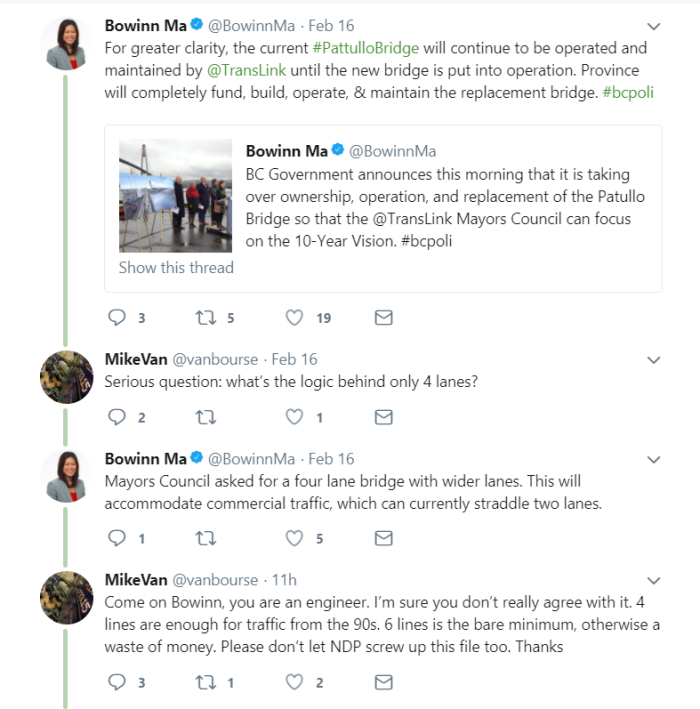
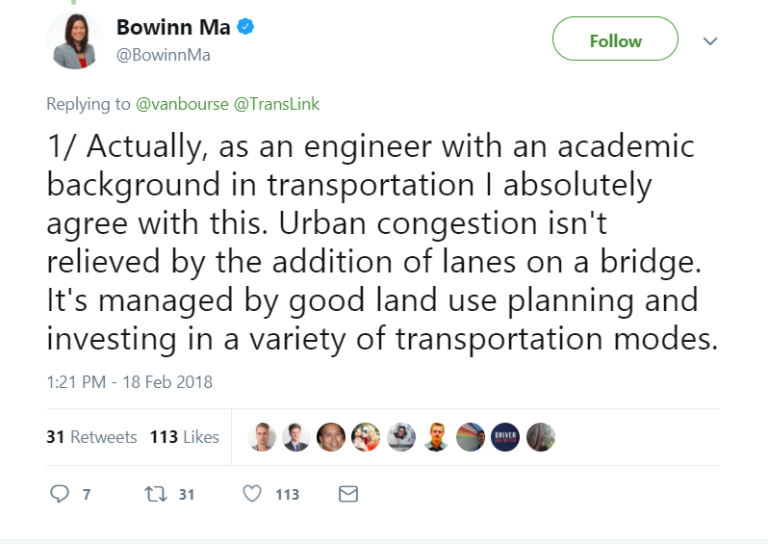
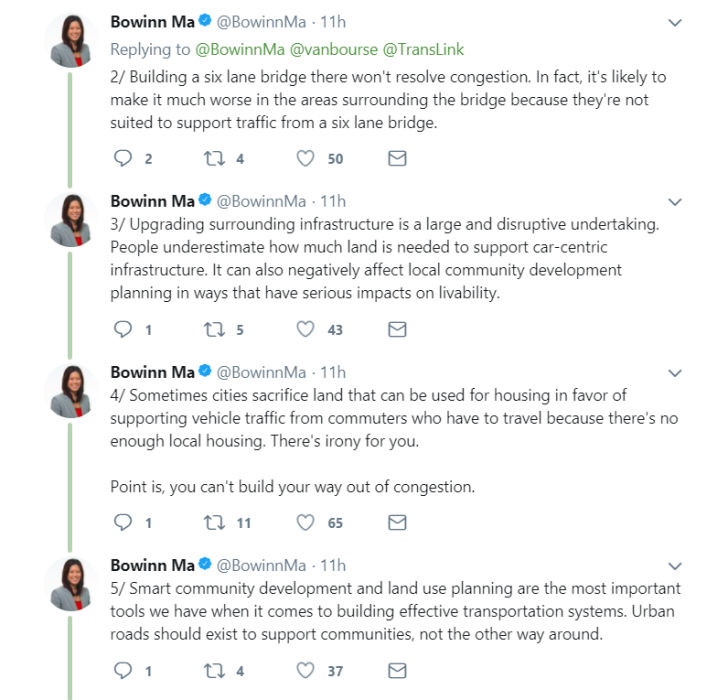
This topic also gives me a chance to give props to North Vancouver MLA Bowinn Ma, whom I was able to chat with at the Pattullo press event on Friday, and who continues to impress with her straightforward smarts and ability to engage on technical topics. It is refreshing to have an MLA speak so clearly and knowledgeably about urban transportation issues as Ma did on twitter last night:

Yep, She gets it.

Us & Them

This is a terrible story.

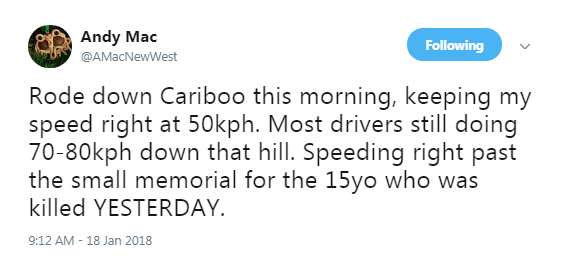
Over a period of four days, two pedestrians and a cyclist were struck by drivers of vehicles on the same section of Cariboo Road. The first pedestrian, a 15 year old, died at the scene. It’s heartbreaking.

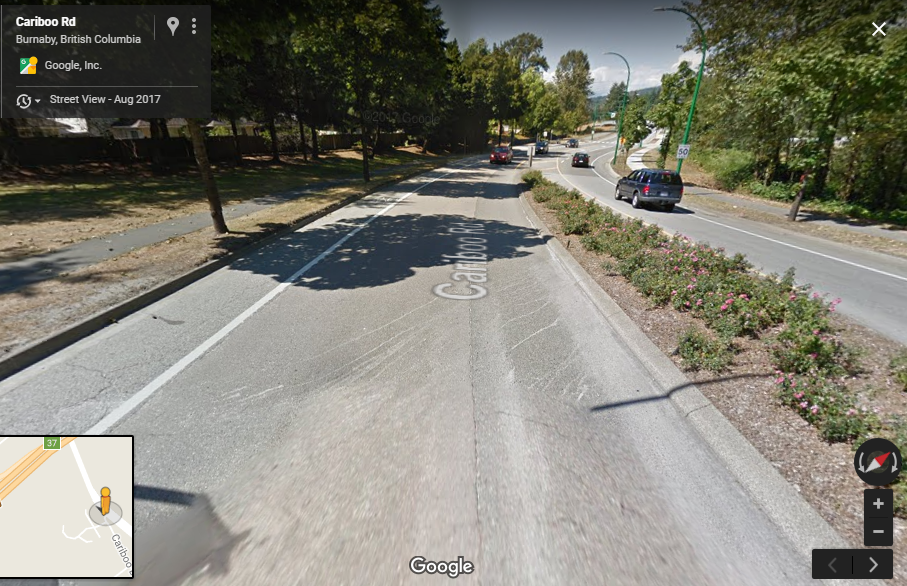
This is a piece of road I am familiar with. It used to be on my daily commute when I worked in Burnaby, and is still part of my regular cycling routine. So am quick to add my “anecdata” along with the list of people commenting that the crosswalk in question is a terrible design. It is a crosswalk that provides access to a well-used bus stop across the street from a residential area, but it is around a corner at the base of a big hill where the speed limit is ostensibly 50km/h, but every piece of the road’s design (separated centre, wide shoulder, 5m lane widths, sidewalk buffer) tells the driver to go much faster. And drivers do go much faster.

So there will be wringing of hands, and pressure for the City to fix this situation. Likely, some sort of pedestrian-activated light will be installed at the cost of a couple of hundred thousand dollars that will marginally increase pedestrian safety, but will add one more step a pedestrian must take (hit a button, wait for a light cycle) to beg for the right to safety while moving through public space. Meanwhile, a little bit of targeted enforcement by the police will increase the perception of something being done until their attention is drawn elsewhere and driver’s behaviors revert to what the road design is telling them to do. The 85th percentile will again sneak up to its design point.

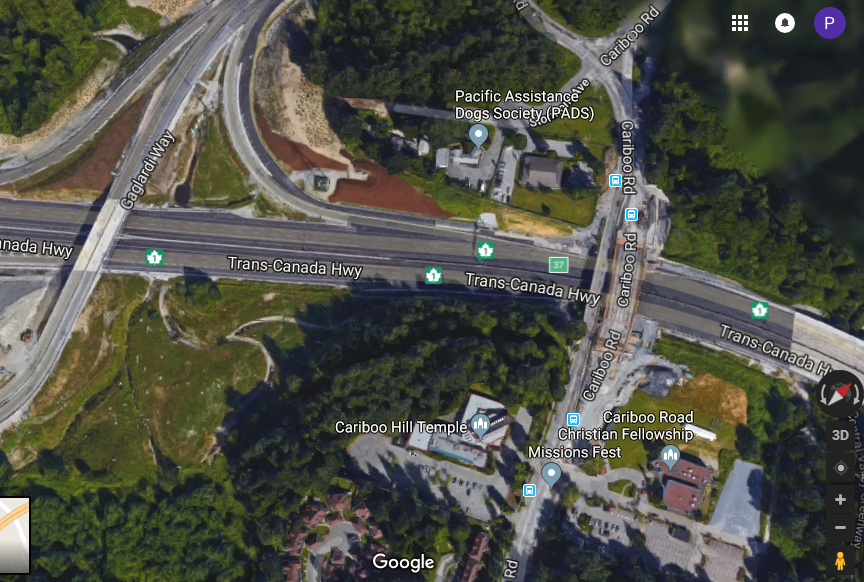
I would be hopeful for, but not expecting, a more sustainable long-term solution, one that would meaningfully increase safety for all users. Reduce the lane width to something like 3.5m (which would provide opportunity for a separated protected cycling path on this well-used route). Complement the pedestrian light with a raised crosswalk, paint and texture treatment to send appropriate speed signals to the drivers. Increase the number of protected crosswalks along Cariboo Hill so people can access the Cariboo Heights residential Co-op and Briar Road, and to again signal drivers that this is a residential area where they should be driving 50km/h and expect pedestrians, not an 80km/h freeway on-ramp. This would, of course, be expensive, but the Google Earth air photo still shows the millions of dollars recently spent here to allow drivers on Cariboo Road to drive faster through here as part of a regional motordom expansion project…

Uncharacteristically, I am not going to hate on Burnaby here. That would be too easy and unfair. This situation is not unique to Cariboo Road, and it is not unique to Burnaby. It in no way undermines the seriousness of this situation to say these three incidents in such close proximity are an unfortunate coincidence. Realistically, I can name a dozen other areas where similarly hazardous conditions exist, and municipalities like Burnaby, Richmond, and (yes) New Westminster are slow to react to them.

That these safety issues are so common is part of the reason we are so slow to react; there’s a lot of infrastructure to fix and a limited infrastructure improvement budget. Still, too much of it is spent on “getting traffic moving” in places like this, were public safety would suggest the opposite. I could go off on a long tangent about “warrant analysis” here, but instead I’ll just reiterate that even if the best intentions exist, priorities need to be set. There simply isn’t enough money to make every pedestrian crossing as safe as we would like, because there are too many unsafe intersections and crossings. 70-odd pedestrians are killed every year in BC, the vast majority at a marked crossing or intersection, demonstrating that we have a lot of work to do when it comes it engineering the protection of pedestrians.

However, engineering can only get us closer to the safety we desire (and please spare me the long digression into autonomous vehicles, the fantastical promises of which seem to commonly fail when pressed against some simple inquiries into their remaining challenges). I’ve recently-enough ranted about how the vehicles pedestrians are forced to share space with are increasingly dangerous to those pedestrians, but haven’t really called out another trend supported mostly by personal anecdote: an increasingly callous disregard for the safety of other demonstrated by people driving cars in British Columbia, and the apparent reluctance of Police and Crown Counsel to meaningfully address this public health emergency.

We have work to do as municipalities (working with and supported by TransLink and the Ministry of Transportation, I hope), and I am proud that New Westminster’s draft 2018 capital budget is showing a serious commitment to meeting the goals set out in our Master Transportation Plan – we are now spending as much on pedestrian and cycling improvements as we do on road repair and asphalt to “keep traffic flowing”. But at some point, we are going to need to convince drivers to meet us half way. We need to change people’s minds about their cars, their entitlement, and how that threatens the safety of our communities.

Motordumb

This is terrifying.

I mean, that is what it’s supposed to be. Part of the macho-truck-tough-guy/gal image it is meant to project. Sports cars were sometimes jokingly referred to as phallic symbols, projecting compensatory manhood and virility. This is a more of a rolling sawed-off shotgun, projecting violence, instability, and wide destructive swath to compensate for an inability to aim.

Big Trucks are nothing new in Canada, but look at the language the puff piece in the “Drive” section of our national newspaper (ugh) uses to describe it:

“Insane”, “ridiculous”, “’roid rage”, “invincible”, “out of scale”.

This truck is too wide (“A single lane suddenly feels too narrow… a foot wider than an already-huge F-250”), too tall (“the bottom of the seat is at eye-level”), and both creates a visual barrier for others (“Once inside you can see clearly over the tops of all SUVs”), yet has terrible visbility itself (“Nothing directly in front of it is visible, thanks to the huge, wide hood”). This lack of visibility is enhanced by mating a 450 horsepower engine with a design that features “bad steering, bad ride and bad handling.” But don’t worry, “You’re so high off the ground, there’s little sense of speed. It’s like looking out the window of a 747 during takeoff.”

Yes, this vehicle is an exaggeration of a point, and not many are sold (although the Globe & Mail will no doubt help with that little problem). But it is symptomatic of a situation where the use of automobiles is,  for the first time in history, getting less safe. And it is increasingly innocent bystanders being killed by them, not drivers.

There are many factors leading to these trends, distracted driving being a bit part of the equation (which raises an entire new rant about big LCD screens in cars). However, we live in a situation were you can roll a Honda Civic off the lot that is faster on the racetrack than a Lamborghini Gallardo. Dodge is selling, over the counter and with no special training mind you, an 840hp drag racer that does a sub-10 second quarter mile. It is so fast, that it is actually illegal to use at a regulated drag strip without doing safety modifications, but you can drive through your local school zone with no such regulatory concerns.

Cars are getting bigger, they are getting more powerful, and things like outward visibility are being compromised for design reasons. Trucks, especially, are seemingly exempt from any regulations around bumper height and fender coverage. After-market modification of lights, suspension, and other critical safety equipment is essentially unregulated.

This is all coming from the position of someone who walks and cycles in a dense urban community, but also someone who sees it as part of his job to make it be safer for 8-year-olds to walk to school and 80-year-olds to cross the street. We already give so much of our urban space to automobiles, because they serve a utility that people value. Recognizing that, we can build wide, comfortable sidewalks. We can design better crosswalks, and paint green paint at conflict zones. We can impose speed limits, improve lighting, create walkable neighbourhoods and dynamic retail districts. But our public spaces will never feel safe – will never be safe – if some agro asshole can charge through it waving a sawed-off shotgun at everyone.

We need to have a discussion about how far is too far for automobiles that want to share our urban space. We need enforceable standards of power, speed, bumper height, and other design elements that emphasize the safety of not just the operator and the passenger, but of other who unwillingly share space with these machines.

Some will suggest this is an intrusion – the end of freedom as we know it. Of course, we already have an actual law telling people to wear a Styrofoam helmet when sharing road space with this monstrosity. And when you get run over by it, rest assured the driver will say “I didn’t even see him!” like that is a defense, and not an admission of guilt. And Crown Counsel will agree.

There is no “War on Cars”, but if that’s what it takes to get these tanks off of our city streets, sign me up.

CGP2?

At the last meeting of 2017, Council received a presentation on the work done by staff, consultants, and the Mayors Task Force on a replacement facility for the Canada Games Pool. Here is my summary of the report, and where we are at on this project (through my eyes, at least).

There is quite a bit of background in the reports presented, but the short version is that Council evaluated refurbishment and replacement options for the Canada Games Pool back in 2015. At that time, the cost for some of the significant mechanical and structural work on the facility was larger than Council was willing to invest in the aged facility. So work began in planning for a replacement and determining if the Centennial Community Centre should be involved in that replacement program, as it was similarly approaching end-of-life for many of its components.

Council and staff worked together on setting some conditions around which future planning should occur. Work was done on a site analysis to determine if the pool should be moved (in the end, the business case did not support changing locations), and how/if to support existing programs during replacement (Council committed to not demolishing the old pool building until the new is built to maintain continuity in programming).

Around the same time, a large public consultation and stakeholder engagement program (“Your Active New West”), engaged the community in discussions around what types of programs the new facility must have, what programs would be nice to have, and what the community was less committed to. The members of Council also toured a number of relatively recent pool and recreation centres around the Lower Mainland, from Coquitlam to West Vancouver, to hear from other communities what worked well and what didn’t in their facilities. A few of us even toured a facility outside Ottawa during last year’s FCM meeting.

There was also a forward-looking needs analysis completed, looking at facility use now (at CGP and other regional aquatic facilities) by the numbers, and projected 30 years into the future. This included demographics on the types of users, facility capacities, and such to provide solid data to back up the expressed desires of the community, and support a business case for operating an expanded recreation facility. “Build it and they will come” is often true, but we need a defensible business case both to demonstrate due diligence, and to bolster our applications for senior government support.

With all of this in hand, the Task Force worked with a team of consultants to develop a proposed program for a new combined Aquatic Centre and Recreation facility. This proposed program is laid out in the detailed Feasibility Study you can read here.

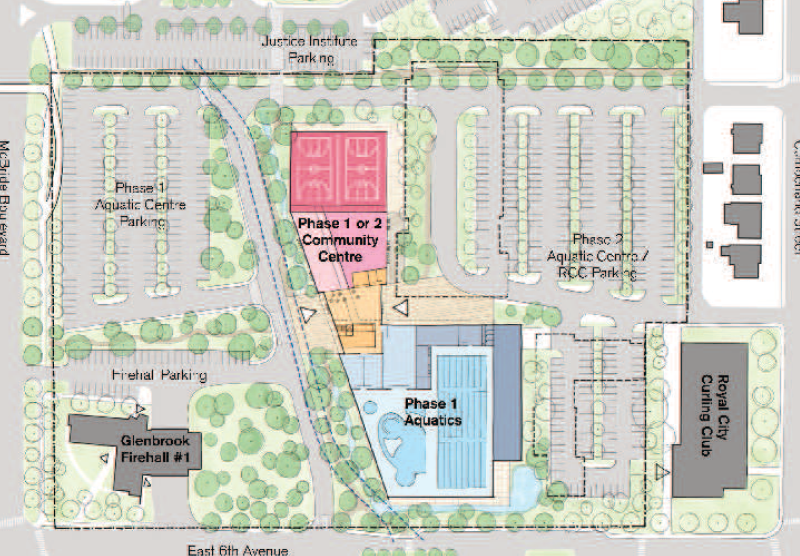
From all of that, the current proposal is to build a natatorium (word of the day!) of similar scale as the Hillcrest Centre build in Vancouver in 2011: a competition-sized tank (8 full-width lanes, 54m long), with a movable floor on one half to provide flexibility of programming, and a separate large (~450 person) leisure pool primarily for family fun, but to also accommodate some (short) lane swimming. The proposal also includes two high-school sized gymnasiums, a fitness/exercise centre more than twice the current capacity, a childcare centre, and 8 very flexible multi-purpose rooms of varying size to accommodate the types of programs the Centennial Centre does now. Throw in change rooms, office space, and common areas, and you have 114,000 square feet of community centre.

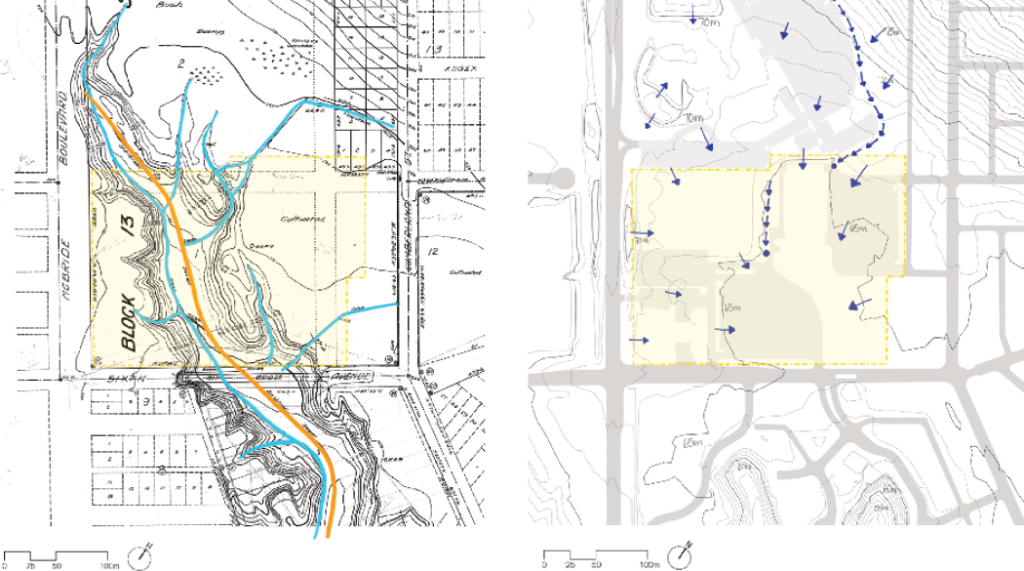
Amongst the many issues that the Task Force have worked on is how to fit that much building on a relatively constrained space. Keeping the existing facilities operating was important, and much of the area where the current parking lot and gravel field are cannot be built upon because of a buried Metro Vancouver sewer line and geotechnical concerns. The Firehall (it is almost new) and the Curling Rink (the City doesn’t own the building) aren’t going anywhere, though the recycling yard may me movable. With traffic access, CPTED, and logistics of construction, the site is very constrained.

As I’m making these points, I need to emphasize that the design and layout suggested in the feasibility study are preliminary and diagrammatic. We don’t yet know what this building will look like in any detail, as we simply are not there yet in the iterative process of design, budget, and construction. However, we know what we want to build, and we know we can make it fit, so now is a good time to take this back out to the public and do a check-in before going forward to the next steps.

There will be public consultation happening early in 2018, but this will be somewhat different than the previous community discussion in 2016-2017. This will be more of a check in to assure we have hit the mark from the earlier consultations, not a time to go back to the drawing board that we already spent a year scribbling on. We also need to start the discussion about how we are going to pay for this.

The budget estimates (and yes, these are early estimates suitable to the early part of the iterative design and planning process we are going through, subject to change for various reasons within and outside of the control of Council) is that the entire centre will cost between $85 and $100 Million. When offering a preliminary estimate, we try to include reasonable contingencies, and are budgeting in 2020 dollars to account for some inflation. However, building costs do not necessarily track the CPI, and anyone trying to hire a contractor right now knows it is  a crazy hot and expensive building market in Greater Vancouver right now. Needless to say, this will be the single largest capital investment ever made by the City of New Westminster.

Council and staff have reason to be confident that the program proposed will qualify for some senior government grants, and potentially some significant Federal Infrastructure dollars. It ticks all the right boxes that the federal program has outlined (inclusive and accessible community infrastructure, improved recreational and social opportunities, significant energy efficiency gains and reduction in GHGs). That said, we cannot move ahead assuming those monies will arrive. We are required to put together a 5-year capital plan that shows we have demonstrated our ability to pay for this, and that will inevitably involve dipping into reserves, some debt financing, and tax increases. There’s no way around that.

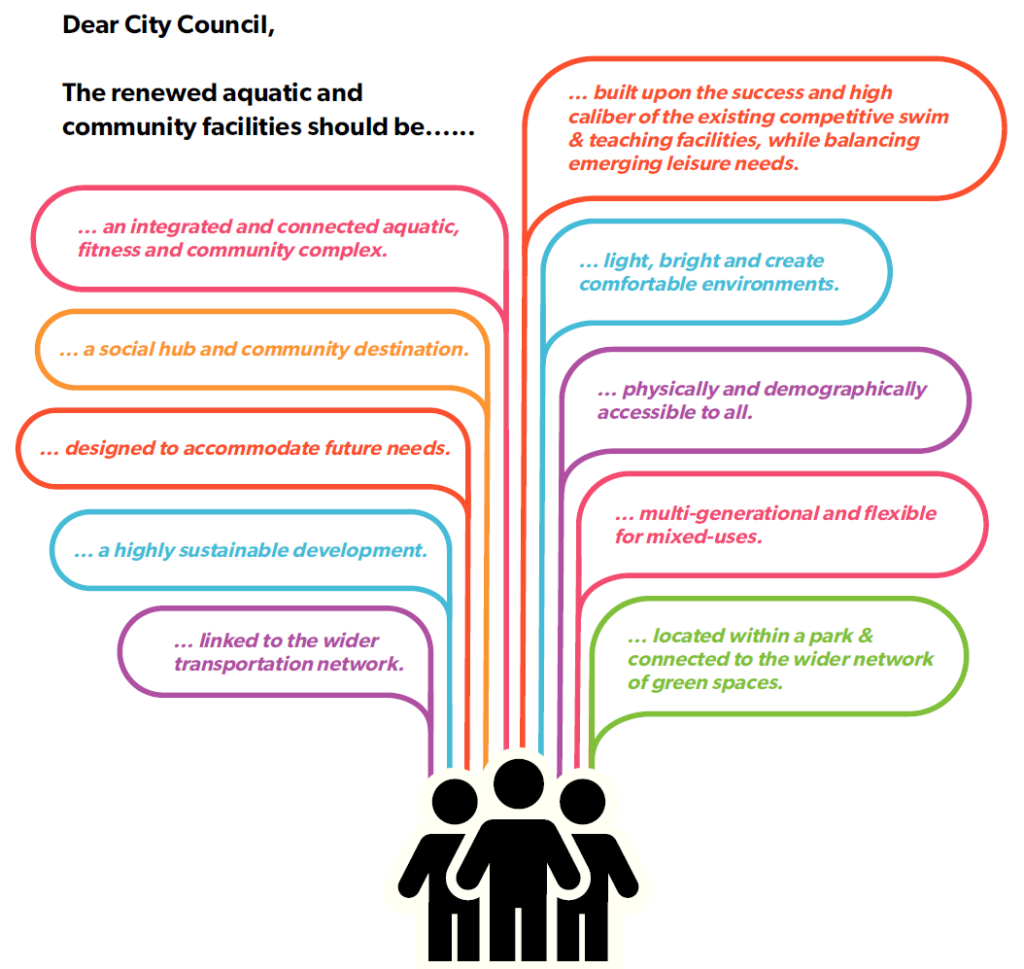
So over to you. Public engagement is coming in January, and in the meantime will be doing some more technical work on things like geotechnical constraints, parking needs, and some sustainability targets for the building (is LEED Gold the right standard?). We will also be preparing to submit grant applications to senior governments when the windows open (if you know anyone in Victoria or Ottawa, put in a good word for us!). This is a big project, and an exciting time for the City. Let’s hear what you think. It is important to let Council know what you like and if you support this project, and to let us know if you have concerns.

Ask Pat: Noise

relic57 asks—

Living on the corner of 6th and Victoria, I am one of hundreds of people adversely affected by the relentless construction noise by not one, but two towers underway at the same time. Just as the first one is winding down, the next has started. This is now three straight years of daily noise, often six days a week. The latest, the so-called ‘Beverly’ on the site of the demolished Masonic Hall, is in its excavation phase. It’s bad enough to have to endure the mind-splitting pneumatic drilling through the workweek, but the contractors (nameless for now) have no compunction whatever starting up at 7:00 a.m. Saturdays as well. This is six days a week where the noise can be so intense I am driven from my apartment.

This is not fair to me or the many others living nearby. These developments are not altruistically based, but purely profit driven. If I were to engage in some activity that disrupts a business, I could be liable. But developers can do anything they want, anytime they want, and they can buy their way into disrupting the little guaranteed quiet time people now have with special permits.

I have commented on this on Twitter (and engaged you a couple of times on other matters) and once received a reply from Mayor Cote informing me that the construction noise bylaws were going to be revised this spring. It is now spring. Nothing has apparently changed.

I have lived in New West for four years. The first year was great, the most quiet area I ever lived in. Then the ‘Novare’ started up across the street. Now the demolition of the hall, and work on the ‘Beverly’, literally next door. By the time that is finished, the Bosa twin tower monstrosity on the waterfront will be underway (we can all look forward to the pile-driving echoing up the hill for months or years, can’t we?), and maybe, just for fun, city hall will finally approve the over-height 618 Carnarvon proposal as well, only a block away from me. All together, seven or eight straight years of noise in total, capped by the probable demoviction from my own cheap walk-up once the area is gentrified enough.

So, what’s up with the noise? These bylaws were written when they built one little tower a year around here, if that–not ten. People don’t all go to work elsewhere anymore–they work at home, or they work shifts, or they’re retired. Why put us through this? These towers won’t even ease the accommodation crisis. They’re all aimed at high or relatively high earners–even the rentals.

There is a lot to unpack here, which is part of the reason it has taken me so long to address this Ask Pat that arrived this summer. I will try to concentrate on the sentences ending in question marks, in order:

“we can all look forward to the pile-driving echoing up the hill for months or years, can’t we?”
The Bosa Project on the waterfront will indeed require the driving of piles. However, this issue was discussed with the developer as part of their rezoning process. They have committed to using secant piles instead of sheet piles where possible along the periphery of the excavation. This more expensive technology was used recently for the Metro Vancouver pump station project in Sapperton (the big hole in the ground to the east you can see from the SkyTrain), creating much less disruption to the neighbourhood. They are also going to use vibratory driving of structural piles where viable. This technology is quieter, but does have other concerns around low-frequency vibration and potential impact on adjacent properties, so a Geotechnical Engineer will have to choose when this approach is, or is not, appropriate. Long story short – pile driving will be getting quieter, but won’t be going away.

So, what’s up with the noise?
Construction is noisy. Pile driving is disruptive, but so is pretty much every other aspect of building a modern building – hammering, drilling, pumping concrete and running of heavy equipment. The City has a Construction Noise Bylaw that exists separately from our regular Noise Bylaw, because of the special needs of construction sites, and the (relatively) short-term nature of any single construction site.

A proposal to update in the Construction Noise Bylaw came to Council in July, after Council asked Staff to address public concerns coming from the driving of piles for the two properties on either end of the McInnes Overpass. The update proposal included reducing construction hours on Saturday (you can go here to read the Minutes of the meeting where this was discussed), and discussed the changes in pile driving technology I already mentioned. The final draft of the Bylaw has not yet come to Council. The report indicated that our mid-week construction noise allowance was similar to other cities, but most cities allowed later starts and earlier ends of the Saturday construction schedule. We don’t allow construction on Sundays (except in your own home). So if the Bylaw is updated, I would expect it will bring us more in line with our neighbouring communities.

Why put us through this?
There is a lot of construction going on in the City, which should be no surprise to anyone. The region is growing, and the Downtown Community Plan includes a lot of new suites in order to allow people to live near our highest-service transit hubs. Both the tower recently completed next to you and the Masonic Lodge project went through extensive community review, including Public Hearings three or four years ago. In the intervening years, the regional housing crisis has further eroded the available housing, especially rental housing. Both projects are dedicated rental buildings, bringing (respectively) 282 and 151 rental suites on-line in a market where vacancy is currently 0.3%. It is hard to argue these types of developments are not an urgent need in our community.

Again, I recognize my answer is not going to satisfy you. Aside from stopping or construction of new homes (worsening our regional housing crisis) or regulating construction hours such that their construction is further delayed (potentially extending the number of months that disruptive noise is created while delaying bringing buildings on-line), I’m not sure what solution I can offer. I am open to suggestions.

ASK PAT: Potash

Shaji asks—

This proposal to put a potash storage and transportation facility on the Surrey-side banks of the Fraser river seems absurd!

I have recent made the New West and the Fraser river my home and come to realize how much of it is surrounded with beautiful marshlands and resident wild life – despite the Fraser being a working river. I see seals bobbing their heads out of the water everyday from my window.

Our efforts need to be to preserve and clean up this beautiful surrounding; not further pollute it with such harmful proposed projects.

What is the City’s stance and influence on the proposed project?

Thanks again

The first I heard of a plan to move potash through Fraser Surrey Docks was when a few residents of Queensborough started sending me e-mails. The general theme of these e-mails was “What is the Port trying to pull here!?” Hopefully I can explain, although I have not heard a peep from the Port (officially or informally) about this project, so most everything I know you can read yourself at the Port’s information website about the project.

It appears that one of the world’s largest mining companies, BHP Billiton, wants to build a facility in Surrey to move potash off of train cars and into bulk carrier ships for export. Much like the previous coal terminal facility proposed for Fraser Surrey Docks, this facility will be required to go through the Port’s own Environmental Review process, instead of a Federal Environmental Assessment. This procedure exists because of legislative changes made by Stephen Harper’s Conservative government that decimated the Canadian Environmental Assessment Act – changes Justin Trudeau’s Liberal Government seems in no rush to address despite significant election promises to the effect. But I digress.

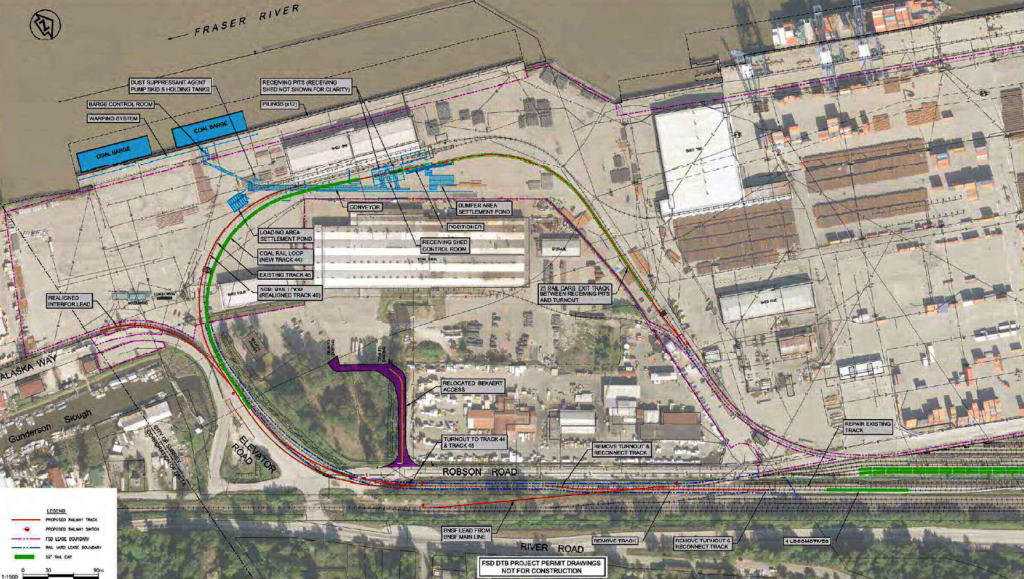
Upon hearing about this proposal, my initial questions were around what it means for the Coal Terminal project. That project has already been approved by the Port, although that approval is still being challenged in court. My cursory look at the proposed coal terminal drawings:

…and the drawings for the proposed potash terminal:

…suggest to me that they do not share operational footprint, except for some rail loop infrastructure. So I am operating under the assumption that potash terminal approval would not mean coal terminal termination. We should be so lucky.

So what do we know about potash? It is mined from evaporate deposits under Saskatchewan; it is mostly potassium chloride with less than 5% sodium chloride and trace amounts of other minerals; it is primarily used for fertilizer, although it is also used in metals refining and other industrial processes. It is no more toxic that table salt, isn’t flammable, isn’t carcinogenic, and isn’t a particularly nasty environmental contaminant in soil or water. There are some well-understood and generally well mitigated environmental impacts from mining. After spending a few hours reading up on potash and its handling, finding science-based sources I consider reliable and relatively unbiased, there is little in my Environmental Geoscientist experience that causes me great concern about this material being handled in or moved through my neighbourhood.

There will be impacts, no doubt. Train traffic, noise, light, and potentially dust (though potash is usually handled though a pretty closed system due it its solubility). The Port review process (as sketchy as it is) should provide us some ability to provide input to the Port about how we want these potential issues mitigated. You can learn about the project and review process by attending an Open House at the Fraser River Discovery Centre on Thursday evening, you can read the project materials here, or you can go to the BHP project site here and provide some feedback directly. For further research, I might reach out to some council colleagues on the North Shore where potash has been handled for years to see what concerns it has caused in their communities.

That said, you asked a specific question, with pretty simple answers: Council has not been formally asked to opine on the project yet (any more than any other stakeholder), haven’t received any reports, and haven’t really discussed it, so the City doesn’t yet have a stance on the project. Our influence as a stakeholder is limited – as we learned from the coal terminal project where our firm opposition did not prevent the project from being approved. I am sure we will participate in the review process, but it would be premature for me to speak on behalf of all of Council on what the City’s position will be.

As an aside, this proposal is apparently to move potash from a new mine outside of Saskatoon, specifically one that BHP Billiton announced they were in no rush to open as recently as August. I have no idea what that means to this project, but the timing does seem strange.

Green City?

Long-time readers (Hi Mom!) will remember that I got involved in this entire blog thing through an environmental lens. When I moved my constant beaking off onto the internet back in 2010, I had been involved with groups in New West and regionally who were trying to promote sustainability and environmental protection, in my profession, in the community, and in politics.

At the time, New West Council was making significant shifts towards better environmental policy. A few of the newer members of Council, led by some young whippersnapper named Cote, were putting environmental issues on the agenda. The City was adopting environmental policies, hired an Environmental Coordinator, and was moving into developing a sustainability framework that would become Envision2032.

The City of New West considers itself a leader in environmental initiatives, however I have yet to see a local government that doesn’t consider itself a leader on this front. That may sound critical, but it is really more a reflection of the sometimes poorly-defined and always evolving concept of environmental sustainability. Local governments (like most organizations, and most people for that matter) emphasize the good things they are doing and progress they are making, but are commonly blind to the things they are not doing. When it comes to something like environmental sustainability, consistent re-evaluation of goals and metrics is the only way to avoid comfortable smugness.

Recognizing this, the City is inviting you to help us move forward on environmental policy. Council has asked staff to review what we are doing, and what we can do better – both a gap analysis and reality check. And we are asking you to help.

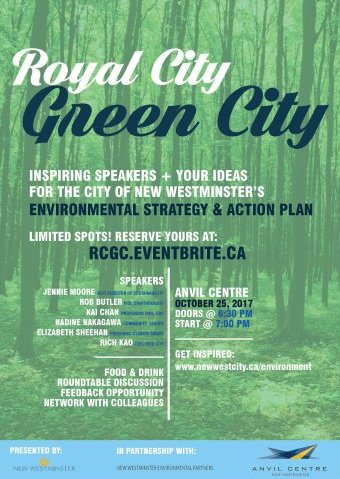
This week (October 25th!) there will be a Public Event called Royal City / Green City, where we are going to get people into a room to talk about where our environmental policies are, and where they need to be. We are bringing together some subject matter experts to provide inspiration, and perhaps to push us in uncomfortable directions. We will also be asking all attendees to react to what they hear, and push the City. It is completely free and open to everyone, whether you work, live, study or play in New West. We do ask that you register ahead of time so we can properly plan for the numbers who will arrive, because this will be an interactive event. You can register here:

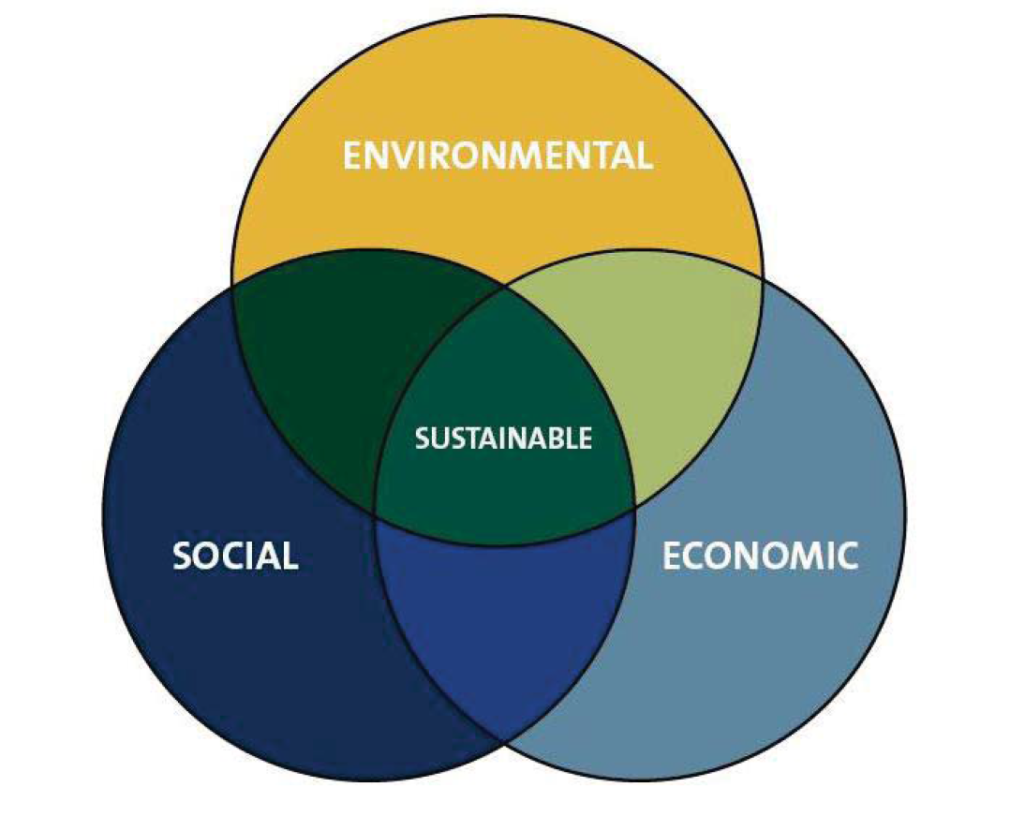
Maybe to get the creative juices flowing, I want to challenge the three- (or increasingly four-) pillar idea model of sustainability. This has become the standard model of suggesting sustainability is a balance between three competing forces – protection of the environment, growth of the economy, and maintenance of societal standards. Diagrammatically, it usually looks like this (copied from Envision2032):

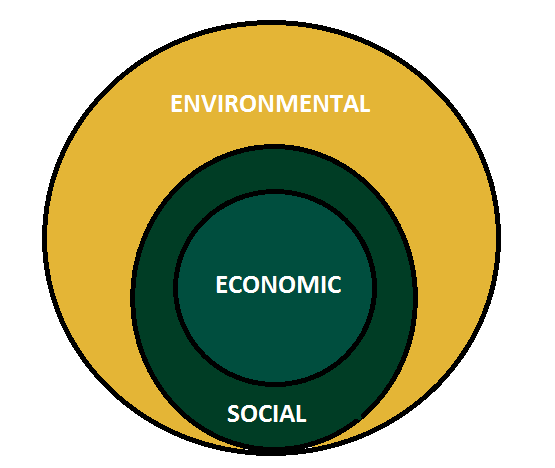
This has always caused me to itch, because I have never felt it accurately reflects the interdependence between the three pillars. Without a sustained environment, we cannot have an economy or a society. Take that one pillar away, the other two disappear. Similarly, our economy exists within, and is defined by, the structures of our society. It cannot exist without a societal structure, which is, in turn, defined by the environment in which we live. In my mind (and I’m not the only person to suggest this) the three pillars should be drawn like this:Actions, technologies, and organizations impact our economy, which in turn shape our society, which in turn impact the greater natural environment. When we shape policies, when we evaluate the worth of technology or price individual actions, we are using economic tools to adjust the shape of our society. If that re-shaping supports the protection of the natural environment in a way that doesn’t constrain future societies from access to natural resources, then we can call those actions “sustainable”.

Clearly, I’m not a philosopher, so come out on October 25th and tell me how I am wrong!

Ask Pat: The Q’boro edition

Yes, I am a bad blogger. I have Ask Pats in the queue, and run the risk of looking like I just don’t care. But summer is over, which traditionally means time to get back to work, so I’ll try to knock off a couple together here, with a Q’boro theme:

Shaji asks—

Hello Pat
Do you know what is the story behind Frankie G’s Boilerhouse Pub on 305 Ewen Avenue in Queensborough? It seems like it has been under renovations for a long time.

I don’t know much, except that there was a fire, and the owner is doing a major renovation to coincide with the repairs required due to flames/smoke/water. That said, nothing has come across the Council table about it, and I am not aware of any other plans for the site. It is a bit of a shame that they were not open this summer, as it would have made a nice walkable destination during the QtoQ Ferry demonstration, and I know that Port Royal residents are missing having a local community pub. Hope it’s open soon!

Dan asks—

Why did you guys wait so long in the process to figure out building a Q2Q bridge was going to be expensive? How many tens of thousands of dollars did you waste in meetings discussing nonsense with other bureaucrats? You say you have us in your mind, but your thoughts and prayers are piss in the wind. Queensborough is one of the least thought out communities I have had the misfortune of living in. It seems not a single person on the council even thought about basic amenities like a grocery store or how people will get in and out or find parking. You saw a quick way to make cash, promised people a solution and future, and produced nothing. There are thousands of new homes coming up, and little to no forethought into how this will make the already existing problem of access even worse.

To answer your first question, the money to build the proposed Q2Q bridge was not going to be available until around 2015, based on the original timeline of the DAC funding model, when it was put together back in 2007 or so. The higher-priority projects (Queensborough Parks and the Queensborough Community Centre, the MUCF/Anvil Centre) were to be funded and completed first, and were. I wrote a longer piece here about the evolution and challenges of the Q2Q bridge, and a follow-up piece on the decisions made since my time on Council, which may answer some of your questions about how a project originally (in 2008) thought to be in the order of $10Million became a project estimated at $40Million.

I’m not sure how to square the idea that Queensborough is ignored by the City when I look at the Queensborough Community Plan, the investments in the QBB and surrounding parks, the largest road improvement project in the City’s history, and the City investing in childcare and affordable housing initiatives in that neighbourhood as priorities over the rest of the City. Queensborough is growing fast, and the City is investing in making it a livable, working community.

The Community Plan does include the building of neighbourhood-serving retail in a new node near Mercer and Ewen, but the reality is that the City doesn’t build retail developments; that is the job of the private sector. There is a frustrating chicken-and-egg situation where retail developers need to see a large population (=potential customer) base before they will invest and build, but in the meantime, we want local retail to support a growing population (it is kind of like the transit conundrum that sees Port Royal still under-served by Transit as it exceeds the density of many better-served neighbourhoods). The mostly-empty strip mall just over the border in Hamilton is an example of what happens if you try to build small neighbourhood-serving retail in a neighbourhood not ready for it, especially in the shadow of WalMart, but that’s an entire other discussion.

So, yeah, Queensborough is a work in progress, just as every other neighbourhood in the City is. It has an abundance of relatively affordable family-friendly housing options near a bunch of great community amenities, if one is willing to suffer from a lack of retail variety and rush hour traffic challenges. I think the community plan shows some longer-term relief from those challenges, but the solutions aren’t instant, and aren’t for a lack of forethought. Communities often shape themselves, regardless of the best laid plans.

And, as a side note, Council will be doing our annual Meeting in Queensborough on September 11, starting at 6:00pm. If you have a specific Q’boro concern, complaint, kudo or claim, Public Delegations start at 7:00! C’mon out and tell us what you think!

on Data

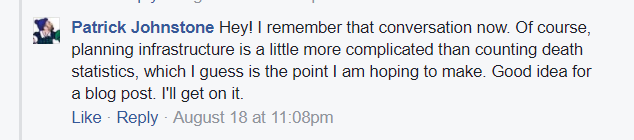
This isn’t exactly an Ask Pat, but I was asked a question on Facebook comments thread discussing the new Crosstown Greenway changes along 7th Ave, and I needed more than a Facebook post to answer:
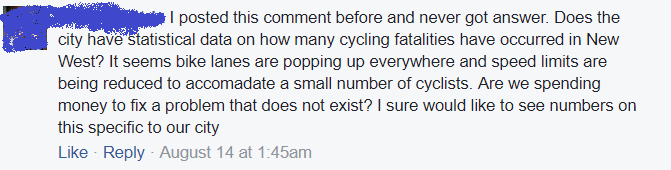
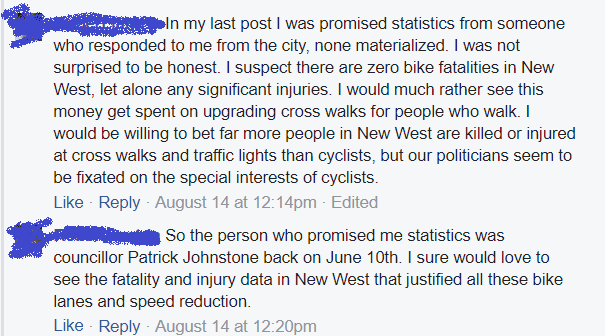
I read two questions here, tied up into one. Paraphrased, the first is “How many cyclist injuries or deaths are there in the City to justify all of this money spent on bike lanes?”, and the second, perhaps more nuanced, is “What data justifies spending money on all these new bike lanes”.

I didn’t answer the first question, because I think it is a terrible question, but never got around to explaining why I feel that way. If we have a spike in deaths or injuries, it may be an indication that we have a problem that needs immediate attention, but we don’t wait for those spike if we can anticipate and prevent incidents. A raw count of deaths or injuries as the sole driver of infrastructure investment is not responsible governance.

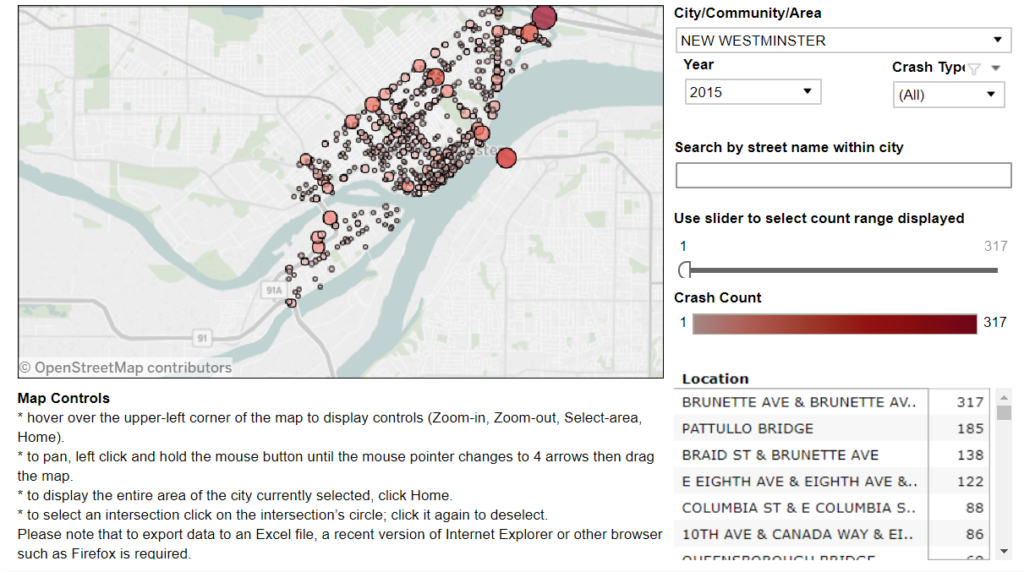
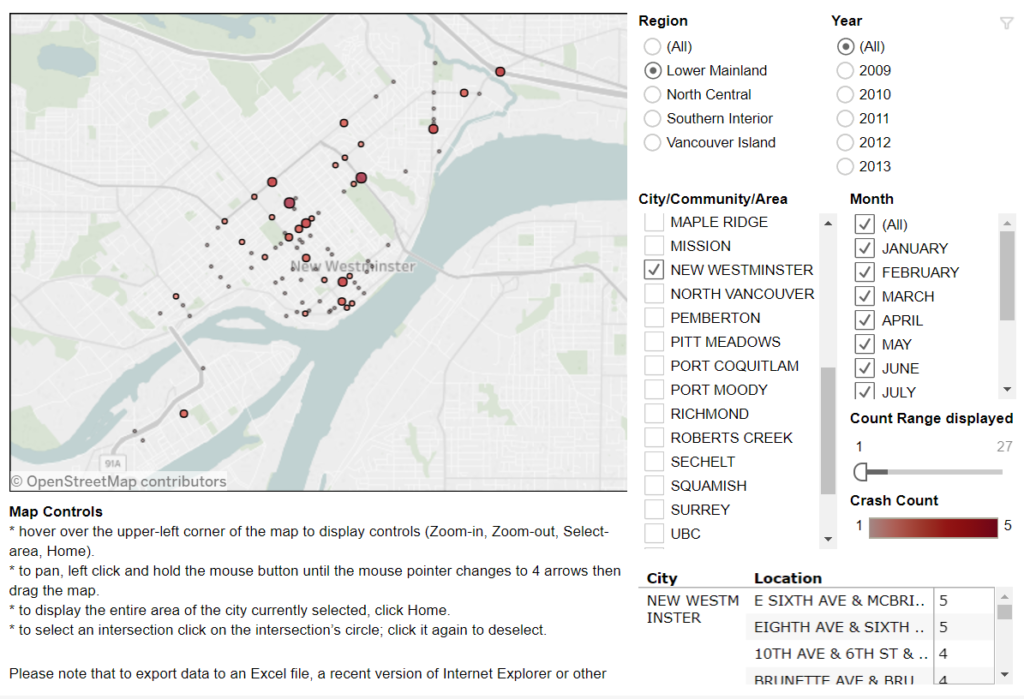
The actual data being asked for is hard to come by. Local governments do not (to the best of my knowledge) collect these stats in any kind of comprehensive way for public consumption. ICBC presumably still collects stats, but their reporting out has become pretty inconsistent, and their crash maps for New Westminster have not been updated since 2013 (for Pedestrians and cyclists) or 2015 (for cars) and cannot be filtered by injury/death/property damage: 
Anecdotally (and off the top of my head) I can think of two cyclist and three pedestrian deaths in New Westminster in the last few years (there have surely been more). One of them I am comfortable in calling an “accident”, a second was clearly an act of negligence on the part of a pedestrian. The rest were just as clearly acts of negligence on the part of the drivers of a vehicles, resulting in the death of 3 innocent road users. I have also spent the last year watching a good friend struggle through recovery from a near-fatal cycling crash where he was clearly a victim of a negligent driver. New West is not unique here, as across the region, there is news every day of cyclist endangered by the negligence of drivers.

Of course, I acknowledge the obvious point that cyclists and pedestrians also sometimes act negligently, and cause accidents. However studies have shown that accidents causing injury or death of pedestrians and cyclist are in the vast majority, caused by the actions of drivers, most notably not yielding right-of way while making turns.

That said, we are talking about infrastructure, and part of designing and investing in transportation infrastructure is in making it harder for people (drivers or vulnerable users) to be negligent, and to reduce the potential impacts of any negligence on vulnerable road users. We can do this through design that reduces conflict points, improves visibility, slows cars, or puts barriers between vulnerable users and the vehicles that endanger them. At some level, this should be the primary goal of all transportation engineering. But perhaps I am already digressing too far from the point, so let me answer more succinctly:

We don’t measure the need for a bridge by counting the number of people drowning in a river.

The second question seems to be more relevant to how governance works: What kind of data do we use to make transportation investment decisions?

The City passed a Master Transportation Plan back in early 2014, and it sets out priorities for the City’s transportation investments. It was developed in context of a bunch of other planning documents, including larger regional plans like the Metro Vancouver Regional Growth Strategy and the TransLink Transport 2040 regional transportation plan, both of which the City participated in. Internally, we have our own Official Community Plan (currently being updated), a relatively recent Sustainability Plan, and a variety of other strategies to make the City more equitable, safer, livable, and sustainable.

These plans all point to making active transportation modes (pedestrians, cycling, and transit) easier to access, safer, and more comfortable, as an important strategy towards the larger regional and local community development goals. This was reflected in our Master Transportation Plan with an established hierarchy for our transportation system:
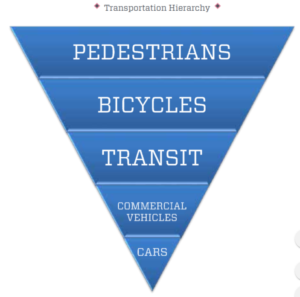
In an ideal world, our transportation spending would reflect that hierarchy, but we are not there yet. This year, we will spend something like $4 Million* on asphalt, mostly to make roads smoother for drivers. At the same time, we will spend about $500,000* on sidewalk improvements and maintenance (which represents a pretty significant proportional increase over previous years), and the Crosstown Greenway improvements that started this entire conversation will cost us less than $125,000*. By any measure, the hierarchy in the MTP is aspirational, as travelling by car is still the preferred mode for a little more than 60% of residents.

(* all budget estimates, very close to reality, but not exact numbers) 

So the City has a well established and regionally-supported goal to encourage active modes, mostly by making them safer and more comfortable for all users. The only question left is what evidence do we have to suggest making active modes safer and more comfortable encourages their use, or provides the livability, sustainability, and inclusion goals the City is after?

I could start with Montreal, or Copenhagen, or Medellin, or even Vancouver. I can refer you to books by Jeanette Sadik-Khan or Charles Montgomery. We are not inventing a new wheel here (we are too small and too fiscally conservative a City to do that), but we are taking the best of what other jurisdictions have already demonstrated to work, and are warned by failures in other jurisdictions.

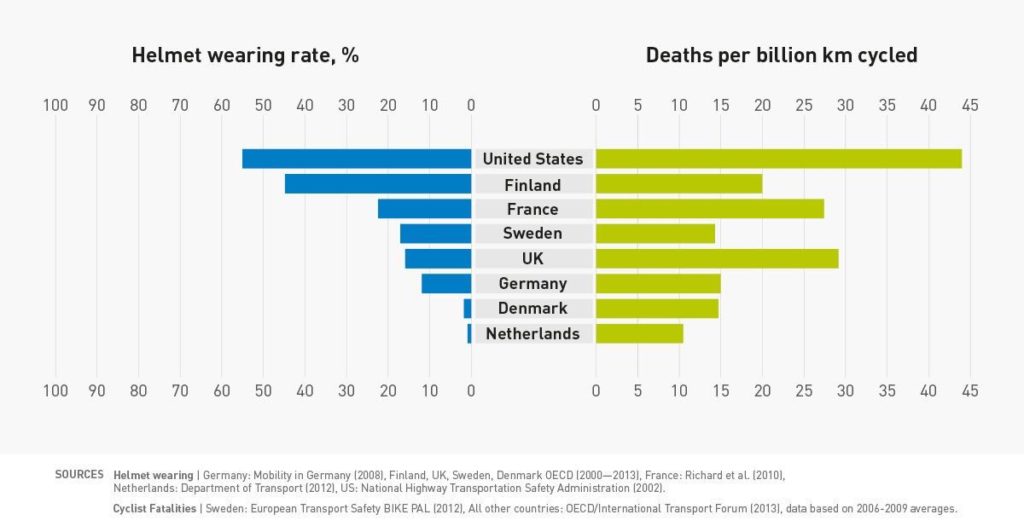
If you want to dig in to the academic underpinnings here, I can link you to resources about how protected bike lanes save lives and reduce injuries, and studies showing that communities where people are encouraged and supported in choosing active modes are happier, healthier, and more inclusive ones. Perhaps most importantly, I can show you the data that building proper infrastructure increases the number of cyclists, which actually correlates with cyclist safety much more than does helmet use (for example):
The Crosstown Greenway improvements are very small part of our transportation budget (less than 3% of this year’s budget for road improvements), and has numerous potential benefits to the community at large. As the City’s first foray into modern separated bikeway design, it may have a few kinks to work out, and it may take a bit of time for drivers to get their head around the new layout, but it is based on well-established design principles, and is a big step towards creating a safe, effective, and all-ages cycling network in the City.

That said, they were done as a bit of a trial, and I encourage everyone to let the City know what you like and don’t about the design – and provide suggestions about how the City could improve upon the design.

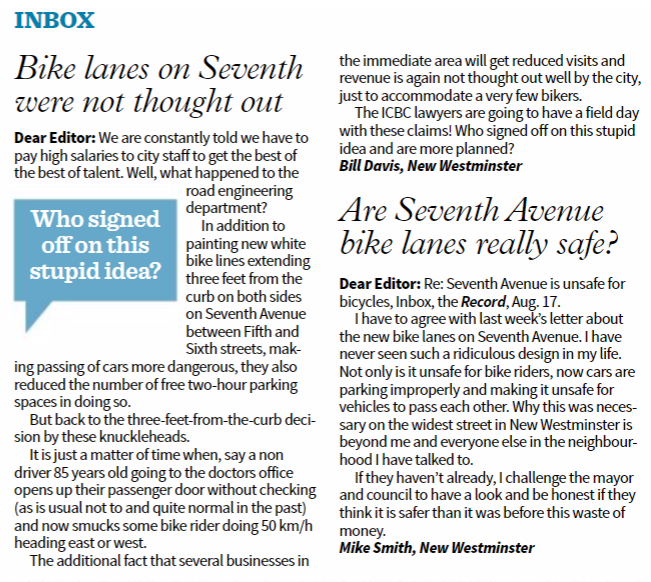
POST SCRIPT: I swear I did not read the New West Record that came out today before writing this post… 
Volunteers

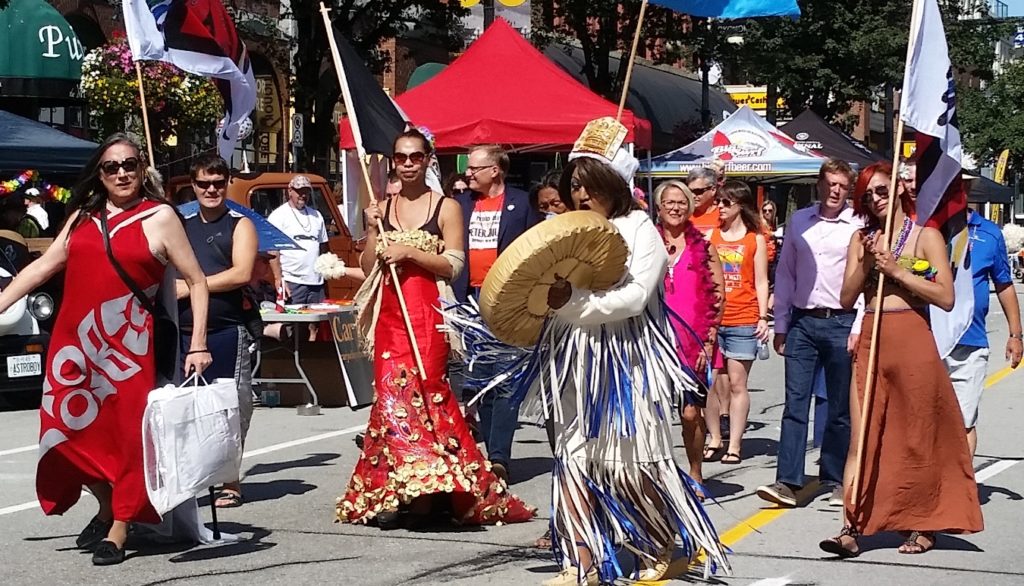
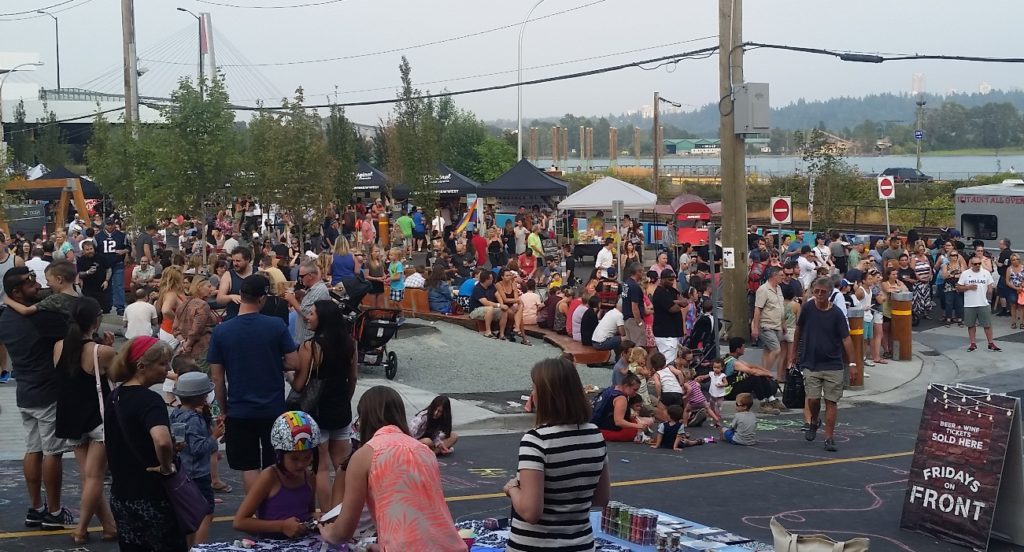
As I noted a little earlier, this summer has been pretty active in New West. This last weekend the trend continued with the annual Pride Street Party. There were community groups booths, three stages with entertainment, an active kid’s area, beer gardens, food trucks, and local restaurants and beer gardens were filled to overflowing. While other parts of the City and the world were having confrontations about inclusiveness and diversity, thousands of people filled Columbia Street to celebrate victories won for inclusion and understanding, and had fun on a sunny afternoon.

It was a great day in New West, and one that would not have been possible without an army of volunteers.

New West Pride Society is a volunteer-run society that organizes and executes the entire event. The City helps with a grant through our festival grant program, and many sponsors step up to pay for everything from volunteer t-shirts to stage rental and advertising. However all of the actual work, the organization, the year of planning, the hundreds of tasks on event day, everything is done by volunteers.

It isn’t just Pride. The New West Farmers Market, the New West Cultural Crawl, The New West Grand Prix, the Hyack International Parade,  Pecha Kucha NW, the New West Film Fest, the events that make the City come alive, are run largely on the backs of volunteer labour. Lots of Volunteer labour.

No surprising point to this, just a short post to give an extra “Thanks” to the volunteers that make this City so full of great activity – from the Presidents of Societies that work all year long, to the folks who show up on game day to sell tickets or pick up litter. I hope that everyone who enjoyed an event this year will think about volunteering for next year’s version of whatever event they enjoyed (and it doesn’t have to be just one). It doesn’t take much time (many hands make light work), you might get a T-shirt (see banner), and it makes the event even more enjoyable for you. You can say “I helped make this happen”, you will help create more opportunities to enjoy the summer with your friends, and you will more likely than not make new friends.