Council – May 11 2020

Another week, and other Council meeting. It didn’t look like that picture above, but I thought i would add that to remind us of the before-times. We are going to start moving towards a more regular schedule again soon (see below), but for now the updates keep coming so we keep meeting. As always, we are recording the audio stream (though we are meeting using video), so you can follow along the recording or see the agenda here. We started with a significant report:

Provincial Restart Plan and City of New Westminster Recovery Plan Presentation
We have talked a lot in the last two months about response to the pandemic situation, and as I suggested last week, we are starting to talk about what recovery is going to look like. As the Provincial announcements made clear last week, we are not past the danger phase, but with most of the response now planned and being implemented, it is time to start talking about what happens where we start moving to post-emergency operations. We had a lengthy reporting out from senior staff on what this looks like for Parks, Recreation, and the Library.

As with the rest of the emergency response, this is mostly following the lead of the provincial health officer’s directions, so we don’t have control over the pace here, only the choice of actions we will take. As the report says right up front – the City has three responsibilities – it is a regulator, it is an employer, and it is a service provider. All three roles need to be considered through this process.

There is a perhaps counter-intuitive issue with facilities opening sooner than the City anticipated in its financial modelling. Opening City facilities will mean some of the cost savings from them being closed will be lost, and potentially bringing some auxiliary staff back sooner than anticipated. This is likely to start to happen before the concomitant return of traditional revenue sources, so this could ironically make our financial situation worse, not better.

For now, some parks facilities will be opening up, and we will be monitoring how that kind of thing goes, and will be working in coordination with adjacent municipalities to try to make this entire thing not be so confusing that people will have a hard time complying. A good time to remind everyone that everybody is doing all of this for this first time, and we need to work together.


The following items were Moved on Consent:

COVID-19 Pandemic The New Normal: Council and Committee Processes
We are adapting the way we are running Council meetings again, this time taking away a few of the restrictions we put in when things were first hitting the fan in late March. We are also establishing a more reasonable schedule going into the summer to replace our current weekly meetings, and trying to get more “regular” business done instead of being all-emergency-all-the-time.

The Province has provided us some extraordinary flexibility in how we run meetings under a Ministerial Order (M139) so we can do business during the emergency, with physical distancing protocols, and outside of the Council Chambers if needed. This replaced the earlier Order (M083) which we were previously operating under, so we need a refresh in our procedures.

City Advisory Committees were suspended in April, and we are now looking at re-launching some of them electronically, especially the Board of Variance and Advisory Planning Commission as needed. Most committees, however, will continue to be suspended until the end of the summer. Unfortunately, Public Delegations are still difficult to organize and manage for staff, and will remain suspended. If you wish to address Council in the meantime, please send us an e-mail or letter, and contact the Clerk’s office if you have questions about how to connect.

We are also going to look at getting electronic Public Hearings happening. This will allow anyone with access to a computer, tablet, or telephone to take part in an on-line meeting. Of course, you can still provide input to public hearings by writing an e-mail or old-skool letter to Council. If the technical stuff can get worked out, we will likely have a Public Hearing for some backlogged projects in late May.

Sapperton Pump Station: 1 Cumberland Street – Request for Construction Noise Bylaw Exemption
That big sewer pump station being built below Sapperton is almost done. This is a request to do some night work to remove a bulkhead within the “wet well” – work that has to happen in the middle of the night on a night when the weather has been dry for some time because it is much, much easier to do when the sewer flows are at their lowest. Council granted a nighttime construction noise exemption to permit this work.


The following items were Removed from Consent for discussion:

COVID-19 Pandemic Response – Update and Progress from the Five Task Forces
Our weekly updates from the operating Task Forces. We are still working on food security, a “Hey Neighbour” initiative to help forge social connections in multi-family buildings, the Friendly Caller program to help isolated seniors is going well, and we are partnering to open an emergency shelter at the empty gym attached to the Massey Theatre. Staff have reached out to most businesses in town, including door-to-door delivering support information in multiple languages to the businesses along 12th Street that don’t have the umbrella of a formal or informal BIA to help with communications. And this is just a few of the things City Staff are doing to keep our community connected and safe.

Also part of this was the need for us to approve spending $82,000 on two emergency food hamper programs. Because government is funny that way, we needed to approve the spending even if it is just flowing through us. I am burying the lede a bit here, as these were both the result of large grants provided by the Vancouver Foundation to local non-profit providers after the City helped with application and coordination. This is great news, as more than 1,500 food hampers will be delivered to those most in need in our community over the next 12 weeks.

COVID-19 At-Risk and Vulnerable Populations Task Force: Information and Resource Dissemination Actions
This is a reporting out on the numerous communications actions the city has taken, and tools that have been developed to assure that we are sharing information about the pandemic response and supports available, from a summary of financial supports from various government programs to a food resources calendar.

I do want to pull out of this an important initiative that came out of our Intelligent City program and a partnership with Douglas College. We are providing recycles WiFi-enabled devices and Wifi hotspots in the City. Of course, much info people need to get through the crisis is available on-line, and access to many program relies on internet connectivity to sign up or get vital information. However, lots of people in New West (especially those who most need the supports above) do not have a consistent connection to the internet. The Library is an important source of Wifi and devices/desktops to connect for many people, but it has been closed for almost two months now, as are other places where public (Anvil Centre) or private (Coffee shops) WiFi connections are available. At the same time so much information about the current crisis and supports available are easiest to find on the internet. Hopefully this program will help more people get connected.

COVID-19 Council Review of 2020 Community Grants Program
Many of the Grants the City awarded in 2020 will not be used, simply because they are for events that cannot happen due to the physical distancing requirements, and because some organizations that were awarded these grants will simply not have capacity to use them this year. Staff reached out to the awardees and did an informal survey to find out which grants will still be used (or were already used), which will not, and which the applicant would like to repurpose in light of the Pandemic situation. We are currently estimating we will still see a reduction of about 1/3 of the ~$1 Million (cash and City services) in grants awarded.

Physical Distancing on City Streets
This report talks about some of the great work our Transportation Department has done to open up pedestrian spaces in the City to help with physical distancing. It also outlines some of the next steps (and a few of the challenges along the way). Many may have noticed that Sixth Ave in Uptown had its sidewalks extended with temporary measures today. More to come, and of course I have a bunch to say about this, considering this motion came right after it:


We had two pieces of New Business:

Motion: Streets for People in 2020

BE IT RESOLVED THAT the City of New Westminster move quickly in 2020 to expand road re-allocation toward pedestrian, cyclist, and public gathering space, using temporary measures where necessary with a mind towards more permanent solutions that can be applied after the period of crisis has passed; and
BE IT FURTHER RESOLVED THAT the Transportation Task Force make rapid reallocation of road space a priority work item, are empowered to immediately apply temporary measures in 2020, and accelerate the timeline towards the 10% space reallocation goal set out in Bold Step 7 of the City’s Climate Action Plan

I put this motion forward, and will talk about it at length in one of my patented “I’ll have to write a follow-up blog post about this” follow-up blog posts about this.

Motion: Public Engagement Strategy for COVID Recovery

BE IT RESOLVED THAT staff prepare a public engagement strategy for involving the community in COVID-19 recovery planning with particular focus on addressing systemic inequities and building a stronger, more vibrant and connected, climate change resilient community; and
BE IT FURTHER RESOLVED THAT the plan proposes ways to address barriers to participation that have resulted in lack of representation by communities of colour, tenants and underhoused, lower income community members, disabled people, and other underrepresented groups that have been disproportionally affected by the pandemic.

Councillor Nakagawa put this motion forward, recognizing that we are starting the conversation about how things are going to change in Post-pandemic times. There is already a lot of talk about “the new normal”, which suggests that things were “normal” before and that the crises we have experienced throughout our community and social systems was solely a result of this virus. The pandemic only cast light on the cracks in our society that were there all along, and provided us a lens though which rapid action could be applied to, however temporarily, address them. It also provides us an opportunity to talk about whether we are going to allow things to go back to how they were, or whether a new path can be taken.

To get there, we need to have a bigger conversation with the community. Not the people who read this blog, or watch council meetings (though your input is always appreciated). We need to take this opportunity to talk to people most impacted by this crisis, most of whom we have not had a lot so success connecting with in the past. This is a Public Engagement challenge, but one we have some pieces in place to achieve through our Public Engagement Strategy.

And that was a Council Meeting.
Council – May 4 2020

We had an uncharacteristically short council meeting this week, at least the open part. There was a fair amount of good info and important stuff in the reports we read and received along with the Agenda, there was just not a lot of detail discussion among Council about it.

We started with this item Removed from Consent for discussion:

COVID-19 Pandemic Response – Update and Progress from the Five Task Forces
This is our weekly reporting out by the task forces put together in the City to address the pandemic response. If you want to know what the City is doing, read this report for the latest summary.

Of course, these are just the extra things City staff are doing. There is still much “regular” business going on in the City. Buildings are being inspected, Bylaws enforced, police doing police work, fire department responding to calls, grass being mowed, planters being tended, financial reports being prepared and audited, trash being removed, etc. etc. All of these things still go on even as staff are having to adjust how they do them.

So when you look at this list of Task force works – it is above and beyond the usual work load. This includes coordinating food distribution by the Food Bank and other service agencies to assure the most vulnerable in our community at least have the dignity and security of a regular meal. There was a recent announcement that the Vancouver Foundation provided a huge grant to local food security in New West, and thanks to this work, 80 families will receive a weekly food hamper every week for three months to help get through the crisis time.

This means working with BC Housing to assure that those without a roof, or in threat of being without a roof have access to a safe, dry place where they can be connected with other resources they may need. This also means assuring that isolated seniors in the community who have been separated from their usual community supports due to physical distancing and their higher risk status have a friendly voice to talk to and someone who can ask them about their needs.

The City is also connecting with every business in the City to assure they know about the supports available to them from senior governments, to talk about their security or social distancing concerns, and to help them determine what kind of supports they are going to need in the recovery phase after this crisis passes so the City is ready to help with those supports. It means coordinating a Support Local campaign to assure residents know what businesses are operating, and need customers to support them now.

Then there is the education and enforcement part of managing physical distancing and the use of City spaces. There are staff reviewing daily the federal and provincial announcements, so that we are on top of the changes, and can change our operations and the info we provide to the public appropriately. There are City staff re-assigned to getting out into parks and public spaces to talk to residents, creating signage, adjusting our Bylaws so that enforcement was possible, making determinations about what uses are still OK, and which need to be adjusted, closed, or adapted. Staff have identified pedestrian areas that need to be improved to permit physical distancing and have made that happen. They have also been managing inquiries from the public through a special hotline, both to educate and to follow up on concerns the public may have.

None of this was in anybody’s work plan in February, none of it built into any departments budget. Our staff have, in my opinion, done a spectacular job adjusting to a new reality that is changing every day, and our community is coming through this strong. It isn’t over, but we can start to put some resources towards looking towards that time. We will be talking more about that next meeting.


The following items were Moved on Consent:

Development Services Fees and Rates Amendment Bylaw to Reflect COVID-19 Interim Development Review Process: Bylaw for Three Readings and Adoption
Last meeting, we talked about some changes to the development review process in light of the ongoing physical distancing requirements and limitation on meetings in City Hall. The cost of internal processes for reviewing developments falls on the developer on a fee-for-service basis, which requires a bylaw, which needs to be edited slightly due to some of the changes we approved last week. This report outlines the edits to that Bylaw which we adopted below.

618 Carnarvon (Urban One Project): Request for Construction Noise Bylaw Exemption
The property at 618 Carnarvon was given approval for development last year, and includes some work immediately adjacent to the SkyTrain guideway. Some of this work needs to happen at night when the SkyTrain is not running. Right now that is just a night or two of work to install a fence to keep the guideway and construction site separate. This requires a Construction Noise Bylaw exemption to permit the night work.

2020 Tax Rates Bylaw No. 8196, 2020
As we approved a financial plan last meeting, we must now establish formally the property tax rates for 2020 to match that financial plan. Property taxes will increase 3.1% this year, plus the 1% Capital Levy will be redirected to a reserve to specifically pay for COVID-19 emergency measures. As always, your personal tax experience will vary based on how your property value changed this year relative the average property value in the City. The average residential property value in the City dropped 7.1% last year. My own property dropped 0.3% last year, so I will be paying about 10% higher municipal property tax than last year.

Electrical Utility Amendment Bylaw No. 8197, 2020
We had previously established some Electrical Utility rate increases this year to mirror BC Hydro rate changes, along with a shift from mirroring the old BC Hydro “Rate Rider” model to putting part of that into a special levy to help pay for some Climate Action plans within the utility. Due to the change in how BC Hydro is rolling out rate changes in light of the COVID-19 emergency, we are putting off those plans for now, and maintaining the same rates for 2020, which means we need to change the Bylaw again to go back to where it previously was.


We then adopted the following Bylaws:

Tax Rates Bylaw No. 8196, 2020
As discussed above, this Bylaw that sets our Property Tax rates for 2020 was adopted by Council.

Electrical Utility Amendment Bylaw No. 8197, 2020
As discussed above, this Bylaw that re-adjusts our Electrical Rates for 2020 was adopted by Council.

Development Services Fees and Rates Amendment Bylaw No. 8198, 2020
And again as discussed above, this Bylaw that changes the language in our Development Fees Bylaw to match the recent changes in process was adopted by Council.


And that was a meeting, short & sweet. I promise there will be more exciting conversation next week, as I plan to start talking about this.

ASK PAT: River Road trees

Denis asks—

Hi Pat, I was cycling along River Road in Richmond for the first time in quite some time this morning and noticed that the trees between the road and the Fraser had been cut along a ~0.5-1 km stretch, perhaps (my memory is fallible!) just to the east of the CNR bridge? I was sad to see that this had been done when I can’t think of any real need — any idea why this was done and whose approvals were necessary? I’m thinking this stretch is actually in Richmond rather than New West, but I figured if anyone would know or could find out about this it would be you!

Hey Denis! Long time no see, hope you and yours are well! This is a little outside of New West, but quite a few of my cycling friends have asked this question, so I’ll take a stab at answering. Besides, I probably owe you a noteworthy number of favours.

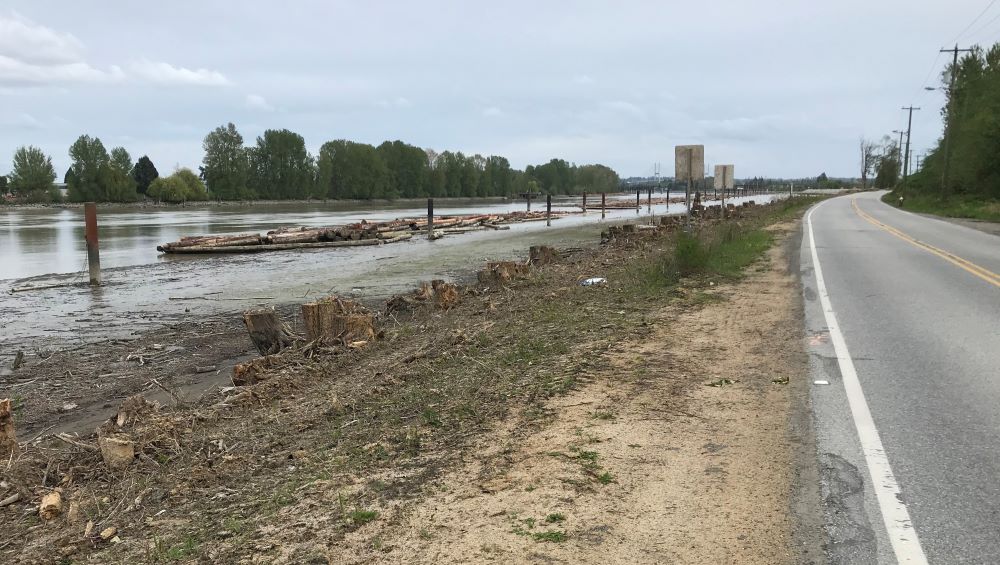
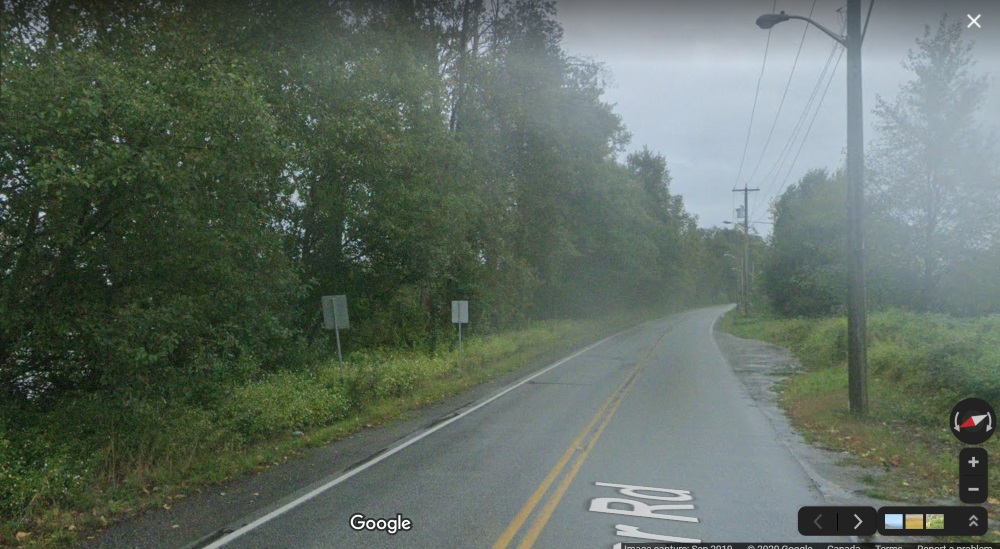
Indeed there is a ~1 km-long stretch of River Road in east Richmond just west of the rail bridge where a significant number of trees and pretty healthy looking habitat was recently clear cut. Where this used to be the view riding along there:

It now looks like this:

There is a pretty simple reason for why it was done. The City of Richmond has an ongoing program to improve and solidify the dike system that keeps Richmond (and Queensborough!) livable and farmable, and this is part of that program. With funding support from the Provincial and Federal Governments, the entire dike-and-drain system for Lulu Island is being upgraded. This means raising some areas of dike to meet new 100-year projections for sea level rise and seismically upgrading parts of the dike where sloughing or liquefaction is likely during a significant earthquake. It also means upgrading the internal canal/ditch/watercourse network and pumping infrastructure that not only keeps the rainwater from flooding within the dike, but serves as an important emergency reservoir and drainage system to reduce damage in the unlikely event of a breach of the dike.

I am not an engineer, but my understanding is that there is some stability and lift work being done on this stretch of dike, and the (primarily) cottonwoods were determined to be both a threat to the soil density and in the way of the soil improvement work that needs to occur, so they needed to go. There is more info here at the City of Richmond website.

Your second question is a bit harder to answer, and I can only really answer in generalities, because I was not involved in this specific project, and I’m not a Professional Biologist. So take everything below as referring to “a typical project like this” and not referring to this specific project, because it is complicated and I don’t want to second guess actual professional people who might have been involved in this project. Geologists talking Biology always get something wrong, but I have spent some of my career peripheral to this type of ecology work, so here is my understanding.

The City has rules about cutting trees and protecting habitat. If you wanted to do this type of clear-cut to build a house or a warehouse or a dock, you might run into that. But a City-run project regulated by a provincial diking authority for life safety reasons would likely be exempt from those types of Bylaws.

Provincially, there is a law called the Riparian Areas Regulation that requires municipalities to regulate the protection of “riparian areas”, which are the lands adjacent to a fish-bearing or fish-supporting stream and provide shade, habitat, nutrients, etc. to the critters that live in and near the stream. In general, RAR does not apply in tidal waters, and the Fraser River here is tidal. So that leaves the Feds, and the biggest, baddest, environmental hammer in Canada: the federal Fisheries Act.

This used to be simple. Back in, say, 2011, work like this would constitute a HADD – “Harmful Alteration, Disruption or Destruction of fish habitat”. Section 35 of the Fisheries Act said you couldn’t do that without specific authorization. That authorization was hard to come by, but if the work was important like upgrading dikes, expanding the Port, or building an oil pipeline, you could get approval that would come along with a bunch of restoration work. If you were working in tidal waters or in the riparian areas near tidal waters, the onus was on you to prove to well-trained and independent scientists at the Department of Fisheries and Oceans (DFO) that your work did not constitute a HADD, and if it did, they were going to make you fix what you broke.

Naturally, that was a bummer to some people who liked to build things in and near fish habitat, like oil refineries and pipelines, or if you wanted to hold a good ol’ Country Hoe-Down in a sensitive habitat. So the Harper Conservatives ripped HADD out of the Fisheries Act. Instead of protecting habitat, your only responsibility is to not cause “serious harm” to a fish. They also canned a great many of those well-trained DFO scientists who would actually be the ones able to determine if there was harm. So for several years, reviewing a project like cutting down all the trees on a 1km-long stretch of Fraser River foreshore was left to an on-line triage system run out of Regina, and evidence to support that review could be provided by pretty much anyone – no requirement for a Professional Biologist to provide assessment to determine if this was a bad thing for fish, or any other part of the ecosystem. Some environmentalists complained at the time. 

Now, the Liberal government put the HADD back into the Fisheries Act late last year, and with it there was a return of authorizations under Section 35. There is still an issue with limited resources in the DFO to provide those authorizations, and I honestly have no idea what the triggering mechanism is compared to how it was pre-2012, or whether a project like this would trigger it. It may have received review through the old triage system prior to the changes in the Act, it may have had full DFO Section 35 review.

Anyway, it looks bad now, and to my untrained and non-biologist eye like a HADD, but this is important dike work making Lulu Island safer from flood and earthquake, so it would very likely have received a DFO authorization, and a compensation plan to improve the habitat value of the river would be required. The City of Richmond mentioned a plan to plant more than twice as many trees as were removed, so there will be a habitat win here eventually. Hopefully, they are also looking at improvements to River Road along with the Dike improvements, to make it a safe place to ride bicycles. But that’s a whole different rant.

Council – April 27, 2020

We had more of a regular longer-agenda meeting this week, though of course many of the topics were not “normal”, and we did things on-line, so normal as normal can be. Again, if you go here you can read the agenda and reports, and even listen to a recording of the meeting to see where the conversations went.

We started with two presentations on the City’s budget:

Financial Plan, 2020-2024
As discussed last week, we have a 5-year Financial Plan ready to go to Bylaw. This is a slightly pared-back budget compared to the earlier version presented before the current chaos arrived, with a somewhat less ambitious capital plan and all new spending suspended other than funds already committed, reflecting the uncertainty of the times. People asking for a “property tax freeze”, this is about as close as we can get while maintaining legal and contractual obligations.

The City’s Financial Sustainability and Changes to City Services and Major Projects – COVID 19 Implications
This report is a broader discussion of the City’s potential financial position as this crisis unfolds. We have had many discussions in both open and closed Council as we have worked to better understand revenue impacts, human resources effects, and the service changes that are resulting from the state of emergency. It is clear this is uncharted territory for us, and for every local government. City staff have been doing heroic work (and they are all humans like you and me, feeling the same stresses about their families, their livelihoods, the future of their community, which has not made this work easier) trying to assure we have the necessary information to make our best estimates about where we are going, so we can make as informed decisions as possible.

Staff have developed a few revenue models based on how long the current public health restrictions go on, and how fast the economic recovery is. There is a best case and a worst case, and staff further developed the “medium” case. This scenario would see about a $50 Million drop in cash flow in the second quarter of 2020. Some of these revenues would be lost forever, some only deferred until later in the year or 2021. We expect (again, in this moderate scenario) that we would be missing $35M in cash flow over all of 2020, and a little more than $11M of revenue would be gone forever.

We have already done some work to prepare to operate with the reduced cash flow, the overall lost-forever revenue will take significant changes in plans. The report outlines where $11M in reduced expenses might be found: reduced shifts to auxiliary staff, freezing hiring for vacant positions and reducing overtime spending primary among them. We would also be putting off some contracted work, and seriously reducing our supplies and materials budget.

As far as the Capital Budget goes, staff have worked through the capital plan and prioritized projects scheduled for 2020. Some will have to continue because they represent business continuity, life safety, and core operations. Some are possible to delay three months or longer to assist with the cash flow situation, and some are going to be punted down the road further.

Each of the 10 departments in the City have presented some cost savings plans to reflect the above, and a short report is attached from each. There is a lot of detail here about programs that are considered essential, and those that are being delayed.


The following items were Moved on Consent:

TransLink/SkyTrain Guideway (22nd Street Station to New Westminster Station): Construction Update
This is just a note to update Council that the delayed work being done on rail and rail pad replacements between 22nd Street Station and New West Station is finally going to start up, and occur in April and May. This may mean some noise at night for nearby residents.

2020 Spring Freshet and Snow Pack Level
This is our update on snowpack in the Fraser Basin as is usual for this time of year to allow us to plan if freshet floods are more or less likely this year. It looks like snow packs are higher than average and quite a bit higher in the mid-basin areas. The flood risk is higher than usual, but the weather for the month ahead will be the determining factor. Our emergency services have done a bit of prep work (dike inspections and sandbag procurement), but no-one is panicking yet.

Statistical update from the New Westminster Police Department
This is an interesting statistical report on the impact of the pandemic on crime rates. Counts of reported offences of most types for March 2020 are below 2019, and property offences for 2020 are below the 5-year average, though persons offences are slightly above the average. Bucking the trend, thefts from vehicles are going up, as are break-and-enter offences.


The following items were Removed from Consent for discussion:

COVID-19 Pandemic Response – Update and Progress from the Six Task Forces
This is our weekly update on what the six working groups on COVID response are doing.
Again, I encourage you to read these reports, and I don’t want to transcribe them here. There is a lot going on in the City to address the impacts of the crisis, and it is interesting as they are starting to transition from the figuring-things-out to the get-things-done phases.

Parks Regulation Amendment Bylaw No. 8193, 2020 – A Bylaw to Amend Parks Regulation Bylaw No. 3646 in response to the COVID-19
A few may have noticed that not all residents are taking the closures and limits to use of some parks infrastructure as seriously as others. Some equipment and areas, such as tennis courts and playground equipment, have been closed because their use was not consistent with physical distancing requirements. Unfortunately, some people have taken to ignoring these closures, even going to far as to remove fencing and cutting locks to access some facilities. As is not unusual, 95% of people will respect community safety measures if they are provided good information as to why and how; for them education is the key. The other 5% need enforcement or at least the threat of enforcement.

We can use trespassing laws to enforce closures, but they are harsh, and are therefore more difficult to enforce. We are instead adapting the Parks Bylaw and ticketing bylaw to clearly define the offence and make it easier for Bylaw Officers to issue tickets for scofflaws. There will also be new signage installed informing of the fines and the increased intent to enforce them. We also had a bit of a conversation about assuring the fines were not used punitively, but were reserved for serious scofflaws that were clearly not interested in respecting the public health concerns of the community.

COVID-19 Pandemic: Food Security Planning and Responses
This crisis had been hard on people in the City who are food insecure. The Food Bank and other organizations have had to change how they operate to address physical distancing protocols. Fortunately, there are a great number of organizations providing for the food security of those in desperate need, and the City is helping them coordinate their programs. The Salvation Army, the Gurdwara Sahib Sukh Sagar in Queensborough, Prupose society, Union gospel Mission, and even a few businesses are helping out with hot meals and food hampers, along with the Food Bank operating out of Tipperary Park alongside the Farmers Market every Thursday. This was a report for information, but we had a bit of discussion about upcoming opportunities for the City to further expand this program during this time of need.

Covid-19: Interim Development Review Process
The development review process has slowed down in the City. This is a problem for several reasons, not the least being the ongoing housing crisis and rental availability crisis, but also is a problem for homeowners wanting to do significant renovations and other projects in the City for things like childcare and services. There is also the concept of procedural fairness – if you own a property in the City, you have a right under provincial law to fair process and the City has a responsibility to do whatever they can to provide it.

Staff have still been working these processes internally, but some need to come to committee or Council for their next steps. Not a problem for Council 9we can do this work in our now-regular virtual meetings), but many committees are not meeting, and public engagement is difficult. Public Hearings are especially difficult as provincial legislation was developed with personal appearance in Council Chambers the default Public Hearing participation method. We can debate (and have!) whether this is the right process in the internet age, but we are kinda stuck without better guidance from the provincial government.

This report outlines a few adjustments, including some of the City Advisory committees meeting virtually, and putting the onus on developers to demonstrate ways they are performing Public Engagement through mail, media, or other methods during the physical distancing era. We have a few very active Residents Associations with long contact lists, which may help in this case, but there is more work to be done here. Finally, staff will be reporting back in May on potential new guidance on Public Hearings after consulting with the provincial government.

Waste Reduction and Recycling Community Engagement Results
The closing of the recycling centre next to the Canada Games Pool and integration of some of our recycling services with neighboring communities has resulted in a lot of conversation about recycling in the City. This is happening at a time when regional and global recycling systems are going through major transitions, resulting in the “bottom falling out” of most recycled material commodity markets. Still, people want to recycle, and it is difficult right now to re-negotiate contracts with product stewardship agencies that would take recycled materials, or set up new or temporary collection systems.

That said, over the months before the pandemic, the City ran a series of community events to collect info about peoples recycling needs and desires. This is the reporting out of the results of that engagement. Glass, Styrofoam and soft plastic are the three top identified materials that were challenging to recycle. No surprise those are the three materials that are most difficult to recycle once collected by the City. Some concerns were also raised about green waste.

For green waste, the City allows unlimited curbside collection (in kraft paper bags) and the City covers the cost of depositing green waste at the Coquitlam transfer station until the new facility on the New West/Coquitlam border is opened. Curbside and free drop-off are both available, take your choice.

The report outlines the potential for adding curbside glass pickup. This would require new containers, and a bit of additional labour cost. Glass is worth very little in the recycling market (the ~125 Tonnes we would expect to collect per year would yield something like $10,000), so the resultant cost per single family home is estimated at about $11 per year. Council asked staff to look into this a little more and develop a detailed proposal for Council to consider.

Staff is also going to look into more options for soft plastic and Styrofoam, beyond the three current locations in the City where they can be dropped off. I am less optimistic about this, as these products have no value right now, and the cost for us to collect and get them to RecycleBC is probably prohibitive.

I see a structural problem here in how the “Extended Product Responsibility” (EPR) model run my RecycleBC works. Recycle BC is an industry-led consortium that is empowered by provincial law to facilitate recycling, and the cost of processing recycled materials is meant to be borne by industry and worked in to the purchase price of products. When you buy this packaging material, you pay for the recycling of it; that is how the EPR system is meant to work. But if you are expected to pay more (through property taxes or utility fees) to get the material to the recycling centre, you are effectively paying twice for recycling.

This become a political discussion between the City and the provincial government, and cannot be disconnected from nascent efforts to limit of ban single-use plastics and non-recyclable materials in the province. More to come here, but probably no-one had bandwidth to dig too deeply into it until after the COVID times.

2020 Property Tax Payment Due and Penalty Dates
The City is recognizing that many residents may be in a difficult financial situation this spring, Council is approving a waiving of late penalties until October 1st. The due date for your taxes is still July 2nd, and if you have the ability, please pay them then, as it reduces the risk that the City will have to borrow money to cover temporary cash flow. If you are not able to pay until October 1st, the penalty we usually charge (5% on July 2nd, another 5% on September 2nd) will not be applied in 2020.


We then Adopted a few Bylaws:

Five-Year Financial Plan (2020 – 2024) Bylaw No. 8183, 2020
As discussed at length for the last 4 months, and detailed above, the Financial Plan Bylaw was approved by Council.

Parks Regulation Bylaw Amending Bylaw No. 8193, 2020
Bylaw Notice Enforcement Amendment Bylaw No. 8194, 2020 and
Municipal Ticket Information Amendment Bylaw No. 8195, 2020
As discussed above, these Bylaws that provide ticketing and fining power to Bylaw Officers for scofflaws ignoring parks closure signage and warnings were adopted by Council.


Finally, we had one piece of New Business

Graffiti Removal Councillor Puchmayr

BE IT RESOLVED THAT during this pandemic crisis, while many local businesses are closed and not able to provide a higher degree of vigilance, that the City of New Westminster waive the current graffiti remediation policy and deploy a graffiti remediation crew to deal with new graffiti as quickly as possible.

This idea was referred to the two task forces that are operating to support Business Continuity and the Education and Enforcement aspects of the pandemic response.


And that ended the new strange (face it, this is not normal) meeting for the week.

Ask Pat: Petitions & Letters

OK, I’m lying a bit. This wasn’t the result of someone hitting the red Ask Pat button, but a question I got asked on Twitter that I thought deserved a longer answer than Tweets were good for. And I must be housebound because 1,500 words later here I am writing an intro.

I have been peripherally involved in some of the campaigning to secure emergency funding for TransLink during this crisis. Mostly by using my platforms to connect people and amplify the ask. (For example: Go here and here and sign a petition and write a letter). An engaged New West resident asked me, perhaps rhetorically, how effective are petitions and form letters in getting action from governments? Is this kind of action useful? So I thought I would answer that here as best I can. TL;DNR: All correspondence matters, the more personal the better. 

Perhaps as a caveat – I do not consider myself a brilliant campaigner. In my life of being a rabble-rouser and then elected guy, I have relied on smarter and/or better trained campaigners. There are library shelves of theses on this topic, people whose entire career is based on engaging the public and driving political action. They may laugh or cry reading what I write below, but you asked me, not them, so I’ll do my best to answer and not worry about the tears of others.

I would say any communication with elected officials is better than none. Your elected representatives need to know and be reminded where you stand on issues that matter to you. They receive correspondence all the time, and though there are many things impacting their decision making, there is something about receiving constituent correspondence that makes any (thinking) elected representative consider their assumptions. If they disagree with you, they are going to be forced to think about why they disagree, and this may result in a more nuanced consideration of a matter. If they agree with you, you have provided them another arrow in their quiver when they have to make a case against the (inevitable) correspondence they will receive on the other side of the issue. So if you care about something, let them know, because a person on the other side of the issue is likely doing the same.

But the real question was about the effectiveness of petitions and form letters coming out of campaigns like I linked to above? To qualify my answer yet again, that depends on what you mean by effective, and how big they are.

I don’t think electronic petitions like those at Change.org change the minds of many elected types. Any petition would have to have huge results to shift elected people away from ideas that were otherwise defended by good public policy or other important political drivers – no petition project exists in a vacuum. I suppose there are some populists who would say “1,400 people signed this! We need to react!”, but for a decision to get to that point there must already be a solid public policy driver, and in a City with 70,000 residents, it is hard to tell what number of self-selected signatures it would require to represent a true plurality of opinion.

This is exacerbated by petitions being strictly directed communications, and are sometimes based on facts that are (to be polite) separated from the decision-making points at hand. If I launched a petition “New West should fix traffic now!” I could probably get a lot of signatures, especially if I had a little money to throw towards a Facebook, Twitter, and Instagram campaign. This would be easier if I worded it so I could rely on signatures from people who want roads expanded to “get traffic flowing” and those who want to further restrict through-traffic to make sidewalks and crosswalks safe for pedestrians. So it would be effective at saying “somebody should do something”, and may be perceived as putting elected types on the hot seat, but it is not going to change anyone’s mind about any specific approach.

So why would I do this? Electronic petitions collect names and e-mails, and sometimes other information, from people who fill them out, so they are a quick data source for people running campaigns. In being easy for the general public to engage with, they give an opportunity to get people thinking and interested in a topic. If you are piqued by an on-line prompt, you are more likely to take a further step, be it forward a tweet or like a Facebook post, send a form letter, or even talk to your friends about the issue. So I think petitions like this are more effective at getting non-activist people engaged than they are at changing elected people’s minds.

Form letters are better, I think. Though it is sometimes irritating to receive 30 emails in an afternoon with the same subject heading, they usually provide a name and contact of the sender, which gives the elected person the chance to respond or engage. They also tend to be clearer in their ask, as they have to be in order to get people to attach their names to them.

It is important to recognize that some campaigns and campaigners are seeking your contact information for their own purposes. You are sharing data: your name, your e-mail, your postal code, etc. with the campaign organization, and it is not always clear how that data will be used. I recently received a series of form letters from a campaign that used your postal code to determine who your local Council was, then sent and e-mail to the Mayor and Council in your area asking that they be vigilant in not allowing face recognition software to be used in the City. I noted the irony of a person concerned about digital security willingly providing their name, postal code, e-mail address, and political opinions to an anonymous letter generator.

That said, small local grass-roots organizations like I linked to above with clear mandates and clear messages are not likely to do anything that makes their burgeoning supporter base upset, like mis-using their data. I am one to usually presume good intentions unless one has acted disingenuously in the past, but it never hurts to ask the organization if they collect data and how it is used, and for the organization to have and respect an opt-out if you don’t want your data shared or to receive further correspondence from them.

From the elected person’s point of view, even the most diligent correspondent has a hard time responding to the 200th exact-same letter. I try (and sometimes succeed) to reply to every e-mail I get, but form letters tend to get a form-letter-like response. I do scan them to see if the writer has added a personal touch to it, and try to reply to that personally. But again, every elected person is going to manage this correspondence differently. If you have the time and energy, personal emails are much, much better, and I prioritize those for responses. As a decision-maker, one well-made personal argument is more likely to convince me than 100 identical form letters, regardless of how well they frame the concern.

So overall, the more personal the better, but all correspondence is important, and if all you can manage is a petition or a form letter, it is better than staying silent on an issue. All of them serve as a demonstration of how broad a support base is for any idea. It also helps an elected person who may want to take a positive action demonstrate that there is some level of support for that action. I will give you a clear and real example from my life.

I want more and better cycling infrastructure in New West. No surprise there, I was beaking off about it for a few years before getting elected, I included in every conversation during my elections, and have talked about it at Council whenever appropriate. Although I think the majority of Council supports this goal, I do at times feel I am shouting into a void. It is “Patrick going on about bikes again.” It’s OK, as you can tell by this blog post, I like to drone on.

Currently, we have limited the use of the Quayside boardwalk for cycles, because more people are using the boardwalk for daily exercise, space is constrained by physical distancing requirements, and given these pressures, bikes really aren’t appropriate there. Staff have recommended Quayside Drive as an alternative, and added some “share the road” signage. I don’t think that is adequate, and think we should close parking on one side of the road during the crisis and make a dedicated cycle route safe for 8 year olds and 80 year olds to replace the one we lost on the boardwalk.

If we do this, we will not doubt hear from people – angry letters to Council and to the Editor, maybe even a petition, demanding that free storage of cars is the best use of public land, as it always has been. Why would staff prioritize my idea, why would the rest of Council prioritize it, just to make Patrick happy when there is no demonstration of public support? I know it is the right thing to do, most of Council may agree it is the right thing to do, but with no public support, why prioritize this now and face the backlash? Everyone is busy, there are a thousand things to do in crisis response, this simply isn’t a burning-enough issue while the room is on fire. A petition or a few dozen letters from concerned citizens who want a safe place for their kids to ride a bike may demonstrate that this isn’t a fantasy in one Councillor’s brain. it may demonstrate that the inevitable backlash is worth it.

Thing about representative democracy: in the end people are more likely to get what they ask for than what they assume should be. So use your voice.

Council April 20, 2020

Yes, we had a Council meeting this week. It was again on-line using video chat software, and we have a recorded version if you want to read the agenda and follow along at home. Here is my recollection of what we did.

Draft 2020 – 2024 Financial Plan
Well, here we go again. The City spent an unprecedented amount of time and effort this spring doing public outreach, holding meetings and open houses, inviting residents and businesses in to talk about the budget. We provided tables, spreadsheets, lists of priorities, and visions for the future. Then we asked New Westminster to respond – tell us what we got right, and where we were missing the mark. We go a lot of feedback, and were ready to put together a budget that provided not just the normal financial plan, but a vision for how the City was going to do things differently on important files like Climate, Transportation, Childcare and Housing.

Then a month ago, all hell broke loose. Grumpy face emoji.

By legislation, we are required to provide a 5-year Financial Plan to the province in May, and to get there we need to write it into a Bylaw, and pass that Bylaw through the appropriate process. The Financial Plan is a complicated document based on well-established accounting principles and best practices established by the Public Service Accounting Board and reviewed by independent auditors every year. That said, it is always (by its nature and purpose) the best available estimate of the City’s financial position over the next 5 years. Some revenues and expenses in this budget we have complete control over, some we don’t.

All that to say this year is a very difficult year to make those estimates. We are preparing this financial plan in the middle of a crisis, likely at the cusp of a significant recession. It is challenging to project what the impact of this will be with the conservative certainty that needs to rest in a financial plan. Compared to what we looked at early in 2020 and sent for early public consultation, the biggest change now is to reduce the amount of money we are committing to new initiatives, and to pare back on capital expenses until we have some more certainty. The tax increase will not be as big as originally proposed, but we are not yet able to account for many of the other lost revenue in 2020, because we simply don’t know yet what it will be. Odds are that there will be further reductions in expenses (i.e. there are a lot of auxiliary staff not working as of this week, and we will be hiring fewer contractors in the coming months as work priorities change) and significant reductions in revenues (Casino, recreation fees, parking fees, etc.).

As a major part of financial projections like this are projecting past trends into the future, the disruption we are seeing now throws that for a loop. The only thing we know for sure right now is that that things will be different than we guessed, and this Financial Plan will no doubt be updated as that certainty arrives. Until then, we need a 5-year Financial Plan to hang the Bylaw on, and this is the best one we have at the time.

As proposed (and this has yet to me formally adopted by Bylaw), the tax increase for 2020 will be 3.1%. That means the average Strata apartment household will pay $33 more in 2020 than in 2019, and the average single family house $74 more. We are also shifting focus to move the 1% Climate Action Levy over to an Emergency Fund to address unanticipated costs related to the pandemic response. That is an extra $14 (apartment) or $29 (Single Family house).

Projected utility increases for water, sewer, and solid waste are not going to change from what was announced earlier. These utility funds cover their own costs purely through rates, don’t earn any profit or dividend for the City, and the balance of their costs (utility rates from Metro Vancouver) are not changing, so that part of the financial plan will stay the same for now. The electrical rate increase has been pared back to reflect the situation at BC Hydro, so out increases are in line with theirs.

These are the numbers that will go into the Bylaw language. If you have feedback to Council about it, drop us an e-mail.


The following items were Moved on Consent by Council:

Closing Open Council Meetings to the Public
These council meetings have been held on-line, but there has always been a staff member present in the Council Chambers taking part in the call, transmitting it to the chambers, and the chambers has always been open to the public – because that is the law. This means we have to have staff overseeing access to the chambers and present during the meeting, and it may be little surprise that no-one has attended.

Under the Emergency Powers the province has giving the City the ability to hold open meetings without the public present, and we are exercising this. Meetings will still be available online, and streamed on the City’s video archive. Agendas will be available on-line and at City Hall.

This effectively means the “public delegations” part of council meetings will be suspended for a while. This does NOT mean that we will hold Public Hearings without public input. We are required for some Bylaws to have these hearings, and staff is working on the technology and processes required to allow public input that meets the requirements of the Community Charter. More will come on this in future meetings.


The following item was Removed from Consent for discussion:

COVID-19 Pandemic Response – Update and Progress from the 7 Task Forces
This is our regular report on the 7 working groups addressing the priority response areas for the City. If your question is “what is the City doing?”, this is where the answer is. Again, I don’t want to go through line by line, it is worth reading to see how multi-faceted the response is, and if you want to hear the discussion around these items, please listen to the recording.

I do, however, want to call attention to several businesses and organizations that are working with the City and together to help people who need help at this time. The Food Bank and Farmers Market have been working together to get people food at Tipperary Park every Thursday. The Sukh Sager Gurdwara in Queensborough has continued its long tradition of providing free meals to the most needy, and both Greens & Beans and Truffles Catering have been contributing meals to seniors and others in need at this time. It is heartwarming to live in a community that cares with its actions, not just its words. Thank you.

Resolution to Support Transit
Finally, the following resolution was passed unanimously by Council in support of a call from the Canadian Urban Transit Association:

That New Westminster City Council endorse CUTA’s request to the Government of Canada for emergency funding to provide immediate liquidity to transit operators and on-going funding to alleviate revenue loss as ridership rebuilds;

I have already probably said enough about this, but if you feel like you want to add your voice, I would encourage you to check out the efforts of the SaveTransit coalition and Abundant Transit BC. You can follow those links to ways to can amplify their voices and help keep transit solvent.

#SaveTransit

There is a lot of bad news right now. Though we have reasons to be optimistic that BC will beat the curve, we cannot and should not ignore the fact people are suffering and people are dying. The disease is clearly worse than the cure. At the same time, many aspects of the cure are also causing significant stress and harm, and as health care professionals and disease researchers struggle to reduce the impact of the disease, we need everyone to be diligent about managing social distancing protocols and their impacts.

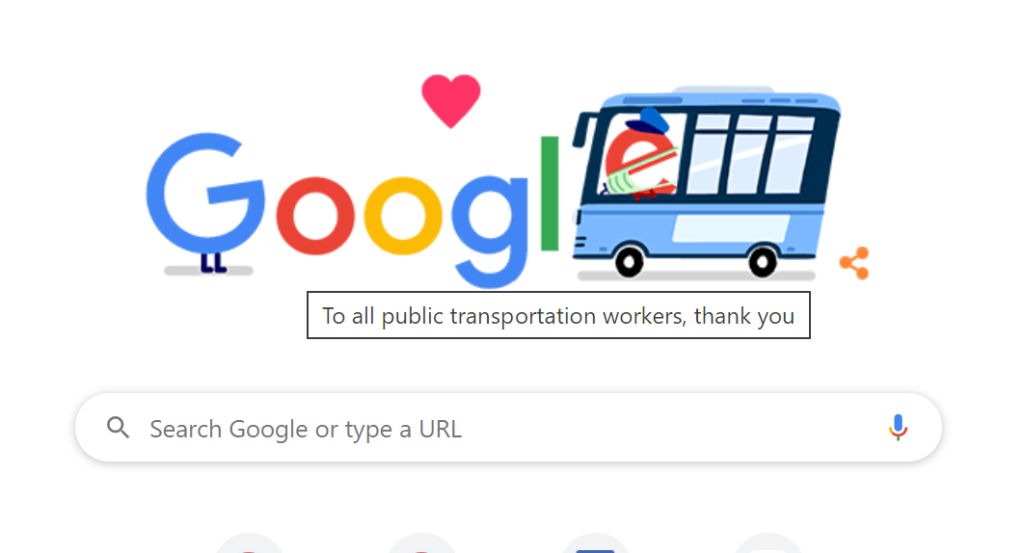
Today, my biggest concern is the Transit system. And it was apropos that this was the Google Doodle today:

Yes, small businesses are suffering. Many are closing, some not returning. Yes, some people are having a hard time meeting rent or mortgage payments. Yes, those who have been marginalized in our society – the precariously housed, people with disabilities, people with addiction – will suffer the most. All three orders of government are working to address these issues. There are also a lot of people working in previously-undervalued jobs who are keeping our society together. Grocery clerks, institutional cleaning staff, food processing and supply chain workers, truck drivers, warehouse staff, general labourers in any of the dozens of industries that are still operating. Many of them are being paid much less than a living wage.

Every day, despite an 80% drop in ridership, more than 75,000 people a day rely on TransLink to get them to their work, to shopping, to their appointments, and to do the things that are keeping our society operating.

Today it became clear that TransLink is in trouble, and those rides may go away as soon as next month. TransLink is losing $75M a month, and it will simply run out of cash to pay the salaries and the gas and electricity to run the system unless they get some kind of relief very soon. Unfortunately neither the provincial or federal governments have yet stepped up to provide that emergency relief, and are slow to commit that they will do anything.

The situation is dire for public transit systems across North America, but TransLink is somewhat unique. For a system its size, it relies more heavily (about 60%) on fare-box revenue than most in the North American context (most bus-based systems are around 40%). The other primary source of revenue – a regional gas tax – is also down more than 60%, while smaller revenue sources like the parking taxes are similarly vaporizing. Despite some ill-informed critique from anti-transit crusaders, TransLink runs a tight ship, so the reserves they are currently running on will not last much longer, and borrowing to run operations would be disastrous. The only option is an orderly deconstruction of the system unless emergency funds arrive.

The Federal Government has declared transit services essential, but they are not stepping up to fund it in an unprecedented emergency. Even the oft-absent US Federal government has committed $25Billion nation wide to keep transit systems afloat, including almost $500M for Sound Transit in Seattle, a system much smaller than we have in Greater Vancouver. TransLink is similarly not eligible for the Federal Wage Subsidy Program that is allowing Air Canada and WestJet to keep employees on the job. Senior Governments recognize that solvent airlines are an important part of keeping the economy rolling, and will be vital to recovery, but they have not yet demonstrated that they feel the same way about a public transit system like TransLink (which, I note, moved 5x the number of passengers last year than Air Canada).

This has come to a head right now, according to the Mayor’s Council, because a multi-modal integrated public transit system is a complicated thing. They are considering the need to scale back and reduce service right now, because a full scale-back will require several weeks. TransLink is currently burning through reserves, and will need to use those reserves to shut down and (eventually) to restart. They also note a re-start will take as long, or longer, than a shut down. In other words, if there is a serious deconstruction due to this liquidity crisis, it will take 4 to 8 weeks to get the system back up and running again once this is all over. And all this time, TransLink will not be earning enough revenue to fund the scale-up. It is crunch time.

It is bad enough to think that the people cleaning your hospitals, the people checking your groceries, the people putting your Amazon diaper order into the delivery truck, will not be able to get to work next month. It is worse to think that when this whole thing is over, the economic recovery will be dragged down by two months of not having a functional transit system in a major City. We cannot let this happen.

We need the Federal and Provincial Government to come to the Mayor’s Council immediately, and work out what value the transit system is providing to the community at this time, and the value it will bring to our eventual economic recovery, and they need to bring the money. Please connect with your MLA and your MP and spread the word that Transit is as vital to the operation of our City. Send them a short, respectful e-mail asking that they include public transit as one of the essential services that need their support right now.

Council – April 6 2020

Yes, we had a Council Meeting last Monday, and it has taken me too much time to put this report out. For all of the details, you are best to look at the agenda and listen to the recording here. The sound recording is not great (it starts spotty, but gets better). Here is my version of that we talked about, as much as I can trust my notes and memory at this time:

COVID-19 Pandemic Response – Update and Progress from the 7 Working Groups
This is a reporting out of the work being done by the 7 working groups formed as the City’s response to the ongoing crisis. I don’t want to transcribe them here, but you can open the report and look if you are keen to know about the breadth of the City’s response. There is a lot going on, and the ground is constantly shifting. We discussed some of the efforts, but at this point, I mostly want folks to recognize the work that City Staff and partners in several non-profit service agencies are doing to help people at these uncertain times.

Use of Previously-Awarded Grants and Criteria for Spring Grants 2020
The City grant program has been somewhat disheveled by the pandemic crisis. Some organizations that received grants will not able to do things we awarded grants for, like summer concerts or festivals, including some multi-year events.

Staff have reviewed the situation, and have made some recommendations. First, they do not want an organization that is not able to to activate a program in 2020 to count against an organization being able to try again in 2021. Some programs may be able to be deferred until the Fall when hopefully we will be past this situation, and the grant process will already allow this, and we are introducing some flexibility there.

We had a bit of discussion about organizations that may be able to shift from a planned activity or event to one that serves the community during this time, for example, creating an on-line event as opposed to a crowd-gathering event. For the most part, staff want to o encourage this, and allow organizations the flexibility to use their grant funding to build community at this difficult time.

The re-purposing of grants already awarded is a delicate balance. The City has some very difficult budget decisions coming up, but we don’t want to make it onerous for applicant who have already gone through an approval process to adapt their program if they have a great idea. So, how to streamline, but still recognize that we can’t be throwing money around right now without some oversight?

We will be asking revisions of already-approved grants to be brought to Council after they have been reviewed and approved by staff. This reflects the big change we have made in the grants process this year to remove the vague politics of Council making direct approvals, and replacing that with Council providing policy guidance to staff who recommend approval based on that policy guidance. After a robust discussion, we agreed to let staff review and recommend, but that the final approval needs to come to Council again, with direction to staff to make the process as streamlined as possible and not onerous for applicants.

On-Street Parking Management During COVID-19 Pandemic
No crisis is so severe that debating where people can and should store their cars isn’t a constant refrain. Of course, a great number of businesses are closed, and there are fewer people out on the streets, but still, parking is still a problem. The Hospital has, essentially, no visitors at this time, and all parking has been made free to help staff get to and from work in this important time when hours are uncertain, everyone is under strain, and transit is seen as undesirable due to physical distancing requirements. Of course, some car users who are NOT hospital employees are going to take advantage of this, but what are you going to do? We are always talking about parking because free car storage is the one thing we are all jerks about.

These has been some suggestion that Cities should not charge for car storage on City streets at this time. But I simply cannot find a reason why we would be encouraging people to put their private automobile on public space for extended periods of time for free, especially as all of our other revenue is going away. Hospital employees have a free parking place (hopefully it will be usefully enforced and people taking advantage of this will be fined, towed, and/or publicly shamed). Our neighbourhoods have a complex multi-tiered system of parking permits, time restriction, locals-only areas, and pay spots, all put in at some time because they addressed some problem around car storage space allocation at the time, and I see no compelling reason to disrupt this right now.

If anything, we should be closing some parking areas and opening up more space for people to walk, roll, and cycle so that people can get outside and exercise while maintaining physical distancing and while there are so fewer cars on the road…

The report from staff recommends no changes in pay parking at this time, and I agree.


The following items were Moved on Consent:

Queensborough Modular Housing: Request for Construction Noise Exemption
Council is providing a Construction Noise Exemption for work on the temporary Modular Housing project in Queensborough. We generally do not permit construction noise on Sundays, but the project is being challenged on timeline and is going to be providing a valuable community service. The work on Sundays will be indoor work (plumbing, drywalling, cabinetry, painting, etc.) and will not be loud outdoor machinery, so not the kind of construction noise that keeps a neighbourhood awake.

2020 Spring Freshet and Snow Pack Level
Every spring we get these updates on snowpack across the Fraser River basin and ENSO predictions to determine the risk of flooding come freshet season. Right now the snowpack is above normal, especially for the upper Fraser, and the forecast is for cooler weather in April – these are both bad things if avoiding a flood is your goal. Nothing to panic about yet, but flood risk is higher than average this year, and the City is taking some early precautions in April (dike inspections and updating supplier contacts in case we need to procure sandbags and such).

Temporary Borrowing for 2020
As I’ve commented before, cities are in for a financial shock as this pandemic response drags on. Required to run balanced budgets, and with limited non-restricted reserve funds, we simply don’t have the liquidity to take a significant hit to our revenue and still provide the services you need every day, from keeping the water flowing and trash disappearing to important protective services like fire and police. Almost every revenue source outside of property taxes is taking a serious hit. Casino revenues, recreation fees, filming revenues, and such have gone to zero. At the same time, things like permitting fees and parking revenues are going down.

As this is likely to run into a short-term cash crunch, we can draw on a line of credit. We prepare for this every year around this time with a pre-approval to borrow up to $3M as the month before we get our big tax revenue input is when we are close to having no cash on hand, by design, and need to assure we can make payroll. We hardly ever use this actual authority, but it is better to have and not use than to need and not have.

But this year in not normal, so staff are asking Council to approve a one-time borrowing of up to $12M from the Municipal Finance Authority to assure we stay solvent if the cash crunch goes on longer and is deeper than usual. Again, nothing says we have to use this borrowing, but it is there to make sure our bases are covered.

At the same time, staff are preparing a medium-term cash flow model with a few different scenarios to determine where and if we need these funds. More to come on that in future meetings. A lot more, I expect, as we are being inundated with requests to provide everything from property tax deferrals to utility credits, and every one of these ideas needs to be tested against the ability of the City to remain solvent. To be honest, this is the topic that is causing me the most sleepless nights right now.

We gave the required Revenue Anticipation Borrowing Bylaw No. 8192 three readings and adopted it. Let’s hope we don’t need to use too much of this.


We then had a couple of items of New Business added late to the Agenda:

Parks Operations
There are a few issues in parks operations that need to be adjusted. Tennis courts and lacrosse boxes need to close, as people are not respecting physical distancing, and as surrounding communities close their courts, ours are attracting crowds. So we have to officially close them to give Bylaws and Parks staff a lever to enforce their use.

Staff is going to put a little work into figuring out if there are ways to better support dog owners, and at the same time step up enforcement of dogs off leash in parks in general as off-leash areas needed to be closed because of issues with social distancing. There is more work to do here, and no quick answers yet.

Finally, there have been some concerns raised around trails and park use in general. New West is an urban area, and many of our parks are compact, making social distancing is a challenge when we want people to have the access to open spaces and sun at least enough to maintain some sanity. We promote awareness, try to educate and use soft enforcement, but for some “tighter” areas like the waterfront trails, we are going to be stepping up and perhaps making some areas one-way to give everyone more room. Watch for signage when you are out for a walk, and try to pay attention to your personal space (plus 6 feet!)

Pedestrian spaces
On a similar vein, we need to support physical distancing in the rest of our public spaces. As commuting traffic has been remarkably reduced, there are still a lot of people trying to get outside to walk, roll, cycle, or otherwise get exercise and fresh air while maintaining distancing. This is creating challenges for people when sidewalks in the city are generally 4 or 5 feet wide, and when navigating our pedestrian realm is already somewhat constrained for space compared to the abundance of road space.

There are a few identified areas where space is very constrained, like the McInnes overpass and some greenway connections that engineering are prioritizing. We had a bit of discussion around this, and there are many examples from other cities across the region and North America where road space is being re-allocated. We have asked staff to find opportunities to immediately and temporarily re-allocate road space from car use and (especially) car storage to give pedestrians more room to circulate safely, especially in constrained high-pedestrian traffic areas like Carnarvon Street or the Central Valley Greenway connection on North Road. This is more complicated that you might think, as intersection treatments need to be considered to keep things safe, because drivers generally need strong controls to keep from driving over people on foot. But it van be done, and Council asked staff to get to work on it.

Staff is also working on adjusting crossing signals to reduce the reliance on pedestrian activation buttons and increasing crossing time allocation for pedestrians, in light of the shift in road use that is happening right now.


This was Monday, which in the current scale of things is about a year ago. Several things have changed since Monday, including New Westminster Electric rolling out it’s pandemic response program that essentially matches the program offered by BC Hydro, and of course, continued calls from local governments for support for the Provincial and Federal governments. Local governments are still the “front line” for emergency response, and we still only collect less than 10% of the taxes paid by Canadians. We are doing a lot with little right now, and that is thanks to the hard work and dedication of the staff at the City. Some are still going into City Hall, some are still doing park maintenance, and doing all the tasks that keep your electricity flowing, your water clean and safe, and your sewage going away. Many are working from home managing the City’s finances, helping with relief measures, and addressing concerns that are arriving every day by phone and e-mail. They are all dealing with the same family and community stresses you are feeling. We are all in this together, and we are getting through it together.

Now it is a “long weekend”. I hope you get to connect with people that are important to you, get a bit of sun, and more importantly, stay safe and help our community get through this as quickly as possible.

Council – March 30 2020

We had a most unusual Council Meeting on Monday. An emergency meeting just to get Council caught up on the various actions the City is taking to the pandemic situation. We did not meet in Council Chambers, but did a video conference. For technical and modesty reasons, the video conference was not recorded as video, though an audio recording was made for the record. So you can’t watch the meeting, but you can read the agenda and listen to the audio here, if you are so inclined. The audio isn’t great, and we were all working it out as we went along, but it is there for the record.

There were two agenda items, both framed around the Working Groups developed in City Hall to get us through this unprecedented situation.


COVID-19 Pandemic Response – Action Items from the 7 Working Groups Seeking Council Approval
The City has (as previously reported) put together 7 working groups to manage aspects of our pandemic response. The reporting structure right now will be for them to update Council in these meetings, and more specifically ask for direction or approval if and when needed, for actions they are proposing.

This week, there were two Working Groups asking for specific direction:

Business and Working Economy:
With many businesses closed, there is some concern about lack of eyes on the street and resultant heightened security concerns. There is a call here for more on-street police patrols, or a change in patrol patterns, perhaps some redeployment of City Staff such as parks operations or engineering operations staff who are otherwise undertasked to provide extra eyes, or helping coordinate private security operations if needed. The Working Group is going to work with the BIAs and neighborhood business groups to develop this idea, and come back to Council if there is a funding request attached.

Some discussion arose here about other aspects of policing that are deserving of extra attention at the time when people are housebound and under increased stress, including domestic violence and power-based crimes. We need to be clear here that Council does not direct police in their operation, but we are able to allocate further resources if needed to achieve community goals.

The Working Group is also establishing a sub-group to look into supporting the arts/culture sector, and how the City can best support them. The impact of this crisis on not-for-profits is similar to that on small businesses, even if they have fewer tools to call attention to the issue.

Education and Enforcement:
The provincial government is issuing variety of orders to protect public health, and are asking local governments for help to enforce them. This is, of course, an expanding demand on City resources. We can hire some extra staff trained in this type of work, and potentially be reimbursed through the provincial emergency funding program.

It is hard to hire enforcement staff in a hurry. Becoming a Bylaw Officer requires specific training courses such as those offered through the Justice Institute, as there is a fair amount of complex interacting legislation and enforcement powers, so getting a bunch of them on-board in a short period of time (when every other City is no doubt in the same situation) will be challenging.

However, a big part of progressive enforcement is education and responding to concerns, and there are likely a bigger pool of folks who have experience being in “public facing” jobs at the City, and have training and knowledge of what the City does and how it operates. Some of them are not able to do their regular jobs – recreation program staff, library staff, lifeguards, etc. – so we may have more luck on-boarding these folks with less training and preparation required.

However, when education shifts to enforcement, we are going to need some expanded local Bylaw powers and ticketing/fines to make enforcement possible. That requires edits to a couple of our Bylaws. This will be addressed in upcoming meetings, and I hope we can see significant fines for serious offenders of those violating the rules for profit, and smaller fines/tickets for those doing it through simple stubbornness.

Finally, the City has established a single contact number if people have questions about the restrictions, supports, or anything related to our local response to the pandemic emergency. This will make it easier for City staff to track complaints, concerns, and inquiries, and will allow you to have a tracking number for your concern to make it easier to follow up.

That number is 604-636-4343 or you can e-mail
covidcompliance@newwestcity.ca

COVID-19 Pandemic Response – Update and Progress from the 7 Working Groups
These reports are simply the working groups reporting out, and if you are interested in the breadth of work the City is doing, you can read them in the on-line agenda.

And there is always the City’s website dedicated to the response which you can find here.


Finally, a bit of a programming report.

I am having a hard time finding non-Pandemic things to blog about, because things that I am usually jawing on about seem out of context right now. I also don’t feel as great talking about the bigger COVID-19 thing outside of the City’s response, because I there is already too much information out there, and too many non-definitive information sources (like this), and I would rather people pay attention to Public Health officials and senior government information channels right now. I’m not sure I have anything useful to add.

This is a really shitty time. Like many of you, I am constantly bouncing between anxiety, hopelessness, and glimmers of joy when I see the positive work communities are doing to hold things together. I just want this to be over, but recognize it isn’t going to be over any time soon. I want to do something to make it better, but recognize there is not a lot I can do, and that sitting at home straining to concentrate on my work is actually the best thing I can do right now.

I’ll probably get around to writing a few things here about what it means to be in this job at a time like this, but I’m not sure I can handle that emotional labour right now. Like the rest of Council, I am hearing from residents, from businesses, and from friends; this thing is hitting a lot of people really hard. The only thing we all share is uncertainty, and that is causing a lot of anxiety. A bit of respite is found in seeing the great work that staff in the City is doing in completely uncertain times, doing things they were not trained to do, and demonstrating great perseverance when they are just as stressed and anxious as the rest of us.

People pulling together – even when they keep their distance – is going to be the key to recovery here. Stay safe, folks.

Council – March 23 2020

We held a special Council meeting on Monday, and I’m sorry I’m so late getting this out. It was recorded on video, despite the slightly-strange chambers set-up to accommodate social distancing, you should be able to follow along with the conversation that occurred. Also note that Monday was a year ago with the pace of change here, so some of the below is updated, some is not. Any discrepancy between the following and today’s reality is likely a product of that lag.

There is one question you may have about why we were physically meeting at all, considering that some participants were able to call in. Short version is that the Community Charter and our Procedure Bylaw require us to have a physical quorum (at least 4 voting members) in the Chambers for it to be a legally constituted meeting, but we will fix that with the first item on the Agenda.


Amendments to the Procedure Bylaw No. 6910, 2004 to Allow for Changes in Notice, and Electronic Meetings
The City has a Procedure Bylaw that outlines, among other things, how we meet the Community Charter requirements for meeting notices, and what constitutes Quorum in Council. These proposed amendments will change the language of that Bylaw to match updated procedures.

The current Procedure Bylaw does not allow Council Meetings to be held remotely through telecommunications – there must be at least 4 members of Council present in chambers to constitute a quorum, otherwise the legal work we do (reading and adopting Bylaws) is not valid. Note the BC Government introduced some legislative changes today to change this, but we were meeting a few days ago, and suspect we still need ot enact our Bylaw to keep everything up to snuff.

We are still required to post notice of meetings in City Hall, but with City Hall closed, we are adding the City’s Website to that requirement (which is good idea for the future anyway). We are also replacing the need to put a notice of a Special Meeting in Council Member’s Personal mailboxes with the need to notify Council Members by E-mail, because it is 2008. Finally, as we need to receive Public Input before changing the Procedures Bylaw, we will be asking for this until the April 3 Special Council Meeting. Which I guess means we are having an April 3 Special Meeting. If you have comments or concerns, please send us an e-mail or letter.

Changes to Council Meetings during the period of the COVID-19 Pandemic
This is, by all definitions, a capital-E Emergency, so staff is suggestion some changes in how we meet as a Council during this time, balancing the need to get work done with the need to follow health authority orders and respecting social distancing protocols.

Our upcoming meetings will not include Open Delegations. There is just no reason to bring your concern in person to Council right now. Write us an e-mail.

We are going to ask Council to be very prudent in suggesting Notices of Motions, and the Mayor will act as a screen to assure we only bring up time-sensitive or important motions. Staff is wanting to avoid the situation like we had last meeting where a Council Member brought a motion that resulted in community outcry and a packed chamber of people from around the region to speak for and against it. We just don’t need that hassle at this time. As an aside, that specific Notice of Motion will be tabled until a more appropriate time.

As much public consultation and committee meetings cannot happen right now, but there is some concern that ongoing work that is important (even to the point of being crises – housing, childcare, climate action) will get delayed because Emergency > Crisis. Though we are putting some work aside right now, starting with cancelling next week’s public hearings, I do want us to think creatively about how we can bring some of those things back on-line, as this situation may stretch on for months, and lost progress will hurt.

I am especially interested to see how we can (technically, and legally) accommodate on-line submissions, set up an online submittal form, facilitate recorded video or audio input to public meetings, etc. Staff right now is pretty over-tasked adapting as much as they can to the emergency situation, so this is best thought of as work we can start once we get ourselves established into a new normal.

Scope of Work of Five COVID-19 Working Groups: Council Approval
As City Committees and Task Forces and much internal work in the City is grinding to a halt, there are some areas of specific need in the City. Staff have set up some temporary working groups/ task forces aligned with the biggest priorities right now. They will be working groups of City Staff, Senior Gov’t agencies, not-for-profit partners and business groups in town, depending on where the subject matter experts are.

There are three out-ward looking working group: At-risk and Vulnerable Populations; Seniors and Persons with Disabilities; and Business Continuity and Local Economy;

We also have two inward-looking working groups to address City operations: Human Resources; and Emergency Operations and IT.

Since the Agenda was put together, there have been two new outward-looking working groups: Childcare; and Education and Enforcement.

This will be the framework for future meetings and reports, so I won’t belabour them too much here.

Protection for Renters during COVID-19 Pandemic
As I blogged earlier, the City doesn’t have a lot of cash lying around, and measures to address the unexpected have to be funded. Staff are making some suggestions of how we can free up some reserve funds (money we have on hand already earmarked for specific purposes), and there is more discussions of budget down below. However, right now there are a lot of people worried about making rent on April 1st, because they have been laid off or their regular income sources are shut down. The City already supports a Rent Bank operated by the Purpose Society and supported by the Province and local Credit Unions. It is suggested that there may be a significant increase in need for this service the months ahead, and it is recommended we move money form the Affordable Housing Reserve Fund into this.

This conversation we knowingly a couple of days before the provincial government introduced their renter-protection measures, but we agreed to commit to a $100,000 infusion from our Affordable Housing Reserve in case it is needed, with a general wiliness to explore other supports that the City may be able to provide through that reserve fund.

COVID-19 New Westminster Emergency Response and Provincial Government Support Request
We are going to need senior government supports here. People, businesses and not-for-profits are lining up asking for supports of various kinds. Local Governments need to assure we are clear with what we need to support our communities and the priorities of our communities. We are prioritizing our requests to help with supply chain for our first responders in Fire and Rescue, Police, and Emergency Operations. Things like masks, sanitizer, gloves and other necessities are challenging to procure now, and the Provincial government has the power to control those supply chains to assure they get to those who need them the most. We also need to prioritize first responders for testing protocols, as they are by necessity, in close contact with many people all day. We need support for the Emergency Operations Centre, and for emergency shelter for the homeless and vulnerable people.

We have also identified an expanded Property Tax Deferral program, some help to replace lost local government revenues (like Casino revenues), and for a ban on eviction for renters. We also asked that some similar consideration be given to business lease-holders, those small businesses that are prevented from operating right now and will, ultimately, be the core of our economic recovery when this is all over.

2020 Budget
Obviously, things have changed since we put our draft budget together last month. We have always referred to it as “draft”, recognizing small adjustments may be necessary, but never in the history of the Local Government Act has so much changed in two weeks as the last two. We need to have a Budget Bylaw and 5-year Financial Plan approved by May, and the unprecedented amount of public consultation and discussion occurred outside of this shit show. Best laid plans. (insert grumpy face emoji).

Council moved to pull back on most of the enhancements in the budget for 2020, excepting those that are already “baked in” – such as changes in interest rates, insurance costs, collective agreements, and such. A 0% tax increase is a fanciful notion, as we have already made significant commitments to 2020 that cannot be undone, and other revenue sources aside from taxation (Casino revenues, parking revenues, recreation and program fees, etc.) are likely going to be much lower than expected. Of course, some savings will be found in not providing some services and there may be some layoffs of staff as some programs simply cannot operate. Problem is, our assumptions about the budget are more tentative than ever, as we don’t know how deep into our 2020-2021 budget year this disruption will continue, we have no idea what our emergency responses are going to cost, and we don’t know how much senior government support is coming to help. That’s a lot of uncertainty for what is usually a very tight and conservative budget process.

It is with a pretty heavy heart that I have to accept that some of the enhancements that we anticipated on 2020 will have to be deferred at least until the 2021 budget year. This does not mean we don’t support those programs, it’s just that with the uncertainty ahead, it is prudent for us to tighten the belt as much as we can to not get into a cash crunch problem.

Staff also suggested, due to the uncertainty of what the emergency response is going to cost, that we re-allocate the 1% Capital Levy to an Emergency Fund. I disagreed, as I think the capital program is still going to need to be funded. However, Council voted to support this change, and in the end the difference between the two approaches is more an instruction to staff about how to prioritize spending than a change in how much revenue we will bring in.

This situation is throwing a wrench on our capital plans for 2020-2024. Some projects will no doubt need to be delayed, though much of our Capital budget is mission-critical maintenance and replacement that will still have to go forward. There will be much more discussion of this in upcoming meetings.


There was a bit of closing roundtable after these items were addressed, to raise a few issues that were not on the agenda. I think the takeaway is that this is really uncharted water for everyone. We have an Emergency Plan and an Pandemic Response Plan, but the first is challenging as it may see a typical emergency as a single short-duration event with long recovery (think flood, earthquake, ice storm) which is clearly not the pattern here, and the latter has never been invoked before. Our emergency services and first responders are managing excellently, staff is doing their best to understand what the new priorities are, and how to address them while obviously being concerned about their own health and that of their families. Council is, ultimately, charged with making the budget and prioritization decisions based on best advice, but we have never had to rely as heavily on this advice (thank you Dr. Henry!) and feedback from residents and the business community about what the community’s priorities are.

Everyone is anxious, but everyone is doing their job as best they can. I think the Mayor and our Management Staff have shown great leadership and flexibility, and I left the meeting no less concerned about the impacts of this pandemic, but more assured that there are positive things we can do to help our community, to keep people safe, and to prepare for the inevitable after-effects on our community.

Reach out (metaphorically) to each other, folks. Find out what your neighbour needs, and if you can help. If you can think about those half-dozen small businesses in town that really make you proud to live in New West, now would be a good time to reach out to them and see if they have on-line offerings or delivery, or if there is any way you can help them bridge through this time. And if you need help, please reach out to the City, either through the Council e-mails, or through the City’s website (see a special section here). Take care of each other!