Feedback

I like to complain as much as the next guy. However, I do try to keep it constructive and useful. I recently send a complaint to TransLink via a short Twitter thread, photos and all. The very pleasant person on the other side of the anonymous @TransLink twitter account replied that they noted the concern, and asked that I follow up with the on-line TransLink feedback form. I was admittedly slow to do this, in part because the feedback form is limited to 2,000 characters (I can’t sing Happy Birthday in less than 2,000 characters) and I thought the issue really needed the photos I took to highlight my concern. So, I sent them a TL;dnr complaint to the suggestion box and added a link to this post, where I expand on my Twitter thread and add the photos that I think tell the story.


Hello.

I had a pleasant conversation through Twitter (yes, that is possible) with your social media staff last month, and they recommended I send this concern directly to this e-mail, so here we are, I finally got my rant together.

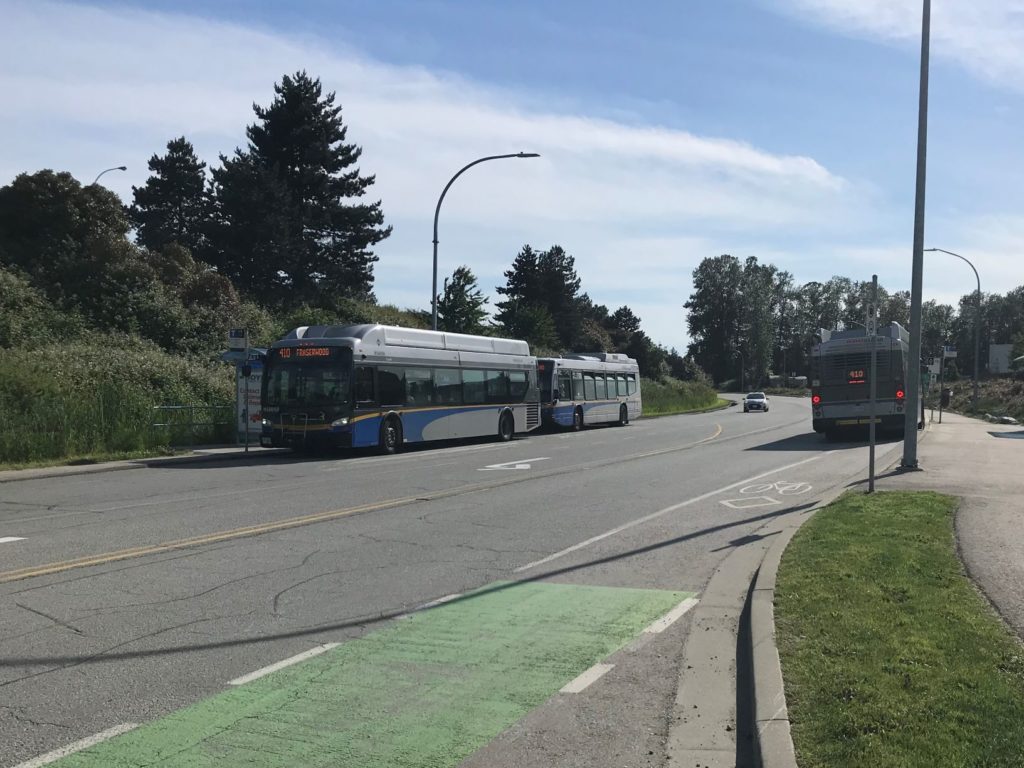
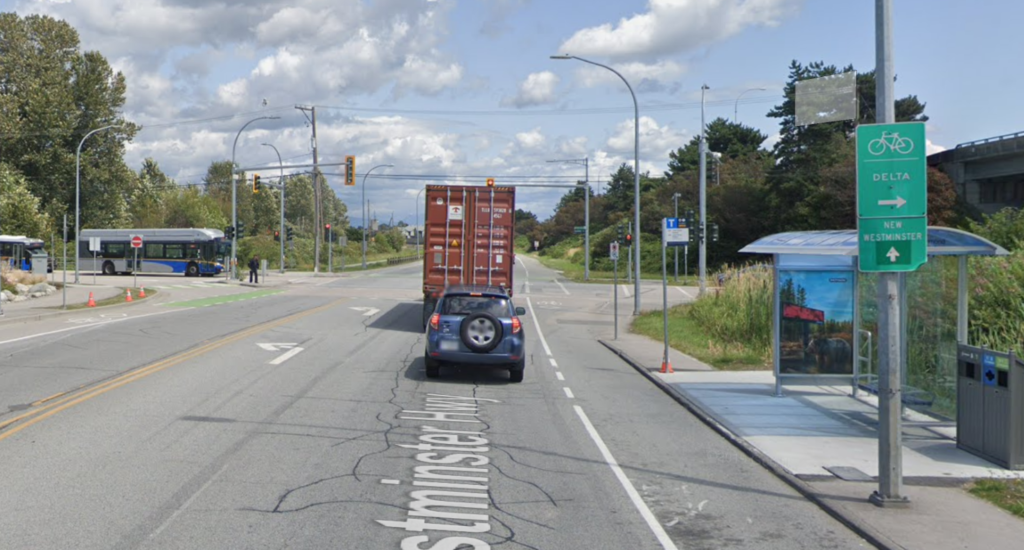
There is a bus stop on Westminster Highway right across the street from the Hamilton Transit Centre. Stop #59555 I think. The bus stop is on a (painted) bike lane. Not a perfect design, but sometimes you need to make due as there are lot of challenges for road space and curb space in the City. A bus stopping for a few seconds to pick up or drop off customers is a minor hassle for someone using the bike lane, and I think supporting transit users is really important for all cyclists – we active transportation users are all in this together!

Though it is not optimal in design, this is kind of an important bike lane. That area of Queensborough/Hamilton is a bit of a pinch point with the freeway jammed through it, and the route along Westminster Highway is really the only accessible, low-gradient and family-friendly route between the residential areas of Hamilton and the residential areas of Queensborough. It serves as an important connection for parks, shopping, the child care centre, and other travel. There really isn’t another way around here (except a ridiculous, really high, steep, and narrow pedestrian overpass a little way to the South, which no cycle should ever be on, and which doesn’t connect to anything, and is a prime example of why MOTI should not be trusted to build anything in an urban area, but I digress).

Now, the problem with Stop #59555 is that it has increasingly been used as place to store buses. It seems there is always one or two buses staged there, sometimes shut off with no drivers. I realize the 410 route often has delay/deadheading issues, but I also assume this is a spot for shift changes or other reasons bus are stored here. I have cycle commuted on this route for years, and I do not recall buses staging here prior to the opening of the Transit Centre. So now, instead of people on bikes waiting a few seconds for the bus to pick up or drop off, we need to travel around the bus.

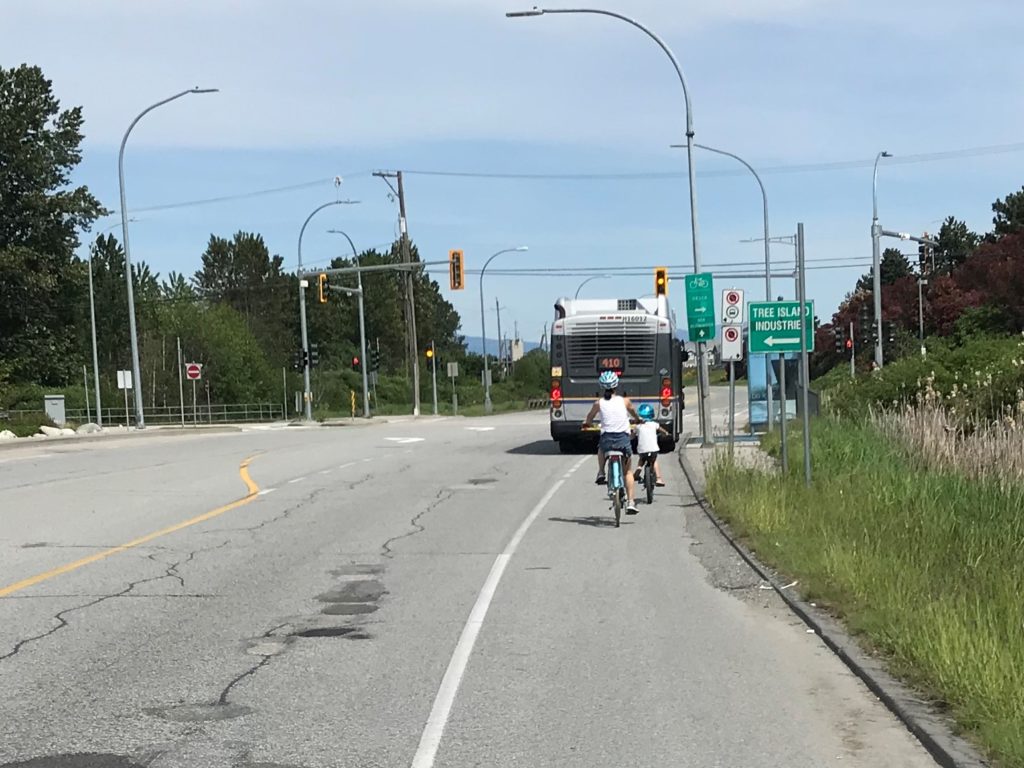
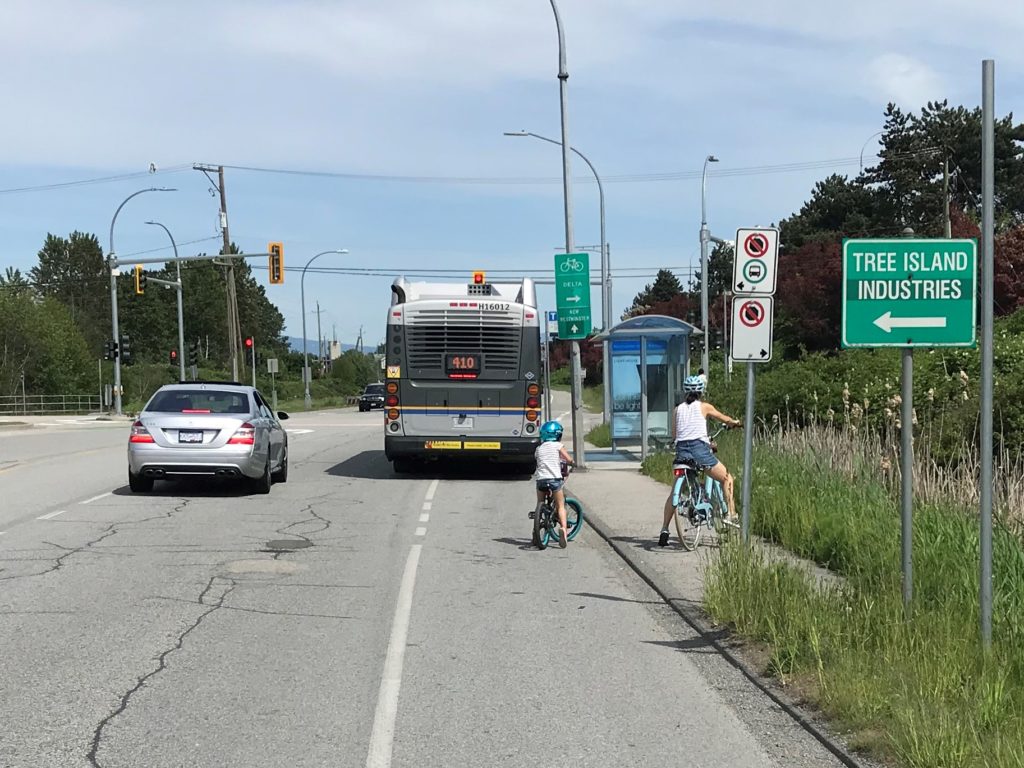
A >2m-wide bus parked in a <2m painted bike lane means cyclists wishing to pass by must enter the driving lane of a road with the name “Highway”, and one with a significant portion of truck traffic. For experienced cyclists like myself, that is merely a bothersome decrease in my safety as I signal and take the lane and hope drivers respect my space (no doubt irritating a small number of them, pushing them towards writing their own long impotent screeds on the Vancouver Sun Facebook page about scofflaw cyclists not staying in their lane). But for other users it creates a serious barrier. Here is what I happened upon while riding along that route a few weeks ago, which launched this specific impotent screed:

As someone who cares about active transportation, as someone who proudly extols the virtues of TransLink as one of the greatest urban transit systems in North America, as someone elected to advocate for the safety and comfort of active transportation users in my community, all I want is for this mother to feel comfortable taking her daughter for a bike ride. I want the daughter to grow up confident and free and empowered by her bicycle. I want mom and daughter to be safe. The bikeway here is not optimal, but Translink’s operational choice here is making it markedly less safe every day. I mean, what is she supposed to do here? What message are we sending?

So please, see if you can change this operational practice, hopefully this summer, until a proper engineered work-around (a pull-out for the bus, or a bike lane routed behind the bus stop) can be implemented. If you need help from the City to make that happen, or if there is someone else I need to call, please let me know. Don’t do it for me, the “experienced rider” who doesn’t mind irritating the occasional driver if road engineering forces me into that choice. Do it for this family, for this mom trying to teach her daughter how to navigate her community safely, for this youth discovering one of the greatest tools for empowerment and freedom ever invented – riding a bicycle.

Thanks.

ASK PAT: Brews & Patios

Wes asks—

Why can’t a brewery get a non-temporary patio in New West?

Has anyone in city hall ever been to Portland (or even Port Moody)? Every brewery literally gets rid of their parking lots and replace them with picnic tables and umbrellas.

They can. It is a bit hard for me to answer this question directly, because there are only two breweries operating in New West, and that makes it challenging to talk  about general City policy without uncomfortable references to specific cases. This is probably not the appropriate medium to talk about specific sites when those are private small businesses in the City. So I’m going to try to make this as general as possible to be fair to those owners.

Yes, I have been to Portland. I know most other members of Council have been to Portland. Some even attended the Livable Cities Conference there last year and have brought back ideas to make New West weirder. There are aspects of the Portland streetscape that the Mayor can’t stop extolling. I’ve also sipped beers on sunny patios around the world, from Montreal to Hue to Lesotho to Cologne. I’ve never heard of Port Moody, though.

New Westminster has allowed patios for the three main categories of food and beverage businesses (Food Primary restaurants, Liquor Primary pubs, and Manufacturer breweries) for some time , and many of them across the City have patios. However, the City is not the only regulatory body involved in licensing these spaces, and often there are complicating details between City zoning bylaws, provincial liquor licencing, and a variety of other rules that apply to businesses, especially the strange amalgam of light industrial activity and hospitality that is represented by breweries with tasting rooms.

I can’t talk about how it works in Portland, because I have no idea how their regulatory regime works, but I’ll try to outline my understanding of the local regulatory environment while avoiding any direct reference to any specific businesses.

In pre-COVID times (when this question was asked, and yep, I’m slow with answers these days), the City had a Sidewalk Cafe policy, guidelines, and a process in place to approve said patios, and on-site patios (those that are on private property of the pub/restaurant) were permitted in all commercial zones in the City. Sometimes a zoning variance would be required to change parking use to patio use (as amount of parking is regulated by zoning), but there was a process to do this, and I don’t recall Council ever saying no. There would also have to be an expansion of the liquor licence, which is provincially regulated and comes with requirements around access and fencing and such, because non-drinking people in BC must be strictly separated from drinking people or else… uh… chaos, I guess.  There are some other details that may be City Zoning or may be Building Code that can get in the way: for example, the patio has to be accessible (ramps less than 5% grade, 2m wide access points, etc) or number of washrooms and accessible washroom consistent with the occupancy of the room, but again those details can usually be worked out.

If the above require zoning variances, then that may trigger a need for some sort of public process – a public consultation or Opportunity to be Heard, and this makes sense. If you live next door to a restaurant, and they decide to put 50 guests outside making noise until 10:00pm every night, you may have concerns with that above and beyond and concerns you may have had, and it is only fair that you have an opportunity to bring those concerns to Council. Of course, Breweries are generally in industrial areas where this is not as much of a concern.

Finally, if a business wanted to put a patio on City land (the sidewalk, a public parking spot, etc.) then there is another step around the need to licence public space for private use. They need to pay a licence fee, there are insurance and liability issues to clear up, and the City has to decide if there is a public benefit served by this use of public land. Again, this all sounds like a hassle, but it is important when allocating public resources that it is guided by some kind of policy or at least a transparent set of principles and to assure transparency, fairness, and (frankly) accountability.

We are now in COVID times, and things have changed. Most notably, the Provincial Government has made some changes to how patio spaces for business with liquor licences are regulated, in an effort to support recovery for these businesses. The changes will allow near-immediate licencing for “temporary” patios to the end of October as long as it doesn’t increase the overall occupancy capacity of the business (which makes sense, as physical distancing requirements are making it hard or businesses to fit their occupancy limits inside). By doing this in a temporary way to the end of October, it gives business a chance to get going right now, and time for them to get more permanent plans in place if that is the way they want to go.

At our last Council Meeting, New Westminster Council made some changes to our zoning bylaw to further support these “temporary” applications, and further established some strong policy guidance to give staff the clear direction that we want to support the opening of patios asap. This sounds a little self-congratulatory, but in reality, City Staff did a great job putting together the documentation, providing clarity about the rapid changes in the regulatory environment, and bringing local business associations onboard with a regime that works for them. This guidance document shows the straightforward pathway to opening a patio in time for this summer’s patio season.

This effectively kicks the ball down the road to the end of the 2020 patio season, but it also gets patios up and running ASAP, and gives us time to get things in place for more permanent changes. As a bonus, and also gives us a chance to “try out” a process and see what works or where the process needs adjustment, which is really the most effective form of public consultation.

ASK PAT: NWSS safe biking routes

I have a bunch of queued up ASK PATS. Sorry, folks, some have been here for quite a while. Things have been busy, and priorities at Council have been shifting so fast and furiously that I have let these linger. I am going to try to clear the queue here in the next little bit. So the answers may be shorter than usual. But probably not, because I like to go on about things…

Don asks—

NWSS safe biking routes need some help. One of those problems is the car traffic cutting through the gas station at 6th and 8th. Perhaps if barriers were installed on the double yellow lines on both those streets would improve safety and traffic flow. Is this possible?

Maybe. That is a pretty “operational” question, and I frankly don’t know the technical requirements when it comes to installing mid-road barriers. I suspect come of those flexi-posts would reduce the number of illegal turns here, but I have also seen drivers do some pretty bizarre things to get around them. Jerks gotta jerk. As this is a more technical operational question than a Council Policy one, you may want to enter it to SeeClickFix or drop a line to Engineering Ops and see what transportation staff say.

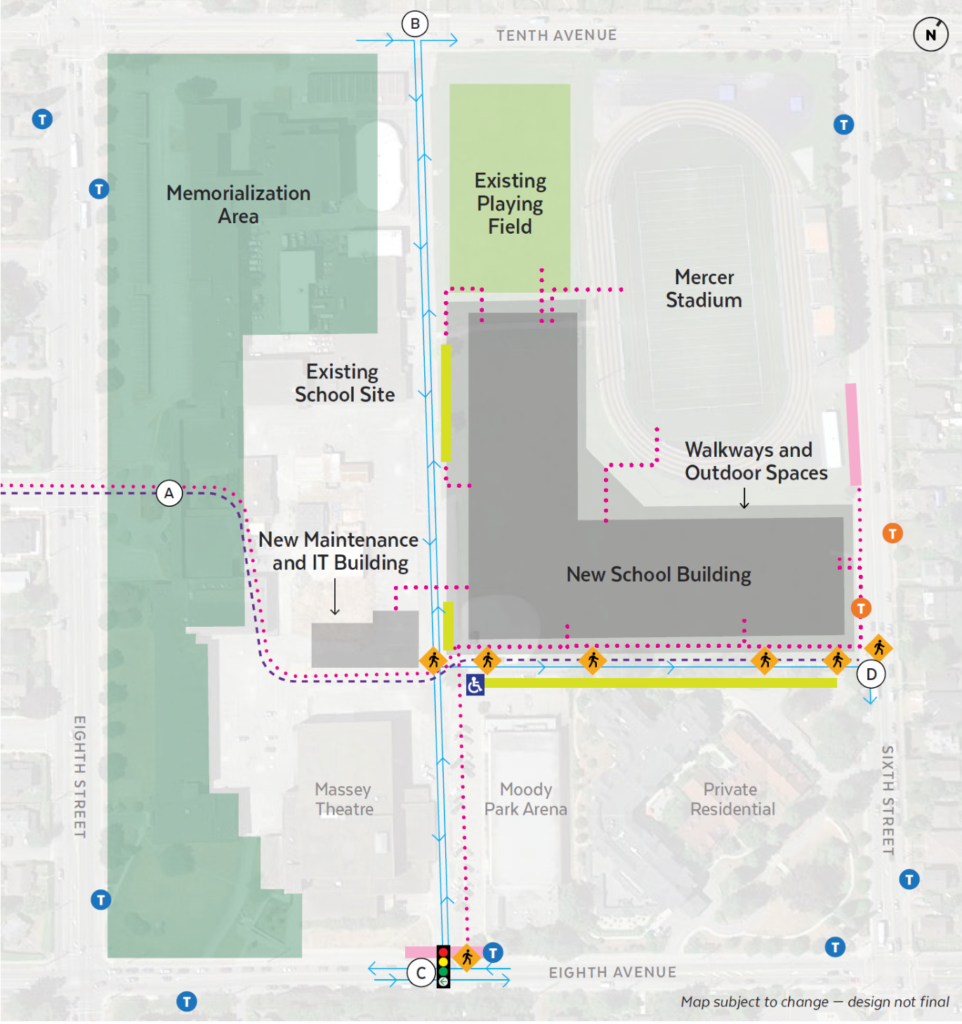
As for bike routes to NWSS, we are working on it. The building of the new High School has given us an opportunity to review how cycling and pedestrian connections to the High School work. With the “main entrance” for the School shifting form 8th Street to 6th Street, there will definitely be a shift in how students get to the school:

An older drawing o the proposed new school site I cribbed from this source. Some stuff may have changed since then, but I wanted to show the lay of the land, and this works.

The City has worked with the School Board and project delivery team on this. The first priority is assuring safe and accessible pedestrian access a the two main “entry points”which will be mid-block on Eighth Ave (“C”) and mid-block on Sixth Street (“D”). The pathway across Eighth Street through the existing school site (“A”) is also identified as important, but will be addressed in the future as the demolition of the existing school and design of the memorialization area will delay works on that side. Light-controlled intersections, crosswalks, and sidewalk upgrades are planned at “C” and “D”.

The City is also committed to assuring there is a safe separated cycling route from Seventh Ave (part of the Crosstown Greenway) to the school. By the time the School opens, that will be a separated path along Eighth Street to Eighth Ave, a new intersection treatment at Eighth and Eighth, and improvements of the pathway past the Massey Theatre.

The Connection of the Crosstown Greenway to the Sixth Street entrance to the school property is going to be designed and implemented as part of the Uptown Streetscape Vision, which will redesign all of Sixth Street from Fourth Ave to Tenth Ave. This is currently going through some stakeholder engagement, but is a bigger road redesign project that will not be implemented by the time the School opens.

a follow-up

In my last post, I tried to give some data on how policing works in BC and New Westminster, and I tried to do so without opining, recognizing that my own biases and opinions probably sneak in all over everything I write.

There was one asterisked statement in that post I wanted to follow up on, because it relied on a more detailed reading of the Police Act, and that post was long enough without this extra 1,000-word digression. However, in the day or two since I started sketching out that previous post, there has been much news, including the Mayor of Vancouver saying he really can’t do much about policing costs, some in the chattering class suggesting that was artless dodging, and the Solicitor General and Premier saying the Police Act is due for an update. All of the sudden, that asterisked point became the center of debate, so I will try to unpack a bit here.

Again, by means of caveat: I am not a lawyer or specialist in interpreting legal documents. I am not on the Police Board, so operating under the Police Act is not part of my day-to-day. I may get details wrong here, and please correct me if I do.

The Police Act says that a municipality over 5,000 residents must pay for policing. At first blush, that means City Council is responsible for approving the Police Budget (both operational and their capital requests) as part of their annual budget work, and we do that. However, that is not the entire story.

Section 15 of the Police Act says:

…a municipality …must bear the expenses necessary to generally maintain law and order in the municipality and must provide, in accordance with this Act, the regulations and the director’s standards, policing and law enforcement in the municipality with a police force or police department of sufficient numbers to adequately enforce municipal bylaws, the criminal law and the laws of British Columbia, and to maintain law and order in the municipality, adequate accommodation, equipment and supplies for the operations of and use by the police force or police department

This makes clear that the Provincial Government has ultimate authority to determine the level to which police are funded in BC. Section 17 of the Act follows up by saying the Director of Police Services (a Provincial Government employee appointed by the Solicitor General, see Section 39 of the Police Act) must notify the City they are in breach and direct them to fix it. If they fail to do so, the Solicitor General can fix it, and send the municipality the bill.

Section 26 also puts policing costs at the foot of the Police Board:

Subject to a collective agreement as defined in the Labour Relations Code, the chief constable and every constable and employee of a municipal police department must be employees of the municipal police board, provided with the accommodation, equipment and supplies the municipal police board considers necessary for his or her duties and functions, and paid the remuneration the municipal police board determines.

Then Section 27 lays out the slightly-convoluted response if the Council refuses to pay for something the Police Board asks. The Board or Council may appeal to the Director (that Provincial government employee), who determines “whether the item or amount should be included in the budget”, and reports back, cc’ing the Solicitor General. If ordered so, the Council must include the item in its budget, or be in violation of the Police Act. Naturally, a lot rides on that should above, but ultimately, the Solicitor General holds all the cards in this dispute.

The grey ares in the middle of all this is the determination of what “sufficient numbers” and “adequate” are in the sections above. How does one measure if the level of service planned by the Police Board and funded by the Council is sufficient? Or more to the point, how would one know when it is insufficient?

This brings us to Regulations, which are pieces of Legislation that exist under Acts. Again, not a lawyer here, but Acts are high level documents enacted by the Legislature that set out general principles and duties, establishing the will of the Government. Regulations are subordinate to and empowered by Acts, but include a lot of the fuzzy details that often need adjustment without opening up the entire big Act. A probably-wrong but simplified example: an Act would say “driving above a speed limit is illegal”, where the subordinate Regulation would say “Speed limits on urban roads is 50km/h unless otherwise designated”.

In Section 74, the Police Act gives the “Lieutenant Governor in Council” (a fancy way to say, the government of the day) the power to create Regulations on various aspects of the Act, including:

prescribing the minimum salary or other remuneration and allowances to be paid to members of police forces, police departments, designated policing units or designated law enforcement units” and “prescribing the minimum number of members of police forces, police departments and designated policing units that are to be employed on a basis of population, area or property assessment, on any combination of them, or on another basis

To the best of my knowledge, these regulations do not actually exist (a list of regulations that do exist under the Police Act is available here). Police staff numbers and police remuneration are determined by the Board, the latter approved by the Council, and Regulations just don’t come into it. There is, however, a legal ability for the provincial government to create such regulations if needed to clarify the funding required for “adequate” policing. Short those regulations, if a dispute occurred and persisted, it would likely end up in the Courts and a judge would decide, though my (unskilled) reading of the Act suggests it would be the Police Board whose opinion carries the most weight.

In in my time on Council in New Westminster, there has never been a significant conflict between the Board and Council on the budget. Council has, on several occasions, reviewed budget augmentation requests made by the Police as part of our annual budgeting process and sent some back for review. This type of negotiation has always resulted in agreed-upon operational budget and Capital requests, much like in other departments in the City from Engineering to Parks.

Yes, a Municipal Council could push back hard against a Police budget and significantly reduce it. Yes, the Police Board could appeal to the provincial government if they feel this reduction would not allow them to discharge their duty under the Police Act to “enforce municipal bylaws, the criminal law and the laws of British Columbia; maintain law and order in the municipality; and prevent crime”. Then the ball would firmly be in the provincial government’s court to determine the path forward – accept that Council’s reductions or order the Council to pay. No doubt, Politics would ensue.

Where we are at

When I see voices being raised here in New Westminster and across North America to call attention to inequity society, most prominently the unjust policing of Black and Indigenous people, I struggle to find the place where my words are important. For the most part, they aren’t. As I have spent my life being a tacit beneficiary of this injustice, my lived experience is not something anyone needs to hear from right now. There are better voices to listen to now on this topic. For now, my admittedly inadequate response is to say I am listening, and I am having conversations with people in the community to better understand what kind of concrete actions I can take in my elected role or support others doing to start addressing the systemic change we need to see. I appreciate the correspondence (even the form letters!) I have received, and am struggling to be timely in my replies, but I’m working on it.

I have often tried to use this blog to unpack arcane bits of municipal government. Maybe my usefulness here is in outlining the lay of the land. Not as call for action, an excuse for a lack of action, or a retort against calls for radical change, but more to inform and empower those who would want to call on government to take concrete actions, and those who have concerns about those calls. I think data can help ideas find better traction in local government, in provincial government, and in police forces. So the following is intentionally short on opinion, but I hope this provides local context to the conversations happening across North America right now.


New Westminster has a Municipal police force. Where many communities in British Columbia contract out local policing to the RCMP, here in New Westminster the police are independent. The legislation that empowers them to act as a law enforcement body is the provincial Police Act, which requires that a Municipality provide policing, whether through a stand-alone police force or contracting the RCMP. It also requires that a non-RCMP municipality establishes a Police Board to oversee that policing.

The New Westminster Police Board is (as regulated by the Police Act) chaired by the Mayor of the City, and one of the positions on the Police board can be appointed by the City Council (city councilors are strictly forbidden from serving on the Police Board). The five other members of the Board are appointed by the provincial government via the Solicitor General’s office. So there is a little bit of overlap of jurisdictions, but it is clear the Police do not answer to City Council, for good separation-of-powers reasons. The Police Board oversees (but doesn’t direct) operations, provides guidance on strategic planning, and even hires the Chief constable. These Board members are, notably, unpaid volunteers, and tenure is limited to two three-year terms.

In requiring a municipal government to provide policing, the Police Act requires that a City Council approve a policing budget. Without digging too deep into the current rhetoric, only the provincial government (through the Police Act) or the Police Board can reform the police; while only the City Council can defund them*. Of course, more complicated responses to the complex issues raised by the current public discourse would rely on some sort of concerted action between all three bodies. In short, the systems are structured such that fundamental changes to the status quo will be hard to make, and it is challenging to think about where to start. But that is the challenge before us.

*within certain limits. See my follow-up blog post


I do want to talk about funding – because the part that is (mostly) under City Council control, and it is something that has become fodder for much of the recent discussion about policing in local government circles.

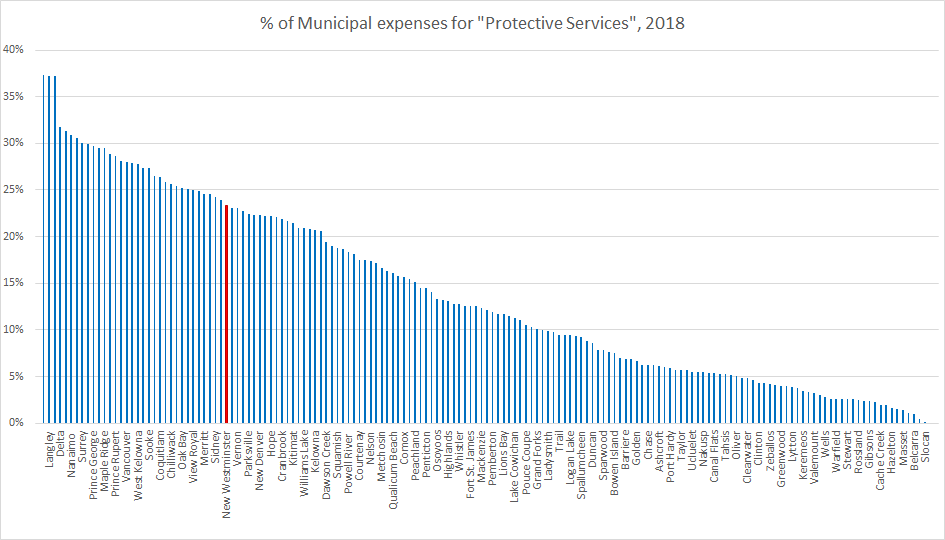
The intrepid CBC Local Government reporter and data geek Justin McElroy put some data together here comparing “protective services” spending across BC municipalities. As he notes, comparing across municipalities is difficult because not all are as transparent about how their spending is broken down. The one definitive source is the BC Government stats collected annually, but they report “protective services” as one category which lumps together Police and Fire. Looking at the 2018 data (the most recent available on-line), on average 25% of local government spending is on Protective Services. New Westminster is a little lower than that average at 23%.

(source: Schedule 402 2018)

This proportion varies widely across the province for many reasons. Victoria has high protective service costs at least partly because it is a small municipality in the middle of a large metro area with some special policing costs related to being the Provincial Capital. Salmo has a small volunteer fire department and limited policing provided by the RCMP, so their protective services costs are really low. There are also great variations on the denominator side of the equation, as different Municipalities have different utility costs and other levels of service in non-protective services. So, all that to say direct comparisons are complicated.

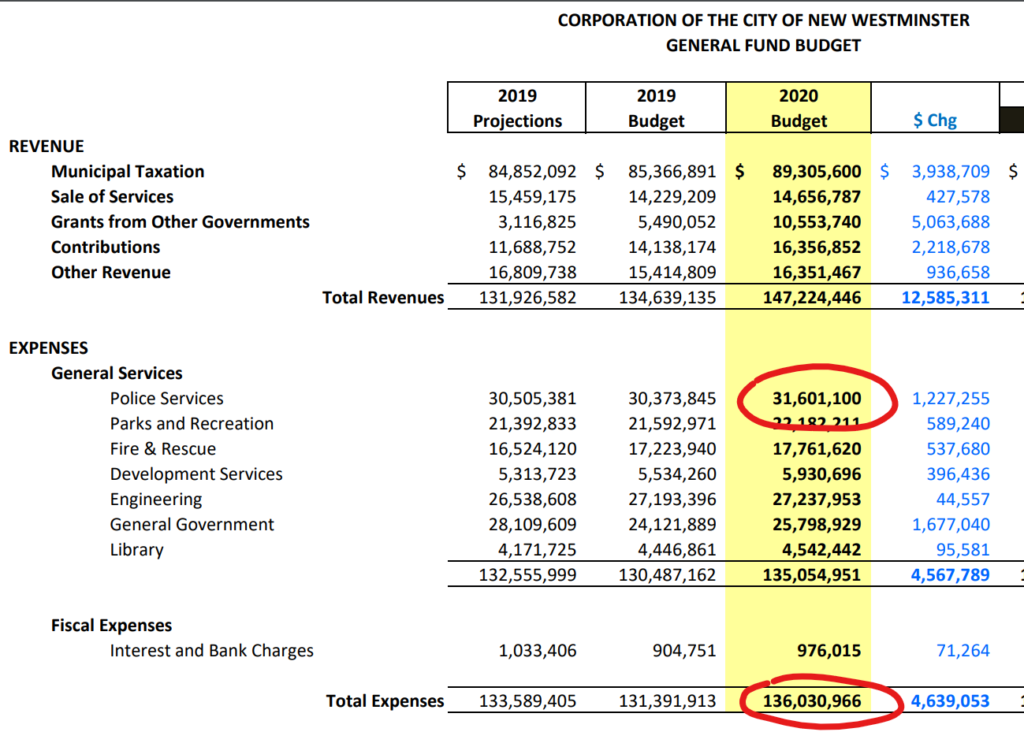
I can talk with a little more certainty about New Westminster’s spending on police services. If you look at our most recent on-line financial reporting here, you can check the 2020 Budget column to see what we plan to spend this fiscal year:

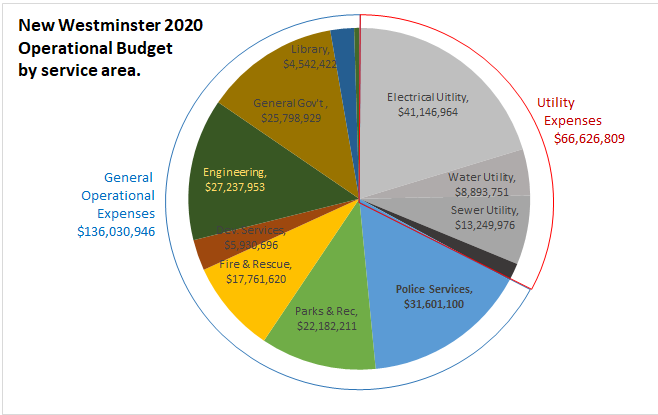
This is cut from page 19 of the pdf in the link above. This is the “Operational” part of the budget, which pays for day-to-day expenses like salaries, gas for police cars, electricity and paper clips. Utilities like sewers and electric are handled separately in the same report because the sources of those funds are different. In 2020 the City budgets to spend $136M on non-utility operations, and $31.6M of that is police operations. It is fair and accurate to say that 23% of our non-utility operational spending in the 2020 budget is on Police operations.

There is a second budget category the City uses to account for its “Capital” expenses. This covers all of the tangible objects the City has to buy that have a useful life span (i.e. are not consumables) but need maintenance or periodic replacement, like buildings, cars, roads, ice plants for arenas and lawnmowers. On pages 25 and 26  of that linked pdf above are the details of what we plan for Capital spending for the 5 years covering 2020-2024. It totals up to a substantial $275M, but if you take all the lines that are for Police services, you see $427,600 for police building repairs & renovations, $828,600 on general equipment and $2,085,000 on police vehicle renewal and repair for a total of $3.3M, which totaled up works out to a little more than 1% of our 5-year capital budget. Savings on equipment is relatively easy, but that is a small proportion of the city budget.

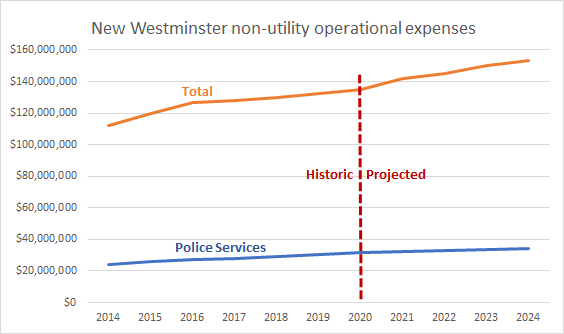
Finally, it is timely to discuss how the local police services budget has changed in the City. The City doesn’t archive old financial plans on the website, and the Provincial stats lump all “protective services” together. However, I do have copies of all of the annual budgets I have been asked to approve since I joined City Council in 2014, and can project forward to 2024 using the current 5-year financial plan (which are projections that may change). Here is what the Police Services portion of the general operations budget looks like over that time. It has remained around 22%-23% of the budget over that time, but is increasing at a slightly higher rate than overall budget:

We can talk about reasons why the police budget has changed over the years, and yes I have opinions, but maybe I’ll leave that for future discussions I am sure we will be having.

Pool Pause

One of the bigger items on the Agenda this week was the update on the Canada Games Pool replacement project. There were two items, and because of the size and scope of the project, there is significant public interest in the plans, so it is worth unpacking the decisions a bit.

The first big news is that the City was not successful in securing an Investing in Canada Infrastructure Program grant for the Project. This is pretty disappointing, as the City has spent 5 years developing a program around this grant process, and specifically designed aspects of the project to assure we had the best chance of receiving some funds. We did the hard public-consultation and program-design work to get a fundable program that met what we considered all of the possible criteria for the Community, Culture and Recreation category. Our application was submitted in January 2019, and we received notice more than a year later that we were not successful.

Exacerbating this disappointment is that projects for this Grant must be “shovel ready”. This means we needed to be ready to go, with a well-developed project, public buy-in, secured financing (ironically, you need to prove you don’t need the grant to get the grant), and all of the hoops jumped through to get ready to dig a hole… but you cannot yet be digging the hole. If you start digging, you are no longer eligible. I think our staff were pretty creative in getting shovel ready in time for grant application, but were still able to get some detail design and site preparation work done during the unexpectedly long waiting period. However, we clearly lost time in the wait, which is unfortunate.

The nature of the grant program is such that there is no clear explanation from the selection organization of why the project was not selected, except to say that there were significantly more applications than available grants for all of BC, and ours didn’t make the cut. There is another phase of ICIP launching in the fall of 2020, and we may be able to re-package parts of the project to apply for grants then. Also, as both the Province and Feds are signaling significant stimulus funding will be rolling out in the Fall as part of COVID recovery, we have some innovative aspects of the pool project that we think may be successful at getting some support. However, we need to recognize that these will be relatively small contributions, and the City of New Westminster is going to have to pay for most of this project on its own.

Last year, Council had some discussions about the financial plans around the pool, and decided that the larger “Enhanced” pool plan that some in the community were asking for was outside of our financial comfort zone unless we got a significant ICIP contribution. With this confirmation that those funds are not coming, we are taking the “Enhanced” pool off of the table. We are now concentrating on the two-tank (8-lane 50m pool model with a second recreation pool) plan that came out of our extensive community consultations and serves community needs, and is still significantly larger than the existing Canada Games Pool, but not the 10-Lane pool that some in the regional competitive swimming community would have liked to see built.

New Westminster is a City of 71,000 people in the centre of a Metro region with 2.5 Million people. There is a need for a refreshed swimming and recreation facility to serve our growing community, and we also have a myriad of other spending priorities and infrastructure that needs updating. I believe that building a facility for the regional competitive swimming community needed regional support. If we want to build a facility to host Provincials and inter-provincial competition, the senior government grants we applied for were the process available to us to fund that type of facility. Without those funds, we need to concentrate on addressing the pressing community need in a way that fits the financial capacity of our community.

With the detailed design decisions made, and the financing worked out, the next step in the process is to hire a construction company by issuing an “Invitation to Tender” to the construction market. We are ready to do that now, but it opens up a bunch of financial implications for the City, so Council decided to pause a few months before we take this big step.

This is not an easy decision, just as the decision to not build the larger pool is a difficult one. But both were made for similar reasons – concern about the impact on the City’s finances. I know political hay-makers love to cast this Council as spendthrifts because we like to do things that make our City stronger and more livable, but my experience in 5+ years on Council is that we are always cautious when projecting out future City finances, and are pretty risk adverse if we don’t fully understand cost implications.

This is the biggest single capital project the City has ever undertaken. We have been putting some money aside for a few years, but will still need to debt finance the bulk of this project. At the scale of this project, any risks can have a big impact on the City’s budget for years to come. Unfortunately, there is significant uncertainty in the City’s medium-term financial status due to the COVID crisis, and in the construction market due to supply chain concerns and disruption in global markets. For that reason, we are not taking the next step in sending this out for tender until at least the end of the summer, when we have a better handle on the financial status of the City, of the Province, and of the world economy, and the construction market will hopefully have a better handle on costs.

This is acting with an abundance of caution, as I think we have to when talking about an infrastructure investment this size and a financial crisis of this unprecedented nature. The news coming out of the Province and the Bank of Canada is generally positive about recovery, but still really uncertain. If better financial certainty puts us in a position to pull the trigger at the end of the summer, this delay will add only a couple of months to the final delivery date in 2023. However, if the local and/or global financial situation goes very badly in the next few months, we will be much more prepared to manage that as a City without a $100+ Million project weighing us down. Let’s hope it is the former, and we are able to go to tender in the fall, but at this time a pause is the prudent, if disappointing, thing to do.

Council – June 1 2020

Ugh. What a terrible time we are in. I’ve been trying to step back a bit from social media right now, the chaos is a good time for people to listen to voices other than mine. But I’ve been doing these reports since I started on Council more than 5 years ago, and as long as the City is doing work and Council is making decisions that impact your community, I feel the need to put these out.

As always, you should read the Agenda and Reports or go to the recording if you want the full story. Now more than ever, you need to be aware that everyone brings their personal filters to information, sometimes even unintentional ones, and that includes me. Every one of us has blinders in our view, and by their very purpose we cannot see them. It takes effort to understand the impact they are having on our own outlook. So here goes.

COVID-19 Draft Recovery Plan
This is our report on planning the City is doing to support the BC Restart Plan. It includes proposed timing for the reopening of City facilities, re-start of suspended City programs, and an outline of what kind of guidance will be used to inform safety protocols needed to make public spaces safe for residents and staff.

There is a bit of prioritization on assuring services essential for vulnerable populations, such as planning for opening Moody Park Outdoor pool and cooling centers in the event we have a heat wave. Some other facilities will be more of a challenge, and will need more work to fulfill safety and comfort requirements for users. Some will have to wait until the Fall (depending on what the pace of change is in the Provincial Health Authority requirements), and the QtoQ Ferry is especially challenging, and may not be running again until 2021.

There is more detail in this report, it is worth a read. Also, recognize this is the best laid plan as of the end of May, as the Province is entering Phase 2 of the recovery. It will surely be adjusted as the recovery is either accelerated or slowed depending on how the Pandemic evolves.


The following items were Moved on Consent:

Inter-Municipal Transportation Network Systems (TNS) Business Licence Bylaws
I am still not happy with the damaging impacts to community and workers’ rights that are represented by the current structure of TNS like Uber, but there is nothing a local government in BC can practically do to stop them, and the only hope we have to regulate and manage some of these externalities is through business licensing. I think the Inter-Municipal Business License is the practical model to do this. We are a little late to getting this Bylaw approved here in New West, more due to our work load than any specific political direction, but we have a Bylaw matching 23 others already established across the region ready to test in an Opportunity to be Heard on June 22. C’mon out (virtually) and tell us what you think.

427 Fourth Street: Development Variance Permit to Vary Rear Yard Setback
How refreshing to be looking at Development Variance Permits again. This heritage home on a uniquely-shaped lot in Queens Park that was strangely subdivided more than 100 years ago. The owner wishes to put an attachment on the house, but to continue the existing lines of the house, this requires a variance to be 7 feet closer to the rear fence than permitted (11 feet, as the existing house is, as opposed to 18 feet). At this point, we are issuing official notice that we intend to review this Variance request at the June 22 meeting. Let us know if you have concerns or comments.

1065 Quayside Drive: Development Variance Permit to Vary Off-Street Parking Requirements
Try to follow this one. There is an E-Comm 911 antenna on a high-rise in the Quayside. It (naturally) requires an emergency back-up generator. They need ot replace the generator, an the new one has bigger footprint than the old one. Its installation requires the removal of a parking spot, which is something counted in our zoning bylaws. This building, it turns out, is already 14 parking spots “deficient” according to our Bylaws (it has 126 spots and 10 visitor spots for 98 units) so the replacement of the generator requires a Development Variance to formalize the current deficiency of (now) 15 parking spaces. Council hereby issues official notice that we intend to review this Variance request at the June 22 meeting. Let us know if you have concerns or comments.

327 East Columbia Street: Development Variance Permit to Vary Off-Street Parking
There is a Daycare development in a commercial building next to Sapperton Park that wishes to open with fewer off-street parking spaces that required under the zoning Bylaw, requiring a variance. Once again, this is just official notice that we intend to review this Variance request at the June 22 meeting. You can send us your opinions.

General Principles for Recommending Waiving of a Public Hearing and Consideration of Public Hearings for Three Bylaws: 909 First Street, 45 East Eighth Avenue, and Miscellaneous Zoning Amendment Bylaws
Public Hearings are difficult right now (they are often difficult at the best of times, and horrendous in the worst of times, but that’s another rant). Council has generally been in support of waiving some Public Hearings at this time, due to the difficulty of managing them and the need to provide procedural fairness to applicants in the City. But procedural fairness works both ways, and changing how hearings work requires that we develop a clear set of guidelines of when waiving is and is not appropriate. This report sets them out for Council approval.

That is, if the application is consistent with City policy or strategic priorities already established by Council, if the applicant responds effectively to public and staff feedback in reviews, and the proposal is consistent with the OCP, then Council will be asked to waive that hearing. All three hurdles need to be passed.

It is important to note that the Public Hearing is only one form of review of any project. Residents and other impacted parties have several other ways available to them to comment to Mayor and Council about whether they like or dislike any particular project. The Public Hearing also comes very late in the process, where potentially better forms of engagement happen earlier when clear issues or changes to the project can be addressed more effectively by applicants, or directed by staff.

There were two applications caught mid-process when the whole COVID thing came down, and we will not waive those Public Hearings, but will pilot a virtual Public Hearing process.

2019 Annual Water Quality Monitoring Report
The City collects more than 1,000 water samples from around our water system every year, and sends them for analysis of E.coli, coliform, HPC, chlorine residuals, metals, temperature, turbidity, and byproducts of the disinfection process (DBPs, THMs, and HAAs). We annually report out on this sampling program. The water is good.

New Westminster Aquatic and Community Centre (NWACC) – Project Status
There is more to talk about here, and I am sure this deserves a follow-up blog post, but here are the short version details for now. The City did not get an ICIP Grant for the Canada Games Pool Replacement. As per our earlier discussions about how much pool the City can afford without this senior government funding report, we are now concentrating on the 8-lane 50m pool model (with a second recreation pool) that is still significantly larger than the existing Canada Games Pool, but not the 10-Lane pool the Hyack Swim Club would have liked to see built.

We are ready to tender construction documents, but there is significant uncertainty in both the construction market and the City’s medium-term financial status due to the COVID crisis. For that reason, we are not taking the next step in sending this out for tender until at least the end of the summer, when we have a better handle on the financial status. At this time, this is the prudent thing to do.

Community Events and Festivals during COVID-19
This will be a summer with fewer events. No parade, no bike race, and if there is a revamped “Fridays on Front”, it will be later in the summer, and we wouldn’t know what it will look like yet. However, there is still going to be some activity around Canada Day. No fireworks, and distributed events as opposed to big gatherings, but something.


The following items were Removed from Consent for discussion:

Public Engagement Strategy on Recovery Planning and Post-Pandemic Vision
To help inform the above-referenced recovery planning, the City is launching a public engagement initiative to connect with residents about the shape of our recovery plan, with an effort to identify inequities in how we have engaged in the past.

This is actually a natural follow-up to the Public Engagement Strategy the City developed a few years ago, but have not until recently fully funded and resourced. There were some plans this spring to concentrate on Climate Emergency response as an opportunity to do more directed engagement, but as we have moved so much of this resource over to COVID response that it seems there is little staff capacity to do this.

This is going to take some resources to do right, and will eat up some engagement bandwidth (i.e. the public can only engage so much with the City before they get back to the other things they need to do in their lives), so finding the balance between this initiative and existing Climate Emergency engagement initiative is the question. And one we will continue to work on.

COVID-19 Pandemic Response – Update and Progress from the Five Task Forces
Speaking of moving resources over the COVID response, here is our weekly report on what our task forces have been up to. As with last week, there is a gradual transition to maintenance and recovery going on, after so much exceptional and amazing work has been done by the staff of the City.

Sidewalk/Street Patios and Parklets to Support Business Recovery
Patios and Parklets are getting fast tracked, both because they support the economic recovery of our hard-hit commercial and restaurant sectors, and because they support the Streets for People motion to re-think how we use our streets and sidewalks to accommodate physical distancing and the needs of active transportation users.

There will be a fast-racked “temporary” application process for those who want to set up immediately, which will cover them until the end of October and get them through the busy summer season and what we hope is the bulk of the recovery time. This coincides with recent changes in Provincial regulation to permit alcohol service on expanded patio areas as a temporary measure. There are several changes here, including amending our Zoning Bylaw to allow them to repurpose parking on their own land to patio space, if that is the path they want to take. There would also be an opportunity for establishments to re-purpose street parking in front of or attached to their business to full service patios.

We are also accelerating the installation of public parklets in select locations. These would not have “restaurant service”, but would support take-out seating. We will work with the adjacent restaurants of food service businesses to have them help with day-to-day maintenance (trash clearing, for the most part) of the parklets.

The big take-away point here is that the City is doing everything we can to accelerate this this process and make the most out of recent changes of provincial regulations – we want to get out of the way and let businesses find out how to make this work best for them.

Stage 1 Sustainable Transportation Zoning Bylaw Amendments for Two Readings – Bylaw 8184, 2020
Land use policy is transportation policy, and vice versa. Our Zoning Bylaw includes regulations that directly impact sustainable transportation opportunities. It has been a while since we did this type of review to assure those regulations are concordant with our Master Transportation Plan goals and principles. This first stage will be improve the clarity and administration of those Bylaws, future stages will bring more significant changes in how we regulate parking requirements.


We then went through a slightly less rhythmic on-line version of the Bylaw reading process, including Adopting these Bylaws:

Sidewalk Café Encroachment Amendment Bylaw No. 8204, 2020
This Bylaw that supports patios as talked about above was given three readings adopted by Council. Get your sunglasses out!

Heritage Revitalization Agreement (1935 Eighth Ave) Bylaw No. 7846, 2019 and
Heritage Designation (1935 Eighth Ave) Bylaw No. 7847, 2019
These Bylaws that support subdivision of a residential lot in the West End and permanent protection of the heritage house in the lot were given Third Reading back in 2019, and are now adopted, making them the law of the land and forever preserving a single family house 300m from a Skytrain station in 2020.

And that is all we have for now. Take care of each other folks.
on Phase 2

There is a lot of stuff going on right now. There are stories local and international that are causing people alarm, confusion, and anxiety. I cannot tell if things are spinning faster now, or if we are all so apprehensive about our imminent release from social quarantine that the tension is making us hyper aware. There will be a reams of sociology research coming out of the time we are in, and the times to come over the next 6 months. Or 8 months. Or 12. Who knows, and maybe that we don’t know timelines is part of this. Or maybe its just me.

I get a lot of correspondence as an elected type, and like many of you have been spending a lot of time looking out through social media at the conversation in my community. I have been stepping out to shop, to exercise, to smell the flowers in a park. Talking to friends from 7 feet apart and stepping sideways to yield some sidewalk space. Wondering if I send the wrong signal when I tried to hold the door for someone, not at first recognizing that they didn’t want to walk past me. There is a common thread through all of this – anxiety. Or maybe nervousness is a better word, and anxiety best reserved for when it becomes disproportionate and disabling, Even then how are we to know what level of discomfort is “disproportionate” right now?

Last year, the City of New West was reviewing applications for cannabis retail stores. These were, nominally, just regular rezoning applications to add another legal use to existing retail locations. We had many people write to us and come to the Public Hearing expressing fear and concern about the impact of these stores on their neighbourhood, their community, and their children. With cannabis made legal and its use already ubiquitous in our community, it was hard to understand where this seemingly disproportionate anxiety was coming from.

A wise colleague put this into context for me. Government at every level, police, schools, churches, and the media, had spent most of the last century telling the public that cannabis was a terrible threat. Reefer Madness, gateway drug, a surefire way for your child to throw their life away. We invested millions in scaring the population about this menace, and incarcerating people for using or trading in it. Then one day, government declared it legal and all fine now, with very little fanfare, and (most importantly) limited education about the reality of its health impacts. They frankly never said “we were wrong”, or if they weren’t wrong, why those fears they transmitted are now not important. What right do we have now to act surprised that everyone didn’t just say OK when that shift happened? We need to recognize that the anxiety came from a place not of the anxious person’s making. We must be compassionate about the impact it is having on them while working on re-doing the public education about this issue.

I feel that the same applies right now as people start to transition out of lockdown, and into whatever modes come next. Except it is on a compressed timeline, and a threat more imminent. Parents are understandably unsure about sending their kids to school, some are nervous about playgrounds opening while others are chagrined that we are not moving faster to open them up. Some feel inconvenienced by the lineups and physical distancing requirements at the Farmers’ Market, others are comforted to see that they can buy food with crowding managed for safety, still others feel the Farmers’ Market is not doing enough to satisfy their personal comfort.

It’s not necessarily because people don’t trust guidance from government or public health officials. Though some may feel that way, the people of BC have demonstrated over the last 4 months incredible faith in the leadership guiding us through this, and faith in their community. However, as that guidance changes, people need time to interpret and adapt to that change. Very few people alive have been through anything like this before, and we are all (experts and lay people) making this up as we go along, doing the best we can. We are all taking different paths through this crisis, some are more vulnerable, some feel more vulnerable. As this is a crisis that has required collective action, our vulnerability and sense of vulnerability are impacted by the actions of others as much as our own action.

So all this to say what Dr. Henry said eloquently in so few words: “Be calm, be kind, be safe

As we transition to re-opening, try to do so with other people’s anxiety in mind. It may not be rational to you, but that is a sign to listen, not to dismiss. We need to be kind to each other and recognize their path is different than our own. Before we criticize others for attending events, or refusing to attend events, before we judge decisions other parents make about how their children interact or play in the weeks ahead, before we mask-shame someone or question their picnic habits, use kindness to inform your view.

And be kind to yourself. It is okay to feel uncomfortable or unsure. We are all making this up as we go along, we are all doing our best, and we are all wondering if it is enough. BC has done a great job up to now, potentially thousands of lives have been saved, and we did it by working together. Let’s keep that collective spirit, keep thinking of each other.

Council – May 25 2020

Sorry, there is too much going on and no time to sit down and bash out these notes. Amazing how busy we can be when we rarely leave our house. We had a Council Meeting on May 25, as always, follow this link to the Agenda and reports for more information, because the stuff below is (inevitably) a view through my filter, and not official positions of anyone other than me:


The following items were Moved on Consent:

At-Risk and Vulnerable Populations Task Force: Food Security Planning and Responses During COVID-19 Recovery
This was actually a tough one for me. One of the local food service organizations has lost its senior government funding. Until another founder (potentially a charity?) can be found, they have asked the City to help. So we have the choice of seeing people go without needed food or stepping in to help. Standing by while people go hungry seems like the worst outcome, so I will support this temporary measure. But not without calling out senior governments who get 92% of tax revenues, and are completely failing here such that local food security teams are forced to go hat-in-hand to charities to assure people have access to food. I’m not the fiscal conservative on Council, but how much blood are we expecting to get from this stone?

That said, there is a second request here for the city to help with some coordination in the food security role. Again, assuring people in poverty have food is probably something best handled by the province, but we definitely are best positioned right now to provide local coordination. I think this is an appropriate use of Affordable Housing Reserve fund and an interim measure.

516 Brunette Avenue: BNSF Railway Telecommunication Tower – Statement of Concurrence
BNSF wants to build a communications tower on their property in Sapperton. The City has no power to regulate this, but BNSF are required to let us know they are doing it, and we have at least theoretical ability to take any concerns to Industry Canada. However, there are no concerns being raised by the City.

Bosa Development: 660 Quayside Drive – Request for Construction Noise Bylaw Exemption
A new pedestrian connection to Pier Park at the end of 6th Street is being provided in partnership with Bosa, and it requires a span over the rail lines along Front Street. That span needs to be installed with a crane, and due to traffic and rail safety concerns, that work needs to happen at night. There will be some disruptions of traffic and work during one late Saturday night in June or early July. Council approved a noise bylaw exemption to allow this to happen.

2020 Spring Freshet and Snow Pack Level
Still keeping an eye on the snowpack, as freshet flooding is still possible. Some higher-than-average April temperatures helped remove some snowmelt, reducing flood risk a bit, but it is noteworthy that snowpacks in the mid- and upper-Fraser basins is among the highest ever recorded at this time of year, so there is still significant risk of flooding depending on how the weather between now and late June turns out. The City is doing some flood preparation work and dike patrols, just in case.

Major Purchases January 1 to April 30, 2020
Here is our every-four-months report on significant purchases the City has made, and the results of our open procurement policy. Want to know how we spend money, the details are in here.

Investment Report to April 30, 2020
This is our regular report on how our investments are doing. The City has significant reserve funds right now because we have been putting money aside for a couple of large projects, most notably the Canada Games Pool, and a pretty typical delay on delivery of a few capital projects. The City earned $1.3M on its investments over the year ending April 30. Notably the TSE Index went down 10% over that same period. We will naturally be impacted by the general market downturn related to COVID, but the City is required by law and by policy to be very conservative in its investment strategy, so our risk is lower than most.

2019 Filming Activity Update
Film revenue in the City was a little down in 2019 compared to the average over the previous 5 years but there were still 140 filming days in the City with almost $800K in revenue.


The following items were Removed from Consent for discussion:

COVID-19 Pandemic Response – Update and Progress from the Five COVID-19 Task Forces
This is the regular report on our COVID response, organized by Task Force. Want to know what the City is doing, it is here. The general trend these days is less organizing and preparing, more operations and planning for a transition to a recovery or post-Pandemic phase.

Education and Enforcement Task Force: Lessons Learned and Proposed Reprioritization
Right up front, I think the Covid Compliance Hotline was a positive initiative – it is unfortunate that the local media (social- and traditional-) chose to use a pejorative in referring to it, but it was effective at reducing the load on Police and 911 calls and providing people a place to address their concerns. It also provided an opportunity to educate the public at a time when many are clearly feeling anxiety, no doubt ramped up by so much bad information circulating through local media platforms where there is no editorial control to filter it. It also allowed the City and its communications staff to better understand where the anxieties were in the community so we can assure we are being effective in our response.

We are transitioning to more of a “personal responsibility” phase, with more expectation that people will be self-policing and less need for direct staff intervention across the City. The presence of compliance officers and Champions in public spaces, along with the rapid response to signage and communication was really excellent, but staff now feel we can scale back a bit.

We are still going to communicate and track compliance. I read a comment last week that came ti mind during this discussion: “Public health policy is predicated on the idea that common sense doesn’t scale up to society, because it’s individually defined, and often self-interested. ‘Common sense’ won’t protect other people from your selfishness. You can’t run a government on “just use your common sense””. – Dr Charlotte Lydia Riley

Sidewalk/Street Patios and Parklets to Support Business Recovery
The City is moving forward with support for re-allocation of space for patios and decks, through streamlining applications and working to implement the changes in the Provincial Liquor rules announced last week by the Attorney General. I’m excited to see how we can support businesses in making our streetscapes more active and functional, including the re-allocation of curbside parking.

There are a few models of this – public parklets open to everyone that restaurant customers can use as a sort of place to sit with their “take out”; extended patios in the “Montreal Style” where they occupy much of the sidewalk, but an alternative boardwalk is installed in the parking lane to assure accessible 2m of sidewalk is maintained, or having a restaurant license a parking spot or two for food/drink service.

This isn’t as simple as we think, there are still provincial and City rules that need to be aligned, and food-primary, liquor-primary and liquor-manufacturing are three different provincial categories that need their own approaches. We also need to remember some “red tape” exists for a great reason- like assuring that street/sidewalk furniture doesn’t create an accessibility barrier for people who need the sidewalk, and assuring transit service is not disrupted, but Council was pretty clear to staff that we want the City to try to do this as quick as possible so restaurants can other businesses can make this part of their re-opening plans. If it takes two or three months, it will be too late to provide the assistance small business need right now.

Pop-Up Recycling Events
As the closure of the recycling centre was earlier than expected due to the Pandemic, and the construction of the new facility on the New West/Coquitlam Border is still ongoing, we have a gap to fill. The planned pop-up recycling events were delayed due to the Public Health Officer orders, but they can now be run, with the first one planned for May 30th at the Public Works Yard on First Street in Glenbrook North. Unfortunately, neither Recycle BC nor any other contractor will accept Styrofoam right now, so that cannot be included. Yes, our recycling system is broken, but add that to the pile.

And that was a Council meeting! See you next week!

Streets for People

I had a motion on the Council Agenda on Monday, which I said I would write about later. First the motion in full, then the rant:

Whereas the City of New Westminster established a Bold Step target to re-allocate 10% of automobile-only space toward sustainable transportation and/or public gathering use by 2030; and
Whereas the COVID-19 pandemic has resulted in significant shifts in the use of public space, and “physical distancing” directives exposed the critical need for greater and more accessible pedestrian, active transportation, and public gathering space in the City; and

Whereas the recovery phase of the City’s pandemic response will put tremendous pressure on the City to address these inequities in public space, to assure that the freedom to move about and be active in public spaces not lost, and that our commercial districts are supported in finding creative ways to activate sidewalk and road space to excite customer support; and

Whereas urban areas around the world are currently demonstrating a commitment to reclaiming roads by rapidly converting automobile-only space to more equitable uses that better support neighborhood livability, commercial district viability, community resiliency, and public safety during the crisis and into post-Pandemic times;

Therefore be it resolved that:
The City of New Westminster move quickly in 2020 to expand road re-allocation toward pedestrian, cyclist, and public gathering space, using temporary measures where necessary with a mind towards more permanent solutions that can be applied after the period of crisis has passed;

And be it further resolved that:
The Transportation Task Force make rapid reallocation of road space a priority work item, are empowered to immediately apply temporary measures in 2020, and accelerate the timeline towards the 10% space reallocation goal set out in Bold Step 7 of the City’s Climate Action Plan.

In a rapidly growing city, the need for our streets to be public spaces where people can walk, shop, even recreate – as opposed to merely roads for the purpose of automobile throughput – has never been more clear. Intrinsically, we knew this all along. Every time we have opened up space for people to use at a human scale, people show up and take advantage of that space. When that space is lost again, we feel the loss. Yes, I’m talking street festivals and parades, but I’m also talking about the temporary closure of the east part of Front Street that brought people to use that space creatively for a summer, and the small calmed or reclaimed areas like the Front Street Mews and Belmont, or the pedestrian space reclaimed on McInnes.

Along comes a pandemic, and all of the sudden commuter traffic has reduced, and people are using space differently. People have shifted to walking more, there are noticeably more youth and families out on bikes, and the way we shop and assemble and queue use transit has changed. With people spending more time working at home or (alas) unemployed, there are more people outside using public spaces. Gathered in parks in small virtual pods of a few people, spread across the space. People want to be outside, but people are wary of being too close or crowded in public space. The only solution to this math is: more public space.

The City has reacted in some rapid ways to support these changes in the transportation realm. The report we received in the May 11 Council package outlines much of this: fixing the pinch point on the Central Valley Greenway at the north end of East Columbia, asking people to use the Quayside esplanade differently, making more space for safer use of the McInnes Overpass. And the obvious happened: every time we have opened up space for people to use at a human scale, people show up and take advantage of that space.

At the motion says, New Westminster has already set a goal to re-allocate 10% of road space by 2030 as one of our Bold Steps towards Climate Action. In light of current events and the radical change in the use of public space we are already seeing, the 2030 timeline no longer feels bold. In a city with as much road and as much pressing need for public space right now, we need to act faster.

And we are no alone in this, Cities from Vancouver to Montreal to London to Seattle have shifted the use of street space to make pedestrians, cyclists, and other street users more comfortable and safer.

New Westminster has a lot of road space, an excess of road space in many ways. We can demonstrate regional and national leadership not by changing our plans, but by simply re-setting the timeline for this work – the immediate shift of road space by temporary measures – paint, no post barriers, planters, delineators, and bollards. We can aggressively do this in the summer of 2020, with a mind to making these re-allocations permanent as capital budget and recovery allow.

My motion calls on us to do the things outlined in the Staff report, and more, and much more rapidly. Additionally, as much as I appreciate the great work transportation staff have done so far, I want us to also think about how we take this work out of the transportation realm, and expand it to thinking more holistically about how we can re-allocate space to support our business districts, support the arts community, support people finding new ways to connect socially while distancing physically, how the re-use of public space will be a keystone to the recovery from this crisis.

The summer of 2020 is going to be different. And coming out of the Pandemic, there will be transformations in how we live in our City. If we are bold and brave now, we can shape those transformations towards the more people-focused, more equitable, and more sustainable community we envisioned in our long-term planning. Like so many other needs in the community, the COVID-19 crisis did not create this need, but it did demonstrate the urgency of the need, and provides the opportunity for accelerated action to address the need that was always there.

I want this motion to be the start of a conversation – but getting mired in debate about priotization and compromises is the biggest risk to us actually getting change during this critical time. I will be talking out a lot in the weeks ahead about this, and I want to hear form the community about the visionary changes you want to see in your community, in your neighbourhood, on your street.

I want to see rapid deployment of greenway treatments to finally address some of the gaps. I want to see expansion of sidewalks into car storage spaces so that people have comfortable space to walk in our commercial areas, and so our commercial businesses can be supported as they re-open by taking patios or merchandizing areas out on to the sidewalk. I want to see small chunks of our local streets closed to traffic and converted to active use for neighbourhoods that are going to be itching for social connection during a summer with no festivals. I want every student to have a safe route to walk or roll to school. I want us to stop laying pavement expanses on parts of roads that don’t facilitate safe speeds or safe crossing. And I’ll be going on at length about these things…

I wrapped my little speech at Council by quoting Gordon Price – the former Director of the City Program at SFU and City Councillor for the City of Vancouver:

Reallocation as a health response, a climate-emergency response, a neighbourhood planning response, and an active-transportation response – all of the above at a time when the difficult-to-do has become the necessary-to-do.

Because it is time, because it will make us a better City, let’s do this.