Council – October 4, 2021

Back to back to back meetings and we are back in the Council Chambers and everything is back to normal, right? Ugh. For those who only tune in for evening meetings (Hey, Canspice) we had an afternoon workshop you might want to check out (the link is here, and there is a big spreadsheet you might enjoy!), as we started to talk about the Capital Budget for 2022. But I’m here to talk about our regular meeting agenda, which started with a Presentation:

Community Grants Highlights and Impacts 2021
This is a reporting out on our annual Grant program. The program has seen some changes in the last few years, and many of the organization that received grants in the last couple of years have had to pivot due to pandemic impacts, but we still granted almost $1 Million (between cash and in-kind assistance) to community groups through 93 Grants. You can review the report and see what community groups were given support, and even see highlights of some of the positive impacts of these grants on the community. Proving government work is never done, we have 91 applications for 2022, which staff and volunteers from the community are reviewing to make recommendations to Council about where next year’s funding goes. Stay tuned!


We then moved the following items On Consent:

Construction Noise Bylaw Exemption Request: 660 Quayside Drive (Bosa Development)
The Bosa Development on the waterfront is going to need a “monolithic concrete pour” – a big pour to set the foundation for the west tower. This will require working through the night, nonstop for 27 hours, as the 4,500 cubic metre pour has to happen in one big move to prevent seams in the foundation. They plan to do it October 22nd-23rd, but if the weather is crap that weekend, they will try the following weekend. There will be a day of traffic disruptions, but mostly they need the permit to allow them to work overnight. Yes, there will be noise, but this also means the pile driving is over!

Downtown New Westminster BIA Extension: 2022 – 2025
BIAs exist by Bylaw. They’re self-organized, but through the Community Charter, cities collect taxes from their members (usually based on a square footage or frontage rate) and turn that money back over to the BIA to do with what their members decide. The Bylaws are periodically updated, including changing the rate structure if the BIA members so decide. Our last update was in 2018 for a 4-year term, so we need to update again. Really, the city’s role here is to facilitate for the Members of the BIA the rate and process they democratically decide they want to see, and draft our Bylaw to suit.

Permissive Property Tax Exempt Properties for 2022 – Review of Application Result
There are some properties, like churches and private schools that don’t pay property taxes because the Provincial Government exempts them by provincial law. There are others that the City has the option to not charge property tax to because they provide a wider community service, like sports facilities or social service providers. Each year we need to update the bylaw that allows the permissive exemptions.

Release of Resolution from Closed meeting regarding 97 Braid Street (Sapperton Green)
“THAT Council direct staff to discontinue to advance processing of the Official Community Plan and Zoning Amendment applications for 97 Braid Street (Sapperton Green) until such a time as it is determined when the proposed community centre with child care will be delivered to the community, should the development applications be approved.”
This resolution is being released from a closed discussion that I can’t talk too much about, but you can read from it that the community amenity being promised as part of the Sapperton Green development proposal is important to the City and negotiations around how it will be delivered are ongoing.


The following items were Removed from Consent for discussion:

Amendments to the Procedure Bylaw 2021: Bylaw for Three Readings 52
Need to change the Procedure Bylaws now that the Province has made clear we can continue to have “hybrid” participation in Council meetings. People will be able to participate in Person or Electronically. This included delegations to Council (which we will now just call “speakers”), though we are now going to ask that delegates register beforehand to make the hybrid model work. We are also, on Councillor Trentadue’s suggestion going to be having further discussions about the formal use of honorifics in Council meetings.

Massey Theatre and Complex Lease and Working Agreement
Now that the Massey Theatre has been officially transferred from the School District to the City, we need to create a working agreement with the Operator of the facility. There is a lot of background here that informed and was informed by the City decision to take over the Massey when the School District no longer wanted to hold responsibility for the facility. The MTS has been a great partner to the City in helping with the operation of the Anvil Theatre, and this transfer is going to represent a new era in that relationship.


We then Adopted the following Bylaws:

Zoning Amendment Bylaw (Miscellaneous Amendments) No.8225, 2020
This Amendment Bylaw that makes various minor revisions, edits and deletions to the Zoning Bylaw that needs to be done every once in a while and for which we waived Public Hearing back in November of last year, was finally given Adoption.


Finally, we had a motion coming out of Public Delegation

Move that Council stand in support of the Cities of Richmond and Vancouver in opposing the continued expansion of LNG at the Tilbury facility, and in opposition to the Phase 2 Expansion Project currently undergoing Provincial and Federal environmental assessment,

And further move that Mayor and Council send correspondence signifying this opposition to the City of Delta, to the BC Ministry of Environment and Climate Change Action, BC Environmental Assessment Office and the Impact Assessment Agency of Canada.

We had two delegates come and speak to Council about the Tilbury LNG expansion project, which represents a massive expansion in LNG production, storage, and export right in the heart of the Fraser River Estuary. The safety and security risks have been explored in depth by our cohort in the City in Richmond, and I empathize with their concerns. However, I am mostly concerned that it represents more than 250,000T of CO2e GHG annually into our local airshed, and potentially an order of magnitude more than that in upstream and downstream emissions. It goes without saying, this one project blows a hole in our local and regional GHG reduction goals.

We just got through a harrowing summer of wildfire, smoke, and hundreds of deaths from unprecedented heat waves. The Climate Emergency is here, and we need to act as Climate Leaders. As we here in New West are developing an updated Community Energy and Emissions reduction plan, this one facility will put out more GHG annually than all of the cars, trucks, houses, businesses and industries in New Westminster combined. I don’t think we can stay silent when these decisions are being made in our region, purportedly to help our regional economy, when the cost is so high. Climate leaders don’t invest in fossil fuels in 2021. Our powers are limited here, but our voices need to stand with our community and oppose this project.

And that was it for a relatively short evening agenda. Happy Thanksgiving!
Rental Astroturf

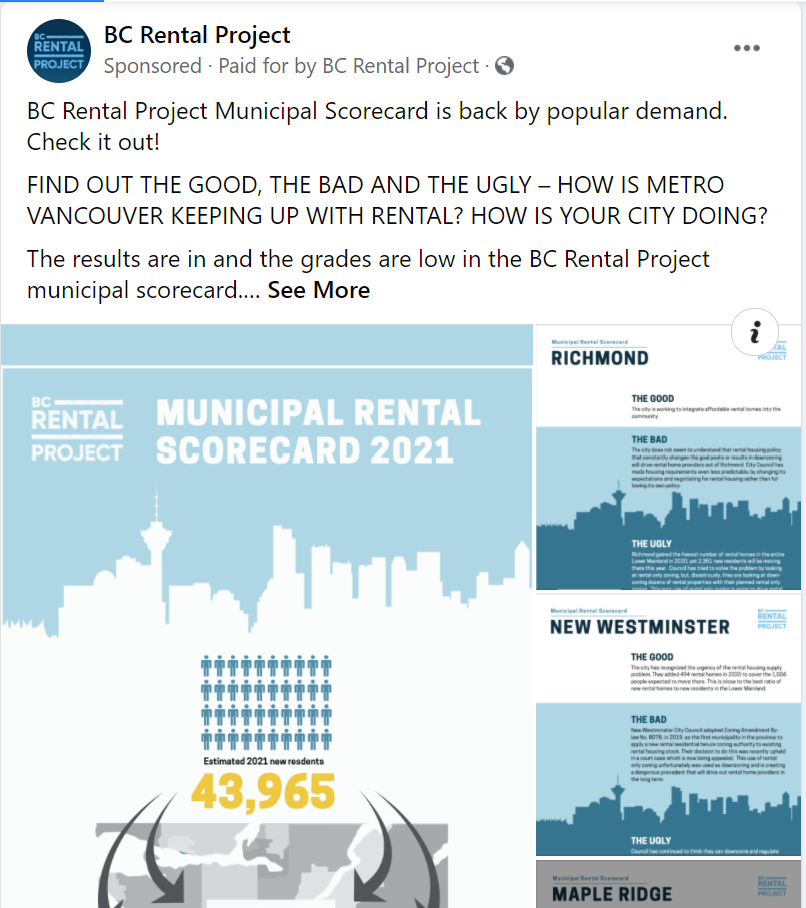
I’m going to get a little polemic here. A friend sent me a note asking about this Facebook post, and why New Westminster has such a low grade in supporting renters:

The post is actually a paid advertisement from a shadowy group calling themselves The Rental Project, and I’ve seen their work before. It’s not surprising that my friend saw this ad. He is a renter who spends some time online talking about the housing crisis, and The Rental Project spent more than $56,000 on Facebook ads in the last couple of years selling bunk like this in the Greater Vancouver area. $56K on Facebook will definitely get you some notice.

Perhaps it’s not really fair to call this group shadowy, because they don’t even come out into the shadows. At the surface, it looks like a grassroots group of people supporting renters and the needs of renters in Metro Vancouver. Indeed, looking at comments on any of their Facebook posts ads and you see responses from people concerned about affordable housing and policies to protect renters. But look at The Rental Project’s webpage. There are no authors, no links to members, no indication who is collecting their data, writing their reports, or paying their staff to design $56,000 in Facebook Ads. It’s not even clear who you are financing if you choose to click the prominent DONATE button.

This is Astroturf. A campaign made to look like a Grassroots effort, but clearly green-coloured plastic standing in place of grassroots. The reality of who is behind it is the story behind New Westminster’s “D” score.

If you look at the “report” being promoted in this ad, the first thing you may notice is that it is lacking in any cited sources or links for their information (though I have no reason to believe the numbers they report are untrue), and that the data and commentary that supports the letter grade headlines is inconsistent and incomplete. There is no mention of an author, and no way to connect to them to ask questions. The word shoddy is easily and fairly applied.

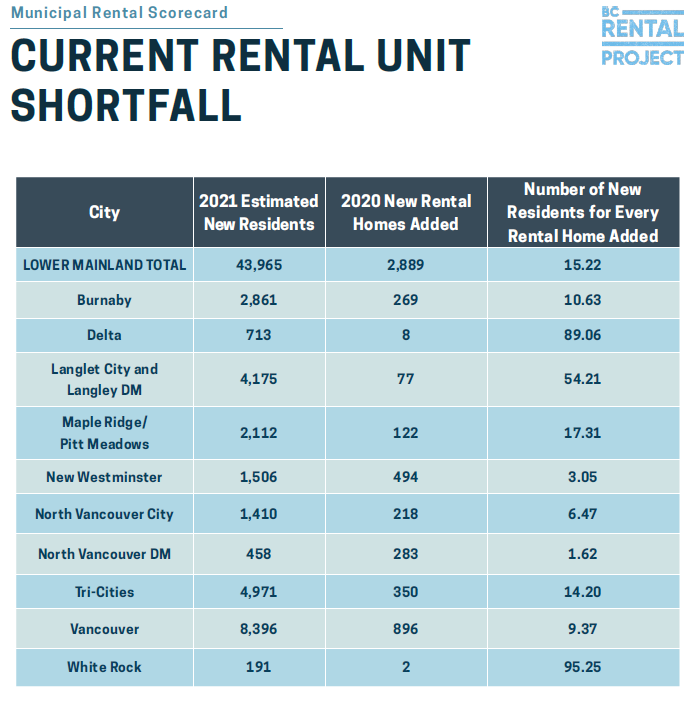
They award New Westminster  a grade of “D” – their lowest grade (though they failed to grade the Langleys, Delta or White Rock). I’ll come back to the rest of their comments in a bit, but I want to look closer at the only actual quantitative data they provide, a short table in the end of the report:

I need to emphasize again that there are no citations, no indication where the numbers here come from, but even if we take them at face value, it shows New Westminster (Grade D) is filling rental need at a rate compared to population growth (their measure, not mine) greater than almost any other community listed. We are more than twice as good at meeting the demand as North Vancouver City (Grade A-) and three times that of Burnaby (Grade B). The only graded Municipality with a better rate of new rental vs. growth is North Vancouver District (Grade C) who achieve that statistic by growing at less than a third of the rate of New West. Invite no-one in, and you don’t need to build new housing. I’m not sure how that serves renters during a housing crisis, though.

Keen observers may note the comparisons here are bereft of actual population numbers (it would make sense that municipalities with 700,000 people should be building more rental on raw numbers than municipalities with 70,000). There are also a few municipalities missing, so I expanded the table out a bit to give a little more context. What do we learn?

here is my population data source: https://www2.gov.bc.ca/gov/content/data/statistics/people-population-community/population/population-estimates

New Westminster is building more rental per capita than any municipality rated. Much more than most.

So why the D grade? Why are we graded lower than Richmond, whose numbers they don’t provide but they describe as “gain[ing] the  fewest number of rental homes in the entire Lower Mainland in 2020,” and West Vancouver, “did not increase the number of rental homes in the city in 2020. A divided council prevents the municipality from making the gains it needs”? Why the specific hate for New West?

Because we have protected the most affordable housing in the City.

This goes back to who is behind the well-financed Astroturf campaign . It is not organizations working to protect renters by supporting rental development in the community or preserving the affordability of rental across the region. It is an organization protecting the financial interest of Landlords, especially those using lower-cost rental as an investment vehicle, and those investing in REITs.

A few years ago, New West passed aggressive anti-demoviction and anti-renoviction Bylaws. The Landlord Lobby came after us hard. They bought advertising saying we were killing rentals, they came to Council and warned us of dire consequences for future rental development, they took us to court. And they launched Astroturf campaigns.

Their main argument was that these Bylaws were illegal, and that these types of policies would prevent any new rental being built. They were wrong. Not only are we still, three years later, leading the region in getting new Purpose Built Rental in the ground, we have had several major development projects shift from for-market-strata to Purpose Built Rental since these Bylaws passed, increasing by hundreds the number of PBR units in the pipeline, and being built as we speak.

These bylaw changes are so powerful that the Landlord Lobby has challenged them in court (and lost). Meanwhile, other cities from Port Coquitlam to Victoria are following suit and writing their own bylaws to provide the same protection in their communities. New West showed such leadership here that the provincial government changed the Residential Tenancy Act to provide some (but not all) of the protections we introduced in our Bylaw. At the same time, our Bylaw changes have literally prevented hundreds of lower income households in New Westminster from being demovicted or renovicted.

No wonder the big money REITs are scared and investing tens of thousands of dollars on political action. Their business model is based on finding “undervalued” rental properties – ones renting for less than the maximum market will bear – so they can jack rents and make a quick profit off putting lowest income people in the City out on the street. When that’s your business, it isn’t hard to find $50K to spend on Facebook ads that blame the unaffordability of rentals on the government. And to be clear, if that’s not the business model, if investors just want to invest in rental property, maintain it in good repair, and assure people have access to rentals at a variety of affordability levels, then they have nothing to fear from New Westminster’s Bylaw changes.

I’m damn proud of the staff of New Westminster for putting these Bylaws together, our legal advisors for assuring they are robust and defendable, and our Council for being bold enough to take these measures to protect some of the most vulnerable residents in our City when literally threatened by lobbyists for landlords and property speculators.

We can do more. Like every City in the region, we can and should be doing more to support affordability through this ongoing housing crisis. Self-evaluation is an important part of this – given funding constraints and limited land and conflicting priorities, it is important to track how we are doing compared to our cohort municipalities. As long as we are still building Purpose Built Rental at a region-leading rate, as long as we are also assuring affordable and supportive housing projects are coming to the City and are supported by our policy choices, and as long as we are preventing unnecessary renovictions and demovictions that turn homelessness into an investment vehicle, I will proudly wear the “D” grade from this deceitful Astroturf campaign as a badge of pride.

UBCM 2021

One of the things that kept me too busy to blog last month was the annual Union of BC Municipalities meeting. As with many of my Council colleagues, I attended the meeting virtually, and had a bunch of accessory meetings around the main UBCM meeting events. It’s a little tardy, but here is my slightly Inside Baseball run-down of my extended UBCM week.


Minister Meetings
UBCM presents an annual opportunity for Local Government elected folks (with staff support) to meet with Provincial Government Ministers (and their staff) on pretty much every topic under the sun. Depending on the Local Government and the Minister, this may be asking the senior government for money to support projects, for changes in legislation, for partnership on specific initiatives, to share concerns or to get clarity on programs. As this was a pandemic meeting, and therefore remote, we were not as rushed to meet during and in between UBCM events, so most Minister meetings happened in the week before the actual UBCM conference.

The City had several meetings with Ministers, attended by different members of Council. I was fortunate to be able to meet with Minister of Municipal Affairs, and along with Councilor Trentadue, provide her a summary of some significant Capital Works we have planned- including upgrades to the Massey Theatre and renewing a vision for connecting our Riverfront from the Queensborough to Sapperton Landing. We also talked about a potential for regional coordination of fire boat services.

Though I could not attend, the City also had meetings with other Ministries, including with the Minister of Mental Health and Addictions and the Minister of Public Safety in regards to reviewing how we can better address the community impacts of homelessness and addiction and take the load off of Police for this work that really needs a compassionate heath-focused approach.

In my role on the executive of the Lower Mainland Local Government Association, I was also able to meet with Minister of Environment and Climate Change Action Heyman to talk about our members’ recent resolutions regarding the end of CARIP and the need for some more tools to Help Cities Lead and our hopes that the next stage of Clean BC will include these supports.


Resolutions
This session stretched over two days is where Members vote to endorse or not support Resolutions proposed by member municipalities. In sense, this is meant to represent the collective desires of Local Governments across BC, but should usually be seen through the lens of the slightly strange political structure of the UBCM. Any municipality can put a resolution forward, but the Resolution Committee of the (elected) UBCM Executive vets them and prioritizes them for voting, even recommending if Members should vote for specific ones. The voting members are not weighed by population or any such thing – essentially any elected official who registers for the meeting and shows up for the resolution session gets a vote. So eleven possible votes from Vancouver, seven possible votes from New Westminster, five possible votes from Pouce Coupe.

You can read all of the Resolutions here. The City of New Westminster had two resolutions:

NR36: Single-Use Item Regional Regulation

Whereas enactment of bylaws to regulate single-use items by individual municipalities could lead to a mosaic of regulations across the region and in BC, which may lead to confusion and inconsistency for residents and businesses in the sale or distribution of these items; And

whereas greater consistency could be achieved by implementing a regional approach; And

whereas regional districts do not have the authority to establish bylaws or regulations in relation to the sale or distribution of single-use items:

Therefore be it resolved that UBCM request the Province to engage with regional governments to develop legislation which would provide regional districts with the legislative authority to restrict the sale and distribution of single-use items.

NR45: Inclusion of Allied Health Workers to Help Combat the Opioid Crisis

Whereas the opioid crisis and mental health challenges affect at least 1 in 5 BC residents and has been compounded by the COVID-19; And

whereas evidence shows that access to upstream services such as counselling related specialties and physical/occupational therapy decreases opioid use and/or provides better health intervention outcomes, but these are not accessible to many residents as they are not covered and are much too expensive through fee for services; And

whereas communities are currently struggling to meet the needs of our residents, between funding of community programs and increased mental health calls for first responders, which already comprise between 20-30 percent of local government expenditures and are not often the most appropriate service to support people in crisis:

Therefore be it resolved that UBCM request that the Province expand access to and funding for allied health professionals, particularly mental health counselling specialties and physical/occupational therapy related specialties, through expansion of team-based care through not-for-profit delivery including community health centres, available to all BC residents regardless of their immigration status and income, throughout the province; And

be it further resolved that the Province increase support and funding for Peer Navigators as part of the BC Mental Health and Addictions Strategy

Members of the UBCM voted to endorse both of these motions.

I was also there to champion two resolutions from the Lower Mainland LGA:

EB35 Help Cities Lead

Whereas emissions by buildings account for 40-60 percent of a community’s green-house gas (GHG) emissions, and current actions in British Columbia to reduce GHG emissions from buildings are insufficient to achieve the province’s GHG targets for 2030 and 2050; and

Whereas the November 2020 mandate letters to ministers include direction to provincial ministries to move forward with three of the five policy measures included in the Help Cities Lead campaign to drive GHG reduction in British Columbia’s building sector:

Therefore be it resolved that UBCM call upon the provincial government to immediately introduce legislation supporting the three measures identified by Help Cities Lead and addressed in ministerial mandate letters: GHG requirements for new buildings, PACE financing, and home energy labelling; and

Be it further resolved that UBCM call upon the provincial government to introduce empowering legislation to permit local governments who so choose to implement the remaining two measures identified in the Help Cities Lead’s campaign: GHG requirements for existing buildings and building energy benchmarking.

NR32 Renewed Vision for Fraser River Estuary

Whereas the Fraser River Estuary is a diverse and productive ecosystem, supporting over 100 species at risk, including salmon and southern resident killer whales, and, is under increased development pressure and impacts of climate change, including flooding of industrial and agricultural lands, and would benefit from a regional planning approach that balances the needs of the ecosystem, people and the economy; and

Whereas Indigenous people have lived in and stewarded the Fraser River Estuary since time immemorial, and know the various species, habitat, and ecosystems as integral to their existence and identity, and are integral to the planning and governance of the of the Fraser River Estuary:

Therefore be it resolved that UBCM call on the federal and provincial governments to allocate the necessary resources and appropriately fund and support a renewed Fraser River Estuary Management planning process that will collectively protect the ecosystem of the Estuary through inter-agency collaboration; and

be it further resolved that the planning process includes, but is not limited to: First Nations, federal government and provincial governments.

Both of these Resolutions were also endorsed by the Membership.


Conference

The other part of the UBCM is all of the stuff you would usually have at a conference: Workshops, panel discussions, and Plenary sessions where we get speeches from important people, from John Horgan to Rick Mercer. I would have to say one difference this UBCM compared to some previous events was the openness of the NDP cabinet members all the way up to the Premier, even taking Questions from the (digitally) assembled crowd, instead of just doing a speech. It may be my bias, or it may have some relationship to our coming out of the peri-Pandemic times and the virtual nature of the meeting, but I get the sense that the shine is not off the NDP (yet?) for most local government officials, and the reception to them was warmer than in previous years, and with previous governments.

Unusually, I was on a panel this year (see photo above) talking about the Heat Dome event, what went wrong locally, and what it means for decision making ahead. I also attended a few other sessions, including a Town Hall led by the Minister for Local Government with a few other members of cabinet on Building Resilient Communities (which was frustratingly neoliberal in its definition of the problem, and its proposed solutions), a Workshop on Climate Action and the Municipal Pension Plan that turned out to be an hour of excuses about why they won’t do the fossil fuel divestment many of their members want. (Ugh).


The 2021 UBCM was virtual. The organization put together a really strong on-line portal to access the event, and it ran super smooth. The public face of the platform was so seamless and functional, it must have only been possible with a bunch of sweat, stress, and chaos behind the (digital) curtain. So kudos to the organizers for achieving that, and i hope the folks who made it work get the thanks they deserve.

Although I missed having those important informal social connections with my Local Government cohort from across the province, I did walk away from UBCM, once again, recharged and excited about the work ahead. So many leaders are doing incredible work to support their communities, finding local approaches to global problems, it makes sharing both the successes and the frustrations so important. Especially over the last 18 months, it has been easy to get discouraged or disheartened about the challenges. Challenges seem to be piling up everywhere, from Vancouver to Pouce Coupe. But knowing there are so many people dedicating themselves to making their corner of the province work better, be safer, more prosperous, and more just, gets me back in the mood that we can make a difference.

Council – Sept 27, 2021

The Council meeting this week was a pretty quick one, but dealt with some difficult subjects, and had a lot of background reading behind it. The Agenda started with a formal Apology:

Apology from the City of New Westminster to the South Asian Community and descendants of the Komagata Maru
When Council asked staff to look back at the history of New Westminster’s connections to the Komagata Maru event, they turned up some pretty troubling history relating specifically to the City Council of New Westminster. No need to repeat it all here (it is there in the report if you want the details), but the Council of the time (led by A. Wells Gray) used the event to stir white supremacist feelings and actions here in New West, even inviting our Member of Parliament (J.D. Taylor) to rally a crowd at a meeting and promising to pass white supremacist laws. This at a time when there was already a sizeable Asian population living, working, farming, and running businesses here in New Westminster. The Council of today wants to acknowledge that this history happened and apologize to the South Asian community for the action of this previous Council, to make clear that the unwelcoming and divisive attitude of the time is not consistent with our current goals and vision for the community.


We then had a presentation from BC Housing and a Report for Action:

Crisis Response Bylaw Amendments: Bylaws for First Reading and Engagement Plan Approval
BC Housing staff gave us a presentation to update us on supportive housing options and the modular housing delivery option they are exploring for a lit in Downtown. It is very similar to a previous and very successful project in Queensborough, although a housing provider (the not-for-profit organization that actually runs the housing in the messed up neoliberal model we are stuck in) has not yet been found. Anyway, BC housing wants to build 52 units of affordable housing on this lot in Downtown that has been a vacant weed farm with a fence around it since the old paint store was knocked down more than a decade ago. It can be up and running in less than a year through the rapid housing initiative. There is also a block of City-owned lots in Queensborough where the Vancouver Native Housing Society would like to leverage senior government funding to build 58 truly affordable rental units. These applications require both OCP amendments and Rezonings, and as the City doesn’t want to be the hold up on either of these applications, so we are using some extraordinary powers recognizing the ongoing crisis that is homelessness in the region to fast track the applications through Crisis Response Bylaws. There will be directed public consultations on these projects coming in October, and we will consider Third reading hopefully before the year end.


The following items were Moved on Consent:

Application for Grant Funding to the 2021 UBCM Asset Management Planning Program
The City has no less than 36 drainage and sanitary sewer pump stations that keep groundwater levels down in low-lying areas, keep storm waters from flooding out the same, and keep sewage moving along in areas where there isn’t enough slope to let gravity do the work. They are due for a comprehensive condition assessment, and we are applying for a UBCM grant to help pay for that.

Construction Noise Bylaw Exemption Request: New Westminster Interceptor Columbia Sewer Rehabilitation
Sewer line work like what is going on at Columbia is complicated. There is a slip-lining process that they are doing that is going to require 24 hours work, because shutting down work at night runs the risk of there being a surcharge situation and the slip-line getting stuck, which would likely require more excavation and noise and ground disturbance and risk. This is going to hopefully start right after Thanksgiving weekend, but is a little weather dependent because lots of rain increases the risk of surcharge, so they need to find a window of weather to get the work done. It sucks, it’s disturbing, but this appears to be the best option for getting the work done. They are asking us for a noise exemption bylaw to allow that work to go through the night over a 4-day period in late October. Sorry folks, but the sewage has gotta keep flowing.

COVID-19 Pandemic Response – Update and Progress from the Four Task Forces
Another update on the work of the City’s COVID Task forces. Read the report for details.

Decommissioning Cosmic Maypole
There is a faux-totem pole between Tipperary Park and City Hall that has been there for about 40 years, and it has been slowly disintegrating for quite some time. At some point, it is going to become a hazard, so we need to remove it, lay it down, or otherwise address it. The Public Art Advisory committee recommends removal in a way that is respectful to First Nations traditions around totems (though this is not an indigenous art piece) and to the original artist, who is currently living in the States. We will need a little funding form the Public Art Reserve Fund to pay for this work.

Development Variance Permit: 220 Carnarvon Street – Permit to Vary Siting, Site Coverage, and Parking/Loading Requirements
This church on the east side of Downtown had an addition approved back in 2018 for a community room and caretaker suite, in exchange for some Heritage protection for the Church and formalization of that use of the site. Their development plan has adjusted a bit, mostly in adding a balcony and re-configuring external stairs, which doesn’t strictly meet the current approved plan. So we are entertaining a Variance Permit to allow these changes. If you have opinions, let us know before October 18.

New Departmental Name for Development Services Department
This is a motion to change the name of one of the departments of the City to better reflect its role, as the growing Climate Action team in the City is under the same umbrella as Planning and Development. Update your letterhead!

Rezoning Application for Child Care: 733 Thirteenth Street – Bylaw for First and Second Readings
The operator of childcare facilities in the West End wants to move their operation to a new nearby location on 13th Street. The use of the new site for childcare meets the OCP, but we need tot rezone to approve the use. There was some consultation around this project in the spring (both positive and opposed), and we are giving the project two readings. It will come back for third Reading, so please let us know if you have opinions!


The following items were Removed from Consent for discussion:

Anvil Centre Default Lighting
The Restorative Justice Committee has suggested the LED lights on the Anvil Centre be lit up orange in a kind of permanent way to mark the residential school discoveries, and we are going to refer this to the Reconciliation, Social Inclusion and Engagement Task Force. We are also asking Staff to help us put together a policy for lighting up of city buildings as these types of requests are increasing. The only strange part to me is I am almost certain we asked staff to do this a few years ago. No harm in asking again.

Climate Emergency: Updated Green Buildings Policy & Energy Efficient Equipment Selection Policy
This report outlines two new policies the City is adopting to address energy efficiency and GHG impacts of buildings.

The first is a Green Buildings policy. The City currently requires (by policy) that all new City buildings we build meet at least LEED Gold status – this is the policy that informed the standards applied for the Anvil Centre and Sportsplex. We are updating this in light of our new Corporate Energy and Emissions Reduction Strategy and the Seven Bold Steps, and due to learnings from design of the təməsew̓txʷ Aquatic and Community Centre (which will be the first zero carbon recreation facility of its type in Canada!). The plan is to make Zero Carbon Building Standard the new standard for all City buildings, and though we will continue to refer to the LEED standards in the design of new buildings, we will not specifically seek that certification.

The second is and Energy Efficient Equipment Selection Policy that will guide the purchase of new equipment for buildings – things like HVAC, back-up generators, appliances, pumps and motors, and any other powered equipment that we may have in a City building. This is not about the kind of outdoor equipment we use (leaf blowers and lawnmowers) as that is part of our fleet fuel efficiency program – and is on our radar, just not under this report.

Remedial Action Requirement: 509 Eleventh Street – Update
The City has had challenges dealing with the owner of a house in the Brow neighbourhood, where it has been in a significant state of disrepair for many, many years. It is a bit of an eyesore, but it is also a nuisance for the neighbours, is of questionable structural integrity, and creates a significant health and safety risk to occupants. We have tried for several years to get the building fixed or demolished, but the owner has demonstrated either an inability or a lack of intent to do the necessary work. In light of their continued failure to meet City requirements, we are taking the extraordinary measure of hiring contractors to do the work, and sending the owner the bill. It is unfortunate it has come to this, but after many years of neighbours complaints, after literally hundreds of hours of staff time, legal action, court orders, and with staff being much more patient and tentative than anyone would consider reasonable, it is time for the City to act. Under Section 17 of the Community Charter, we are taking that action.


We then adopted the following Bylaws:

Zoning Amendment Bylaw (819 Milton St) No. 8266, 2021
The Bylaw that permits the construction of a duplex that is “suite ready” for future secondary suites in the Brow neighbourhood was adopted.

Zoning Amendment (823-841 Sixth St) Bylaw No. 8260, 2021
Official Community Plan Amendment (823-841 Sixth St) Bylaw No. 8261, 2021
These bylaws to permit an affordable rental housing development for Indigenous and Swahili speaking communities in Glenbrook North were adopted by Council.

It’s worth noting that these are two examples of approvals the City gave Third Reading (which is, effectively but not strictly “final Council approval”) some time ago, you might wonder why we are adopting now. In short, how rezoning works is that the entire plan is put together and Council provides approval as Third reading of the required bylaws (usually after a Public Hearing). However, that approval is contingent on a series of commitments on behalf of the applicant, such as providing a dedication to build a sidewalk out front, contributing money to pay for the required connection to the sewer, or getting necessary approvals from the province to address contamination on the site, or any of a dozen other things. Each of these are secured by a legal agreement that can only be framed once Third Reading is completed. The details of putting together that legal agreement, securing financing to pay for some of those commitments, etc. sometimes takes some time. The City holds up Adpotion until those commitments are secured to make sure the City gets what the applicant promised the community in exchange for rezoning. So when it comes for adoption that means all of the commitments are secured, and they can get their building permit. Now you know!


Finally, there was one Motion from Council:

Building an All Ages and Abilities “AAA” Network

Whereas the City of New Westminster’s Master Transportation Plan is six years old, and has seen significant improvements in accessibility and pedestrian safety, and progress is beginning to be seen in completion of the Cycling Network (better termed as an Active Transportation Network in light of advances in personal mobility technologies); and
Whereas the COVID-19 Pandemic has brought about a generational change in how people move around urban areas, with municipalities across North America and Europe that rapidly rolled out safe Active Transportation infrastructure seeing immediate take-up, and achieving mode shift similar to that envisioned in the Master Transportation Plan; and
Whereas New Westminster has adopted a bold vision for Climate Action, including transportation emission reduction, mode shift, and public realm changes that will only be achieved through equally bold transportation infrastructure changes, including a network that connects our key destinations and safe routes to school; and
Whereas the provincial Move.Commute.Connect program and federal Canada’s National Active Transportation Strategy represent new partnership opportunities to help finance transformational Active Transportation infrastructure programs for communities with shovel-ready projects that meet the goals of making Active Transportation safe, comfortable, and connected;

Therefore be it resolved that Council commit to the rapid completion of a safe, comfortable, and connected All Ages and Abilities (AAA) Active Transportation Network; and
Be it further resolved that Council request staff update the Long Term Bicycle Network in the Master Transportation Plan, with an emphasis on establishment of a core AAA Active Transportation Network to connect neighborhoods and schools across New Westminster; and
Be it further resolved that staff work with the Sustainable Transportation Task Force to develop preliminary AAA designs and standards, and report back to Council with an ambitious timeline for implementation of the core AAA network and phasing schedule that can be integrated into a 5-year capital plan for Council consideration.

I think the Wherases speak for themselves, but I’ll write a follow-up about what this means, as Council voted unanimously to support it and the path ahead.

And that was the week that was. Some heavy topics, but for the most part positive work. It was one of those Council meetings where I walked home after feeling pretty good about the work we are doing.

Downtown

I put forward a motion last Council Meeting regarding revitalization of Downtown, and I thought I would write a bit of a follow up about my thinking in working with Councillor Trentadue on this motion. The motion was seconded by Councillor Trentadue, and supported by all of Council, but it is always important for me to remind folks that what I write here on my blog reflects only my thoughts, not necessarily those of my colleagues on Council. Though my ideas on this have been informed by some really enlightening discussions with business owners downtown and members of the BIA.

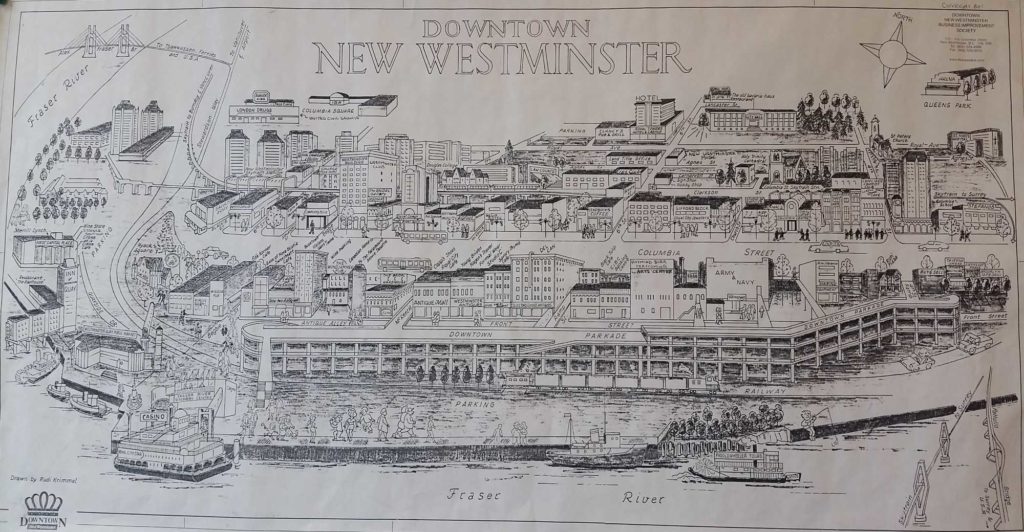
It has obviously been a difficult last year and a half for many in our community. This in no way makes us unique in the Province or in Canada, but I want to recognize that the results of the Pandemic hit the historic Downtown of New Westminster at a time when there is already a lot going on, both good and bad. Perhaps that requires a bit of a step-back to look at Downtown New West as a Regional City Centre, and what makes it unique.

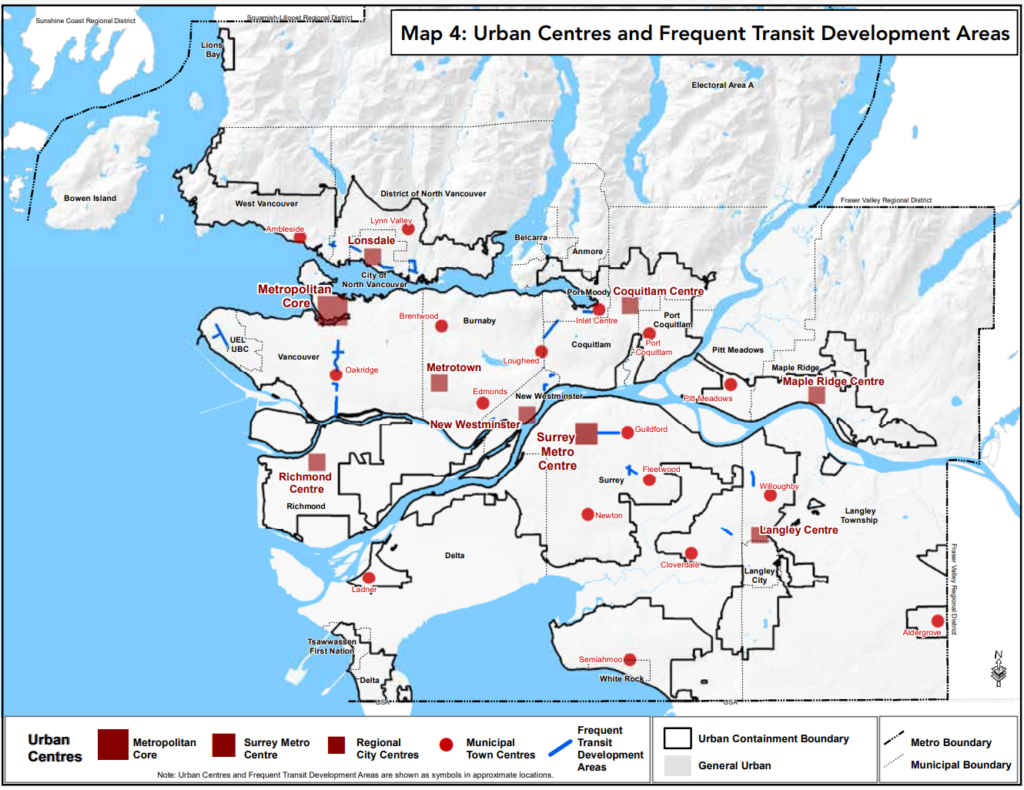
The City of New West has committed to the Regional Growth Strategy shares with the other 20 Municipalities that make up Metro Vancouver; a plan aligned with the TransLink Regional Transportation Strategy. A keystone to both of these plans is the increase in new density in identified Regional City Centres – with Downtown New Westminster being one of those identified centres. The vision for these centres is higher density mixed use (commercial, office, retail and residential) at high-service transit nodes to reduce reliance on cars. As a result of this plan and our exceptional Transit-centric location, Downtown New West is becoming one of the densest and most rapidly-growing residential neighbourhoods of the region. Being one of the few such centers with a strong historical walkable street scale, it is also one of the regions of the Lower Mainland most reliant on Transit, and least reliant on cars as a primary transportation mode.

Indeed, since the Downtown Community Plan was developed, we have seen significant residential growth, especially in the last few years, with some key developments coming on line. With more recent emphasis on Family Friendly suites, Purpose Built Rental, and Affordable Housing, there is a much richer and dynamic residential mix in the community as ever. This is even extending to there being more young families buying in the older and (slightly) more affordable units in Quayside. In short, population is booming Downtown, which should be good for local-serving retailers.

At the same time, we have had some significant setbacks. The loss of a portion of the Pier Park was probably the highest profile, and definitely reduced the public space amenity for Downtown residents, but the more recent loss of the building that housed 4 businesses on Church and Columbia was a real punch in the gut. This came after we lost an anchor retailer as the Army & Navy closed their last 5 locations. At the same time, the great work the BIA has done over the last decade to activate the street and draw people into Downtown through events and directed promotion has been hamstrung by Pandemic restrictions. And, though I am optimistic about the medium-term benefits of some of the larger developments currently under construction in the downtown, the ongoing impact of construction noise and disruption is further eroding livability at a time when these impacts pile up. And then there is the damn sewer work.

I would argue that the role of Downtown New West are a Regional City Centre makes it fundamentally different than our other (still important and valued!) commercial strips like historic Sapperton, Uptown, Ewen Ave or 12th Street. I would also argue that Downtown is facing a different set of challenges than the City’s other commercial areas, and needs a different and more proactive approach. And it needs it soon.

There are some interesting contrasts in Downtown. There is actually not an abundance of leasable retail space available right now for a new business to set up in. Indeed, there are a few businesses doing really well downtown, and at times the streetscape is really inviting. There is, perhaps surprisingly, a fair amount of office space in all three class levels yet office vacancy is under 5%, which is one of the lowest office vacancy rates in the Lower Mainland. At the same time, there are vacant storefronts in buildings that have been verging on decrepit for a long period of time, creating significant “gaps” in the retail environment. Finally there are sites like the Copps store site (still a hole 8 years after that devastating fire) and the Kyoto block empty lot right across from the Anvil Centre (empty 7 years after Council last saw a development proposal) that seem to need motivation to get activated.

The motion here is not to put pressure on existing business operators in the downtown – they are doing their best in tough times. Nor does the City have real power add specific retail businesses residents might like (be that a hardware store or a haberdashery). What we are asking is for staff to suggest tactics the City can apply to get these underperforming lots and derelict buildings activated. Though I (of course) have ideas, we really need Staff guidance to let us know what the suite of regulatory tools we have, as the relationship between a Municipality and any business is strictly defined in the Local Government Act and the Community Charter. We appear to have some special powers under the New Westminster Redevelopment Act that we have not yet exercised, and I would love to understand that fuller.

We also may need to have a conversation about street-level retail/commercial space having an amenity value we can apply in new development proposals. I would also love to see us evaluate radical parking relaxations for new buildings on Columbia, in light of the Transit-Oriented Development goals of the neighbourhood. The prohibitive cost and significant risk related to digging deep holes for parkades may be a barrier to innovative builders interested in making something cool happen on Columbia, and the value represented by that parking may be better applied at assuring buildings support other goals in the historic downtown.

These are my opening thoughts, I really hope in further conversation with the business owners, our City’s great Economic Development staff, and the wider community, we can bring some confidence back that Downtown New West will be a walkable, livable, full service community that supports its growing population.

Council – Sept 13, 2021

We had a Council meeting on Monday, and I am a little later than I like reporting this for a bunch of reasons, not the least because I have been at UBCM meetings all week, and have been doing a bit of volunteering work for the Election.  Oh, and I took a bit of a vacation/staycation to recharge the batteries before the UBCM Conference, so I am really slow on updates here. Sorry, more frequent posts to come! In the meantime there was a lot of exciting stuff on our Agenda Monday, starting with no less than three (3!) presentations:

Pattullo Bridge Replacement Project Heritage Alteration Permit Application and Project Update
The concrete and wrought-iron Wall that faces Columbia Street in front of Victoria Hill is the old perimeter wall of the old Woodlands site, and is a designated Heritage Asset. It also creates a visual barrier to drivers and makes the intersection of McBride and Columbia less safe for vulnerable road users making use of the Central Valley Greenway. There is a long history of Active Transportation advocates (figuratively) banging their head against this wall. The plan now is to address this as part of the Pattullo Bridge replacement. No two ways around this, if we want safe pedestrian space here, either the cars or the wall has to go.

To relocate the wall and expand the plaza at the entrance requires a Heritage Alteration Permit. The City has worked with the Pattullo project team, and a design that improves sight lines, assures accessibility of the crosswalk, moves the wall while preserving its historic value, and expands the public plaza space while preserving the historic trees has been developed. Council agreed to this plan.

I’m still not happy about some of the impacts on the Central Valley Greenway resulting from the design choices at this project that prioritize speedy movements of cars over the needs of Active Transportation users and vulnerable road users, but that is something I’ll have to whine about in a follow-up. The treatment at this specific intersection looks like a really good approach to a challenging piece of geometry and geography.

Homelessness Action Strategy – Proposed Plan
The City’s existing homelessness strategy is a bit dated. Naturally, the 2006 plan has been updated and adapted to new realities since its initial adoptions, and has brought some real measurable successes. However, there has been significant change in the last year and a half, both in the form of homelessness and in the ability for response. There is also more senior government support now than there has been in decades, and we need to assure we are making the best use of those supports. So it is time for a renewal. Fortunately, the foundations set by our existing strategy means we have dedicated partners in the community to help us with this work, including the Homelessness Coalition and Community Action Network to provide the wisdom from real one-the-ground experience, and Planning and Policy support from engaged Academic partners. We have also hired up in our Social Planning staff to assure we can coordinate this work in-house, saving on consulting cost, and allowing us to instead direct that money towards including people with personal lived experience in homelessness as subject matter experts to guide our approach.

Crisis Response Bylaw Amendments
More on the topic of affordable housing, there are currently Federal and Provincial funds available to fast-track the building of affordable housing units, and there are City- and Provincially-owned properties in the City which may be appropriate for this housing. The steps between the idea being funded and having something built and operating are, perhaps infamously, challenging, and the timeliness of overcoming those challenges sometimes limits the ability to take advantage of those funds.

In light of the ongoing homelessness crisis, Cities need to find ways past these logjams. We are looking to amend some bylaws to allow us to be more nimble in response to these opportunities in light of the declared crises, and have identified two projects (one in Downtown with 52 units of modular housing, one in Queensborough with a similar number of more townhouse-style family housing) where this fast-tracked process can be tried out to address the homelessness crisis. This is going to make some people in the community uncomfortable, as some review steps for projects (or “Red Tape”, depending on your viewpoint) are going to be either bypassed or greatly accelerated in light of the clearly acknowledged social and public benefit of addressing the ongoing crisis – in this case more than 100 units of truly affordable supportive housing on our community.

We are also looking further afield with a special land use type: “Social Benefit Land Use”, where we can fast-track projects with measureable community good. This process will take a bit of time and consultation with the community (what type of use does the community consider a “social benefit”? What limits on what kind of land tenure would apply?) but this may be a really transformational how we address social support spaces in our community. More to come here.


We than moved the following items On Consent:

Broken Drug Policies: Inter-Municipal Strategic Action Committee
Speaking of crises, it has been 5 years since the poisoned drug supply situation was declared a state of emergency, and in 2021 alone more than two dozen New Westminster residents have died of overdose. We have an interdepartmental working group in the City to coordinate the City’s actions and to work with Fraser Health and outside agencies, but we need to do more. Previous success in addressing the problem in New West (like the rest of the region) has been set back by the Pandemic, which hampered support programming and disrupted established illegal drug supply chains, making the supply more risky, and more deadly.

Though the social and financial impacts of the opioid crisis are felt at the local government level, including its impact on first responders and social services in the community. But the policy decisions that will perpetuate or address this crisis are almost all provincial (health interventions, law enforcement choices) and Federal (legalizing and regulating the supply). Staff have recommended that we participate in a new inter-municipal Strategic Action Committee addressing the broken policy problem.

Construction Noise Bylaw Exemption Request: 680 Clarkson Street Roofing Project
This residential building in Downtown needs to fix its roof, and that means lifting heavy stuff up onto the roof, which requires a big crane, which disrupts traffic, making weekends better, but also means noise that means they need a construction noise bylaw exemption. Staff are recommending we approve this for the same time as the noise exemption for the Columbia Street sewer works, so the impact is less on the community.

Construction Noise Bylaw Exemption Request: Metro Vancouver Sewer Inspections
Metro Vancouver need to do sewer inspection work along 8th Ave by Justice Institute, and this kind of work has to happen at night when there is less…uh… stuff in the sewer, which requires a construction noise Bylaw exemption. This work is not as noisy as jackhammers and pile drivers and drills, but does involve traffic disruption and running vehicles and generators, and they try to buffer as much has possible. All in the cost of keeping the poo flowing, folks.

Construction Noise Bylaw Exemption Request: Metro Vancouver Sewer Upgrades
And, there will also be some sewer hatch maintenance work that requires noise bylaw exemptions. Looks like we are spending a lot of money on infrastructure these days, but at least this is along Front Street below the cliffs, so I suspect more people in Surrey will be disturbed than those in New West. Still, it’s our Bylaw that needs addressing….

Heritage Revitalization Agreement: 102 Seventh Avenue – Preliminary Report to Council
The owner of this house in Glenbrook north wants to build an infill house on the lot, and preserve the existing Heritage House. The wrinkle here is that the infill house will be a duplex, two-bedroom units of about 1,025sqft each (compared to the 2,500 sqft preserved house), which makes them similar to a townhouse in size and shape. There are some significant relaxations here to make it work, and this is a preliminary application, so I’ll hold my comments for after the Public consultations.

Investing in Canada Infrastructure Program (ICIP) – COVID-19 Resilience Infrastructure Stream (CVRIS) Grant Funding: Urban Reforestation and Biodiversity Enhancement Initiative
You might have noticed a bunch of new trees being planted around the City. As I remarked to a friend the other day – more this year than in the last 20 years combined. As part of our Urban Forest Management Plan, we are seeking to get to 27% canopy cover across the City by 2030 – that means all residential neighbourhoods having the same tree density as Queens Park. We applied for and was awarded a grant from the combined Federal/Provincial CVRIS program which will pay for the installation of 2,200 larger trees – moving us a big step towards that goal.

This is going to be a very different city in 20 years because of this goal – cooler, quieter, with fresher air, because of what we are doing today. I’m really proud of this work and thankful that senior governments are helping us do this.


The following item was Removed from Consent:

COVID-19 At-Risk and Vulnerable Populations Task Force Update and Next Steps
Since the Pandemic started, The City has a task force dedicated to addressing the impacts on At-risk and vulnerable residents of the City – the food-insecure, the unhoused, those living with addiction or mental health challenges. And though we would have hoped the Pandemic would be over by now, this is a reporting out on recent and ongoing work, and a reporting on two recent successful grant applications to outreach & referral services, and for food security coordination.

There is much too much here for me to summarize here, but the work of staff, the partnerships with senior government and with the many non-government service organizations, faith-based organizations and he wider non-profit sector in New Westminster, all adds up to an amazing body of work that has kept people supported and alive through this crisis. The City has an important role, but this is a community-wide effort that demonstrates New Westminster is a compassionate community like few others, and every citizen should have pride in that. The work isn’t over, but the result is a better community for all.


We then adopted the following Bylaws

Street and Traffic Amendment Bylaw No. 8275, 2021
Bylaw Notice Enforcement Amendment Bylaw No. 8277, 2021
and
Municipal Ticket Information Amendment Bylaw No. 8278, 2021
These Bylaws that support changes to the Street and Traffic Bylaw, as discussed last meeting, were adopted by Council.


Finally, we had a Motion for Council

Downtown Recovery Strategy, Councillors Johnstone and Trentadue
Recommendation:

Whereas Downtown is the densest and most rapidly-growing residential neighbourhood of New Westminster, representing a commitment to regional Transit-Oriented Mixed-Use development goals concentrated in identified Regional City Centres; and

Whereas the initial revitalization since the 2010 Downtown Community Plan was developed has suffered a series of more recent setbacks, including the loss of several historic buildings to fires and the loss of a major anchor retailer, while a recent loss of park space and ongoing construction serve to challenge livability goals for the downtown community; and

Whereas despite robust growth, several properties in the key blocks of Columbia Street have been derelict or vacant for many years, impairing neighborhood revitalization efforts and challenging the impression of Columbia Street as a vibrant commercial district for both residents and existing businesses;

Therefore be it resolved:
That staff review strategies and regulatory tools available to Council to support the rapid revitalization of underperforming, derelict, and vacant properties on Columbia Street in the historic Downtown, including but not limited to powers under the New Westminster Redevelopment Act (1989), and

That Staff provide recommendations for rapid and medium-term actions to support the vibrancy of business, the activation of the streets, and improving the amenity value of the historic Downtown for all residents of New Westminster.

I think I need to write a separate blog post outlining my thinking here when I have a little more time, in case it’s not clear in the motion. I’ll just say for now that Downtown is on our radar, we recognize some of the unique challenges there, and are asking Staff to help guide us through some creative approaches to those challenges.


And that was it for the meeting. See you in the Fall!

Council – August 30, 2021

Well, that was a heck of a summer, eh? I know what you are saying – Labour Day, Autumnal equinox, lots of summer left! But we started our Council meetings again, so if I can’t have any fun neither can you. Here is what we had on our Agenda this week.

We started with a Development Variance Permit

DVP00690 for 601 Sixth Street
This Office building in Uptown wants to do some interior renovation to increase the useable space, but then runs afoul of the parking requirements (that have notable changed since the building we built decades ago). This requires a Development Variance to forgive some minimum parking requirements. There is one thing the Uptown neighbourhood is not lacking in it is off-street parking spaces. WE had a piece of correspondence concerned about intrusions of light into adjacent residential property, but approved the Development Variance.


The following Items were Moved on Consent:

2022 Budget Process Next Steps and Engagement Workshop Results
We have started the 2022 budget process, including preliminary stakeholder workshops with City Advisory Committees. Building upon the 2021 budget consultation program, there is much more to come, including on-line consultations and a webinar for people who want to learn more about hoe municipal budgeting actually works so they can engage more meaningfully. Check out details here and stay tuned!

Recruitment 2021: Multiculturalism Advisory Committee (MAC) Appointment
We are filling a seat on the MAC.

Update on Changes to the Procedure Bylaw
The way we have been running remote Council Meetings for the last 18 months has been under an emergency provincial Ministerial Order which overrides some of the other aspects of our Procedure Bylaw that keep us compliant with the Community Charter. That Ministerial Order has been replaced by changes to the Community Charter, so now we are going to change our Procedure Bylaw to be compliant. Is that all clear?

In short, all of our Closed meetings (which we typically hold in the afternoon of council Mondays) are going to stay as remote meetings, because that works and it gives staff more flexibility in how they participate while trying to get other work done, and as there is no public face to closed meetings, there is less concern about public access and participation opportunities. Our regular meetings will by a Hybrid model, with both a meatspace meeting in Council Chambers and the option for digital participation on the part of the public and Council. There are a few technical hurdles to cross (our regular council streaming process had a couple of seconds of delay, which was no problem if people were watching, but was a challenge for on-line participation) so I expect it will be a bit bumpy in the first meeting or two, but as we have all learned in the last year, the processes we have operated under are lagging a bit behind the technology on these things, so I generally am hopeful about this transition.

Heritage Revitalization Agreement Refresh: Timeline and Work Plan
The City paused new HRA applications in the Queens Park HCA until the policy that informs these applications can be updated, citing community concerns about the existing process following the implementation of the HCA in 2017. This report outlines the work plan for that policy update. There are details in here, but in short, we hope to have a Policy Framework for Council Consideration by Spring 2022. Expect a robust community consultation through winter 2021-2022.

2021 Heritage Register Update: Addition of One Property and Removal of One Property
The City has a Heritage Register of properties that have specific legal protection (“Heritage Designation”) and those that have very high heritage value but may not specifically be designated. We are adding the 1939 Slovak Hall in Queensborough to Register (due to its recent HRA and upcoming restoration), and are removing the 1931 “Deane Block” in Downtown, which burned to the ground in May.

Metro Vancouver Sewer Inspections: Request for Construction Noise Bylaw Exemption
MetroVan is doing video inspection of a major sewer interceptor, which has to happen at night when the weather is good because that’s when the levels of…uh… stuff in sewer is low enough to provide an adequate inspection. Construction at night needs a noise exemption, here it is. The directly impacted neighbourhood (small areas of Quayside and Q’Boro) will be notified, though the work schedule is a bit dependent on a short stretch of non-rainy weather.

TransLink Pavement Rehabilitation Project – Braid Station: Request for Construction Noise Bylaw Exemption
Translink is doing pavement rehabilitation at Braid Station, and some part of that work can’t happen while there are buses and transit passengers running all over the place, so they are asking for a construction noise exemption to allow that work to extend into night. It’s relatively far from any residential areas, but will likely have some transportation impacts.

Street and Traffic Bylaw Amendments for Three Readings – Bylaw 8275, 2021
We are making some relatively minor changes to this Bylaw partly to improve Active Transportation safety, and partly just as housekeeping. We are adding to the 30km/h zones to include those commercial areas where riding a bike or using a scooter on the sidewalk is strictly forbidden, but there is no safe alternative separated from traffic. We are adding regulations about how private driveways are permitted to this bylaw (taking it out of the zoning bylaw). We are updating rules around how Street Occupancy permits are permitted, and how boulevards are regulated to help with trash collections and improve pedestrian safety. This also requires updates to the Bylaw Enforcement Bylaw and the Municipal Ticket Information Bylaw, so that the new rules can be enforced.

National Day for Truth and Reconciliation
The City is going to mirror the Federal Government’s declaration of September 30th as a Statutory holiday, and follow the Province’s lead by instituting the stat holiday today, but put off until 2022 the significant work to determine how best to memorialize or mark the day, mostly because we just don’t have that much time to organize or consult in the next 3 weeks.

323 Regina Street Heritage Revitalization Agreement – Preliminary Report
This is, to me, a bit of a baffling application from a process viewpoint. A homeowner of a house deemed not worthy of heritage protection during the HCA process now wants to give it HRA protection in exchange for building a secondary house on the property. This is on the surface similar to an application across the street that was rejected by Council in November of last year before it even go to Public Hearing. This is a preliminary report, and the proposal will no doubt result in some interesting discussion in the community, and an interesting Public Hearing (if it goes that far). So I’ll hold on of further comment until then.

Reconciliation, Social Inclusion and Engagement Task Force: Final 2021- 2022 Equity Key Performance Indicator Framework
The City has a DIEAR Framework, and needs metrics to measure if we are being successful at our goals. This report outlines what those metrics (or “Key Performance Indicators” in the parlance of the times) will be.


The following items were Removed from Consent for discussion:

819 Milton Street: Rezoning and Development Permit for a Duplex – Bylaw for First and Second Reading
The owner of this vacant property in the Brow neighbourhood wants to build a duplex with potential for two lock-off suites – a total of 4 residential units on 9,000 square foot lot that meets the OCP land use, but not the zoning. There have been a couple of rounds of consultation with the neighbourhood, and a bit of a revision of the design based on that feedback. We had two public delegations about the project – the proponent explaining their rationale and a neighbour concerned about the impact on their property values if a non-heritage style building is permitted. Because of the public consultation process, the alignment with existing City policies, and the relatively minor changes here relative to the existing zoning entitlement, staff have recommended waiving the Public Hearing, and Council moved to give the application two readings.

404 Salter Street (Summit Earthworks): Proposed Soil Transfer Facility and Gravel Storage Facility – Update
Two adjacent industrial properties in Queensborough are being re-purposed for soil management. One (404 Salter) will be a stockpile and trans-shipment sit where waste soils from construction around the lower mainland will be trucked in and transferred to barges for eventual relocation to deposit sites up the Fraser River. The second (404a Salter) will be a site where construction gravel will be stockpiled and shipped to construction sites around the Lower Mainland.

These sites are Federally-regulated Port of Vancouver lands, so the projects went through the Port’s Environmental Review process, in which the City is little more than another stakeholder along with concerned residents. The City did raise some concerns through the review process, and some (impacts on the dike, environmental impact) were addressed to the City’s satisfaction, and some (transportation concerns) look to be covered by the conditions on the operating certificate. The one outstanding concern is that the permitted Saturday operating hours do not match with our own Noise Bylaw, and we will request that the Port and the operator meet our Bylaws.

Recruitment 2021: Community Heritage Commission and Economic Development Advisory Committee Appointments,
We appointed some representatives to these committees.


Then we Adopted the following Bylaws:

Zoning Amendment Bylaw (Secondary Suite Requirements) No. 8154, 202
Bylaw Notice Enforcement Amendment Bylaw No. 8249, 2021 and
Municipal Ticket Information Amendment Bylaw No. 8251, 2021
This Bylaw that changes how we regulate and approve secondary suites (and the two Bylaws that make it enforceable) was given Public Hearing back on February 22nd, and are now adopted.

Delegation Amendment Bylaw No. 8270, 2021
This Bylaw that changes a few of the internal delegation authorities within City Hall, as discussed back on July 12th, has now been adopted.


Finally, we had one piece of New Business:

Urban Farming Councillor Nakagawa

WHEREAS the City of New Westminster declared a climate crisis in 2019; and
WHEREAS the climate crisis is impacting and will continue to further impact food security in our community; and
WHEREAS actions 19 and 20 of the Food Security Action Plan are aimed at encouraging community gardens on public and private lands; and
WHEREAS not all members of our community have access to space to grow their own foods, especially in higher density neighbourhoods; and
WHEREAS fostering community connections and resilience are crucial as impacts of the climate crisis continue to be felt;
THEREFORE BE IT RESOLVED
THAT the City of New Westminster create and implement policy to support and encourage the climate crisis equivalent of victory gardens; and
THAT these gardens be understood to include forest gardens and orchards, pollinator pastures/bee hotels, compost systems, foraging opportunities, and rainwater harvesting so that we are considering complete and interconnected systems; and
THAT this work creatively considers underutilized space such as boulevards, industrial rooftops, multi-family common areas, and conversion of street space;
THAT the City create policy on and explore ways to incentivize front yard and boulevard gardens, with special consideration for condo and apartment buildings in high density neighbourhoods, where appropriate and in consideration of other needs such as accessibility and tree planting; and
THAT the City explore ways to support and incentivize container gardening in areas where it is not possible to garden at street level such as offering a starter plant sale for multi-family housing similar to the tree sale; and
THAT the City engage the community and provide learning opportunities through new and existing programs such as the hanging basket classes and Queens Park petting farm transition; and
THAT these plans incorporate Indigenous plant knowledge and principles of Indigenous land stewardship; and
THAT these plans include an equity lens.

Not sure I have much to add to this, it is a great idea, and I am glad to support it, as the rest of Council seemed to be!

And that was it for the evening. Have a good Labour Day weekend, enjoy the election season, and we’ll see you all in September!

#elxn2021 Housing

Are we all enjoying our election now?

I spent a bit of time this weekend looking at platforms, and thought I would review the housing policies announced so far, seeing as how housing policy was in the news a bit this week, housing policy is interesting to a local government type like me, and I happen to live in a community where there are persistent numbers of unhoused and precariously housed people, where the rental vacancy rate is stuck at an unhealthy under 2%, and where the housing market is becoming out of reach for a larger number of current residents and people who would like to live here.

Canada has a Constitution in which housing and municipalities are provincial responsibilities. We need to keep this in mind when talking about federal campaign promises, especially in areas where the federal government wants to intrude into local government planning processes. The reality is they will need to work with provincial governments to make any changes in things like zoning laws or “red tape” around the building approval processes. They do, however, have significant financial resources to fund housing, and can leverage that to incent provincial and local governments to make changes if they want access to those funds. They also have significant, almost unlimited, taxation powers to similarly incent changes in how the housing market operates.

What are the major parties proposing to address the housing crises?


The Conservative plan has been recently touted by some members of the Bro Wing of the Vancouver YIMBY crowd, and there is a lot in the housing section of their Platform on the Supply Side. The “Housing Problem” is framed as “supply is not keeping up with demand”, which suits the traditional YIMBY narrative. Alas, the primary tools to deal with that seem to be stopping foreign speculators and making mortgages easier. Oh, and building 1 Million new homes in three years.

Let’s start with that aspiration. Canada currently “starts” about 250,000 homes a year, and we have (if we want to compare to our G7 cohort) a housing deficit of about 1.8 Million homes. If we are meant to read this 1 Million in 3 years as all homes, that means about 250,000 over the current rate for the next three years, or a 33% increase in homebuilding. This is ambitious, based on the current reality of the building industry and material supply situation that is challenged to keep up with existing construction. If it is meant to be read as 1 Million over the base rate, then we are talking about a 130% increase in the current rate of building, which would be impossible outside of adopting a serious wartime reconstruction effort, and seriously inflating the cost of construction, so let’s assume the former.

Anyway, there is little detail on how they would do even the more modest 33% increase. The aspirational goal is not reflected in any of the details in the rest of the plan. Call me a cynic, but I don’t see the modest suite of boutique tax credits and crackdown on foreign speculation as leveraging a massive boost in housing starts. Add this to the climate targets as great numbers we will never reach.

There is a good bit in the plan incentivizing Transit Oriented Development by tying federal transit funding to Municipalities approving density near that transit. This is a good idea theoretically, though I am not sure what the mechanism would be. In the BC context, I suppose they could ask a Municipality commit to a more growth-oriented Official Community Plan, but the negotiations between adjacent communities (such as, say, West Van and the North Vancouvers) over who had to take what density over what part of a new Transit Line would surely bog down any kind of negotiation about transit expansion. As we have learned from some current examples, OCP commitments can be ignored by a City with little or no penalty, and you can’t stop building a transit line if a new Council is elected and reneges on the promise when the NIMBY voices arise. The chicken and egg debates should be interesting to watch. Also, this would seem to do nothing to get new transit built to already dense communities, nor to densify communities where transit service already exists. A good idea theoretically, but in practice likely to become one of those “Red Tape” things that will only be an impediment to both housing and transit. Let’s let the Transit agencies decide what transit they need.

There is a telling bit in the platform that is window into the mindset of who this platform is written for (perhaps as much as the uber-suburban photo they use as the header for this section of the platform – I stole copied it for my header here). When listing off the “Everyday Canadians” (they didn’t say Old Stock) that were impacted by the housing shortage, they include “…the retired empty-nesters wanting to downsize without losing all their home equity to pay for an overpriced condo”. This only-houses-are-homes mindset pervades the platform, including the plan to stop foreigners from buying “homes” for two years (and maybe longer), while providing tax benefits to encourage foreign speculators to buy up rental properties. Add this to the boutique tax credits they want to give landlords to “encourage rental investment”, and steadfast resistance to extending capital gains taxes to houses, and it became clear the need to put roofs over heads is secondary to securing the value of the housing stock as an investment. Then they will make it easier for you to get a higher-risk mortgage to get into that market. Though gas on the fire is something every Party promises.

As far as the non-market part of the housing spectrum, the entire Conservative platform seems to be 1,000 beds for people recovering from addiction. There is no serious plan outlined here to get the federal government back into funding housing in the way it did during the housing boom years of the last century, and the embarrassing conflation of addiction with homelessness is, well, embarrassing. It appears the Million new homes will have to rely on the Invisible Hand to wield the construction hammer.


The NDP Housing platform got a bit of guff from the same Bro wing of the YIMBY crowd last week, as Jagmeet Singh put out an unfortunate tweet that didn’t hit the tone they were hoping for – both playing up the vaguely xenophobic “stop foreign speculation” angle also prevalent in the Conservative platform, and floating a renters tax credit that is strangely absent from the actual platform. The Platform itself is as lengthy on housing as the Conservative one, and identifies the “Housing Problem” through a slightly different lens – that of the 1.6 million Canadian Households that are precariously housed (spending more than 30% of their income on housing) and the fastest-growing housing prices in the G7.

The big aspirational goal is 500,000 units of affordable housing in the next 10 years – perhaps not ambitious enough, but much more likely achievable than doubling our housing starts overnight. And by emphasizing the affordable component, they both indicate this is largely above the baseline of new building happening now, and is perhaps being more clear on where they see the Federal Governments role – inserting themselves more actively in the part of the housing spectrum where the market is failing to fill the need.

The primary tool here is fast-start funding specifically directed at affordable housing providers and Co-ops. To me, this is the place where the Federal Government’s major tool (they hold most of our money) is most useful. From the post-WW2 plan to build houses for returning soldiers to the 1970s investments in Co-op housing, it was always the federal government’s ability to finance large capital investment that made housing affordable for all. It is no coincidence that our housing crises began when the Federal Government got out of the business of building subsidized housing in the Chretien/Martin years. We can push the market to provide more housing, but unless we provide options for those the market has left behind, we are not going to get to where we were 40 years go on housing. It is also great to see the NDP talking about change CMHC rules to support innovative ownership models, such as co-housing and co-ops to bridge the gap between renting and traditional home ownership, between supportive and market housing. This is an area where Canada lacks innovation.

The anti-foreign ownership part is a 20% tax on non-resident purchases, but no outright ban, and of course a similar tip of the hat to stamping out money laundering The throwing-gasoline-on-the-fire part is slightly less ambitious than the Conservative plan, with a return to 30-year mortgages and an increase in the homebuyer credit for first time purchasers. They would also like to waive sales tax on affordable rental units – a small savings, but clearly directed and in the right direction.

The thing about the NDP Platform is that Housing section is supplemented with mentions of housing in the addressing poverty section (because putting a roof over someone’s head is a the first step to breaking the cycle of poverty for many), in the sections addressing the needs of veterans and seniors, and later under infrastructure investment. There is also a separate and very comprehensive section addressing the unique housing challenges in indigenous communities (both on reserve and off). There is a sense through the platform that housing is at the centre of a lot of inequity issues across our country, and that we can’t keep applying the market-only approach that got us into this mess and hope to get out of it.


I cannot comment on the Liberal plans, because we haven’t seen any yet. Just as I was about to hit “publish”, they roll it out, and there is a lot there! I will take as read the context of what they have offered as Government over the last 6 years as the housing market and homelessness have gone off the rails. It is banal at this point to say Liberal Platform Authors often overestimate the willingness of Liberal Governments to do things, but here is where their plan points.

The “Housing Problem” is summed up as “…for many – young people in particular – the dream of owning their own home feels like it’s moving further out of reach“, and indeed a theme of the Liberal Housing Platform seems to suggest renting is something people are forced to do in that whacky time of life, and government’s job is to support renters in overcoming this temporary set back and encouraging them to buy a house. It really is that dismal. Renters can enter some arcane rent-to-own scheme (supported by giving money to landlords, natch) or can set up a First Home Savings Account, because the one thing people under 40 spending more than 30% of their income on housing have is $40,000 of extra cash to save for a downpayment. A Home Buyers Bill of Rights only calls into contrast the lack of a similar effort to protect the precariously housed in rental housing.

There are many things here to help people enter the spiraling housing market: increasing the first time homebuyers credit like the NDP and meddling with the mortgage insurance market. There is also a two-year foreign purchasing ban just like the Conservatives, a tax on vacant foreign-owned property, and the ubiquitous tip of the hat to money laundering crimes. There is also an anti-flipping tax which will make at least one of their Vancouver candidates unhappy.

When it comes to the supply side, the Liberal ambition is to spend $4 Billion on “accelerating” building of 100,000 Middle Class homes (their underline emphasis, not mine) by 2025, which by my math is an increase on the existing baseline by 10%. There is some weirdness in here about providing this to Municipalities to do things like hire planners, and forcing cities to use vacant land for homes, but Middle Class homes is not something we lack in a community like New Westminster or something our planners spend a lot of time or energy on, nor is it something out inclusionary zoning efforts are directed at. there is a subtext in here I just can’t square with what our actual needs are.

But it’s the homelessness and the non-market portion of the housing spectrum where this platform really falls flat. The approach is “more if the same” towards a goal of reducing homelessness by 50% by 2027. A program that is, I note, not working and an ambition that is embarrassingly lacking in ambition. This is not a National Housing program or ambition appropriate for a G7 country, one of the wealthiest countries on earth.

ASK PAT: Omnibus edition

I want to clear some Ask Pats off the queue, some that have been there for  a while, but I don’t really have detailed answers to, but are just sitting there in draft form filling me with the angst of failed promise, so here we go:

JC asked—

Hi Pat I read your great article on the “cycle” route on the Perimeter Highway and you were bang on. Do you know that there still is so much garbage in the “bike lane” that it is almost impossible to ride and I was so scared as a seasoned cyclist from the speed of the trucks (at least 110 kms ) that my life could have been taken early. Nothing has been done obviously since your article. Who would I call in regards to this extremely dangerous “cycling” route?

I don’t know.

The Ministry of Transportation? Nope, they privatized off all of the road maintenance in a neoliberal flourish a couple of decades ago.

Maybe Mainroad Lower Mainland Contractors? Nope, as it seems they cover all Provincial Highways in the Lower Mainland, except the North Fraser Perimeter Road.

Try Fraser Transportation Group / Mainland Fraser Maintenance LP, who is contracted to “the Concessionaire, Fraser Transportation Group Partnership led by ACS Infrastructure Canada Inc.”, whatever that means, but I assure you is a completely different company, I think. They have a useful phone number: 604-271-0337. Let me know how that works out.

By the way, driving on the SFPR from the ferry last week, I saw two separate, unrelated, vehicles broken down and parked in the “cycling lane”. Long enough for some safety-conscious crew to go out and put traffic cones around them so passing vehicles that may cheat into the “cycling lane” don’t accidently bump into them at 110km/h. Safety first.


Chip asks—

I’m 54, living in a 45 an up condo. I am the owner. My common law who I’ve just gotten back together with is 41. It says s if a spouse is younger the age restriction does not apply. Does this mean common law as well?

I still get occasional questions like this about age-restricted condos, because I wrote this piece several years ago. I honestly don’t know much about them that isn’t in that piece, or even if everything I wrote back then is still applicable. The only thing I can tell you for sure is that Local Governments have no control over them. So best ask the Strata, or someone in whatever Ministry of the Provincial government regulates them.


Tim asks—

Pat, I have a very nice car that I only use in the summer and drive on weekends. It is parked on the street in front of my girlfriend’s house. My question is: Can I put a car cover on it to protect it from the wear and tear of summer UV, dust, and rain or will I be ticketed?

Congratulations. I have a 1996 Honda Civic. Hatchback. But enough bragging, to your question: I don’t think there is a specific law against it, and I can’t find anything in the Street and Traffic Bylaw. If you are allowed to store your car there (i.e. you are parked as legally entitled), then I don’t suppose there is any reason you can’t cover your car. I suspect you want to have your parking pass or license plate visible to prove you are legally entitled to park there, as I don’t think bylaw enforcement staff should have to dig around under a cover to do their job, but you know, I’m not a lawyer, police officer or even trained in Bylaw enforcement. So as you review this paragraph and see the number of weasel words and claims of no authority I make, you might want to note that and recognize if you take this response in front of a judge and try to use it to plead you were given permission from a City Councillor and the ticket you got therefore doesn’t apply, I’m totally throwing you under the bus. Good luck!


Ross asks—

It’s great that the City has EV charging on the street lamps! But what’s less great is when ICE drivers block access to the chargers.

The charger on 3rd at 6th is blocked by ICE drivers more often than not. I get my hair cut at the barber shop in that building, and I’m only able to get my EV plugged in about a third (or fewer!) of the time. ICE drivers like to park in those spots because they’re still free parking, whereas the street parking on 6th has parking meters. What would it take to get the city to install parking meters on 3rd along that first block where the EV chargers are? It would disincentivize ICE drivers from blocking the chargers just to avoid paying for parking, and would increase the availability of the chargers for EV drivers without restricting the spots to be EV-only, and might make the city a few extra coins too.

It seems to work like that on Carnarvon at 6th, because I’ve *always* been able to get plugged in down there no problem. Can you help make this happen, Pat?

The City’s Streets and Traffic Bylaw says no-one can park at a public charging station for more than 2 hours at a time, but I know staff are working on an update of that Bylaw, and making it illegal to park an ICE at a charging spot was on the list of changes being discussed. This is probably better than parking meters, because we are already charging a nominal fee for charging, and I think two separate charges for the same spot would be confusing for folks. Interesting to think that we should probably expand it a bit from and ICE restriction to a “only park here when paying for charging” restriction. I can’t guarantee anything (I’m only one of 7 votes on Council) but I’m all for it.


Anyway, if you have a question about the City of New Westminster or City Council, be sure to hit that red button up top and send me an Ask Pat. It sometimes takes me a while, but I do try to answer. In the meantime, enjoy the first Federal election of the peri-Apocalyptic age, and try to avoid breathing the air.

Heat & Glass

Had a bit of a break there after that last blog post. No Council meetings going on right now, so the regular cycle a little disrupted, and though I have a few things of write about, the time just wasn’t there. But as I started to reply to the e-mail that accumulated during my week off (went to Victoria, it was great!), it got me thinking about heat and glass.

The last post I wrote about the Heat Dome, and the inadequate response by local and provincial governments to the event, got a fair amount of pickup. This lead to interviews with a local news radio station, the local CBC radio, and even a short clip on the national CTV News. Easily the biggest media response to anything I’ve written here in a few years. Of course, writing “the government did a bad job” will always be a more compelling story than “here is something that the government is working hard at” or (Gord forbid) “Here is something the government is doing really well”. Such is the zeitgeist.

on the other hand, a topic I received a few e-mails on just this week was that of glass recycling in the City, apparently a slightly-delayed form of feedback to a slightly-delayed story appearing on local print paper about the conversation last month about glass recycling. I talked a bit about it here, but I think we need to have a better discussion in the community about the topic. So here, stripped of perhaps-useful context of the original letters, were my responses to two of the letters I received:

Hi <REDACTED>,

Thanks for writing, and for thinking about this issue more than most do!

First off, I agree that the environmental impact of glass going to the landfill is negligible. Glass is inert, and does not create the leachate and GHG issues that organic materials cause in landfill. There are two complicating factors, however. Glass is dense, and the way we pay for waste disposal (tipping fee by mass, not volume) means it adds cost to disposal. Also, much of our mixed garbage goes to the incinerator, not the landfill, and the fate of glass through that process is less clear to me, though adding mass to the bottom-ash of the incinerator (which is a definitively not-inert product) may be a problem. 

I suspect we are headed towards separate curbside-glass collection (though I cannot speak for what Council will decide when we get the report from staff), and because of the environmental point made above, my vote on that decision will be heavily biased towards whatever path results in the least increased cost long-term for New West residents.


Hello <REDACTED>.

I’m not sure I understand what your point is? Glass that is placed in single-family combined recycling does, indeed, currently end up in the garbage stream, because the mixed recycling process does not include glass recovery. Indeed, if that glass is mixed with paper and plastic recyclables, then there is a likelihood that the plastic and paper will accompany the glass to landfill/incinerator, as a “contaminated” load that cannot be treated as clean recyclable materials. The City does not send it to the landfill, but the waste processor who takes our recyclables likely does. Indeed the conversation at Council last month was around how the City (who is paying fines to the material processing corporation because too much of our recycling material includes glass contamination) should address this problem. I think the suggestion that education about the need to separate glass, backed by enforcement if necessary, is a reasonable one, and a fairly common good governance model that has worked effectively in other jurisdictions for managing waste stream separation problems.

Thing is, our recycling systems are very different that the narrative that exists about them. This is evidenced by seeing how the region talks about reducing or banning single-use plastics, while there is no similar discussion about banning or reducing single-use glass containers, when the latter are a much bigger problem for our recycling system. Indeed, glass going to landfill is likely (from a strictly environmental viewpoint) the ideal, as it has low recycling value and is essentially inert in the landfill, not causing downstream leachate or Greenhouse gas issues that are the fate of organic landfill materials. However, the density of glass, and the way we pay for landfilling material (tipping fees charged by mass, not volume) mean we have an economic incentive to find a different pathway for glass.

There is also a significant social marketing aspect to glass recycling. We have, for a good 40 years now, been trained to believe that glass recycling is the keystone of recycling, because glass (along with metal cans) was the first material we had society-wide systems to recycle – through education and the ubiquitous 5 cent refund. Now when glass recycling is likely both an environmental and economic negative, we still do it because we have created a cultural expectation about glass belonging in the “recycle” pile, not the “garbage” pile. Indeed, I read studies from the States (more than a decade ago, but probably still applicable, as here I am having this conversation) that showed plastic and paper diversion to recycling is more successful if parallel glass collection is available. We are trained to recycle glass and cans, plastic was the next step.

So, in short:
Glass mixed with other recyclables = bad, and really expensive.
Glass collected beside other recyclables = better, but not for the reasons you think.
Glass sent to landfill with other non-recyclables = not as bad as you might think, but expensive.

Hope you are having a good summer, and are staying safe and comfortable in the unprecedented heat.