Council, December 13, 2021

This Council report is late. Because there is too much going on, and too much ugly news dragging me down. I’ve had a hard time finding the emotional energy to sit down and write this up. But it’s the last meeting for 2021, and we can put this doomscroll of a year into the books and move on to building good things in 2022.

We also had an afternoon workshop where we talked about the City’s response to the Opening Doors report, but that’s going to have to go I go in a different blog post, because boy I have opinions. The evening Council meeting started with a presentation of the Draft Budget 2022, which I will also have to delay to a longer stand-alone blog, because boy do I have opinions. So this blog will be reserved for the other things on the stuffed Agenda, starting with this presentation:

People, Parks & Pups – A 10-Year Strategy for Sharing Public Space
We have our first comprehensive city-wide strategy for dog parks and amenities for the something like 40% of the people in New West who have a dog. There is some good reading here, and it was a big body of work for Parks and Rec staff, with a multi-tier consultation to get us to this point which is a landmark for the City. The result is a framework for the next 10 years of work the City can do to make people and dogs better companions in our public space, including some short-term actions you will see in the year ahead.


We then passed the following items On Consent:

22nd Street Station Area: Bold Vision Work Plan
The City is going to re-launch the planning project for the 22nd Street station area. This is one of the things that got delayed by COVID, as planning staff were shifted to helping with pandemic response work supporting vulnerable populations and businesses. This is one of the few stations in the legacy Skytrain line that is still surrounded by single-family homes, and that is not consistent with the City’s or the region’s long-term growth vision. A rough outline of the densities imagines here was included in the OCP update a few years ago, but we are now thinking a little bolder.

The plan is to put this design and visioning exercise to a design competition, with hopes that we can see a landmark plan that will teach and inform the future of planning in the region. Initial ideas around this comprise a compact, transit-oriented, climate-focused, “eco-neigbourhood”. All of this tells me that we cannot achieve our goals with a traffic calmed or car-light community, but that there is an opportunity here to build a truly car free community. If we want to set a new standard, that is the path I could envision, and indeed the only one that achieves our stated goals of being net zero or positive impact on climate. This could be exciting, if we are brave enough to make it so.

Acting Mayor Appointments for January to October 2022
We trade off Acting Mayor duties, to cover for the Worship in case he cannot do the mayor-like things. I get February and March, so in case he slips out of town for Spring Break, I better update my Class 4 License.

Construction Noise Bylaw Exemption Extension Request: New Westminster Interceptor – Columbia Sewer Rehabilitation
This Project is delayed because of persistent heavy rain events, which cause surcharges in the sewer line (water pressure so high that it fill and overflows the pipe if given an opening) that prevent the work from happening. This is pretty disappointing, as the impacts of them being there are being felt even as they are standing around not doing the work that can get them out of there.

Covid-19 Task Forces: Update
Our regular task forces update: the exceptional work staff is doing to address the impacts of COVID and health restrictions on the various parts of the community.

DCC Expenditure Bylaw No. 8307, 2021
Development Cost Charges are money we collect from developers to pay for infrastructure needs related to population growth. Because they are strictly regulated, and must be spent on identified projects, a Bylaw is required to authorize spending the DC funds on the projects they are defined for.

About $500K of the $2M cost of the boundary Road Pump Station upgrade came from DCCs. About $250K in water main upgrades in Q’boro came from DCCs, as did $500K in transportation upgrades in Q’boro. On the Mainland, a little more than $200K in transportation improvements were funded through portions of 6 projects. $185K was applied to the debt from waterfront park land acquisition in Q’boro, and $360K for the same for the Pier Park purchase.

Downtown New Westminster BIA Extension: 2022 – 2025 – Revised
The BIA is a self-funded organization of the members. All downtown business owners pay a tax to the City that is transferred in whole back to the members for them to spend on business improvement initiatives of their choosing. Again, this is a provincially regulated process. Up to now, the BIA tax has been based on business frontage – paid based on in the linear feet of frontage for the lots. This makes sense if the primary expenditure of the BIA is streetfront improvements, but the BIA is a much more complex and dynamic organization now, and the way property development happens now values street front differently (with things like “air parcel rights” becoming more common).

On conversation between the BIA and City staff, it was decided to shift to a tax rate based on assessed value. This will not change the amount of money the BIA gets, only how the tax that funds it is distributed between their members.

Heritage Designation (125 Third Street) Bylaw No. 8306, 2021
The owner of this house in Queens Park wants to have it Designated, which is a higher level of protection than currently offered by the Queens Park HCA. This requires Bylaws that require a Public Hearing, so we are setting that up.

Heritage Revitalization Agreement: 802-806 Eighth Street and 809 Eighth Avenue – Preliminary Report
This project would see a heritage house in the Moody Park neighbourhood preserved, and a pretty unique stacked townhouse style development placed on some amalgamated lots. This represents a slightly unusual “missing middle” approach with stacked three-bedroom townhouses and single-level accessible studios integrated together, for a unique housing mix totaling 18 new units where there are currently thee houses. This is a preliminary report, and will go to Public Hearing, so I’ll hold my comments until then.

Metro 2040: Land Use Designation Amendment Requests
Surrey wants to make a few changes to the regional growth strategy. Two are minor and non-controversial. In the third, they wish to convert some farm lands outside the Urban Containment Boundary into warehouses in an expansion of the Campbell Heights light industrial area. This would represent a pretty significant shift in one of the region’s most powerful planning tools, putting pressure on farmland and green areas outside the UCB, for seemingly questionable regional benefits. They need some consent from the Regional Government to edit the Regional Growth Strategy in this way. As a City and a signatory to the RGS, we are sending them a note of concern about the inconsistency with regional plans around farm protection, green space protection, containment of the Urban footprint, and climate and environmental strategies for the region. Let’s see where this goes.

Metro Vancouver Integrated Liquid Waste and Resource Management Plan: Sewage Rate Allocation
We pay Metro Vancouver ($10.2 Million in 2021) to take our wastewater and treat it at the treatment plants. That cost is going up because the complexity, cost, and regulations around those plants is going up. The region wants to shift how they set that rate, and it will mean cities like New Westminster (Burnaby, Vancouver, a bit of North Van – essentially the “oldest” parts of the Metro region) that still have legacy Combined Flow sewers (where storm water is mixed with sewage and it all goes to the plant in one pipe) will pay more.

All cities with Combined Flow sewer systems are furiously working to separate the systems at some substantial cost. In New West in 2021 alone we are spending about $4M on sewer separation. Over the entire system, we are investing $27 per linear metre of sewer on rehabilitation and upgrades of sewers, and sewer separation represents the bulk of this spending. This is about 8x the regional average investment per linear metre. If we have to spend more to dispose of the water we collect, that will erode our ability to keep up this level of investment, meaning we will no longer be able to meet our goal of complete separation by Metro Vancouver’s timeline. So their “incentivizing” us to do sewer separation, they are eroding our ability to pay for it.

So we are asking them to reconsider.

Queen’s Park Farm Transition – Community Engagement Summary
The Queens Park petting zoo was closed by COVID, though discussion about the future of the site began before that, as standards for keeping and caring for livestock have changed and the operation of the Petting Zoo was going to have to change to keep up. So the City launched a public engagement process to help guide the decisions we are going to have to make about the space. We heard from hundreds of people through on-site engagement, Be Heard New West, workshops and on-line forums, surveys and other correspondence. Several themes emerged, from nostalgia about the petting zoo to concerns about animal welfare. There did seem to be a consistent desire to keep the area oriented towards agriculture and food systems education, and that animals should be a component of that. Parks staff will use this to guide some ideas for the upcoming season.

Recruitment 2022: Appointment of Committee Chairs and Liaisons
We are updating our Committee roles for the last year of the term. Read ‘em and weep.

Rezoning for Passive House Triplex: 817 St. Andrews Street – Preliminary Report
This is an interesting project in The Brow of the Hill that doesn’t fit neatly in any of our Zoning bylaws. It would turn a single house on a largish lot in to a triplex of three family-friendly units build to Passive House standard, which is about as efficient a building as you can build. This is a preliminary application, it will be interesting to see how it goes and how the community reacts to this type of modest density increase in a real mixed-density part of town. If you have opinions, let us know.

Update on the Implementation of the COVID-19 Booster Vaccination Program in New Westminster
Vaccination rates in New West are really high, and we have been lending City facilities to Fraser Health to make sure residents have as much access as possible. Now that we are into the booster cycle of the provincial vaccination program, we are looking at what role the City will play, aside from the ongoing drop-in clinics at Century House.


The following items were Removed from Consent for discussion:

Climate Action Key Performance Indicators: 2020 Baseline Data
Another Part of Climate Action and accountability. We committed to act, we set some aggressive goals, we burned Climate Action into our workplans for every department, and we integrated Climate Action into our budgeting process. But if we cannot measure our progress or be held accountable unless we have metrics. Adopting these metrics took a lot of work, because they need to be meaningful, they need to be measureable, and we need to know where our data is going to come from. For example, it would be great to ask that carbon from car exhaust is halved by 2030 compared to 2010 baseline, but we have no way directly to measure car exhaust generated in the City (can we fund a correlation spectrometer? Maybe put it in a geostationary satellite?), and we certainly don’t have accurate date going back to 2010. So we can find a way to measure that, or we need to find reliable proxies, or we need to set a different metric.

This report outlines the “Key Performance Indicators” we will be using to track, monitor, and report on our progress towards our climate goals. We will establish and update a Climate Action Report Card, and will update and adapt it as new metrics become available.

Multiculturalism Advisory Committee: International Holocaust Remembrance Day
The City will light up the Anvil Centre in Yellow to mark this memorial date. Still waiting for staff to bring us that policy on when and how we light up buildings, but until then, we’ll do it this ad hoc way.

Queensborough Historic Area Drainage Update
This is a update on engineering works ongoing to address the chronic minor flooding in a low-lying residential part of Queensborough, as came up in the last Council meeting. As drainage requires an integrated network, the preliminary works have included increasing drainage and pumping capacity around the periphery to the tune of $8 Million (some funded by DCCs, see above), and a measurable improvement in the system has been noticed. Now engineering has to get more into the middle of the area and address the many small ad-hoc “improvements” performed along property frontages, all on City lands (not private lands) but not done by the City. Many of them hinder the ability of the drainage system to convey storm waters efficiently. This means unregulated driveway widening, retaining walls build to “square” the open channel, and culverts of sub-standard design. The report was really just an update for our information.

Recruitment 2022: Library Board Appointments
We have also moved to appoint 5 new Library Board members for two-year terms. I am really grateful to community members who take on these volunteer roles and help guide policy for such an important facility two facilities in the community.

Signalized Intersection Policy
This has been an interesting bit of work Staff has done, working with the Sustainable Transportation Committee. The City has not had a signalized intersection policy to guide how we prioritize the many conflicting desires when a signalized intersection is installed or improved. Without policy guidance, these intersections tend to be designed based on local needs at the time, and don’t necessarily reflect the City-wide transportation goals or the priorities set out in our Master Transportation Plan. As such, unless the improvements are part of a bigger plan, Level of Service for drivers is probably over emphasized over pedestrian wait times (as one example).

The new policy now prioritizes the safety and comfort of pedestrians, the removing of accessibility barriers, considerations for bus efficiency and reliability, and will prioritize improvements in areas where we are trying to encourage active modes (greenways, around schools and SkyTrain station, etc.). This is good progress, and is part of what I think we need to see more of – integrating the Master Transportation Plan priorities into all City operations just as we do Climate Action priorities.

Social Inclusion, Engagement and Reconciliation Advisory Committee Terms of Reference
As we continue to right-size the advisory committee structures at City Hall, this is a new working committee designed to keep our reconciliation and social inclusion actions on track. Term of reference means we can have a committee now!


And we read some Bylaws, including adoption of the following:

Arts Commission Repeal Bylaw No. 8297, 2021
The Bylaw that shifts our Arts Commission and the Public Art Advisory Committee into a single entity, the Arts Advisory Committee, as discussed in our Nov 15 meeting, was adopted by Council.

Electrical Utility Amendment Bylaw No. 8303, 2021
Engineering User Fees and Rates Amendment Bylaw No. 8301.2021,
These Bylaws that set utility rates for 2022 was adopted by Council

Revenue Anticipation Borrowing Amendment Bylaw No. 8300, 2021
Our annual cash-flow-protection temporary borrowing Bylaw, as discussed in our Nov 15th meeting, was adopted by Council.

Heritage Revitalization Agreement (515 St. George St) Bylaw No. 8262, 2021
Heritage Designation (515 St. George St) Bylaw No. 8263, 2021
These Bylaws to allow heritage designation and a laneway house in Queens Park, as discussed at the Nov 22nd Public Hearing, were adopted by Council.

Heritage Revitalization Agreement (208 Fifth Avenue) Bylaw No. 8271, 2021
Heritage Designation (208 Fifth Avenue) Bylaw No. 8272, 2021
These Bylaws to allow heritage designation and an infill house in Queens Park, as discussed at the Nov 22nd Public Hearing, were adopted by Council.


Finally, we had Motion from Members of Council

Endorsement of the Fossil Fuel Non-Proliferation Treaty

WHEREAS the most recent Intergovernmental Panel on Climate Change (IPCC) report in 2021, Code Red for Humanity, confirmed that without radical reductions in carbon emissions this decade, temperature rises above 1.5 degrees Celsius would be inevitable and irreversible and the credible threat of unstoppable, self-accelerating global heating; and
WHEREAS changes in the City of New Westminster’s climate are already being felt, including the summer heat dome, a pattern of hotter/drier summers, increased exposure to wildfire smoke, and increased frequency and intensity of heavy rain which impacts food security, infrastructure and the well-being of the entire community; and
WHEREAS all members of our community will be impacted by the health and safety risks of fossil fuel expansion, but those impacts will be most particularly experienced by those who live with socioeconomic and health inequities—including low-income individuals and families as well as those experiencing homelessness—Black, Indigenous, and people of colour, youth, seniors, people with disabilities, and especially people who live at the intersection of these identities; and
WHEREAS the City of New Westminster declared a climate emergency with an accompanying plan of 7 Bold Steps, and is committed to a just energy transition to green infrastructure and industries that will create jobs and rapidly decarbonize our economy; and
WHEREAS a new global initiative is calling for a Fossil Fuel Non- Proliferation Treaty that would end new fossil fuel exploration and expansion, phase out existing production in line with the global commitment to limit warming to 1.5°C, and accelerate equitable transition plans,

THEREFORE IT BE RESOLVED THAT the City of New Westminster formally endorse the call for a Fossil Fuel Non-Proliferation Treaty; and THAT the City of New Westminster write to the BC Minister for the Environmental and Climate Change Strategy, the MLAs for New Westminster and New Westminster-Queensborough, the Federal Minister for Environment and Climate Change, the MP for New Westminster-Burnaby, and
THAT that the following motion be sent to the Lower Mainland Local Government Association:

WHEREAS the most recent Intergovernmental Panel on Climate Change (IPCC) report in 2021, Code Red for Humanity, confirmed that without radical reductions in carbon emissions this decade, temperature rises above 1.5 degrees Celsius would be inevitable and irreversible and the credible threat of unstoppable, self-accelerating global heating; and
WHEREAS climate crisis impacts are already being felt in our communities, including the summer heat dome, a pattern of hotter/drier summers, increased exposure to wildfire smoke, and increased frequency and intensity of heavy rain which impacts food security, infrastructure and the well-being of the entire community;

THEREFORE IT BE RESOLVED THAT LMLGA formally endorse the call for a Fossil Fuel Non-Proliferation Treaty; and
THAT this motion be sent to UBCM for endorsement.

That’s a lot of words, but in essence, we are signing on to the call for the end of fossil fuel expansion with many cohort communities in the Lower Mainland and across Canada, and are using our lobbying power to senior government to amplify that call.

And that was the last meeting of 2021. I will try to get to writing up a bit about those two topics I skipped a bit above, and clearing the queue of unanswered ASK PATS that is getting a little embarrassing, over the holidays. Be careful out there, find joy in spending time with the people closest to you, and lets all think of the good things we can do in 2022.
Council – December 6, 2021

The Council meeting of December 6 was limited to addressing three Public Hearings (run concurrently) to hear about 6 Bylaws. This collection of important and time-sensitive Bylaw changes are all in direct response to the ongoing Homelessness and Housing Affordability crises. They represent us acting quickly when senior government supports come available, and will further provide us the ability to act swiftly in reaction to new funding opportunities coming from senior governments.

There are two specific sites in the City, one City-owned and one owned by the province, where there is an immediate opportunity to provide truly affordable housing totaling up to 110 units – not enough (as we have at least 120 unhoused people living in New West, and many more precariously housed) but a big move in the right direction. This Public Hearing addressed the necessary OCP and Zoning amendments needed to make these two sites a reality. Staff have also put forward proposed Bylaw changes that would permit Council to more rapidly approve certain types of supportive housing and supportive land use projects.


Official Community Plan Amendment Bylaw (City-wide Crisis Response) No. 8285, 2021 and
Zoning Amendment Bylaw (City-wide Crisis Response) No. 8286, 2021
These Bylaws give Council and staff the ability to fast-track certain land use changes if those changes are in direct response a BC Public Health Emergency, a State of Emergency Declaration, or a regional crisis recognized by multiple member municipalities in Metro Vancouver.

This is, on one side, a broad city-wide application, but on the other side pretty restricted. Besides the need for there to be a declared provincial or regional emergency, the project getting fast-tracked would also have to be on City-owned or government-owned land, be funded by a senior government, and operated either by government or a non-profit. This directly addresses the issue of local government approval processes sometimes creating critical time challenges or risks that make otherwise viable projects harder to implement, even if the funding and senior governments are on board. We don’t want to be standing in the way of getting people housed or otherwise supported during a crisis, and these Bylaws will facilitate that.

We did not get a lot of feedback on these proposed bylaw changes in correspondence or the Public Hearing, but we did have one person ask what the rush is, considering homelessness and affordable housing has been a crisis for 15 years. My response to that is that I wish we had the luxury of time. I wish that when the seeds of today’s overlapping homelessness and housing affordability crises were sown by neo-Liberal austerity 20 years ago that we instead had Federal and Provincial governments that cared. But we didn’t, and for two decades the problem got progressively worse, until COVID snapped the strings holding so many support systems afloat. We are acting now, aggressively and rapidly, because we finally (see the two items below) have senior governments putting money into this problem to fund the types of housing and housing supports our community desperately needs, and we don’t know how long before the austerity cancer recurs.

Council moved to give the Bylaws third reading.


Official Community Plan Amendment Bylaw (60-68 Sixth Street) No.8283, 2021 and
Zoning Amendment Bylaw (60-68 Sixth Street) No. 8284, 2021
These bylaws would facilitate the building of a supportive housing project on a long-vacant piece of land in the Downtown that was purchased relatively recently by the province. BC Housing is ready to deliver a 4-storey modular building with 52 supportive housing units that was rejected by another community. The housing, once up and running, would be supported by BC Housing and a not-for-profit operator, and will be similar in size and operation to the current Mazarine Lodge in Queensborough, which has been operating successfully and with no problems for more than a year now.

This is truly affordable housing, with units renting for the Income Assistance Rate of $375/month. The units are self-contained studio suites (with full bathroom and small kitchens) with some common amenities like social space and laundry facilities. There will be 24/7 support staff on the site, life skills and employment training, referrals to other community services, and on-site medical and other health support. But this is not “shelter” – this is housing, where people have the dignity and comfort of their own safe space. Their own home.

This item had the most feedback in the Public Hearing, with a few people speaking in support, but more neighbors calling in to oppose this intrusion into their community. The main opposition seemed to hinge on the notion that people living in supportive housing are a danger to their neighbours, which is demonstrably false. The arguments were familiar to those presented at the Public Hearing for the Mazarine Lodge, and the dangers alleged have of course not appeared. From a land-use perspective, this is an excellent place for modular supportive housing, and with BC Housing covering the bill, it is a real boon for our community during these difficult times.

Council moved to give the Bylaws third reading.


Official Community Plan Amendment Bylaw (350-366 Fenton Street) No.8281, 2021 and
Zoning Amendment Bylaw (350-366 Fenton Street) No. 8282, 2021
This proposed project would see four City-owned lots in Queensborough amalgamated into a single lot, with 58 units (totaling 88 bedrooms) in a low-rise apartment style, to be funded primarily by the federal government through the Rapid Housing Initiative, and operated by the Vancouver Native Housing Society.

This is a continuation of the City’s Small Lot Affordable Housing strategy. Unlike some of our neighbouring communities, the last generation of City leaders didn’t leave us with a big land bank, but over the last 7 years, Council has been asking staff to find opportunities to put affordable housing on City-owned lots that do not have another specific purpose (Park, Road, Library, etc.). This is the fourth project to come along that seems to math out on an available site (the other three are up and running).

The one challenge raised by a neighbor at this site is the proximity to some long-standing drainage issues in a part of Queensborough that is a bit of a low spot. Drainage improvements have not come with the low-density redevelopment in this area, and the open watercourses do sometimes fill up and even overflow, resulting in flooding of the road. This flooding does not, generally, impact the houses because of the floodplain building standards that are meant to prevent this, and indeed this proposed building will be designed with the flood construction level to manage that risk. The drainage issue is partly about ongoing maintenance, and there is some medium-term engineering plans to improve the network in the area. Unfortunately, loosely-regulated driveway crossings and drainage impacts make Fenton Street not particularly pedestrian-friendly, with a gravelly shoulder on a highly crowned but beat-up road and very loosely regulated parking. The accessibility of the site is somewhat compromised by this situation, so I added another motion asking that staff report back on how we can assure safe and accessible pedestrian connections to the development.

Council moved to give the Bylaws third reading. Then supported my motion on Pedestrian accessibility.


It was a bit of a long (almost 4 hours), and at times challenging, Public Hearing, but I am glad the City is moving the needle on truly affordable housing, and acting as swiftly as the law allows in getting it done. This is the shit I got elected to do, so in the end it was a good day.

CGP Meeting

We had an extraordinary Council meeting on Wednesday, because we had some tough decisions to make. Well, really one big decision, and some accessory decisions will fall out of that.

The headline is that we have decided to not pursue emergency repairs on the existing Canada Games Pool, and will instead begin work towards its demolition. This was not a decision made lightly, as it has significant impacts on residents, staff, and budgets. It also breaking a commitment we made to the community about maintaining continuity of programming between the CGP and the TACC (təməsew̓ txʷ Aquatic and Community Centre), and we need to see accountability for not being able to follow through.

There are reports provided as part of the Council meeting that you can read here. If you want the details to address some of the speculation in the community, the facts are in there. I will try to summarize here, and let you know where my head is in making this decision – reminding you as always that I only speak for myself and not for all of Council or for the City.

The problem began a few weeks ago when we had torrential rains that overwhelmed the drainage system bypass designed to take all of the storm and sewer flow from the existing pool. The water back-up flooded a mechanical vault and messed up the mechanical and electrical systems that heat, filter, and circulate water to the pool. It also made it impossible to heat water for showers or run sewage, meaning the gym and fitness areas needed closing as well. While repairs were being undertaken, it became apparent that the pool was leaking. This is a bigger problem.

To find the source of the leak was a bit of a complicated process. It’s not just the concrete tank, it is the fittings for the drains and water supply system, and the 50-year-old pipe network that is underneath a big concrete water filled tank, so not really available for visual inspection. It involved pressure tests, scuba divers in the tank, isolating different circulation systems, dye tests, and systemically eliminating potential causes. There turns out to be more than one cause, but the biggest issue is a crack along the width of the tank where it goes from the shallow end to the deep one.

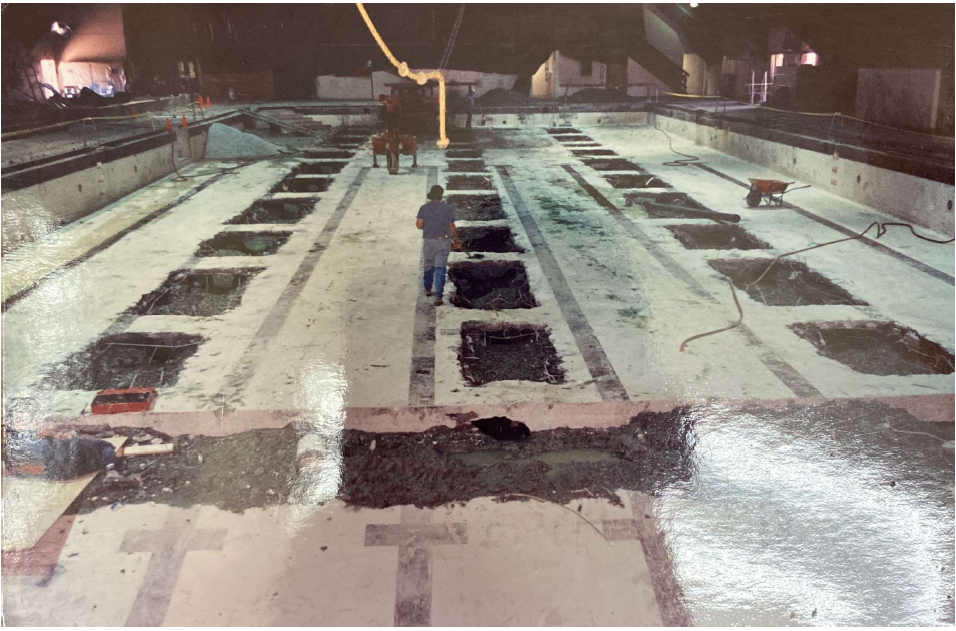
Once it was conformed the crack was actually losing water, there was a rapid but extensive evaluation of repair options, including bringing in outside experts for second opinions. Everything from epoxy in the cracks to re-lining the pool was evaluated, but the work required means draining the pool, which for complicated hydrostatic pressure reasons, can’t be done without groundwater management, which means drilling wells, then excavating the pool floor. A similar exercise was undertaken about 30 years ago, and it was not quick or inexpensive, as you can tell from the photos appended to the report:

So the decision staff and Council had to make was whether to go down this road. To make that decision we need to know the cost, the timing, and the risk. It is a bit complicated (its set out pretty well in the report, if you want to read it) but based on initial estimates of repair cost, and assuming that the repair could be affected in 6-8 months, the difference to taxpayers of us doing or not doing the repair is about $3 Million. The 8 month timeline is also based on some assumptions that may prove incorrect once we start the work. There was also a risk not just that the timeline would be extended, but that structural damage was such that the repair strategy simply didn’t work.

I appreciate that staff and our consultants were straight-up about this. Everyone want the pool up and running – the staff who work there, Council, the community. So there is a temptation to be engineering-optimistic to the point of Pollyanna about the proposed repair. But the reality is that any repair approach was going to be expensive, and uncertain. I think if we had a $100K repair bill and could guarantee it would be done by March, we would have pulled the trigger and gone that path, but that’s not the reality.

With the TACC scheduled to open in later 2023, and a potential for extensive repair to take 8 months, it came down to justifying the significant cost for what looked to be a decreasing number of months of service. It’s disappointing, but it was increasingly looking like we were throwing good money after bad, and the sunk cost fallacy, as tempting as it is, is bad governance.

So with CGP out of commission, we are looking at ways to provide alternative services, from re-arranging some gym equipment space and programming in to other spaces in the City to expanding the season and hours of both Hume and Moody outdoor pools. We are also looking to re-scheduling demolition work at the CGP to coordinate better with TACC construction. No doubt, this increases the urgency and importance of getting the TACC completed on time.

It is natural for the community to want to know why this happened, and even to speculate on some causes. Up to this point, the priority of City staff and contractors has been to investigate what was happening and gathering information about potential repair strategies so Council could make an informed decision as soon as possible. Determining the cause is part of that work, but not the focus. Now that the decision has been made, we can turn more focus to cause and accountability.

This is something that is sometimes hard to talk about in local government. We have contract relationships with consultants that spell out who is responsible for what; we have legitimate insurance and liability concerns that have an effect on the business of the City. Some of this info is protected by Section 90 of the Community Charter. However, in my comments in Council, I tried to make clear that the public needs accountability here. Fiscal impacts aside, the community has lost something – access to an important amenity, as end-of-life as it may have been. And the community deserves to know why. If this was a predictable and avoidable, I think we need to be transparent about why it was not predicted or avoided. If it was a fluke of geotechnical bad luck, I’d like to know what measures were taken to anticipate and avoid this turn. The community is going to speculate (New West is pretty good at that – we are an engaged and chatty community!), but the only response to that speculation is to get the right information out there, The City has an FAQ up here, and we will update info when we have info to update.

So in summary, this sucks. We really hoped that there would be continuity between CGP closing and TACC opening, but I think Council made the prudent fiscal and responsible decision. Following up on that, we have more decisions about alternate programming and staffing that will unfold in the next little while.

Council – Nov 22, 2021

Our meeting this week included two relatively high-profile Public Hearings. Not because the change to the land use was large, but because the word Heritage was involved, and the properties were in Queens Park. Add those two together, and you get passionate community input. So we had four hours of discussion with the community about two projects:

Heritage Revitalization Agreement (Bylaw No. 8262, 2021)
Heritage Designation (Bylaw No. 8263, 2021) for 515 St. George Street
This homeowner on the western edge of Queens Park wants to build a laneway house on the back of their property, which is one of the “lanes” that is actually a named street with other properties facing it. The laneway house would be a single-storey fully accessible 830 square foot home and meet the design guidelines for new construction in the Queens Park Heritage Conservation area.

The Community Heritage Commission supports the HRA, and the project meets the OCP. It is actually within the laneway house accommodation that would be permitted by right in Queens Park, except for the zoning designation of this lot. The total density proposed (FSR 0.515 for the existing house and 0.185 for the LWH) is the same as any heritage house in Queens Park is entitled to (0.7), so instead of building an addition to the house and a accessory/garage, they are taking this path to build a LWH.

We had 5 written submission and about a dozen people come to Council to speak to this project, the majority opposed. Opposition included that this was not a “real” HRA (yes it is, this is exactly what the HRA program is designed for), and that here is no “heritage win” (like every HRA in Queens Park, we need to remind folks that designation through HRA is a much higher level of protection than the HCA provides).

Council voted to give the HRA and Designation Bylaws Third Reading.

Heritage Revitalization Agreement Bylaw No. 8271, 2021
Heritage Designation Bylaw No. 8272, 2021 for 208 Fifth Avenue
This homeowner wants to subdivide their property into two lots (4,000 and 4,710 sqft), move the existing 1910 house forward on the northerly lot, and build a new house on the larger southerly lot facing Elgin Street. This project has been back and forth a few times, and the owner has made some pretty significant changes to the project over the last year. This project aligns with OCP goals and was approved by the Community Heritage Commission.

The resultant lots will be smaller than the zoning requires, but not out of scale with the 8 lots around them (two 4,356 sqft lots to the east, a 3,300 sqft lot to the south, several 4,356 sqft lots to the north). There was a lot of concern expressed about this being “extreme density”, but the two lots would have FSRs (0.7 and 0.64) within what is currently allowable for heritage properties, and lot coverages (31% and 29%) lower than what is allowed (35%). To put that in perspective the land owner is currently entitled to build 1,154 sqft more on the existing lot than the total that is proposed for the two lots. This is not only not “extreme density”, it isn’t even building to already approved density. If that isn’t gentle, I don’t know what would be.

We received 14 pieces of correspondence on this project, and had about 20 people come to speak to us about it; again more against than for. Opposition included that this was not a “real” HRA (yes it is, this is exactly what the HRA program is designed for), and that here is no “heritage win” (like every HRA in Queens Park, we need to remind folks that designation through HRA is a much higher level of protection than the HCA provides). There was also concern that this was “over density”, when by any measure it is under density already permitted for the site.

Council voted to give the HRA and Designation Bylaws Third Reading.

Resilience

I never remember feeling like this before. The bad stuff is piling up. People and governments are being tested in ways I don’t think anyone anticipated, though it was easily predicted. What’s on my mind is not the bad news happening (there has always been bad news), but in the shift in mindset about the bad news. Maybe it was Trump, maybe it was COVID, maybe it is the algorithms in our news feed or there was truth to the theory that David Bowie was holding the good in the Universe together. I don’t know the cause, but I have been thinking about how a shift in language I noticed might give insight into a change in out collective mindset, and what it means to be in a leadership role at this time.

I am involved in a few organizations that bring Local Governments together. I’m on the Executive of the Lower Mainland Local Government Association. We bring local government leaders together to network, share resources and knowledge, and advocate for the things we need (money and/or regulatory change) to make our communities work better. I am also the Chair of the Board of Directors of the Community Energy Association. We are a not-for profit with a growing professional staff that empower local and regional governments to achieve energy and emissions reductions targets, through planning support, coaching, and actual implementation of programs that move the dial on Climate Action.

In both of those organizations, we spend a lot of time strategizing the best way to serve our communities. We are both receivers and dealers in Buzz Words. In that part of the work, there has been a shift that was so subtle, I didn’t even notice at the time, and was swept up in the change such that I even changed my own language and thinking without noticing. Only with hindsight, and only recently, have I started to think about what we may have lost.

The shift is how we stopped talking about (and building towards) sustainable communities, and are now talking about (and hoping for) resilient communities. Perhaps this is not a revelation. Google “resilience is the new sustainability” and you get an awful lot of hits, most of them of the eco-marketing genre. Resilience is the new buzz, sustainability is passé.

This has been in my mind of late because [gestures to everything happening around us] and how wordshift / mindshift is not limited to those organizations above, but in communications being used by the government in face of overlapping catastrophe. The increased reliance on “resilience” as a planning idea, a community goal, a vision, means something different when you recognize just don’t talk about sustainability any more, it turns to dark thoughts.

Sustainability, use as a buzzword aside, has a clear definition that can be traced back to the Brundtland Report and can be simplified to “meeting the needs of the present without compromising the ability of future generations to meet their own needs”. There is a hope in sustainability. A vision that we can do better right now in ways that will make things better in the future. It’s planning for a prosperous future, like planting a tree under whose shade you may never personally sit. It tells the next generation that we care, that we are cognizant we are passing to them a legacy of our decisions, and we are taking responsibility for that legacy.

Resilience is something different. So shockingly different that it is amazing we have so easily slotted it in to replace sustainability. Though definitions may vary based on context, the one we are talking about in community planning and governance is something akin to “an ability to recover from, or adjust easily to, misfortune or disruption”. This is a different vision, one that sees a lot of bad shit coming down the pike, and we can do nothing to stop it, so hold on tight, and we’ll try to get you some pillows to soften the blow. It is different than hope, and if it isn’t exactly despair, it is at least stripped of optimism.

These days, our emergencies feel like Matryoshka dolls. Last week’s emergencies are sitting within last month’s emergencies, sitting within the emergency that has been going on for two years, surrounded by a decades-long building emergency that is, ultimately, the cause of last week’s emergency. And will be the cause of next week’s.

How did we get here? After decades of talking about, instead of applying, a sustainability lens to addressing that big emergency, we are left with trying to build resiliency to the inevitable emergencies that we know are coming. It is an admission of failure at providing the basic stability of yesterday to those living tomorrow.  If we weren’t successful at the sustainability, why would we believe we are going to be successful at resilience? How did we let this shift happen without us noticing it? Without even comment?

These questions are rhetorical, but the answers are there for us. There is the generational failure where hoarding was seen as the best path to assuring the next generation’s prosperity. There is the neo-liberal outsourcing of solutions for pressing problems to a market that was wholly unequipped to think long-term because we had to be creating something to hoard. There is an intentional erosion of trust in institutions from science to education to governance to journalism that has disarmed the warning systems that should have shown us this future. There is a paucity of leadership, replaced with caffeine hits of populism.

Worse than a lack of vision, there is a fear of vision. A suspicion of vision. We are at the same time clamoring for change and terrified of change. Ideas like “maybe we can fix homelessness by building homes” are seen as radical, fanciful, and ultimately unaffordable. So the change we are getting is the one we could not avoid. At the heart of it all is the feeling that we, one of the most prosperous societies in the history of the globe, can’t afford change. We need to keep digging the hole, because hole-digging is what’s going to pay our way out of this hole. Yes, I’m looking at you, TMX.

If there is hope in this, it is that there are people who see past this. There are leaders in our community, in our province, in our country who are talking about what we can do, not what we can’t. Because shit has to change, and this dread you are feeling doesn’t need to be there. We can’t settle for resilience. Sustainability is not a pipe dream we should let die, it is the survival of all we value, and it is the promise we should be making to the next generation, and to ourselves. It’s the path away from this dread.

It’s the work we have to do, now more than ever.

Council – Nov 15, 2021

Our Council meeting this week seemed like everything else this last month –  little glitchy. Staff at the City have done a phenomenal job rolling with the various changes in how we delivered Council meetings, with shifting Public Health Orders and legislative requirements around electronic meetings, which included a complete review of our digital environment. This week’s glitches were not their fault, but a failure in the phone system that was felt nationwide that just happened to occur during our meeting, and our meeting while the province was beginning to flood. I’m not sure the two were related, but if you were following in Zoom and didn’t hear everything, the streamed video of our meeting does have clear audio, so you don’t have to miss any of the exciting action on our agenda. We started with reviewing a Temporary Use Permit:

TUP00027: 502 Columbia Street (former Army and Navy Store) for Emergency Homeless Shelter
This permit would allow the Purpose Society to operate an emergency shelter in the lower floor (fronting Front Street, not Columbia) of the Army and Navy Building, in which Purpose has been providing other programming for several months. The TUP will be active for 3 years, though we hope it will not be required for this long a time. The last time we issued a TUP for an emergency shelter, it was active for about 6 months.

At this point, it is a little unclear which will be funded here. Purpose has adequate funding to open an “Emergency Weather Response” shelter, which would be made available for up to 50 persons with no other shelter overnight only during extreme weather events between November and March. The only other such service in New West was downsized to 30 beds due to COVID restrictions, and is now in the process of being repurposed to provide health services on a more permanent basis. If BC Housing comes through with additional funding, this could become an “Emergency Response Shelter”, which would provide a similar number of beds on a 24/7 basis with full supports for the residents that would fill the gap until more permanent Emergency Housing is available (which we hope to see opened within 18 months).

We has a significant amount of public feedback on this through various media. Written correspondence included 44 pieces, with concerns raised related to crime and the impact on businesses, but also a significant amount of support and recognition of the pressing need for shelter, and preferably housing.

Council moved to approve the TUP, and reinforced the message to BC Housing that true 27/7 shelter with supports is the preferred model here. We have more than 100 people living without shelter in New Westminster. We have a service provider willing to step up, BC funding willing to fund, and a building owner with vacant space willing to provide appropriate space for those residents that want to come indoors, get warm, get clean, get help, it would be unconscionable for us to say no.

Business Regulations and Licensing (Rental Units) Amendment Bylaw No. 8302, 2021
We are making changes to the business Bylaws we adapted to provide extended protection to renters from demo-viction and reno-viction in light of changes by the Provincial Government to the Residential Tenancy Act. We asked for public input, it got a little media attention, but we received no feedback, so Council moved to go ahead with the changes.


We then moved the following items on Consent:

Budget 2022: Engineering and Electrical Utility Amendment Bylaw Report
As previously discussed, the Bylaws for Utility Fee changes was presented and moved by Council. Yep, utility rates are going up. Both Water and Sewer primarily because of Metro Vancouver costs going up, Electrical going up basically at the inflation rate as recommended by the Electrical Utility Commission, and Solid Waste going up because we have a couple of pressing capital costs.

Construction Noise Bylaw Exemption Extension Request: 618 Carnarvon Street
The new building that will partly encapsulate the SkyTrain downtown (reducing its noise) has been planning to do that encapsulation work for a few months, but was delayed. So the noise variance they need to do some of this work at night (when SkyTrain is not operating, for obvious reason) needs to be extended, which we are doing except for the period through the Christmas Holidays.

Construction Noise Bylaw Exemption Request: New Westminster Interceptor – Columbia Sewer Rehabilitation
That shitty sewer project on Columbia needs to work up to 4 nights in late November or early December in order to get done this year. The timing is critical because they cannot do this work when there is significant surcharge in the sewer –so they need drier weather for a short stretch. Like a root canal, it sucks, but we gotta get past this and get that sewer rehabbed.

Construction Noise Bylaw Exemption Request: New Westminster Interceptor – Sapperton Connection along East Columbia Street
This is a different phase of the same work, in a different location. Two nights some time before Christmas, they are going to do sonar inspection of the sewer line. This should not make much noise other than the idling of a couple of vehicles, but night construction work requires an exemption.

Covid-19 Task Forces: Update
This is our regular (now about once a month) update on the Tasks Forces the City setup to address specific challenges related to the pandemic and related Public Health measures. If you are curious about what the City has been doing in support of vulnerable and at risk populations, seniors and persons living with disabilities, and business and the local economy, these are the updates you want to see. Putting hope into action, as we have been doing for 18 months now.

Crisis Response Bylaw Amendments: Consultation Summary and Second Reading of Bylaws
More of the Hope and Vision stuff, the City has bundled three projects together to accelerate the development of supportive and affordable housing in the City in response to the ongoing homelessness crisis. One is giving Council some power to fast-track response City-wide in the event of a BC State of Emergency declaration, one to accelerate approval for a supportive housing project in Queensborough, and another to fast track a supportive modular housing project downtown. We sent this out for Public Consultation, and this is the report back.

We had four virtual information sessions (totaling >50 people), A Be Heard New West page (>450 visits. >150 active participants). General support for the City-wide plan, and general support for doing “something” about providing shelter for unhoused people, but local concerns about the specific locations and problem behaviours. There are also a significant number of responses fully in favour of each project.

As this involves an OCP amendment, it will go to a Public Hearing, so I’ll hold my comments until them.

District Energy Bylaw No. 8269, 2021 for First Reading
The City and the Electrical Utility are continuing to work on a District Energy Utility (DEU) for Lower Sapperton to take advantage of a Metro Vancouver sanitary sewer main (as a carbon-free energy source), in a location that can provide base load carbon-free energy to the expanded RCH and upcoming developments in the area – predominantly Sapperton Green. This single project, if fully realized, would offset community GHG emissions equivalent to the entirety of New Westminster’s Corporate Emissions. To undertake the next stage business case development, a Bylaw is required to assure new development in the area hooks up to the DEU such that space heating, cooling and/or water heating in new developments will be provided by the DEU, and sets out conditions for the relationship between a developer and the Electrical utility to let this happen.

Anyway, this is first reading, so if you have input, let us know!

Heritage Revitalization Agreement Refresh: Principles and Community Consultation
This is a very preliminary report, asking that staff go out to do public consultation on this topic that eats up a completely disproportionate amount of our Council time and staff energy, considering the minuscule impact it has on the community at large. Ultimately, the process for approving HRAs (where the City gives rezoning-like benefits to property owners in exchange for them preserving a heritage asset) is cumbersome and has been the cause of much community conflict, so clarifying the process will benefit us in reducing the effort of staff needed to manage these, and potentially the conflict in the community related to their application. So off to Public Consultation it goes, and we will try to hammer out some principles to make the process work better, because the current process is clearly making no-one happy.

Revenue Anticipation Borrowing Amendment Bylaw No. 8300, 2021
Every year, we need to set up a borrowing Bylaw to give staff the ability to dip into a line of credit in case we run out of cash waiting for the annual tax and utility bills to get paid. We spend money year round, but mostly get paid in one month in the summer, this gives us the $3 Million buffer we need to make sure we don’t run into a shot-term cash crunch.

Schedule of Council Meetings for 2022
Mark your Calendars. Here is the schedule for 2022. 20 Council meetings, 10 Workshops, and 7 Public Hearings. One meeting in Queensborough (haven’t done that in a while!) and 3 of those meetings are actually after the 2022 election, so will be a new Council.


The following items were Removed from consent for discussion:

Climate Action: 2020 Corporate Greenhouse Gas Emissions Update
We annually report out our Corporate GHG emissions, and compare to the reduction goals set out in our Community Energy and Emissions Reduction Strategy (CEERS). 2020 was the first year in included the emissions produced by contractors working for the City as part of our own emissions, but we are still almost on track to our CEERS targets. There have also been some changes to how the Province counts electricity emission factor (how much GHG emissions are related to BC Hydro supplied electricity) so our reporting numbers look a little different than previous numbers.

In short, our emissions are about 20% lower now than they were in our 2010 baseline year, where a “straight-line” reduction to our 2030 would have us at 22.5% below 2010 now. Not quite on track, but not far off. This is, however, good news. We know that the construction of the təməsew̓txʷ Aquatic and Community Centre will reduce our emissions by something like 15% when it replaces the Canada Games Pool, so that 15% is not yet counted, but is already in our budget and being built. We are certainly on track to get below our 2030 target by investing now, not by waiting or talking about targets, but by doing the work.

New Westminster School District’s 2021-2022 Eligible School Sites Proposal Report: City Response
The City is growing at the pace outlined in the City’s Official Community Plan and we are hitting the targets we committed to in the Regional Growth Strategy. More importantly, we are seeing that there is a demographic shift happening in the community, and (perhaps a reflection of the City’s Family Friendly Housing policies coming into effect) we are having an increased number of young families moving to the community, which means we need more schools.

Fortunately, the Provincial government has abandoned the absurd BC Liberal policy of only building schools for *current* need, and are giving School Districts more flexibility to apply for capital projects to meet projected capacity needs based on community OCPs and demographics, but we are already about 5 years behind (as schools under construction were mostly approved under that previous policy). So the City needs new school locations. Of course, it has been more than 100 years since New Westminster had any empty “greenfield” spaces for new schools. So we need to repurpose existing land use and build schools more appropriate for dense urban spaces.

The School District has been working on this, and we have had extensive discussions over the last little while at both a staff-to-staff level, and a Council-to-School-Board level, to see how we can help the School District achieve their goals. The Board has developed a needs assessment and an Eligible School Sites Proposal to take to the Provincial government, and have asked the City to provide support. Staff say their projections look spot on, so we are sending a note to that effect. More to come here!

Preliminary Application Review: OCP Amendment and Rezoning – 1084 Tanaka Court
A property owner in Queensborough previous approached the City about building a banquet hall on a piece of industrial-zoned property in Queensborough. They now want to build a residential (Purpose built Rental) on this property as part of a mixed-use development. This is an area (North of the freeway, near the Casino and Lowe’s) not previously envisioned for residential use, and is a pretty significant departure from our OCP. Not just an increase in density or built form, but a substantial shift in land use areas. Staff is recommending against this change, but the applicant has an opportunity to apply to Council.

This was an interesting discussion at Council, and I honestly think most of us are on the fence on this one – but I can only really speak for myself here. At first pass, this does not look like an appropriate change of land use. The property is in a light industrial area, though most of the surrounding use is more commercial. We have long supported a policy of protecting job-creation and industrial space in the City, as it is under threat form a variety of directions. Then you consider that adjacent properties and those across the street are zoned M-1 or M-2, and as such are currently permitted to be lumberyards, machine shops, or factories manufacturing anything from rubber tires to textiles. The pedestrian realm nearby is not designed for a family neighbourhood, and most services are not easily accessible. But the idea of saying no to daycare and housing when both are in such critical need in the community and the region right now puts us in a real conundrum.

Council, in a split vote, agree to allow staff to continue to work with the property owner to see if they can develop the project some more, but also expressed some concerns about it. If this proceeds, it will eventually end up in a Public Hearing, and it will no doubt be an interesting one that asks some difficult question of Council and the community.


We also had a Presentation:

Cohousing
We got a presentation from a person who lives in the Driftwood Village Cohousing Project in North Vancouver, and from a member of a burgeoning co-housing group in New West, to outline how co-housing might work in the City. A lot of this was very educational about what co-housing is and (more importantly) about what is isn’t. This is a different model than Co-op housing, and though it may include some affordability elements, it would generally not be considered an Affordable Housing model. It does however, fill as a bit of a “missing middle” niche for people who want to live in a more community-focused setting ,somewhere between a regular strata and a co-op (though they are usually structured as a Strata in the legal and financial sense. Our new OCP provides an opening to supporting Co-housing, and this presentation gave us an opportunity to learn what models might work in the Greater Vancouver context, and how we might support that model better. It also ended in Council asking staff to look deeper into how we might support such a model in the City if the opportunity arises.


Finally, we had a boatload of Bylaws, including the following for Adoption:

Bylaw Notice Enforcement Amendment Bylaw No. 8298, 2021
Municipal Ticket Information Amendment Bylaw No. 8299, 2021
These bylaw amendments support the change in the Business Licensing Bylaws around Tenant Protection, as discussed above, and were Adopted by Council.

Climate Action, Planning and Development User Fees and Rates Amendment Bylaw No. 8293, 2021
Cultural Services User Fees and Rates Amendment Bylaw No. 8294, 2021
Electric Utility Fees and Rates Amendment Bylaw No. 8295, 2021
Engineering Services User Fees and Rates Amendment Bylaw No. 8292, 2021 and
Financial Services Fees and Rates Amendment Bylaw No. 8296, 2021
These Bylaws amend the fees for 2022 for the various services provided by the City, mostly going up to match inflation. And they were all adopted by Council.

Ask Pat: Zoning shops

Ject asks—

How do zoning and bylaws work in New West? It seems to me that allowing for small retail spaces in neighbourhoods like the ones surrounding Agnes and Carnarvon @ Elliot, for example, would be of great benefit to the community: More walking distance shops and such (I’m thinking coffeeshops, produce stands, maybe a convenience store) would make this area more walkable, livable and agreeable to its inhabitants. I have seen some small stores close to brow of the hill, and I know that there are stores on sixth, but why not more centric?

To answer your first question: it works like zoning everywhere else in BC (except Vancouver), because although the powers local government have under zoning are very broad, they are set out in Provincial legislation. And as in many other things, when it comes to zoning power, the Local Government Act giveth, but the Community Charter taketh away.

There is a lot of talk in urbanist and activist circles about zoning, some even suggesting that it is more trouble than it is worth. There is no doubt the history of zoning is problematic (racist and classist zoning was more the norm than the anomaly for North America for much of the twentieth century), and it is currently a cause of (or at least a functional part of) a lot of inequity in communities. However most don’t really understand what it is as a tool in modern local government.

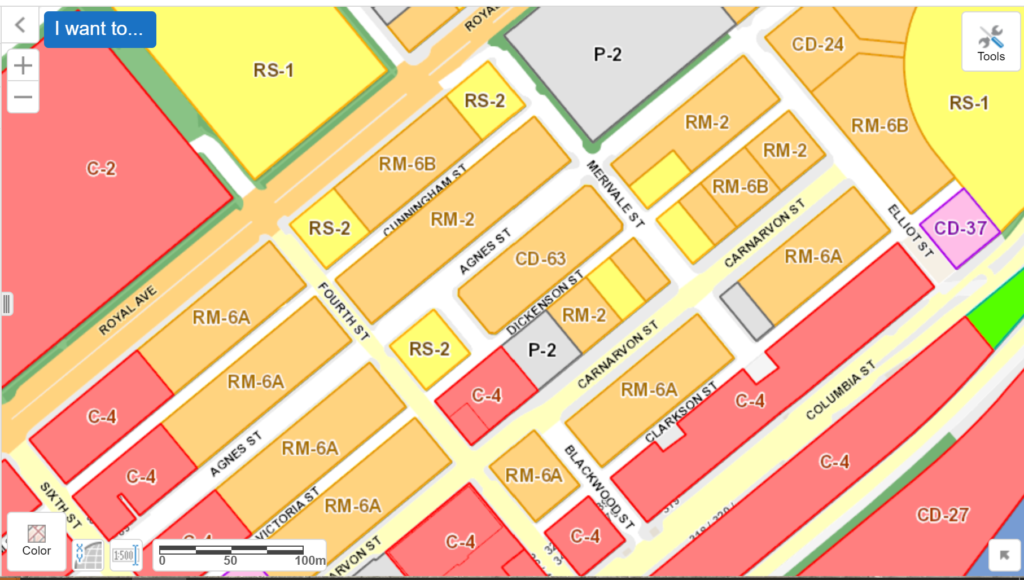
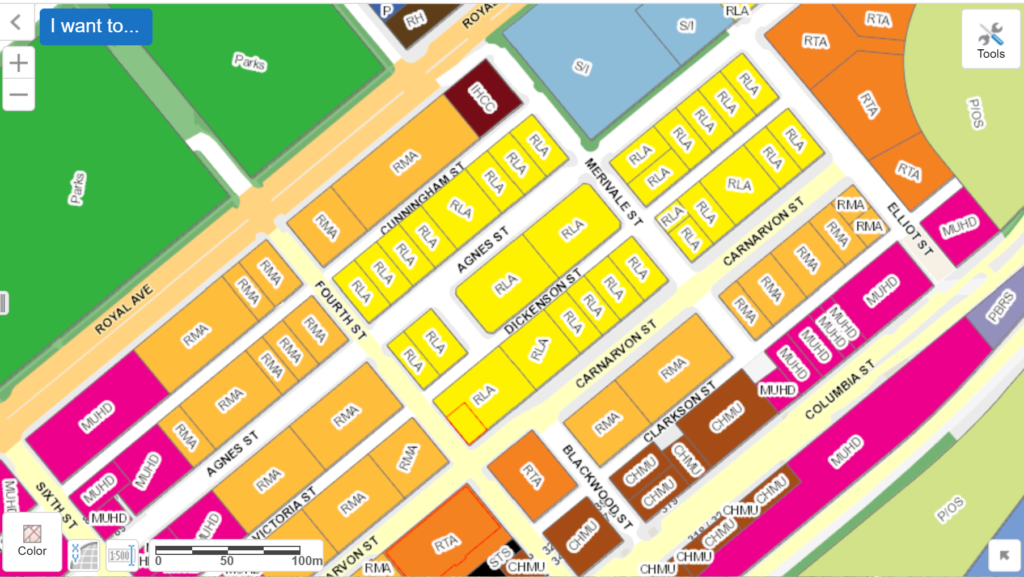
Many armchair planners have a perhaps SimCity-derived thought that zoning is designed to keep noisy, polluting, industries and busy, crowded commercial areas separate from comparatively pastoral and quiet residential areas, so people are healthy and can sleep at night. But in BC, that type of high level distribution of land use is more achieved by an Official Community Plan (OCP). Zoning is a finer-grained distribution of land uses within those bigger categories. It also speaks more to the size, shape, and form of development within neighborhoods, and it also manages more specific land uses and how different land uses are mixed together within the same area. A neighbourhood might be designated Residential in the OCP, but zoning may allow “four floors and a corner store” types of buildings, or even stand-alone buildings that don’t necessarily “fit” the strict OCP designation for the entire neighbourhood, like a stand-alone cafe in an otherwise residential neighbourhood.Map of the OCP designations for the eastern part of Downtown from the City’s on-line map.

It’s important to note that zoning doesn’t necessarily drive changes in use, it is usually the other way around. If a specific use is allowed in a zone, it doesn’t necessarily mean anyone will actually come along and do that use, or build a new building for that use. Council rarely re-zones or changes the allowable uses on a zoned piece of land unless a landowner requests it by making a rezoning application – they want to change the use and ask the City for permission.

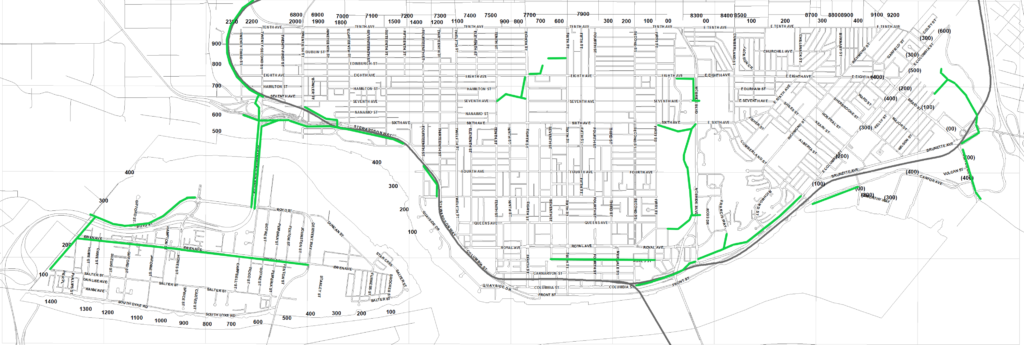
Map of zoning designations in the eastern part of Downtown from the City’s on-line map.

The thing about zoning is that zoning changes for any lot need to be approved by Council, and (this is the big part) Council can say “no” to a change for pretty much any reason they want. Most powers of Councils are limited by legislation or common law, and we are expected to act reasonably. In administering building permits (as a random example), we cannot capriciously withhold a permit if you want to build something – as long as what you are building meets the zoning and the building code, no bylaws are violated, and you pay your fees. We can’t just say “no” without providing a reasoning for why, and can get dragged into court if we act arbitrarily in refusing you a permit for, say, a bathroom renovation. But if you ask us to change your zoning, we have almost unlimited power to say “no” and you are unlikely to have any recourse.

As a result, a City can ask for pretty much anything in exchange for zoning – Development Cost Charges to pay for sewer, water, and transportation upgrades, so-called “Voluntary” Amenity Charges to pay for other things in the City, we sometimes ask for a strip of land to be dedicated to the City for a boulevard, or sidewalk replacement or other upgrades to adjacent City lands. We can ask the developer looking to re-zone that they build space in their proposed building for Daycare use or Affordable Housing or that they build more (or less) parking, or that they paint their building a different shade of blue. Every rezoning is a negotiation.

Now, this of course is a power a wise Council will not want to abuse. Besides making ourselves unpopular and getting voted out, making rezoning too onerous will cause landowners to scoff at the demands, and no-one will invest in developing your City, which might mean you will not achieve the goals of your OCP. On top of this, the community may lose out on those amenity benefits that could be negotiated. Of course, a Council could cynically use this piling on of demands as a great way to prevent new housing from being built while not appearing like you are opposed to new housing. “This development just didn’t quite do enough to address (pick a concern)” is a great stall tactic that effectively shuts down development as easily as saying no, with predictable results. But as a practicality, most Councils want to make sure the community gets “its share” of the value that the developer receives when a property is rezoned. It’s a balance, and no-one does it perfect.

The point is, if we abolished zoning, we would need to replace it with another tool that provided the community an ability to leverage a fair share of the land lift (the increase in property value that comes with zoning changes in a land-constrained region such as ours) in order to pay for the externalized cost if development and community growth. Right now, it is the best tool we have for that because it is the only tool that gives Local Government negotiating power.

But you were asking about zoning for small retail. This has been a topic of *much* discussion over my 7 years on Council, going back to the last big OCP update. Part of livable, walkable, dense urban communities like Downtown New West is being able to walk to some basic services. I feel fortunate that I live in a part of the Brow of the Hill where I am a <10 minute walk from most services, and as such can do most of my shopping by waking or riding my bike. But there are areas of New West with a paucity of services within such a short distance, like the west part of the West End, parts of Upper Sapperton, or Port Royal in Queensborough. There are also some areas like the east aside of Downtown (as you note) are surprisingly far from some services, and probably don’t achieve the walkscore we would like to see for such a dense community.

Expanding on your example of the east part of Downtown, most of that area (other than Columbia Street, which is commercial) is zoned for low-rise multi-family residential, with a note in the zoning that higher density may be permitted if enough amenity is provided. Any retail coming to this area would need a rezoning. Would Council approve such a rezoning? I don’t know, but I doubt we are going to be asked to any time soon.

There is an ongoing discussion locally and regionally about retail space. I have heard owners of commercial property argue there is too much, and if Cities require retail space as part of new mixed-use developments, they will remain empty, especially as the traditional retail environment has been Amazoned into a state of… shall we call it uncertainty? Others suggest high lease rates and somewhat onerous triple-net lease terms are a result of there being too few spaces available and commercial owners holding all the cards. There is also a universe where both of these are true at the same time, and location and neighbourhood characteristics determine where your street or block fall on that spectrum.

Developers definitely would rather build residential, given the option, because they know the demand is there. Build residential, and it will sell for a pretty easily predicted price per square foot. Commercial space is not as certain. Building a residential property is also more predictable in how you fit it out. Every home needs a toilet and sink in every bathroom, countertops and appliances, wired and plumbed for in suite laundry and known kitchen appliances. But a commercial space is largely unknown. To use your examples, a coffee shop, a produce stand, a convenience store all need very different layouts, plumbing, electrical loads, even locations of doors. So commercial space built on speculation is built as an empty shell, creating uncertain costs for anyone who hopes to lease them and fit them out. I can point you to several places in the city where retail-at grade is still an empty shell years after the residential building it sits on is occupied.

So when the City talked about updating the OCP for the middle part of Sixth Street (between Royal and 4th), the question was raised about whether requiring retail at grade was worthwhile. Perhaps having more residential spaces built will provide better support to the existing retail spaces on Sixth, and zoning for retail grade is making it uneconomic to develop. The same conversation ensued along the Twelfth Street retail strip. Is more retail space needed? If we force developers to build retail at grade, will it be occupied? More importantly, will it make it so hard for a developer to make any money developing the area that nothing gets built, and then the existing retailers don’t have nearby customers. The answer is not simple, and opinions vary.

Where we do see new community-serving retail is in major development projects. Plaza 88 is an obvious example. I think if we were planning Victoria Hill now (instead of 15-20 years ago when the vision for the community was being hammered out), we would include more commercial spaces, and perhaps a few larger retail spaces, though no-one is going to open a major grocery there (with a Safeway and a Save-on each just a little over a km away). That said, the few spaces that are there have taken a significant amount of time finding their purpose. Was that because there are more spaces than needed, or because there are two few to create a real “hub”? The long-proposed “Eastern Node” development area in Queensborough would finally bring some community-serving retail to Port Royal, which is now an established medium-density residential neighbourhood with nary a place to buy an apple. In hindsight, the long wait for this commercial node is really disappointing for the City, and for the residents of that neighbourhood. Hopefully these lessons are being learned and Sapperton Green looks to not only bring more commercial square footage, but is phased to bring it earlier in the neighbourhood development.

So, back again to eastern downtown. To my knowledge, there is only one development in the works in that neighbourhood, and it came to Council as a preliminary application as a mixed use residential, affordable housing and childcare – but no commercial space. For a new commercial space to be built in that neighbourhood, someone would have to come to the City with a plan, and go through a rezoning to make it happen. I cannot predict if Council would support this plan or not, but for the reasons I outlined above, that is just not where the market is for development now, or really where the market is for retail. Neighbourhood convenience stores you do see around mostly have one thing in common – they have been there for a long time and are very low-cost operations. Starting a new one would probably be a financial risk with little chance of recovery. I suspect if you could make money doing it, people would be doing it. So, alas, I wouldn’t hold my breath for any new commercial or retail being built in that area (other than along Columbia) any time soon.

Council – Nov 1, 2021

Another Council meeting that followed another afternoon workshop on the budget. This one was our first look at the Operational budget, and you can see the video here and look at the agenda that has spreadsheets and numbers of such if that is your thing. More on that later, because we had an entire evening Agenda to go through. We started with a Presentation:

Peer Assisted Crisis Team Pilot Project
There is no questioning the mental health and addiction crises impacting our City. This doesn’t make us any different than any city in North America during the overlapping crises of opioid addiction and poisoned drug supply, housing affordability and homelessness, COVID-related strains on support services, ongoing austerity approaches to health care and neoliberal approaches to addressing poverty. In most jurisdictions, the biggest impacts of all of these are falling upon police to address, when policing usually isn’t what is lacking in these spaces, and when police interactions have a history of turning out poorly for some people in mental health distress, and for the police. We have committed in New Westminster to not put this burden on police, but to find alternative approaches.

This presentation outlines a pilot project that takes a different approach, working in collaboration with the Canadian Mental Health Association, and three other municipalities, based on best practices applied in other jurisdictions around North America. We are also applying to a couple of Provincial funding programs to help support this approach. The goal (fully supported by New Westminster Police) is to shift from a criminal response to a health response for the calls that warrant that response.


We then moved the following items On Consent:

Canada Games Pool Unplanned Closure Update
The CGP has been closed for a couple of reasons, none of them good. An equipment vault under the pool building flooded during heavy rain damaging a bunch of water heating and recirculating equipment. With uncertain drainage capacity, and no hot water for operations, the entire pool building had to be shut down while the flooding problem was fixed and damaged equipment was repaired or replaced. Unfortunately, as these repairs were occurring, a leak in the main pool tank was detected, and that is going to take some time to diagnose and (hopefully) repair. In the meantime, we have to make some hard decisions about programming and staff as it looks like the facility will not be able to operate until at least early 2022.

One of the foundational ideas of the CGP replacement plan was that the existing pool was old and subject to significant maintenance and operational risk, but we needed to keep it running while the new pool was built so there was as little loss in continuity of programming as possible. That is still our principle, and our goal is still to get the exiting pool operating ASAP so we are no going without for the next three years. So we will hope the engineers can assess and provide a remediation plan in short order. Fingers crossed.

Electric Bikeshare Program – Motion from Sustainable Transportation Task Force
There is a new e-bike share program being piloted on the North Shore after a couple of false starts. We did some preliminary look at a similar program a couple of years ago, but the business case was not looking promising. There has been some learning in the North Shore program, some change in technology and we are moving from bleeding-edge to leading-edge on these types of programs, so we are asking Staff to take another stab at putting together a model that might work here. (That sentence was more Halloween-themed than I intended).

Miscellaneous Zoning Bylaw Amendments for First and Second Readings
Our Zoning Bylaw is a big, cumbersome document. Occasionally, staff do these omnibus updates to fix miscellaneous text, definitions, alignments with other city bylaws, or to simplify parts that are unnecessarily complicated or redundant. These don’t change how the zoning bylaw works, just how it reads. This is First and Second Reading, and we will waive Public Hearing for this update, but if you have opinions or feelings about the categorization of drive-in theatres or anything else, let us know.

Public Art Calls: Artist Roster and Artist-Initiated Projects
The Arts Commission recommends we put together an Artist Roster to reduce the amount of time and effort it takes ot engage an artist for smaller public art projects in the City. We will also open up opportunities for Artist-Led public art projects in the City, with some funding from the Public art Reserve Fund.

Temporary Use Permit: 502 Columbia Street (Former Army and Navy Department Store) – For Emergency Shelter
We have an emergency shelter crisis in the City – there are simply not enough emergency shelter beds for the unhoused population of the City. The Purpose Society has vacant space on the lower floor of the Army & Navy building they can convert to emergency shelter space for up to 50 adults. That doesn’t fit their current zoning, so we can issue a Temporary Use Permit for up to three years. This report outlines the plan and gives notice we will consider the TUP in a future meeting. If you have opinion, let us know.

But think of this: the City has no Weather Emergency Beds right now. Unhoused residents of New Westminster (of which there are more than 50) currently have no-where to seek emergency shelter as we are heading into winter. We can put in up to 50 beds for Weather Emergencies where unhoused residents can safely spend the night in the event a weather emergency is declared. If BC Housing comes through with Emergency Shelter funds, we can create up to 50 shelter beds that would be available 24/7 and come with full support for people needing support. All of this is for up to 18 months until Emergency Supportive shelter that is planned can come on line.

User Fees and Rates Review for 2022, Amendment Bylaws for Three Readings
As discussed last meeting, one of the early parts of our annual Budget process is to update our fees. We gave tacit approval last meeting, now the appropriate Bylaws have been sketched up and we are giving them three readings.


These items were Removed from Consent for discussion:

Arts Advisory Committee
We are streamlining a couple of committees that provide subject matter expertise and community input to the City’s arts policies. This approves the committee Term of Reference to the new Arts Advisory Committee.

Business Regulations and Licensing (Rental Unit) Bylaw: Next Steps
This is a slightly complicated success story. A couple of years ago, as the City was facing a burgeoning reno-viction crisis, so we took a proactive approach to use our Business Licensing powers to fill what we identified as gaps in the tenant protection parts of the Residential Tenancy Act. Since then, three things happened: the Landlord Lobby challenged us in court (we won), other cities have followed our approach (yeah!), and the province update the Residential Tenancy Act to fill some of those gaps.

Those RTA changes made parts of our Bylaw inoperative, so staff is suggesting we repeal those parts of the Bylaw (and the parts of the ticketing Bylaw that support it) as is good practice (you don’t need inoperative bylaws kicking around), and as the new RTA changes are coming into operation, we will continue to keep an eye on how they work in practice, and will be ready to act if we feel the protections are not adequate to address the issue in our community.

Heritage Revitalization Agreement (208 Fifth Avenue) Bylaw No. 8271, 2021 and Heritage Designation (208 Fifth Avenue) Bylaw No. 8272, 2021: Bylaws for First and Second Readings
The owner of this house in Queens Park wants to restore and permanently preserve the existing heritage house and move it forward on the lot while subdividing the lot and building an infill house facing Elgin Street. This project will go to a Public Hearing, so I’ll hold my comments until then. If you have opinions, let us know!

HRA Refresh: Queen’s Park Heritage Conservation Area Post-Implementation Evaluation and Report Back on Final Incentives
When the Queens Park Heritage Conservation Area was implemented 4 years ago, the plan included developing a series of immediate and longer-term incentives to encourage the conservation of heritage homes, and perhaps to compensate owners for perceived or actual loss of house value due to the HCA. All of the short-term incentives have been introduced, and this report talks about the medium-term incentives. The great part is we are 4 years out and can do the analysis to determine whether the knock-off effects some people feared with the HCA occurred.

There was fear that the extra “red tape” would reduce the amount of renovation activity. Turns out permits are slightly up. There were fears that housing values would be impacted, and it turns out that during the HCA debates price increases went up 5% -7% slower than the rest of the region, but two years after implementation this had rebounded with values going up 10% faster than the regional average. Overall, there has been no significant impact on housing process relative to larger regional trends.

With a couple of medium-term incentives already introduced, and a couple more already in the pipeline, we are not going to explore the housing-price-driven incentives of multi-unit conversions and stratification. These will not be introduced as an as-right benefit of owning a home in the HCA, but will still be possible on a project-by-project basis under the Heritage Restoration Agreement process, much like in the rest of the City. More will come on that as we are working on a refreshing of the HRA program.

Regional Growth Strategy Update: Metro 2050 Comment Period
As we saw in the workshop presentations last time Council met, Metro Vancouver is working to update the Regional Growth Strategy, adopted 10 years ago, and look forward to 2050.

The existing plan was ratified in 2011 by the 20 Municipalities in Greater Vancouver, the sole Treaty First Nation with Municipal powers (Tsawwassen) and the neighboring Regional Districts. It projected the expected growth in the region (pretty accurately, it turns out) and set targets for each of the 22 jurisdictions within the region to fulfill the need to accommodate this growth (which were perhaps less accurate). The updated RGS puts more of an emphasis on climate, equity, reconciliation, and housing affordability, but will work in pretty much the same way. There are other changes, and I will write about this in a follow-up.

New West, like all other municipalities, was asked to provide formal feedback through both staff and council. Our Staff have already helped assure that more analysis is done on the current impacts of climate disruption (e.g. heat waves and air quality related to fires) and how we plan to address the horrific health impacts of these. They also introduced the need for more ecologically-focused set of policies around conservation lands and a more equity-focused set of strategies around tree canopy enhancement. We now have a few more suggestion to include in out input. The target of 15% of new units in transit-dense areas of the region being Affordable Rental Housing is consistent with New Westminster’s own goals, but we cannot limit ourselves to transit-dense areas where land prices are highest to fill this need, and need to find the incentives to leverage affordable housing development in these areas. We also need to have stronger renter protection regionally, so new affordable housing is not displacing the already-most-affordable stock in the region. The one part I added was a concern that jurisdictional targets are being replaced by sub-regional targets. I’m not sure I like this, because it seems to make local governments less accountable. We need more accountability for inequity across the region, not less, and we need elected officials to be accountable for decisions that impact the whole region. A sub-regional approach may remove that.


We then moved a bunch of Bylaws, including Adopting the following:

Zoning Amendment Bylaw (733 Thirteenth Street) No. 8266, 2021
This Bylaw that enables the conversion of a existing single detached dwelling in the West End for use as a licensed group child care facility was Adopted by Council.


And we had one Motion from Council
Creating a more inclusive and welcoming environment outside Council Chamber, Councillor Trentadue

Whereas the City of New Westminster’s vision is “A vibrant, compassionate, sustainable city that includes everyone”; and
Whereas Reconciliation, Inclusion and Engagement is a high priority for the City as we work towards “creating a welcoming, inclusive and accepting community that promotes a deep understanding and respect for all cultures”; and
Whereas our 2019 Arts Strategy outlines goals and a vision that encompasses “Communicate, Nurture, Include, Generate and Innovate” while expanding opportunities for the Arts in our community; and Whereas a motion approved in January 2020 called for ways in which the City can be more welcoming and inclusive, specifically related to Civic facilities, City Hall and Council Meetings;
Therefore be it resolved that Arts Services report back to Council and the PAAC with options to reimagine the space and walls outside Council Chamber to create a more inclusive and welcoming environment.

With all the renovations of City Hall, the foyer in front of Council Chambers has been largely ignored, and is really not a very inclusive or particularly attractive place. Giving the Public Art Advisory Committee a chance to dream up something better and more fitting is a great idea.

Getting to AAA

Last month I put forward a motion (passed unanimously by Council) asking that we commit to planning and building a AAA Active Transportation Network in New West. I thought I would take a bit of time to outline what that means (from my point of view, anyway, because I am always cautious not to speak on behalf of all of Council) and talk about why I think it is important for us to do it now.

As I am often using terms more familiar to transportation advocates than your average person, maybe I could start by talking about the italicized-in-blue term I just used. Because this is not just about bike lanes. Though it may include bike lanes.

AAA” stands for All Ages and Abilities, to differentiate it from infrastructure built specifically for me – the “avid cyclist” stereotype. I’m a healthy middle-class middle-aged sorta-fit guy who has been riding bikes pretty consistently for more than 45 years. I have raced bicycles (mostly mountain bikes; remarkably unsuccessfully), I have commuted by bicycle in big cities and small towns, ridden next to highway traffic over mountain passes sometimes more than 100km in a day. I even spent some time as a bicycle courier in downtown Vancouver, back when that was something people did. Because of this history, I have a high tolerance for danger and an inflated sense of invincibility. I don’t need bicycle lanes or special infrastructure to get me riding my bike. I’ll ride anyway (and probably irritate a few drivers on the way, but we’ll get back to that). AAA bike infrastructure isn’t for me.

Transportation advocacy used to be about people like me – wanting to make trips safer for a American Wheelmen (yes, that was the name of an early cycling advocacy group, and by early, I mean until the 1990s). But there has been a shift in North America since then, following after a couple of decades of progress in Western Europe, to shift towards making cycling infrastructure work for more people. Ideally, everyone who chooses or might choose to ride a bike (or trike, or quadcycle, or handcycle, etc.), but may not be avid about it. Like the way many people drive cars or ride buses, but aren’t avid drivers or avid passengers.

There is also advocacy around “880 Cities”, the idea that if you build a City that is safe enough to make an 8 year old and/or an 80 year old comfortable and independent in public spaces, it is making the space safe and accessible for everyone. You can read into that that people should be able to ride their bikes to school, even in elementary school (like I did as an 8-year-old). An 80-year-old should be able to ride as safely as they can walk, to expand their reach and options in a community and make them less reliant on cars (like my Mom does, with the help of her E-bike). To build for these users, we need to build AAA.

This corresponds with talking about Active Transportation Routes instead of the more restrictive “bike lane”. This means infrastructure should accommodate adult trikes or recumbents for people who may rely on the extra stability they offer. It should also be comfortable to share with people who rely on scooters, electric wheelchairs, or similar lightweight controlled-speed rolling devices. Multi Use Paths (MUPs), where pedestrians are mixed with rolling users should be built in a way that accommodates both user groups and their distinctive needs. Moving bicycles off of busy roads and onto sidewalk-style MUPs makes the bicycle riders feel safer from the larger, faster vehicles, but it may do so by making bicycles the larger, faster vehicles making some pedestrians feel less safe, unless a MUP is built what that in mind.

Finally, we need a network. Bike lanes are like roads, sidewalks, and pipes: they don’t do as much good until they are connected to something. Some people note they don’t see a lot of people using the Agnes Street bike lanes, or the bike lanes in front of the new high school, but both of them represent an important first piece of infrastructure that isn’t yet connected to a network. For users like me, it’s great to have those sections of increased safety; for less confident users, 100m of missing safety between two great bike lanes can be the barrier stopping them from riding on either. This is the issue being addressed by current region-wide “Ungap the Map” campaigns.


So, where is New West now? We are six years into the current Master Transportation Plan, and have made serious progress in pedestrian safety and accessibility. Though it lags behind a bit, we are starting to see some key parts of our planned cycling network come into place. However, the planned bike network envisioned in the MTP is no longer, I would argue, the vision for a AAA Active Transportation Network we would choose to develop if we were starting today. We can, and should, do better.

By way of sketching on the back of an envelope, our current network of infrastructure that meets AAA standards looks something like this:This is a map I sketched up using MSPaint just for discussion purposes. This is NOT an official City of New Westminster map, and possibly not even accurate.

There is some good stuff there, but it is disconnected and incomplete. Of the AAA we have, it leans heavily on the MUP-in-the-Park bikes-are-for-recreation model of the 1990s.

In my mind, a complete AAA network built off of our existing system would look something like this:

Once again, not a map created or endorsed by the City of New Westminster or anyone else. I just sketched this up to facilitate a discussion. Actual plans will probably look different than this.

Note that there are two kinds of future AAA Active Transportation routes shown in my sketch. Those shown in Yellow would comprise separated and protected bike lanes and/or MUPs (like the Agnes Greenway or the CVG past Victoria Hill), where people rolling or riding are not expected to share space with cars. The other type is shown in blue, where bikes might continue to share road space with cars but only if there are specific structures to significantly calm the traffic and force cars on that route to move at bicycle speed. No cars passing bikes, no person on a bike placed between a moving car and a parked car, and intersections designed to be safe by people using all modes. There are several routes like this in Vancouver (I think sections of the Ontario Street or 10th Ave bikeways in Mount Pleasant qualify), and maybe London Street through the West End is the closest example in New West (though there could be some improved calming and signage there). There is some work for us to do to establish the standards we want to apply to safety/comfort of these routes to call them AAA, including the level of traffic calming we can achieve vs. the need to separate.


Finally, I want to emphasize that the time is now to do this work, for a variety of reasons.

One result of the pandemic is that it resulted in a generational shift in how people around North America move about their cities. Bicycle take up has happened at an unprecedented rate, such that stores across North America ran out of bikes and parts to maintain them. Add to this the battery and technology revolutions that have brought reliable e-assist bikes and other personal mobility devices that open up active transportation to many people who did not see that as a viable option previously.

Some communities have seen more rapid pick-up in this shift than others. And surprisingly (unless you have ever been the Madison Wisconsin or Boulder, Colorado), it is not warmer climate or flatter topography that correlates with this take-up, it is the availability of safe infrastructure. Like roads – build it and they will come.

Examples abound, but I’ll limit myself to two: In Paris, Mayor Hidalgo introduced Plan Velo, and committed to 1,000km of cycle paths, a key part of the 15-minute City vision, transforming her city into one that is now seeing close to a million bike trips a day. Recently, emboldened by a landslide re-election, she doubled down with another $300M investment in expanding bike lanes. The City of Lights is becoming a City of bikes.

Closer to home, the work Victoria has done since adopting a 5-year plan for a AAA bike network in 2016 has been equally transformative. With most of the network now installed, it is seeing incredible take-up, and Victoria has established itself in a few short years as one of the most bike-friendly cities in Canada.

At the same time, senior governments in Victoria and Ottawa are funding Active Transportation projects as never before, so we don’t have to pay for this alone. But right here in New West, we have introduced an ambitious climate action plan, framed around 7 Bold Steps. These goals will not be achieved unless we start shifting how we move around, and how we allocate road space in the City, and only a complete AAA Active Transportation network will get us there. The time is now to commit to this work, and to ask staff to give us the data we need to integrate that commitment in to our 5 year capital plans.

Council – October 18, 2021

Another Council Monday, another mid-day Workshop you might be interested in watching. I’ll talk about those later, as they are likely to be subjects of regional discussions for the next year or so, and we are here to talk about the Council Agenda, which started with those three little words everyone loves to hear: Development Variance Permit:

DVP00695 for 220 Carnarvon Street
A church in the east end of downtown has been working on an addition, and received a permit to do so a couple of years ago, but they have made a few changes to the design to make the addition function better, and these require some variances. Quite a few, actually, related to sideyard and overhangs and sit coverage, but all relatively minor in the context of the project and location. We received no public feedback in or request for comment, and Council voted to approve the DVP.


We then moved the following items On Consent:

Amendments to the Procedure Bylaw 2021: Bylaw for Adoption
We are making several changes to our Procedure Bylaw that manages how our Council meetings and committee meetings work. This was needed because the emergency authorization from the Province that allowed us to meet remotely during COVID has expired, and we need a way to make the preferred hybrid process (some people in person, some people virtually) functional and totally legal. We asked for public feedback, and got none.

Budget 2022: User Fees and Rates Review
Part of our budget work is to set any fee changes for next year. The City has three sources of income: Property taxes, grants or transfers from other governments, and fees. This third group is separated into utility fees (electric, water, and sewer service, which go into separate utility cost-recovery funds) and general fees, which cover everything from what it costs you to close a street for construction staging to what it costs you to take a spin class at the gym. Every year we adjust these fees through a set of bylaws.

The first principle behind all fees is cost recovery – the fee should generally represent what it costs to deliver the service. That is, for some things, a very difficult number to calculate because the cost to deliver some things is a complicated mix of staff time, equipment, supplies, management, etc. The second principle is (for lack of a better term) competitiveness. If we are charging much more or much less than adjacent communities, that may show a problem with how we are delivering a service. The third is principle is around service goals. We want to encourage some things (e.g. youth getting swimming lessons) so our fees are much lower than cost recovery for some things (i.e. swimming fees do not pay for the cost of operating pools). Some fees like parking are set to optimize the use of available parking resources (there is a dark hole of mathematics to fall down here) which in most commercial areas like New Westminster metered street parking, seems to be a price point where there is 15% empty spots most of the time – too cheap, and there is no parking available, too expensive, and people stop using the available resource.

After saying all that, we didn’t raise rates much last year because of COVID and the uncertainty around how people were going to use services. So there is a political aspect as well.

This is a preliminary report around engineering and planning fees. Most engineering and planning fees are going up with inflation (2.5%), parking is going up more, some are staying the same. Then there are details in here about some specific changes we are making. (example: we don’t current charge for a Construction Noise Exemption, but it costs us several hundred dollars to process each one, and most other cities charge, so we are going to start charging).

And good news for Garry: the hourly rates for EV charging stations are going down a little, based on industry trends and usage metrics.

Construction Noise Bylaw Exemption Extension Request: Metro Vancouver Sewer Inspections
It’s that sewer inspection time of year! This work has to happen at night, because that’s when you folks flush less. This is generally not the type of work that creates a lot of complaints, but it nonetheless requires approval by Council (unlike in any other City in the Lower Mainland!)

Heritage Revitalization Agreement: 328 Second Street – Preliminary Report
This property owner in Queens Park wants to build an infill house on their property while restoring and permanently preserving the exiting heritage house, subdividing the largish lot into two smaller lots, with a bit of a complicated driveway arrangement due to the property not having a back alley. This is a preliminary report, and there will need to be some public consultation and review by the Heritage Commission, so I’ll hold any comments until then.

Heritage Revitalization Agreement and Designation: 515 St. George Street – bylaws for first and second readings
This property owner in Queens Park wants to build a laneway house on their property while permanently preserving the exiting heritage house. Most properties in the City are already zoned to permit a Laneway house of this size and form, but this one isn’t because it has a bit of a complex history, and they need a zoning relaxation for parking, so they are going through the Heritage Restoration Agreement process. This is First and Second reading, and will need to go to Public Hearing. If you have any opinions, be sure to let us know.

Indigenous Land Acknowledgement
The City has had a bit of an ad-hoc approach to land acknowledgement, and as our Reconciliation work progressed, we recognized this as a gap. However, we also recognized that our knowledge of the history of this land has been eroded by colonialism, and that a land acknowledgement that fails to address that uncertainty does less to respect the many peoples who lived on these lands before they were displaced. Even some of the common terms we use to describe Indigenous communities, like tribe, First Nation, or band, can be the result of Indian Act governance models, or other programs that worked to break the connection between Indigenous peoples and their lands. We don’t want to continue to mask the history of the peoples, the families, communities and other groupings that existed here.

As with much in our reconciliation file, this is a work in progress. The proposed land acknowledgement is intentionally incomplete, and meant to evolve as we continue to learn and build relationships. But not having any acknowledgement until the rest of that work was done also felt inconsistent with the principles of reconciliation we have adopted.

Parks and Recreation Access & Inclusion Policy
The City’s Recreation services have a discount program to improve accessibility for people living in lower income households. We are expanding that program slightly to include discounts on the Active 30 Pass.

Recruitment 2021: Social and Cultural Vibrancy Grant Committee Appointment
We have a committee of community volunteers that reviews grant applications for Council, and we make appointments to that committee!

Stage 2 – Part A Sustainable Transportation Zoning Bylaw Amendments for Two Readings – Bylaw 8231, 2021
We are adding red tape to the Zoning Bylaw. In this case, we need to update the requirements for end-of-trip cycling facilities for new buildings. We often think of cycling infrastructure as bike lanes, but people who use bikes recognize that having a safe secure place to store a bicycle when you are not using it is a big barrier to bicycle use. As e-assist bikes, cargo bikes, and other Active Transportation innovations are becoming more common, these challenges become more prevalent. The changes to the zoning bylaw will assure cycle storage spaces are more accessible, accommodate non-conventional bikes, that there is sufficient short-term storage (bike racks) and long term storage (secure bike rooms or cages).

In case you think we are going overboard here, our requirements for secure bikes storage (in a per-unit count for residential, a per-sq-foot count for commercial) will still be much, much less than the requirements for car parking.


The following items were Removed from Consent for discussion:

Budget 2022: Public Engagement Community Survey Results
We asked the public to provide feedback on the budget process, and we got some. This report shows the feedback we got. People are concerned about housing, infrastructure, and climate. More people are happy with (or accepting of, I guess) modest tax increases that perhaps we would expect. The Survey had almost 600 completed responses, which is fewer than last year, but we are doing this earlier in the process this year, and we are asking that people register on the platform, so there is less chance of people responding multiple times. The number would be pretty representative, except it is a self-selected survey, not a random sample and not a true representation of New Westminster’s population. For example, 78% of respondents were homeowners, where only 20% were renters (where the census tells us the breakdown in the general population is 56% owner, 44% renter). This is all good data and feedback as we continue to work on our 2022 budget. Even if some of the detailed feedback demonstrates we have some work to do to increase public knowledge about how the City’s budgeting works.

Downtown Livability Initiatives
This report outlines some of the work staff is working on to address both resident concerns and recent motions at Council about livability in the downtown area, as COVID and other crises have been compounding the strain on existing social services. There are both short-term (happening right now) tactics and longer-term (will need to be included the 2022 budget deliberations) strategies, each looking at different aspects of overlapping issues.

There is work here addressing pretty core services like waste management and getting better access to toilets, and more complicated work improving outreach, seeking more funding for shelter and other services. Fundamentally, the important part here is that everyone is on board (Fire, Police, Fraser Health, Service Agencies, the City’s Bylaws and ED staff, the downtown business community, etc.) and are working to address the issues with compassion. Everyone recognizes that unhoused members of our community are members of our community who have every right to be present in our community, and to have dignified access to services.

Multifamily and Curbside Residential Glass Collection
We have a contamination problem in our recycling program, which started when we went from sorted recycling at the curbside to comingled recycling back in 2012. However, more recently, the business that accepts our comingled recycleables is getting persistent that we need to reduce that contamination, or face significant fines. The most common contaminant is glass, so we are going to spend a bunch of money to collect separate glass at the curbside and creating a separate glass stream for mutli-family.

I’ve got some complicated reasons for opposing this that may not come though as well in a short blog post. In short, I do not feel Recycle BC is taking enough responsibility for the Extended Producer Responsibility they are legally required to provide and you pay for every time you purchase a packaged product. They should be paying for this. I also do not see the environmental benefit of burning fuel and putting tonnes of GHG into the air to down-cycle a few tonnes of inert glass. I could probably be convinced I am wrong on both points, but have not yet heard anything that will change my mind.

Ultimately, this is a service people are calling for, and it will cost homeowners a small amount every year, so perhaps I’m tilting at windmills, but in the end Council voted to approve staff’s plan to put this program together. Let’s see how it goes.


We adopted the following Bylaws:

Council Procedure Bylaw Amendment Bylaw No. 8276, 2021
As mentioned above, this Bylaw that adapts our Procedures Bylaw was adopted by Council. We will hybrid meet for the foreseeable future.

Permissive Tax Exemption Bylaw No. 8280, 2021
This Bylaw that gives permissive property tax exemptions to certain properties in New Westminster was Adopted by Council.


Finally, as has become our practice, we had some Motions form Council:

Enforcement Against Derelict Vehicles, Mayor Cote

Therefore be it resolved that Council direct staff to bring forward for Council’s consideration some potential amendments to the Unsightly Premises Bylaw No. 5969, 1991, with the purpose of creating a ban on the outdoor storage of derelict vehicles.

Funny we don’t have a Bylaw like this, and it seems to make us unique in the Lower Mainland. Let’s see what staff come back with.

Federal Government’s appeal of Canadian Human Rights Tribunal Rulings regarding Indigenous Children, Councillor Puchmayr

Therefore be it resolved that the City of New Westminster asks that the federal government abandon all future litigation, and immediately comply with the rulings of the Canadian Human Rights Tribunal.

I have no comment on this, we need to do better than fight Indigenous youth in court.


And that was a full agenda. See you again in two weeks, which will be November 1st, so have fun out there. And by the way, why doesn’t anyone ever say “New Westmonster” in a clever way wound Halloween? Feel free to take that and run with it.