Council report – Oct 5, 2015

The City Council Road Trip continued, as we set up Council in the Auditorium at the Library in Uptown. With the Mayor out of town, Acting Mayor for October, Councillor Trentadue, did a bang-up job keeping us on Agenda and the meeting running smooth.

The meeting started with a staff update on the Official Community Plan process “Our City 2014”. The report we were provided concentrated on how infill density and “middle housing” could be made more available in the City, and these ideas will be bounced around on November 7th at a public workshop at the Anvil Centre.

The report (part of the agenda I linked to above) is worth reading, as it provides a great review of the different types of housing we could accommodate in the future – between the Single Family Detached home (which is becoming less and less affordable for young families) and the high-rise apartment (which often is not accommodating to the needs of a young family). The report also shows some of the challenges of making these types of housing choices available: how do we protect greenspace and trees? Are these types of developments affordable with today’s land prices? Where does Freehold vs. Strata work?

I found it interesting that so many examples, from rowhomes to clusterhouses are already built and occupied in Queensborough, and if you wonder how these types of developments work, it might be worth your time to take a walk around the Port Royal neighbourhood (it really is beautiful) and see how these different forms actually look on the ground.

I also find it perplexing how much time we spend talking about cars – more than we actually spend talking about people and homes. That is something we need to fix.

I look forward to seeing what happens on November 7th with the workshop. This is an interesting discussion, and the information in this report will help guide a better discussion about what our vision is for the City for the next 30 years. If you care enough about the City to read this blog, you should probably show up and get your two cents in.

After a few proclamations, we moved on to the Consent Agenda, the following of which were moved on consent (so we moved them without discussion):

City Grant Information Session and Festival Planning Workshop
The City held a first-ever workshop for organizations applying for Festival grants. We have a variety of organizations that apply to put on events, which sometimes means they ask for a grant, and almost always means they need to ask to occupy a street or park and deal with everything from liquor licenses to portable bathrooms to emergency plans. Dealing with all of the things the City requires can be daunting for a new organizer, and even some of the more experienced organizations may benefit from understand how to better interact with various City departments to make things run more smoothly. Staff put on an evening workshop that was well attended and generally well received. So we will make it an annual event.

Council Meetings in November
To little surprise, City Hall renovations are running behind schedule. The good news is that they are on budget, but we won’t have access to the Chamber for the best part of November. So the tour continues.

The meetings in November will be held at the Anvil Centre. Adjust your schedules appropriately.

Major Purchasing Transactions (January 1 to April 30, 2015)
Three times a year, the Finance department reports its major purchases to Council. This is partly to inform us, but also to assure that there is a public disclosure of how we spend our money.

This is another on the long list of ways Government is different that Business, and why we cannot run a City “more like a business”. Having worked in small business for much of my life, I recognize no business would disclose to all of their suppliers and competitors what they budgeted to pay for a project, and what they paid to a supplier’s competitors. That would be protected info to provide a competitive advantage in negotiations. However a City has a regulatory responsibility for public disclosure, even if that costs us money in the long run.

Anyway, look the table over, see where you think we paid too much, and be sure to watch BC Bid and underbid these guys next time so the City can save you money.

Temporary Borrowing Bylaws No. 7788, 2015
Now this is a bit more business-like. The Front Street Remediation / Demolition project included $3.3Million in debt financing, and we need to pass a Bylaw to authorize that borrowing. This does not mean it is $3.3Million over budget, this was always the plan for how to pay for a portion of the work that could not be paid out of money in the bank.

We did this type of borrowing for the Pier Park and NW Substation upgrades. However, we still have almost $9,000,000 in unissued debt authorization on those projects (Money we received authorization to borrow, but never had to borrow to make the projects work), so this resolution also rescinds the authorization to borrow that $9 Million.

Hope that makes sense.

We then moved on to discussing the Items removed from Consent:

OCP Amendment for 97 Braid Street (Sapperton
Green)

This is ready for official public hearing, after 5 years of work, 4 open houses, the striking and meeting of a stakeholder group from the neighbourhood. The first Council Resolution on this was March 14, 2011. Two councils ago. This is not a rushed process.

There will soon be a Public Hearing on this step of the process which is an OCP update. This will be a Master Planned Community, which means after the initial “aspirational” vision of the neighbourhood is passed, a Master Planning Process with flesh out the details around building distribution, size, transportation corridors, etc. Most regional stakeholders have supported the OCP change, with a few notable exceptions that the media took note of.

I am still concerned about transportation around this project, and how we are going to deal with the Braid – Brunette intersection, and with the Brunette overpass of Highway 1. As I wrote earlier, I hope we can have a meaningful and non-confrontational dialogue with Coquitlam council, because I think we both have the same interest here – in making that overpass a functional gateway to our respective Cities.

The comments from the Trucking Association concerned me in a way that the comments from Coquitlam did not. The language in their comments made it clear that they saw the streets of our City only as “goods movement corridors”. I see them more as transportation corridors serving local residents, the residents and businesses of our adjacent communities, and the entire region, be they driving cars, riding busses, cycling, walking or hoverboarding (this is, I note, a plan looking forward 20+ years).

Worse, the letter from the trucking association first notes that the expansion of Highway 1, the Port Mann Bridge, and the SFPR (all of which they supported),
have completely failed to reduce the trucking load on our surface streets because their members are not using these expensive maga-projects that we all paid more than $5 Billion (and counting) to build, but are instead diverting to local roads through our residential and commercial neighbourhoods. They then somehow use this to argue that they “suffer” congestion in our neighbourhoods. Its almost like they cant hear themselves.

This is why we need to work with Coquitlam, because Maillardville needs relief just as Sapperton does, and if we forget that Brunette Highway connects these communities and the people in them, we may lose the livability of both to the insatiable hunger of “goods movement”.

800 Twelfth Street –Amendment to Zoning Bylaw
A business is interested in moving to New Westminster from nearby Burnaby, and needed to adjust the Zoning Bylaw to accommodate one use of the land that is not currently covered in the Zoning (boarding cats). Council referred this for First and Second Reading.

Exempt Properties
I excluded myself from this discussion because I am an active member and former Director of the Royal City Curling Club which receives this benefit, and @MsNWimby is a current director of the Arts Council of New West, which also receives a benefit.

After all of that excitement, we moved on to Bylaws:

Zoning Amendment Bylaw No. 7785, 2015 (800 Twelfth Street)
This is the Cat Hotel mentioned above. Council moved two readings, with a Public Hearing Scheduled for November 30, 2015. C’mon out and tell us what you think.

OCP Amendment Bylaw No. 7783, 2015 (97 Braid Street)
This is the OCP Amendment for Sapperton green mentioned above. It received two readings, and a Public Hearing is scheduled for October 26, 2015. C’mon out and tell us what you think.

Taxation Exemption and Exempt Properties Bylaw No. 7784, 2015
This is the Bylaw to support the tax exemption, the earlier discussion of which I removed myself from. This is what you get when you lose attention for just a moment at Council, as I probably should have removed myself from this vote to remove the perception of conflict. I did not move or second the Bylaw, there was no subsequent discussion, and my non-opposition vote was counted as part of the consensus. Add this to the point that the conflict is one of perception (I don’t actually receive any fiduciary or other benefits from either of these organizations), and it is pretty easy to argue nothing untoward happened here. Rookie mistake.

Temporary Borrowing Bylaw No. 7788, 2015
This Bylaw was discussed above, and was given three readings.

Electric Utility Commission Amendment Bylaw No. 7782, 2015
This Bylaw was discussed and given three readings at the September 28 meeting, and was adopted today. It’s now the Law of the Land – adjust your behavior appropriately.

Zoning Amendment Bylaw No. 7779, 2015
This Bylaw was discussed and given third readings at the September 28 meeting, and was adopted today. It’s now the Law of the Land – adjust your behavior appropriately

Borrowing Bylaw No. 7780, 2015
This Bylaw was discussed and given third readings at the September 28 meeting, and was adopted today. It’s now the Law of the Land – adjust your behavior appropriately

Finally, we (for a change of pace) had a bit of New Business added to the Agenda.

Quayside Community Emergency Drill
There was an emergency preparedness, communications and evacuation drill down on the Quayside last weekend. The neighbourhood down there has for several years asked about

While the exercise went well from a functional standpoint and the response agencies were able to test systems, there was problem in the organization of the exercise in that the community simply didn’t turn up. Apparently there was a gap in communications between the City and the residents of the buildings. There will be a debrief at the next Emergency Advisory Committee, and the Mayor’s Public Engagement Taskforce will add this to their agenda.

And after that, it was all over but for the Delegations.
Council report – Sept 28, 2015

Council on Tour (which is looking like it is going to last longer than the Who’s retirement tours) continued with us meeting in Sapperton for the first time, at the Sapperton Pensioner’s Hall.

There was an extended Public Hearing on the 4th tower at Plaza 88. Short version is that Council supported the revised plan with some conditions on managing how the building integrates with the rest of Plaza 88. I think this will deserve its own blog post, so I will not expand on the comments I made at the meeting Council (see the video here) in this post, but will hold off so I can flesh it out a little better.

At the regular meeting, we started with passing the two recommendations that came from the Public Hearing, then had Opportunity to be Heard on two variance requests:

302 5th Street
This request to build a garage taller than permitted in the zoning made sense to me. They have a unique house (Dutch Colonial style), and to make the garage fit with the roofline of the house and make sense architecturally, it need to be taller than specifically permitted. The neighbours are not opposed, and the upper space will be designed to not be living space, but with a truss system that will prevent it from being converted to an illegal living space. I had no reason to oppose this reasonable request.

1258 Ewen Ave
This relatively minor variance (10 inches), would allow the building to match the scale and mass of the building right next door. The Residents’ Association reviewed and approved the request, and with no-one speaking against it, I have no reason to oppose this request.

Following that business, we moved on to the Consent Agenda, where the following was passed without comment:

Amendment to the 2015 Schedule of Regular Council Meetings
Yes, Council on the Road continues. It appears that City Hall Renovations are (surprise!) delayed a bit, and the October 5th meeting will be at the Library. We have also cancelled the meeting on Election Day, so you should be out voting, or helping people vote, instead of sitting around watching Council.

SOP for October 10, 2015: Cyclo Cross in Queens Park!
This was a motion to approve a beer garden license for Queens Park for a bike race. You may not think beer and bike races are a logical connection, but then you don’t know about the sport of Cyclocross. This decidedly Belgian style of cycling involved riding bicycles designed for riding on the road in places where there are not roads. In Belgium, it is usually winter farmer’s fields, in North America it tends to be grassy fields and other such “off road” places. Here is a good intro to what ‘Cross is:

I’m really excited that Caps the Original is bringing a ‘Cross Race to New West. It is as much fun to watch as it is to race, with even the most serious competitors happy to engage in beer (or increasingly bacon) hand-ups, costumes, and general comradery. You should go on October 10 and watch. Rain or shine, but it will be more fun in the rain!

Investment Report
The City has $132 Million in the bank. This is a combination of money we have set aside for special projects (like the eventual Canada Games Pool replacement), money we have collected through DCCs or utility capital funds that are specifically earmarked for capital projects, and strategic reserves there to assure long-term solvency. We earned about $1.8Million in interest on these funds, which is (not surprisingly considering the global trend right now) less than predicted.

Most of our money is saved with the Municipal Finance Authority, which gives us good rates and excellent security, and assures that our money is invested in building communities in British Columbia. Earlier this year, Council recommended asking the MFA to divest from fossil fuels, and we have since been joined by Victoria and other municipalities in this direction. This is an ongoing conversation that will be taken to the MFA general meeting in the spring.

Temporary Borrowing for 2016
The City needs to borrow money sometimes for operations in the short term, and much like a business or household, we run a line of credit to allow that flexibility. We don’t often use it very much, but it is there in the event we need it. The Community Charter says we need to have a bylaw to authorize short-term borrowing, so annually Council has to approve a bylaw like this.

520 Twenty-First Street, Rezoning Bylaw for First and Second Readings
This is a vacant piece of property recently liquidated by the Provincial government next to the Queensborough Bridge. A company wants to build an industrial building on the site to employ people, and because of the type of business they want to run and the somewhat remote location, they want a caretaker suite in the building. We need to change the zoning to allow this. There will be a Public Hearing on October 26, 2015. C’mon out and tell us what you think!

335 Buchanan Avenue – Preliminary Report, Heritage Revitalization Agreement
This is a somewhat unique Heritage Revitalization Agreement project, as the house is not the typical Victorian/Edwardian/Craftsman type most people would think of when they imagine a heritage home. This is a 1937 modern-style home. There will be a Public Hearing about the project, assuming it gets through the few steps before, so I’ll hold my comments until after that.

205 Clinton Place – Preliminary Report, Heritage Revitalization Agreement
A more typical HRA process, in that it is a more typical 1912 house. Again, this will go to Public Hearing, so I will hold my comments until then.

602 Ewen Avenue – Preliminary Report, Rezoning Application
This plan for a townhouse development in Queensborough is at the initial stages. Council approved it moving forward to the next stages.

These things all passed, we then addressed Items Removed from Consent:

Fraser River Discovery Centre
The Fraser River Discovery Centre is, in my mind, a really positive development on the City’s waterfront. As we look at the longer-term goals of the City to develop a waterfront that connects people to the water, it has a role to improve knowledge and appreciation about how that silty band of water defines our City and our province, and helped build our nation.

However, the Centre has had some ongoing sustainability issues, as they have grown and developed over the years. It should be no surprise to any educational not-for-profit that you need to build it for them to come, but the revenue to build it will not arrive until they arrive. The scale and quality of the displays has been steadily improving, and the visits have therefore been increasing. I hope that trend can continue, and the funding model becomes sustainable so the FRDC can stand on its own.

The request was for an increase in the grants the City provides FRDC over the next three years (from $30,800 this year to $60,000 for each of the next three next years). Because of some funding windows with other sponsors that the Centre had to get by, we needed to address this issue outside of the regular grant process. This will include the money they currently receive from various other community grants (Festival, Community, Heritage, and Environment), and comes with the commitment to still make all of the contributions that those grants supported.

I was supportive of this increased support, but from a process standpoint, I don’t like doing a three-year approval outside of the regular granting process. I respect the time-sensitive nature of this year’s request, but the following two years can be addressed this fall with the rest of the grant reviews.

Sapperton Park Refurbishment Public Consultation Overview
I wondered about the timing here. We need to put any changes to Sapperton Park into context of changes at Royal Columbian Hospital and the Economic Health Care Cluster. It is not out of the realm of possibility that Sapperton Park could be re-aligned to better address what will be a very different East Columbia Street – this could include removing the fence, re-orienting the playing fields, etc. I don’t want to do work on the back half of the park without doing a master plan for the entire park.

After the short conversation, I’m satisfied with moving ahead with the consultation, and that Parks has the entire park and potential changes at the Columbia Street end in mind.

Funny. I had no idea this was going on when I answered this Ask Pat, so it probably gives you an idea of how useful that red button up to the right is. It is possible I have no idea whatsoever.

User Fees and Rates Review
These various fees in the City are reviewed on a regular basis, mostly to keep up with inflation. The general practice/policy is that these fees should be adjusted to reflect the true cost of providing the service. As a policy, that makes sense to me.

I think residents in every City feel theirs is the most expensive, and New West is no exception. So I want to know where our fees are relative to other Cities when they are adjusted. If our fees are much higher or lower than other Cities, I want to know if it is because of the efficiency of our processes, or if there are other factors.

We then moved onto Bylaws for Reading and Adoption:

Bylaw No. 7782, 2015
This Bylaw to adjust the Electrical Utility as discussed September 14 was given Three Readings.

Bylaw No. 7780, 2015
This is the temporary borrowing Bylaw discussed above, which received three readings.

Bylaw No. 7778, 2015
This is the Zoning Bylaw for the caretaker unit discussed above, which received two readings.

Bylaw No. 7760, 2015
This was the zoning amendment for 328 Holmes, discussed June 22, and now Adopted by Council. It’s the Law of the Land, folks, adjust your behaviour appropriately.

And that was a Meeting! Sorry it took me a week to provide this report.

Election stuff!

Again, I am mostly avoiding talking about the ongoing election on this site, partly because my time is limited due to (totally partisan) election work I have been doing, and partly because I want to keep this page less about fighting (depressingly partisan) fights and more about building local community. I am reserving most of my regular political (unabashedly partisan) rants for my Facebook Page, so if you care about my (hilariously partisan) opinions on “the horserace”, you can go over there. I do, however, opine here occasionally on the election as a process, and what it means for the state of our democracy.

Two quick points on that:

The politics of fear and division are rising in Canada in a way I have never seen in my (admittedly-short 40-year) awareness of politics. I draw a distinction between “Vote for us because our opposition’s policies/ideas are scary” and “Vote for us, because we are the only ones who will protect you from some dark-skinned boogeyman who is hiding in the shadow but wants to murder your family”. These are two very different uses of the term “fear”. The former is drawing a distinction between people running for office, and is the root of the reason we have elections. The second is fear-mongering, and a dangerous erosion of civil society.

When we draw these types of distinctions between groups of people, it seeds a garden of hate towards all identifiable groups, and supports a volatile coalition of ignorance, xenophobia, religious intolerance and outright racism. Done well, it allows the target voter to pick their own boogeyman to fill the gap (remember how Sikh and Hindu people were attacked in the United States in the immediate aftermath of 9/11?) and can target specific voter groups. This stuff is the specialty of Harper’s new adviser, Lynton Crosby, and I am chagrined that it is working.

My second point is that you, before you vote, should take a bit of time meet those vying to be your representative. You should ask them questions, and you should hear answers. You should make the connection so that after the election you can contact them with your concerns or ideas and start with “we met at…”. A few of you have reached the level of local fame that they can just put a few silly questions on a blog and expect answers. Others can attend one of several All-Candidates events, where you might be lucky enough to get a question in, and may or may not get the answer you were looking for.

This is why for the last few years, through Local, Provincial, and Federal Elections (excepting the last one, where I was an actual candidate!), I have worked with the NWEP, NEXT New West and Tenth to the Fraser to put on a different type of All Candidates Event. We have had a comedy night, a Jane’s Walk, a Cocktail Party, all with the desire to break the partisan and confrontational mould of the typical debate, and bring the candidates together in a social setting so that voters could get to know them better. We are doing it again this year, and we are doing it on a boat, so the candidates cannot escape your questions!

Next Tuesday, we will set sail at 6:30pm and do a 90-minute cruise of the Fraser on the MV Native. Cocktails and canapé will be available. We will be strictly limiting the speechmaking to only a few minutes, and will instead rely on the candidates and participants to mix and mingle for the rest of the cruise and schmooze the fickle voter (you!). We emphasize that this is not a confrontational environment, and heckling or badgering will not be tolerated. The Captain has the authority to throw jerks in the brig for the duration of the tour, so no candidate should fear appearing here. Unless they are jerks, I guess.

We need to pay for the boat and snacks, so the tickets are $15*, and tickets are limited by lifeboat capacity, so you need to go on-line to buy them. This will be a unique (and very #NewWest) event, you should join us, so you can also say “I knew them back when…” Tickets here.

*Hey, we want to be as inclusive as possible, because money should not be a barrier to participation in democracy-building events. So an anonymous donor has agreed to contribute a few dollars to buy tickets for some people who feel $15 is a barrier to their participation. Please drop me an e-mail at info@patrickjohnstone.ca if you know someone who might want to take advantage of this offer.

Consultation

The Sapperton Green project is big, and it will redefine the shape of New Westminster, especially as it is slated to occur on the heels of the expansion of Royal Columbia Hospital and development of the associated Economic Health Care Cluster.

It also is a long-term project. Even at the most ambitious pace, I cannot imagine Sapperton Green building out within 20 years. It is simply too large and too complicated, and the organization developing this new community are not build-it-and-run types, but long term players in developing and managing large real estate investments. One indication of the slow approach being taken here is the pace so far. The project has already seen 5 public open houses, the striking of a community stakeholder group with representatives from the community, and numerous “checking in” reports to Council over more than 5 years of initial planning before a Public Hearing was even scheduled. The developer is taking the slow approach here, and this appears to suit New Westminster Council just fine.

That is why I find this story a little frustrating, as it unfairly presents a confrontational motif to what I expect to be a respectful dialogue between municipalities. The concerns raised by Coquitlam city staff in their report and by their Council at the meeting are excellent, and are remarkably similar to the conversations that have taken place between New West Council and staff, and to the comments I heard from the public at the Open Houses I attended. My feeling (and I cannot speak for all of Council on this) is that Sapperton Green can only be developed in concert with a re-imagining of how the Brunette and Highway 1 interchange operates. Those discussions will (because of jurisdictional requirements, and because it only makes sense) include Coquitlam, the Ministry of Transportation (as owner of the interchange) and TransLink (as administrator of the Major Road Network). As I understand, those conversations have already begun at a staff-to-staff level, where the real expertise resides.

One comment made at Coquitlam Council to which I do take exception is the suggestion that this plan represents New Westminster not working in the best interest of the region. This City, along with Coquitlam, is a signatory to the Regional Growth Strategy and the regional transportation plan known as Transport 2040. We have agreed to take on a fair chunk of the projected population growth in the region, up to 30,000 more people by mid-century. Both of these documents emphasize building dense, compact, multi-use (work, live, and play) development projects adjacent to major transit hubs as the best way to address that growth. They both see development along the SkyTrain corridors as the highest priority to accommodate regional growth, as that is the best way to reduce the impacts and costs of that growth when it comes to transportation, utility infrastructure, and protecting greenspaces across the region. New West has, through the ongoing consultation, made it clear that Sapperton Green must be a mixed-use development, with real job-generation lands (not just a scatter of retail-in-the-pedestal) included with the residential development. I would be hard pressed to find a proposed development in the region that better reflects the long-term regional growth vision than what is proposed for the Braid Skytrain station.

That said, this project is still at a very preliminary stage, and Council has not yet officially provided any approval to the project. The open houses so far are a precursor to an Official Community Plan amendment that would permit the rezoning of the site to a Comprehensive Development District. Only the broadest of zoning principles are being established at this point, and even if this OCP amendment is approved by Council after the Public Hearing, there is a long way to go and a lot of design and amenity discussions to be had before the first concrete gets poured on this site. There will be Public Hearings, there will be more Open Houses, and indeed there will be further consultation with key stakeholders like Coquitlam. The recent report to Council lays out the comprehensive consultation plan, and the City of Coquitlam is #1 on the list of communities we need to be having discussions with. In fact, the report that Coquitlam Council was addressing at the September 8th meeting was sent by New Westminster as part of that longer-term consultation plan.

If I was to put the most optimistic light on this situation, I would think the ongoing consultation is a unique opportunity for the neighbouring Councils to get together and talk about how we can better manage boundary issues like this. There may be areas we fundamentally disagree, but we already share many services and would both benefit from better integration. There is no reason that the inevitable re-alignment of the Brunette overpass and interchange can’t be a project that suits both of our needs (indeed, we may need to work together to assure that is the case, as the Ministry of Transportation may have other needs in mind). Ultimately we both win if we can work together to address knotty issues, as we can both make better decisions for the people who elected us. I’m not sure offsetting Reports to Council and edited comments printed in the media are the most productive way for us to do this.

Maybe we should use Twitter. (Just kidding!)

Council Report – September 14, 2015

This meeting was unique in a few ways. First, Council On Tour continued with a trip to the Queensborough Community Centre. Second, this was the first time we have rolled out the new Council format, where we have done away with the Committee of the Whole, and instead do all of the day’s open business in one evening meeting. It is hoped (and we are working out the bugs) that this will make Council more accessible, and more of the conversation around out decision making will take place in the evening meeting, when most people are paying attention.

That said, we had a fairly light agenda to deal with, and many issues were addressed in the Consent Agenda (as they typically are in Committee of the Whole), so it wasn’t a long Council Meeting.

Items passed in Consent Agenda:

404 Ash Street (3 Reports):
This is the replacement rental building on Ash and 4th Ave for the one that burned down in 2014. This came to us last meeting, and I asked Staff to explore whether the mature trees that line the north side of the property could in any way be saved during development. They survived the fire, they survived the windstorm, and they provide true ecosystem services to the properties around them, but unfortunately, I was probably too late in the process to make this difference. You can read the staff report, but the long and short is that the excavations, setbacks, and parking needs for the building make it pretty much impossible to save the trees without a significant redesign and a whole raft of variances. On the good side, more trees were added to the landscape plan.

I was recently asked by a Downtown resident about the trees that were lost on Agnes Street as part of the landscaping for the new rental development at Merrivale. This speaks to our City’s need to get moving on the Urban Forest Strategy.

Overall, this project has a lot of positives for the neighbourhood, and I think on balance it would not be fair at this late stage to hold up the official process. Council voted unanimously to approve the Housing Agreement that will protect this as a rental building, and to issue the development Permit.

1308 Fifth Avenue:
These are minor changes to an already-approved development in the West End. Council approved unanimously.

Development Cost Charges Update:
Development Cost Charges are the fees that the City collects from developers when they add density to a neighbourhood. The idea (and I am simplifying this, so give me some slack) is that it costs money to build (for example) sewers, and if we add population, we need to build bigger sewers, which costs more money. So when a developer says they want to put 100 houses where there used to be 10, the City calculates how much it is going to cost us to provide that 10x larger infrastructure, and we charge a fee to the developer for that cost. That way, the new people moving into the new development (through the purchase price, passed on by the developer) pay for the new sewer capacity, instead of the people who were there before the density increase paying for it.

The Provincial Government allows local governments to collect these fees, but it isn’t a free-for all. Cities need to identify the projects for which DCCs will be applied (e.g. water service, sewers, roads), needs to put a cost to the projects, and needs to spend the money on those projects. This is why DCCs for drainage are higher in Queensborough than for the rest of New Westminster – it is more expensive to build drainage infrastructure in Queensborough (see below).

This update is a result of a review of the City’s growth plans, the projects required to accommodate that growth, and the cost for those projects. Council has very little regulatory ability to adjust these numbers (they are reviewed and approved by the Province), but need to officially pass a Bylaw to make them effective.

Victoria Hill Parking:
There have been concerns expressed about the availability of Parking in Victoria Hill. By looking at these reports, you can see the concerns go back to 2011, and there have been significant changes in Victoria Hill since then – more developments, more underground parking, and more road and street parking. Staff has provided this update, which suggests things are getting better.

Museum and Archives Deaccession Report:
I learned a new word today! This is just a heads-up report for Council approval on the process that Museum and Archives go through when they dispose of items in their collection that have no value to their collection. It is an interesting report, and I note that items can be traded with other institutions, sold, or given away, and even destroyed if none of the above are found to be possible. The only thing they can’t do is give stuff to people who work or volunteer for the City. I totally understand the conflict issues inherent here, but find it funny that destruction is preferred to giving unwanted materials to City Councillors.

Items removed from consent Agenda

Queensborough Ditch infill:
In Queensborough, we have “ditches”. In places where there are no in-ground storm sewers, we have open watercourses to direct storm water away from roads and houses.
There are certain advantages to having open watercourses – they are inexpensive to build and maintain (especially in a place like Queensborough where there is no natural gradient to force drainage), they have higher capacity than a closed pipe, and they provide a bunch of “ecosystem services” – habitat for plants, invertebrates, frogs, and even some hardy fish like sticklebacks, which in turn attract heron and ducks and provide food chain links to species we value, like salmonids.

There are also issues with open watercourses – they take up space that would otherwise be lawn or sidewalks, they can accumulate weeds (including invasive species) and trash if not maintained, and they require residents have culvert crossings to access their property.
These issues are often balanced off by the fact that some people “like” the ditches, and some people don’t. So, politics. Regardless, the general practice of the City is to move towards removal of any ditch that is “ephemeral”, which means it is not wetted all year, and therefore is not deemed to have enough ecological value to be protected by the Provincial Riparian Areas Regulation.

Although this report was more about the process that the City goes through to approve and finance the in-fills (which all seems to make sense to me), but had a few questions about the eventual outcomes of our drive towards infills, and the communities we are building while doing infills.

Asphalt to Curb & gutter to sidewalk treatments of neighbourhood roads are no longer always viewed as the optimal solution to moving rain water through our cities. Rain gardens, swales, permeable pavement treatments, soil cells and the such are more commonly applied because the reduce the “peak flow” of water during storm events (reducing the cost for downstream infrastructure), improve the quality of the water run-off by naturally filtering out hydrocarbons and other pollutants that accumulate on our streets, and by providing other ecosystem services. The profiles provided in the report appeared to emphasize “hard solutions” of curb & gutter over these softer approaches (although there was still the use of some swale structures), and I wanted to clarify the process that got there.

I was also concerned that street side parking was emphasised over the providing of sidewalks in residential areas. This might be me reading too much into the language of the report, but when I read “all road widths should accommodate an area for parking” and. “sidewalks will be added where cross section width permits”, it seems the priority is contrary to the City’s Pedestrian Charter and new Master Transportation Plan.

The condition of the unregulated crossings in the report are something I think the City has a duty to address immediately, both to responsibly manage our drainage infrastructure, and for the safety of the public, and I expect a report back form engineering on that ASAP.

Ewen Street Update:
This is just an update on the progress to making Ewen Street a proper urban street – or a “High Street”. With concurrent sewer line replacements and the significant scale of the project, it is a multi-year plan, but we can see the completion on the horizon, and the central part of Queensborough will be addressed within the next year.

Electrical Utility Bylaw:
These are housekeeping changes to the Utility Bylaw, required to make the desired changes to the Electrical Utility Commission – the governance body that provides oversight to the operation of the Utility. Council agreed to send the changes forward to three readings.

Refugee Crisis Response:
I added this item to the Agenda in response to several pieces of correspondence council received from residents, and related social media discussion from residents and businesses in New Westminster wondering what they can do – and what the City can do – to help alleviate the refugee situation, remove barriers for people who have been displaced by war and oppression in the Middle East, and make our community more welcoming to refugees seeking to build a new life here for themselves and their family

Problem is, I have no idea how to respond. This is an international situation that requires specific response by the federal government, and arranging for sponsorship or specific outreach to refugees is simply not the core competency of local government. However, our City does have staff who are regionally renowned for their ability to manage otherwise difficult social situations and find resources to help people in need.

I suspect that providing a communication portal through which people in the city can work together and pool their abilities to support a program or two that are already in place is the right approach, but I want to hear from our Staff and the subject experts.

In the meantime, people who just can’t wait should check out this excellent short piece by Burnaby reporter Jennifer Moreau with a list of 5 ways you can help right now.

Memorial Bricks:
As a final step in the completion of the Wait for Me Daddy memorial, the City is selling memorial bricks into which you can have a memorial (or any other kind of) message engraved for posterity. You can go to this link on the City webpage here it get more info about how you can make your permanent mark on Hyack Square.

Bylaws:

Bylaw 7770 2015: Council gave the DCC Bylaw Amendment three readings, it will now go to the Province for approval before it can be adopted.

Bylaw 7775 2015: Council adopted this Housing Agreement Bylaw to formalize the rental nature of the development at 404 Ash Street.

And with that, we were done the business of the day.

Getting our head in the game

I have been pretty silent on this blog about the ongoing election, as I have directed my (almost daily) rants over to my Facebook Page. However there is one topic I figured was non-partisan enough and apropos for this blog, so I am copying it over here almost verbatim.

This Candidate-shaming thing has gotten completely out of hand.

The idea that people vying to be a Member of Parliament should not have ever expressed an opinion or uttered a word that would raise your grandmother’s eyebrow is a grotesque shift of what it means to be a community representative or a member of the “House of Commons”. Worse, it threatens the nature of our democracy and the quality of our governance.

It is hard to keep count, but there have been at least a dozen candidates from all three major parties turfed aside this election based on something they said last year – or last decade. Some may have said truly offensive things that speak to fundamental character, some may just have acknowledged the existence of sex, and used the language of his peers in talking about it. The problem in the election cycle is that we are rarely provided any context whatsoever – we are just provided a few salacious quotes from some social media stream. Soon enough, someone announces “the former Candidate’s views do not represent the Party” and the Candidate is sent down the memory hole.

There are many things wrong with this. I will try (and fail) to be concise. Beware: there may be a career-limiting four-letter word or two below.

He without sin: Ever said anything you regret? Ever had a strongly held opinion and expressed it? Ever just thrown a weakly held opinion out there to see what sticks, and after feedback, consideration, or learning, changed that opinion based on better information? Ever used sarcasm or humour to diffuse a delicate situation? Ever challenged a popular notion? If not, then your social media history and public record is probably safe from scrutiny. However, you are equally unsuited to be in a decision-making position in any organization, never mind representative government. If you have never done any of those things, you likely lack intellectual curiosity, a willingness to challenge yourself or others, and an empathy for ideas.

Selection towards older, duller people: If you have no social media history, you are likely over 35, and as much as I appreciate and value your experience and knowledge, we also need some young, fresh ideas in politics. If you have no record of challenging norms, you are probably not a very interesting person, and don’t bring anything to the table with which it is not already overflowing. Regression to the mean is a bad thing for leaders and governments.

It hurts our understanding of candidates: We currently have a raft of candidates, mostly from one party, and including local candidates here in New West, who have practically no media (traditional or social) profile. We have no idea who they are except for their scripted Bio pages. Their entire history and public record has apparently been scrubbed clean, for fear of missing one 4-letter word. It is like they popped into existence at the nomination meeting, and since then have only forwarded Tweets from Head Office. With few of them showing up for public events (all to avoid the gaffe, of course), most of us have no practical opportunity to know who these people are. I don’t mean to shock you here, but I guarantee they all have flaws, and that doesn’t mean they aren’t good people trying to serve their community. It hurts local representation when we try to shame them for a cheap news story.

It is a barrier to participation: Who wants to put themselves up for this scrutiny? Why would any person with the talent and energy to do good work for their community risk being embarrassed nationally because of an essay they wrote in their second year comparative religion class, or because they once wrote a positive review of a Biggie album that referred to “the gang lifestyle”? Why would you even want to work on a campaign or be a vocal supporter when there is a risk of some faux-outrage tarnish rubbing off on good people?

It is meaningless: There are three hundred and thirty-eight seats; more than a thousand candidates. We can spend our time digging through them all to try to find a time a local no-hope candidate said “blow job” on a rap lyrics website. But we should ask if that is really deserving of column inches when the last two elections resulted in people from the winning party going to jail for cheating, when for the second time during this election members of the Prime Minister’s Office are being named in sworn testimony during criminal proceedings, when we have no action on climate change, when we have more than a thousand murdered and missing women, when salmon stocks are collapsing and refugees are flooding Europe and our leaders are offering three very different visions of Canada…

There is an election going on, people! The polls are too close to call! Get your damn head in the game!

Council Report – August 31, 2015

Welcome back. We took Council on the Road for the last meeting of August, meeting at the Anvil Centre in beautiful, historic Downtown New Westminster – Western Canada’s Original Downtowntm.

For the first meeting after a month-long break, it wasn’t as packed an agenda as one might expect, although there were a significant number of proclamations and presentations that are worth your time to watch on video.

We also had a bit of commentary about the windstorm from the Chief of Police and the Director of Parks. The short version is that our Fire and Electrical Utility folks did an exemplary job, got almost everybody’s lights back on within 24 hours, and managed a huge call volume through activation of the new Emergency Operations Centre at Firehall #1 to take a bit of the load off of the swamped central E-Comm system. This was a relatively small emergency, but was a good test of our response capabilities, and will be a learning experience going forward.

It should also be a learning experience for people like me, who were found wandering the streets of Uptown on Saturday Night trying to find a meal and a place to plug my mobile phone in (both successfully located). I will try to pop out another blog post this week about Emergency Preparedness, and what we should learn from this event.

As usual (but for the last time ever?) the meat of the meeting involved covering Recommendations from the Committee of the Whole.

FCM encouragement for Federal Leaders Debate

I don’t know if you noticed, but there is a federal election happening, and Federation of Canadian Municipalities is attempting to the get the leaders of the major parties together to hold a debate on the topic of “municipal issues”. As a Council, we support this initiative, as there are numerous Federal issues (the Long Form Census and reinvestment of the Federal Gas Tax pop immediately to mind) that have a direct impact on Municipal governments, including New Westminster.

Land Use and Planning Committee

This is part of our new Council format, where the Council will no longer be meeting as Committee of the Whole. In part to reduce the workload on the newly expanded evening meetings, and also with the intent to serve the public better in providing more timely responses to “development” questions, we are setting up a Land Use and Planning Committee. This will comprise two Councillors and the Mayor, supported by a few relevant staff members, with the plan to meet earlier in the development process and provide more detailed reviews of potential projects and potential pitfalls. The LUPC will serve as advisory to the whole of Council, and will hold their meetings in public.

I’m excited to be serving on this committee for an inaugural two-year term, and am interested to see how we can make the development process smoother for developers, and more open and transparent for residents.

Development Variance Permit – 302 Fifth Ave

This is a simple request to replace a garage with one that is quite a bit taller than is allowed in the zoning. The City limits garage or outbuilding heights in part to reduce the unregulated conversion to living space, and also to reduce the visual impact on adjacent properties. In this case, the proponent was requesting a taller height so the garage matches better the unique roofline of the house, was building the garage with a truss design that prevented the upper part of the garage from ever being converted to living space, and the two closest neighbours provided letters indicating they were not opposed to the larger size.

With that information in hand, Council agreed to consider the requested Development Variance at the September 28 meeting. If you have an opinion, you should let us know before then!

Development Variance Permit – 1258 Ewen Ave

This is a request to build a new house in Queensborough 10 inches higher than permitted, which would make it the same size as the adjacent houses. Council agreed to consider the requested Development Variance at the September 28 meeting. If you have an opinion, you should let us know before then!

Housekeeping Amendment Bylaw

This is to make several housekeeping changes to the existing zoning Bylaw. The changes are:
• Changing the wording of the bylaw so the reference to the professional organization that oversees massage providers matches the language of the actual professional organization;
• An adjustment of the density formula for RM-6 and C-4 districts to make the formula actually work properly and as intended for smaller sites;
• Clarifying some language in at-grade commercial requirements in the C4 district;
• An amendment to allow animal care operations in CD-19, to bring it in line with other commercial districts of the type; and
• An amendment of the language for how corner cuts are defined for properties with front lawns.

Exciting stuff, I know, and these changes will go to Public Hearing on September 28, 2015. C’mon out and tell us what you think!

Development Permit 26 E Royal

This is the final development site at Victoria Hill, which will provide some long-awaited commercial property in the centre of the neighbourhood as part of two 4-story residential buildings. The unit mix here is very family-friendly, with almost every unit being 2- or 3-bedroom, and many of them ground-oriented with access to a large public courtyard and parks.

Council voted unanimously to consider issuance of the Development Permit.

404 Ash Street Development Permit and Housing Agreement

This is the plan to replace the building lost to fire at 4th Ave and Ash in February, 2014. The rental building had 29 units, and will be replaced with a slightly larger building featuring 38 units, and will be a secured rental building.

In Committee of the Whole, I asked that we have staff report back to us prior to the DP being issued about the potential to save the row of about 18 trees that line the north side of the property.

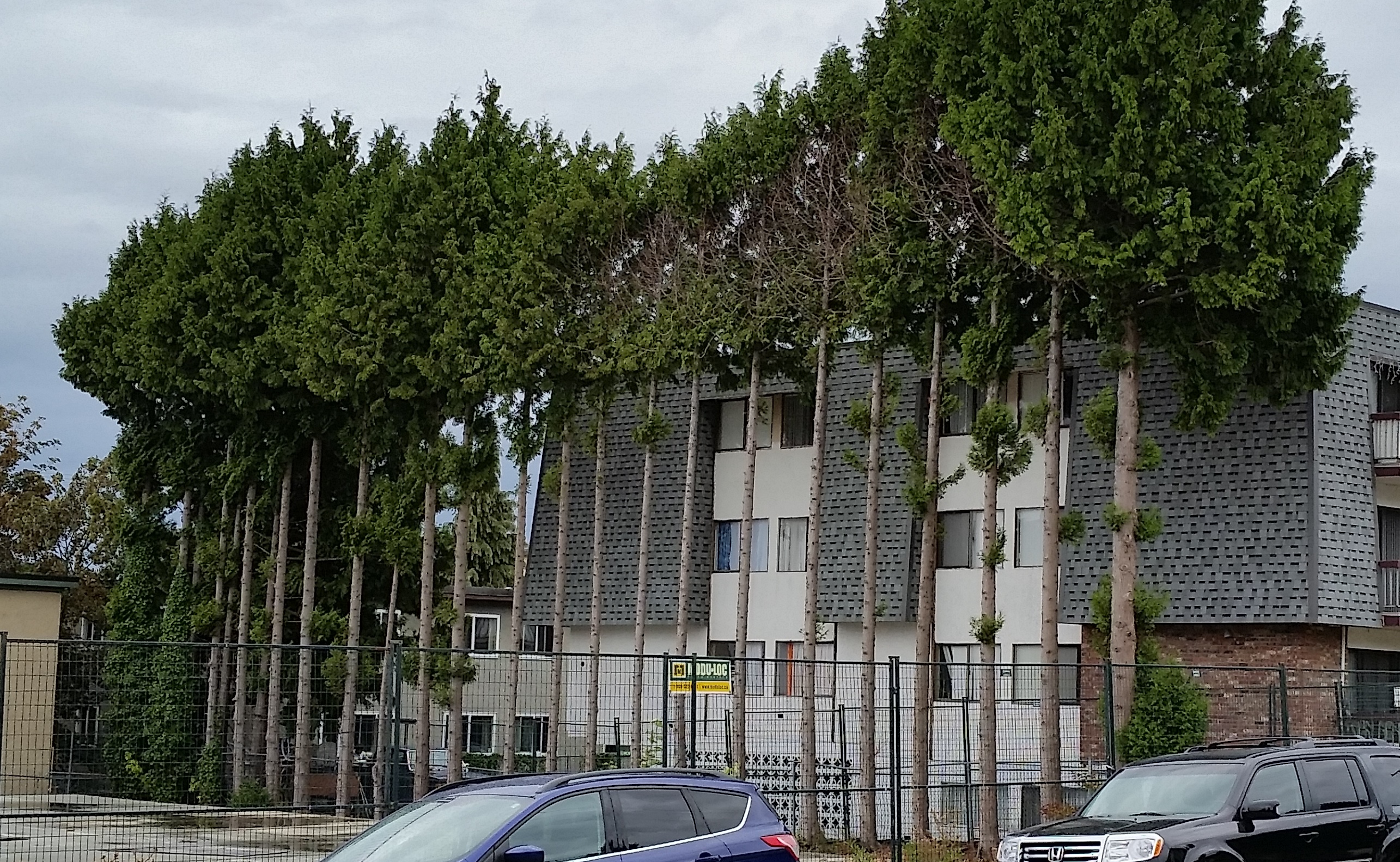
These tall, mature evergreens trees were impacted by the fire, but survived and appear now to be healthy – they even came through last weeks’ windstorm without a scratch.
They are essentially limb-free for the bottom 25 feet, but have healthy crowns that rise to probably 50 feet. Besides all of the community amenities trees provide in regards to the sustainability of our community, this particular line of trees provide an incredible weather buffer to the apartment building to the north – shading the three-story walkup from the worst of the summer heat, and reducing wind and noise.

The trees are planted just within the property line of 404 Ash, and are prospering despite only taking up about 3 feet of soil between the driveway to the north and the excavated underground basement foundations of the building that was burned. It would be a shame if we lost these trees now. It would be a loss to the Brow of the Hill community that lacks tree coverage, to the neighbours to the north, and ultimately to the residents of this new rental building (as was pointed out recently in a news story).

The trees look healthy to me, but I am not an arbourist. Therefore, I asked that Staff provide us a bit of guidance about the viability of these trees, and to opine on whether they could be saved. If the new building’ footprint is going on top of the foundation footprint of the old building, then the trees should not be effected, and just might need a bit of protection during construction. If the planned foundation of the new building is closer to the north property line than the existing building, then I would even be happy to see the entire building shifted 3 feet south to allow these trees to remain for the entire neighbourhood.

I don’t want to hold up this development, I just want to assure that every possible step was taken to protect these trees, so they are not lost out of general neglect of their benefits.

?

Council will be reviewing this Development Permit at the September 14 meeting.

Queensborough Special Study Area – Consultation and preliminary zoning

Council was asked to approve an ongoing consultation plan on the comprehensive redevelopment of a large area of Queensborough. The plan outlines the stakeholders that must be consulted under the Local Government Act (like Metro Vancouver), and those that probably should be consulted (Port Metro Vancouver), along with the next stages of public consultation, especially with property owners within the Special Study Area.

This is a large redevelopment, which will bring a commercial hub to the east part of Queensborough adjacent to Port Royal, along with residential development of family-friendly ground oriented housing. I attended a Publci Open House at the Queensborough community Centre back in June, and the reception we generally very positive about this development. There were a few traffic-impact details to work out at that time, but the most frequent comment I heard was “how soon can we get those stores?” There is a real desire to get a bit of local retail around Port Royal, and I hope it can be built early in this development plan, if the plan is approved.

There are more details to be worked out yet, but Council is happy at this point with moving the project ahead to the next steps.

800 12th Street, Text Amendment to Zoning Bylaw

A business wants to move their operation to New Westminster at 12th St. and 8th Ave, but the strict wording of our Zoning Bylaw does not allow part of their business plan. They currently offer a variety of pet services, but boarding for cats is one of them, and that does not fit the zoning of the property. There are several steps to make the required change to the Bylaw, including informing neighbours, committee review, and Public Hearing. Council is happy to allow the process to proceed as required by the Bylaw and the Local Government Act.

Street and Traffic Bylaw changes
We moved 3 readings of the changes to our Street and Traffic Bylaw back on July 13th, but before it is adopted, the Bylaw needs to pass Ministry of Transportation and Infrastructure muster – one of those gentle reminders that Local Governments and Municipal streets exist at the pleasure of the Provincial Government. The MoTI review found our definition of “street” was not strictly appropriate, and needed a bit of modification. No problem there, but to make the change we need to rescind our original Third Reading and replace it with a Third Reading of the text of the Bylaw that reflects the new definition.

Yes, this all makes perfect sense, although it is a pretty good argument for why Government can’t just “run more like a business”. Checks and balances, my friends. Checks and balances.

2014 Annual Water Quality Report

There has been a lot of talk this year about water quantity, but not as much about water quality. The water that comes out of your tap is remarkably clean, and we take extraordinary measures to assure it is some of the cleanest, safest water in the world. Our Water crews in the City and our supplier the Greater Vancouver Water District do excellent work, and it is something we should trumpet more. If nothing else, we should use it to point out the silliness of paying for bottled water.

This annual report is the public disclosure of how, where and when the 966 water samples for 2014 were collected, and the detailed results of their analytical testing. Data geeks might want to have fun there, but for everyone else- the water is safe, and we are going above and beyond the requirements to assure it stays that way.

Sewer separation budget re-allocation

If you noticed all the digging activity along Queens Street near Tipperary Park of late, that is part of the ongoing “sewer separation” program, where the City’s archaic combined-flow sewers are being replaced with separate sanitary and storm systems. A legacy of being a very old city, and a lack of infrastructure investment in previous decades, much of New Westminster’s sewers still combine storm flows with sanitary flows, which means our sanitary system carries more water than it needs to, treatment costs are high, and occasional very large storm events can result in sanitary sewer spills. Replacing these systems City-wide is a decades-long process that will cost the City hundreds of millions of dollars – we do what we can when we can.

In this report, Engineering is asking Council to approve a plan to accelerate separation in an area of Sapperton where there are current plans to pave and install gutter/drain systems. It makes sense to do the separation at the same time – you only have to tear the road up once, and you are not hooking your new surface works to obsolete infrastructure. So Council approved the plan to move some money over to facilitate this and save us money in the long run.

Update 2016 Budget Survey

The City commissions a survey every year as part of our outreach efforts during the budgeting process. The questions are very opinion-poll-like (“What do you like more or less about the City? Where do you think we should put more/less emphasis?”), but the study has been asking similar questions for several years, so longitudal trends can be tracked. This report was just a final “OK” on the survey questions from Council before the poll is commissioned.

Sole Source Multi-year Maintenance Agreement

The City has enterprise software it purchases from a large company. That software is proprietary, and requires regular maintenance. We need to pay the supplier for that maintenance, as no-one else can do it. Our purchasing Policy requires that only Council can authorize sole-source procurement for the necessary ~$150,000 per year spent on this software system. We did so.

Front Street Public Art Installation

Back in July, Council decided it didn’t like the Public Art proposal for the Front Street Parkade that we chosen by an independent jury of professionals working under the guidance of the Public Art Advisory Committee. So the project was punted back to Staff and Committee to come up with a better proposal.

This is a topic where I respectfully disagree with some of my Council colleagues, in that I think that judging the aesthetics or artistic merit of Public Art is not the role of politicians (as wise and intelligent as we may be). I won’t go into this at length here (another blog post, another time – a short version can be heard in my comments at Committee of the Whole). Regardless, I agree with the idea that we need to get the PAAC involved and get a project approved for this site.

Capital Budget amendment

The NW Police Department needs to renovate its space to reflect the results of their successful recruiting of female members. The Old Boys Club needs a few more lockers for the New Girls. This approval by Council is a preliminary step towards the NWPD including the improvements in their Capital Plan, and securing cost estimates. Council will once again be able to opine on the project once some more detailed costs and timing are worked out.

Rental Displacement Policy

This is a topic I brought before Committee of the Whole for consideration. I wanted to hear how the City’s existing rental protection policies and practices, and those of the provincial Residential Tenancy Act are working to protect individuals who are living in the City’s rental properties. I also want the report to identify potential policy gaps, and how we could do better.

There have been a couple of events recently that have raised the profile of people displaced from affordable rental accommodation. During the Urban Academy debate in the spring, there was a situation created where residents of a Manitoba Street residential building were evicted in preparation for a development that was (in the end) not supported by Council. During those discussions, it was clear that the proponent felt they took measures well above and beyond to help the displaced residents, however it was also clear that some of the families that were displaced suffered tremendously, and felt that their rights were not respected by the proponent or by the process. I also had a conversation a few weeks ago with a neighbour who knew of two other men who were being displaced right now by a new small residential development in the West End.

There is increasing media attention in some of our neighbouring communities around “renovictions” and loss of affordable and rental housing that results from rapid development (especially around SkyTrain stations) and our rapidly increasing cost of housing.

There are already some policies in place in New Westminster to prevent the loss of rental properties and to reduce the impact on affordability that comes with redevelopment, but I think it is timely for us to review the policies and have a closer look at provincial and municipal standards compared to the expectations we have as a City about how rental property and affordable housing will be protected as our building stock is updated.

After all of that Committee of the Whole action, we had a few Bylaws to read:

Zoning Amendment No. 7779, 2015
Housekeeping changes to the Zoning Bylaw mentioned above, Received First and Second reading.
Housing Agreement Bylaw No. 7775, 2015
The agreement that assures this development will be secured for rental, also mentioned above, received First, Second and Third Reading.
Street and Traffic Bylaw No. 7664, 2015
The changes made by the Ministry (mentioned above) required rescinding of Third Reading and a new Third Reading.

And that was an evening’s work.

Stroads

Can we avoid a stroad problem in New West?

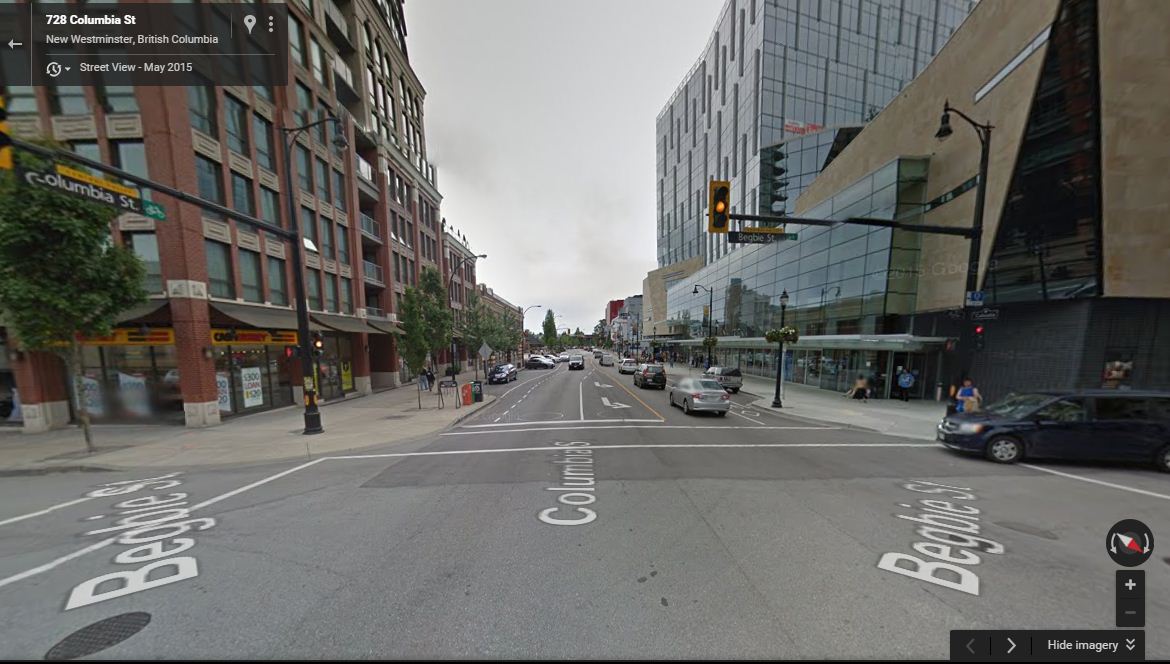
The word “stroad” is a slightly tongue-in-cheek portmanteau combining “street” with “road”, and it is becoming such common parlance in city planning that even small towns in Pennsylvania are talking about how to deal with them. The term came from people who understand the difference between how a “street” operates, and how a “road” operates. The former is a place where people do things, like socialize and perform commerce; the latter is a conduit for travel to get somewhere else. The term “stroad” pinpoints the problem created when you try to combine those two mutually exclusive uses into the same space.

I would argue that New Westminster has very effectively dealt with one stroad in its midst when the Council of the day put Columbia Street on a road diet. I remember the boo-birds talking about the disaster that would befall the City, and many of them still pop up to complain about pedestrian bumps or crosswalks or any other thing the City does to make the pedestrian space safer. Columbia is not back to being the Miracle Mile of the 1940s, and it never will be. However there is no doubt it is a better place for walking, for shopping, for living and for driving, than it was in the 1990s.

stroad5

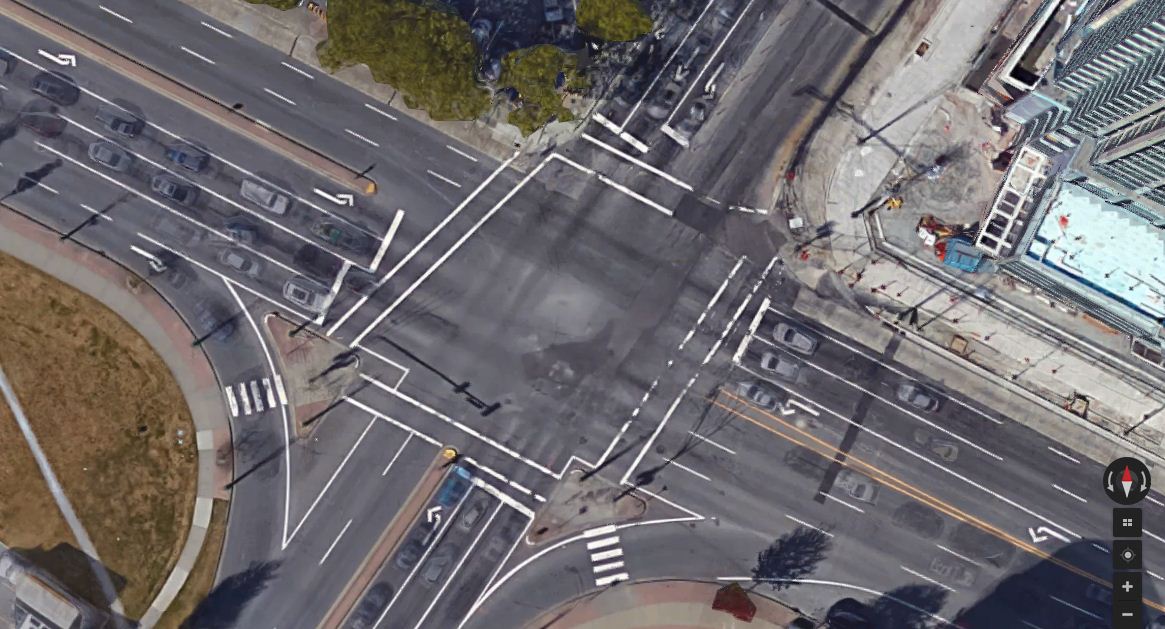
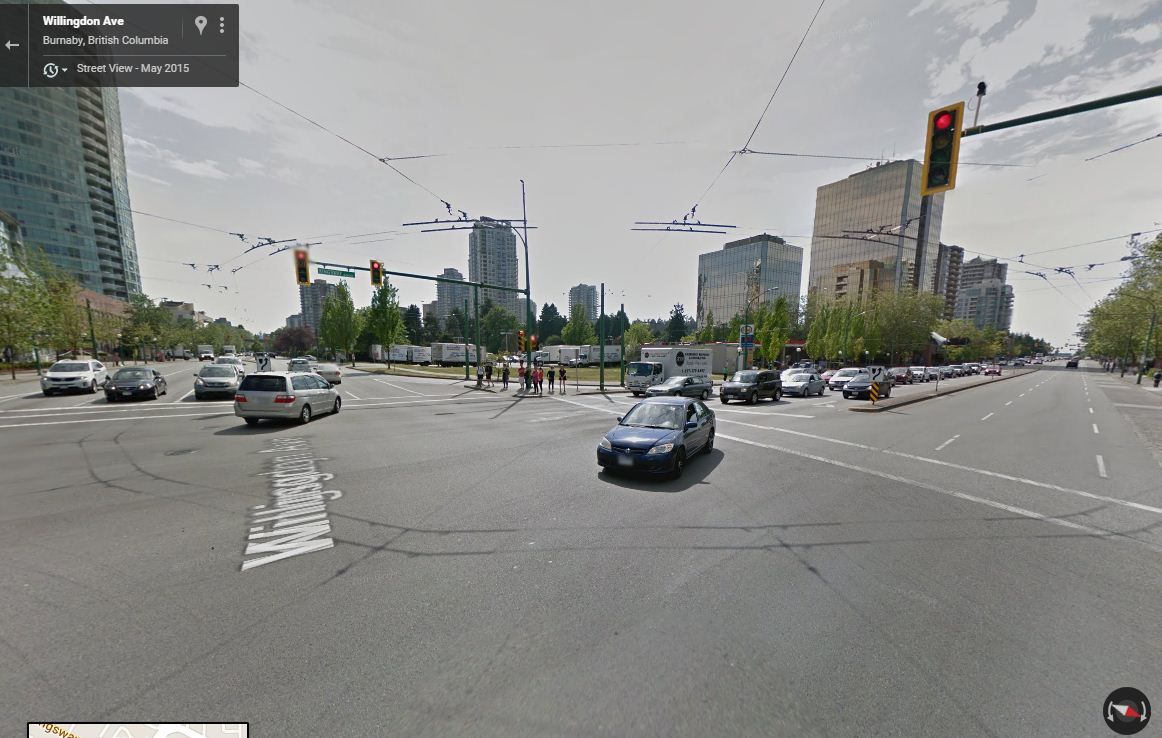
Stroads are rarely created intentionally, they evolve into existence, with a bunch of small (and at the time, seemingly rational) decisions. Most commonly, a city finds one of its shopping streets is increasingly used by through-commuters. In hopes of eking some value out of this apparent windfall, automobile-oriented development happens along the route, displacing the existing landuse with the intent to capture the fleeting attention of through-commuters. This (often strip-mall commercial) development also attracts local drivers who used to shop on the street, and now blend with the through-commuters. Congestion is exacerbated, and the engineering solution is to increase capacity. You widen the road, removing on-street parking if necessary, which requires you to build parking lots, further separating the road from the businesses, and creates in-out driveways or more light-controlled intersections, which slows the through-drivers. To fix this, you put in a left-turn lane or two so the through-traffic doesn’t get stuck, then a right-turn lane to get them even further unstuck. Which kind of works for a while (see Byrne Road and Marine, or Kingsway at Metrotown), as long as you have a bottomless asphalt budget.

stroad3

All of the sudden, you have a road in the middle of your City right in the middle of the street in the middle of your City. Anyone who wants to try to put value into the street by using their local commercial businesses discover the shops are behind expansive parking lots that are hard to get into or out of, and walking across the street means braving 40 metres of asphalt where the people trying to turn right through the crosswalk are separated from the people trying to pull a left turn across traffic by the people in between speeding along to be the first to get to the next red light, frustrated by all the traffic. So, complicated light timing, “pedestrian islands”, or expensive overpasses are required to make the space marginally safe for people who failed to bring along 3,000lbs of metal when they went to buy a loaf of bread. And we have built a stroad.

stroad4

Stroads are expensive to build and maintain. They move traffic poorly, yet provide the appearance of moving it well, which paradoxically increases induced demand while not actually increasing capacity. They are dangerous for all users, but especially for cyclists and pedestrians, who end up avoiding their chosen mode because the stroads are so uninviting. Worst of all, they strip away the value of expensive and precious urban land space, and contribute less to the local economy than an active street. They represent a planning failure, an engineering failure, and a leadership failure that must be avoided in modern urban areas.

So when you hear about plans for East Columbia Street, 12th Street, Ewen Avenue, 6th Street or 20th Street, or any of the busy streets in New Westminster, think to yourself: do we want this to be a street, or a road? Without first making that distinction, we will inevitably hedge towards a stroad, and end up with neither.

Thermodynamics

Now that we are deep enough into the Anthropogenic Global Warming crisis that only the whackiest of whackaloons are still denying its existence or the serious impacts it is going to have on planetary livability, a whole different type of whacky thought is filling the airwaves. These have to do with a variety of techniques to suck CO2 out of the sky and turn atmospheric carbon into something useful like carbon nanotubes or alternative fuels.

These schemes are no doubt possible. The problem is that they don’t solve the actual problem, which isn’t carbon in the air, it is about making energy by putting carbon in the air. To talk about that, we need to talk about thermodynamics.

The Laws of Thermodynamics are pretty fundamental science. They cannot, in the normal universe where we live, be violated. They were once summed up to me in this analogy which helps to keep track of them*:

1st Law: You can’t win.
2nd Law: You can’t even break even.
3rd Law: You can’t get out of the game.

The one we are most worried about here is the 2nd Law, which essentially says that any time energy changes states, there is a net increase in entropy. In other words, every time you use energy to do something, you lose a bit of energy. It is the 2nd Law that makes perpetual motion machines impossible.

Relating this to schemes to pull carbon out of the air and make it useful, it is important to realize we don’t just toss CO2 into the air for the fun of it. For the most part we do it to use the energy released when you combine carbon with oxygen, be it energy to drive our cars/planes/ships or energy to generate electricity. We do this because the act of combining carbon with oxygen releases energy in the form of heat (which is a whole different chemistry lecture we should save for Beer Friday). We can do the same thing backwards, strip the oxygen off of the carbon, but that takes energy, and (this is where the 2nd Law comes in) a little bit more energy than it produced during the original combination.

So all of those schemes you see that will turn CO2 into something useful, no matter how efficient they are, will require more energy than we gained when we created the CO2 in the first place. So it makes way more sense to simply not produce the CO2 in the first place. instead, we could use the energy we would dedicate to sucking it out of the air and making carbon nanotubes out of it back into doing whatever job we wanted to do with the energy we gained in the first place when we added the oxygen to the carbon. As a bonus, we can still make the carbon nanotubes out of any of a zillion existing carbon sources we have on the planet, be they plants, rocks, or hydrocarbons, without the need to waste a bunch of energy stripping oxygen off of the carbon.  That way the carbon stays out of the atmosphere, we use less energy, and we are all better off.

The reality is that the “technological fix” of climate change is nothing shocking, cutting edge or freaky; it is in our hand right now. It is no more complicated than stopping the taking of carbon out of the ground to combine with oxygen for cheap energy when there is an abundance of alternatives available. But it starts with recognizing this “cheap” form of energy is a false economy, as is betting the future on big fans and diamonds from the sky.

*there is a 4th Law, but since it was developed later, and then determined to be more fundamental, the physics community called it the “0th Law”, just to reinforce those points. In the analogy above, it would be translated as “We are all playing the same game”

Opening Streets

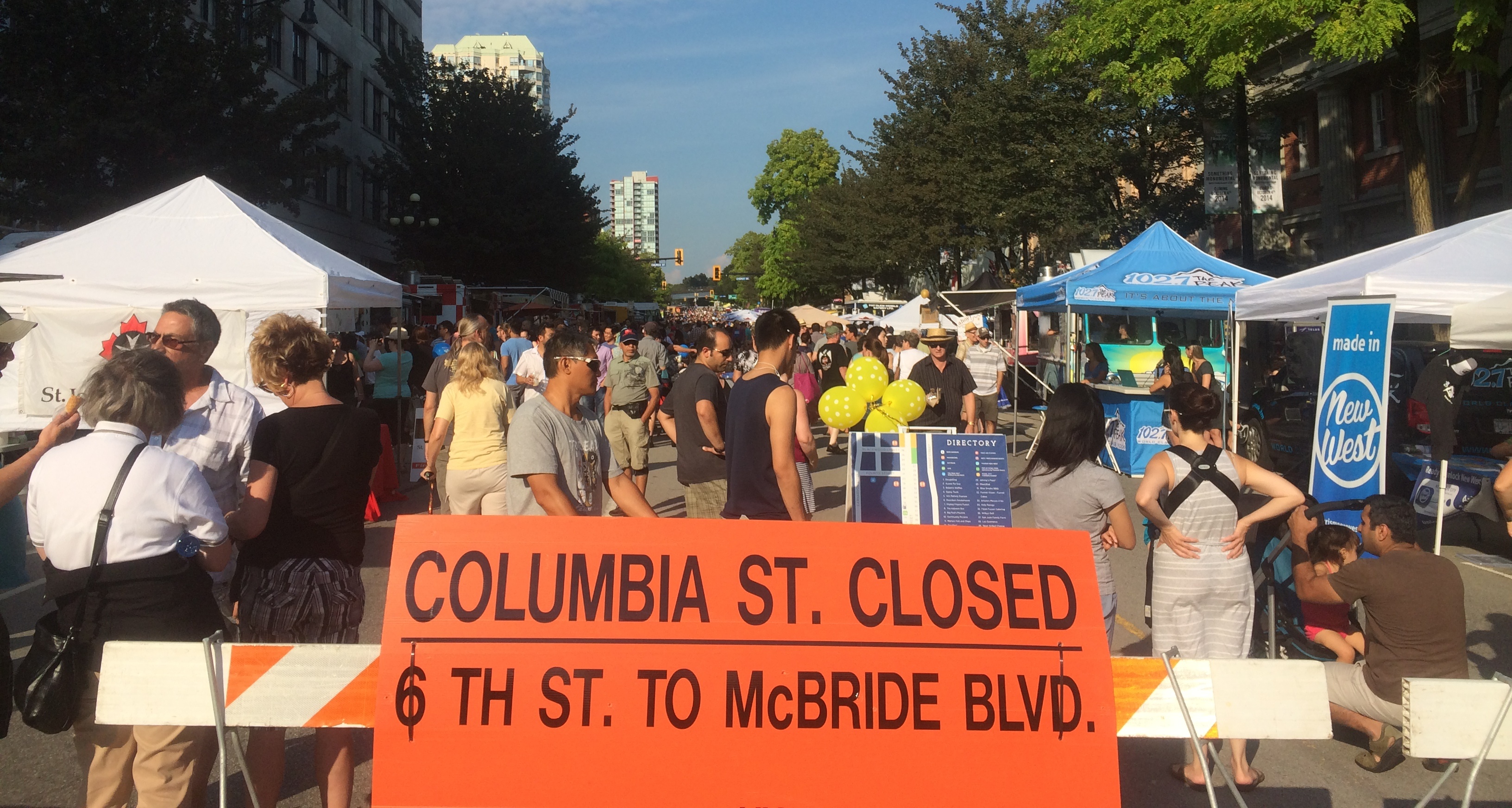
Much like this earlier post, I want to address a common use of language that has been bugging me of late: that around “closing” streets to hold events. It is a convenient term we use in a City to organize traffic management, emergency planning and engineering needs, but it is wrong. It implies that our streets are only there to serve people driving along them, or for temporary storage of your vehicle while you are off doing other things. There is so much more we can do with our streets when we stop worrying about “closing” them, and start creating better ways to “open” them.

Last weekend, I was at the New West Pride Street Party on Columbia Street, where two lanes of road was indeed closed for 10 hours so that people could walk, sit, talk, drink, dance, shop, share, eat, sing, and celebrate. I defy anyone to look at this picture of Columbia Street (which I borrowed from Bif Naked, because her view was better than mine!) and tell me that street is closed:

A photo posted by Bif Naked (@missbifnaked) on

This weekend, we are doing it again, with 70 food trucks and (if last year’s event is any evidence) tens of more thousands of people will be enjoying themselves on Columbia Street. These are not just New Westminster people, but folks from around the region coming to New Westminster to add to the vitality of our downtown, support local businesses and entrepreneurs from around the region, and hopefully discover that Downtown New Westminster is a great place to spend some time, not just a place to drive through.

closed

I also noted a news story this week about the Royal City Farmers Market plans to move uptown for their winter market season. The story mentions “Belmont Street will be closed to traffic from 11 am to 3 pm”. This statement is only true if you define “traffic” as cars. I am willing to bet that there will be more people using Belmont Street for those 4 hours every second Saturday than on any other day – it is just that the “traffic” will be on foot. By being on foot, they are more likely to stop, to shop, to talk to their neighbours and enjoy a laugh. People can, just with their presence, bring several hundred square metres of dead asphalt to life by making it a place of human interaction and commerce, not  just a place for cars to drive and park.

Language matters, so let’s stop talking about a day where tens of thousands of people flood onto our streets as a “Road Closure”; let’s start calling it a “Street Opening”.