All Pattullo, all the time.

I missed my first NWEP meeting in a couple of years to attend the TransLink Pattullo Bridge consultations in Surrey. I stepped back and did not take part in the “consultation” part (TransLink got a page full of notes from me at the New West meetings, let them hear from someone else for a change), I really just wanted to see how the other half lived, and get a sense of what the mood is on the Surrey side of the River.

Exposing my cultural biases, I walked into the meeting assuming that people in Surrey were all for the bridge, and the bigger and more toll-free, the better (which seems to be the position of their Mayor). Instead, I found there was a lot of diversity of opinion in the room. Admittedly, there was more discussion of getting rid of traffic lights in favour of onramps and overpasses in Surrey that I heard in any New Westminster meeting, but there were still a lot of people concerned about the need for the bridge, and the impacts on their community of yet another major highway expansion. Perhaps this should not be surprising, as these people are currently watching the installation of South Fraser Perimeter Road in their neighbourhood – highway expansion is not a hypothetical to them.

One of the issues I heard a lot of (that was new to me) was the encroachment of industrial and commercial development in the Bridgeview Neighbourhood. There are a lot if single-family homes in the area between King George Highway and the new South Fraser Perimeter Road, and the residents are feeling squeezed by the commercial properties along King George, the industrial lands to the east and west, and the new truck route to the north. One resident of 124th was concerned that the proposed expansion of 124th to accommodate truck traffic linking the SFPR to King George was going to bring trucks through the middle of this neighbourhood, and within 20 feet of his house. His house is built on “60 feet of peat bog”, and every time a truck drives by now “I get shaken from one side of the sofa to the other”.  Naturally, goods movement through his front yard does not seem like a good idea to him.

For many Bridgeview residents, the “Upstream” vs. “Downstream” question, which I kind of made fun of for the New Westminster side as an example of a completely irrelevant question, is not at all irrelevant. Downstream means the bridge will extend over a small area of waterfront park space (a limited, and therefore valuable, commodity in Bridgeview), but the Upstream option will move the elevated parts of the bridge closer to their homes, potentially increasing noise and view impacts.

Another thing I learned is that TransLink is actually listening. Many of the issues raised by residents in the first consultation in New Westminster two weeks ago are now being brought up by TransLink during the introductory discussions. This has even resulted in more complete answers being provided to address some of the uncertainties I raised in my earlier posts about this project.

And example is more detailed explanation of the 6-lane bridge decision. Frankly, I still think the “increased safety” argument is a red herring, but the argument for 6-lanes is more fleshed out now with discussion of the business case made back in 2008, and subsequent reviews of the business case. It would be great if the metrics of those analyses were available on the consultation page. Especially as I heard one interesting discussion at this event about how the value of the existing bridge was assessed.

I had something like this question bouncing in my head recently, but I didn’t know how to frame it. Luckily, one of the participants in Surrey was very eloquent on the idea (more than I will be in this paragraph): what about the social and economic value of the existing bridge? Like it or not, the Pattullo is an iconic structure, a steel arch-span bridge similar in age, height and length to the Sydney Harbour Bridge (though less than half as wide). It’s arch has loomed over New Westminster for 75 years: the same age as the Lions Gate Bridge and the Columbia Theatre – two structures of which no-one would argue the heritage value. Surely this has a socio-economic value to the City, and to the region. If Translink wants to replace it with another dull, cookie-cutter, concrete cable-stayed bridge built by the lowest bidder, what value is lost? Honestly, I don’t know how we estimate that value (or if we can), but this is a question that a City that prides itself on its Heritage Values needs to address: What will New Westminster look like without the Pattullo?
?

Thank You Jack Campbell!

? Another interesting question was raised by one of the participants at the tables rising from the data provided by TransLink. If the daily truck volume is 3,000 and the daily vehicle volume is 60,000, then less than 5% of the volume is actually trucks. 20 cars per truck. So why are we building a 24-hour dedicated truck lane each way? How much do we anticipate truck volumes growing? 3,000 a day is only 1 or 2 each way per minute. This seems like a lot of extra money for very few trucks. Or more frightening, does TransLink think the increase in trucks will be much, much larger? What impact will this have on New Wesmtinster?

Maybe I am getting mired in the details too much, and am missing the fundamental point here; and if so, perhaps TransLink is doing the same thing.

At all of these consultations, I have had friendly chats with TransLink Roads and PR staff, the consultation team from HB Lanarc Golder, and the representatives from the engineering firm that provided the conceptual design work. All of them say the same thing: we need to build a bigger bridge because traffic volumes are going up. Some people in the room disagree with this (as do, apparently, some members of New Westminster Council). So perhaps TransLink should not have sent their roads guys to come and consult with the City of New West on the topic of offramp shapes, but should have sent the Policy Guys to come and discuss the need for a bridge.

Perhaps the fundamental question we need answered is this: What is Translink’s Mandate? Is it to create the transportation system that people want, or that Kevin Falcon wants? Or is it to set transportation policy for the region? I always thought the latter, but the Act seems to suggest they carry both responsibilities. If so,  shouldn’t the Policy part come before the building part?

TransLink’s policy document right now is Transport 2040. So before they send people to New Wesmtinster and Surrey to talk about offramps, they should come to our communities and have a discussion about how Transport 2040 fits our local conditions. Then we can talk about the type of bridge to build. As it is, building an expanded road bridge while Surrey and the Broadway Corridor wait for their long-promised mass transit investments seems to be a demonstration of a policy very diffrent than laid out in Transport 2040. 

Pattullo and the City

Having attended both New Westminster workshops on the Pattullo Bridge Replacement being held by TransLink, and being on the Master Transportation Planning (MTP) committee for the City, I noticed there is a o lot of misunderstanding about what the City’s position is on the TransLink process, and how the City’s MTP process fits into that.

Big caveat here: I am but one member of the Master Transportation Planning committee, representing the Advisory Committee on Transit, Bicycles and Pedestrians. The MTP committee has 20+ members from various City committees and outside agencies, and is only one part of the entire MTP process, being run by City Staff and outside consultants, under direction from Council. Therefore, nothing I say here is in any way the official position of the MTP committee, City staff or Council, or anyone else other than me. It is, however, based on what I have heard said at various official meetings and unofficial conversations with staff and council.

At the TransLink meeting at the Quay on Thursday, I talked to School Board members and several other people in the community who are usually very much in the know, and I found myself trying to explain what the relationship between the MTP and the Pattullo Bridge consultation is. Unfortunately, it has been cast a bit in the media that New West is once again being obstructionist, engaging in Nimbyism, refusing to take part, and being generally petulant spoilt brats. This despite the attempts by City Council and TransLink to broadcast that this is not the case.

So I am going to presume to interpret how the City sees this process happening, based on conversations at the (public and open) MTP meeting and with City Staff and Council members (so interpretation ahead: Staff or Councillors please correct me if I am off the mark here!)
I don’t see New Westminster missing the boat at all here, but I see the City taking a pragmatic, responsible and measured approach.

The first thing you need to keep in mind is that this round of consultations on the Pattullo is the first round of a very long process. TransLink will be taking the results of this consultation (preliminary design characteristics) and then entering an “operation analysis” phase. The preferred design out of this process will be tested at both ends for everything from how it manages traffic flows, how it fits the existing traffic patterns, how bikes and pedestrians will be accommodated, etc., etc. TransLink will also start the (potentially lengthy) joint Provincial and Federal Environmental Assessment process. Both of these steps will include significant public consultation and discussion. Then they will have to deal with the financing model, hiring a concessionaire, negotiating land swaps, etc. Even after this initial consultation, TransLink is at least 4 years from any shovels getting into any ground, and at least 3 before we know whose shovels it will be, and where they want to put them.  In other words: there is no rush to provide all the answers right now.

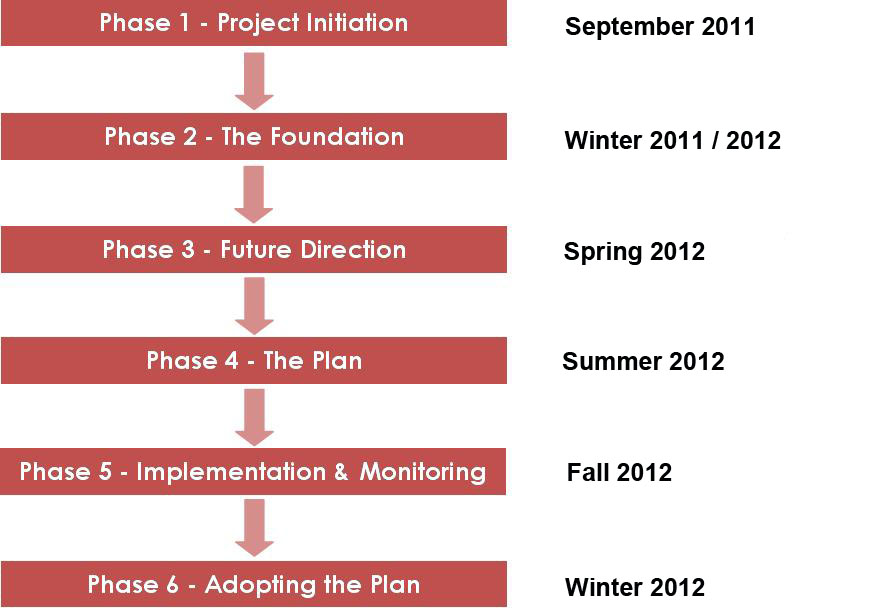
As for the City, they are updating their Master Transportation Plan, last completed 13 years ago. The MTP process will take about another 12 months. If you look at this diagram, it shows the steps for the MTP:

The City is currently completing Phase 2 (information gathering) and is about to embark on Phase 3. That is the phase where the City looks at where it is today, transportation infrastructure-wise, and determines what the Goals, Values, Objectives are for the coming decade or two. It is the big “visioning stage”. In a couple of months, after some public and stakeholder meetings, and likely workshops, the City will come up with a set of Values and Goals that define what type of transportation infrastructure the community wants to see in the foreseeable future (and in this case, by “the community”, I mean the residents, the businesses, the staff and the elected officials; everyone involved in the MTP process).

Then, when those Values and Goals are determined and formalized, the City will be in a position to approach TransLink and say: “Here you go. Make your plans address this”.

I don’t think there is yet a concrete idea of how that discussion will take place: will there be public consultations? Will the City report out to TransLink or do a joint consultation and reporting? No idea., but the point is that the City will take a bit of time right now to get a better understanding of that the community of New Westminster wants in a transportation system, then they will be armed with that knowledge when they go into negotiations with TransLink on how the bridge they want to build fits those parameters – or if it can even be made to fit them.

In the meantime, TransLink will be continuing to work on their process, but New Westminster will not be missing any boats here. We will be through that Phase 3 work in only a few months, TransLink will not likely have any operational plans in place for a year. When the MTP is at a point where useful data is available for TransLink, TransLink will be in about the same position as they are now. More importantly, TransLink knows and understands that this is the route the City wants to take, and seems to respect that decision.

So, if you really want to influence the Pattullo Bridge design? My advice is to get involved in the Master Transportation Plan process. Come to the meetings, attend the workshops, follow on-line, and provide your input at every opportunity.

Pattullo Bridge Consultation – Day 1

First off, you think TransLink would learn their lesson.

During their last foray to New Westminster to consult on highway expansion, the turnout was at first completely overwhelming, then Standing Room Only in the subsequent hastily-assembled  4- or 5-step consultation proccess. This month’s public open houses for the City’s Master Transportation Plan had a higher turnout than the consultants have ever seen at a similar event, more than 100 people each for the first phases of what, for most sities, is a dull planning document. The Lesson? Have a public meeting about Transportation issues in New Westminster, and people are going to show up! There is no excuse for having too small a room and not enough chairs for the participants.

I’m not going to talk too much about what Translink discussed at the Workshop at Centennial Centre on Tuesday. Daniel at City Caucus sums up the spirit of the room pretty well, and we were not really offered any info that isn’t available on the TransLink website for the consultation.

Instead I am going to talk about what wasn’t discussed at the meeting, and why that is a problem.

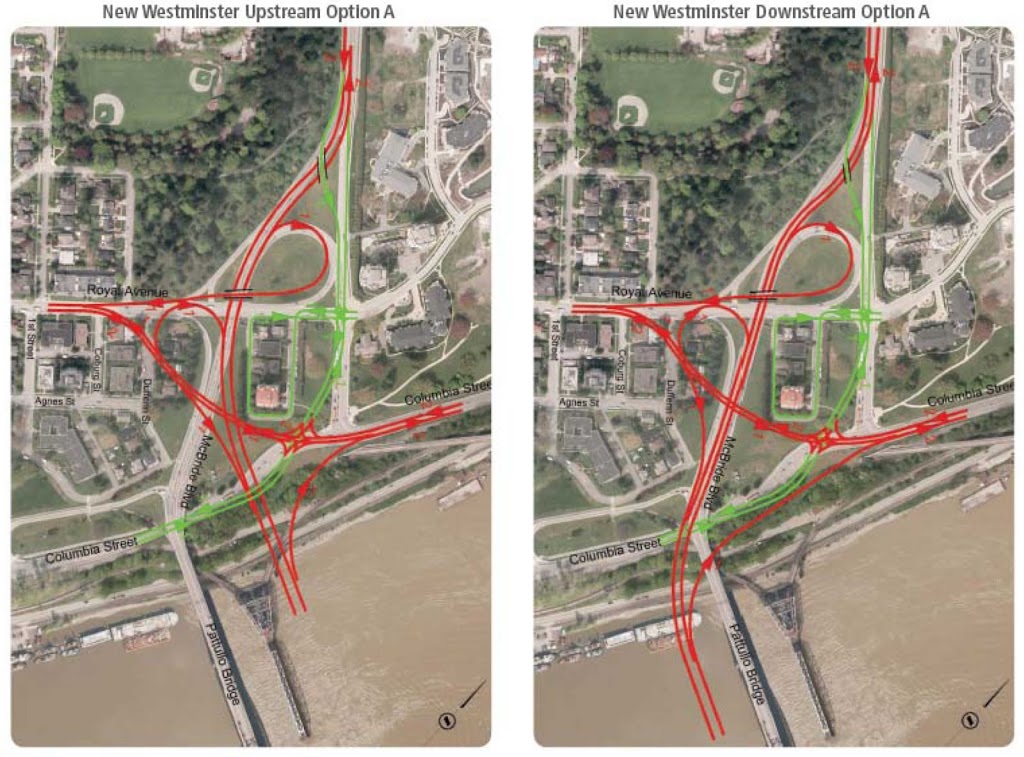
The first topic that was not up for discussion was the number of lanes. TransLink has determined they will build a 6-lane bridge with two of the lanes (apparently) dedicated to trucks only. No business case is made for this (for perspective, a transportation expert once opined to the NWEP Transportation Group that the difference between a 4-lane and 6-lane bridge could be as much as $300 Million). When pressed on the question of lane count, TransLink suggested 6 lanes was the only option on the table for “safety reasons”. The somewhat convoluted justification being that keeping trucks on the outside lanes keeps them from needing to change lanes on the bridge, or mix with the cars on the inside lanes, increasing safety for all users. That sounds good, unless you are paying attention. Take a look:

click to embigginate

All of the designs deal with on ramps the same way, but I’ll use this one as an example, because it is first alphabetically.

Say you are Dave the Truckdriver entering New Westminster from Surrey, over there in the rightmost lane. If you want to go east to Highway 1, you take the first offramp, if you want to go towards the Queensborough, you take the second offramp, if you want to continue north towards Burnaby, you stay on the main route to McBride. All are options, as all are on the Major Road Network and designated as Truck Routes. It is unclear where the main route changes from three to two lanes, but it is presumably at the first or the second offramp. If it is the first, then you will need to change lanes before then (unless that is your destination). If it is at the second, you will still need to change lanes before that. Trucks going North will always need to change lanes. So lane changing is inevitable unless all trucks are forced to a single offramp going in one direction, but that would significantly reduce the usefulness of the bridge for “Goods Movement”, wouldn’t it.

The same situation happens for trucks heading south down McBride onto the bridge, or entering the on-ramps from the other roads, they are either going to have to change lanes to get to the outside lane, or merge onto the outside lane, and there will be inevitable mixing with cars. Oh, and cars using any of the offramps will of course need to move into the lane with the trucks in it, presuming the exit ramps are all on the outside lane. It is inevitable that cars and trucks will need to move lanes, and will need to at some point share lanes. Mixing of cars and trucks in inevitable.

This is the important part: These inevitabilities do not change at all between a 6-lane or 4- lane structure. The argument that a 6-lane bridge is “safer” is a complete wash.

The second point that was not discussed was the bigger picture around how we will manage the extra traffic once it exits the off-ramps of the bridge. TransLink pointed out one of the arguments against locating the bridge in another location (such as upstream at Sapperton Bar, downstream at the Tree Island location) was the integration with the existing road network. However, the current road network on the New West side is built to accommodate a 4-lane bridge, and already fails at times to accommodate that traffic load. Increasing the bridge by two more lanes will increase traffic capacity at the City boundary by 50%,. Currently, there is no plan to accommodate that. Think McBride is backed up northbound now? Think Brunette and Braid is an issue today? Think the Stewardson-to- Queensborough connection is a mess today? How will increasing traffic 50% to these locations help?  This is unfortunately and eerily like the UBE discussion again.

Tranklink responded to this saying: we’ll design the bridge first, then figure that out. Not surprisingly, few people in the room were satisfied with that answer. That answer shouldn’t be acceptable to anyone in the region who is funding TransLink; even those that believe building roads can solve traffic problems. TransLink wants to spend a Billion of your dollars to move a traffic pinch point 100m up the road. This is an example of a build-then-plan mentality that has them currently building a $4 Billion 10-lane Port Mann Bridge / Highway 1 Widening Project and a $1 Billion South Fraser Perimeter Road project, two major new Goods Movement routes that actually cross each other but do not intersect, forcing trucks to drive through New Westminster to get between them.

Oh, and that Billion dollars? That was the third topic not discussed. According to Translink, there is currently no funding source for the bridge. They are therefore presuming that it will be funded by tolls, likely through a design-build-operate concessionaire, much like the other 16 lanes of Fraser River crossing traffic that have been built in the last decade. They won’t say it is tolled, but they won’t say if there are any other sources.

This creates another area of uncertainty that needs to be addressed before we go any further. The BC Liberals have, as few as two weeks ago in that strange radio-interview-mini-throne-speech-event, suggested they are against tolling. The Mayor of Surrey doesn’t like tolls for this bridge. However, the senior governments are not lining up to dump a billion dollars on TransLink, and TransLink can’t raise taxes. So how are we paying for this thing? TransLink says let’s design it, and get approvals, and the money will arrive. One significant problem with this, of course, is that we cannot establish the business case or the demand for the bridge without knowing if it will be tolled.

TransLink representatives after the meeting admitted their estimates for future traffic demand on the bridge are based on tolls being collected. They provided some demand estimates based on population growth: increased vehicles from 60,300 today to 94,800 in 2041, but didn’t make clear in the presentation part that these estimates are based on a 6-lane, tolled bridge. How do these estimates change if we build a 4-lane bridge? Or if we don’t toll? Or if this same $1 Billion is invested in rails and/or SkyTrain for Surrey and Langley? Or are we, once again, just going to build it, then plan?

We have learned from the Golden Ears bridge example that tolls are effective Transportation Demand Management tools. People have avoided paying them, by driving around the long way or by reducing the number of trips. We have also learned from the Golden Ears that traffic estimates for tolled bridges can be overly optimistic (not the same story for new rapid transit infrastructure).

So without demonstrating the need for increased lanes, without explaining how these increased lanes will be accommodated on our already crowded and built-out streets, and without telling us how the bridge will be paid for, TransLink has taken to time to ask us which side of the old bridge we would prefer the new ramps?

Sorry TransLink. For some reason, the people of New Westminster are not feeling like they are “Part of the Plan”.

Cluffy and the Bridge

It is not going to surprise any CBC Radio1 listener if I admit to being a firm Anti-Cluff-ite.

Rick Cluff is the morning show host in Vancouver on the Flagship Mothership, and comes to us after a long history of sportscasting in southern Ontario. This explains why the only thing he approaches with any intelligence or enthusiasm is sports. When talking to the Sports Guy in Toronto (whoever that is this week), he is in his element. And food; he seems to really be into talking about food. For pretty much any other topic, he is hopeless.

It is worst when he is interviewing someone on a topic he is less versed in, like, say, this morning’s interview with TransLink’s Sany Zein about the Pattullo Bridge. (you will be able to hear it here, February 21, just before the 8:00 news, so about 1:50 into the 2:35 program). Rick’s technique is to prepare for the interview by finding the conflict, then writing down a bunch of questions probing that conflict. That way, during the interview, he can read the questions off the page (and the cadence he uses make it clear he is reading through the bottom of his bifocals) and not have to worry about listening to or understanding the answers. It is especially funny when an interviewee provides the answer to the question before Rick asks it, and Rick just can’t break the script and have a conversation, so he boldly charges ahead and asks the question just answered…

In this morning’s conversation , the conflict narrative was New Westminster being a roadblock to replacing the aged Pattullo. Sany Zein tried to clarify and explain that New Westminster was in the middle of their Master Transportation Plan and that the two consultations would work in parallel, and together. There is no conflict there. Then he has a canned input from Wayne Wright saying the same thing, followed by Mr. Zein repeating it, but Rick kept on narrative- How can they move forward with New Westminster being so uncooperative? It was painful.

The worst part is that Rick’s blind devotion to the conflict he wrote down on his crib sheet kept him from asking questions most of his listeners wanted to have answered. How big will this bridge be? Who is going to pay for it? Will it be tolled? How can the public get involved in the consultations? You know, useful information that the news could provide, instead of trying to find a simple conflict narrative to attach sports metaphors to.

Contrast this to Stephen Quinn’s interview approach, where he carries on a conversation, responds to the previous answer, and prepares himself ahead of time so that he can follow the conversation wherever it leads. He also has a knack for fitting in that one slightly uncomfortable question that the public wants to hear answered. Quinn is clearly the best interview talent on the local CBC. Yet again, I digress.

In the case of this morning’s interview, Rick Cluff continues his trend of seeing the world through a windshield. He is of the generation that thinks you can solve traffic problems by putting more roads down, which is a frankly ridiculous approach in the year 2012. This might be because he drives in from White Rock at 4:30 am when the roads are empty, then listens to the traffic reports all day and can’t imagine the cars are the problem.

Regardless, Sany Zein is, in my experience, an approachable and thoughtful guy. So you should feel comfortable asking him questions directly during the open houses coming up this week. Starting tonight!

Discussing the Parkade- Part 1.

There was a meeting tonight hosted by the Downtown New Westminster Business Improvement Association, on the topic of… well… a few things.

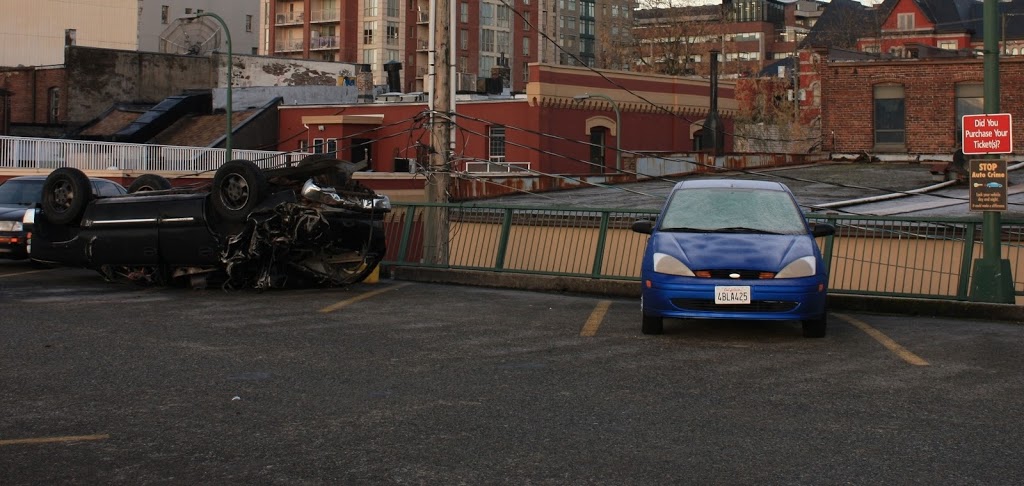
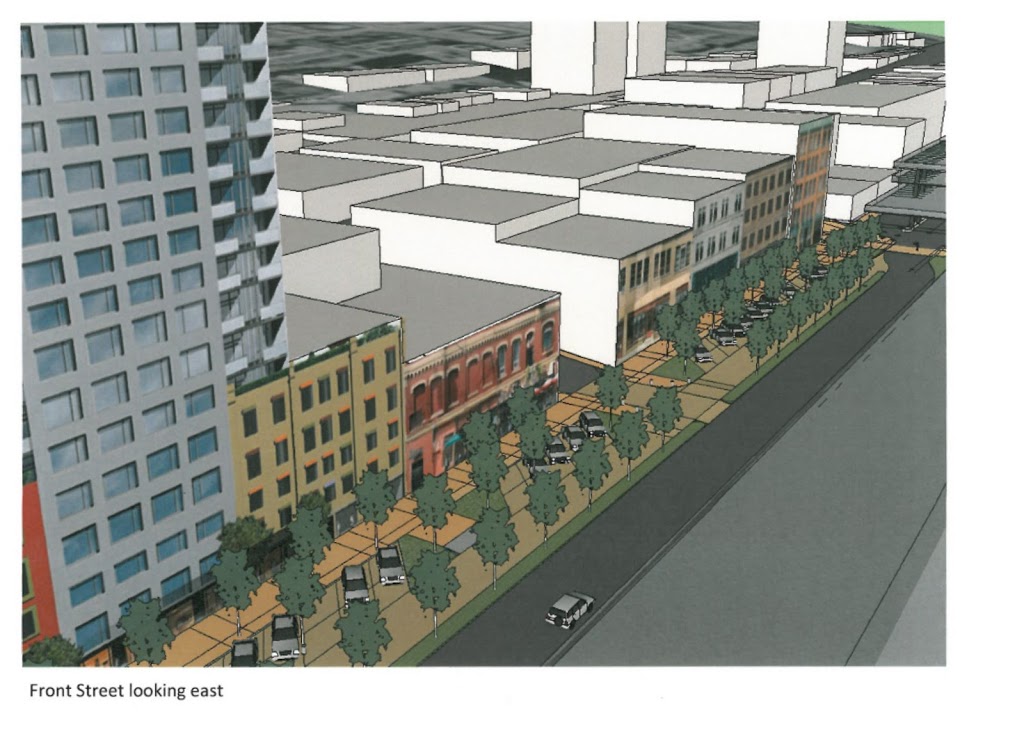
The main point of discussion was the future of the Front Street Parkade. There have been reports to council talking about longer-term visions for the waterfront, most of which include the partial or complete removal of the Parkade. These are supported by some engineering reports that indicate the maintenance costs for the Parkade are likely to go up significantly in the next few years, and some decisions are going to need to be made about how much to invest. It probably doesn’t help that some uppity bloggers have been calling for the end of the Parkade for a while now…

Naturally, there is a significant number of downtown business owners who see ample, inexpensive parking as fundamental to their business success. When others (be they uppity bloggers, City Staff, or Elected types) start talking about taking away their parking, they get a little itchy.

The BIA also had some gripes about back-in angle parking on Columbia, Bike Lanes, bike lanes, and Pay Parking on Sundays, but those issues seemed to be brushed aside as the conversation centered on the past, present and future of the Parkade.

Present were about a score BIA members, and about the same number of non-BIA types (including downtown residents and uppity bloggers), a few members of the local media, and from the City: Mayor Wright, Councillors Puchmayr, Harper, and MacIntosh, and Jim Lowrie from the City Engineering Department.

The Transportation Committee of the BIA provided a PowerPoint presentation with a lot of words on it (all caps lock), and perhaps I will go through that presentation in detail in a later blog post. Now I want to more talk about the spirit of the room and the nature of the conflict, from an uppity blogger point of view.

If I’m not sure how to summarize what the BIA’s complaints are, it might be because they have not come up with a coherent message. It is clear they do not like that others are suggesting they are going to take away parking. They feel that access to parking, and more specifically, access to the entire Parkade that they (or their ancestral business owners) financed and built, is not only necessary for their businesses, but is vital to the future of the City’s business community.

Arguments that the Parkade is underutilized are countered by the BIA suggesting the Parkade is too expensive and not effectively marketed. Dan O’Hearn from the BIA went so far as to suggest that if the Parkade was put under the control of the Downtown Merchants, it would be filled to capacity providing revenue for the Merchants. This reflected a certain spirit in the room that the Parkade is just poorly managed by the City.

To me, this argument has always sounded like cognitive dissonance, to argue on one hand that every parking spot is needed and that Downtown suffers from a lack of parking, then to argue on the other that the Parkade needs to be more effectively marketed to get people to use it. Are they saying there isn’t a lack of parking Downtown, there is a perceived lack of parking? Or are they saying there are simply not enough parkers downtown? How is either an argument for investing in a mostly-empty Parkade?

Even then, whose responsibility is it to advertise the availability of parking in the Downtown Parkade? The City? The Parking Commission? Dare I say, the BIA?

However, I think the main complaint I heard was that the BIA was not in the loop about what is going on. I heard a lot of people unhappy about not being consulted, and more than a few people worried that the Parkade would be going away this year, with no plan to accommodate the people who currently use the Parkade. It may only be 30% used on most days, but that still represents more than 200 parking spots.

I think this is where there is agreement between the BIA and uppity bloggers like me (and other people who are looking forward to a pedestrian-friendly Front Street connecting Downtown with real human ties to the Waterfront). We agree that there needs to be a plan. I just happen to think we need to look at confirming our current and future parking needs, then planning to accommodate those needs as we develop the Downtown, with the eventual goal being the removal of the eyesore Parkade from our waterfront. The BIA just doesn’t want the Parkade removed until there is a plan in place to accommodate Downtown parking needs. Some might think we are looking for the same thing.

Jim Lowrie and the Councillors at the meeting said as much. The plans they have read regarding eventual Parkade removal have been mid- to long-term planning documents. The City has no intention of removing the Parkade until the BIA and other stakeholders have been consulted, and until there is a comprehensive plan to address the current and future parking needs of Downtown.

So the two sides are not too far apart, and the City is right in the middle. This shouldn’t be to hard, should it?

The Port Declares War

Jeff Nagel of Black Press (who is turning out to be the best Municipal Affairs reporter in the local Dead Tree Press) wrote a piece on recent proclamations by the new CEO of Port Metro Vancouver, and the reactions from various groups throughout the lower mainland.

My first reaction was – poor bastard from England has no idea what he is doing wading into ALR politics. Then I did a little research and see that CEO Robin Sylvester was party to the sell-off of part of BC Rail, so he is obviously aware of (and not afraid of) the worst of BC political morass. He knows exactly what he is wading into here, the poor bastard.

My issue with the Port Authoirty is not just their stunning disregard for the spirit of the Agricultural Land Reserve (even if, as a Federal Agency, it doesn’t apply to them), but their business model. It isn’t just farmland that the Port has declared war upon, it is our roads, our waterfronts, and the livability of our cities.

All of this discussion skips over the reason we have n ALR. It is because BC has very little high-quality farmable land, and most of it is very close toVancouver. Once farm land becomes industrial land, commercial land, or a neighbourhood, it is neigh impossible for it ever to be returned to agricutural use. none of these characterisitcs are true for Industrial Land. Industrial Land can be located anywhere, and land that was once industrial can be easily converted to other uses – and land under other use can easily be converted to industrial use. All it takes is for someone to spend the neccessary money to convert the land. So the need for an “Industrial Land Reserve” is a red herring. There is no scarcity of land to put warehouses upon, although there is currently a scarcity of people willing to spend money to deveop industrial land, and a lack of willingness for Cities to provide appropriate industrial zoning within their land base.
Which brings us to the Port, an organization that is exploting these issues, and is rapidly getting out of the business of taking things off of and putting things on to boats. If farmland (which is commonly located right next to the River) is sacrificed for that, they may have an argument for balancing out industry and farming. Frankly, if the current buzz-word “Food Security” is our primary concern, it is no worse than Golf Courses or cranberry bogs, or even the 100-acre greenhouses being built on ALR farmland today:

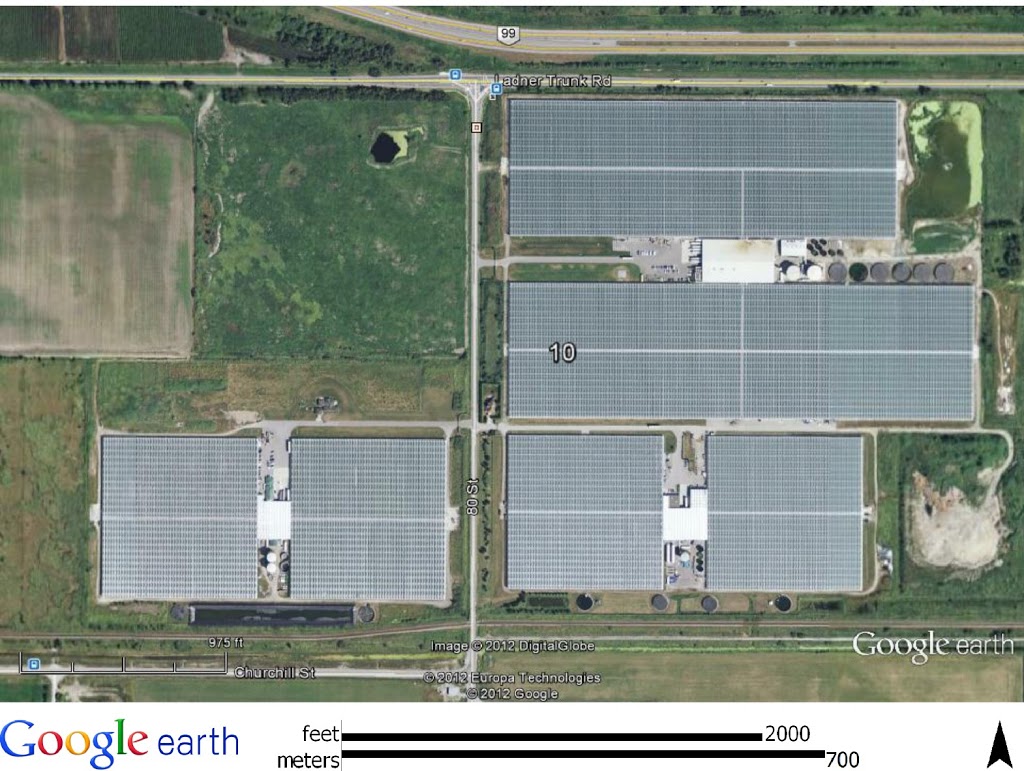
140 Acres of our best Reserved Agricutural Land in Delta

Except that the port isn’t using our prime farm land to take things on and off of boats. They are using it to take things on and off of trucks, something they can do on any land, really. No need to use ALR land. The only reason they choose to do this on ALR land is because they can buy ALR land at a fraction of the cost of non-ALR land. Since they are able to remove it from the ALR with federal fiat, they can convert it to valuable lease space for warehouses, instead of buying expensive commercial- or industrial-zoned land that municipalities have set aside for just that purpose.

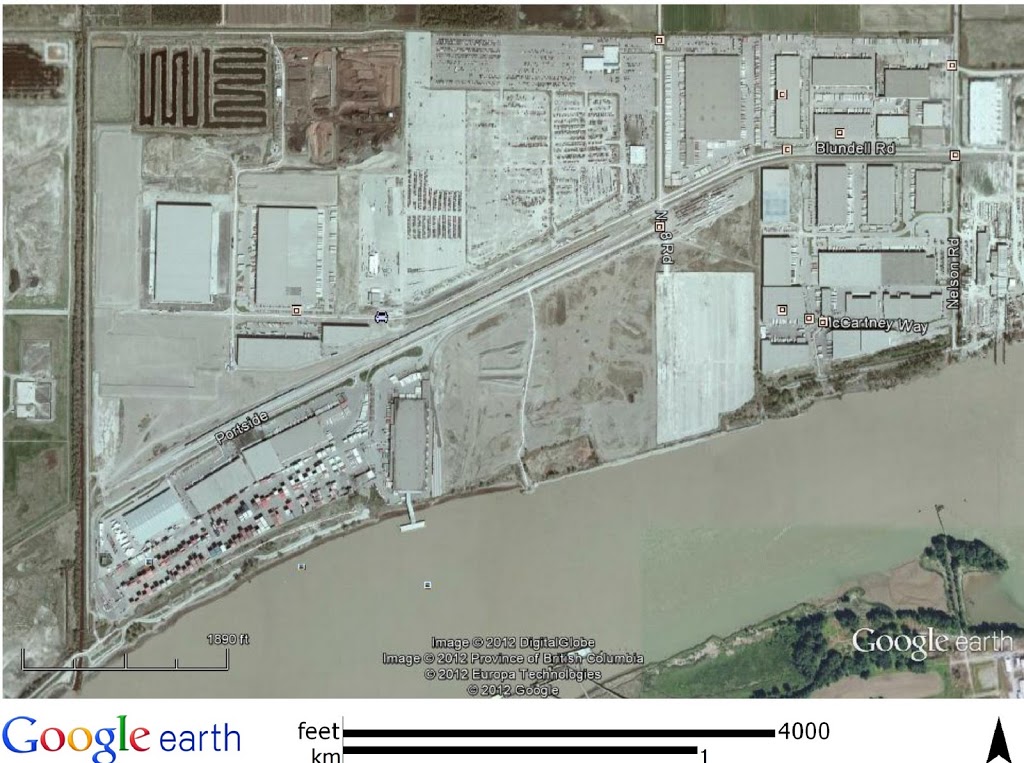
This is because the Port is no longer in the business of taking things on and off of boats, they are now a real estate development and lease business. How else can one justify the purchase of more farm land in Richmond? Look at the port land adjacent to their recent purchase in Richmond:

click to zoom it. or go to Google Earth yourself

All those warehouses (actually there are more now, this photo is a little old), a new highway overpass to connect this land to the East-West Connector, and only one thing is missing: Docks. There is a single berth there for ships, where a single business moves wood pulp onto barges from the rails. Every other business there is truck-oriented, with only a couple even having rail spurs. This is the Port Authority business plan for ALR land. Buy cheap, develop, lease for cheaper than anyone else can. That’s the free market, I guess.

So what? Notice how much of the talk about the traffic issues in New Westminster are around “goods movement”. The issue always comes up of trucks crowding our roads, or our livability being eroded by the noise and pollution of all this container traffic on our roads. When people wonder why we aren’t using the river or the rails more, why there are all these trucks on the road. They aren’t bringing laves of bread to Safeway, they are shuffling goods from the actual Port to “Port Facilities” like these, and to the vast warehouse ghettos of places like Port Mann, Port Kells, and Port Coquitlam – all locations of huge truck warehouses, and all lacking in actual Port facilities to move things on an off of boats (with the occasional exception of logs and woodchips).

How will we ever make use of the goods movement opportunities of the River, when it is against the business interests of the Port Authority – the only agency with any jurisdiction over the waterfront?

The MTP Begins

Thursday night is the first open house for New Westminster’s Master Transportation Plan. The first meeting will mostly talk about the process to come over the next 12-18 months, and there will be more public consultation, so don’t go in expecting to hear a lot of answers… but do expect to hear lots of questions, and be prepared to ask them!

The part I am looking forward to is the first bits of data coming from the City’s traffic measuring and public surveys. it will be interesting if the problems we perceive are the same as the problems shown by traffic counts and other data collected by the City and their consultants.

As for the path ahead, the new President of the NWEP, Reena Meijer-Drees does a great job getting Grant Granger at the NewsLeader updated on what the vision that group has for the future of transportation in the City. This is a great start. 

 There was also a great short article in the March Walrus Magazine (I suspect you non-subscribers will have to wait a month or so until you can read it on-line, or pick it up at the Library) talking about Luc Ferrandez, the Mayor of the Montreal’s Plateau borough. Being both a cyclist and and a believer in contemporary urbanism, he has been turning one of the most storied and historic neighbourhoods into a pedestrian-friendly paradise of wide sidewalks and green spaces.

Limited in his powers by a Metropolitan Government that oversees all major transportation infrastructure, and facing opposition from neighboring communities whose denizens want to commute through the Plateau unfettered by his neighbourhood traffic calming, Ferrandez is unapologetic. How unapologetic?

“I accept that some people think I’m the Devil. For them, the Plateau doesn’t exist. It is just a place to be driven through. I don’t give a shit about those people. They’ve abandoned the idea that humans can live together”.

Oh, to have the candor of Québécois politicians. However, when speaking about his vision for his neighbourhood, he sounds inspired:

“The Plateau is an Italian cathedral. It’s a forest. It’s something to protect, something sacred. I don’t want it to become a place where people come to live in a condo behind triple-glazed windows for a couple of years. This has to be a place where people can be comfortable walking to the bakery, walking to school, walking of the park – where they want to stay and raise a family”.

Will anyone stand up and say they want anything less for British Columbia’s most historic City?

Confessions of a Greenpeace Dropout Review – Part 6 – Fit the last.

As diligent readers are aware (Hi Mom!), I have been ploughing my way through Dr. Patrick Moore’s dissertation on “Sensible Environmentalism”. What started as a review turned into a lengthy criticism. This is the last fit of a 6-part essay, and it is worth reading it all if you want to learn about how Patrick Moore and his Greenwashing company use misinformation, self-contradiction, and frankly absurd ideas to market everything from coal mining to salmon farming as “Green Industries” You can follow these links:

Although this book is full of ideas with which I disagree, and many ideas that are just flat wrong, I always suspected Dr. Moore at the least came by his ideas honestly, or for the most pragmatic reasons. His debatable ideas on clear-cut logging (the best thing one can do for a forest!) and fish farming (the only way we could possibly save the native salmon!) likely rise form his history working as a logger and a farmer of fish. His call to end government subsidies for wind and solar, while at the same time making the use of ground-source heat pumps mandatory, may have to do with his promotion to Vice President of NextEnergy: “the Canadian leader in designing and marketing geothermal systems for the home!”

Or maybe those are coincidences.

However, in his discussion of Anthropogenic Global Warming (AGW), Dr. Moore not only loses his remaining credibility, but loses any claim to being science-minded, skeptical, sensible, or an environmentalist. Coming from someone with the intelligence, training in science, and access to information that Dr. Moore is alleged to have, his arguments are so poorly thought-out, so anti-science, and so ill-informed, that it can only be the result of a disingenuous and callow disregard for the truth, and for the intelligence of his readers. I am going to waste a lot of words discussing this part of the book, because it is a microcosm of everything that is wrong with the current public discourse on AGW.

To get there, we have to first take a step back and talk about Duane Gish. Dr. Gish is a Young-Earth Creationist who met with some small fame holding public debates against scientists on the topic of Evolution. Dr. Gish brought to these his opinion that the Bible is literally true and that the Universe was created in a single 6-day fit about 8,000 years ago, in exactly the order that is written in Genesis. Clearly, this is a preposterous position to debate against a serious scientist with academic expertise in genetics, geology, astronomy, or, for that matter, physics or chemistry. That did not stop Dr. Gish. Paradoxically, audiences would quite often leave the debates feeling Dr. Gish had “won”. This is because he used a rhetorical technique that he wielded with such might and power that it now bears his name.

The Gish Gallop is a debating technique where one uses their allotted time to throw out such a large number of disconnected, unsupported, misrepresented or simply untrue “facts” that the opponent can only hope to refute one or two of them in their rebuttal time. After rebuttal, the Galloper ignores the countering points made by their learned opponent, and just throws out a new random pile of other points, or even the same ones slightly re-phrased, until the opponent is left to throw up their arms in frustration. It is less the shotgun technique than the M61 Vulcan technique.

The point is: for the Galloper, it is not important that you support any of your allegations with truth or data, or even if several of your allegations contradict one another – just keep shooting out stuff and let the poor bastard on the other side try to refute it all. To a general audience, one guy sounds like he has all the facts, the other guy can hardly refute any of them, so guess who wins? The Gish Gallop is well known by Creationist “debaters”, and has been adopted very successfully by people like Lord Monckton when discussing AGW. In skilled hands, it is an effective debating tool. It is also the mark of someone who knows that few of their actual arguments will stand to scrutiny on their own, so in that sense, it is the epitome of being disingenuous.

When I read Dr. Moore’s discussion of AGW, I couldn’t help but see Gish Gallop all over it. He, in turns, argues that it isn’t getting warmer, that warmer is better, that climate scientists lie, that scientists are incompetent, that most scientists don’t believe in AGW, that CO2 cannot cause warming, that the warming caused by CO2 is good for plants, that the ocean is not acidifying, that ocean acidification is good for corals, that human action can’t possibly impact the climate, that human activity might have prevented an ice age, that AGW will lead to more species, that sea level is not rising, that sea level rise is a good thing, that ice is not shrinking, that ice shrinking is a good thing…etc. etc. It is painful to read, mostly because it seems that Dr. Moore forgot that Gish Galloping does not work if those you are debating against have infinite time to refute each point one at a time.

Now I cannot hope to address each of his points here. Even given infinite time and near-infinite bandwidth, my patience to stupidity is not infinite, nor should yours be. So I am going skim the cream off the top of his Gallop, and allow you to find out for yourself if there are any curds below.

Dr. Moore’s discussion of AGW starts by suggesting there is no scientific consensus on AGW. This argument can be summed up into three Logical Fallacies: Argument from Incredulity, Argument from Authority, and Argument from Popularity.

The first argument is basically this:

“The subject of climate change… is perhaps the most complex scientific issue we have ever attempted to resolve. Hundreds, possibly thousands of factors influence the earth’s climate, many in ways we do not fully understand” pg. 330

This is a rather uncompelling argument. I hardly think measuring the basic energy flows of the earth’s atmosphere is all that more complex that, oh, I don’t know, tracking speed-of light particles with half-lives measured in the picoseconds at the Large Hadron Collider or unravelling the 3 billion base pairs in the Human Genome Project. Yeah, complicated, but hardly insurmountable, and with numerous lines of evidence from dozens of different disciplines pointing to the same conclusion, and a well-understood causation train, it is not really that big a scientific leap to conclude that increased CO2 output results in higher atmospheric CO2, which results in a stronger Greenhouse effect.

Argument two sounds like this:

“A comprehensive scientific critique of the IPCC’s findings… was signed by more than 31,000 American scientists and concluded, ‘there is no convincing scientific evidence that human release of…greenhouse gasses is causing or will cause catastrophic heating of the Earth’s atmosphere’. Clearly there is no overwhelming consensus among scientists on the subject of climate.” Pg 332

The 31,000+ name petition of which he writes is none other than the one generated by the venerable climate research foundation the Oregon Institute of Science and Medicine. You need to follow that link to see what they are about, seriously, take a look. It is telling that Dr. Moore talks about their work, and provides lots of references to them in this chapter (more on that later), but he clearly recognized that linking to this source would not improve his credibility. This is what I mean by being disingenuous.

I know, that is a bit of an ad hominem (although, ad hominem is actually a valid rebuttal to Argument from Authority), so lets take a closer look at the 31,000 scientists. You can see from the Petition Project Site that, of the 31,000, exactly 39 self-declared as Climate Scientists. This in comparison to the 2,000+ Climate Scientists who took part in the IPCC Working Group that the Petition Project was a response to. Sounds like something close to a consensus there. What of the other 30,961 scientists? A random mix of biologists, geologists, computer scientists, chemists, engineers and medical doctors. Yes, more than 13,000 were trained in medicine or engineering (I know my podiatrist has strong feelings about Climate Change, but does his M.D. really represent authority on the subject?) The only selection criteria for this Petition Project is that you had to get at least a B.Sc. in some physical science field, or medicine, or engineering. To put that in perspective, there are, according to recent counts, at least 10 Million Americans who have received their B.Sc. in an applicable discipline since 1970. So the 31,000 represent about 0.3% of “American Scientists” the way the petition itself defines them. I dunno, 99.7% sounds pretty close to a consensus to me.

As an aside, they seem to put a lot of emphasis on the scientific credibility of TV weather forecasters. I rest my case.

Ultimately, the Petition Project is a marketing exercise, not a scientific survey. It was a voluntary on-line sign-up, with no vetting of actual credentials. Luckily, a scientific analysis has been done, judging the opinions of climate scientists, other scientists, and the general public. It seems the consensus decreases the less people actually know about the climate and about science. Likely the Dunning-Kruger Effect. Which brings us to Argument #3.

This third argument is a general discussion of how the general public doesn’t believe in AGW. He quotes a bunch of public opinion polls indicating the “man on the street” does not believe in AGW. Or even that people don’t believe that other people believe in AGW, like that is relevant to the scientific certainty of the issue:

“ a poll taken by Ipsos Mori found 60 percent of Britons believed ‘many scientific experts still question if humans are contributing the climate change’. Clearly a majority of the British public does not believe there is a scientific certainty on the subject”. Pg 334.

Now, I hate to sound like a weedy academic elitist, but polling public opinion about the opinions of researchers is not really the best way to find scientific truth.

Do I really need to say that to a guy with a PhD?

Again, for perspective only, I can list things that a majority of Americans think, according to polls similar to the ones Dr. Moore cites, and you can decide if these are, therefore, scientific facts:
80% believe in the literal existence of angels;
78% believe Evolution by Natural Selection is false;
60% believe that Noahs Flood actually happened.
So much for the wisdom of the majority.

Soon after this, Dr. Moore’s honesty takes another dive. There is a bit of intellectual dishonesty that people often engage in, on both sides of this discussion: “cherry picking” data. This is a type of scientific fraud where you pick data that supports your theory, but disregard data that does not, without any justification for that dismissal. Aware of this concern, Dr. Moore says:

”I will try not to ‘trick’ the reader by cherry-picking timelines that support a particular bias” pg336

Then, on the bottom of the very same page he engages in this blatant piece of cherry picking:

”Since 1998 there has been no further warming and apparently a slight cooling” pg336

On… the… very… same… page. He also engages in timeline cherry picking in other areas, such as on Page 344, alleging “cooling” between 1940 and 1980 (when there was actually a slight slowing of the continued warming trend), but let’s concentrate on the first cherry pick, as it is very commonly heard in the Anti-AGW noise.

The grain of truth in that pile of bullshit is that 1998 was previously thought to be the year with the highest average temperature ever recorded by surface-based instruments since reliable instrument records began around the turn of the previous century. It is more commonly held now that 2005 and 2010 were both warmer, with the benefit of more robust analysis. The argument about 1998 vs. 2005 vs. 2010 is kind of irrelevant, though, seeing as how the nine of the hottest years recorded have happened in the last 10 years, with 1998 being the one outlier. Plain and simple: the world is getting hotter at a rate unprecedented in our recorded history, or in the proxy record (Tree rings, varves, coral layers, ice cores, etc.). Surface temperature logs are not the only effect that we measure that demonstrates AGW.

The importance of Rate of Change is a topic that Dr. Moore completely ignores. In 15,000 words on AGW, where he often mentions that the temperature has been warmer in the past (ironically putting trust in scientists who make assumptions about the earths temperature millions of years ago, but not trusting them when they suggest that it is warming now…. cognitive dissonance much?), he never mentions that the rate of temperature change is as important as, if not more important than, the actual amount of change.

This is strange, because Dr. Moore spends a bunch of time talking about how easy it will be for the planet’s species (including people) to react to climate change (after denying it exists). The scientific literature has been pretty clear in demonstrating that adaptation to natural epochal shifts in temperature is a normal part of the world’s ecosystems, but it is the century-scale shifts of multiple degrees that will cause most of the negative ecological effects of AGW. There is no way the boreal forests will have time to shift north if the planet’s temperature increases markedly over less than a century, to give a single example.

Dr. Moore even talks about how the planet was warmer 9,000 years ago by almost 3 degrees during the Holocene Thermal Maximum (which he actually lies about, since the HTM was a regional temperature trend driven by the recession of the Laurentide Ice Sheet, not a global trend, and it was only about 1.6 degrees warmer in areas than today.) but not notice that 3 degrees over 9,000 years is a much different thing than 3 degrees over 100 years. I suspect he is being deliberately obtuse here, or he just hasn’t read the science.

Or maybe he figures the researchers who spend their lives studying historic climates don’t know about the HTM, just like he assumes NASA doesn’t know how to locate or read thermometers. This is the basic accusation he makes against NASA and NOAA. On Page 337 he purports that the Urban Heat Island Effect is causing us to observe increasing temperatures due to local effects only (blithely assuming the scientists at GISS and NASA, who I note are able to put a freaking temperature probe into orbit around Jupiter – haven’t thought about this little detail).

Then on Page 345 he accuses NASA of deliberately removing the “colder” thermometers (an accusation of scientific fraud that has no actual data to support it, and nonetheless has been proven false) to lead to a false conclusion about current temperature trends. He is conveniently avoiding mentioning the myriad of other ways we measure the earth’s temperature aside from the surface thermometer record, such as ocean temperature, satellite observations, and dozens of proxy techniques.

With his scientific credibility tied to Ecology, Dr. Moore, should know more about plants than he is letting on. Perhaps this points to his lack of Masters research, and his apparent lack of academic publishing after his PhD (which was a study on mining policy and local tidal effects). So when he states that the measured increase in atmospheric CO2 is good for plants – and uses some ridiculous horticultural greenhouse studies to support his argument – it is hard to give him the benefit of the doubt and assume he knows not what he thinks.

Dr. Moore (taking cues from other climate change deniers) takes the argument to the most ridiculous extreme on Page 352, suggesting that if human society and the industrial revolution hadn’t come along to produce all of this CO2, then plants probably would have died out from lack of CO2 (wait, didn’t he, few pages earlier, argue that most of the CO2 increase was natural? Yikes).

While it is true that in a hydroponic greenhouse system where there is an infinite supply of all nutrients available to plants, CO2 (which is not plant “food”, but is more plant “air”, to correct the allegory) may become a limiting factor in growth. In this case, adding more CO2 may hasten the growth rate of plants in that very specific, tightly controlled environment. Of course, this translates nada to the real world outside of greenhouses or basement pot farms. The reason for this, as Dr. Moore surely knows, was well understood in the 1800s, when Liebig developed his Law of the Minimum.

Like most biological ideas form the 1800s, this makes perfect sense to even the uneducated in the subject today. Plants require a suite of nutrients to grow: CO2, water, nitrogen, phosphorous, potassium, calcium, etc. Liebig demonstrated, using fertilizers, that their growth is limited by one “limiting nutrient”. That nutrient in nature is usually either water or nitrogen (or, more specifically, the ability of soil bacteria to fix nitrogen). This makes sense to animals too, if you are deprived of water and carbohydrates, no amount of oxygen in the world is going to keep you alive for very long. In reality, increasing atmospheric CO2 enough to dramatically raise atmospheric temperatures will have a negligible effect on plant growth rates, and if it did, it would likely dramatically increase demand for nitrogen in the soil – already the limiting factor for most commercial farming. Even this response is likely to be short-lived and have severe negative repercussions. Don’t take my word for it. And certainly don’t take Dr. Moore’s.

Idiotic is the word that comes to mind when Dr. Moore starts talking about sea ice. He ignores all of the data currently available (on the very website he cites!) that demonstrates that Arctic Sea Ice is continuing to decline in mass, not recovering from 2008 levels as he implies on page 359. He takes one graph from the Cryosphere Today, claiming it shows no reduction in sea ice, yet fails to cite this graph from the same page, or this one, or this one from Antarctica. He also falsely claims that

“Our knowledge of the extent of sea ice in the Arctic and Antarctic began in 1979, the first year satellites were used to photograph the polar regions on a continual basis” Pg 359

This is stunning ignorance. Sea ice was measured by mariners for hundreds of years prior to 1979, and even longer by Inuit. There are also ice cores (which tell us the age of any single piece of sea ice), and dozens of analysis techniques that can be applied to arctic sediments such as varving of sea-floor sediments around arctic deltas, palynology records, arctic flora and fauna growth patterns, and other techniques to trace back the history if ice on both poles. This is another Argument from Personal Astonishment. I don’t know if you noticed, but we know there was ice over Georgia Straight 15,000 years ago, even when we don’t have satellite photos to prove it!

One has to wonder about his ability to do basic journal research when reading his discussion of ocean acidification. On pages 361-362, after quoting a paper by Orr et al that states “Between 1751 and 1994 surface ocean pH is estimated to have decreased from approximately 8.179 to 8.104 (a change of -0.075)”, Dr. Moore replies writing:

”One has to wonder how the pH of the ocean was measured to an accuracy of three decimal places in 1751 when the concept of pH was not introduced until 1909”

Well, one does not have to wonder, because one actually cited the actual freaking scientific paper! All one has to do is read the paper one cited. If one does that, though, one finds the paper cited by Dr. Moore contains no such quote! The quote seems to have been lifted from the esteemed scientific journal Wikipedia, as it appears in the introductory paragraph on the Wikipedia entry on “Ocean Acidification” , although with less precise numbers (which further erodes part of Dr. Moore’s original whinge, doesn’t it?)

Clearly, Dr. Moore didn’t even bother to read the papers he mis-quotes, nor did he bother to read the papers that Wikipedia cited as the source of the quote, because that paper from JGR explains that ocean-atmospheric gas exchange can be very accurately determined if you know the chemistry of the ocean and atmosphere, and a bit about temperatures (all of which can be currently measured from proxies, such as sediment cores, carbon and oxygen isotopes, and coral ring growth). Just because pH hadn’t been discovered, doesn’t mean it didn’t exist. Gravity existed before Newton, you nitwit.

Can we all agree that the days if citing Wikipedia in any discussion about anything other than Wikipedia is irrelevant? It is the internet equivalent of citing the Encyclopaedia Britannica while writing our grade 9 reports on Argentina – the teacher didn’t like it then, and they wouldn’t accept it now. But Dr. Moore cites Wikipedia no less than 12 times during his discussion of AGW.

This crappy citation rigour is, unfortunately, a trend continued during Dr. Moore’s brief Gish Gallop on pages 345-346 to how scientists used to predict a new ice age was coming, providing two excellent references: Spiked Online and something called ZombieBlog. I wonder if their scientists signed the petition.

Yet another argument from Dr. Moores’ personal incredulity is to question if the increases in atmospheric CO2 are actually man made, or just a natural trend; after all, CO2 has been higher in the past.

“Many scientists assume that human emissions of CO2 from burning fossil fuels are the main cause of this [observed] increase [in atmospheric CO2 since 1958]. Some scientists question this assumption.” Pg 336.

This is such an important point of contention, he raises the question rhetorically a few pages later:

”Is CO2, the main cause of global warming, either natural or human-caused?” pg 338

Except this is not an assumption made by scientists, nor is it a rhetorical question, it is an observable phenomenon. Atmospheric scientists can differentiate CO2 from natural and anthropogenic sources, using carbon isotopes . It is pretty clear from isotope analysis that the observed increases in atmospheric CO2 during the 20th century are dominated by fossil fuel burning. If  “some scientists question this assumption”, they need to come up with some data to support their point. They haven’t.

There are other topics of scientific illiteracy in this book, but at some point they are coming on so fast and so erratically, that response would be futile. Pure Gish Gallop Gold. Dr. Moore’s profound lack of understanding hydrology leads him to opine that glaciers don’t do anyone any good (Pg357). He suggests a warmer world is better because… wait for it… people like warm weather and can freeze to death when it isn’t warm enough (Pg340). Since wetlands are so good for migratory birds, what’s the problem with rising Sea Levels (pg366)? After a while, throwing this terrible book against the wall was causing me repetitive strain disorders.

Speaking of repetitive strain, Dr. Moore also jumps into “Climategate”. The book first makes a passing reference to this alleged scandal early in his discussion of AGW:

“in November 2009…thousands of emails, leaked or hacked from the Climate Research Unit of the University of East Anglia in the U.K. shocked the climate change community. These revelations were quickly dubbed ‘Climategate’” p337

After a paragraph introducing the topic, Dr. Moore Gish Gallops off to talk about the Copenhagen Conference, causation vs. correlation, polar bears, climate changes over time, etc. for 7 pages, before mentioning “Climategate” again in another stand-alone paragraph

“…the revelations of ‘Climategate’ in November 2009 … clearly showed that many of the most influential climate scientists associated with the IPCC have been manipulating data…”pg 344

There is another drive-by mention a page later, where he at least mentions there were inquiries in to the “scandal” (but fails to mention the scientists were exonerated in all inquiries, and many newspapers were forced to retract their stories previously written about the “scandal”. After no less than 22 pages of random garble on a variety of unrelated topics, Dr. Moore once again raises the topic of “Climategate”, in perfect Gish Gallop technique: if you mention it enough, the words will stick, even if you don’t make a convincing case.

It is actually this fourth mention of “Climategate”, 368 pages into his 390 page book, where Dr. Moore cements the case that he was not interested in the truth. He actually repeats the basest accusations of “Climategate”, the ones that forced reputable newspapers and media outlets to retract the story once they were found to be false. He dismisses the three separate independent inquiries in to the scandal that exonerated the scientists as “whitewashes”. He very clearly did not read the “damning” emails in context, nor did he read the results of the inquiries into the scandal. The only newspaper he cites is the Telegraph of UK, the only one not to retract its “Climategate” reporting.

He also accuses the journals Science and Nature as having “a marked bias in support of human-caused climate change”. It is apparent he is talking about the magazines, but he may as well say the same thing about actual nature (which keeps reacting predictably to a warming planet) and actual science (which keeps finding more evidence of AGW).

Sorry, Dr. Moore. No “Sensible Environmentalist” can continue to ignore both science and nature, and maintain their credibility.

My final review? Don’t read this book. It will make you dumber.
Freedom of Crappy Information

The Wikipedia/Reddit/BoingBoing protest today, stemming from the SOPA “Stop On-line Piracy Act” and PIPA “Protect Intellectual Property Act” legislation pending in the Excited States was an interesting event. The issues are huge: freedom of information versus ownership of intellectual property, or at least how it is being cast.

So I am now going to do a long rant, almost as dull as looking at Wiki’s black page today.

I think this is a fight between an existing paradigm for information and the opening of a whole new world. This is nothing less than the first strike in WWW 3.0 with the old media (print, music, motion pictures) finally understanding that their business model is dead, but they will not go down without a fight.

More importantly, this is definitely NOT a battle between the “little guy” every day internet users and file sharers and the “Big Business” people who make movies, run record labels and produce printed materials. The antagonists here are one type of Big Business (record labels, movie studios, TV networks) and another type of Big Business (Google, YouTube, Wikipedia). To one group, the “little guy” is a customer, to the other, he is the product.

The Business Model of the old media was to sell you content. You bought books, you bought movie tickets, you bought records. Pretty simple. The improvement on this was the business model where you get the print or the music or the movie for free, but they sell your attention to a third party advertiser – Newspapers, Radio, Network TV. The internet has completed that transition, as the only real product Google has is your attention. “Free” websites like those taking part in the blackout today make a lot of money selling your attention to advertisers. Wikipedia is amazing, as they get the users to generate the content – as I guess Google does with things like Blogger, the “free” host of this blog. I’m sure they are tracking your use, after all, I can go to Google Analytics and download the stats for my Blog, including stats about the people who visit it.

There is a market for websurfing info. I met a woman a few weeks ago who worked for a marketing research firm, they had 200,000 “volunteers” who shared their surfing habits with her firm, who stats-massaged them, then packaged them into marketing plans for clients. She was reluctant to mention it, but admitted most of the “volunteers” had no idea they were volunteers, because they didn’t read the small print of their terms and conditions of some free “App” they downloaded for their iPhones.

So the SOPA and PIPA Act battle seems to be between old media, who want to make you pay for content, and new media, who want to make it easy for you to share content you may or may not have created, as long as they can track how you do it.

Frankly, I don’t give a damn. Because the internet is, in my opinion, too big to stop. The whole purpose of it is to be distributed, and the Old Media types can whack-a-mole with sites trying to “steal” their intellectual property, but they will never win. I’m not saying it is right, I’m saying it is reality. Old Media would be better served trying to update their business models before they join the buggy whip and quill pen industries in the dustbin of old ideas.

Still, isn’t this about freedom of information, you say? I guess it is, but primarily, it is about the freedom of bad information. If I am going to fight a freedom of information battle, it will be against Elsevier and the Research Works Act. This Act will ensure that the private sector will be rewarded by having the exclusive distribution rights to academic research papers.

For those of you not in science, let me explain. When Patrick Johnstone, researcher, does a bit of science, he tries to publish it in a peer reviewed journal. You do this for several reasons: it provides legitimacy to the research you do, to is the easiest way to share your data and results with other researchers – they an vet it, they can prove it wrong, they can build on it. That is how science works. We also do it because our worth as a researcher is often measured by out ability to publish original work in academic journals. In a sen se, these journals are the currency of science

In the good old days, these journals were produced by academic organizations, say, the Canadian Journal of Earth Sciences is produced by the Geological Association of Canada. If you were a member of the GAC, you got a copy of the CJES every month, and Academic institutions would get copies for their libraries. Students and other researchers would go to the library and (illegally – but that’s the grey area) photocopy papers from the Journal and cite them, learn from them, etc.

However, publishing and producing these journals, distributing them to libraries and – this is more important – creating on-line access to papers and searchable databases of their content – soon became the interest of a few Multi-national Corporations. Elsevier being probably the biggest. This is a Dutch company that also does great business running arms shows, but that’s another story.

As a result, for scientific researchers to share data over this great technology designed originally to allow scientific researchers to share data – the internet – they gotta pay Elsevier or the like. If you search for the paper I wrote in 2006 while doing my Masters, you can find it mentioned in library search engines, but if you try to read it on line you get this. Ingenta Corporation owns it. You can read it for $40. Trust me, I will see none of that money. I have no right to that intellectual property.

Or you can do what this instructor has done, and put it on line illegally. Which I, as the author, might be OK with (no money out of my pocket), but the Research Works Act wants to make sure is very illegal.

I can hear you now – Who cares? A couple of tweedy-sleeved academics can’t own their vanity projects. But the problem isn’t my little paper about some obscure rock outcrops in the Gulf Islands (talk about Crappy Information!), it is about how academic data will be kept more separate from the public at a time when the entire world is shifting towards freer exchange of information.

So when the topic of Anthropogenic Climate Change comes up, a crank like “Lord” Monkton can make a bunch of bald assertions about how CO2 is good for plants, and therefore climate change isn’t a problem, then back it up with an opinion piece in the Daily Telegraph and a blog post put out by the Heartland Institute. It’s all bullshit, but it looks legit to the average reader. How is a curious person to know? A well-intentioned scientist could refute the points made by Monkton with a ream of scientific data to the contrary. She could even give you links to 20 or 30 peer reviewed scientific articles that clearly demonstrate the falsehood of Monkton’s statements. But you won’t be able to read them unless you pay $100 or more to get past Elsevier’s paywall.

So the freedom of information question to me is this: What is the fate of our discourse in the WalMart world if bullshit is free, but factual scientific data costs large?

On Pipelines, Parks, and Rhetoric

I could start this post apologizing for not writing more recently, but things are pretty crazy busy and… well.. most of my recent posts have been of the “haven’t written much lately” genre, so just read one of those if you come here for lame excuses.

I did stay up last night to see Stephen Harper talk to Peter Mansbridge. The take-away quote for me came when the Prime Minister suggested :

“But just because certain people in the United States would like to see Canada be one giant national park for the northern half of North America, I don’t think that’s part of what our review process is all about.”

First off, for those interested in the he art of rhetoric, this is a textbook example of a “Strawman Fallacy”. This is when you re-phrase your opponent’s argument using a deliberately extreme caricature of it. You then argue not against your opponent’s actual position, but against the extreme caricature of your own creation. The name comes from the idea of building up an effigy of your opponent, but make it of straw so that it is easy for you to defeat.

Like most logically fallacies, it is pulled out when you cannot refute your opponents’ actual position. Really, the only way it works is if his opponent falls for it, and tries to defend the Strawman position without realizing that it is an exaggerated version of their position.

So, just to prove it is a crappy Strawman, I’m going to do exactly that.

The Northern Gateway Pipeline has benefits to BC, no doubt. According to the Astroturf organization the Northern Gateway Alliance , these benefits can be counted as 3000 short-term jobs, 500 long-term jobs, and $1.2Billion in tax revenue over 30 years (that is $40Million a year). That is pretty impressive.

However, compare that to the benefits Alberta receives from its National Parks. According to the Albera government, just Alberta’s Rocky Mountain National parks provide almost 20,000 fulltime jobs (40x that of the Northern Gateway), $1.14 Billion in annual revenue, and $398 Million in government revenue every year (more than 10x the Northern Gateway).

I’m with Steve! It’s a no-brainer. Lets us stop the Northern Gateway Pipeline and open the Northern Gateway National Park. Have you seen that part of the Province? it is spectacular! One Peter Jackson movie, and we’re in gravy!

Even if it only sees 10% of the visitors of Banff, we will still be way ahead economically, and we don’t have to worry about the long-term environmental impacts, the oil tankers, the GHG emissions, or anything. Best thing is that this is sustainable in the long run, and it wouldn’t require us slowing down on Bituminous Sands extraction at all, as there are already plenty of places to ship the stuff. Or maybe we can start refining it domestically and see some value added, but I am digressing here…

OF course, I am being facetious (a little bit), but really, this just puts the lie to the biggest logical fallacy that is made by Stephen Harper here, and by his entire “you are with us, or you are radicals” crowd: the false dichotomy they create between environmental protection and economic development. I’m not just saying that both can exist simultaneously, I’m saying that they had better exist simultaneously.

Otherwise, what future do we have?