Sorry, I’m not blogging much, and I would insert the usual “I’m too busy!” excuse here, but my busy-ness right now is at least partially because I have been doing a little better on the work-life balance thing and have spent some weekends away. I’m sure I’ll fall off the wagon soon, but here is something to hold my readers (Hi Mom!) over.
This is the beginning of a (possible) blog series that grew from a single post on the “Rattled by Traffic in New Westminster” Facebook Group. A regular Poster there, member of the Neighbourhood Traffic Advisory Committee, professional driver and all-around good guy Dave Tate wrote a comment that summarized a series of common questions in the City about traffic planning. I genuinely enjoy talking traffic with Dave, both agreeing and disagreeing with him, as he brings a pragmatic and relatively dogma-free approach to “the traffic issue”, which is pretty rare in this City. Anyway, upon reading his rant long list of suggestions, I commented that it was too much to digest on Facebook, but I would chew on it and provide a Blog response or two. This is the first, on the topic of curb extensions, and I hope I can get around to touching on the others in future posts.
Dave’s (slightly paraphrased) comment was:
“Curb Extensions. I understand their purpose and I do agree that they have a use. Having them in places like 12th St between 10th and 6th on the side streets is a good idea. They help protect pedestrians by making them more visible in uncontrolled intersections. But installing them on Royal and 6th at a controlled intersections is a bad idea. If you had a right turn lane there it would allow cars turning to get over and allow others to pass, rather than stopping an entire lane of traffic.”
With all due respect, I think you only understand part of their purpose, and some purposes are different on Royal than on 12th. Arguably, they are *more* important on Royal, and have more uses. I’ve written this before, and there is a significant amount of published information on the value of curb bulges or extensions, or whatever you want to call them, from the fact they lead to better yield compliance by drivers to how they improve overall safety in the urban realm. However, aside from the dusty boring research, I’ll quickly summarize what I see as the benefits of the specific curb bulge at Royal and 6th, as that one commonly comes up in conversation.
First off, it is a tremendous aid to pedestrians when you have a road like Royal Ave. There are six lanes of traffic (including turn lanes) and a significant median, all on a hill. With the curb extensions, the crossing length is almost 30m. For you and I that is no problem, but not everyone is as young and spry as us. Reducing the crossing length by 6 or more metres at each end makes it more accessible and safer for users from 8 to 80.
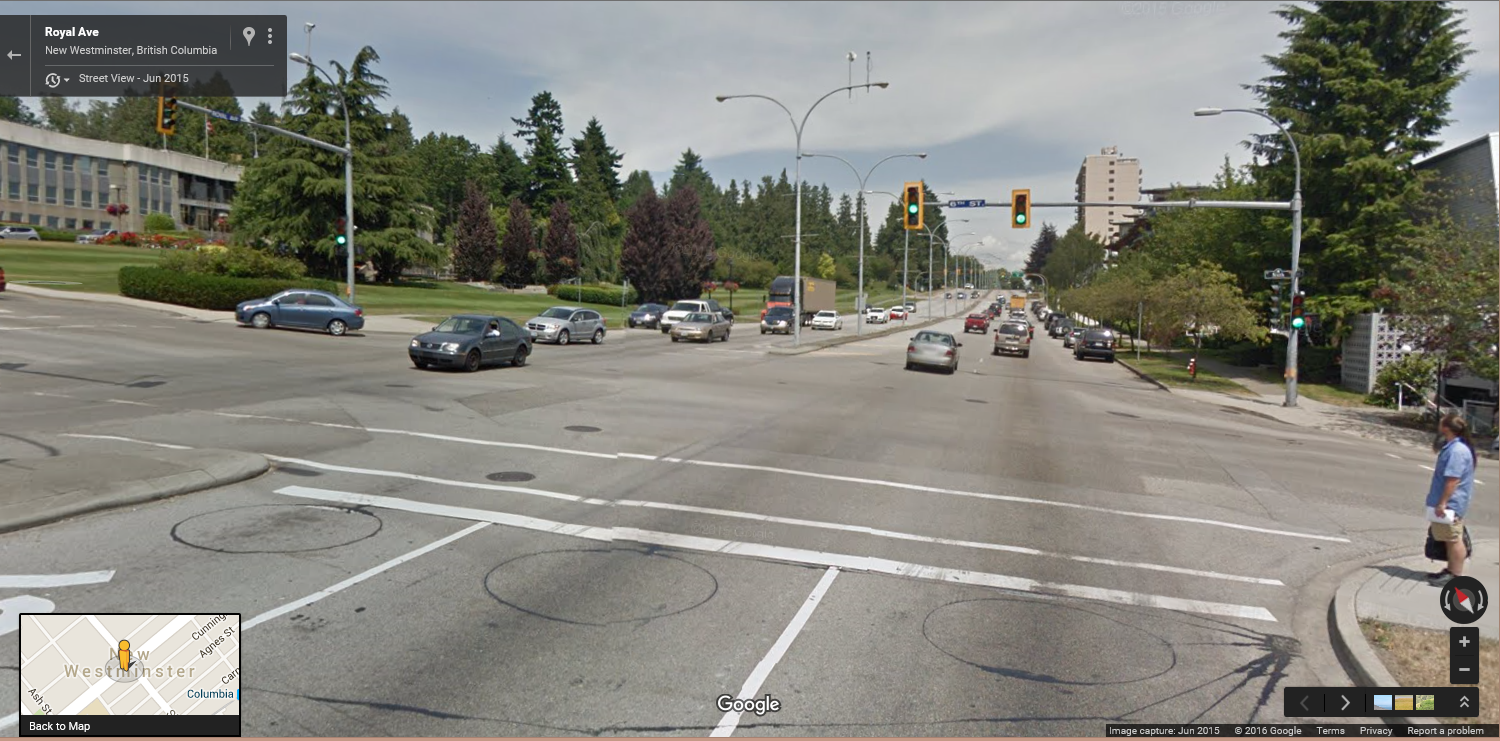
Those extra metres have another effect. The timing for a walk cycle is measured based on the distance of the crossing, and a general flat-ground rule of thumb is 1 to 1.2m per second. By adding curb bulges we actually reduce the amount of time that drivers face a red light, and increase the green light time for the cross traffic, increasing the efficiency of the traffic signal cycle for everyone involved.
Another benefit is by extending the radius of the corner, so right-turning drivers have a less extreme curve, and have better visibility through the turn, which significantly improves the safety of pedestrians from being clipped by right turners (one of the most dangerous interactions for pedestrians).
Also, curb bulges tend to slow drivers down when they enter an intersection, regardless of their intended direction (turn or straight through). This is because the narrowing creates visual “roughness”, making the road appear narrower than it actually is, which causes drivers to self-regulate. This is one of those basic road safety concepts: wide straight streets lead to higher speeds and more dangerous conditions for all road uses.
Now back to those right-turners. Why do we want them to skip the queue when traffic is backed up on Royal? Part of the traffic management goals of the City that pretty much everyone can agree on is that through-commuters should be encouraged to stay on the major routes, and not avail themselves of our residential side-streets for their daily rip through town. But you know if you are that through-commuter coming down Royal one morning and see the line-up of 10 cars at the red light, you are more likely to take that empty right-turn lane and go up 6th, and maybe turn left on Queens or Third or Fourth and try to get to Stewardson or places west. Of course, it is a fools errand, because as you mentioned, there is traffic calming in the Brow neighbourhood to make this choice less appealing, in order to make those residential neighbourhoods more comfortable and safe for the people who live and walk there. So it is easier of everyone if people stay on Royal in the first place. The curb-bulge does not reduce through-capacity (unless we made it a through-lane, not a right-turn lane, then we need to talk about making Royal 4 lanes, which is a whole different discussion). Creating a queue-jumping lane for rat-runners is not a great reason to remove a structure that provides so much pedestrian benefit.
So, yeah. You may have to wait an entire light cycle to make the right turn on Royal, and I’m sorry about that. But if that is the cost we have to pay for the multiple safety and neighbourhood benefits provided by that curb bulge, then I’m happy with the choice we’ve made.