Ask Pat: Columbia & McBride

C D asks—

Just wondering if anything can be done to keep vehicles from running the red right turn light at Columbia Street and McBride. I walk this way everyday from Columbia Stn to Victoria Hill and it’s an enjoyable walk until I get there. Today a vehicle stopped only to be passed on the left by a vehicle that was behind the stopped vehicle. This is a daily occurrence just on my walk but I know this happens to other pedestrians and cyclists. Someone is going to be killed. Perhaps we can have a railway crossing arm that can come down?

I hate this crossing. I have railed about it in the past, and even wrote a blog post about it here back before I was elected and when I was little more sassy than I am now (there is a funny story in here about how an outgoing city councillor tried to use that blog post to scupper my first election campaign – but that’s a long digression). Even since then, there have been suggestions to fix the crossing and the signage and lighting has been changed to better address the confusion drivers seem to have. I do not think there will ever be a physical barrier installed in that spot and we (vulnerable road users) are just going to have to keep acting with an overabundance of caution until the entire thing is torn up and replaced along with the Pattullo Bridge replacement, which will be starting in the next year or so.

But why wait and not do something sooner? Because there is no obvious engineering solution that meets the current design code and is remotely affordable to do. People often suggest “what cost can you put on saving a life!?” when I say something like that, but I need to point out that this is one of more than a thousand intersections in the City, and by technical evaluation and statistical analysis it is not the most dangerous one for pedestrians by far. Those analyses are the way that staff decide which intersections to prioritize the (necessarily) limited budget of time and money into pedestrian improvements.

For example, the unmarked pedestrian crossing at 11th Street and Royal Avenue is current Pedestrian Enemy #1, so that block of Royal is currently being reconfigured to make it safer. There are a few other priority crossings, and staff are constantly updating the priority list and figuring out what interventions provide the best cost/benefit ratio. I’m not a transportation engineer, so I have to rely on their analysis when it comes to determining relative risk and how to prioritize to most effectively reduce pedestrian risk. Either that, or rely on anecdotal feelings about different intersections, but I think the former serves the community better.

I hate to say it, but “someone is going to get killed” is not a characteristic that separates McBride and Columbia from most urban intersections. Although New Westminster has been fortunate in the last couple of years and have not suffered a pedestrian fatality, the reality is that the ongoing trend towards improved driver and passenger safety is not reflected in the pedestrian realm. In Morissettian Irony, it is getting more dangerous to be a pedestrian around “safer” cars. There are several alleged reasons for this, but the most likely one being the increased size, mass, and power of vehicles with which vulnerable road users are meant to share the road. The only logical response to that is slower speed limits (working on it) and better design of intersections. But with 1,000+ intersections in a little City like New West, and many that need expensive interventions, that is not a quick fix.

I am more convinced every day that the real fix is more than engineering, though. This intersection is one where there is signage, lighting, a painted crosswalk, and yet some significant percentage of drivers just don’t follow the rules. Are they unaware, inattentive, or do they just not care? Likely, there is a Venn diagram where these three factors overlap, and no amount of engineering can fix all of these.

This has me more frustrated every day, and more wondering how we are going to get the real culture change we need to make our pedestrian spaces safe. We need to change the culture of drivers, of law enforcement, and of the entire community to address the fact people in cars are killing people who are not in cars, and that threat is making our cities less livable. We need to educate people about the actual risk they are posing to others every time they step into a car. And we need more active enforcement of the specific traffic laws that serve to protect vulnerable road users, because you apparently cannot engineer negligence and stupidity out of road users.

And worse, every time a City tries to build engineering to protect vulnerable road users, such as better crossings, longer cross signals, separated cycling infrastructure or curb bump-outs, we are bombarded by entitled drivers whinging about how pedestrians and cyclists don’t follow the rules (just read the comments). This despite clear evidence that the vast majority of pedestrian deaths are a result of the *driver* breaking the rules. This is a cultural problem rooted in entitlement, and I don’t know how to fix it.

To be clear: we need to acknowledge that the automobile is the single most dangerous technology we use in our everyday life, and stop being so blasé about the real risk and damage it causes. We also need to stop telling ourselves lies like automated electric cars are going to make life better – they demonstrably are not. But that is another entire blog post.
Ask Pat: Smoking Bylaws

Norm asked—

I live in a low-rise condo in New West. Our Strata bylaws prohibit anyone from smoking in common areas, including decks and patios. The resident in the unit below me is a smoker. He stands in the patio doorway of his unit and holds his cigarette outside. He also blows the cigarette smoke outside. If I have my patio doors open, the smokes comes directly into my unit, which is several times a day. It’s a problem year-round, but obviously worse during the summer. After many complaints to the Strata Council, they say there is nothing they can do because technically he is standing inside his unit. I’m wondering if Bylaw 7583, 2014 3(p) would apply in my situation?

I was just flipping through Bylaw 7583, 2014 yesterday and…. um, no, I’m kidding, I had to look this up. And it wasn’t the easiest Google.

The City’s Smoking Control Bylaw 6263, 1995 regulates smoking within the limits of the City’s jurisdiction. Bylaw 7583, 2014 is an amendment to that Bylaw which includes your cited Section 3(p). Altogether it reads:

3. No person shall smoke:
(p) within 7.5 metres of any opening into a building, including any door or window that opens and any air intake;

Which sounds like a slam-dunk, except that Section 4 of the Bylaw reads:

The provisions of this Bylaw do not apply to private residential properties

So just like a homeowner is allowed to make rules about smoking in their own house or backyard, your strata is allowed to make such rules about smoking around doors, balconies, and common areas on your strata Lot. And I feel your pain, as MsNWimby and I once lived in an apartment where the person downstairs was a smoker, and there were no rules preventing them from second-hand fumigating our apartment. If your strata has an anti-nuisance Bylaw, and you manage to argue to the strata council that your neighbour’s action constitute a nuisance, you might get some relief, but unless one or the other of you move, there is no quick fix here. Unfortunately, there is also not much technically or legally the City can do.

This is, I suspect, going to become an increased problem in the next short while as cannabis legalization causes those who choose to use the product to be less bashful about it, and strata councils are going to be uncertain how to manage it.

The enforcement of smoking laws is really difficult for a City – the nature of the offence is that it is short-lived and ephemeral. There are varying and possibly overlapping rules between private property, city property, and other public property (i.e. enforcement around New West Station) and our Bylaw officers do not have a lot of power to detain or force people to give them ID.

Alas, I don’t know what we can do other than rely on public education and peer pressure to manage the nuisance, and it seems to me that there is currently no public pressure to change the behavior of smokers. I sat near New West Station the other day for 30 minutes watching person after person stand right next to a “No Smoking” sign and light up. Every single one of them tossed the butt on the ground. The tossed butt alone is a $200 fine, but not a fine anyone enforces, because cigarette butts are the last bastion of free littering, despite their significant impacts on our storm drainage systems and river ecosystems. Smokers don’t seem to give a shit, nor do most of the public it seems.

I’d love to see if a Bylaw crackdown would work to address this, but also recognize much of this behavior is by people already marginalized and for whom interactions with the Strong Arm Of The Law could have seriously negative consequences. There is also the addictions issue – being addicted to nicotine is a medical condition for which there is limited access to support, especially for marginalized populations. Unlike alcohol, smokers cannot go into a pub to get their fix, and if they are lower income, they are more likely to live in a setting (rental or other shared housing) where they are legally not able to use it in their own home. Parks and most public places are also illegal. They are addicted and suffering from a prohibition – not a legal one, but a geographic and socio-economic one. We can debate the addictive properties of cannabis, but the situation is essentially the same.

So short version is I don’t know what to do. In your condo or as a City. You can check to see if your building’s nuisance bylaw is any relief, but I suspect that is a long row to hoe, with questionable results. The City could have Bylaw Officers and police walking the streets telling people to put those things out, handing out fines if appropriate, but I am not sure it is the way to change behavior or community standards, and I wonder about our actual ability to collect on those fines and the potential for further marginalizing people. I’ve banged my head against this sine I started on Council, everyone agrees that someone should do something. I’m open for suggestions.

ASK PAT: Anvil theme!

The Anvil Centre edition! I have three questions on two topics:

Dale asks —

I was heartened to see that the recent budget includes a line item related to signage for the Anvil Centre. The building has been up for 3+ years and has thousands of people traveling by it on foot, bicycle and vehicle with no indication at all as to what the heck is going on inside. The budget item sets aside $100,000 “to work with a sign expert to determine more effective signage outside the Anvil Centre”. Please tell me that the $100k will include more than the expert consultation. Also, why not have a competition for the signage which would probably give a better outcome and will also provide publicity for the Anvil Centre?

I had two very similar questions arrive on this, and the short answer is yes, the $100K is the entire budget for the signage project, and will include more than just the planning and design. Hopefully this will result in signage and wayfinding to draw more people into the Anvil when things are happening inside.

There is a point to be made here about how we set out budget for projects like this. Municipal finance is sometimes a terrifying thing, because it involves various layers of policy, regulation and reporting, and it all must be kept transparent for obvious reasons. The diversity of things we spend money on, the need to not demonstrate favoritism or bias when purchasing, our requirement to enter contracts in service delivery, and the relative reluctance to face risk in spending run up against the fact that every check and balance takes time and staff resources that make everything less efficient. It is more complicated than that last sentence, and these complications – all designed to make government more accountable to the people they work for – are a big reason why people who say “a City should run like a business” are only indicating that they have no idea how government works.

If I ran an underwear store in Downtown New West, and I wanted to change my signage, I would call a few places to see who could provide such a service. I might get some quotes, and choose the lowest bidder, or I might call my uncle Ernie who has a sign company and give him a discount on boxer briefs if he could bang a few signs out for me at cost. I may even decide to go to the artisanal organic sign company up the block because the owner is a neighbor, gives generously of her time and energy to community-building, I like keeping my money local, and I don’t mind paying a little more for a quality product when I know the person who I am buying from. I may buy one less sign, or a slightly smaller one, because that is all I have in my budget right now, or I may go for a bulk discount and go a little over my budget to get a lot more. The purchase process is dynamic, I can act fast in response to the market, and my personal preferences. And no-one needs to know how much I spend on signs, except maybe Revenue Canada when I report the signs as a business expense at the end of the year.

Local Governments can’t do this. Our ability to “sole source”, or buy from a preferred person, is generally limited to smaller-cost items purchased irregularly. To buy anything substantial or enter into a longer-term supplier agreement, there needs to be a budget line. Depending on the cost, it may need to go all the way up to Council to approve the purchase as part of the annual Financial Plan or a Financial Plan update, as was the case for the Anvil signage program. It is outside of regular operating costs, and big enough that staff need to come to Council to ask for budget room to do the work. Problematically, they likely cannot do much more than some preliminary cost estimates before that ask (i.e. they cannot enter a contract, even a “Contract A”, without budget authority), but spending less than the budget will be easy while spending more than the budget difficult.

Once budget is approved, staff is then required to go to the market and ask for bids. Depending on the type of project and the estimated budget, that may mean going out to get three quotes, or it may mean a much more formal open procurement process like you see listed here in BC Bid. This process is regulated by our internal policies in order to prevent favoritism, to make us complaint with proper public process, contract law, and trade agreements like the Agreement on Internal Trade and the Northwest Partnership Trade Agreement. So, yes, there is a competition for the work required by practice and law.

Strangely, there is no actual statutory obligation for local governments to procure goods and services through this competitive process, and the trade agreements above are not legally binding on Local Governments, yet we are creatures of the Province, and are expected to follow these guidelines, or be subject to legal challenges or expensive arbitration by bidders who feel they were aggrieved by us not following due process. There is also a bunch of contract law around this the exists in parallel to legislation, but I am getting way deeper into the law than I am qualified to opine upon. Short version is: we have policies and practice in place to assure that public funds are spent transparently without undue bias ,and suppliers have a fair chance to compete for projects.

This, of course, often puts us at a significant competitive disadvantage when purchasing compared to underwear store guy above. If the market knows you need to buy something and exactly what you are willing to spend, you are entering into a negotiation with one hand tied behind your back – especially when it comes to purchasing a specific property or very specialized services with limited suppliers. This is why the City is able, under Sections 90 .1 (e) and (k) of the Community Charter, to discuss things like business negotiations in a closed meeting, although the eventual expenditure must be approved in an open meeting.

There is another strange part of municipal finance that is partially a result of this cumbersome process – every year we underspend our capital budget. For some reason the Koch Brothers anti-tax brigade never talk about this when complaining about our budgets, but that heads us down another long hallway…


Deanna asks—

One of those little things, three years ago there was a number of red seats and tables in front of the Anvil Centre, then they disappeared over Winter and never returned. I really liked those seats and often sat there enjoying a coffee I purchased up the street. I do often wish they were back, the benches further up are too close to the street/traffic for me. Any chance we can get the red tables and chairs back? 

The red chairs that were in front of the Anvil were part of a larger City pilot a couple of years ago to try to set up a few cheap/quick seating areas around the city. The same chairs popped up in other places, including the Uptown Parklet, in front of the Queensborough Community Centre, and out back of City Hall. They have also been moved around a bit to different places, to see what sticks as far as making some of our public spaces ”stickier”. Unfortunately, the front on the Anvil was one of those spaces where the chairs didn’t really work out. A few people liked them (obviously including you!), but many found the spot too hot in the summer and not well connected to anything else, while there were some trash issues that required some management. So when the Downtown BIA wanted some help with seating for Fridays on Front, those tables and chairs were lent to them, and you will see them being used in the Front Street Parklet area.

As always, this leads to another conversation related to Dale’s question above: the public activation of the ground space around Anvil Centre. Bringing this new cultural centre into operation has been a slow and iterative process. There are many parts of it that are running exceptionally well (YEA New Media Gallery!), some that have really ramped up in a good way in the last little while (YEA Theatre programming!), but there is also some more work to do, and I think making the ground floor (inside and out) a welcoming community space that contributes to a lively downtown street scene continues to be a challenge. Council is aware of this, as is the staff at Anvil. The opening of Piva’s patio is a great addition, but that fact that they are across the street from a vacant lot is still a problem, as is the design of 8th Street that does little to draw people out of Plaza 88 onto the street, but I’ve been banging that drum for (Oh. My. God. Was this 8 years ago!?) a long time.

We have work to do there, but after all this time, I wonder if we can get it done.

Intersections

I’m disappointed we didn’t get some of these stepped-up intersection speed cameras in New West. Speed cameras in intersections that can automatically ticket speeders are a good idea, one that can only be opposed by those who like to speed through intersections at illegal speeds, selfishly endangering everyone around them.

Why not New Wet? Apparently the intersections where these cameras were activated were those ranked highest in accident history and  speed issues. Perhaps the silver lining here is that this suggests our intersections are relatively safe by those measures compared to other areas in the Lower Mainland. Though I recognize just by saying that I am going to see comments on social media with people listing their least-favourite intersection. Mine is shown in the picture above.

But hopefully this is the just the first phase of the program, and we may see more cameras in the future. I would also hope that the next phases look not only at raw speed or 85th percentile or accident history, but we may expand the warrant analysis to emphasize intersections where vulnerable road users are more common. Yes, Accidents between speeding cars can be expensive, and often leads to injury or death. but a speeding car hitting a pedestrian is almost always fatal. While injuries and deaths of people inside cars is going down, injuries and deaths of pedestrians is going up. Technology like this can correct that trend.

On the good news side, New West has begun to make changes that were suggested by the Walkers Caucus last year, and are implementing a program of standardizing (and lengthening) the timing of pedestrian crossing light signals. Starting with the pedestrian-activated signals such as the one on Sixth Ave at 14th Street, which have already been adjusted to allow sufficient time for more people to cross safely. The ACTBiPed is also spending some time this year looking at the use of “Beg Buttons” in the City. Despite some lengthy critiques of these in Urbanist circles, there are places where pedestrian-controlled signals serve to make the pedestrian experience safer and more convenient, and there are places where they definitely prioritize car movement over pedestrian movement, in direct contrast to the priorities set out in our Master Transportation Plan. Teasing out these differences, and howto fix it, is an interesting topic, and one we hope to review and create some policy recommendations to Council.

But as you can see above, making our intersections safer and more comfortable for pedestrians is going to take more than signal timing and activation timing. This is why I support intersection camera, and further suggest we need to step up enforcement in the good old fashioned cop-with-a-ticketbook format if we are going to change drivers behaviour.

Jane’s Walk 2019

I’m leading a Jane’s Walk on Friday afternoon.

Apologies it needs to be on a Friday evening and not in the weekend true, but I have to be out of town Saturday/Sunday, and promised a certain Mary I would put a walk on, so here we go.

For those not in the know, Jane’s Walks are a series of walks held on the first weekend in May in places around the world in celebration of Jane Jacobs’ contributions to making Cities more livable. There are probably a dozen walks in New West this weekend, and I highly recommend you pick a few and meet some neighbours.

My walk is going to start at 5:30pm on Friday at Moody Park pool, and we will wander east along the path through Moody Park and then 7th Ave towards Glenbrook Middle School. I’m not sure how far we will get, but depending on the conversation, we will walk for 60 or 90 minutes before our perambulations lead some of us, inevitably, to a pub.

The topic of the conversation I want to have with whoever shows up will be framed by the contentious (?) temporary bike lane installations on 7th Ave between Moody Park and 6th Street. There is a lot to say about that particular stretch (I’ve said some of it here and here), but the bigger question is – What does a true AAA (“All Ages and Abilities”) bike route look like in New West? What compromises are we willing to make in regards to loss of green space, loss of traffic space, loss of parking, to see a AAA route built? Can a AAA bike route ever be one where bikes share space with cars, or is total separation needed? How do those needs shift between – a trail through a park, a route along a busy street, and a quiet residential street?

I need to emphasize, I don’t have a lot of answers here, other than what is informed by my “gut feeling” (which is no better than anyone else’s) about what is safe for cyclists. I would love if people discuss and think about these questions along the way, and try to discover for themselves what the friction points are that prevent rapid shift towards a full integrated and safe bike network. If you read my blog regularly (Hi Mom!), you may be interested in coming along. After all, what better way to spend a sunny evening walking through your neighbourhood, meeting some neighbours, and talking about ways to make your community safer and more livable?

C’mon out, bend a Councillor’s ear. Meet a neighbour. Take a walk. Love your City.

Price Talk

I was fortunate to be able to attend the taping of a Price Talks podcast. It was a real transportation policy geek fest (and, alas, a real sausage fest). Jarrett Walker is a transit planning consultant, an author, and an academic with an incredibly cosmopolitan view of urban transportation systems. He has worked on 4 continents, and can see the universal truths expressed in the great variety of built forms in cities around the world. The conversation was wide reaching, from Coriolanus to Elon Musk, from the inescapable geometric truths of urban transportation to aesthetic as a guiding principle in urban planning. There were dozens of quotable nuggets in the talk, some I will be chewing on for a long time as I think about how to apply them to my neighbourhood and community

My favourite nugget, however, was the 4-minute summary of ride hailing and its impact on communities. You can skip to 1:09 to hear this as part of the Q&A at the end of the evening, but to fully appreciate his answer, you need to hear his earlier discourses on the phenomenon of Elite Projection, and how it is the scourge of most North American transit planning.

Walker is much more profound on this topic than I can ever be, but the short definition of Elite Projection is the tendency for the most wealthiest and most influential minority in a population to think what is good or attractive to them is best for everyone. It exists throughout hierarchical decision-making, and once you open your eyes to it, it is everywhere. In urban transportation, it is manifest in Musk’s The Boring Company and in “cute streetcar stuck in traffic” approaches to urban transit world-wide. There may be a few local examples: here, here, or even here.

The heart of his argument about ride hailing is best summed up in this quote (based on his observed experience in American cities where it has rolled out):

…it has been a great way to draw out the worst aspects of elite projection, because people who can afford it have become addicted to it, [and] expect as a matter of course that it will be available… [but] like anything to do with cars, it only works as long as not many people use it.

Part of the problem is that providing mass transportation in an urban area is not a profitable business. It never has been, and never will be. Uber and Lyft are losing billions of dollars a year, their underpants-gnome business plans being propped up by venture capital silliness, while they can’t even pay living wages or provide basic workplace protections to the people doing the labour (we aren’t allowed to call them “employees”). At the same time, they cut into public transit revenues while increasing traffic congestion making those transit systems less reliable, pushing customers over to the ride-hailing industry, exacerbating the impacts. He doesn’t even touch on how ride hailing demonstrably correlates with less safe roads for people in cars, pedestrians and cyclists, but he doesn’t need to.

The warning for Vancouver is that the introduction of ride hailing could be “really terrible” for our traffic systems and our livability, for obvious reasons. The promise of ride hailing is that it reduces parking demand by increasing traffic congestion – this is not conjecture, but the demonstrated experience around North America. That is no win at all.

For you Uber fans out there, Walker does provide a clear policy recommendation about how we can make ride hailing work in our jurisdiction without externalizing these real impacts, but I guarantee Francesco Aquilini and Andrew Wilkinson ain’t going to like it…

Give it a listen, it is a great conversation:

A Night with Jarrett Walker: Building Human Transit with Shakespeare, String & Elephants in Wine Glasses

Miner improvements?

I went on a bit of a rant last week in Council on pedestrian crossings, and it is worth following up a bit here to expand sometimes on the things I rant about. In this case the subject was something we can all agree on – making pedestrian spaces safer in the City – but the details of the discussion outline how difficult it can sometimes be, even when everyone is on the same page. The hill on Richmond Street provides a great case in point about how we want to do things differently, but are stuck with a bad legacy to clean up. And that costs.

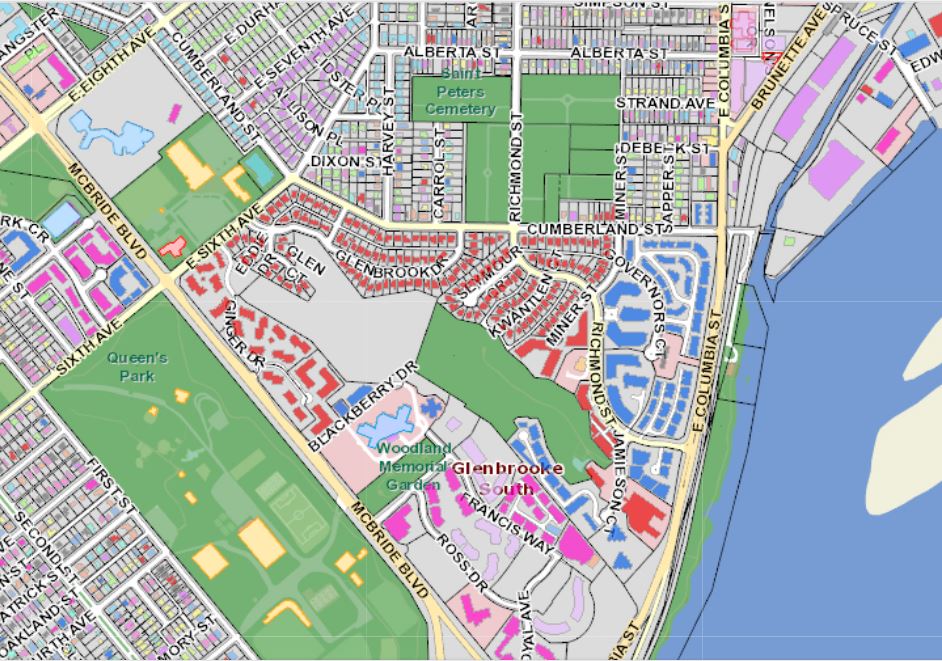
The Fraserview neighbourhood is somewhat unique in New Westminster. Most of our community is based on a well established and dense street grid that reflects how humans move around their communities – a layout that is “human scaled”. The Fraserview neighbourhood was developed out of the abandoned BC Pen site in the 1980s, which was the Canadian peak of auto-oriented suburb design. This is not the fault of the council or staff of the time, or of the people who live there now, but a result of where we were and how we valued space as a society in the 1980s.

The buildings on this map are coloured by the decade they were built. See Sapperton and Queens Park with a blend of ages and traditional dense street grids, Fraser View with 1980s houses (red) and 1990s condos (blue) with the suburban road scheme so sexy at the time.

At the time, New Westminster built this strange little auto-oriented suburb in the gap between two dense urban community centres. Since the primary built form was “house with a garage facing the street and a private yard in the back” (note this is a generally unusual built form in New West!), the streets were designed with the same exact mindset – they will be used to move cars between garages, and not much else.

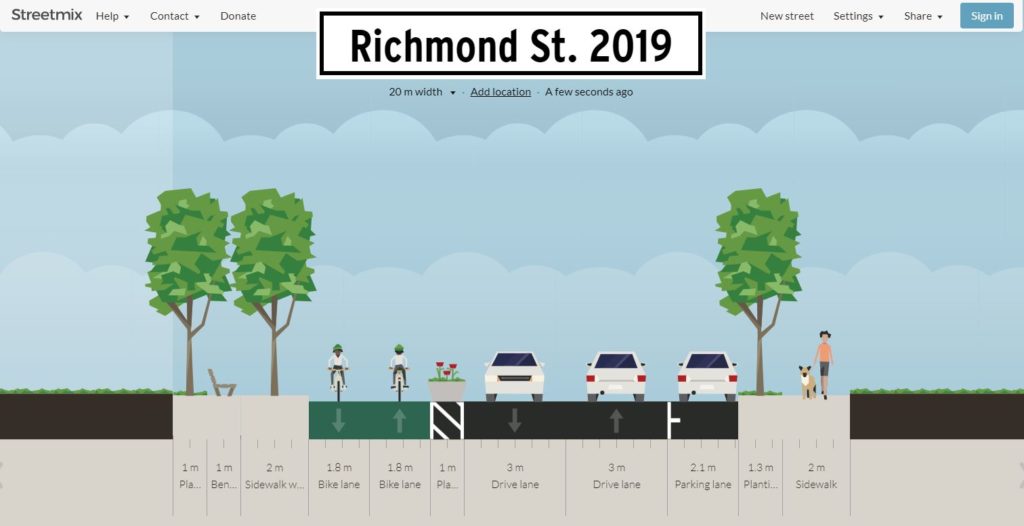
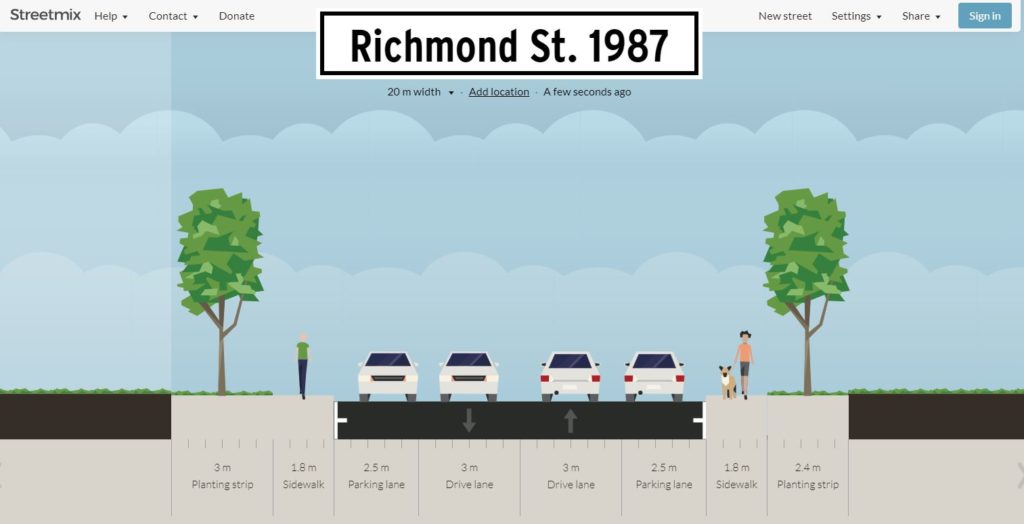
This resulted in some road design ideas that were the opposite of current thinking. Instead of straight lines and a dense grid to connect pedestrians, we build a meandering “arterial” road connecting capillaries of culs-de-sac. Of course these are ostensibly “family neighbourhoods”, so we kept the speed down to 50km/h by putting up a sign, and left plenty of road space for road-side parking and car passage. The curvy hill part of Richmond has wide 20m right-of-way between property lines, but the road profile part (travel lanes and sidewalk) are a pretty typical 14.5m. This feels wider partly because the sidewalks are less than the 1.8-2m wide we would shoot for in 2019, there is no buffer space between the sidewalk and the road, and the parking spots along the road are unmarked and not very heavily used. Add this up, and you have no visual “friction” giving drivers cues to slow down. Wide roads tell people to drive fast, it is human nature.

This is how the road was built in the late 1980s:

I like to think if we were building the road today, it would more like this:

But that is just a representative cross section. There is another issue that makes the pedestrian experience even more uncomfortable. If you look at the intersection of Richmond and Miner, where staff were asked to evaluate placing a crosswalk, you see the corners are rounded off to facilitate higher turning speeds:
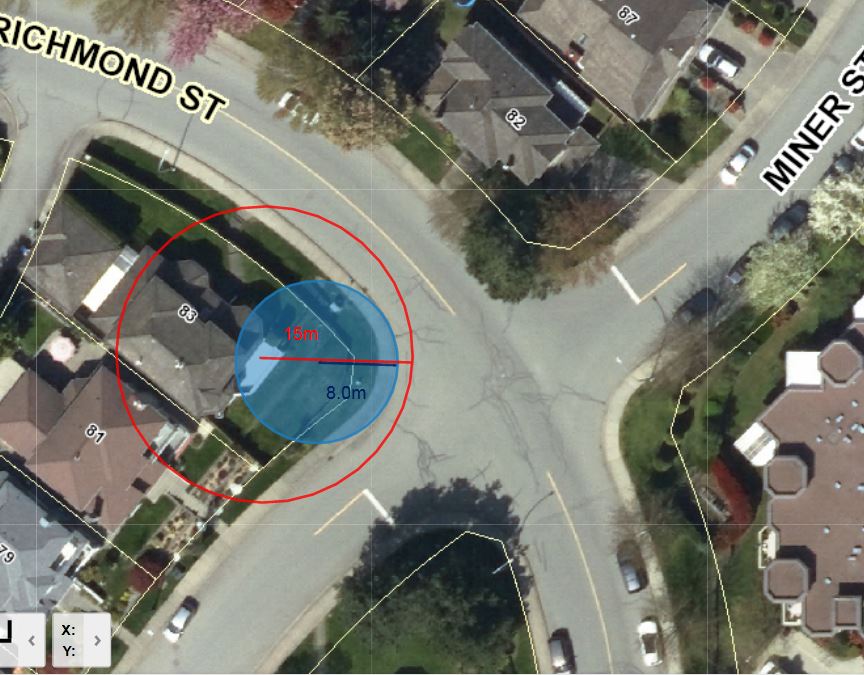
The technical term for this shape is “Corner Radius”. In this diagram you can see the curb follows a curve with a radius (blue) of about 8m, and the effective turning radius (tracing the track a vehicle would actually use for a right turn) is closer to 15m. By modern standards, this is a crazy wide corner, more suited for a race track than an urban area. Reading up on modern urban streets standards, curb radii smaller than 1m are not uncommon, and radii bigger than 5m (15 feet) fall under the category of “should be avoided”.
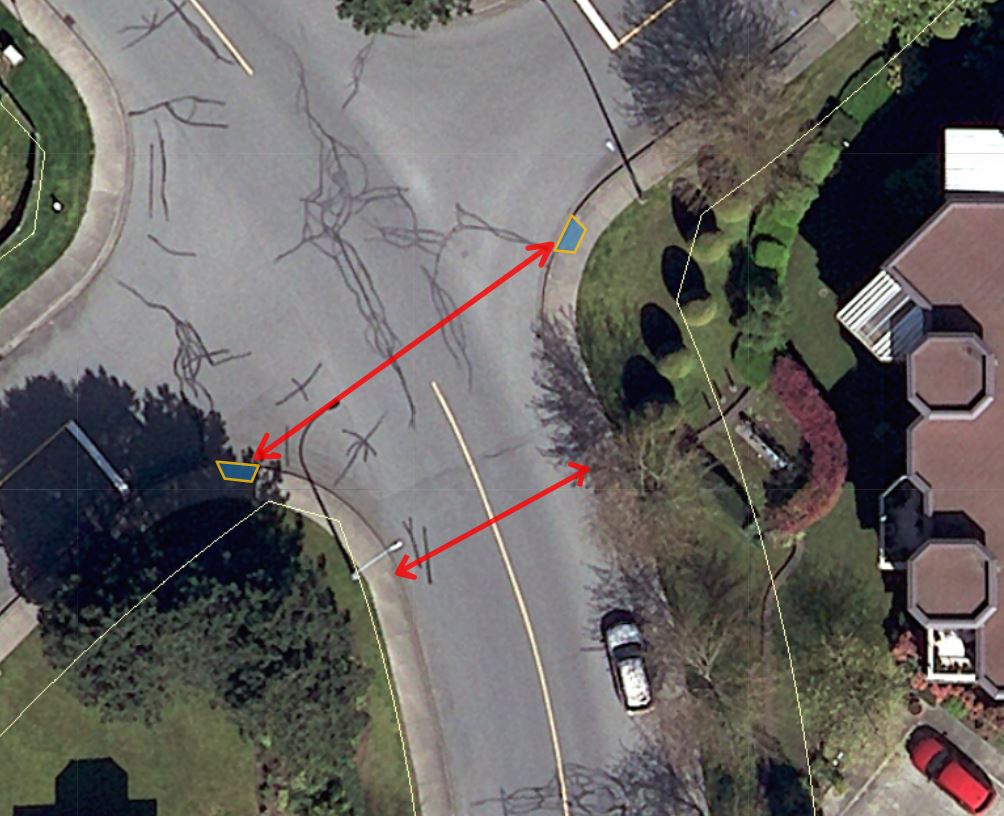
The impact of such a wide radius is bigger than just facilitating faster turns, it also creates a variety of sightline problems. See how far back the stop line is on this corner? How far around the corner can a driver practically see? This results in the confusing stop, creep forward, peek, make aggressive move intersection action that opens up opportunity for driver error. This is made worse when there is no clear demarcation of where the parking zone ends near the intersection. Our Street and Parking Bylaw says you can’t park within 6m of the nearest edge of an intersecting sidewalk or crosswalk, but it is less clear where that 6m buffer is when the sidewalk geometry is like this. moving the stop line further forward creates a conflict with pedestrians trying to cross the street at a rational place – where the curbs are closer.

For pedestrians, these big radius corners increase the crossing distances, expanding the time that someone (especially a young child or senior citizen, who travel slower) is exposed to traffic. Crossing Richmond Street at this intersection, the distance between curb cuts is almost 20m, where the sidewalks are only 11m apart a few meters outside of the intersection:

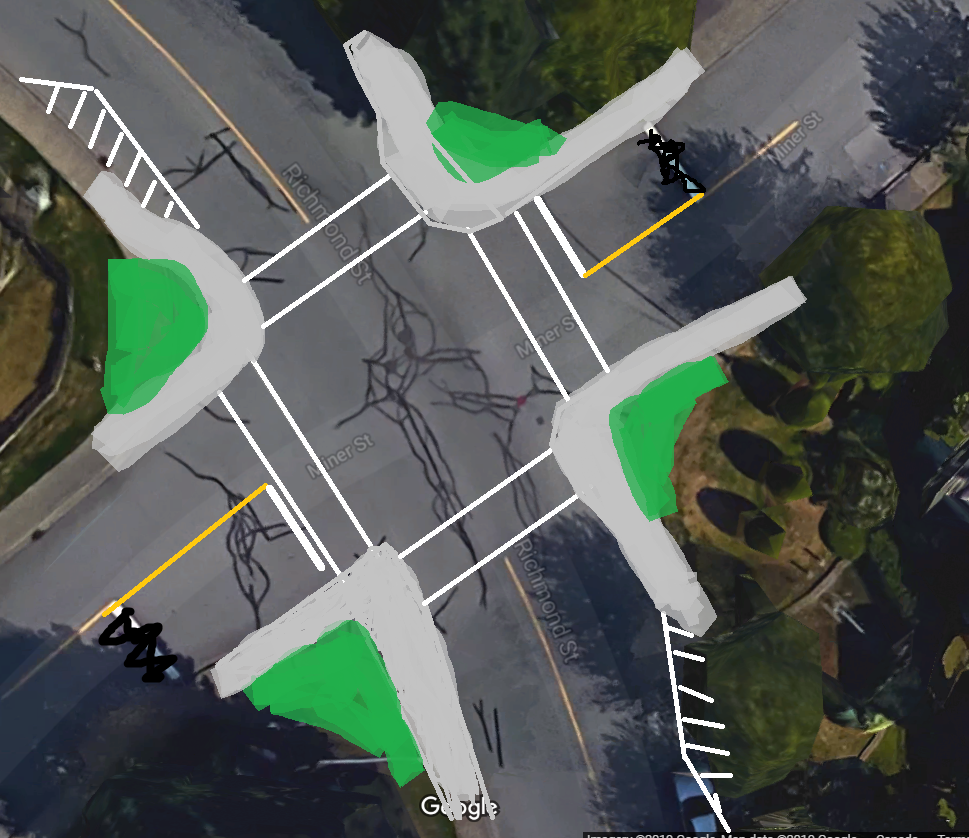
So what do we do? There are lots of useful guides like these great NATCO manuals that show how an intersection like this can be made safer for pedestrians. We can narrow the road at the intersection, paint new crosswalks, and reduce the turning radius through curb bulges:

But my bad painting skills here represent couple of hundred thousand dollars in concrete, road paint, asphalt, curbs, soil, planting and storm drain realignment (never mind a complete re-design of Richmond Street to pull it into the 2000s as I showed in the cross sections above; that would cost millions). And this is one intersection in a City with more than 1,000 intersections, some better designed than others, some more used than others, some with worse safety records than others. I want to change this specific intersection tomorrow, but who is going to come to Council and ask us to raise property taxes by 0.3% to do it? And why do it here and not at the intersection that bugs you in front of your house?

All this to say that some changes are going to be made to Richmond to improve pedestrian safety, and three other intersections (8th Street at 3rd Avenue, 12th Street at Queens, 6th Avenue at 11th Street) that have been prioritized for this year’s Pedestrian Crossing Improvement program, totaling about $200,000 in work. The work is, necessarily, incremental, and because of that it is never enough, and never fast enough.

Be safe out there folks.

Active Transportation

I know I haven’t blogged about this week’s Council meeting yet, I haven’t had time to edit and get the post up. It’s coming, I swear. In the meantime, I want to get this out, because it has been in my outbox for a little while and it has suddenly become time sensitive.

The Provincial Government is asking the public about active transportation. I have been known to criticize the Ministry of Transportation in the past about their approach to “cycling infrastructure”, but I am going to hope that this is the start of a new approach. You have until Monday to answer their questions!

If you are too busy to write your own thing, you can go to HUB and fill in their form letter, but as an elected person, I like to receive input that brings something new – a 1000-person petition is not as powerful as 100 personal letters that each bring different nuance. So I encourage you to take a few minutes and fill in the answers yourself. If you want some inspiration, here are my answers I will submit this weekend:

Question 1: What does active transportation mean to you and how does it fit into your life?
Active transportation means healthier, safer, happier communities where youth are safe to ride a bike to school and the elderly are comfortable walking to the grocery store. It is about replacing fossil fuel dependence with transportation independence. When we build the infrastructure to support active transportation, we give more people the freedom of choice in how they move around their community, reduce their reliance on volatile international oil markets, keep more of their money in the local economy, build resiliency in our communities and connections between neighbors.

Question 2: What are some of the challenges in your every day life that prevent you from moving towards using active transportation modes? What are some of your concerns about active transportation?
As an active transportation user, and a local government decision maker, the biggest challenge I face is addressing the “gaps” in our systems that make active transportation less safe and less comfortable. I am lucky to live in a compact, dense community where most services are a short walk or bike ride away, but so many of my neighbours still feel it is unsafe to make the journey unless surrounded by two tonnes of steel, which in turn reduces the perceived safety for other community members.

Too much of our active transportation infrastructure is developed as baubles attached to the side of new automobile infrastructure. Sidewalks, crosswalks, overpasses, cycling lanes, and transit supports are evaluated in how they support or hinder adequate “Levels of Service” for automobiles, while the high LOS goals (fast, uninterrupted vehicle travel) acts to make active transportation space less safe and less comfortable. An overpass over a busy road is seen as a pedestrian amenity, when it actually serves to provide more space for automobiles to have unrestricted travel. The trade-off is usually a longer more difficult journey for a pedestrian and introduction of a new barrier for people with mobility challenges. We need to see active transportation alternatives as a solution to community livability, not as a hindrance to the flow of traffic.

Even the language of “transportation” vs. “active transportation” reinforces the idea that using your feet and your own body to move around is somehow lesser than – a secondary consideration to – using an automobile. I have to explain to people that I use transit to get to work, I use a bike to run errands, I walk to City Hall, like that is some sort of radical action instead of a rational and normal way for a person to live in on a modern urban city. Let’s switch that default, for the good of our communities, the good of our budgets, and the good of our planet.

Question 3: What is the most important action that government could take to promote active transportation? What is unique in your community or region that needs to be considered?
Of course, funding. Local governments are straining to provide services as our infrastructure ages. We receive 8% of the tax revenue in Canada, yet own more than 50% of the infrastructure. This inequity is sharpest when it comes to transportation infrastructure. Billions flow for highways and bridges that direct automobiles into our communities (with, admittedly, the requisite active transportation baubles attached), but the local improvements to help us move around within our communities are tied to expectations about “Level of Service” for those automobiles. The cycle is vicious.

My community has one of the highest active transportation mode shares in the province. New Westminster is a transit city, it is an easy city to walk in and the revolution in electric assist bicycles means that residents no longer need to be athletes to manage our hills. We have some of the lowest car ownership rates in Canada. This is not an accident, the City has a dense urban fabric that puts most services near where people live, we are concentrating our growth around these transit hubs and working to make our pedestrian spaces safer and fully accessible. Yet we are choked by through-traffic that makes all of our active transportation spaces less safe and comfortable. This load means we need to spend millions of dollars every year in maintaining our asphalt to provide the level of service through-traffic expects, while struggling to find the thousands of dollars to build better cycling, pedestrian, and transit-supporting infrastructure.

We need help making our transportation system work better for our community, but as long as that transportation funding is tied to our ability to get cars moving, to provide high automobile “levels of service”, we are putting out fires with gasoline.

ASK PAT: Parking Bylaws

Susan asks—

According to New West’s by-law for the parking of vehicles 4.9.1 – any New West resident can park their vehicle(s) on any residential street (except areas requiring permits, or metered parking) for as long as they wish as long as their vehicle has valid insurance.
In Burnaby & Vancouver, the by-law is more specific and requires that any vehicle cannot park for more than 3 hours in front of a residence unless the residence is the actual property of the parker.
If another New West resident decides to leave their vehicle parked in front of another residence and does not move it for week/months, there is nothing Parking Enforcement can do.
What is the process in requesting a change to this bylaw?

You basically have it right. Our Street and Traffic Bylaw makes it illegal to park a car for more than 72 hours where there are no other parking restrictions, unless you are a resident of the City. As long as your vehicle is not derelict, is insured, and is not a commercial vehicle heavier than 5,500kg, the road is yours to store your vehicle for free as long as you can find a spot.

I have vague memories of the last time we upgraded the Streets and Traffic Bylaw, and at the time staff recommended that the 72-hour restriction be applied to everyone. Checking my notes, it was in the March 23, 2015 Committee of the Whole meeting where some members of Council argued that this was unfair, and that residents should be able to park for free for as long as they want. I disagreed at the time, and continue to disagree.

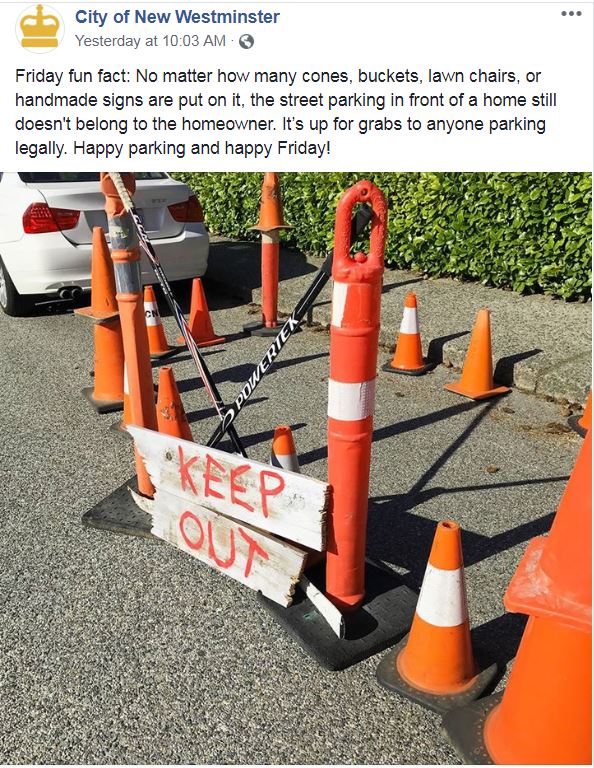
That said, I doubly disagree with the Burnaby approach, where the public land in front of your house somehow belongs to the resident of the house that happens to be in front of it. That land does not belong to you, it belongs to the public. Putting up barriers, cones, milk crates, or buckets to protect it as a personal parking space like this is similarly against the law.

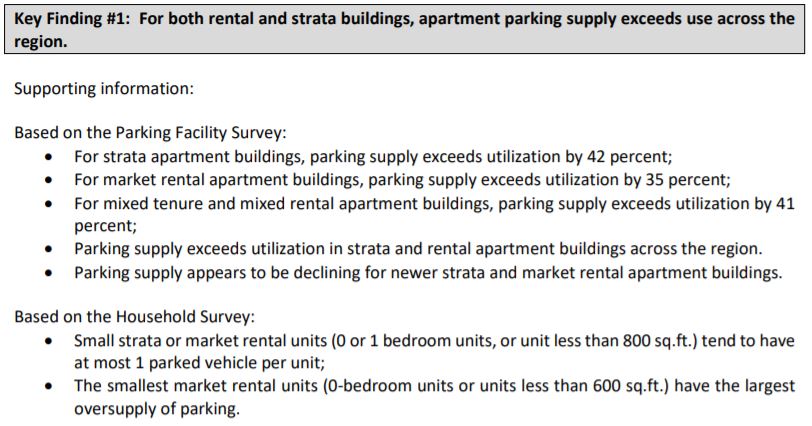
Here is an unpopular opinion: there is no shortage of parking in New Westminster. There are local shortages of the free or very low-cost public parking that people prefer, but every house in New Westminster has a garage or parking pad (regardless of whether they are actually used for car storage) and every new multi-family building is built with more parking than the residents use. And outside of a few special events and around churches on Sunday Morning, there is generally no lack of street parking. When it comes to resident parking and nw buildings, we are simply building too much.

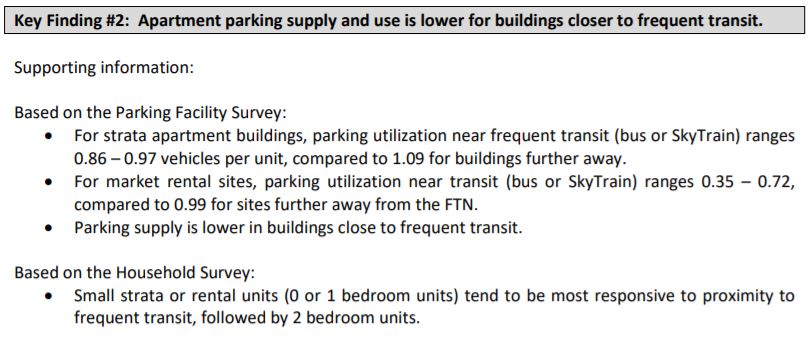
There was even a recent Metro Vancouver study on parking availability whose highlight point was that across the region “Apartment parking supply remains excessive relative to observed utilization”. Here are the first two key findings:

As mentioned in an opinion in The Record a few weeks ago, there is a real cost to this. Underground parking is expensive to build ($50,000+ per spot) and an alleged lack of parking is a common reason residents oppose new housing in their neighbourhoods, making housing more expensive for all. But I now I realize I’m drifting pretty far from the nature of your question…

The process to change the Bylaw would be to ask Council to do it. Ask Pats, as fun as they are, do not represent official correspondence with Mayor and Council, so you could write a letter to Council (here are the links about how you do that). Try to keep it relatively short and respectful, and explain the rationale for why you think the Bylaw should change. Any member of Council could take the concern to Council and ask staff to follow up, though there is no guarantee. Alternately, you can come to Council yourself and make your case as a Public Delegation at most Council Meetings, and again, Council may or may not act, but it can’t hurt to ask.

(draft) Budget 2019

I guess we knew this was going to be a tight budget year for New Westminster, as it is for most Cities in the lower mainland. The shift in MSP / employer health tax has impacted many municipalities hard, which I will talk more about below. Combine that with our aggressive capital plan, regular inflationary increases in costs, and constant demand for new services, and the tax increase is higher than some would have liked this year. That said, I actually would vote to make it a little bit higher, and indicated so to Council. Here is my rationale.

The current proposal is for a 5.28% increase in property taxes. That is about a $117/year increase for the “average” household. For perspective, the “average” household in New West is a $1.2M house that went up in value over the last year by 9%, or about $100,000. Condos went up a little more than houses overall, so the tax increase for condo owners will be proportionally higher than for detached house owners. The City has no control over that, it is just how the market works.

For the purpose of explanation, it is helpful to break that 5.28% into component parts. The numbers below are my back-of-the envelope estimates drawn from the kinda complex budget documents (you can see a staff report here), and of course the budget has not been passed yet, so the numbers may change. All that to say nothing below represents official numbers or communications, but this is close enough to an accurate breakdown to foster conversation:

1.8% is directly attributable to the shift in the MSP and employer health tax. This could be viewed as downloading: increased local government costs that will be funding something that should be paid from provincial and federal coffers. However, I generally reserve that for when we shift the burden for a service to local governments, not just the cost – an oft-mentioned (by me!) example is underfunding the provincially-funded ambulance service so that our locally-funded Fire and Rescue staff need to cover the load. regardless of what you call it ,the effect is the same. We and other cities have challenged the province to not apply this to local governments, and we lost that fight. So here we are, and need to budget for it.

If you want to take a more positive look at (spin of?) this tax increase, remember that it is a result of phasing out of the MSP system. That means the $40 or so that this 1.8% costs the “average” household is easily offset by the $1,500 the “average” New West household saves in reduced MSP fees. If that is no help, then at least recognize this is a one-time event, and that there will actually be a slight reduction in City costs next year as the final MSP phase-out occurs. That means we will be starting the 2020 budget year ahead of the game by about $300,000.

4.23% is direct growth and inflationary pressure – increased wage and supply costs related to just doing what we do every day. This goes up both because of because of inflation, and because the population City is growing at a rate of about 1.6% per year, so we need to do about 1.6% more stuff. Add to this inflation a little above the 2.0% projected CPI increase (don’t get me on a rant about how the CPI “basket of goods” does not fairly reflect the inflation of running a municipal government) and the projected 2.5 % wage growth across the region. Much of this increase is locked up in contracts with our staff, which have annual increases built into them. Of course budget time usually results in some on-line trolling of City workers. For the record, I no not think our staff is underworked or overpaid. Wages in New West are a little below the regional average for municipal governments for people in comparative roles, and our ratio of exempt staff to union staff is about 13%, which is slightly below the average of comparable sized municipalities (a fact that is directly counter to the rhetoric used by some during the recent election).

-2.46% That’s right, this is a negative. The growth part of above means that there are more properties / people to pay taxes and more services bought from the City. The taxes from new construction and increased other revenues allow us to actually reduce the overall tax rate by about 2.5%.

1.2% is related to new spending. This is all new staff positions and operational and capital costs related to things we do now that we didn’t do in the past. This is “discretionary spending”, the money we get to haggle over at this point in the budget cycle. And haggle we did.

The reality for us on Council is that people rarely ask us to do less. Every week, people come to Council asking the City to do something more, be it paint more crosswalks or plant more trees or give more to a local group to help run a festival or provide homelessness outreach. Nine times out of ten, we want to do it, and often I see the strained look in staff’s eyes as they are the first to recognize that we don’t have the capacity in our budgets or room in staff work plans to do this, and they are going to have to come back to Council with hat in hand, asking for the resources to fund what Council has already said we want them to do, or to ask us which of the existing programs or services we should cut. It is only the week of budget that everyone asks us to spend less, but aside from “finding efficiencies”, I never hear specific programs that people want us to cut.

The “nice to haves” in the budget reporting this year added up to more than $2 Million, and would have put us well over a 7% tax increase. This means we did not fund some of the things I would have loved see happen this year in the City.

To give you an idea of what kind of new spending we did approve, here are a few line items from the report:
• $122,000 (equal to 0.15% tax increase) to hire two new staff to ramp up the tree maintenance and planting program as we move forward with Urban Forest Management Program;
• $80,000 (0.10%) to bring in some expertise to guide us through our Truth and Reconciliation process;
• $225,000 (0.28%) to run the QtoQ ferry service year-round;
• $54,000 (0.07%)for a part-time Facilities Project Manager to help us make budget and timing on a couple of our bigger capital projects;
• $100,000 (0.13%) for a full time program coordinator to carry the Intelligent City program forward for one more year;
• $65,000 (0.08%) for a Special Events program coordinator to help for community partners to run events like Fridays on Front.

0.5% The final piece of the budget increase this year is the Capital Levy. We introduced this special line item last year as a buffer for our increasingly extensive capital plan. The big item is, of course, the replacement of the Canada Games Pool and the Centennial Community Centre, which will blow a $100 Million hole in our budget. This is a big enough story, and this is already a long enough blog, that I am going to hold off commenting more on the Capital Plan until a follow-up blog. Short version: I think we should be putting more into this Capital Levy and keep it at 1% this year, but the majority of Council did not agree.

What we have now is a proposed budget framework, subject to some last-minute number crunching and adjustments by finance staff. There will be a budget bylaw (and new 5-year financial plan) prepared, which will come to Council for deliberation, though the real debate happened in workshop last week (see the video here). Of course, we always invite public comment and delegations to come speak to the budget and let us know how much they appreciate the hard work staff and Council do to manage the City’s finances responsibly. Alternate opinions are also welcomed.