The Killer Bridge

Just a little more fodder for the Pattullo discussions.

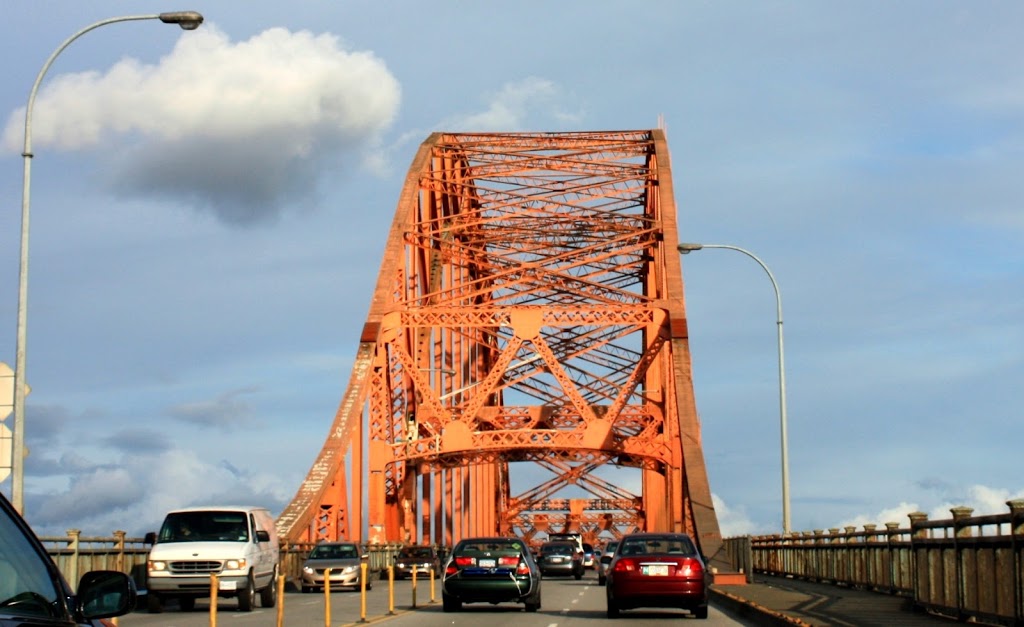
We all know the Pattullo is a dangerous bridge: it is narrow, the road curves, the merges and approaches are unsafe. It is anthropomorphised as some sort of “killer” bridge, and few feel safe driving across it. But is it actually unsafe?

The problem with common knowledge is that it is rarely either.

Surely there was a spate of terrible head-on accidents on the bridge a few years ago, and we all remember them well. However, the last head-on fatality was in 2007, they have dropped remarkably since the late-night centre lane closures started. 26 fatalities between 1996 and 2006 are too many, we can all agree, but the count since 2007 of zero is pretty much what we have been looking for. The measures in place seem to be helping, and more important to the current discussion, the main cause of these crashes isn’t narrowness of lanes or lack of central median.

The story from the 2006 tragedy indicates ICBC found 85% of people crossing the bridge were driving more than 30km/h over the posted limits. Not a few or some people exceeding the limit, but almost everyone, and not exceeding the limit by a few km/h, but by more than 75% of the speed limit – with a large number of drivers exceeding the definition of “Excessive Speed”, you would think that a couple of Photo Radar cameras would do more for the safety of this bridge than any other measure. But I guess that ship has left the dock…

Regardless, if people feel unsafe on the bridge, they are sure not displaying it by behaviour: in a rational world, people usually slow down on dangerous roads, they don’t drive at excessive speed. 

At their Open Houses, TransLink commonly repeated the statistic of 138 crashes per year (one every three days), and 33 crashes causing injury per year. That sounds bad, but is it?

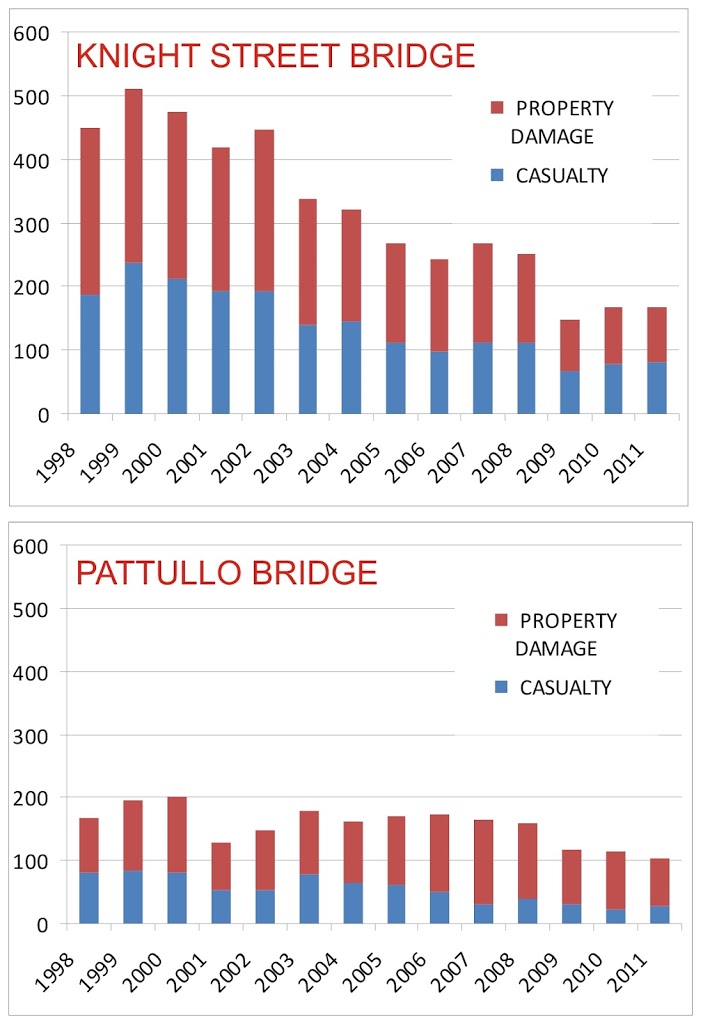
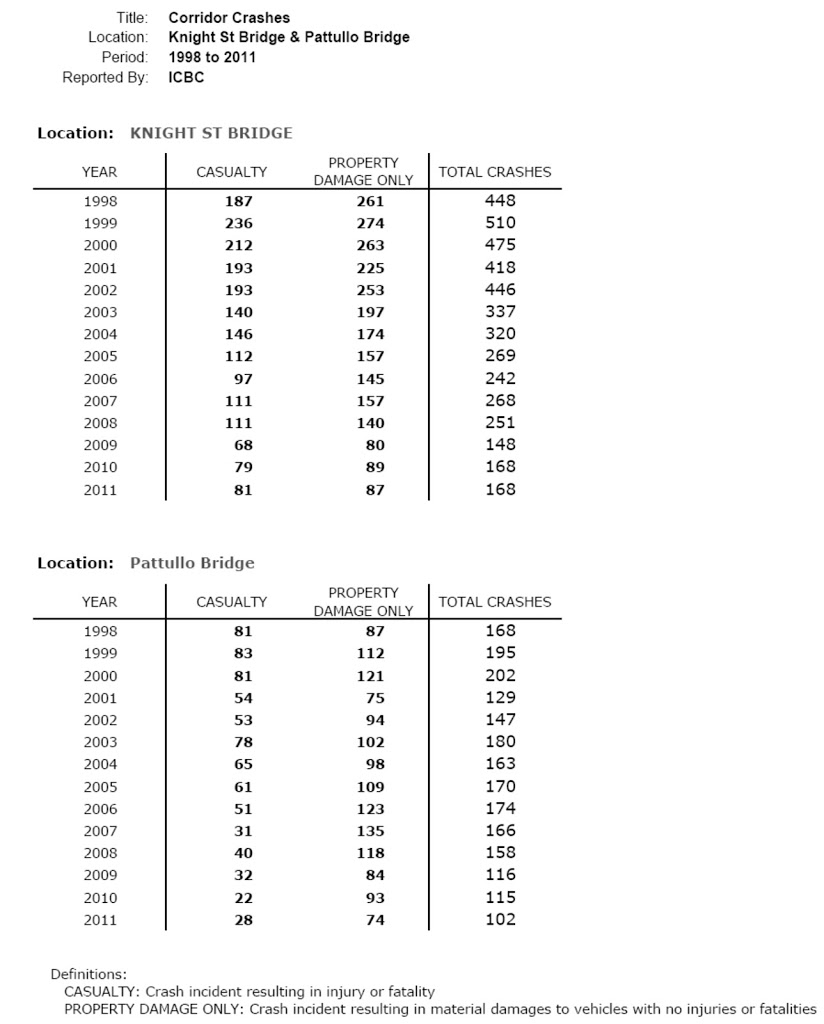
Perhaps a useful comparison is to the other major bridge that TransLink operates, and for which we have significant statistics: the Knight Street. I asked ICBC for the crash statistics for the two bridges over the last decade, and here is what they sent me:

Here is what it looks like graphically.

The blue columns are “casualty” data, those crashes where there is a reported injury, which could be anything from a fatality to serious trauma to whiplash (note these are counts of crashes, not of injuries). Stacked on these are the red columns of accidents where there was no ICBC injury claim.

So TransLink’s number of accidents, 138 per year, is a fair estimate of the average over the last 6 years, essentially since the barriers went in at night, but does not acknowledge the significant decrease in accidents over the last three years. The number of accidents with injuries has also been decreasing markedly.

What is shocking is how the Pattullo has always been a significantly safer bridge than the Knight Street. In many years, there are more casualty accidents on the Knight Street than accidents of all kinds on the Pattullo, and the total for the Knight is often twice that of the Pattullo. There has been a similar decrease in accidents over the last decade on the Knight Street Bridge, and that has closed tha gap a bit, but the comparison is shocking. Especially when you look at the Knight Street Bridge:


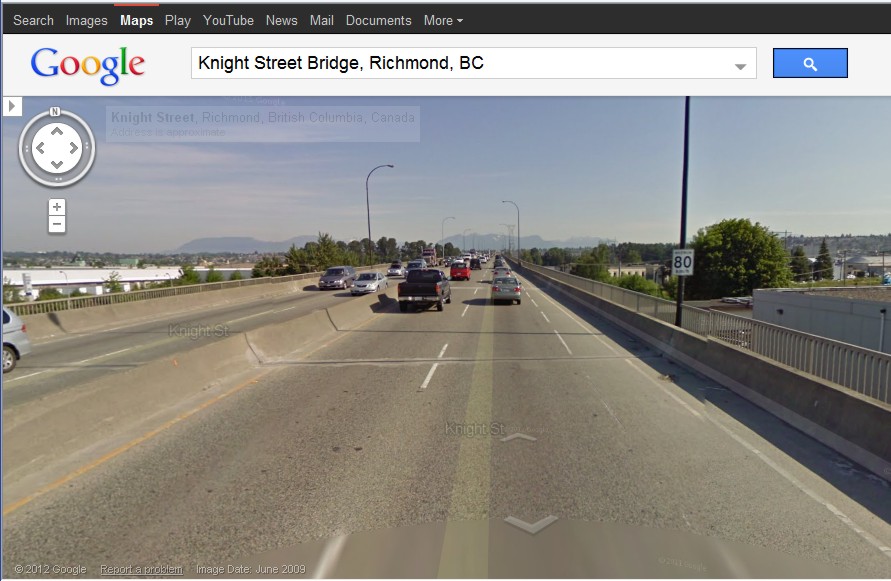
Knight Street is straight; it has wider lanes, a central barrier, and a shoulder for buffer room. It is predominantly a 4-lane bridge, but has two extra outside lanes on the short northern part of the span connecting the Industrial area of Mitchell Island to the Marine Drive truck route (ostensibly “truck priority lanes”). Why is it so much more dangerous than the “Killer” Pattullo Bridge? Why are we not investing in making the Knight Street safer?

Or maybe more important: why are we so afraid of the Pattullo Bridge?

ICBC gave me permission to share the above statistics, but asked that I include this caveat with the statistics they provided:

What’s N.E.X.T. for the Pattullo?

As I mentioned, I was invited to give a talk this week to N.E.X.T.NewWest, a group of young entrepreneurs, business leaders and community builders in New Westminster.

Not sure why they asked me, but I took the opportunity. As I had previously whinged, we need to hear from this community on important issues like the Pattullo Bridge. New Westminster’s business community is not just the Bricks and Mortars on 6th Street, or Columbia, or 12th Street. They are fundamental to our City, and well represented by the Chamber of Commerce and various BIAs, but I chatted at the N.E.X.T.NewWest event with people running bricks-and-mortars, and with a bunch of people running home-based business, most with home-based employees, or using services like the Network Hub –examples of what the business community of the future is going to look like.

I gave them a speech full of facts and opinions (challenging them to call me on the difference). I really had no idea what kind of reception I was going to get from the 60+ people in the crowd, and I can only characterise it as “mixed”. They mostly laughed at my lame jokes, and some folks really engaged (i.e. nodded their heads at the right time), while others were clearly not buying my bunk (i.e. rolling their eyes at the opportune time). I even got cornered after and into a long discussion with a couple of guys who strongly disagreed with me about how traffic and road building interact. Actually, it was those conversations that were the most fun, because I learned from those guys, and I hope they learned a bit from me as well.

As an afterthought, I had no reason to be as nervous as I was, they were a receptive and informal group, and fun to hang with. I perhaps should have been more depressed that I was the oldest guy in the room, considering the accomplishment and contributions of the folks in attendance. My only other mistake was assuming that everyone was already engaged in the discussion around the Pattullo, and know what the “NFPR” and “SFPR” are, or even what I was referring to when I used the term “Puchmayr Express” in reference to connecting the SFPR to the new Mega Mann Bridge.

Anyway, I drifted off script a bit, but here was my prepared summary of my talk. If you have read this blog a lot, you have heard all of this before. If not, then hopefully this is a good summary of the Pattullo Bridge issue, as I see it, with references to some documents I mentioned in my talk – so you can verify my facts and separate them from my opinion. The photos are all mine, I had them running behind me on the mother of all flatscreens at the ReMax Office.
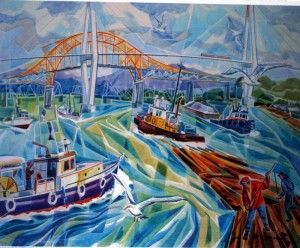
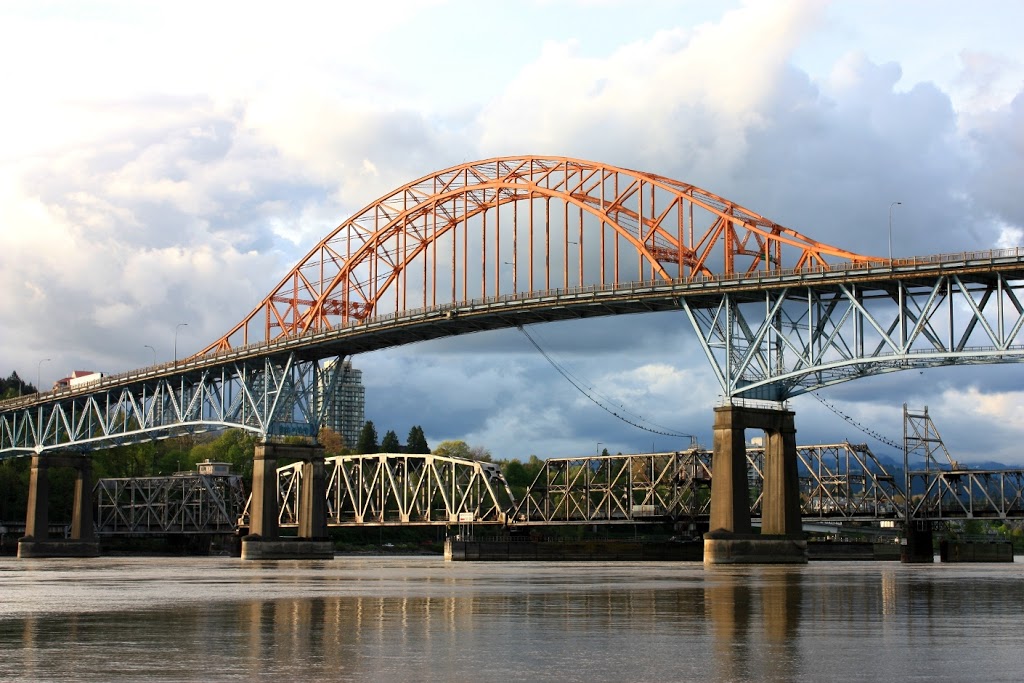
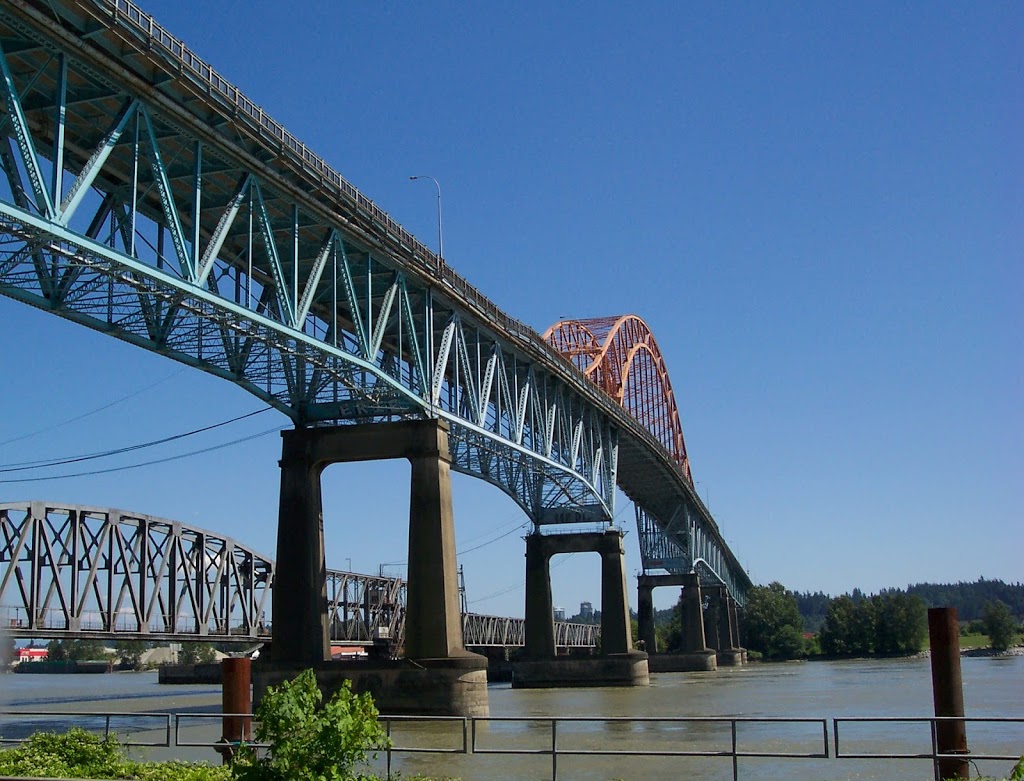
This is the only image here not my own creation. Well, I took the photo, but the image is of a painting by one of my favourite artists, Jack Campbell. He was a long-time New Westminster resident, and captured many remarkable images of New West during his time here. Coincidentally, he is also my neighbour on Saturna Island, where he is now catching remarkable images of the arbutus trees and sandstone shorelines of that jewel of a Gulf Island. When I think of the Pattullo as being an iconic structure in New Westminster, an important part of the heritage, I think of this image, there it is between the futuristic SkyBridge and the guys doing the historic work of booming logs on the Fraser River

What’s N.E.X.T. for the Pattullo Bridge?

I’m here to talk to you guys about the Pattullo Bridge, where it came from, where it is going, and why I think you should care. I have been following this issue for a while, have written a bunch about it on my blog, have been to several community meetings, and have read a lot of reports on the Pattullo, so I am going to start off by supplying you a bunch of facts, then will work my way into a whole bunch of opinions. I will try to make it clear which is which – and I want you to call me on it, if you think I have confused the two!

First the Facts.

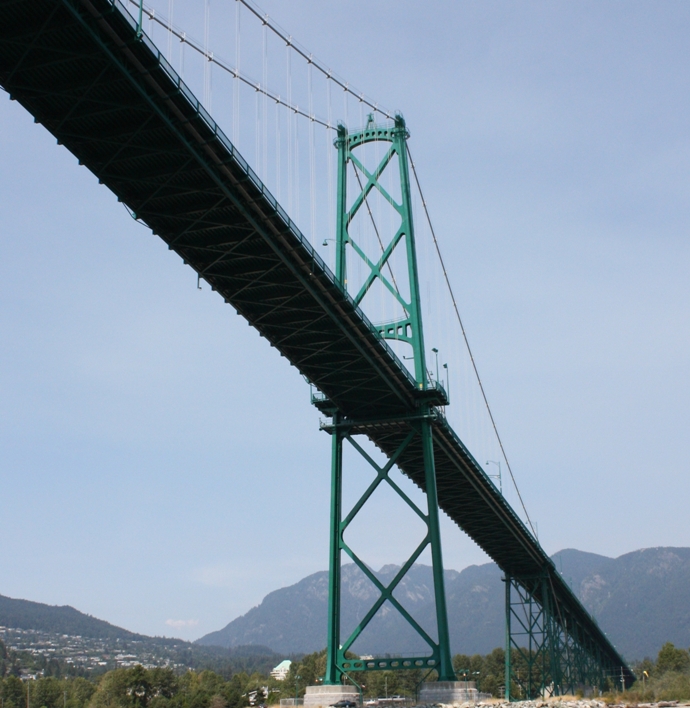
The Pattullo Bridge opened in 1937, a year before the Lions Gate Bridge and a year before Superman was published in Action Comics #1.

The bridge belongs to TransLink, which is kind of unique. TransLink only owns and operates three bridges: Pattullo, Knight, and Westham Island. They also own Golden Ears, but it is financed and operated by a concessionaire through the PPP process, so that is best left for another conversation. The rest of the bridges you cross every day either belong to the Province through the Ministry of Transportation and Infrastructure (Port Mann, Lions Gate) or to a City (Burrard Street, Cambie Street).

The Pattullo, for 75 years old, is really showing its age. Worse than the Lions Gate or Superman.

According to TransLink stats, about 60,000 cars and 3,500 big trucks cross the bridge on the average day. This is about the same car count as the Lions Gate, but there are no big trucks permitted on the Lions Gate.

However, the number of cars and trucks crossing the bridge is NOT the reason Translink wants to replace the bridge.

Instead, TransLink has provided an alliterative list of Replacement Factors: Safety, Scour, Seismic, Structure.

The safety issue is probably the one most people can relate to. The Pattullo has narrow lanes, curves at both end, and has a reputation for being accident-prone. For those prone to anthropomorphise, the term “Killer Bridge” has been used. I just want to note that there has not been a fatality on the Pattullo since 2005, when the nightime centre-lane closures were implemented. There are also fewer accidents and injuries per year on the Pattullo than on TransLink’s other bridge- the Knight Street.

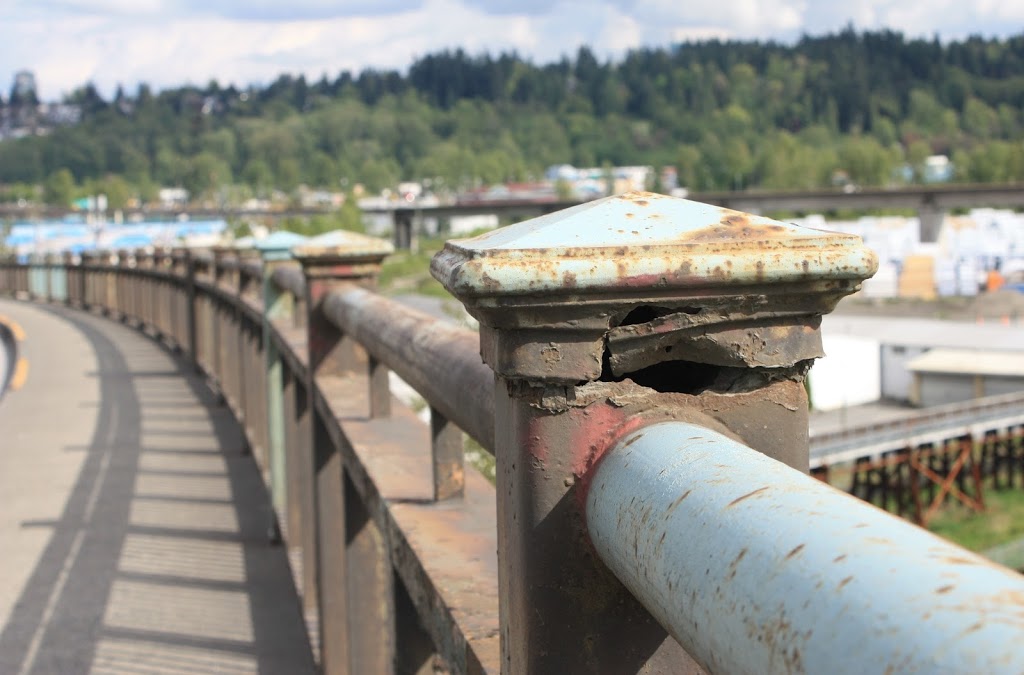
The bigger concern is that the bridge is currently faslling apart.

TransLink says it is past the end of its service life, and costs them $3 Million/year to maintain. It will not last much longer without a major re-fit, which will cost about $200 Million. This will bring the bridge up to modern structural code, and get us another 50 years of life out of it, but will not bring it up to the highest current seismic codes.

So TransLink has a plan.

Actually, these plans have been brewing for some time. A commonly cited report from 2001 talks about the federal government paying $1Billion to replace the rail bridge with a tunnel, and attaching some car lanes to it (although it is unclear if this would be parallel to the existing Pattullo or replace is). It wasn’t until late fall of 2010 that TransLink announced the start of public consultation on the project. Then those consultations were abruptly cancelled.

This was unfortunate, partly because that would have given us the opportunity to discuss the future of the Pattullo and the plans that TransLink had in the context of a Municipal Election. That would have led to interesting dialogue on both sides of the River, and in the region.

Instead, the consultations were re-announces a couple of weeks after last November’s elections were over. But it wasn’t until after the Christmas Break that TransLink brought their planto the public: 

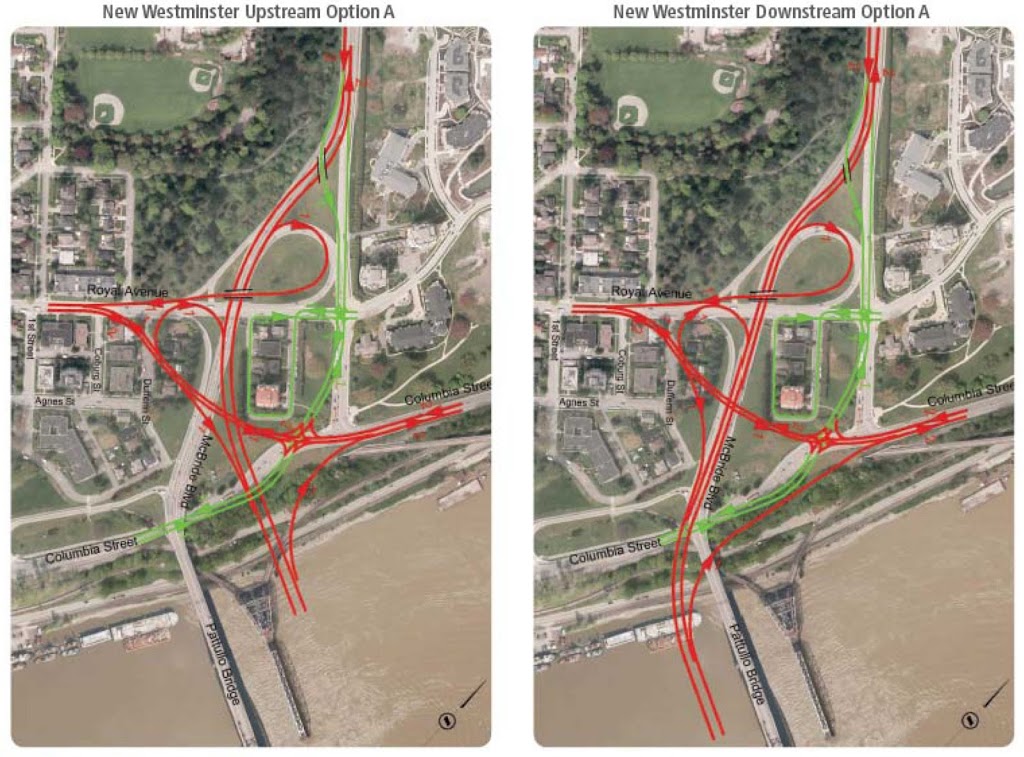
There were a series of open houses this spring run by TransLink showing us a bunch of options to consider: did we want a new 6-lane Pattullo bridge just to the left of the old one, or just to the right of the old one?

They also included a few different off-ramp configurations, but did not (as was humourously reported by many) ask us what colour we wanted the off-ramps painted. I would rather re-characterise it as offering us a few different bowl-of-spaghetti off-ramp drawings, and asking us which offended us less. Primavera or Alfredo?

It was also during this consultation that the alliterative reasoning for replacement was provided:
Scour, Safety, Structure, Seismic.

The 60,000 cars a day were not (and remain not) a replacement factor for the bridge. The two extra lanes were instead justified for “goods movement” – and were referred to as “truck priority” lanes. The definition of “truck priority” lanes was not supplied, and is hard to calculate, as no such thing exists in TransLink’s jurisdiction, anywhere else in the province, or in the Motor Vehicle Act.

There were a few other ideas that fundamental to the public discussions, but came out through the question and answer parts of the consultations.

1: the bridge will be tolled;

2: TransLink projects traffic to increase on the new bridge to 94,000 cars a day, and 7500 trucks a day.

Remember those numbers, if nothing else: 50% more cars. 100% more trucks.

Now I cannot speak for the City of New Westminster, I am not an employee of the City of New Westminster – it is not my job to speak for the City. But I do serve on the City’s Master Transportation Plan committee, and have attended a lot of public meetings on this issue. So what you are about to hear is my take on the situation, and I stand to be corrected by the City if I misquote their position.

This plan and the consultation are both – to be generous – less than optimal.

First off, the timing is terrible. The City had already begun its Master Transportation Plan process. This is a master planning document that will outline the shape and form of the City’s transportation network (roads, sidewalks, bike lanes, trails, transit facilities) over the next decade or longer. A major component of the MTP is multi-stage public consultation to determine what the visions and goals of New Westminster are for their transportation network. Here have already been two rounds of public consultations and stakeholders engagement.

So part way through this process, TransLink drops a 6-lane bridge, effectively shuffling the deck.

The City decided to not provide a formal response to the consultation at that time, but to wait until the MTP process got to the point where the goals and visions are reported out, and those goals and visions would constitute the information that TransLink wanted from the City. TransLink recognized this as a valid approach, and agreed.

And that is where we are now.

Secondly, there were some obvious problems with the plan itself, expressed by the public at the public consultations and informally by many of the elected types in New West. Primarily:

Why 6 Lanes? How does 6 lanes address the problem TransLink has with the Pattullo?

Remember what the problem was? Not cars, not trucks, it was:

…an old bridge.

At the public consultations, TransLink claimed the maintenance costs for the Pattullo are $3 Million per year. I have refuted this claim, based on both opinion and fact:

The opinion part is when you walk along that bridge and try to find evidence anyone had opened a bucket of paint anywhere near the bridge in the last three years. The storm grates are plugged with sand, there are birds nesting and plants growing in the steel superstructure.

The fact part is going back through TransLinks public financial documents and trying to identify the $3Million. It just isn’t there. The total costs for bridge operations and maintenance last year was under $300,000, and that is combined for all three bridges. The average over the last couple of years has been $1.2Million a year. I don’t know what they spend, but it is not $3 Million.

And this is an important point. The Pattullo Bridge is an old steel structure. Like other old steel structures: the Lions Gate Bridge (75 years); the Golden Gate Bridge (75 years); the Empire State Building (80 years); the Eiffel Tower (122 years); my Honda Civic (15 years), old steel structures require maintenance to be reliable. They can last forever if appropriately cared for, but will turn to dust in an instant if neglected.

But instead of addressing the issues with the existing bridge, TransLink has decided instead to build a new bridge, and a bigger one.

Now a bigger bridge is an easy sell to people on both sides of the river caught in traffic:

“Whoo hoo! New lanes! The end of congestion! No more mention of the Pattullo in the traffic report- freedom!”

But remember those numbers? 50% more cars. 100% more trucks.

Now, I’m a geologist, which is science code for “I failed Calculus”, but this is not difficult math. 50% more lanes with more than 50% more traffic is not less congestion. It is the same number of cars per lane, the same number of cars per hour in each lane. Just more lanes and more cars.

So what happens when those 50% more cars and 100% more trucks get dropped on New Westminster’s old streets, already stressed by 400,000+ through-drivers every day?

How will 50% more cars and 100% more trucks fix the situation at Front and Columbia? At Columbia and Brunette? On Royal Avenue? On Stewardson?

I’d like to stand here and tell you we need a bigger vision – a longer term plan. But I can’t say we need these things, because we already have them!

The City has its existing Master Transportation Plan, and is updating it currently. TransLink has a long-term regional transportation plan called Transport 2040. MetroVancouver has a Regional Growth Strategy, built on the old Liveable Region Strategy.

All of these documents say the same thing:

The future is in compact urban centres, in smart density, in transit-oriented development, in moving living and work spaces nearer together, in providing people options to use transit, to bike, to walk. The future relies on us ending the dependence on automobiles. Not ending cars, ending the dependency on cars, through an integrated transportation network that supports all users and provides choice. A sustainable region will be the one where sustainable transportation choices are available and supported through sustainable development practices.

And we are building this future today. Look at Downtown New Westminster. Look at Sapperton. These strategies are being built into New Westminster.

You may not realize, New Westminster is second only to the City of Vancouver for our “Alternative Mode Share” – the proportion of our population who use transit, bikes, or walking for their commuting and shopping trips. We are approaching Transport 2040 goals faster than any other City. We will be the densest City in MetroVancouver by 2041- we are leading the way on the regional planning goals. New Westminster is the target other Cities are striving towards, even as we move forward.

So why jab a 6-Lane Freeway-style bridge into the middle of that progress?

How does that serve our long term plan, or the regional long term plans?
Whose long term plan does it serve?

I have an alternative approach (warning: lots of opinion ahead).

First- to TransLink. Please give the City and the region a real consultation on this. Don’t come to the first community open house with a bowl of spaghetti and ask us what flavour of sauce we prefer. Even Anton’s lets you choose the noodle first.

Let’s discuss the local and regional impacts of a 6-lane bridge; of a 4-lane bridge; or of no bridge at all.

Some have suggested the solution is to move the bridge, upstream to Sapperton Bar and Coquitlam, or downstream to Tree Island and Burnaby. I’m not personally a big fan of this argument, as it stinks of nimbyism, and if this bridge is a bad idea for New West, it is probably just as bad an idea for Coquitlam. But hey, show me the business case, and I’m ready to be convinced.

How about an evaluation of this approach: what I like to call the Lions Gate Solution.

The Lions Gate Bridge is an interesting parallel. The bridge is the same age, and had the same problem. In the late 90’s, the old steel structure was falling apart and it needed replacement.

The public consultation process started with a public call for proposals, and evaluated a suite of solutions- replacement, twinning, refurbishment, tunnels…

Here is the first lesson for TransLink, the public consultation process lasted 3 years. They even opened an office on Denman Street that operated for two years, so people could come down, look at the proposals, learn about the strengths and weaknesses.

It is a long story, and a great thesis was written at SFU on the topic, but the short version is that the West End of Vancouver and West Van would not accept increased traffic. No-one wanted a major shift in the Stanley Park Causeway. North Shore commuters would not agree to tolls. No PPP partner could be found to expand the bridge to 4 lanes (the preferred approach) so the Provincial government spent $80 Million refitting the bridge, starting in 2001.

$80 million, replaced structural components to increase the load capacity, seismic upgrade, replaced the entire deck, and kept the same number of lanes.

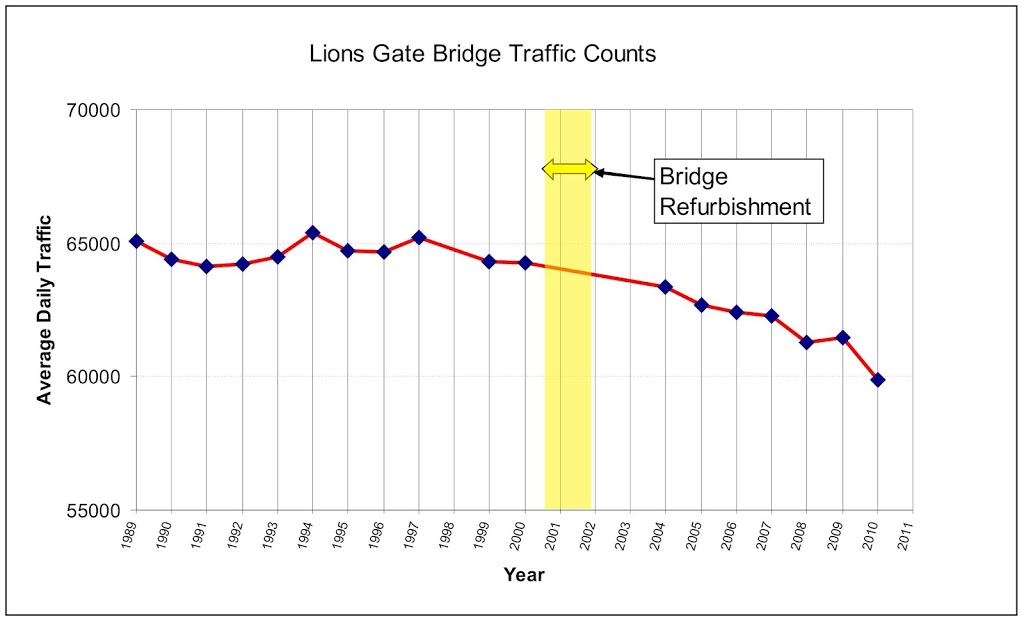
This is the only graph I will show, because I want you to know this is not my opinion, these are real numbers from the Ministry of Transportation (from Here, Here, and Here.) 

During the consultations for the Lions gate, they looked at tunnels, twinning replacement, because they were certain they needed more lanes. The argument looks pretty familiar: “Traffic is coming, it will grow, it always does, so we need to build a bigger bridge, here is our chance”.

They got three lanes, and this graph shows what happened to the traffic.

Over the same period, 22% population Growth in Vancouver (more on the downtown peninsula), 125 growth on the North Shore, Combined jobs growth over 18%. Housing prices are up, employment is up, every indication is robust economic growth, even through an earth-shattering recession. Where did the inevitable traffic go?

Maybe it is magic. Or maybe it is the Plan.

OK, Back to opinion:

Good enough for Lions Gate its good enough for Pattullo.
Good enough for West Vancouver, good enough for New Westminster.

So I am suggesting we fix it. Let’s spend the $200 Million fixing the Pattullo Bridge, and the $3 Million needed to maintain an old steel structure. We will still be $800 million ahead. That money TransLink can use to give Diane Watts and Surrey the transit system they want and need. I don’t care if it is light rail, heavy rail, SkyTrain, street cars, fast busses, or jetpacks. Let them build the transit sytem of their dreams with an $800 million blank cheque.

Because every person South of the Fraser who is on transit is one less car driving through New West.

Let’s fix the historic, iconic, non-killer, repairable, and affordable Pattullo.
Sapperton Day(s)

I had a great Sapperton Day(s), again this year.

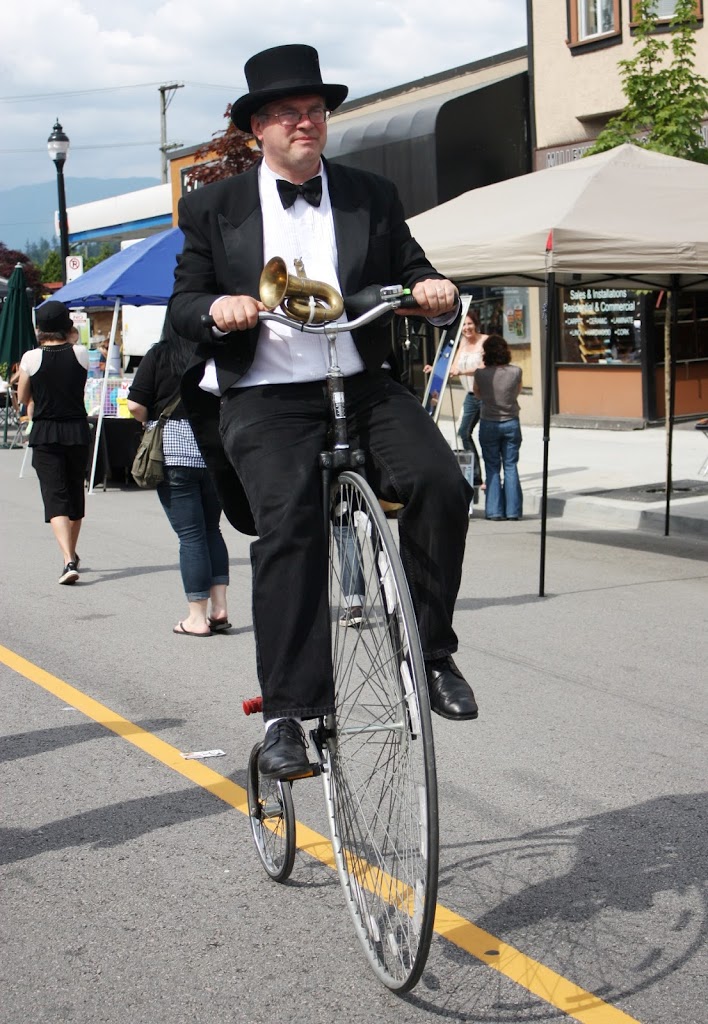
This has become my favourite one-day festival in the City, not the least because it is the only festival with guaranteed Penny Farthing appearances.

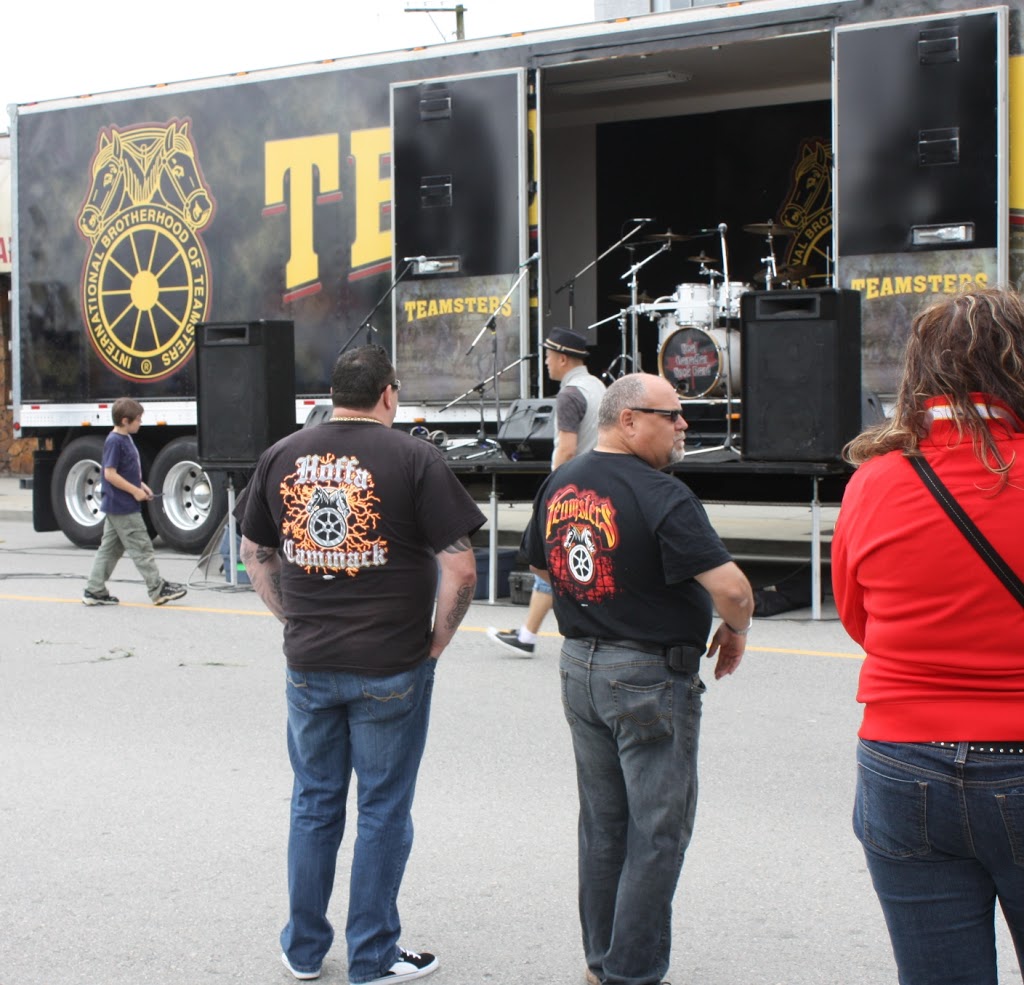
As usual, there were lots of kids activities, lots of Food Truck options, a kick-ass Pancake breakfast with Real Maple syrup and free-range pork sausages, numerous community and volunteer groups, a few giveaways, random entertainment, and the music was loud and really well defended:

I did a tour of Cap’s “Bicycle Museum”. I’ve been going to Cap’s since I bought a Diamond Back Arrival from them in 1987, but I have never seen their remarkable collection of bikes, some dating back to before the Penny-Farthing era. It is amazing, as a bike geek, to see how the same simple engineering problems were solved in so many different ways, based on the best technology of the day. It is well worth the $2 admission to walk through that collection. Maybe we can get them museum space at the new MUCF?

Sapperton Day(s) also gives you a chance to see some of the new businesses in Sapperton. Last year’s big surprise was the great pulled pork at the Graze Market/The Ranch BBQ, this year it was the Pad Thai at the new Thai restaurant just up the Street, named (if I remember correctly) Thai New West.

For the second year in a row, the Sushi Restaurant right across the street from my booth remained closed for Sapperton Day(s); a strange business decision to make when 10,000 people would be walking by the front of the restaurant that day…

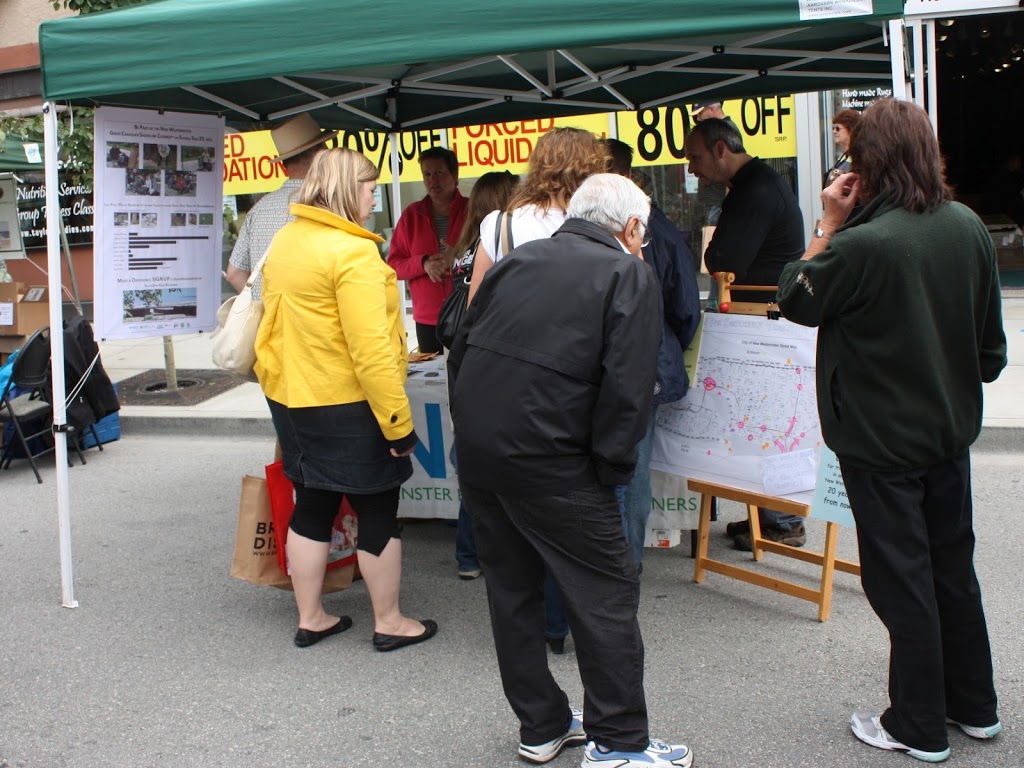
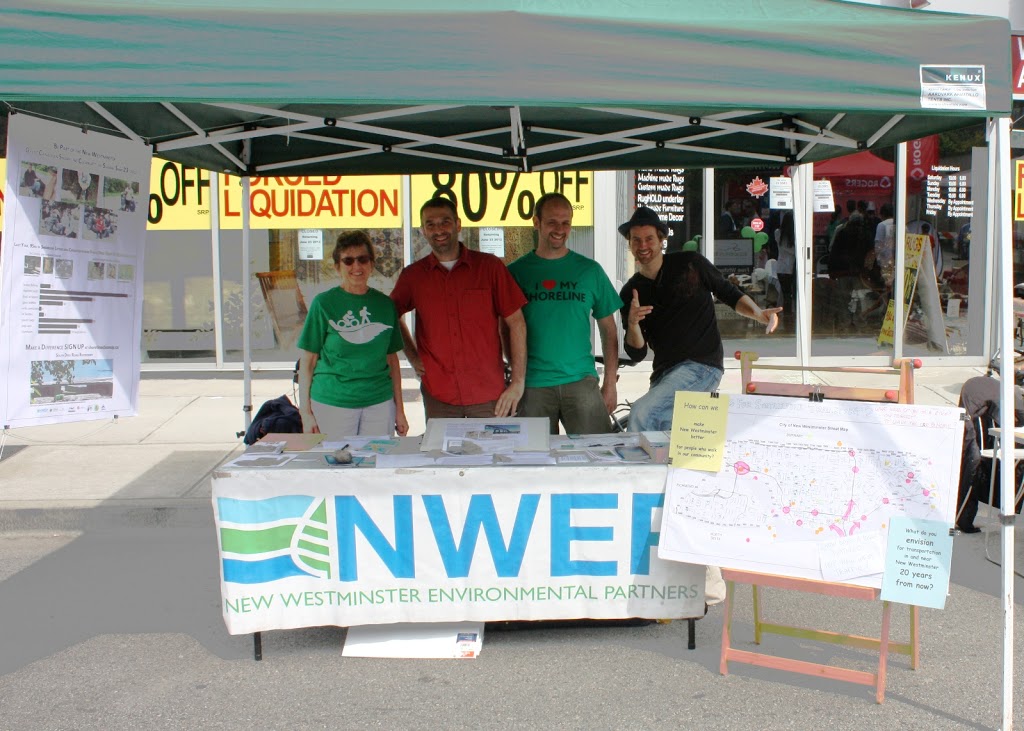
I spent most of the day at the NWEP booth, talking transportation with people from across the City, and across the region. I noticed a difference at this event compared to the dozens of previous events where the NWEP went to talk policy stuff: almost universal agreement.

Previously, we have been out helping the City promote the Clean Green bins, or collecting ideas for the Master Transportation Plan, or promoting backyard composting, we are introducing people to the ideas for the first time. This means you have to try to keep their attention while trying to get enough info across that they will care to learn more before wandering next door for lemonade.

And the Lemonade at the Sapperton Day(s) was great. It was a lemonade kind of day.

This time, where the main topic was the Pattullo Bridge (note it was our main topic, the TransLink Booth at Sapperton Day(s) was paradoxically bereft of any information on the Pattullo expansion plans…), it seemed most people in New Westminster knew something was going on and just wanted to know more. They were engaged in the topic before we even started talking. The first question I asked people as they wandered by was “what do you think about the Pattullo Bridge”, and the conversation flowed easily from there.

The most common question I got from New Westminster residents is “what can we do about it?”

That’s not to say everybody had the same opinion. There were a few people who had better ideas to spend more money (on tunnels, cable cars, jetpacks) to “solve our traffic problems once and forever”, but most recognized that more lanes into New West means more cars in to New West means more traffic to deal with. Oh, there was also a long, circular and soul-crushing discussion with our local Libertarian Torch-bearer who kept saying that “you people rely on violent coercion to tell people how to live”, without explaining how voting was an act of violence or who, exactly, “you people” were.

But no-one was without an opinion on it, and that is the good thing. All we need to do is channel all of those opinions into the upcoming TransLink Open Houses, on June 23. It hadn’t been announced by Sapperton Day(s), but our main advise to people was to keep your eye on the local media and on the TransLink website, and show up at the next Public consultation.

Thanks especially go to HUB for lending us the tent: we thought it might be rainy but in the end it just reduced sunburn. We also gave away a tonne of pocket-sized folding bike maps for New Westminster and neighbouring communities, and promoted the upcoming HUB Streetwise safe cycling course in New West on the 16th.

I suppose it will appeal to folks like James Crosty and Ted Eddy, who wouldn’t be caught dead at the Pier Park Grand Opening.

This just in….

This just in from TransLink (emphases mine):

Hello,

In February 2012, TransLink gathered public and stakeholder feedback on bridge location (alignment) and connection options in New Westminster and Surrey for the New Pattullo Bridge Project. We invite you to attend a series of Open Houses to learn more about the proposed project, its status, and share your views.

Please join us on the following dates:

Date: Thursday, June 21
Time: 2:00 PM-8:00 PM
Location: Surrey SFU

Date: Saturday, June 23
Time: 10:00 AM-3:00PM
Location: Sapperton Pensioners Hall

Date: Tuesday, June 26
Time: 2:00 PM-8:00 PM
Location: Sapperton Pensioners Hall

Date: Wednesday, June 27
Time: 2:00 PM-8:00 PM
Location: Surrey SFU

For further information about the project, please go to www.translink.ca/pattullo or contact Vincent.Gonsalves@translink.ca at 604.453.3043.

Mark Your Calendars for the 23rd.

Bicycle Boxing

I managed to survive Bike-to-Work Week, despite the actions of one idiot and the reality that my schedule did not allow me to ride my bike to work even as many days as I did the week before or the week after. In honour of Bike Month, I want to talk about the most persistent threats to cyclists on the road.

Although I had a run-in with an idiot who seemed to be offended by my presence on a bike, I need to emphasize this is a real anomaly. I cannot remember the last time I had a deliberate assault like that in Canada.

I lived in the MidWest of the United States for a couple of years, and when riding my road bike on country roads through corn and soybean fields, having someone brush you off (speed by so close it causes you swerve towards the ditch by reflex), or throw a beer can at you while yelling “fag!” was not that uncommon. I’d put it at less than once a week, more than once a month, but maybe I have a really faggy peddling stroke.

Interesting aside: Budweiser is by far the preferred brand of beer amongst the type of people who throw cans at passing cyclists while yelling “fag”. You would think they would market that more.

Regardless, this type of aggressive behavior towards bikes is very rare, and I don’t see it as a real threat when riding my bike. At least these idiots see me, and acknowledge I am on the road. What is much more dangerous are the large number of people who don’t even see cyclists on the road. This commonly results in a two-punch attack to bicycle commuters that have come to be known as the Right Hook and the Left Hook.

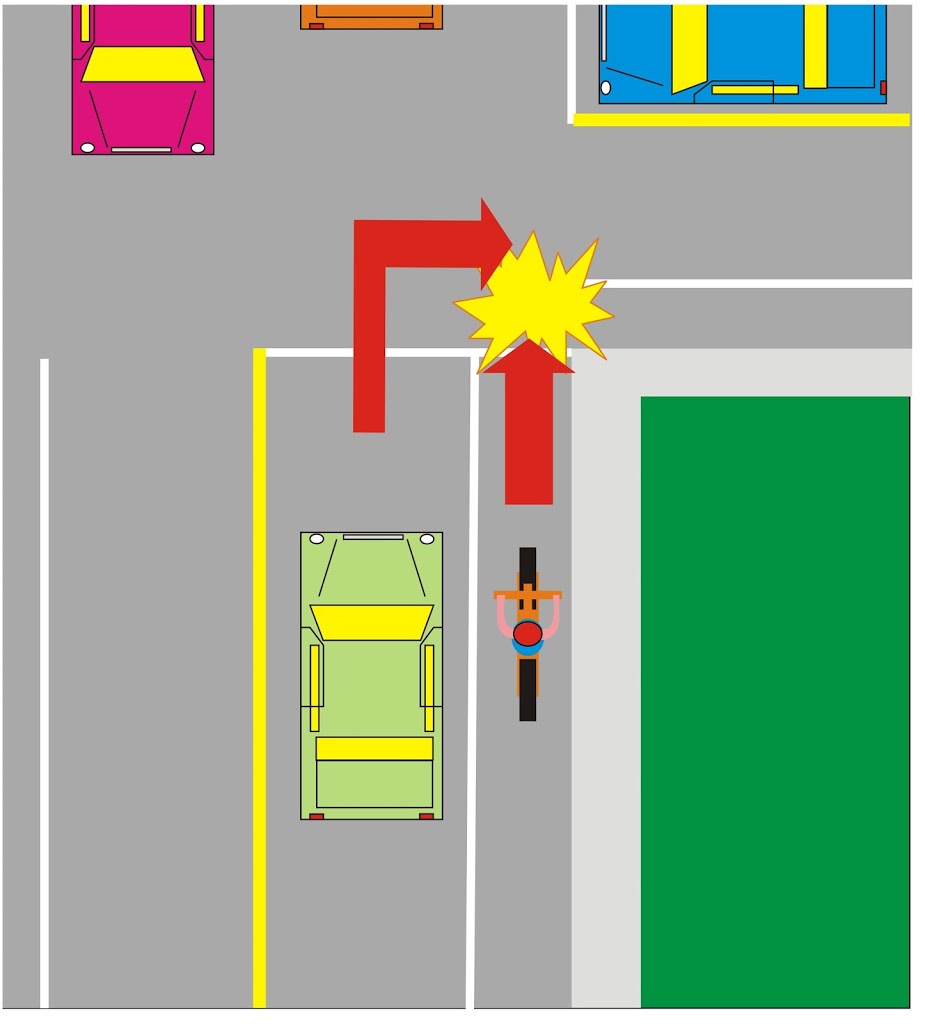
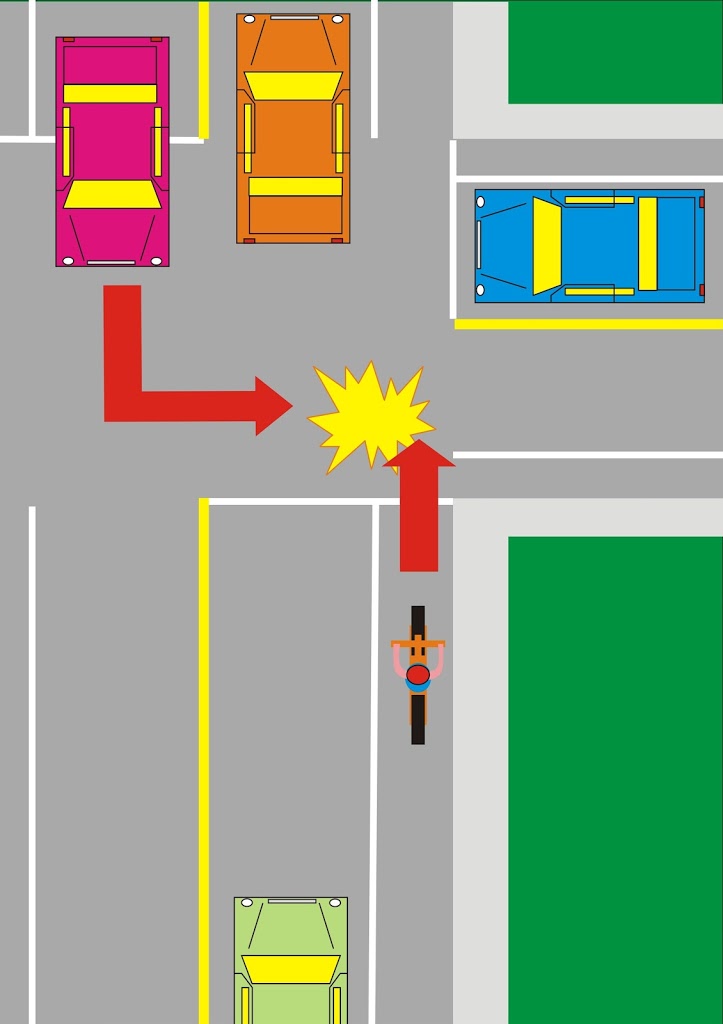
The Right Hook occurs when a cyclist is riding along “as far right as practicable” as per the Motor Vehicle Act, commonly in the bike lane. As drivers pass by on the left, you note one slowing down just after they pass you. The car then pulls a right turn directly into you or directly in your path. A cyclist has virtually no defense. A faster car catches up to you, passes you, then cuts in front of you at an intersection or, even less predictably, at a driveway.

The Left Hook is when a car turns left into your path. The typical situation is when the cyclist is rolling along “as far right as practicable” as per the Motor Vehicle Act, maybe even in a bike lane, with a string of cars steaming by to your left. You roll into an intersection just as there is a gap in that string of cars, and an oncoming driver, who has been patiently waiting to turn left sees their gap and goes for the left turn, and either hits the cyclist, or the cyclist hits them.

In both cases, the cyclist does nothing wrong, riding in full compliance with the law, and has absolutely no defense, yet takes the brunt of the crash. With all the talk of cyclists running stop signs or weaving through traffic, or any of the other hundred behaviours that drivers criticize in cyclists (yet turn a blind eye when other car drivers do them), the majority of actual bike-and-car accidents are either a Right or a Left Hook. I had near-misses of both types on the same day during Bike To Work Week. This happens ALL THE TIME.

When the impact or near miss happens, the driver’s defense is universal: “I didn’t see you!”

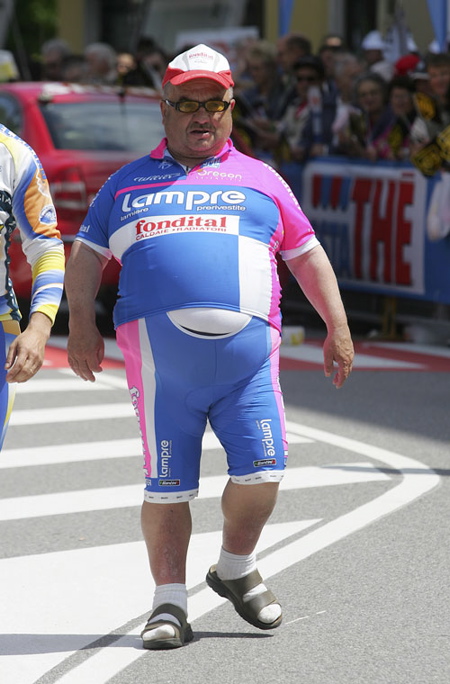
Let me give you a tip, drivers. This is an admission of guilt, not a defense. This is the definition of driving without due care and attention. When I ride my bike in the City, I am dressed up like a freaking MardiGras Parade. If it is twilight or darker, I have more flashy lights and reflective surfaces than the last 5 minutes of Close Encounters of the Third Kind. Here is a picture of me back in my racing days…

If you did not see me, you were not driving with the attention or care due for a person operating a 3000-lb 200-HP piece of machinery in a public space.

This excuse is especially hollow when (as commonly happens) the person delivering the Right Hook actually accelerates to get in front of you before pulling the hook. You know they saw you, they know they saw you. What they are really saying is that they did not understand how to deal with you. People who don’t ride bikes in traffic (the majority of drivers) simply don’t know how they are supposed to interact with a bike in the right lane.

One approach that seems most unlikely is to slow down a bit and let the cyclist pass in front of you before you make the turn. This is likely because most drivers still see bicycles as faster pedestrians (“get on the sidewalk!”) and not a slow motor vehicle (as the Motor Vehicle Act chooses to define our role).

Active aggression towards bikes is really rare in Vancouver, despite Bruce Allen’s hysterical blathering; it is the passive misunderstanding of bike that is more deadly for people who use them.

Two (+) Upcoming Events (edited to add more panic)

It should be a couple of interesting weeks, and if I don’t post too often, I have some good excuses. I have said this before, but believe me, this time I am really busy.

I have both the Royal City Curling Club AGM next week (my report is written, but I may need to prep a speech and be prepared to be peppered by questions on my role as Ice & House Committee Chair) and the Environmental Managers Association of BC AGM and Awards Luncheon is also next week (I am expecting to return to the board as a VP at that event). There is also the Westminster Pier Park Grand Opening coming up, and I did my volunteer training for that yesterday. I also have an Emergency Advisory Committee meeting tomorrow evening. Don’t forget the first Royal City Farmers Market of the year is this Thursday (great fundraiser, by the way!).

Bonus last-minute panic-causing addition:
Sapperton Day is also this Sunday! See us at the NWEP Booth talkin’ transportation and Pattullo!

Although these are keeping be busy, there are two upcoming events I want to talk about here:

Tomorrow (fortunately, after the EAC meeting), there will be a Forum on the Future of the Pattullo Bridge at the River Market. Although the list of presenters is interesting, I can’t shake the feeling that this is a bit of a smoke screen.

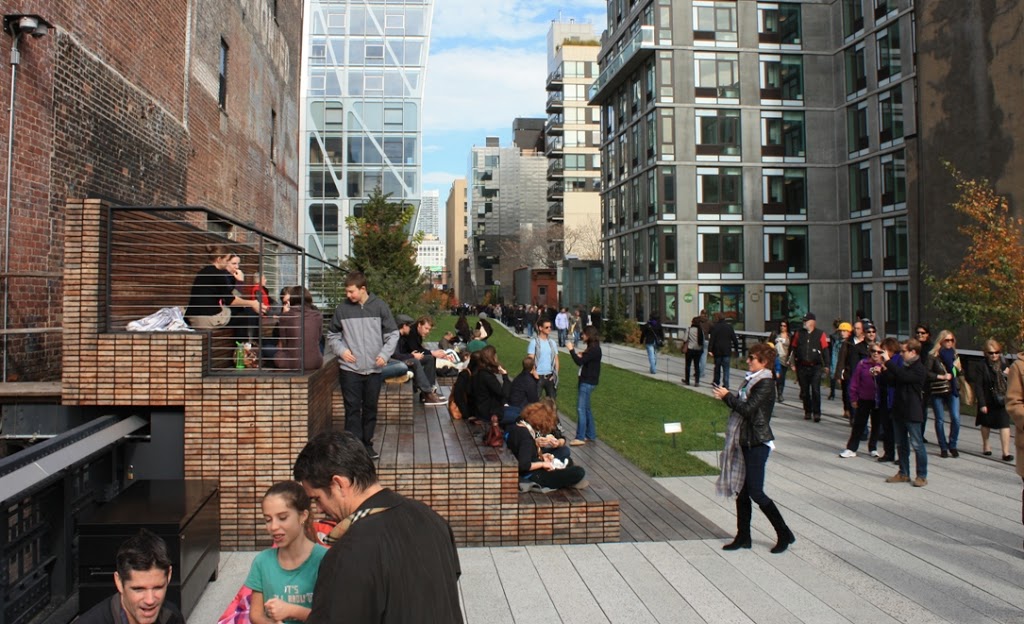
The topic for discussion is what to do with the Pattullo Bridge after TransLink builds the new 6-lane bridge. There are some interesting ideas, including keeping it as some sort of linear parkway or re-purposing as development space. Having visited the original HighLine last year, I agree it is a compelling piece of urban infrastructure, and the impact on the part of Chelsea where it was built is undeniably positive. It is getting so every developer building an elevated walkway in every City in North America is putting a few trees on it and saying it is “a HighLine like design”.

HighLine, the type sample.

I’m interested to see what learned people have to say about this type of use for the Pattullo, but I can’t help but thinking about all of the people in this town turning themselves inside-out over a much less ambitious waterfront park very close to the Pattullo. I also wonder why, if TransLink is so convinced the bridge is in immediate peril of collapse, we are entertaining fixing it for a recreation or development space. So although I enjoy speculative thinking about the future of the City as much as anyone, let’s not take our eye off the ball here. The livability of our City is not currently threatened by a lack of elevated or waterfront park space, it is threatened by the risk of increased traffic resulting from a 6-lane Pattullo.

Ultimately, I think the best use for a refurbished Pattullo Bridge is as a transportation corridor with 4 lanes and improved pedestrian and bike facilities, or even three lanes with a counter-flow middle lane. If it can be fixed, I can’t imagine a better use for it than the one it currently serves.

Which brings me to the second event of note. Next Tuesday is a N.E.X.T.NewWest event featuring some random blogivator talking about the Pattullo Bridge.

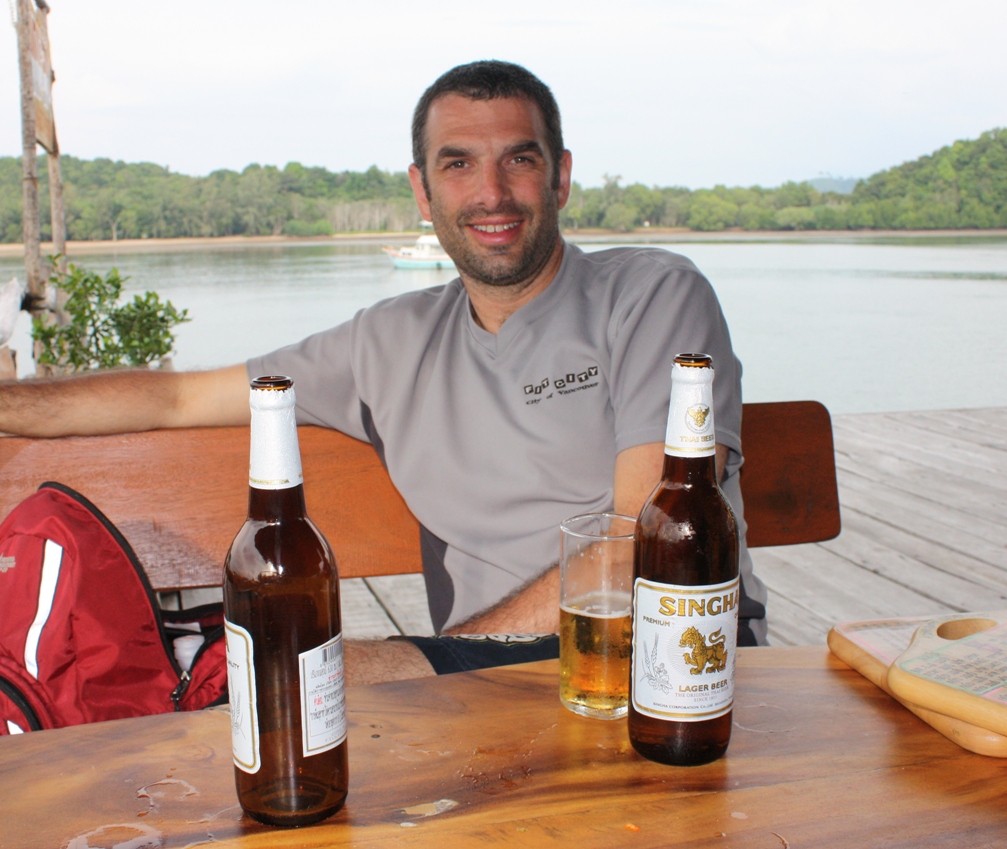
In my natural envrionment: hiding behind beer.

I am going to give a very brief background of the Pattullo situation and talk a bit about the community open houses I attended and the City’s approach to the TransLink process. I will also have some interesting data to present about aspects of the plan, and then present a bunch of opinion about where the City should be going with its transportation system, and how the Pattullo fits into that.

It should be fun and informative, as N.E.X.T. is exactly the group of “New” New Westminster business leaders whom I was whinging about being too silent in the discussion of the Pattullo up to now. My only goal for the evening will be to convince as many of them as possible that they should be getting involved in the discussion, and not let these decisions be made without their important voice. I also hope to make a few of them laugh… with me, as opposed to at me. But I’ll take it either way.

I hope to see lots of folks at both of these events, as they demonstrate one of the strengths of New Westminster – a community coming together to discuss an issue from various different angles. The more voices we have, the more likely TransLink will listen to us.

Elizabeth May on Bill C-38

I didn’t “Go Black” today for two reasons:

1: most days on this blog, I am pretty quiet, so a break from my regular irregular blogging wouldn’t really be noticed, even by my Mom.

2: The technical challenge of “going black” seems daunting for an internet putz like me.

I cannot add anything to the discussion of Bill C-38 that hasn’t already been said. When you have Andrew Coyne and David Suzuki on the same side of an argument, you can be pretty clear something special is going on. So allow me to engage in a bit of hyperbole.

I’m not currently a member of the Green Party, and I did not vote for the Green Party last election. There are times the Green Party has pissed me off, there are other times I thought they were an important voice that needed to be heard. I still think they have the most rational economic plan of any Canadian political party, but never before did I actually think the Green Party could save Canada. Until today.

Elizabeth May stood up in the House of Commons today on a Point of Order. Her speech is nothing short of spectacular. A model for parliamentary behavior, delivered from the very back corner of the house, up in the cheap seats. Our New Westminster MPs have been outspoken and effective in this debate, and We should be proud of them, but it is Elizabeth May who looks to be shifting the conversation.

Everyone who cares about the Environment, who cares about Democracy or the future of the Country needs to read this speech, in its entirety. It is long, but so is our parliamentary tradition. Regardless of what you feel about Elizabeth May or the Green Party; you need to read this. It is a perfectly crafted, well referenced, and clear argument for just how far off the rails this Parliament currently is.

Here is a link to the speech in its entirety: Take the 10 minutes it will take to read it though. It is the least you can do for Democracy. As enticement, here is my extract from her summary

I recall the words of the late journalist, a great Canadian, James Travers. We were both on CBC Sunday Edition in the spring of 2009, discussing the threats to our institutions. He commented that we really no longer have democracy in Canada. He said (and I am paraphrasing) “you can visit Ottawa and what you’ll see is a democracy theme park. The buildings are still there. You can tour Parliament, but you will no longer see democracy.”

I refuse to accept that such is the case. I acknowledge that democracy is not a permanent state of existence. It can be won, as in Arab Spring. And it can be lost. It can be lost through violence; it can be lost through neglect. It does not survive without the constant application of checks on abuse of power. It needs openness. Those things done by stealth invariably breed an unhealthy loss of respect in our democratic institutions. Sunlight is a great antiseptic. The myriad, unrelated pieces of legislation under cover of C-38, should, to respect Westminster Parliamentary democracy, be brought out of the shadows, and be tabled separately, and studied on their own merit. To allow C-38 to masquerade as a legitimate omnibus bill will bring our institutions into greater disrepute.

We, as Parliamentarians, must be the bulwark against abuse of power, even in a majority government. Our only shield is our traditions, the Standing Rules, precedent and respect for the same. Our only hope is in a fair judge. I turn to you, Mr. Speaker, without fear or favour, sine timore aut favore, to rule fairly and protect Westminster Parliamentary democracy, to restore public faith in our institutions, and to order Bill C-38, a bill imperfect in form and shape, to be withdrawn pursuant to our Standing Rules.

Reading this speech, understanding what it says, what it means, looking up and reading the references provided, that is my alternative to “going black”. To me it is much more satisfying to read and learn and talk and engage. That is our duty as unelected citizens, and it is the only defense Democracy has.

An open letter to the guy driving the Grey Volks, BC Licence Plate 707 PRE.

Look, it is pretty clear our relationship go off on the wrong foot. I’m the guy on the bike you tried to kill today? In case there were more than one, I was the one on Garden City Way in Richmond.

Admittedly, there were quite a few bikes out today, it being “Bike to Work Week” and all, but I try to ride my bike in a few times every week, so I’ll probably see you again on Garden City Way, so I thought we should talk this thing out.

You see, when you tried to merge in front of the traffic on Garden City, that narrow little lane you were driving up was actually a bike lane. Notice how the shape painted on the pavement looked like the bike I was riding, and how the lane was too narrow for your car? That is why I was taking up the whole lane, riding along at 30km/h and minding my own business. I did not realize I was preventing you racing up the right side of the road in the bike lane to get a premium spot in front of the cars tolling along Garden City at 50km/h in the car lane (the wide one, no bikes painted in it). First off, let me profusely apologize for potentially causing you to be behind another car in rush hour in Richmond, it may have cost you literally seconds that you would not have been able to make up until at least the next stop light.

Since I was in the bike lane, moving at a pretty brisk pace, I was a little surprised to get honked at by someone riding my back wheel in a crappy late model Jetta or such shitbox in the bike lane. Hence, when I turned by body around to look at the source of the honk, and saw you 16 inches off my back wheel, that look on my face was one of surprise and confusion. I honestly did not understand what you expected me to do. My options were to continue to ride in the bike lane (now slower than 30km/h, as I had to sit up and look behind me to see what the fuss was all about), or, I suppose, to throw myself into the ditch and get out of your way. Although it appeared the latter was your preferred option, I didn’t really see that as the best bet for my getting home in time to make my 6:30 meeting with the Bicycle and Pedestrian Advisory Committee.

As I turned back forward, I heard the crappy little overwound 4-banger in the shitbox you lease for $150/month begin to pick up revs. Apparently, the people over in the car lane exercised some defensive driving skills (you can Google that) or became more cognizant of the importance of your mission, and moved back, permitting you to now occupy the car lane. Therefore, you felt the need to throw a few kernels on the popcorn popper you call an engine to gun past me. Not yet fully in the car lane, you passed rather close to me. And at this point, I am ashamed to admit, I might have used a swear word in the interrogative.

Lucky you pay an extra $10/month for the factory sunroof option in the shitbox, as you looked through it at me and perhaps you could hear me mutter under my breath, in the spirit of genuine curiosity: “What the Fuck?”. Note it was said with no anger, as I was, at this point, just confused by your behaviour. I had not yet managed to calculate the situation to the level where I could generate actual anger. Now, far be it from me to opine on another’s personal space issues, we only just met a few seconds earlier, but I may suggest that any time you are looking at a passing cyclist through the sunroof when that cyclist is in the bike lane, you are probably too close. Apparently, you felt this was not close enough…

Now let me be clear here. When you took that opportunity to purposely swerve your car into the bike lane and force me into the ditch, you were trying to kill me. That was, for lack of a better term, attempted murder. I evaded contact through luck, nothing else, I cannot even thank my usually cat-like reflexes, as they I have none. When 3000lbs of wheezing shitty steel & plastic at speed contacts a cyclist going 25km/h on an asphalt road with a grassy shoulder before a hard sidewalk with telephone poles and sign standards astride, the possibility of that cyclist dying is not marginal. The chances of serious bodily harm are large, the chances that I would walk away from the incident are very small. It might have also dented your car… what would that do to your lease payments!?!

You did something very stupid, for which my dying was not an impossibility.

That loud horn you heard was the guy in the Sierra Waste truck two cars behind you, expressing his surprise and distain for what he witnessed. He stopped to make sure I was OK, and was tempted to run you down. I assured him I was OK, and he should probably not get involved. When he asked why you were trying to kill me, I had to admit I had no answer. Maybe the combination of the steroids that are accelerating your male pattern baldness (the gelled spikey hair doesn’t hide all) and the daily low-level exposure to Aqua Velva was rotting your brain. Or maybe you are just a dangerous asshole who shouldn’t be allowed to operate machinery.

Anyway I have your car type, I have your licence plate, I saw your dumbass visage through the sunroof, and I have the contact info for the guy in the Sierra Waste truck, whom I will not name, but will only refer to as “willing eye witness”. I will be meeting with the Richmond Police tomorrow. I do some work with them, pretty conscientious guys and gals for the most part. I know a few members who like to ride bikes. Maybe I’ll show up with donuts.

Oh, and now that I have done the math and discover anger is an appropriate response, I should let you know. If you come back to your crappy leased financial burden with licence plate 707 PRE one day, and find someone has unthreaded the valve cores from all four tires and your air vents smell of urine? You will know I noticed your car parked there and left you my calling card. Smells better than Aqua Velva.

P@J

The Chamber and Council respond…

A couple of developments have occurred since last week’s “dialogue” on the Pattullo Bridge that I found so unsatisfying.

The President of the New West Chamber of Commerce, Andrew Hopkins, provided an on-line message that sort of clarifies the Chamber’s position in these discussions. I say “sort of” because the Chamber doesn’t really take a strong stand on the future of the Pattullo (unlike the Surrey Board of Trade), but instead acknowledges that there are differing opinions and that the Chamber has some work to do, gathering information and arriving at a position that fairly represents their members.

This is both a reasonable and appropriate response, and I applaud the Chamber for taking the cautious approach, appropriate for a project of such magnitude. Again, the model here should be, as Jim Lowrie has pointed out at the recent meetings, “Debate then Decide”, not the other way around.

As such, we can re-characterise last Thursday’s meeting as the New West Chamber hearing one side of the story- that of the Surrey and Lower Mainland Boards of Trade.

I wouldn’t be NWimby if I didn’t also point out in irritating detail the concerns I have in the release by Mr. Hopkins. My criticisms of the Chamber Dialogue last week stand: it sort of failed as a forum to share differing ideas, there were no “varying perspectives” presented. It was instead the Surrey Board of Trade, City of Surrey, and TransLink telling New West what was good for Surrey, without even acknowledging what might be good or bad for New West. I hope the Chamber will seek out and give fair audience to the other sides of this discussion before coming to any conclusions on the Pattullo.

Anyone who sat through 2+ hours of Elizabeth Fry-related delegations at New West Council last night also heard Council pass a resolution (moved by Councillor Puchmayr) asking that New Westminster businesses be consulted by the City regarding the Pattullo. To hear Puchmayr call some of the comments by the Surrey Board of Trade “shocking” was promising. In fact, many of the points I raised last week also came to the fore in this week’s Council meeting, with our Council raising concerns about why Surrey’s business community seems to be setting policy for the City of New Westminster.

I feel much better just hearing that our Council was just as concerned as I was coming out of that meeting. Which brings me to the thesis of what was discussed at the Chamber Dialogue, summarized effectively as the final paragraph of Mr. Hopkins’ note from the Chamber:

Traffic is increasing and there are more and more buses, trucks and cars on the roads. The cost of congestion for the region’s economy is estimated at $1.3 billion annually. We must address our transportation infrastructure today for the sake of our tomorrow.

I can take this line by line:

“Traffic is increasing” is not a stand-alone phenomenon: it is not an unavoidable force of nature like the tide, nor is it the inevitable result of increasing population and economic growth. It is one possible result of the decisions we make today, and not necessarily the best one. The only way it is inevitable is if we believe it is inevitable, and attempt to build our way out of it. We don’t have to look very far to find examples of this.

Between 1991 (the first census after opening of the full SkyTrain system) and 2006 (the most recent census for which data is fully available), the City of Vancouver grew in population by 22%, and increased the number of jobs by 18%. Over the same period, the number of automobiles entering the City every day went down by almost 11%. Why? Largely because Vancouver resisted the urge to build freeways into the core of the City, starting with the East Van Freeway being cancelled in the 1960s, and continuing with the refusal to increase the lane count on the Lions Gate Bridge a decade ago. Yet Vancouver still has more than twice the number of jobs of Surrey. Economic and population growth without automobile growth is not just possible, it is demonstrable.

“there are more busses, trucks, and cars on the roads” This is verbatim the way the Board of Trade talked about traffic on the Pattullo, but the order those parts of the traffic system are mentioned belies the reality of the situation. According to TransLink, there are 3,500 trucks a day crossing the Pattullo, and exactly 11 busses a day that cross the bridge (all operating at night, well out of peak congestion times). Compare this to 56,800+ cars. So let’s stop kidding ourselves: busses are not the problem here, when we are talking about congestion, we are talking about 94% of vehicles on the bridge that are neither trucks nor busses.

”The cost of congestion for the region’s economy is estimated at $1.3 billion annually” This is a number that is repeatedly dragged out by Gateway Program proponents to justify the spending of tens of billions of taxpayer’s dollars to build freeways. No-one ever cites a source for this very large number, it is just part of the numeric folklore of British Columbia politics. You can find it, without citation, here, here and here.

Coincidently, this is the same amount of “money” that congestion annually costs the state of Colorado, the cities of Moscow and Melbourne, and the amount that Chicago could “save” just be reducing congestion by 10%. But where does this number come from in BC?

Best I can tell from my extensive research Googling is this report by Delcan, completed in 2003. The “$1.3 Billion” number seems to be based on a growth projection to 2021, based on conditions in 2002, and estimates of anticipated “congestion” on the roads, in the rail system, and at the ports resulting from that projects growth. The report sees the replacement of the New Westminster Rail Bridge as the biggest regional congestion issue.

Interesting to note this report was written long before the Port Mann 2 and Highway 1 expansion, before the Golden Ears Bridge and the South Fraser Perimeter Road and Pitt River Bridge doubling (all told, $6 Billion in road expansion since this report). There is also major Port expansion at Vancouver and Delta on line right now. Yet the rail bridge pinch point of so much importance is not yet addressed.

The $1.3 Billion number is a vestige of roadbuilders’ dreams from a decade ago. To use this report to justify expanding the Pattullo Bridge is simply dishonest. One thing we know for sure is that the Pattullo Bridge is not currently costing anyone $1.3 Billion a year.

Oh, and interesting aside from that report. In 2002, the best option for the Pattullo going forward was apparently a combined road and rail tunnel connecting McBride to the South Fraser Perimeter Road under the Fraser River, proposed to be funded in whole by the Feds for $1 Billion. Guess that option is off the table now…

“We must address our transportation infrastructure today for the sake of our tomorrow” Yeah, that sounds kinda right. Except that I would rather say we need to build the transportation infrastructure for tomorrow, instead of building the transportation infrastructure of yesterday.

Pattullo Bridge: Giving New West the Business

Minor edits to clean up some language issues…

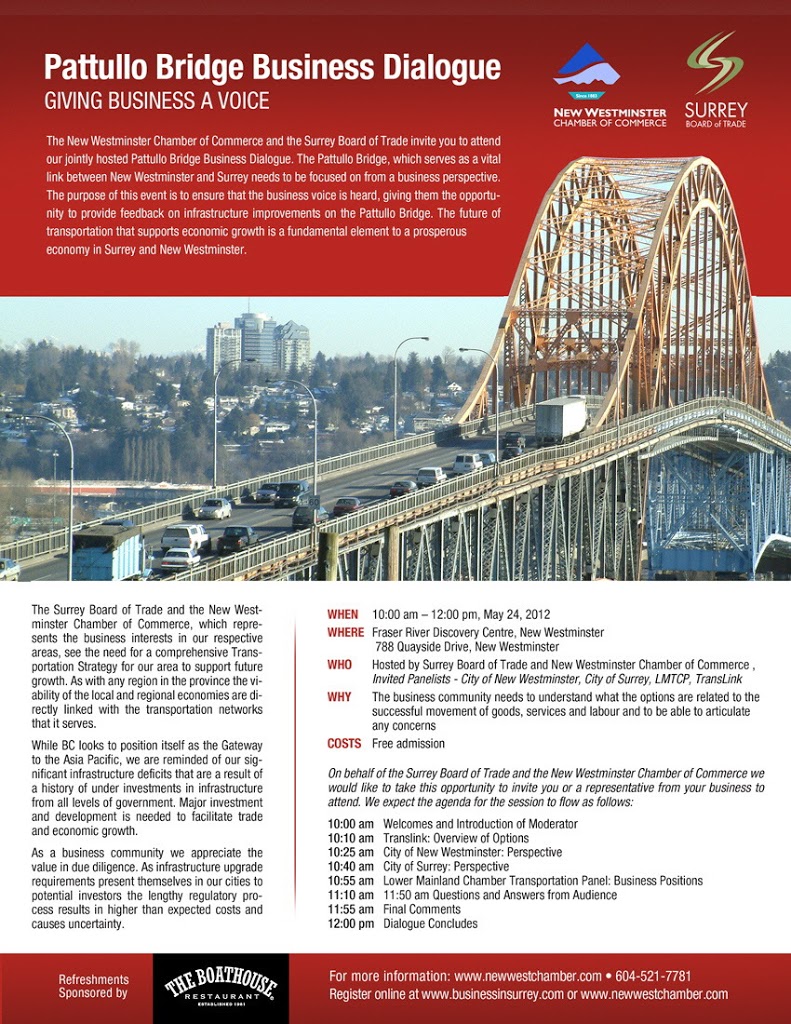
This last Thursday, I attended the “Pattullo Bridge Business Dialogue” at the Fraser River Discovery Centre. I am not a business owner in New West, nor am I member of the Chamber, so I went to listen and learn. Or as some would call it, “document the atrocities”.

The event was well attended by representatives from both sides of the River. The NDP Transportation Critic (and MLA for Surrey Newton) Harry Bains was there, as were four New West City Councilors (Harper, McIntosh, McEvoy, and Puchmayr) and two Surrey Councilors (Linda Hepner and Barinder Rasode). I also noticed Paul Forseth there, but not the other two apparent contenders for Dawn Black’s job. None of these attendees was asked to comment or provide part of the dialogue, it seemed much like me, They were there to listen and learn.

The Panellists were Sany Zein, Director of Roads for TransLink and no stranger to community meetings in New Westminster; Jim Lowrie, the Director of Engineering for the City of New Westminster; Bernie Magnan, long-time Vancouver Board of Trade apparatchik and Transportation Panel member from the Lower Mainland Chambers of Commerce; and Paul Lee, who is a Transportation Manager from the City of Surrey.

Sany Zein essentially repeated the message we have seen sine the beginning of the “consultations” on the bridge a few months ago. There was little new here, including a few zombie topics (points that have been questioned in New West in the past, but keep coming back) like the interesting math equation “(50% more cars + 100% more trucks) / 50% more lanes = less congestion” or the assertion that TransLink is spending “millions of dollars a year” on maintaining the Pattullo.

If we were to summarize the Translink message it is this: These decisions have been made, so there is no point discussing it; which makes me wonder why they even bother wasting staff resources on attending these “dialogues”.

Jim Lowrie then presented a bit of info about New Westminster’s concerns regarding a 6-lane bridge, and the lack of consultation on the important points around bridge size and location. Mostly, he was repeating the information from the Open House the City held last month, while also outlining some of the public discourse in the City about the bridge. I even heard him (in his summary) suggest that TransLink first has to recognize that the problem they are trying to solve is an aging bridge (not sure where he got that idea!) and that once they identify their problem, they should come to New West to see what our problems with the existing bridge are, then go to Surrey and find out what their problems with the existing bridge are, then have discussions to address all of the problems at once: and that this dialogue should have started years ago. A very rational approach.

Paul Lee read a short, concise prepared statement, seemingly directly from the desk of Dianne “build-it-they-will-come” Watts. A few of the key points I managed to jot down: A well-functioned multimodal Bridge is a vital part of the transportation infrastructure required to service Surrey. A new 6-lane bridge must be directly connected to the SFPR, to minimize trucks on City Streets, and to provide access to local businesses.

Of course, the concern that Surrey has for trucks on their City Streets should sound rather hollow to people in New Westminster… as that is our exact point here.

Bernie Mangan repeatedly referred to New Westminster as a “transportation corridor”. He boldly suggested that once the SFPR, Pattullo, and NFPR are completed, the transportation network will be “complete”, and the $1.3 Billion lost annually to traffic congestion will finally be realized. He suggested that most of the 3000+ trucks a day crossing the Pattullo are delivering lettuce to New Westminster stores, and that new industrial land has to be South of the Fraser, while people live north of the Fraser, and without a 6-lane bridge in the middle of New Westminster, all will be lost. He also hated tolls, a they hurt business, and suggested if the bridge was tolled than the people South of the Fraser would carry too much burden for the cost of a bridge that would benefit the entire region.

It was painful to watch, and I would love to go through every one of his points and take them apart, but in the interest of brevity (ha!) lets look just at that last one. It made me think about the Quebec Student protests. Let us compare these two statements, and see if anyone agrees with both:

A: The Students in Quebec should pay for most of their education, because although all of society benefits from an educated workforce, the students themselves see the greatest benefits from the Schools.

B: The drivers South of the Fraser should pay for most of the Fraser-crossing bridges, because although all of society benefits from an integrated transportation network, the drivers South of Fraser see the greatest benefit from the bridges.

My impression, overall, is that this was not really a “dialogue” at all. It was TransLink presenting their plan, a representative from old-school business and one from Surrey presenting their opinion that the Pattullo Bridge is simply the most important transportation link for the future of Business in Surrey, and Jim Lowrie valiantly trying to get someone to acknowledge that perhaps New Westminster has an interest in this and perhaps meaningful consultation would be useful for the entire region?

During the brief Q&A session, there were no questions asked that challenged the plan, or the assumptions built into the assertion that a newer bigger bridge is needed now. It was clear from the beginning (the moderator brought it up several times) that this was a meeting for “business” to exchange ideas, that only “business questions” from “business people” would be accepted, and that anyone in the audience who did not own a business should just shut the fuck up. There is nothing inherently wrong with this (hey, it was their meeting- they paid for the coffee and cookies), but what is the point of calling it a “Dialogue” when it is just everyone sitting in a circle talking about how much they agree?

At least twice, it was clear Surrey came to town to tell New West what’s what. Mr. Lee mentioned more than once that the only thing more vitally important than a new 6-lane bridge is that trucks not infiltrate local Surrey roads and negatively impact the liveability of Surrey neighbourhoods (and yes, he said this with no apparent irony).

Probably the most pointed question was “How does New Westminster expect Surrey to businesses to operate without this vital link?” – yet no-one from New West stood up and asked Surrey businesses the same question about how they will operate their businesses when their streets are choked by even more traffic? In fact, during the “Dialogue”, I did not hear a single comment from the New Westminster business community. I didn’t hear anyone from New West explain how this transportation link was vital to their business, or ask what the impacts to New Westminster businesses would be. Where were you, New Westminster Chamber?

When Mr. Zein suggests that increasing lanes 50% and increasing traffic 50% will result in less congestion, why did no-one ask him to square that circle?

When he suggested that “Millions of dollars a year” are being spent on Pattullo maintenance, why did no-one call on him to provide some evidence of that?

Was no-one in the room interested in anything but the old school orthodoxy that more cars = more customers = happier business?

All along, Chris Bryan’s column in the NewsLeader this week was fresh in my mind. This “dialogue” was a perfect example of the Old vs. New for New Westminster and the Business community. These guys sitting in their bubble with a myopic vision of the business world of the 1900s have no idea what is happening in the year 2012.

The problem is, at least they showed up and enjoyed their echo chamber. Where were the “New” New Westminster business community at this event: those who are moving to Downtown and filling up the River Market because of the increased liveability of our downtown and our transit access, those who attend NEXTNewWest events? But it was 10:00 on a Thursday morning, they were probably working.

With all due respect, old school, if the future of your business in New West relies on 400,000 people driving by your storefront every day, and 700 empty parking spots in the waterfront Parkade, then your future looks cloudy. And Chamber of Commerce: if your idea of Dialogue is to only talk to yourself and to ignore the voices of the rest of the community – of your own customers – then all of our futures are cloudy.

Unless the New Westminster business community grows some balls and gets involved here, we are going to end up being nothing more than Surrey’s “Transportation Corridor”.