Political non Science

Although I have always been rather political – much to the chagrin of my Grade 5 teachers – I somehow ended up a scientist. That is what I studied in school, and what I have done for work for neigh 15 years.

My political views have changed quite a bit since my teenage days campaigning for the burgeoning Reform Party of Canada, and I suspect a large part of that change has resulted from my science education (if not from losing way too many debates to people with more book learnin’ than me).

Recently listening to one of my favourite podcasts, they were discussing the role of science in modern politics, or more specifically, how hard it is to base policy on even very well-established science (think anthropogenic global warming, harm-reduction drug policies, mandatory minimum sentences, etc). The problem, this group of scientists suggested, was too many lawyers.

Yeah, sure, it is easy to blame Lawyers, but they provided a foundation behind why Lawyers interpreting science is a problem. But first, are there too many lawyers?

This might be a bigger issue in the USA, but looking at our house of commons, there is a distinct paucity of people trained in the Sciences. The precise numbers for our MPs are not easy to get : You can see all of their occupations here , but with pretty much every Conservative MP calling themselves a “Businessman” first, then a farmer/engineer/lawyer/oystershucker later, and every NDP member calling themselves a “Community Activist” or “Unionist” first, then some long list of occupations after, it is not clear what people’s real training and occupations are. The NDP have a “Country Gentleman” representing in one riding, for FSM’s sake.

Still, we can condense somewhat. Of the 309 MPs, at least 50 are Lawyers. Only 8 are Scientists.

I am not counting Engineers as Scientists, for all sorts of reasons that probably deserve another blog post (short version – Engineers are trained to apply the results of science to specific problems; they are not trained to think like scientists or to apply the scientific method: quite the opposite). I will be generous and not count the four Chiropractors. Generous, because just as an anti-neutrino cancels out a neutrino, people who rely on such terrible science and ignorance of evidence-based medicine as a part of their regular practice should count as negative scientists and be subtracted from the 8. But I digress.

One issue problem for governance (one discussed at length in the Podcast) is that Lawyers and Scientists use similar language, but use it in very different ways. Especially the word “evidence”. To a scientist, evidence is something you gather to see if your hypothesis can be disproven. I once wrote a long post about common misconceptions of the scientific method, and I don’t want to go that deep into it here. The point is that a large pile of evidence that supports a scientists’ hypothesis can be made irrelevant by a very small piece of very good evidence that disproves it; and scientists, by their nature and their training, are looking for and evaluating that little piece. Lawyers, in contrast, are trained to weigh the evidence, and to present a compelling case that the evidence on their side of the scale is correct, and that the evidence on the other side of the scale is less worthy.

If this sounds unfairly critical, it isn’t meant to be, that is the job of a Lawyer. Our legal process is not constructed to allow Lawyers to look at all the evidence of a case, then decide which side they wish to represent. There are valid reasons for the legal system to provide equal voice and strong advocates on both sides of a given issue, it serves a purpose well. The problem arrives when Lawyers are presented with scientific evidence, they are simply not trained to address it the way it is meant to be addressed.

The most obvious recent example of this is Anthropogenic Climate Change, where there is simply no scientific debate on the cause or mechanism of the phenomenon that is clearly being observed. Still, too many legislators get confused by the legitimate policy debate about how to deal with it, and falsely assume “there is no scientific consensus”. The “environmental” side of the political spectrum falls under the same spell when talking about scientific topics they do not understand, such as “toxins” in our food or the alleged “link” between Smart Meters and Cancer.

This week, though, we have seen another form of this intellectual deficit caused by too many Lawyers: the discussion of the Dutch Disease. Thomas Mulcair has been criticised by many political opponents for suggesting that rapid development of Alberta hydrocarbons threatens the diversification of Canadian industry; that the “Dutch Disease” may be playing a role in the downturn in manufacturing in Ontario.

The Federal Ministers of Oil Sales reacted to this by calling such talk “divisive”, while Premier McSparkles referred to the entire concept as “goofy” and “gobbledygook”. However, none of them are discussing the point, nor are they addressing what the Dutch Disease is.

I’m no economist (“the dismal science” – Thomas Carlyle), but even I am reasonably familiar with the term. At the base level, it is when a sudden natural resource boom inflates a nation’s currency to the point where other industries cannot compete on the global market due to high export costs and low import costs. It was named (well after the fact) after the rapid exploitation of offshore natural gas fields in the Netherlands the 1960s. It is interesting to note that the eponymous case is probably not as good an example of the phenomenon and other instances such as the Australian Gold Boom and the Nigerian Oil boom, but the Dutch get the credit (glory? ).

This simple description of the Dutch Disease, although perfectly condensed for the third paragraph of a wire service new report, is only part of the story. For it to truly be “the Dutch Disease”, the economic sector providing the income must be non-renewable natural resource based. There are a couple of reasons for this, but it has to do with the disproportionally low employment numbers compared to the incomes collected from the extraction activities, and the limited long-term gain from re-investment back into that specific extraction activity. The income earned by the industry must also represent a significant portion of export trade, and the economy has to be unfettered enough to allow the markets to adjust prices according to market demands. Further, the source country must receive the benefit of the exporting industry right away, and not specifically apply this income towards subsidizing the other impacted industries. There are few other nuances, but I’m sure you are bored already. I know I am.

Now, you can debate whether Canada is suffering from the Dutch Disease, or even how much the Dutch Disease is responsible for the recent manufacturing downturn in Ontario. But you cannot argue that the Dutch Disease is a “goofy” idea or “gobbledygook”. And if mentioning it is being “divisive”, then it is reality that is being divisive, not the person who mentions it. A child mentioning the Emperor’s lack of clothes is not a pornographer.

Having read into this quite a bit over the last few days, I might offer my (not an Economist) opinion on whether we are suffering the Dutch disease in Canada. Surely, all of the makers of the Dutch Disease exist. Our manufacturing sector is being impacted by our high dollar (just ask them), and our high dollar is being propped up by our oil export activities (ask those commie radicals at the Canadian Chamber of Commerce). The number of people working the Oil Sands (~150,000) is not offsetting the number of lost Manufacturing jobs (~500,000) [see above references]. Further, many of the actions taken by more progressive governments with oil resource booms (like Norway and Azerbaijan) to avoid the Dutch disease are not being taken. These would include limiting the growth of the sector, placing all of the royalties into a sealed legacy fund to spread the economic impact over a longer period of time and as a hedge against currency fluctuation, building infrastructure that is not directly related to the primary export industry, etc. (Note, shutting down the industry is not a cure that anyone, including Thomas Mulcair, has proposed).

I cannot see any reason to disagree with the Economists who were paid by the Federal Government and came to the conclusion that the Dutch Disease is impacting Canada.

One thing is for certain: if we ignore the science like the Federal Government seems prone to do, or (even worse) belittle the science like our Premier, then we are not going to make the necessary adjustments to avoid the Dutch Disease, and it will become a certainty. It’s not gobbledygook, it is basic Macroeconomics. Forget the Scientists and the Lawyers, there are more than 70 MPs who list their occupation as “Businessman” or “Businesswoman” or some such derivative – why don’t they take their own advice?
Confessions of a Pattullo Critic

Dear Ms. Myers,

Thank you for writing such a heart-felt and well-presented case for the Pattullo Bridge. You offer a genuine voice of people who use the Pattullo regularly. In community discussions about Big Things like the future of the Pattullo, people with differing opinions too often ignore the voice on the other side of the table, or worse, replace it with their own hastily-painted chariacture, whose opinion is not worth regarding… discussion is important.

So before I go on, I want to clear up one misconception about how one person (me) who thinks we don’t need to expand capacity on the Pattullo actually views the issue: I don’t want you to be “re-routed around the Royal City”. I want you to live in the Royal City. Or at least, I would rather you had better options for work, living, and commuting so the Single Occupancy Vehicle wasn’t the only option you had, or even the best option to choose. Cars are expensive, they are inconvenient, they are unreliable due to the vagaries and unpredictability of traffic. However, as you demonstrated, a car somehow became the best option for you. That is not your failure, that is a failure of infrastructure and community planning, failure of a hundred decisions made by people other then you.

Now I realize that last paragraph has me sounding like a radical anti-car nut with my head in the clouds, or even a holier-than-thou eco-facist, but let me try to convince you I am not. I own a car. Sometimes I use it to commute to work, a single occupancy vehicle when I do. I have cursed the intersection at the north end of the Queensborough at 7:30 am as much as anyone in this town. I know a couple on New West who commute to opposite ends of MetroVancouver daily, have two kids, and lives full of volunteer commitments, and do this without owning a car. I am not nearly that dedicated or organized. I make different choices, sometimes using transit, sometimes riding my bike, sometimes driving my car.

The problem with the car choice is that cars are bad for us. They make us less healthy, they make our cities less healthy. They cost us lots of money, they take up a disproportionate amount of our valuable urban space, and they damage the environment disproportionally with the benefits they deliver. They are by far the #1 cause of death for school-aged children in North America. They are, by almost any measure, a bad choice, yet here we are, both of us, and 400,000+ other people, making that daily choice to drive through New Westminster; all for good, rational, considered reasons. How did we get here? But first, why should anyone care?

“Increased traffic” is not a side effect, as you suggest, it is the main effect. The continued renaissance of New Westminster is not going to depend on a few of the 400,000+ commuters stopping to pick up a few groceries or noticing a new boutique on the way by, nor on 700 people filling the empty Waterfront Parkade spots. In the hierarchy of car-oriented retail, we will never compete with Coquitlam Centre, Lougheed Mall, or even King George Highway. Those days are gone: left New Westminster on the 60s, and are not coming back.

The future of New Westminster is in re-developing an urban environment where people want to live, work, shop and play. The 10,000+ people who live downtown, and the 500,000+ who are truly 20 minutes away by SkyTrain. For us to realize this future, we need a variety of good shops and entertainment opportunities (and that is coming along very nicely), and we need to produce a friendly, clean, safe environment inviting to people, not a space dedicated to the movement of cars and trucks. You know, a “fantastic place” to be.

You outlined the decision process that led to your workplace – home -commuting choice. Part of that choice of that was a cognizance of how long it would take you every day to drive to work. I have no idea how long it takes you, 20 minutes? 40? I will bet it is less than an hour. People who study commuting behaviors know that would be a safe bet, because very few people willingly choose to commute for more than an hour a day, regardless of the mode they choose. That has been true for centuries, and actually has a name: the Marchetti Constant.

As an aside, there is another factor here as well, and that is failed expectations. Especially when home-shopping, if we find a place we like, we tend to sell ourselves that the commute won’t be so bad. We often think of “central” as (to quote the radio ad) “20 minutes from everywhere”. Problem is, when driving in Vancouver, we are rarely 20 minutes from anywhere.

As an example, Tim Hortons are ubiquitous in this town, but if you stood up right now, got your coat and your hat, grabbed your car keys, walk to your car, wherever it is parked, get it started, drive to the nearest Timmy’s, find parking nearby, park, and walk to Timmy’s, (or sit in the drive-thru line, ugh) I’ll bet you the price of your doubl-double it is more than 20 minutes before you take your first sip. (Not fair to say “but I can walk to a nearby Timmy’s in 5 minutes”. Actually, if you say that, you are making my point that we unfairly justify the convenience of cars).

Back to the point, if your daily drive to work took an hour and a half each way, you would be much less likely to make that choice, to find that combination of home, work, and lifestyle acceptable. You would instead choose another home, another job, or another mode of travel. If that same trip takes 20 minutes, you are more likely to make that choice. This is, boiled down to the substance, what traffic planners call “Induced Demand”. This is the reason many people (including me) are afraid of the impact to our City of an expanded Pattullo Bridge.

The bridge now carries 60,000 or so cars per day. TransLink estimates a 6-lane bridge will carry 90,000 or so. Those extra 30,000 will be people who choose to use the bridge because it is the easiest, most convenient route. This choice will mostly not be made when they get into their car in the morning and turn on the traffic radio, but will instead be made the way you described it: when people are shopping for homes and doing that complex calculus about commute times, yard size, amenities, and price per square foot. Nothing makes that decision easier than the promise of a big new bridge that will solve traffic congestion problems once and for all. Hence “demand” for traffic lanes is “induced” not by bumper-to-bumper traffic lanes, but paradoxically, by the promise of empty traffic lanes.

Except, of course, the bigger bridge will do nothing to improve traffic congestion. Simple math says 90,000 vehicles cannot cross a 6-lane bridge any faster than 60,000 can cross a 4-lane bridge. Traffic will, as TransLink suggests, increase until the same state on congestion is reached as exists now ( see Marchetti Constant above). Of course, this will be limited slightly by the increased congestion on the surface roads on either end (see the Braess Paradox), not too mention that they really can’t be built to accommodate the increase. If they are, you can kiss that Livable City goal goodbye.

The promise of solving congestion by building lanes has always proven false in the past, there is no reason it will be proven true in this one case. This is why it is frustrating to hear people opine that New West has always been a “speed bump” where traffic grinds to a halt. The implication is that if we just build more lanes through New West, that problem will be solved. However, we can never build enough lanes (and if you don’t believe me, spend some time on Lougheed Highway anywhere it has seen recent expansion – if you have a few hours to spare).

Yikes. Went off on a lecture there. Let’s bring this back down to earth.

Your article shouldn’t be a “confession”, as that implies you have done something wrong. You made rational choices for yourself and for your family, with many of the confounding factors not within your control, what is wrong with that?

I ask you only to consider carefully what you want when thinking about the future of the Pattullo. Do you want a bigger bridge, or do you want a shorter commute, more predictability of travel times, and more time to spend with your family? Are you sure a bigger bridge will provide the things you want? Perhaps spending the same $800 Million on improved transit South of the Fraser, so people in Surrey have the same access that New Westminster enjoys, is more likely to address traffic issues on both sides of the Fraser. If nothing else, it will “induce” some of those 60,000 drivers to choose transit instead of the single occupancy vehicle, resulting in less of those negative affects cars bring to our communities.

Let me finish how I started, by thanking you for your article. Yours is an important a voice in the future of the Pattullo as is mine, or anyone else’s; We need the entire community involved in this discussion. But first, we need to convince TransLink that there needs to be a discussion. As things stand, TransLink has made a choice based on short-term thinking that contradicts their own master planning document , and the modern science of Transportation Demand Management. The results of that bad plan could make my home, New Westminster, a much less pleasant, more expensive, and less safe place to live, while failing at the promise of making your commute slightly shorter. Worse, their “consultations” have not included any real discussion of options or the needs of the community.

I happen to agree with you: tearing the bridge down is an extreme position, but so is building a bigger bridge and dumping that unsustainable traffic load on a City trying so hard to be a modern, compact, transit-friendly community. Presumably, somewhere between those two extremes is a viable compromise.

All I have heard New Westminster ask for up to now is a true consultation: the very conversation we are having right now, and that the decision on the fate of the bridge, the compromise, be based on what the Community decides. “Debate then Decide”, to borrow a phrase from the recent City open house.

Let’s hope your voice, and mine, will be heard by TransLink, and the Community makes the right decision.

Great weekend (Signs of the Queensborough revisited).

Wow. What a weekend. Great weather, fun evenings with friends, a whole lot of gardening, Ryder leading the Giro. I’ve been too busy enjoying life to post my gripes.

So I saved them all up for Sunday Night.

Interesting event #1:
I went to a local retailer, who shall remain nameless for obvious reasons. There was a big multinational chain nearby I could have gone to, but I like to support the local guy. I bought a dozen items, he gave me a deal on a few, gave me some advice on some others, general good customer service experience.

But while I was shopping on my own, I overhear the proprietor talking about gas prices with another customer. The general consensus was that they were being screwed, and the best solution was to use their big Tidy Tank to gas up across the border. The proprietor didn’t see the irony in the conversation.

Interesting Event #2:
Went to a movie on Friday Night: the Avengers at the Landmark Cinema at Plaza 88. I came out of the movie wondering why everyone was fighting everyone else, and why, the minute the portal to the netherworld appears in the sky about New York, someone didn’t just call the Ghostbusters. Maybe I am getting too old for this stuff. The Theatre itself is what you expect in 10-screen modern movieplex: smallish rooms; comfy, new-fangled chairs; good sound (thankfully NOT turned up to 11); and a super clear, bright screen. The staff were mostly new young folks (a few trainers came in from the Landmark location in Abbotsford) but managed to handle all the appropriate transactions… uh… appropriately?

Most of the top floor of the Plaza 88 is not yet open, but things continue to evolve at this site. Not the least being the sale of the entire Plaza 88 retail complex for a cool $100 Million. More proof that we have good reason to be bully about the future of Downtown New Westminster.

Interesting Event #3:
55km in midday Sunday, crossing the Queensborough Bridge on the way home, we stopped at the north end of the pedestrian overpass. There were two clearly confused ladies standing there next to their bikes. I asked where they were headed and confirmed my suspicions when I first spied them. They wanted to get down to the Quay and the River Market, but had no idea how to get there from where they were.

It is almost exactly a year since I wrote this post detailing the issues with wayfinding around the (otherwise excellent) Queensborough bridge pedestrian and bike infrastructure. I know that original post generated discussion in the Transportation staff in New Westminster and Richmond, and with MoT and TransLink staff, and with people at VACC (now HUB) and B.E.S.T. None of these discussions have generated any actual changes in the signs at the Queensborough. It was interesting to see the lack of signage almost prevent two potential customers from reaching the Quayside (they had arrived from Burnaby).

As I suggested last year, that location would be perfect for a large-format wayfinding map, as it is where three different bike routes intersect with the SkyTrain. It would be great if these potential customers know how to get from that spot to Queensborough, Downtown, and Uptown New Westminster, instead of just turning around and going home. This type of signage would require some sort of partnership between TransLink and the City.

The signs on the bridge are ultimately MoT responsibility. I think about them every time I cross that bridge, and every time I ride my bike along Westminster Highway by Gifford (the “Casino Road”) and see this:

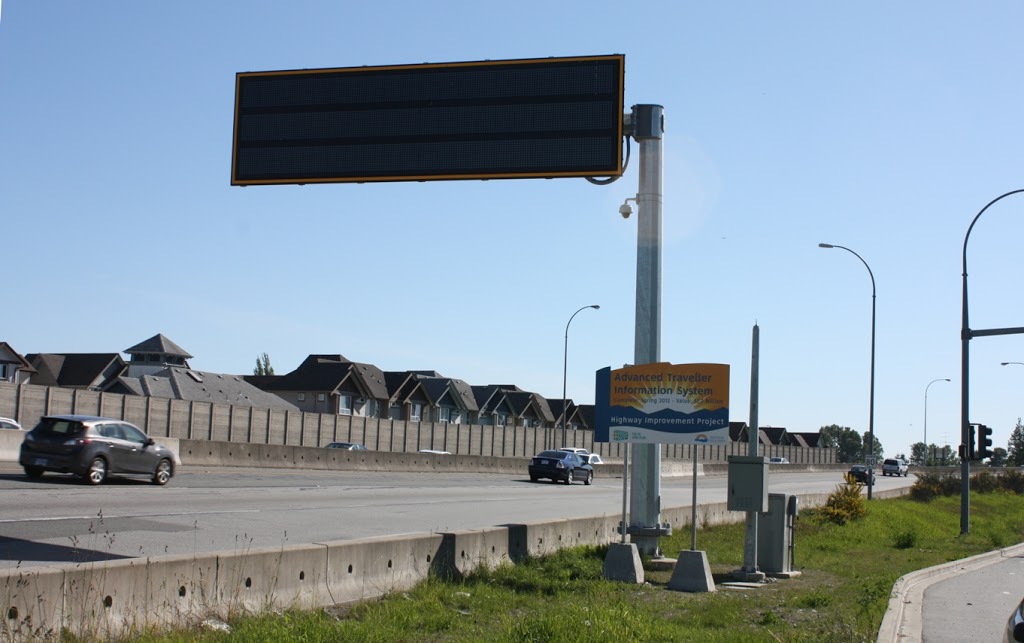
A big electronic wayfinding sign that must have cost hundreds of the thousands of dollars (I suspect, read: hope that the $2.7 Million price tag on the attached propaganda sign is for a larger integrated system and not just this sign). This sign has been installed less than a kilometre from the Queensborough Bridge, and installed after my whinging post of a year ago.

You would think if the Province can invest $2.7 Million on a fancy new illuminated signs, they can afford to open a bucket of green paint and fix the signs on the Pattullo?

on the MUCF, risk, and sandwiches…

The other big story last week in New Westminster has been the City’s decision to move ahead with the development of a primo Class-A office tower on top of the MUCF, despite the loss of the developer/funding partner, Uptown Property Group.

Part of why I have been so reluctant to comment on this issue at length is that I don’t know enough about the discussions behind how this decision was made, the foundations of this being Real Estate Negotiations, much of it is (perfectly legally and legitimately) done in camera.

I have talked to a lot of people about this in the last week, have watched the online coverage of council, and listened to a lot of the rhetoric. Of course, no knowing what the real back story has not stopped a whole bunch of people twittering up a storm about how this was the Final Betrayal of this Council, and one particularly excitable individual even suggesting we need some sort of Recall Initiative for the 4 councillors and the Mayor who voted for this (an initiative idea which does not, I note, exist under the Local Government Act.)

Almost all of the rhetoric we have heard about this in the Social Media has been, lets say, factually challenged. So now that I am adding my idiocy to the mix, I should probably admit up front I am no more or less informed that any other random schmuck spouting off about this. Still, here is the way I see this:

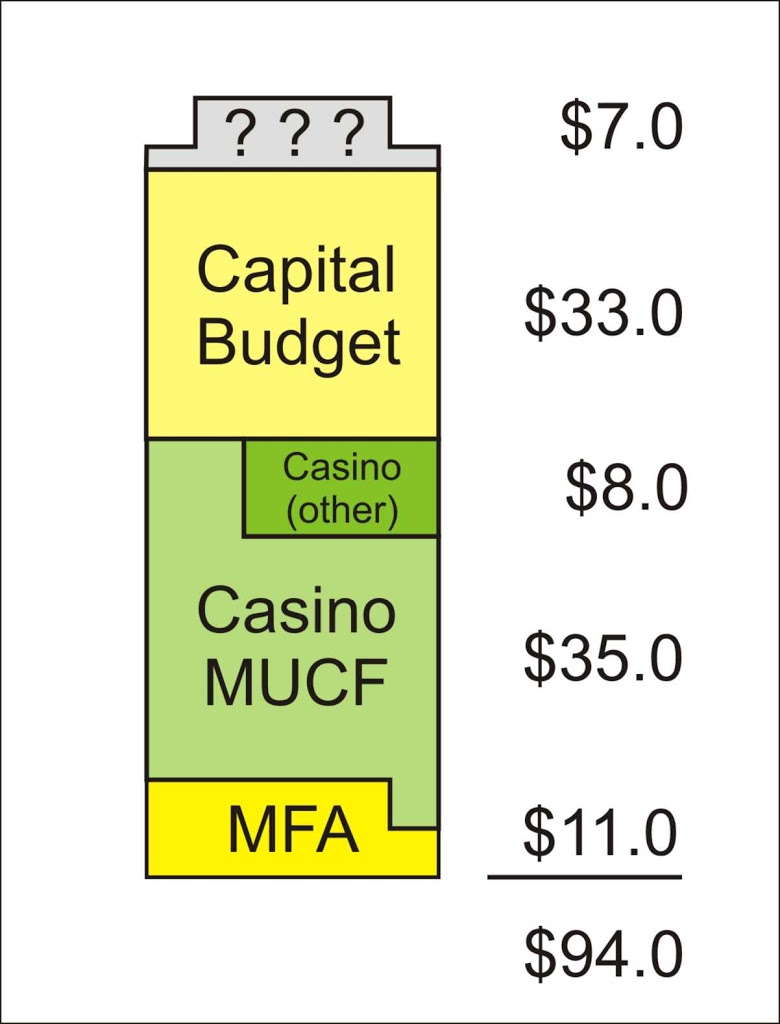
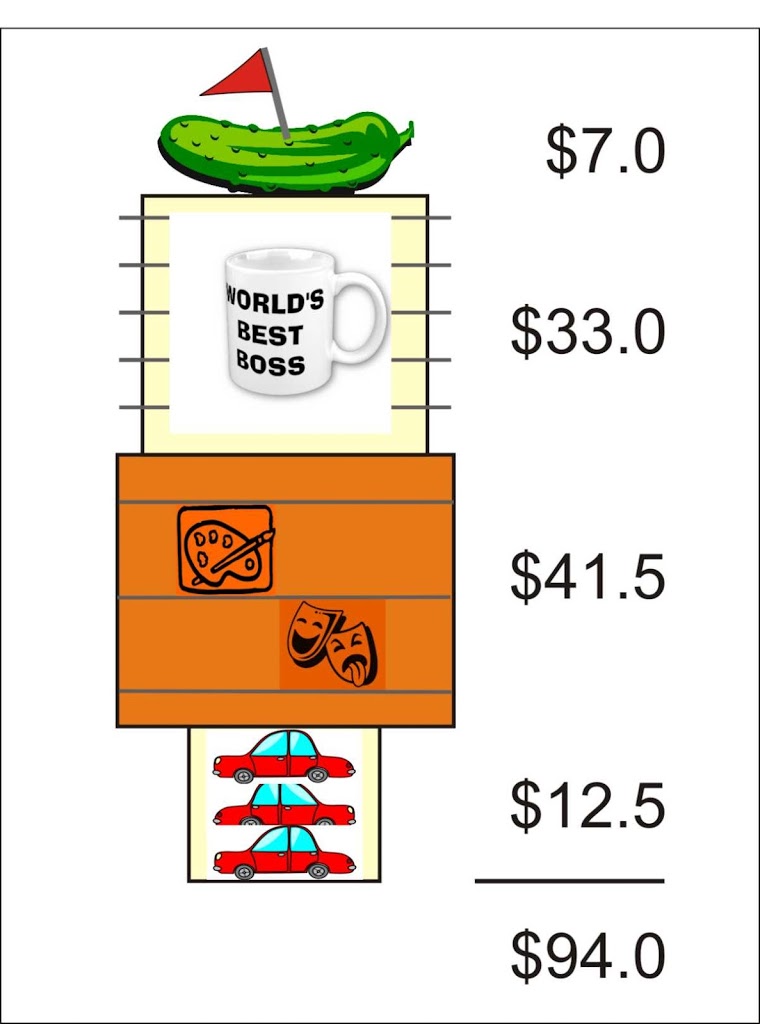
The City has a big hole in the ground Downtown, and has a limited time to use $35 Million of “Casino Money” to fill it. The meat in the MUCF burger is the large Civic Complex, which will cost $41.5M to build. On piece of bread is $12.5 million worth of underground parking (which is a whole different topic worthy of discussion, but I’ll note even the most strident conservative has yet to complain about socialist parking, unless it is pay parking, which is somehow too socialist). The top piece of bread is $33 Million worth of aforementioned Class-A office space. The pickle on top is $7 Million in “office improvements”, to make those offices actually leasable. That adds up to a $94 million sandwich of woe.

All figures in Millions of Dollars.

The second side of this equation is how we are going to pay for it, and this is where things get a little fuzzier. The first “up to” $11Million is to be borrowed from the Municipal Finance Authority to cover most of the Parking Garage Cost and shortfall on the MUCF. This agency lends money to Municipalities for capital projects at rates better than those available to private developers, so it is really the cheapest money available. $43 Million will come from the Casino DAC money (more on this later). Then “up to” $33Million will be borrowed from Capital Reserves budget (money used to upgrade pipes in the ground and potholes in streets). The “up to” $15 Million being borrowed up to cover the shortfall while waiting for DAC money to arrive is presumably part of the $43 Million, so we won’t count that again. Nor will we count the $7 Million pickle on top, because it won’t be needed until we have leases, so it will no doubt come from those leases.

Apparently, the DAC money set aside for the MUCF was not $43 Million, it was $35 Million. The extra $8 Million may be directed from other DAC-funded projects (the so-called “funding flexibility” being sought by the City). The remaining funds are $10.3 Million for the alleged pedestrian crossing between the Quayside and Port Royal, and $4 Million for dock improvements at the quayside, the rest of the DAC money already spent on those great parks and boardwalks in Queensborough, an the new community centre in Queensborough. The City is apparently looking to take $8 million of the remaining money and use it for the MUCF, at least temporarily.

I was really worried when I read this. The pedestrian link to Queensborough is a fundamental missing link in the City’s sustainable transportation infrastructure. To think that the City will cancel that project just as our new Master Transportation Plan is coming together shocked me. I vocalized my concern enough that one City Councillor took me aside at the MTP open house last Thursday and assured me that the bridge was still going to happen, there was no plan to cancel it. I have no reason to think he would lie to me, so I am taking him at his word. I assume (though could not confirm) that this $8 Million could be used to fill short-term funding gaps, if none of those “up to”s above are available, and are needed. The money is there to provide flexibility, and to give the City one more option to potentially reduce the costs of financing, as any prudent business would do. I will be the first at the gates of City Hall with a pitchfork if that bridge gets cancelled. I give them until 2015.

After borrowing somewhere between $44 Million (the $33M for the tower + $11M for the Parking) and $51 Million (if we include the $7M improvement money), the City will either own a revenue-regenerating asset, or will sell off the revenue-generating part of the building to recover their costs. We know the demand for the office space exists. Class A office space is valued north of $30/sqft per annum, and is going up. This building will generate parking and other tax revenue. It could bring 500+ more workers into Downtown New Westminster every day (or keep the young professionals moving to New Westminster working n New Westminster).

Watching council discuss the MUCF decision on the video-feed meetings last week, and hearing what the other options were, I can see where they are coming from. This project is too important to the future of the downtown to let it fall off. It is important to note that the Municipality can borrow the money at rates and with terms that no Developer can get, so the risk is lower for the City than it would be for a private developer. Also, some of the on-line discussion around this has not seemed very factual- the City is not “spending $60 Million of taxpayers money” as some commenter suggested, they are making a strategic investment that will no doubt bring some returns, if those returns exceed the investment (and we have many reasons to think it will), then the Taxpayers will make money (well, not really, taxpayers never make money, we just pay less money, I guess). This investment will also result in more taxpayers, which is what economic development is all about.

I find it disingenuous for people to complain that Government should be run “more like a business”, then freak out when a Government does the one thing that all businesses must do to survive: take a strategic risk. I hope that Council have received the business advice that tells them this risk is good. I also hope the real beneficiaries of this strategic risk – the retail businesses of Downtown New Westminster and the developers planning new buildings down there – will step up and throw their support behind this. I’m bully about the future of New Westminster, it is clear that Mayor and Council are, and it seems many developers are. I am cautiously optimistic we can make this pay off, and the result will be better than the current hole in the ground

One potential downside I can see is that this investment could potentially make it harder for the City to make other important investments in the next few years. Upgrading or fixing the Canada Games Pool, securing the Kyoto Block as public space, Queens Park capital improvements, connecting the Pier Park to amenity space east and west, refurbishing the old Gas Works site, etc. However, the City is in a tough situation. I’m not sure why they dug a hole downtown until they had an iron-clad contract with whomever was going to fill it, but again, I am so bereft of details that it is hard to understand how this situation arose. The MUCF was a good idea last month, and it is still a good idea today.

The one person I would love to have a coffee with over this is Bart Slotman, but I haven’t seen him around.

Old Steel Structures

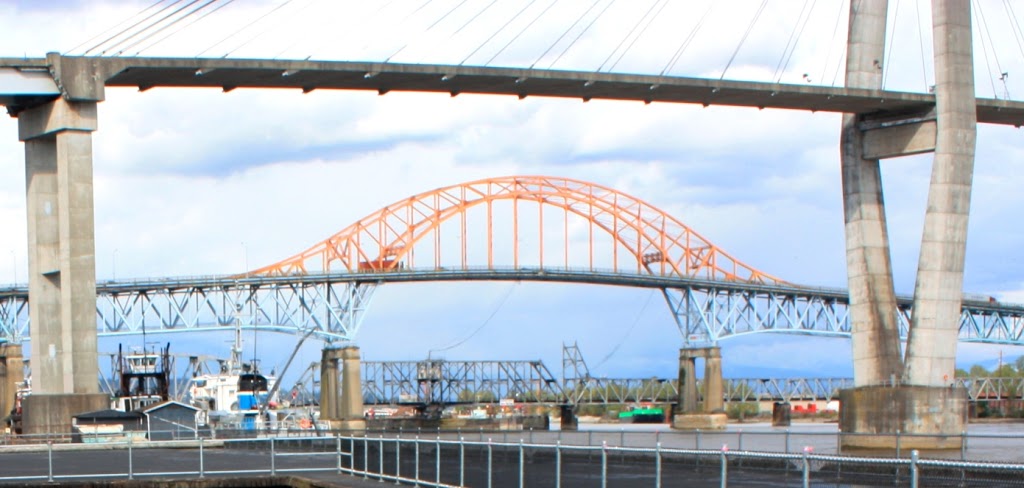
It having already been established that the problem TransLink has with the Pattullo is not a traffic problem, but an aging bridge problem, I want to poke at the edges of that problem a little bit.

We can all agree that the Pattullo is an old steel structure. The world is full of old steel structures, many well past their design life: The Lions Gate Bridge, the Eiffel Tower, the Canadian Navy. To bring this back down to earth, I own a couple of old steel structures: my 1996 Honda, and my commuter bike. Admittedly, not as old as my other examples, but both built with the cheapest steel they could find at the price point, and in very good shape considering their design life.

The thing all old steel structures have in common is the need for maintenance. Steel rusts, so you need to get ahead of the rust. Water and salt exacerbate the rust problem, so you have to manage those corroding elements. Bare steel rusts faster, so you have to keep up on the paint. If you do these things, steel structures can last nearly forever. Even ones that bounce around in the ocean getting shot at.

On the flip side, all steel structures similarly turn to dust faster than you can imagine if the basic maintenance above is ignored.

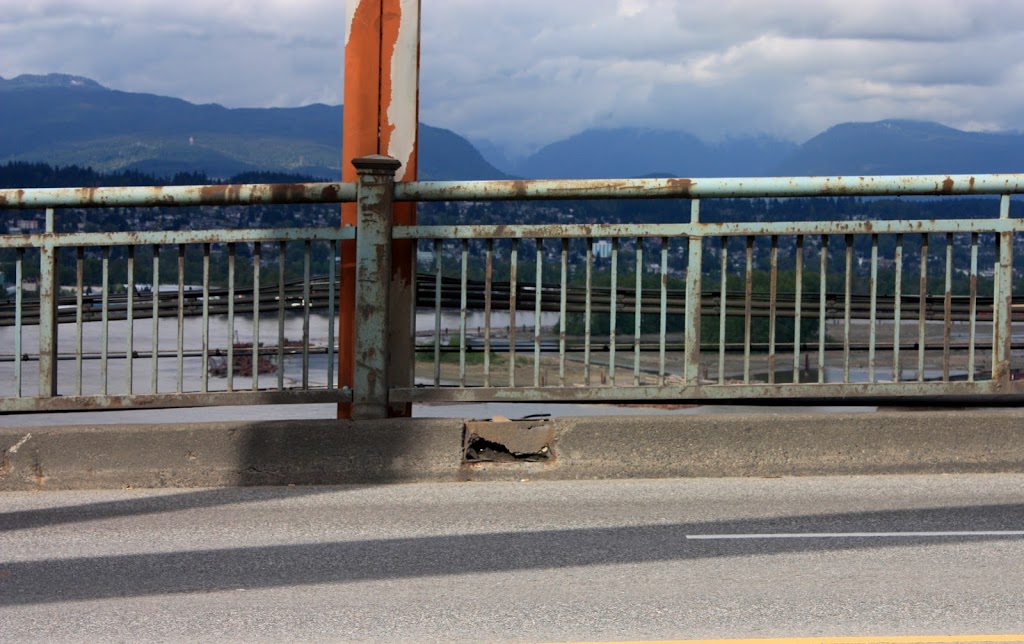
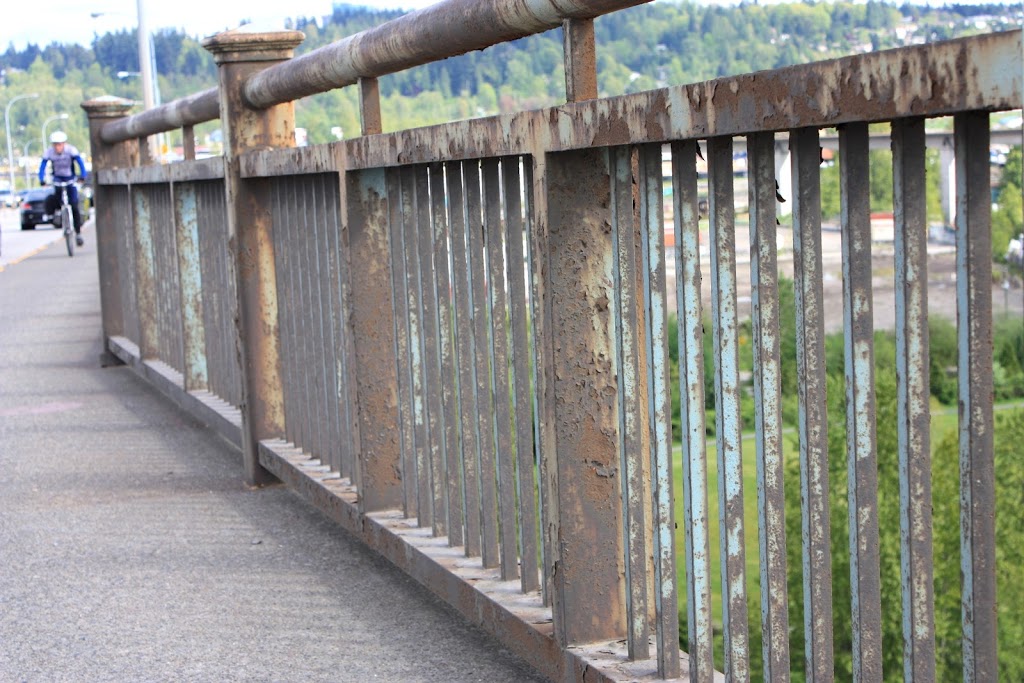
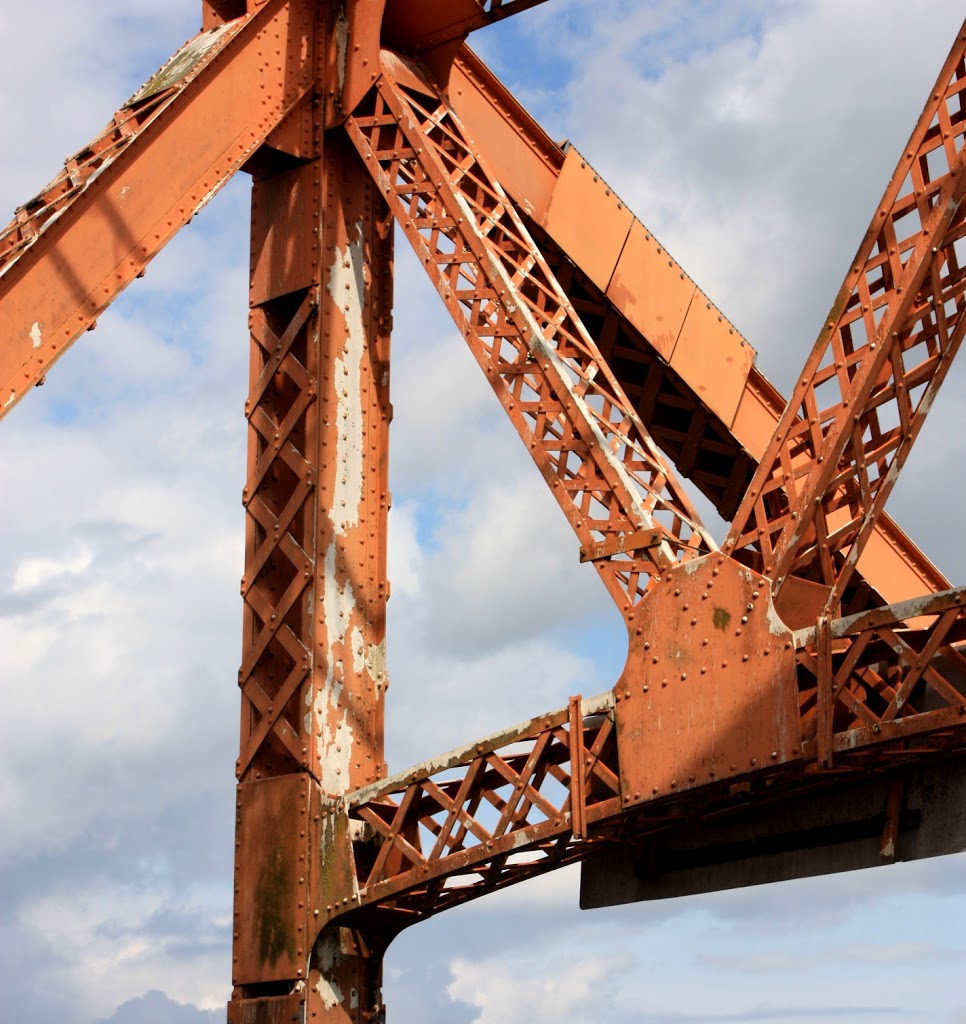
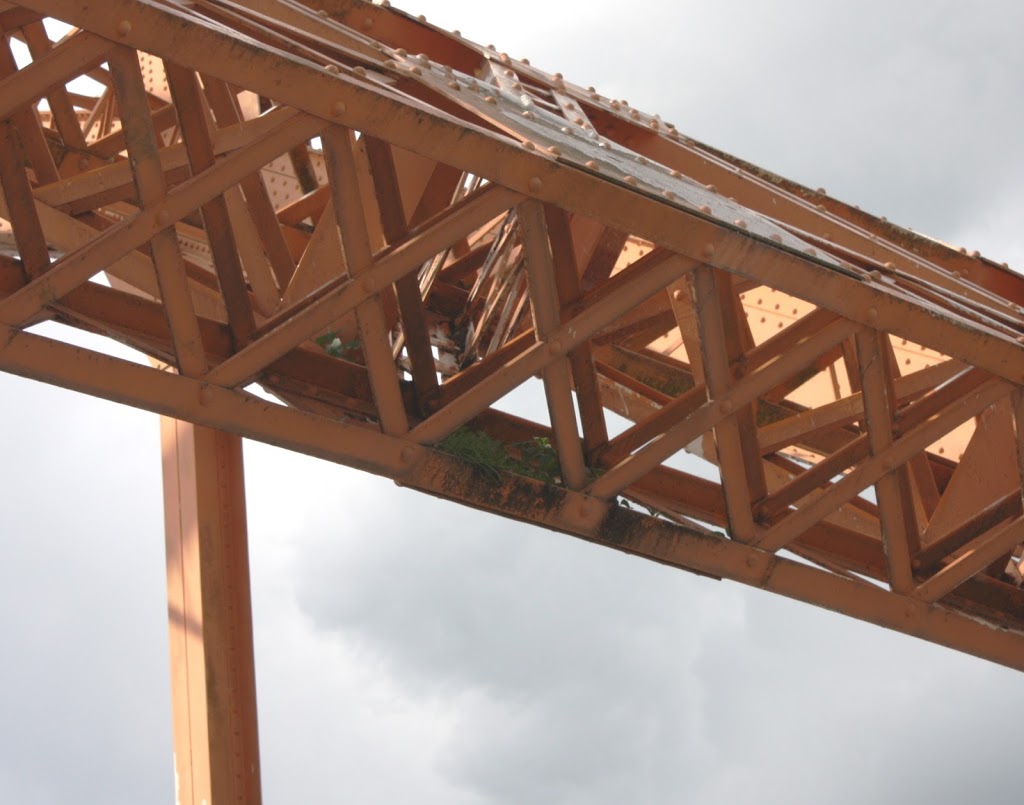
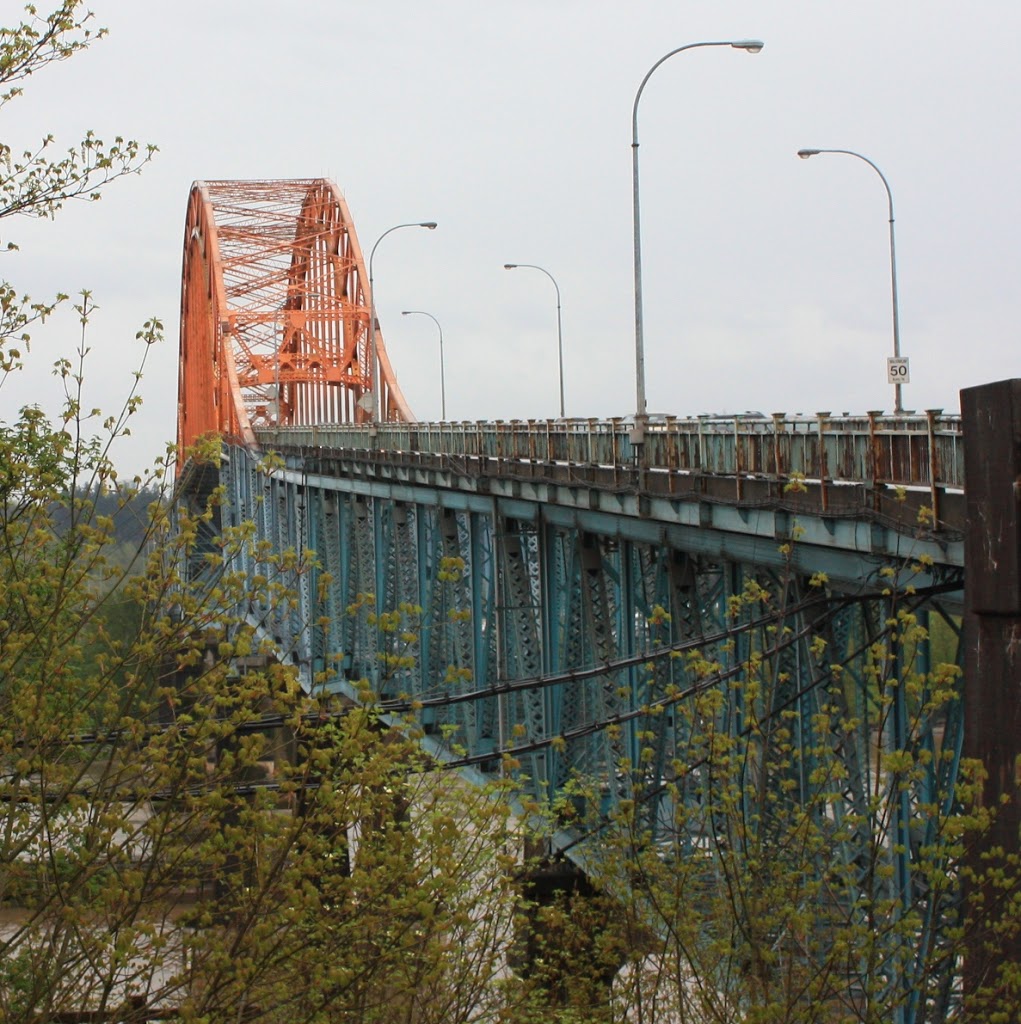
With this in mind I took a walk across the Pattullo Bridge this weekend, and I took a camera. I ask you, does this look like a steel structure where the maintenance is being kept up?

you can click on any picture to fully appreciate the majesty.

Where they are staying ahead of the rust?

If the traffic is quiet enough, you can hear the bridge rust.

Where the paint is regularly inspected and renewed?

Where corroding elements are controlled?

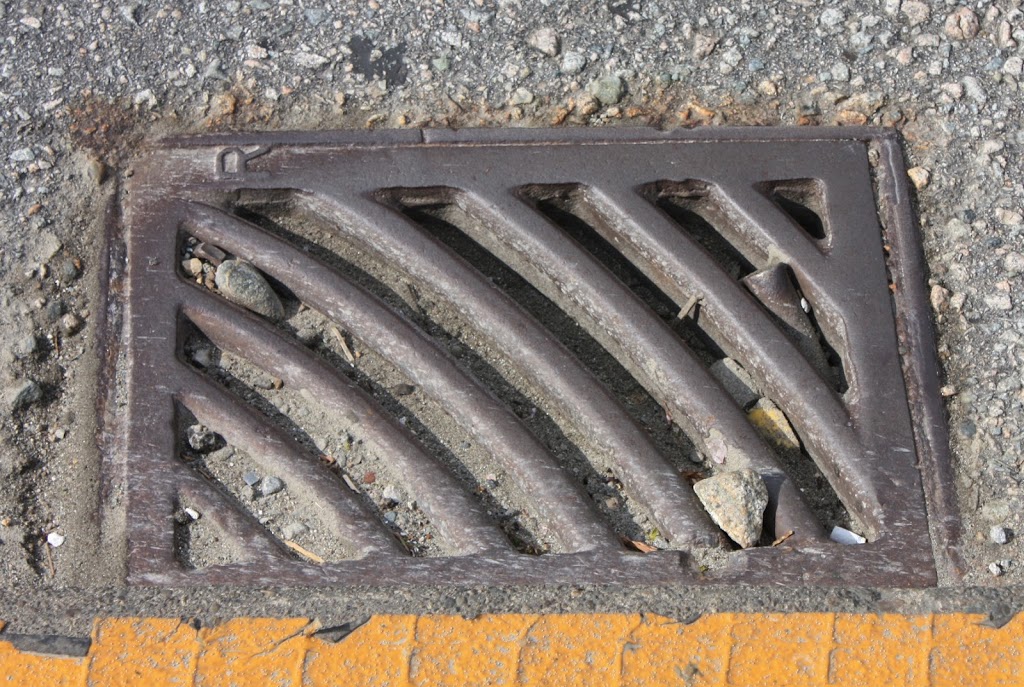
Every drain on the Surrey side was plugged. Every single one. where does the water go?
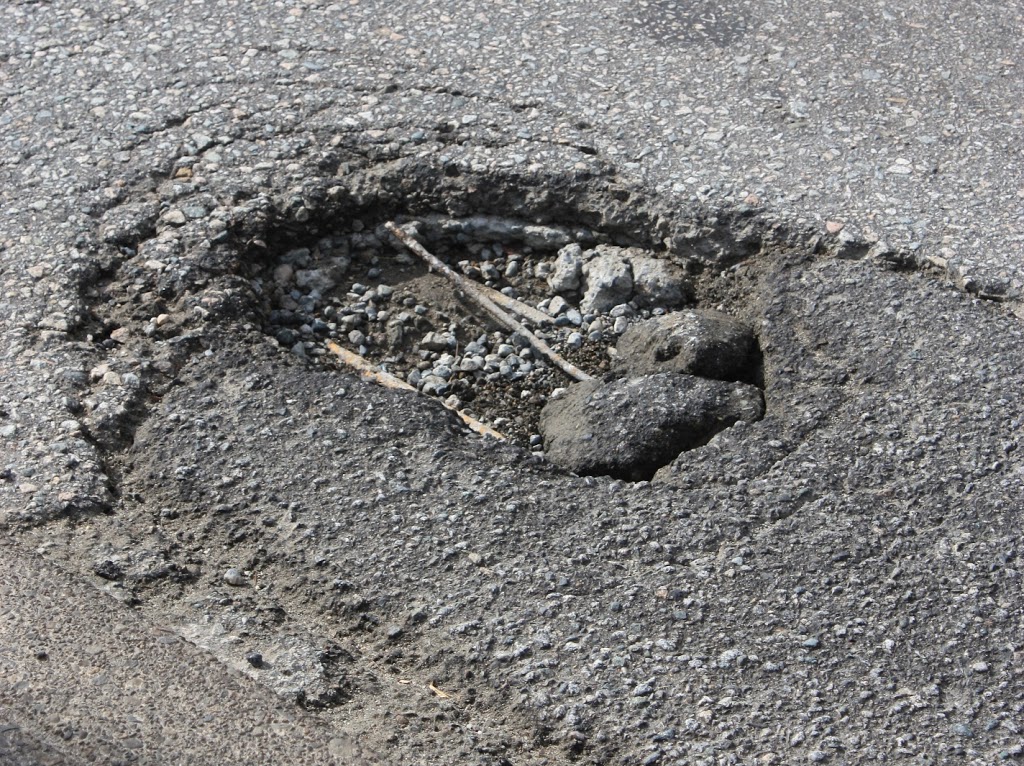
…some goes into this pothole with an actual piece of rebar sticking out of it.

Or does this look like a bridge where maintenance has been ignored, and is turning to dust?
??

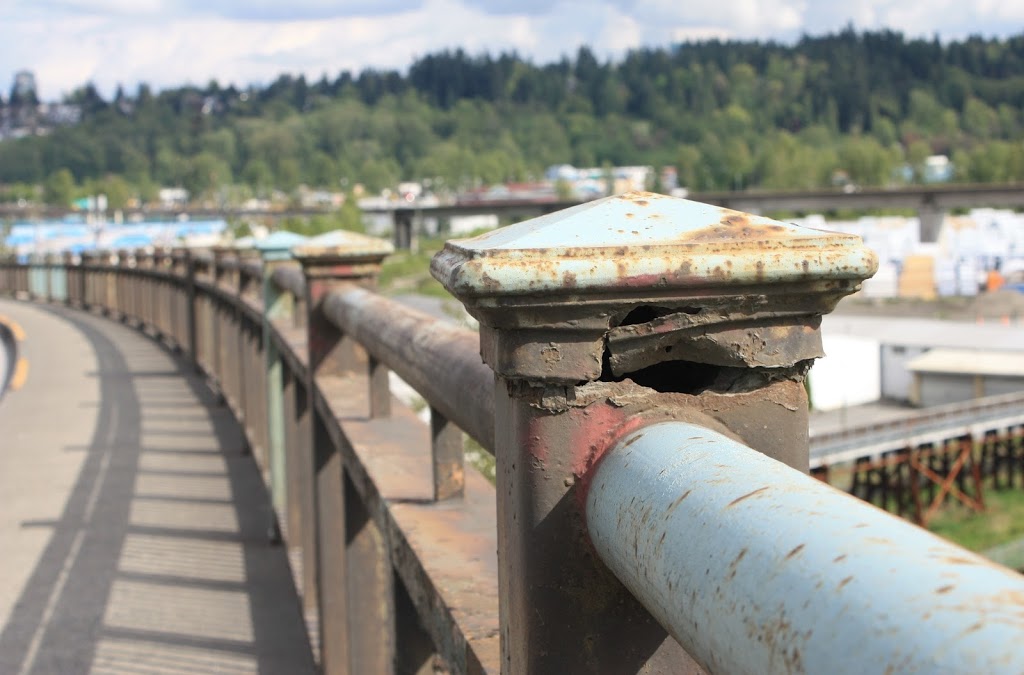
Noting inspires confidence in a railing like being able to stick your finger in rustholes.

??Yes, I am suggesting part of TransLink’s aging bridge problem is created by TransLink, themselves. Once again falling back to Hanlon’s Razor, I have to assume that this is not an intentional move, but more a result of bad planning, misplaced priorities, and lack of budget (a three-step program which is starting to sound like TransLink’s Modus operandi). That does not excuse them, though. The obvious neglect of basic maintenance is an irresponsible way to manage an expensive public asset. You own this bridge, you pay for it, and they are responsible for maintenenace. You are getting ripped off.

I was thinking maybe it is just a funding issue; that seems to be the cause of most ails of TransLink. At the “consultation” meetings that TransLink held back in February, TransLink mentioned that they spend $3 Million a year to maintain the Pattullo ( see page 4 of this document). You would think $3 Million would buy a hell of a lot of paint, or at least allow them to occasionally pressure-wash the plant ecosystems off of the steel trusswork.

This is not, unfortunately, the only place where plants are growing on the steel truss.

Except, TransLink does not spend $3 Million a year maintaining the Pattullo as claimed. That is obvious if you look at it, but more obvious when you look at their budget documents. There is a line item for bridge operations and maintenance, and it has averaged about $1.5 Million per year over the last few years (see this document). That $1.5M is spread amongst the Pattullo, the Knight Street Bridge & associated overpasses (a bridge that, I note, has a worse safety record than the Pattullo), and the old Westham Bridge (which is an old swing bridge with actual moving parts and machinery and such).

Maybe if they actually spent $3 Million a year on the Pattullo like they claimed, we could get another 50 years out of the Old Steel Structure. That would equal $150 Million, or a fifth of the cost of a replacement. We can even drop and extra $200 Million for the upgrades to make the bridge safer, and still be way ahead.

But TransLink wants a new bridge, just like I want a Porsche. My wife won’t let me get a Porsche. But maybe she will change her mind if I stop putting oil into my Honda…

City Open House on the Pattulo – Part 1

I am just starting to get back to regular life, after all the excitement of this week.

In New Westminster, there have been no less than two major twitterstorm brous-ha-ha (which I contend is the appropriate plural form of that word).

One is the announcement that the City will charge ahead with the MUCF and office tower, after their developer-partner bailed. I have had a lot of conversations with a lot of people about this in the last week, and will opine soon.

The bigger news story to me was the huge turnout by the people of New Westminster at the Master Transportation Plan open houses. Yes, there was discussion about the MTP, but (and it pains me to say this as a member of the MTP Committee) the real issue of the night was not the MTP, it was the damn Bridge. The MTP was like Larry Holmes vs. Rodney Bobick in Manila in 1975: a nominally interesting lead-in to the real show.

The meeting I attended at the Justice Institute was very well attended. The room has a seating capacity of 250, and there were not many empty seats. Apparently, the daytime meeting at the Century House was also very well attended, with estimates north of 100 people (“crowded enough to be just uncomfortable” was how it was described to me).

More than 300 people from across the City come out on a Thursday to debate transportation policy. This is why I love New Westminster.

Another reason is that this meeting was live-streamed by a group of volunteers: and that video is available for you to watch now. Got to http://www.newwest.tv to see the video, and thank the people who produced it.

Again, New Westminster demonstrated to TransLink what consultation looks like. The consultant engaged by the City outlined the proposal presented by TransLink, and then showed various other options that TransLink had not offered. More importantly, he talked about the myriad of things we need to discuss when talking about the future of the bridge.

First, the options.

Options 1 & 2 are, respectively, the upstream and downstream options of the six-lane bridge, as proposed by TransLink. Enough said about those. The one interesting point raised at this meeting is that this option may cost in the order of $750 Million, which is less than the $1 Billion that TransLink suggested during their initial consultations.

Option 3 is the refurbishment of the existing bridge. This would reduce the lanes to a three-lane counterflow design similar to the Lions Gate, and would cost in the order of $200Million. It was suggested at the meeting that this would result in increased congestion, but that is a debateable point. Most urban transportation experts and the experience of every other city in the history of earth suggests the exact opposite.

Options 4 & 5 are replacing the bridge in approximately the same locations TransLink has proposed, but building a modern 4-lane bridge. Order of magnitude costs for this are $600 Million. This option provides all the safety and structural benefits of the TransLink proposals, at a lower costs, and has the bonus of not causing a major shift in the traffic situation on either side of the bridge.

Option 6 involved simply decommissioning the bridge and replacing it with air. I have to admit, 6 months ago when I started blogging about this, I would have thought that a fanciful option, but a couple of New West City Councillors have mentioned it as an option, and judging by the response of the crowd at the JI (watch the newest.tv coverage at 51:40, that is the loudest reaction at any moment in the presentation), I am coming around to seeing that this might be a viable starting point for negotiations, and an idea worth exploring.

This option was priced at about $40 Million. I heard it said after the meeting by a business leader in the City; “Give me two weeks, I’ll get you the $40 Million”. She might have been being facetious, but there is no doubt that money would be easily returned just by developing the land freed up by the removal of the bridge.

Options 7 & 8 are both about moving the bridge to different locations, each explored at different times in the past, one upstream at Sapperton Bar, one at Tree Island. Both of these are less compelling to me, both because they are more expensive than the Pattullo replacement ($2.5 Billion and $2 Billion respectively), and they both smack somewhat of Nimbyism. If a new bridge and more traffic is bad for New West, it is also bad for Coquitlam and Burnaby, and the resultant increase in traffic from any big bridge on our doorstep will have negative impacts on our City (see the Port Mann experience).

The consultation part of the meeting was further helped by the consultant discussing that there are factors in choosing a bridge other than lane count. He raised some interesting points about how a bridge fits into the community. A strong point is that this bridge is different than the Alex Fraser, the Golden Ears, or even the new Port Mann, in that this bridge is located in the centre of a dense urban area, and is connected to surface streets, not limited-access freeways.

One result of this is that it would be inappropriate to build the cheapest bridge possible, built by the lowest bidder. That will no doubt be TransLink’s intent, but we need to resist that intent.

When building a new crossing out in the country, this may be the approach to choose, just like if you are building an electrical switching house or a water pump station out in the country, you might put up a bland concrete box. If you are building a pump house or an electrical substation in the middle of a dense urban area, you need to incorporate design and aesthetics.

The same goes for a bridge.

If one is to build a major piece of infrastructure that will dominate an urban skyline for 50-100 years, most Cities would engage in an international design competition. There are architects and bridge designers who would love to apply their skill and talent to an iconic structure. Think of the roof of BC Place, the Vancouver Convention Centre, even the stations on the Millennium SkyTrain Line: like them or hate them, they are designed with aesthetic values, not dull pre-stressed concrete function-only structures, like the three five cable-stayed bridges over the Fraser River (if the throw the Skytrain and Canada Line bridges into the discussion).

A second point is that we need to carefully consider the transportation engineering of the bridge. Again, using the Alex Fraser, the Golden Ears, and the Port Mann 2 as examples, all are built to expressway standards. This makes sense, as they are on expressways. But if we build a new bridge in the middle of an urban area, connecting to surface streets, should it be built more like a surface street?

TransLink is likely assuming that the new bridge will be built with open wide lanes, as you would design for 80km/h or 100km/h traffic. As the roads on either side are 50km/h, the bridge will no doubt have a similar speed limit, and everyone will ignore it. If we were building a surface street, it would have curb bulges, roundabouts, a planted median, etc. to create a dynamic visual landscape, and to slow traffic.

The discussion included many other topics, including costs, traffic impacts, visual and safety impacts, maintenance issues.

Clearly, there are lots of things to discuss about the future of the Pattullo other than how the offramps will attach to the existing streets.

When they got to the point, it was this: Consultation is not TransLink telling us what they are going to build. Much like the Lions Gate process, we need to “debate then decide”, not the other way around.

So let’s get this debate started.

More Advertizing (updated)

Do you care about the future of the Pattullo Bridge
…and the impact on traffic in New Westminster?
TransLink has decided to tear down the historic Pattullo Bridge and replace it with a 6-lane bridge.  By their own estimates, this will increase the number of cars crossing the bridge by 50%, and double the number of trucks! Yet TransLink has no plans to accommodate this traffic in New Westminster. So far, the only consultation they have had with New Westminster is to ask us which flavour or offramp we prefer.
Meanwhile, the City is working on a Master Transportation Plan, to better understand the goals and visions of the people of New Westminster. Through this plan it is hoped better-informed decisions can be made about our transportation future.
The City has made it clear to TransLink that it will only support a plan for the Pattullo that fits the City’s goals. The upcoming open houses are your chance to help form those goals…with TransLink moving fast on the bridge planning, this may be your only chance (see below) to have a real say on the project that will define traffic in New Westminster for the decades ahead.
City Staff and Officials will be on hand to answer your questions and address your concerns about the Pattullo or other transportation concerns in New West.
Your voice is needed at one of these important open houses!
Thursday, May 3, 2012.
2:00pm at Century House (620 8th Street, in Moody Park)
or
6:00pm at the Justice Institute (715 McBride Blvd, McBride and 8th Ave ))
For more information check in on the
City’s Master Transportation Plan website: tinyurl.com/NewwestMTP
or the New Westminster Environmental Partners website: NWEP.ca

Edited to add: The City is now also using a new piece of social media called “Place Speak” to collect opinions on the MTP and the Pattullo Bridge. It is just starting up, but you can go there to add to the conversation. Remember, though, to make your voice really stand out, you should still attend one of the May 3rd open houses. Without support of the citizens of New West, the City is going to have a hard time convincing TransLink that a proper consultation needs to take place.

Thinking about Oil Exports

The Provincial NDP have come out strongly against the Northern Gateway Pipeline.

Before anyone accuse them of just following the crowd to see where it is going, then rushing out front to make it look like they were leading all the time, they have also provided a 6-point argument for why they do not support Enbridge.

Most of the points are ones you have heard before from other radical foreign-funded environmentalists like me (full disclosure: I spent two years receiving paycheques from the Illinois State Department of Natural Resources): risk of tanker spills, risk to inland waterways, GHG impacts, etc. One argument, however has always led to interesting discussions with people I talk to whom I consider “environmentalists”.

“The NGP provides few long-term, sustainable economic benefits for B.C., and forgoes value-added economic activity involving upgrading and refining in Canada”

As a reflex, I support this argument. Selling off as much of a finite resource as quickly as possible without first squeezing out as much value from that resource as possible seems like a really bad idea. Perhaps the only worse idea is to sell off a sustainable resource at a rate that makes it unsustainable and at the same time not first squeezing out as much value from that resource. But this argument hides another deeper argument that is harder for many on both sides of the political spectrum to get around.

First, it is interesting to look at the oil numbers. Canada (according to the CIA factbook) produces about 3.3 Million barrels of oil per day (Mbbl/d), but consumes the equivalent of 2.2 Mbbl/d in oil products. Although we export about 2.0 Mbbl/d, we import about 1.2 Mbbl/d.

The numbers look like this (Mbbl/d, all 2011 numbers):
Production:      3.289
Import:              1.192
Export:               2.001
Consumption:  2.151

Canada currently has 15 operating oil refineries, which combined total 1.879 Mbbl/d in daily refining capacity. This does not include “upgrade” refineries in Alberta and Saskatchewan; those turn bitumen into synthetic crude oil (syncrude), which must then go to another refinery to be made into useable product. Exporting syncrude is indistinguishable from exporting crude oil, carbon- and ecological-footprint aside. Three of those refineries are in the Maritimes, 2 in Quebec, 4 in Ontario, 1 in Saskatchewan, 3 in Alberta, and 2 in BC (including the Chevron refinery in Vancouver).

The point is that, even if all the refineries were to run at maximum capacity, we could not begin to refine all of the oil we produce here in Canada, we could not even refine enough to satiate our consumption needs. Hence, we need to import refined product, some of that potentially refined from the 60% of the oil we produce that goes offshore. With all the recent talk of China, most of the oil currently going out of Burrard Inlet is bound for California refineries, and most of those tank farms you see around Burrard Inlet (Shellburn in Burnaby, Ioco in Port Moody, Suncor on the northeast slope of Burnaby Mountain) are just storing oil products imported for the States to supply local demand.

Ideally, based on the NDP argument above, Canada would refine our own oil. We would at the very least build refineries to meet our domestic refined product demand, and potentially build enough that we could export the refined product to gain all the added value instead of the raw syncrude. We don’t do this, because the refineries belong, for the most part, to publicly traded multinational corporations. They will build and operate refineries where it is easiest and cheapest to do so, with lower labour costs, lower tax regimes, and softer environmental laws. What may be (agruably) in our national interest is most defintiely not in their best financial interest.

Canadian Refineries and capacity by ownership:
Imperial Oil (Exxon): 4 refineries totalling 503,000 bbl/d;
Suncor (formerly PetroCanada): 3 refineries totalling 360,000 bbl/d
Irving (a Canadian business): 1 refinery at 300,000 bbl/d;
Valero (Texaco): 1 refinery at 265,000 bbl/d;
Shell (Royal Dutch Shell): 2 refineries totalling 172,000 bbl/d;
Korea National Oil Company: 1 refinery at 115,000 bbl/d;
CCRL (a Sask. co-operative!): 1 refinery at 100,000 bbl/d;
Chevron Corporation: 1 refinery at 52,000 bbl/d;
Husky Energy: 1 refinery at 12,000 bbl/d.

So here is when my environmentalist friends start to get itchy collars: I suggest this scenario (recognizing it is highly unlikely). Let’s assume that the NDP win the next federal election, and just to piss off Alberta after all the efforts their guys have done to piss off the NDP over the previous 5+ years, they bring about Canada National Energy Program 2.0. Part of that program includes an end to raw crude exports, and an end to refined product imports.

The question for envrionmentalists concerned about all this export of raw crude: Would you support increasing refining capacity in Canada? Even if that meant doubling capacity in order to meet the demand from back in 2011? So, my sensible environmentalist friends, I ask you: would you support the building of oil refineries if it meant the end of oil imports for Canada, and the end of raw crude exports?

This might be a good question to ask the NDP.

Law of the Instrument

This is similar in tone to an earlier post I wrote regarding the misapplication of technology. In that post, I questioned how “on-line voting” was going to fix the low turn-out rates in elections. The problem of low voter turn-out was not caused by the lack of options or access to polling booths, so increasing that access through the wonder of the Internet was not really a sensible solution. It was the wrong tool addressing the problem from the wrong direction.

This time, I hope to convince you that increasing the volume of traffic is not the solution to the problem of an aging bridge.

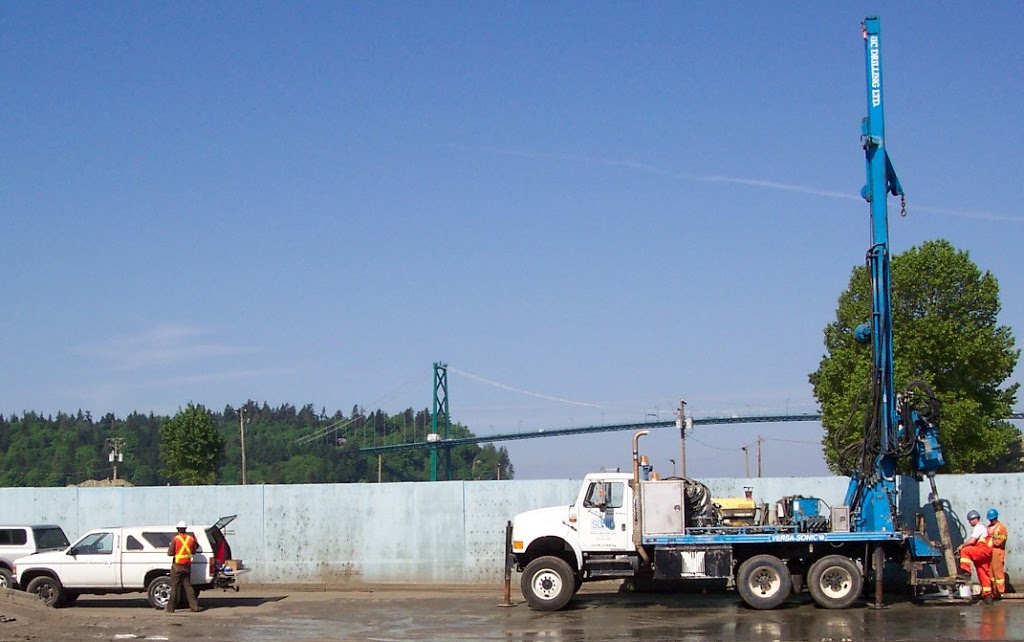
In earlier stages of my career, I had plenty of opportunities to work with drillers. Guys (and yes, they were all guys) who operate drilling equipment are a special breed. It is hard work, intensely physical, dirty, noisy, and you are doing it in the rain, the sleet, the snow, and any other unpleasant environment you are asked. Days are usually 12 hours, and you spend much of your off time living in flea-bag hotels on the outskirts of towns you wouldn’t otherwise visit.

I have drilled (actually, stood there watching other guys drill while I sketched on a clipboard and put samples into jars) in pounding down rain in February in Port Alice, in frozen sleet in September in Wells; In heavy snow in Anahim Lake, and on bright sunny warm days while standing on bulk sulphur storage piles. I have even stood on a small barge in Burrard Inlet in the middle of winter with drillers running a Pionjar off the side. With all of these conditions, they are operating a piece of equipment that can kill or maim them instantly if they lose attention. As a result, drillers are tough, skilled, determined, crude and practical: Every edge they have is rough. They all smoke every cigarette like it is their last; I have never seen a group of people so enthusiastic about smoking, and I grew up in a Pulp Mill town.

L to R: me, a notable bridge, a Sonic drill rig.

All that aside, one of the charming things about drillers is their tool kit. It contains two types of tools: hammers, and unused. There is nothing a driller cannot fix with a hammer. If there is, it needed replacing anyway. Every process in the instruction book “Drilling for Dummies” starts with these two steps: 1) Get a hammer; 2) No, a bigger hammer.

As a result, drillers generally have a lot of broken and bent equipment around. When something goes wrong on the drill rig there are two ways it can go: lots of banging and then back to work; or lots of banging then back to the shop. The only shocking past is how often it is the former.

There is a truism called the Law of the Instrument, which is colloquially “when all you have is hammers, every problem looks like a nail”.

When applied to how our province has been operating its roads, and overseeing Translink’s management of the Major Road Network (including the Pattullo Bridge), it could be said that there is no problem that cannot be fixed by building more roads. Never mind what the problem is, or whether this solution has worked in the past, building more roads seems to be the one thing upon which this government has no problem spending taxpayers money.

If the connection isn’t obvious, let me put it this way: At a time when they are cutting back on bus routes and are putting all transit expansion on hold, TransLink is fast-tracking the “consultation” on the Pattullo, saying they need a new 6-lane bridge PDQ. This seems to be the solution to some problem, but there problem isn’t “traffic” or “truck movement” or “growing communities” (the talking points used to justify a 6-lane bridge). Their problem is an aging bridge.

Look at the “Replacement Factors” listed on their website for the project, what do we find? An alliterative list: Safety, Structure, Seismic, and Scour.

“Safety” issues are related to traffic operations on the bridge: lanes too narrow, inadequate railings, too many accidents. If TransLink or the Government was really concerned about driver safety on the bridge, they would put four photo radar cameras on the bridge and enforce the 50km/h speed limit. A revenue-generating end of the problem.

“Structure” arguments are all about corrosion of steel components on the bridge and degradation of the bridge deck, so exactly the same factors that led to the extensive refurbishment of the Lions Gate Bridge. There, things were repaired at a much lower cost than replacing the bridge.

“Seismic” seems pretty straight forward: a 1938 bridge does not meet 2012 earthquake standards. The Sandwell Report done for TransLink in 2007 was pretty clear: “…the bridge is vulnerable to collapse even under moderate earthquakes and is in urgent need of retrofitting.” So what are we waiting for? Let’s get on with that retrofitting and make a safe bridge, at a fraction of the cost of building a new bridge.

“Scour” is the argument that after 75 years, the River is now starting to scour away the sand and silt around the foundations of the bridge. Give me a couple of barges of 1-tonne rip-rap, and we can take care of the scour issue. No need for two lanes of extra traffic to fix this one.

Notably, not one of these “Replacement Factors” justify increasing the number of lanes on the bridge, and most can actually be facilitated at much lower cost by reducing the lanes to three (with counter-flow) like the Lions Gate. As compelling an argument TransLink makes for extensive refurbishment of the Pattullo Bridge, nothing that says we need to accept the negative impacts on the City and the region of increasing road capacity, or the loss of the iconic steel arch span that is part of our City’s heritage and skyline for 75 years. Nor do they justify ramping up a $200 Million refurbishment project into a $1Billion bridge expansion project.

However, bridge replacement and expansion is the hammer that TransLink has. Collecting tolls on the bridge is the force behind that hammer. So no surprise when the problem is an aging bridge, the solution is not fixing it. The solution is to imagine other problems that may be solved by expanding it and slapping on tolls.

Simply put: the Province will not pay $200 Million to upkeep the infrastructure it has, but will throw a bunch of money building other infrastructure with no plan for long-term maintenance costs.

Hardly a model of fiscal prudence in my book.

We interrupt this Public Affairs program… to bring you a Football Game!

With all due respect to Homer, this week’s televised coverage of the Council Working Session was pretty compelling. You can watch it here, by choosing the date (April 23) and selecting  “Regular Working Session of Council”

Most of it was spent talking about the upcoming Open Houses (May 3rd, have I mentioned those before?) on the Pattullo Bridge. It is interesting to hear Council work their way through the material, some of them clearly very up-to-date on the issues at hand, some not so much.

The Consultant does raise some interesting issues about the bridge itself (starting at around 23:00). He seems to spend a lot of time suggesting that the form of any replacement bridge is as important as the other aspects: as this is an iconic structure in the middle of a major urban Centre, do we want the simplest, cheapest, IKEA “Billy” bridge that is likely to result from a PPP? If the bridge is to be replaced, this is an opportunity to add to the value of our Community with a spectacular feature, perhaps one resulting from an international design competition. This is indeed an interesting idea, and one I have not heard used for major infrastructure projects sponsored by the Province. Unless people can play football under it.

But the Councillor’s differing ideas around the project are also interesting.

Starting at 30:00 Councillor Cote rightly suggests the one approach that few have discussed yet is the refurbishing of the existing bridge. This is the direction I am leaning right now ( he even mentions the similarities to the Lions Gate consultation process).

Starting at about 31:30, Councillor Puchmayr seems to be suggesting we are putting the cart ahead of the horse: why are we talking about the shape and form of the bridge, when we should be talking about the alleged need for a bridge? You don’t bring a puppy home to ask the family if they think the family should get a puppy – you make the choice before you go to the puppy mill to pick one up.

I am a little thick, but I think I finally get where Councillor Puchmayr has been going with his on-going diatribes about the lack of a connection between the new Port Mann and the SFPR. Up to now, I thought he was just pointing out an example of bad planning on the Provincial Government’s part (or shooting fish in barrels just for sport). I have now realized he seems to be suggesting that building that connection now might be a more cost-effective way to get trucks across the Fraser than re-furbishing the Pattullo. It couldn’t possibly be as expensive, and the truckers seem to think it’s a viable solution. I am liking this approach…

Starting at 34:30, Councillor McEvoy spares no love on TransLink and their “consultation” process. He is also clear that the City of New Westminster has not taken a strong position on Transportation Planning up to now, and with other communities making clear what their position is, the City needs to have their clear, sensible, and logical position prepared. (hopefully this is what comes out the MTP if we havea good turnout on May 3rd). 

Councillor Harper (@43:00) is also right to raise the central question about all of these options: the one question we are going to have to have a clear answer on before we make difficult choices around the bridge is the impact on our City of the different plans. I am especially glad to hear him suggesting the City may need to spend some money to do the traffic surveys and studies to get the hard numbers, and not rely on TransLink’s obviously-loaded numbers.

I think the block we needto watch out for here is that many people think the “Problem” that TransLink is trying to solve is traffic, and therefore the solution all involve moving lanes or bridges or onramps. However, TransLink’s Pattullo Bridge Consultation page is pretty clear: their “Problem” is an aging bridge, not traffic.

But that is the topic of another post.