UBCM 2018

Apologies to regular readers (Hi Mom!) that I have not been putting a lot of content on this blog recently. The campaign is in full swing, we are still doing our regular City Council stuff, and I have another job that keeps me occupied. Hopefully back to regular programming in later October. In the meantime, I am talking more about campaign stuff on my campaign Facebook page, and on the my campaign website and trying to keep this page about City stuff that isn’t campaigning.

However, I thought it apropos to provide a quick update on the annual Union of BC Municipalities meeting. I was not able to attend this year, mostly due to work and Council commitments. I did go up there on September 10th (disclosure: on the City’s dime) to attend the BC Municipal Climate Leadership Council quarterly meeting, and the Minister’s breakfast that is hosted by that Council (of which I am a member). It was a productive meeting, and we were able to discuss the BCMCLC’s response to the Province’s Clean Growth Intentions Paper, which was both supportive of the work the province wants to do, and suggestive of some further steps the province could take to support local governments in reaching the aggressive greenhouse gas reduction goals that are required to meet Canada’s Paris targets.

I then returned to Whistler on Wednesday (not on the City’s dime this time) to attend the Lower Mainland LGA meeting (I am a vice president) and to present the annual Community Energy Association awards to communities taking exceptional efforts to reduce their energy use and greenhouse gas emissions. In my role as Chair of the CEA, it was my honour to share the awarding duties with the Minister of Environment and Climate Change Strategy. I also had the opportunity to give one of the awards to the Mayor of Nelson for their Solar Garden project –and let her know that imitation is the sincerest form of flattery, demonstrated by New Westminster copying their model for our own Solar Garden project.

The good news coming out the UBCM is that some resolutions we sent to be debated were passed by the membership of UBCM. These were:

B-8: Alert Ready Emergency Alert System

… be it resolved that UBCM works with the Province of British Columbia to provide access to the Alert Ready (emergency alert) system to local governments in order to allow them to broadcast critical and potentially life threatening alerts to residents of their respective communities using the framework of the Alert Ready System.

B-54: Cannabis and Harmonizing Smoking Regulations

… be it resolved that UBCM urge the Provincial Government of British Columbia to extend the prescribed distance from a doorway, window, or air intake in which a person must not smoke tobacco, hold lighted tobacco, use an e-cigarette or hold an activated e-cigarette from 6 meters to 7.5 meters and prohibit smoking in all public parks by amending the Tobacco and Vapour Control Regulations and by ensuring the corresponding distances prescribed in the Cannabis Control and Licensing Regulations are the same.

And:
B-102: Updating the BC Motor Vehicle Act to Improve Safety for All Road Users

… be it resolved that the provincial government be requested to support modernization of the Motor Vehicle Act, addressing the recommendations in the Road Safety Law Reform Group of BC Position Paper entitled “Modernizing the BC Motor Vehicle Act” to enhance safety for all road users.

I have to admit, I’m pretty chuffed about that last one.

Bad Data

I never want to react to the Fraser Institute. The easy ad hominem attack is that they are the Canadian propaganda wing of Koch Brothers enterprises, and their attempts to shift public policy in Canada should raise concern, but the more substantive attack is that they produce terrible reports that would not earn a passing grade if they were handed in as an Economics 101 term paper. They are bad at data, so it is best if we ignore them.

Alas, I was asked by an intrepid local reporter to comment because the City of New Westminster is made to look fiscally irresponsible in their latest fresh-off-the-presses piece of decontextualized tripe, so I did a bit of a dive into the numbers. This turned into several hours of trying to reverse-math their numbers, because like the failing university economics students they resemble, they don’t actually provide raw data or point clearly to what their data sources are, instead providing derived numbers without the benefit of showing their calculations. They are bad at reporting data, and we should probably ignore them.

I dug around in the BC Government website they link to as a data source (this one), and after figuring out how they got all of the population for 2016 wrong (using projected estimates instead of readily-available Census data), I started to dig through the various tables and repeated calculations until I got results mimicking theirs. They primarily used “spending data” from this table, and “revenue data” from this table. But they clearly didn’t know (or didn’t care) that New Westminster’s data includes the financial reporting by our Electrical Utility. They are bad at interpreting the data they have, so it is best we just ignore them.

For context, New Westminster operates its own Electrical Utility. It has since before BC Hydro existed. We hold on to it because it is a great deal for the residents of New Westminster. Using 2016 numbers to be consistent with the Fraser Institute report (See Page 90 of this report for the utility’s 2017 numbers), our Electrical Utility sells about $45,000,000 worth of electricity to residents and businesses in the City, at the same rate (more or less) as those customers would pay BC Hydro if they were in another Municipality. It costs the utility about $33,000,000 to purchase that electricity from BC Hydro at bulk wholesale rates. About half of that difference goes into operating the utility (paying staff, buying wires and building substations) and the other half is paid to the City as a dividend. We are the only Municipality in the lower mainland that does this, so we are the only municipality that includes these numbers in their expenses and revenue tables. This is important context. The Fraser Institute is bad at context, which is why we would all be better off by ignoring them.

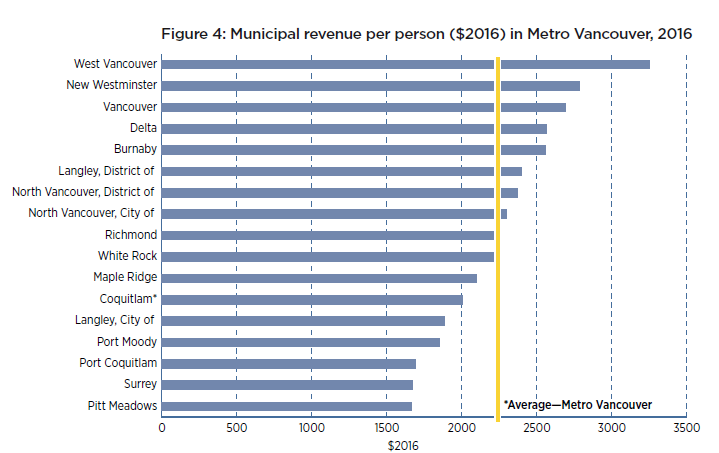
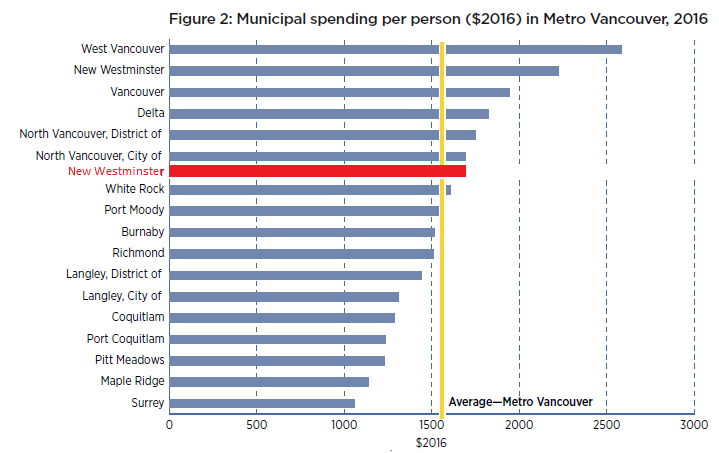
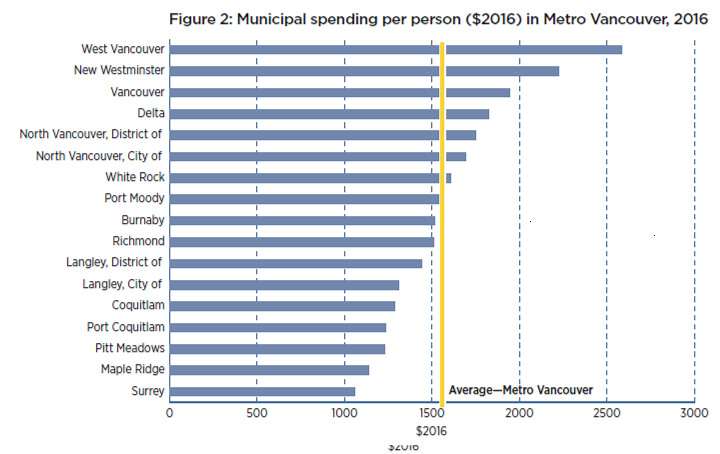
Because of this bug in the data, their report suggests that New Westminster has “the second highest municipal spending” per capita, along with “the second highest municipal revenue” per capita. They even have bar charts to prove it:

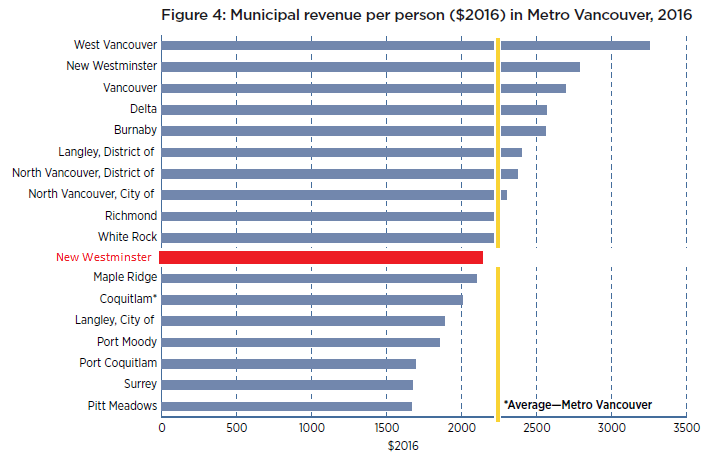
The problem being, New Westminster’s electrical utility “spends” about $38 Million a year, and it generates about $45 Million in revenue. If you take this into account, those bar charts look very different:

The shorter and more accurate story here is that New Westminster (outside of the electrical utility) spends slightly above the regional average on a per capita basis, and collects slightly less than the regional average in taxation and fee revenue. Think about that for a minute.

“Spending” in the local government context means putting police officers on the street, mowing lawns in our parks, and providing swimming lessons to your kids. The money we spend is providing services to our residents, and we do that at a slightly higher rate than the regional average. At the same time, the revenue we collect from our residents in the form of taxes and fees is lower than the regional average. An alternate Fraser Institute headline may be: New Westminster delivers more for less!

Ironically, part of the reason we deliver more for less is the electrical utility that can buy electricity for wholesale, sell it for retail, and provide a dividend to the City which we can use to provide services that would otherwise need to be paid for through taxes. Arguably, having an electrical utility is the most entrepreneurial thing we do, and is something that the entire “run government more like a business” Fraser Institute crowd would normally celebrate.

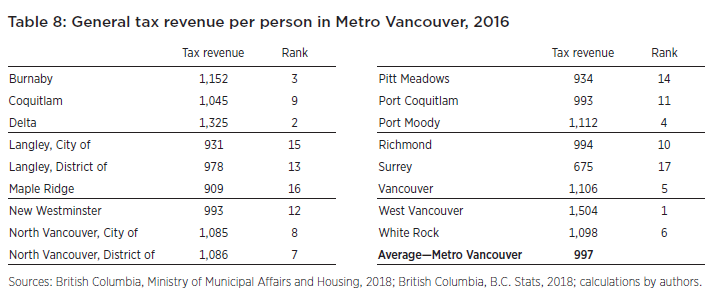
There is more in this report, including tables showing the City’s residential taxes are below average for the region (12th highest of 17 municipalities), and our debt servicing costs are average, but that kind of story – “City is about average” – doesn’t make for a very exciting headline.

Alas, New Westminster is just kind of average. And when it comes to managing finances, this is not a bad thing. Every financial decision is about balancing the cost with the priorities our residents and businesses expect us to address. I am proud of the level of service we provide in New Westminster, and our ability to do that while keeping taxes below the regional average.

Council – August 27, 2018

It was a strange Council meeting on Monday. Maybe we were out of practice, maybe election fever is frying our brains, but the meeting had a different feel. Or maybe it was just me. Nonetheless, we persevered, and started our Agenda with four (4!) Opportunities to be Heard:

DVP00648 for 601 Sixth Street
This is a pretty straight-forward sign variance to replace an existing sign for an established business. The variance is because the area of the sign is twice what is permitted, mostly because it’s location fits in under the more restrictive category of “under canopy” sign. Other than that, it is completely appropriate in size as a building identification sign.

We received no correspondence on this variance, no-one came to speak to it, and it seems reasonable. Council voted to grant the variance.

DVP00649 for 315 Fifth Street
This is an interesting application. The owner of the heritage home in Queens Park wants to install a livable basement, and wishes to raise the house by 2.75 feet to accomplish this. Some complications exist in digging down to make up enough basement roof height, mostly around how the perimeter drainage of the house interacts with groundwater and the invert of the adjacent drainage network. Although the request puts the roof 1.25 feet above the allowable height, it would still be significantly lower than the heritage houses adjacent on either side.

We received some correspondence for neighbours concerned about overlook issues, and had two neighbours come to speak to Council about their concerns. After a bit of discussion, I am satisfied most neighbouring concerns (around drainage changes and the City enforcing overlook mitigation) were addressed, and the relatively minor lift of the house is a reasonable request. Council voted to approve the variance.

Tanaka Court Road Closure Bylaw No. 7991, 2018
This is the process through which the City “closes” a road. The road in question is currently undeveloped, and the city has no plans to ever develop it. The owner of the adjacent undeveloped property would like to purchase the land and include it in their development plan for a new business. As the road is surplus to City needs, there is no reason to oppose this. We get paid for the land, and the new owner starts paying taxes to us for the land!

Building Bylaw Amendment Bylaw No. 8030, 2018
The City is making adjustments to its building bylaw to restrict some types of pile driving, after making the changes to the Construction Noise Bylaw. The impact on residents of the current building boom is something the City recognizes, and we are trying to balance the needs of new developments with the livability impacts of construction. Getting rid of the largest diesel-hammer pile drivers will be a noticeable difference.

We receive no correspondence on this, and no one came to speak to Council on the Bylaw. Council moved to approve the Bylaw for three readings.


We than had a Report for action:

Official Community Plan: Phase Two of the Infill Housing Program – Discussion of Scope of Work,
This report outlines what staff will be working on for the next few months as part of the ongoing OCP implementation work. In Phase 1 of the work, they have been concentrating on getting the laneway/carriage home guidelines operational and have been working on the infill townhouse/rowhome program, with results of that work coming to Council in October and November.

Phase 2 is going to look at other more flexible housing forms: duplexes and triplexes, with a hopes to better understand what works in the economics of lot size vs. construction cost with an eye to making more flexible housing forms available, and to actually fill and affordability gap for families that need more room than an apartment

The goals here are good, but it is important that we are doing this work in the context of a shifting economic environment. The goals of the OCP are to create more housing choice across the affordability spectrum, and we need to assure the tools we are applying are actually moving us that direction. More to come!


The following items were Moved on Consent without Council discussion:

Draft Economic Development Plan
The City has been working on this plan for a bit of time, based on some strategic direction given at the beginning of this Council term. After extensive stakeholder consultation, it is time to open it up to more public discussion. This is the first comprehensive update of the EDP since 2008, and a lot has changed locally and regionally in that decade.

Stakeholder input so far include 600 business respondents to survey, a formal meetings with business stakeholder groups. It bounced of Council in February workshop, and some changes included. The strategy includes 4 goal statements, 6 strategies, and about 30 concrete actions the City can take to enact those strategies. As this is a report about a strategy that is going out to public comment, I don’t want to pre-judge too much before we hear from that public. However, I will talk about one aspect that I’m not sure any City is really ready to deal with: the future of retail.

Will our retail space be different in 10 years? Will we need to move towards smaller storefronts and more affordable spaces for “artisan” or more curated retail experiences, or will we see continued amalgamation to larger 20,000-square foot+ major retail as has been the trend over the last decade? What does that mean for our commercial areas, and how can we shift them to meet the demand that will be different in 2025, even if we don’t yet know what those difference will be? I don’t have answers ot these questions, but want us to be thinking about them.

Recruitment 2018: Multiculturalism Advisory Committee Appointment
We have seats on several City committees for representatives from School District 40. The School district has asked us to shift the person in the role for this committee, and we moved to approve this change.

205 Clinton Place: Heritage Revitalization Agreement Amendment Bylaw for Timeline Extension – Bylaw for Three Readings
The homeowners who are doing extensive renovations to a heritage home on the edge of Queens Park need some more time to complete the heritage restoration. This is not unreasonable – these types of projects on 100-year-old houses commonly run into unexpected delays, and there is ample evidence that the homeowner is moving forward with good intent, but had some unavoidable delays. Council moved to grant them an extension.

207 – 209 St. Patrick Street: Official Community Plan Amendment to Return Heritage Conservation Area Related Protection – Bylaw for First and Second Readings
This is a property that qualified to be removed from the Heritage Conservation Area in Queens Park as part of the group evaluation process developed to refine protections as the HCA was rolled in. However, the owner requested that protection of the HCA be applied to their property – they were automatically opted out do to the evaluation criteria, and wish to opt back in. It seems a little ungainly, but the process here is actually the quickest way to get through these post-HRA adjustments, so this is the path we are taking! It will go to Public Hearing on the September 17th.

647 Ewen Avenue: Official Community Plan Amendment Section 475 and 476 – Consultation Report
This small development in Queensborough will preserve the heritage Slovak Hall while building five new townhouses in a predominantly single-family neighbourhood. This is a preliminary report, and needs to go through some committee review, public consultation, and a Public Hearing. This report outlines that consultation and gives Council an opportunity to highlight any concerns. We had no concerns, and are OK with the project moving forward towards a Public Hearing in 2019. Mark your calendar.

610 – 612 Brantford Street: Temporary Use Permit for a Sales Centre – Consideration of Opportunity to be Heard
This medium-density development in the Bent Court area of Brow of the Hill included the preservation of a heritage home on the property. The developer wants to use that restored heritage house as their sales centre for the development. To do this, they need a Temporary Use Permit. It is in a somewhat unique location, with adjacent commercial uses, so it seems reasonable, but if you feel differently, there will be an Opportunity to be Heard on September 17.

228 Nelson’s Court: Development Variance Permit No. DVP00650 to Vary Sign Bylaw Requirements for the Brewery District – Consideration of Notice of Opportunity to be Heard
The Brewery District developer wants to vary the sign bylaw to put larger-then-permitted signs on the Brunette Ave fascia of the building. There will be an opportunity to be heard on September 17th!

This is not directly related to the “The Sappers were Here” public art piece, which I think may need to be discussed at some point in context of the City’s reconciliation work. However, we have a lot of work to do before we get to that conversation.

1001 Edinburgh Street: Appeal of Tree Removal Permit Issuance
The City passed a Tree Protection Bylaw in 2016 to prevent the loss of tree canopy in the City. A fundamental part of this Bylaw is not permitting the removal of large trees (called “specimen trees” in the Bylaw) unless they pose a hazard or have reached end of life. When refused a removal permit for a tree on private property, that owner has the right to appeal to Council. A homeowner is exercising that right after they were refused a permit to remove a large monkey puzzle tree in their front yard.

The arbourist the landowner hired and the City’s arbourist agreed that this tree is healthy and does not present a hazard. Council did not grant the appeal.

420 Boyne Street (Animal Shelter): Ministry of Transportation and Infrastructure Outstanding Referral: Rescinding and Amendment to Zoning Amendment Bylaw – Consideration of Readings and Public Hearing Waiver
The zoning amendment for this property that occurred in 2017 apparently skipped an important step, which is referral to the Ministry of Transportation. So we need to rescind it, complete that referral step, then do it again. As the application already went through a Public Hearing, we will not have to do that again.

1400 Quayside Drive (Muni Evers Park and Poplar Landing): Update on Phase 1 Consultation Results and Proposed Next Steps
The last piece of Quayside Drive land has an interesting history, and is still, for the most part, vacant. The property belongs to the City and Metro Vancouver utilities, and has a Combined Sewer Overflow tank on it – a storage tank designed to temporarily store surges of sewer water during intense storms to prevent those surges from overflowing into the Fraser River when the down-pipe capacity is not able to accommodate the volume. At some point, the property was christened “Muni Evers Park”, after New Westminster’s longest-serving Mayor. It is, however, not currently a park, and is secured behind a fence after extensive soil and groundwater remediation occurred on the site.

The City would like to activate this site, and would like to use it for some combination of affordable housing and park use, with a market housing component to pay for those. This will involve a number of steps, the first being getting Metro Vancouver to agree, as they have an ownership stake on the land and the existing infrastructure there.

As the City works that angle, we are also doing public engagement to get an idea what the neighbourhood thinks of the property and potential uses. This report provides some of the feedback we heard from the attendees of an open house at the Quayside.

DVP00652 – Off-Site Servicing Works for 1 Cumberland Street (Alias) – Metro Vancouver Sapperton Pump Station
For technical reasons including a couple of rail lines and a SkyTrain guideway, it is difficult (I try never to say “impossible”) to provide underground electrical service to the new Metro Vancouver pump station being built in the Braid Industrial Area. To allow overhead service, we need to provide a Development Variance.

Application for Grant Funding to the Investing in Canada Infrastructure Program
We are applying for senior government grants to help pay for our ongoing sewer separation program. We did receive a grant to help with the Sapperton program, and though the timeliness conditions attached to that funding meant we had to work faster than we might have likely contributed to the impact on the community during the works being less than ideal, it meant that the City received more than $5Million that did not have to get passed on in your utility bills. The next priority is in the Kelvin Heights and West end. If we get a grant, it will allow us to accelerate the sewer separation, and further reduce the increases in your sewer costs.

Licence to Occupy Agreement for Brow of the Hill Parklet at Seventh Street and Fourth Avenue
The City’s newest Parklet is half-completed – the part on City lands has been installed and planted by volunteers from the Brow of the Hill Residents’ Association. The second half is on land that belongs to the First Presbyterian Church, and we need a license agreement with them to make sure everyone is clear who is responsible for what.

Queensborough Dog Off-Leash Area Relocation
The current off-leash area in Queensborough is going to be developed, so the City has been working with members of the Q’Boro community to plan for a replacement. There have been pop-up events at “Pawfest” events at the current park, a couple of public open houses, and Residents’ Association conversations. The result was a request for two off-leash parks: one at Ryall Park to replace the current one, and a smaller one at Port Royal. The first we can do right away, the second is going to need some more work with the neighbourhood to identify the right size and location.

Multicultural Advisory Committee: Immigrant and Refugee Survey
The City’s Multiculturalism Advisory Committee is recommending we re-do a survey of the refugee and immigrant community in the City, to repeat one last performed in 2013. Good idea.

Environmental Advisory Committee: Contaminants and Pollutants Entering the Environment
The EAC identified a concern around lead and other metals entering soil and waterways via sporting equipment (shot and fishing lures), which expanded into concerns about activities in the City that may act to introduce contaminants and pollutants in to the waterways and soil in the City. I am OK with adding this to our burgeoning Environmental Strategy, but want us to be cautious about expanding the City’s limited capacity into areas of jurisdiction that clearly belong to senior governments. The Federal Fisheries Act regulates deleterious substances, the provincial Environmental Management Act regulates spills, waste management, air quality and pollution prevention. If we have a role to play in these areas, it is in assuring senior governments enforce the rules they have, and providing them assistance in doing that. Creating another layer of rules is not an effective way to address this situation when there are no resources to manage the rules we have. Still, advocacy at the local government level can push senior government towards better enforcement.

Access Ability Advisory Committee: Request for Additional Accessible Taxis
The AAAC raised this issue to Council after recent decisions by the Passenger Transportation Board meant that requests to increase the numbers of accessible taxis in New Westminster were not approved. The City will advocate and let the PTB and the Minister of Transportation know that this is not acceptable, that accessible taxis are in desperate need in the City right now, and that any changes to the regulations that will bring ride-hailing services like Uber or Lyft to British Columbia have to assure that the needs of the disabled are integrated in to the regulations.


The following items were Removed from Consent for discussion:

Committee Recruitment and Diversity
This is a follow-up on Councillor Trentadue’s motion to start work on assuring the demographics of our committees better represent the demographics of our community. The first step on this process is to actually collect the demographic information for Committee members, and for committee applicants, so we know what the gaps in our recruiting process are and what the underrepresented groups are.

This first step is making changes in the application form for committee recruitment to collect the demographic info. It will be optional to fill that part of the form out at first (let’s see how the take-up is), but we can hopefully start on this path and use the data to be more systematic about our committee recruitment in coming years.

Tl’etinqox Sister Community Agreement
The City has several “Sister City” relationships with cities in Asia, some more active than others. However, we have been looking at a new form of International relationship – that with the First Nations of Canada. As we are working towards reconciliation and addressing the Call to Action of the Truth and Reconciliation Commission, we are cognizant that the first step is always in building relationships to forge a mutual respect and trust. As a municipality, we are hoping to establish a Sister Community relationship with the largest community in the Tsilhqot’in Nation.

Council moved to approve this agreement, and we will send the invitation to the Tl’etinqox leaders in hopes that they will meet us to formalize this relationship.

Recreational Cannabis: Consideration of Bylaws for Implementation of Cannabis Regulatory Framework
We are moving forward with cannabis regulation, as a nation, a province, and a city. In New Westminster, we have had a series of public engagements and Council workshops to work our way towards a regulatory framework. This is a good example of where the 7 members of Council have had some pretty strong disagreements on the details of the regulations, but have worked with staff to integrate the public engagement results and put together a framework that we can all agree upon. I suspect this isn’t perfect, and there will be some adjustments needed as this unrolls, but this is ready to go to Public hearing on September 17, in hopes everything can be in place by the time the Federal law makes this new industry and these businesses in our community legal.

Rental Replacement Policy and Inclusionary Housing Policy: Next Steps and Timeline
We are continuing the policy work of getting the newly-developed Inclusionary Housing and Rental Replacement Policy in place. This is actually a massively complicated piece of public policy work because it interacts with so much of the City’s core functions, and multiple other internal and external policy. Some of the groundwork has already been done, including internal intra-departmental consultation, case studies of other municipalities, and land economics analysis to give us an idea what we would need to do to get any take-up on this new policy. There will now be some stakeholder consultation, and reaching out to Advisory Committees, the development community, non-profit housing providers and the public.

I think there is an opportunity here for us to use these new zoning tools to protect and preserve exiting purpose built rental, but it must be applied with an understanding of the positive and potential negative impacts. The law of unintended consequences will no doubt apply, but I think we are well positioned to take great advantage of this change.

Electrical Vehicle Charging Infrastructure for New Buildings
The City has developed a zoning bylaw amendment that would require a Level 2 energized outlet for all residential parking spaces in new buildings. As it is much easier and more cost-effective to build the supporting infrastructure for chargers during initial construction than to retro-fit buildings after, this will ultimately save residents and building owners money.

The Bylaw change will assure the necessary infrastructure to support chargers will be installed during construction (adequate power supply, conduit to carry electricity to parking spots, and energized outlets) but will allow building owners to install their own energy management tools and charging units when the need arises. This balances the up-front cost with making sure future homeowners are not burdened with engineering barriers to having a home charger.

This bylaw amendment will go to Public Hearing on September 17, so come out and tell us what you think!


Then we had one piece of new business:

Communities on the Move Declaration
The BC Alliance for Healthy Living is a partnership between organizations involved in Public Health initiatives, including the Heart & Stroke Foundation, the Canadian cancer Society and the Health Officers Council of BC. Their main call in the Communities on the Move declaration is to call on the Province to prioritize active transportation as a public health initiative.
We know people who engage in active transportation –transit, walking, cycling – have better health outcomes than those who rely on automobiles, and as communities invest in supporting active transportation, the province’s health agencies are the primary budget beneficiaries – we save out health agencies money by supporting healthier lifestyles for our residents. So we are calling on the Province to budget accordingly and support active transportation not just in our urban areas, but in all parts of the province.
Our Local HUB chapter has asked New Westminster to join the dozens of other communities across BC to endorse the declaration. This meets so many of our City’s goals in building a healthy community, mobility for all, clean air and environment and safety for all road users. Council voted to endorse the declaration.


We then ran through the Bylaws of the day:

Zoning Amendment (420 Boyne Street) Bylaw No. 8036, 2018
As mentioned above, to make the Ministry of Transportations process valid, we rescinded third and second reading, and re-read Second Reading for the amended Bylaw so that we can bounce it off MOTI.

Zoning Amendment (Cannabis) Bylaw No. 8043, 2018
As mentioned above, the Bylaw that changes our zoning Bylaw to allow cannabis retail in the City was given two readings. There will be a Public Hearing on September 17 if you want to share some thoughts about this with Council.

Official Community Plan Amendment (207/209 St. Patrick Street) Bylaw No 8042, 2018
As mentioned above, this Bylaw that returns HCA protection to this home at the request of the homeowner was given two readings. This will have a Public Hearing on September 17 if you have any concerns or issues.

Zoning Amendment Bylaw (Electric Vehicle Charging Infrastructure in Residential Buildings) No. 8040, 2018 and
Official Community Plan Amendment (Electric Vehicle Infrastructure Guidance for Development Permit Area Guidelines) Bylaw No. 8039, 2018
As mentioned above, these Bylaws that bring electric charging infrastructure to new residential buildings were given two readings, and will also come to a Public Hearing on September 17.

Heritage Revitalization Agreement (205 Clinton Place) Amendment Bylaw No. 8046, 2018
This bylaw that extends the timeline for restoration of this heritage house was given Three readings.

Business Licence Bylaw Amendment (Cannabis) Bylaw No. 8044, 2018;
Development Services Fees and Rates Bylaw Amendment Bylaw No. 8047, 2018;
Smoking Control Bylaw Amendment Bylaw No. 8048, 2018;
Bylaw Notice Enforcement Bylaw Amendment Bylaw No. 8049, 2018;
and
Municipal Ticketing Information Amendment Bylaw No. 8050, 2018
These Bylaws that cover the various aspects of cannabis regulation in the City around business licenses an nuisance smoking were all given Third Readings.

Bylaw Notice Enforcement Bylaw Amendment No. 8031, 2018 and Municipal Ticketing Information Bylaw Amendment No. 8032, 2018
As discussed on the July 9th meeting, these Bylaws that formalize the fines and ticketing to support the ban on large diesel impact pile drivers were adopted. They are no the law.

Zoning Amendment (228 – 232 Sixth Street) Bylaw No. 7996, 2018
As discussed at the April 30, 2017 Public Hearing, this Bylaw that formalized the zoning of the proposed development in at the old La Rustica restaurant site was adopted by Council.

Zoning Amendment (406 – 412 East Columbia Street) Bylaw No. 7995, 2018
As discussed at the April 30, 2017 Public Hearing, this Bylaw that formalized the zoning of the proposed development at the vacant lot in Sapperton was adopted by Council.

Zoning Amendment Bylaw (41 and 175 Duncan Street) No. 7983, 2018 and
Official Community Plan Amendment (175 Duncan Street) Bylaw No.7982, 2018

As also discussed at the April 30, 2017 Public Hearing, these Bylaws that formalized the OSP update and zoning of the proposed townhouse development in Queensborough was adopted by Council.

Wood-Boyne Street Road Closure Bylaw No. 8037, 3028
As discussed at the July 12st Meeting, this Bylaw that formally closes a section of road in Queensborough was adopted by Council.

And after that, it was all over except the speeching.
Council Top 3!

This is episode 3 of my hopefully-regular pre-council list of what I think are going to be the most important three items on our Council agenda on Monday* in no particular order, so you can decide if you want to tune in.

#1: Building Bylaw Amendment Bylaw No. 8030, 2018
The City is making adjustments to its building bylaw to restrict some types of pile driving, after making the changes to the Construction Noise Bylaw. The impact on residents of the current building boom is something the City recognizes, and we are trying to balance the needs of new developments with the livability impacts of construction. We have already made some adjustments to the Construction noise Bylaw to reduce the number oh hours of allowable noise, and we are now looking at getting rid of the largest diesel-hammer pile drivers for future projects. These are the loudest pieces of construction equipment, and there are viable alternatives available. Some in the development community are not happy about this. We are having an Opportunity to be Heard about this. If you have an opinion, you can come out and let us know!

#2: Official Community Plan: Phase Two of the Infill Housing Program – Discussion of Scope of Work
Things are moving fast in the housing file, as the economics of housing across the region are shifting. This piece of policy work will help the City better support the building of more flexible housing forms in our Residential Ground Oriented and Townhouse/Rowhouse areas. This follows on the work to implement laneway and carriage home policies. The goal is to figure out what kind of “missing middle” we can support and the economics of the region can support, then develop guidelines to make it easier for that type of housing to be built. Staff are going to give us an outline of their proposed workplan to make this happen.

#3: Communities on the Move:
The local chapter of HUB has asked the City of New Westminster to endorse a Communities on the Move Declaration developed and promoted by the BC Alliance for Healthy Living. A premise being approached here is that people who engage in active transportation – transit, walking, cycling – have better health outcomes than those who rely on automobiles, and as communities invest in supporting active transportation, the province’s health agencies are the primary budget beneficiaries – we save our health agencies money by supporting healthier lifestyles for our residents. I’m going to ask Council to endorse this, and as the initiative reflects so many of our goals, I’m not going to expect it to me controversial. But hey, this my listicle, so I can promote anything I want!

*footnote: The funny thing about Council: it is almost impossible to predict what three items will rise to the top and get the most debate/ public feedback / media coverage, so these are only my guesses. For a full prediction of the entire Council agenda, go to the agenda!

Renovictions

There was a meeting this week hosted by the Vancouver Tenants Union in my Brow of the Hill neighbourhood. It was to address the culminating “renoviction” crisis in this area, and to hear from people who may be facing renoviction. As I said in my previous post, this is the hardest question for me to address as a City Councillor, and this meeting was at times heartbreaking (see a good summary in the Record here). These are my neighbours (quite literally in one case), they are scared, and we heard a lot from them at this meeting.

The background to the meeting is the work that the Vancouver Tenants Union are doing around the region to provide support to people who are facing renoviction. They are one resource that can assist people in appealing eviction notices, in making sure tenants’ rights are protected to the letter of the law. They have been working mostly in Vancouver, but have also done some work in other areas in the Lower Mainland, and see New Westminster as a current “hot spot” for renovictions.

Whenever this issue of renoviction comes up, there is a common refrain that we need to give landlords the ability to maintain and renovate these lower-cost buildings, or they will quickly degrade into slums. We hear that many of these buildings are approaching end-of-life, and the increase in rent is necessary to fund the renovations to keep them standing. The VTU are presenting data that this is largely a red herring, and I am going to dig deep into one example they use. So grab a tea and comfy seat, this may go on a bit:

If you prefer TL;dnr versions: The current renoviction surge in New Westminster is mostly the result of investors extracting healthier returns for their portfolios by throwing low-income people out on the street. This is not an unfortunate result of unavoidable events – this is driven by greed for profits. And they aren’t even subtle about it.

The building-systems-reaching-end-of-life situation does occur. We get applications every couple of years for a building that fits this description. However, we are now seeing a huge increase in numbers, and dozens of buildings in New Westminster are now facing some form of renoviction, most owned by the same small group of land-flipping corporate entities. There is significant evidence that this is a profit-driven activity.

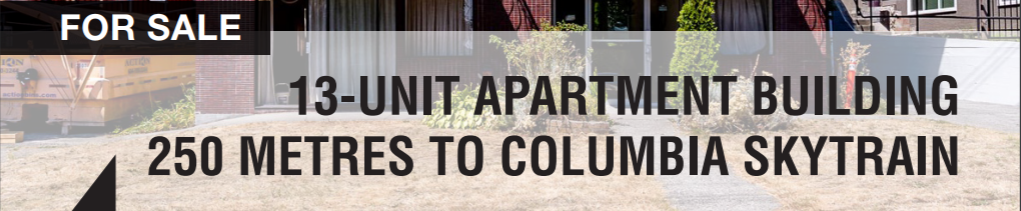
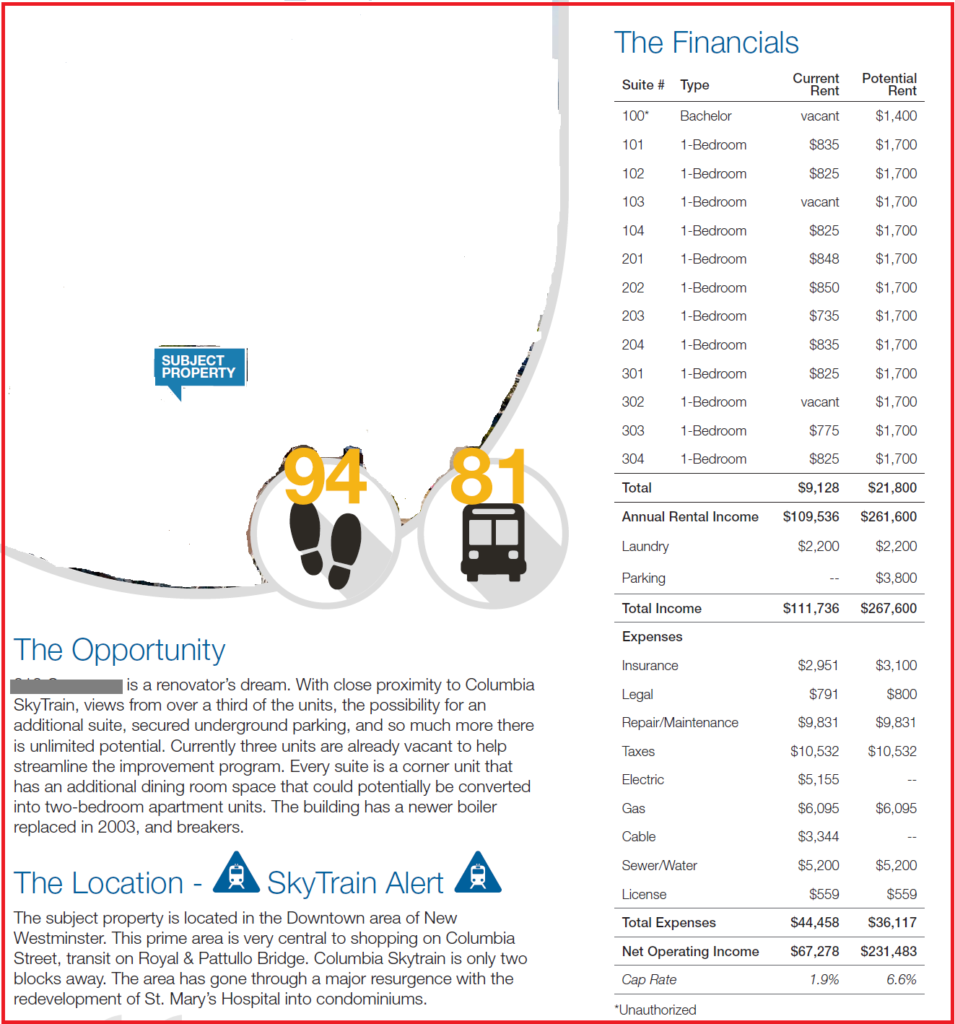
As a single case in point, the VTU provided me a copy of a sales brochure for a commercial property in New Westminster. I have done what I can to remove the actual address from this to protect the privacy of the current residents, but suffice it to say this is a ~40 year old three-story walk-up typical of New Westminster’s ample affordable rental stock. The real estate agent is offering this “renovators dream” for sale for $3.5 Million, which is $500k over assessed value. Here is a redacted image of page 2 of the brochure:

I would love to go through this pamphlet and pick out the numerous flaws in fact in here, (“The area has gone through a major resurgence with the redevelopment of St. Mary’s Hospital into condominiums” – The St. Mary’s site is currently an elementary school and public park), and speculative fiction about potential increases in suites, but making fun of sales-fluff seems seems pedantic, so I will concentrate on what we can glean from the prospectus. (highlights are mine:)

This shows 13 rental suites (one illegal, or “unauthorized” in the parlance of sales), with three of them vacant to “to help streamline the improvement program”. The other 10 are single-bedroom and renting for between $735 and $850 a month. This includes free parking and cable, and some landlord subsidy of the electrical (likely for common areas, heating, etc.). The building is netting $67,278 a year, which is a Cap Rate of 1.9% per year based on the $3.5M sale price. For some reason they are not renting out two legal suites in a market where rental vacancy is under 1%, but add that revenue, even if it meant a concurrent 20% increase in expenses and you can turn in an extra $16K, bringing the Cap Rate up to 2.3%. This is less than the expected return for a serious real estate investor, but in no way is this building losing money. As a bonus, the Residential Tenancy Act allows annual rent increases greater than inflation – these numbers will only get better over time.

Now shift over to the “Potential Rent” column. It shows an increase in rents ranging from 100% to 135%, renting the illegal suite, charging for parking, all of the electricity and cable, and all of the sudden your Cap Rate is a very attractive 6.6%. Note that nothing in this prospectus mentions the cost of significant renovation, and the sales pitch seem to suggest the building is in good shape, with recent heating and electrical upgrades. So the proposal is to more than double the rent and not increase costs at all. I guess I am mostly shocked that they have no shame just putting that right out there in the middle of a housing crisis.

The VTU have found a number of buildings in New Westminster in similar situations, and have been tracing the ownership of the corporate entities who are – and there is no finer point to make than this – making a healthy investment strategy out of throwing low-income and vulnerable people out on the street in the tightest real estate market in the country.

Arguably, there is nothing illegal going on here. People are allowed to buy buildings and make money renting them out. If this building needs significant upgrades (or, if the landlord just wants to do upgrades such that they require the suites to be vacant), they are totally within their rights to throw those people out, provided they give appropriate notice. It becomes legally grey if they just do superficial upgrades as an excuse to evict residents. However, there is currently nothing the City or the Province can do to prevent this activity from taking place, and when the decision is to turn a small profit into a bigger profit by making vulnerable people homeless, then we are into a question of morality, not law.

The City is working hard to identify these properties, as are the VTU. At this point, all we can do is try to contact the residents and assure they understand their rights under the Residential Tenancy Act and what supports exist for them if they are insecure in housing. The VTU is working to get people in these buildings organized, and help guide them through the appeal process that exists under the RTA if they feel they were unfairly evicted, but need all of the information and support they can get. The City has no power to refuse building permits in these cases, if the landlord even bothers to apply for a permit.

Ultimately, we need to change the regulations to protect these vulnerable people from predatory rent increases. This is most likely to come from the Provincial government. At UBCM last year, the City of New Westminster put forward a resolution (endorsed by the membership) that read:

be it resolved that UBCM urge the provincial government to undertake a broad review of the Residential Tenancy Act including, but not limited to, amending the Residential Tenancy Act to allow renters the right of first refusal to return to their units at a rent that is no more than what the landlord could lawfully have charged, including allowable annual increases, if there had been no interruption in the tenancy;

Although some changes in the RTA were made in May to give renovicted tenants more notice and compensation, we are still short of where we need to be, and renovictions are an emergent crisis in New Westminster. I wish there was something we could do, because being in a meeting with 50 people feeling the stress and recognizing some of them may become homeless, after all of the work this City has done and investments this City has made to protect and enhance our affordable housing stock, only because of a lucrative investment opportunity being sold here, is enraging

The Booth

People who follow my exploits (Hi Mom!) know I have been running this webpage for several years, and not too long after I first got elected as a City Councillor, I added an “Ask Pat” button to it. Through this, people can send me questions about the City, and I try my best to answer them. Recognizing that not everyone reads my Blog, I decided to take Ask Pat analogue a little while ago; hence the Lucy Booth.

(Credit where credit is due: Hayley Sinclair is convinced this was her idea, but I am pretty sure the original inspiration was JJ Lee’s “Sartorial Advice” booth from a few years ago, it just took me a long time to put this into action).

Having set this up in various places around town over the last few months, the response is pretty fun. However, last weekend’s Pride Street Fest was the most active booth location yet, with more than 100 questions being asked, most of them answerable, some even by me. Examples? (shortened in both question and answer for the sake of brevity)

Q: What is the long-term plan for the QtoQ Ferry?
A: We will see how the ridership on this year’s Pilot goes, and will work with senior partners to help close a funding gap. I hope we can continue to run it, because it is an important transportation link!

Q: Is the rental building at *00 block of *th street turning into Condos?
A: No. We do not permit the conversion of residential rental to condo in the City, and we would hear about it if that was happening.

Q: What is the smallest thing?
A: The Planck Length (*turns out I was only kinda right here, as is to be expected whenever anyone involves quantum physics).

Q: Is the City developing Glenbrook Ravine?
A: No. The Ravine is one of the few natural areas left in the city, and is an important park and habitat asset. A large part of it was preserved permanently as part of the Victoria Hill agreement. No-one has proposed buildings in the ravine to Council, and I cannot imagine Council ever agreeing to do this.

Q: (from a ~9 year old girl) Why does my big brother always bug me?
A: Probably because he is jealous of you! That’s why I bugged my big sister! But don’t worry, I grew out of it.

Q: Do you agree with a 10-lane pool?
A: Yes, and we are working on a grants to help pay for it and the increased deck space and other additions to the base plan for the CGP replacement that Hyack Swim Club asked for – Contact your MLA and MP to put in a good word for the pool, and help us secure those grants!

Q: What is going to happen with Marijuana Dispensaries in October?
A: The City will permit cannabis retail in a limited way as soon as the federal laws are in place, I suspect it will be limited to a few locations in the short term, and probably won’t arrive until Christmas at the earliest, mostly because of the complicated process we need to go through with Zoning and Business License regulations. It’s coming, and we are going to be ready.

Etc., etc.

Both serious and funny questions aside, there was one theme I heard a few times that was, frankly, the hardest question to answer:

Q: What are you doing about housing?
It is hard because I know any truthful answer I provide is not going to help. I can talk about the City investing in several affordable housing projects (it isn’t enough), about us working to bring in more purpose built rental (it is increasingly unaffordable), about our protecting the affordable rental we have by preventing demovictions (but are hand-tied somewhat when it comes to renovictions). I can say, honestly, we are doing all we can, and are doing arguably more than any other municipality in BC; but it is still not enough to fix the problem. We are advocating to senior governments for help, and it is starting to trickle in, but after 15+ years of inaction, it isn’t fast enough. This answer is hard, because I know the people asking me are scared and feel helpless, and I know my answers will not help them feel more secure. Empathy feels hollow when people are suffering, because it isn’t enough.

I’m working on a blog post right now that digs a little deeper into this topic.

Have questions? You can send them to Ask Pat, but recognize I am really busy these days with Campaign stuff, and it may take a while before you get an answer. It will be more immediate if you see a little red booth set up, and come and talk. If you ask a question, you may also get a button:

ASK PAT: Small trees and Beg Buttons

neil21 asks—

Howdy. Two questions having just moved here from Vancouver’s West End.

1. Why are the street trees so short? Is it just time (but I thought this city was older) or the species? The streets are really hot without that shade.

2. At 6th and Carnarvon, pedestrians don’t get to cross without pressing the button. Even if pedestrians are crossing the same way on the other side.
2b. Also why aren’t your beg buttons those buttonless ones like you have for the bikes? Those are better.
2c. Also why does 6th and C have beg buttons at all? Just let peds cross with green cars always.

Welcome to New West. I would love to hear more about your decision to move here from our western suburb, and your experiences since making the shift. The theme of my answers to the above will be “A City is always a work in progress”. We are now headed the right direction, but have more work to do.

1: (caveat: I’m not an arbourist, but I have a couple of suppositions) First, the trees may be younger than you are used to. The City of New Westminster, with the exception of Queens Park (the neighbourhood) and a few parts of Glenbrooke North and Sapperton, really lost the plot on street trees a few decades ago. It may have been the fashion of the time, the cost of development, a mandate by the electrical utility, or just short-term thinking, but our urban forest was cut back in a devastating way. Our canopy cover City-wide is less than 18%, which is similar to Vancouver, but low compared to much of North America. It was only a few years ago when New Westminster introduced a new Urban Forest Management Strategy, and started to a) proactively protect the trees we have; and b) ramp up plans to plant trees and bring back more canopy cover. Unfortunately, the ultimate results of this will not be seen for another decade or two. That said, although the best time to plant a tree is 20 years ago, the second best time is today, and we are getting on it.

That said, it is also possible that trees are smaller above ground because they are smaller underground. Trees need healthy root systems to prosper, and our 150-year-old streets and sidewalks and utility corridors mean that the area of healthy nutrient-rich and porous soil around many of our newer trees is limited. This may mean staff decided to plant diminutive tree species to respect the available growing area, or it may be that the lack of soil is keeping the tree from meeting its ultimate size. There is a bunch of new engineering practice around creating “soil cells” as part of new street tree installations, but see last paragraph about 20 years.

2: (Mostly) because the City is old, doesn’t have endless money, and until recently, it wasn’t a priority.

Beg Buttons (the pejorative name given by pedestrian advocates to buttons that must be pushed by pedestrians in order for the red hand to become the white man at light-controlled intersections when the cars get a green light) were all the rage at one time, because everybody important drove, and pedestrians were just another thing that needed to be managed within car spaces to get traffic moving.

Our new Master Transportation Plan, however, prioritizes pedestrians for the first time, so we are working on changing these things. That said, Beg Buttons can still serve a purpose for system-wide traffic management in more pedestrian-oriented urban areas. They can assure that crossing times for wider roads are adequate for slower pedestrians when they are present, and not too long when they are not. They also make the audible crossing signal for the hearing impaired work better. As always, the devil is in the details.

In some places, we still have older Beg Buttons (even old-style small-button ones in place of the larger panel-type ones) in places where more modern treatments would be appropriate. These are being replaced as budgets allow on a priority basis. Every year, Transportation staff do a review of all  identified crossing improvement needs, place some draft priorities on them based on safety, potential to dovetail with bigger projects or adjacent development, and other factors. They pass that priority list through the Advisory Committee for Transit, Bicycles and Pedestrians, the Access Ability Advisory Committee, and the Neighbourhood Transportation Advisory Committee, then spend their budget making the changes. Sometimes that means curb bulges, marked cross walks, lighting changes or updating the signal operations. All of these things are ridiculously expensive, hence the need to set priorities.

In some places, the Beg Buttons will remain (although I hope we will eventually migrate all to the more accessible panel-type ones) because they are a useful tool. If well applied, they make crossing safer for pedestrians, especially in lower-pedestrian-traffic areas. However, when they are not well applied (as you point out a 6th and Carnarvon, and I can point out a few more in the City), they create an impression to pedestrians that are not a priority in our public spaces, and sometimes go so far as to create inconvenient barriers to pedestrians. Perhaps a good example is all of the crossings along Columbia Street in Downtown, where there is an almost constant east-west flow of pedestrians, and pedestrians should see the white walking guy every time cars get a green light.

Ask Pat: Permit times

Someone asked—

I am a rental tenant at [redacted to protect privacy – a downtown Strata building]. I have heard our Strata is considering dissolution & sale of our building to developers. How long does a demolition process take per the City of New West’s permit(s) process etc.?

This is really not a question I can answer with certainty, because I am not involved with these kind of front-counter operations. The short version of your answer is that a Demolition Permit can probably take less than a day or several months (depending on things like the need for hazardous material surveys, Environmental Site Assessments, and safe disconnection from City utilities) but it isn’t the Demolition Permit timing that would necessarily be a limiting factor here.

It sounds like the feeling in your building is that the current building will be demolished and a replacement building built. I suggest that, if this was the case, a new owner would not apply to demolish the building until they had a certainty that they would be permitted to build a replacement on the site. That would likely require a Development Permit, and may even require a Rezoning or an Official Community Plan amendment, depending on what the owner wishes to build. The more of these you add, the more time it takes to get through the process. Those processes also include extensive public consultation, and would likely result in a Public Hearing. All told, these processes can take a year or more. The more complex the project and the more it varies from existing land use, the more complicated and time-consuming these applications go. It is also possible that a developer’s proposal will not be found acceptable by City Policy or by whim of Council, so the wait an be literally endless.

That said, I have no idea what process your building will have to go through, nor do I know what the new owner would plan to build. No application for your address has come to City Council yet. I did a quick scan of the Land Use and Planning Committee agendas for the last year, and don’t see it mentioned there at all (as a preliminary step, any application would likely go to LUPC before it came to Council). I also checked the on-line “Projects on the Go” table, and see no reference to your location, so I am pretty sure no formal application has been made to the City.

In researching your answer, I stumbled upon a report that I am a little reluctant to link to, because it was authored by an organization that has a long reputation of producing dubious reports using sketchy research methods. But for that it is worth, a third party with no reason to make a progressive city like New Westminster look good found that we are comparatively quick in getting new buildings through the approval process. They found that our staff and process are able to process applications faster than most Municipalities in the Lower Mainland: generally in the top 3 or top 5 in the region (depending on the application type). They also found we had among the lowest “Costs and Fees” for a typical application (those fees are ideally set to act as cost recovery). I started by saying I am somewhat separated from front-counter activities at the City, so none of this credit goes to me, but kudos to our great professional staff!

So, in summary, if you are curious about redevelopment plans for your apartment, keep an eye on the City’s LUPC Agenda and the “Projects on the Go” list. Also remember, as a renter, you have rights under the Residential Tenancy Act, including appropriate notice and compensation for being evicted. If you have questions, you should contact those professional staff in our Planning Department. They almost certainly know more than I do. Good luck!

Ask Pat: Climbing (pool) walls

Jason asks—

I’m very interested about how the new pool is coming along and would like to know if there is still opportunity to give input on what amenities go into this new centre.

This coming summer Olympic games in Tokyo will feature a new sport: rock climbing. The climbing event will include three disciplines: sport, bouldering, and speed. 40 climbers (20 men and 20 women) will compete over four days, and the medalists will be chosen based on the combined results of all three disciplines.

I understand that adding a full-scale rock wall, bouldering wall AND speed wall might not be in the budget or have space for it in the new facility. Perhaps only one discipline could be incorporated into the new building… I propose speed climbing. This is because there are already dedicated facilities who offer a wide range of sport and bouldering walls, but speed walls are few and far between. Creating a place for speed wall competition would add a truly unique, exciting, cutting edge component to New Westminster that no other municipality in the country offers. The square footage required of a climbing wall would be fairly minimal as the space needed is more vertical than horizontal. New auto-belay systems are very safe and would allow for individuals new to climbing to try out the sport without needing a partner to belay for them.

We live in a part of the country that offers mountains and the ocean, all in one city. But we all know that it rains for the better part of the year, so why not offer swimming AND climbing in this new state of the art facility?

So my question to you is: What would it take for council to seriously consider incorporating the idea of a speed climbing rock wall into the plans?

The short answer is people need to ask for it, and convince staff it is a good idea. A good case can be made that this improves the overall program in a meaningful way, and makes the entire pool a better grant application. Of course, as always, there is a longer answer.

The Canada Games Pool replacement is a big project, likely the biggest single capital investment the City has ever made. We have spent a couple of years doing extensive public consultations and project planning work – from figuring out a financing model to determining where a new 140,000sqft building can be built without tearing down the old pool first to developing a business plan around what the different major program elements (natatorium, pools, gyms , meeting space, etc.) look like. As we reported last month, we have a pretty well developed plan around these “big questions” and are now working on the next steps: developing a solid senior government grant application and procurement processes.

With clear direction on the bigger questions (square footage, major program elements, buildability), we still have a tonne of smaller questions to answer. I don’t mean smaller in the sense that they are less important, but smaller in that they are more fine-grained details that we need to design, the can hang on the larger framework once built.

I was able to attend one day of  conference out in Harrison last winter where recreation programmers from around the province met to talk about new trends in recreation. It was interesting to hear, especially, how community recreation spaces (centres and outdoor spaces) were changing in Europe. The old-school gyms where basketball and badminton and indoor soccer lines shared floor space between four blank walls were being replaced by more organically-shaped mixed use spaces. They still accommodate the traditional team sports, but were designed to also accommodate adventure playing, climbing walls, and “free play” areas. Outdoor areas where there used to be a soccer pitch within a running track used free spaces to create three-dimensional workout and fun areas, again emphasizing unstructured and creative play instead of just traditionally-structured team sport. It was inspiring, as there was clear integration of traditional sports with spaces designed to be more flexible and share space, and our recreation staff were paying attention.

So when I think about the Canada Games Pool replacement, I see gyms that can house basketball and pickleball, but I also imagine a space designed to have this kind of flexibility. I think a climbing wall would be a great addition, and could easily be fit within that space.

I’m not a climber, so I would need to hear from the climbing community what they would want to see, and to know how it can fit within the space. This should happen soon, as every new and creative use idea (especially ones that appeal to emerging competitive sports) actually strengthen the case for significant Federal and Provincial grants. Could you rally Sport Climbing BC into sending a brief to Council and staff? Let me know!


On a somewhat similar point, I can answer a question for a resident who dropped by my Ask Pat booth a couple of weeks ago and asked about the future of the diving board at Moody Park outdoor pool. As I wrote this answer to you, I see that Staff have come up with a creative replacement plan, so here is the background on that.

The diving board had some structural problems last year, and required repairs. However, the diving board was increasingly an area of concern at the pool, as the depth of the pool and nature of the slope in the tank was such that it did not make our lifeguard staff happy. They restricted head-first diving, and it had been increasingly causing them concern, so the decision was made to not replace the diving board. This is a disappointment to some of the regular pool users.

The good news is that staff have found a creative play element that can replace the diving board, and not have the safety concerns of the springboard. It is an adjustable climbing wall apparatus that bows over the water. Kids and adults can challenge themselves to do climbing moves and try to get to the top of the apparatus, and will splash down in the deep end of the pool if (when!) they lose grip.

I recognize this is not a “competitive” climbing apparatus, but it is adjustable to different skill levels, and should be a fun piece of equipment, and may give a generation of kids a first taste of the newest Olympic sport.

Council – July 9, 2018

The last full Council Meeting before we take our summer break (back in late August – in the meantime, I’ll have to find something else to write about) had a fairly full Agenda that started with an Opportunity to be Heard

Temporary Use Permit TUP00017 for 620 Third Avenue
I recused myself from this conversation, not because of an actual conflict of interest, but more because of a standard practice when a member of Council’s home or property are very close to an applicant’s, there may be a perception of unfair bias. There is no hard-and-fast rule about how close it too close, but this property is only few doors down from my home, and it is always better to err on the side of caution when it comes to perceived conflict.

This application is from Westminster House, who would like to operate a supportive housing facility for young women recovering from addiction in the Brow of the Hill neighbourhood near their other properties. We received some correspondence on this (all in support, though some concerned about the need for a painted crosswalk or other safety improvements at this corner), and I can’t comment on how many came to the Opportunity to be Heard, because I wasn’t in the room!

Council voted to approve the Temporary Use Permit.


We then moved onto a Report for Action:

Recreational Cannabis: Summary of Consultation, Proposed Regulation Framework, and Next Steps
Following up on our previous workshops and other discussions about the local regulatory framework on cannabis legalization, Staff came with some final discussion on the work they plan to do over the summer to get our local regulatory regime worked out. The City has been having, I think, a pretty fulsome discussion of a local regulatory regime around the legalization of cannabis, and Staff now has a good framework to put together some model Bylaws and changes to existing Bylaws to make the transition as smooth as possible.

We had a few of open houses for the general public in June, along with one targeting the local business community. Neither was overwhelmed with response (indicating, I think that people are not as worried as perhaps us regulators are about impacts), but some positive feedback was provided to staff. We also had an on-line survey, with more than 300 responses (and I love that staff provided a concise summary of over- and under-represented demographics in the consultation, this is really valuable info for a detail geek like me!). Here is where we are at:

Locations: The City is putting a 200m distance between cannabis retail locations, and are creating a 150m buffer from schools and other “child-centric” land uses. The only change made to the map proposed by Staff was to remove the 150m buffer from our core Downtown business area (although the 200m separation would still apply).

Business licenses: The rules around business licensing will very closely parallel those for liquor stores, in regards to external appearance, staffing, hours of operation, etc.

Manufacturing: as suggested earlier, will be limited to M-2 zones that provide appropriate security and other site characteristics.

Cultivation: the City is not going to make any rules above or beyond the ones by the provincial and federal government regarding growing your own for personal use.

There was quite a bit of discussion around the rezoning process that we will undertake. It will not be a quick one by the look of it, and will eat up quite a bit of staff resources. I hope (and asked staff to evaluate) some sort of group rezoning application process to avoid the duplication we will see with a number of first-time applicants. With extensive public consultation (Advisory Planning Commission, Resident’s Association, Open House, Public Hearing, etc.) for each individual applicant after a year doing public consultation on where we will and will not allow these operations seems incredibly redundant, a draw on staff resources, and a burden for the community.

We also had quite the discussion about whether “first come- first served” for the limited number of initial applications is fair, or whether we should have some objective/subjective evaluation of application quality, or even a lottery system for initial applicants that meet some minimum threshold of application. This speaks to procedural fairness, and wanting to incentivize local entrepreneurship over global multinationals (to keep more of the benefits in the community). It is a tough process to wrap ones head around.

In the end, we came up with some advice for staff, and will see how that pans out at the end of summer when we hope to have these regulations drafted into Bylaws.


The following items were Moved on Consent:

Status of 2015-2018 Strategic Initiatives – Update for First Half of 2018
Staff are reporting out (as they are wont to do twice a year) on progress on the Strategic Initiatives that Council identified for this term. From a Council point of view, most of the work for this term is done. We have three council meetings until the election, and the last two will no doubt be clouded by the pall of that oncoming storm. That said, staff are still working away, and summer is a time when a lot of actual work gets done in the City, as time- and effort-consuming council meetings and public consultations head to the back burner.

BC Penitentiary Cemetery – Interpretive Signage and Unveiling Event
There has been an ongoing effort to recognize the BC Pen cemetery. It is a place where predominantly marginalized people were buried, including hard criminals, and it is difficult for some to think about these graves as something worth memorializing and saving, but this is an important piece of our History as a City and a province. The court and penal systems, imperfect today, were generally atrocious in the early part of the last century, especially for people of colour, for the indigenous population, and foe people with mental illnesses. Our ideas of what constitutes “society” today is different than it was then, and it is worthwhile for is to spend time contemplating those changes and what we can learn from them. New West is a compassionate city, and a historical City, and respectfully memorializing this site could be thought of as a encapsulation of that.

An interesting side-point for a Child of the Kootenays is the Doukhobor names of several men who died in prison the 1930s. I suspect (but can’t be sure) that these men were part of the 1930’s crack-down on “un-Canadian activities” in the D0ukhobor community that occurred in the area around my home town. Alas.

Recruitment 2018: Seniors Advisory Committee Appointment
There is a change in one of the community representatives to this committee.

Recruitment 2018: Restorative Justice Committee (RJC) Appointment
There is a change in CERA representative to this committee.

Recruitment 2018: Parks and Recreation Committee Appointment
There is a change in SD40 representative to this committee.

Recruitment 2018: NTAC Appointment
There is a change in MVHRA representative to this committee.

509 Eleventh Street: Remedial Action Requirement Update
We had a longer discussion about this problem property back in November, and this report is an update on enforcement actions. It is problematic, the many steps we must go through to take action on someone’s private property, but staff are carefully working through the process and assuring that we are following a defensible path.

838 Ewen Avenue (Modular Housing): Development Permit to Facilitate a 44 Unit Housing Development with Support Services for Women – Issuance of Development Permit
The Temporary Modular Housing project in Queensborough requires a Development Permit, but that permit does not require a complicated public process following the rezoning because there are no outstanding variances in the development. Council just needs to agree to issue the Permit, which we did.

Naming of the Interim Multi-Sport Facility
There is going to be an “Interim” facility built in Queens Park to replace many of the functions of the Arenex, and it needs a name. As it is interim, I am ok with the fairly innocuous and descriptive name “Queens Park Sportsplex” as proposed by Staff. I am sure a nickname will develop organically (Sporty McSportsface?)

315 Fifth Street: Development Variance Permit to Vary the Height Requirement – Consideration of Opportunity to be Heard
The property owner here wants to finish a basement, which requires lifting the house so it is a little more than a foot higher than permitted in the zoning. This requires a variance, which will require a public process. There will be an Opportunity to be Heard on August 27th, if you want to come out and tell us what you think.


The following items were Removed from Consent for discussion:

Preparation of a City Theatre Policy –Workplan
With the City currently the owner of two performance theatres, and potentially the owner of three if the plan for the future of the Massey pans out, we need an plan for how to get the most value out of these assets. The discussion of how to balance the desire to support local artists, students, and arts programming, while also providing stages for major performances, and balancing the revenue stream to minimize the amount of subsidy the City needs to provide while still meeting its goals- that takes some strategic thinking. This report provides the workplan for developing that theatre strategy.

Official Community Plan: Launch of Phase Two of the Infill Housing Program
As the next phase of policy work coming out of our new Official Community Plan, staff is looking at ways to accommodate more flexible housing options through allowing different infill density types. This could include more duplexes on smaller lots that traditionally used for duplexes and more common subdivision of single family lots into more compact lots (think 25-foot lots instead of 50 or 60 foot).

I think there have been some significant changes in the region and in New West since 2016 when we adopted the OCP. The regional housing crisis was percolating around our edges then, we are fully immersed in it. The $1Million line for single family homes has swept through New West, and how we measure “affordable” or “family friendly” family housing has changed remarkably in just two years.

The work plan here includes several steps around one of the more modest forms of infill density, including economic analysis of the viability of it in the current land price environment. I’m not a land economist but I would need to be convinced by one that making a single family house in to two single family houses will solve any of our most pressing problems. We need to have a more frank discussion about more middle-density housing further from the arterial roads if we hope to build the flexible, affordable, and accessible housing stock for the next generation. So I asked that staff expand this economic analysis to take a renewed look at the economics of the “next step” of infill – tri- and quadraplexes, cluster homes, and other alternative forms that can maximize flexibility of some of our single-family-detached areas.

The ground is moving so fast on land value. We need to not be afraid to challenge some of the assumptions make two years ago when we finalized the OCP.

302 Twelfth Street (Key West Ford): Development Permit for Building Addition and Façade Improvements – Council Consideration of Issuance
Key West are great community partners in New Westminster, and am glad to see them investing in making their commercial space more viable. They came to the city to ask for a Development Permit, and have worked on it for a while.

The corner of Third and Stewardson is an aggressively pedestrian-unfriendly location, with heavy traffic and not a lot of room between the Key West fence and that traffic. And because the SkyTrain ROW and the railway, this is the only pedestrian crossing of Stewardson for more than a kilometer and a half. It is an important pinch point for pedestrians, and a horribly uncomfortable and arguably unsafe one. Through this application, Key West has given a corner cut that should improve the pedestrian experience at that corner.

Pile Driving Technology: Consideration of Restrictions on the Use of Diesel Impact Hammers over 30,000 Foot Pounds – Bylaw for First, Second and Third Readings
The City is essentially banning the loudest form of pile drivers, those that use a diesel impact hammer to advance the pile. This should result in a measureable reduction in pile driving noise in the City.

Ministry of Transportation and Infrastructure Outstanding Referrals: Update and Five Related Bylaws – Consideration of Readings and Public Hearing Waiver
These are five recent rezoning-type Bylaws that, due to a procedural SNAFU related to determining the buffer distance from MOTI infrastructure, missed having appropriate Ministry of Transportation review. So we need to back them up and do them again, excepting that we do not have to go to Public Hearing again, reasonably assuming that the public engagement process for these application was fairly met in the original process.


We then finished up with the regular run through of Bylaws:

Zoning Amendment (1050 Boyd Street and 1005 Ewen Avenue) Bylaw No.8033, 2018;
Zoning Amendment (1102, 1110, 1116 and 1122 Salter Street) Bylaw No. 8034, 2018;
Zoning Amendment (630 Ewen Avenue) Bylaw No. 8035, 2018;
Zoning Amendment (420 Boyne Street) Bylaw No. 8036, 2018; and
Wood-Boyne Street Road Closure Bylaw No. 8037, 2018
As mentioned above, these five rezoning bylaws that are being re-launched in order to correct a procedural mistake in relation to Ministry of Transportation consultation were each given two readings.

Building Bylaw Amendment (Pile Driving) Bylaw No. 8030, 2018;
Bylaw Notice Enforcement Bylaw Amendment No. 8031, 2018; and
Municipal Ticketing Information Bylaw Amendment No. 8032, 2018
These Bylaws that makes diesel-impact hammers for pile driving in the City and set the appropriate fines, were given three readings.

Five Year Financial Plan (2017 – 2021) Amendment Bylaw No. 8023, 2018
This Bylaw that updates our five-year financial plan was adopted by Council. It is now the law.

Official Community Plan Amendment (838 Ewen Avenue) Bylaw No.8021, 2018; and
Zoning Amendment Bylaw (838 Ewen Ave) No. 8022, 2018
These Bylaws discussed at the last Public Hearing that permit the building of a 44-unit Temporary Modular Housing project in Queensborough were Adopted by Council.

Utility Commission Bylaw No. 8029, 2018
This Bylaw that updates the name and mandate of our Electrical Utility was Adopted by Council.

And that was the last meeting of the spring session of Council. Our next regular meeting is in late August, meaning Staff can get some work done without being hassled by Council! Have a good summer!