Council – July 13 2020 (pt1)

The last Council meeting before the summer break (pending emergency meetings, because, hey, it’s 2020, and we may need to address a local response to the meteor impact) had a lot on the Agenda and a lengthy Zoom meeting ensued. I think what I will do is split this report into two, because it is simply too much to write up in one sitting. I will also talk more in a follow up post about the special resolutions, but our business started with moving the following items On Consent:

Amendments to the 2020 Schedule of Regular Council Meetings
Staff are suggesting some adjustments of the Council schedule after the summer breaks, and as we anticipate we will still be meeting virtually in September, so the regular September meeting in Q’boro will be delayed until we can meet again. All this subject to change based on meteor forecast.

Terms of Reference – Grants Committees
We have been working on making our Grant process more streamlined and community-centered. This step will disband the 5 existing community volunteer committees that review the applications, and replace them with three committees that are aligned with the goals of the grants: have more directed focus: Community Livability and Social Equity; Social and Cultural Vibrancy; and Community Economic Activators. We are also re-assigning members of the “old” committees to the “new” ones, and dong a call out to the public to fill the vacant roles in the new ones. If you want to help the City decide how to spend $1M next year in making your community a more inclusive, livable, and vibrant place, watch this site for an opportunity to sign up.

Non-Profit Pandemic Recovery Response
New West has a lot of non-profit (or, I prefer “social profit”) organizations doing a bunch of important work that keeps our community livable. Arts, culture, social support, education, health, housing, so much of the important village-building work relies on these organizations, and they are stressed by COVID at the same time that the need for their work is made more pronounced by the pandemic.

The City has followed up on some province-wide work to connect with our social profit sector and find out what supports they most need, and what role the City has in facilitating that support. Through this, a number of tactics are discussed, and ones that don’t involve a lot of new direct expense for the City (as we are also in uncertain financial times) are moving forward, including facilitating a peer-network approach, and reviewing how we charge for City services like room rentals. There is more to do here, but this is a start. And the appendix of this report gives us a good “lay of the land” look at the City’s non-profit sector.

COVID-19 Pandemic Response – Update and Progress from the Five Task Forces
Here are the every-meeting updates on the action of the 5 internal city task forces. There is some interesting discussion here about how prepared we are for the “second wave”, but mostly these updates show a measured reduction in response activities.

Artist Selection – Queen’s Park Sportsplex Public Art Project
All new City buildings have a Public Art provision to make the space around them better. Generally, a budget is created (proportional to the cost of the building), a Call for Artists is done, and applications (in this case – 10 of them) are reviewed for a short list. Three short-listed artists/teams provide more design ideas and vision, and the Public Art Advisory Committee (a volunteer committee made up of subject matter experts from the community) makes a recommendation to Council. We then have the option to approve or reject the application, after which a contract is drawn up and the artist gets to work. We are now at the “Council approves” stage, which Council did.

631 Second Street: Heritage Revitalization Agreement – For Preliminary Review
This is a preliminary report on an application to subdivide a single family lot in Glenbrook North and build two single family homes on “compact lots”. This one is a bit complicated, because the house is older, but has been modified such that it doesn’t really qualify for Heritage Protection, so it would have to be restored by replacing with replica materials. (Enter the “form and character” debate). There is a lot going on here, with the lot somewhat restricted by access and grade. The eventual proposal would see one house replaced with two houses, each potentially with a basement suite, for up to 4 units where there is currently one (or two?). As a preliminary application, this will now go to public consultation and other reviews. If you have opinions, let us know what you think.

404 Second Street: Heritage Revitalization Agreement – Preliminary Report
This is a preliminary application to put an addition on the unusual butcher/deli business in Queens Park, formalize it current use, and allow some change of signage and awning to reflect its original character. Again, going to community consultation and review. Let us know if you have opinions.

Interdepartmental Working Group on the Overdose Epidemic: Update
There has been an ongoing Public Health Emergency since 2016, related to a poisoned illicit drug supply. It has killed many more people in British Columbia than COVID, and New Westminster is no less impacted than any other community in the province. This is another one of those areas that is, by strict definition, the responsibility of the Provincial Government, but costs related to managing emergency response still fall on Local Governments (Our Fire Service has administered Naloxone to more than 250 people since starting with the program a few years ago, more than 100 times in 2019 alone). The City cannot turn away from our residents being impacted by the emergency, and instead have been a participant in an action team coordinating efforts between Fraser Health and non-profit organizations. This report provides an update on the actions we are supporting, and next steps.

I am not going to bury the lede here: we can save lives with safe consumption sites and with a safe supply. These are both challenging ideas for some members of the community, but the data supporting both of these measures as public health interventions is unequivocal. This public emergency is killing people here in New Westminster, it is time for us to move on the things we know will help, we know will save lives. The direction Council is endorsing here is to work with Fraser Health and community partners to make these happen.

New Westminster Rent Bank Program Funding Renewal Request
The City has participated in the Rent Bank program for a couple of years now. This is a program where people facing temporary financial crisis can borrow money at low cost to cover rent or utility costs to prevent them becoming homeless. Credit Unions provide backing for the loans, and the City provides funding to support the administration of the program, after an initial seed funding contribution. The Province is also providing annual administrative support. The request here is for the City to continue to support administrative support for $35,000/year, which is already in our capital budget, so not new spending. Done.

618 Carnarvon (Urban One Project): Request for Construction Noise Bylaw Exemption
This project under construction on Downtown New West needs to remove and replace a street lamp which is so close to the SkyTrain line that they are not permitted to do it while the SkyTrian is running, meaning they need a permit to do the work between midnight and 5am. They will do this work on the night of July 17.

2019 Statement of Financial Information
Every year we do the SOFI, which reports all of our audited financial information in a standard form. It also reports those juicy details like how much we pay everyone (over $75,000/year – here comes that news story again), how much we paid every contractor in the City (over $25,000) and the expenses of City Councilors. In 2019 I attended the Lower Mainland LGA Conference in Harrison (part of my costs were covered by the LMLGA because I am on the executive), the one-day CivX conference in Vancouver, the UBCM Conference in Vancouver, and the FCM conference in Quebec City. It was a busy year for me conference-wise, which will be a very different story in 2020. I generally report out on my Blog about these events, so you know what I was up to. That was virtually all of my expenses for 2019. Happy to answer any questions you have.

2020 Deferral of Tax Sale Bylaw No. 8210, 2020
Taxes get paid. If a property owner defaults on property taxes, the City is able to required by law to sell the property for recovery of the delinquent taxes. There is a timeliness point to this, no doubt developed to keep the process fair and transparent. However, recognizing that we are giving some room to delay tax payment in 2020 because of the Pandemic, we are also delaying the Tax Sale aspect of the process, to give people more time to address any financial burden the property tax may cause.

Proposed Queensborough Community Learning Garden in Ryall Park
The Changes at Ryall Park around the Temporary Modular Housing project are coming along as the housing itself is ready to open. The opportunity here to bring urban agriculture public lands in Ryall Park is really exciting. The City is partnering with GROWcery Food Network to provide the community garden aspects, and the design will also include an urban orchard to bring food trees. There are a bunch of overlapping community benefits here, from locally sourced food to community-based gardening training and education, and will hopefully be a centre for cooperation between the community and the housing operators and residents. There are lots of partners here, but City staff have really done a great job creating and fostering a vision for this space. This is good work.


Correspondence: New Westminster Police Board letter dated July 7, 2020 regarding a motion regarding reforms to the New Westminster Police Department
I have written a couple of posts about the role of City Council and the role of the Police Board in how the Police are run and funded in the City. Obviously, both bodies have heard the calls from Black Lives Matter and people concerned about the culture of Policing in Canada, especially as it relates to the impacts on Indigenous and Black persons in our community. The Police Board have put together a plan of action and are asking the City Council to take part in the conversation, and Council has responded positively to the invite with the following motion:

THAT City Council work with the Police Board;
THAT the CAO be directed to work with the Police Chief and the Director of Human Resources to develop a comprehensive workplan and budget to implement the motion;
and THAT a Special joint meeting of City Council and the Police Board be held in September to discuss and deliberate on the comprehensive workplan and budget.

More to come.


We then had a Financial Plan Amendment report:

Five Year Financial Plan (2019-2023) Amendment Bylaw No. 8207, 2020
By now, diligent readers will know the City operates under a 5-year financial plan that is approved by Council as a Bylaw, and updated every year. As any plan that projects financial information forward into the next year is likely to need adjustment as estimates are improved or unanticipated financial changes occur, the 5-year plan is also updated within the year as needed to track as close as possible to reality. There is also a big adjustment at the end of the year to rectify our estimates with what actually came to pass. So here is the last adjustment of the 2019 budget, to reflect what actually happened vs. what we estimated. How much changed? That sounds like a fun follow-up blog post…

We reported this out in an earlier meeting and posted it on the website asking for comment. We received none. Council moved to give the Five-Year Financial Plan (2019-2023) Amendment Bylaw three readings and adoption.

…and I think that is all I will report now, more to come tomorrow (or the next day? As I find some time to write it up. In the meantime, go out, get some sun.

Taxes 2020 part 2

The conversation about property taxes is always loudest not at tax time, but when the annual tax rates are announced. Early in the new year, every City Council in BC gets to the part of the annual budgeting process where tax increases enter the conversation.

Most of the rest of the year, Council talks about things they want to do. People come to Council and ask the City to do things. Any reduction in the base level of service is treated as an affront to all that is good. Reluctance to take on new tasks is seen as not supporting the incredible community benefits those tasks will support. Ten months of the year Council is asked to do more; two months of the year, we are told to spend less. That is not a complaint, it is an observation of how democratic government works. It’s the job I applied for.

As a result, discussion of taxes is rarely separated from discussion of ever increasing taxes. It does little to tell people that federal and provincial taxes have been steadily going down in Canada and BC for several decades as more tasks are downloaded to local governments. Property taxes are going up faster than inflation, and some people don’t like it.

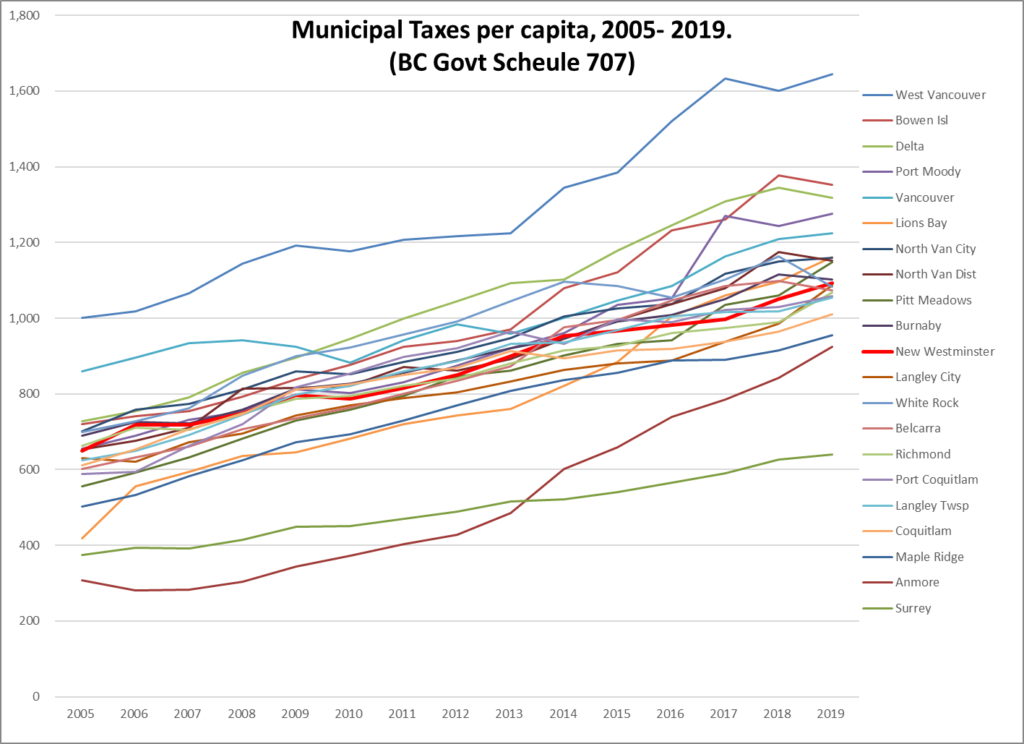
Following on my last post, and in my continued quest to compare us to our cohort, I got to digging into the data again. We can again compare the New Westminster experience to the rest of Greater Vancouver through the BC Government stats on property taxes that are available as far back as 2005 here in “Schedule 707”. I will continue to argue (until someone gives me a good reason to think otherwise) that taxes collected per capita is the best comparator of taxes paid across the region. So how does New West compare to the other 20 Greater Vancouver Municipalities in tax per capita of the last 15 years? It’s a bit messy, but here we are:

There are two outliers: West Van has always been highest, Surrey has been lowest. New West is somewhere in the middle, increasing slightly less (by my eye) than average over the decade and a half. The big tends if I try to parse them: Delta and Port Moody rising faster than most (likely related to higher industrial land use and resultant industrial tax “windfalls”); the small communities (Anmore, Bowen, Lions Bay, Belcarra) all seeing recent significant rises since ~2013 (I would suggest they are coming to grips with infrastructure renewal costs they cannot offset with growth); Vancouver bucking the trend a bit, and the rest of us pretty tightly clustered together. If there are reasons for municipal tax increases, they don’t seem to track with politically left or right councils, rich or poor cities, or any imagined east-west or north-south divide.

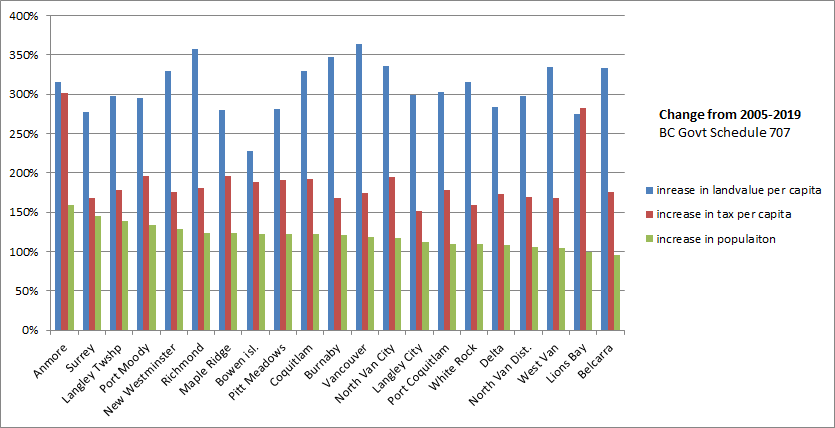
Using the same BC Government Schedule 707 tables, you can look at how each city has changed in the 15 years between 2005 and 2019. There are three related growth numbers I think are fun to compare: population, value of residential land per capita, and the residential taxes collected per capita:

For the fun of it, I sorted this data by the rate of population growth. Despite what I said just two paragraphs ago, you can see Anmore was the surprisingly-fastest growing municipality over that 15 years increasing by 57%, even faster than Surrey. New West population rose 29% over that time (from just under 60,000 to just under 77,000), which makes us one of the faster growing communities. Lions Bay and Belcarra both lost population over this time. This chart, however, doesn’t show any clear trend relating the rate of growth to the rate of property value increases or tax increases.

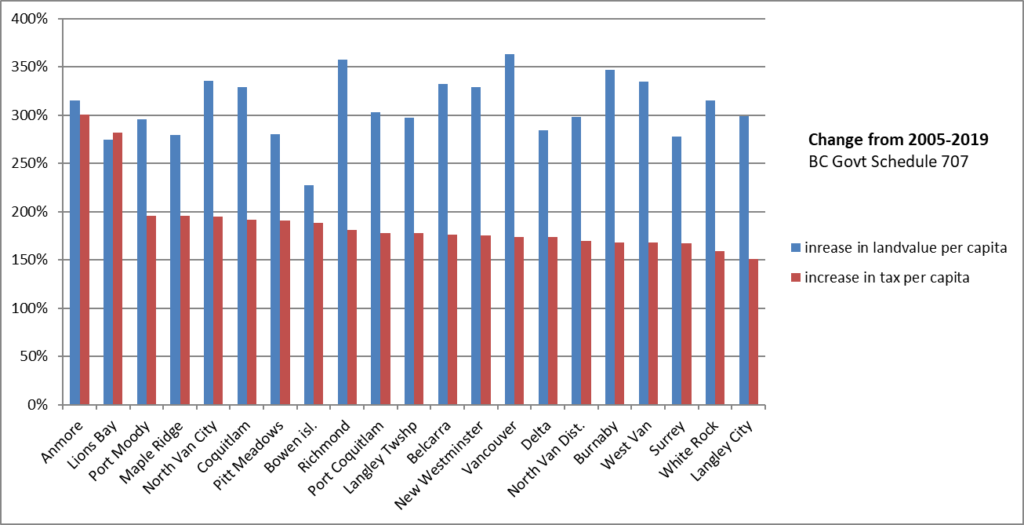
This second view is the same data, but sorted by the increase in residential property taxes per capita. New Westminster is slightly below average in increase, as the per capita tax rate has gone up 76% over 15 years, compared to 78% for the average municipality (a tie between Langley Township and Port Coquitlam). New West residential land values have gone up quite a bit more than the average, though. In 2005, there was $84,000 worth of residential property per person, in 2019 that number is $276,000 – more than a tripling in value.

Just for the fun of it, I did the math to create a totally meaningless idea. If there was a (statistically-unlikely) person in New Westminster who owned a proportionate value of land for those 15 years, they would have paid about $7,700 in property taxes over that time, and earned about $192,000 in increased land value. Of course this is only property taxes to the municipality, not to the province (School taxes) to regional government (GVRD taxes), and doesn’t include the fee-for service money the City collects for utilities. Still, I think it argues against the sometimes-proffered idea that municipal taxes have been a significant driver of housing affordability challenges in the region over the last decade and a half.

Taxes 2020

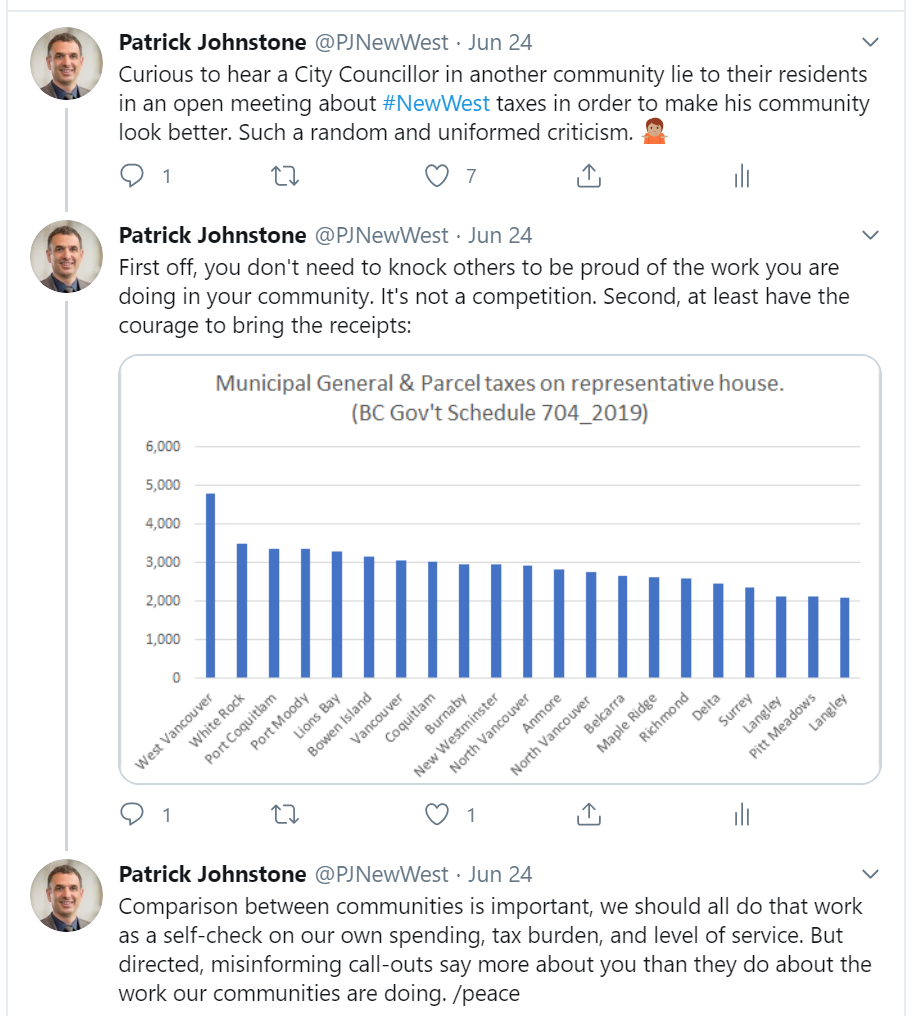
I am returning to a common theme here in the blog, because I like to look at data, and have recently had a resurgence of folks suggesting to me that New Westminster is the highest taxed city in Christendom. Well, maybe only in British Columbia. Recently, I noticed a Councilor in another municipality puffing his own tires about how prudent the tax regime in his City was by calling out New Westminster as specifically worse tax- & spend-thrifts. Which allotted me the excuse for the following subtweet:

That the City that Councillor represented was well to the left of New West in the graph above was left unsaid, as were his name and that of his community, because I really don’t think it is a competition. Moreover, the problem with graphs like above is that they are one simplified analysis, and as I have tried to demonstrate in many blog posts like this over the years (Here with 2019 numbers, Here from 2015, Here where I compared taxes and utility rates, etc, etc. ) there are various ways to compare property taxes between Cities, and any comparison is useless without context. Some more useless than others.

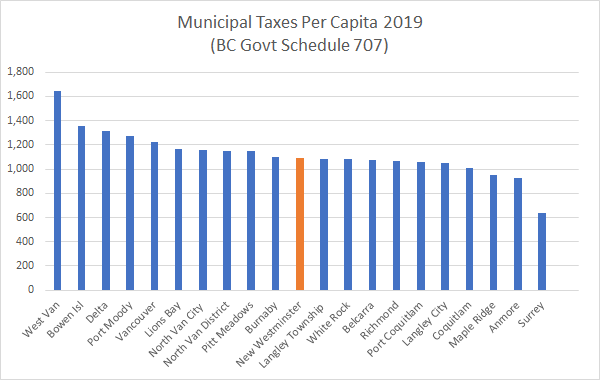
Cities primarily provide services to people. This is why we generally rank the “size” of a City by population, not by square kilometers. The cost of providing services also most closely tracks with population. So when we talk about tax burden, certainly in the sense that our nameless Councillor was talking about it, we are talking about how much you pay for taxes as a resident of the City, which is easily measured by the taxes collected per capita:

The BC Government collects these stats every year, and report out on “tax burden” on a spreadsheet they call Schedule 707. You can read it here. The table above was generated by dividing the 2019 “Total Municipal Taxes” from each City by the population (2018 estimate, because that is what is on the Schedule). New West collected just under $84M in taxes a population of just over 76,000 people, for a per capita tax of $1093. This puts us right in the middle of Lower Mainland municipalities. The average of these per capita numbers is $1123 (New West is a little lower), but the average tax burden is actually $1042 (New West is a little higher).  This makes sense based on the different ways you can calculate the average, but fair to say New West is pretty firmly in the middle of the region.

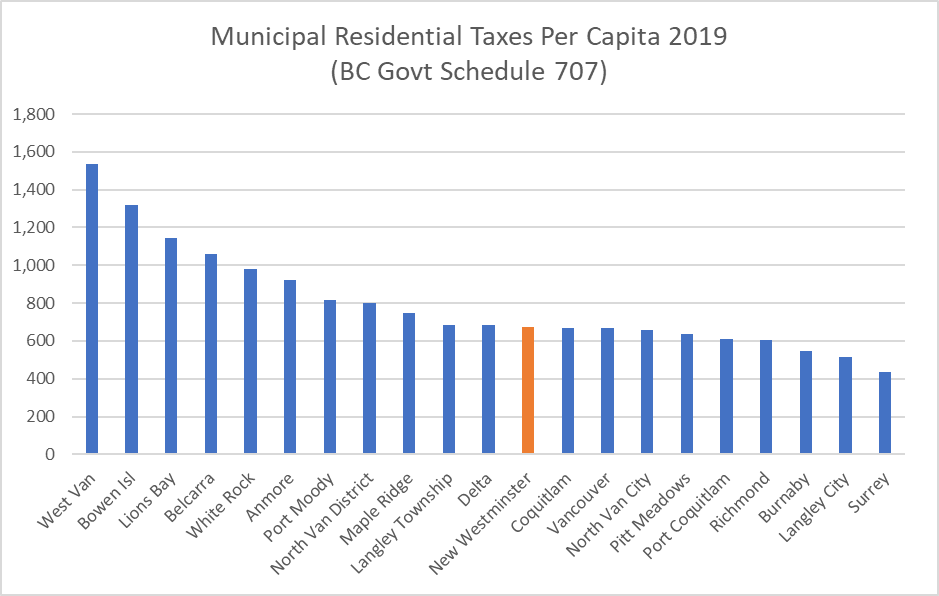
This first chart compares all municipal taxes, though, and residential property tax – that collected from homeowners and landlords of rental properties – is only a portion of this. We also collect taxes from businesses and industries and utilities and such. Fortunately, Schedule 707 also break taxes down by property class. New Westminster collected just under $52M in residential taxes from those 76,000 residents, which works out to $675 per capita:

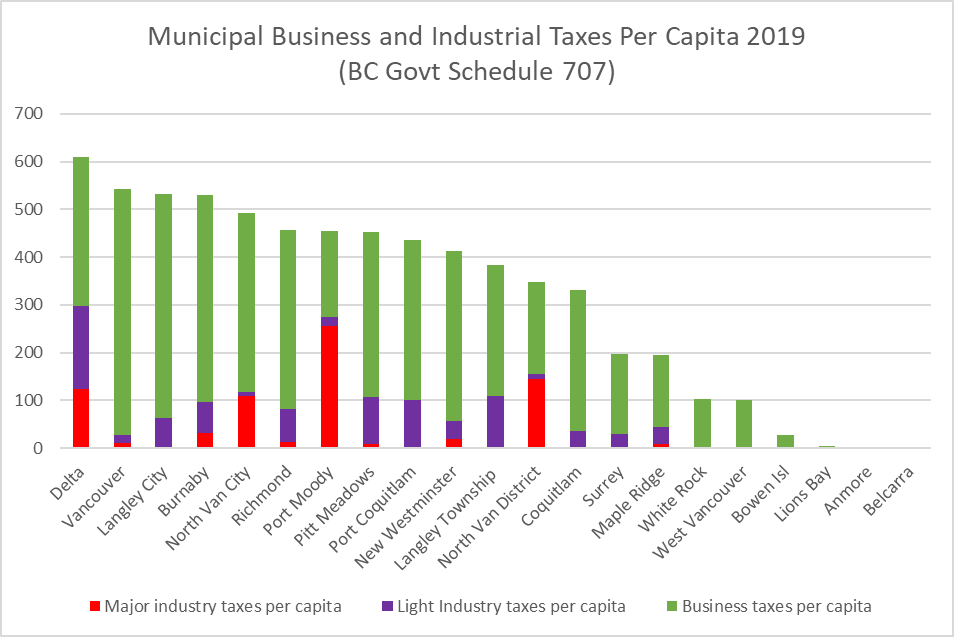
As you can see, that puts New Westminster just below average across the region. You will also note the municipalities that leap to the left side of the graph tend to be residential communities with limited commercial and industrial properties. Without those businesses to prop up the expense of the running the City, residential property owners have to pay more. Here is the commercial and industrial taxes collected per capita in 2019:

In this red is “Major Industry” like the Kruger paper plant or big industrial areas like Annacis and Mitchell Islands. Purple is “light industry” like the type of warehouses you drive by on the Mary Hill Bypass or in Port Kells. Green is “commercial”, which means retail, restaurants, malls and office buildings.

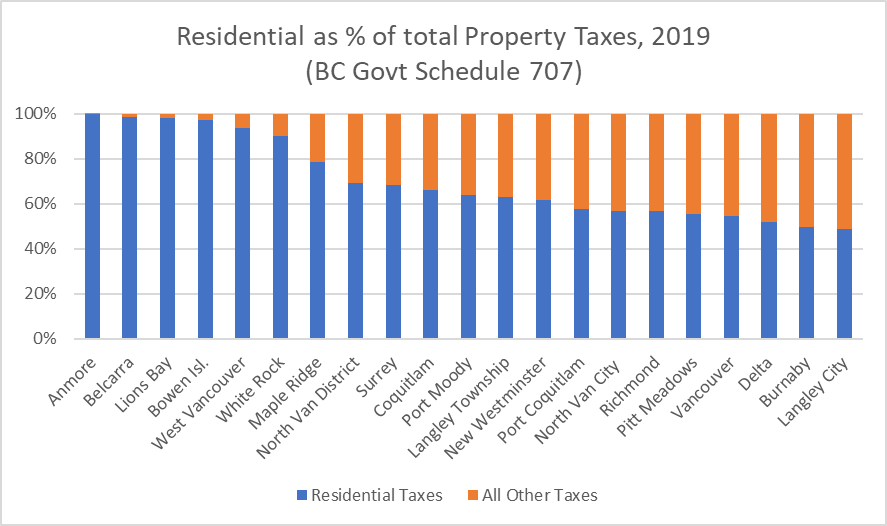
As you can see the distribution of this type of development is unequal across the region. Vancouver is the commercial centre of the region, and has oodles of office and retail space downtown and along the Broadway corridor. Delta has Annacis Island and the River Road corridor, that huge industrial reservoir allows them to keep their residential taxes low. As a proportion of property tax collected, New Westminster gets about 38% of its tax revenue from commercial and industrial properties and 62% from residential, which again puts it somewhere in the middle:

Unfortunately, commercial and industrial taxes are much harder to compare across the region. “Per Capita”, as I have used here, feels wrong. Raw numbers or rates are hard to compare because the value of commercial real estate in Downtown Vancouver is very different then the same office space in Langley, with New West somewhere in the middle. The pressures, costs, and relative utility of industrial land varies even more widely across the region. I will try to dig more into that in a follow-up post, because there are a few ways to look at business taxes in New West that make it look like we may be a little out of the ordinary.

But when ti comes to residential taxes, it is clear that New West is neither high or low taxed relative to the rest of the region. And there is a good case to be made that the Lower Mainland of BC has among the lowest residential property taxes in North America. But I’ll let someone else make that case.

June 22 Public Hearing

This week we had our first adventure with an on-line Public Hearing and Opportunity to be Heard. It was not without its challenges. Though it appeared that staff had made the systems necessary work, and our “trial run” last week fairly uneventful, we are relying on members of the general public to manage their own interface and web technology during what is probably an unusual situation for many, so there were a few glitches. People were afforded the ability to write or e-mail Council with input prior to the meeting, or to use web videoconferencing through a web browser, or phone in during the meeting. Some did more than one of these.

First off, the Public Hearing:

Zoning Amendment (Miscellaneous) Bylaw No. 8172, 2020
This first Public Hearing is to review multiple relatively minor changes to the language of our Zoning Bylaws. It updated some language and made numerous textural changes to make things more consistent internally and with City policies. Not surprisingly, we had no written submissions and no speakers to this item.

Council moved to give this Bylaw Third Reading and Adoption.

Zoning Amendment Bylaw (909 First Street) No. 8188, 2020
This project will have four townhouse style homes replace a single family home on a largish lot in Glenbrooke North. This represents the type of moderate infill density that was envisioned in our OCP. Though it is not the transit-densest neighbourhood in town, there are a lot of walkable services nearby and will provide more housing options in a very family-friendly neighbourhood.

This went through a public open house and Residents Association meeting, and generally received favourable comments. There were a few concerns raised about traffic and parking. However, it was noted that this will be a 4-unit development replacing a duplex with basement suites, so the actual increase in density (and car space needed) is marginal.

We received 8 written submissions (mostly in favour) and a few people took part in the public hearing, raising concerns about parking and traffic for the most part.

Council moved to support giving the Rezoning Bylaw Third Reading.

Zoning Amendment Bylaw (45 East Eighth Avenue) No. 8189, 2020
This is another project that will replace a single family home with townhouses to provide more “missing middle” housing with relatively gentle infill, this time in the Massey Victory Heights neigbourhood. It went to a public open house and residents’ association meeting and appeared to generate favourable comments. We had a few speakers, mostly related ot the development (the owner and Architect) and one neighbor concerned about parking and traffic.

Council moved to approve Third reading of the rezoning.


We then went into an Opportunity to be Heard:

Inter-Municipal TNS (Ride Hailing) Business Licence Scheme Bylaw No.
8186, 2020

This Bylaw would sign New Westminster onto the larger inter-municipal business licensing scheme for ride hailing in the Lower Mainland. This doesn’t really equal “approving” ride hailing, as the provincial government hasn’t really given us that option, but instead it allows us to take part in a regional regulatory regime that will give us some control over how it operates, and provide us some access to the valuable data collected by the industry to help us manage the transportation regime in our community more effectively.

We had two people contact us, one a small operator in the industry, and one raising some concerns about what ride hailing means for equity in our community.

I have already expressed my concerns about the model of ride hailing as being offered by large venture-capital supported multinational corporations that exploit their employees, increase GHG emissions in our communities, make our neighbourhood streets less safe and undermine sustainable transportation modes that are the foundation of our regional planning principles. I also have concerns about climate impacts and accessibility impacts, but recognize that we as local governments have limited regulatory authority to address those concerns.

My support for this Inter-Municipal business license is in recognition that if we are to have any regulatory control over this potentially damaging technology, it will be through business licensing. It is important that we collect and interpret this data, and having business licensing is a way to get that data. This is not the end of the story, but the beginning, and it is upon us to work with our neighboring communities to stay aware of the impacts or ride hailing – positive and negative – and work to the limit of our licensing authority to address the negative impacts, as the provincial government seems to be taking a hands-off approach.

Council voted to approve this Bylaw.


We had a few more Bylaws to adopt this meeting:

Zoning Amendment (Stage 1 – Sustainable Transportation) Bylaw No. 8184, 2020
Bylaw Notice Enforcement Amendment Bylaw No. 8168, 2020 and
Municipal Ticket Information Amendment Bylaw No. 8169, 2020
As discussed in the June 1 meeting, we updated some of our zoning requirements that support sustainable transportation. These bylaw changes are now adopted by Council.

Zoning Amendment (Sidewalk/Street Patios and Parklets) Bylaw No. 8206, 2020
As discussed last meeting, we are doing more to support patios in the City, and we have now adopted the bylaw.

Zoning Amendment Bylaw (2223 Ninth Avenue) No. 8180, 2020
This single family house with a laneway house development was given a Public Hearing back in February, and now that all the details have been hammered out, we can adopt the Bylaw.

Council – June 22, 2020

We had a busy Council meeting on Monday, including our first attempt at a “remote” Public Hearing and Opportunity to the Heard, which was a bit of an adventure. I will talk about those in a follow-up post, and will here just get through the regular Agenda:

First off, we had to start by making it all legal:

Ministerial Order No. M192: Continuation of Electronic Council Meetings during the COVID-19 Pandemic
We have been meeting electronically during the pandemic, almost weekly since mid-March. There are procedural and legislative stuff we need to do to permit this, and the provincial government has facilitated that though Ministerial Orders. As the older MO 139 has been repealed and replaced with MO 192, we need to have a resolution to adopt this.

We recognize public participation in Council Meetings has been hampered, and local government in BC has always operated on a principle of transparency and giving space for public participation. This meeting has our first “Public Hearing” under new protocols, but we are still strictly operating through electronic and remote means. Staff are working on how to safely implement Open Delegations and a re-opening of the Council Chambers to public attendance and participation during the “reopening” phases of the pandemic response. In the meantime, we are doing what we can to assure the process of City Council and the decisions made are as transparent as possible, and the public have opportunities to provide feedback to Mayor and Council. As always, send e-mails, call us up. Drop us a line. We can’t be in the room together, but we need to keep the communication happening.

Then we had a Presentation:

Downtown Transportation Plan – Key Directions and Implementation Plan
The City’s Master Transportation Plan was adopted in 2015, but it had a pretty significant “grey area” around downtown. The overarching goals of the MTP (pedestrian priority, reducing car trips, etc.) still apply to downtown planning decisions, but the details of downtown are complicated. It was recognized in 2015 that more detailed work and more consultation with stakeholders had to happen to make Downtown fit into the bigger plan. For two years, we have been working on a Downtown Transportation Plan, and it would have been unveiled already if COVID hadn’t rudely intruded in March. This is the draft plan being passed by Council prior to it going out to stakeholders one more time. With a little tweaking, we can adopt in July.

There is a lot in here, so I’ll keep my points of interest short. The proposed plan outlines two types of bike routes: primary “All Ages and Abilities” routes and a network of secondary ones. I am more interested in completing this primary network than the sharrows & signage of the secondaries, and question whether 10th Street should even be on the secondary list, but the priority routes are good, and overdue. Especially Agnes Street Greenway, which has the potential to redefine Downtown New West to the same scale that Pier Park did.

There are some pretty exciting changes proposed for the bottom of 8th Street. This is the new great crossroads of our City, and it is a pedestrian crossroads. Unfortunately, cars still rule the space, making for crowded sidewalks and inconvenient traffic signals. The current design does not reflect current use. I lament some of the design choices we made in the last decade around putting parking garage entrances and loading bays on this street. I loudly lamented them at the time, and still lament them, as they make our job today recreating a safe, comfortable, and functional pedestrian space much harder. My only hope is that we can move faster on the proposed changes, and see them in our current 5-year financial plan.

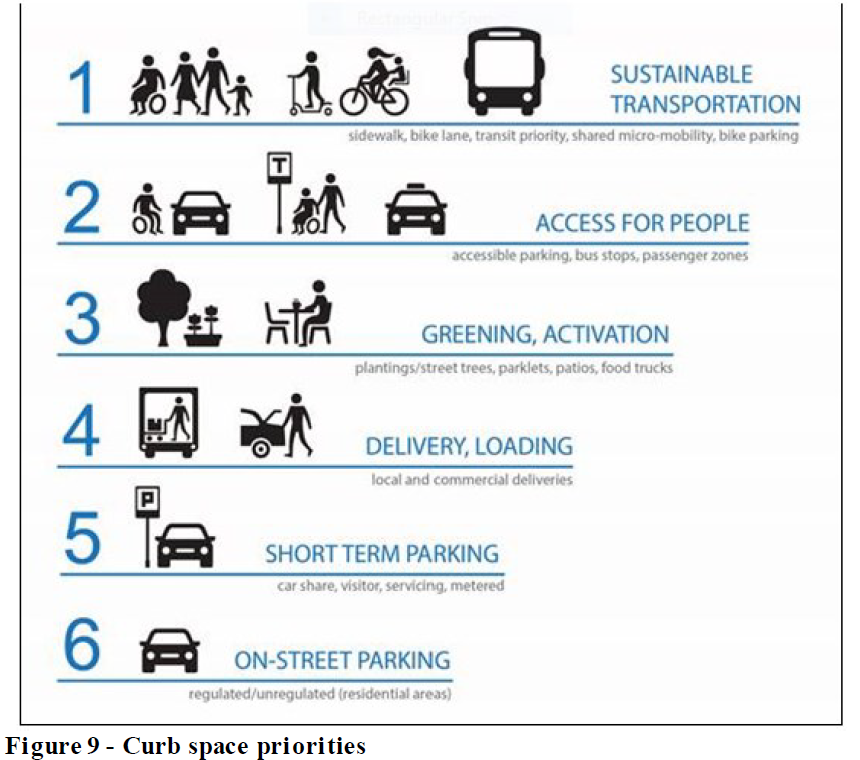
I love this diagram:

This is a great acknowledgement that in a busy, dense, mixed-use urban area like Downtown, curb space is a valuable commodity. Arguably, it is even more valuable than road lanes, and often too valuable to waste on car storage. This prioritization of how that valuable space will be allocated is important, because the curb is where many transportation battles are fought, and we need to have policy guidance to inform how we address those conflicts.

Overall, this is a good document, with maybe a few tweaks. The big grey oval in the Master Transportation Plan still has a few smaller grey ovals within, but we are moving along.


The following items were Moved on Consent:

Submission to the Department of Canadian Heritage Museum Assistance Program for COVID-19 Emergency Support Funding
We are applying for federal support to help with financial shortfalls at the Museum and Archives related to COVID though a targeted support program.

709 Cumberland Street: Heritage Revitalization Agreement – for Preliminary Review
There was a heritage house near the Canada Games Pool that was knocked down by the owner in violation of its protection covenant a few years ago. A new owner now wants to repurpose the site, including bringing a heritage house from Royal Avenue and re-building the original heritage house. This will require a new Heritage Revitalization Agreement. There would need to be a few zoning relaxations (minimum lot size, FSR, and setbacks). This is an early check in to see if Council is OK for it going to public consultation, heritage review, etc., so more to come here.

Submission to the Federation of Canadian Municipalities (FCM) Green Municipal Fund (GMF) for Feasibility Study of Agnes Greenway
As mentioned above, we are working on the plans for the Agnes Greenway, and there is a federal infrastructure planning fund we can apply to for a grant to help pay for the design work. We are applying for this.

2019 Consolidated Financial Statements
This is the official submission we send off to the Province to comply with regulations around financial reporting; the audited financial report from last fiscal year. What details do you want? The City ended the fiscal year with $203M in fiscal assets and $153M in liabilities, which puts us $50M in the black (financially). We also have $705M in capital assets (buildings, roads, pipes, vehicles, lawnmowers, etc.). We took in $226M in revenue last year ($85M in the form of Property Taxes), and spent $195M, which means we added $31M to our accumulated surplus. We ended the year with $116M in financial investments, and $66M in long-term debt. We are in good shape financially, and are ready to invest in a significant capital program. Of course, COVID is throwing a wrench into this, but that is the task ahead of us.


The following items were Removed from Consent for discussion:

Draft Recovery Action Plan for Council’s Consideration
We are working out the details of the recovery plan here for the City, now that it looks like the provincial government is leading that way. Of course, we will continue to follow provincial health and safety guidance, and need to be prepared for setbacks and second waves, but we also need to start supporting concrete moves to the post-COVID world.

The work is everything from re-designing how the City facilities work to permit physical distancing to determining which staff re-assignments need to occur when, and how and when to bring some auxiliary staff back, based on which services we can restart. This is a monumental amount of work, more so when you realize none of the staff have done anything like this before. We will make mistakes, but hopefully if we have strong principles and recognize everyone’s limitations, this can hopefully reduce, not increase, the anxiety and stress of re-opening the City.

For Council, the difficulty here is that we are still in uncertain financial times. Despite the good financial shape the City was in at the end of 2019 (see above), things have clearly changed for the general economy and for the cash flow of the City. At the same time, response to the emergency is going to require some investments – the community needs support in new ways, and we need to be ready to provide that support. If we approach recover with a mindset that we simply cannot afford to do these important things, the recovery will be more difficult. Finding the balance between cost savings and meeting the goals and expectations of the community is always the tension at the heart of this work. I will continue to challenge an austerity approach at any level of government when the community is in need.

COVID-19 Pandemic Response – Update and Progress from the Five Task Forces
As we have done since late March, every meeting we get a reporting out from our COVID response working groups in the City. This is a good summary of the City’s work during the crisis. This includes work City staff has been doing to support vulnerable residents during this crisis, seniors, local businesses, and the general community through education.

Artist Selection – New Westminster Aquatic & Community Centre Public Art Project
The City’s Public Art program includes funding for art installations in all new major infrastructure projects. The Replacement for the Canada Games Pool and Centennial Community Centre New Westminster Aquatic and Community Centre project is a big piece of infrastructure, and the Public Art Advisory Committee has identified a successful applicant in the call for public art to enhance the building. A piece by James Harry will grace the public plaza on the west side of the building.

8 – 30 Capilano Way: Temporary Use Permit – Notice of Issuance
A company that rents out pinball machines to bars has been having a hard time of it during the Pandemic, as their customers are all closed. They want to open up their warehouse in the Braid Street Industrial Area to allow people to come there and play. This is not a business type permitted within the existing zoning for his property, so they are asking for a Temporary Use Permit, similar to what the other recently-opened arcade in town received. We had some discussion about whether this is appropriate use for the city’s limited industrial space, but a shorter Temporary Use permit seemed to meet consensus at Council.

There are some concerns about how an arcade would operate during the Pandemic, but apparently there are Phase 3 protocols for amusements. There will be both limited capacity, and no food or alcohol service. Council will receive public feedback on this application until July 13th, then consider the application at the Council meeting. If you have an opinion, let us know.

Front Street Temporary 2020 Summer Weekend Opening to Pedestrians and Cyclists
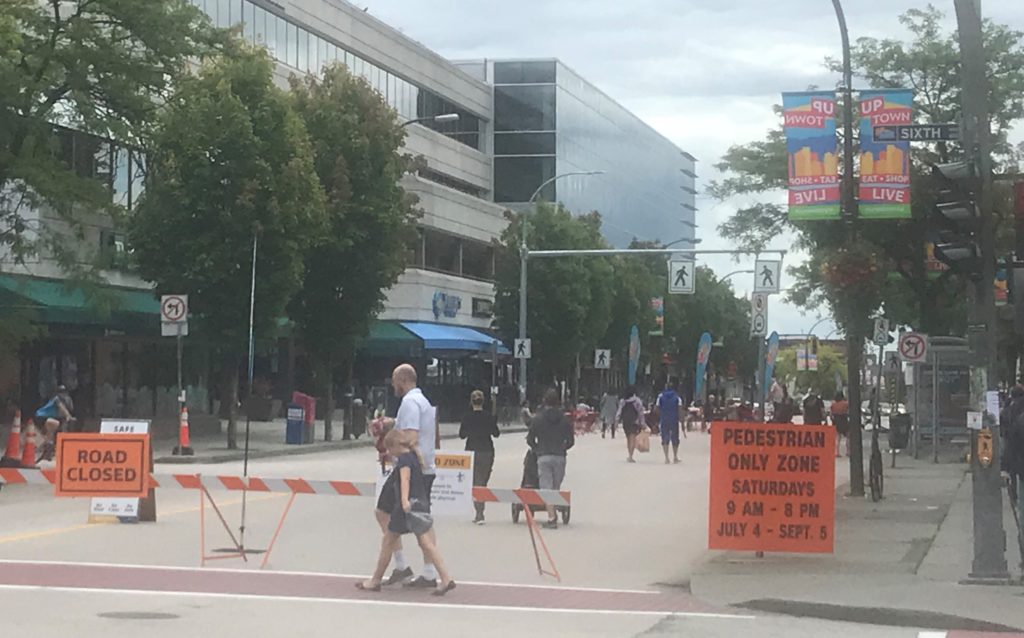
We need more outdoor space this summer, which will be, unfortunately, the summer without festivals. Previous closures of Front Street have permitted gathering, and great connections between Pier Park and Sapperton Landing Park. There have been suggestions this year that closing Front over the weekend may give people more reason to go outside and more space to enjoy outside. Unfortunately, the Railways will not permit access from the east end of Pier Park, but connecting Downtown to Sapperton Landing and creating a large flexible open space along the water all summer was supported by council.


We had three Development Variance Permits that received public comment and were ready for Council approval:

DVP00678 to Vary Off-Street Parking Requirements at 1065 Quayside Drive
As I talked about last meeting, there is a high-rise in the Quay that houses an antenna for the 911 system, and its back-up generator needs replacing with a larger unit, which means the building will lose a parking spot for which they need a development variance permit, since their original development permit required a minimum number of parking spots. We asked if people had opinions about this, and we got 7 letters, mostly seeking clarification (which makes sense as this is a bit strange) but none strenuously opposed. Council moved to issue the DVP.

DVP00679 to Vary Off-Street Parking at 327 East Columbia Street
Also mentioned last meeting, a daycare in Sapperton wants to expand but doesn’t have sufficient parking for the zoning requirement for that expansion, so they want a variance to open with less than the minimum parking stalls. We asked for your input and didn’t get any correspondence. Council voted to approve issuance of the DVP.

DVP00681 to Vary Rear Yard Setback at 427 Fourth Street
Finally, we talked last meeting about this homeowner who wishes to put an addition on his house, but at least in part of a strange subdivision of his property dating back to 1912, this will result in his addition being too close to the back lot line (though it will be in line with the existing house), so this needs a variance. We asked for public consultation, and received two letters, both form neighbours, and both opposed due to proximity issues. I general agree with the staff assessment that the variance is minor, and is consistent with the existing landscape of the house. Council voted to approve issuance of the DVP.


Finally, we had one motion in New Business:

COVID-19 Data Collection Councillor Nakagawa

BE IT RESOLVED THAT the City of New Westminster write to the provincial and federal Ministers of Health requesting that they collect disaggregated data including race, socioeconomic class, and disability that will allow for evidence-based health care and social program interventions; and
THAT the data are analyzed and interpreted with community leadership and input; and
THAT the data are collected with the intention of being understood as indicators of systemic and structural oppression to identify root causes of disparity; and
THAT this letter be forwarded to all BC municipalities asking to write their support as well.

I think the motion speaks for itself.

And that was it for our main business, but we had a Public Hearing and Opportunities to be Heard, which I will outline in a follow-up blog post.

ASK PAT: NWSS safe biking routes

I have a bunch of queued up ASK PATS. Sorry, folks, some have been here for quite a while. Things have been busy, and priorities at Council have been shifting so fast and furiously that I have let these linger. I am going to try to clear the queue here in the next little bit. So the answers may be shorter than usual. But probably not, because I like to go on about things…

Don asks—

NWSS safe biking routes need some help. One of those problems is the car traffic cutting through the gas station at 6th and 8th. Perhaps if barriers were installed on the double yellow lines on both those streets would improve safety and traffic flow. Is this possible?

Maybe. That is a pretty “operational” question, and I frankly don’t know the technical requirements when it comes to installing mid-road barriers. I suspect come of those flexi-posts would reduce the number of illegal turns here, but I have also seen drivers do some pretty bizarre things to get around them. Jerks gotta jerk. As this is a more technical operational question than a Council Policy one, you may want to enter it to SeeClickFix or drop a line to Engineering Ops and see what transportation staff say.

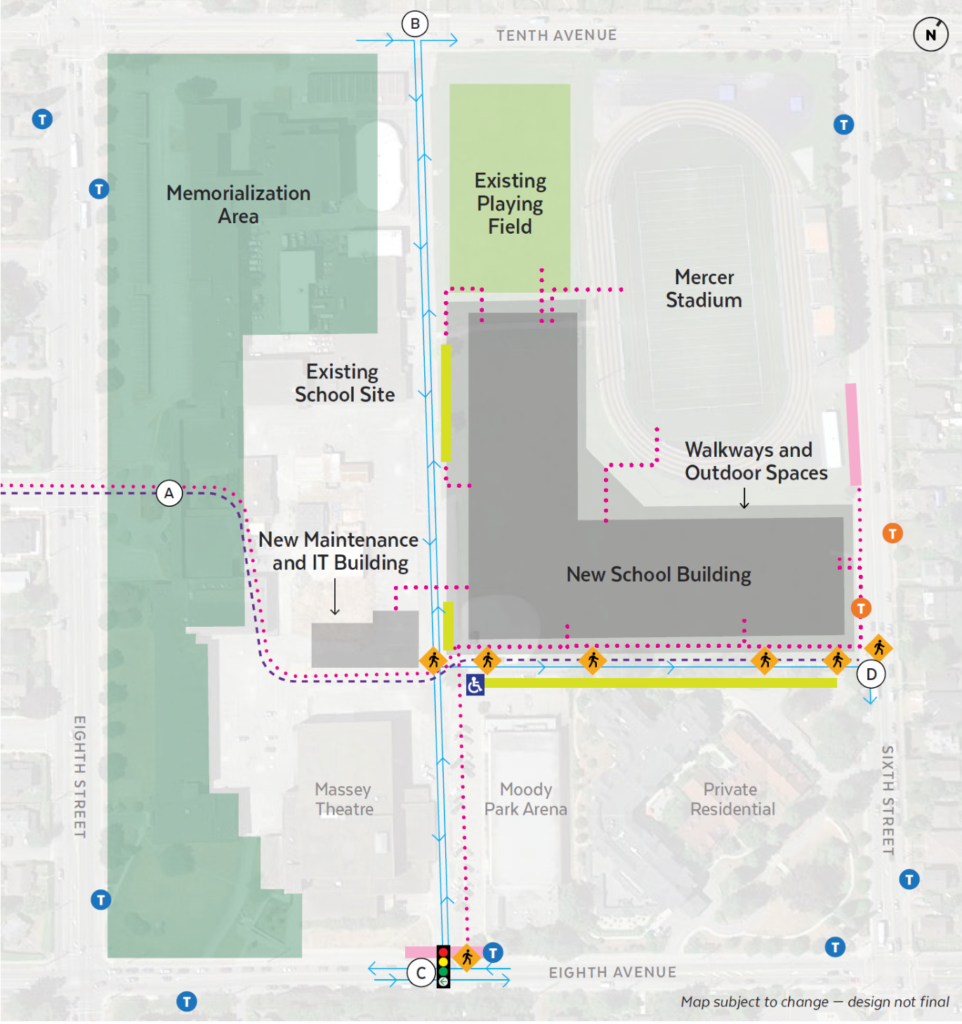
As for bike routes to NWSS, we are working on it. The building of the new High School has given us an opportunity to review how cycling and pedestrian connections to the High School work. With the “main entrance” for the School shifting form 8th Street to 6th Street, there will definitely be a shift in how students get to the school:

An older drawing o the proposed new school site I cribbed from this source. Some stuff may have changed since then, but I wanted to show the lay of the land, and this works.

The City has worked with the School Board and project delivery team on this. The first priority is assuring safe and accessible pedestrian access a the two main “entry points”which will be mid-block on Eighth Ave (“C”) and mid-block on Sixth Street (“D”). The pathway across Eighth Street through the existing school site (“A”) is also identified as important, but will be addressed in the future as the demolition of the existing school and design of the memorialization area will delay works on that side. Light-controlled intersections, crosswalks, and sidewalk upgrades are planned at “C” and “D”.

The City is also committed to assuring there is a safe separated cycling route from Seventh Ave (part of the Crosstown Greenway) to the school. By the time the School opens, that will be a separated path along Eighth Street to Eighth Ave, a new intersection treatment at Eighth and Eighth, and improvements of the pathway past the Massey Theatre.

The Connection of the Crosstown Greenway to the Sixth Street entrance to the school property is going to be designed and implemented as part of the Uptown Streetscape Vision, which will redesign all of Sixth Street from Fourth Ave to Tenth Ave. This is currently going through some stakeholder engagement, but is a bigger road redesign project that will not be implemented by the time the School opens.

a follow-up

In my last post, I tried to give some data on how policing works in BC and New Westminster, and I tried to do so without opining, recognizing that my own biases and opinions probably sneak in all over everything I write.

There was one asterisked statement in that post I wanted to follow up on, because it relied on a more detailed reading of the Police Act, and that post was long enough without this extra 1,000-word digression. However, in the day or two since I started sketching out that previous post, there has been much news, including the Mayor of Vancouver saying he really can’t do much about policing costs, some in the chattering class suggesting that was artless dodging, and the Solicitor General and Premier saying the Police Act is due for an update. All of the sudden, that asterisked point became the center of debate, so I will try to unpack a bit here.

Again, by means of caveat: I am not a lawyer or specialist in interpreting legal documents. I am not on the Police Board, so operating under the Police Act is not part of my day-to-day. I may get details wrong here, and please correct me if I do.

The Police Act says that a municipality over 5,000 residents must pay for policing. At first blush, that means City Council is responsible for approving the Police Budget (both operational and their capital requests) as part of their annual budget work, and we do that. However, that is not the entire story.

Section 15 of the Police Act says:

…a municipality …must bear the expenses necessary to generally maintain law and order in the municipality and must provide, in accordance with this Act, the regulations and the director’s standards, policing and law enforcement in the municipality with a police force or police department of sufficient numbers to adequately enforce municipal bylaws, the criminal law and the laws of British Columbia, and to maintain law and order in the municipality, adequate accommodation, equipment and supplies for the operations of and use by the police force or police department

This makes clear that the Provincial Government has ultimate authority to determine the level to which police are funded in BC. Section 17 of the Act follows up by saying the Director of Police Services (a Provincial Government employee appointed by the Solicitor General, see Section 39 of the Police Act) must notify the City they are in breach and direct them to fix it. If they fail to do so, the Solicitor General can fix it, and send the municipality the bill.

Section 26 also puts policing costs at the foot of the Police Board:

Subject to a collective agreement as defined in the Labour Relations Code, the chief constable and every constable and employee of a municipal police department must be employees of the municipal police board, provided with the accommodation, equipment and supplies the municipal police board considers necessary for his or her duties and functions, and paid the remuneration the municipal police board determines.

Then Section 27 lays out the slightly-convoluted response if the Council refuses to pay for something the Police Board asks. The Board or Council may appeal to the Director (that Provincial government employee), who determines “whether the item or amount should be included in the budget”, and reports back, cc’ing the Solicitor General. If ordered so, the Council must include the item in its budget, or be in violation of the Police Act. Naturally, a lot rides on that should above, but ultimately, the Solicitor General holds all the cards in this dispute.

The grey ares in the middle of all this is the determination of what “sufficient numbers” and “adequate” are in the sections above. How does one measure if the level of service planned by the Police Board and funded by the Council is sufficient? Or more to the point, how would one know when it is insufficient?

This brings us to Regulations, which are pieces of Legislation that exist under Acts. Again, not a lawyer here, but Acts are high level documents enacted by the Legislature that set out general principles and duties, establishing the will of the Government. Regulations are subordinate to and empowered by Acts, but include a lot of the fuzzy details that often need adjustment without opening up the entire big Act. A probably-wrong but simplified example: an Act would say “driving above a speed limit is illegal”, where the subordinate Regulation would say “Speed limits on urban roads is 50km/h unless otherwise designated”.

In Section 74, the Police Act gives the “Lieutenant Governor in Council” (a fancy way to say, the government of the day) the power to create Regulations on various aspects of the Act, including:

prescribing the minimum salary or other remuneration and allowances to be paid to members of police forces, police departments, designated policing units or designated law enforcement units” and “prescribing the minimum number of members of police forces, police departments and designated policing units that are to be employed on a basis of population, area or property assessment, on any combination of them, or on another basis

To the best of my knowledge, these regulations do not actually exist (a list of regulations that do exist under the Police Act is available here). Police staff numbers and police remuneration are determined by the Board, the latter approved by the Council, and Regulations just don’t come into it. There is, however, a legal ability for the provincial government to create such regulations if needed to clarify the funding required for “adequate” policing. Short those regulations, if a dispute occurred and persisted, it would likely end up in the Courts and a judge would decide, though my (unskilled) reading of the Act suggests it would be the Police Board whose opinion carries the most weight.

In in my time on Council in New Westminster, there has never been a significant conflict between the Board and Council on the budget. Council has, on several occasions, reviewed budget augmentation requests made by the Police as part of our annual budgeting process and sent some back for review. This type of negotiation has always resulted in agreed-upon operational budget and Capital requests, much like in other departments in the City from Engineering to Parks.

Yes, a Municipal Council could push back hard against a Police budget and significantly reduce it. Yes, the Police Board could appeal to the provincial government if they feel this reduction would not allow them to discharge their duty under the Police Act to “enforce municipal bylaws, the criminal law and the laws of British Columbia; maintain law and order in the municipality; and prevent crime”. Then the ball would firmly be in the provincial government’s court to determine the path forward – accept that Council’s reductions or order the Council to pay. No doubt, Politics would ensue.

Where we are at

When I see voices being raised here in New Westminster and across North America to call attention to inequity society, most prominently the unjust policing of Black and Indigenous people, I struggle to find the place where my words are important. For the most part, they aren’t. As I have spent my life being a tacit beneficiary of this injustice, my lived experience is not something anyone needs to hear from right now. There are better voices to listen to now on this topic. For now, my admittedly inadequate response is to say I am listening, and I am having conversations with people in the community to better understand what kind of concrete actions I can take in my elected role or support others doing to start addressing the systemic change we need to see. I appreciate the correspondence (even the form letters!) I have received, and am struggling to be timely in my replies, but I’m working on it.

I have often tried to use this blog to unpack arcane bits of municipal government. Maybe my usefulness here is in outlining the lay of the land. Not as call for action, an excuse for a lack of action, or a retort against calls for radical change, but more to inform and empower those who would want to call on government to take concrete actions, and those who have concerns about those calls. I think data can help ideas find better traction in local government, in provincial government, and in police forces. So the following is intentionally short on opinion, but I hope this provides local context to the conversations happening across North America right now.


New Westminster has a Municipal police force. Where many communities in British Columbia contract out local policing to the RCMP, here in New Westminster the police are independent. The legislation that empowers them to act as a law enforcement body is the provincial Police Act, which requires that a Municipality provide policing, whether through a stand-alone police force or contracting the RCMP. It also requires that a non-RCMP municipality establishes a Police Board to oversee that policing.

The New Westminster Police Board is (as regulated by the Police Act) chaired by the Mayor of the City, and one of the positions on the Police board can be appointed by the City Council (city councilors are strictly forbidden from serving on the Police Board). The five other members of the Board are appointed by the provincial government via the Solicitor General’s office. So there is a little bit of overlap of jurisdictions, but it is clear the Police do not answer to City Council, for good separation-of-powers reasons. The Police Board oversees (but doesn’t direct) operations, provides guidance on strategic planning, and even hires the Chief constable. These Board members are, notably, unpaid volunteers, and tenure is limited to two three-year terms.

In requiring a municipal government to provide policing, the Police Act requires that a City Council approve a policing budget. Without digging too deep into the current rhetoric, only the provincial government (through the Police Act) or the Police Board can reform the police; while only the City Council can defund them*. Of course, more complicated responses to the complex issues raised by the current public discourse would rely on some sort of concerted action between all three bodies. In short, the systems are structured such that fundamental changes to the status quo will be hard to make, and it is challenging to think about where to start. But that is the challenge before us.

*within certain limits. See my follow-up blog post


I do want to talk about funding – because the part that is (mostly) under City Council control, and it is something that has become fodder for much of the recent discussion about policing in local government circles.

The intrepid CBC Local Government reporter and data geek Justin McElroy put some data together here comparing “protective services” spending across BC municipalities. As he notes, comparing across municipalities is difficult because not all are as transparent about how their spending is broken down. The one definitive source is the BC Government stats collected annually, but they report “protective services” as one category which lumps together Police and Fire. Looking at the 2018 data (the most recent available on-line), on average 25% of local government spending is on Protective Services. New Westminster is a little lower than that average at 23%.

(source: Schedule 402 2018)

This proportion varies widely across the province for many reasons. Victoria has high protective service costs at least partly because it is a small municipality in the middle of a large metro area with some special policing costs related to being the Provincial Capital. Salmo has a small volunteer fire department and limited policing provided by the RCMP, so their protective services costs are really low. There are also great variations on the denominator side of the equation, as different Municipalities have different utility costs and other levels of service in non-protective services. So, all that to say direct comparisons are complicated.

I can talk with a little more certainty about New Westminster’s spending on police services. If you look at our most recent on-line financial reporting here, you can check the 2020 Budget column to see what we plan to spend this fiscal year:

This is cut from page 19 of the pdf in the link above. This is the “Operational” part of the budget, which pays for day-to-day expenses like salaries, gas for police cars, electricity and paper clips. Utilities like sewers and electric are handled separately in the same report because the sources of those funds are different. In 2020 the City budgets to spend $136M on non-utility operations, and $31.6M of that is police operations. It is fair and accurate to say that 23% of our non-utility operational spending in the 2020 budget is on Police operations.

There is a second budget category the City uses to account for its “Capital” expenses. This covers all of the tangible objects the City has to buy that have a useful life span (i.e. are not consumables) but need maintenance or periodic replacement, like buildings, cars, roads, ice plants for arenas and lawnmowers. On pages 25 and 26  of that linked pdf above are the details of what we plan for Capital spending for the 5 years covering 2020-2024. It totals up to a substantial $275M, but if you take all the lines that are for Police services, you see $427,600 for police building repairs & renovations, $828,600 on general equipment and $2,085,000 on police vehicle renewal and repair for a total of $3.3M, which totaled up works out to a little more than 1% of our 5-year capital budget. Savings on equipment is relatively easy, but that is a small proportion of the city budget.

Finally, it is timely to discuss how the local police services budget has changed in the City. The City doesn’t archive old financial plans on the website, and the Provincial stats lump all “protective services” together. However, I do have copies of all of the annual budgets I have been asked to approve since I joined City Council in 2014, and can project forward to 2024 using the current 5-year financial plan (which are projections that may change). Here is what the Police Services portion of the general operations budget looks like over that time. It has remained around 22%-23% of the budget over that time, but is increasing at a slightly higher rate than overall budget:

We can talk about reasons why the police budget has changed over the years, and yes I have opinions, but maybe I’ll leave that for future discussions I am sure we will be having.

Pool Pause

One of the bigger items on the Agenda this week was the update on the Canada Games Pool replacement project. There were two items, and because of the size and scope of the project, there is significant public interest in the plans, so it is worth unpacking the decisions a bit.

The first big news is that the City was not successful in securing an Investing in Canada Infrastructure Program grant for the Project. This is pretty disappointing, as the City has spent 5 years developing a program around this grant process, and specifically designed aspects of the project to assure we had the best chance of receiving some funds. We did the hard public-consultation and program-design work to get a fundable program that met what we considered all of the possible criteria for the Community, Culture and Recreation category. Our application was submitted in January 2019, and we received notice more than a year later that we were not successful.

Exacerbating this disappointment is that projects for this Grant must be “shovel ready”. This means we needed to be ready to go, with a well-developed project, public buy-in, secured financing (ironically, you need to prove you don’t need the grant to get the grant), and all of the hoops jumped through to get ready to dig a hole… but you cannot yet be digging the hole. If you start digging, you are no longer eligible. I think our staff were pretty creative in getting shovel ready in time for grant application, but were still able to get some detail design and site preparation work done during the unexpectedly long waiting period. However, we clearly lost time in the wait, which is unfortunate.

The nature of the grant program is such that there is no clear explanation from the selection organization of why the project was not selected, except to say that there were significantly more applications than available grants for all of BC, and ours didn’t make the cut. There is another phase of ICIP launching in the fall of 2020, and we may be able to re-package parts of the project to apply for grants then. Also, as both the Province and Feds are signaling significant stimulus funding will be rolling out in the Fall as part of COVID recovery, we have some innovative aspects of the pool project that we think may be successful at getting some support. However, we need to recognize that these will be relatively small contributions, and the City of New Westminster is going to have to pay for most of this project on its own.

Last year, Council had some discussions about the financial plans around the pool, and decided that the larger “Enhanced” pool plan that some in the community were asking for was outside of our financial comfort zone unless we got a significant ICIP contribution. With this confirmation that those funds are not coming, we are taking the “Enhanced” pool off of the table. We are now concentrating on the two-tank (8-lane 50m pool model with a second recreation pool) plan that came out of our extensive community consultations and serves community needs, and is still significantly larger than the existing Canada Games Pool, but not the 10-Lane pool that some in the regional competitive swimming community would have liked to see built.

New Westminster is a City of 71,000 people in the centre of a Metro region with 2.5 Million people. There is a need for a refreshed swimming and recreation facility to serve our growing community, and we also have a myriad of other spending priorities and infrastructure that needs updating. I believe that building a facility for the regional competitive swimming community needed regional support. If we want to build a facility to host Provincials and inter-provincial competition, the senior government grants we applied for were the process available to us to fund that type of facility. Without those funds, we need to concentrate on addressing the pressing community need in a way that fits the financial capacity of our community.

With the detailed design decisions made, and the financing worked out, the next step in the process is to hire a construction company by issuing an “Invitation to Tender” to the construction market. We are ready to do that now, but it opens up a bunch of financial implications for the City, so Council decided to pause a few months before we take this big step.

This is not an easy decision, just as the decision to not build the larger pool is a difficult one. But both were made for similar reasons – concern about the impact on the City’s finances. I know political hay-makers love to cast this Council as spendthrifts because we like to do things that make our City stronger and more livable, but my experience in 5+ years on Council is that we are always cautious when projecting out future City finances, and are pretty risk adverse if we don’t fully understand cost implications.

This is the biggest single capital project the City has ever undertaken. We have been putting some money aside for a few years, but will still need to debt finance the bulk of this project. At the scale of this project, any risks can have a big impact on the City’s budget for years to come. Unfortunately, there is significant uncertainty in the City’s medium-term financial status due to the COVID crisis, and in the construction market due to supply chain concerns and disruption in global markets. For that reason, we are not taking the next step in sending this out for tender until at least the end of the summer, when we have a better handle on the financial status of the City, of the Province, and of the world economy, and the construction market will hopefully have a better handle on costs.

This is acting with an abundance of caution, as I think we have to when talking about an infrastructure investment this size and a financial crisis of this unprecedented nature. The news coming out of the Province and the Bank of Canada is generally positive about recovery, but still really uncertain. If better financial certainty puts us in a position to pull the trigger at the end of the summer, this delay will add only a couple of months to the final delivery date in 2023. However, if the local and/or global financial situation goes very badly in the next few months, we will be much more prepared to manage that as a City without a $100+ Million project weighing us down. Let’s hope it is the former, and we are able to go to tender in the fall, but at this time a pause is the prudent, if disappointing, thing to do.

Council – June 1 2020

Ugh. What a terrible time we are in. I’ve been trying to step back a bit from social media right now, the chaos is a good time for people to listen to voices other than mine. But I’ve been doing these reports since I started on Council more than 5 years ago, and as long as the City is doing work and Council is making decisions that impact your community, I feel the need to put these out.

As always, you should read the Agenda and Reports or go to the recording if you want the full story. Now more than ever, you need to be aware that everyone brings their personal filters to information, sometimes even unintentional ones, and that includes me. Every one of us has blinders in our view, and by their very purpose we cannot see them. It takes effort to understand the impact they are having on our own outlook. So here goes.

COVID-19 Draft Recovery Plan
This is our report on planning the City is doing to support the BC Restart Plan. It includes proposed timing for the reopening of City facilities, re-start of suspended City programs, and an outline of what kind of guidance will be used to inform safety protocols needed to make public spaces safe for residents and staff.

There is a bit of prioritization on assuring services essential for vulnerable populations, such as planning for opening Moody Park Outdoor pool and cooling centers in the event we have a heat wave. Some other facilities will be more of a challenge, and will need more work to fulfill safety and comfort requirements for users. Some will have to wait until the Fall (depending on what the pace of change is in the Provincial Health Authority requirements), and the QtoQ Ferry is especially challenging, and may not be running again until 2021.

There is more detail in this report, it is worth a read. Also, recognize this is the best laid plan as of the end of May, as the Province is entering Phase 2 of the recovery. It will surely be adjusted as the recovery is either accelerated or slowed depending on how the Pandemic evolves.


The following items were Moved on Consent:

Inter-Municipal Transportation Network Systems (TNS) Business Licence Bylaws
I am still not happy with the damaging impacts to community and workers’ rights that are represented by the current structure of TNS like Uber, but there is nothing a local government in BC can practically do to stop them, and the only hope we have to regulate and manage some of these externalities is through business licensing. I think the Inter-Municipal Business License is the practical model to do this. We are a little late to getting this Bylaw approved here in New West, more due to our work load than any specific political direction, but we have a Bylaw matching 23 others already established across the region ready to test in an Opportunity to be Heard on June 22. C’mon out (virtually) and tell us what you think.

427 Fourth Street: Development Variance Permit to Vary Rear Yard Setback
How refreshing to be looking at Development Variance Permits again. This heritage home on a uniquely-shaped lot in Queens Park that was strangely subdivided more than 100 years ago. The owner wishes to put an attachment on the house, but to continue the existing lines of the house, this requires a variance to be 7 feet closer to the rear fence than permitted (11 feet, as the existing house is, as opposed to 18 feet). At this point, we are issuing official notice that we intend to review this Variance request at the June 22 meeting. Let us know if you have concerns or comments.

1065 Quayside Drive: Development Variance Permit to Vary Off-Street Parking Requirements
Try to follow this one. There is an E-Comm 911 antenna on a high-rise in the Quayside. It (naturally) requires an emergency back-up generator. They need ot replace the generator, an the new one has bigger footprint than the old one. Its installation requires the removal of a parking spot, which is something counted in our zoning bylaws. This building, it turns out, is already 14 parking spots “deficient” according to our Bylaws (it has 126 spots and 10 visitor spots for 98 units) so the replacement of the generator requires a Development Variance to formalize the current deficiency of (now) 15 parking spaces. Council hereby issues official notice that we intend to review this Variance request at the June 22 meeting. Let us know if you have concerns or comments.

327 East Columbia Street: Development Variance Permit to Vary Off-Street Parking
There is a Daycare development in a commercial building next to Sapperton Park that wishes to open with fewer off-street parking spaces that required under the zoning Bylaw, requiring a variance. Once again, this is just official notice that we intend to review this Variance request at the June 22 meeting. You can send us your opinions.

General Principles for Recommending Waiving of a Public Hearing and Consideration of Public Hearings for Three Bylaws: 909 First Street, 45 East Eighth Avenue, and Miscellaneous Zoning Amendment Bylaws
Public Hearings are difficult right now (they are often difficult at the best of times, and horrendous in the worst of times, but that’s another rant). Council has generally been in support of waiving some Public Hearings at this time, due to the difficulty of managing them and the need to provide procedural fairness to applicants in the City. But procedural fairness works both ways, and changing how hearings work requires that we develop a clear set of guidelines of when waiving is and is not appropriate. This report sets them out for Council approval.

That is, if the application is consistent with City policy or strategic priorities already established by Council, if the applicant responds effectively to public and staff feedback in reviews, and the proposal is consistent with the OCP, then Council will be asked to waive that hearing. All three hurdles need to be passed.

It is important to note that the Public Hearing is only one form of review of any project. Residents and other impacted parties have several other ways available to them to comment to Mayor and Council about whether they like or dislike any particular project. The Public Hearing also comes very late in the process, where potentially better forms of engagement happen earlier when clear issues or changes to the project can be addressed more effectively by applicants, or directed by staff.

There were two applications caught mid-process when the whole COVID thing came down, and we will not waive those Public Hearings, but will pilot a virtual Public Hearing process.

2019 Annual Water Quality Monitoring Report
The City collects more than 1,000 water samples from around our water system every year, and sends them for analysis of E.coli, coliform, HPC, chlorine residuals, metals, temperature, turbidity, and byproducts of the disinfection process (DBPs, THMs, and HAAs). We annually report out on this sampling program. The water is good.

New Westminster Aquatic and Community Centre (NWACC) – Project Status
There is more to talk about here, and I am sure this deserves a follow-up blog post, but here are the short version details for now. The City did not get an ICIP Grant for the Canada Games Pool Replacement. As per our earlier discussions about how much pool the City can afford without this senior government funding report, we are now concentrating on the 8-lane 50m pool model (with a second recreation pool) that is still significantly larger than the existing Canada Games Pool, but not the 10-Lane pool the Hyack Swim Club would have liked to see built.

We are ready to tender construction documents, but there is significant uncertainty in both the construction market and the City’s medium-term financial status due to the COVID crisis. For that reason, we are not taking the next step in sending this out for tender until at least the end of the summer, when we have a better handle on the financial status. At this time, this is the prudent thing to do.

Community Events and Festivals during COVID-19
This will be a summer with fewer events. No parade, no bike race, and if there is a revamped “Fridays on Front”, it will be later in the summer, and we wouldn’t know what it will look like yet. However, there is still going to be some activity around Canada Day. No fireworks, and distributed events as opposed to big gatherings, but something.


The following items were Removed from Consent for discussion:

Public Engagement Strategy on Recovery Planning and Post-Pandemic Vision
To help inform the above-referenced recovery planning, the City is launching a public engagement initiative to connect with residents about the shape of our recovery plan, with an effort to identify inequities in how we have engaged in the past.

This is actually a natural follow-up to the Public Engagement Strategy the City developed a few years ago, but have not until recently fully funded and resourced. There were some plans this spring to concentrate on Climate Emergency response as an opportunity to do more directed engagement, but as we have moved so much of this resource over to COVID response that it seems there is little staff capacity to do this.

This is going to take some resources to do right, and will eat up some engagement bandwidth (i.e. the public can only engage so much with the City before they get back to the other things they need to do in their lives), so finding the balance between this initiative and existing Climate Emergency engagement initiative is the question. And one we will continue to work on.

COVID-19 Pandemic Response – Update and Progress from the Five Task Forces
Speaking of moving resources over the COVID response, here is our weekly report on what our task forces have been up to. As with last week, there is a gradual transition to maintenance and recovery going on, after so much exceptional and amazing work has been done by the staff of the City.

Sidewalk/Street Patios and Parklets to Support Business Recovery
Patios and Parklets are getting fast tracked, both because they support the economic recovery of our hard-hit commercial and restaurant sectors, and because they support the Streets for People motion to re-think how we use our streets and sidewalks to accommodate physical distancing and the needs of active transportation users.

There will be a fast-racked “temporary” application process for those who want to set up immediately, which will cover them until the end of October and get them through the busy summer season and what we hope is the bulk of the recovery time. This coincides with recent changes in Provincial regulation to permit alcohol service on expanded patio areas as a temporary measure. There are several changes here, including amending our Zoning Bylaw to allow them to repurpose parking on their own land to patio space, if that is the path they want to take. There would also be an opportunity for establishments to re-purpose street parking in front of or attached to their business to full service patios.

We are also accelerating the installation of public parklets in select locations. These would not have “restaurant service”, but would support take-out seating. We will work with the adjacent restaurants of food service businesses to have them help with day-to-day maintenance (trash clearing, for the most part) of the parklets.

The big take-away point here is that the City is doing everything we can to accelerate this this process and make the most out of recent changes of provincial regulations – we want to get out of the way and let businesses find out how to make this work best for them.

Stage 1 Sustainable Transportation Zoning Bylaw Amendments for Two Readings – Bylaw 8184, 2020
Land use policy is transportation policy, and vice versa. Our Zoning Bylaw includes regulations that directly impact sustainable transportation opportunities. It has been a while since we did this type of review to assure those regulations are concordant with our Master Transportation Plan goals and principles. This first stage will be improve the clarity and administration of those Bylaws, future stages will bring more significant changes in how we regulate parking requirements.


We then went through a slightly less rhythmic on-line version of the Bylaw reading process, including Adopting these Bylaws:

Sidewalk Café Encroachment Amendment Bylaw No. 8204, 2020
This Bylaw that supports patios as talked about above was given three readings adopted by Council. Get your sunglasses out!

Heritage Revitalization Agreement (1935 Eighth Ave) Bylaw No. 7846, 2019 and
Heritage Designation (1935 Eighth Ave) Bylaw No. 7847, 2019
These Bylaws that support subdivision of a residential lot in the West End and permanent protection of the heritage house in the lot were given Third Reading back in 2019, and are now adopted, making them the law of the land and forever preserving a single family house 300m from a Skytrain station in 2020.

And that is all we have for now. Take care of each other folks.