Doubling Down on Dumb Growth.

There was a meeting last week of the Province’s Cities: the Union of BC Municipalities annual conference. People who run cities get together to talk about innovations, ideas, problems, and solutions. Pretty much like any other “convention”, except that there is another aspect to the meeting. Cities also have the opportunity to communicate with the Provincial Government. This happens through closed-door meetings where Civic politicos or staff meet with Provincial Ministers and their staff to hash out issues of an intergovernmental nature; where the UBCM passes “resolutions” of their members to ask the Provincial Government to take action on some topic; and in the Provincial Government presenting speeches to the collected City folk, to tell them what great things the Province has in store for Municipalities.

This year, the Premier (whom I like to refer to as McSparklestm) gave the Keynote address, and as is typical, offered a number of baubles to Muni leaders to show that the Province cares about families cities.

For those of us living in the Metropola of Vancouva, there has been an awful lot of talk recently about the biggest challenge the region is facing: how to move people about. As the Biggest Bestest Bridge Ever is getting rolled out, our regional Transportation Authority is bleeding from the eyes. Such is the ongoing funding crisis at TransLink that they are cutting rationalizing bus service, hiring security guards to intimidate people away from overloaded night buses, scrapping plans to invest in expanded service, cutting their bike program, and will not even be able to drive buses over that shiny new bridge…

So I waited in a cat-like state of readiness anticipating that Premier was going to show a little leadership and give the Province’s biggest Cities the relief they have been waiting for – a new funding model for TransLink, a new Governance model for Translink, a new idea of some kind in regards to TransLink. Anything. Just deal with it.

However, the word “Transit” did not appear once in her Keynote Speech to the Province’s Municipal Leaders, just as the word Leadership rarely crosses her mind. Instead, she doubled-down on building up last century’s transportation infrastructure. She doubled-down on Bridges and Roads. She doubled-down on dumb.

How bad? Almost a billion dollars in road infrastructure spending, not including the $2 Billion or more that any eventual Deas/Massey Tunnel will cost. Not a penny for TransLink or transit anywhere in the Province. I’ve said this before, and I‘ll say it again: Dumb.

The Premier announced they are going to start planning for a replacement of the Deas/Massey Tunnel, hoping to have it completed “in 10 years”. She has no plan, doesn’t know what to build, doesn’t know what it will cost, doesn’t know if it will be tolled, doesn’t know anything- but she announced that it is time to start the conversation (recognizing she won’t be arond long to complete the conversation). She want to start the planning.

Here, I’ll save her some time. You are not twinning or expanding the tunnel. It may seem cheap and easy to toss a third tube down adjacent to existing ones, but it would be anything but. The infrastructure used to make and install the tunnel is long gone (the basin built for the purpose now a BC Ferries works dock just west of the tunnel), and the design from 1958 would surely not pass 2012 seismic standards, and dropping a third tube without disturbing the existing ones or the armor rock on them would be difficult.
Further, the tunnel is currently a limiting factor on ships traversing the Fraser River. Ocean-going cargo ships are restricted in draft on the River now by the clearance at the tunnel. The Panamax Tankers envisioned for the Vancouver Airport Fuel Delivery Project could not reach their terminal unless they are less than 80% laden, and even then only at high tide. If the Federal Government are going to agree to any Deas Island crossing (and they will have to as per the Navigable Waters Protection Act), they will no doubt insist on a bridge to open up PortMetroVancouver to more flexible freight movement on the River. Any “upgrade” here will involve the removal of the Deas/Massey Tunnel, full stop.

There is also no chance of a bored tunnel (as the Canada Line takes under False Creek) working in this location. The geology there is loose river sediment at least 500m down – making it like tunnelling through jello: a geotechnical nightmare.

So it will be a bridge. If near the same location as the tunnel (as would be required to fit Highway 99, we are looking at a 800-m long main span, similar to the Pattullo Bridge, but built on technically challenging foundations due to the loose sediment. Any other location (to the east, as there is no way Richmond will be ploughing neighbourhoods to allow the bridge to move west) will mean a longer span and lesser connection to Highway 99.

But how big? The new bridge will need to be larger than the current 4 lanes to meet Premier McSparklestm 1950’s mindset that the “congestion problem” in Delta can be solved with new highway lanes. As the counter-flow system currently has three lanes with Rush Hour flow, a 6-lane bridge will also likely not be up to the task…. will 8 be enough?

For the sake of argument, let’s say the Deas/Massey Tunnel is replaced with a 8-lane bridge, just slightly ahead of the Premier’s 2022 deadline, to align with the Province’s and MetroVancouver’s growth predictions for 2021. Also presume that the current funding stranglehold doesn’t scupper TransLink’s planned 6-lane Pattullo replacement, the exponential growth of traffic lanes across the River is pretty clear:
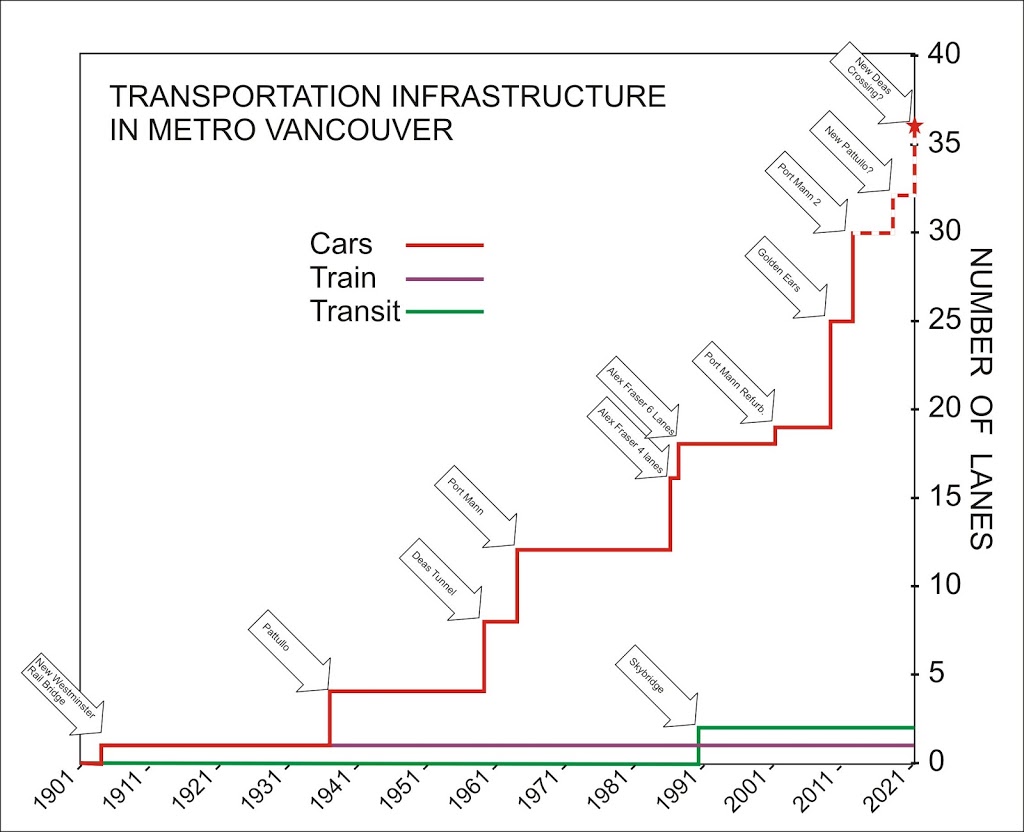
Just between 2000 and 2021, the number of road lanes crossing the Fraser River within MetroVancouver would double from 18 to 36 with not a single increase in rail or transit capacity crossing the river in the same time.

The real economic choke point in the crossing of the Fraser is the 100-year old New Westminster Rail Bridge, with its single rail line being that flat purple line on the graph. TransLink forecasts big increases in Transit ridership across the River (well, it used to, it is unsure how the current funding crunch will impact these projections), but is currently operating the only two lanes of rapid transit (Skybridge is green line) at near capacity, will not have the money to even put buses on the World’s Widest Bridge, which will have 10 lanes, but not one of them dedicated to transit. Dumb.

This is the real story behind the TransLink “Funding Crisis”. $5Billion spent on roads and bridges in the last decade, and Billions more to come. All this while car use is declining, and our existing transit system is hopelessly overcrowdedThe last comprehensive study of Traffic at the Deas/Massey Tunnel demonstrated that traffic through the Tube declined more than 7% over the 5 years, while people taking transit over the same time went up over 8% in the same period. This is not about capacity issues- this is about entrenching the building of car-oriented neighbourhoods in Langley, Surrey and Delta. This is threatening our livable region strategy, it will continue to threaten ALR land and our airshed. We cannot possibly hope to reduce our Greenhouse Gas emissions, to become food or energy independent. 

The worst part of the Surrey Leader story? The Vice-Chair of TransLink (who happens to be Mayor of the City with the greatest proportion of car users in the region) calling it “a great announcement”, while the only quote from the NDP opposition seems to be critical that the tunnel can’t be replaced sooner. There is plenty of dumb to go around here.
Shaking my Fist from my Pier Park Porch Swing

Seems I haven’t been talking about New West that much recently, so here is a viciously local issue that was brought up to me last week., via the Twitter.

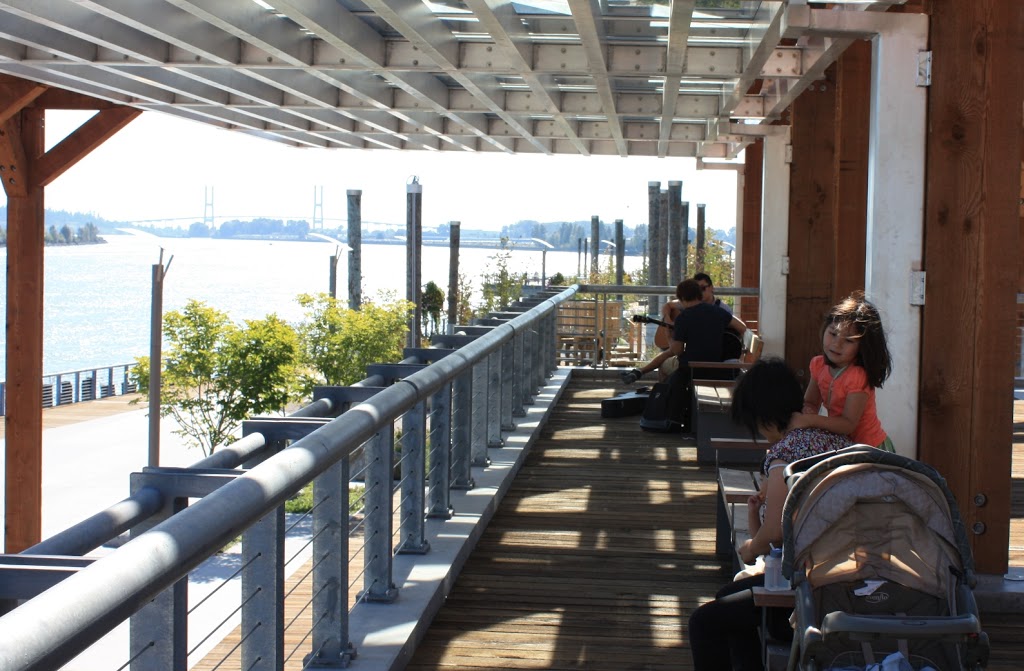
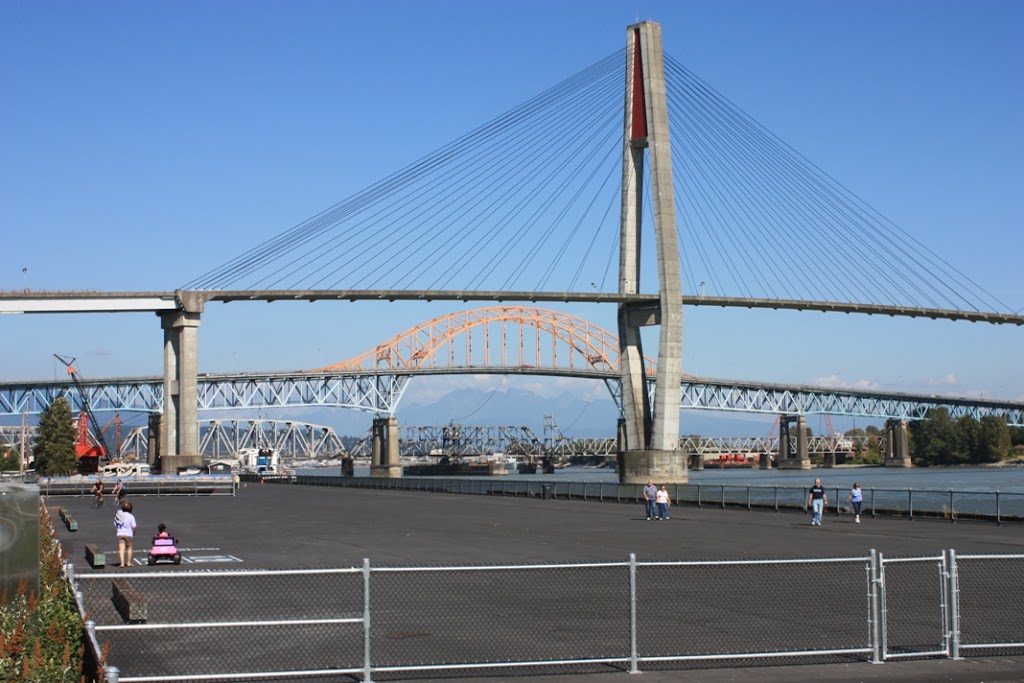
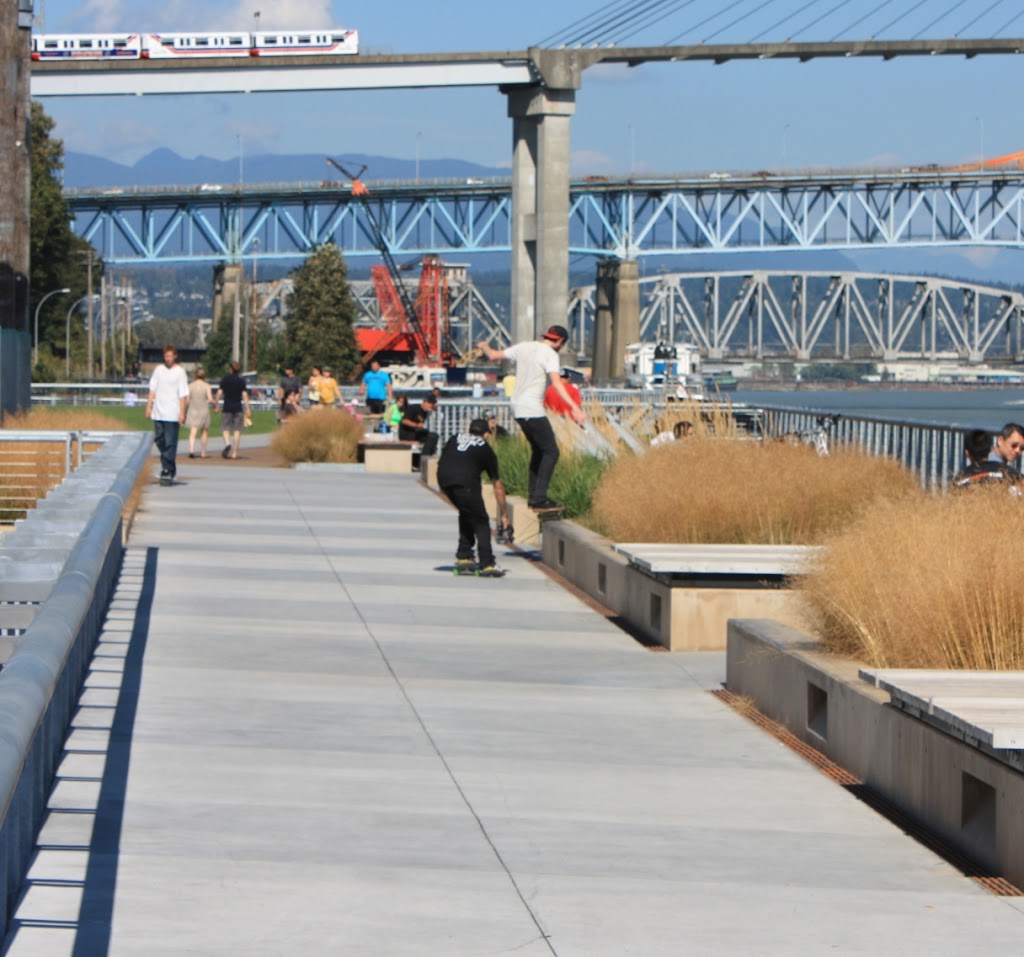
The new Westminster Pier Park is a little more than 2 months from opening day, and so far so good. Rave reviews are coming in, despite a slightly embarrassing lack of spell-checking at the steel plant, and less-than-ideal access, which will soon be improved. I have yet to hear a negative review. Then I went down on Labour day and saw literally hundreds of people over a few hours coming and going, sun tanning on the grass, people connecting their Quayside walks, and kids on the playgrounds.

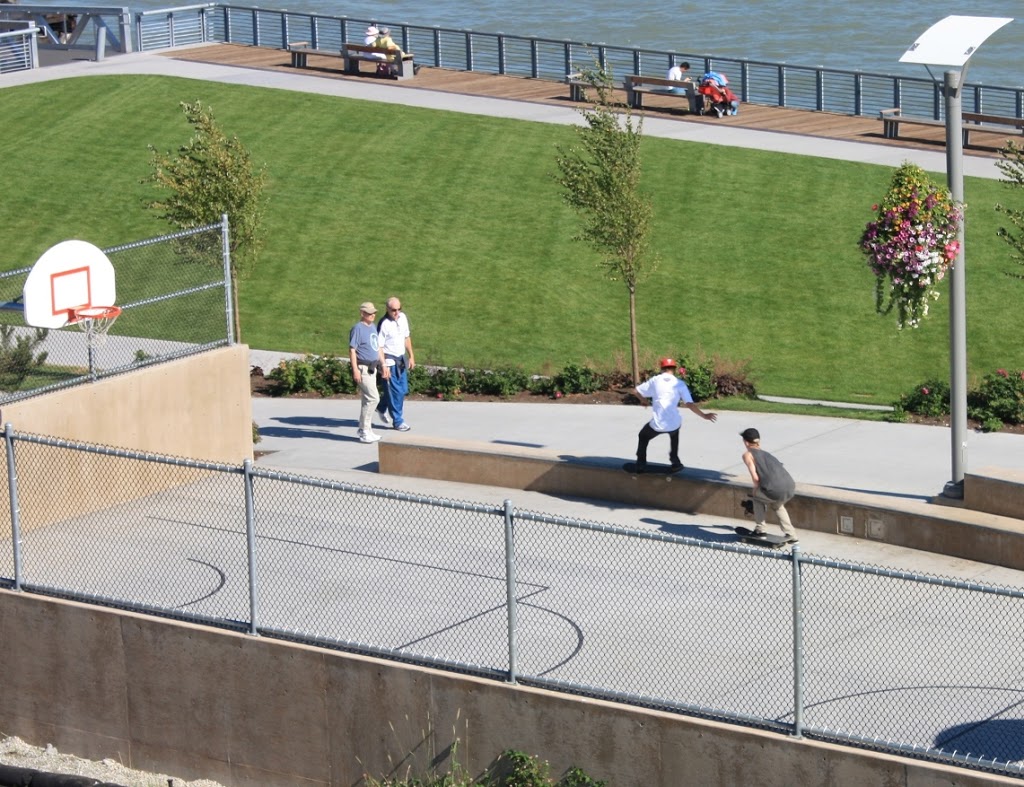
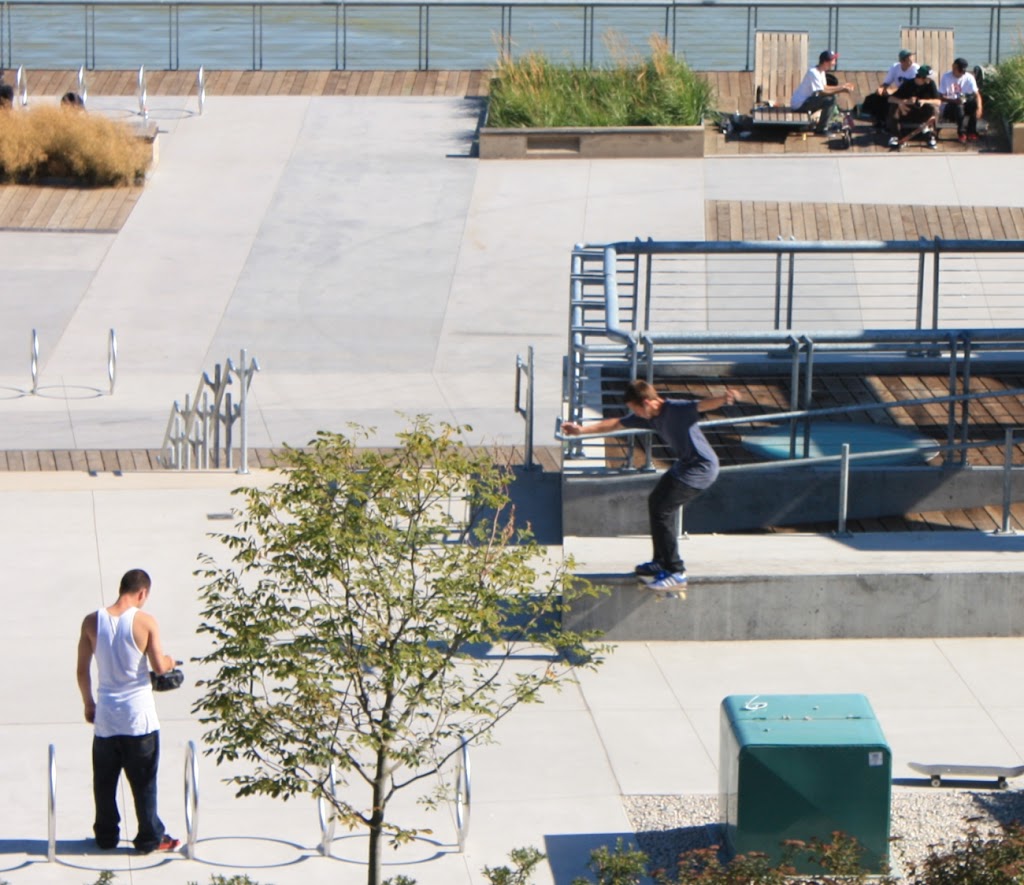
And then there were the skateboarders.

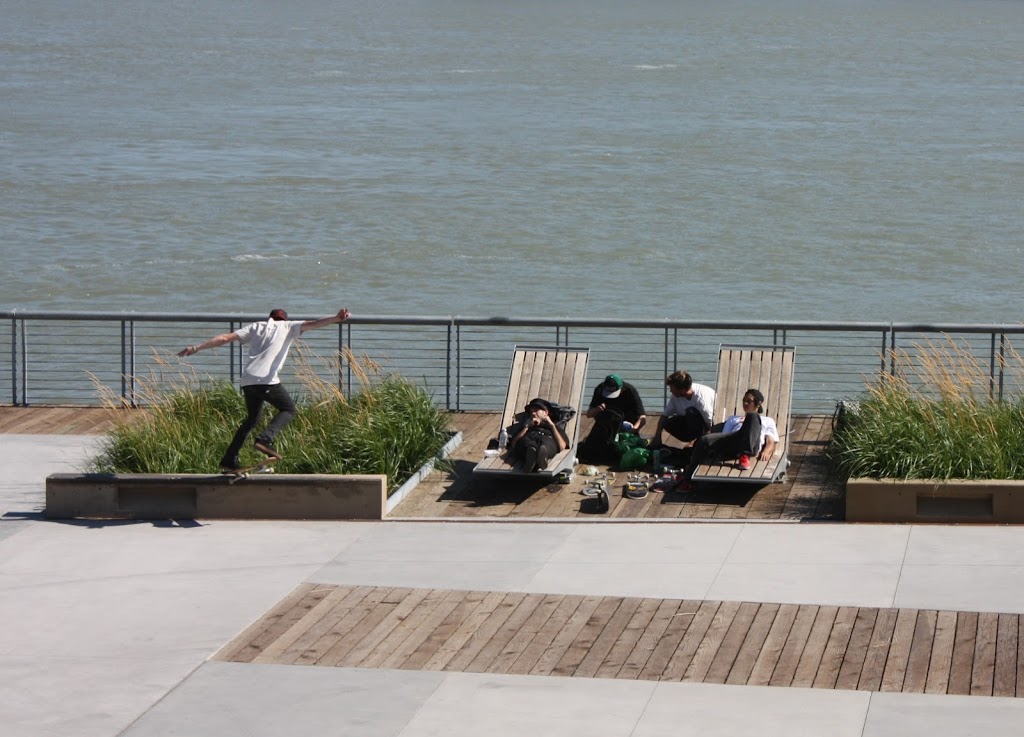
Now I am not going to be that guy – just trying to bring the dudes down – but I guess I am now old enough to complain that the noise and the impact of a few young kids on skateboards disrupted an otherwise peaceful, pleasant park. Except there weren’t just a few of them (there was at least two dozen), and they weren’t kids (I peg the average age in the mid 20s). Excuse me a minute while I shake my metaphorical fist from my metaphorical porch swing – I’m going somewhere here.

They were also comfortable enough to afford beer and video equipment. Yes, they were video recording things. At least three separate cameras on site, being filmed by each other doing slides and grinds along anything concrete. Not on iPhones, mind you, but full-on Sony digital video cameras. No doubt to be dubbed to music and posted on YouTube.

Kids today…

The situation at the basketball court was pretty funny- as the crowd of a dozen or so guys had organized into what I can only describe as a hockey-style drill: lining up along the wall behind one net while they took turns, one at a time, sliding the concrete step at the opposite end of the court, while one guy took the occasional video recording from his own slow-moving deck. It had all the aesthetic flow of a Pee-Wee hockey team pre-game drill. Passing seniors were less excited.

Except way louder. Big kids slamming boards against concrete and asphalt gets pretty loud. It is a jarring, violent sound in the middle of a park where other people were picnicking, walking, playing on swings, or even playing guitar. When they do it for hours on end 5 feet from your lounge chair, it can kind of ruin the entire waterfront-park aesthetic.

However, the noise is not my biggest concern. That would be the damage that is already apparent on some of the concrete structures at the Park.

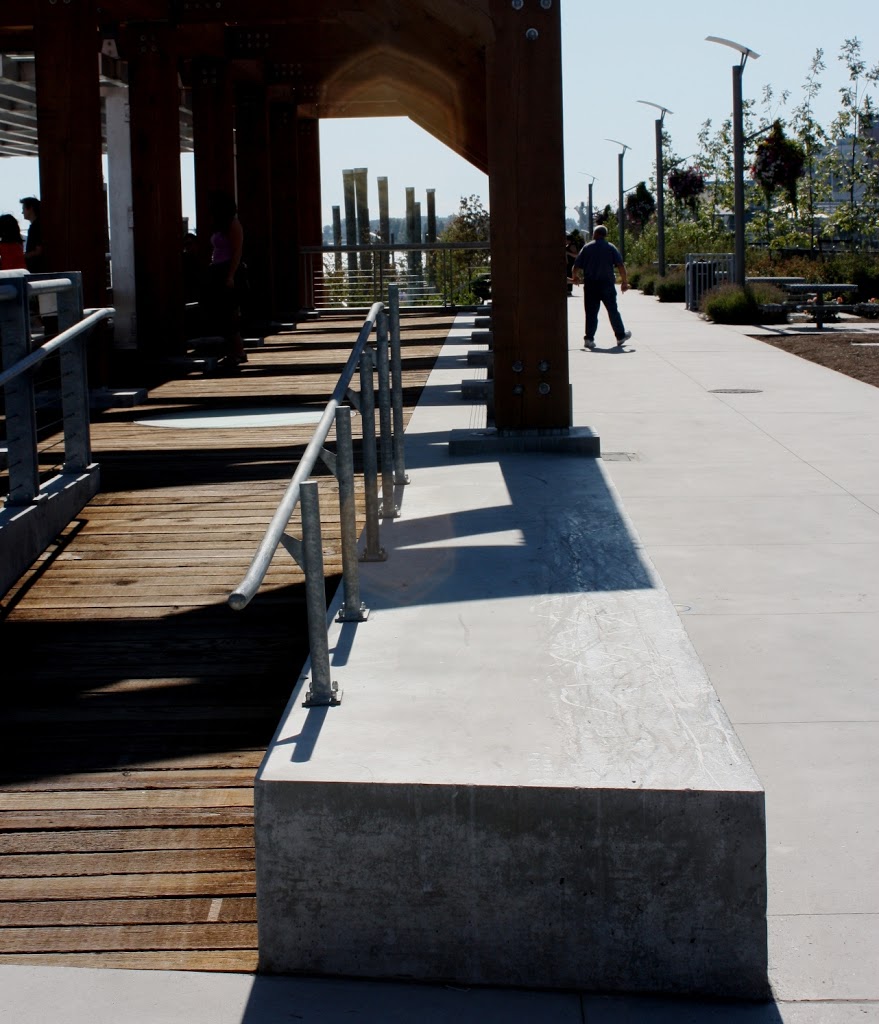
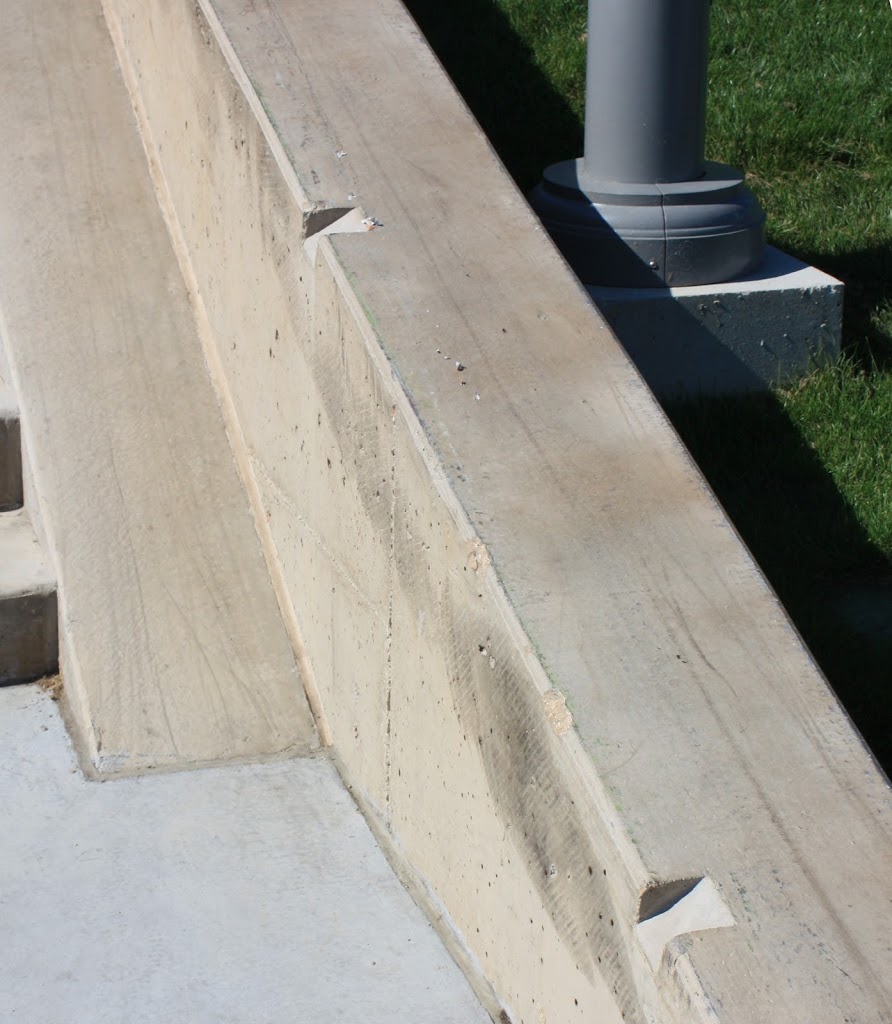
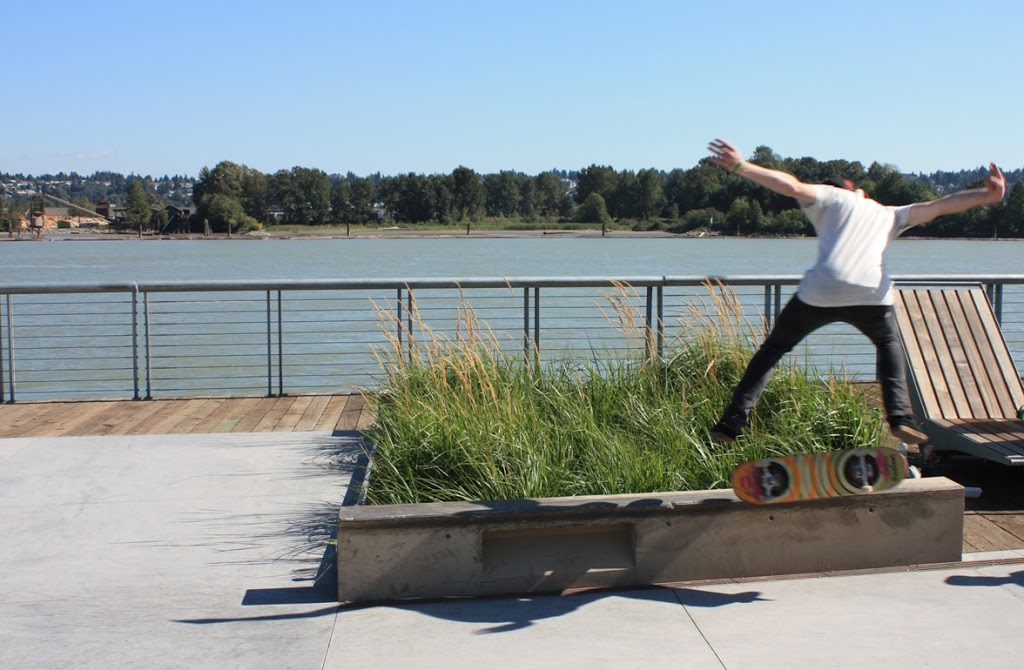
Most concrete structures these days are built with some sort of anti-skateboard technology. There is a whole industry involved in designing concrete surfaces to not become skateboard-attractants. At the Pier Park, they too one of the most passive approaches: small dents every few feet on concrete ledges.

Clearly it isn’t working. Only two months after opening, the concrete is chipped and broken in areas, and there is significant ground metal/board wax staining on “grind” areas. I can’t imagine what it will look like after a few years. (notably, the concrete stair on the edge of the basketball court is lined with a steel rail to protect the concrete and facilitate “grinding” – as the Urban Dictionary tells me the kids say).

So what are the alternatives? There are already two established skate parks in New Westminster. The brand new one in Queensborough came at significant cost to the City, and is a pretty big facility with a huge variety of riding options. Unfortunately, the old bowl adjacent to Mercer Stadium is a little old, a little decrepit, and likely bound for destruction when the new School is built.

Neither of these location are where the new population centres of the City are. Maybe it is time to build a new park?
I’m not a skateboarder, never have been, but I can see it as a sport that gives youth (and increasingly, adults) a physical and creative outlet: this is something we need to be encouraging in the City, and not discouraging with arbitrary rules. However, when any one user group (be they skateboarders, firearms enthusiasts, equestrians or performance artists) disrupts the enjoyment of public facilities for other users, and damages the physical infrastructure built by the City while doing it, we need to find a way to mitigate those physical impacts. We live in a society, and that’s what societies do.

Here are two quick proposals:

1) Build some temporary skate-friendly structures on the asphalt part of the Pier Park. That asphalt is not being used now in any way that would change if a few jersey barriers, concrete blocks, or whatever the kids are “grinding”, “sliding”, and “ollying” today, were installed for the skaters to use and abuse at their leisure. It isn’t as good as a full skate park, but it is better for everyone than the structures being abused now; or

2) Do the same thing on something like 1/8th of the current Waterfront Parkade: those wide-open expanses of elevated concrete that are currently abandoned even on the busiest days of downtown businesses. Let’s put the white elephant to some practical use as a temporary measure until a longer-term solution can be found.

Ultimately, we need to find a longer-term positive solution, past installing “no skateboarding signs” at the new Pier Park. But let’s install the signs in the meantime, and get some Bylaw enforcement down there, just to stem the tide of the damage before repair costs get out of hand…

Bicycle Lane Obstacle Course #4

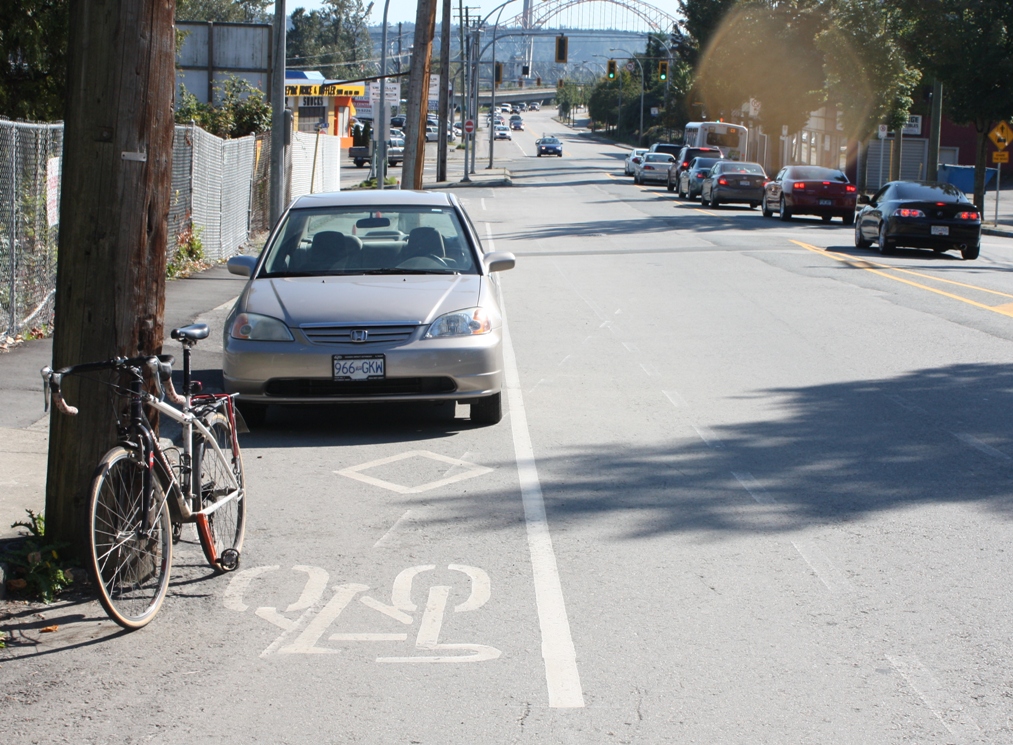
On Labour Day, I rode my bike along the Central Valley Greenway, one of the premier regional bike routes.

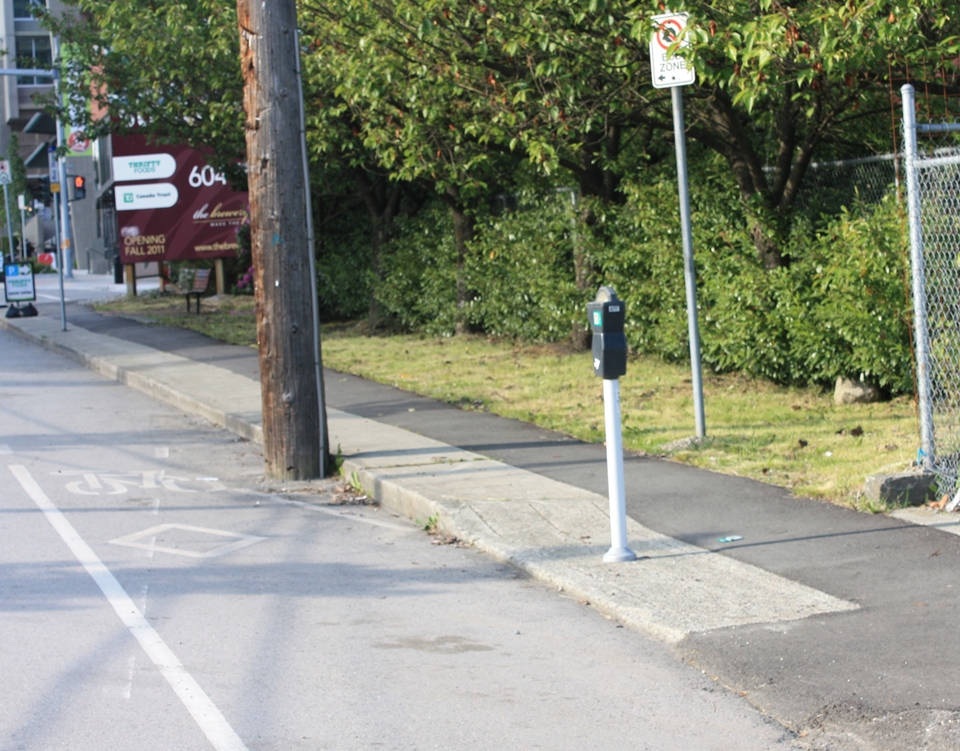
Also a good place to park.

Its not like the driver couldn’t see the diamond or the bike symbol. What made them think this was a parking spot?

Possibly because it used to be a parking spot. It has been part of the CVG since the bike route opened more than three years ago to much fanfare. However, up until a few months ago the very spot this car is parked looked like this:

Yes. That is an operating parking meter. There were about a half dozen of them along the bike lane on Sapperton. In defence of the City’s Transportation guys, once this was brought to their attention, they took the meters out pretty quick (there are meter-stumps there now). So I guess Mr. Civic Driver figured it was now free parking. Bonus!

I am just confused that the fact there were parking meters on a bike lane had to be brought to the attention of the Transportation Staff three years after the bike lane opened. I mean, did the guys painting the lanes not notice the meters? Did the Meter Collector not notice the lane paintings? Did no-one working for the City put two and two together?

Thousands of cyclists must have ridden by parked cars in the bike lanes over those three years… and silently lamented the cars parked in the travelling lane. That is how unremarkable the first photo is to cyclists, even on the region’s premier bike routes.

Signs of Protest

I was driving along Highway 3 this past weekend, along one of my favourite roads. I have driven and cycled this road more than a hundred of times in my life, the 600km from my first Home to my adopted Home. It seems I know every curve, every hill, every summit (can name them off the top of my head, and picture each clearly: Allison, Sunday, Richter, Anarchist, Phoenix, Paulson), every place where the Police hand out tickets.

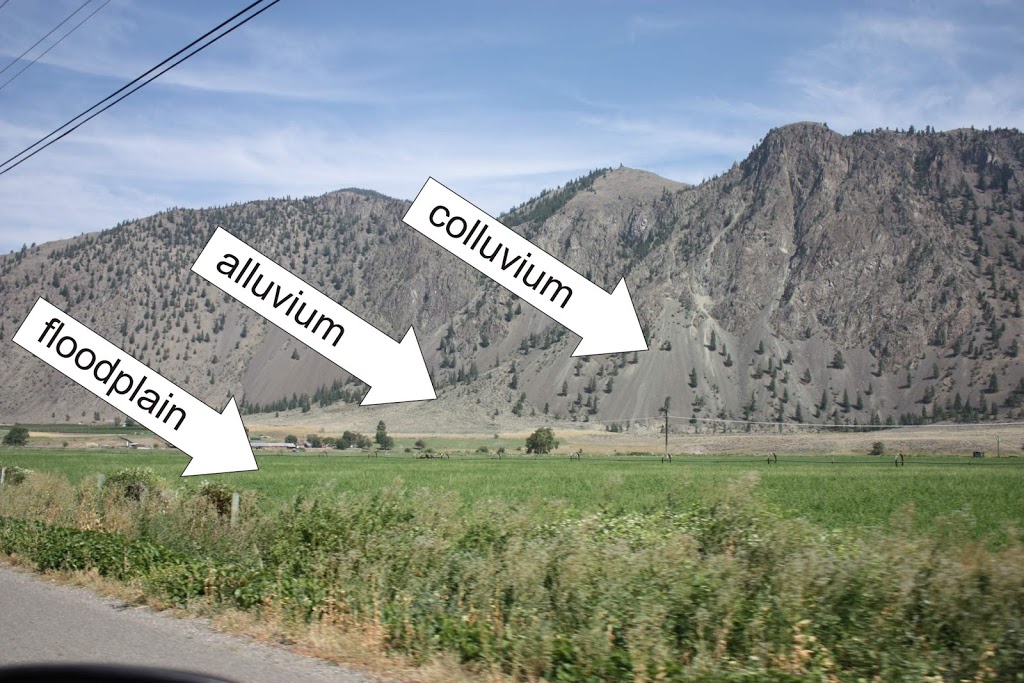
One of the spectacular stretches for a geologist is west of Richter Pass, as you drop into the wide, flat Similkameen Valley, bounded by the vertical wall of the Catherdal Range of the Okanagan Mountains. The valley floor has a classic underfit meandering river flanked by the shallow drapes of alluvial fans leading up to much steeper scree slopes of colluvium. Traditional ranching and hay fields on the slopes are increasingly being turned over to viniculture, while the orchards of Keremeos continue to pound out unreasonably good cherries, apples, and stone fruit.

Aside from the human uses, these grasslands represent a rare ecosystem in British Columbia: A sagebrush desert. With rapid development up the mountains in the adjacent Okanagan Valley, these ecosystems are under a lot of pressure. To call it a desert makes it sound, well, deserted, but this area has the highest concentration of threatened or endangered species of any similar-sized region in Canada; at least 23 different listed species, from Pacific rattlesnakes to Flammulated owls, and one-third of the red-listed species in the Province. Protection is spotty, development is encroaching, and the ecosystem is threatened.

With this in mind, the (Liberal) Federal Government signed a memorandum of understanding with the (Liberal) Provincial Government in 2003, to do the appropriate feasibility studies towards developing a National Park or National Reserve Lands (the first in the Okanagan). The MOU includes the statement:

“On February 11, 2003, the Government of British Columbia announced in its Speech from the Throne its interest in exploring the potential for establishing a new National Park Reserve in the Okanagan area, and its “Heartlands Economic Strategy” by which economic development plans will open up new opportunities for tourism, resort development and recreation, among other things, in the Province of British Columbia”
Sounds good; a Park plan which will balance out economic growth in an area of intense tourist interest and very unique geography and ecology (currently unprotected by any National Parks), to provide recreation opportunities while limiting impacts. In a region full of seasonal hotels, campsites, fruit stands, and tourists, who could possibly oppose?

People who like to shoot things and burn hydrocarbons for entertainment. That’s who.

A local “No National Park” movement began, led by a small but determined group of hunters and ATV enthusiasts out of Oliver, BC, who were offended that their chosen recreation activities may be even slightly encroached upon in the name of protecting ecological lands or endangered species.

Long story short, after 9 years of consultation, the Province caved. With her characteristic ability to solve problems, bring people together, and provide leadership you can believe in, our Premier was unable to voice support for a Park that had broad local and First Nations support, with backing from a broad range of people and groups across the country. Apparently recreational lead-shooters and gasoline-burners have a lot of voice in one of the last remaining BCLiberal strongholds in the Province. The Federal Conservative Government, citing a lack of interest on the part of the BC Liberals announced this spring that they would no longer explore the Park. Even while they announce a big park up North that will apparently feature spectacular mining expanses.

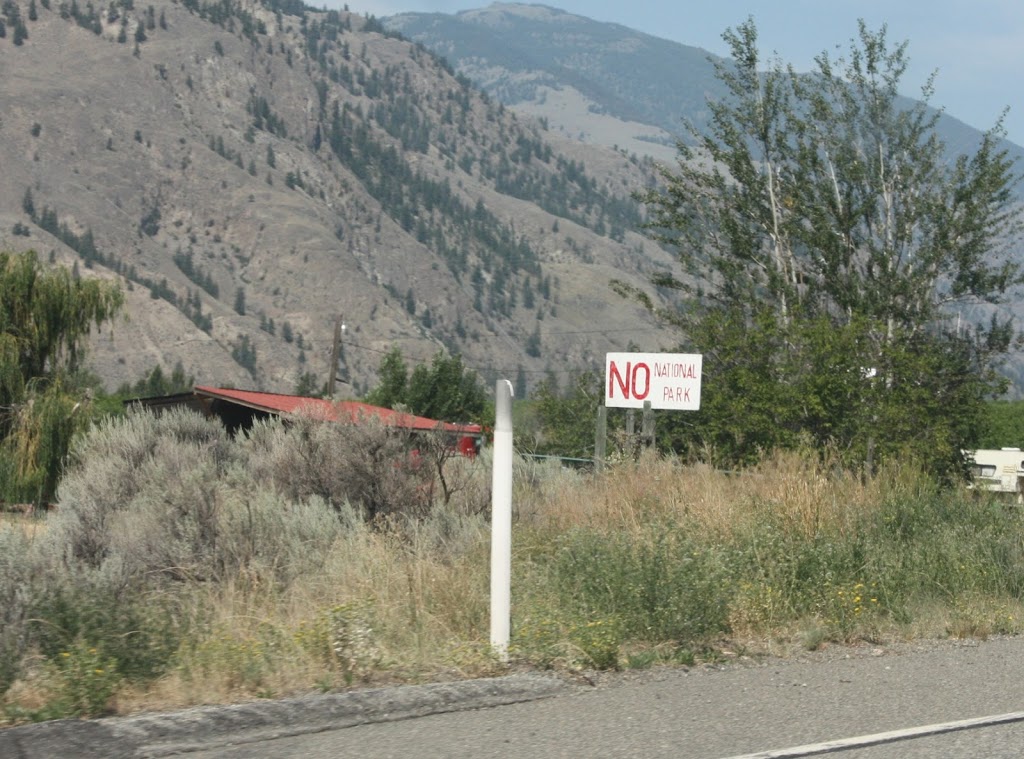
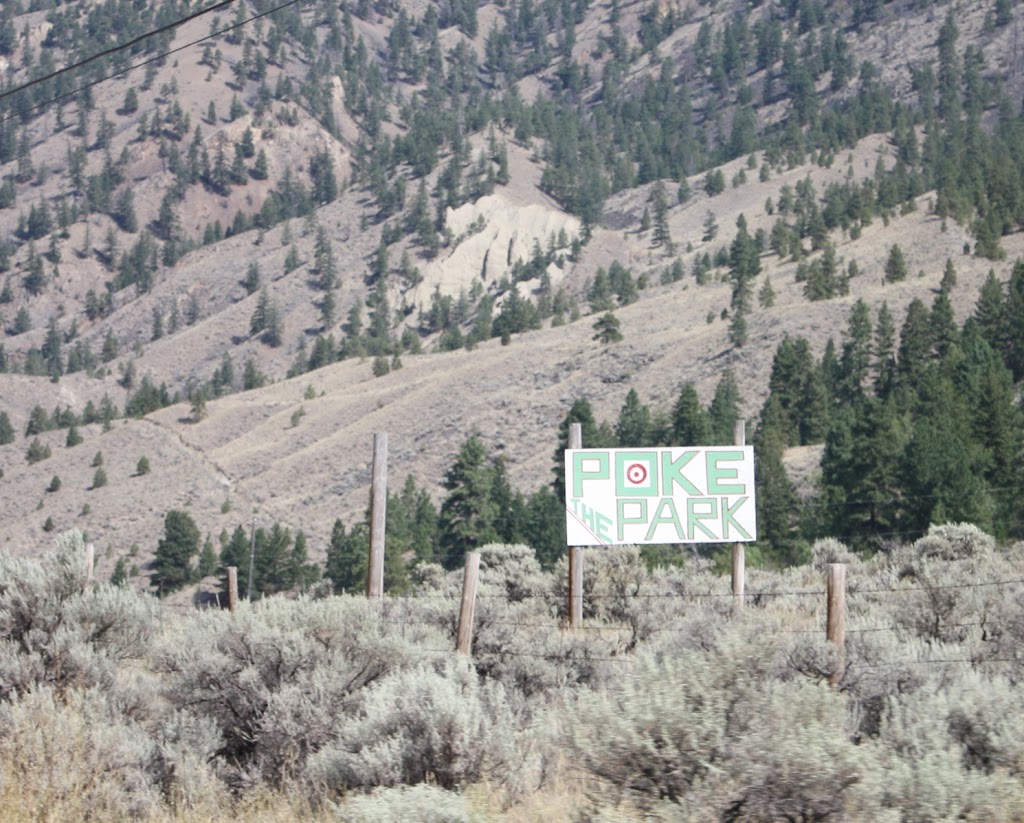
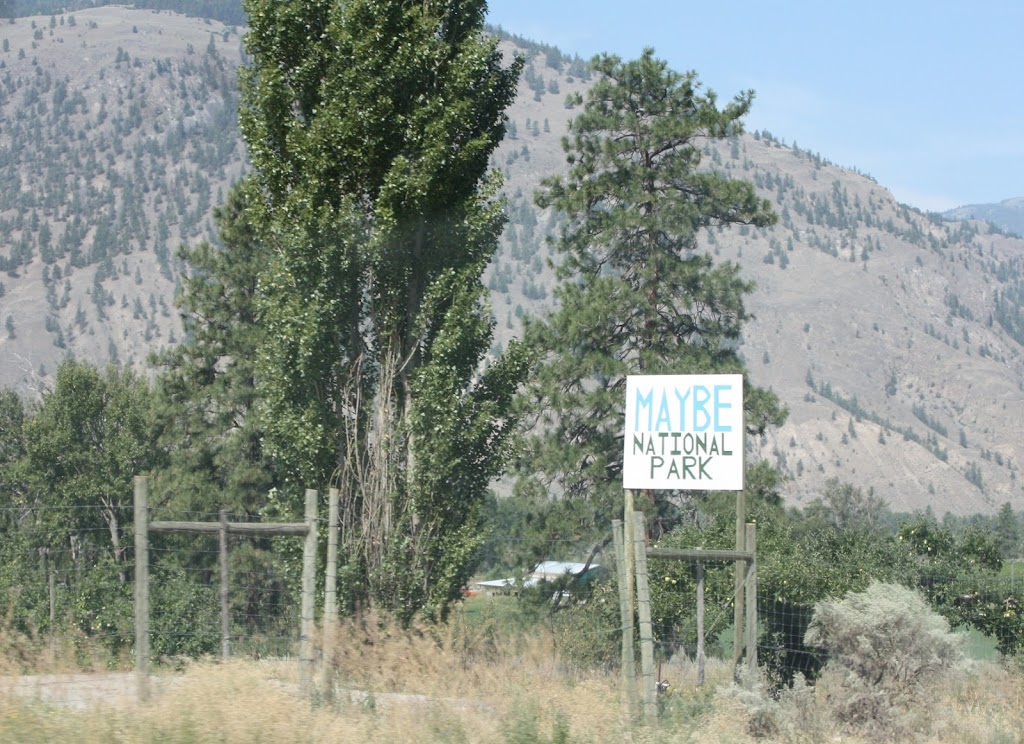
The fight may be over (or not…), but the signs are still up all through the Similkameen Valley. To me, this entire story has been about a 9-year sign war played out across the Cawston countryside. That small, organized group did a good job plastering Highway 3 with red-on-white signs, stating “No National Park”, confusing the hell out of thousands of RVs from Alberta and Germans in rental cars every year. Really, it does not present the most inviting message to passing drivers: “Wer ist gegen einen Nationalpark?!?”

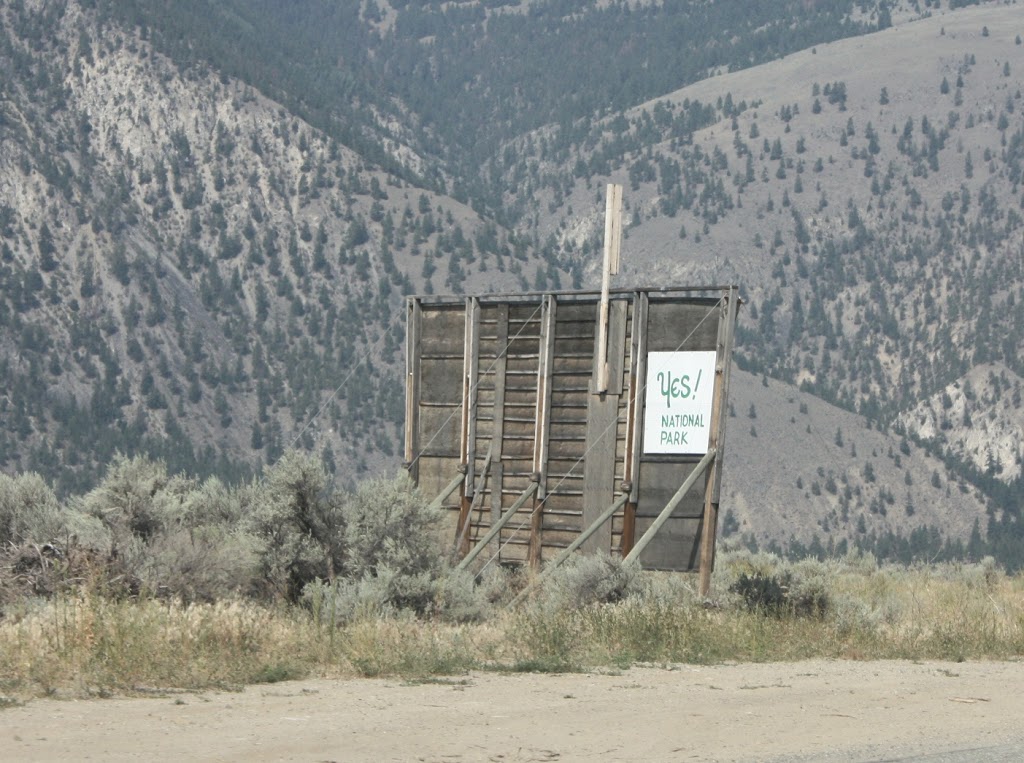
It has only been the last year or so that a counter-protest sign campaign has started, using much more positive, if derivative, imagery:

And even some more creative approaches:

And now, with the entire thing in limbo, maybe the time was right for the ultimate modern slacktivist movement:

Now there is a protest I can believe in.

?

Helmets are at least 7% of the solution.

This is a tragic story. Cyclist falls off his bike, hits his head, and dies. No less tragic than the driver who is momentarily distracted, causing an accident or death (something that occurs dozens of times a year in Toronto, and causes over 500 deaths a year in Ontario) or a pedestrian slipping and falling causing fatal injuries (more common than you think!), or even a pedestrian being killed by a car (which happens more than 100 times a year in Ontario), but tragic and probably completely avoidable.

Of course, the immediate reaction reading this (especially amongst non-cyclists) is the presumption that a helmet would have saved the cyclist’s life, and ergo: helmet laws. We don’t know if that is true, but it fits the current narrative in the media (bicycles are dangerous, nothing we can do about it but drive cars instead just to be safe, or at least put styrofoam beer coolers on the cyclist’s heads!). In this story, that is further reinforced by the last paragraph:

“About two months ago, Ontario’s deputy chief coroner released a report on more than a hundred cycling deaths that said helmet use by all cyclists can decrease fatal head injuries.”

Just for fun, you can read the Deputy Chief Coroner’s report right here. Proving that the CBC got the report pretty much right, while fitting the current media narrative, the DCC did indeed recommend a provincial helmet law. Down there on Page 30, we find Recommendation #11:

The Highway Traffic Act should be amended to make helmets mandatory for cyclists of all ages in Ontario. This should occur in conjunction with an evaluation of the impact of mandatory helmet legislation on cycling activity in Ontario.

The DCC is suggesting a helmet law, and that the impact of that helmet law on bicycle use be evaluated after it is implemented. This reads to me like some acknowledgement of data from various jurisdictions that helmet laws actually dissuade people from riding bikes. See the experience with bike share programs in cities with mandatory helmet laws vs. cities without them. There is an argument to be made that the public health risk posed by helmetless bicycle use may be outweighed by the public health benefits of more people riding bikes. The data ia ambiguous at best, so the DCC is just asking the Government of Ontario to collect this data, allowing the policy change can be fairly evaluated. Sounds reasonable.

You know what is missing from much of the reporting on the DCC report recommending a helmet law? The other 13 recommendations!

I am pretty agnostic towards helmet laws (although I wear one 95% of the time while riding), but wouldn’t mind them so much if there was an equal push from non-cyclists so concerned about the health and well being of cyclists to implement the other changes the DCC suggests (excerpted here) :

Recommendation #1: A “complete streets” approach to guide the development of existing communities and the creation of new communities…require that any (re-)development give consideration to enhancing safety for all road users, and should include: Creation of cycling networks (incorporating strategies such as connected cycling lanes, separated bike lanes, bike paths and other models appropriate to the community.) and Designation of community safety zones in residential areas, with reduced posted maximum speeds and increased fines for speeding.

More info on “complete streets” is available here, but basically, we have to stop designing roads to just move cars as quickly and efficiently as possible while treating sidewalks, bike paths, and crosswalks as inconvenient things shoehorned into an established car-moving network.

Recommendation #2: An Ontario Cycling Plan should be developed [to] establish a vision for cycling in Ontario, and guide the development of policy, legislation and regulations and commitment of necessary infrastructure funding pertaining to cycling in Ontario.

My translation: make planning for bicycles on the public roads a Provincial policy, not just leaving it up to local governments, and make the Province provide the funding to build the appropriate infrastructure.

Recommendation #3: The Ministry of Transportation should identify the development of paved shoulders on provincial highways as a high priority initiative.

Makes sense: fix the damn roads.

Recommendation #4: A comprehensive public education program should be developed to promote safer sharing of the road by all users [including] a targeted public awareness campaign, in the spring/summer months, with key messages around cycling safety; education targeted at professional truck drivers regarding awareness and avoidance of cycling dangers; education / regulation directed towards Beginning Driver Education (BDE) courses and driving instructors to include sharing the road and bicycle safety; public safety campaigns around the dangers of distracted and impaired cycling.

Of course education would help, but I love how the target for this education is not just cyclists, but also professional and learning drivers. The very sad recent story in New Westminster where a Professional Driver was found not at fault for the death of a young cyclist that he “just didn’t see” before delivering the right hook demonstrates part of the problem.

Recommendation #5: It should be a requirement that important bicycle safety information (such as rules of the road and helmet information) be provided to purchasers of any new or used bicycle. Such information could be included in a “hang tag” information card attached to the handlebar of every bicycle at the time of purchase which would include critical information and a reference to the Ministry of Transportation website and Service Ontario for additional bicycle safety information and publications.

OK, here is one I am less fond of. Putting a label on a bike that says “this thing is dangerous” irritates the hell out of me. I can go into Home Depot and buy an axe without having to sift through a bunch of warning labels about the ways I can hurt myself or others with it. But I buy a barbeque and am provided 400 pages of nonsensical warnings about burning myself or immolating my neighbourhood. This seems an onerous burden to put on bicycle manufacturers and sellers, with little actual gain. But maybe it is my life in a retail bike shop coming back to influence my opinion here…

Recommendation #6: Cycling and road safety education should be incorporated into the public school curriculum.

Boom! Yes! Mandatory bike safety training of the youth would go a long way towards correcting bicycle behavior, and normalizing the use of bicycles amongst youth. Right now, organizations like BEST and HUB scramble to get grant money and volunteers to put on education programs, and (as far as I know- can anyone in the school system correct me here?) there is no formal training in school for kids. Maybe I’m engaging in used-to-be-ism, but when I was in grade 3 or 4, our school had an annual bike rodeo, where the RCMP would set up a training course in the school parking lot and teach us basic rules of the road, hand signal, and how to safely get to and from school. Just teaching kids to see the bike as not just a toy, but as a tool they need to be aware of using safely. Does this happen anymore?

Recommendation #7: The Official Driver’s Handbooks should be updated to provide expanded information around sharing the road with cyclists, and include cycling-related scenarios in driver examinations.

All part of the education model, and normalizing the idea of bicycles being part of the traffic system. This might even reduce the number of young drivers yelling at me to get on the sidewalk or honking at me to get out of the way when I am occupying a lane for safety.

Recommendation #8: A comprehensive review and revision of the Highway Traffic Act should be conducted to ensure that it is consistent and understandable with respect to cycling and cyclists and therefore easier to promote and enforce.

Makes sense: fix the damn laws to make riding legally understandable and sensible. I can’t imagine how a new cyclist deals with drivers telling them to “get on the sidewalk” and pedestrians telling them to “get off the sidewalk” when the law is inconsistent and unclear. In New Westminster, it is legal to ride a bike on the sidewalk in some places, and not in others, anyone out there willing to guess where? Think there is signage to indicate this, or are visitors and residents expected to go to the City’s website and search the bylaws? Is riding two abreast illegal? Should it be? How do you define “complete stop” on a bike? Do I have to put my foot down? The laws are written for motor vehicles, and bikes are expected to behave like them, unless strictly forbidden to do so. We need to update out BC Motor Vehicle Act to the modern reality of bikes on roads.

Recommendation #9: A comprehensive review and revision of the Municipal Act, the City of Toronto Act and relevant Municipal By‐Laws should be conducted to ensure that they are consistent and understandable with respect to cycling and cyclists and therefore easier to promote and enforce.

See my comments on #8.

Recommendation #10: The use of helmets by cyclists of all ages should be promoted and supported [including] financial incentives, such as removal of tax on bicycle helmets and helmet rebate program; promotion of helmet use through public awareness campaigns; enforcement of existing legislation regarding helmet use in cyclists under the age of 18.

Like I said, I am agnostic about bike helmet laws, but I almost always wear a helmet, and was wearing a helmet for years before the BC Helmet Law was introduced. This is through public awareness, and no small amount of social pressure from the people I rode bikes with: there was a time in the early 90’s when attitudes changed about bike helmet use amongst serious road riders, and I followed that trend like the obedient sheep I am. It helped that I was a mountain biker first, and mountain bikers were quick to adopt helmets, mostly because we fell off our bikes and went over the handlebars a LOT in those early days.

Recommendation #11: The Highway Traffic Act should be amended to make helmets mandatory for cyclists of all ages in Ontario. This should occur in conjunction with an evaluation of the impact of mandatory helmet legislation on cycling activity in Ontario.

See above.

Recommendation #12: The Highway Traffic Act should be amended to include a one (1) meter / three (3) foot passing rule for vehicles when passing cyclists. This change in legislation should be reflected in the Ontario Driver’s Handbook, Beginning Driver Education curricula and the driver’s licence examination process.

This is the most stunning recommendation, and of course, the most likely to not be followed. Three-foot rules are not uncommon though, and have a lot of implications. First, it means that any road with less than 3 feet of shoulder, a car is required, by law, to change lanes to pass a cyclist, like if they were passing any other vehicle. It also puts an extra onus on drivers in the event of car-bike collisions, right hooks and brush-offs (when a car passes you so closely, that they effectively push you off the road without touching you). Any bike-car contact where the car was passing the bike in the same lane would become the car’s fault automatically. If this one law was passed and enforced, it would probably do more to prevent highway cyclist deaths than any other recommendation above.

Recommendation #13: Side-guards should be made mandatory for heavy trucks in Canada. In addition, consideration should also be given to requiring additional safety equipment (such as blind spot mirrors and blind spot warning signs) to make cyclists more visible to trucks and decrease the chance of a collision, especially during right-hand turns.

Again, “I just didn’t see him” is the too-common excuse for right-hook crashes, and the result when the right-hook is performed by a large truck is usually fatal. This is not about blaming truckers, they have a lot to deal with in complicated traffic situations, but giving them the tools (actually, forcing them to have the tools) to improve the safety of those around them makes perfect sense.

Recommendation #14: Municipalities and police services (municipal/regional/provincial) should review local data related to cycling injuries and fatalities in order to identify and address opportunities for targeted education, public safety interventions and enforcement activities.

Makes sense: keep track of what is actually causing the accidents and fatalities, and direct your energy towards mitigating those causes, through education, enforcement, and/or infrastructure changes. Often, the Police and ICBC are reluctant to share accident info when bicyclesand pedestrians are involved, as it violates privace rights or is “before the courts”. They cannot even share it with those charged with designing and maintaining the road traffic system. Therefore, their knowledge of what does and doesn’t work in the pedestrian and cycling infrastructure is incomplete.
___________________________________
Overall, it is an excellent set of recommendations. We don’t know if a helmet law would have saved the life of the guy in the story above, nor do we know if any of the other 13 recommendations would have. The problem with the CBC story (and the general media narrative it supports) is how it sets up the helmet as the simple solution to a complex problem; one few jurisdictions are willing to address as comprehensively as the coroner suggests. The result will be more preventable “accidental” deaths, and too much irrational attention paid to helmet laws

From the jaws of defeat

It appears, as many suspected, that the campaign to collect signatures and force a referendum on a controversial borrowing bylaw failed to get the numbers required. Initial reports are that they didn’t even get half the number of signatures required.

Contrary to what some may say, I think this demonstrates, more powerfully than a successful campaign would, that the Alternative Approval Process is seriously flawed.

Remember, this process was started when the City decided to request authorization to loan up to $59Million from the Municipal Finance Authority. To do that, they were required to pass a Bylaw, and because of the nature of the loan authorisation, the City was required by the Community Charter to get approval from the electorate to pass that Bylaw. As a referendum is potentially expensive and time-consuming, the Alternative Approval Process allows the City to just send the idea out to the community without the hassle of a full referendum, and see if there is even any appetite for having a referendum about the issue. If no appetite is found (by not getting enough people to sign their disapproval) then a referendum can be skipped and approval is presumed.

Except in this case, the alarm was raised on what is usually a dull procedural process, and there was a coordinated campaign to force the referendum, a campaign that clearly struck a chord.

James Crosty is a hell of an organizer, and proved again that he can raise a ruckus like no-one else in this town. Sometimes I agree with him, sometimes don’t, but I’ll always respect his ability to rally the troops and get the media attention when needed. He makes me think of the Woody Guthrie lyric:

“I ain’t the world’s best writer nor the world’s best speller,
But when I believe in something I’m the loudest yeller

So when Crosty took the charge in this campaign, he managed to put an organizing team together in short order, dominate the local media and editorial pages, create an ongoing Twitterstorm, and gain radio time on CBC and CKNW, all about a little local bylaw issue in New Westminster. The volunteer team no doubt invested lots of time and some donated money to make the campaign happen, including buying ads in the local newspapers. When City Hall would not provide enough ballots or long enough hours for people to collect them, Crosty first shamed them into putting the forms online, then opened his office space to serve as a proxy City Hall.

The way the campaign framed the issue, it was broad enough to encompass people who hated the Tower idea on the face of it, those who had a distrust of the current Council verging on conspiracy theory, those who were concerned about the sustainability of local government debt and the impact on Taxes, and those who just thought referenda were a better way to make decisions like this. A former Mayor and several former Councillors spoke in favour of the campaign, as did current and past School Board Trustees and business leaders in the community. FOI requests were generated, casting more suspicion around details of the Tower and the pull-out of the private partner. Even the Canadian Taxpayers Federation got their unaccountable two bits in on the topic.

So I ask you, if this campaign was unable to hit half the minimum amount of signatures, will any campaign ever hit the mark? Does anyone seriously think an overwhelming majority of the people in this City are happy with this process? Or is the bar set too high, with too many restrictions in place to make it achievable?

Talking to people on either side of this campaign, no-one thought that 4500+ signatures was possible, (note: I never actually asked Crosty if he thought it was possible, so don’t include him or his team in this generalization) and no-one thought that if a referendum was actually called, the Bylaw would be approved by the populace. People were not going to line up to vote “for” the City borrowing $59 Million on behalf of the Taxpayers on a business venture, but a hell of a lot would line up to stop it. In other words, the Alternative Approval Process seemed almost guaranteed to get the opposite result that a referendum would have. That isn’t right, and we can thank Crosty’s campaign for making that obvious.

It is legal, completely legitimate, and something that has happened before in the City. The Community Charter and the Local Government Act allow this process to happen and set the terms for it. The City, I have to emphasise, did nothing illegal or outside of its rights as a Local Government. Maybe the result is for the better good and all is well, but I still hate this process, as it seems by design or by chance, it was set up to fail.

So what can we change? The City could just step up and take accountability on its own behalf and review whether the AAP process should be used in future, and if so, how it might be adapted to get a fairer poll of the populace (remember, the Community Charter only sets minimum standards for the AAP, the City is free to exceed those standards in quest for greater accountability). Perhaps a better idea would be for the Provincial Government (who writes and administers the Community Charter) to acknowledge that this is an accountability problem, and change the Charter to reflect that problem. Perhaps this is a better task for the Municipal Auditor General to undertake than the nitpicking of library or recreation facility accounts.

I don’t know the solution. Hopefully, now that it is out in the light, we can have a rational discussion about what this process means, and how to balance the need for public input and consultation with the need for a Municipal government to operate efficiently and effectively.

The Campaign is over, let the conversation begin.

Politics

As the days count down for the Alternative Approval process, and the citizenry of New Westminster sits in a cat-like state of readiness, anticipating what comes next, it seems as good a time as any for me to noodle on about what we’ve learned, and haven’t.

It has been an interesting campaign to watch for many reasons – almost as many reasons as there have been given for the campaign itself – because no two people seem to agree on what the campaign is even about.

Ultimately, it is all about the Office Tower that the City wants to built atop the New Multi-Use Civic Facility. Since the Uptown Property Group bowed out last winter and the City decided to charge ahead, everyone has been Monday-morning quarterbacking the decision. People bully about the future of the City, including a lot of Real Estate types I have talked to, think it is a good idea, a sound business decision that shows confidence in the downtown revitalization. Others have questioned whether a Municipal Government should be taking business risks with taxpayers’ money.

It is this second group who have been most vocal about the referendum campaign. Most of the talk around this campaign, and the balance of Letters to the Editors, have been of the opinion that the City should not be building the Tower. Many of these opinionists wrongly think that 4528 signatures will stop the Tower from being built, after the hole had been dug, the foundation has been poured, and $12 Million has already been spent on the building. Some go so far as to call the City’s refusing to stop building now regardless of referendum is a display of “arrogance”. This is silly, as the only way the City is sure to lose is if they stop building now…

However, the campaign is not really about the Tower, it is about the $59 Million long-term loan guarantee for which the City is seeking approval, in order to finance construction of the Tower, MUCF, and attached parking garage. Some say this is too much debt for a City the size of New Westminster to take on, and may cause us to go bankrupt if the Tower business model (gamble?) doesn’t work out.

Except, again, it isn’t really a $59 Million loan. It is asking for pre-approved financing for up to $59 Million over the next three years, if required. It is more like a $59 Million line of credit at 1.7%, there if we need it, no obligation to use it. Some of this money will be used to finance things for which we are guaranteed a return on a known schedule (i.e. the DAC funding we are going to get in 2013, but we must spend before we can get reimbursed for it). Some we may spend on the risky stuff, and we are very likely to get some (if not all) in return based on the value built into the Tower.

It is certainly not “risk free”, but the City is securing $59 Million at 1.7% to build an asset that will be worth $100 Million when completed. I imagine there would be a line of developers who would line up to take that risk (but of course, they do not have access to the MFA loan rates). The City has money and assets elsewhere (some, notably, earning more than 3% interest) that by far outstrip this Tower in value. I suspect that is where the City’s financial folks are saying, I paraphrase, “we don’t need the loan to move ahead”. Even after (when) (if) this loan is drawn, the City will only be using less than a third of the total credit available to them from the MFA. the City can make money here for taxpayer, or they can lose some money, but the risk of bankruptcy, even if this tower is hit by a meteor the day after it is built, is so low as to be indistinguishable from zero.

Borrowing from the MFA to build an asset seems like a strategic investment to me, not a dangerous debt.

There is a third thing this campaign is about, besides the Tower and the Loan. James Crosty has taken pains to point it out (although it just isn’t as compelling to most of the Twitteridiots and letter-to-the-Editor-writers as Towers and $59 Million numbers): and that is the Alternative Approval Process itself. Crosty has said several times that this is all about getting the discussion out into the open; bringing democracy out of the shadows, to make it accountable.

The AAP is perfectly legal, and something the City of New West and other Cities have done numerous times before, but it stinks like a flattened skunk on East Columbia. It is effectively “reverse-billing”, by assuming people are happy with a big decision if they don’t line up to oppose it. To ask people to voluntarily engage in that process in the middle of summer, then not make the process as open, transparent, easy, and accountable as possible is to not respect the democratic purpose or the spirit of the Community Charter.

Crosty has said he just wants to call attention to this process, and I have to say he has been pretty damn successful. The unanticipated side of it was that it drew attention to some of the bigger issues behind the Tower, the deals signed (or apparently not signed) between UPG and the City, and the timely disclosure of when the deal started to go sour. Ugly questions are arising about election timing…

Regardless of how this referendum campaign comes out, the City needs to start talking about this. New Westminster is a small town, with many active rumour mills. There are too many people who are willing to publicly fill gaps in their own knowledge or understanding of a process with assumed corruption or malfeasance. The only way to quash that is to fill those gaps with defensible data. And a new building surrounded by rumour, innuendo, and suspicion is going to be a lot harder to sell when that time comes, effectively increasing the “risk”.

Now, I’m not always the sharpest knife in the drawer, but I know a fair amount about the Community Charter and how Municipal Governments operate. I have been reading all of the City-provided info about this project, including Council reports around the financing and the loan. I have read the FOI-released info acquired by Chris Bryan at the Newsleader, and the other news and opinion in the papers. I even attended the Downtown Residents Association meeting where the Mayor talked about this project, and listened to his comments on CKNW. After all of these attempts at information gathering, I still have a lot of questions about this topic. What went wrong with UPG? Where is the business plan? While there may be good business reasons to keep some info proprietary, there must be a balance to be struck while giving the voting public some idea of what their business plan is like for is tower – the rationale that had most Councillors vote for moving ahead, yet cause Chuck Puchmayr to say no.

I have a lot of confidence in this Council being able to do good for the City (and see a decade of steady improvement in the City as proof of this confidence), but blind trust in their perfection is just as irresponsible as presuming that they’re doomed to screw everything up.

One untrue thing I have heard during this is “this is not about politics”. To that I can only say bullshit. This is all about politics.

The usual Wayne Wright critics have surfaced in the Letters section of the Record and NewsLeader, the local Twitterati (including the @59million sock-puppet handle) has been filling their own gaps in knowledge about the tower with suspicion and suggesting a referendum was the only way to get to whatever you wanted (be it stopping the loan, stopping the tower, finding the “truth”, whatever) while listing off political allies from former Councils, current school boards, and citizens groups. People like me, who have been asking questions, challenging ideas, or pointing out that maybe, just perhaps, everyone at City hall isn’t corrupt to the core, have been called Astroturfers and Goons (which is strange, as I have never had a conversation with Wayne Wright in my life, other then the couple of times I have delegated to council).

Right from the start, this campaign has been pure politics. That is not necessarily a bad thing; you can’t have an effective democracy without politics. Politics is just the art of convincing people that what you want to give them is what they want.

To that end, the City played the politics here rather passively, and if, by some miracle, James Crosty gets his 4500+ signatures, the City will have to look back at how they may have communicated better through this all. If the campaign is not successful, then maybe the City played it right. Maybe.

I was with a group of friends talking about this last week over beers, and there was quite a variety of opinions about the Tower, the Loan, the referendum. We couldn’t decide if this was a good thing or not – is this just making chaos for the purpose of making chaos? Is there’s higher ideal here we can get behind? What are the outcomes? A friend shut me up with a simple question: “what do you want out of this?” I couldn’t answer, which is probably why I hadn’t yet given James my signature on a form. I need to have some idea what the outcomes will be of my actions, I don’t like to act first and ask questions later, just not my style in life.

Over the last two weeks, I have decided that all I want out of this process is for that light to be cast on the process: on the Community Charter and the Alternative Approval Process. It is the same thing I wanted last year when the New West electrical utility used the same process to get your approval for a $25 Million loan to support a new deal that guaranteed revenues to BC Hydro at the Risk of New Westminster utility users. We agreed to that deal through the Alternative process, even if most of us didn’t even know it happened.

I’m OK with the Tower (and the inherent risk), because I’m bully about the future of Downtown and like the path we are taking in this City. I’m OK with the creative financing that allows the City to leverage a 1.7% lending rate to its maximum advantage, because I want the City to use it’s financial advantages like a good business would. I’m OK that the City needs to have the ability to negotiate the terms of complicated construction and cost-sharing contracts, and that those negotiations sometimes go sideways. What I don’t like is that the City (in complete compliance with the law) attempted to push through the largest loan in its history through a reverse-billing option on a short timeline in the middle of the summer with the minimum of notice to the public, and apparently hoped and prayed that no-one would notice.

They didn’t count on James Crosty, and his remarkable campaign skills.

They got caught out, and now the process, if nothing else, is in the light. So in a way, it doesn’t matter if James gets his 4500+ signatures. He has already won. And the electorate of New Westminster is better for him having put up the fight, regardless of whether you agree with his position.

If there is a referendum, I am voting FOR the Bylaw.

Transit Riders and Pedestrians work too!

I was happy this morning to hear the local radio media reporting on this press release from the Delta Chamber of Commerce. Not because it is a “good news story”, but because it indicates Chambers of Commerce are starting to see the light about bigger transportation issues in our Cities.

This is a refreshing change from the old-skool Board of Trade argument that business just needs a wide road with many lanes and plenty’o’parking to succeed at business. In the coming decades, there will need to be ways for customers and employees to get to your door besides parking a car in front of it.

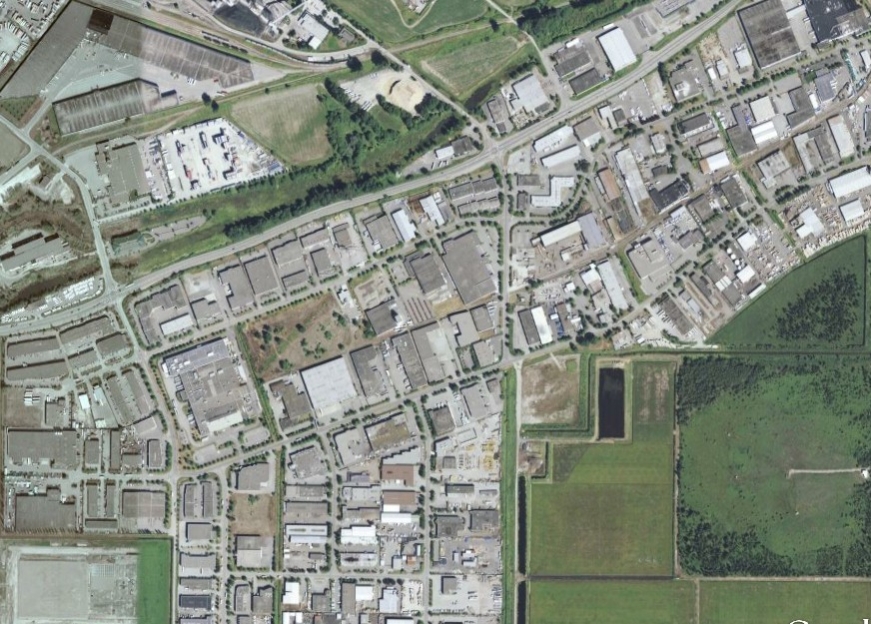
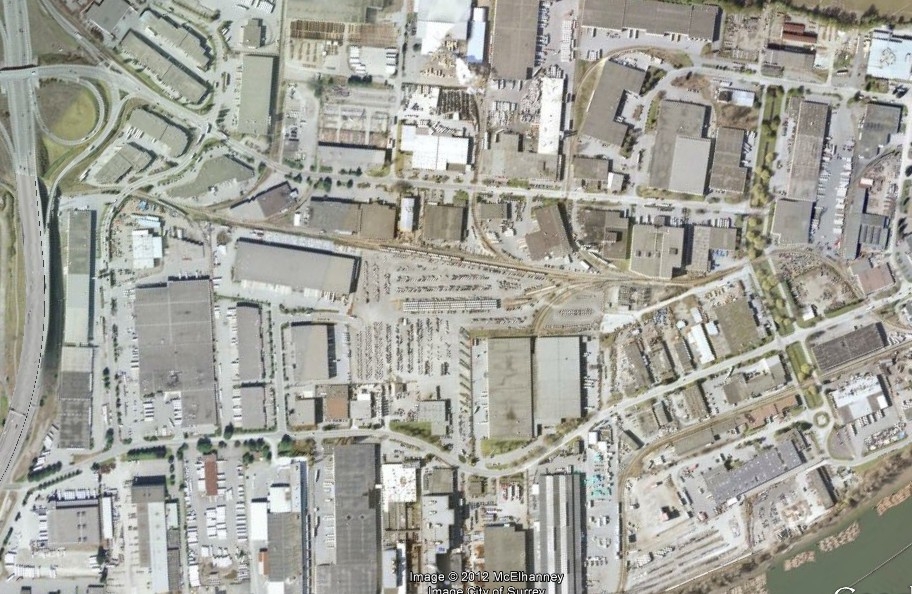
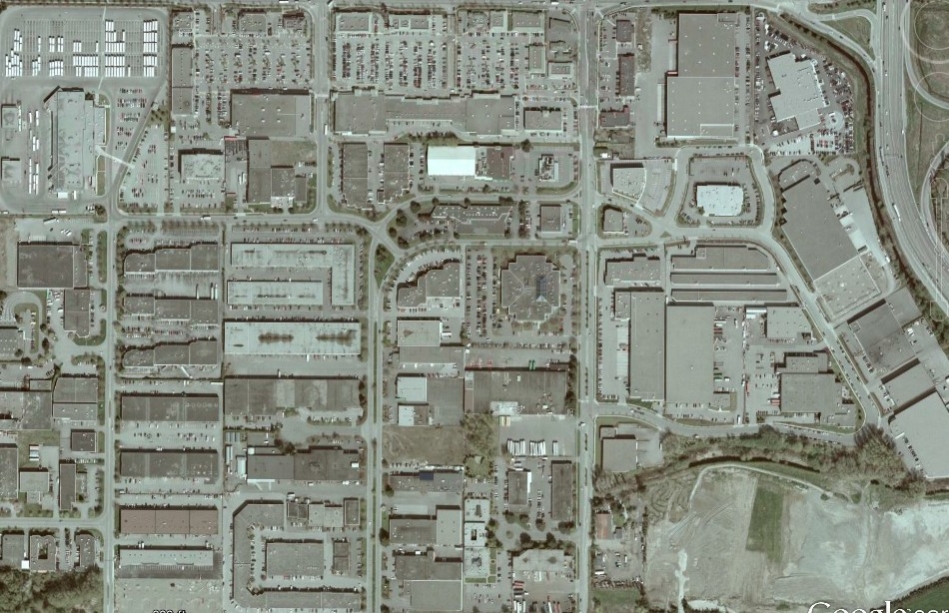
According to the report behind the presser, the people who actually operate within industrial areas and business parks are noticing that their staff is having a hard time getting to the auto-oriented developments being offered by our city planners. They are finding their lower-wage employees are demanding a sufficient pay rate to support running a car, which at about $7000 per year (according to CAA) is more than a third of the entire pre-tax income of a minimum-wage worker. There is also an increasing number of higher-skilled and higher-wage employees who are wanting better options than being shackled to a car for their daily transportation (a group within which I include myself, and a startling number of my professional colleagues and friends).

So the owners and operators of these business parks, like in the Tilbury district of Delta:

on Annacis Island:

the Richmond Port lands:

or Horseshoe Way:

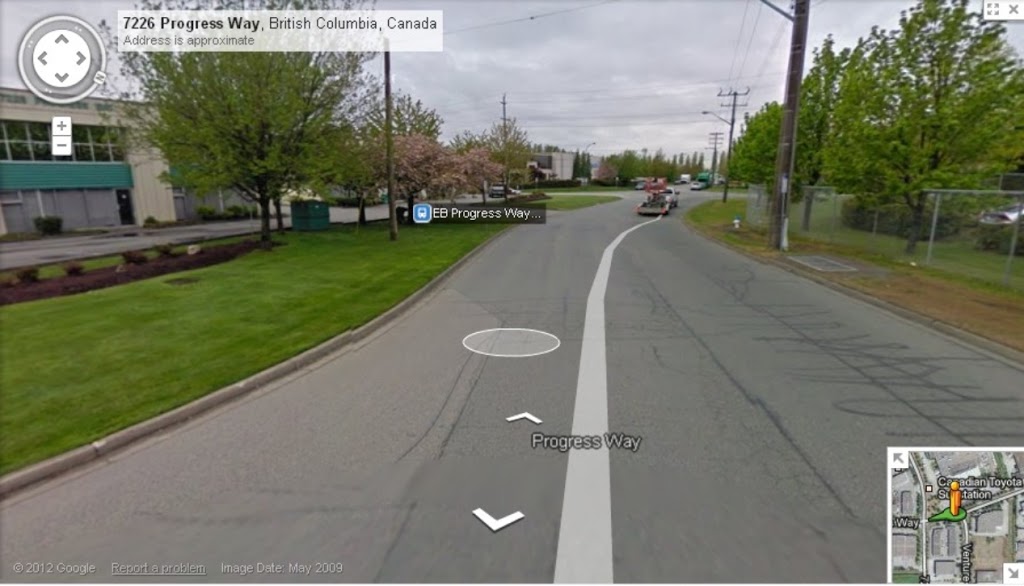
…are trying to operate in areas where bus service is infrequent, does not fit shift hours, does not connect well to rapid transit, and is located a long way from residential areas. Even the infrequent bus service is limited in coverage, forcing transit-users to walk long distances on roads commonly built without sidewalks, and crowded with large trucks and poorly organized parking systems.

Just go to Google StreetView and wander around those neighbourhoods, it is a pedestrian disaster:

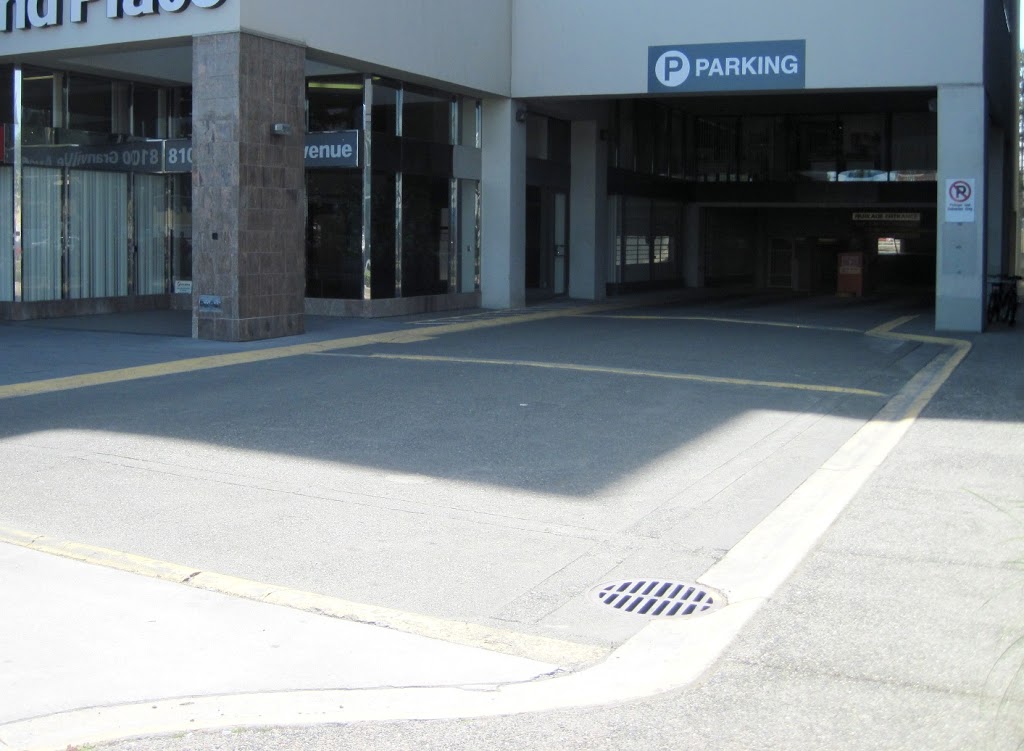
The Chambers above call out TransLink for not providing more comprehensive service to these areas, but that is only part of the problem. They should also be calling out on their local Municipal Councils, Transportation and Planning departments to design these “business parks” with accessibility in mind. There appears to be a legacy of bad planning here we are currently saddled with, but look at at this brochure for Surrey’s newest, most exciting business park opportunity: notice anything missing from the “features”? There is one bus that runs through this park, the 531, which provides 30-minute service from 6 in the morning to 9 at night. Marginal service at best, and if you are the guy sweeping the warehouse after the crews leave at 5:00, you are driving home at midnight. But you won’t see that in the flashy brochure. Is that TransLink’s fault, or Surreys?

Also, it isn’t just warehouses and industrial sites: the slab-walled business parks in places like the Knight Street area of Richmond have high office vacancy, not because they are not Class-A space, or because the rates are too high, but because the location between highway offramps in the ‘burbs (even the really-close-in ‘burbs) is just not where people setting up Class-A-desirous businesses prefer to be anymore. These entrepreneurs and corporations would rather be in Yaletown, on the Broadway Corridor, or even (dare I say) New Westminster – because there they can attract the best talent, and have happier employees, partly because the transit service is frequent, but more because you can walk outside at lunch and have a choice of eateries, or run errands at local businesses. Life is too busy these days to rely on a car. You can’t get anywhere in a car on your lunch hour.

It is worth noting, these things represent New Westminster’s competitive advantage. Even our worst-serviced areas, which happen to be the low-wage labour areas (the warehouses and big box retailers of Queensborough), they still see better, more frequent service and are more friendly pedestrian environments than most industrial-warehouse wastelands in Greater Vancouver. This is why the addition of 230,000 square feet of Class-A office space in Sapperton is good gamble for Wesgroup, and 130,000 square feet of Class-A is a good gamble for the City.

But that’s a topic for another Blog post.

Bicycle Lane Obstacle Course #3

In light of comments from someone whose opinions matter, I thought I would clarify the purpose of these posts a bit.

I am always first to point out that my bike route to work is pretty good, an example of what should be available to more people in more places. I don’t get all that concerned about the few little issues that pop up – because I am cognizant of how difficult it is to operate a City, and manage all of the little things that crop up, not to mention the hassles that typically go with living in a big urban area with 3 million other people.

So when they are tearing up a road to replace a water line, that doesn’t bother me. When they need to drill holes in a road and close a lane, and have lots of signs and flag persons, and I have to wait a minute to get on my way, that’s part of the deal of getting to use the infrastructure. Most drivers roll with that, and so do I when riding.

Sometimes commercial vehicles, for whatever reason, need to block a lane for an extended period of time to do their jobs. When that happens, they apply to the City for a temporary road closure permit, and set up appropriate safety flagging, signage, etc. The City I work for does not charge for this: the permits are free, a service your tax dollars provide. When driving or riding, you see these things as necessary and accept them as part of City life.

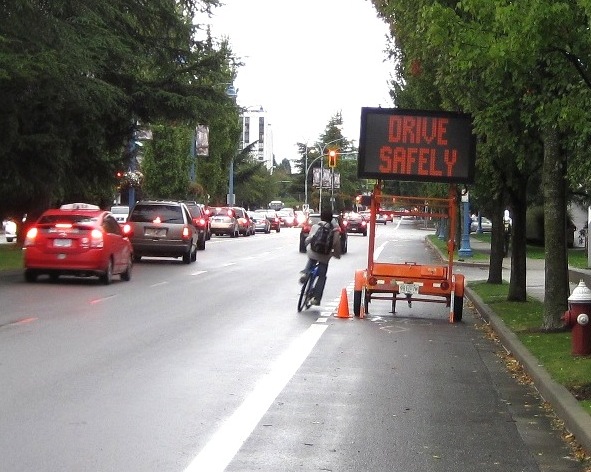
That’s not what I’m talking abut here. What I’m talking about is things we find in the bike lane that would never happen in a driving lane, or at least would be met with outrage by drivers, but is commonplace in the bike lane, or as it is typically viewed “the shoulder of the road”. Daily dodging people pulling into the bike lane to pass on the right is par for the course. Until they kill me, I’ll just get used to it.

So when I complained about this commercial vehicle blocking the bike lane during rush hour, it was not just him being there, it was because we know he would not block the car lane during rush hour, and it is not like he had no alternative: this is the commercial loading zone less then 20 feet away where he chose not to park, because the bike lane was just too convenient:

But here is the best example I have found yet, one I griped about earlier, but fits as probably the model example of the Bicycle Lane Obstacle Course, one worthy of BLOC post #3:

damn cyclist, swerving all over the place, and not even wearing a helmet!
Can you imagine a lit sign in the middle of the driving lane asking people to “Ride Safely!” that cars had to swerve around? What if it forced you to get out of your car (“dismount”) and push your car around the obstacle, or maybe to hop onto the sidewalk and dodge pedestrians, to get through safely – hey, its only a few seconds of your time… then you can get on your way!
So I hope to show examples of how good cycling infrastructure (all photos so far show good, well planned bicycle lanes) goes terribly wrong by missing the details, or through general lack of acknowledgement that it even matters.

Show and Shine – a trip through Car History

Showing how behind the times I am, here is another post at least two weeks late…

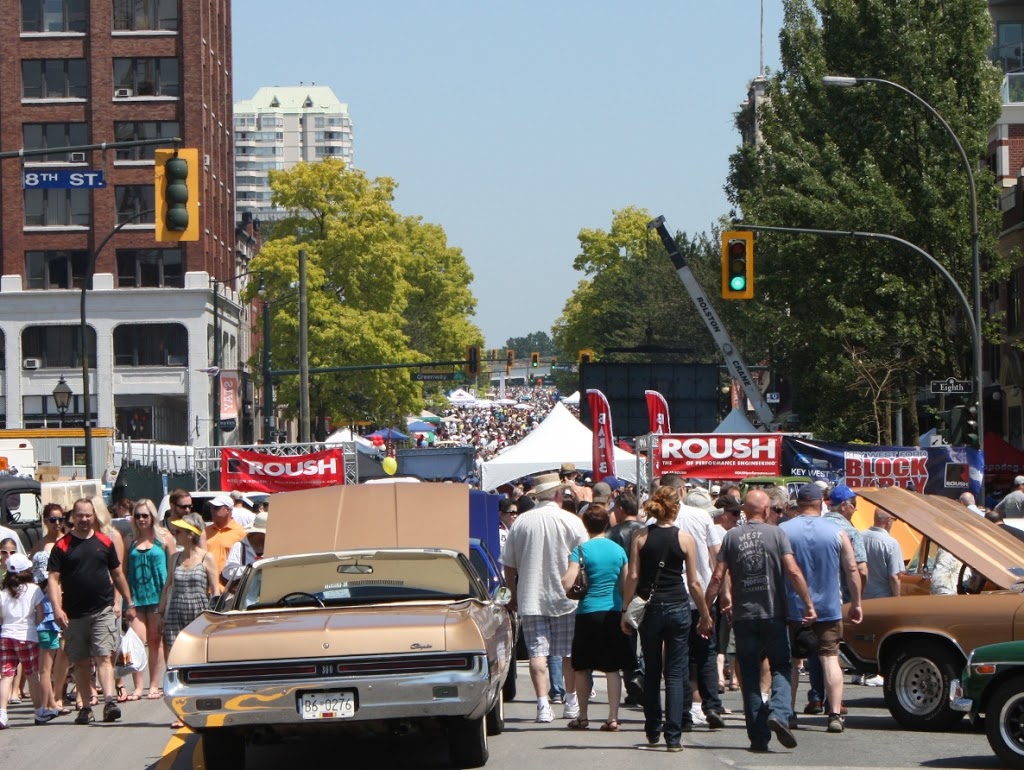
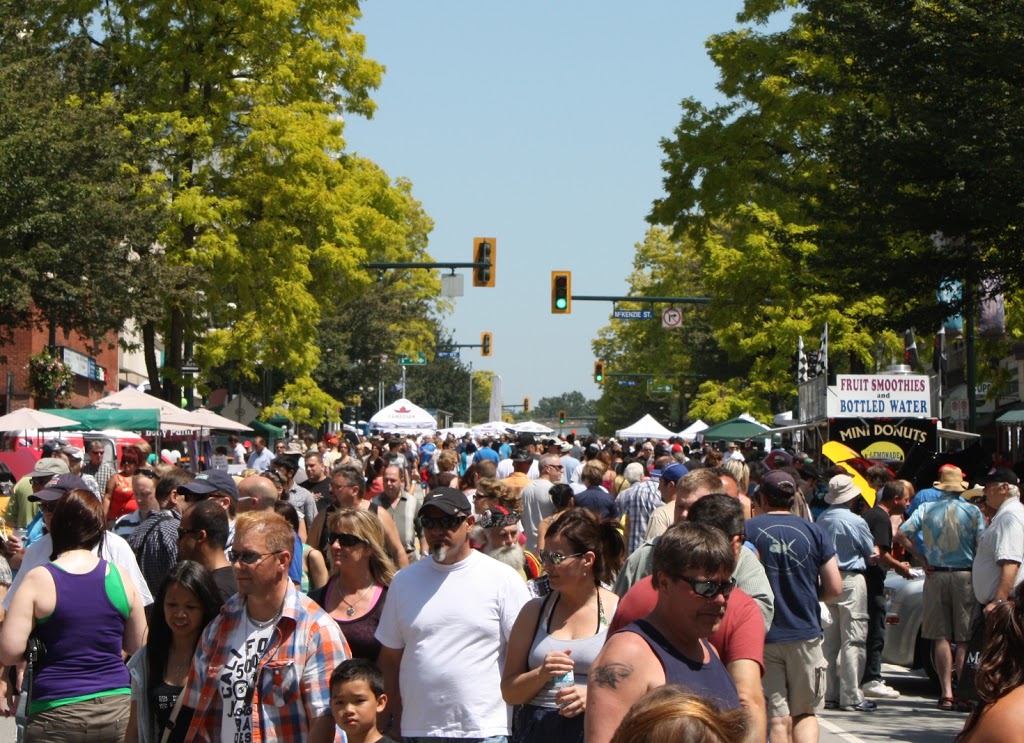
Yes, I went to the Show and Shine here in New West. Sapperton Day(s), FraserFest, SummerFest, the 12th Street Festival: they all have their charms, but the Show and Shine is really the biggest one-day event we have in New West. The sheer numbers of people downtown and the scope of the whole affair is daunting. Kudos to the Downtown BIA for a great show.

I can’t avoid the irony that the biggest “Car Free Day” we have in New Westminster is, in fact, and Ode to the Car, in all its forms. However history of Columbia Street and Downtown New Westminster is, in many ways, drawn from the history of the automobile.

Columbia was built in the 1850s for horses, wagons, and pedestrians. It hosted electric streetcars for local service from 1891 to 1938, and Interurban electric passenger rail from 1892 to 1950. During this time, the rails shared space with increasing numbers of cars, and it was the increase in cars that brought Columbia to the fore.

The building of the Pattullo in 1937 brought more cars (and the end of local streetcar service along Columbia), and around the same time a bunch of what we would now call “stimulus money” was used to expand Kingsway from a small rural road to a major urban throughfare. Thus began the “Golden Mile” era of Columbia Street, as it became a major regional shopping, business and entertainment district, peaking at the time when Car was King.

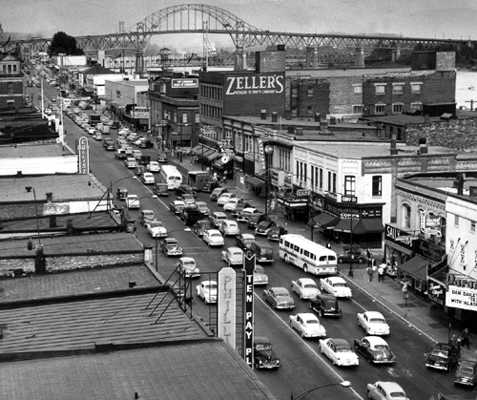
Clearly, traffic wasn’t a problem in 1953. Nothing but free flow here in the good old days.
(photo courtesy the Province, via KnowBC)

Like most Kings, the Car giveth, and the Car taketh away. First the Interurban was gone, leaving an almost 40-year gap in train service. Then by the late 1950s, another phenomenon began to rise: the car-oriented shopping centre (soon to evolve into the Mall). If American Graffiti told you everything you needed to know about North American culture at the end of the ‘50s, then Mall Rats told you the story of the end of the ‘80s. The “Golden Mile”, after only a few decades, started to tarnish. Drivers went to places like Oakridge, and Lougheed, and Lansdowne; shoppers drawn to their massive free parking lots and climate-controlled browsing opportunities.

Not that Downtown gave up without a fight. They built a Parkade in 1959 to compete directly with the burgeoning shopping centres. In 1964, the Trans-Canada Highway was built way over on the Port Mann Bridge, stealing yet more attention from Columbia. Downtown New West doubled down on parking, increasing the size of the Parkade.

Alas, there seemed to be no stopping the forces at work. It wasn’t the lack of parking that was killing Columbia Street, but change in lifestyle and shopping patterns. New Westminster’s Golden Mile was yesterday’s news.

The first sign of resurgence came 20 years later with the arrival of SkyTrain and the Expo-86-funded Westminster Quay. Along with a waterfront Casino, a new hotel and the relocation of Douglas College, but for whatever reason, the momentum didn’t hold. Maybe poor City planning, inexperience on how to exploit the growth, the damn NDP, who knows? Maybe it was because despite the new improvements, Columbia Street was just not that nice a place to be in the 80s. Fast forward another 20 years and a few well-timed and well-placed developments, along with a significant road diet have changed that. A major shift came when Columbia Street once again turned from a place for cars that barely tolerated people, to a place for people where cars are tolerated. Things are booming again.

Still, one day a year, we turn the street back over to the cars, with a vengeance. And this year, the crowds were phenomenal. The beer gardens were full, the food carts had line-ups, the streets were just less than uncomfortably crowded, and the sun was out with bare midriffs everywhere (unfortunately, mostly expansive and belonging to middle-aged men). Somewhere around 100,000 people on Columbia Street easily make this the busiest day of the year downtown. It was a great opportunity for the Downtown BIA to show off Columbia Street, and they did a great job.

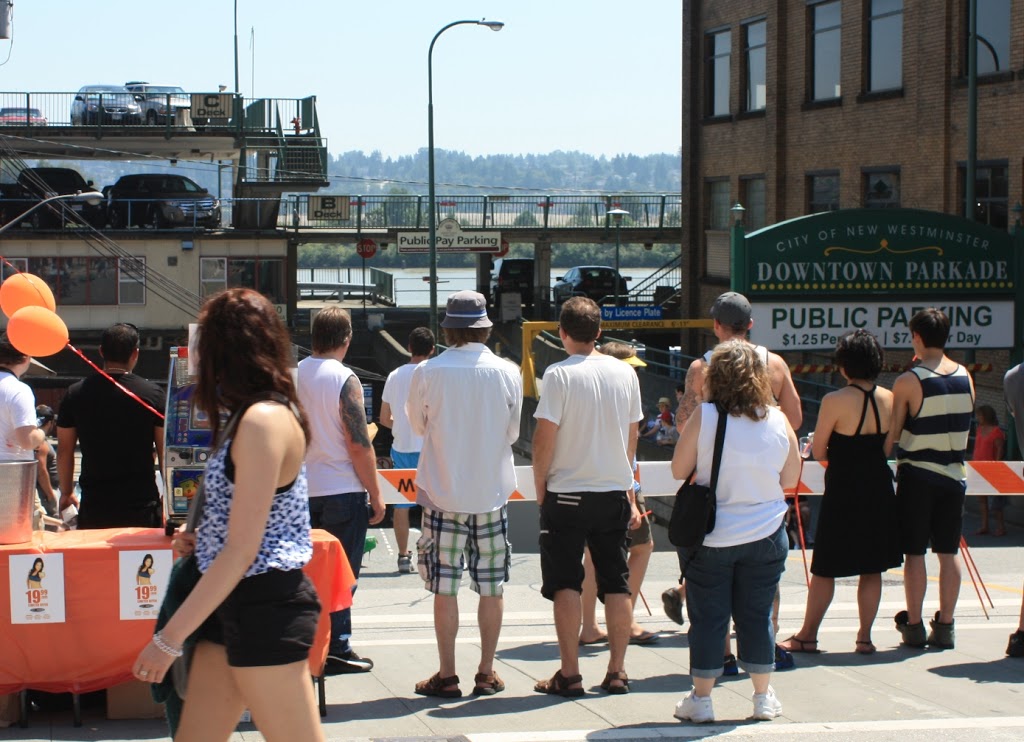
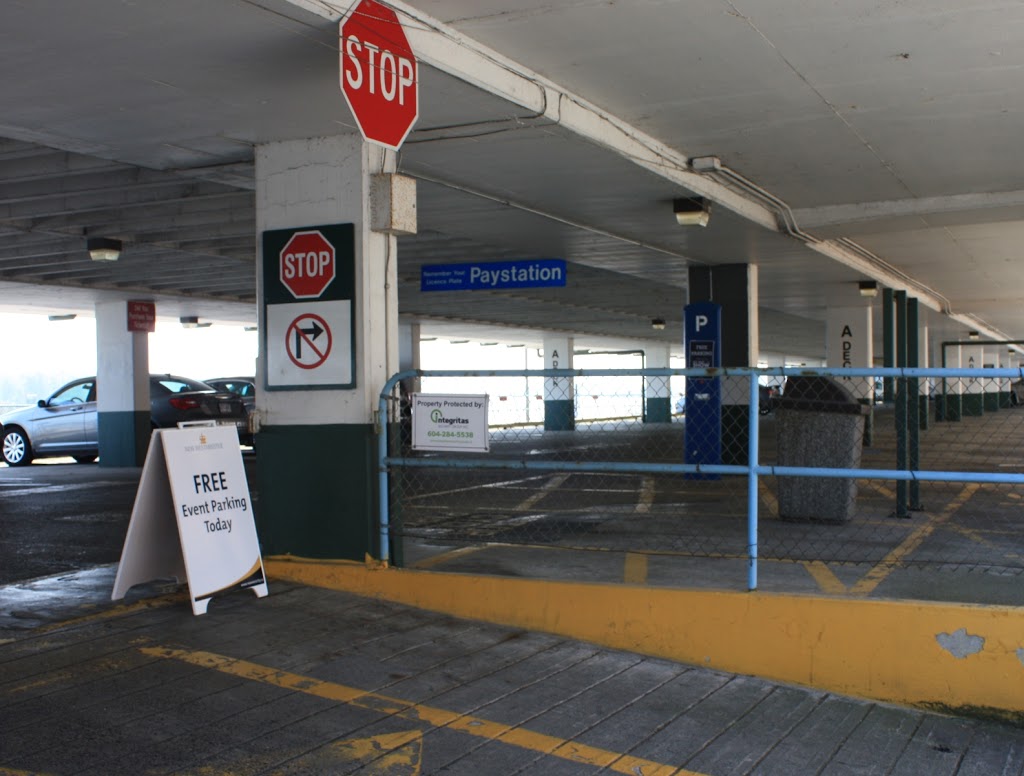
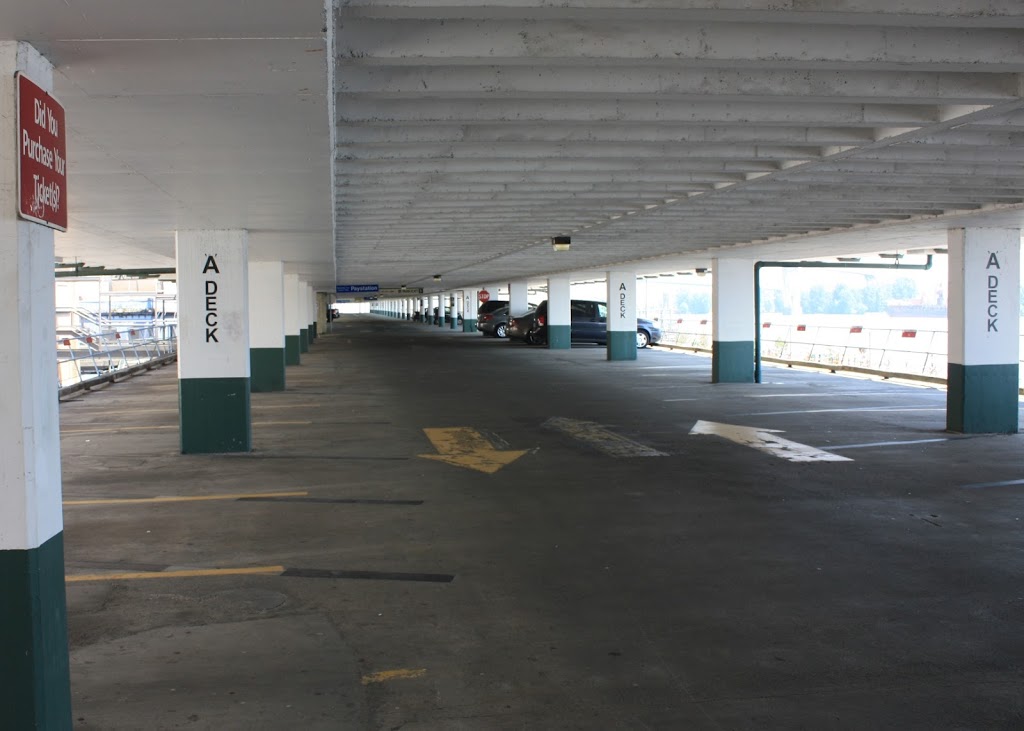
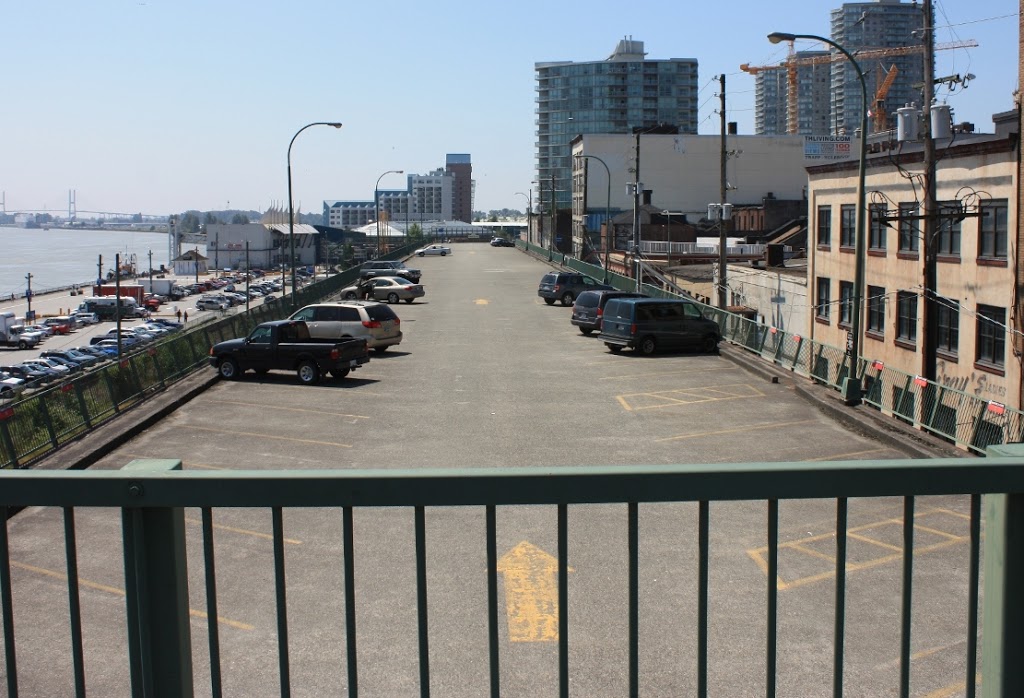
Of course, to support the visiting crowds on the busiest day of the year in Downtown New West, the Parkade was free. It was advertised as being free, there were cops manning the barriers at 6th Street and 4th Street so that people could drive easily into the Parkade, with signs showing just how free it was. So was I the only one not surprised to find it was not only free: it was mostly empty.

All 4 photos above taken between 1:00pm and 2:00pm on July 8, 2012.

Again, I ask the merchants of downtown, if on your busiest day of the year, when all of Columbia is turned over to public space and you could not comfortably fit more people downtown; when the Parkade is free and duly advertised as such; when the free Parkade remains is mostly empty: isn’t it time to recognize the Parkade for the white elephant it is? Can we now accept that it is time to move past the Parkade, and recover the potential human space it supplants? Can we now stop saying it is necessary to support business growth in the City?

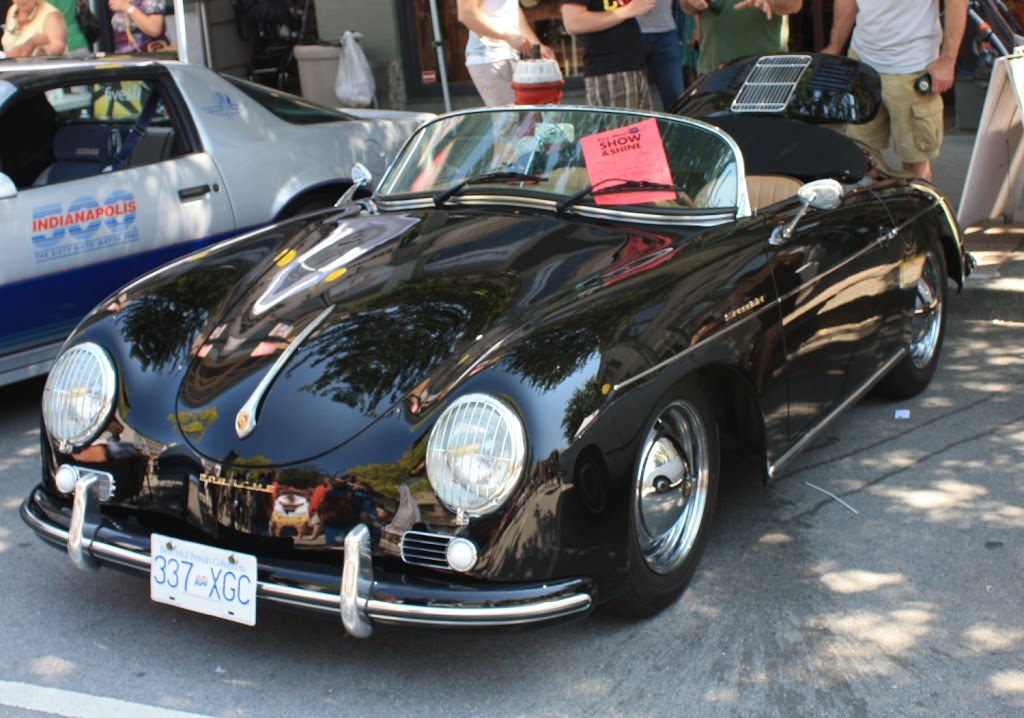
Oh, yeah, the Cars. As much as a I appreciate the level of effort that goes into keeping them valve covers so brightly polished and chroming those headers, American muscle cars and over-wound rice rockets don’t do much for me. My personal best-of-show choice was this perfect combination of design, agility, and elegance: Porsche 356 Speedster.

Cruising the Golden Mile in 1959 – this would have been my chariot of choice.