Council – Nov 4, 2019

We had a shorter Agenda in our Council Meeting this week, but a couple of important pieces were presented right at the beginning as Presentations:

Strategic Plan
Our Strategic Plan was presented by the Mayor himself. This was formally adopted in a meeting more than month ago, but we never had a chance to describe it in detail because that was a busy and long meeting. This outlines our vision, our strategic priorities as a Council, and some of the measures we will use to guide our decision making through to the end of this term. As we start delving deeper into discussions of our budget in the months ahead, this is our guiding document. You can read the entire document here.

2020 Climate Action Budgeting Framework and Ten Year Carbon Targets: New Westminster’s Seven Bold Steps
This report answers the oft-repeated question: What does a declaration of a Climate Emergency really mean?

When Council moved to support this declaration we gave staff clear direction: We want the City to set emissions goals that get us to where the Paris Agreement says Canada has to be, and we want staff to be bold in telling us what that transition looks like. We also wanted to make clear for the public where we are going so that operational and budget changes made in light of this declaration fit within a context.

This report outlines some ambitious goals for the first 10 years of this transition, with the hope to get our emissions down by 45% by 2030 by prioritizing the biggest sources of greenhouses gas emissions in the City. It includes 7 Bold Steps, each with a clear measure for 2030.

But more than these 7 steps, it is clear from this report that Climate Action is an all-hands-on-deck operation. It will be part of every departmental work plan, and our city ide priorities are going to be viewed through a climate lens. It is also going to come with some costs in the short term that we are going to have to bake into our financial plans. We will have, in the 2020-2024 Five Year Financial Plan, the first carbon-focused budget for the City.

I’m clearly not done talking about this, and as we go through the implementation of these ideas and shift in our budgeting, there will be a lot more discussion, but overall I am excited about this work. And note that by happy coincidence, the things that will change in the City to reduce emissions are also things that will make the City a more livable and healthy place: fewer cars burning less gas, more efficient housing, a more robust energy grid, and more green spaces.

2020 Utility Rates
As we are going through work on our budget, it is time to set some utility rates for next year. We have four utilities in New West, and the biggest cost driver in all of them is the cost of the stuff the utility provides – be that water, sewage treatment, tippage fees for solid waste, or wholesale electricity. I had fun drawing flow diagrams last year to show where this money goes, which you can see here.

The proposed increases for water/sewer/trash are consistent with what we talked about last year (we do this as part of 5-year plans), so nothing changed here.

The Electrical Utility, however, is proposing to shift how the 5% Rate Rider is managed. Instead of going into general utility revenue (like the BC Hydro Rate Rider that it was originally modeled on) we are taking a portion of the rate rider revenues to fund a Climate Action Reserve to fund the acceleration of some climate actions.

These are the proposed rate changes, and Council supported them in principle. This will now get baked into a Bylaw and Council will review again.


We then moved the following items on Consent:

Completion of Appointment of Members to the new Grant Committees
We talked last meeting about re-alignment of committees, but skipped over the Grant Committees, as they are a bit unique – they exist to provide community input to the job of sifting through our many grant applications to determine who gets those grants. We are also assigning a senior staff member to each of those grant committees to help guide the process from a policy side.

Recruitment 2020: Appointment of Chairs to 2020 Advisory Bodies of Council and External Organizations
This is our annual appointment of Council members to Advisory Committees, and internal and external boards. With the change in committee structures, there is quite a bit of shifting around here. I’m on the Electrical Utility Commission, the new Facilities, Infrastructure and Public Realm Advisory Committee, and will Chair the Sustainable Transportation Committee. I will also be a member of the Environment and Climate Task Force, the Facilities, Infrastructure and Public Realm Task Force, and the Sustainable Transportation Task Force.

TransLink/SkyTrain Guideway (22nd Street Station to New Westminster Station): Request for Construction Noise Bylaw Exemption
Translink is doing some guideway maintenance of the SkyTrain, which simply cannot happen during the day when the rails are energized and have trains running on them. They need a construction noise exemption to do this work.

Provincial Housing Needs Report Program
The provincial government now requires local governments to do annual Housing Needs Assessments. I was ready to get all huffy about downloading work, but the Provincial Government also provided funding to do the work! More good news is that Metro Vancouver is going to coordinate collective data collection to inform these reports as part of their work plan. So we are going to apply for the provincial funding to pay for the part of the report we need to do, and join our metro partners in the group data collection. I love it when governments work together.

705 Queen’s Avenue: Temporary Use Permit for Group Living Facility – Preliminary Report
Westminster House provides residential programs for women recovering from addiction. They run several support houses in residential areas in New Westminster. This is another house they would like to use for the same purpose, but need a Temporary Use Permit because the type of service they provide doesn’t strictly fit the zoning. This is a preliminary report, and the application will go to public consultation and an Opportunity to be Heard, so I’ll hold my comments until then.

550 Sixth Street (CIBC): Development Variance Permit to Vary Sign Bylaw Requirements – Consideration of Notice of Opportunity to be Heard
The Bank at 6th and 6th wants to replace their fascia signs, and though they are basically consistent with what is there now, they but they would not comply with the Sign Bylaw, so they are asking for a variance. This will go to an Opportunity to be Heard, so I’ll hold my comments until then.

330 East Columbia Street (Royal Columbian Hospital): Development Variance Permit to Vary Sign Bylaw Requirements – Consideration of Notice of Opportunity to be Heard
Perhaps not surprisingly, our Sign Bylaw also doesn’t reflect the unique signage needs of a Hospital, so RCH is applying for a variance for the signage on their new building, and some wayfinding signage around the campus. This will go to public consultation and an Opportunity to be Heard, so I’ll hold my comments until then.

221 St. Patrick Street: Development Variance Permit to Vary Height Limit – Consideration of Opportunity to be Heard
This property owner in Queens Park wants to lift their house to make an underheight basement in to a livable space. This requires a variance because the height of the house would be about two feet higher than currently allowed. This will go to an Opportunity to be Heard, so I’ll hold my comments until then.

Queen’s Park Heritage Conservation Area: Special Limited Category Study Completion – Official Community Plan Amendment for Consideration of First and Second Readings and Direction on Proposed Zoning Bylaw Amendment
This is our ongoing refinement of the Queens Park Heritage Conservation Area. In the original Bylaw, we had 86 properties in the “special study” netherworld between protected and not protected. Through further study, 33 of those were removed from protection, leaving 53. Through yet again, another level of evaluating the remaining houses, we are now looking at removing 7 more, leaving 46 which we would move into the protected category, which requires an OCP amendment.

We also had a request to formalize the zoning of a duplex in Queens Park, and identified two more that are in the same state – long-standing duplex, without the consummate zoning. Duplexes are exempt from protection in the QP Heritage Area, but all three of these duplexes are too young to subject to protection anyway.

This will, as you may have guessed, be going to a Public Hearing, so I’ll hold my comments until then.

DCC Expenditure Bylaw No. 8159, 2019
Development Cost Charges are money we collect from developers to pay for infrastructure upgrades identified to be required because of the increased density that comes with development. To release money from the DCC reserves to pay for that infrastructure work, we need an authorizing bylaw, which this is.

1111 Sixth Avenue (Wisdom Forest Early Learning Centre): Official Community Plan Amendment and Heritage Revitalization Agreement – Bylaws for First and Second Readings
The Shiloh Church on Sixth Ave near 12th Street is a designated heritage building, but the owners want to replace the accessory building beside with a new building to host a childcare centre. Because the property is designated, that need an OCP amendment to make this happen. This will go to Public Hearing on November 25th, C’mon out and tell us what you think.


The following items were Removed from Consent for discussion:

Amendment to the 2020 Schedule of Regular Council Meetings
We are going to adjust how we do Public Hearing days, starting our regular meetings at 6:00 and starting Public Hearings at 7:00. This has a couple of advantages. We can get some priority work done before the Public Hearing starts, reducing the amount of staff who have to stick around late into the evening for longer Public Hearings, and it gives people with busy schedules an commutes a little more time to get to City Hall if they want to take part in the Public Hearing. We will try this out a few times, and I suspect it will work better.

User Fees and Rates Review
As part of our annual budget work, we review our fees for everything from cemetery plots to renting studio space to connecting your house to electrical service. Each department compares the fees to the actual cost to provide the service, and compares us to other municipalities and comes up with recommended changes. Most changes are linked to CPI (a 2% increase this year). One thing going up more is the charge for car storage in public space, which we talked about last meeting. We also removed the charge for casket services for infants, which I think is a subtle nod to being a more compassionate City.


We then did our usual multiple-reading bylaw exercise, which included moving Adoption fo the following Bylaws:

Delegation Bylaw Amendment No. 8163, 2019
This Bylaw that shifts some language in the Bylaw that delegates some of Council’s responsibility to senior staff so they can do their jobs without waiting for us to meet and review everything was adopted by Council.

Revenue Anticipation Borrowing Amendment Bylaw No. 8158, 2019
This Bylaw that allows the City to borrow up to $3Million in the very short term to keep us from going overdraft, which we renew every year and hardly ever use was nonetheless adopted by Council.

Street and Traffic Amendment Bylaw No. 8160, 2019
This shift in how we define “truck” to better coincide with neighbouring communities was adopted by Council. Keep on Truckin’, but please stick to regulated Truck Routes.
Public Hearing- Oct. 28, 2019

Of course last Council meeting was a long one less because of all of the business I reported earlier, and more because there were Public Hearings on 4 items:

Zoning Amendment Bylaw (837-841 Twelfth Street) No. 8139, 2019
This project would see a 5-storey residential building built where there is currently an empty lot on 12th Street at Dublin Street. This is a project that has shifted a lot over the time it has been through public and committee review, including reducing from 6 stories and a shift in unit mix. It landed at Public Hearing with 29 residential units, 8 of them being three-bedroom and 21 being two-bedroom, with 4 units ground-level townhouse style units facing 12th Street. It would also meet “Step 4” of the BC Step code making it the most energy efficient multi-family building in New West.

We had no written submissions, but two neighbours came to speak with concerns about the massing, and about the impact of pile driving during construction (this issue was raised during public consultation, and the builder provided a geotechnical report indicating there would not be pile driving required during the construction).

Council moved unanimously to approve giving this project three readings.

Zoning Bylaw Amendment (540 Ewen Avenue – Cannabis Retail Location) No. 8108, 2019
This was the application that had the most delegations for the evening. The application is to permit the sale of cannabis in an empty retail storefront in Queensborough. This was the first of two cannabis retail applications for review this evening (with three other locations – Uptown, 12th Ave and Queensborough Landing already approved), but it certainly was the most contentious application we reviewed. We received something like 600 pieces of correspondence on this application, with more than 500 of those individually signed copies of a form letter in opposition. Of the other correspondence, it was evenly mixed between people in favour and those opposed. We had about two dozen people delegate to Council, with a few more in favour than opposed.

Much of the discussion both for and against seemed to be re-litigating the case for cannabis legalization. One of my council colleagues wisely pointed out that the fears people have about cannabis legalization are based not on ignorance or prudishness, but on the legacy of a century of Canadian government, schools, police, and other “authorities” telling people that cannabis was evil and one of the most dangerous things their kids could ever be exposed to. People are afraid of cannabis because they have been relentlessly told to fear it their entire lives. That the federal government has now made it legal, and is not investing any time or energy undoing those narratives has essentially set people up, and communities up, for these conflicts of conscience.

Even in much of the discussion of this specific location, much of the concern was related to fears of the product. It shouldn’t be near a toddler daycare, 150m is not far enough from a playground, and a general idea that people will feel “unsafe” near the store. I did have more time for people concerned about noise and nuisance in a location that is near several residential properties, but the application is being made by a local business owner with deep roots in the community and experience running a nearby neighbourhood pub and is experienced at managing these type of issues, helped assuage some of these concerns for me.

On the bigger issue of cannabis retailing, I do hear people’s fears and concerns. It has been decades since I was a cannabis user (hey, I grew up in the Kootenays!) but I am aware how ubiquitous it is in British Columbia. I don’t believe it is a harmless product, but I think the potential for harm is much lower than alcohol or tobacco, and those harms are best managed through a legalized and regulated industry, not through prohibition. Pot exists, and is not going away, lets allow a regulatory regime suck all of the cool out of it and saturate the black market out of it, and it will be easier to address the externalities.

So I voted to support this location, and in a split decision, Council voted to approve the location.

Zoning Bylaw Amendment (71 Sixth Street – Cannabis Retail Location) No. 8107, 2019
This second Cannabis Retail application of the night did not draw quite as much response as the first. The location is in a corner store location on Sixth Street and Agnes in the Downtown. We had 5 written submissions, and about a dozen people came to speak to the Public Hearing, about evenly mixed between those in favour and those opposed. There were some difficult delegations, as the conversation moved to a bigger discussion of the current addiction and fentanyl crises, though the understanding of what the role of Cannabis regulation (and other aspects of “safe supply”) was not really explored at length.

In the end Council voted unanimously to support this application.

Official Community Plan Amendment (318 Fourth Street) Bylaw No. 8147, 2019
This application was to remove a house from protection under the Queens Park Heritage Conservation Area. The house is old enough (1908) to merit protection, but there is a process through which people can apply to have the protection removed through a combination of limited heritage merit, low potential for restoration, or unreasonable impairment of zoning entitlement. There is a scoring system developed to guide evaluation of the merit of these applications, and houses that score 61% or higher are not recommended for removal. This house scored 60%, which means it is recommended for removal by staff, but is obviously right on the edge, and ultimately, this decision is up to Council. Because removing protection requires an amendment of the Official Community Plan, they must go to Public Hearing.

We had 14 written submissions on this application, almost all opposed to removal of protection. We also had 11 people come and delegate to Council, all excepting the applicant opposed to removal.

The argument for removal was that the homeowner wanted to build a different style of house, and did not feel that the exiting house could be renovated in an affordable way to meet his family’s needs. This 0.47 FSR house on a 7000 SqFt lot could be replaced with a slightly larger (up to 0.50 FSR) house. With the incentives available through the HCA program, an extension or carriage house totaling more than 0.70FSR could be built with preservation of the house. I would argue that his zoning entitlements are much better (by 1,600+ Square Feet) with preservation.

In the end, the house is intact, and there was no compelling evidence provided that preservation was particularly onerous. Arguably, this is the type of house that the incentive programs were developed to encourage the preservation of, and I believe the spirit of the HRA was reflected in its protection. Council moved unanimously to not permit removal.

Council – Oct. 28, 2019

We had a long council meeting this week after a full day of meetings made longer by the awareness that it was glorious and sunny outside and more rational people were frolicking in sun. The Mayor did not see the wisdom in my suggesting we move the meeting to a hiking train nearby, so doomed to Council Chambers we were. The meeting was made longer by a couple of Public Hearing topics that had significant public input, but I am going to skip past those (watch for the next blog post) and just get to the Regular Council Agenda:

After the Public Hearing we started our regular meeting with an Opportunity to be Heard:

Development Variance Permit DVP00666 for 331 Richmond Street (Richard McBride Elementary)
The replacement school at McBride needs a few variances, because the unusual nature of the building and it’s zoning. We received a bit of correspondence, and had two people come to the Opportunity to be Heard about the height variance. Many homes on School and Devoy Streets do have spectacular views up the Fraser River due to the steep grades in upper Sapperton, and are concerned a three-storey school blocking that. The variance requested, however, was less than 4 feet over the allowable height, and with the grade of the school site and surrounding roads, I am of the impression the change in visual impact will be minor. And we need to replace the School.

Council voted to approve the variance.


The following items were Moved on Consent:

Recruitment 2019: Committee Rescindments
We have had a couple of members of committees change their life situations and have to leave some committees, as commonly happens. We do this official rescindment so their lack of presence doesn’t have a big an impact on the quorum requirements for the volunteer committees

A Bylaw to Amend Delegation Bylaw No. 7176, 2015
This Bylaw defines the things that staff (our CAO or her delegate) can decide that are typically within Council purview. We are updating this Bylaw for the first time since 2015, mostly to update the names of departments and job roles that have shifted. The biggest difference is shifting the awarding for Grants from a direct Council decision to a staff decision based on Council policy guidance, which should remove some of the politics from the process.

City Small Sites Affordable Housing Projects: Recommended Sites for Two New Developments and Calls for Proposal
The City has supported small-lot affordable housing projects by providing grants of City-owned land to providers able to put housing there. This addresses one of the major hurdles to affordable housing in the lower mainland – the high cost of land. Unfortunately, the City of New Westminster simply doesn’t own very much land, so these opportunities are limited. Staff have, however, identified two undeveloped City-owned properties where housing may be appropriate; one in Queensborough and one in Connaught Heights. We will now reach out to Affordable Housing providers to see if anyone has the resources to put housing on these spots.

404 Salter Street (Summit Earthworks): Update on Port of Vancouver Permit Review Process for Soil Transfer Facility
These two related projects on Port of Vancouver lands in Queensborough are raising some concern in the adjacent neighbourhood. The lands are within Port jurisdiction and designated industrial by the Port, so the City has little to no jurisdiction over their use, we are essentially a “stakeholder” in the consultation much like the neighbours. We have asked the Port for some feedback on some significant points (traffic impacts, dike improvements, rainwater runoff management, etc.) and we will see where this goes. If you have concerns or want to learn more, the Port’s information page is here.

Development Approval Process Streamlining: Proposed Changes to Development Permit Process and Official Community Plan Updates
We have been working on shifting some of the established ways we run City Hall to make things more efficient and to stop getting in our own way on some of the strategic goals the City has. Staff in Planning have identified some practices in the how we do development approvals that make it smoother, quicker, and more consistent for applicants, the public, and staff. Some changes are internal practices that don’t need any official approval, but some others require that Council amend the OCP. Those latter ones are outlined here, and will need to be put into a Bylaw, and will need a Public Hearing after a bit of public consultation about what the changes mean in a practical sense. Council moved to approve this going to a bylaw.

909 First Street: Rezoning and Development Permit – Report for Information
This applicant would like to build a compact 4-unit townhouse development on a large single family lot behind the City Works Yard in Glenbrooke North. The site coverage is less than what would be regularly permitted, and the FSR is well within permitted, so no variances are expected from the Infill Townhouse and Rowhouse Design Guidelines. This is the first development of this type in this neighbourhood, though, so this is a “check in” report to Council to raise any red flags before it goes to public consultation and the rigmarole of committee reviews and eventually a Public Hearing if it gets that far. Council raised no concerns.

2018 Corporate Greenhouse Gas Emissions Update
The Greenhouse Gasses produced by our corporate activity (running garbage trucks and police cars and lawnmowers and swimming pools and libraries, etc.) have gone down in the 10 years since we established a Corporate Energy and Emissions Reduction Plan, even as our City has grown. In 2008 we set the target of a 15% overall reduction from 2007 levels by 2017. We managed to make that reduction 12.6%, or just short of the target, for 2018. However, this is not a consistent number, as our overall emissions change every year based on things like the amount of snowclearing we need to do.

This is a look back, but we are now, through our Climate Emergency action plan, looking at some very aggressive targets in the decade ahead, ultimately aiming to be truly zero carbon by 2050. There is a lot to unpack here, and our accelerated Climate Emergency approach is going to be reported out soon, so stay tuned, planet-watchers!

Street and Traffic Bylaw No. 7664, 2015 – Revision to Harmonize Truck Definition
Like most cities, we have a Bylaw that regulates how our roads operate above and beside the boundaries of the Motor Vehicle Act. Unfortunately, there are parts of these Bylaws that vary from other Cities (they should all be like us!), and one of those is the definition of “truck” for truck routes. We are aligning these through the regional committee of engineers from all of these cities (“RTAC”). So we need to update our Bylaw to make that alignment work. Adjust your truck definitions accordingly.

Revenue Anticipation Borrowing Amendment Bylaw No. 8158, 2019
Every year, about this time, we update our borrowing authorization so that we can borrow some cash in case it is needed between the end of our spending year and when the next pile of tax payments come it. We have authorization to borrow up to $3M as a kind of “line of credit” for one year, but we are unlikely to use it.


The following items were, late in the evening, Removed From Consent for discussion:

Amendments to the Council Procedure Bylaw No. 6910, 2004
We talked last meeting quite a bit about proposed changes in the Council Procedures Bylaw, and this following some workshopping and a lot of hand-wringing over what works and what doesn’t with our current structure The changes are subtle, but will hopefully act to remind everyone involved that time in Council meetings is expensive and valuable, and that we need to make this time as equitable as possible so a greater diversity of voices can be heard. Council moved (in a split vote) to bring this Bylaw to a public Opportunity to be Heard on November 25. C’mon out and tell us that you think.

New Advisory Committee and Task Force Structure
We are changing the Committees and Task Forces that provide advice to Council. There is a tonne to say here, and this is already a long agenda, so I will only give a bit of a summary here and will talk more about it in a stand-alone blog post. The City currently has 38 (!) committees, way more than any other City in the region, and these committees eat up a lot of staff and volunteer time. We want to make sure we are getting the most value from that time, and have pared the committees down to those that directly relate to Council’s strategic plan, and those where lived experience and technical expertise do not exist in our staff or council to assure we are hearing voices that need to be heard in order for us to move forward on priority areas.

We are amalgamating some committees, moving some into internal staff-only working groups, and are starting a new committee. We will be reducing our total count of volunteer committees and staff task forces to 27 (with a couple of the amalgamated ones running for one more year to wrap up some ongoing projects).

Compassionate City Charter: Recommendation from Community and Social Issues Committee
The New West Hospice Society has done great work raising awareness and support for compassionate dying in New Westminster, but their great public profile raising may belie the point that there are no hospice beds currently offered anywhere in New Westminster. We, as a community, have a lot of work to do!

Hospice is, fundamentally, a health care issue that should be a regular part of our health care system, and that is 100% on the provincial government, but the City has found some resources to help the Hospice Society do its great work in the City. I am happy to continue that level of support (including grants and resource assistance with things like the Festival of Loss and Healing), but some of the wide reaching expectations in the Compassionate City Charter are not within our current budget or work plans, and likely exceed what would typically be expected of a City of 70,000 people. Council moved to support the principles of the Charter, and to continue to provide assistance to Hospice within existing budgets, and to continue the discussion about some of the larger goals and deliverables.

Five-Year Approach to On-Street Parking Fees & Rates
It has been a long time since the City did a comprehensive review of the pricing for car storage on public lands. We have not done a serious review during my time on Council, and with ongoing implementation of our newish Master Transportation Plan and further work on bringing in policies congruent with the Climate Emergency declaration, it is well worth us reviewing how car storage fits in our larger strategic visions for the City.

On-street vehicle parking is a valuable resource in urbanized communities, especially in commercial districts, around major institutions, and near rapid transit stations.” I may need to take an entire blog post to deconstruct this single sentence. I actually want to write a novel that deconstructs this sentence… but I digress. The point staff is getting at is that space for car storage is at a premium, so it has a value, and we need to price it appropriately to allocate that space, or it will not work well. To know if it is working well, we need to be clear about what we want from street storage of cars (aside from “MOAR!”)

The report outlines a good set of guiding principles: On-street parking should be priced equal to or higher than off-street, to encourage cars being stored off of the street; using a car should be transparently more expensive than using Transit; and Parking Permit rates should act to encourage use of private land for private car storage. I agree with all of these.

The report has suggested (and Council agreed) that we increase our rates for street storage of cars, especially since our meter rates are now lower than the regional median (often much lower than dense parts of Vancouver, Richmond, North Van, Burnaby) and on-street meters are currently cheaper than off-street garages. Part of this increase will be a Climate Action Levy (or something similarly named) to be dedicated to a Climate Action Fund in the City to pay for initiatives that reduce our community or corporate GHG emissions.

Drainage Improvement Program and Ditch Enclosure in Queensborough
Open drainage watercourses (“ditches”) in Queensborough are a long-standing issue. During the last election, they were easily the #1 issue in the part of the community where they are still present. We had a pretty comprehensive review of them back in 2015, and this report updates that a bit.

I think this is yet another topic I need to write an entire blog post about, because the answers are not simple. But some of the present issues with open ditches can be addressed without the monumental cost of installing complete covered storm sewers across the island. There are also places where open drainage is always going to be present because the flood storage capacity and resiliency offered by them cannot be replicated with underground storm sewers, not to mention the ecological habitat values of some of the canals.

We were shown pictures, and anyone who walks down there during the winter rain season recognizes that the drainage system is not operating in a way that encourages walking, or even guarantees access to some houses. This is related to downstream drainage capacity, sometime to illegal modifications of the ditches to widen driveways or provide street-side parking. Ultimate long-term fixes will sometimes require complete regrading of properties that have houses on them now.

This is a report for information coming out of a public delegation a few weeks ago, and there are some details here about the longer-term planning for drainage infrastructure in Q’Boro, and some operational strategies to address maintenance and illegal filling.

Brow of the Hill Neighbourhood Park Site Acquisition (1009 Cornwall Street)
The City does things like real estate transactions in camera for good reason – you can’t negotiate a business transaction like this in public, but it is great to be able to announce that we were able to secure a fair price for the undeveloped lot in the middle of the Brow of the Hill which the community definitely showed an interest in us acquiring as a passive park area. No big plans for it yet, but the City will do some minor maintenance with a bit of a passive park model.

Multiculturalism Advisory Committee: Formation of a Multicultural Festival Working Group
The Multicultural Festival on July 1st has become a mainstay of the City’s Canada Day celebrations, but it has up to now been run on a shoestring by a volunteer group from the local Philippine community with some grant support from the City. Our MAC is putting together a working group to see if they can provide more direction ans support to make the event more sustainable.


We then adopted the following Bylaws:

Permissive Tax Exemption Bylaw No. 8150, 2019
This is our annual Bylaw to grant permissive property tax exemptions to charitable and civic uses in the City.

Zoning Amendment (886 Boyd Street) Bylaw No. 8100, 2019
This Zoning Bylaw amendment is to allow an electrical substation in the M-1(light industrial) zone so we can build a new substation in Queensborough to make the grid there more robust. We gave this a Public Hearing back in April, and have now adopted the Bylaw. Law of the land, folks.


Finally, we had one piece of New Business:

Motion: Renaming Begbie Square and Begbie Street
Be it resolved that New Westminster Council proceeds with removing the name of Begbie Square and begin a process to identify an appropriate new name for this important civic space;

Be it further resolved that through the City’s examination of our street naming policy that we review the name of Begbie Street; and

Be it further resolved that through our reconciliation process the City find a way to acknowledge, recognize and tell the history of the wrongful conviction and execution of the six Tŝilhqot’in chiefs in Qunellemouth and New Westminster.

This motion removes the name Begbie from the Square in front of the Courthouse, for reasons similar to this. The changing of a street name is a bit of a more complicated legal process, as people have addresses and such, and we have not yet completed the work on our new Street Naming Policy, so this motion does not change Begbie Street, but prioritizes its place in the policy once we get that developed. I was happy to support this motion, and Council supported it unanimously, but humbly.

#ELXN2019

The election is over, and it ended with a bit of a whimper. I have been immersed in this election for a few months and have many resultant notions bouncing around in my head, so better to get them down on paper bits so I can sleep again at night. That said, I am not much of a political pundit, and am willing to lose an argument over beers on any of the points I raise below. If nothing else, it will be fun to read in two years when everything I say below is proved wrong.

I was not too surprised by the nationwide result. Even the day before the election I was thinking (and MsNWimby can attest to my many shifts of opinion about this) that a Liberal majority was still in the cards, based mostly on their apparent strength in the 905 and the Maritimes. Against my own advice, I allowed the poll aggregators to sway my betting pool entry, and under-guessed their strength. The full strength of the BQ surge was not something I saw coming through, and was more of a surprise to me than the fully-expected but nonetheless-satisfying no-show by the racists (may we never speak their name again). Scheer won the 32% Conservative base, and not a single vote more. I suspect he will be replaced as Leader before he gets another chance. Make no mistake, that is the long game of Jason Kenney’s silly “Alberta will separate” rhetoric, and when Kenny’s knives come out for Scheer, it is going to be a milk bath. May’s campaign was also likely to be her last, though she picked up a seat (notably in a jurisdiction where the only clinic offering abortion services is closing due to lack of public funds – coincidentally?), she is clearly bumping up against the ceiling of support she can bring the party, and needs to step aside for some new vision.

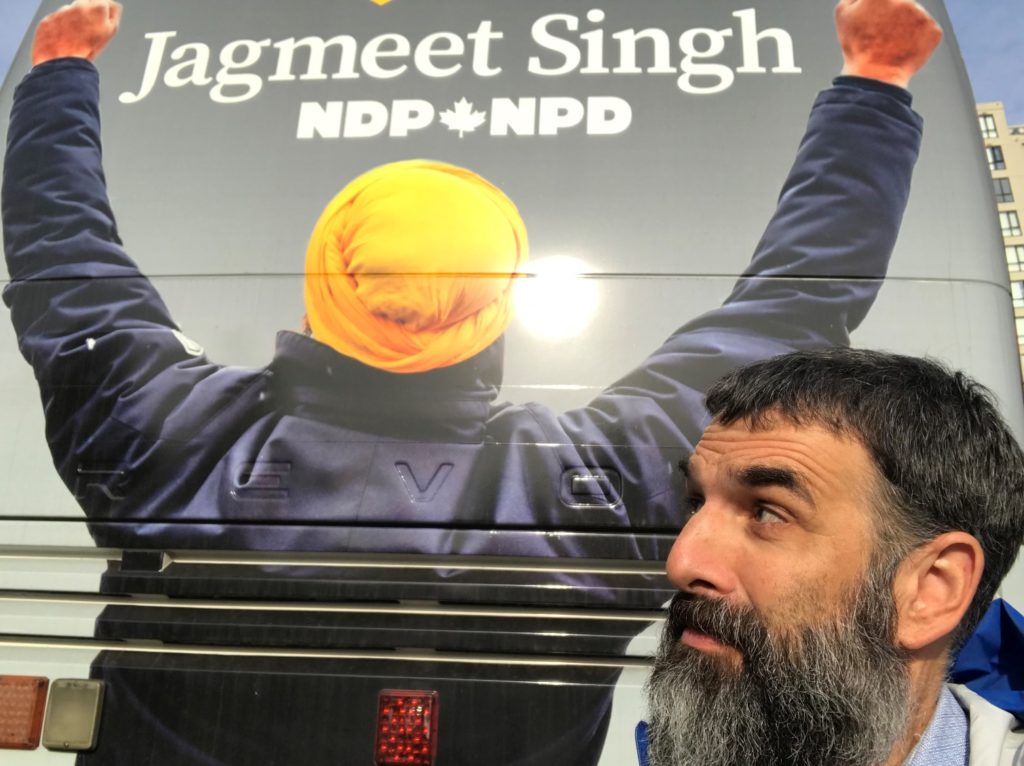
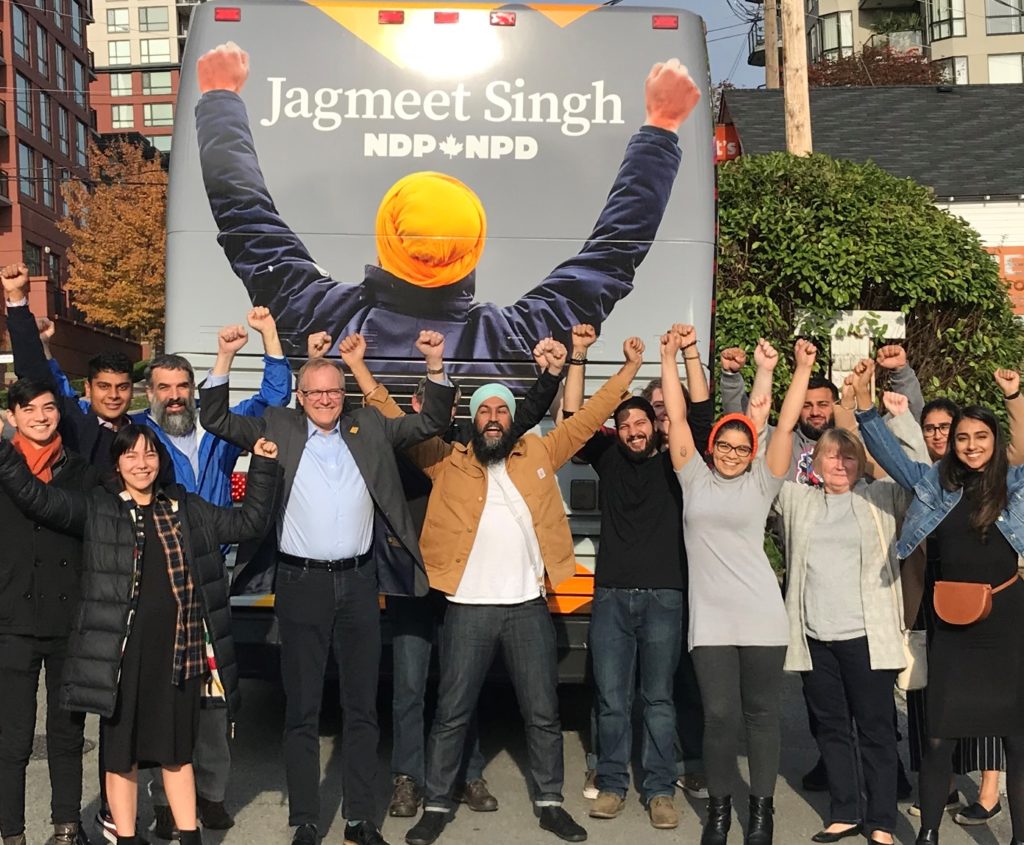
I already publicly threw my lot in with Jagmeet and do feel he was the breath of fresh air in this election, but I’m not going to sugar-coat a loss of 20 seats by pretending it is a victory. There are bright lights across the country, and the NDP indeed did elect members in every region, but 24 seats is a disappointment. That a terrible ultra-conservative parachute candidate with no apparent ability to remember her own party’s platform eaked out a victory over a dedicated hard working ass-kicker of a community leader like Bonita Zarrillo may be my biggest disappointment of the night. If the surge branded as the #upriSingh really extended past the base, Bonita would have taken that riding, as would have Ruth Ellen Brosseau in Berthier-Maskinong and Svend Robinson in North Burnaby. The poll surge was visible, but it may have reflected only the base coming back to camp after a bit of time in the wilderness. Singh’s growth may have just represented the progressive faith that many lent to Trudeau last election coming back to the NDP, as more people recognize that Trudeau’s “progressivness” is as skin deep as his Indigenous-themed tattoo.

The NDP gained come power in this loss (what is the opposite of Pyrric Victory? Lavenic Defeat?). I think the result that gives Liberals and NDP together that crucial 170+ seats is one that will lend itself to some stability (along with the inevitable Conservative milk bath mentioned above). In contrast to a formal coalition, a Confidence and Supply Agreement as was worked out in BC may be a positive path forward, if the peoples in the backrooms of both federal parties are mature enough to get that work done. But is suspect minority rule will be the model, with the opportunity to make some positive progressive change through this, including finally seeing the Liberals honour their many promises on National Pharmacare. Any talk of a potential referendum on Electoral Reform would have to be tempered by the recognition that such a measure would be doomed from the start, and would only serve to entrench the inequity that gives the NDP 7% of the seats with 18% of the vote.

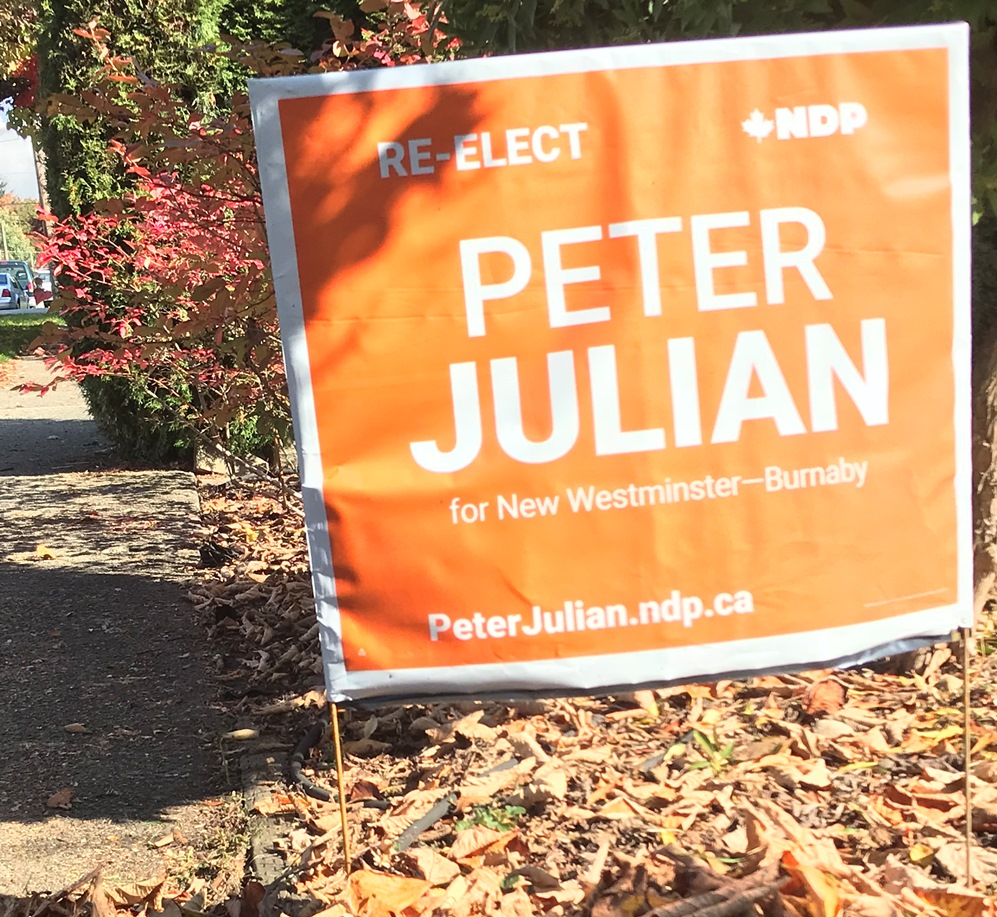
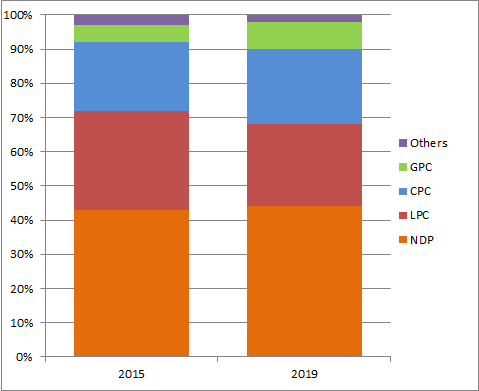
Locally, Peter Julian was no surprise, and it should be no surprise as he is an eminently electable guy, a hard worker, and a strong campaigner. Will Davis had an impressive lawn sign budget, but no other visible demonstration of a campaign or local bona fides, aside from leveraging the New West Progressive campaign “machine”. Megan Veck was another capable spaceholder for the Conservatives in town, aptly drawing their 20% vote base. Suzanne de Montigny showed up at every event, and put in a serious effort, but the positive Green campaign narrative was hampered by her random attacks on the NDP, culminating in a social media accusation of “corruption” in the last weekend of the campaign because she got an anonymous phone call she didn’t agree with. So aside from a couple of notable all candidates events no-shows by both Davis and Veck, there wasn’t much of a local campaign story, and the general lack in vote shift reflected that:

Percentage of vote in New Westminster – Burnaby riding, 2015-2019 Federal Elections.

BTWW 2019

My ride to work for Bike To Work Week yesterday was pretty typical. Nice weather for a 20km ride, and 4 people attempted to murder me.

One was a person in an SUV blowing through a stop sign into my path on a residential Vancouver street, which was easy to forgive because she gave me that ubiquitous “oops” wave. One person pulled a bone-headed u-turn right in front of me as I am going down a hill on another designated bike route in Vancouver, causing me to lock up both wheels on slick streets. No “oops” wave this time, but he did give me a dismissive spin of his tires as he shot away from the scene, which I guess is acknowledgement. One was an attempted dooring on a traffic-calmed bike route, followed a few hundred metres later by a guy in a CLK brush-passing me at 50km/h when I try to stay out of the door zone on another traffic calmed bike route. I foiled them all.

There were also two places where City works crews (one in Burnaby, one in Vancouver) chose to completely close off a relatively safe bike route with no warning and no indications of alternative routes in order to do horticulture work, which is kinda a nice nod to Bike to Work Week.

There were also three places where I was forced to make sketchy moves on the bike because of horrid cycling infrastructure failures. One infrastructure failure in Burnaby is a long-standing grievance at Royal Oak station that will get someone killed eventually. Another is the relatively new one in Burnaby I have already lamented, that the City of Burnaby has now made even worse with the addition of a pedestrian fence. The third one is related to recent construction at the Nanaimo Skytrain Station in Vancouver that has been there for a few months, and seems like it may continue to be there for a very long time. All three of them are adjacent to or near transit stations, so perhaps I should be complaining to TransLink? But not one of them would be acceptable, or last this long, if it was cars forced to make the sketchy move. If drivers were forced to even lighten up slightly on the gas pedal for a brief moment, there would be signs and flagging people and traffic studies. Because even where cycling routes meet transit stations in pedestrian-heavy areas adjacent to popular parks, it is cars that are accommodated first, and the rest of us can fuck right off and get killed. In the context of a ride where several people in cars did actually try to kill me, these little grievances and seemingly minor inconveniences start to grind your gears.

But I’m tired of complaining. And I’m tired of hearing that “scofflaw cyclists” are the bane of urban areas. I’m tired of reading study after study showing that pedestrians and cyclists are getting killed by cars at increasing rates at the same time that driver fatalities are going down. I am tired of Police and ICBC telling me to make eye contact and dress up like a Christmas tree or I had it coming when some asshole left hooks me. I am tired of the profound gap between the lack of responsibility that the people who choose to use cars feel, and their absolute righteousness around their use of cars. I am tired of arguing for basic cycling infrastructure against the societal priority of (preferably free) storage of cars in all public space. I am tired of meetings at City Hall where the only time we discuss cycling infrastructure, it is in the context of how we can maybe afford some half-measure some time off in the future if it doesn’t irritate too many people, but we certainly can’t afford to build something that is safe, connected, and integrated. I’m tired of ceding so much space and energy and money and atmosphere to cars. I’m tired of us treating this City-destroying and planet-killing addiction like it is untreatable, or even beneficial. I’m sick and tired of car culture, of Motordom.

Cycling is making me tired. But it isn’t my legs that hurt, its my heart. I’m afraid that this weariness has taken away the joy I used to get from riding a bicycle.

Voting For

My regular readers (Hi Mom!) will not be shocked to find out I have a bias this Federal Election. Still, there are some people who follow me on social media or read this blog hoping to read about City Council stuff who get angry that I sully that with politics. Some feel that I need to bury my partisan opinions not that I am elected and pretend I support everyone’s ideas equally. If you fall in this camp, I respectfully disagree, and suggest you might want to skip this post and go on to another one where I am ranting about bike lanes or climate change or housing or some other “non-political” subject.

This election has had some holding their nose, but I feel fortunate that I have someone and something to vote for in this election. I have not always been a strong supporter of the NDP (a point one of the campaign managers in this election tried to make hay with when he was running against me in the Muni election – strangely not recognizing it undermined his own narrative that I was a hopeless partisan hack, but I digress…) but I have become a stronger one with each passing year.

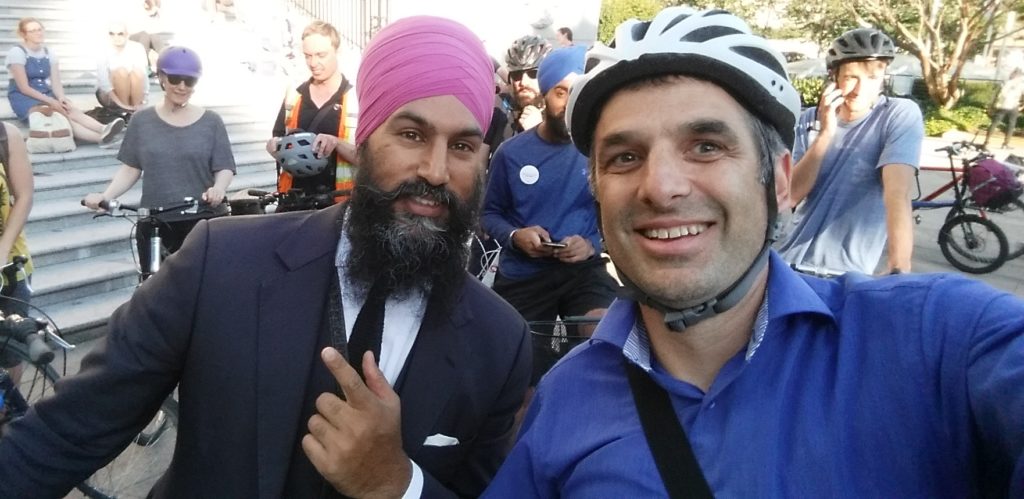
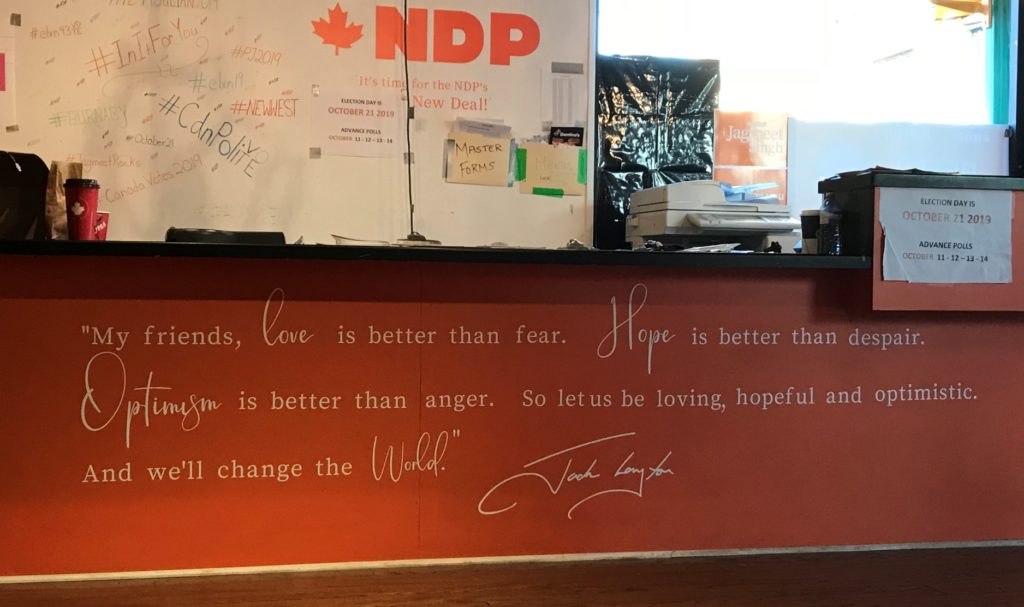
At the Federal level, I was inspired by the strength, vision, and positivity of Jack Layton. I appreciate that it was Tom Mulcair who served as Judge, Jury and Executioner on the corruption of the Harper government and opened up the gap that Trudeau was ultimately more effective at filling in 2015. I can debate at length (and have!) the direction the NDP Campaign went that election, but the principles of the party, including speaking out strongly against the Hijab ban, stood in contrast to the alleged progressiveness of the Liberals, who predictably swerved back to the Right once elected. I have had the opportunity to meet, eat, and ride bikes with Jagmeet Singh, and am always amazed at his grace, his firmness of vision, and the intensity with which he listens. He sees people as good, and sees Canada as a force for good, and wants to see that vision realized. Dude is the real deal.

Fortunately, here in New West we are represented by Peter Julian, and it is easy for me to support him as well. He has a well-deserved reputation as one of the hardest working MPs. His busy Constituency Office here in New West has helped thousands of people address everyday problems with the federal government. He has spent more than a decade running seminars to help people with disabilities and other barriers assure they receive the benefits to which they are entitled in their income tax filings. Representing one of the most culturally diverse ridings in Canada, Peter has learned to greet constituents in dozens of languages (some put the count at 50) because he feels it is important that every resident of this riding feel welcome here. In Ottawa he is bringing forward issues that matter to this constituency, most recently including the Canadian Green New Deal bill he brought to Parliament, hoping we can begin to justly and fairly transition away from a fossil-fuel reliant economy.

I’ve got at least 1,000 more words about the other local candidates that I wrote a few times and deleted, because I am trying really hard to avoid negativity here. Perhaps I can sum it all up wondering where these people were before the election. Other parties parachuting in candidates with zero name recognition and no history working on issues in this community, only to have them avoid all candidates events and play duck-and weave with voters, will assure this remains an “NDP stronghold”. I see no effort by another party to develop a following, or even identify local leaders to carry their brand. Based on the last 5 years in this riding, it appears the NDP are the only party to take New Westminster seriously. After the election other parties will no doubt lament the NDP is unfair or too strong in New West, blaming voters for the work the parties and candidates themselves simply didn’t do to earn their votes.

No federal platform is perfect. There are things in the NDP platform I would like to see them push further on, and things I am critical of (e.g.: electric car subsidies are not great climate policy). Their housing plan is ambitious, and realistically relies less on incentivizing the market (which if done poorly only pushes prices up and is ultimately a better policy area for provincial and local governments) and instead emphasizes doing what Canadian governments did successfully in the decades between WW2 and Brian Mulroney: investing in subsidized housing to provide supply at the lowest parts of the affordability scale. The NDP Climate Plan pushes the edge of possibility (as it is now too late for half-measures) and rightfully centers the marginalized and those displaced by the inevitable economic shift. Their platform more holistically addresses Truth & Reconciliation than any other federal platform. The time for universal pharmacare and sliding-scale dental coverage is now, and will get our health care program up to speed with those provided in advanced European economies while ultimately saving the government and employers money. And we will pay for the (short-term) cost by taking the subsidies away from the companies that are using them to nuke our climate, and by charging more tax to very wealthy people. And, of course, the type of social investments the NDP are talking about are the type that actually grow an economy, not the type that the wealthy can squirrel away in the Caymans…

There is stuff in here for me to vote for, and lots of it.

So I count myself lucky. No holding my nose and no ill-informed strategic hedge betting. A local candidate who walks the walk and does the work, a federal leader I believe in, and a platform I can support. I voted NDP at the Advance Poll last Sunday morning and was enthusiastic in doing it, and on Monday I will be spending my time Getting out the Vote and thinking of a better Canada.

More recycling

There was a good letter in the Record that asked some questions about curbside recycling. So I thought I would try my best to answer them. They make reference to the current recycling yard is closing, if you are here wondering about that, I talked about that here. Short version: the road accessing the current recycling yard will most certainly NOT be accessible during most of the construction period for the Canada Games Pool replacement as it will be a hole in the ground for much of that time, so the City is working on some alternatives, and there will be more to report on this soon.

The most holistic answer to most of the questions in the letter is that the City of New Westminster does not operate in a vacuum, but is a relatively small community in a large, dynamic region. There are multiple jurisdictions involved in our solid waste systems, including Metro Vancouver (who manage all landfill waste and organic waste recycling) and the province (who manage paper and packaging recycling through Recycle BC). These operate alongside Extended Product Responsibility (EPR) programs (like oil waste management and tire recycling), and within a larger regional and global commodities market for the recycled materials, without which there would be no recycling at all.

So the answer to the question why is one type of thing collected at the curbside (newspapers and soup cans) and another is not (glass jars and Styrofoam) is because the organization that takes our recycling from us (be that a government agency, a commercial operation, or a hybrid of both) has the ability to dictate what they will and will not take as part of that commercial arrangement. If no-one will take a type of waste, has to go to landfill, so recycling relies on these agencies and businesses.

When we made the big shift to “comingled” recyclables a number of years ago, it necessarily sent us down a path where we were reliant on a certain type of Materials Recovery Facility to separate those wastes into material we can sell or have someone take off of our hands for a lower cost than sending the material to a landfill or the Burnaby incinerator. For example, the simplest reason why glass jars cannot go in comingled curbside recycling is because the newsprint and mixed paper has some value in the recycling market, and that value goes away if a little bit of broken glass is mixed in with it. We can sell recycled mixed paper for up to $85/Tonne (if we can find a customer, which is becoming harder as there is a significant oversupply of paper fibre right now), but if that paper is contaminated with a broken peanut butter jar, that paper is more likely going to landfill at a cost of $140/Tonne or more for disposal.

When it comes to “depot items”, there are a lot of things that cannot be recycled curbside, from waste paint to toasters to batteries, because handling them in a MRF is hazardous and results in contamination of potentially-recyclable materials. There may be a market for them if the initial separation of materials can happen, so they can;t go in the curbside bin, but can go in their own special bin in a collection point, be that London Drugs or a Return-It depot, or the tire store. This is why so much of our solid waste system regionally relies on education programs about recycling – what can got in curbside, and what can’t. Things that are “technically” recyclable become non-recyclable when they enter the wrong stream, and potentially make a bunch of other stuff not recyclable at the same time. As you allude to, putting technically recyclable stuff in the wrong stream may assuage guilt, it doesn’t help the environment.

Most of these technically-recyclable but not-at-the-curbside materials have multiple places they can be taken in New Westminster, including very likely, the place you bought the actual item. In my earlier post, I linked to this tool from Metro Vancouver that allows you to search for places where you recycle your wastes. There are a half dozen places in New Westminster where you can take Styrofoam or plastic shopping begs to recycle them. Glass jars can also go to a few places in town, but the commodity value of that waste glass is so low, that it is challenging to find anyone to take it. Of course, glass is environmentally inert and non-polluting, so aside from the cost ($140/Tonne +) there is little reason to divert it from the landfill, unless it can be brought into an industrial process like cement making at a lower environmental cost than other raw materials like crushed aggregate, but we are getting deep down the rabbit hole here…

The hardest part about this conversation for an environmentalist like me is the reaction you get when you tell people that recycling is not a particularly effective environmental intervention. For many materials, it simply makes no environmental or economic sense. “Reduce Reuse Recycle” is too often offered as a circular, as if they are all equal in weight when it comes to environmental sustainability. They should always instead be offered as a hierarchy. Reducing your use of single-use plastics and items that are difficult or impossible to recycle (and I am going to throw in here – economically unsustainable to recycle) should be your first priority.

If we are playing with “R” words, we can add “Refuse” – as in refuse to buy items that are packaged in unsustainable ways, and “Rechoose” – as in seek out products and formats that don’t create hard to recycle waste. We have been well trained as a society to think about recycling at the time when we are finished with a product, but we are terrible at thinking about it at the time we purchase something. I suspect our reliance on (even blind faith in) EPR programs was part of this problem. 

Trip Diary 2

In my recent post about the TransLink Trip Diary data release, I talked about how the use of cars in New Westminster is going down. Even as our population grows, the number of people using cars to get around is stable, and the actual number of car trips generated by New West residents on the average day is going down.

I also wrote this does not mean there are fewer cars on the road, or that traffic is getting better, because New Westminster is in the centre of a connected region, and that region is growing. Unfortunately, New Westminster’s decrease in car use is not being seen across the region, and our roads and livability are being  impacted by those trips generated mostly from the south and east of us.

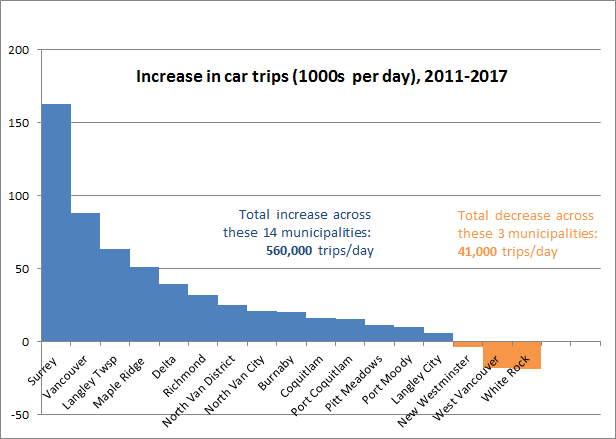
All but three municipalities in the Trip Diary data had an increase in car trips, and the combined number of regional trip increased by more than half a million trips a day between 2011 and 2017. This is only slightly offset by the combined decrease in trips seen in New West, West Van and White Rock:

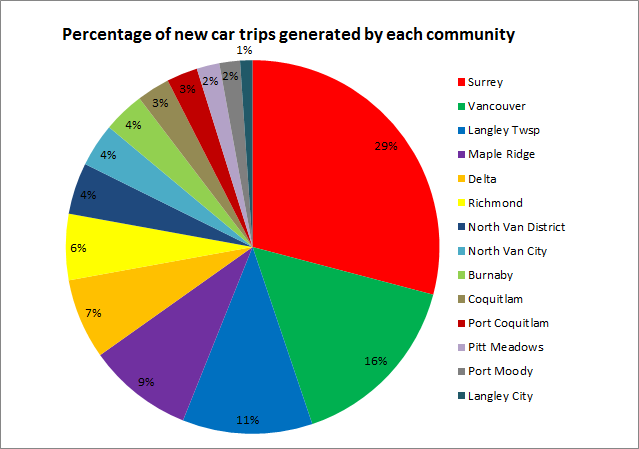
There are a couple of other ways to look at this data, using percentages instead of raw numbers. If there are 520,000 new car trips across the region, this pie shows the percentage of that total traffic load that is generated by each municipality:

So no surprise Surrey and Vancouver lead the way in new car trips, as they are the largest municipalities, nor is it surprising that 50% of the new trips are generated South of the Fraser, and most trips are generated in areas where the region has spent billions of dollars building new freeway infrastructure and new river crossings.

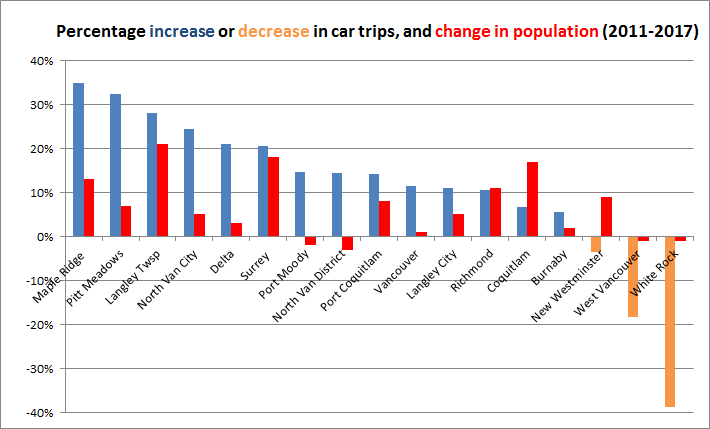
But what about population growth? The South of Fraser an northeast communities are growing fastest, so it makes sense that their car trips will increase in correlation with this, right? More people = more trips is the meme I challenged last post, and it clearly is not the case for New West, but how true is that across the region? The blue bars here represent the percentage increase in car tips between 2011 and 2017, and the red bars represent the population increases over the same time period (2011 – 2017) from the BC Government stats page:

Note that in almost every municipality, car trip numbers are increasing at a faster rate than population. In Port Moody and North Vancouver District – two communities where the councils are using increased traffic congestion as a reason to slow or halt new housing – actual population did not significantly increase over that 6-year period (the fact they show a slight decrease in population is quirk in how BC Population stats are estimated between census years), yet this did not prevent car trips increasing. The short point:

Car trips and resultant congestion do not correlate with local population changes.

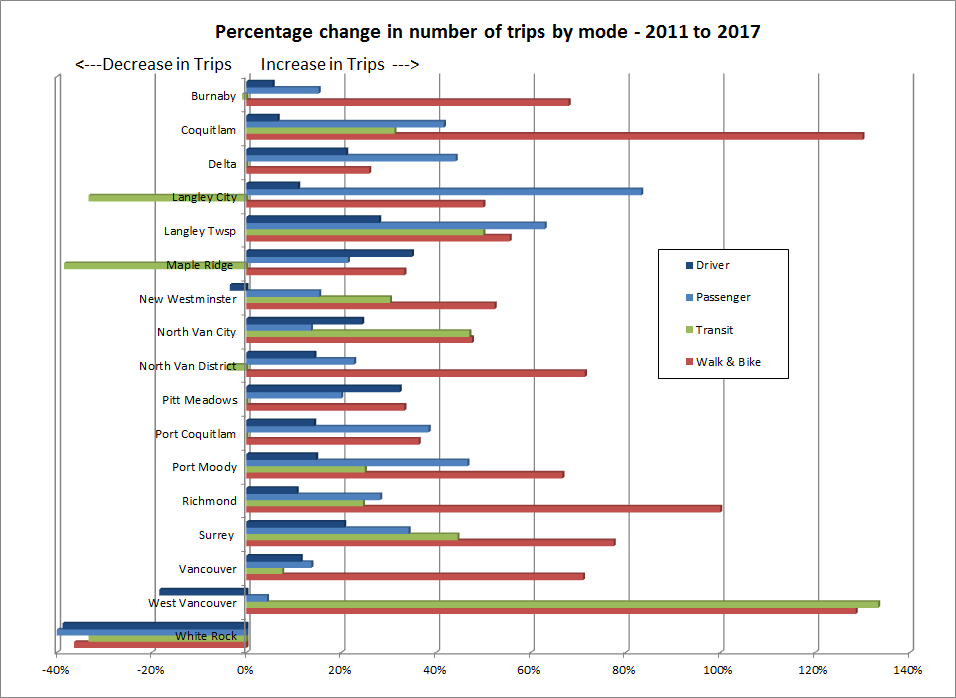
I leave you to speculate about what is happening in White Rock and West Vancouver, two municipalities where population has been stagnant or decreasing for a decade, and neither specifically transit-oriented relative to those of us sprinkled along the Rapid Transit spines, but both seeing much reduced car use. Each has its own tale to tell as West Vancouver had a significant increases in walking and transit use to balance out to about the same number of total trips, while the entire trip count for White Rock across all modes went down significantly. This graph shows the percentage increase or decease in each mode for all Cities, and you can’t help but wonder what people in White Rock are doing at home all the time: 

Also note the latest data was collected not long after the opening of the Evergreen Line, but before the changes that have come with the Mayor’s 10-year Plan investments, which has brought more and more reliable bus service across the region, both in undeserved and overcrowded areas. It is also worth noting that the 2011 data was before the opening of the expanded Port Mann Bridge, and the 2017 data was from the very time when tolls on that bridge were being removed, so the longer term impact on transportation patterns related to toll removal are muted here. Like all surveys, this represents a snapshot in time, and only by collecting this type of data over a longer period can we see the long-term trends our transportation policy is creating.

Council, October 7, 2019

It was annual Council on the Road day at New West Council, when we hold our regular Council Meeting in sunny Queensborough. There were lots of proclamations and delegations, so it is worth watching online! But our regular agenda was fairly light:

The following items were Moved on Consent:

Innovate New West Proposed Work Plan
The City has run a couple of successful “Innovation week” events over the last couple of years. These have brought businesses, institutions, and government together to talk about how we can better foster innovation in public services and better support innovative businesses. As a major part of our Economic Development Strategy, Innovate New West is adapting to better fit the needs of stakeholders and participants. This biggest shift will be breaking up “innovation week” into several events spread throughout the year, which allows more participants to take part in more of the program – it is really hard for small businesses and people running institutes to take several days away from work to attend a week of events. The first will be a one-day Innovation Forum in February or March.

This is a great program, happy to support it!

Proposed 2020 Schedule of Regular Council Meetings
This is the schedule for 2020 Council meetings: 24 meetings, including 9 Public Hearings. We will meet two or three times every month, except in July, August, and December, when people are less interested in City Council stuff, but we meet once to keep business moving along. Plan your year accordingly!

Acting Mayor Appointments for November 2019 to December 2020
We also need a Councillor to serve as Acting Mayor every month, in the event the Mayor is not available to sign timely documents, run a meeting, or do any of those other important Mayor-type things. Each Councillor takes two months of acting duty, mine are March and August. Plan your year accordingly!

Recruitment 2019: Advisory Planning Commission Appointment
The Advisory Planning Commission is a committee of volunteers in the city that has a legislative function in planning by providing a review of development projects from a broad community perspective. We have a short vacancy before recruiting for next year, so we asked on the original applicants to step up and fill the role so they can get the business done. Full recruitment for the next APC will start at the end of the year. If you want a say in how the City meets its planning policy guidelines, dust off your resume!

318 Fourth Street: Official Community Plan Amendment to Remove Heritage Conservation Area Protection – Bylaw for First and Second Readings
The Heritage Conservation Area in the Queens Park neighbourhood protects older houses that have significant heritage value. Some older houses have been modified enough that there is little heritage value yet, and there is a process through which homeowners can evaluate whether removal from protection is reasonable given their specific situation. This applicant is asking to be removed from protection. Because this is an Official Community Plan Amendment, it will have to go to a Public Hearing, so I’ll hold my comments until then.

Major Purchases May 1st to August 31st, 2019
Every 4 months we put out a report of all of the major purchases the City makes. If you bid on a job, or want to know what the City spends your money on, this is the thing.

837 – 841 Twelfth Street: Rezoning and Development Permit for Five Storey Residential Building – Bylaw for First and Second Readings
This is an application to build a 5-storey residential building on the vacant lot on the corner of Twelfth and Dublin. There would be 29 units, all two- or three-bedroom, including 4 ground-level townhouses. This would be the first mutli-family building in New Westminster to be built at Step 4 on the Step Code, making it the most energy efficient residential building ever built in the City.

This will go to Public Hearing on October 28, so I will hold further comment until then.


The following items were Removed from Consent for discussion:

2020 Pedestrian Crossing Improvement Program
The City has a Master Transportation Plan that prioritizes the comfort and safety of pedestrians, and one manifestation of this is a budget line item specifically to improve the safety of crosswalks, and a program to prioritize how that money is spent. This report outlines the 2020 program priorities, based on citizen requests, engineering review, and consultation through the City’s transportation advisory committees.

Litter Receptacles Within Public Streetscapes, Parks and Open Spaces
The City is adjusting how street litter bins are being maintained. The biggest problem we have right now is that some of these bins are being overloaded with residential garbage. For some reason, people are choosing to put their household trash in these receptacles, overloading them, creating mess and expense. Short of putting dumpsters on the street, or paying someone to stand beside garbage bins 24/7, it is hard to figure out how to address this.

Staff has removed, moved and down-sized some of these receptacles to see what that does to behavior. Surprisingly, this resulted in less litter on the streets (yes, the City has people who actually track and count litter, along with picking it up), and reduced volume of trash being collected, which presumably means people are taking their trash home or throwing it into a commercial receptacle. This reflects the experience in other cities when a program like this is implemented.

Another interesting and completely unsurprising point out of this: street recycling bins simply don’t work. People put everything and anything in them, and the resultant waste is too contaminated to go to the recycling stream, so it goes to landfill with the rest of the trash.

New Westminster Aquatic and Community Centre Update
This is an update on progress with the Canada Games Pool and Centennial Community Centre Replacement Project. Last week we dealt with the variances needed given the design, and talked about the energy and GHG efficiency goals of the new building, this is more a holistic update on the project.

Unfortunately, one of the base assumptions about how we were planning this project has been problematic. Since we started serious planning for this project, the federal government has been promising an Infrastructure Grant Program for local governments, the ICIP. We have structured much of this project around making it as fundable as possible under that program, and have a project that hits every checkpoint for ICIP eligibility. We also assumed that ICIP funding would be announced before the 2019 Federal Election, but it was not. When the writ dropped, we still did not know if we were getting an ICIP grant, or how much it would be. That is hampering our ability to advance planning on this project, and every week we delay adds costs to the project. The nature of these grants is that we have to be shovel-ready, but we cannot already be building. So we idle.

But there is work we need to do to reduce the risk and cost related to that idling, and we are at a point where we need to make some decisions about the two-path planning process. Are we going to build the pool that the community consultation asked for (“Base Program”), or are we going to build the much larger facility that the Hyack Swim Club was advocating for (“Enhanced Competition Hosting Facility, or ECHF”)? The larger option adds 18,000 square feet to the building, along with increased energy and staffing costs. Council has, up to now, said we will look at this option once we know how much federal grant money we can count on. As we are now doing some thorough life cycle costing of the facility, we need to provide some clarity to our finance department about how much grant is enough that we can afford to build the ECHF. There is a lot of financial calculus that went into this number, but $22.4 Million is the number that percolated out. We applied for much more than this, but we will not know until November at the earliest what the result will be, and we will have to make some decisions then.

Public Art Advisory Committee Request to Increase Sportsplex Public Art Funds
The PAAC has a bigger idea for public art in the space between the new Sportplex and the Skate Park, and they don’t think this vision will fit within the available budget, so they are asking for more. Note – they are not asking for new money here, just drawing more from the already established Public Art Reserve Funds – more spent here means less spent elsewhere on Public Art. Council gave them that authority.

331 Richmond Street (Richard McBride School): Development Variance Permit for New Elementary School – Consideration of Notice of Opportunity to be Heard
It looks like they were serious when they said they are building a new school to replace Richard McBride. Much like last week’s discussion of the Canada Games Pool replacement, this project will require some variances because of the uniqueness of the building doesn’t strictly fit our Zoning Bylaw.

The new, 430-student school will be 44,000 square feet, and the site has some obvious challenges with a huge grade difference across the lot and the need to build a school on a site while the old school still operates. The variances are for building height (3.6 feet taller than the allowed 30 feet), parking (56 spaces including pick-up/drop-off, where the Bylaw wants 62), sign bylaw (the undercanopy sign much larger than allowed for really wonky reasons), the presence of an on-site retaining wall required because of the grades, and a reduction in some off-site improvement needs.

This will go to a Public Opportunity to be heard on October 28, c’mon out and tell us what you think!

Council Efficiencies – Proposed Changes to the Council Procedure Bylaw
This is a follow-up report to a discussion we had earlier this year after a couple of pretty long council meetings, and this was a lengthy discussion, but messing with the way council procedures work is an important topic, so it was worth having the chat.

This is less about about trying to make Council meetings shorter, and more about trying to make them more efficient and our discussion more productive. Council time is valuable time, for the public who come to see these meetings, and for the staff who take so much of their time to be here. They deserve to not have their time wasted. And as a Councillor, I don’t think we make our best decisions at 10:30pm after a 13 hour day of meetings.

I like the recommendation that we have 5 minutes limit to councilors – as someone who does sometimes go off on tangents and talk more than I should, I think if you cannot make your point in 5 minutes, it shows a lack of preparation and you are wasting everyone’s time. This will force us to be clearer and more concise, to everyone’s benefit.

Honestly, I don’t think Public Delegations are the major problem, at least at most meetings when we have two or three. I would have agreed to reducing public delegations from 5 minutes to 3 minutes if we have more than, say, 20 people sign up, mostly so delegate #25 doesn’t have to wait two hours to get their chance to talk, but it didn’t look like that idea was well supported at council and the argument the it would cause problems for people preparing statements was a good one. In the end, Council agreed that we should limit the Public Delegation period to 1.5 hours, but can agree to extend this time limit in the event a significant community conversation is happening. This would only apply to public delegation, NOT to Public Hearings or Opportunities to be Heard.

This will come back to Council as a new Procedures Bylaw, so there will be some more talk about it.

Recruitment 2020: Youth Advisory Committee (YAC) Appointments
The Youth Advisory committee is one that assigns members on a different cycle than the others in order to align better with the school season. The appointments are named!


The following Bylaw was adopted:

Zoning Amendment Bylaw (616 – 640 Sixth Street) Bylaw No. 7997, 2019
This zoning amendment permits the development of a high-rise with a mix of market condo and market rental units on the corner of Sixth Street and Princess. It was given a Public Hearing back in June, and now that some of the approval conditions have been completed, it can move ahead.


Finally, we had one piece of New Business rising from the Public Delegation period and a piece of correspondence we received:

Descendants of the Komagata Maru Society email dated August 19,2019 regarding the Komagata Maru
Councilor Das moved the following:
THAT city staff do a report on the connection of New Westminster and the Komagata Maru incident. In particular, the report should provide documentation of the support the New Westminster South Asian community offered to the passengers of the Komagata Maru.

There is a call for the City of New Westminster to mark the role some of its citizens played in this historic incident. This motion will allow Staff to put some work in to putting those events into a local context, and will hopefully inform whether some formal marking is appropriate. Council moved to support this

And that was all for the Queensborough edition 2019. See you after the Thanksgiving break!

Trip Diary

The venn diagram overlap of transportation geeks and data geeks shines brightest when Trip Diary numbers are released. So despite the zillion other things I have to do, I sat down for some Excel Spreadsheet fun this weekend to look at what the Trip Diary data release tells us about New Westminster.

The Translink Trip Diary is a survey-based analysis of how people in Greater Vancouver get around. Unlike the Canada Census that asks simply “How do you usually get to work?” and “How long does that take you?”, the Trip Diary digs down into details about how people get around. What types of trips do they take, where do they go, how far, and how often? The difference matters because many people, especially those who use active transportation modes, use more than one way to get to work and travel for non-commuting reasons as well. I have two jobs, one I either walk or cycle to, the other I either cycle or ride transit (after a 5-minute walk on one end). My “usual” could be transit or cycling or walking, depending on the week. I usually walk to shopping, but sometimes drive. I sometimes drive to recreation, sometimes I bike or walk. For most of us living in a modern urban area, our modes are mixed, and understanding that mix is more important to how we plan our transportation system than the simplistic census question.

I’m going to skip over some of the regional stuff (maybe a later post when I find time because there is some fascinating data in here) to concentrate on New Westminster. All of the numbers below that I refer to as “New Westminster trips” are trips by people who call New West their city of residence – whether their trips start and/or end in New West or elsewhere in the region, every trip made by a New West resident is considered a New West trip.

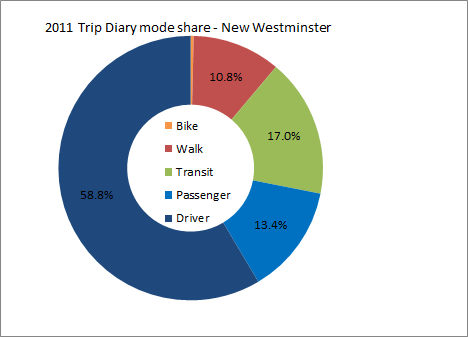
The last Trip Diary provided data from 2011, and at the time, New West was doing OK as far as “mode share”, which is transportation geek speak for “what percentage of people are travelling by X mode.”

As might be expected for a compact city with 5 Skytrain stations, New West has high transit mode share at 17% of all trips. In 2011 we used transit at a higher rate per trip than any other City in the Lower Mainland except the City of Vancouver itself (at 20%). We also had higher walking mode share than most cities (11% of all trips, which is only behind Vancouver, North Van City and White Rock). Our 2011 cycling mode share was a dismal 0.4%, which was, even more dismally, close to the regional average. Add these up, and we had one of the lowest automobile mode shares in the region. 59% of trips were drivers, 13% were passengers, totalling 72% of trips, which was lowest in the region except (natch) Vancouver. Contrast that with the traffic we need to deal with and the amount of space we have given over to that traffic. But more on that later.

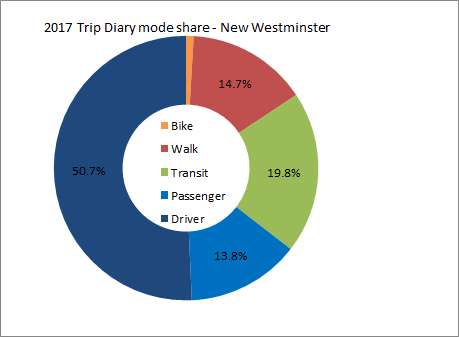
The 2017 Trip Diary data shows how our mode share has shifted over a 6-year span:

As you can see, the shift is subtle, but in a positive direction if you hate traffic. Our transit rode share went up to 20% and is now the highest in the region (Vancouver’s dropped a bit to 18%) New Westminster is now the City in BC with the highest transit mode share! Our walk share went up to 15% and is still 4th in the region, and our bike mode share doubled from dismal to still pretty bad. Or car mode share, however, dropped from 72% of all trips to 64.5%, and “passengers” went up a little bit in share, suggesting that single occupancy vehicle trips went down. Going from 59% to 51% of driving trips in 6 years is (a 14% decrease) is a really positive sign for the livability of our community.
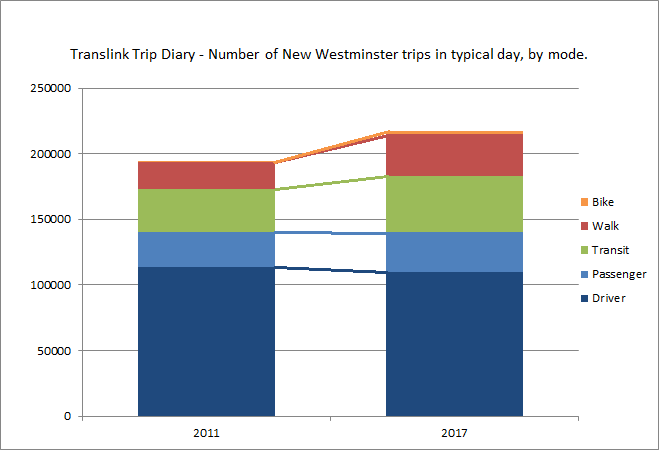
All of those numbers are percentages of trips, but they mask that New Westminster is a growing city. Based on BC Government population estimates (BC Gov’t Local Government Statistics Schedule 201), our population went from 67,880 to 73,928 over that 6-year span, an 8.9% population increase. The trip diary raw numbers show that our number of trips went up at a higher rate: a 12% increase from 194,000 individual trips on the average day to 217,000 trips. We are moving around more. And this is where things get interesting:

With a modest increase in cycling (around 1,000), and significant increases in walk trips (11,000) and transit trips (10,000), there was no increase in trips taken by car – the increase in passengers almost exactly offset the reduced trips by drivers. I need to emphasize this, in bold, italics and in colour, because this is the big story in all of these numbers:

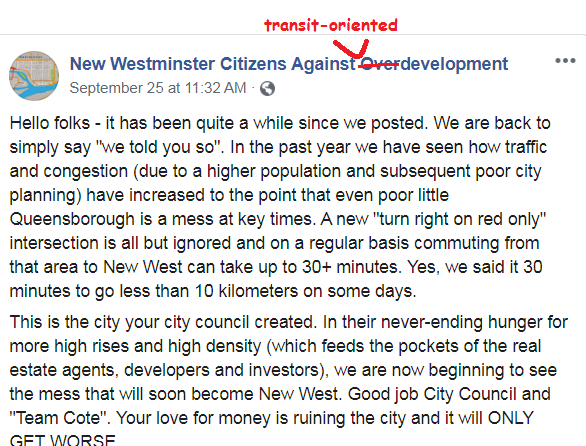
All of the new trips taken by New Westminster residents, as our population grew by 8.9% and our travelling around grew by 12%, resulted in no increase in car use by residents of the City. All of the extra trips were counted as transit, walking, or cycling. Simply put, this logical connection perpetuated by people who oppose the transit-oriented development model, is not supported by the data:

Admittedly, this does not necessarily mean traffic is getting better; That a smaller proportion of people are driving and that driving is becoming less convenient, are not contradictory ideas. Other parts of the region have not seen the same shift, and growth to the south and east of us especially is increasing demand on our local roads. This also means there are more pedestrians and cyclists about, so crosswalks are fuller and taking more time to clear, meaning some tiny amount of through-capacity from cars is lost to accommodate the mode shift and keep vulnerable road users safe. The City shifting resources to serve the growing proportion of our residents that don’t rely on a car every day also makes sense from a planning principle. If I am car-reliant (and some in our City definitely are) I can rest assured that a huge proportion of our public land space is still dedicated to moving and storing cars, and a large portion of our budget to accommodating the expectations of drivers.

But the writing is on the wall, and we need to continue to adapt our practices and resources to reflect the success that is starting to show in our regional transportation numbers.