Community – Jan 12, 2020

I hope to get back in to the practice of posting weekly (or so) on the things I have done that are Council-job-related and happenings-around-town aside from the Exciting! Monday! Night! Meetings! you all watch at home. This is because people have often asked questions along the theme of “how much time does it take?”, or “What does the job involve?”. I had always hoped to use my little pulpit here to open that part of the job up a bit, and then I got busy and it fell by the wayside, but I’ll try again.

Of course, “Council work” includes a bunch of reading of reports, independent research, and countless e-mails and conversations on the street with residents, business owners, and others. Lots of times, you wake up in the morning thinking about it, and go to sleep at night thinking about it. You sit in the pub and chat about recycling, friends corner you at the curling rink and ask you about dog parks, the barber fills you in with the latest happenings during your trim. I’m a social guy, and I love to talk, so I don’t want that to come across as a complaint, but his makes it hard to “count the hours” of the job. Is it full time or part time? The only answer is that it is a job that expands to the time available to it.

Still , here are some of the things I have been up to:

The funnest event in my week was going to the New Media Gallery to see the Cartooney show currently going on. I am embarrassingly late getting to this show (I usually try to get to the openings of new NMG shows), and I need another visit. You really should book out a full hour for this show so you can enjoy the full cycle of Andy Holden’s “Laws of Motion in a Cartoon Landscape” because it is hilarious and insightful. The other 5 pieces are also worth taking the time to chew on, so get there before February 9th when the show closes!

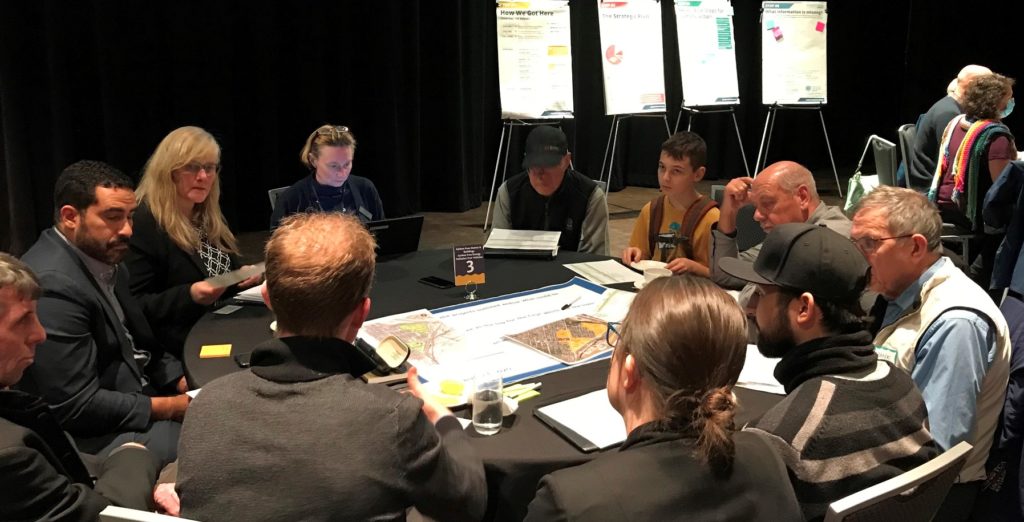
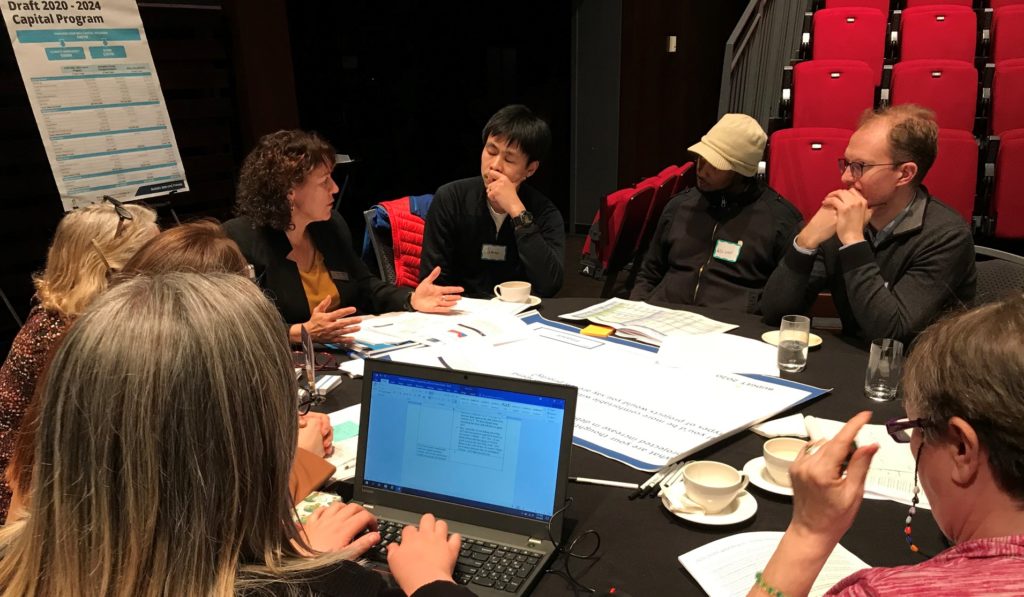
This week we held a Capital Budget workshop where a few dozen residents and stakeholders in the community came to look at the work done so far by staff and council on the 2020-2024 budget. This evening workshop outlines council’s strategic plans and the goals of the Climate Action strategy, and then gave details about the capital expenditures the City is looking at making over the next 5 years, hoping that residents can provide feedback about priorities. There were spreadsheets of numbers, and some pretty intense discussions:

This was, by far, the most public engagement in our budgeting process has ever had, and I don’t know of any other City in the lower mainland doing anywhere near this much outreach. some even seen to disdain this type of public participation. If you were not able to attend, there is still an on-line survey you can do, and of course you can come to Council for open delegation and tell us what you think.

This is a bit of an experiment, putting all of the data out there early in hopes that people will read what is pretty detailed data bout the City’s finances, and provide informed and meaningful feedback. If you are reading this blog, you probably care about this stuff, so please take some time to read the info, and provide us some feedback. It not only makes it easier for us to make better decisions, it shows that this kind of engagement is valued by the community.

I had two informal meetings this week, one with a member of the Intelligent City Advisory Committee to talk about the future of that file as the ICAC’s work gets rolled into the Economic Development Advisory Committee’s workplan (as part of the overall consolidation of advisory committee work). I also met with representatives of the Queensborough Residents’ Association executive, as I have been assigned to act as Council liaison to the QRA, and I wanted to get their idea about how they think this will work best. This liaison-to-RAs is a new thing, and I am really cognizant that RAs belong to the residents, not to Council, so I am putting a bit of a burden on them to define the bounds of my participation, and to make sure that communication works in a way that serves their needs.

Bad measures

I try not to be one to rise to the bait.

In my role as an elected official, there are voices you are best to just ignore. Part of this is something I have talked about before around not punching down – an elected role is a bully pulpit, and it shouldn’t be used to ridicule people who have less access to information or less understanding of what my job actually is. There is also a second part, though, where disingenuous arguments are used by political opportunists – those who know better – but responding to them just throws attention toward them, and we enter some weird Streisand Effect peril.

This is the second one, and here I am rising to the bait, because someone who knows better is being very, very silly, and trying to make narrative out of it. He is doing this specifically because he knows that most people don’t recognize the flaw in his argument, but having worked in City Halls himself, he knows perfectly well how disingenuous he is being. Since he already has many platforms, I don’t mind calling him out.

When Daniel Fontaine started a blog to specifically criticize New Westminster Council, it wasn’t a surprise. The blog is a little light on content (hey, blogs are dead as a media!) but the hook is something he calls the “unanimeter”. This ostensibly measures how often New West Council votes unanimously on motions, apparently an effort to prove we are all one like mind.

Anyone who watches Council meetings, especially our (always free on video) afternoon workshops, can hear that we are rarely of one mind. But that is not the point I want to push back against. The inference in the Unanimeter is that if we had a few people like Daniel on Council, we would have more split votes, which would mean, in an underpants gnome type of causation, better democracy. But measuring split votes is based on a flawed understanding of how a City Council works.

Currently, Daniel has pegged the “Unanimeter” at 96%. We have, apparently, voted unanimously 96% of the time on motions brought to vote in 2019. I don’t know if this claim is true, as he doesn’t really provide back-up to this claim, and I’m not interested in doing his math for him. But more importantly, he also doesn’t provide any kind of “ideal” number, because he knows the idea underpinning this is ridiculous.

Does anyone think a Council that is always arguing (0% unanimous) is a better one? How many people on the Council have to vote against the majority for democracy to be served? One? Three? What exactly are we measuring here? 

Still, to the people Daniel is trying to misinform, 96% sounds bad. So I thought I would do a bit of my own math to see how bad that is compared to other (supposedly better, by the underlying conceit) councils.

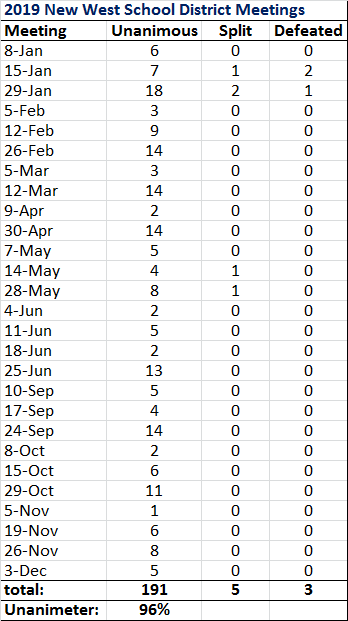
For example, New Westminster has a School Board made up of 7 Trustees. Five of them ran together as a slate (full disclosure – with me!), one ran as an independent, and one ran on Daniel Fontaine’s team. They are, by all accounts, doing a great job. The School District is managing money well, building new infrastructure, and showing provincial leadership on some important issues. If these positive results are related to the diversity of representatives, and this can be measured by a Unanimeter, surely their Unanimeter would count lower than New West Council? I went through the publicly available minutes for SD40’s Board for 2019, and guess what? 96% unanimous votes. (numbers below).

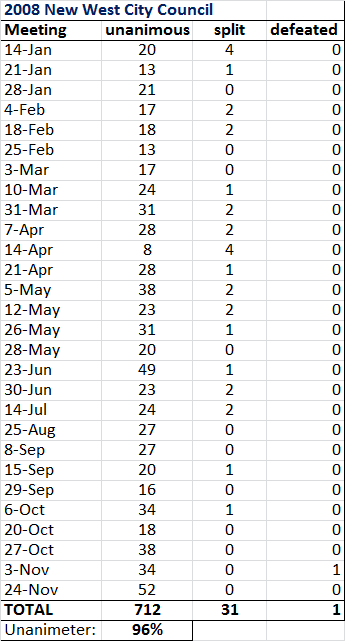
But that is a School District, surely  City Council is a different animal? I went back to 2008 to look over the minutes of the most diverse Council for which New West has an online record. This Council was chaired by Mayor Wayne Wright, and included three “labour endorsed” City Councillors (Cote, Harper, and Williams). There were also three long-serving Councillors who were definitively NOT labour-endorsed: Calvin Donnelly, Bob Osterman and Betty MacIntosh (who is still a Facebook critic of everything this Council does). Going back through their minutes from 2008, how did this democracy-serving Council work? 96% unanimous votes. (numbers below).

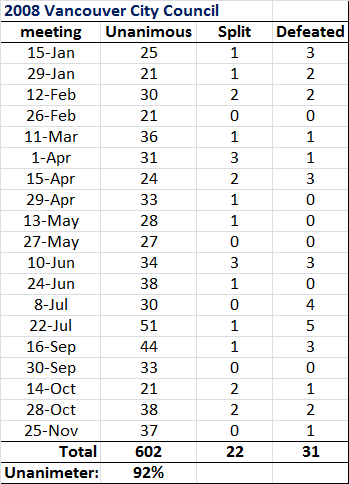
To demonstrate why this is especially disingenuous coming from Daniel is that we can all remember he worked in Sam Sullivan’s office when Sam was the Mayor of Vancouver. Daniel helped the increasingly-unpopular NPA Mayor manage a Council of 5 NPA members, 4 Vision Vancouver members, and a COPE member. Luckily, their 2008 minutes are available online as well. Guess what? This fractious and oppositional Council made up of three parties with no love of each other and representing very different political alignments was unanimous 92% of the time. When you dig deeper into the minutes, you see most of the “defeated” votes were on amendments to motions that were subsequently approved unanimously by Council. If you adjust for this anomaly, the Unanimeter tips to 96% (numbers below).

Short version: The Unanaimeter is useless at measuring… the thing Daniel claims to be concerned about.

Now, there may be an argument that majority government is a bad idea, but if Daniel is making that argument, the Unanimeter is not supporting it. There may be an argument that this Council makes bad decisions, or that the voters made a big mistake when they gave the people who are on this Council more votes than they did to Daniel. I would like to hear Daniel make those arguments, because at least they will be based on something other than an ill-informed meme that only serves to misinform voters.

I’ve always been transparent about my decision-making on Council, and anyone is free to watch our meetings and ask Council questions. Part of the reason I do this blog (though blogs are a dead media!) is to help people be informed enough to engage meaningfully with Council. Sometimes people use this to call me on what they think is a bad decision on my part, or on the part of Council, and I encourage that. Sometimes I change my mind.

But what I won’t do is the easy thing – throw meaningless votes away to shift the numbers on a voter-insulting meme like the Unanimeter. It would be easy, and it would disarm Daniel, but it would be silly, and it would be disrespectful to the people I serve and the work the Council is doing.

Links to the sources are above, but here is my math, please check it! 

Year of the Beard

I’ve been taking a serious year-end break. I took a couple of weeks off work, got out of town just after the last Council meeting. I’m taking a social media break as well, though I do hazard a short lurk once in a while to assure myself #NewWest still exists. I brought a few City documents on the road with me, and I am spending a bit of down time reading capital budget stuff (January is coming on soon!)but it’s been nice to turn most things off for a bit, ride my bike, sit on a beach, and chill with @MsNWimby.

That said, the week between Christmas and the New Year is ripe for these “year in review” things, so here goes mine. 2019 was a strange and interesting year, and I have a hard time summing my 2019 up.

One big change for me personally in 2019 is a change in my work/life balance. I went back to more regular “work” outside of Council. When elected in 2014, I was working full time. After almost two years of increasingly strained attempts at making it work, I had to be honest that I was not giving the attention or energy my 40-a-week professional job deserved, and decided to quit. For the balance of my first Council term I was doing a bit of consulting work, but nowhere near full time. Being honest about the effort and time I could put in with this council work (and my volunteer work with the CEA, CSAP, and LMLGA), I had found a couple of clients that offered the right level or workload, though I think @MsNWimby would have liked a more equitable contribution to household expenses.

In early 2019, I had an opportunity to take a real job working in my field that was half time – a solid 20 hours a week at a proper professional wage. It is work I am very familiar with so the learning curve was easy to get past, and I was able to provide value right up front. The employer is super flexible, and we have a great relationship around planning a work load for the weeks ahead, so I can assure scheduling conflicts are avoided. It all seems very “millennial” in work conditions, but it is working for everyone, and I am staying connected in my field. It has been a fun team to get to know as well, and the work is really interesting. so all’s good!

I also spent a bit of time in 2019 volunteering on the local federal election campaign. This was mostly a good news story – Peter Julian is an easy Member of Parliament to support, he had a great team working for him, and it is fun to knock on doors and make phone calls when you are stumping for such a popular guy!

The disappointment side of the 2019 Federal Election, personally, is a regret that I didn’t spend more time over in Coquitlam/Port Moody helping Bonita Zarrillo’s campaign. I have known Bonita from local government stuff for a few years, and was really excited to hear she was going to represent the NDP in Fin Donnelly’s riding. She is passionate, smart, caring, and hardworking, and she loves her home in the Tri Cities. In the end, she lost a squeaker to a parachuted-in ultra-conservative who failed to meaningfully campaign when she arrived. To see such a brilliant local leader lose to a party-issue hack form central casting is sad. To me a Member of Parliament is representative of your community in Ottawa, not a representative of the Party in your community. I feel disappointment that I didn’t have the foresight to invest more of my volunteer time to help Bonita, when she just needed a few hundred votes to get over the top. Sorry Bonita, but I am glad we are still working together in Local Government in the Lower Mainland.

In the local political realm, New West Council had probably the most quietly challenging year I have ever experienced. From my seat, it seemed there were very few big splashes, yet we pushed some really bold stuff forward. I have felt a tremendous amount of personal growth in how I approach the work, and the organization’s growth in some of the functional changes we are making at City Hall and in Council Chambers. We are making the organization more efficient and effective, though some of this is a bit out of sight for all but the vigilant council-watcher. This is alongside the real progress and growth reflected across the organization on files like climate and reconciliation. I think our Strategic Plan is (perhaps) too aggressive in wanting to achieve much more in a short time period than will be easy for a City our size. That said, I can’t disagree with the bold vision created, and hope we can continue to build the political will to be the most progressive and forward-looking local government in the province, if not in Canada. The shift represented by our Council and Staff’s embrace of aggressive climate actions is an encouraging example of progress that can be made when we are all on the same page, and I’m glad this community is still pushing us forward on that front.

In looking back at the direction we are forging, I find myself using words like “aggressive” and “bold”. Still, it feels like we are being given the clear political push from the public to get this work done. The community is telling us they can be just as bold as this Council, and perhaps through us providing transparency and a clear set of underlying values and vision, I am more confident in our ability to make this progress.

It is a bit funny, but you sometimes need to go outside to see how good things are inside. Our Council has ways of disagreeing – even new ways different than the last Council –and can drive each other nuts with our 7 different ways of approaching solutions, but if our paddles sometimes cross, we are all at least rowing the same direction. It is mostly at regional or provincial conferences where our cohort reminds us that New West is functional and punching way above its weight in the local government actions, and we do it while avoiding so much of the hijinks afflicting other less-functional Councils around the region. They get headlines, we get work done. That is a good feeling.

2019 had challenges, but I think the year ahead will be more challenging. We are deep into Capital Budget discussions right now, and are asking for the public’s help in setting those priorities. Translating an aggressive capital plan into a sustainable operational budget is the hard work part. We will be having some conversations not just about the things we want to do, but our vision for the 5 years ahead is going to have to include some conversations about what we are not going to do, or are going to stop doing. And New Westminster is not as good at letting things go as we are at starting new things (and by that I mean Council, City Staff, and the Public!). These conversations will be at times hard, but worth while. I’m looking forward to the work!

With all of this going on, I hardly had time to ride my bike for recreation, my blog here has been suffering from lack of attention (but blogs as a media are deader than dead, so who knows the future of this?), and my garden was a pretty dismal failure, except for all the tomatoes. I also found myself intentionally stepping back a bit from some things in 2019, mostly because of my new work & commuting schedule: fewer of those “I should make an appearance” events, and less patience for social media. I’m not sure what to make of my nascent impression that our local political challenges have become pettier, despite the good work we are doing (see above). I am not sure if that is a product of the changing social media landscape, or just the natural result of me settling in after five (5!) years of elected life. Or maybe I’m getting older.

Which brings the big personal news – I turned 50 in 2019. I’m not sure how that happened, but it just kinda snuck up on me and now I am looking down the second half of middle age. @MsNWimby threw a hell of a party, and I really haven’t taken the time to thank everyone who came out to celebrate. 50 makes you ornery, I guess. Or gives you a ready excuse to be so. Thank you for the great party, and for being a great support network for me and @MsNWimby.

Let me wrap my 2019 in review by thanking the wider network of great people in New West working to build this unique, progressive, compassionate community. There are so many people in this town who are doing so much to make it a great place to live. My Council colleagues are constantly challenging and surprising me, and the Mayor has really grown into a strong leader who earns more respect every day. There are true leaders in the School District, in the Arts community, in our BIAs and local businesses, in the many service agencies that make New West tick. Please keep up your good work, though it may feel you are fighting against the tide, your contributions are noticed and appreciated. If I have one resolution for 2020, it will be consciously spending less time worrying about the boo-birds on Facebook, and more time expressing gratitude to the many people around New West actually working every day to make this community so great. Happy New Year!

Council – Dec. 9, 2019

Our last Council meeting of 2019 included and afternoon workshop where staff presented some framework ideas on a new Inclusionary Housing policy – you housing and policy wonks might want to catch the video and see what the City is dreaming up! That will all come to regular council as the program is put together, so I’m sticking to regular Council business here. Our evening Agenda started with two presentations:

Theatre Strategy for approval
The City owns two performing arts theatres, and will own three in the near future when the Massey Theatre is exchanged to the City from the School District as the new High School is built. With a total of 1761 city-owned theatre seats and three stages, this is a pretty significant investment for a City of 72,000 people. Making the most of this asset, and the important relationships we have with non-profit operators of these theatres, is the goal of this strategy.

The big goal is to have a thriving theatre scene, from students learning the performing arts to dedicated local amateurs, regional professional productions and major touring acts (I still can’t believe I saw Nick Cave in New Westminster!), assure that our non-profit partners have the tools they need to remain financially solvent, and assure the theater assets are maintained. There are a myriad of cultural benefits and business spin-off from this, and I’m glad to see council support the strategy.

Queen’s Park Sportsplex Update
At long last, the Sportsplex is being built. This has been a long journey – much longer than most would want. We had some delays getting the insurance claim worked out, we bounced around the idea of a temporary building, and expanded gym space at the NWACC caused us to re-evaluate some of the programming needs, then we had a failed procurement for our first version of the replacement. But at long last we have a solid plan for a modern, high efficiency, uber-accessible multi-purpose building, and the beams are being installed as you read this. It will be ready to open in the spring to finally give those activities that have been displaced a stable home.


The following items were moved by Council On Consent:

New Guidelines for Residents’ Associations
As part of our ongoing efforts to improve community engagement and make our Committee and Council Advisory systems work better, we are making a new commitment to our 12 Residents Associations at the same time as we are disbanding the existing RA forum. Instead, we are assigning each RA a Council Liaison, which will change every two years (I was assigned to Glenbrooke North and Queensborough for the first 2-year term). The role of Liaison is not rigidly defined, and I will be reaching out to “my” two RAs early in the New Year to see how they want this new relationship to work. We will also have an annual RA forum with all of Council, where Council meets with representatives of the 12 RAs. Finally, the City will continue to provide a very modest $200 operating grant to any RA who asks for it, to help with minor administrative costs like maintaining a website or creating leaflets.

705 Queen’s Avenue: Proposed Temporary Use Permit – Results of Applicant Led Consultation
Westminster House wants to expand their operations in the Brow of the Hill to provide more supportive housing for women. They had an open house that was widely advertised and poorly attended, with the only attendees showing support of the project. The Brow of the Hill RA also expressed support. This report is only on the results of that consultation and informs the ongoing Temporary Use Permit application, which came to an Opportunity to be Heard later in the meeting (see below).

Queen’s Park Heritage Conservation Area: Zoning Amendment Bylaw to Rezone Three Non-Conforming Properties to Duplex Districts (RT-1)- Bylaw for Two Readings
For reasons unknown (but ripe with inference and allegations of how Council operated in the 1980s), three duplex houses in Queens Park were re-zoned to single family in 1987. They all have duplexes on them now, and through the Queens Park Heritage Conservation Area work, this mis-zoning was identified. The owners of these houses are supportive of the City changing the zoning back to the appropriate category for these three properties only. It is still a Rezoning, which will require a Public Hearing, so I will hold further comment until then.

312 Fifth Street: Bylaw No. 8171, 2019 to Rescind Heritage Revitalization Agreement Bylaw No. 7979, 2018 and Heritage Designation Bylaw No. 7980, 2018 – Bylaw For Three Readings and Consideration of Notice of Opportunity to be Heard for Development Variance Permit
There was a Heritage Revitalization Agreement on a property in Queens Park, where the homeowner promised the City to restore and preserve a heritage house in exchange for some variances and extra zoning entitlement to build a larger-than-normal laneway house. Subsequently, the work done on the heritage house broke that agreement, and has resulted in the heritage benefits of the project being lost to the community. So the City is taking away the entitlements granted.

A the same time, there was some work done as part of that HRA that is now difficult to undo, so we need to go through a Variance process to allow the porch on the house that is already mostly built to remain. That requires an Opportunity to be Heard, which seems a strange waste of everybody’s time, but such is the law.

97 Braid Street: Extension of Temporary Use Permit for the Royal Columbian Hospital Temporary Off-Site Parking Lot
That big parking lot by Braid Station is to support the work happening at RCH (there are shuttles that run between the two). It is there on a Temporary Use Permit, as the Sapperton Green development works its way through design and approvals. The TUP needs to be extended for another three years.

Development Review Streamlining: Proposed Improvements in Support of Reallocating Resources to Council Priorities
We are updating some of the processes in our Planning department to make things work more efficiently, better manage employee workload, and hopefully provide better customer service. This is kind of an omnibus report outlining various changes:
Completed and Proposed Improvements to Development Review
Process and Regulations
This would allow staff to amalgamate reports when there are two different application types on one project, e.g.: an affordable housing project that need a rezoning and a housing agreement; reduce the review steps for small projects of less than 5 units; remove the neighbourhood consultation step from laneway house projects where the project meets zoning regulations; and simplify secondary suite requirements while maintaining life/safety standards)
Sign Permit Application Improvements: Sign Bylaw Amendment Bylaw
No. 8132, 2019 – for Three Readings
This would update our sign bylaw to reduce the number of variance applications required.
Official Community Plan Update and Development Permit Process Improvements: Official Community Plan Amendment Bylaw No. 8151, 2019, Development Approval Procedures Amendment Bylaw No. 8152, 2019, and Development Services Fees and Rates Amendment Bylaw No. 8153, 2019 – For Consideration of Readings This would update our OCP to introduce some of the streamlining effects, including delegating some Council powers to the Director of Development Services; change the Land use Designation (not the zoning) of 4 properties that are not operating as currently designated; align some of the language between the OCP, and the Queensborough Community Plan; and update some planning and development permit fees.

Brewery District (Wesgroup Project): Request for Construction Noise Bylaw Exemption
We need to change how we do this. We have 90,000 vehicles a day streaming through the Brunette Ave corridor. Any reduction in lane capacity will, according to staff, grind the entire region to a halt and compromise the safety of untold workers and residents. So when road works have to happen (and they do), we need to do it at night. Then I hear form angry residents because someone is operating a backhoe in front of their house at 2am, and they need to sleep. So what to do?

Currently we grant that exception, let them work at night, because keeping traffic flowing is more important that people getting sleep. I still don’t believe that reflects our values as a community, and believe that traffic flowing is just as dangerous and disruptive to my community and traffic constricted. I content more people are injured and killed by free flowing traffic than speed-constricted traffic, but I appear to be the only person who feels this way.

The proponent here says they are going to take great effort to work quietly, the Hospital and others are concerned about traffic impacts, and the last phase of night work in this area did not result in complaints. And at some point when our engineering staff suggest to you serious safety concerns, you have to listen. Council voted (on consent) to give the variance.

Budget Process: Capital Program aligned by Council’s Strategic Priorities
This bundle of reports and tables provides some of the background data staff will use to lead the public conversations about our Capital Budget that is ongoing now. This compliments the data we got last meeting, and the Climate action budget priority info provided below. If you have feedback to Council about the Capital Budget (and I know you do!) you will be able to go to an open house and/or fill out an online survey you can find here.

Mayor’s Transportation Task Force: Royal Columbia Hospital Redevelopment – Parking Requirements and Pedestrian Connectivity to Sapperton Skytrain Station
We are working with Fraser Health on the RCH rezoning, and the Mayors Transportation Task force has put forward some strong recommendations on how to address some of the City’s transportation and climate change priorities in the new buildings. The first design has not seemed to hit the mark (from a City perspective) on accessibility or designed-in active transportation features. So we sent some suggestions to Fraser Health. I maybe would have pointed out that getting people out of cars is a public health intervention, but maybe that is a bit too on-nose.


The following items were Removed from Consent for discussion:

Capital Budget 2020-2024 Climate Action Memos
This report provides a bit more detail on a couple of parts of the Capital budget numbers we were given last meeting, with more discussion of the climate action targets, and how the “climate impact” of funded projects is weighed against other important maintenance-of-operations needs. Not everything in the plan will be a climate action – maintaining a retaining wall (for example) may not have a climate impact, but failing to do so may result in a structural failure and risk to the City, so risks like this need to be balanced. This is a crude example, but the same logic can be applied to many City operations, some of which even have negative climate impacts.

The public consultation on our Capital Budget is ongoing, if you want to ask questions or provide input on these priorities – a survey will be open soon! We are going to have to make the hard decisions early in the New Year.

Recruitment 2020: Appointments to the New Westminster Library Board
The Library Board provides governance oversight for the city of New Westminster’s single most used public facility. This is an important volunteer role, and I really appreciate the folks who step up to provide this service to the community. Three re-appointments re-appointed!

Release of Items from Closed Meetings
This report is from our Clerk to clarify some of the procedural hiccups that happened at the end of last meeting. Nothing went “wrong”, but there was some procedural confusion, and the City Clerk is a bit of a stickler about procedure, because that is her job and because it matters.

Things in Closed (or more correctly and jargon in camera as I wrote about recently) are there because they contain sensitive information, sometimes sensitive to the business interests of the City, sometimes because they involve private citizens whose privacy should be protected as much as possible. This sometimes creates a situation like last week where Council makes decision in closed, but staff needs to action that decision, which requires the item be brought in to open. Ideally, there is an opportunity for staff to communicate with the private citizen before it becomes an open item so that they are the first to know – no-one wants to read on Twitter that their personal business is being discussed in Council. Staff do their best to make sure residents and business are informed before these items hit open meetings.

The Clerk has recommended a process to make release of information from a Closed decision work more smoothly in future meetings, but the suggestion that only the resolution passed in closed be read by the Mayor caused me some issue. By my reading, this would mean we were able to tell the public the result of a decision, but were not able to discuss the details, because they would all remain in closed. The more common practice now is for the Clerk to produce an open report that strips the sensitive or Section 90 restricted information so it was clear to Council what were able to talk about to the public and what we aren’t. This report did not make clear that distinction, so we sent it back to the clerk for a bit more work.

TransLink/SkyTrain Communications Upgrade: Request for Construction Noise Bylaw Exemption
TransLink needs to do electronics and communications systems upgrades in the City’s 5 SkyTrain Stations. By obvious necessity, much of this needs to happen when the trains are not running, which means at night, which is outside of permitted construction noise hours in New West. They are applying for a single Construction Noise Variance for 4 stations, each of which has a 3- to 4- month construction schedule.

They are doing what they can to reduce the noise generated, and are going to be doing direct mail-out communications to the neighbours immediately adjacent to the stations. I requested that Council receive a report after the first phase of work (the 22nd Street Station work) is completed detailing the complaints, mitigation undertaken, and lessons learned, so we can be assured that complaints are being responded to and issues addressed where possible. Councillor McEvoy asked that they give a wider buffer around Christmas. Council approved with these two conditions.

Proposed Child Care Facility Ownership and Management Policy and Provincial Child Care Funding Update
Cities are getting deeper into childcare. We have a provincial government willing to help fund childcare (which is a nice shift), but it will fall on Cities to support childcare through amenity contributions and grants. New West does both. We are also granting City-owned property and investing capital funds to get them operating. We need to set some policy about who we are going to partner with for these City-subsidized operations. This policy will outline how those services should be supported, based on their structure and the level of City involvement. If childcare is in a City building, we will have a lease relationship to the provider managed by Parks; if it is a stand-alone building on City owned land, the City will retain ownership of the land and building with a lease managed by Engineering; if the child care is in a mixed-use development as an amenity, the lease will be managed by the Engineering department.

Inevitably, the City being involved in this is going to increase your taxes, because this is a new service area and we are going to have to have staff to manage it.

Neighbourhood Traffic Advisory Committee: Advisory Committee Structure Changes and Future Engagement with Residents’ Associations
The NTAC is no longer going to meet. This is a shift in how we manage communication about traffic issues in the City, and we are getting away from using a committee structure to manage parochial traffic issues. We are integrating all transportation types into the new Sustainable Transportation Advisory Committee (“STAC”) whose work will be aligned with the Mayors Transportation Task Force and the Master Transportation Plan.

The NTAC made a few suggestions on how the City can still engage with neighbourhoods through these changes, including assuring broad neighbourhood representation on STAC. They also recommended the City do more to acknowledge the efforts of our community volunteers, which is a good point. Council moved to accept the recommendations, based on the approaches staff recommended.


We then had an Opportunity to Be Heard:

Temporary Use Permit TUP00021 for 705 Queen’s Avenue
As mentioned above, Westminster House wants to expand operations to a new residential house in the Brow of the Hill neighbourhood. This requires that the City wither do a zoning amendment (because running a recovery residence does not fit approved land use of the house) or do a Temporary Use Permit for up to three years. This latter process is temporary, but much quicker and easier for the proponent.

We had a single piece of written correspondence in support of the application, and four members of the public came to speak in favour of the project. The public consultation (see above) did not raise any red flags. Westminster House do great and really important work, and are the most respectful residential neighbours one could hope to have. Council was very supportive of this application.


We then had a significant number of Bylaws to adopt:

Council Procedure Bylaw Amendment Bylaw No. 8162, 2019
This Bylaw amends the one that governs all of the procedures in how our Council Meetings work. We are instituting some streamlining – including reducing the amount f time Councilors can speak on a single topic – and the Bylaw was adopted by a split vote. Get out your stopwatches, folks!

Engineering User Fees and Rates Amendment (Fees) Bylaw No. 8165, 2019,
Electrical Utility Amendment Bylaw (Schedule B) No. 8167, 2019,
Development Services Fees and Rates Amendment Bylaw No. 8157, 2019,
Cultural Services Fees and Charges Amendment Bylaw No. 8166, 2019,
Engineering User Fees and Rates Amendment (Rates) Bylaw No. 8174, 2019, and
Electrical Utility Amendment Bylaw (Schedule A) No. 8173, 2019,
These Bylaws that adjust our various fees and non-tax revenue, updated every year as part of our budget process, were adopted by Council.

Water Shortage Response Amendment Bylaw No. 8170, 2019
This Bylaw that brings our water shortage response fees and charges in line with the rest of our engineering charges to make administration easier was adopted by Council. It can’t be New Orleans every night, folks.

Official Community Plan Amendment (Queensborough Residential Low Density) Bylaw No. 8122, 2019
This is the final adoption of the OCP amendment for a development (a combination of preserving the Slovak Hall and building adjacent townhouses) that was approved through the Public Hearing process back on June 24, 2019.


And that is the end of business for 2019. I hope everyone has a good holidays. I am going to take a bit of a Social Media break for the rest of December, though I may get a chance to pump out a few blog posts, I’m just not sure if the mood will strike. See you all in 2020!
Gross

There was a weird event in Council last week, following something that got a little media news on the TriCities, if not much mileage here in New West. This week, New West Council moved to take a piece of  correspondence out of closed, which means I am now able to talk about it. I should probably add that to this post one of my semi-regular caveats that this blog is my writing and contains some of my opinions and should not be construed to reflect the official position of the City or the opinion of anyone other than me.

The first point here is to clarify why City Councils have in camera, or “closed” meetings at all. There is certainly a broader collection of topics talked about in Closed than suggested in the news report linked above. Pretty much every Monday, Council has a closed meeting, usually just before the regular or “open” meeting. At those meetings we talk about things that fall under Section 90 of the Community Charter, which you can read here in its full breadth. This is the Provincial Law that governs how local government councils operate, and Section 90(1) list the reasons a council may discuss items in closed, where Section 90(2) talks about where council must keep the topic in camera – a not-unimportant distinction.

The topics typically discussed in closed are ones you might expect – real estate negotiations, human resources issues, advice from our lawyers, or involving information about a member of the public that is subject to the privacy protection provisions of FOIPPA but also many things beyond that involving security of the organization, procurement, negotiations with senior governments, financial planning, and more.

Of course, there is very little the City can do that remains secret – we eventually have to make an open decision before we spend money or adopt a bylaw, so most things discussed in closed eventually end up in open reports. When we buy or sell a piece of land for example, we operate those negotiations in closed (to assure we have a competitive relationship with the purchaser/seller), but the final purchase/sale agreement comes to an open meeting and is publicly voted upon. The line item of the price we pay also ends up in a financial report. Review of appointments to City Commissions and Advisory Committees or hiring of senior managers necessarily contain a significant amount of personal information about applicants, so that information is kept in closed, though the final decision of whom to appoint is brought to an open meeting.

The decision whether a subject can or must be discussed in closed usually happens long before Council even sees the Agenda, and the City Clerk (whose skills include an encyclopedic knowledge of the application of Section 90, and who gets advice from the City Solicitor if there are any doubts) usually makes the call, though there may be discussion with Council. It is important to note in this case that Section 90 also applies to Metro Vancouver Board and the committees within, and if necessary, communications from the City to Metro Vancouver about those boards.

It is not unusual for municipalities to communicate with each other about how regional boards operate. The City of New Westminster sends representatives to Metro Vancouver boards and committees, agencies like E-Comm, the Fraser Health Authority Advisory Council, Municipal Finance Authority, and others. It should be no surprise to anyone who follows New Westminster Council that we have been pretty proactive at seeking diversity in the representation on those boards, just as we have for our own advisory committees, and that has included some communications with other Cities to coordinate equity-seeking actions.

But this is something different, something much less positive, but concomitant with creating a respectful and safe workplace for all persons.

At the time that New Westminster wrote this letter, the Mayor of Port Moody was indicating that he was ready to come back to work at Port Moody Council, though it was unclear if the legal case against him had been resolved, or what that resolution entailed. This return to work was, to use the technical term, a shit show. Debate about whether he should have returned to work made clear that the only person with the power to prevent him from doing so was himself. His Council and the residents of his community were powerless to remove a person facing a serious criminal charge.

During this time, it was not reported that Mayor Vagramov also returned to work on Metro Vancouver committees. This resulted in the situation where other regional leaders, often including a member of the New Westminster Council, had to sit in committee meetings beside a person charged with sexual assault while the case was still before the courts. That is not an acceptable situation to me, and it is clear from the letter we wrote that this was not acceptable to the majority of New Westminster Council. Unlike his decision to return to his regular Council duties, he serves at Metro committee at the pleasure of his Council, and it is within that Council’s prerogative to remove him from that position until his legal situation was resolved. New Westminster appealed to Port Moody Council to exercise that prerogative, to assure that all members of our Council and Councils across the Lower Mainland are able to exercise their duties in a respectful and safe workplace.

Yet another gross part about this is that someone in Port Moody leaked this letter to the media before it was released from in camera, which is likely a violation of the Community Charter, but I’m not a lawyer. Why they did it is unclear, but it smells of shitty politics. Ultimately, it was fated to come out to the public sooner than later, but by jumping the gun the person who leaked the letter put many people, including me, in the difficult spot of having to say “no comment” to the media when asked about it, because for us to comment on it would itself be a violation of Section 90.

So New West Council lifted the resolution and letter from closed this week, allowing us to speak about it. But in many ways it speaks for itself.

This is a gross situation, and it is far from resolved. Vagramov has not been “exonerated” as he claimed, and the way he and his lawyer shrugged off the original accusations with the “awkward date” language further the ongoing patterns of victimizing and the accuser by robbing her of a voice. This is not an act of apology, and shows a profound lack of self-awareness,  of judgement, and of understanding of  a power imbalance being asserted.

That there is no way to remove him from his position of power is problematic, but that is not something we can do anything about, and need to ask the provincial government to make changes to the legislation. That my colleagues in New Westminster and across the region, some of whom may have been victims of sexual assault and have felt this case more personally than I have, will now have to choose between serving beside Vagramov on a Committee, or removing themselves from committees. He should not have the power to force others to make this choice, and they should not be the ones stepping aside.

The letter from New West Council was written at a time before this matter was “resolved” in Vargamov’s mind, but I do not think it is resolved in the minds of many people. I think it is still appropriate to call on his Council to remove him from Metro Committees, and I hope that the provincial government can finally bring in some legislation to address these issues when they arise.

Council – November 25, 2019

The last council meeting of the month usually includes a Public Hearing meeting, and November 25th was no exception. What was different was we changed the timing so we had a full hour of meeting before the public hearing, which made it much easier for us to get some of the non-public-hearing work done and let some of our staff go home a little earlier. So my order of things may be a little off here, but the Agenda was something like this:

Proposed 2020-2024 Capital Program
We started off with a presentation on the (still very draft) Capital Plan to fit into the 2020-2024 financial plan. The biggest part of this work right now is not deciding what things we could do in the next 5 years, but what we are NOT going to do, because the Capital plan as presented in preceding months is simply too big. The NWAAC is blowing a $100 Million hole through the plan, and other things are going to need to be scaled back or deferred.

I will talk more about this in the months ahead, but more importantly, Council endorsed a public engagement plan to have the public help us set capital priorities, and hopefully get some feed back on where we see the budget going. How do we prioritize? This is a conversation Council has to have, and a conversation we need to have with the residents of New West.


The following items were Moved on Consent:

263 Jardine Street: Temporary Protection Order
The owner of a 1922 house in Queensborough wants to demolish it, and presumably replace it with a new house. The City has a policy that 60+ year old houses up for demolition pass through the Community Heritage Commission prior to demo approval, and the community has raised some concerns about the heritage value of this house. The CHC recommend we put a 60-day stay on the demolition order to try to convince the owner to not knock it down, or find alternatives.

Heritage Register Update
4 houses in the City that have received some sort of zoning entitlement through Heritage Restoration Agreements are being added to the Heritage Register.

Amendment to Water Shortage Response Bylaw
This is a housekeeping amendment to bring the water shortage fees and fines into the regular engineering rates bylaw so they can have synchronized annual review. This changes literally nothing except how we operationally account for the fees and the process required to change them in the future.

660 Quayside Drive (Pier West BOSA Development) – Status of Construction
This is an update on construction activities at the Pier West site on the waterfront. After some difficult issues arose last summer, Bosa has spent more time communicating with stakeholders in the neighbourhood and has worked out some of those issues. The overpass at Sixth Street is delayed by railway approvals (but coming along). There are still some “in river works” that need to happen this winter during the “fisheries window” when they will have the least impact on fish in the river due to seasonal migration. The eventual closure of Quayside Drive at Begbie is delayed until 2023, and will be limited to 6-8 weeks; the earlier scenario of a year or longer closure has been avoided though creative project management and some shifting of how the underground parking will be structured.

There have been some challenges maintaining accessibility through the site, as Bosa have committed to do until the Sixth Street overpass is completed. City Staff and Bosa are continuing to work through some of these issues, and Bosa has been fast to make necessary improvements when identified.

User Fees and Rates Review for 2020, Amendment Bylaws for Three Readings
After a review in principle last meeting, Staff have now sketched up the necessary Bylaws to adjust our Users Fees and Rates for 2020. The Shoe Shine Stand business license rate remains unchanged at $95.98 for up to 5 chairs, and $17.77 per chair for 6 or more.

Electrical and Engineering Utility Amendment Bylaw report
After a review in principle back in the November 4 meeting, Staff have now sketched up the necessary Bylaws to adjust our Utility fees for the next year. Water (7%) Sewer (7%) and Solid Waste (12%) increases are what was projected last year, and reflect our current 5-year financial plan so no change there. Electric utility will be going up 3.8%, which is from the already-project 2.8% increase plus a 1% increase to the Rate Rider which (along with half of the existing 5% Rate Rider) be directed to a Climate Action reserve fund to pay for some of the Climate Action initiatives in the community.

Justice Committee Terms of Reference – Unit Coordinator of the New Westminster Victim Assistance Association
We are adjusting the terms for this committee to assure a member of the New Westminster Victim Assistance Association is included.


The following items were Removed from Consent for discussion:

Tourism New Westminster request for financial support for Municipal Regional District Tax application
Our local Destination Marketing Organization has an opportunity to implement a local 2% – 3% tax on local hotel rooms, as is common throughout BC. This fund would go directly to fund the Tourism New West operations, and would finally establish consistent funding for their operations. They are requesting some seed money to set up the most robust application. This one-time request will come from existing budget in the CAO’s office.

Council Procedure Bylaw Amendment Bylaw No. 8162, 2019 – Second and Third Readings
We are making a subtle change in how our Public Delegations work, mostly to assure time-sensitive business can get done on Council nights and to help assure delegation space at council remains accessible to as many people as possible. Hopefully, things will run a little more efficiently in the New Year.

230 Keary Street, 268 Nelson’s Court and 228 Nelson’s Crescent (Brewery District): Zoning Amendment Bylaw (Text Amendment) for First and Second Readings and Housing Agreement Amendment Bylaw for Three Readings
Wesgroup is hoping to shift some land use in the next phases of the Brewery District development. They are not increasing density, but want to shift one building (Building 5) from a mix of market rental and strata condo to all market rental, and shift the next building (Building 7) to mostly Market Rental with a smaller commercial/office component, then switch the final all-commercial/office building (Building 8) to be switched to up to 2/3 residential, with the remaining commercial/office. This would also include a significant change in the shape of Building 8 (taller and narrower) but no net increase in density.

I expressed some concerns about how this change will impact some of the other goals we have for Building 8 (i.e. the building of accessible and seamless access between the SkyTrain Station and RCH) and how these changes would impacts the assumptions for traffic impacts and parking needs built into earlier approvals on the site. I was mostly interested in better understanding how our processes to secure commitments around these items fit in this slightly unusual process.

This Bylaw amendment will go to Public Hearing, so I will hold off on further comment until then.

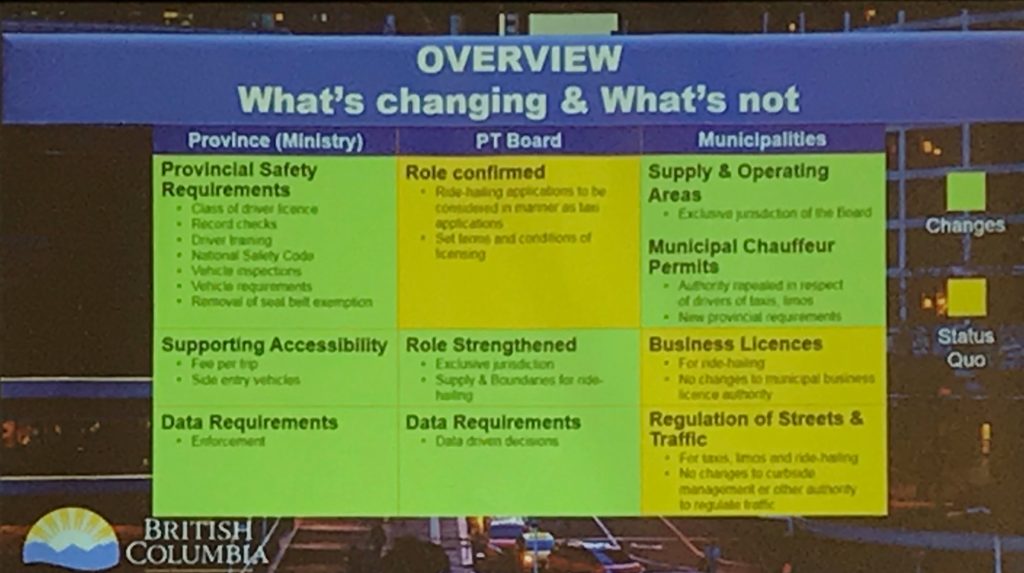
Ride-Hailing: Guiding Principles for Responding to Ride-Hailing
The ride-hailing legislation by the province both gives to and takes away from some powers local governments have in how we regulate businesses and road use in our City. For example, we cannot (sorry Mayor McCallum and Councillor Jackson) stop ride-hailing companies from operating in our City, or even regulate the number of vehicles operating. We can, however, require business licenses for anyone operating on our community, and regulate things like pick-up and drop off rules.

As we are now required to adjust our regulatory environment, staff sought Council support for a set of guiding principles to outline how they should go about putting that regulator environment together.

Not speaking on behalf of Council now, but I believe the rules for ride hailing services should be similar to taxis: they need a business license to operate (and we should take part in any initiative to develop inter-municipal business license agreements with the rest of Greater Vancouver), and that we should regulate pick-up and drop off to assure that public safety, especially that of vulnerable road users, is paramount. I also believe that usage data would be a vital tool to allow municipalities to manage the negative road and traffic system impacts of ride hailing seen in other cities, and it is important that Cities that want it have access to this data.

As far as I can tell, we do not have the regularly authority as a local government to require accessibility standards for the fleet, but this is something we should advocate towards, and I agree with the Provincially proposed approach that a tax be placed on non-accessible rides to fund accessibility upgrades, but I have no idea if this is even functionally possible. We are also unclear if there is even a legislative ability to do per-trip fees, like the City of Vancouver is proposing.

In the end, Council agreed to the guiding principles staff put together to provide a framework for legislation. Staff will continue to work with our neighboring communities to try as best we can to assure that there is some sort of coordinated approach here, as we all agree a patchwork of local regulations will be both hard to enforce, and confusing for the public.

Period Promise Campaign
The City of New Westminster is following the lead of our own School District and a few other communities like the City of Victoria in assuring that Civic Facilities that have washrooms and distribute free toilet paper and paper towels, also provide fee menstrual products. The cost of this program is low in the scale of our public facilities operation budget, but reflects the need to for equity in our public service offerings. In hindsight, it is remarkable it took us this long to think this is right.


We had a single piece of Correspondence with a follow-up action:

Metro Vancouver letter dated November 4, 2019 regarding consent to Metro Vancouver Regional Parks Service Amendment Bylaw No. 1290
We are a member of Metro Vancouver, and therefore part owner of the Regional Parks. There is a park on the edge of Metro Vancouver in Langley that overlaps into adjacent Abbotsford (“Aldergrove Regional Park”), and we need to agree to allow Metro Vancouver to maintain a park that is not, strictly, within Metro Vancouver. 2/3 of Metro Vancouver communities have to consent to this idea, and New Westminster formally consented to it.


We also had to Late Additions to the Agenda:

318 Columbia Street life safety
Bylaws brought to our attention a commercial property that had some unapproved residential units in it that presented some life safety issues. They updated us on some proposed enforcement actions, and will work with the building owner to bring things into compliance.

Closed motion letter to Port Moody
This is a weird one. New West Council was communicating with another municipality over some board appointment issues, and someone in that municipality provided to the media information about closed correspondence, which is clearly a violation of Section 90 of the Community Charter. This put members of our Council in a difficult situation where we were asked to comment about closed deliberations, which would have put us in violation of the Charter. So our Clerk decided it was best to release the correspondence from closed so that we were free to discuss it. I will write more about this in a future post. It’s gross, but here we are.


We then held our Public Hearing and addressed the Bylaws being considered:

Official Community Plan Amendment (Removal of Queen’s Park Heritage Conservation Area Related Protection from Seven Properties) Bylaw No. 8156, 2019
This Bylaw would wrap up the largest part of work related to the Heritage Conservation Area in Queens Park. When the HCA Bylaw was adopted, there was a division between protected heritage houses and unprotected non-heritage houses. There were 86 properties (out of ~700) that were old enough to qualify for heritage protection, but had other confounding factors that made it difficult to determine at first pass if they qualified to be protected. We have since been going through a systematic process to move all of these to Protected or Not Protected, based on their heritage merit, potential to achieve zoning entitlements, and building condition.

At a second more detailed screening back in 2018, 33 were removed from protection based on heritage merit, and 6 more are recommended for such removal now after a third level of screening. Of the 47 remaining, one more is recommended for removal due to zoning entitlement issues, which would move the remaining 46 into fully protected status.

We received several pieces of correspondence, some opposing any removals, one opposing a specific removal, a few agreeing with removals, and a few asking to have their property added to the removed list. The public delegations were mostly representing that last group, with a few showing support for the HCA process that got us this far.

Council Gave the Bylaw Third Reading and Adoption after the Public Hearing.

Official Community Plan Amendment Bylaw (1111 Sixth Avenue) No. 8145, 2019 and
Heritage Revitalization Agreement Bylaw (1111 Sixth Avenue) No. 8146, 2019
This project would remove the small office-type building that is adjacent to the historic Shiloh Sixth Avenue United Church and replace it (and the empty parking lot next door) with a larger 4-story building with underground parking. There would be a sizeable (114 spaces!) childcare facility in that new building. In the meantime, a conservation plan would further protect the adjacent Shiloh Church building according to a conservation plan.

We had a few people come to speak to Council, mostly concerned about the impact on the alleyway and the ability for it to handle the inferred traffic increases related to the Daycare. None was strongly opposed, just worried that the City address these impacts.

Council moved to support Third reading for both of these bylaws.


We then had Opportunities to be Heard on some variance permits:

Development Variance Permit DVP00670 for 221 St Patrick Street
The applicant wants to raise their house to make the basement space 8’, which means lifting the house by 1.2 feet. The house is already 0.7 feet above allowable height limit, this will put it 1.9 feet above, which is not out of scale with adjacent properties. No-one came to speak to Council on the matter, and Council moved to approve the variance.

Development Variance Permit DVP00671 for 330 E. Columbia Street (Royal Columbian Hospital)
The Hospital needs wayfinding signage, and it doesn’t meet the strict guidelines of our sign bylaw, so they need a variance. No-one came to speak to Council on the matter, and Council moved to approve the variance.

Development Variance Permit DVP00669 for 550 Sixth Street
The CIBC at Sixth and Sixth wants to update their signage, and though it is very similar to the exiting signage, it doesn’t meet the strict guidelines of our sign bylaw, so they need a variance. No-one came to speak to Council on the matter, and Council moved to approve the variance.


Finally, we adopted the following Bylaw:

Development Cost Charge Reserve Funds Expenditure Bylaw No. 8159, 2019
This Bylaw releases money from our DCCs (the money developers pay us to pay for utility and other upgrades related to development-related growth) to pay for several of the infrastructure upgrades they paid for.

One more Council Meeting until Christmas!

Shaping our future

Expanding freeways doesn’t remove congestion.

This should not be a controversial statement. But somehow, urban planners, transit advocates, and climate activists still have to point this out to local government and provincial leaders, who have for the most part replied by saying some version of “Yeah, but this one is different”. Denial is an expensive vanity in light of the Climate Crisis.

The world around, growing cities have added capacity to congested road networks to find that the larger road networks are just as congested, and the surrounding areas made less livable because of that congestion. This is not conjecture or legend, it is a measurable certainty well established in the literature. Continued application of lanes has never, ever proven to solve the problem. I risk belaboring the point here, but if you need convincing, spend 5 minutes (or 5 hours!) Googling “The Fundamental Law of Road Congestion”, or your pick of paradoxes: Braess Paradox, Jevon’s Paradox, Downs–Thomson paradox. They all, from different angles, explain that adding road lanes makes congestion worse for everyone. Always.

So, taking those things as read, I don’t have to go into the myriad of reasons why the 10-lane bridge plan for the Massey crossing was a bad idea. As I may have mentioned in the past, it was an idea built on a foundation as shaky as Fraser Delta silt. This was obvious during the Environmental Assessment of that lamentable plan. It was found wanting, and required such a contraction of inferred impacts that it literally ignored traffic impacts 100m from the intersection pictured above. It was clear that the only benefit to building it was a political one in a riding held by an independent on the south side of the link. It was no surprise that when the political imperative went away, that half-baked mutli-billion dollar scheme needed to be cancelled.

Here we are two years later. A very-slightly-less-terrible option is being legitimately floated (immersed?), and the same arguments for expanded road capacity are being trotted out like they are long-held truths. Meet the new boss, same as the old boss.

I’m engaging in a bit of wrathful Patsplaining here because I have been banging this drum for a long time, as an advocate for sustainable transportation, as a professional who worked on the Environmental Assessment process of the previous 10-lane bridge proposal, and as an elected official expected to show leadership in my community. This project has been part of my life for almost a decade, and I lament we still have completely failed to address the underlying issues. After all of this time, the political conversation is no more truthful than it was almost a decade ago. Same as it ever was.

The plan to replace the Massey Tunnel with an 8-lane immersed tube is a bad one. Every bit as bad as the 10-lane bridge. Fundamentally wrong for all the same reasons as the bridge, such that they are effectively the same project. There is no defensible reason to oppose the big bridge and now support the big tunnel. To point: it is a massive waste of money that will not solve the problem it is alleged to solve, but will instead take away from efforts to address real crises in our region.

The current tunnel does not meet current seismic codes, that is not a point of debate. Like a shocking amount of our public infrastructure, even life-critical infrastructure, it was not built with a 21st century understanding of seismic risk. There is something very visceral about being one of the unfortunate dozens in the tunnel at the time of a major earthquake that does not have the same effect when we think about the dozens of schools, office buildings, bridges and other structures that are at risk, so this makes a compelling case for doing something. Upgrading or replacing a piece of infrastructure to meet current risk standards should be a priority, no argument there. We may quibble about where to prioritize a tunnel over, say, the 270 schools still on the “to do” list. However, to continue the unfortunate whataboutism of using schools as a comparison, building a much larger facility to accommodate future growth is a different discussion than whether we should replace or fix up a school. Seismic upgrades do not require doubling capacity.

If building more lanes doesn’t fix congestion, you may ask, what does? Experience from around the world tells us there are only two models to significantly reducing road congestion. The Detroit Model (massive economic collapse and depopulation) is probably something only a few fringy cranks want to promote and I want to be clear I disagree with this model for the Lower Mainland.  That leaves the Nordic Model: road pricing and serious investment in the alternatives. Invest in rapid expansion of rapid transit, and price the roads to pay for it. One will not work without the other, you need to do both. This combination is the only thing that we know will work, anyone telling you otherwise is lying. No government can claim to be progressive, to be addressing road congestion, or to be committed to climate action unless they are doing these two things.

Why do I care, here in New Westminster, and why should you care? I assert that aside from the Port Mann fiasco, this project will be the most important region-shaping project of our generation. More than SkyTrain to UBC or rapid transit to Fleetwood (and likely at much higher a cost), the expansion of road capacity and entrenchment of a Motordom-oriented development model South of the Fraser will define our region. And the current definition makes us look antiquated and negligent. The tunnel will not only shape our region in a less sustainable way, it will take away limited resources that can must be applied to sustainable transportation approaches if we can ever hope to reach our regional livability goals, or Paris climate targets. But who is going to stand up in our region, and show the leadership needed to push back against this bullshit-driven boondoggle?

Ask Pat: Pier Park overpass

Harvey asks—

What’s happening with the new Pier Park overpass. It was originally announced to be completed in the Fall 2019 but now it appears as if no work is being done.

The overpass at the foot of 6th Street will provide pedestrian and cycling access to the west side of Pier Park prior to the closure of the through-a-construction-site access currently provided, which needs to be closed because that construction site will spend more than a year being a hole in the ground. The idea is that there always needs to be a second access to the park to compliment the current 4th street overpass and elevator.

It was originally going to rely on an elevator for accessibility, like the 4th Street one, but our experience with that elevator has been infamously problematic, first with some design issues delaying opening, then with ongoing vandalism that puts the elevator out of service periodically. The ramp was seen as a better choice for the west side, giving people more and different options (for some people, long ramps are a barrier, for others, elevators are). There has also been a long-standing complaint at Pier Park that it lacks shady areas in the heat of summer, especially for kids to play. To meet accessibility guidelines for grades (less than 5%, with regular “landings”), the ramp must be quite long. By building a light, airy structure with a wide platform, the ramp also provides shade for a redesigned children’s playground that will be in the center of it.

Now to your question. The new overpass is a partnership between the City and the developer of that soon-to-be-a-hole-in-the-ground-before-it-can-be-rebuilt-into-a-permanent-park as one of the conditions of the rezoning. Early plans to have the overpass open in 2019 ran into some permitting problems between the developer and the railways. There are 4 rail companies that need to sign off on a new overpass spanning those lines. These four Purveyors of the National Enterprise have head corporate offices in Montreal, Calgary, San Francisco and Fort Worth and combined annual revenues just under $60 Billion, so getting them all to set aside a little time to sign off on a pre-approved design for a little ol’ overpass in New Westminster is sometimes a challenge. Arranging for a window of time to lift a span over their rail lines that doesn’t interfere with their operations or possible operations is also a challenge. Especially as their empowering legislation (the Rail Safety Act) essentially puts them in a power position more akin to the Jedi Council than than any level of government, never mind the power usually granted to publicly-traded multi-national corporations operating in our communities. This means these highly profitable corporate entities not only choose not pay property taxes for the lands used in our community, they are also not required to comply with noise or nuisance bylaws, or any laws that establish community standards. They are not even expected to pay for the basic infrastructure required to keep their operations in our community safe, instead passing those costs on to the local governments they don’t pay those taxes to. They even have their own armed police force operating inside our community with no accountability to local or provincial police oversight. So each and every one of them has veto power, and they rarely feel any specific rush to respond to requests from communities or third parties trying to make good things.

Didn’t see that rant coming did you? It’s been building up.

Anyway, the overpass will be built as soon as the developer and the railways can get their regulatory thing figured out, hopefully by the spring, and then the access to the west side of the park will be via the Parkade entrance at the foot of 6th Street, and probably 2 years later, the underground construction part of the development to the west of Pier Park will be done enough that pedestrian access at the west end can be re-established on the waterfront.

ASK PAT: Noise bylaws

CG asked—

Noise bylaws. Why are the allowable hours different for construction (which I presume includes homeowners working on their property) and for other noise?

Because that’s the way things have always been! That as bit of a tongue in cheek, but the real answer to why the City (and most other cities) do most things the way they do. However, in this case I can see why the bylaws are set up this way.

The “regular” Noise Bylaw in the City says no-one in the City can make a sound that “…disturbs, or tends to disturb, the quiet, peace, rest, enjoyment, comfort, or convenience of the neighbourhood or persons in the vicinity” unless that noise is specifically permitted by the Bylaw. There is another part of the Bylaw that says sounds can further not exceed some legislated level (60dBs in the day, 55dBs at night), but the Bylaw is written so that even a sound under those prescribed levels could be considered disturbing.

Most people (including me, but I listen to a lot of the Pixies) have no idea what a decibel is, but there are lots of on-line examples that will tell you 60dB is about regular conversation level, 55dB is about the noise level of a coffee percolator, and 110dB is a jet engine. I’m not sure those help.

There are various exemptions in the Bylaw for things like “power equipment” which can be used within certain hours, so leaf blowers can continue to disturb the many for the benefit of the few. There are also obvious exemptions like emergency vehicle sirens, street sweepers, parades, concerts, and the such, some requiring specific authorization, some not.

Like most Cities, New Westminster has a different Bylaw regulating noise made at construction sites. This is because construction sites are (usually) temporary in nature, and they are places where noise is made outside of the regular standards that would apply in a community. We relax regulations for construction sites because of their ephemeral nature, and because we, in general, want things to be built. However, we limit construction noise hours to those typical of business (daytime and Saturdays). We have recently made some changes to the bylaw to reduce those hours and bring us more in line with adjacent cities, and to more tightly regulate pile driving.


It has taken me forever to answer this, but funny that this ASK PAT raises two different things that have been on my mind a lot recently: whether predictable sleep is more important than predictable traffic, and Oslo, Norway. I promise this will make sense.

A few months ago, I did something I had not done before. I voted against a nighttime noise variance for a road construction project. The City often hands these out to utility companies, Metro Vancouver, or construction companies to allow them to do noise-generating construction work at night because the work involves digging up a major road. The thinking is that the traffic chaos caused by digging up a road during the day is worse for community well being than some people near the construction site not being able to sleep at night. I voted against this one variance because I wanted to challenge that idea – maybe the livability of my community is served more if residents can get a night’s sleep than it is if regional through-traffic is inconvenienced. I made some comment about this being my new position on these variances.

Of course, in governance, when you make a strong proclamation of principles like that, something else comes along a challenges it immediately. In this case it was a request to close Front Street in a way that would impact Quayside Drive and River Market at a time when they are already dealing with significant traffic disruptions that is hurting their business. Is a good nights sleep for one night more important than a day’s traffic chaos *and* another hit at a keystone business in the City already reeling from the impacts of adjacent construction? Then we recently got a request for nighttime work for track maintenance along the Skytrain line which we approved. Is a good night’s sleep more important that providing timely maintenance to a regional transit line where there are literally not alternative routes? In the end, I voted “no” and “no” to those two questions and voted to allow the night work. Then around the same time, I once again said that traffic disruption on Brunette Ave is not reason to keep people living near Brunette up all night for three days, and Council agreed.

This is not to say I was right, it is to say governance of complicated, and guidelines are not standards. I can see how this looks like inconsistency (nay, hypocrisy?), but balancing various community standards is part of the reason why these variances have to come to Council in the first place. The answers ultimately require some kind of compromise of one community standard to satisfy another, and as much as I’d like to think I am consistent on what I think our standards should be, there are subtle differences in every application.

Now, what does this have to do with Oslo? A friend of mine who happens to be the Mayor of another BC City was recently on a tour of Oslo where the city has developed a progressive procurement strategy. The City has said that all City construction sites are going to have to shift away from using diesel equipment. No more diesel excavators or cement mixers. No more diesel generators to spin the hydraulic pumps or air compressors or drill rigs or cranes. Through a combination of wiring up the sites for electricity and battery tech on equipment, they have major building construction happening without burning fossil fuels.

My friend noted one thing first while visiting the site – how quiet it was. Aside from the folks next to the drill rig (busting rock still makes noise), no-one as wearing ear protection. The sound of shovels and nail guns and saws are still there, but the difference was (apparently) profound in how the construction site integrates in to the neighbourhood.

I think we are a decade behind Norway on progressive policy like this. The City of New Westminster doesn’t have the procurement power of the city of Oslo (The “County of Oslo” apparently procures about 10% of the construction in the entire nation), and you know, socialism and all, but it is interesting to challenge our own assumptions about what are reasonable community standards. It is also interesting to think that so many GHG-reduction strategies have spin-off benefits that make our community more livable. Dare to dream.

UBCM 2019

This year’s Union of BC Municipalities meeting was a crazy week for me, and I didn’t report out right away because I got behind on e-mail and council stuff and my other work and enough excuses I have a bit of time this weekend so here we go. Being a month and a half after actual event, I will try to keep this short, and if you want to hear longer details about what happens when a couple of thousand local government types get together and talk policy, you will have to buy me a beer, I guess.

Yes, there is a socializing/networking part to UBCM like any convention. It is often inspiring to meet your cohort from other Municipalities, like the super cool and visionary leadership of the District of Squamish.

The annual UBCM conference has several different elements for most participants, but I am going to skip past the AGM and appointment of executive stuff that is pretty inside baseball. The big three elements, and the reason we are all there, are the resolutions, the workshops, and the meetings. With so much going on, it is impossible to attend them all, but here were my experiences this year:

The Meetings: The City of New West had official meetings with several Ministers and senior provincial government staff to discuss specific issues. We share the load between my Council colleagues a bit on these meetings, so I was not able to attend them all. I did get to take part in the meeting with the Premier to discuss some aspects of our capital and strategic plans, and ways we thought the province could help us achieve them (and, of course, how us achieving them helps the provincial government meet some of their goals!). I’m not sure of the Premier deciding to put on his Victoria Shamrocks cap as he saw the New West contingent enter the meeting room was a good sign. New West Council also met with Ministers to discuss the future of the Massey Theatre site, the state of Indigenous Courts in New West, and the urgent need for support in building Child Care in New West.

I also serve a role on the executive of the Lower Mainland Local Government Association, which is kind of a professional association for local government elected officials and acts as a sort of local chapter of the UBCM serving the Greater Vancouver, Fraser Valley, and Sea to Sky areas. The Lower Mainland LGA has its own resolution sessions at our spring conference, and the Executive takes the highest-priority resolutions from the conference and requests meetings with the appropriate Ministers to lobby on the resolution topics.

Through this process, I was able to attend a meeting with senior officials in the Ministry of Environment, calling on them to match Local Governments’ commitment to climate action by declaring a Climate Emergency and consummate acceleration of their efforts to get BC in line with the emissions targets in the Paris Agreement. I took part in a meeting with the Attorney General asking for better support for the Indigenous Court System, with the Ministry of Transportation reiterating our need to make it easier for Local Governments to reduce speed limits within our jurisdictions, and with the Minister of Finance to discuss expansion of the vacancy tax and speculation tax programs. Finally, we had a meeting with the Minister of Indigenous Relations and Reconciliation where he and his staff outlined the Province’s intentions in introducing UNDRIP legislation.

The Resolutions:
This is the part of UBCM where the group collectively calls on senior governments to change policy or provide funding. The UBCM resolutions session is a bit of a gong show, not in the least because there were more than 200 resolutions on the agenda this year. As the meeting has a fixed schedule, there was no chance we would get through them all. Some are moved through a “consent” block, but some others take a long time to work through as amendments and debate are inevitable, especially when talking about potentially divisive topics like whether we are killing the planet and maybe should do something about that.

Yes, they literally throw you on the Big Screen when delegating on resolutions. It’s true what they say about TV adding 5 pounds to your beard.

New Westminster had seven (7!) resolutions, but only 6 were being considered:

B80: Declaration of Employee Compensation as Part of Annual SOFI Reporting was endorsed by the Membership. This was covered a bit here, and I was happy to hear that the members of UBCM supported this move to reduce harassment in our workplaces, especially for our public-facing workers.

B109: Fresh Voices #LostVotes Campaign call to open up voting in local elections to Permanent Residents was endorsed by the membership after a hearty debate lead by Councillor Nakagawa, and framed brilliantly by Councillor Sharmarke Dubow of Victoria.

B174: Investments in Local Government and Not-For-Profit Seniors’ Services and Supports;
B184: Creation of the Office of the Renters Advocate;
B194: School Bus Safety; and
B207: Support of Indigenous Court System.
None of these resolutions made it to the floor for debate. Simply put, the resolution session ran out of time, before these items got to the floor. We had about 220 resolutions (plus more than 60 “C” category resolution, see below), and only got through the first 168. These resolutions are “referred back to the Executive”, which means for the most part, they will disappear into a black hole. Some we may try to bring back next year.

C14: #AllOnBoardCampaign. This was the City of New West joining the call on the Province to make transit more equitable by removing fares for those under 18 years of age and to address the punitive structure of fare evasion fines for youth and those with low or no incomes. As a “C” category resolution, it was put aside in favour of another resolution that was thought to materially address the same topic. In this case, the UBCM resolutions committee saw Resolutions B113 and B114 by Burnaby (which addressed youth and restorative justice in fines, and increasing the low-income transportation subsidy, respectively) as being a more comprehensive approach to the issue, which is, in the technical term, bullshit. So we will have to go again next on this one with a better-structured resolution.

Alas, the resolutions session at UBCM is both exciting and frustrating. I can’t help but feel there needs to be a refresh of how resolutions are prioritized, and how the session is managed, as letting half of the resolutions die on the floor for lack of time is unsatisfactory to everyone. There is also a strange dichotomy of debate on the floor. I pledge next year to do a “slippery slope count” for how many times that phrase is used in an argument to not make change because it implies some sort of endorsement of much larger change. Not only is the “slippery slope” a logical fallacy – indeed I think it is the only logical fallacy we actually name while we make it – I think it is too often used to defend a status quo that even the delegate admits is not functional. Ah, governance.

Workshops:
This is the most typical “conference” part of the conference, where there are workshops and forums that let local government types find out what is happening around the province, what legislation is changing, what we could do better or stop doing badly so we can be better at our jobs.

Yes, passenger vehicles are a complex legislative framework in Canada and BC. And it is all going to have to change.

I attended a Policy Session on Ride Hailing “Passenger Directed Vehicle Services” legislation that was a bit of a hot mess, as it is clear that the provincial government is trying to responsibly regulate an industry whose business model is based on lack of regulatory oversight, and the audience’s essential message was “I want” despite the regulatory hurdles – which is a weird piece of cognitive dissonance for elected officials. I attended a Plenary on BC’s Energy Futures where the need to take immediate and meaningful action on climate was moderated against not asking a few “resource dependent” communities to change.Yes, this is a Panel on Energy Policy in local government featuring some powerful and intelligent local leaders, and some guy from Langley who was there for undefined reasons.

I was at the Large Cities Forum, where the dominant topic of conversation was clearly the housing crisis and the housing affordability crisis. I attended a workshop in the changing face of waste management and recycling as this area is shifting fast as the amount of waste we are generating is starting to increase again at the same time as global markets for recycling products is shrinking, and what that means for the targets we have set. I also attended a Cabinet Town Hall on Infrastructure investment.

there are always lots of bar charts at UBCM, and like every Homer ever, I am always looking to see how we measure up, even in the bad news statistics.

We heard addresses by the Premier (well done, funny at times, nothing ground-breaking, and clearly more directed towards the more rural communities present), the Leader of the Official Opposition and the Leader of the Green Party. The star of the room, however, was Selena Robinson, who as Minister of Municipal Affairs and Housing is clearly getting a lot done and is building a lot of respect across party lines for the work she is doing.

I took part in the BC Municipal Climate Leadership breakfast with members of the Council and representatives from all three Provincial parties to discuss the alignment of local and provincial goals towards climate action. I am also the Chair of the Community Energy Association, so I was tasked with a bit of Awards Ceremony MCing, as the Minister of Energy and Mines handed out Climate and Energy Action Awards to local government across the province that have done exceptional work or are breaking new ground on reducing energy use and GHG emissions in their community.

So, yeah, looking back, it was a busy three days.