There are a number of townhouses and condo units in New Westminster that are age-restricted to 19+ only. This age discrimination is legal under BC’s Human Rights Code (and purchasing property is the only area laid out in the Human Rights Code in which it’s legal to discriminate against age).
Is there anything that a municipality in BC can do to extend the Human Rights Code to make age discrimination when purchasing property illegal?
If so, might New Westminster consider doing this to improve the housing stock available to families with children under 19?
I remember back when @MsNWimby and I were looking to upgrade from our condo on Royal Ave several years back. We weren’t really hunting hard, as we really liked our Condo and the building, but with my continued obsession with bicycles and inkling of wanting to start a garden (this is before the New Westminster Community Garden Society got launched), living on the 20th floor was starting to get stale. So we started softly looking around.
Our shopping was 95% New Westminster, and we weren’t fussed about house or townhome, as long as we had a place for bikes and a bit of soil to put plants into. Walkability to SkyTrain was a high priority, as was being away from noisy traffic. We looked at a few of the spacious townhouses in the Fraserview area. At more than one, the seller looked at us (a couple close enough to their prime reproductive years looking a multi-bedroom units) and pointed out that this was an “age restricted” complex. No-one under 19 admitted… we weren’t thinking of starting a family, were we?
I remember specifically one relatively affordable 2,400 square foot 3 bedroom 3 bath two-car-garage unit opening to the ravine park where you were allowed to have two cats and two dogs, but no people under the age of 19. I thought “bullshit”. How could that type of discrimination even be legal?
Apparently it is.
Section 123 of the Strata Property Act (a provincial legislation over which a City has no jurisdiction) makes it clear that Strata Councils can pass Bylaws that restrict the ages of people residing in a Strata Lot, as long as it does not violate the Human Rights Code.
Section 9 of the BC Human Rights Code says you cannot discriminate against a person attempting to purchase a property on account of their race, colour, religion, or sexual orientation, but does not restrict discrimination based on a age.
Section 10 of the same Act deals with tenancy, saying you cannot refuse to rent to someone for the same reasons, but adds age and “family status” to the list of discriminatory factors.
So you cannot use a persons youth or a family’s children as a reason to refuse renting an apartment, but you can use those reasons to refuse to allow them to live in an apartment they own. Government is stupid.
There is a provision in the Act for 55+ “seniors housing”, but the 19+ part is not really spelled out anywhere in the Act, except that “age” in the act is defined to mean an age of 19 years or more – if you are under 19, you are not protected from age discrimination by the Act.
Of course, the Human Rights Code is, ultimately, superseded by the Charter of Rights and Freedoms, so I suppose some Constitutional Lawyer may be able to argue that the gaps in the Human Rights Code violate the Charter, but I have neither the black robe nor powdered wig to opine knowledgably about that.
One interesting point: the pressing need for family-sized housing is having an interesting effect on age-restricted condos. Prices for condos in age-restricted complexes are generally depressed (more than 10% in many cases), and CMHC are very reluctant to (or, according to some sources, completely refuse to) provide Mortgage Insurance to complexes with age restrictions.
Is there anything that a Municipality can do? Not directly. We could work through the LMLGA and UBCM to pass resolutions asking the provincial government to change the rules, but I am not sure there would be much political appetite in senior governments (or in local government, for that matter) to poke that hornet’s nest.
I would love to hear from people defending the 19+ restrictions – are they really a good thing for a neighbourhood, or for a community?
A little while ago, I blogged about Property Taxes, and tried to put some context to where New Westminster compares regionally around residential property tax levels. I used this dataset provided by the Province, as comparing the financial documents of all 21 Lower Mainland municipalities from their on-line reporting is a bit of a challenge. I demonstrated (I think) that New Westminster is neither the highest of lowest taxes municipality, but was either in the top third (if you take a very raw measure) or right about in the middle (if you actually count how much the typical household or resident pays).
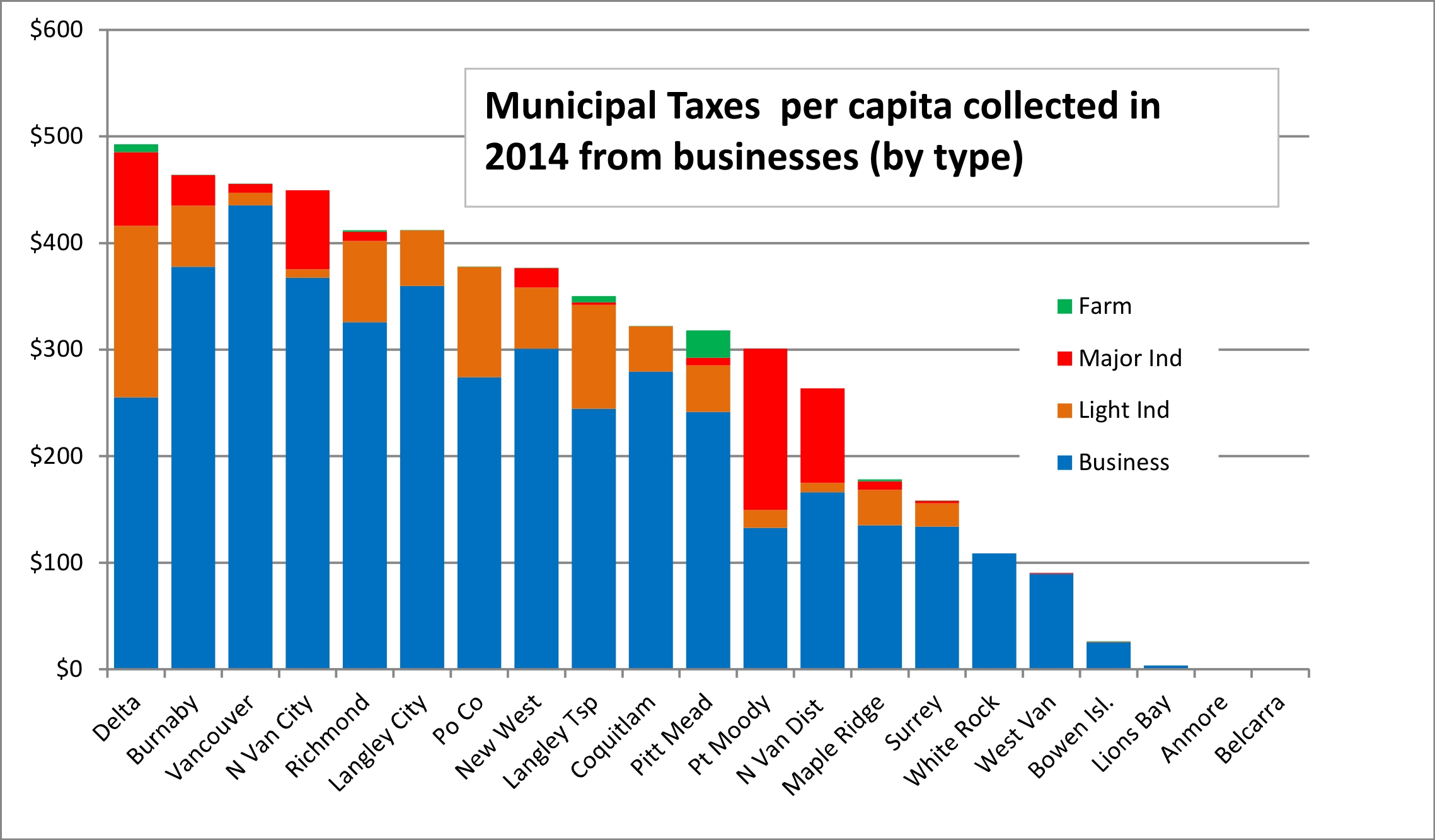
But what about businesses? During the last election, it was suggested in print by one of the (unsuccessful) candidates that taxes charged to businesses in New Wesmtinster are “the highest in Metro Vancouver”. This did not make sense to me at the time, but didn’t rise to the point, as I wanted to be able to put number to the issue. The simplest method, of course is to compare how much is collected from businesses of every type on a per-capita basis:
You can see that New Westminster is 8th in the crazy category of most taxes per capita from businesses of all types. If you look only at commercial businesses (blue), we are the 6th highest. This is where you can see some of land use choices affecting the numbers. Delta has huge tracts of industrial land on Annacis Island that provides almost half of its non-residential taxes, and Port Moody hosts a lot of major industrial use. Meanwhile, Vancouver is truly post-industrial, with their largest “industry” being non-industrial commercial businesses. There is nothing here that makes New Westminster anomalous.
However, this is a rather useless comparison. Unlike residential taxes, you cannot evaluate business taxes on a per-capita basis. With the varying levels of residential/business mix, you can’t really count up the number of businesses or business owners or leasable square footage and divide the taxes collected between those groups, as the variables are way too…uh…variable. So how do we compare apples in this diverse bowl of fruit?
One way would be to look what proportion of the total property tax revenue is paid by residents, and what proportion is paid by businesses. To index this, you need to compare it to the proportion of assessed land value that is zoned Residential vs. that zoned Commercial. This allows you to recognize anomalies like Anmore and West Vancouver (which have almost all of their land in residential use) and compare them to places like Langley City and Port Moody, where commercial land use is proportionally large.
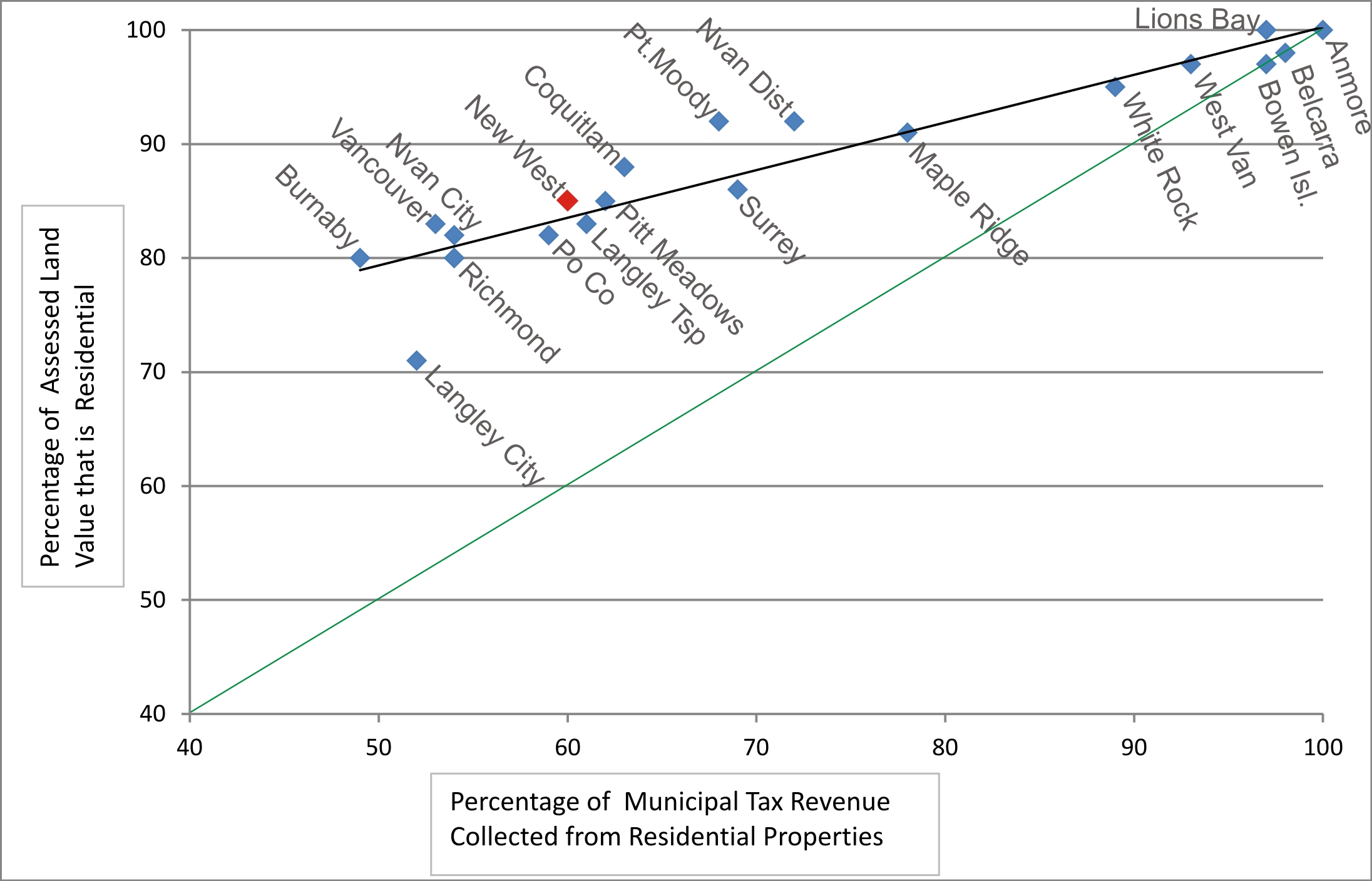
First, compare the percentage of land value that is in residential property with the percentage of tax revenue drawn from that residential land:
You can see that in Anmore 100% of the property is residential, therefore that is the only source of revenue. At the other end of the “best fit line” is Burnaby, where 80% of the land is residential, but only 50% of the tax revenue comes from residential taxes. Note the green line, which represents an even balance between proportion of residential land value and tax revenue. The best fit around which all municipalities cluster is well above that, which makes sense as all municipalities charge a higher Mil Rate for businesses and industry than for residents. The amount more they charge is the “Multiplier”.
In New Westminster, our Multipliers in 2015 are shown on the table below. The first number is just New Westminster taxes, the second includes all the School, GVRD, MFA, etc. taxes that the City has no real control over.
Property use Multiplier (City Only) (all taxes)
Residential x 1 x 1
Business x 3.475 x 3.403
Light Industry x 4.566 x 4.131
Heavy Industry x 8.102 x 6.444
But back to the graph above. If a municipality charges less to residents in proportion to their property value than they do to business and industry in comparison to other municipalities, then they appear below the best fit line. For lack of a less-pejorative term, I’ll call these municipalities “resident friendly”. Those above the line are more “business friendly”. Langley City is anomalously “resident friendly”, where North Van City and Port Moody are more “Business Friendly”.
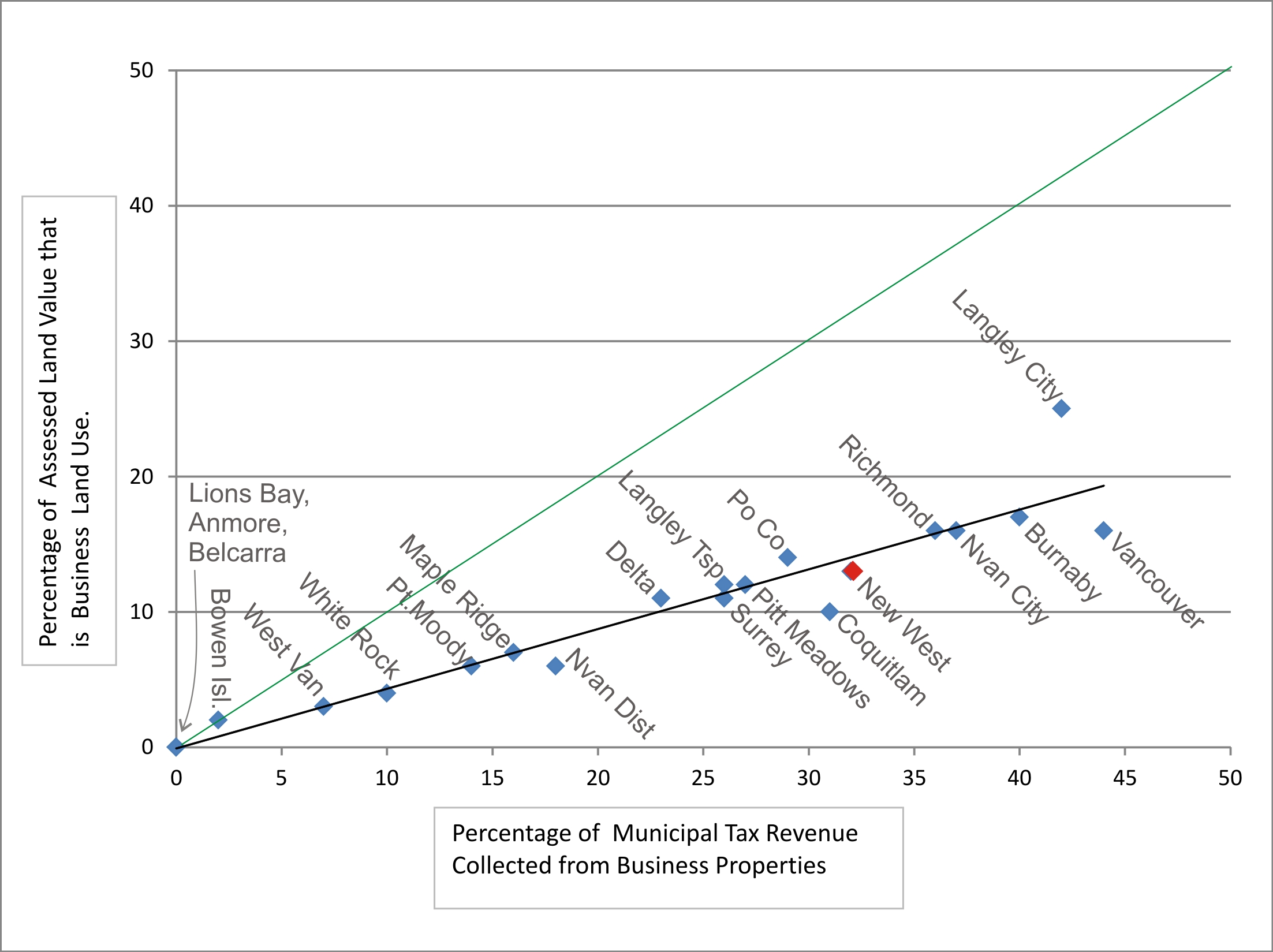
However, much of what controls the proportion of industrial land is structural to the economy and geography. Today’s Delta won the lottery in 1955 when the island was designated as the region’s first Industrial Park, and the high-multiplier property taxes started rolling in. Another way to look at the above graph is to flip it over looking only at commercial business taxes:
This time the best fit is under the (green) equality line because every business in every municipality pays more than its share of property taxes. The further under the best fit line, the less “business friendly” a Municipality may be considered. Vancouver is the obvious standout (the attractiveness for major businesses of being located at the central business district of the metropolis demands a premium), but New Westminster, Coquitlam, and the District of North Vancouver also appear a little below the line, and have very different land use proportions when looking at residential vs. industrial vs. commercial.
This raises a question which is completely rhetorical, but well worth asking: what should be the balance between residential and business taxation? Should a City like New Westminster give business owners a bit of a break to encourage job creation, or should we keep residential property taxes lower to manage the affordability of living here? Should businesses subsidize residents, or vice versa? If “neither”, what is the balance?
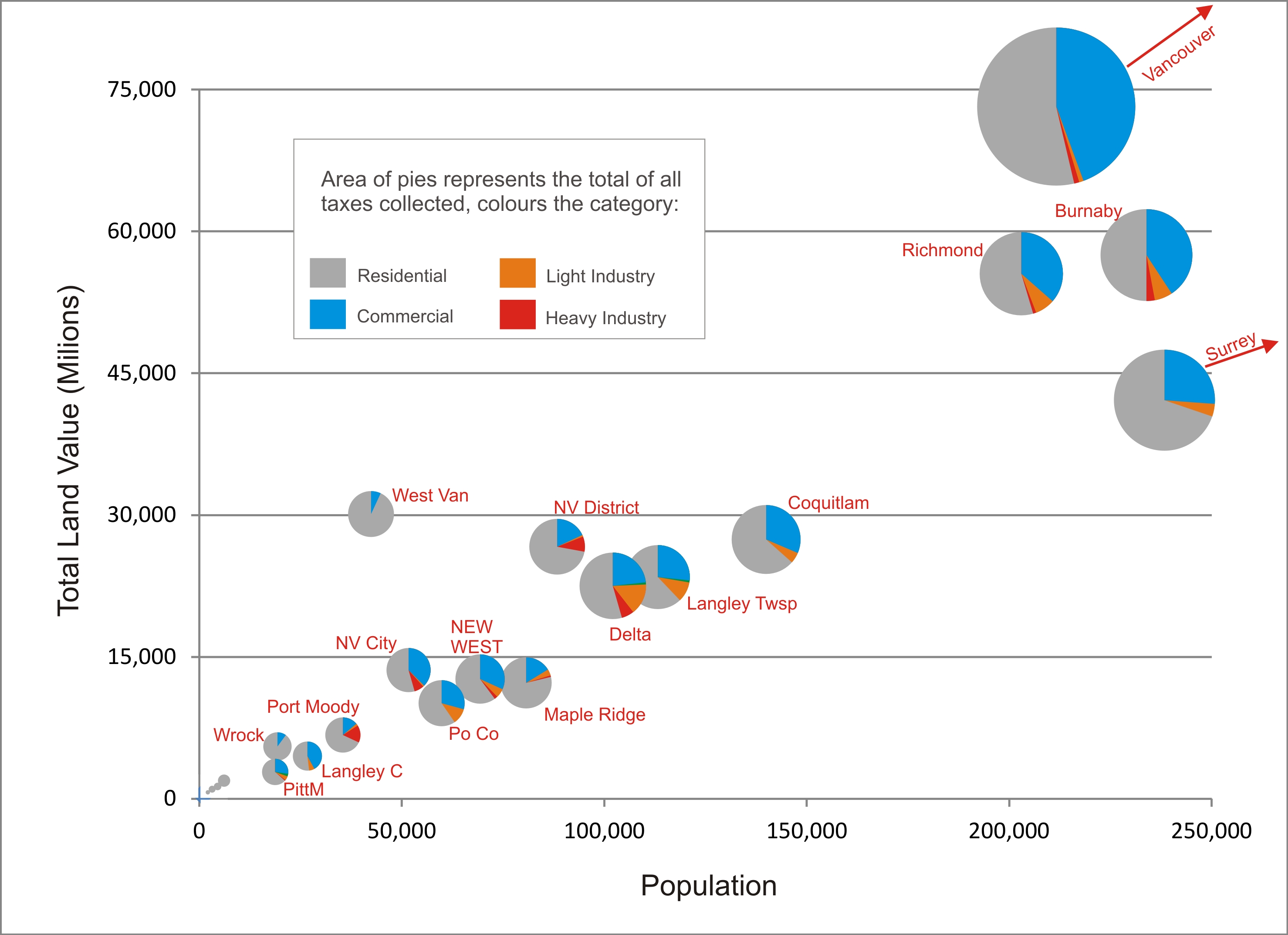
Just for the fun of it, I plotted every municipality’s details on the same graph. Population is on the X axis, and the total land assessed value on the Y axis. The area of the pies represent the annual tax revenue, and the colours of the pie charts represent the tax revenue by land use. Note that Vancouver and Surrey are both way off the chart here. Both their populations (640,914 and 504,661 respectively) and assessed land values ($221 Billion and $85 Billion) put them in a range that is out of scale with the rest of the graph.
I don’t have much to say about this graph except that New Westminster is snugly right in the middle on pretty much every measure. The amount of tax revenue collected and the proportion of residential vs. other types of taxation is pretty much right where you would expect for a City of our size and population. It is clear that we do not, by any measure, have the highest taxes in Metro Vancouver, nor are we the lowest, regardless of whether you are a business or a resident. We are somewhere in the middle, proportionate with our land use and population size.
All of this data is from 2014, and the new 2015 reporting to the Provincial government is starting to trickle in. This year, New Westminster Council approved a 2.42% tax increase, which is higher than the 1.3% increase in the Consumer Price Index over the fiscal year 2014-2015. This raises the question of whether our tax increases are happening at an anomalous rate. I’ll try to dig out some data for that and bring you a Part 3.
Will the city be offering pay by phone for parking? I thought that one of the reasons for these fancy new metres was so that this service could be offered. I personally find it far more convenient. I see exactly the same metres at River Market and Plaza 88 and they both offer pay by phone, yet the city does not. What gives?
Short answer: Yes. The new digital pay stations being installed are compatible with Pay-by-Phone applications. The removal of the old meters and the installation of the new ones is an ongoing process, however, and there are a few steps that need to happen in the City’s internal processes before full pay-by-phone comes on line. I hope it happens by the end of the year, and that would be a safe bet, but I’m not making any promises.
We also, just before Council started, were given a grand tour of the New Westminster Hyack float (see above). The theme is a little cheeky, and the float has already won awards in spring Parades. I was also given a little background about the details of how a float operates. The New Westminster Hyack Float is actually electric, has a range of about 20km, and a top speed of about 35km/h. I was not, much to my chagrin, permitted to check it’s cornering. Anyway, this is an important reminder that Hyack week starts this weekend, with the Antique Sale and Anvil Battery Salute this weekend, the May Day dances on May 20th, and of course, the Parade and Uptown Street Fest on the 23rd.
After talking about airplanes with the previous Mayor, we received a presentation from Staff to update us on the process for the OCP, and the Visions and Goals developed through the first phase of public and stakeholder consultation. The report was great, and worth a look-through if you are at all interested in the Future of New Westminster.
A not-uncommon genre of complaint I hear is that the City is not managing growth appropriately. Although many are excited to see a more dynamic urban environment, others look at planned developments and say “what will happen with all the cars!?” or “how are we going to fit them all in the Library / Pool/ Community Centre” or “what does this mean for the character of my neighbourhood”?
The answers to those questions are in the OCP. We can, and will, plan to accommodate the growth, and can balance the need to accommodate people moving to the regions with protecting (or even enhancing) the livability of the places people live in today. But it takes careful planning, and community participation in that planning so we can understand what people are looking for when they say “livability” or “mobility” or “character”. The “Love Our City” event back in February brought a lot of good ideas forward, and started setting the table for what the community wants to look like in 25 years.
Because growth is going to happen. There are going to be a million more people in the Lower Mainland, and something like 30,000 of them are going to live in New Westminster. We cannot turn or back on that growth or prevent it, because we have agreed to a regional growth strategy with our Metro area neighbours, and because forcing those people to find a place to live in greenfields south and east of us will put unacceptable pressure on our ALR and employment lands, and will monumentally increase the tolls on our regional infrastructure (roads, sewers, water supply, etc.)
The rub here is how we accommodate growth in New West. To simplify, people seem to like (or at least accept) tower-oriented high density mixed use near SkyTrain Stations as the backbone of new urban development. We also have areas of New Westminster (Lower Sapperton, Queens Park, Massey Heights) where single-family detached will be the dominant land use for another generation at least, although opportunities do exist for “sensitive infill” like laneway houses, strata-dividing larger homes, or narrow-lot infill as long as the approach is diffuse and not to impactful on neighbourhood character.
The fun part is what happens in the middle. My neighbourhood of Brow of the Hill, Queensborough, Moody Park, and some other areas have already seem some moderate density increases, and may be ripe for more. The range that fits here would be wide, and where a lot of consultation may be needed: from duplexes to townhomes to fee-simple row homes and mixed commercial-residential buildings up to 6 stories. These types of developments can really add to the “street life” of commercial areas like 12th Street, bring more affordable family-sized options, while protecting a neighbourhood spirit where you know and trust your neighbours.
There is a lot more to come on this, and we should be looking forward to the Fall when all of the data collected up to here will be condensed into a few draft planning concepts – then we can really start to put a vision to New Westminster in 2041. Before that, watch this space, as there will be a public survey component to the current data, to see if you have ideas to improve it. Expect to see that out in the next week or two.
After these reports, we moved on to recommendations from the Committee of the Whole meeting from earlier in the day:
Council meeting schedule changes
We have been making adjustments to our Council Schedule, as there is an interest both with Staff and Council to have more “workshop” type meetings where we dig down into a project or issue at more detail and have a more complete discussion. Staff suggested we take three dates when Council is not scheduled to meet, and make those special workshop days. I have two problems with this.
First, I work for a living, and have had to make some accommodation with my employer to do my Council duties. We have an Annual Council Schedule, and I used that to work out the accommodation I need, and my employer has agreed to adjust to that (with unpaid time off). It is not fair to my employer for me to keep changing that schedule – they need certainty that I will remain a reliable employee. I am not the only person on Council who has a “real” job, and I shouldn’t be. Council does not pay enough to cover a mortgage in New Westminster, and I do not want to exclude working-age people in the making-a-living stage of life from serving on Council, so accommodation to our working schedules is really important in my opinion.
Second, these all-day workshop meetings take a lot of senior staff time. I do not want to take three more days from their already busy schedules to do these workshops. At least not until we have found a way to make our existing meetings as efficient as possible. There is a balance, of course, between having a meaningful and complete discussion, and running and efficient meeting. There are also two parts to that: the way reports are written to maximize the information and clarity of information, and the work that Council puts in preparing prior to a meeting so we are not reviewing information, but are enhancing our understanding to allow informed decision-making. We are a good team, Council and Staff, but we have some work to do to make our operation more efficient.
In the end, we compromised by adding a June 15th Workshop meeting, and asking Staff to recommend ways to improve the efficiency of our meetings or otherwise fit the other workshop topics into our existing schedule.
OCP Review, Draft Vision and Goals for OurCity 2041
We accepted the report from staff as discussed at some length above.
DP for 620 Salter Street
This is a development application for a 54-unit townhouse development on Salter Street in Queensborough. There will be an Opportunity to be Heard on this permit application on June 22, 2015. C’mon out and tell us what you think.
DP for 843 Ewen Ave
This is a development application for a 67-unit townhouse development on Ewen Avenue in Queensborough. There will be an Opportunity to be Heard on this permit application on June 22, 2015. C’mon out and tell us what you think.
DP for 188 Wood Street
This is a development application for a 65-unit townhouse development on Wood Street (the address used to be 702 Salter Street) in Queensborough. There will be an Opportunity to be Heard on this permit application on June 22, 2015. C’mon out and tell us what you think.
DP for 240 Jardine Street
This is a development application for a 34-unit townhouse development on Jardine Street in Queensborough. There will be an Opportunity to be Heard on this permit application on June 22, 2015. C’mon out and tell us what you think.
Editorializing Alert! Holy Cow. 4 separate developments in one week. 218 units averaging 1,330 square feet and including more than 600 bedrooms and 434 parking spots. 289,649 total square feet on 8.65 acres. Clearly, Queensborough is booming with the kind of family-oriented building that people on the elevated side of the river are clamouring for. What’s missing? Why are people in New West saying there are no affordable family homes being built? Is it one bridge too far? Not enough amenities nearby? Transit access? Lack of the urban feel? What has Queensborough got that the uphill neighbourhoods don’t?
New Westminster Healthier Community Partnership Committee
This was an update report on a Committee that was struck back in 2011 as a partnership between the City, the School District and Fraser Health. Recent actions include an agreement to integrate health goals in to the Official Community Plan, which is a bit of leading-edge as far as health policy for a City. You can read more about the goals of the Partnership at this link.
Council received the report for information.
Amendment to Bylaw Notice Enforcement Bylaw
This amendment coordinates the way several recent changes in various City bylaws interact with the bylaw that provides bylaw officers the legal ability to write tickets. Yeah, it seems kind of confusing that we need a ticketing bylaw that has to refer to every bylaw that refers to it, and it has to change when those bylaws do, but hey, no-one said government was simple.
Council referred this for three readings (see below).
2014 Filming Update
New Westminster is popular for filming, and it was rather fitting that this report came to council on a date when Tiperrary Park was filled with fog machines and period clothing as another film set day was occurring. 2014 was but down from 2013 (reflecting the volatility of the industry and the impact of a shifting Canadian Dollar on the market), but is up in 2015. The City charged film companies $313,000 in 2014 to work in the City, and it cost the City about $130,000 to provide services to accommodate that filming. The net profit to the City is modest in the scope of our annual $100M budget, but is a respectable return on investment.
More important to me, the negative impacts of filming on residents and businesses are being managed pretty well, and the positive economic impacts for local businesses (not to mention the sometimes-significant stipends paid to businesses and residents for the use of their property) are being felt across the City. New Westminster has great locations, but our great staff also helps make it a desirable place to film.
Electrical Utility Bylaw Amendment
The City has a bylaw that regulates its Electrical Utility. There are a couple of initiatives ramping up right now that have the potential to really expand the scope of the Utility – a potential district Energy Utility for the Sapperton/RCH area and the installation and operation of a dark fibre network to support the Intelligent City Initiative. Further, more of the Energy Save New West operation is involving the Electrical Utility, so the range and amount of work the electrical Commission will be required to do is going up. It was agreed by Council that a second representative be elected to the Commission to help spread the load.
The required bylaw change was referred to Council for three readings (see below).
Surrey Fraser Docks Amendment of Permit
As no-one could possibly have foreseen (/sarcasm), Fraser Surrey Docks is already looking to amend the permit they received from Port Metro Vancouver last year to introduce the import and trans-loading of thermal coal from the Powder River Basin in the US at their Surrey facility. They have not even started construction on the facility (as they are a little tied up with a couple of Metro Vancouver Permit snafus and a legal case), but they are asking to shift from loading barges to loading Panamax-sized ocean-going bulk carriers.
They are currently in the pre-application phase, meaning they are doing a bit of public outreach to decide if an application will go forward. If they go forward, they will need to update the human health and environmental risk reports, along with the marine traffic impacts and other studies, to reflect the new operation, then they will go through some level of stakeholder or public engagement.
Regardless, it is good to get your comments in early, as this phase of the public engagement ends on May 19th. Go to this web address and fill in the online form, e-mail your comments, or give them a phone call, They should hear from you, and reply to your concerns, after all, it is your back yard, and your climate.
Closure of the Pattullo Bridge Sidewalk
This was a concern brought to me by a constituent who commutes across the Pattullo Bridge on his bike to his job at Surrey Memorial Hospital on a regular basis. Signs went up recently announcing nighttime closures of the sidewalk for a month starting May 10th. I went to the TransLink website and saw no information about this closure (until this notice went up on May 10th), and it took City staff making some contact with TransLink to get some details.
The concern here is that the sidewalk is a vital transportation link for a lot of people, be they cyclists or pedestrians, and there are no ready replacements, especially at night when the Skytrain may not be running. Closures of a link with no ready alternative can by majorly disruptive, and putting a sign up a week beforehand is not optimum notice. Ideally, TransLink should be providing alternate means for those who rely on this crossing if the Sidewalk is going to be closed for a longer period of time.
I recognize that the works being proposed to repair the railing may be necessary, but there needs to be some recognition of the impacts on non-drivers when a vital link like this is closed. This relates not just to this project, but further repairs planned for the Pattullo in the coming months (at least according to their on-line tender documents) and, of course, eventual replacement if we get a YES vote. The Pattullo is not just a car bridge, but is a vital sustainable transportation link. If that link is not available for some time, TransLink really needs to come ot the plate with a plan to accommodate users.
Correspondence from DTRA
We also received correspondence form the Downtown Residents Association in regards to some specific and general traffic and safety concerns in their neighbourhood. I asked that Council direct these concerns to the Neighbourhood Traffic Advisory Committee and the Advisory Committee for Transit, Bicycles and Pedestrians so that they can review and send recommendations that Council may be able to act on.
Bylaws, Bylaws, Bylaws.
7749 2015 – Downtown BIA
This update of the BIA Parcel Tax saw three readings on April 27, and was adopted at this meeting. It’s now the Law of the Land.
7750 2015 – Downtown BIA – secondary area
This update of the BIA Parcel Tax for the other part of Downtown saw three readings on April 27, and was adopted at this meeting. It’s now the Law of the Land.
7748 2015 – Uptown BIA
This is an update of the BIA Parcel Tax for the Uptown BIA, which also saw three readings on April 27, and was adopted at this meeting. It’s now the Law of the Land.
7751 2015 – Tax Rates Bylaw
The bylaw that makes our tax increase for 2015 official saw three readings on April 27. Now that it has been adopted, it’s the Law of the Land.
7734 2015 and 7735 2015– HRA for 336 Agnes
As discussed back on the 30th of March, these are the Bylaws that support the HRA for renovation of Dontenwill Hall. Law of the Land, folks!
We had a council meeting on May 4 (insert obligatory apology for being so late getting this out). We had a Closed Session, a Committee of the Whole meeting, and a few other things on the Regular Meeting agenda, but this meeting was dominated by the Public Hearing on two Bylaws that supported the proposed expansion of the Urban Academy campus in Queens Park. More than 6 hours of delegations and a very packed City Hall (the photo above is the overflow outside of the packed Council Chambers).
Not intending to bury the lede, the proposal was voted down by Council, six votes to one. I was the one.
I have complete respect for my Council colleagues. I have not asked them about the places where we disagree, and there is no reason for me to try to pick apart or translate their votes or their reasoning. Instead, I can only speak for myself, and say I disagreed with the majority vote here, and provide my reasoning for why I voted the way I did.
I did everything I could to learn about this project, and that started before the election. I attended an open house at the Olivet Church. I met with the Chair of the UA Board and with the Principal. On more than one occasion, I took a walk by the school (without warning the school) during the morning drop-off time to see how the traffic worked, and interacted with the Qayqayt traffic. I attended a QPRA meeting where the topic was discussed, and another private meeting in a home in Queens Park with about a dozen neighbours who opposed the project. I had conversations with people from the Advisory Planning Commission, the Queens Park and Downtown RAs, staff in the City and professionals who do heritage restorations. I went into all of these meetings and discussion to learn, not to tell people what I think or give advice. I tried to play the “devil’s advocate” in those conversations, with the intent of getting people to see the other side better.
I also received a lot of correspondence on this project. I have read and replied to more than 100 e-mails (remain neutral in my responses, cognizant of the upcoming Public Hearing), and have read about 50 more, to which I have yet to reply (sorry, folks, I’ll try hard to get back to you). I received written correspondence on old-fashioned paper, had a few Social Media exchanges.
The hardest part was the conservations with a person I consider a friend, and a community leader in New Westminster, who was heartbroken when her family was displaced by Urban Academy as they bought the neighbouring property and started handing out evictions.
Even after all of this, I can honestly say I woke up on Monday morning unsure about whether I supported the project. I changed my mind three times between showering and shaving on Monday. I was struggling to understand how to put a project like this into a context that would allow me to make a decision that I could defend.
When I ran for Council, I told people they may not agree with every decision I make, but I will always provide a rationale, will do the research required to make an informed decision, and will do what I think is best for the future of the community. At the time, the Whitecaps Soccer proposal was front and centre with its lawn sign battles and divisive public hearings. However, this is the first time during my term on Council where I really felt the power of that type of divide. There were passionate communities for and against, and there simply was no middle ground to be found. So I couldn’t make a “gut” call or follow the crowd, I had to find something to hang my reasoning on.
Looking back at the Public Hearing, I know when I made my decision – when it solidified in my mind. I listened to the 60-odd delegates and took 8 pages of notes, but it was one delegate, somewhere in the middle, that created the context I needed (I won’t declare here who it was, but will send that delegate a thank-you email). At that point, I started to pare away the things I could not decide on, and get down to the things I could.
For example, I do not question the appropriateness of the HRA process. This project met the criteria and the spirit of an HRA as laid out in City policy and bylaws. Further, there was an impression created during the debate that an HRA is some sort of run-around of the “normal process”, giving the proponent a shortcut to approval. This is simply not true. An HRA requires the same committee reviews and public processes as a traditional Rezoning and Development. An HRA actually includes an extra assessment on heritage value and an extra committee review to discuss this. The heritage benefits of an HRA become part of the negotiation when it comes to variances or amenity contributions, but that is, as we learned, at the pleasure of Council, who are free at any time to say “no deal”. Staff and the Community Heritage Commission felt this was an appropriate application of the HRA process, and the process was applied properly. I cannot vote against a project because people don’t like the process the Proponent followed when that process was set up and supported by Council.
Another part I really had a hard time putting weight into for my own decision was the personal testimonials of all the parents about how good they thought the school was for their kids (here is the part of this blog where I lose any potential “political gain” I may have received by supporting the project). This rubbed against my personal conviction that Public School is a cornerstone in our civil society. Yes, Urban Academy provides unique programming not available in the public system, and the parents that run it take efforts to open their school to those who could not traditionally afford or have access to a private school, but I fundamentally believe those resources and efforts should be put towards making our public system a more effective and inclusive one. I do not support two-tier education. However, that discussion has to happen at the Provincial level, and within society as a whole, and cannot be decided on a case-by-case basis around the Council table during a rezoning application.
That leaves us with the topics that (in my opinion) are the sole duty of City Council – land use and urban planning. To be fair, many arguments against the proposal were around land use and urban planning. I just failed to find them compelling. Which I guess is going to take some explaining.
At the most hyperbolic, it was suggested that the expansion of Urban Academy would have a “devastating impact” on the Queens Park neighbourhood as one of the most valuable collections of heritage homes in British Columbia. I all honesty, I found this idea ridiculous. Not a single heritage home was being demolished or threatened, and the impact on the few adjacent ones was so minor that a direct neighbour who owned one of these heritage homes was a vocal supporter of the project. The location of this project is at the periphery of the historic Queens Park neighbourhood, immediately adjacent to an 11-story concrete building with zero heritage value, and on the same block as two other three story walk-ups with a similar lack of heritage value. As far as impact on the neighbouring community, I liken it to Queens Park West, the commercial Building at 5th Street and 6th Ave that effectively transitions the heavily-commercial 6th and 6th area and the high-rise residential Legion Manor to the adjacent heritage residential area.
Far from a “devastating impact” on the Queens Park neighbourhood, I saw the Urban Academy project as having some impact on a small number of residents in the Queens Park Neighbourhood. From a land-use planning perspective, it is those impacts I need to weigh against the benefits to the community of approving the project. As no project in the City, from Sapperton Green to my replacing my back fence, is truly “impact free”, we cannot set zero impact as the standard. We do, however, have to have an honest discussion about the impacts, and how they can or cannot be mitigated.
The mass of the proposed new building was an oft-expressed concern. The increase from an FSR of 0.38 (for the School site) and 0.85 for the existing apartment building to a combined 1.27 is a significant increase, especially when compared to the residential properties to the north with lower FSRs (generally below 0.3). However, the property directly to the south has an FSR of 2.36, and that includes the large parking lot area adjacent to it. The next two apartment buildings to the east are 1.96 and 1.41. Aside from the single family homes on far the east end of the block, the expanded school would still have had the lowest FSR on the block, which on a pure numbers basis, represents appropriate mass for the site.
Unfortunately, the layout of the property and the preservation of the existing heritage building pushes the new mass to the north part of the lot and around the periphery, which may (as was argued by the school) reduce the noise and disturbance of a regular school on adjacent residential areas, but it does make the mass feel bigger than it is. The proponents took significant measures to reduce the massing impact to the north side, shifting the building south, installing a regulation-width sidewalk in Manitoba Street for the first time, reducing the total floorspace area (especially of the top floor) and creating a more articulated and softer interface. All things considered, I think the resulting building was appropriate for the space.
The concerns about the safety of the school, including the suggestion that children would be imperiled by a sunken gym or that access to the school was inadequate, were not concerns I shared. The building was designed to meet the BC building and fire codes for the number of students it planned to hold, just like the semi-sunken gym at Qayqayt School and the fully-sunken gym at the Century House Youth Centre. These are important questions to be asked, and are part of the responsibility of the architects, City inspectors and Fire Marshall, and no public building (especially a school) will receive its occupancy permit until these concerns are addressed.
The lack of adequate play area was another issue of concern to the neighbors. Again, I leave this concern to the childhood education professionals at the school and the parents who choose to send their kids to the school. They argue that the rooftop, paved surfaces, gym and play areas are adequate for their needs, and it isn’t for me or concerned neighbours who don’t send kids to the school to measure this.
The occasional use of Tipperary Park and other community green spaces is not something I see as a threat to the greater community. Parks are places set aside for community use, and Tipperary is never, even on the sunniest Farmers Market Day, crowded enough to make it unusable. Kids playing in a City-owned park is something this City should be excited about, not something we should see as a potential threat to our livability.
Looking at the proposal at a high level, I saw a reflection of the reality of modern compact school design in a dense urban area. Schools and other institutions are no longer going to be the sprawling low-rise complexes surrounded by acres of green grass that we grew up with. Land in a City like New Westminster is too valuable, and there are too many cost pressures on people operating these facilities, be they private or public sector. In the bigger urban planning context, this is the type of use that is absolutely appropriate for transition space between higher-density to the south and single family with a heritage character to the north. A school this size adjacent to a residential area is not unusual in urban areas across North America, and the scale, density, and character is common in those Northern European countries we look to for examples of high-livability urban planning principles.
I can see the benefits that this type of institution could bring the City, including jobs (this school would employ more people than the Fraser Surrey Docks Coal Terminal!) and the economic impacts of having school families using adjacent services (one just has to count the numbers of UA uniforms at the spring and fall Farmers Markets in adjacent Tipperary Park). I also see the broader community benefits of an arts-infused school program (I just wish our public schools were funded enough to provide the same opportunity). If the school fails due to an inability to grow, I cannot imagine what other use will come along for the site that will provide the same long-term stability and community benefits without similar or higher impacts on the neighbourhood.
Indeed, there would have been impacts on the neighbourhood, which brings us to the real issue at the middle of this discussion: cars. With all due respect to the Lancers, when is the last time any truly contentious topic in New Westminster didn’t come down the movement or parking of cars? Yes, the Urban Academy creates traffic, and they fully acknowledge that. They have also proposed several approaches to dealing with the traffic they will generate; from shifting school start times to developing more comprehensive carpooling and bussing program and using a code of conduct to designate “exclusion zones” to protect more sensitive neighbourhood areas. Unfortunately, it is difficult for the City to secure these voluntary approaches through the HRA/Rezoning process.
This is a school, which are institutions that have always lived in residential areas. There are traffic snafus around all schools, from the over-crowded 8th Ave sidewalk by NWSS to irregular road rage issues around Lord Tweedsmuir and Qayqayt teething issues. The nature of how we move kids to and from schools today (which few will debate is completely bonkers compared to when we were kids) creates twice-daily traffic challenges in the immediate area. We can work to mitigate those, but they will never go away. Traffic is an organic system that will adapt in ways we cannot foresee, but we can plan, manage, and adapt through partnership between the City and the Proponent. Which is the way we address traffic issues with other schools (partnering with the School District and PACs), and commercial developments (partnering with the developers and commercial operators). We do this through planning, infrastructure investment, education and enforcement (collectively known as “governance”).
To protect livability, which (to be generous) is the real issue people are talking about when hyperbolically discussing neighbourhood “traffic chaos”, we cannot only work on a project-by-project basis. Livability related to traffic needs to be addressed city-wide and region wide. I could go on at terrible length about this (as I have in the past), but this is why we need to implement the new Master Transportation Plan, emphasize pedestrian safety, alternative modes, and neighbourhood livability, and why we need a YES vote in referendum, so we can get on with building a regional system that supports our efforts to protect the livability of Queens and Third, and every other residential intersection in the City.
Urban Academy had a multi-faceted plan to reduce traffic loads, and made some solid suggestions around how to reduce neighbourhood impacts. The work they did satisfied the City’s Engineering Department, who has the professional expertise to review these things, and would have to pay for any costs related to the traffic. If there were specific issues that cropped up (i.e. student drop-offs in inappropriate places), then a combination of infrastructure adjustments, signage, and enforcement can manage that. Yes, Urban Academy would have neighbourhood traffic impacts, and yes, I believed they could be managed.
This leaves me with the issue of the evictions of the tenants of 228 Manitoba. I had several conversations with a tenant who felt bullied, belittled, and disrespected through the entire process. She lost the home in which she raised her family, and was both heartbroken by the loss, and felt violated by the treatment she received. When I discussed the eviction process with the Proponents, they clearly had a different view of what transpired, and felt they had bent over backwards to accommodate residents and met and exceeded their requirements under the Residential Tenancy Act for these situations. This was clearly a horrible situation, and I have no reason to doubt the experience of the tenant, whom I have known for several years and for whom I have a lot of respect. However, I cannot in good conscience use this terrible experience as a reason to deny an otherwise acceptable HRA application.
I see my role in making decisions not by counting polls, comparing the thickness of petitions (referenda are a terrible way to apply public policy), or weighing personal anecdotes, but to honestly measure the merits and costs of a project and vote based on that measure. I also think that those who disagree with me, and those who do not, deserve an explanation for why I vote the way I do. I am open to hearing your opinions, because at 6 months, I am clearly still trying to learn my role here.
The last council meeting of the month is usually a Public Hearing meeting, meaning we start a little early (6:00 instead of 7:00) and we provide Opportunities to be Heard on any pending Bylaws that, as per the Local Government Act require Public Hearings prior to adoption. This month, we had Public Hearings on two projects, one big and one small.
Bylaw 7740 – 318 and 328 Agnes Street
This is a pretty big rental-only development on a vacant lot at Agnes and Merrivale, which puts it kitty-corner to Qayqayt school, pretty much in the center of the City’s growing residential downtown. Two 6-story buildings, comprising 202 residential suites, all market rental. The developments will include a large number of family-sized suites (26 two-bedroom and 36 three-bedroom) and even the one-bedroom suites will be larger that is typically being built today.
The market is looking for this type of rental mix right now, and it supports the City’s Secured Market Rental housing policy, fits within the Downtown Community Plan and the OCP, and meets the objectives of the City’s burgeoning Family-Friendly housing policy. The City’s Advisory Planning commission and Design Panel both supported the development as proposed. Written correspondence on the project was, on balance, supportive.
I am happy to support this type of development in the downtown. My main concern with this property was how it integrates with the surrounding pedestrian infrastructure, seeing as it is locate immediately adjacent to Qayqayt, in a location where lots of people are going to be walking by (and indeed, through) the site every day. The townhouse-type street expression (where people enter their apartments from the front yard, not through the interior of the building) definitely increases the on-street livability and community connection of the building. With people facing the street, the “front yards” are activated, and pedestrians feel more comfortable. This is great, and a new direction for market-rental buildings.
In Public Hearing, we referred the Bylaw to the Council Meeting for Third Reading.
Bylaw 7710 – 223 Queens Ave.
This is a heritage home (1897) on a pretty typical 55 foot lot, with the exceptional depth of 206 feet. The plan is to subdivide the lot such that the back 85 feet of lot become a separate property, with a house that faces an alley that has already been re-classified as a Street and named “Gifford Place”, presumably as the adjacent properties performed similar subdivisions.
The public hearing raised a few concerns about this proposal. The immediate neighbor was concerned about windows staring into the windows of their house (they won’t), and about the grade separation impacting their land. The drawings were not obvious in how the basement suite of the new building would be accessed. After reviewing the drawings and clarifying with the applicant, the grade between properties would be flat, and the 3 foot slope-down is actually in the middle of the applicant property, which should keep it well away from having any effect on the neighbour’s fence. Another nearby neighbour did not like the position of the new property line, but shifting the new building forward on the lot to accommodate a change in property line would intrude onto Gifford Place in such a way that access would be challenging.
There are some concessions given in that this is a Heritage Preservation project. The preserved heritage home will have no off-street parking. Zero. That would never be allowed outside of a heritage conservation project. Simply put, you do not own the street in front of your home, so expecting it will always be available for parking is a bad idea. Secondly, Gifford Place itself is not much of a road, being narrow, with very small setbacks for the existing properties, and no sidewalks whatsoever. It has a name, and homes face it, but it really is not much more than an alley. This makes it a bit challenging for vehicles, but a covenant on the property will assure that there is always a “turn around” spot on the property for cars on the short stub that is Gifford Place to use. When this entire project is taken into account, both the heritage home and the new home will have secondary suites, which puts even a bigger pinch on the parking issues. However, the Advisory Planning Commission, the Queens Park Residents Association, and the Community Heritage Commission all supported the project.
In Public Hearing, we referred the Bylaw to the Council Meeting for Third Reading.
Bylaw 7711 – 223 Queens Ave
This is the Heritage Designation Bylaw for the project above. This makes the house a Designated Heritage Building
In Public Hearing, we referred the Bylaw to the Council Meeting for Third Reading.
After the Public Hearings, we resumed with our regular Council Meeting, including a couple of presentations:
We had a Moment of Silence to mark the National Day of Mourning for workers killed on the job. During my minute, I thought of my High School friend Johnny Hadikin, a guy with a great sense of humour, a penchant for hijinks, and a dream of flying planes, who died way, way too young in a sawmill accident at the age of 25.
We had a proclamation of Multiple Sclerosis Month – which is a good reminder of how Canada has by far the highest incidence of MS in the world, and how after all of these years, we really understand very little about the cause of MS, even when they are starting to find effective treatments to slow the onset.
It was also Public Rail Safety Week, which is rather apropos in a week with another train derailment, but the Week is about raising awareness around safe rail crossings and train/car/pedestrian interactions.
We also had a presentation on the Blue Dot Movement, which is seeking local, provincial, and federal support for the Right to a Clean Environment, which included this video:
I was happy to support this program, and it’s ideals. For those not in the room, here is a complete copy of the Declaration supported by Council:
Whereas New Westminster understands that people are part of the environment, and that a healthy environment is inextricably linked to the well-being of our community;
New Westminster finds and declares that:
1. All people have the right to live in a healthy environment, including:
The right to breathe clean air
The right to drink clean water
The right to consume safe food
The right to access nature
The right to know about pollutants and contaminants released into the local environment
The right to participate in decision-making that will affect the environment
2. New Westminster has the responsibility, within its jurisdiction, to respect, protect, fulfill and promote these rights.
3. New Westminster shall apply the precautionary principle: where threats of serious or irreversible damage to human health or the environment exist, New Westminster shall take cost effective measures to prevent the degradation of the environment and protect the health of its citizens. Lack of full scientific certainty shall not be viewed as sufficient reason for New Westminster to postpone such measures
4. New Westminster shall apply full cost accounting: when evaluating reasonably foreseeable costs of proposed actions and alternatives, New Westminster will consider costs to human health and the environment.
5. By Dec 31st 2015, New Westminster shall specify objectives, targets and timelines and actions New Westminster will take, within its jurisdiction, to fulfill residents’ right to a healthy environment, including priority actions to:
a. Ensure equitable distribution of environmental benefits and burdens within the municipality, preventing the development of pollution “hot spots”;
b. Ensure infrastructure and development projects protect the environment, including air quality;
c. Address climate change by reducing greenhouse gas emissions and implementing adaptation measures;
d. Responsibly increase density;
e. Prioritize walking, cycling and public transit as preferred modes of transportation;
f. Ensure adequate infrastructure for the provision of safe and accessible drinking water;
g. Promote the availability of safe foods;
h. Reduce solid waste and promote recycling and composting;
i. Establish and maintain accessible green spaces in all residential neighbourhoods.
New Westminster shall review the objectives, targets, timelines and actions every five (5) years, and evaluate progress towards fulfilling this declaration.
New Westminster shall consult with residents as part of this process.
6. New Westminster will call on the Province of British Columbia to enact a provincial environmental bill of rights to fulfill the right of every resident to live in a healthy environment by supporting favourable consideration of this matter at the Union of BC Municipalities 2015 Convention.
I also support this movement because of the history of the concept of the Pale Blue Dot, which you can read about here, and it should explain what that feature image at the top of this Blog post is. That’s earth, folks.
Finally, we had a presentation on the City’s Waterfront Vision, which you can watch on the video, or I will post about later.
We then dispensed with the Bylaws that were addressed in the earlier Public Hearings, where all three received Third Reading.
Then we had an Opportunity to be Heard on two Bylaws:
DVP 00587, 610 6th Street.
This Development Variance Permit was to modify the signs in front of the Royal City Centre. No-one appeared to speak on this, as the Variance was only to modify a small portion of the existing large signs, the sign was not getting bigger, it was just adding some words to existing panels, with no added lighting.
Council approved the variance, with Councillor Puchmayr opposed.
Bylaw 7739 2015 – closing a portion of Boyne Street
This Bylaw would officially close an unopened piece of Boyne Street so that it can be sold to the adjacent landowner to facilitate a development that has seen Third Reading. A few neighbors wanted to be heard on this, as they were concerned about how this closure would impact their access and an adjacent walkway. It appeared through the discussion that the neighbor’s concerns were addressed by the clarification provided by Staff.
Council Adopted the Bylaw, but not until further down the agenda.
This taskforce is going to oversee the details of the design and planning of the new Animal Shelter on behalf of Council, and comprises members of Council, Staff, and the Public. Council approved the appointment of two Community members, Leona Green and former City Councillor Bob Osterman.
Seniors Advisory Committee
With one Community member not able to attend the Seniors Advisory Committee meetings, we pulled another volunteer in. This town seems to have a LOT of volunteers!
Proposed Amendment to Definition of Commercial School
Zoning Bylaws are sometimes strangely specific in regards to the type of business that can operate in a zone, and there are, more often than not, very good reasons for that specificity. However, our current definition of “Commercial School” does not reflect the current breadth of training that takes place in the increasing number of commercial schools, especially in the heath sector. This edit of the Zoning bylaw reflects this broader group of activities, so it better reflects the current mix of schools in the City, and some who may want to come here to set up shop if there is (as expected) a bit of a Health Care Cluster boom in Sapperton with the long-awaited and hopefully-anticipated not-yet-announced RCH expansion.
Council approved giving the Amendment First and Second Reading, and scheduling a Public Hearing. (see below)
Industrial Building with Caretaker Suite
A proponent wants to build an industrial building on a vacant piece of industrial-zoned land in the City, but wants to include a two bedroom caretaker suite, presumably for security reasons. Our current Zoning Bylaw prohibits Caretaker Suites, which is an uncommon (but not unique) practice in Greater Vancouver. This is the beginning of the Development Permit process, and there are many steps including committee review and public hearing. The Report was received for information.
Queens Park Neighbourhood Heritage Study
This is just an update on the good work being done by a group of engaged volunteers and City staff from the Queens Park Neighbourhood to look at strategies and opportunities to protect heritage assets in Queens Park better than we have been doing. This was just an update report, but it looks like a good set of principles are being developed, and we can expect some solid recommendations to come out of the group later in the year.
Parkade Demolition
I have said enough about this project, and don’t want to belabor the point. It is good to see that the initial budget estimates for the work were in line with the budgets that came back from the tender process. It is time to move forward.
2015 Tax Rates Bylaw
Coming out of the 5-Year Financial Plan, we now need to pass a Bylaw to support the tax increase required to support it. Council moved to send the Bylaw, which calls for a 2.42% increase in Property Taxes, to receive Three Readings. I have been blogging about taxes, and will cover increases (in Part 3, I suppose), so I will hold off on commenting too much now.
Uptown BIA Parcel Tax Bylaw
The businesses in Uptown New Westminster volunteered last year to form a Business Improvement Area, and collected fee from all businesses (based on the footage of storefront) to fund streetscape improvements and business promotion in the Uptown. The process to create a BIA is described in Section 215 of the Community Charter, and it is important to note that municipal taxpayers outside of the BIA do not contribute at all the BIA. The BIA is 100% self-funded by the member businesses, but many of the benefits that come from the BIA, especially streetscape improvements, benefit all of the community.
Council approved sending this Bylaw to three readings.
Downtown BIA Parcel Tax Bylaws
Same story, but Downtown this time, and as there are two Downtown BIAs covering slightly different areas, there are two Bylaws, both of which Council sent for three readings.
European Chafer Management
It has been, by most reports, a bad year for the European Chafer beetle. Actually, a good year for them, but a bad year for the lawns impacted by them. This is a pest that kills grass lawns with a particular combination shot: the grub stage gets fat eating the roots, then the juicy grubs attract crows, skunks, and raccoons, which tear up the weakened turf to get at them.
If a green grass yard is important to you, then you can apply a natural biological agent to help beat the chafers back. Nematodes are microscopic worm-like bugs, of which there are thousands of species living in pretty much every media on earth, from the sea to the soil to your skin, but a particular species likes to infect and kill chafer grubs. The good part of this application is that the nematodes reproduce inside the grubs, so if you apply them successfully, they should pretty much keep killing grubs until the food source is exhausted, or at least for the full season.
The problem is they are a little expensive, and you need to take some care in how you apply them. The City will help you, though, by subsidizing your purchase of nematodes from local garden suppliers. Besides being a good service to the community, this helps the City out by controlling the spread of the bugs, so we are less likely to have to control them on boulevards and playing fields.
So if there are signs of grubs on your yard, or on your neighbour’s yard, come to City hall, get coupon, go buy some nematodes in July, and kill the nasty bastards while putting a skunk off his dinner.
Correspondence
We received mail, which we received for information, but required no specific action
Then we went through adoption and/or readings of a raft of Bylaws.
7739 2015 – Boyne Street Closure
Adopted. This is now the Law of the Land.
HRA for 708 Cumberland
Adopted. This is now Law of the Land.
Bylaw 7744 2015 regarding Council Procedures for Open Delegations
Adopted. This is now Law of the Land.
Bylaw 7747 2015 – 5-year Financial Plan
Adopted. This is now Law of the Land.
Three BIA Parcel Tax Bylaws
All received 3 readings. I count that as 9 readings total. It was exhausting.
Tax Rate Bylaw 7751 2015
Received Three Readings.
Zoning Amendment Bylaw 7756 2015
This passed two readings, and a Public Hearing will be held on May 25th. C’mon out and tell us what you think.
This is another in my semi-regular series of excuses for not updating this blog in a timely enough manner. I have been busy.
To clarify what that means, I think people know I have a job. Regular take-a-lunch-box-to-the-office 5-days-a-week three-weeks-vacation fill-out-timesheet type stuff. Fortunately, my employer has adopted a fortnight flex day schedule for all employees (meaning I work 7.75 hours for 9 days every fortnight, and get every second Monday off) and my employer has agreed to a small concession of unpaid leave for alternate Mondays when I have New West Council duties (which turns out to only be about 12 days a year). This still means I spend (on average) 35 hours a week completing Comfort Letter requests, administering dewatering agreements, reviewing Site Profiles, managing contaminated sites investigation and remediation projects and coordinating the technical aspects of PS3260 Accounting Standards compliance. It is fun and I work with a great team of people, so no complaints on my part. But it does eat into my time.
This week (as an aside, but to demonstrate the general chaos of my life right now), I took a couple of hours of my vacation time (with prior approval from my boss) to have a morning meeting with representatives from The Shops at New Westminster Station, Fraser Health, TransLink Police, NW Police Department, and New West Bylaw Enforcement to do a walkaround at New Westminster Station and the surrounding bus loops, retail areas and sidewalks to discuss a collaborative approach to making the area a more inviting pedestrian and public space, with an emphasis on how the various Provincial and City anti-smoking bylaws could be applied to address one of the primary complaints about the area (see pic above). Wow, that was a long sentence. I hope to be able to report an update on that meeting soon.
After work most nights, my schedule is rather chaotic. This week, I had a frustrating committee meeting with the Royal Lancers on Tuesday, and pinch-hit for Councillor Harper to chair a much more positive and productive Residents’ Association Forum on Wednesday. Thursday is free (hence me writing this), but I have, since Monday’s Council Day, received about 50 e-mails to my Council address, which will take some time to triage and decide what requires a response. Some may even require multiple e-mail exchanges with staff or others to gather the data required for a useful response. If you e-mailed me and I have not responded yet, my apologies. I have read it, and will try to get back to you as soon as practicable. And on Friday, I receive the Council Package I need to review in detail before Monday. I also have to organize my Jane’s Walk for Saturday, so that will have to be done tonight or Friday night, as I work Friday. I will probably get something figured out by Saturday Morning.
This is not meant to be a whine. I chose my path (and as has been joked, I went door-to-door begging for it!). So this is more an explanation why my blogging and other correspondence is, occasionally, less timely than I would like it to be. There are a few “Ask Pat” posts in the queue, and I am late assembling the April 27 Council Report. It also explains the lack of copy editing on this blog – any attempts at scanning for typos likely occurred after midnight.
On the plus side, I did get a great bike ride in on Sunday morning, and the New West Lit Fest last weekend was a great event, so it isn’t all toil. Actually, I am loving it.
For those who were paying attention, the City of New Westminster’s new 5-year Financial Plan just went through public hearing, and passed three readings at Council. After months of work, several reviews by Council, and a not-terribly-exciting public engagement process, the Bylaw that supports the Plan will likely be adopted by Council this Monday.
But we really haven’t talked about it as a community. When you measure column inches in the local paper, hours of council delegation time and discussion, or conversation at coffee shops and pubs, Parkades and Lancers have by far outstripped this. Which is probably not good, as this is arguably the most important thing Council ever does – scheduling the spending of your money.
We, as a City, need to have a better conversation about this, and I hope the Mayor’s Public Engagement Taskforce can figure out how to make this issue front and centre in the City’s conversation for the next budget cycle.
It’s not like people in New Westminster don’t talk about taxes. It comes up every local election, and there will be a few letters to the editor complaining about the increase approved this time around. There was even a Facebook page that *mysteriously* popped up during the last election all about the untenable tax situation in New West. The general opinion is that New Westminster is either one of the highest-taxed communities in the Lower Mainland, or the highest. This spectrum of opinions is only partially true.
A few years ago (long before Council was a glimmer in my eye) I wrote a series of blog posts on taxes in the City compared to the rest of the region. I wanted to understand where we stand and wanted to cut through the rhetoric. I talked about what a mil rate really is, I expanded by talking about how that compares to actual taxes you pay based on typical house values, and for the fun of it, threw utilities into the mix. My conclusion at the time was that we were not the highest-taxed community in Metro Vancouver, but somewhere in the middle. As a general rule, people north and west of us paid more, people south and east paid less.
Now I have a new role, and although I do not agree with the opinion that taxes are “out of control” (as people continue to ask for the services that taxes provide), I do think I need to be more cognizant of how the tax system in the City relates to other municipalities with whom we compete for businesses and residents (with taxes being only one of the many factors that influence location choices for both of those).
So I started to gather data on taxes from various Cities’ 5-year Financial Plans. However, if you start to search through them, you quickly realize the varying ways financial statements are presented in the published plans. For fun, compare recent 5-year plans of Burnaby and Port Moody.
Fortunately, local governments are required to make disclosures to the provincial government every year, and through that process, a standardized set to statistics are collected. You can read them here. I’m not saying they are the perfect Stats to evaluate whether we get full value for our taxes, but it does give us a level playing field through which to compare New Westminster to our neighboring jurisdictions. And comparison, I will do.
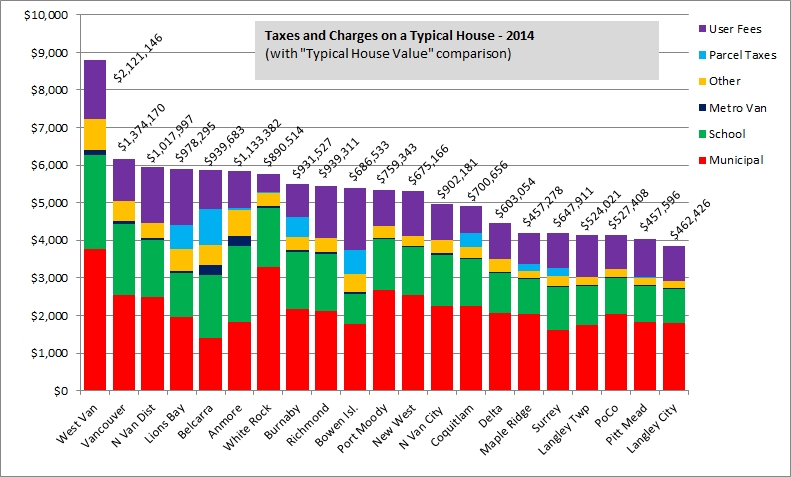
This first graph below shows what a typical household should have paid in all property taxes to their municipality in 2014, and breaks it up by different categories. The number on the top of each column is the assessed home value deemed “typical” for that community by the province, and the value used to calculate the tax amounts based on mil rates.
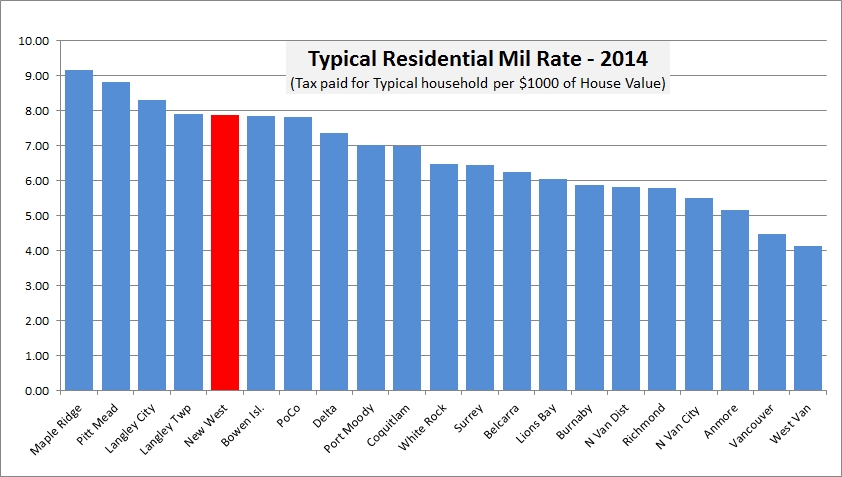
By this analysis (and this is the province’s data, not mine), the typical New Westminster residential property tax bill is the 12th highest of the 21 municipalities in Metro Vancouver. Obviously, a huge driver of this placement is that New Westminster’s “typical” $675,000 home value is below average (14th of 21) and our Mil rate is higher than typical (5th of 21, but in a virtual tie with those that are 4th through 7th):
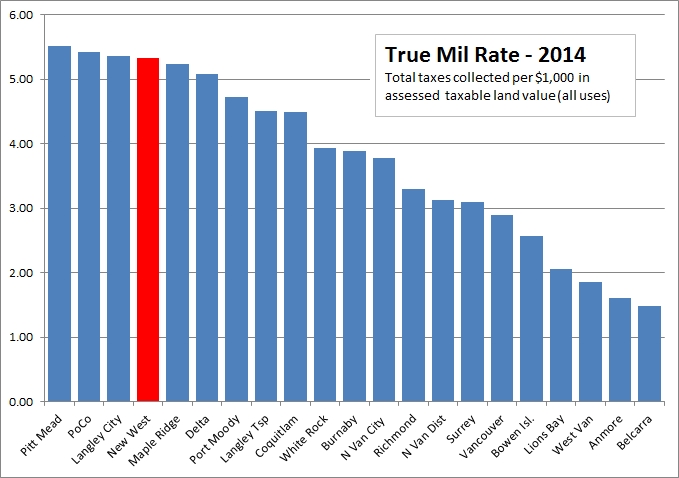
Recognize, these are averaged numbers, the Mil rate multiplied by the “typical” value. What about what people actually pay? You can calculate a “True Mil Rate” paid in a City by taking all of the Property Taxes collected by the City (in New Westminster in 2014 that was a bit over $65 Million) and divide it by the assessed property value of all taxable property in the City (in New Westminster, that number is just north of $12 Billion), then divide by 1,000. That makes our “True Mil Rate” about 5.32, which is the fourth highest in the region:
Note that municipalities with low land values cluster towards the left side of the graph, and higher-land-value places cluster towards the right, so this graph more displays relative land value than it does level of service provided or efficiency of the operation of local government.
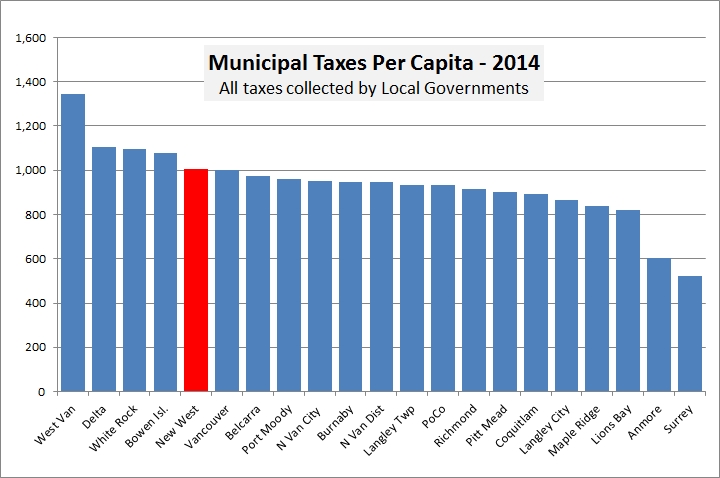
Up to now, we have only been looking at taxes as compared to land value. Land doesn’t pay tax, people do. So it might be more meaningful to look at how much tax we pay per resident in the City. Lucky, the same provincial data provides population estimates by municipality projected from the 2011 census to 2014, so that is also an easy comparison to make. Here, again, New Westminster is up in the top quarter, finishing 5th of 21 municipalities.
However, the comparison here is (yet again) not fair, because all taxes are not paid by residents. Businesses and industry also pay property taxes. The Province helpfully divides out local government tax revenue by land use, and if we limit the comparison of residential property taxes paid per resident in their municipality, we see that New Westminster falls back down to the middle – coincidentally 12th place among 21 municipalities:
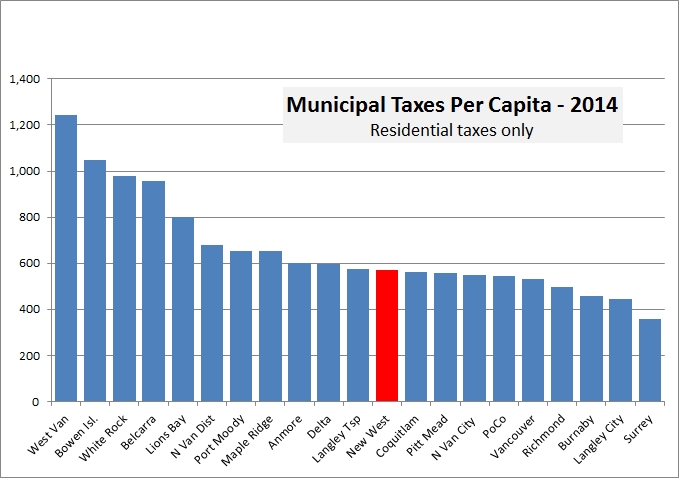
I say coincidentally because although New West finishes 12th in the first and last graph here, none of the other 21 municipalities fall in the same location on both graphs. There are many ways to look at the numbers, but by various apropos analysis, New Westminster residential property taxes are pretty much in the middle regionally. Our $572 per person in 2014 puts New Westminster well below the $660 regional average, and essentially equal to the regional median of $573 represented by Langley Township.
So why do some graphs show New West so high? That has to do with how we use our land in New West, and how we tax residents, businesses and industry differently. To see more analysis of that, you will have to stay tuned for Part 2, coming soon.
When is the Café/Restaurant at the Anvil Coming? Is there an issue with the contract demanding Fair Living Wage? Using CUPE staff to overcome this issue like done at Pier Park concession, needs to be discussed.
This was sent as a comment on a recent Council Report, but I thought it worked better as an ASK PAT, and hey, it’s my party, so I can post how I want to.
There are some things I simply cannot talk about on this forum, because of Section 90 of the Community Charter. However, I am confident that we will soon have a tenant operating a restaurant in the Anvil.
The Living Wage Policy is not an issue. You can read the policy here, and see that it only applies to organizations providing services “to the City on City Premises.” As is a practice I try to use here, the “City” with a capital “C” strictly means the corporate entity, not the general populace (“community”) or geographic locality (“city”). Companies that lease property from the City to operate a not-for-profit or for-profit business venture in the city that offers goods or services to the community are exempt from the policy.
My bike commute has got me thinking lately…thinking about bike lane design on bridges. I’ve had some close calls on the Queensborough Bridge with cigarette-wielding, headphone wearing pedestrians travelling in the same direction, totally oblivious to their surroundings. I also had an accident on the same bridge while passing a fellow cyclist who urged me to go around him. And I’ve never understood the unwritten rules of passing etiquette on the Pattullo Bridge (“I’ll stop if going up” or is it “I’ll stop if on the inside”, or maybe it’s just a game of chicken).
So, what is the best design of cyclist/pedestrian shared pathways on bridges? Is bigger better? Is there a secret formula for success?
New West will soon have two new shared bridge pathways: the new Pattullo and the drawbridge from the Quay to Queensborough. I am curious if these will be built to ensure a pleasurable experience for all.
I feel qualified to answer this, because the Queensborough is on my regular commute, and indeed, a little sidewalk etiquette would be in order. The only real conflict I have ever had was with a defensive dude on one of those electric fake-mopeds which I ranted about previously. However, I am commonly bothered by two things: inattentive pedestrians with earphones that are impossible to pass, no matter how much you ring a bell, slow down, say “ahem” or “excuse me”; and downhill-travelling cyclists who have a distorted trust in our combined ability to prevent collision as they blow by me at high speed.
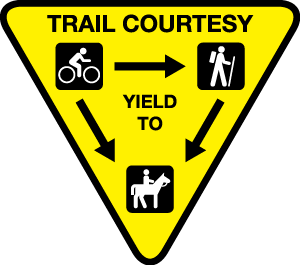
I would generally suggest we need a bit of common courtesy here, and two sets of rules seem to make sense to me. Those established in the early years of mountain biking by advocacy groups like IMBA, where cyclists *always* yield to pedestrians:
A second suggestion would be the old skiing standard that lower traffic always has right-of way. Meaning if you are going downhill and approaching someone else also going downhill, you slow down and only pass if they wave you through. If you are going downhill and someone is coming uphill, the person going down always yields (makes sense as it takes more energy to stop and start while climbing than it does while downhilling).
That would deal with 80% of conflict, common courtesy with another 15%, and the last 5% are jerks you just gotta put out of your mind – there’s no helping them. At least you only have to deal with them 5% of the time. Imagine how hard it must be for them being jerks 100% of the time!
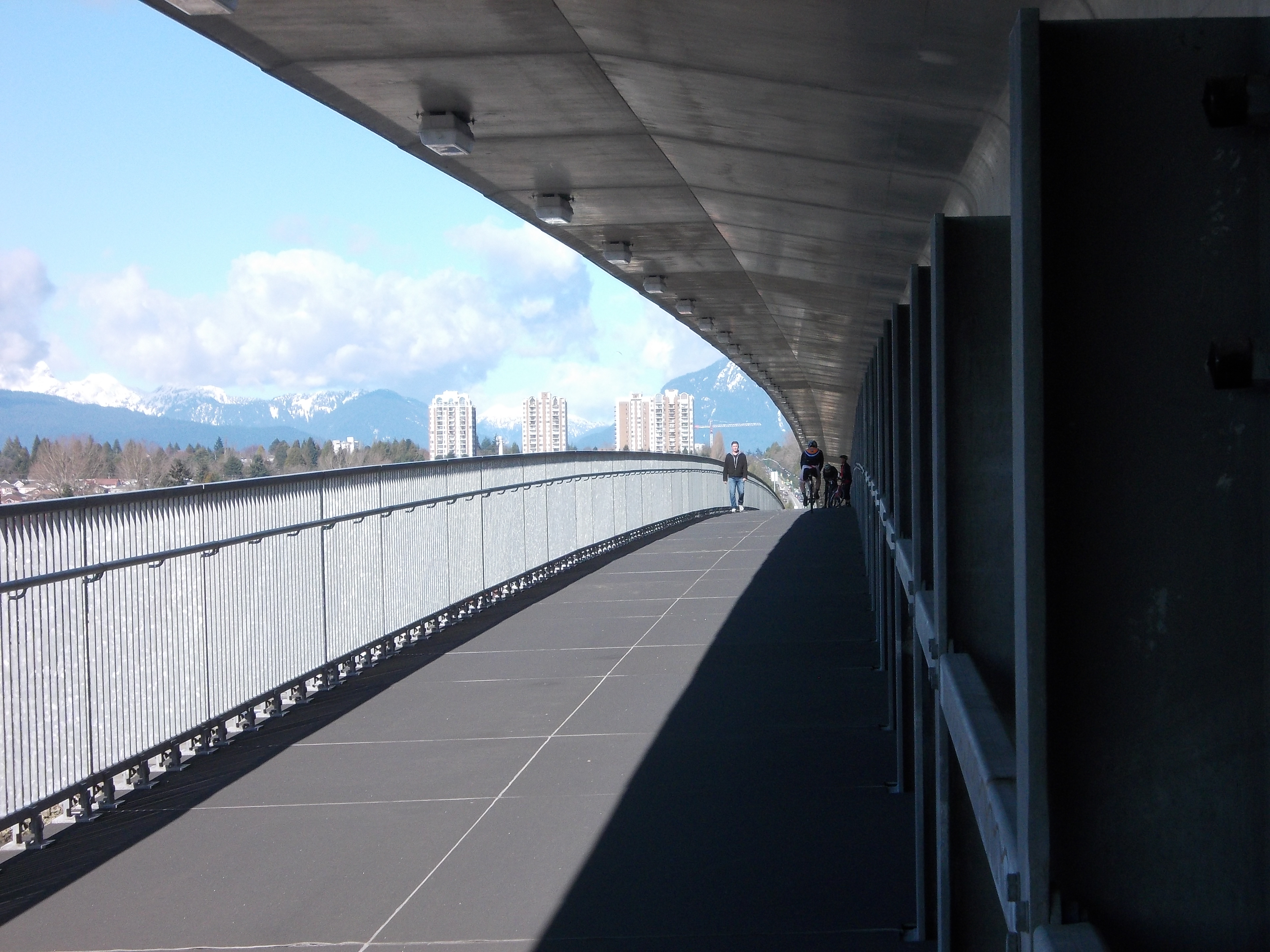
In my experience, the best bike-path-on-a-bridge is on the Canada Line Bridge, and yeah, the secret is width. There is enough room that people can get out of each other’s way, without having to squeeze over next to an irregular fence that is as likely to catch your handlebars than stop you from falling into traffic. Even there, common courtesy is needed, but I have never had anything close to an uncomfortable experience on that bridge. Given adequate room, people just seem to stay right and chill:
The new Q2Q bridge is initially being designed to accommodate a police vehicle or ambulance in the event of emergency, so I am pretty sure it will be wide enough to be comfortable (like the Canada Line Bridge). Initial design of the eventual Pattullo Replacement hasn’t even started, to my knowledge, but considering the Canada Line Bridge is the last piece of water-crossing cyclist and pedestrian infrastructure that TransLink has designed and built, I hope for as high a standard.
Until then, just be careful and courteous, and recognize that although the Queensborough crossing is not “state-of-the-art” or quite wide enough to be perfect, it is a pretty well designed pathway as far as access at each end. Maybe we just need to think about some basic courtesy signs at each entrance establishing yield rules/suggestions. I’d love to see a design that might work that we could take to the Ministry of Transportation for approval…