Off to the Races…

This is a good thing.

Suggestions that Jonathan Cote may (and should) run for Mayor have been bandied around for many months now, so the surprise is a little… unsurprising.

It seems like a natural progression. He has served three terms on council, and led the polls during the last two elections. His profile has been increasing, taking the lead on some of the higher-profile issues in town, and he has become the go-to Councillor when the regional press comes to New Westminster to talk about this “New New Westminster” phenomenon, and terms like (shudder) the “next Brooklyn” arise in talk about how our City is developing.

Meanwhile, not resting on his electoral popularity or media exposure, Cote has spent the last couple of years learning more about Cities while earning a Masters Degree in Urban Studies at SFU. This is the kind of thing a person might would typically do if they want to move up the ladder to a senior planning position in a City – not the standard route for a part-time City Councillor with a full time job and a young family who is thinking about politics.

That tells me a lot about what kind of guy Cote is, and one of the reasons I love that he has decided to run. He has a demonstrated work ethic, and he doesn’t come to the table assuming he knows all the answers. He instead wants to learn and find out about solutions already tested and true. I have seen him operate in committees, and he knows how to get the best out of a team and move the agenda forward. He also loves cities and the process of making them work better for the people living in them. As a Mayor, he will be able to bring a deeper understanding, and challenge staff to do better, explain better, and move the City forward.

I also like the symbolism of his run: The oldest city in the Province may have the youngest Mayor in the Province. As a bonus, that “youth” comes with significant professionalism and experience.

We don’t know what this means for Mayor Wright (at least I don’t). By all accounts, the current Mayor and Councillor Cote have worked very effectively together and have a lot of respect for each other, but there is no indication from His Worship what he intends to do in November.

I need to say, I like Mayor Wright. I have grown to appreciate his ability to move this City forward over the last decade. He has been the cheerleader this City has needed during its recent re-emergence, and has taken a few political risks that have (mostly) paid off tremendously. He’s not generally thought of as a “labour guy”, but has worked effectively with the labour-endorsed Councils he has been provided by the voters. His support in town is such that last election, when the opposition decided to run *against* him instead of *for* something else, they got beat badly. There is also something to say for the fact I am just as happy calling the Mayor “His Worship” as I am calling him “Wayne”: he is both worthy of respect, and popularly familiar.

There is an idea that the best time to pass the torch is when it is burning bright, and Mayor Wright could do much worse than passing it to Cote, but that is really the current Mayor’s decision to make. Regardless of what Wright decides to do, we can be confident the “silly season” has begun, and this will be an interesting election season!

The Mayors have a Plan

The Mayors of the region have done what no-one (and I include the Minister of Transportation in this group) thought they could: they came to a consensus around a 10+ year transportation plan. For a moment in time Thursday morning, people around the region started to dream about a rational transportation future… then the Minister reminded us that he wasn’t interested in solving the transportation problem, he wanted to perpetuate the contrived impasse. Alas…

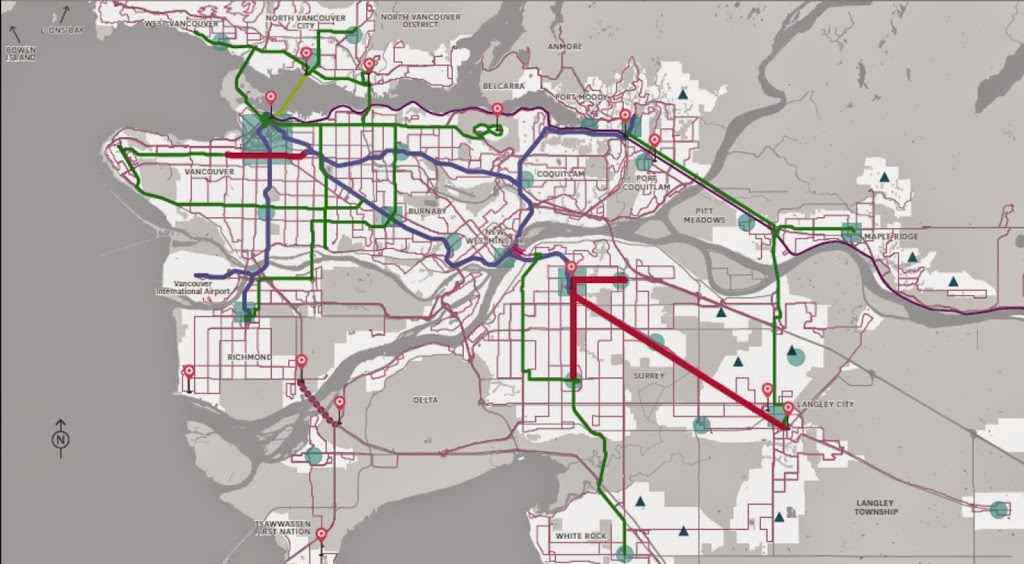
First the good news: the plan looks good. The major components show a significant amount of compromise by many of the Mayors, as a few big dreams have been scaled back somewhat. However the route charted is clear: Rapid transit in the form of underground Skytrain on the Broadway corridor and two light rail lines in Surrey. A whole swack of B-line routes for everyone else. Investment in the SeaBus, a few shekels tossed to pedestrian and cycling infrastructure, and yes- a tolled 4-lane Pattullo Bridge.

Surrey LRT: Three lines total, 104 Ave and King George Boulevard running within 7 years, and the Fraser Highway line in service by year 12.

Broadway Corridor: Continuation of the Millennium Line to Arbutus within 10 years.

Skytrain: improvements to the system to increase frequency of Skytrain by 2016.

Burnaby Mountain Gondola: They are calling it a “connection” to avoid discussing technology, but the business case for the gondola is solid: it can move many more people for much less money with much more reliability than buses. There is no timeline provided for this investment.

SeaBus: An increase in SeaBus service by 50% will bring it close to a “Frequent Transit Service” standard, meaning waits for the next SeaBus will be reduced to the point where “Over Town” commuters don’t have the schedule your life around catching the next boat.

Pattullo Replacement: A tolled, 4-lane Pattullo is now the plan – although no date is provided for completion. The bridge will be “expandable” to 6 lanes, so the devil will clearly be in the details (for those who remember the Alex Fraser was built with two “spare” lanes that were opened about a year after opening). The language sounds to me like they are NOT trying to sneak in a 6-lane bridge:

“This possible expansion may be considered if need arises, if demand increases beyond forecasts and/or the surrounding network changes. Future consideration of expansion would require all-party agreement and Mayors’ Council approval.”

I read from that that New Westminster, being one of the parties, would need to agree, and with the toll in place, the odds of demand requiring more lanes any time soon are pretty small. I call this a win for the “Reasonable Approach” work that New Westminster Council has been doing for the last year. This was the part of the Mayor’s Plan I was most concerned about before it was unveiled, and I’m glad to see it is something I can vote for as part of the greater plan.

Roads: “…having benefited from many decades of high and consistent investment… no major road capacity increases are needed” -BOOM!

Pedestrians and Cycling: The Mayors support and call upon TransLink to strengthen the regional cycling network, and to invest in making the pedestrian connections to transit stronger. There are few specifics here, but the next time you hear about the great Bicycle Conspiracy/Agenda, note that only 3% of TransLink’s current budget will go to all of the cycling, pedestrian , road and bridge maintenance (yes, even truck and car roads), and the plan will bring that proportion up to… 3% (which is an increase, as it will be the same percentage of a slightly larger budget).

B-lines: 11 New B-line bus routes. These almost-express buses bridge the gap between light rail and old-style buses, by being frequent enough with limited stops to get a lot of people across medium-distances fairly efficiently. The advantages are that 200km of these lines can be installed with very little capital investment on the part of TransLink, but their effectiveness is tied to their being as fast as, or faster than, a car on the same route, which requires the individual Cities investing in supporting infrastructure (priority lanes, queue-jumper lights, etc.). More devil-in-detail stuff here.

Buses: More and newer buses will mean a better quality of service, and lower operating costs. The plan includes more than half a million more service hours per year, between the B-lines, peak load service, and off-peak service. This would support getting more people to the “core services” of rapid transit which will increase revenue. The plan proposes that by 2030, more than 60% of front doors in Greater Vancouver will be within walking distance of the Frequent Transit Network (the service that is frequent and reliable enough that you don’t need a schedule to depend on it, you can just walk to the stop and a bus will arrive within a few minutes). That gives pretty much the entire region a level of service approaching Burnaby levels, if not quite New Westminster levels. This is good, and will provide huge revenue increases through tickets.

There is a bunch of other stuff in there about transportation demand management, better integrated information and payment systems, upgrading the Goods Movement system, etc. This is a 45-page document full of good details; a well-referenced and integrated Regional Transportation Plan. It is simply amazing that TransLink and the Mayors were able to put it together so quickly, and find enough consensus on it to get it (almost) unanimously passed.

Reading it through, you can see how this happened. Overall, there are signs of compromise – a little of everything, not too much of any one thing – note the SkyTrain to UBC is not included, and the LRT access for Surrey is coming online slower than ideal. Make no mistake: this is actually a very modest plan compared to what our region should build if we want to be “world class”… but at least we are, for the first time in almost a decade, moving forward instead of backwards.

Well, we were, until Minister Stone killed it shortly after birth. This, once again, confuses exactly what his goal is. The Minister told the mayors to make a plan, they did it. He told them to set up a payment plan, and that (this is the important part) the populace would be able to vote on whether that plan was acceptable. No money unless the people agree. That was the deal.

Of course, he didn’t really want the people to vote, he wanted the Mayors to be forced to supplicate themselves in front of the public asking for more money…ideally during local elections. The tax plan the Mayor’s have proposed has suggested a re-jig of the Carbon Tax, which puts a load on general revenue , which the people are apparently not allowed to vote on.

This type of cynical politicking is why we can’t have nice things.

The hanging question, after a year of this discussion, is this: What is the BC Liberal Plan? So far they have offered nothing- no vision, no funding, no ideas, not even any creative criticism – they just say “No”. Leadership is not asking other people to come to you with proposals, then responding by saying “I think not, try again”. It is instead about finding the way to say “yes” to a better future – something the herd-of-cats Mayors’ Council have been able to do, but Todd Stone simply cannot abide.

Put this lack of leadership in contrast with Kathleen Wynne’s bold leadership on sustainable transportation in Ontario. Both of these unexpectedly-re-elected premiers call themselves “Liberals”, but they clearly have very different visions of what liberalism is, and different views of leadership.

Reflective Clothing and Infrastructure

Twitter is a pretty cool communications tool. One person can link many others to common information, ideas can be debated 140 characters at a time, and you can immediately link to a larger “community” based not on your geographic location, but your common interests.

The format also allows you to take quick jabs at cultural norms – some of them that need constant jabbing.

One example is the ongoing discussion about how the RCMP and other Law Enforcement message active transportation in the world of motordom. I could list endless examples, from “crackdowns” on helmetless cyclists on protected bike paths, the use of euphemisms like “accident involving a pedestrian”, or the constant messaging that everyone needs to be vigilant around traffic, because one of these cars (never “drivers”) could kill you. Somehow, surrounding pedestrians and cyclists are held more responsible for the operation of the 3,000-lb steel box than the person inside the steel box. The pervasive message is that the safest place to be is inside a car (despite a huge body of evidence that inside a car is the most dangerous place most people in North America ever spend time!)

There have been a couple of “incidents involving cyclists” in Burnaby of late, including one that did not involve a car, but rather infrastructure installed to reduce car traffic. Clearly, this is a sad, unfortunate event, and we don’t really know all the causative factors. This did not prevent the Burnaby RCMP from repeating the “helmet and reflective clothing” meme. We don’t know if a helmet would have helped this person (likely it would have, depending on whether the presumed head injury was to the area typically covered by foam), but there is no doubt reflective clothing would have done nothing to help this person.

What the RCMP did not suggest was that the City should assure infrastructure is safe for cyclists, be they helmet-wearing and lit up like a Christmas tree or not. One thing we know for certain is that the quality of cycling infrastructure is the best correlate to cyclist safety (much better than helmet use does).

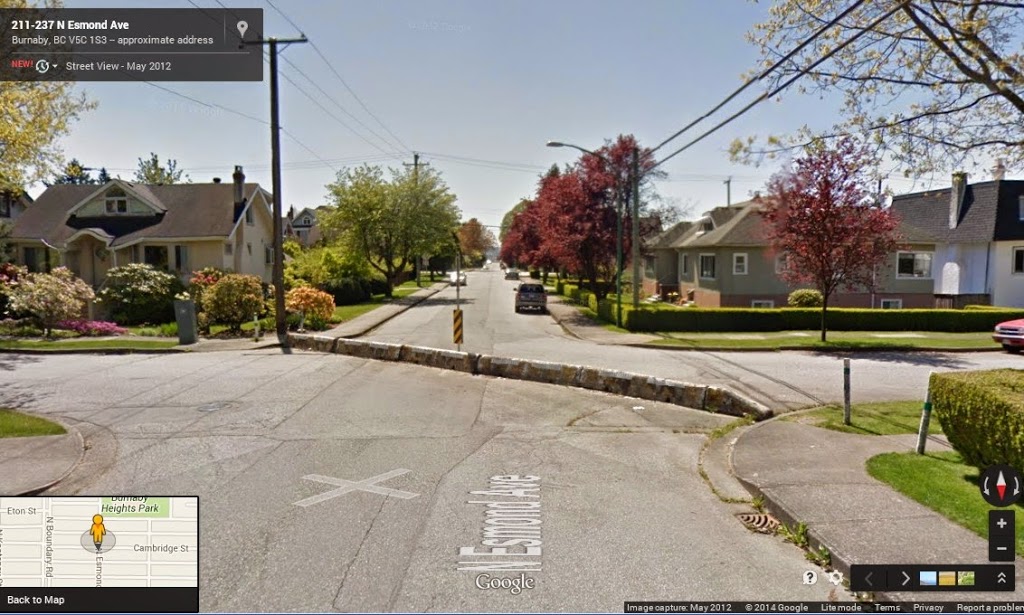
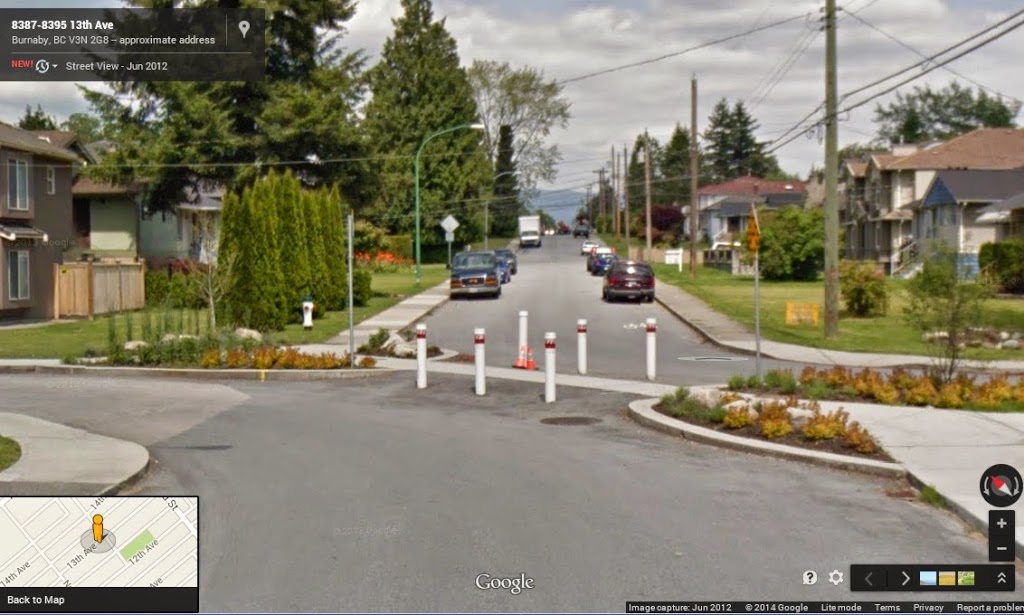
Upon reading this story, I immediately went to Google Street View and saw the intersection where the accident took place. It is pretty ugly:

Google Street View – Click to zoom in.

A tattered old set of curb-standard concrete barriers, yellow paint faded and tattered, a single sign in the middle of the lane (the main part of which is offset 90 degrees from the direction of travel on Esmond Ave). The barriers go right to the curb, where the offset sidewalk ramps are incomplete. Simply put, there is no safe route through this intersection for a cyclist. Could this crappy piece of infrastructure be at least part of the problem?

So I took a screen capture from Google, and tweeted away that perhaps bad infrastructure was more a part of this than a lack of reflective clothing. And as sometimes happens with Twitter: the message got out. (note, the first hint I got that the reporter wrote a story around my tweet was when I read it in my twitter feed – full circle!)

For a better, and safer, solution to the intersection in question, you don’t have to look any farther than south Burnaby where we have barriers like this…

…which serve the same purpose, but with better visibility, better sightlines, logical through-paths, and are also more attractive in the streetscape.

The City of Burnaby response in the story above is familiar for anyone involved in transportation planning (allow me to paraphrase): it’s been like this for a long time; we think it is probably OK; we don’t think anyone has had an accident here before; we will look at it again.” That last part is satisfying, but the rest sounds like the excuses often heard when a bad piece of infrastructure is pointed out. To many active transportation advocates, tragedy too often sounds like something used to elicit change, instead of something we should be actively trying to prevent through change.

This is why active transportation advocates have to keep beating the drum whenever we see a potentially-unsafe piece of infrastructure.

Green Drinks and Food Security!

I’ve mentioned the Southwest BC Bio-Regional Food System Design Project (SWBCBRFSDP – my acronym, not theirs!) on this blog before, but it was tied in with a bunch of bummer complaining about lack of government support for protecting the ALR, so the good news might have been buried in all that whining. So this is the “good news” follow-up post. Folks in the know are coming to New West on Tuesday to tell us about this really cool project.

Recognizing the need to support more robust local food systems, the researchers at Kwantlen’s Institute for Sustainable Food Systems are applying their significant expertise, and partnering with a diverse community of business, governance, and agricultural experts, to bring about change in how we source our food.

There are a lot of words in SWBCBRFSDP, but I like the idea of showing why every word is relevant:

SWBC: Southwest BC is defined by the project as the area from Hope to Powell River, and from Delta to Lillooet: an extensive area that ties the lower stretch of the Fraser River to the Sunshine Coast, and essentially comprises the mainland Canadian portions of the traditional lands of the Coast Salish People.

BR: A Bio-Region is and area defined by a common topography, climate, plant and animal life, and human cultural influence. In this sense, the watersheds of the Salish Sea from the desert of Lillooet to Howe Sound has a diversity of eco-zones, but are tied together by bio-cultural heritage and geography.

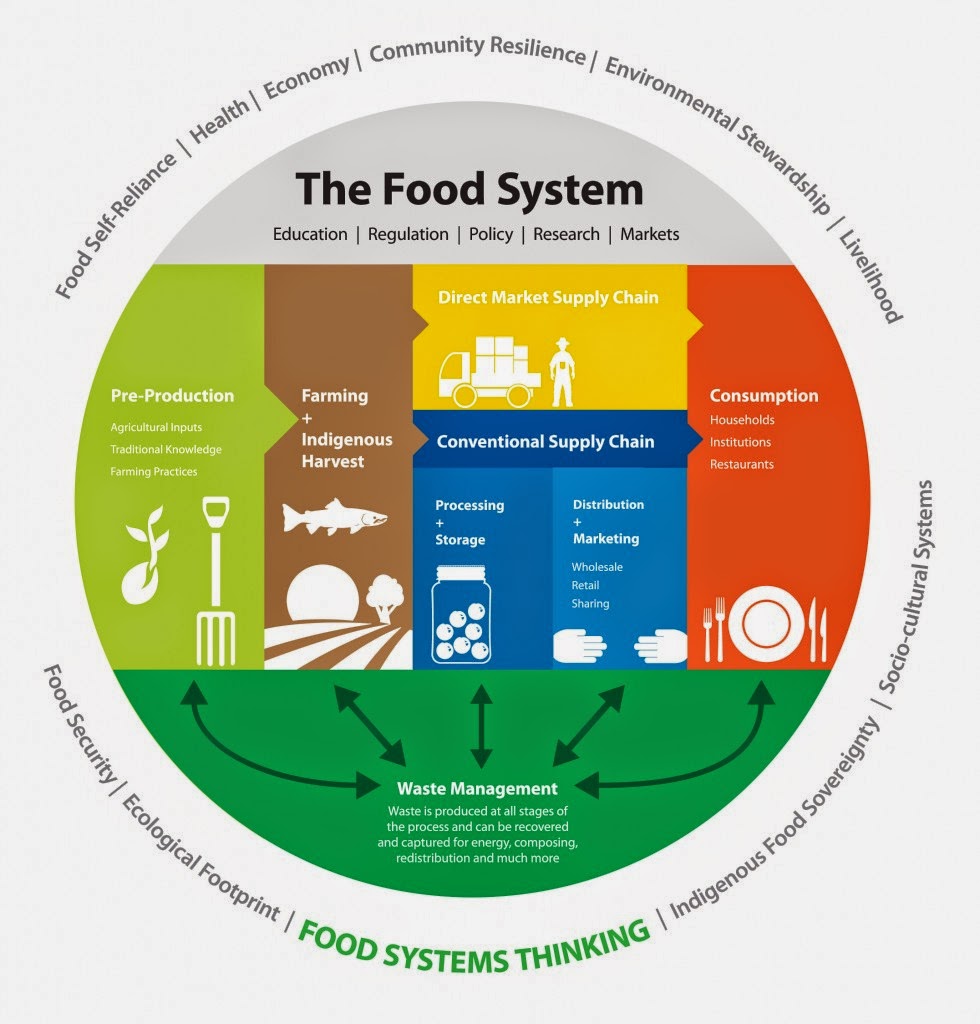
FS: This project is not just about farming and protecting the ALR. Yes, preserving farmland when we can will be an important part of the food security equation, but we also have to consider the other major food inputs, such as the salmon we catch from the river, and the traditional food-gathering that many of us are separated from, but are still an important part of the region’s culture. However, there is much more to food than having profitable local Agri-business farms (how many cranberries do you eat in the average year?). A Food System would support the regional economy by connecting together food sources with processors, warehousing and retail, delivery systems from Farmers’ Markets to restaurants and standard retail. A true system would even connect our disjointed organic waste stream, to bring the nutrients in our food waste back to the farms and better manage in the industrial-scale waste sometimes produced in Agri-business. Ultimately, every step in the food cycle should not just just feed British Columbians, but employ, include, and benefit British Columbians. That is how local economic resiliency is built.

Design Project: This project will start by performing an actual, science-based evaluation of what the food potential of the region is – can this region actually meet its own food needs? And if so, how? They will also be evaluating the critical needs and opportunities for our local food systems to get the food we produce to our local plates. The eventual plan is to create a series of science-based policy papers and best practices reviews that decision-makers in municipal, regional and provincial government can use to help bring a more sustainable local food system into existence.

This project hopes to realize that building a local food economy is about more than just Food Sovereignty (our ability to feed ourselves domestically and not being overly reliant on volatile global markets), but also supports economic development for the region. Every bit of food we import is a bleed on the local economy – it is a flow of our wealth to other places that we could instead use to fuel our local economy. If food is grown in BC, processed in BC, sold in BC, and the waste recycled in BC, we are creating jobs at every step, we are having a smaller environmental impact on the planet. It also brings our communities together by bringing us closer to the people who provide us our nourishment.

At a time when many of us feel bombarded by bad news and general malaise about the future of sustainability planning in our communities / province / country, this is a good news story – a positive look forward towards a better future.

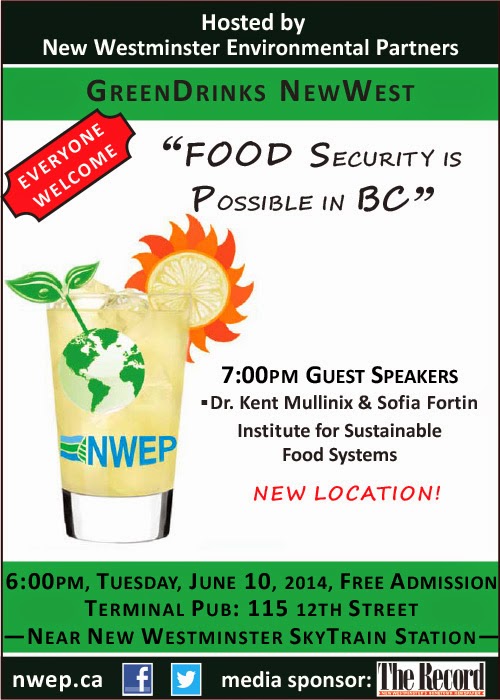
At this point, the project is still being set up, and the proponents are trying to tie stakeholders together. The proponents are putting on a bit of a travelling discussion about the project and food security, which is why I am talking about this here and now – because Dr. Kent Mullinix and Sofia Fortin from the SW BC Bio-Regional Food System Design Project are coming to Green Drinks in New West!

The NWEP is moving it’s every-second-month-or-so Green Drinks to the Terminal Pub (where there is a new menu, many excellent choices at the taps, and a cool new room) on June 10. Green Drinks is always fun, casual, and no-stress. You get to chat with a wide diversity of New Westies and people from a little further afield. The formal program is kept short to give you lots of chat time, and there is no need to drink if that isn’t your thing. It’s mostly just a social gathering of folks concerned about sustainability issues, socializing, talking, and having some fun.

This time, you get a chance to talk to the folks from the above-raved-about project (and ask Kent about pruning your trees- I took a pruning course from him a few years ago and learned more than anyone should ever need to know- the guy is a font of knowledge on all things growing!)

Join us! It’s Free!

Hyack : the more things change…

Last post, I suggested some hopes for (dreams of?), a better Hyack Festival in New Westminster. In doing so, I was cognizant of stepping on eggshells, because I don’t want to downplay the efforts of the hard-working volunteers who bring a bit of fun to New Westminster while holding up long-standing traditions.

This got me reading about the history of Hyack*, and I learned that questioning the organization of these major events and challenging the meaning of them has actually been one of those long-standing traditions!

The May Day Celebrations started in 1870, with the ceremony developing around securing a common identity as an agricultural town with “royal” origins – perhaps as a bit of the thumb-to-the-nose at the upstart Capital across the water. It is important to note that May Day was, in those early days, an internal celebration for the residents of New Westminster, not a regional event intended to promote the City externally to a larger regional trading region. At the turn of the Century, the City had the Pacific Exhibition and the Farmers Market to do those things.

Through the first half of the 20th century, the May Day Celebrations expanded to act both for internal cohesion and external boosterism. It was primarily an event for children, becoming an all-day fete with folk dances, the Maypole, and sporting events, with attendance by all New Westminster school children at one point made compulsory. Originally this fest was highlighted by the Anvil Battery Salute, but by the early 1950s, May Day had moved to the Friday before Victoria Day, to foster attendance by elementary students.

By the late 50’s to early 60’s, some of those institutions that held the City together and put it on the map regionally – the Miracle Mile of shops, the Exhibition, and the Farmers Market – were disappearing. During this time, there was pressure to “protect” the May Day Festival and keep it safe from “contemporary tendencies” to expand or transform the event. The Chamber of Commerce, recognizing the mercantile opportunities, suggested moving the May Day to Saturday in 1961 to allow more visitors to be drawn to town. They were thoroughly rebuked by the May Day Committee for suggesting a children’s festival should suffer the ugly encroachment of commercialism.

In the late 60’s, this transformation began regardless, partly due to ongoing pressure from different parts of the community, partly because of the coincidence with larger celebrations of the Centennials of 1958 (of New Westminster), 1966 (of the Colony), and 1967 (of Confederation). The changes were also coincident with some of the “Old Guard” of the May Day Committee starting to retire or die off. By 1966, it was a three-day festival, and in 1967, a 5-day event, including the “largest Parade in the Province’s History”, a carnival in Queens Park, sporting events, an agricultural show, and more. With more than 100,000 people showing up for the Parade (remember, this was a City with less than 40,000 residents), this was clearly a regional event to promote New Westminster, and a significant tourist draw for the local commercial interests at a time when Columbia Street was beginning to see decline. Ugly commercialism had, eventually, encroached.

This growth was not without concern. The loss of traditions and increasing cost of the larger event caused apprehension among many of the traditionalists. When conflict ensued at City Council about spiraling costs, and a concurrent push by some to build a more “professional type, money making event”, a new organizing committee for all festivals was created: one comprised of upstart younger businessmen. This group was less encumbered by old traditionalist and parochial ideas about the fete, but wanted to inject new ideas, energy, and blood into the City’s Festivals. One of their first acts of this so-called “Royal City Society” was to change the name of the May Day celebration into The “Hyack Festival”.

Funded by a 1% tax on businesses, and unfettered by the City’s bureaucracy, Hyack grew to a 10-day celebration. It didn’t replace traditions like the May Day celebrations or the Anvil Salute, but surrounded them with other events to improve the overall attractiveness. In 1972 there was reportedly “a carnival, high-wire acts, roving western singers throughout the City”. In 1973, the festival was just as big with a week of sporting events to build the excitement towards the upcoming Canada Summer Games. In 1974, the Parade moved from Columbia Street to the current Uptown route, reflecting the shifting economic fortunes of the City’s two main commercial centres. By then, visitor numbers had dropped back to the more-typical 25,000 or so people, but Hyack as an entity, and as a festival, continued to thrive. Through ups and downs, as events came and went (canoe race anyone?), this is the same Hyack festival we have today.

But where are we today? The number of events surrounding the mainstay traditions is definitely reduced, and there were clearly not 25,000 people on 6th Street last month. The traditions hold strong, and the Hyack Festivals Association has to be thanked for keeping the flame burning for 40+ years. However, the root of all of the conflict in and around Hyack for the last year seems eerily familiar: how much change is too much change? What is the most responsible way to spend Taxpayer’s Money? Do we want to have a large commercial event (dare I say “professional” or “not amateurish”) to attract people to our City, or a smaller community-building event that represents our traditions and desires? Are these two ideas incompatible?

The 2014 Hyack Festival is over, there is some new leadership of the Festival Association, and the battle for Letter-to-the-Editor dominance has apparently fizzled out. However, the conversation cannot stop now. Sustainable funding is still an uncertainty. The prominence of Hyack is being challenged by the many new neighbourhood and community groups setting up festivals and other events around town. Some of the structural concerns and visioning issues about Hyack that led to last year’s conflict have not been resolved. The worst thing that can happen right now is for the conversation about the role of the Hyack festival Association in our community to go silent.

The bitter fight was silly and distracting; we need a calm discussion. Maybe Hyack should start it. The people of New Westminster want to be engaged in the conversation, because most of us don’t want to volunteer for Hyack or wear a Green Jacket, but we all love a Parade.

*I read many sources for this Post, not the least being Earl Noah’s 1992 MA Thesis (Geography) from UBC, from which anything in quotes above was drawn. My not being a historian means I can hang any errors above on my unprofessional misinterpretation of records, and not a flaw of the records themselves!

Hyack Festival – the fete goes on

Well, we survived another Hyack Festival. By that, I mean Hyack survived to put on another week+ long schedule of events, culminating in the Hyack Parade.

After a year of questionable decisions, accusations, battles (petty and otherwise), victories (pyrrhic and otherwise), and Editorial Page exchanges that only increased the questions and doubts, it was good to see the Show that Must, did indeed Go On. Everyone loves a parade.

Clearly, a successful, if slightly scaled-back, Hyack Festival does not mark the end of the ongoing battle for Hyack relevancy and funding. However, it was a positive step, both for Hyack and the City, and one that did not look a certainty only a few months ago.

I attended various Hyack events this year, chatted with quite a few people at these events, and have talked to many people since. At times, these conversations led to deeper discussions about what these “traditions” we celebrate are for, and who they are for.

Before I start to get critical, I need to acknowledge that I did nothing to help organize the events of Hyack Festival. That puts me in the (very crowded) category of people who complain about something that other people – mostly volunteers – bust their ass to do to the benefit of the community, without lifting a finger myself to help them. This is pretty much the definition of a jerk.However, Hyack themselves are quick to remind us that they are an important part of the City of New Westminster and its traditions. They are also asking that the City continue to support (logistically and financially) the events Hyack organizes every year, which opens them up for a certain level of constructive ruminations. So here are my impressions, not meant to disparage the Festival or organizers, but to add to the discussion of what Hyack means to this city.

There are three 4 major events of general public interest that make up the Hyack festival: the Anvil Battery Salute, the May Day Celebrations, the Parade, and the Uptown Street Fair. Some will point out the many other associated events, but I get the sense some fall under the category of normal local events that could occur on any weekend (antique fair, petting farm opening), others seem a little inward-looking (Portland Rosarians Rose Planting, Seymour Artillery Firing), and yet others are not really open events (such as the Formal Banquet) that are more important to Hyack than to the rest of the community.

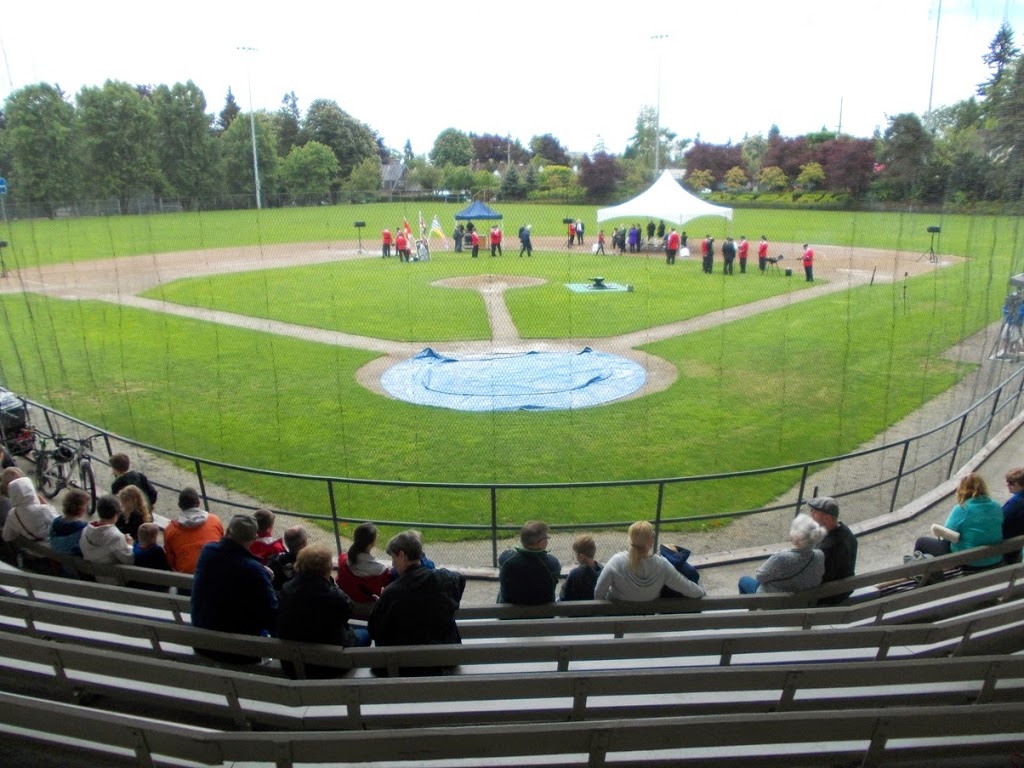
Of the main events, the Anvil Battery Salute is the one with the greatest historic relevance to New Westminster. The 21-firing salute to Queen Victoria, starting at noon on Victoria Day, is a unique, exciting, and important tradition. I just wish more people were there to see it. I could imagine it as a centrepiece of a great day in the park – the middle of a festival with everything from kid’s games to sports contests to food booths and beer gardens, music, and entertainment. Pick up Sapperton Day, drop it into the middle of the baseball field, and run the Anvil salute then, and you can see what I am getting at. Unfortunately, as a stand-alone event, it can appear to be much ado about nothing to those not aware of the tradition, and the crowd measured in the dozens this year* are a testimony to the failure to make this connection to people.

Being without kids and with a full-time job, I was not able to attend the May Day Celebrations. Wednesday, mid-day just doesn’t work for most of us working stiffs. By all accounts it was well attended, appreciated, and continues to be a highlight of the spring for many kids and parents. That the School Board puts so much effort into the event in these difficult times for that organization shows the desire of the community to protect this tradition that goes back more than 140 years.

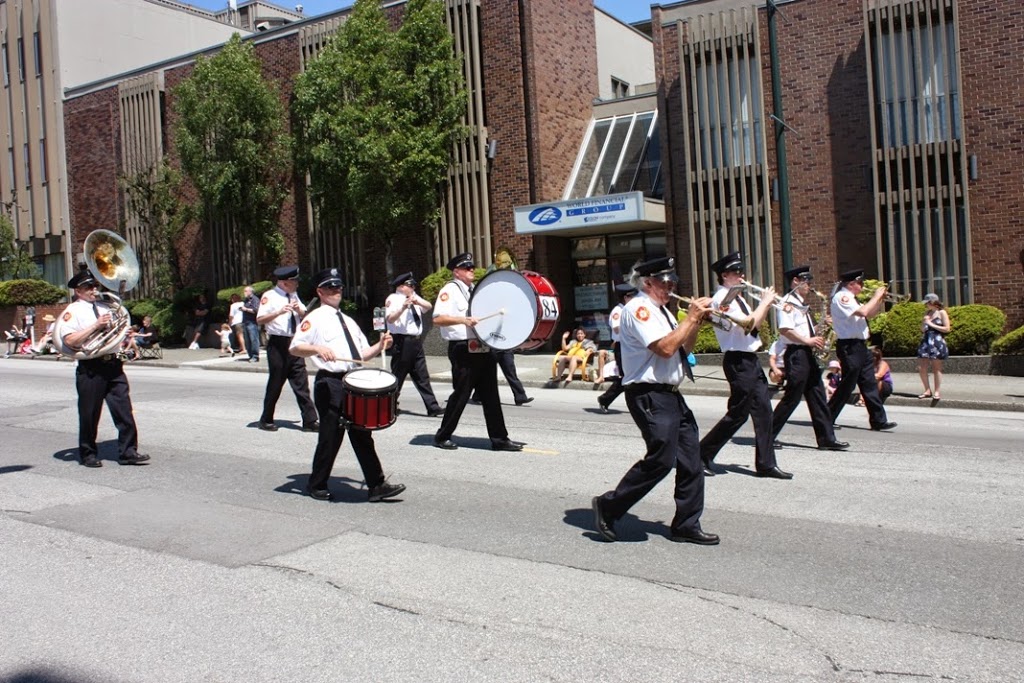
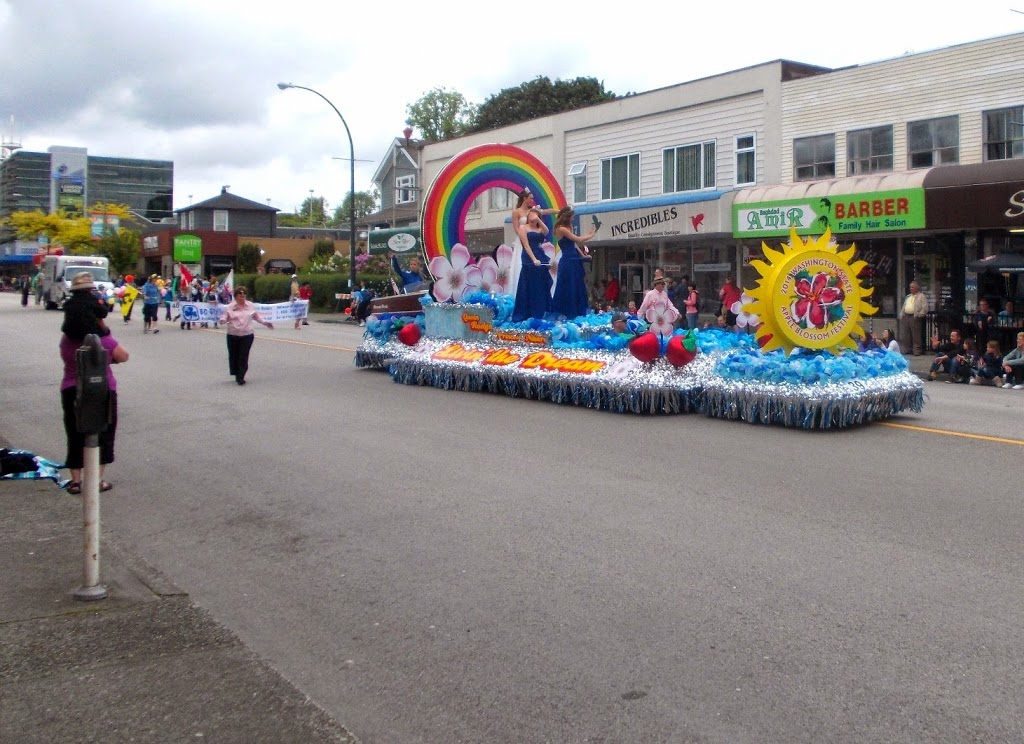
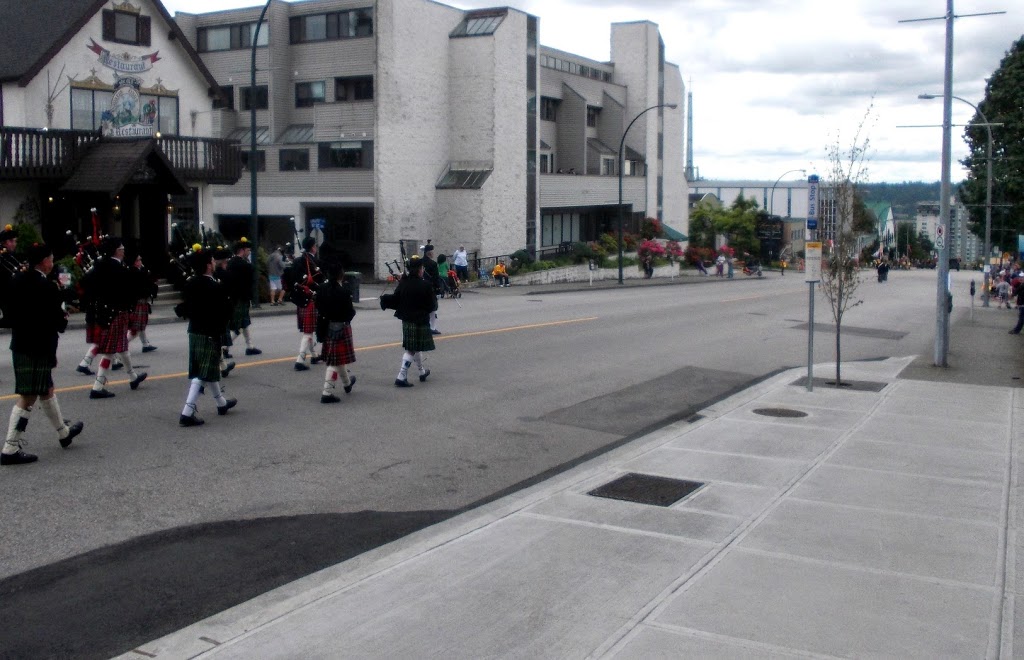
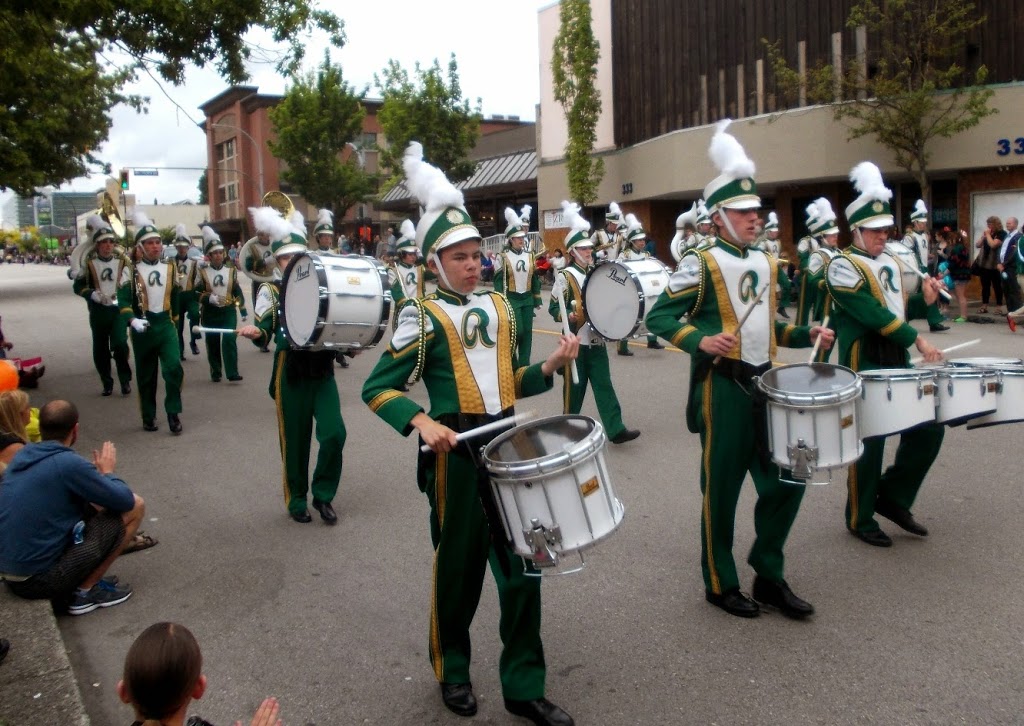
This leaves the Hyack Parade and Uptown Street Fest. Everyone (and I have to include myself) loves a parade. It seemed there were many fewer floats this year than last year, and there were definitely more notable gaps in the crowd on the bottom half of the route that I remember from previous years, but the crowd that was there seemed into it. The same goes for the distinctly scaled-back Uptown Street Fest. With a bouncy castle and some food trucks, there was a good hour or so worth of entertainment to be had post-parade. It was well attended for the relatively small space it took up, but to suggest (as some boosters did on Twitter the day of) that it had 3x the attendees of last year’s hugely popular Uptown Festival, is fanciful.

If I was to put out one major criticism (and this is a common theme I have heard voiced), it is that these four events combined would make for a great 2- or 3-day festival. To stretch it out to 8 days over two weekends takes the momentum away from each of the events, and serves all of them a little less. Asking to general public in these busy times to dedicate two weekends to the Hyack festival, when there is only a couple of hours entertainment on each weekend, is not optimal. Given the choice of the Anvil Battery or the Parade, and going camping or to visit grandma on the other weekend, I’ll take the Parade every time (but I wish I didn’t have to choose).

Again, not being an insider, I only have my own suspicions as to why a good 2-day festival is stretched out to 8 days – mostly because the two headliner events can’t be held on the same weekend. Of course, the Anvil Battery Salute is a Victoria Day celebration, so it makes no sense to move that date. However, Victoria Day is a Monday that is not a civic holiday in the United States, and with so many parade floats and marching bands coming up from the Northwest, having the parade on this day would be problematic.

This problem is exacerbated because Hyack is the only Canadian member of the Northwest Festival Hosting Association, and the third weekend in May is already reserved for the Spokane Lilac Festival (put on some sunglasses before clicking that link). I suspect that Spokane is not interested in changing their weekend-before-Memorial-Day tradition, and competition between NFHA members is discouraged. So neither the Parade nor the Anvil Battery Salute can be moved, unless a tradition is broken.

That’s the way of it with traditions. Next post I am going to delve a little deeper into the history of these traditions in New Westminster, and tell a bit of a story about what happens when an upstart group of young business leaders step up to challenge a stale organization to be “bigger and better”, City Hall gets involved, funding gets withheld, and people challenge the parochialism and suspect impropriety of long-held traditions.

*Correction: A member of the Anvil Battery Salute team corrected me today on Twitter, saying an actual crowd count numbered the people at the Anvil Salute at 400. I am surprised, as I felt I had a lot of elbow room” in the stands, and even the photos of the event show pretty sparse crowds, but they had a count and all I have is a vague feeling, so you are better to rust the count! 

BLOC – The Bike to Work Week edition!

My place of employment had a remarkably successful Bike To Work Week – lots of people rode their bikes in, some every day, some just one day. That is the point of BTWW- for people to take a chance and see of riding a bike works for them. In the end, our organization more than tripled the number of kilometers ridden in BTWW over last year, by creating some fun inside challenges, and a significant beer-based bet between co-workers. It was fun for all, but mostly for those of us who ride in on a regular basis.

As I have written before, my ride to work is really, really good. The bike route is, for the most part, really well designed, safe, and easy to use. However, there is one ongoing issue that I keep complaining about (and I am not alone): the lack of respect for bike routes. With the vanishingly small amount of our regional transportation investment going to bike infrastructure, can we please just acknowledge that bike lanes are for bikes- the one piece of our region’s vast expanses of pavement that are not dedicated to cars and trucks?

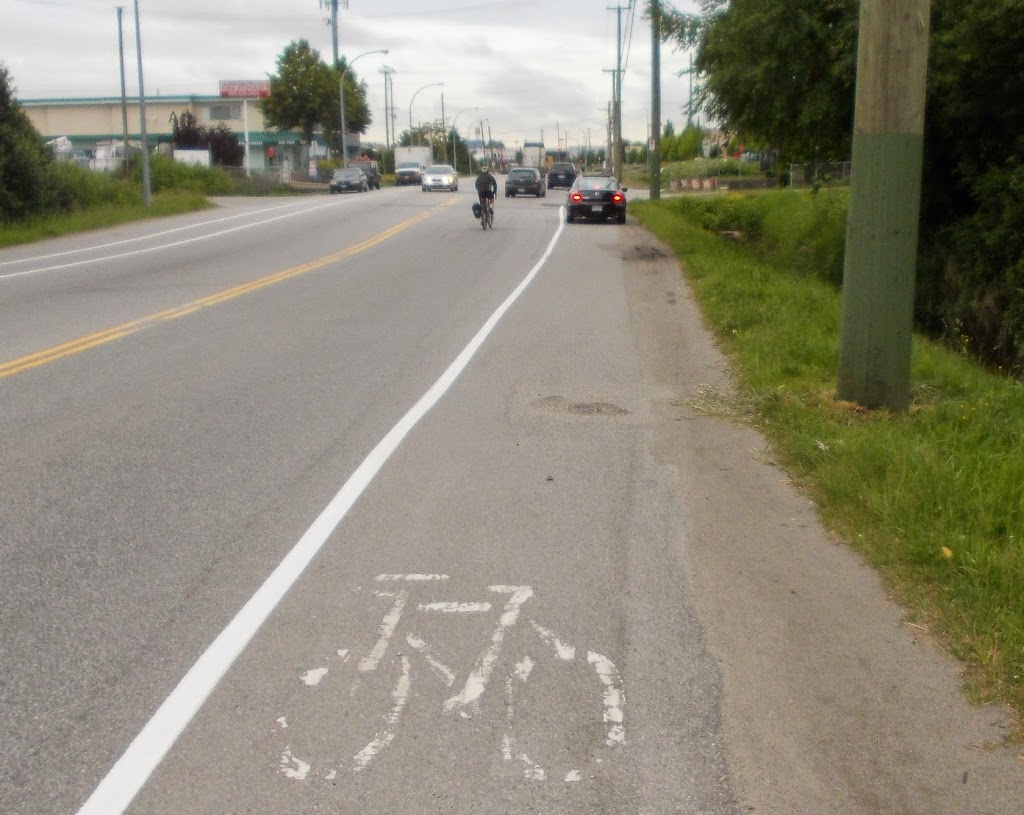
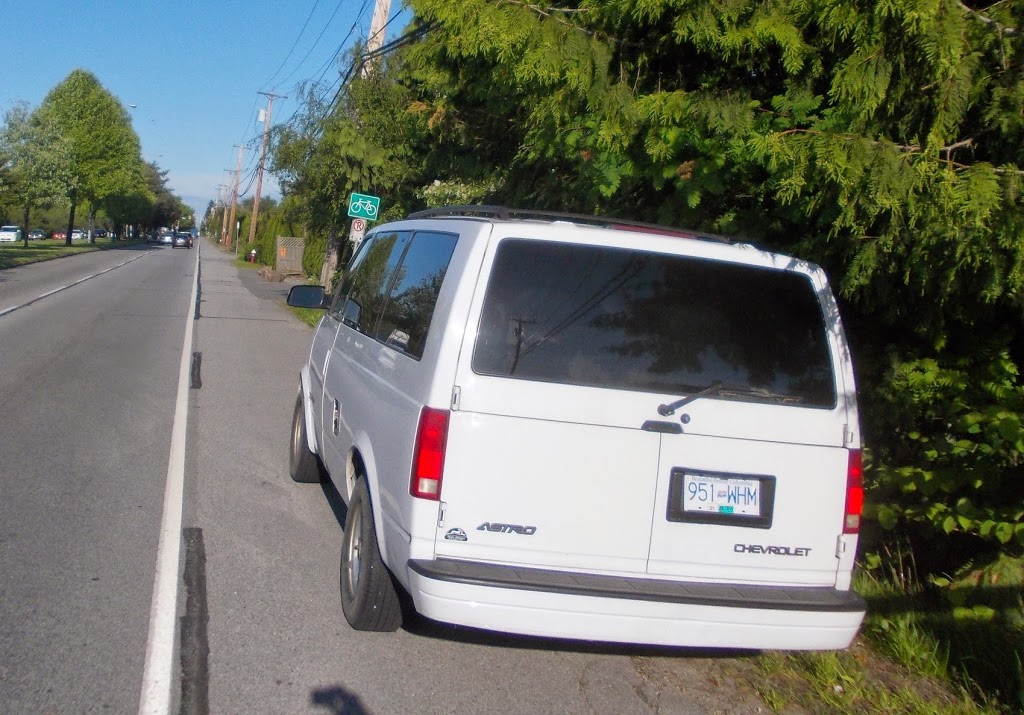
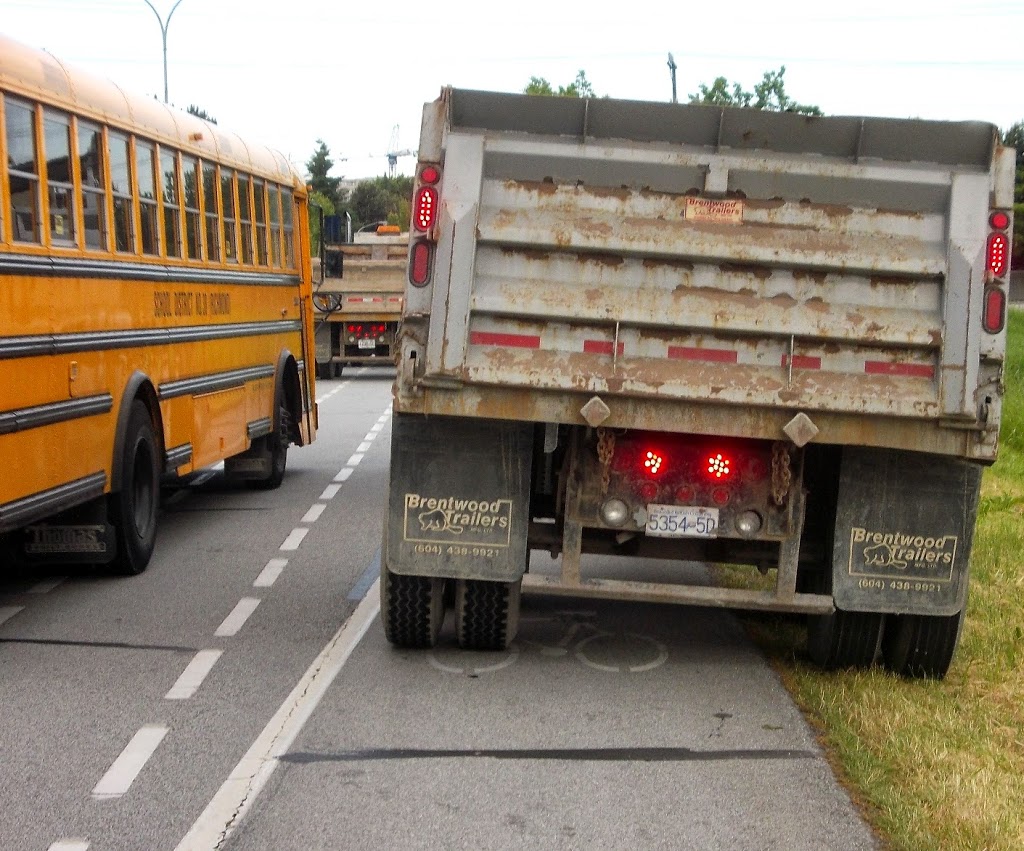
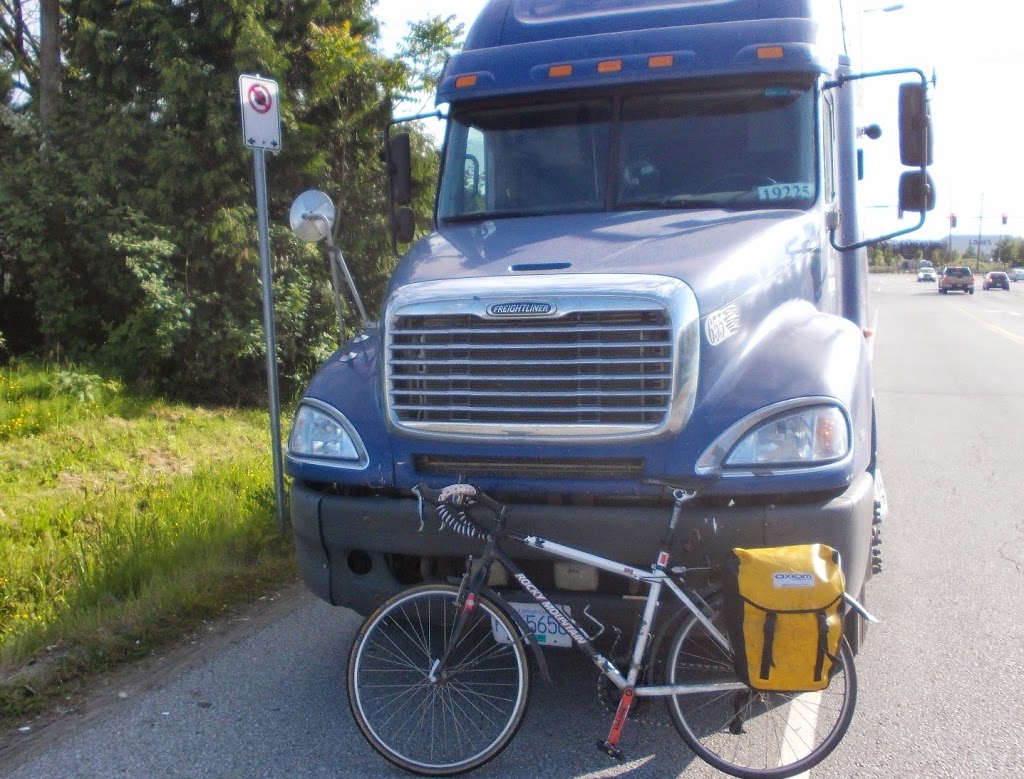
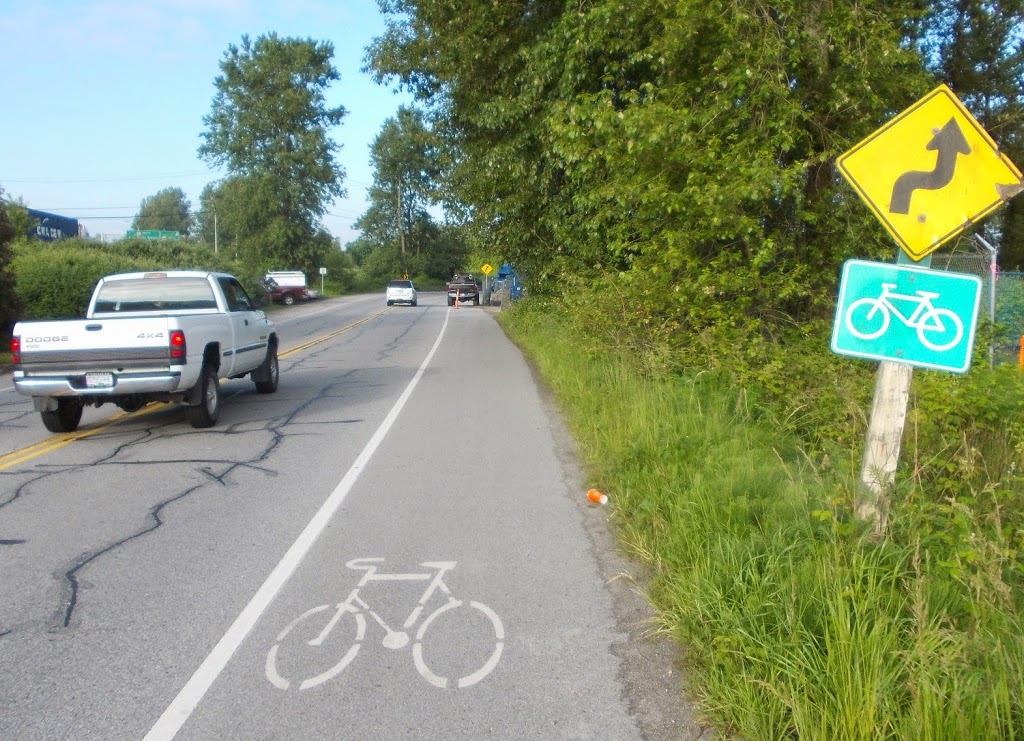
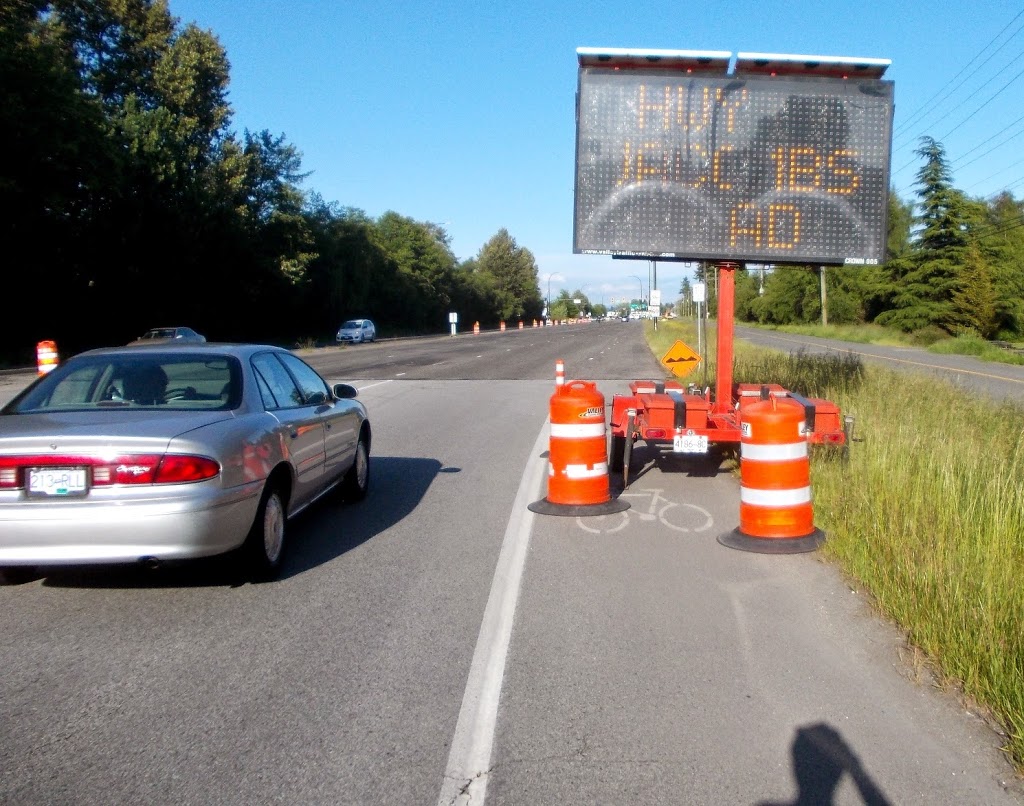
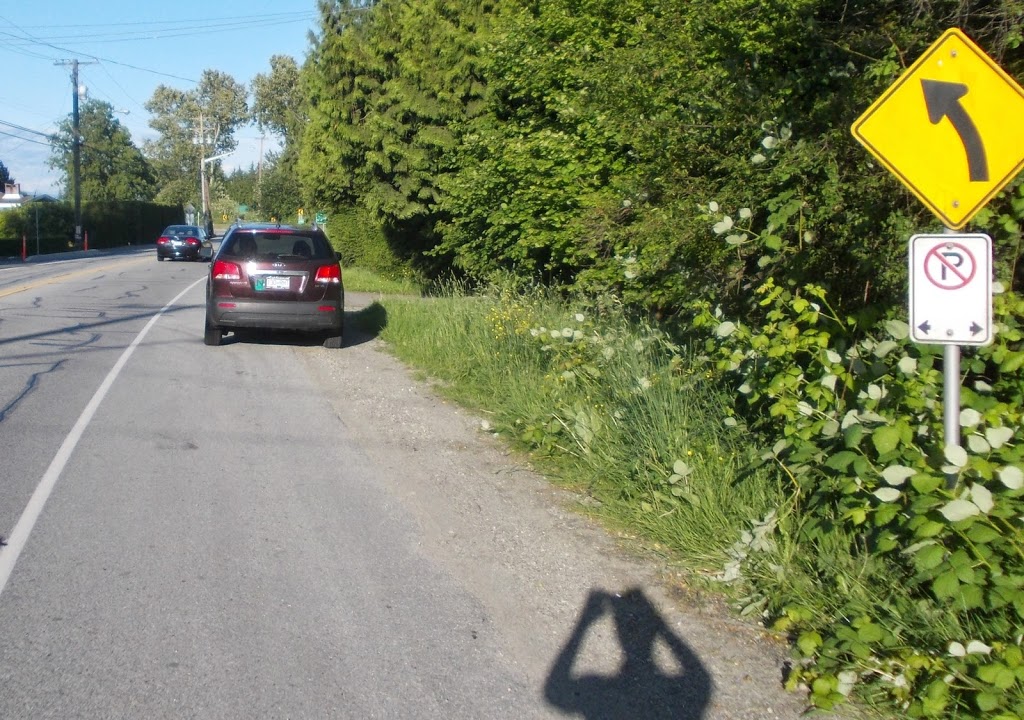
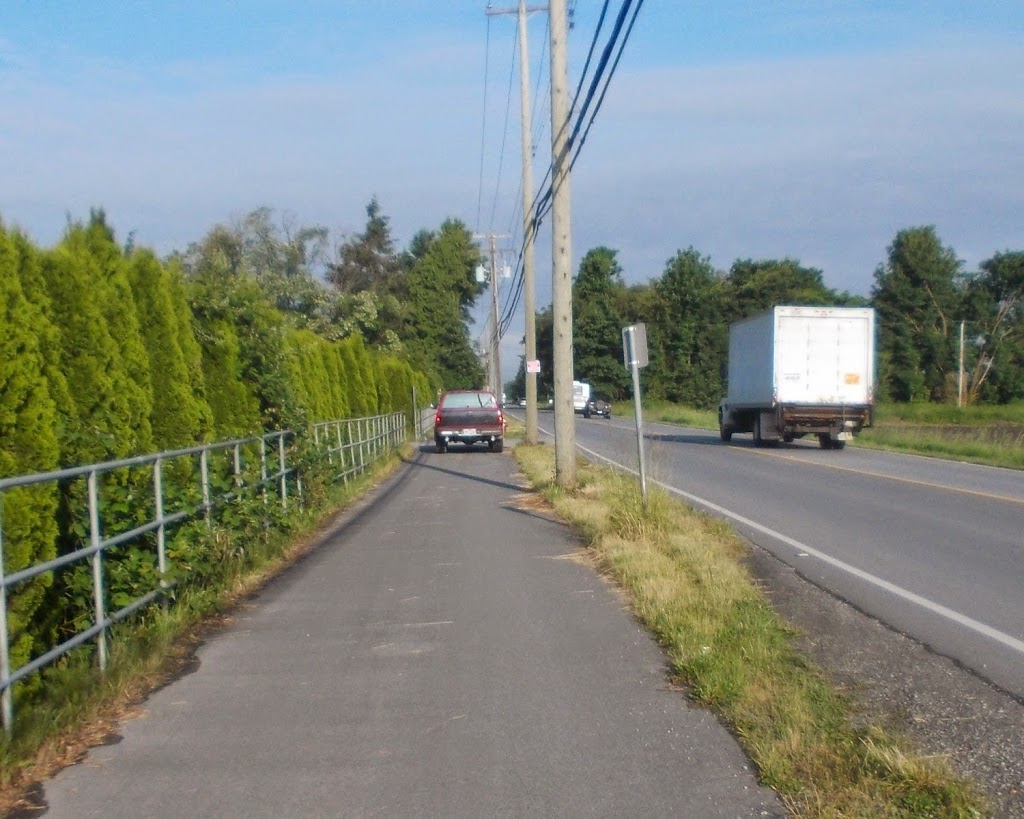
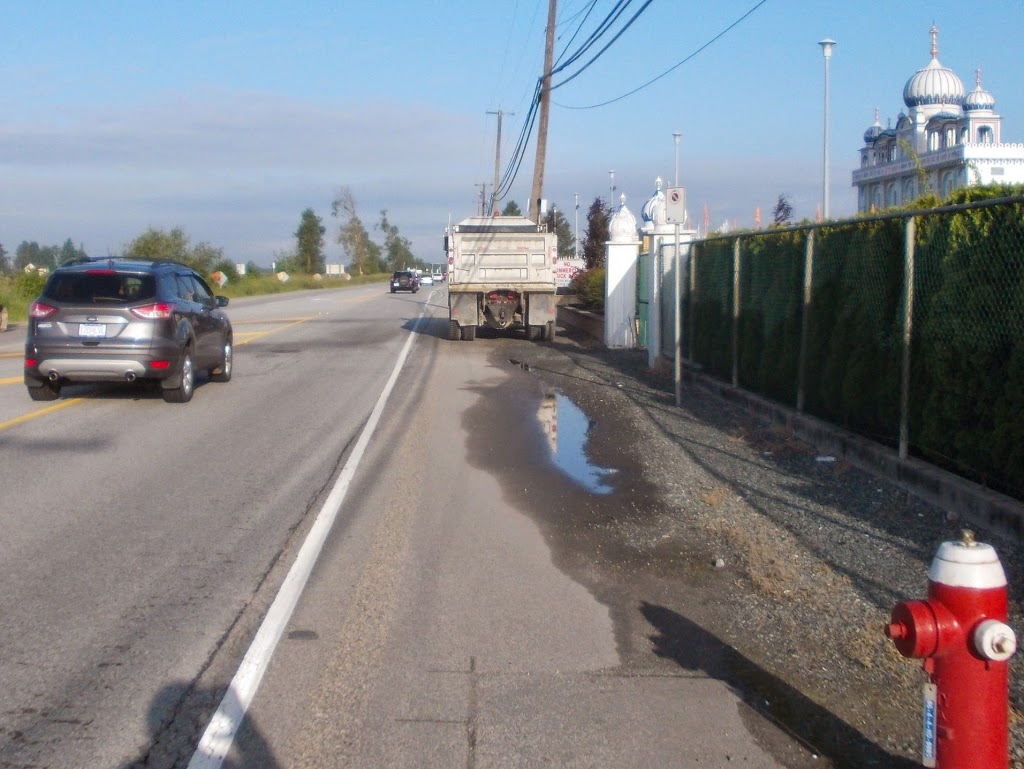
Here is what I am talking about, in images. And yes, every single one of these photos was taken this week during my regular bike route to or from work. I wish this was not typical, but this is my daily commute, folks. Actually, this is an abridged sample of my week.

Monday:

I’m not the only one avoiding this guy.
in his defense, how could he possibly have seen the bike lane of no parking sign? 

Tuesday:

At least it is a pictogram of a bike under him, not an actual one.
Nice picture of my commuting bike, and a no stopping sign on the bike lane.

Wednesday:

This guy put a cone up, which is nice, in a way.
Note the only construction stuff blocking this bike lane is the warning sign.

Thursday:

Note both of these pics for Thursday are from the way home, as the morning ride was too rainy to photograph.
And note this guy is a jerk… 
…but not as big a jerk as this guy who honked at me (?) as I passed him.

Friday:

Yes, he was parked. Yes, a completely separated lane. 
Note no stopping sign. 

I’m not sure  what my point here is, except that I don’t think any of these people were in any kind of risk of receiving a ticket for their illegal vehicle use, while the City of Vancouver police were using BTWW to crack down on people riding bicycles on bike lanes without helmets and Bruce Allen was ranting on the radio about scofflaw bike riders and the out of control bike lane lobby. You would figure people like Bruce would love bike lanes – if only for the free parking.

A short note from the complaints department

Let’s skip the obligatory apologies for infrequent updates here; I’m busy.

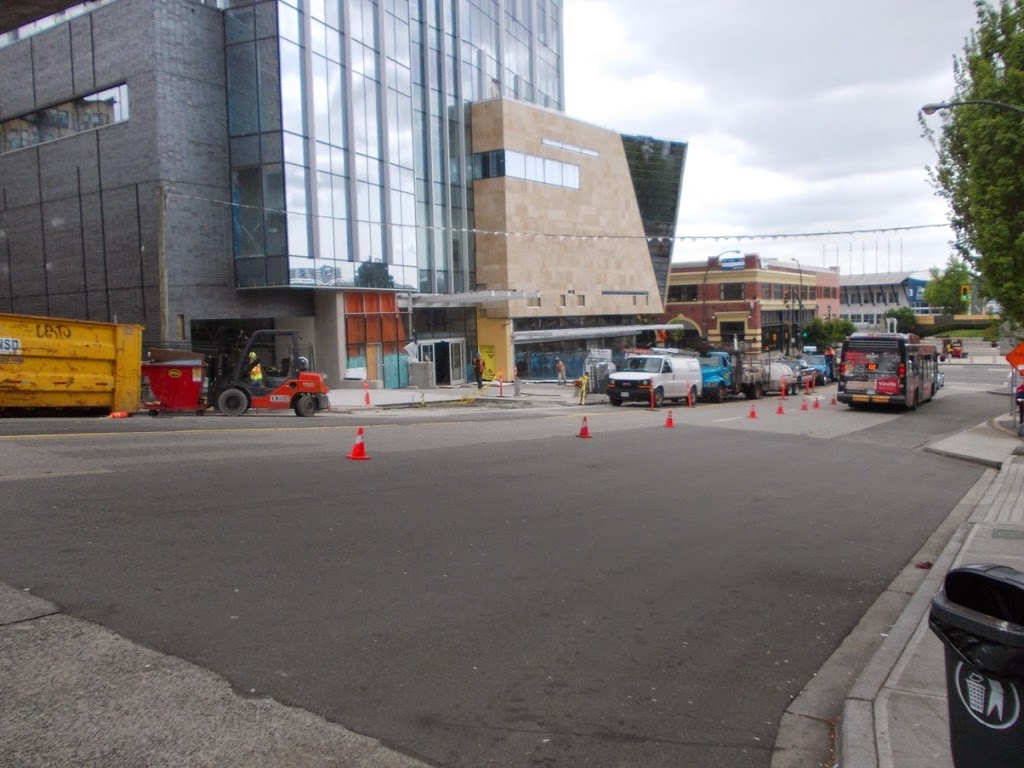
On a not-unrelated note, I was on my way to the very successful RCFM fundraiser on Wednesday night when I noted that we are soon to get our sidewalk back, as the Anvil Centre nears completion.

This is great news, as the deplorable condition around the east entrance of New Westminster station and lack of connection with the rest of Columbia Street has been disruptive for a couple of years. I look forward to the opening of the Anvil, the re-activation of that important piece of real estate as a new, expanded public space. I also look forward to a return to the debate about the need for a mid-block crosswalk at the foot of 8th Street between Carnarvon and Columbia.

We have been through this debate at least twice before, once when the crosswalk was installed, and once again when it was removed a few years later. The removal was put off until the start of Anvil construction, when the sidewalk on the east side of 8th essentially ceased to exist. Now that there will be a major destination on the other side of 8th, the obvious, direct, and dry route for pedestrians connecting between Anvil and Plaza 88 will once again be up for discussion.

Much like the recent discussion about a mid-block crosswalk on Eighth Avenue by the Massey Theatre, to make safer the preferred pedestrian route between major destinations, the idea of a mid-block crossing at the foot of 8th Ave is a measure of how serious the City is about its Pedestrian Charter.

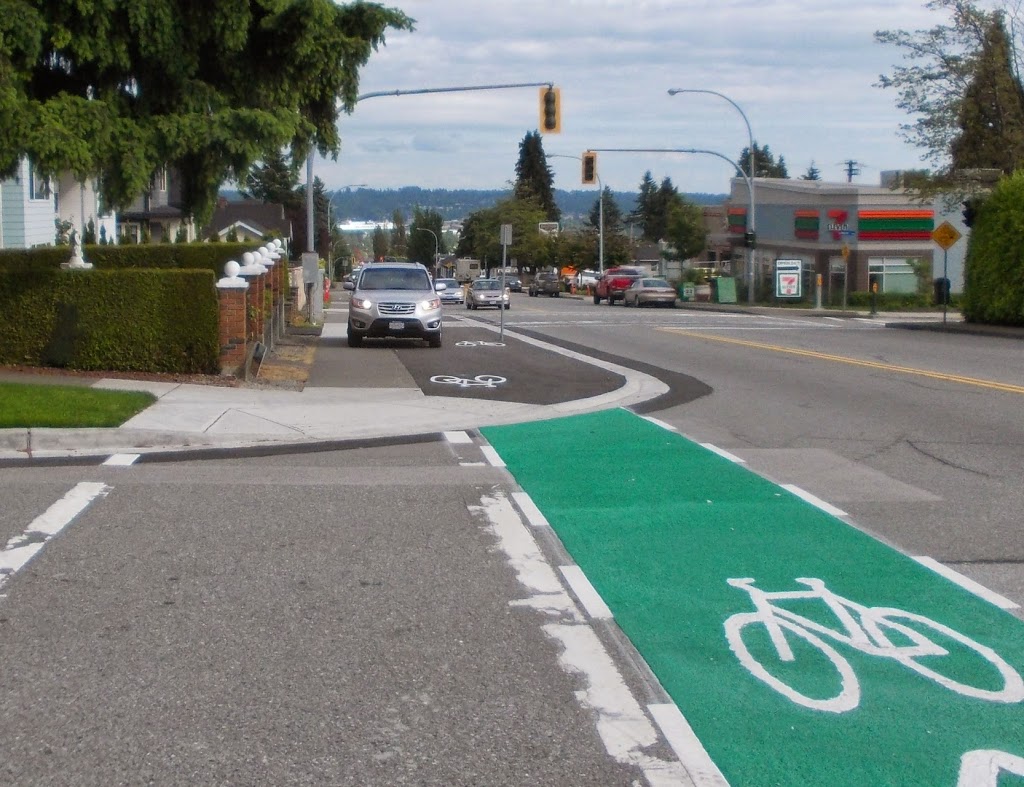
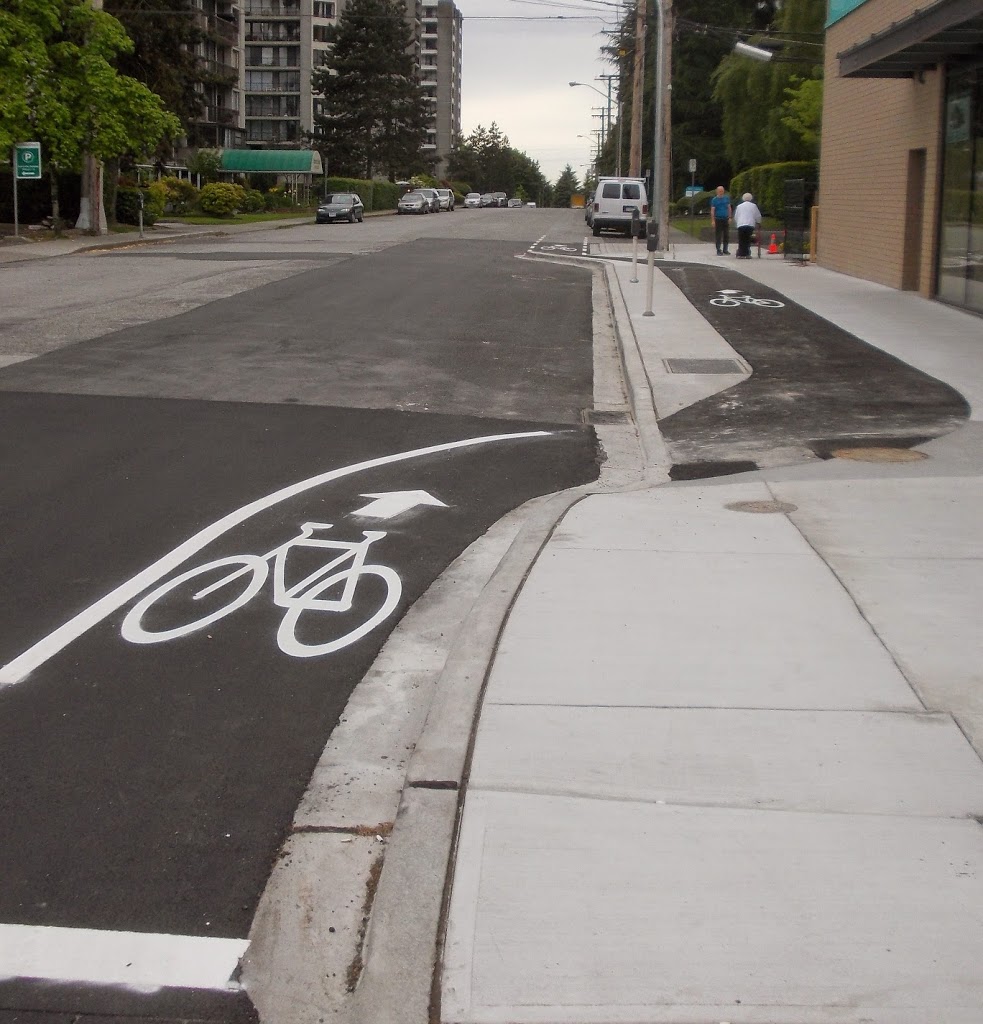
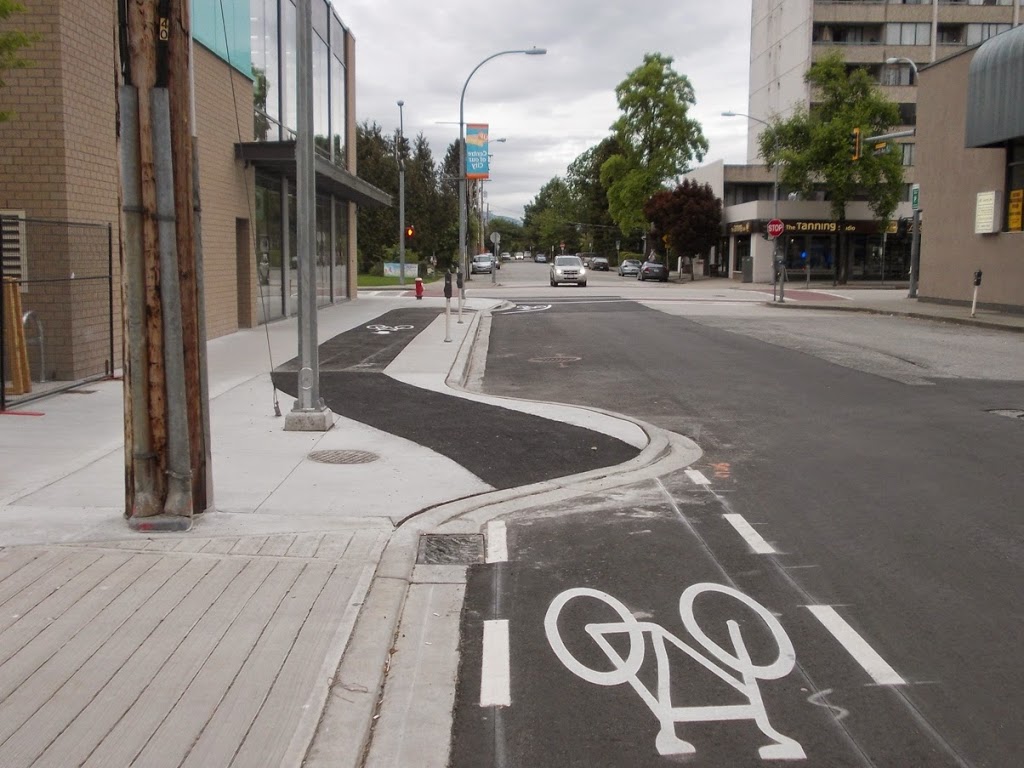
Then on Thursday night I was on my way to the NWEP meeting in Uptown, and I notice this sparkling new piece of bicycle infrastructure on Seventh Avenue, built concurrent with the redevelopment of the new drugstore at the corner with of 6th Street:

Bike lanes are important here, because Seventh is part of the Rotary Crosstown Greenway, one of the City’s primary bike routes, connecting the West End to Uptown to Glenbrook and upper Sapperton. As far as east-west travel across the upper part of the City, it is the premier bike route, as important as the Central Valley Greenway (the connections of which I was recently lamenting).

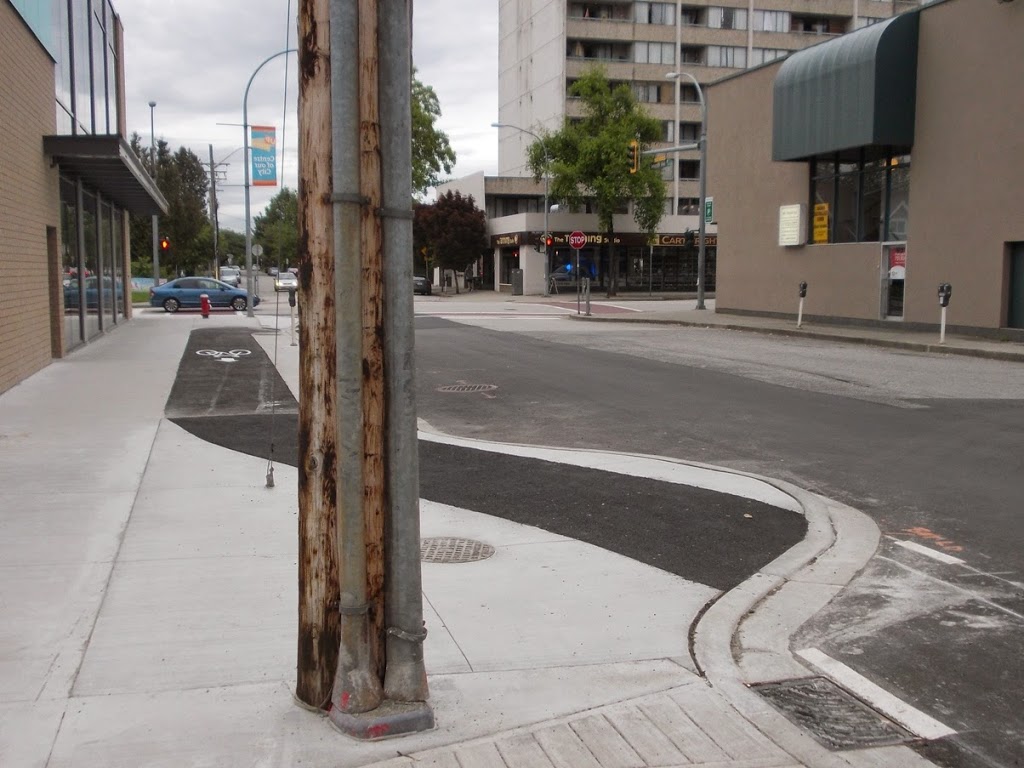
With that context, just look at this ridiculous piece of infrastructure:

A cyclist is meant to clear the signal-controlled intersection at 6th, take a sharp right turn into the dip at the curb then up onto a sidewalk, clear the pedestrians, then take another hard left before hitting the light standard to dump themselves back into traffic immediately in front of a parked car just before two (2!) driveways where the opulent 30m of bike lane abruptly stops.

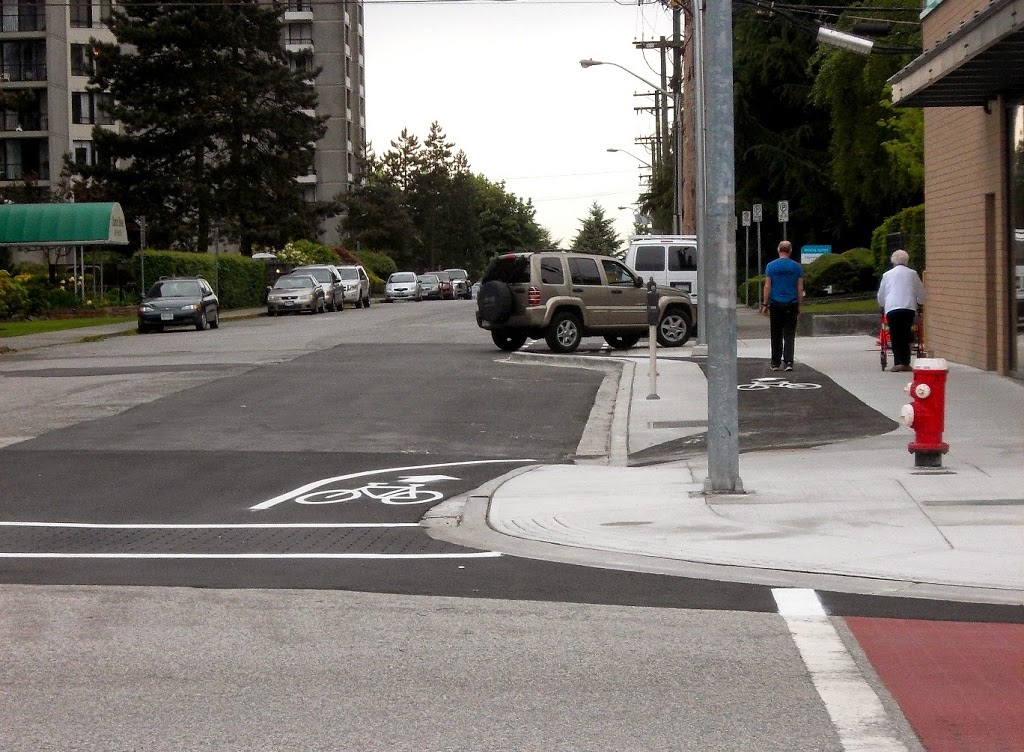
Allow me to count the many ways this installation fails. The entry point creates confusion for three modes (cyclist, turning car, pedestrians), all of whom are forced to cross each other at the single crosswalk point. The cyclist is forced to share the crosswalk with pedestrians, who are unlikely to be expecting them there when they get out of the passenger side of their car, when they go to the parking meter, or when they are simply walking on the sidewalk as pictured below. The exit back onto the street is again confusing for the cyclist and the drivers who may be either passing a line of parked cars when a bike appears, or even turning right into the driveways (see picture below) when a cyclist appears “out of nowhere” from the behind the parked cars, and hops off the sidewalk. I honestly have no idea who has right of way in that collision!

For drivers pulling out of the driveways, the pole is located perfectly to block the driver’s vision, requiring them to pull a little forward, and making it more likely they will pull right in front of a cyclist who is checking his left shoulder as he is about to hop back into traffic (note this picture has no-one in the parking spots – so this is optimum visibility).

Now I can sort of see what the thinking is – it is a Greenway, we need to accommodate bikes. The developer will pay for sidewalk improvements, so let’s get it done by him. Businesses need parking, so let’s protect the 3 precious spots. With all these best intentions, the result is actually significantly worse than if they had done nothing at all. By trying to build a “bike path” where it doesn’t work, and not connecting it meaningfully to anything, they have made the situation considerably less safe for pedestrians and cyclists.

I’m not sure if I am more angry about the danger created, or the money wasted doing it!

I look at this fiasco and I wonder why? How? What was everyone thinking? Surely at some point someone – the person creating the drawing, the person approving the drawing, the person laying the concrete, the person painting the white lines – looked and said: what are we doing here? Does this make any sense at all?

We can do better. We need to do better.

RCFM FUNdraiser!

Since I wrote that last piece about the ALR, I have had a lot of chats with people in various forums on the very topic.

I have also read a bit more about the issue, including this typically-idiotic piece by Tom Fletcher where he suggests the only people against the systematic disassembly of ALR protections are the evil NDP and others who aren’t “in the real British Columbia”. I guess he didn’t talk to this guy who seems to know a bit about land development around the ALR, he being a former mayor and land developer in a place with a lot of ALR land, or this collection of people who live and work in the BC food supply chain, from the farm to the restaurant plate, or even these folks, who represent 14,000 BC Farmers. I guess none of them live “in the real British Columbia”, which by Fletcher’s opinions, I have to assume is somewhere near the Premier’s back pocket.

Many people have asked me – what can they do about it? Hopefully you have already contacted your MLA, and the Minister of Agriculture. Really, it only takes a few minutes to write an e-mail, and if you wait until election time to tell your elected officials what you think, you have failed at Democracy 101.

Here is another thing you can do to improve the Food Security in New Westminster: Come to the Royal City Farmers Market fundraiser next Wednesday!

How does that help? The RCFM gives people like Urban Digs and Glen Valley Organic Farm and the Forstbauer Family a place to market their fresh-from-the-ground actually-grown-here good-for-you food. As the good people at the Southwest BC Food System Project remind us- it isn’t just about saving the farmland, it is about assuring we have the sustainable processing, distribution and marketing systems in place to bring the local food to local tables in a way that supports local jobs and the local economy. Your local Farmers Market is part of that.

When everyone in this City is complaining about the Competition Bureau deciding that 4 grocery outlets owned by the same company is the best way to protect our town from monopolistic control of our food supply, a weekly trip to the RCFM is part of the solution – buying fresh food from people you know while enjoying the benefits of community building.

So yeah, you love the RCFM, but why go to the fundraiser? Two reasons:

First, it raises funds to keep the RCFM going. It helps pay for things like the tents, the advertising, the paperwork, the web presence, the musicians, the kids activity table, the special promotions, and it helps the RCFM employ its single staff member to herd the cats that need to be herded to make the whole travelling circus of volunteers and vendors run. It helps the RCFM do the other stuff it provides for the community, like the community table and the food coupon program and the bursary it provides for an NWSS grad. Every bit of the fundraiser money goes right back into our community, into making the RCFM the great weekly event it is!

Second, it will be the social event of the year (or at least the social event of the year that won’t require a special wardrobe). It will be at the brand new Hub Restaurant (have you seen their deck!?) with special canapé prepared by Executive Chef Michael Knowlson from food supplied by actual RCFM vendors, local craft beer and wine, a bunch of silent auction opportunities, and (this is new) a live auction for a few special items.

And yes, the rumours are true, I am going to be acting as MC, and running the live auction. So please show up, because it will be pretty weird for me to stand there auctioning things off to myself.

I personally guarantee you will laugh, you will meet new people, you will enjoy your food and drink, and you will be doing a good thing for a good cause.

Link for ticket purchase is www.rcfm2014.eventbrite.ca

The future of farming or a future without farms?

I’ve been thinking about the Agricultural Land Reserve (ALR) and the Agricultural Land Commission (ALC) a lot recently. For several reasons.

Caveat: Although dealing with ALR issues is a (very small) part of my job, nothing I write here is related to actual experiences on the job, nor do I does it relate whatsoever to the opinions of my employers.

We were out on our regular every-Sunday-morning-in-a-month-without-an-“r” Fraser River Fuggitivi ride to Steveston, and a friend starting asking me about farms in Richmond. Among the topics: “wow, farmers must be rich, these huge houses!” and (in response to some signs on a farm) “is illegal dumping a really an issue?”

A second reason it has been on my mind was my recent short tour of Urban Digs Farm in Burnaby. We were there to buy some locally-grown and humanely raised pork, but got an impromptu tour and learned a lot about the realities of small farming in the Urban ALR.

Thirdly, I recently saw a presentation by Kent Mullinix about the Southwest BC Bio-Regional Food System Design Project. This is a science-based collaborative investigation of the BC food system, with an emphasis on the sustainability of the inputs (soil, water, nutrients) and outputs (waste) of our local food supply.

All of these ideas were entering my already-addled head, because they entered in the context of the current discussion happening in Victoria about changes to the Agricultural Land Commission. The more I learn about this topic, the more concerned I am about the erosion of our ability, as a society, to feed ourselves, and the ripple effects that will have in our local and regional economy.

So let’s go back up to topic #1: The economics of farming in parts of the Lower Mainland. The reality is that some people are making money farming in the Lower Mainland, but they aren’t building mansions. Well, a few are building mansions because they are the very few large landowners and leaseholders growing cranberries or blueberries at a scale and scope that they can tie into the globalized agri-business model. Most of the mansions you see on agricultural land are not owned by the farmers of the land, but people who want to build a 20,000-sqft house, and a 10-acre piece of farmland is the most affordable way to do it. The farming that occurs on that land is not by them, but by someone else (usually the agri-business conglomerates) that lease the land, allowing the person who can afford the 20,000-sqft mansion to avoid paying too much tax.

There is also a fair amount of good farmland in the Lower Mainland that is sitting idle – not being farmed because it is owned as a long-term investment. Occasionally, someone decides the land has to be raised to grow crops (often, a dubious argument) and gets approval to bring fill onto the land from the ALC. That can be very lucrative, as it is surprisingly difficult to find somewhere to put all of the dirt you dig out of the ground when you build a high-rise tower in Burnaby or Surrey or New Westminster. Occasionally, this fill is contaminated or contains construction trash or debris. Since the ALC currently does not have an Enforcement Officer in the Lower Mainland, the chances of anyone getting in trouble for dumping this non-farm-use soil on ALR land are pretty slim. Very occasionally, unknown people dump large quantities of fill of unknown quality or origin on unoccupied farmland. See the part above about “Enforcement Officer”.

The third category of farmland use in the Lower Mainland is the small farmer trying to grow crops for local markets and maybe trying to latch onto the side of the global agri-business train. For them, the work is hard, and the economics dire.

Part one of the sketchy economics are land prices. Large tracts of ALR land in the Lower Mainland can be had for $100,000 acre, if you are buying a very large piece out in the far reaches of Langley or an unimproved piece of South Surrey. If you want to buy a smaller 5- or 10-acre ALR lot closer to urban areas, your land price can get up to $1,000,000 per acre. When the vast majority of BC Farms make less than $100,000 in annual revenue, there is simply no opportunity to support that land value.

So why is the land so valuable if it doesn’t deliver revenue? See the two examples of ALR land use above. If you want 40 acres upon which to build a 20,000-sqft mansion, $6 Million seems like a bargain, especially as you can lease 75% of the land to an agri-business and save on your taxes. Add to this the speculation that all ALR (especially the stuff near urban development) has the potential to turn into extremely valuable commercial or industrial land, if you can only convince the ALC to let it out of the ALR. The speculative value of the land is so much higher than its monetary value as farmland.

The second half of this sketchy economics discussion is the globalized agri-business industry in BC as a whole. According to Kent Mullinix, Food agriculture on BC made about $2.5 Billion in revenue last year, but the industry as a whole lost $87 Million. That is only a 3% loss on revenue – an industry can rebound from this type of temporary setback – except it is not temporary, it is systemic. The trend is downward, with no plan to recover.

The trend is going that way because the North American agriculture system is becoming less sustainable. It relies on uncertain hydrocarbon markets to fuel it, it is overtaxing the soil, in some places depleting the ground and surface water that sustains it, in other areas polluting the water running off from it. It is becoming more reliant on a few large Corporations that own all of the seeds and the pesticides that the seeds have been genetically modified to tolerate. The meat is overloaded with antibiotics that are creating a resistance problem, and grown in such concentrated conditions that the entire Fraser Valley has a “nutrient glut” – they can’t find anywhere to put all the shit they are generating. If, god forbid, there is a bumper crop, the Global Market, in all its invisible-hand wisdom, causes prices to dive and the farmer still struggles to break even. Margins are so tight that an entire industry of indentured servants temporary foreign workers had to be developed to allow the money-losing crops to get to export.

This contrasts completely with the approach the good people at Urban Digs are taking. They have leased a few acres of land in the last remnants of farm land in Burnaby, and use it to grow higher-value vegetable crops, organic free-run chickens (for eggs), ducks (for meat), and pigs. They may grow other things, but those what was on site when I visited.

I first met Julia from Urban Digs when we both presented at the same PechaKucha event at the River Market. I babbled on about rocks, but she gave a compelling talk about the farm that struck a nerve when she discussed the ethics of meat eating. She spoke of raising, nurturing, and caring for animals before you slaughter them for meat. Short of becoming an ethical vegan, this seems the least cruel way to manage our meat supply. Also, because they are not stressed, are free to roam, and have healthy balanced diets, the meat simply tastes better. Yes, this meat is a little more expensive than the foam-platter plastic-wrapped slab of flesh at Safeway… but I’ll address that issue later.

That’s MsNWimby meeting her meat at Urban Digs. 

Urban Digs are like pretty much every successful small-business owner I have met: They bust their ass every day to keep things running; They hire a local assistant when they can afford it and need arises to share in the hard work and they pay them for it; They rely on an integrated network of local supports for the bulk of their supplies; They are constantly reaching out to expand their local customer base and innovating to find new ways to serve their market. They contribute to their community, and every dollar they make is returned to the local economy. They are not getting rich, aren’t building a big house on their acreage, but they are getting by, doing good, honest work right here in our community.

This to me is the fundamental point that speaks to the real issue behind farming in BC: they can make enough revenue on a few acres of rich ALR farmland to make a (hard) living, but they can only dream of making enough to pay for the actual land they farm, hence the short-term lease.

So the big operators are scratching by, or losing money, riding the globalized agri-business  train, and the small operator is scratching by, but cannot afford to settle on a piece of land by providing better food to local people. At the same time that the majority of the food we grow, and the majority of the $2.5 Billion in annual revenue agriculture generates leaves BC, we in British Columbia spend more than $6.3 Billion on food, and watch our own farmland sit idle, or get redeveloped into tilt-up slab industrial land. Why?

A new crop of tilt-slab light industrial buildings in Burnaby.

Because agri-business food is cheaper.

That’s it – that is the only reason anyone can give for why that slab of antibiotic-laden, nutrient-reduced, potentially-diseased, tasteless flesh wrapped in plastic at Safeway is the better way to feed ourselves. However – and this is the important point – this is a false economy.

The compromises we need to make to our food security to save that little bit of money at the check-out counter are huge, and piling up, and they don’t represent real savings, they represent offsetting costs. The reliance on increased petrochemical inputs, on overtaxed soil and contaminated water systems, on increasing livestock influenza epidemics and moving food in gigantic steel boxes across the ocean when it can be grown in our own backyard. When almost all of the money we spend on that “cheaper” food leaves the Province, and the large agri-businesses operating in BC are losing money – is this really the cheaper option? Or are we being penny wise and pound foolish.

When the California Central Valley, where most of our vegetable crops come from, is seeing its third consecutive year of critical drought; when the Ogallala Aquifer, which irrigates 1/3 of grain crops in North America, is showing signs of failure; and when the world is moving past peak phosphorous (Cripes! That’s a thing!?), there are many signs that the era of all this “cheap food” is fleeting. The system is too big, too unyielding, and relies on too many critical paths. The globalized agri-business food industry in 2012 is starting to look like a Soviet corn or cotton plan from 1960, and it is just as doomed. The economics are shifting.

If this system is breaking, what will replace it? That is what the team from the Southwest BC Bio-Regional Food System Design Project are going to try to calculate. Now this post is running very long already, so I leave it to you to go to the website and get more detail about this very interesting program (and maybe I’ll Blog more about it later). Short version: A group of researchers from Kwantlen’s Institute for Sustainable Food Systems is working with a broad group of partners including Local Governments from Hope to the Sunshine Coast and groups as diverse as the ALC, Real Estate Foundation of BC, the New Westminster Community Food Action Committee, and the Surrey Board of Trade to study the food system that nourishes our community.

Here is a quote form their website:

“The team is using a bio-regional approach to design an integrated food system that respects the boundaries and leverages the opportunities of an ecological and cultural region beyond the conventional delineations of municipal and regional boundaries. Our planning horizon is 2050. What is the potential for a revived and re-localized food system in BC; how can we respect and incorporate Indigenous harvest and hunting practices in the food system; how many jobs can we create; how much can we contribute to the regional economy; what kinds of ancillary businesses can emerge and how can this kind of food system reduce GHG emissions and address serious environmental concerns? These are some of the questions the ISFS team is trying to answer”.

This is an interesting project, in its infancy, but inside here may well be found the systems that need to be developed that will allow businesses like Urban Digs to provide food in a sustainable way to our community, and pay themselves a living wage while doing it.

Our Provincial government is also aware the ALR system is broken, but instead of fixing it, they seem intent on scattering the pieces about to prevent it’s repair. I present to you Bill 24 – Amendments to the Agricultural Land Commission Act.

The first step (and it can’t be the only one) to repair the disconnect between farm land value and its cost is to end the speculative investment in ALR land, which starts with a Government standing up and saying “This Government will not undo the ALR, and will not allow lands to be removed from the ALR”, like every other government of the last 40 years has done. Even showing the kind of commitment for the ALR that they demonstrated during the election last year would be nice. Look at their 2013 Campaign Platform, and the Agriculture section was 400 words with three strategies and 10 actions, and no mention of changes to the ALC. Actually, the platform suggests it will help with a Buy Local campaign and promote 50- and 100-mile diets, an idea that is best supported by strengthening the ALC.

This Act does quite the opposite, and opens up the door for exclusion on the whim of local politicians. The cost of farm land in the lower mainland will be going up when this bill passes, hand in hand with the pressure on local councils to open it for development.

With apologies to the most stunningly non-partisan of all Canadian scientists, this Government seems to never see a problem so bad that they can’t make worse.

Bill 24 is a potential disaster for BC food security, because it entrenches the unsustainable, failing business model that is our current globalized agri-business based food system. It not only fails to prop that business model up (as the land price equation change is going to hurt them as well!) it runs the risk of ending any hope we have of building the sustainable model that may replace it, at the very time when we are seeking to understand better what that system looks like.