My Fan-Boy weekend.

I spent much of the Thanksgiving weekend at the Royal City Curling Club, volunteering and watching some curling.

For the last 12 years, that weekend has played host to the Westcoast Curling Classic, which is a pretty big event in the world of Curling, and really should be a bigger deal to the rest of New Westminster. This is an annual event that brings the best curlers in the world together to compete right here in New West for a big pot of money. Last year’s final was an epic battle between the reigning Canadian and World Champion team (Kevin Koe) and the reigning Olympic Gold medallists (team Kevin Martin). This year, Kevin Martin returned to the final after dispatching 6-Time Canadian and 4-Time World Champion Randy Ferbey in the semis, and won the final over multiple Grand Slam winner Mike McEwen. So saying the “best in the world” is not hyperbole.

I can’t think of another annual sporting event in the Lower Mainland that, every year, brings the best in the world to compete, and it happens right here in New West.

This year I was volunteering as a driver, shuttling out-of-town teams between the hotel and the Club, or wherever. Last night I gave Randy Ferbey’s team a ride to the airport just after they lost a close semi-final to the eventual champions. If they were disappointed with not winning the $17,000 top prize, they didn’t show it.

The most unusual occurrence for me this year was going down to the New Westminster SkyTrain Station at 11:00 at night to pick up Kevin Martin’s team (returning from the BC Lions Game via the most logical transportation route). Interesting that the mixed bag of fellows that hang out around the New West Skytrain late on a Saturday night didn’t recognize the Olympic Gold Medallists walking through the station. Not curling fans, I guess.

That got me thinking about the value of the football game. If you want to go see the Lions play, you can pay $40 for a ticket in the upper bowl, 100m from the field, pay $9 for a beer in a plastic cup, $7 for a hot dog, and get your three hours of entertainment under a $600 Million roof you already paid for.

In comparison, for $15 you can get a Monday pass to the Westcoast Classic, watch 7 curling games over three draws (between 9:00am and 6:00 at night) from a seat about 2m from the ice surface, pay $10 for a great homemade hamburger with all the fixings and a big basket of thick-cut fries, and pay $4 for a real pint of real beer served in a real glass. As a bonus, between games you can chat with the players, and even have a beer with them after the games: an unparalleled fan experience. No wonder the Royal City Club has a full house Monday.

Memo for next year: if you buy a $30 weekend pass, you can attend the party Saturday night. Live band, open bar, and fun times for all, curlers and fans. Trust me – I was a designated driver that night – it gets wild.

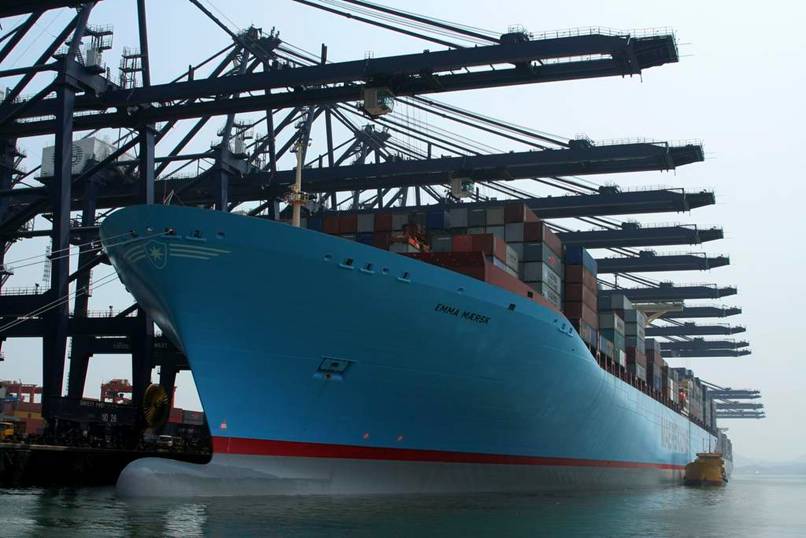
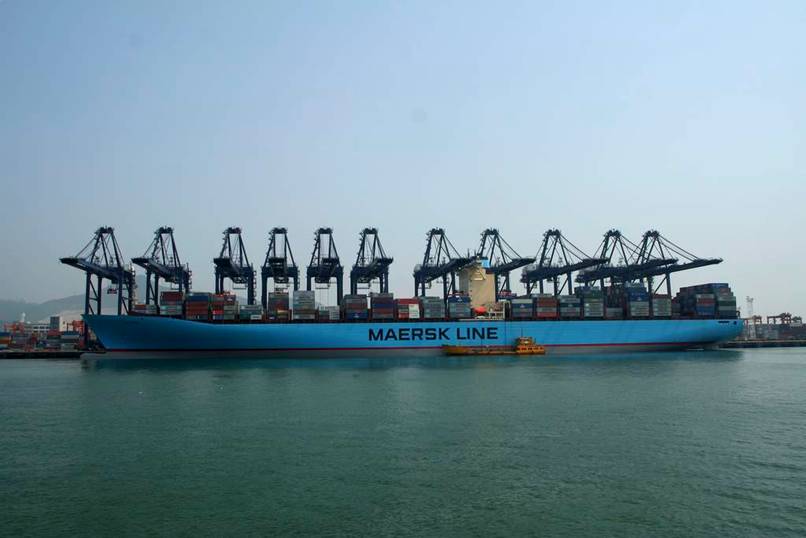
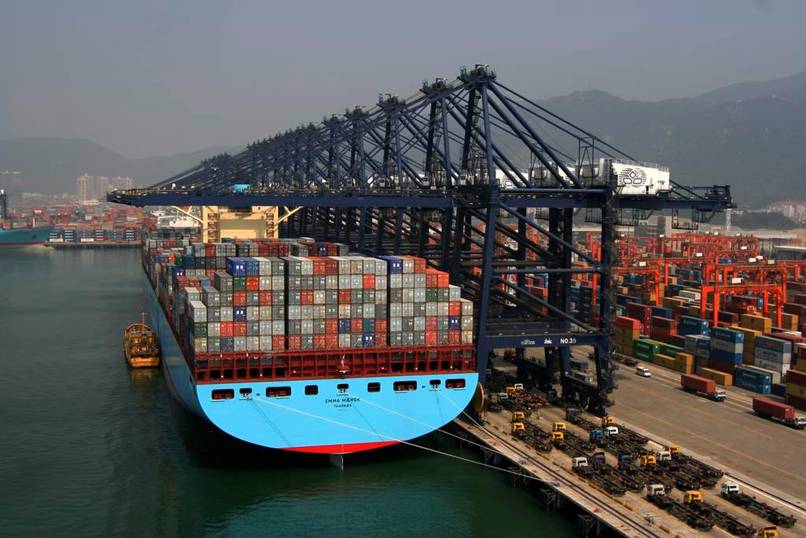
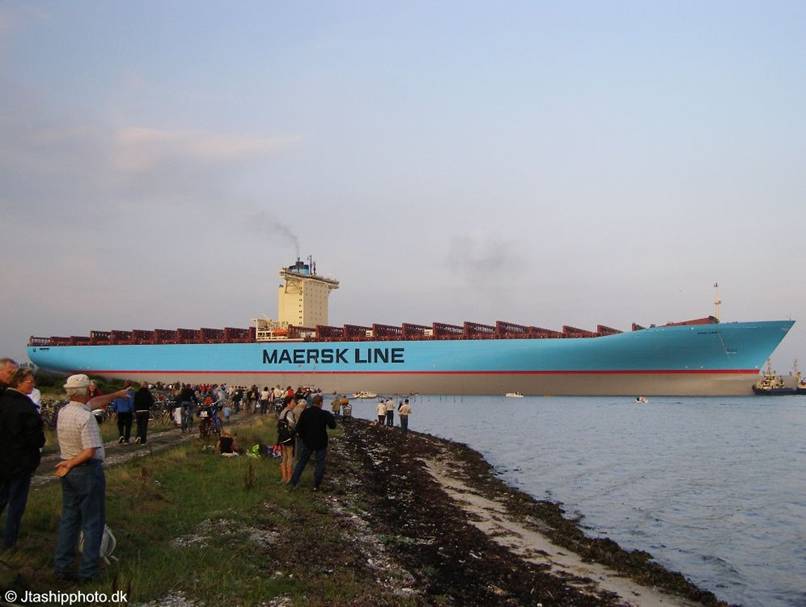
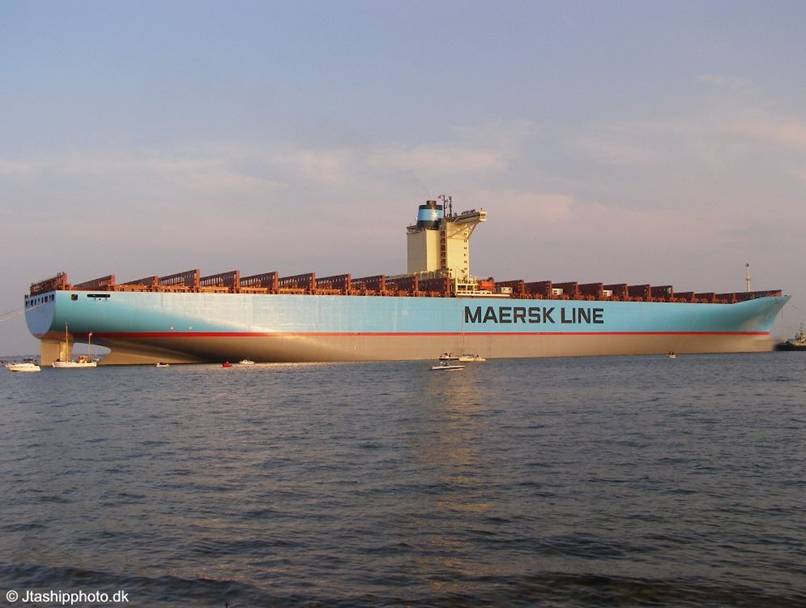
Emma Maersk

Hunter S Thompson was one of my favourite authors. He probably understood politics better than any other writer of his generation, and through that insight, he became remarkably and hilariously cynical. This cynicism could only be expressed through the use of Gonzo Journalism; a genre he did not name, although he invented it, and he, alone, mastered it.

People talk about Gonzo Journalism being about the writer being “immersed” in the story, and writing without objectivity (both characteristics of all journalism, although most journalists don’t want to admit it). But I see it as including one other thing: a vicious disregard for accuracy in order to get to the actual truth. Things don’t have to be factual to be true. In “Fear and Loathing in Elko” , He chronicled a drunken, murderous trip through northern Nevada with Judge Clarence Thomas and two hookers. He wasn’t suggesting this was a true story, but he was able, through the story, tell some truths about the Judge that he couldn’t say within the confines of “objective journalism”.

But that was then. Now, Hunter is dead, politics are beyond cynicism, and instead of journalism, we have the internet.

Recently, I received a chain e-mail that got me thinking about truth and accuracy. I think there is a message in here, I think the author is trying to say something, but the actual information is so far from an objective analysis of reality, that it must be meta-gonzo.

Here it is in it’s entirety, complete with pictures, lurid formatting, and quixotic syntax.

From:
Sent: September-23-11 12:55 AM
To:  Undisclosed Recipients
Subject: Fw: MAERSK LINE

Subject: FW: MAERSK LINE

Be Sure to read the ending…………………….

See the editorial under the last picture.. That says it all!

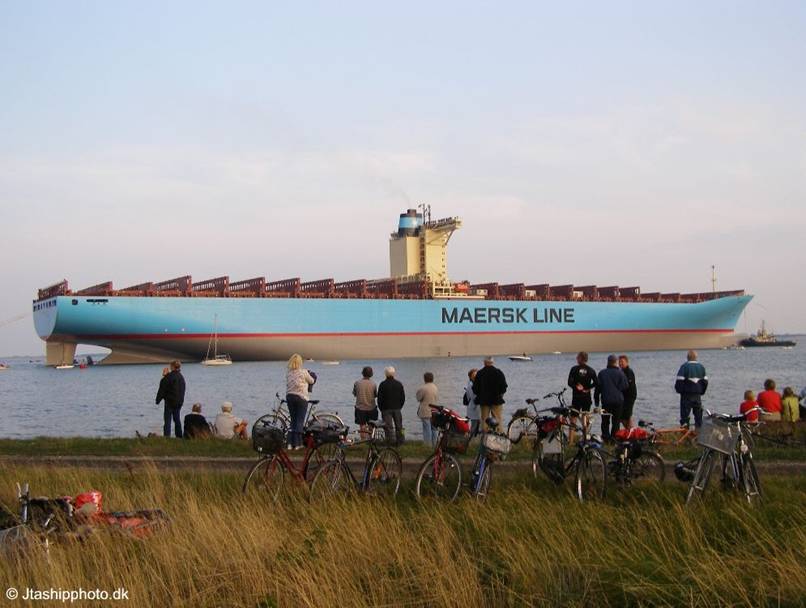
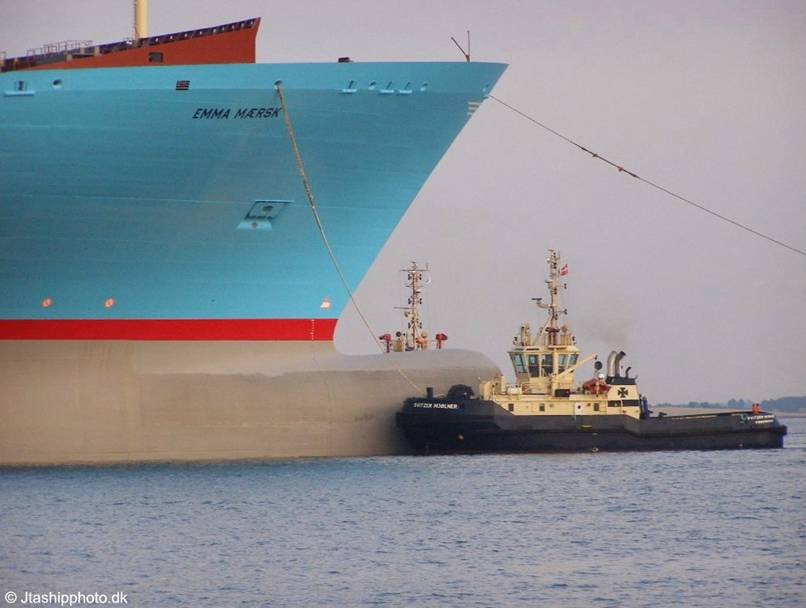
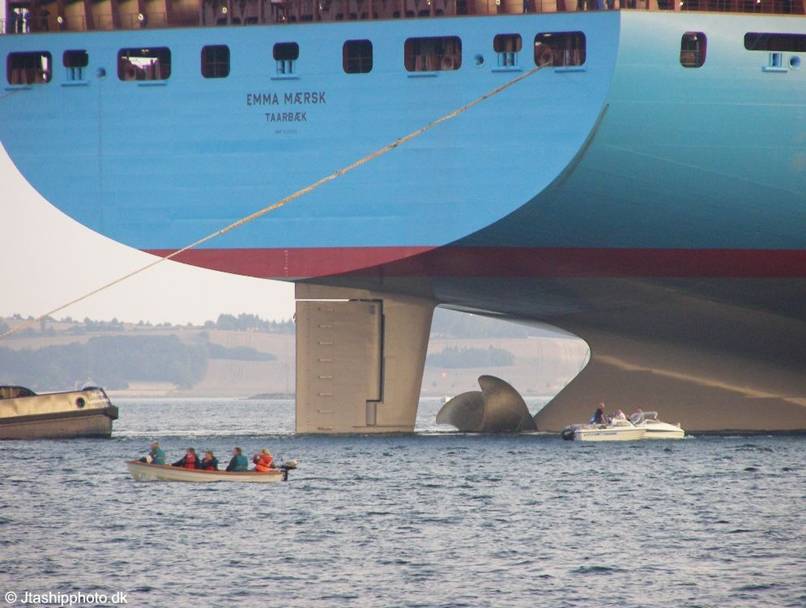
The Emma Maersk, part of a Danish shipping line, is shown in the photos below.

What a ship….no wonder ‘Made in ‘ is displacing North American made goods big time. This monster transports goods across the Pacific in just 5 days!!
This is one of three ships presently in service, with another two ships commissioned to be completed in 2012.

These ships were commissioned by Wal-Mart to get all their goods and stuff from China . They hold an incredible 15,000 containers and have a 207 foot deck beam!!
The full crew is just 13 people on a ship longer than a US Aircraft Carrier (which has a crew of 5,000). With it’s 207′ beam it is too big to fit through the Panama or Suez Canals …

It is strictly transpacific. Cruise speed: 31 knots..

The goods arrive 4 days before the typical container ship (18-20 knots) on a China-to-California run. 91% of Walmart products are made in China . So this behemoth is hugely competitive even when carrying perishable goods.
The ship was built in five sections. The sections floated together and then welded.

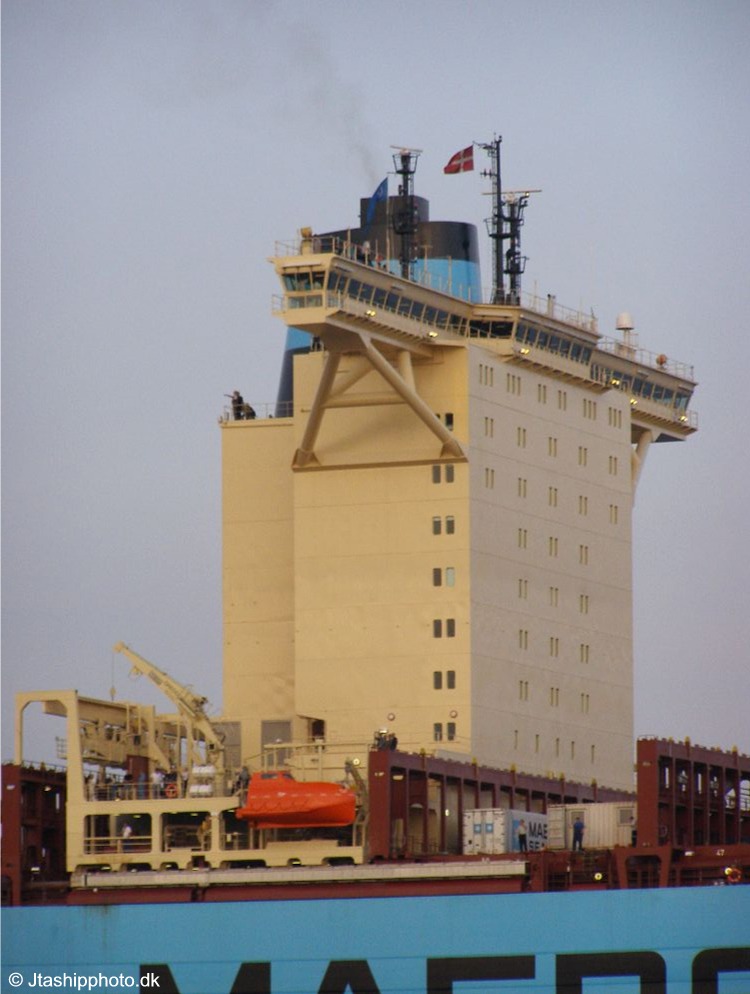
The command bridge is higher than a 10-story building and has 11 cargo crane rigs that can operate simultaneously unloading the entire ship in less than two hours.


Additional info:


Country of origin – Denmark
Length – 1,302 ft
Width – 207 ft
Net cargo – 123,200 tons
Engine – 14 cylinders in-line diesel engine (110,000 BHP)
Cruise Speed – 31 knots
Cargo capacity – 15,000 TEU (1 TEU = 20 cubic feet)
Crew – 13 people !
First Trip – Sept. 08, 2006
Construction cost – US $145,000,000+

Silicone painting applied to the ship bottom reduces water resistance and saves 317,000 gallons of diesel per year.

Editorial Comment!

A recent documentary in late March, 2010 on the History Channel noted that all of these containers are shipped back to China , EMPTY. Yep, that’s right.
We send nothing back on these ships. What does that tell you about the current financial state of this country? Just keep buying those imported goods (mostly gadgets) until you run out of money.


Then you may wonder what the cause of unemployment (maybe even your job) in the U.S. and Canada might be????


‘Nuff said ??


This message, if any, surely deserves forwarding, doesn’t it ?

(end transmission)
 As is my wont, I am going to go through this point by point.

Paragraph 1: Correct. This is a photo of the Emma Maersk, a large container ship of the Danish Shipping company Maersk.

Paragraph 2: Wrong on every point of fact. The Emma Maersk has never transported goods across the Pacific. It’s regular run is between southeast Asia and Rotterdam, making the Pacific the long way around by far. The Emma Mearsk’s maximum speed is 25knots, and it cruises at around 20knots, making the hypothetical crossing of the Pacific (say, 5144 miles from Tokyo to San Francisco), not a 5-day journey, but more than 9 days. Add a couple of days if you want to go to China. This is in fact one of 8 (not three) “E-Maersk” ships of the same size in service since the 8th was commissioned in 2008.

Paragraph 3: Only mostly wrong. These ships were not “commissioned” by WalMart, nor does the Emma Maersk even travel to North America. The ship carries between 11,000 and 15,000 containers (depending on how you measure them), and the ship’s beam is 185 feet.

Paragraph 4: Getting Better. The minimum crew is 13, although there is capacity for 17 more people. The ship is indeed longer than any American aircraft carrier ever built, and an aircraft carrier typically has 5,000 crew members (notably, the Emma Maersk’s compliment does not require a lot of aircraft pilots or mechanics). The Emma Maersk is indeed too wide and too long to pass through the Panama Canal, but it not only can pass through the Suez, it has regularly passed through the Suez many times since it first did so on it’s maiden voyage.

Paragraph 5: Wrong and wrong. It has never travelled the trans-Pacific route, and it certainly cannot cruise at 31 knots.

Paragraph 6: Wrong when relevant. The Emma moves at the same speed as a “typical” container ship, around 20 knots. It does not go from China to California, never has. Where WalMart makes it’s goods is a non-sequitor. Although I cannot comment on competitiveness, some argue the MSC-class container ships, though smaller, are actually more efficient in container handling, even if they may use a little more fuel. Notably, perishables are usually carried in refrigerated containers, much like on other container ships. The Emma Maersk has capacity for 1000 reefer containers.

Paragraph 7: Unconfirmed. I can find no record of this modular construction technique, except various references to this e-mail chain.

Paragraph 6: I’ll give you a C-. That crew superstructure looks to be about 10 stories high, but the ship actually does not contain any cranes whatsoever. The 11 cranes shown in the picture are actually attached to and controlled from the shore. However, unloading the entire ship in 2 hours would require each of the 11 cranes, working in concert, to unload a container every 6 seconds, non-stop. Highly unlikely.

Additional Info:

Country of Origin: Correct!
Length: Correct!
Width: Wrong! (184 feet)
Net Cargo: Wrong! (55,400 Net Tonnes)
Engine: Almost! (109,000 hp from the main engine, plus 40,000hp from 5 auxiliaries).
Cruise Speed: Wrong! (20 knots cruise, 25 knots max)
Cargo Capacity: Almost! (14,770 TEU, which are not = 20 cubic feet)
Crew: Correct!
First trip: Correct!
Construction Cost: Pretty close!

So for a the Speed Round, the score is 55% correct. That’s a pass!

Next paragraph: Sort of. The silicone-based paint actually increases efficiency by preventing barnacle problems without the use of more toxic anti-fouling paints. It is expected to reduce fuel use by 1200 tonnes, which works out to 320,000gallons. Close enough for the internet! Of course, this ship does not burn diesel, it burns bunker fuel.

On the Editorial Content:
Well, the historicity of History Channel documentaries aside, it seems rather unlikely that a ship would carry 14,000 empty containers across the ocean. Believe it or not, the United States is still the second largest manufacturer in the world, producing almost 20% of the world’s manufactured goods. They are also the largest exporter of recycling materials to China. But all this is irrelevant, as the Emma Maersk does not run goods between China and North America!


Ugh.


Well, to take a page from Hunter, who cares about the truth and the statistics? Is the message one to be concerned about?. This ship still the largest ship in the world, and it moves a whole lotta shit from point A (developing country manufacturing inexpensive goods with low wages and lax environmental standards) to point B (post-industrial country with high wages, high environmental standards) to serve and consumers willing to ignore it all just to buy some new stuff).

This message seems to be cloaked in standard anti-China protectionist rhetoric (“China is stealing our Jobs!”). It fails to note, however, that China, and Maersk as a shipping company, are just doing what we in North America and Europe are asking for. We are the ones demanding a plentiful supply of cheap goods. We are the ones deciding to buy 10 pairs of underwear at WalMart for $5, and not one pair of high-quality underwear from Truro, Nova Scotia for $10. That the WalMart gonch fall apart faster than the plastic bag they are packaged in is irrelevant to us.

Here is my editorial comment:

Perhaps a more interesting point is the billions of dollars our Provincial Government is spending, right here in BC, to build Canada’s “Pacific Gateway”. Considering that 2% of our exports and almost 10% of our imports are traded with China (by far the largest trade deficit we have with any trading partner), isn’t Pacific Gateway essentially a giant subsidy to Chinese manufacturers over domestic or US manufacturers? I can understand why you might want to buy WalMart underwear, but why does our Federal Government want us to?
The Trains of October -UPDATE

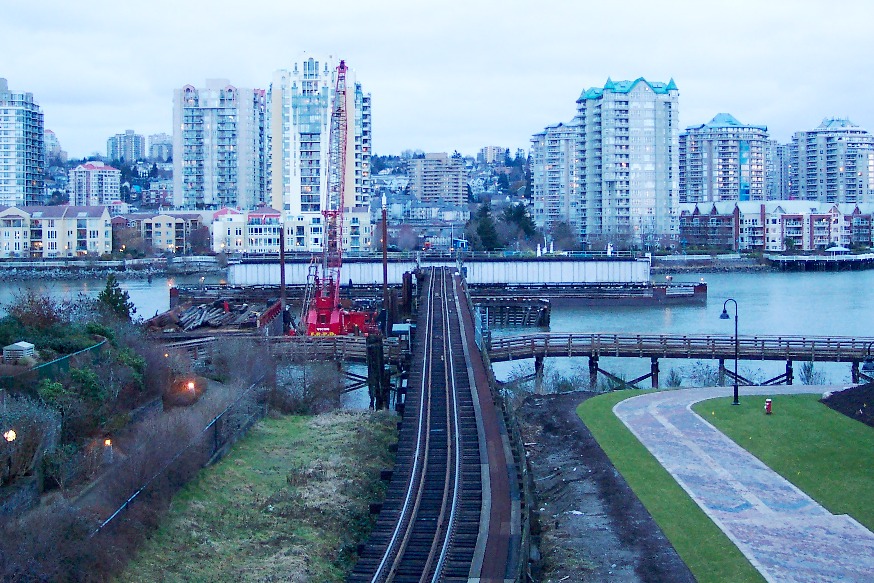
I guess once James Crosty stepped up to run for Mayor, it was inevitable that a distraction like train noise would become a central talking point in this election.

Vital transportation link or loaded shotgun? Actually, both.

Based on recent comments in the local media, trains are either the worst thing that ever happened to New Westminster, or they are completely benign and only bother a couple of Nimby whiners. Like most things, the reality is somewhere in between the two. And like most political hot-button topics, there are numerous interacting issues here, none of them being addressed by the overtly-partisan letter-writers to the local papers. Yes, I’m talking to you, Ted Eddy.

First off, and pointed out by Matt Laird in a letter that garnered no feedback a few weeks ago, the issue that the Quayside Board and the esteemed Mr. Crosty was fighting is a completely different issue than train whistles and the City’s new plan to address whistle cessation. Matt should know: he is named in the court case, Mr. Crosty is not. The City doesn’t really have a horse in the first fight, but has significant input on the second. I’m not sure if conflating the two issues is particularly helpful, as any success we will make in whistle cessation is going to require participation with the railways in question and collaboration, not court fights.

Scott Larsen’s very long letter to both papers last week was a treatise on the “who gives a shit?” side of the argument. The thesis, that being “trains are here, love them or leave” is kind of unsatisfying.

I don’t see trains as different than any other business or resident in the City. They have a right to use their land and to do business, and to not be unnecessarily fettered by unreasonable neighbours. Like any other part of the community, they also have some (ethical, if not legal) responsibility towards their neighbours, and need to consider what reasonable accommodation they can afford their neighbours. Since Rail companies are not beholden to City Bylaws and do not pay property tax, there is little that Cities can do but respectfully request these accommodations, and work with the Rail Companies in a partnership to manage them. For this to happen, both sides need to be honest brokers, and the Rail Company needs to be concerned about the needs of their neighbours.

I have worked with railways on “emissions” issues in the past (emissions being the catch-all term for air pollutants, vibrations, and noise), and from my limited personal experience: the small guys are great to deal with, the two big Canadian railways are harder to deal with, and BNSF are a bunch of jerks. My suspicion is that this reflects their corporate structures, as the larger and more pan-national the organizations, the less accountability the guy across the table has to the community and the more he has to the “shareholders”, wherever they are.

In the case of the Quayside, it seems that efforts to be honest brokering fell apart years ago, although none of us really know what happened, as the agreement was kept confidential, and no-one is talking about it. However, continued engagement is the best bet the Quayside has, and Mr. Crosty and company should get kudos for doing so much to keep the issue moving along. I’m not sure conflict through the courts is the best approach, but I am on the outside, am not party to the confidential agreement, nor to their strategy discussions with their legal counsel. Here is the point: neither are most of the people commenting so vociferously about this issue! Therefore, you are criticising Mr. Crosty and the Quayside about something you don’t know anything about!

The most idiotic and useless part of this public discourse is the “they were here first” trope. Residential development pre-dates rails in New Westminster by at least 20 years. Of course, the rails were here before James Crosty moved to the Quayside, but James Crosty and many of the Quayside condos were there before SRY Railway (the current keeper of the bridge through the Quayside) was created, and down the rabbit hole we go. All of this built the idea that whoever is here first can do whatever they want, and anyone who comes later has to lump it. That is anti-community, anti-democracy, anti-development, anti-progress, and a silly argument for an adult to make.

That said, Mr. Crosty’s argument that the First Nations were really here first is kind of bizarre: I don’t think the First Nations experience is a good image to evoke about how newcomers should treat long-time residents…

His long response to Mr. Larsen’s letter the New Leader makes it clear that Mr. Crosty wants this issue to stay in front of the election. Which is too bad, because I think that there are other issues in the City that need more attention this election than the Quayside’s ongoing battle with the Railways. Clearly that is one issue that will not be solved in this election or during the next council term. The role of the City in finding that solution is also hard to define, and in the end, Mr. Crosty and Mayor Wright are on the same side of this fight: they want the rails and the people of the Quayside to peacefully coexist.

Finally, does anyone else think it is a bizarre that there was a lot of news, much generated by Mr. Crosty himself when the Court of Appeal hearing was held,  now that the decision has been returned, and the Quayside appears to have lost, there has been no mention of this setback in the local news or on Mr. Crosty’s website?

UPDATE: Mr. Crosty sent me a message, and addressed some of the issues above. here is his note:

What you state is a loss may not be. We are waiting for the CTA to determine the outcome. The Judgement’s first page states the following:

“The appeal is allowed, the decision of the Agency is set aside and the matter is returned for re-determination in accordance with the reasons of the Court with one set of costs payable by the Canadian Transportation Agency to the Appellants.”

In other words the second complaint was rejected and the original complaint has yet to be dealt with. The CTA ruled on the second complaint this was rejected by the court hence the CTA is required to pay costs on this successful appeal by the rail companies.
As per usual court decisions are complicated matters we will not know what happens until the CTA convenes with it’s legal council. Sorry you have to wait but this is not a simple court case. We prefer to wait for the CTA to render it’s findings. The QCB has been patient, these things move slowly thru the system when it is the first time – after all we been waiting 5 years whats another week, month, or year 🙂 I trust you understand.

Like I said, I’m not a lawyer, and I am not in the middle of this case, so I am obviously missing a lot of the subtlety. Mr. Crosty’s trust is misplaced, as I really don’t understand. But the QCB has a strategy, so let’s wait to see where it goes before we pass any judgement.

Smart Meters?

There seems to be a lot of talk about Smart Meters. Although the program has been in the works for a couple of years, it was the Green Party who really brought the issue to the front page this summer with their strange dip into the EMF health Scare issue this summer. Now the UBCM has brought the issue into the mainstream, and random, sporadic reports are coming out about how the installation process is causing all sorts of trouble for a very small number of BC Hydro’s 4 million customers.

As complaints about the Smart Meter program keep popping up like some sort of cosmic whinging whack-a-mole game, I keep flip-flopping between supporting them and not supporting them. When the local media asked if the NWEP had a position on the meters, and we had to answer no. There has been lots of discussion at NWEP meetings, and socially amongst the various NWEP folks, and frankly, we do not have a consensus opinion. Some are “for”, some are “against”, and most for very different reasons. I’m going to go through some of the issues, and give my opinions (worth, as always, exactly what you pay for them), about Smart Meters, and address them individually. None of these opinions necessarily reflect the opinions of the NWEP membership.

First off, there is no measurable health risk related to the use of microwave communications for the reading of Smart Meters. This is not only my opinion, it is by far the scientific consensus. If you have a problem with that, take it up with Orac. Frankly, I’m tired of that debate, and would rather argue with Astrologers about how the location of Jupiter when I passed through the birth canal impacted my life.

A second common complaint is a loss of privacy. Some people seem to be afraid that BC Hydro will somehow know when they like to make toast or do laundry. My response to that is also an easy dismissive: who cares? I think that a utility that sells you a service has the right to collect data on how much you use and when you use it, in order to better facilitate billing and to optimize their resource allocation. I am also not so narcissistic to think that my refrigeration or vacuuming habits are of anyone’s interest, as long as I pay my bill, and frankly, I don’t care what your habits are. In a time when people tweet their bowel movements, is your hourly electricity use really a high-security issue? Electricity in BC is a public resource, much like treated drinking water, the minerals in the ground, the trees in the forest, and the fish in the river. Like all of these things (except, paradoxically, water), in order for you to personally benefit from the common resource, you need to pay a little for it, and we also ask that you tell the government how much of the resource you have used and when you used it. This is a fundamental principle of resource management. You always have the option to opt out and go off grid. Good luck.

Probably a better argument against the meters is the apparent lack of a business case. BC Hydro is, believe it or not, still the property of the BC Taxpayers, and no matter how much the BC Liberals try to dice it up, sell it off, and cripple it, there is still strong public support for keeping our electrical utility in public hands. Fundamental to that is that there be transparent oversight by an independent Utilities Commission. From my meagre research, the roll-out of the Smart Meter program has not been public, it has not been overseen, and it has been contracted out to a private company for an unknown and unaccounted cost. The program might be good for BC Hydro and good for all British Columbians, but if that is the case, it should be opened up to oversight and scrutiny (this sounds like an HST argument all of the sudden). Otherwise, it leaves a bad taste, and only fuels the fire of the conspiracy theorists.

My biggest issue with the program is that Darth Coleman keeps on saying that the Smart Meters are not going to be used for the one thing they are good at. It is like he is trading in his K-car for a Corvette and says he doesn’t like to drive fast. I am talking about variable billing based on time-of-use. This has the potential to save BC Hydro a ton of electricity, and us a ton of money, by reducing peak demand, as demonstrated in BC Hydro’s own study of the issue. Ultimately, energy conservation at the “peak” saves us needing to build new generation capacity, and provides a easier planning for a robust energy infrastructure. Just being able to measure and account for peak and off-peak times may provide enough benefit for BC hydro to make the switch worth while, (although, again, I would be a lot more confident in this statement if BC Hydro were to be more transparent around the business case) by charging less at off-peak times to allow those with the ability to use electricity flexibly (industrial users, those charging electric vehicles, house-hold co-generators, people watching Canucks games at pubs instead of at home, etc.)

One of the funnier tropes in this debate is that somehow Smart Meters are a sneaky way to increase power rates. This is wrong on so many levels. I don’t know if anyone noticed, but BC hydro can raise rates without the need for Smart Meters. They would need to demonstrate to the B.C. Utility Commission that there is a genuine need for an organization that belongs to the taxpayers to charge the taxpayer more money for a product that belongs to the taxpayer and is transmitted through infrastructure that belongs to the taxpayer, but that has worked for them in the past. It is perhaps telling of BC Hydro’s broken governance system and the current BC Government’s lack of transparency that they did not have to go to the BCUC to demonstrate the business case for the Meters, but that is a flawed governance issue, not a Smart Meter issue. Whether your electricity is measured by a Smart Meters or analog meters or by handing out batteries has no relation whatsoever to how much money BC hydro can collect from power users. Yes, it provides them flexibility in pricing, but ultimately, the overall cost per KW/h delivered will be the same.

These conspiracies assume that the ultimate goal of BC Hydro is to unnecessarily raise rates. Why? They are not a for-profit organization; they do not pay dividends to shareholders. They do not transfer profits to the Provincial government to make the deficit improve elect-ability. The worst things they do with their money are pay wages to British Columbians and buy equipment and services from BC companies. The senior management would seem to benefit most from providing BC taxpayers with a financially solvent, well-managed and reliable utility that provides us the lowest rates possible, in order to keep the pitchfork-and-torches crowd chasing David Hahn instead of them. This grand conspiracy lacks a plausible benefit, and once again Hanlon’s Razor rears it’s ugly head: Never assume malice when incompetence will suffice.

The issue of Smart Meters did come up in Monday’s City Council meeting in New West. With our own Electrical Utility, the Mayor was quick to point out that the people of New Westminster would be making their own decision about whether Smart Meters or other technologies would be used in New Westminster homes. Perhaps this is a good question to ask Mayor Wright, the Council representative the Electricity Commission, during the election campaign. Does he see wireless Smart Meter technology suiting New Westminster’s Electrical conservation goals? Actually, let’s step back and ask if New Westminster has electrical conservation goals.

One year on.

Things are so busy these days, I forgot to notice I have been doing this for a year. It’s been a year since I first posted with what has become my regular schtick: Half complaining about the City, while also giving them kudos.

1 year

139 posts (~one every 2.5 days)

13,000 all-time hits (including, I suspect, 6,500 by my Mom)

1,500 average monthly hits for last few months.

All-time most-read post: “on being visionary”.

O.K., when it comes to bandwidth and net presence, this is clearly not CNN, or even DrunkCyclist, but 40-50 hits a day is more than I should probably expect, as my target market is pretty tiny, I tend to blather on about the same crap, day-in and day-out, my marketing is non-existent, and anyone on the web in New West really should be spending their time over at 10ttF, where much more useful discussions ensue, and there is less profanity and fewer unending run-on sentences like this one.

However, going in, the purpose of this blog was to give me some practice writing, which I clearly need. I still start too many sentences with conjunctions, and end too many with prepositions. This has also forced me to bring my ideas and thoughts out in to open, which hopefully causes me to reason them through a little more, and hopefully learn from your criticism. This goes for my political ideas about the City, and my ideas about what it means to be an “environmental scientist”, when so much of the rhetoric around environmentalism (for and against) lacks scientific rigor. It also helps keep my spleen vented, and all the money I raise through it will go directly to my political campaign.

Clearly, I still need these things, so onward to Year 2. And thanks, Mom, for coming by.

Finally, for those who have come this far, I thought I would provide a rare glimpse into the process. Here is a brief behind-the-scenes view in the Green New West Headquarters, with me at my creative best…

Trucks on Front Street

The City’s official jump onto the Let’s-Make-Front-Street-Livable bandwagon has received a little media play locally. It has also caused some rumbling in local blogosphere. Much like the UBE debate last year, there is a lot of miscommunication. There is one point I want to clarify when it comes to my vision for the waterfront.

As much as I support the City’s new vision for Front Street, there are aspects I am more reluctant to support. I think the entire Parkade has to go, not just the more decrepit half. I think we need to reassess how more 30-story buildings with 5-story pedestals fit on our waterfront. I think we need to connect our waterfront east to Quayside and west to Sapperton. Most significantly, I don’t think it is necessary, or even desirable, to force trucks off of Front Street.

This is not a new position, but something I have been saying all along. Some local comments have suggested I “hate trucks” and want to move everyone back to “horses and buggies”. Anyone who knows me well knows that I really, really hate horses. So that argument is spurious.

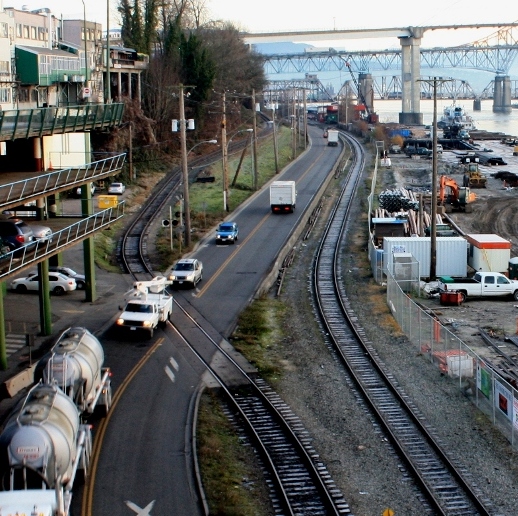
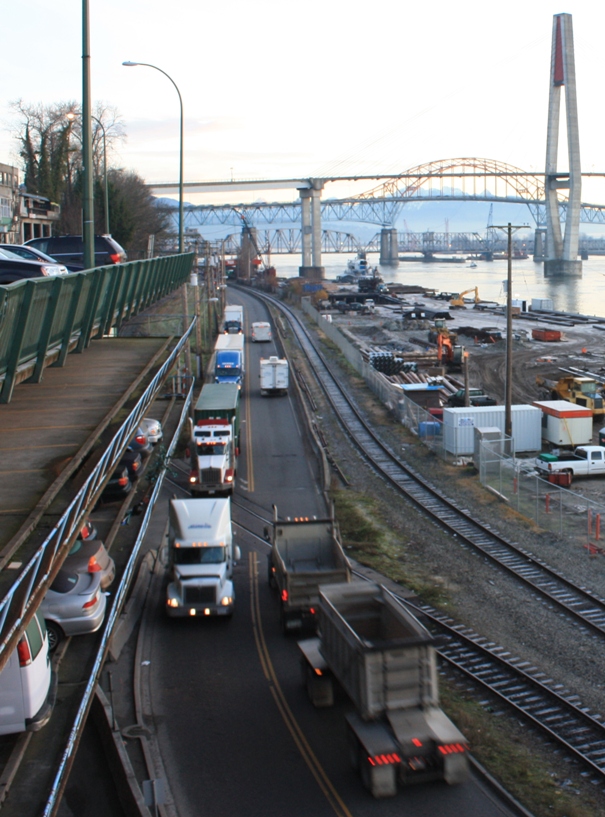
When considering a future for Front Street, we need to deal with what we have and make the best of it. We have three sets of rails that are not going anywhere soon, so this is never going to be a completely re-claimed area. The main impacts from trucks and trains are noise and soot, both of which will be significantly improved with the removal of the Parkade.* With the loss of the parkade pedestals, there will be lots of room for two lanes of through-traffic, and some combination of back-in angle or parallel parking with wide sidewalks, trees and greenery to provide a buffer from the exhaust stacks of trucks and trains. It will still have a bit of an “industrial” feel, much like the Warehouse District of Yaletown, but with the river as a view and a provider of breeze. It will be a livable, commercially viable space. It could even become a regional evening entertainment district if connected smartly to the Plaza 88 Theatre complex and Skytrain stations.

With a 30km/h speed limit, there is no reason trucks can’t continue to use Front Street, as long as we keep the pavement in good repair (to reduce noise) and integrate green buffers. New Westminster’s waterfront has historically been a working one, and the design of the new park reflects that. I suspect development of Front Street could continue that trend, and connect seamlessly. Anyone who has been to the Quays of Old Montreal knows what I am talking about. Rails, trucks, commercial property, and livable space; intelligently planned to work together.

The other way to look at the problem is what happens if we close Front Street to Traffic? Some have suggested pushing the trucks to Royal Avenue or 8th Ave. Evidently, these people do not live on Royal Avenue or 8th Ave. Royal already has difficulty with it’s truck traffic, especially around the big hill between 8th Street and Stewardson. The hill is steep, with a light-controlled intersection at the top, and half-way down. Between laden trucks grumbling to get started on a steep slope going up the hill to truckers using Jake Brakes to go down the hill and the inevitable rattle-and-crack of containers over the necessarily-uneven pavement at the mid-hill intersection, the large number of residents on Royal have enough truck problems of their own. 8th Ave also has it’s own traffic problems, and connects poorly at either end. It is worth noting both Royal Ave and 8th Ave are the locations of two major school-building projects. Generally, truck routes and school zones don’t mix.

So, no. Removing trucks from Front Street probably creates more problems than it solves. However, that doesn’t mean we need to build a 4-lane high-speed truck route to, as people euphemistically say, “keep traffic moving”. Nothing we do on Front Street will solve the problems of congestion at the Queensborough Bridge interchange, on Stewardson and Third Ave, Front and Columbia, Columbia and Brunette or the Brunette and Highway 1 interchange. The last 50 years or study on traffic demand management around the world has shown one thing: if you replace two congested lanes of traffic with four lanes, the only long-term result is four congested lanes.

Keep Front Street at two lanes, keep trucks on it, to reduce the load on other routes, but don’t let the presence of a few trucks take away from a larger vision for a useable and commercially viable Front Street.

* I note if Larco builds a 30-story development on a 5-story parking pedestal, a la Plaza 88 and Carnarvon Canyon, we are into a whole new level of negative impact traffic noise and pollution wise – but that’s another post for another day.

Old Glory

Last weekend, my Mom had one of those birthdays ending in “0”, bringing the Johnstone Clan together in the Kootenays to do the presents, cake and singing thing that is obligatory for such events.

Born in Castlegar, I don’t get back there very often; home is very much New Westminster now. Any idea I used to entertain of moving back to the Koots is usually pushed aside pretty quickly by thinking about everything I would need to give up: my City Girl wife (whom I am still rather fond of), my job (that I also quite like), my funky little house (that I can almost afford), my curling team (who are just good enough), riding a bike in the winter (without snow tires), and this great New West community into which I have somehow become immersed.

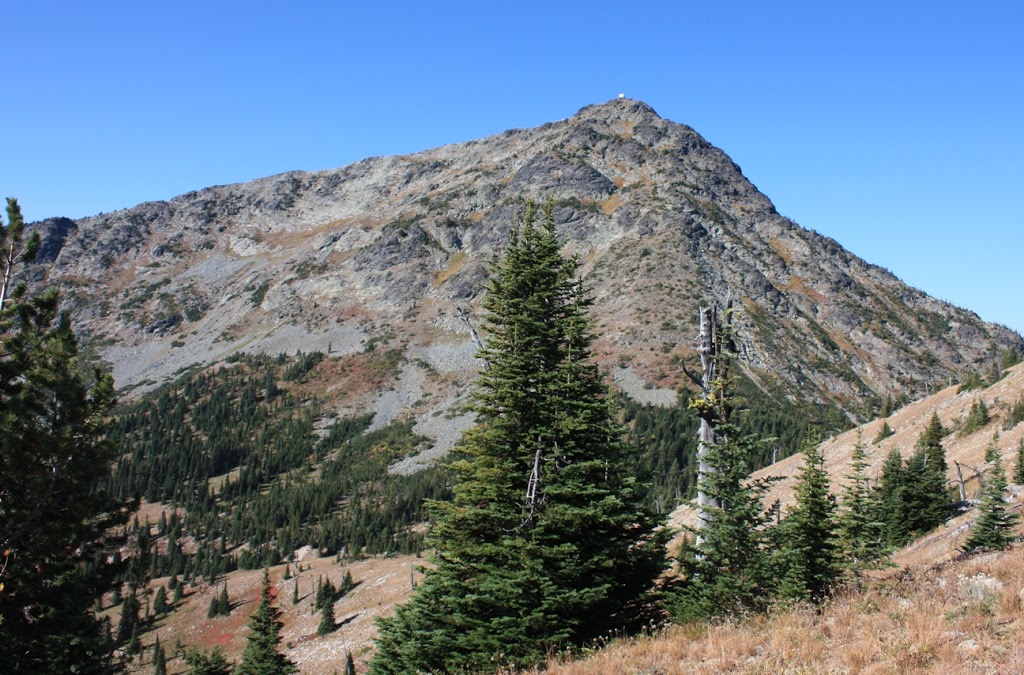
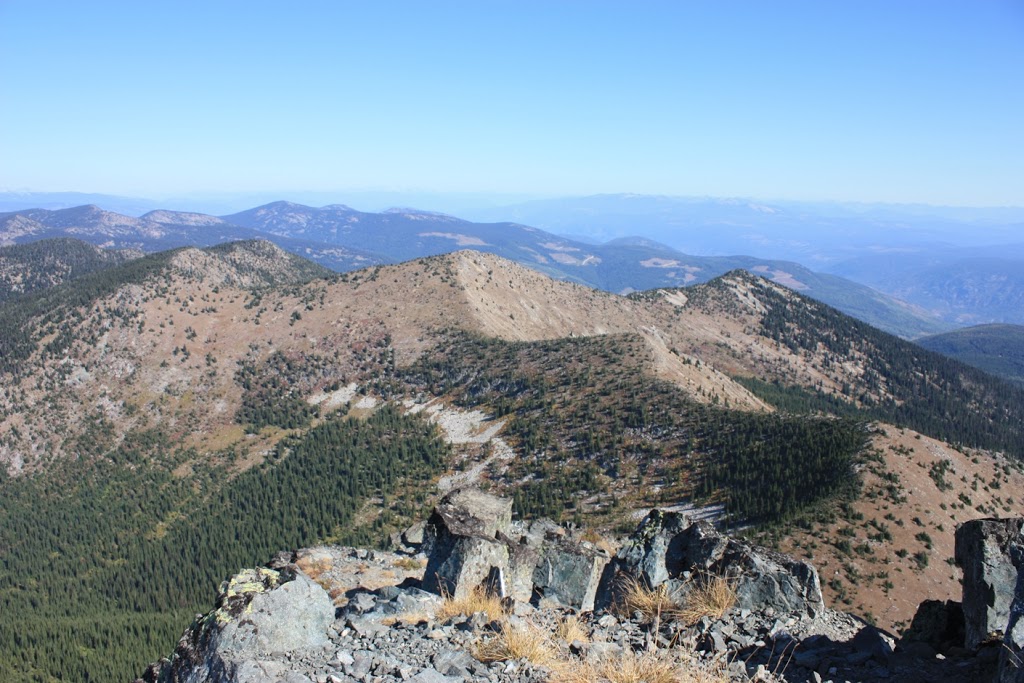
That said, I think the hike up the Plewman trail to Old Glory Mountain is my favourite place on earth.

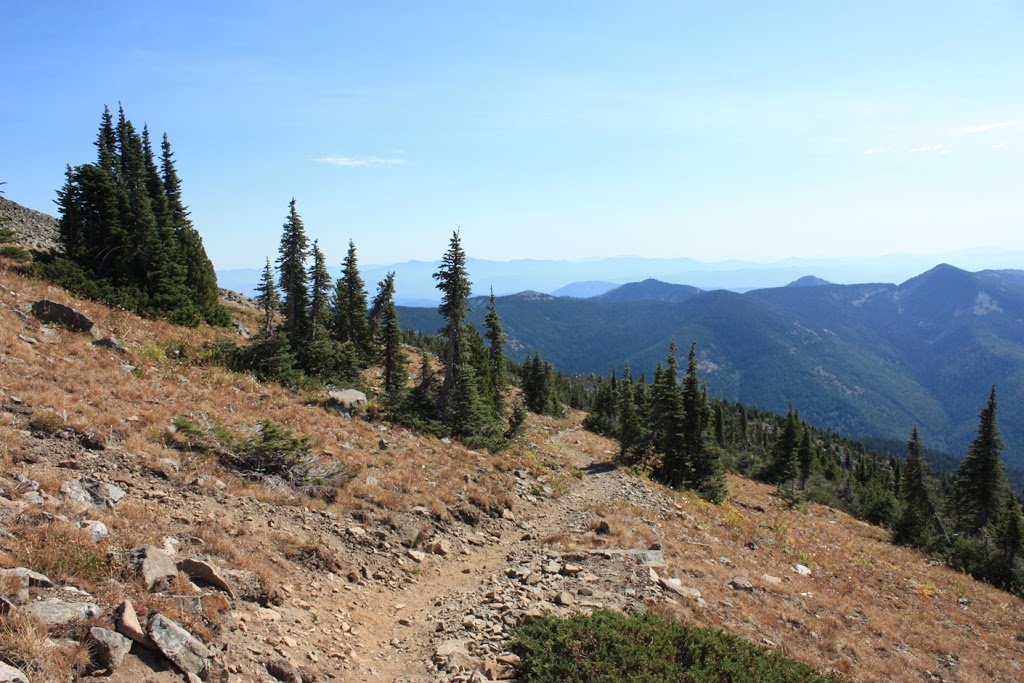
Old Glory is a 7,800-foot peak in the Rossland Range, part of the Monashee Mountains in the West Kootenay. It is the highest peak in the range, but not as tall as the highest peaks in the Valhalla Range, which is clearly visible from the top. What makes Old Glory so great is it’s 3,400-foot prominence, the fact most of that prominence is above the tree line, making for spectacular sights much of the way up, and the accessibility of the peak by a relatively easy 2-hour hike.

The first time I went up Old Glory, Mt. St Helens was erupting, so it was probably summer 1980. I remember this distinctly, as I thought every cloud passing over head was ash from St. Helens, and when I found out the rocks that make up Old Glory were “volcanic”, I turned that into pre-teen angst that it would erupt when we were there. Of course, Old Glory is made up of Jurassic volcanic rock that erupted in an oceanic island arc something like 180million years ago, long before this part of the world had accreted to the North American continent. So eruption risk was pretty low.
Last time I was up there was a year ago at the Seven Summits Poker Ride. That day it was windy enough at the summit on a cloudy day that hoar frost was forming. I had to provide proof to the Seven Summit organizers that I had made it to the top of Old Glory with my bike in order to get a “Bonus Card” in the Poker run competition, so here is the i-Pod video I used for proof (also providing proof I am not Stephen Speilberg… or even Kevin Smith).

It was damn cold up there for Labour Day, but at least we didn’t get snowed out like the previous year.

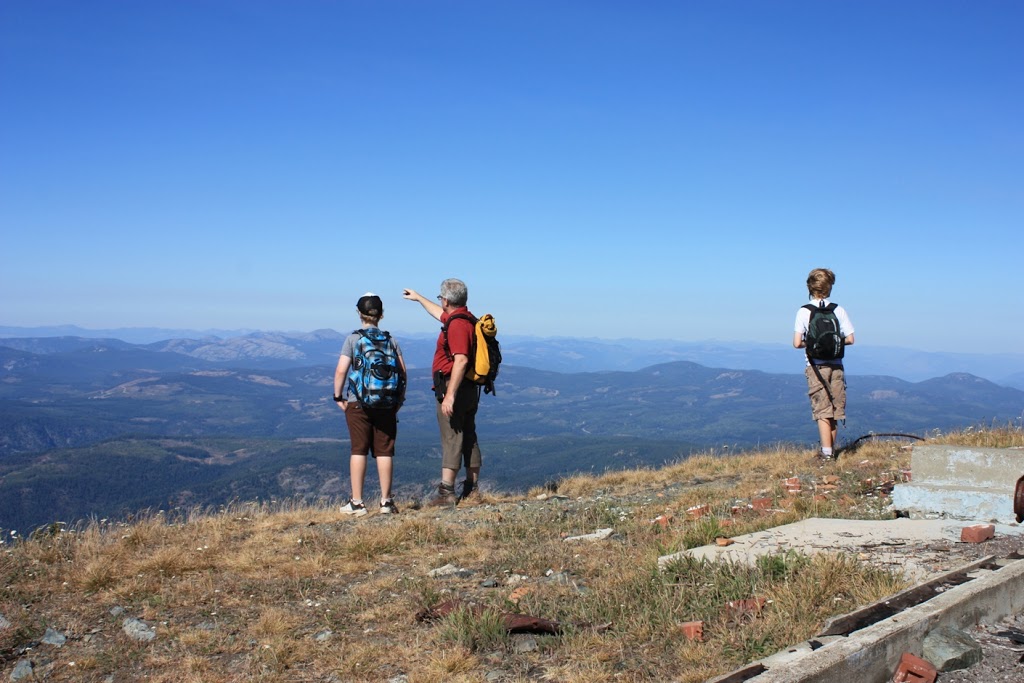
This trip, I walked up Old Glory with my brother and two of my nephews, both a couple of years older than I was the first time I climbed this hill, and they soldiered up there like solders (totally resigned to their fate and no doubt cursing the names of their commanders for leading them into certain death and discomfort), and this time the sky was blue and the view was spectacular.

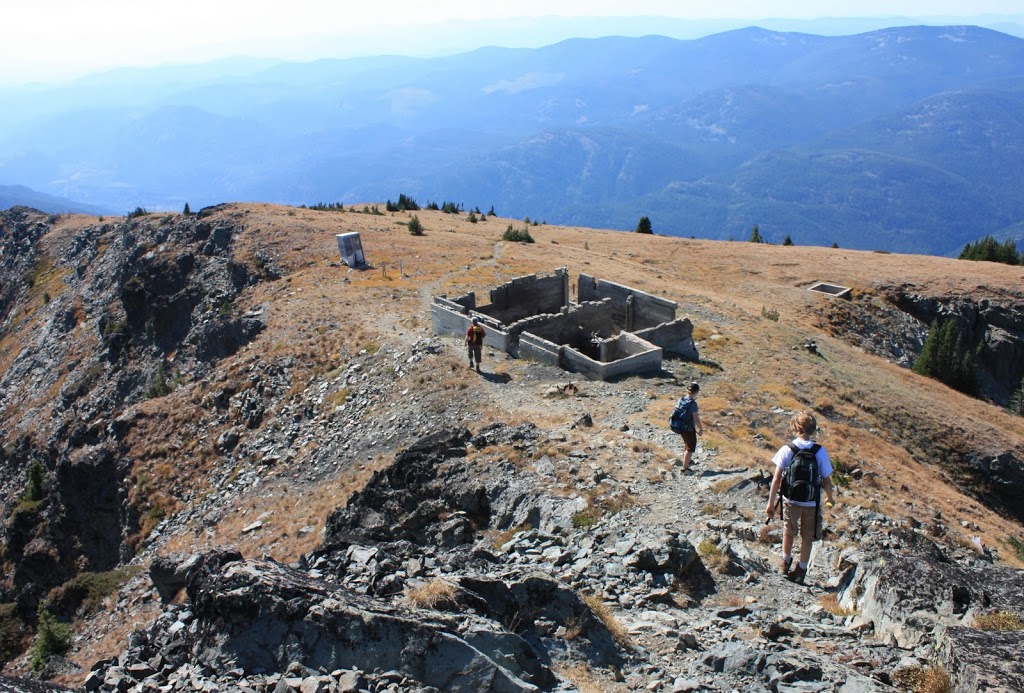
One of the great features of Old Glory is the mini-ghost town on top. This was once the location of Canada’s highest elevation weather station, and a forestry fire protection lookout. The lookout shack is still there, kept up as a hiker’s shelter, but all that remains of the homestead is foundations and scrap metal.

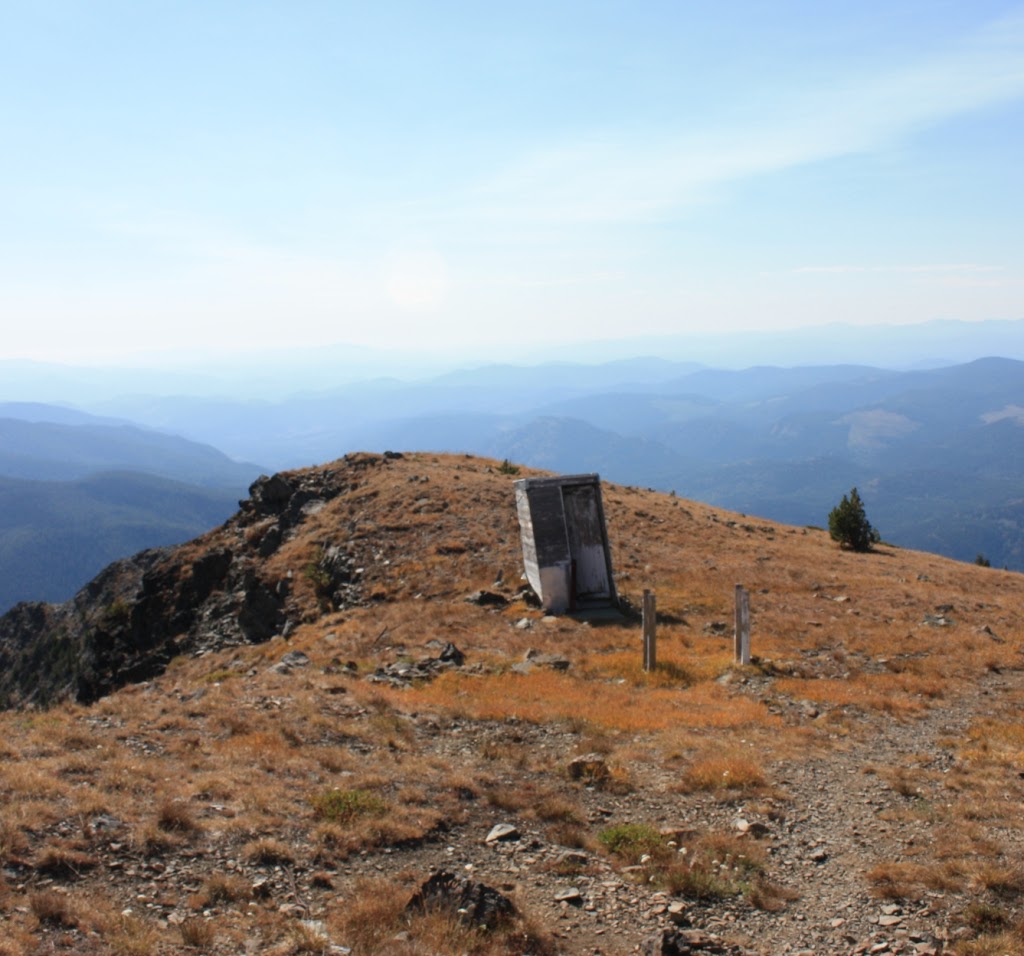
And a very windy outhouse.

But for me, the best thing is the view from the top: the rolling hills of the Rossland Range, all just touching the tree line, with the Valhalla and higher Monashee ranges in the distance, landmarks all around that I can just barely recognize from my growing up climbing mountains, skiing, and riding bikes. This landscape is my favourite place in the world.

Probably made more so by the fact I only get to go out there once in a while to visit. And that’s OK.

The “Jobs Plan” and lack of leadership

I cast my eyes down, shook my head slowly, rested my forehead in my hands, then had to go outside and get some air. It is rare that a politician so profoundly demonstrates her lack of vision, I had to re-calibrate my cynicism.
What caused me this mental distress strong enough that it caused physical distress? It was Christy Clarke’s “Jobs Plan” announcement at Thompson River University.

Someone has to tell Clark that the industrial revolution is over, that we are now in a post-industrial economy, a “knowledge economy” to borrow Moira Stillwell’s campaign plank. The days when BC jobs used to rely on cutting down trees or digging up dirt are gone. There are a lot of places in the world with trees and minerals, most with more relaxed environmental standards, and many with huge pools of uneducated and semi-skilled workers who will cut the tree or dig the dirt for way less money than the average BC worker. We cannot compete with China in the cheap-labour department. Simple supply and demand, and to race the other countries to the bottom for raw material supplier will destroy the “Greatest Place on Earth”. That is not a future of BC I want to see.

If you want to solve unemployment, if you want to build a home-grown knowledge-based economy, if you want entrepreneurs, wealth-generators, people who can develop the products and ideas that the 21st century needs – you need to have an educated workforce. The only government jobs program that has ever really worked long-term is the public education system.

It has the side benefits of being the most effective health-care program, and the most effective crime prevention program. There are few aspects of a post-industrial society that are not directly linked to the education system.

This is why Premier Clark’s announcement filled me with such dismay. She stood up in front of a University crowd and said she wanted to attract more foreign students, because they pay a lot for an education, and that is, like, free money! At a time when our public schools (K-12 and Universities) are feeling space and financial crunches, at a time when she should be sitting down with the teachers union and setting a course for the decade ahead, at a time when our entire school system is suffering for infrastructure development, Clark’s big plan is to take seats in BC schools that BC students increasingly cannot afford, and sell them to the highest overseas bidders.

Christ, she really does hates teachers, doesn’t she?

This is the public education equivalent of cutting down trees to sell the raw logs overseas. The product of chronic short-term thinking. Who are paying for these seats? People from China, Korea, India, Brazil, the Persian Gulf States. What do these countries have in common? Rapidly expanding economies, and the ability to think about the future. They recognize that an investment in education is the fuel to power their economies. These countries are looking forward at what they can do in the next generation, not back at what the last generation should have been. When will BC have the vision to invest it our own education system, so that the students of British Columbia can compete in the world economy with students from abroad?

This is a failure of vision, and a complete absence of leadership, and speaks very poorly for the future of the Liberal Party. This is a party that cannot afford to drift along on it’s past, because it’s past looks much worse through the lens of hindsight. It needs to look forward. The NDP are resurgent, Adrian Dix is politically astute, is almost as telegenic as Christy Clark, and is clearly brighter. Grampa Cummins will slice off a significant number of “Big C” true Conservatives, who always held their nose when voting for Campbell, because he wasn’t a Socialist. If the Liberals want to have a future, they need a vision, they need to start thinking big, or Christy will be back on CKNW in no time.

I mean, how far can you coast on charm?

More on the Waterfront Vision

Now that some committee meetings are available for streaming at home, we can hear a lot more of the discussion around topics that go to council, discussion that at times is more important than the Staff Reports that are available in the on-line agendas.

The discussions last week of the new vision for Front Street and the Parkade, is a perfect example. Here are a few things I picked up on.

As much as I like green spaces and innovative park design, I don’t want to see half the Parkade preserved as some sort of elevated park/viewpoint over the Pier Park as Councillor McEvoy suggests. Putting a green roof on the white elephant won’t change it from being a white elephant. Making any long-term investment in “improving” the Parkade would be money wasted, as its very existence will continue to be a blight on our waterfront and limit the potential to convert Front Street into human space. Parks should be on the ground, and putting one up in the air that will limit the economic development adjacent is less than optimal.

To hear Councillor McIntosh still talk about further “beautification” of the Parkade was depressing. Her Twitter feed last week read:

“more customers needed to park on Front St. Parkade. Should park ‘n ride be promoted?”

This creates a strange paradox. The Parkade is underused, on average about 25%, up to 38% at peak times. So it seems Councillor McIntosh is looking for way to promote the use of something, in order to justify not demolishing it because it is underused relative to the expense of repairing and maintaining it. I know Councillor McIntosh is on the record as being a “fan of the Parkade”, but it is time to move on. The Parkade is holding back the development of our waterfront, it is a blight on the face of our City, it limits the development of potentially high-value commercial Real Estate on Front Street…it is time to let it go.

I think Councillor Cote put the right stamp on the discussion: the City needs to start looking forward to when the Parkade is no longer there. That will definitely include making some hard decisions about how to accommodate the parking elsewhere in downtown, which will have to follow some sober discussion about how much parking we need downtown. I suspect a large proportion of the Parade traffic is already park-and-ride folks, but there is no doubt downtown businesses can make a compelling case that parking will need to be found for the 200-odd cars that use the Parkade on the average day. I’m not saying tear it down tomorrow, I’m saying let’s start planning for the day we do tear it down, and in the meantime, let’s not dump any money into it. (It is important to note that the City is not, as of yet, dumping money into the Parkade. It operates much like a utility, and has something like a million dollars in its contingency fund. But major refurbishment will be expensive, and I would like to see our money spent elsewhere).

Councillor Cote also points out the importance of connectivity, between downtown and the waterfront, between the MUCF and the Quay, between the Pier Park and Sapperton Landing. If the council elected in November has one “developing the City vision for their term, I hope this is it.

Finally, it was interesting to hear Councillor Harper express his concern about the zombification of the NFPR. When the UBE went down the drain, TransLink made several announcements that the NFPR did not make sense without a UBE, and as such, the NFPR is not a project they are considering further (see final page of this presentation) . Or maybe they said it isn’t a priority. OR maybe they said no such thing. The message has been a little uncertain. I distinctly remember thinking the NFPR was dead after hearing Sany Zein talk to the Public open house, and to Council. So zombie or not, I think we have to take TransLink on their word, and proceed with building the waterfront we want. We have waited 20 years fro TransLink to build the NFPR, and that waiting has slowed down the growth of our commercial centre. Time to cut the cord.

Finally, I disagree with the idea that we need to get the trucks off Front Street to make it a livable, human space. To do that, we need to get rid of the Parkade. We need to clean up the rail area, we need to build a pedestrian-friendly streetscape on the north side, with adequate green space, and we need to build safe crossings of the rails. Keeping the traffic lanes to two lanes and limiting speed to 30km/h is all the traffic control we need. The rails are not going anywhere, and the park itself pays homage to the working waterfront, slow-moving trucks can be accommodated.

Less trucks might be nice, but it will only open up the road for commuters, who will quickly fill the space, and generally drive faster than trucks. This way, we avoid the other big debate: pushing trucks onto Royal Avenue 24 hours a day. There are more than thousand residents of Royal Avenue who know all too well the number of trucks that ignore the night-time truck-closure of that street. This traffic should remain in the commercial parts of town, where the noise impacts are less personal, and affect property values less

The Master Transportation Plan and Models.

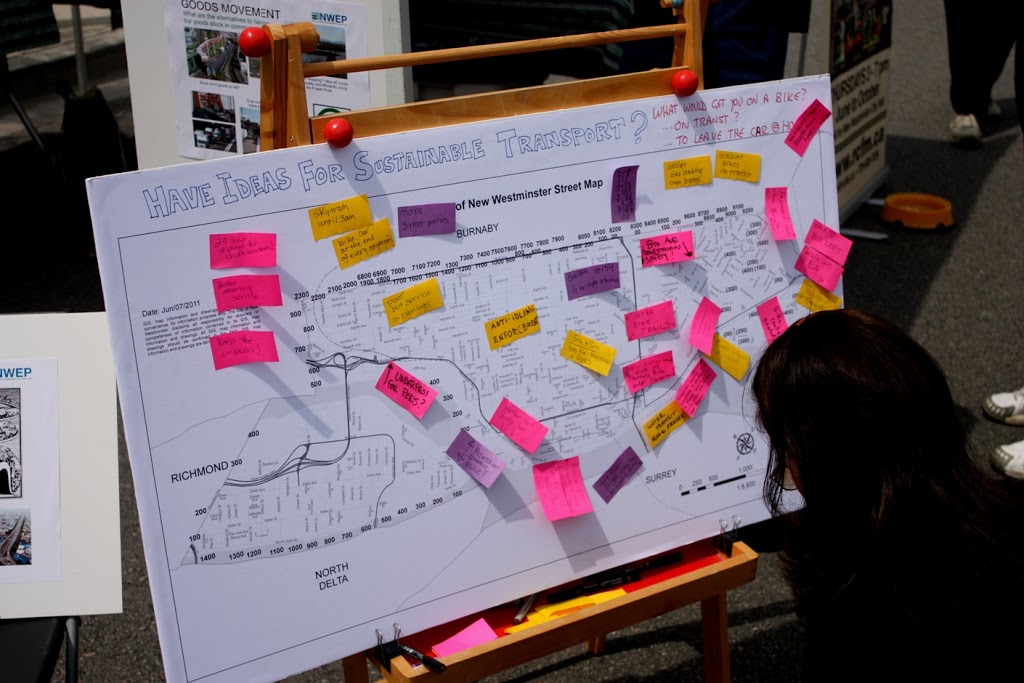
A second report to Council that came down last week was an outline on the Master Transportation Plan process. I have railed on about this in the past, and have spent much of the summer letting people know about the MTP during NWEP booth events. All along, we have been telling people it is coming, asking them questions about their transportation issues, and suggesting they get involved in the consultation process if they care about the future of the City.

The report to council outlines how the Master Transportation Plan will come about, and now that we have some details. It seems the first opportunity for public consultation will be during Stage2, and we can expect a lot of initial “community visioning” events like took place during the UBE process.

However, I want to talk about Stage 3, and about transportation models. First, the caveat part: I am not Transportation Engineer, so my opinion here is worth exactly what you paid for it. My expertise is in other areas, so I will be the first to stand corrected by those with more expertise or different facts. That said, during the UBE controversy, in discussions around the NWEP’s transportation forum last year, and by following along in transportation discussions with people like Stephen Rees, Voony, and Eric Doherty (who have a much higher level of expertise than I), I have learned a bit about Transportation Models, their strengths and weaknesses.

My concern about Transportation Models is that they generally fail to accommodate things like induced demand and the traffic demand elasticity – things that are vitally important for planning a transportation system in a built-out city like New Westminster, where the economic and social costs of building expanded road infrastructure are massive.

The basic transportation forecasting model works like this: You draw out a virtual transportation network to match your existing one. You then enter landuse parameters within and outside your study area, which tell you a bit about what is generating the trips (i.e, 30,000 residents here, industrial area there, commercial district over here, etc.). These create a model framework. Then you count your actual traffic, and calibrate your model so the traffic load generated in your model matches the traffic you measure in the real world. Then you take the Regional Growth Strategy off the shelf and apply the projected growth to your model: 10% more residents here, 15% more businesses there, etc. and count what that does to the traffic. If there are trouble spots that pop up, you mess around with your transportation network to make it work as efficiently as possible.

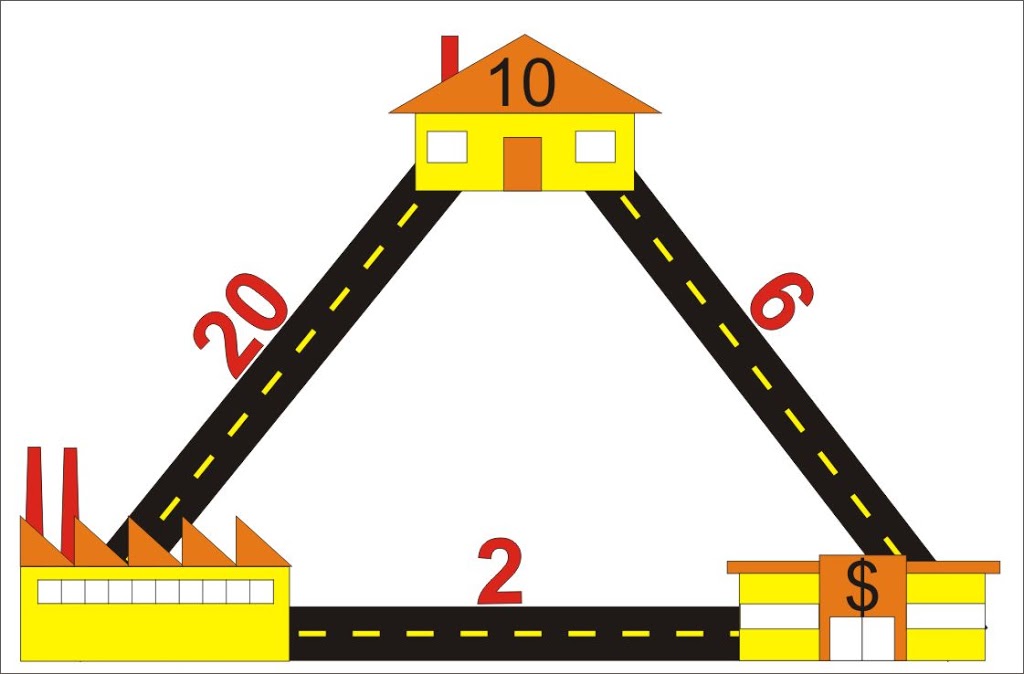
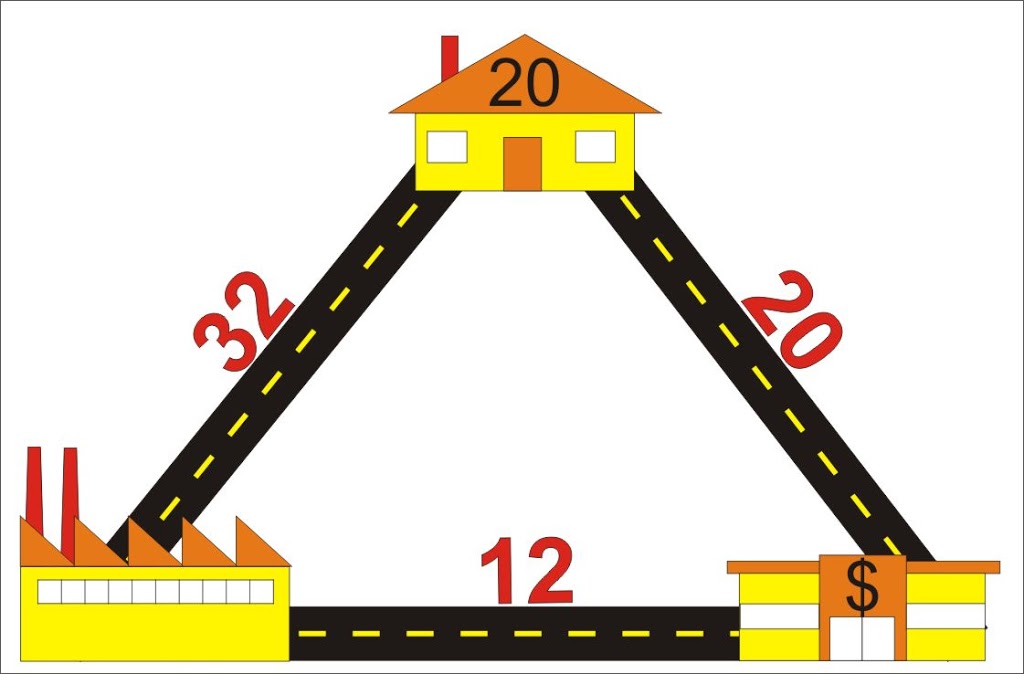
To demonstrate this, I can draw a ridiculously simple model. Let’s say you have a village with 10 houses, one factory and one shopping centre, and they are connected in a triangle (see below). We measure 20 trips between the factory and the house every day, and 6 between the houses and shopping centre, and 2 between the shopping centre and the factory. That is our model set up.

Now let’s say the Growth Strategy indicates we will double population in 10 years. In this case we double the number of houses (and for the sake of model simplicity, keep the factory and shopping centers in the same place, just assume they both double in size). We enter that in our model and presto: we get a doubling of all trips.

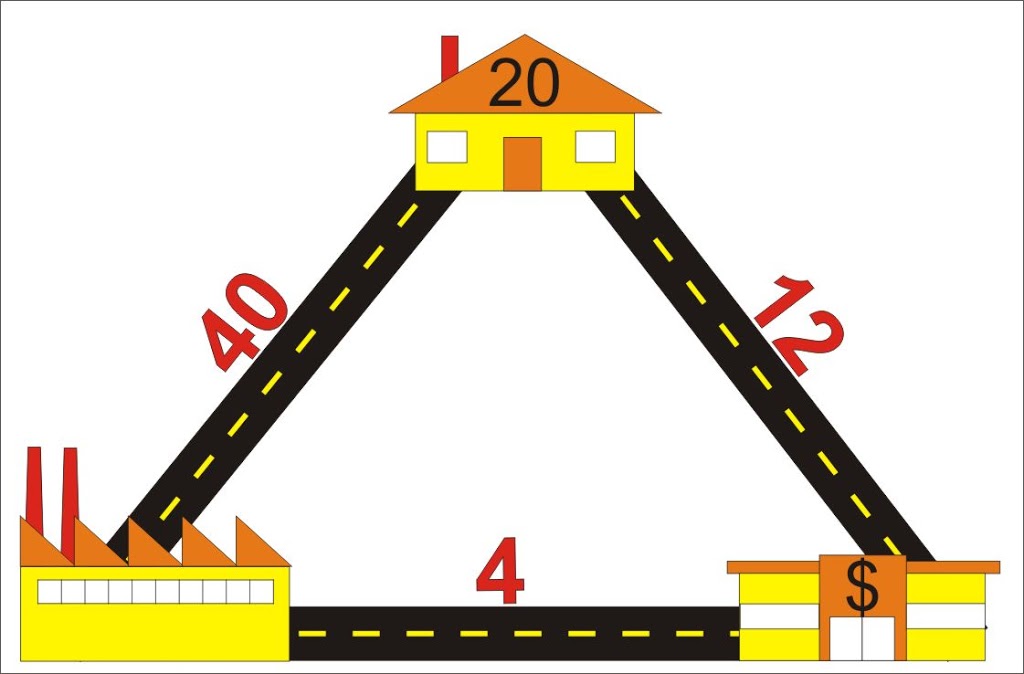
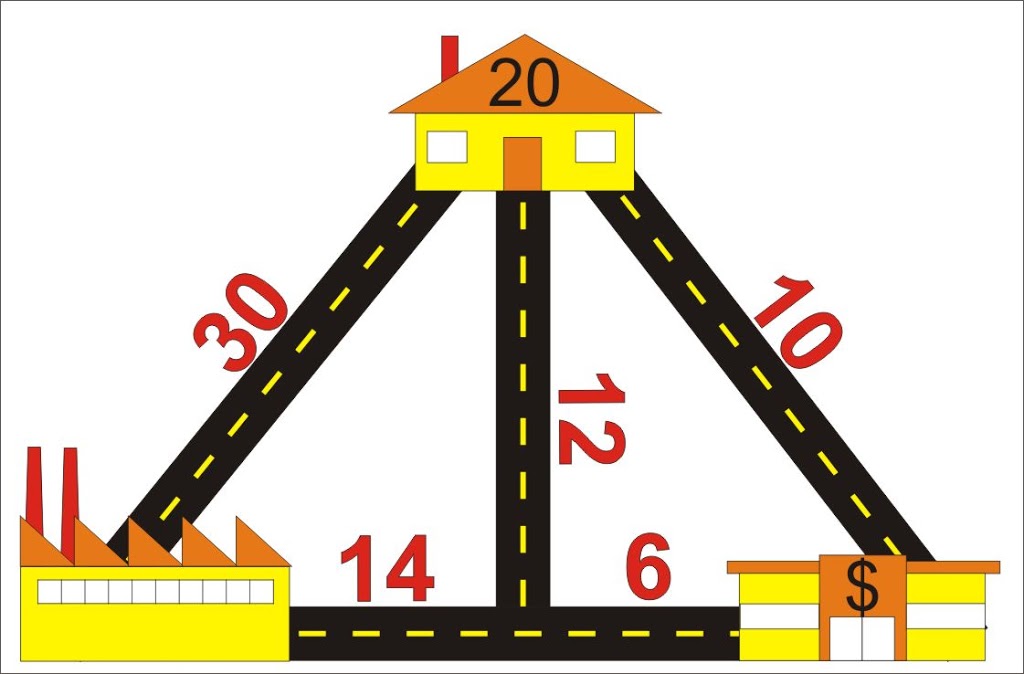
But what if the road between the factory and the houses can only handle 30 trips until it becomes hopelessly congested? In that case, the citizens have two options: sit in the congestion and accept their fate, or go around the “long way” which might take less time if the congestion gets bad enough. Some will choose to go-around until the time is equal on both routes, and the model might look something like this:

Since citizens hate congestion, they lobby City Hall to fix the problem. City Hall has two options to fix the problem: it can expand the road to accommodate the traffic, so things look like our second drawing up there. Or it can build another route to relieve congestion. (Now we enter into the world of the Braess Paradox, but let’s not go down that rabbit hole just now).

We can do all sorts of messing around with the road configuration to best accommodate the traffic generated by the growth, and this is how we can apply the model to make the most logical choices about how we invest our transportation money. However, (and this is the nut of the matter) it is assumed in these models that traffic (=trips) will grow to match the population increase. Whether you build a road to accommodate it or not is irrelevant to the model.

Let’s say you don’t do anything to expand road capacity. Do we really get 32 trips on the one road and 20 on the other? If 32 trips cause congestion enough to shift people’s behaviour and make them change road choices, perhaps it also induces some to not drive. Carpooling, transit, bicycling, or telecommuting become better options. Maybe building a bus route instead of building a road is better investment – we can move more people with less money (if a bus is cheaper than two more lanes).

With 8 of the trips from home to factory going via the Shopping Centre, won’t this cause people to shop in the way home, and reduce the number of specific trips between the houses and shopping centre? If we don’t build more road capacity to accommodate growth, will the number of trips actually be reduced?

One thing we noticed in the UBE process is that models are really good at predicting increased levels of congestion, but do not accommodate the idea that congestion has an upper limit before people stop fighting it, and find alternatives.

The result? People discussing the NFPR say that traffic on Front Street is at a dead stop, is constantly congested, is completely at a breaking point, then produce models that suggest the problem will only get worse until we fix it. Of course, if the roads are already at capacity, the problem cannot get worse, unless we add lanes in an attempt to fix it.

Transit is a real alternative when it is faster and more efficient that driving (Canada Line anyone?), cycling is an alternative if the distance is short enough, the trip is on safe infrastructure, an there are end of trip facilities available. Moving closer to your work, or working closer to home, is an alternative, when land-use planning makes this possible. Shopping locally is an alternative to driving across town to your favourite Megamart. Moving containers by rail and barge is an alternative. And yes, building more roads an option, but is it the best use of our resources?

Back the Master Transportation Plan, and I’ll be uncharacteristically brief here. Because the vast majority of traffic in New Westminster is through-traffic (something like 400,000 vehicles a day in a City with a population of less than 70,000) most of the factors that control traffic in our City – like landuse planning, growth in the rest of Metro Vancouver, the building of mega-freeways – are beyond our control. Therefore, it is possible that the only control we have is how we allocate our road space. In a sense, the only way we can control out own traffic fate is to manage the implied demand part of the equation. Will the model be the tool to do this?