More on setting rules

A little expansion on my last past about the election, and my talking about it here.

I received a bit of social media feedback, mostly positive, but also including a bit of criticism from someone in the community I respect immensely about being too political or partisan on my blog. They like the council updates and community stuff, but didn’t want to have to sift through partisan attacks and negativity.

Frankly, I don’t know how to respond to that, except to say sorry.

I try to use this blog as a bit of a community service, to report out on things happening in the City, but I also try to make it clear this is my voice and my opinion. This is not official communications from the City or anyone else, nor is this an official duty of my City Councillor job. It is something I do because I like it, and because I think it helps me to a better job as a City Councillor.

Because of that, I am perhaps a little more selfish about it than I would be in most things. I think I have tapered off some of the more political stuff since I got elected, partly because of time commitments, partly because I need to be more aware of a wider audience, and that I have been trusted with a bit of a Bully Pulpit (in the Roosevelt sense of the word “bully”, although some would argue a fear of the more modern usage as well…)

That caution aside, I still feel the urge to shout from this pulpit at times. Often times. There are issues like the Massey Tunnel replacement, our failing ambulance service, fighting climate change and homelessness and the Kinder Morgan Pipeline, that are important to me, important to our City and the region. These conversations are inevitably political, and inevitably partisan. I cannot not talk about them, nor can I pretend I think they are being properly addressed by the current government in Victoria.

Arguably, by not talking about important issues like this, or taking a milquetoast approach to them, I am failing to show the kind of leadership and outspokenness that got me elected in the first place. Some of my regular readers (Hi Bart!) have even suggested I have stepped too far back form the edge since getting elected, that I am getting soft. I honestly have no idea where the middle ground is here, but I am reluctant to spend too much time searching for it, because life is always more fun out by the edge.

So if reading partisan political discussion here is not to your liking, I recommend you skip past those posts. You can always skim down to the more municipal events type posts.

However, I would respectfully also ask you to consider why reading an opinion you don’t agree with, especially from someone you otherwise enjoy reading, causes you discomfort. We need to keep our eyes and our ears open to the people on the other side of the partisan aisle, because sometimes, every so often, they have an idea worth hearing.

Ground Rules

It is election time in British Columbia. The writ has not, technically, been dropped, but campaigning has been going on for quite a while. Arguably, the current government has done nothing but campaign for the last 4 years, but I’m getting ahead of myself here. In this light, I thought I would throw together a bit of a pre-campaign blog post to tell my loyal readers (Hi Mom!) and anyone else what to expect from me here.

Now, more than ever, I am partisan. This blog post will be including much partisan content in the coming months. This election matters to the future of our region and our community, and there is no way I can stay silent or disinterested in the result. I will expand on this further between now and May 9, but I can summarize my feelings in one paragraph:

The current government has failed to address the issues that are most important to me, as a citizen and as a person trying to make my community better. Their failures include the silly Transit Referendum and the shameless waste of billions of dollars on unnecessary bridges, violation of modern urban planning principles, against the desires of the very communities they are meant to serve, and in opposition to established regional and community plans. Their failures include 4 years of fiddling around the edges as the housing affordability and homelessness crises exploded across the region, including their recent attempts to blame the problem on local governments who have been busting their asses (and budgets) to fill in for a senior government failure on a subject that is clearly, constitutionally, Provincial jurisdiction. They have failed to develop any kind of vision for the future of the Province, dumping resources and time into one pet project (Massey Bridge) or another (Site C) with no cohesive vision for how these short-term expenses will result in long-term strength in a post-carbon economy. Say what you want about the LNG, at least it was a (failed) vision. And then there is the corruption…

So I am going to be partisan on this blog, and call out the BC Liberals on their failures. I will, however, endeavor to be respectful towards the people involved (as hard as that is when talking about corruption – which we need to talk about this election, often and repeatedly). They are politicians, but they are also people, and I have to trust they truly believe the lies they are telling. However, I will not spare criticism of their policies or bad decisions.

But yesterday was International Women’s Day, and that makes me want to make one more point.

When a woman serves in politics, she faces a completely different type of criticism, especially in the Social Media age. It seems the more powerful she becomes, the more criticism of her includes misogynist, sexist, and offensive language. I was myself accused last election of being misogynist because I dared to suggest the Premier wasn’t very smart when it comes to public policy, which launched me into a slightly too-long and too-mansplainy response.

So without getting too deep into it again, I just want to say that we, as a province, as a social media community, and a planet, need to point out misogynist language in the election cycle, whether it is pointed at our allies or opponents. I have already seen way too much use of language to criticise Premier Clark that would never be applied to a man in the same role. We need to, especially, point out and criticize misogynist language when it is directed at our opponents, and we need to recognize that pointing out a misogynist attack does not constitute support for the positions of the politician who was attacked.

Ugh, Facebook, why you gotta be like that? Call anyone this election a “bitch”, and I’m unfollowing you.

Keep it clean, folks, no hitting below the belt. Return to your corners, and come out fighting. Let’s get us a government that cares about the people of the province.

Demoviction Conversation

Amongst the joys of my job as a City Councillor is collaboration with other elected types around the region who are trying to solve regional problems in new ways. I’m also a bit of a data geek, so I love getting new information and learning from people much smarter than me who have innovative approaches to problems.

In the interest of bringing these things together, I am working with some pretty cool colleagues to develop a “MetroConversations” series. We had a successful first event in New Westminster last November, and have plans to expand and grow the program in 2017. The second in the series is happening in Langley City next week, hosted by the brilliant and telegenic City Councillor Nathan Pachal

The topic is as relevant in New Westminster as anywhere in the region: How do we replace an aging stock of rental buildings without displacing people who rely on an affordable rental building stock?

There has been a lot of talk about this in the City of Burnaby, and although they get a (perhap unfair?) majority of the press, this is truly a regional concern. The City of New Westminster has done a lot to incentivise the building of family friendly apartment housing, secured rental housing, and other housing forms in the hopes that we can eat away at the affordability monster. We also have a huge stock of condo and rental buildings, mostly in Brow of the Hill and Sapperton, that are aging and don’t meet modern building standards. At some point, replacement of this stock is going to create a Burnaby-like situation, unless we take a proactive approach to the issue. That said, who knows what that proactive approach looks like?

This MetroConversation will feature people who have a better idea of what works and doesn’t when it comes to managing our affordable housing stock – actual subject matter experts who view the issue from diferent angles. As always, this will be an interactive conversation, not a boring set of speeches. Bring your questions, bring your ideas, and help add to the conversation in the region.

The room is relatively small (we want an intimate conversation) so please be sure to register to make sure you can get a seat, we totally expect to sell out.

MCbanner

Council – February Feb 20, 2017

If feel like I am very busy these days, but we had a remarkably short Council Meeting on February 20th. So short, that I was actually home in time to cook dinner for MsNWimby, which I think is a first for my time on Council. We had a longer Workshop during the day, which I will try to blog about later…

Like most meetings that are the last of the month, this one featured a Public Hearing on a single project (but two bylaws):

Heritage Revitalization Agreement (720 Second Street) Bylaw No. 7887, 2017
Heritage Designation (720 Second Street) Bylaw No. 7888, 2017

This project would see the 1912 corner store at Second Street and Durham Street in Glenbrook North restored to its vernacular Edwardian glory and converted back to its original layout: commercial at the ground floor with a small family home above. In exchange for restoration and permanent protection of the building, the owner is applying for a subdivision of the lot to build a relatively small Craftsman-style bungalow on the other half of the lot.

The Heritage Commission and Advisory Planning Commission approved of the project, and there was a generally positive response to the plan from the residents’ association. We received 3 written submissions in response to this application, one opposed to the subdivision, but in favour of the heritage restoration, and two concerned about the impact on street parking. We also had three presentations at the Public Hearing, the proponent (who was in favour), a neighbour with questions regarding potential commercial uses and the heritage value of the building (but not necessarily opposed), and one neighbour who expressed support for the project.

Council moved to refer these Bylaws to the regular council meeting which immediately followed:


Our Regular Agenda began with the Bylaws referred from the above Public Hearing:

Heritage Revitalization Agreement (720 Second Street) Bylaw No. 7887, 2017
Heritage Designation (720 Second Street) Bylaw No. 7888, 2017

This project was pretty easy to support for me, and it seems my Council colleagues agreed. There is a heritage win in preserving a building that seemed important to the neighbourhood, there is a great potential that the space will be turned into a neighbourhood daycare, which is in desperately short supply in New Westminster, an the infill density (the proponent is turning one converted house into a commercial space, a similar-sized house, and two rental suites) will include some more affordable options in a very family-friendly neighbourhood.

The one concern I have heard was the impact on street parking. The residential buildings will have off-street parking to meet their needs, but the commercial parking will indeed impact street parking availability. I did a quick Google Earth Survey, and calculated that of the 29 residential houses within 100m of this property, one is under construction, and the rest share no less than 29 indoor parking spots and 45 outdoor off-street parking spots. I am not compelled to believe there is a lack of parking on this block, at least not enough that I am going to say no to much-needed daycare spaces in the neighbourhood.

Council voted unanimously to give these bylaws third reading.


This was followed by an Opportunity to be Heard on a Development Variance:

Development Variance Permit DVP00620 for 100 Braid Street (466 Rousseau Street)
You might remember the Urban Academy / Wesgroup plan for the 100 Braid Street site. The school wants to get building, but the other lot, where 100 Braid Studios is, is not slated for demolition for some time; potentially a few years yet. Unfortunately, if it stays there, it will be too close to the lot line created by the subdivision, and the subdivision is needed to move the school project forward. Such is government.

The easiest solution here is to allow the building a variance from the applicable zoning law, so it can remain closer to the lot line than would regularly be allowed. No-one came to the Opportunity to be Heard to talk to the variance, and our staff have reviewed it and cannot think of any good reason for us to say no.

Council voted unanimously to approve the variance.


We then had a Report from staff:

Train Whistle Cessation Update
This was a lengthy update on the progress made by the City in getting trains in the City to stop blowing their whistles at every crossing. We recently passed a resolution deeming the crossings along Front Street (at Begbie and under the east end of the Parkade) whistle-free, and the rail operators have until the beginning of March to change their practices. Downtown should get quitter then. Two down, we have 20 more crossings in the City to deal with.

The crossings we anticipate being done in 2017 are in Sapperton just below the foot of Cumberland, and on River Drive near the Queensborough Bridge. Assuming the required equipment is delivered on time and there isn’t any certification SNAFUs, the Quayside Drive crossing should also be done by the end of 2017. The crossings along Ewen in Queensborough should be worked on in 2018, as the geometry of many of the intersections create some issues that need yet to be worked out to Southern Rail’s satisfaction.

The other two Sapperton crossings are in pause mode right now, as their final work will depend on the outcome of two other projects. In the cast of the Spruce Street crossing, the alternate access to Sapperton Station needs to be developed, and in the case of Braid, the Brunette Interchange Project will obviously impact the work to be done.

The City has committed $3.75 Million in capital works for these projects, including $2 Million in 2017. We are committed to doing the work, and are confident we will get there, but if you are frustrated by the pace, I share your feelings. It sounds slow, I know, but this is a terribly complicated process, involving two levels of government, four separate rail operators, and a trainload of standards and regulations to work through. However, we now have a website dedicated to the project, which will be regularly updated so you can keep track of progress. We are getting there.


The following items were Moved on Consent:

Hyack Festival Association request for additional funding for the 2017 Parade Float program
The new Festival Committee (of which I am a member) reviewed the request brought to Council in January for an extra $30,000 of Festival Grant funds to expand their float program and support and expanded Qayqayt Howl event as part of Hyack Week.

As the 2017 grants were awarded by the previous Festivals Committee, the new committee reviewed the applications from Hyack Festival Association in light of the available funds, and the decisions made by the previous committee. The committee had to say no to several organizations, as the $225,000 budget was exceeded by over $300,000 in requests. The new committee saw no reason to change the allocations provided to the community groups, and as much as we would like to say Yes to everyone, there is a reason we set a budget and try to stick to it. Hyack was provided $61,800 in grants (out of a request for $101,800), and the new Festival Committee agreed that this was a fair and prudent award based on the terms of the Grants.

234 Second Street (Queen’s Park): Heritage Alteration Permit No. 083 to Permit New House Construction – Council Consideration
This is the other side of the Heritage Conservation Period in Queens Park. Not only do requests for demolition have to come through Council, some new house construction also need to meet the (previously optional) heritage guidelines set up for the community, and Council needs to approve the building plans. We did so.

This is not an idea process the way it is, but the Heritage Conservation Period is temporary, and hopefully there will be smoother processes developed as part of a future and permanent Heritage Conservation Area, assuming the community and Council decide to go that way. Please think about attending one of the open houses coming in early March if this issue is important to you!

Queen’s Park Conservation Area Regional Stakeholder Consultation
We also need to consult with other affected agencies around the region when we make changes like introducing a Heritage Conservation Area. This report simply outlines the agencies that will and will not be consulted.

Financial Plan, 2017-2021
I really need to sit down and write some more on the update Financial Plan. It has been through public consultation, we have reviewed the capital plan at some detail, we have projected tax rates, this is now the Bylaw that supports that plan. Council agreed to give it three readings.

2016 Filming Activity Update
Filming for TV and movies is a big deal in New West, and growing. We had 203 filming days in the City, and the City moved about $900,000 in revenue from those film permits. His doesn’t mean the City made $900,000 in profits. In reality, filming is pretty close to a break-even prospect, as most of that revenue is collected specifically to pay for engineering folks and police to arrange road closures, providing various services like fire inspection, paying our film coordinator to help coordinate the permitting processes, rentals to pay for lost parking revenue in the event parking meters are blocked, and things like that.

This number also does not include the economic spin-offs, from private property owners earning rental fees to allow film companies to use their houses or business properties, or the various service companies that exist to source to the film industry. Nor does it take into account the millions of dollars in wages paid to New Westminster residents every year from the film industry.


A single item was Removed from Consent so that a speech could be made about it.

2017/2018 Electrical Utility Rates Bylaw No. 7901, 2017
Our electricity rates are going up to match the cost of electricity that we purchase from BC Hydro to power our utility, based on the long-established policy of the City. Under that policy, New West customers (system-wide) pay the same rate as BC Hydro customers, and the city uses the difference between the wholesale rate way pay for power and the retail rate to run the system, and return the profits to the City’s coffers to offset taxes.

BC Hydro rates are going up 3.5% on April 1, so New Westminster rates are going up 3.5%.


After this, we went through our regular Bylaws ritual:

Five-Year Financial Plan (2017-2021) Bylaw No. 7906, 2017
This Bylaw that makes our 2017-2022 Financial Plan the law of the land was given three readings.

Electrical Utility Amendment Bylaw No. 7901, 2017
This Bylaw that formalizes the increase in electrical rates to math BC Hydro increases was given three readings.

And aside for a few announcements, that was a meeting.
TransLink Fare Review

Now that we are all used to having a Compass Card, and even whingy, retro-grouch, late adopters like me have adapted and find the payment system easier to use, it’s probably a good time to discuss whether the current payment system for public transit makes sense. Fortunately, TransLink is doing that right now.

The system used by TransLink now dates back to the BC Transit days, more than 30 years ago. The familiar zones, transfers, off-peak discounts, and concession fares have only been tinkered with since the SkyTrain was shiny and new. The shift to single-zone buses to accommodate Compass Card was probably the biggest system-wide shift, but the arrival of Compass and long-awaited expansion of transit service make this a good time to review if the system we have really serves its customers best.

As New Westminster is the community that relies on transit more than any other on a per-capita basis, I hope people in New West take the opportunity to take part in the on-line survey and share their ideas.

Fares paid by transit users represent about 37% of TransLink’s revenues, a little over $510 Million out of total revenues of $1.4 Billion. However, it is not the intention of the ongoing fare review to increase the amount of revenue generated from current users. It is more about making the system more efficient and more attractive to users, which may result in increased revenue through boosted ridership.

At this point, TransLink are asking three simple, high-level questions, although each leads to longer discussions about how we want our transportation system to work, and what we want it to be. They are described in more detail here, but my short version is:

1) Zones: Should there be a flat fare for the system regardless of distance traveled, or should people pay more to travel further? If the latter, how fine-grained do you want zones to be? We currently have 3 zones for SkyTrain and one for bus and separate ones for YVR and West Coast Express, but could easily break the region up into 10 or more zones, or create “floating” zones where the edges shift based on where you first enter the system.

2) Travel Time: Should you always pay the same rate to ride transit, or should TransLink continue to give discounts outside of the busiest hours to try to spread the load (and crowds) across the system? If the latter, should there be only a Peak and an Off-Peak rate, or should the rate shift throughout the day, even hourly?

3) Service Type: Should all transit cost that same, or should you pay more for SkyTrain than you do for a bus; more for B-lines than for regular buses; different rates for West Coast Express and SeaBus? Perhaps more provocatively: should we have “business class” buses, with WiFi and cushy seats and foot massage for a premium cost?

I have my own opinions (surprise!) on all three of these topics. I even got to share them at a stakeholders meeting for elected types a few weeks ago. Fortunately, I also got to hear differing opinions on each of the points from people around the region. Most of these arguments discussions ended up circling around providing a “simple” system vs. a “fair” system. I tended towards the latter argument, mostly because I want a system that works for the day-to-day users and encourages use by residents of the region, and am less fussed about whether the system is quickly understood by tourists. I’ve traveled in transit systems in lots of countries in the last few years. Whether it was New York’s flat $2.75 a ride or Singapore’s highly variable distance-based sliding rates, we always managed to figure it out very quickly, and with a digital cards, it was never enough of a hassle that it made riding transit difficult.

I was also very curious about how any future payment system would be integrated with a regional road pricing scheme. It has always bugged me that tolls to cross the river or the Burrard Inlet have always existed for transit users in the form of “zone boundaries”, but driving across the bridges remained toll-free. If we want to leverage fair pricing of our regional transportation network towards Transportation Demand Management goals, the fare system must be integrated.

Finally I have a bunch of opinions (surprise!) about other aspects of the TransLink fare system. Why do we charge youth when they are travelling with their parent? Where are the employer incentive programs? Why am I paying an extra $7 at YVR? But these are not part of the current discussion. That type of fine-tuning and incentive program development will need to be a new discussion once TransLink has scoped out a renewed fare model based on the three principles above.

So go and take the survey, please, in the next couple of days, and give TransLink a bit of guidance about how you use the system, and how you want to pay for it. Make it work better for you, and for the region.

Census 2016 (part 1)

The 2016 Census data is starting to trickle out. I’m not sure if it is for dramatic effect, or if different data sets require different massaging levels, but the info you and I provided Stats Can in 2016 will be released in several stages through 2017. The first tranche, released this week, is population and residential dwelling count per census tract, along with numbers that can be calculated from those, like population change since 2011, population density, and residential vacancy rate.

growth
…from Canada Census website.

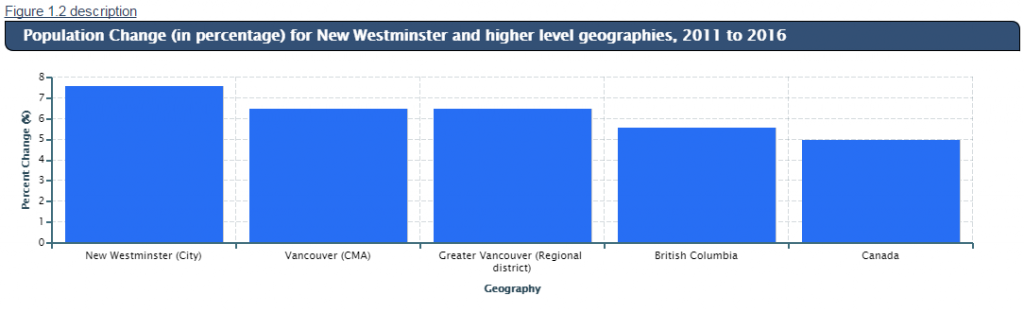
It should be no surprise to anyone that New Westminster is growing. Just a little under 71,000 people called New Westminster home in 2016. In terms of population growth, New Westminster grew about 7.6% over those 5 years (which works out to an average of about 1.2% increase per year). This rate of growth is above the average for Vancouver (6.4%), BC (5.6%), and Canada (5%).

There is a website called CensusMapper where the raw census data is popped into a map of census tracts as it becomes available, providing quick analysis opportunities for data geeks (like me).

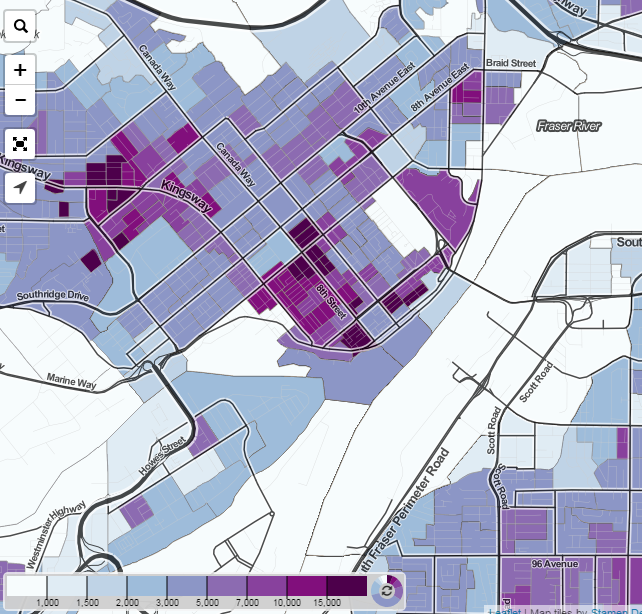
Density is a simple measure of the number of residents per square kilometre, and density is one area where New Westminster leads the nation (by some estimates, we are the 4th or 6th densest Municipality in Canada). This s a result of several factors, including us having a relatively small land base (only 11 square kilometres), 150+ years of being the centre of expanding hinterlands that created their own local governments, and our being largely built out as an urban community. It is no surprise that Downtown and the Brow are the densest parts of the City, Queens Park and the industrial areas the least dense:

INSERT DENSITY 1 (image extracted from Censusmapper.ca)
Population Density, persons per square km. (image extracted from Censusmapper.ca)

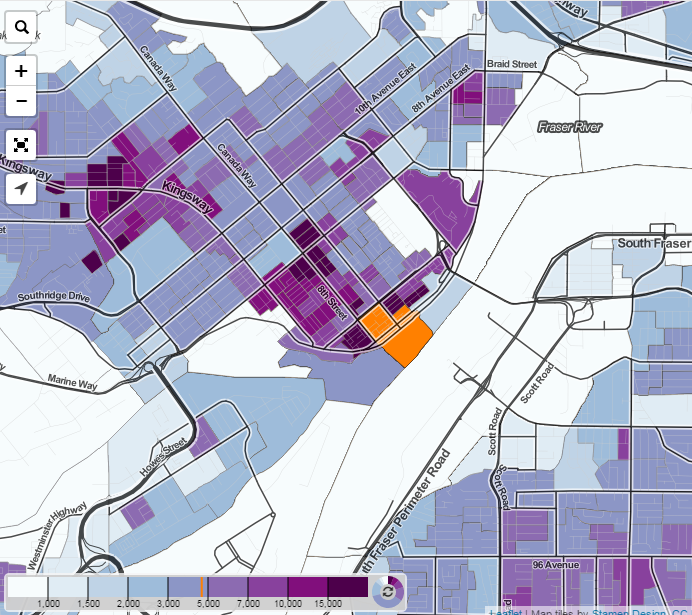
There are a few things off with this presentation, as the census tracts include areas like the river and park land, so the east half of Queens Park neighbourhood is shown as less dense than the west half, which does not necessarily reflect the true residential density differences on either side of Second Street. In the image below, I highlighted in orange a downtown tract that is biased by including the river – without the river, it may be darker purple like the adjacent tracts.

INSERT DENSITY 1 (image extracted from Censusmapper.ca)
Population Density persons per square km. (image extracted from Censusmapper.ca)

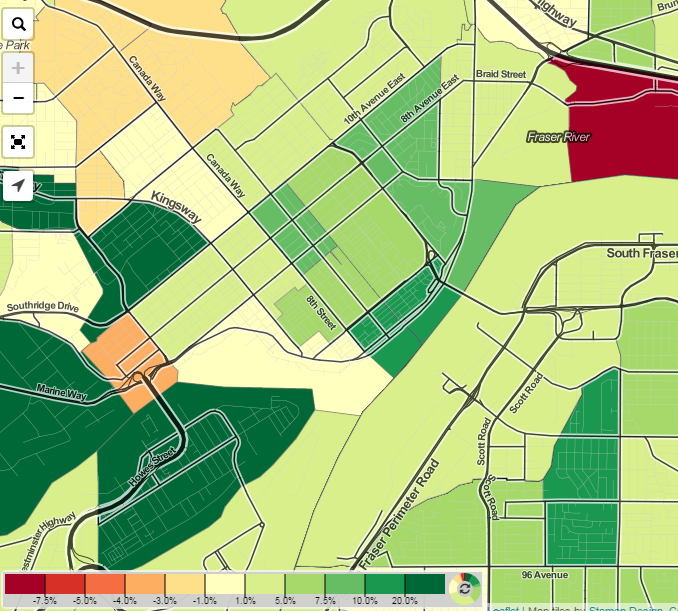
Finally, there are some interesting patterns in the Population Growth plot. It is clear (and not surprising) that growth is not evenly distributed throughout the City. We have been building a lot of family-friendly ground-oriented “missing middle” housing in Queensborough, and that has led to predictable growth. Areas where we have towers and other forms of multi-family dwelling are growing, with only very moderate growth in the West End and other single family neighbourhoods. The only surprise is that the Connaught Heights neighbourhood, during significant regional growth driving an ongoing housing crisis, somehow shrank in population.

INSERT Popgrowth (image extracted from Censusmapper.ca)
Percentage population gr0wth, 2011-2016 (image extracted from Censusmapper.ca)

This is a concern. Both our City’s long-range planning and the regional planning documents depend on concentrating growth along rapid transit lines, for a variety of sustainability and livability reasons. We have slower growth around Braid and Sapperton Stations than in the relative transit desert of Queensborough, and actual population loss around 22nd Street Station. Keep this in mind as we discuss the OCP in the months ahead.

More than the map

I know a few people showed up at Council today, hoping to talk about the Official Community Plan and Land Use Map. Unfortunately, it was a Public Hearing night, as the last meeting of every month usually is, and as such we generally don’t have Public Delegations on those nights, saving space in the Agenda and reserving the floor for people who would like to talk to Council about items on the Public Hearing.

Worry not, there will be lots of opportunity for you to talk to Council about the OCP, as the entire draft Plan will be going out to Public Open houses in February. That was the decision made by Council today during our mid-day Workshop, which you can watch here, if you want to get a sense of where Council is on this topic, the conversation was wide-reaching and at times challenging.

You might want to look at the Land Use Map (as that seems to be where most of the conversation has been up to now), but you may also want to delve into the entire OCP document. This is a 150-page document that draws a much more detailed map of where the citizens of New Westminster see the City going over the next 10 to 25 years.

(You can click here to open the Council document from today’s Workshop, skip ahead to page 128, unless you also care about Heritage Protection in Queens Park!)

Under an overarching Vision Statement, there are 7 major Themes. These Themes support 12 Goals, which are descriptions of how we will describe the City in 25 years. To reach those Goals, there are 61 proposed Policies and 175 Actions that the City will take. It is only after reviewing those intended Actions that the Land Use Map and Land Use Designations make sense. The map should, if the OCP is on the right track, support those Policies and Goals, and ultimately, the Vision. And I want to talk about that.

New Westminster is a healthy, inclusive and thriving community where people feel connected with each other.  This sustainable city showcases a spectacular natural environment, public spaces and unique neighbourhoods that are well-connected and accessible. Superior urban design integrates its distinctive character, heritage assets and cultural identity. Growth and development provide a variety of services and employment opportunities that contribute to a high quality of life for all.”

When we started this process, almost three years ago, there was a burgeoning housing crisis in the Lower Mainland. In the two years since, the situation has gotten measurably worse. Accessibility to housing and affordability of housing is at critical levels in New Westminster, with 30% increases in property values in the last 12 months alone – ground oriented housing increased at more than that rate.

Over the last decade (and notably, mostly before my time, so I get little credit here) New Westminster has made real progress in addressing homelessness, in creating incentives to address the critical rental shortage, and in supporting the development of more affordable apartments and sustainable densities around our SkyTrain hubs. However, the “Missing Middle” is still a challenge. This OCP, and drafted, will open up possibilities for a variety of housing forms in some areas, and I appreciate the increased flexibility offered in the “ground oriented Infill” designation.

Just two weeks ago, we had a Council Report on the City’s Business Survey, and one of the biggest concerns of our business community was the loss of affordable family housing: for their employees and for their customers. Affordable family housing and housing variety isn’t just the biggest issue in our housing file, it is the biggest issue in our business development file, our transportation file, and our sustainability file.

I hope that during this last round of public consultation, we can correct some of the misinformation that lead to some relatively concentrated but sincerely-felt push-back, and can continue the ongoing three-year-long conversation about the context of this OCP and the future vision for the City that it presents. As part of that, we need to ask ourselves – have we done all we can to assure our family neighbourhoods can remain family neighbourhoods, accessible to the young families that will make our City prosper in the future? Have we provided opportunities for people from all walks of life and from all stages of life, to live in New Westminster and contribute to the vibrancy of this great community? Have we addressed regional affordability challenges and shown the leadership our residents expect from us?

So we are taking this back out to Open Houses, and I hope our residents and businesses ask themselves if this plan it meets their vision for that “healthy, inclusive and thriving community”.

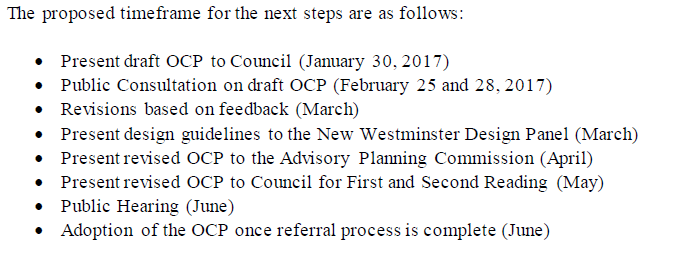
The schedule ahead:

schedule

Pedestrians matter

The City has been doing a lot under the new Master Transportation Plan to re-prioritize our transportation system. As New Westminster is increasingly a compact, mixed-use urban centre, our public spaces become more important to the comfort and safety of residents, to the attractiveness and accessibility of our businesses, and to the building of community. That means our public spaces have to be safe places for people; that safety cannot be compromised in the interest of “getting traffic flowing”. Freeways are for flowing traffic, streets are for people.

I’m proud of the work that the City’s Advisory Committee for Transit, Bicycles and Pedestrians (ACTBiPed) has done, and the collaborative attitude that City staff has adopted when discussion transportation issues, be they local traffic improvements or large regional projects like the Pattullo Bridge. However one piece of the political puzzle around transportation has been notably absent, not just in New Westminster, but regionally, and that is an independent advocacy organization to support the rights of pedestrians, and assure their voice is heard.

We have had various regional “straphangers” organizations over the years, and greater Vancouver has not one, but two separate cycling advocacy groups: The BC Cycling Coalition and HUB. The cycling groups have demonstrated that adding political voices together multiplies the volume, but also shows that advocacy can be constructive and collaborative. Their hard work over the last decades has resulted in millions of dollars in work making cycling a safer and easier alternative to driving in our region, and their work goes on.

There hasn’t been any such organization regionally working on protecting pedestrian space, or helping governments make better decisions regarding pedestrian rights. Perhaps this is because pedestrians are not seen as an under-represented minority. When you think about it, we are all pedestrians. Even if the only walking you do is to get from your car to a parking space, you need outcross a sidewalk to get there, and want that space to be safe (To expand out to truly everyone – the definition of “pedestrian” in modern transportation planning includes those who need mobility aids like walkers of chairs to help them get around). But politically, pedestrians are almost silent.

When the Ministry of Transportation, TransLink, or a Local Government design a new bridge or overpass, they seek input from the BC Trucking Association and the Gateway Council, organizations like BCAA and HUB use their political influence and the voices of their membership to assure that the interests of their member groups are added to the discussion. But pedestrians, for some reason, are absent. Because of this, sidewalks, crosswalks, and other aspects of the pedestrian realm are too often tacked on afterward, not integrated into the primary design thinking. The first thought is “how do we move cars”, then followed by “ok, let’s fit in some sidewalks”. Imagine how we would design our transportation system differently if we started with “how will a pedestrian use this space”, then decide what spaces we can allow for cars? Shouldn’t that be the default mode in a dense urban area like New West? Where is the organization to advocate for this shift?

The good news is that some local people are starting just this type of organization. They are calling themselves New Westminster Walker’s Caucus. They are a small group started by a few people familiar to the ACTBiPed as strong advocates for pedestrian rights, and for walking as a transportation mode. They have had a couple of meetings, and would love a little support from other walkers in New West and the region – show up at a meeting, lend them your skills, share the conversation.

We are all pedestrians, it’s time we stopped being so damn quiet about it.

Tax time – 2017 edition

Assessments are out, everybody lucky enough to have entered the housing market lottery prior to about 2008 is discovering how much their nest egg has expanded in the last year, and even to the lucky winners, this is at times disconcerting. Strangely enough, people who have just discovered that have an extra couple of hundred thousand dollars in tax-protected equity they didn’t know about are concerned about the impact on their Property Tax. People are funny that way.

I wrote a piece several years ago about how property tax relates to your assessment increase, and last year provided a handy graph showing how your assessment increase vs. the average city-wide assessment increase results in different increases in your taxes.

This year, the Mayor of Coquitlam used Facebook to send essentially the same message, and New West blogger and noted Hawaiian star-coder Canspice wrote another piece with a slightly more updated example of how the system works compared my older one. So I won’t tread over all that again, but short version is your Municipal taxes won’t go up nearly as much as your assessment.

My incredibly average house’s value went up 30% this year, and the average for New Westminster was 28.5%, so my property tax bill will go up 2.5% plus whatever increase Council decides is required to pay the bills in 2017 (now looking to be just under 3%, but not yet confirmed). If your home went up 25.5% in value, your taxes would be exactly the same as last year. If your home went up less than 25%, your taxes are going down.

However (and here is another important point people often miss), this only relates to your Municipal taxes. When Council decides it needs to collect 3% more tax revenue to balance the budget, we adjust the mill rate to increase our revenue by 3%. However, Municipal taxes are only a little more than half of your Property Tax bill. You may remember these line items from last time you paid your taxes:tabletax

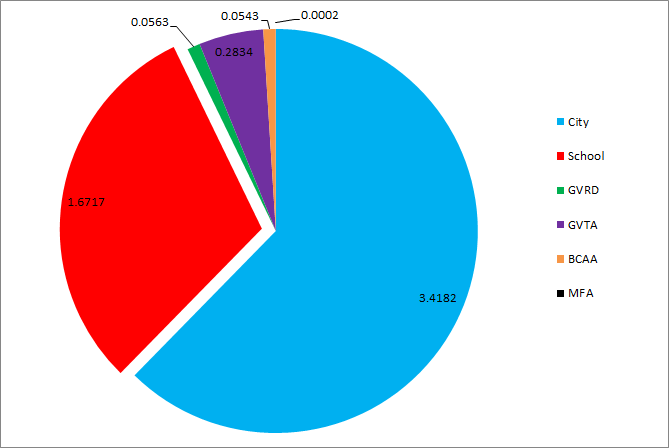
In New West (and this varies between Cities for reasons that will soon become obvious), about 60% of your Property Tax goes to the City, the other 40% goes to other agencies, and the City has no control over what the rates are for those taxes.

Your 2016 property tax in New West broke down into these categories, with the Mil rates shown. Only about 60% goes to the City
Your 2016 property tax in New West broke down into these categories, with the Mil rates shown. Only about 60% (the blue bit) goes to the City.

The School Taxes (for a New West residential property, this is about 30% of the total you pay) are set by the Provincial government. They are based on a Mil rate, like your Municipal taxes, and like them, the rate is different in every City. Generally cities with higher land values have lower mil rates (West Vancouver is 1.026, Quesnel is 3.698), and the rates are adjusted every year. After that, I honestly have no idea what formula they use or what their goals are towards equity across the Province. According to the Ministry, they are raised every year “based on the previous year’s provincial inflation rate”, but I am not really able to confirm or refute that idea. I have never seen a letter written to the newspaper complaining to the province that School Taxes are going up.

There are also two regional charges attached to your Property Tax bill, again not directly controlled by the Municipality: those to support the operation of Metro Vancouver (GVRD) and TransLink (GVTA).

The Metro tax (Mil rate 0.0563) is solely for regional government operation, and is separate from the utility charges that makes up most of Metro Vancouver’s revenue. The Metro Vancouver board (which is every mayor in the region) negotiates that rate every year based on needs, and it is the same Mil rate across the region, so people in West Vancouver pay much more per household than people in New West, as their property values are higher.

The TransLink Mil rate (currently 0.2834) is determined by the TransLink board, with approval from the provincial government and within the confines of the provincial regulation that governs them. This rate is , again, flat across the region, meaning West Vancouver and Vancouver pay more than New West and Langley per household. This provides about 20% of TransLink’s revenue, and this is the heart of the long battle between the provincial government and the mayors of the region – the Province would prefer that new TransLink revenue to come from increases here, the Mayors have a long list of alternate sources they would prefer, from sales taxes to road pricing to carbon tax. But let’s not go down that rabbit hole just now.

There are also two small charges controlled by the provincial government for the benefit of local governments. The BC Assessment Authority (BCAA), who determines your land value, is funded wholly through Property taxes, and the Municipal Finance Authority (MFA) gains some operational funds through a very small Property Tax charge (20 cents for a $1,000,000 house). Both of these are collected with Mil rates flat across the province, so the average West Vancouver resident pays much more than the average Quesnel resident, with New West somewhere in the middle.

Finally, the City’s new Property Tax Estimator gives you an idea of what your actual assessment means to your tax bill, assuming that Council approves a 2.98% tax increase. It also provides an interesting break-down of how the City’s revenues are distributed between departments, giving you an idea of what you are buying with your Property Tax, and how much you are paying for each.

Sharpshooter politics

You may have heard of anecdote of the Texas Sharpshooter. He is generally portrayed as a cocky fella standing in a farmyard shooting at the side of the barn. Once his bullets are exhausted, he walks over to the barn, identifies the tightest cluster of bullet holes, and draws a bulls-eye around them. He then speaks glowingly of his targeting skills.

We just witnessed the Premier of British Columbia play Texas Sharpshooter with our coastline.

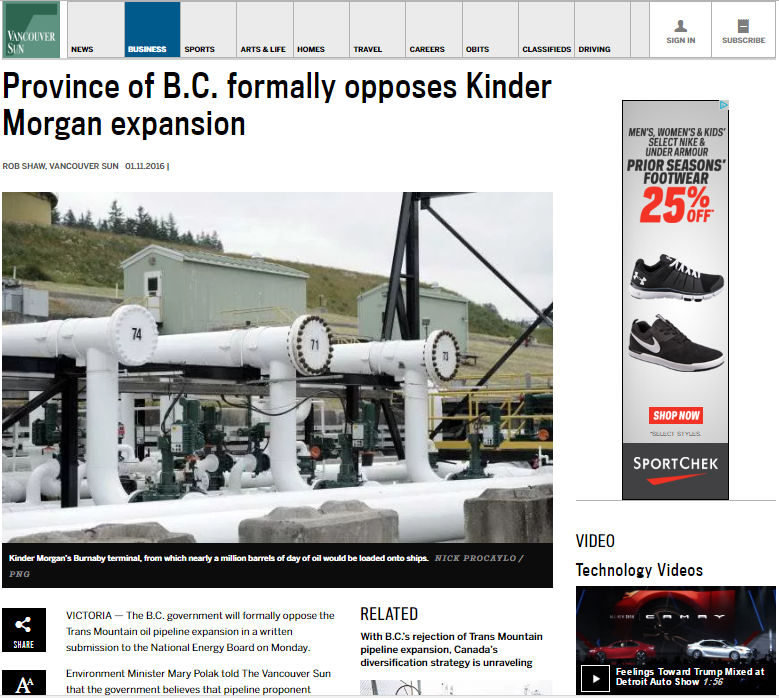
About five years ago, the Premier was in a tough political situation with the Kinder Morgan pipeline expansion project. She didn’t know which way the political winds were going to blow as she approached her first election. She needed to telegraph general support to satisfy her political contributors, but didn’t want to be caught wearing that approval if things went south. So she pragmatically hedged her bets. She said she would approve the project only if 5 conditions are met. In other words: “I could be convinced”.

At first, the conditions sounded reasonable and concise: Federal environmental assessment approval, Adequate spill protection for land and sea, First Nations agreement, and financial benefit for BC. Five bullets shot towards the barn. It took 5 years for her to finally saunter over there and draw the targets, now declaring them hit.

The problem with what she describes as her “consistent and principled” stand on this project is that it wasn’t any stand at all. One of the conditions was a sure thing (the NEB approval of the project, and I could go on another entire rant about that one – I have in the past!), but the other 4 had no actual measures! They were phantom targets, a blank barn wall waiting for bulls-eyes to be painted.

To use “World-Leading” as the measure for the spill prevention and response plans is, of course, ridiculous. It would be difficult for the nations of the world to have a spill-prevention-off or an Oil Clean Olympics. That said, I have worked on both the Federal (marine) and Provincial (land-based) consultations as part of my previous job. I have reviewed what other jurisdictions do, have read and critiqued position papers, have attended workshops and spill response exercises, and have conferred with experts local and international. That there are major gaps and unaddressed concerns with the spill prevention and response plans is not a controversial opinion.

?

No plan is perfect, but for them to earn the moniker “World Leading”, I would think you would at least meet the standard set out by Washington State, and it is clear these plans fall far short of those measures. There are places in the world where shipping Afrimax tankers full of diluted bitumen is against the law – a spill prevention measure that really can’t be exceeded. We do not measure up to many other jurisdictions yet, not even close.

But it’s OK. The Premier has drawn the target around the collection of half-baked plans the Province, the Feds and Kinder Morgan have, and has determined they meet her vague test of “World Leading”.

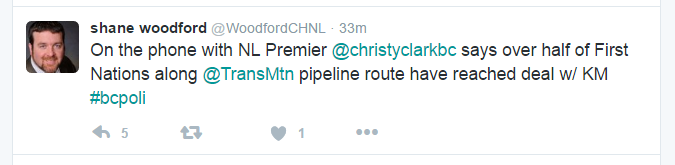
The First Nations condition included the meeting of legal and constitutional requirements, which will be measured by a judge, I guess, but also included undefined opportunities and benefits for First Nations. Despite the Premier’s confidence, we don’t know if the legal and constitutional issues are fully addressed, as many of the groups along the route appear to still be opposed to the project, nor has it been made clear who or what opportunities or benefits agreements have been made. This was tweeted out by a reliable newsgatherer during the announcement:shaneKM

So I guess the target was 50% of First Nations. Nice to find out after.

Finally, the economic benefit to BC was also never provided a measure. It sounds like the Premier negotiated with Kinder Morgan to assure pipeline jobs go to British Columbians first (which probably violates NAFTA and TILMA, but I digress), and Kinder Morgan will contribute $25-50 Million a year to fund various local environmental programs in the Province, providing the Premier many opportunities to stand in front of banners with her Haida print shawl in the future. The amount is significant, unless you compare it to the $1.5 Billion subsidy to oil pipelines recently announced by Trudeau.

Again, this target was never defined or openly discussed until the day it was announced as being hit. If it sounds like I wanted more, maybe it is because hard negotiations to get money out of oil companies is apparently a BC Liberal strength when it serves their purposes. But that’s just politics.

Recently, a poll was released that showed 54% of BC are in favour of the pipeline. My Facebook algorithm keeps spamming my feed with that poll, and it always seems a shockingly small number to me. This was a poll conducted by the Canadian Association of Petroleum Producers, an organization with extremely deep pockets that has served as the primary public speaker in favour of the project. Not only have they and others spent hundreds of millions of dollars on print, internet, radio and tv ads trying to convince us this pipeline is a great idea, They no doubt were able to frame the poll questions in as favourable a light as possible to push towards their desired result. Yet they still only got 50% plus the margin of error in support. Describing this support as anything but tepid would be disingenuous.

However, the Premier has clearly done the math. The ridings in Greater Vancouver and Vancouver Island that most opposed to this project were not likely winnable next election anyway. This approval may even boost Green Party support enough in areas like North Vancouver to assure a few quiet, obedient Liberals can still squeeze through. The great thing about drawing your targets afterwards – the real strength of Texas Sharpshooter politics – is the flexibility. We can have no doubt if polls showed an electoral advantage to opposing this project, those targets would have been drawn on another part of the barn, and our “consistent and principled” Premier would be standing in opposition to the project now. Like she was only a year ago:

Capture